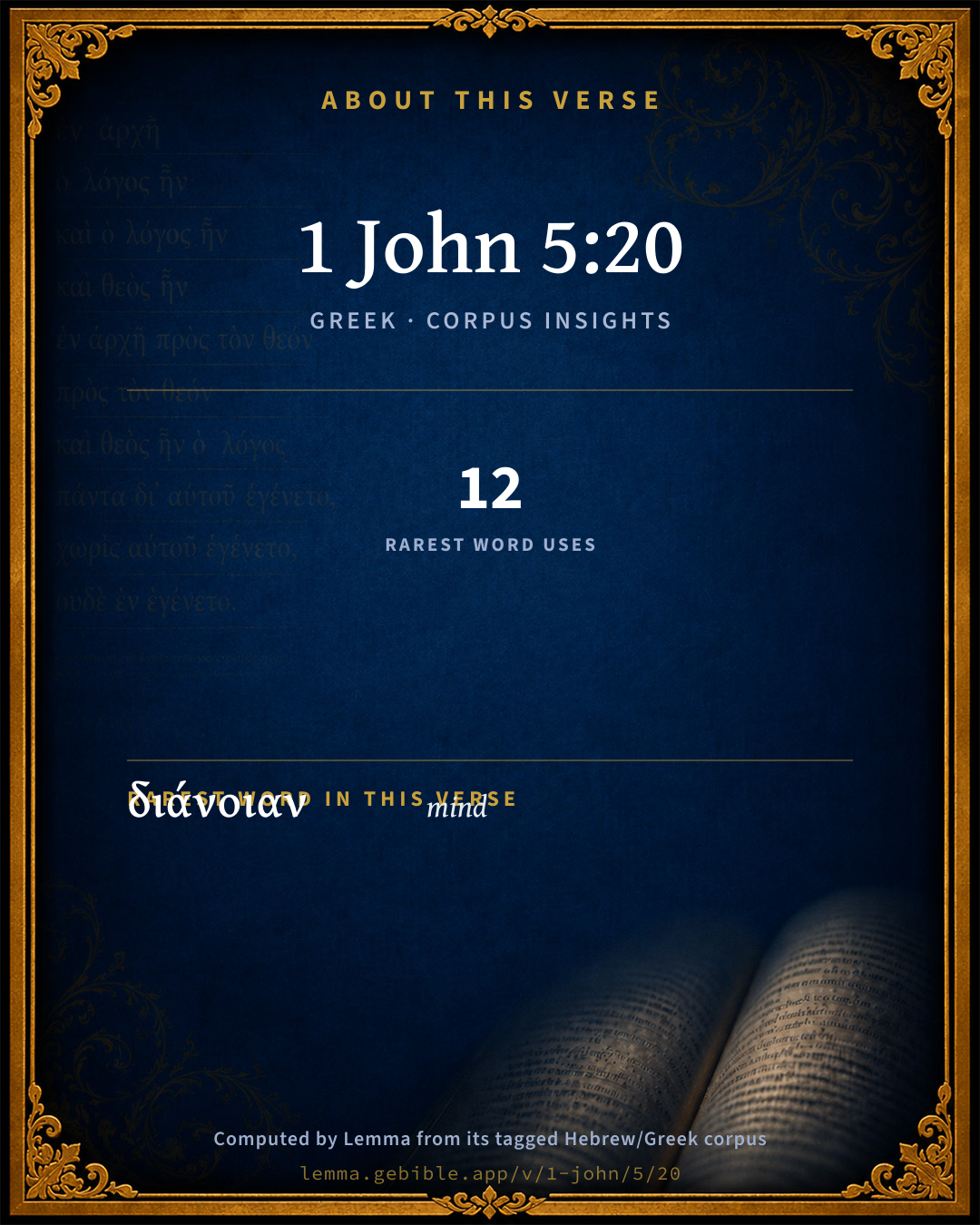
1 John 5:20

Greek (Tischendorf 8th ed.) 1 John 5:20 appears in the Greek New Testament. The text above is from the Tischendorf 8th edition. Each word links to its Strong’s number and a concise gloss. Click any word for its full Thayer’s Greek Lexicon entry.
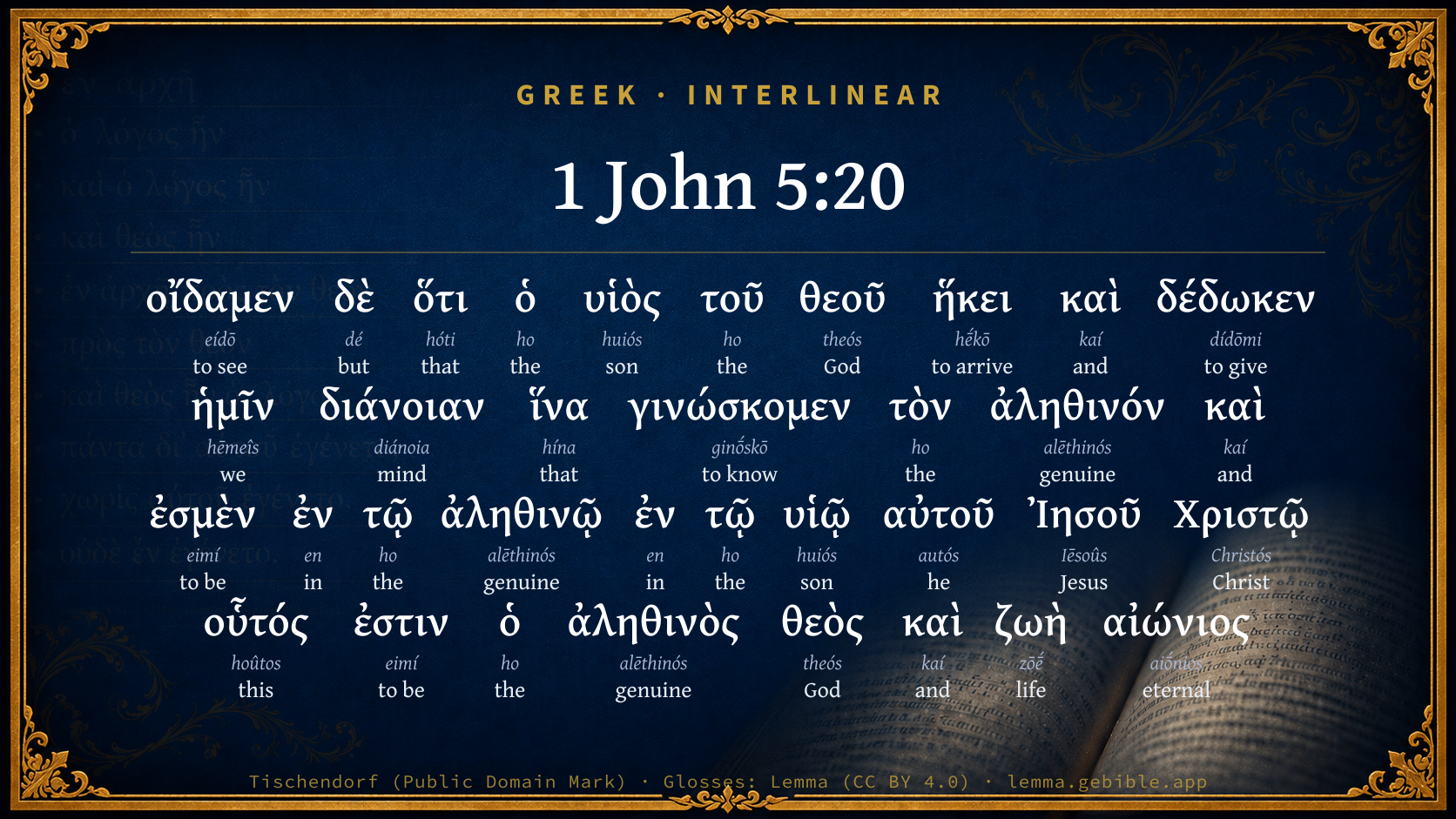
Download image
Cite this verse

1 John 5:20 (World English Bible). Public Domain. Lemma interlinear Bible study tool, https://lemma.gebible.app/v/1-john/5/20.

Show BibTeX & RIS
BibTeX
RIS
English Translation
We know that the Son of God has come, and has given us an understanding, that we know him who is true, and we are in him who is true, in his Son Jesus Christ. This is the true God, and eternal life.
World English Bible · Public Domain
Download a study sheet

One document with this verse’s original text, its word-by-word gloss line, the meaning frame, cross-references with their text, attributed commentary, and full source and license credits — printable, and it pastes into notes with its structure intact.

This verse Autodidact and up

Study sheet (.html) Plain text (.txt)

A passage Seminary Student

Up to 50 verses in one chapter. A passage sheet keeps up to 6 commentary sources and 12 cross-references per verse, in the order this page ranks them, and says so on the sheet whenever that leaves anything out. Ask for a single verse and you get the Autodidact verse sheet above.

Everything on this page stays free to read, with no account — the sheet is a download of what is already on screen, not access to it.

Want to remove ads? Support Godless Engineer
Compare translations 3

The same verse in 3 English versions, stacked beneath the original-language interlinear above. Click any original word for its lexicon entry.

Each is an independent rendering of the whole verse — the interlinear is not word-aligned to these translations.

Highlighted words mark where these versions differ — a whole-verse word diff, not a word-by-word alignment.

  • World English Bible Public Domain
    We know that the Son of God has come, and has given us an understanding, that we know him who is true, and we are in him who is true, in his Son Jesus Christ. This is the true God, and eternal life.
  • King James Version Public Domain
    And we know that the Son of God is come, and hath given us an understanding, that we may know him that is true, and we are in him that is true, even in his Son Jesus Christ. This is the true God, and eternal life.
  • unfoldingWord Literal Text CC BY-SA 4.0
    But we know that the Son of God has come and has given us understanding, so that we may know the True One. And we are in the True One, in his Son Jesus Christ. This is the true God and eternal life.

unfoldingWord Literal Text — © unfoldingWord, licensed CC BY-SA 4.0. Word-aligned USFM3 via Door43 (git.door43.org/unfoldingWord/en_ult).

Versions to compare (up to 4)

3 of 4 selected

Show all 19 translations

Every available English version of this verse, each an independent rendering of the whole verse.

  • World English Bible Public Domain
    We know that the Son of God has come, and has given us an understanding, that we know him who is true, and we are in him who is true, in his Son Jesus Christ. This is the true God, and eternal life.
  • Berean Standard Bible Public Domain
    And we know that the Son of God has come and has given us understanding, so that we may know Him who is true; and we are in Him who is true—in His Son Jesus Christ. He is the true God and eternal life.
  • Majority Standard Bible Public Domain
    And we know that the Son of God has come and has given us understanding, so that we may know Him who is true; and we are in Him who is true—in His Son Jesus Christ. He is the true God and eternal life.
  • King James Version Public Domain
    And we know that the Son of God is come, and hath given us an understanding, that we may know him that is true, and we are in him that is true, even in his Son Jesus Christ. This is the true God, and eternal life.
  • American Standard Version (1901) Public Domain
    And we know that the Son of God is come, and hath given us an understanding, that we know him that is true, and we are in him that is true, `even' in his Son Jesus Christ. This is the true God, and eternal life.
  • Revised Version (1885) Public Domain
    And we know that the Son of God is come, and hath given us an understanding, that we know him that is true, and we are in him that is true, even in his Son Jesus Christ. This is the true God, and eternal life.
  • Geneva Bible (1599) Public Domain
    But we know that that Sone of God is come, and hath giue vs a mind to know him, which is true: and we are in him that is true, that is, in that his Sone Iesus Christ: this same is that very God, and that eternal life.
  • Douay-Rheims (1899) Public Domain
    And we know that the Son of God is come: and he hath given us understanding that we may know the true God, and may be in his true Son. This is the true God and life eternal.
  • Young's Literal Translation Public Domain
    and we have known that the Son of God is come, and hath given us a mind, that we may know Him who is true, and we are in Him who is true, in His Son Jesus Christ; this one is the true God and the life age-during!
  • Literal Standard Version CC BY-SA 4.0
    but we have known that the Son of God has come, and has given us a mind that we may know Him who is true, and we are in Him who is true, in His Son Jesus Christ; this One is the true God and the continuous Life!
  • Unlocked Literal Bible CC BY-SA 4.0
    But we know that the Son of God has come and has given us understanding, so that we may know him who is true. Also, we are in him who is true, in his Son Jesus Christ. This one is the true God and eternal life.
  • unfoldingWord Literal Text CC BY-SA 4.0
    But we know that the Son of God has come and has given us understanding, so that we may know the True One. And we are in the True One, in his Son Jesus Christ. This is the true God and eternal life.
  • Darby Bible Public Domain
    And we know that the Son of God has come, and has given us an understanding that we should know him that [is] true; and we are in him that [is] true, in his Son Jesus Christ. He is the true God and eternal life.
  • World Messianic Bible Public Domain
    We know that the Son of God has come and has given us an understanding, that we know him who is true; and we are in him who is true, in his Son Yeshua the Messiah. This is the true God and eternal life.
  • Webster's Bible Public Domain
    And we know that the Son of God hath come, and hath given us an understanding, that we may know him that is true, and we are in him that is true, even in his Son Jesus Christ. This is the true God, and eternal life.
  • Free Bible Version CC BY-SA 4.0
    We also know that the Son of God has come, and has helped us to understand so we can recognize the one who is true. We live in him who is true, in his Son Jesus Christ. He is the true God, and is eternal life.
  • Bible in Basic English Public Domain
    And we are certain that the Son of God has come, and has given us a clear vision, so that we may see him who is true, and we are in him who is true, in his Son Jesus Christ. He is the true God and eternal life.
  • Text-Critical English NT CC BY 4.0
    And we know that the Son of God has come and given us understanding so that we may know him who is true. And we are in him who is true, in his Son Jesus Christ. He is the true God and eternal life.
  • Tyndale New Testament (1534) Public Domain
    We knowe that the sonne of God is come and hath geven vs a mynde to knowe him which is true: and we are in him that is true through his sonne Iesu Christ. This same is very god and eternall lyfe.

Literal Standard Version (2020), Covenant Press — licensed CC BY-SA 4.0. Text via the HelloAO Bible API (eBible.org). Unlocked Literal Bible (unfoldingWord) — licensed CC BY-SA 4.0. Text via the HelloAO Bible API (eBible.org). unfoldingWord Literal Text — © unfoldingWord, licensed CC BY-SA 4.0. Word-aligned USFM3 via Door43 (git.door43.org/unfoldingWord/en_ult). Free Bible Version, Dr. Jonathan Gallagher — licensed CC BY-SA 4.0. Text via the HelloAO Bible API (eBible.org).

Word by word

More ways to search: Search by grammar → Find every occurrence → Compare this word →

Practice this passage: Drill this verse → Learn its vocabulary →

διάνοιαν
diánoia
G1271
“mind”
Noun, Accusative, Singular, Feminine
Part of Speech
Noun
Case
Accusative
Number
Singular
Gender
Feminine
Full Thayer's Definition

Origin: from G1223 and G3563

TDNT: 20:03,6

1. the mind as a faculty of understanding, feeling, desiring 2. understanding 3. mind, i.e. spirit, way of thinking and feeling 4. thoughts, either good or bad
  1. οἴδαμεν eídō G1492 “to see” Verb, Perfect, Active, Indicative, 1st person, Plural
  2. δὲ dé G1161 “but” Conjunction
  3. ὅτι hóti G3754 “that” Conjunction
  4. ὁ ho G3588 “the” Article, Nominative, Singular, Masculine
  5. υἱὸς huiós G5207 “son” Noun, Nominative, Singular, Masculine
  6. τοῦ ho G3588 “the” Article, Genitive, Singular, Masculine
  7. θεοῦ theós G2316 “God” Noun, Genitive, Singular, Masculine
  8. ἥκει hḗkō G2240 “to arrive” Verb, Present, Active, Indicative, 3rd person, Singular
  9. καὶ kaí G2532 “and” Conjunction
  10. δέδωκεν dídōmi G1325 “to give” Verb, Perfect, Active, Indicative, 3rd person, Singular
  11. ἡμῖν hēmeîs G2249 “we” Personal pronoun, 1st person, Dative, Plural
  12. ἵνα hína G2443 “that” Conjunction
  13. γινώσκομεν ginṓskō G1097 “to know” Verb, Present, Active, Indicative, 1st person, Plural
  14. τὸν ho G3588 “the” Article, Accusative, Singular, Masculine
  15. ἀληθινόν alēthinós G228 “genuine” Adjective, Accusative, Singular, Masculine
  16. καὶ kaí G2532 “and” Conjunction
  17. ἐσμὲν eimí G1510 “to be” Verb, Present, Active, Indicative, 1st person, Plural
  18. ἐν en G1722 “in” Preposition
  19. τῷ ho G3588 “the” Article, Dative, Singular, Masculine
  20. ἀληθινῷ alēthinós G228 “genuine” Adjective, Dative, Singular, Masculine
  21. ἐν en G1722 “in” Preposition
  22. τῷ ho G3588 “the” Article, Dative, Singular, Masculine
  23. υἱῷ huiós G5207 “son” Noun, Dative, Singular, Masculine
  24. αὐτοῦ autós G846 “he” Personal pronoun, Genitive, Singular, Masculine
  25. Ἰησοῦ Iēsoûs G2424 “Jesus” Noun, Dative, Singular, Masculine
  26. Χριστῷ Christós G5547 “Christ” Noun, Dative, Singular, Masculine
  27. οὗτός hoûtos G3778 “this” Demonstrative pronoun, Nominative, Singular, Masculine
  28. ἐστιν eimí G1510 “to be” Verb, Present, Active, Indicative, 3rd person, Singular
  29. ὁ ho G3588 “the” Article, Nominative, Singular, Masculine
  30. ἀληθινὸς alēthinós G228 “genuine” Adjective, Nominative, Singular, Masculine
  31. θεὸς theós G2316 “God” Noun, Nominative, Singular, Masculine
  32. καὶ kaí G2532 “and” Conjunction
  33. ζωὴ zōḗ G2222 “life” Noun, Nominative, Singular, Feminine
  34. αἰώνιος aiṓnios G166 “eternal” Adjective, Nominative, Singular, Feminine

About this verse

These counts appear in no published source. They are computed here, from the morphology-tagged text and Lemma’s own curated glosses. What Lemma adds →

35
words
22
distinct lemmas
General Epistles
section

Notable vocabulary

The rarest word here is διάνοιαν mind G1271 — appearing just 12 times in the whole Greek New Testament.

Shared distinctive vocabulary

διάνοιαν mind G1271 occurs in 12 verses of the Greek New Testament. Also found in:

Repetition

Words recur within this verse:

  • ἀληθινόν genuine G228 ×3
  • υἱὸς son G5207 ×2
  • θεοῦ God G2316 ×2
  • ἐσμὲν to be G1510 ×2
  • ὁ the G3588 ×6
  • καὶ and G2532 ×3
  • ἐν in G1722 ×2

Cross-references

48

Topical passages linked to 1 John 5:20 in the Treasury of Scripture Knowledge — connected by theme and wording, ordered by reader-vote popularity; previews shown in the World English Bible.

  • John 17:3 This is eternal life, that they should know you, the only true God, and him whom you sent, Jesus Christ.
  • Luke 24:45 Then he opened their minds, that they might understand the Scriptures.
  • John 14:9 Jesus said to him, "Have I been with you such a long time, and do you not know me, Philip? He who has seen me has seen the Father. How do you say, 'Show us the Father?'
  • 1 Timothy 3:16 Without controversy, the mystery of godliness is great: God was revealed in the flesh, Justified in the spirit, Seen by angels, Preached among the nations, Believed on in the world, And received up in glory.
  • Isaiah 44:6 Thus says Yahweh, the King of Israel, and his Redeemer, Yahweh of Hosts: I am the first, and I am the last; and besides me there is no God.
  • 1 John 5:11–13 The testimony is this, that God gave to us eternal life, and this life is in his Son.
  • John 1:1–3 In the beginning was the Word, and the Word was with God, and the Word was God.
  • Isaiah 9:6 For to us a child is born, to us a son is given; and the government shall be on his shoulder: and his name shall be called Wonderful, Counselor, Mighty God, Everlasting Father, Prince of Peace.
  • John 20:28 Thomas answered him, "My Lord and my God!"
  • 1 John 4:16 We know and have believed the love which God has for us. God is love, and he who remains in love remains in God, and God remains in him.
  • 1 John 5:1 Whoever believes that Jesus is the Christ is born of God. Whoever loves the father also loves the child who is born of him.
  • Ephesians 1:17–19 that the God of our Lord Jesus Christ, the Father of glory, may give to you a spirit of wisdom and revelation in the knowledge of him;
  • 1 John 1:1–3 That which was from the beginning, that which we have heard, that which we have seen with our eyes, that which we saw, and our hands touched, concerning the Word of life
  • John 10:30 I and the Father are one."
  • Romans 9:5 of whom are the fathers, and from whom is Christ as concerning the flesh, who is over all, God, blessed forever. Amen.
  • Revelation 3:7 "To the angel of the assembly in Philadelphia write: "He who is holy, he who is true, he who has the key of David, he who opens and no one can shut, and who shuts and no one opens, says these things:
  • 1 John 2:6 he who says he remains in him ought himself also to walk just like he walked.
  • 1 John 4:2 By this you know the Spirit of God: every spirit who confesses that Jesus Christ has come in the flesh is of God,
  • John 17:14 I have given them your word. The world hated them, because they are not of the world, even as I am not of the world.
  • Acts 20:28 Take heed, therefore, to yourselves, and to all the flock, in which the Holy Spirit has made you overseers, to shepherd the assembly of the Lord and God which he purchased with his own blood.
  • Colossians 2:2–3 that their hearts may be comforted, they being knit together in love, and gaining all riches of the full assurance of understanding, that they may know the mystery of God, both of the Father and of Christ,
  • Titus 2:13 looking for the blessed hope and appearing of the glory of our great God and Savior, Jesus Christ;
  • Hebrews 1:8 but of the Son he says, "Your throne, O God, is forever and ever; The scepter of uprightness is the scepter of your Kingdom.
  • 1 John 4:14 We have seen and testify that the Father has sent the Son as the Savior of the world.
  • Matthew 13:11 He answered them, "To you it is given to know the mysteries of the Kingdom of Heaven, but it is not given to them.
  • Luke 21:15 for I will give you a mouth and wisdom which all your adversaries will not be able to withstand or to contradict.
  • John 1:18 No one has seen God at any time. The one and only Son, who is in the bosom of the Father, he has declared him.
  • John 14:6 Jesus said to him, "I am the way, the truth, and the life. No one comes to the Father, except through me.
  • John 14:20 In that day you will know that I am in my Father, and you in me, and I in you.
  • John 14:23 Jesus answered him, "If a man loves me, he will keep my word. My Father will love him, and we will come to him, and make our home with him.
  • John 17:20–23 Not for these only do I pray, but for those also who believe in me through their word,
  • Revelation 3:14 "To the angel of the assembly in Laodicea write: "The Amen, the Faithful and True Witness, the Head of God's creation, says these things:
  • Revelation 15:3 They sang the song of Moses, the servant of God, and the song of the Lamb, saying, "Great and marvelous are your works, Lord God, the Almighty; Righteous and true are your ways, you King of the nations.
  • Isaiah 45:14–15 Thus says Yahweh: "The labor of Egypt, and the merchandise of Ethiopia, and the Sabeans, men of stature, shall come over to you, and they shall be yours. They shall go after you. In chains they shall come over; and they shall fall down to you. They shall make supplication to you: 'Surely God is in you; and there is none else, there is no other god.
  • Isaiah 45:21–25 Declare you, and bring [it] forth; yes, let them take counsel together: who has shown this from ancient time? who has declared it of old? Haven't I, Yahweh? and there is no God else besides me, a just God and a Savior; there is no one besides me.
  • Jeremiah 10:10 But Yahweh is the true God; he is the living God, and an everlasting King: at his wrath the earth trembles, and the nations are not able to abide his indignation.
  • John 15:4 Remain in me, and I in you. As the branch can't bear fruit by itself, unless it remains in the vine, so neither can you, unless you remain in me.
  • John 17:25 Righteous Father, the world hasn't known you, but I knew you; and these knew that you sent me.
  • 1 Corinthians 1:30 But of him, you are in Christ Jesus, who was made to us wisdom from God, and righteousness and sanctification, and redemption:
  • 2 Corinthians 4:6 seeing it is God who said, "Light will shine out of darkness," who has shone in our hearts, to give the light of the knowledge of the glory of God in the face of Jesus Christ.
  • Philippians 3:9 and be found in him, not having a righteousness of my own, that which is of the law, but that which is through faith in Christ, the righteousness which is from God by faith;
  • 1 John 2:24 Therefore, as for you, let that remain in you which you heard from the beginning. If that which you heard from the beginning remains in you, you also will remain in the Son, and in the Father.
  • Revelation 6:10 They cried with a loud voice, saying, "How long, Master, the holy and true, until you judge and avenge our blood on those who dwell on the earth?"
  • Revelation 19:11 I saw the heaven opened, and behold, a white horse, and he who sat on it is called Faithful and True. In righteousness he judges and makes war.
  • Isaiah 54:5 For your Maker is your husband; Yahweh of Hosts is his name: and the Holy One of Israel is your Redeemer; the God of the whole earth shall he be called.
  • Jeremiah 23:6 In his days Judah shall be saved, and Israel shall dwell safely; and this is his name by which he shall be called: Yahweh our righteousness.
  • 2 Corinthians 5:17 Therefore if anyone is in Christ, he is a new creation. The old things have passed away. Behold, all things have become new.
  • Ephesians 3:18 may be strengthened to comprehend with all the saints what is the breadth and length and height and depth,

Cross-references courtesy of OpenBible.info (CC BY 4.0).

Commentary

Notes on 1 John 5:20 from classic Christian and Jewish commentators (each source and its license shown beneath its notes). The classic Christian expositions comment on the surrounding passage and are grouped to its opening verse, so a note may address several verses; the Jewish commentaries on the Tanakh (Rashi and others) are per-verse, so they appear only where the commentator wrote on this verse.

Lemma curates 59 commentaries, every one of them public domain or Creative Commons licensed, each selected and text-cleaned for this edition rather than reprinted as found. About our sources →

The Biblical Illustrator

Joseph S. Exell

1Jn_5:20

We know that the Son of God is come

The gospel of the Incarnation

He is coining is the word of the Old Testament; He is come is the better word of the blew.

John knew Jesus as the Son of God; and in his writings he only tells us what he knows. We know that the Son of God is come. Weft, this is a simple fact, simply stated; but if you go down deep enough into it, you will find a whole gospel inside.

I. By His coming He has given us an understanding that we may know Him that is true. Now this does not mean, of course, that Christ gives men any new intellectual power, that He adds to the faculties of the mind any more than to the senses of the body. Understanding here signifies rather the means of knowing, the power of understanding. By word and life He has given us ideas about Fatherhood, holiness, pity, kindness, and love, that we had not before. Purity, meekness, patience, and all the graces, mean more now than they did before Christ lived and died. The horizon of language has been widened, and its heaven lifted higher than before.

II. Well, for what purpose has Christ given us these new ideas and opened the eyes of our understandings? In order that we may know Him that is true, in order that we may know God. In Christ you will find the truth about God. There are mysteries still? Yes, but they are all mysteries of goodness, holiness, and love. In a recently published book of travel the authoress tells of gigantic camellia trees in Madeira, and says that one man made an excursion to see them, and came back much disappointed, having failed to find them. He was desired to pay a second visit to the spot, and was told by his friends to look upwards this time, and was much surprised and gladdened to see a glorious canopy of scarlet and white blossoms fifty feet overhead! Is not that the story of many more in our days? They grub and moil amid molluscs and ocean slime; they turn back the strata granite, limestone, coal and clay, concluding coldly with, Here is law! Where is God? I have swept the heavens with my telescope, said Lalande, but have nowhere found a God! Sirs, you are looking in the wrong direction: look higher l Look as Ezekiel looked--above the firmament. In the presence of Christ Jesus you will find what you shall in vain seek elsewhere, God, in all that He is, made manifest in the flesh.

III. We know that the Son of God is come, and we are in Him that is true, in His Son Jesus Christ, i.e., in Christ we are in God. Dr. Arnold used to say that though the revelation of the splendour of God in the infinite fulness of His nature may be something awaiting him in the world to come, he felt sure that in this world he had only to do with Christ. Yes! it is with Christ we have to do. God Himself is the ultimate, but Christ is the immediate object of our faith. In our penitence we go straight as the Magdalene went, and, sitting at the feet of Jesus, we know that we are confessing our sins to God. Our prayers are as direct as that of Peter, when, beginning to sink in the boiling sea, he cried, saying, Lord, save me! and we know that we are crying to God for help.

IV. Lastly, the Son of God is come, and to be in Him is to have eternal life. This is the true God (the God in Christ) and eternal life. Victor Hugo said on his deathbed in a fit of great pain, This is death: this is the battle of the day and the night. Yes, but for those who are in Christ the day wins, not the night, and death is the gate leading to a larger life. (J. M. Gibbon.)

Three greatest things

In this verse we have three of the greatest things.

I. The greatest fact in human history. That the Son of God has come. There are many great facts in the history of our race. But of all the facts the advent of Christ to our world eighteen centuries ago is the greatest. This fact is the most--

1. Undeniable.

2. Influential.

3. Vital to the interests of every man.

II. The greatest capability of the human mind. What is that? An understanding, that we may know Him that is true. Men are endowed with many distinguishing faculties--imagination, memory, intellect. But the capacity to know Him who is true is for many reasons greater than all.

1. It is a rare faculty. The mighty millions have not this power, O righteous Father, the world hath not known Thee.

2. It is a Christ-imparted faculty--He hath given us. What is it? It is love. He that loveth not, knoweth not God. Christ generates this love. Love alone can interpret love, God is love.

III. The greatest privilege in human life. We are in Him that is true, even in His Son Jesus Christ. This means, Jesus Christ is the true God. (Homilist.)

Soul evidence of the divinity of Christ

Christ was Divine. As there can be no argument of chemistry in proof of odours like a present perfume itself; as the shining of the stars is a better proof of their existence than the figures of an astronomer; as the restored health of his patients is a better argument of skill in a physician than laboured examinations and certificates; as the testimony of the almanac that summer comes with June is not so convincing as is the coming of summer itself in the sky, in the air, in the fields, on hill and mountain, so the power of Christ upon the human soul is to the soul evidence of His divinity based upon a living experience, and transcending in conclusiveness any convictions of the intellect alone, founded upon a contemplation of mere ideas, however just and sound. (H. W. Beecher.)

Christ manifested in the heart the life of His people

I. The character here given of our Lord Jesus Christ--Him that is true, the true God and eternal life, the Son of God.

1. The first object in this glorious description which claims our notice refers to the truth of our Saviours character and mission--Him that is true. This title is descriptive of our blessed Lords faithfulness, and His punctuality in the performance of every engagement; He is true to His word of promise, though heaven and earth shall pass away, yet His word shall not pass away till all be fulfilled. This title also refers to the validity of His claim to the character of Messiah. He was no pretender to a station which did not of right pertain unto Him--He was the true Messiah. Jesus Christ is also called true, to express that all the types and shadows of the Levitical dispensation received a complete fulfilment in Him, who is the end of the law for righteousness to everyone that believeth.

2. The next appellation is, the true God. This epithet is not conferred upon the Redeemer merely as an honorary distinction--no, it is given to Him as asserting His Divine nature; a declaration, that He is very God of very God. If Christ be not truly and properly God, He cannot be the Saviour of sinners.

3. Another epithet here applied to Christ is, eternal life. He is so called with reference to His glorious work, as the Saviour of sinners. By the gospel He has abolished death, and brought life and immortality to light,--has opened the kingdom of heaven to all believers; and by His meritorious death has obtained life for them; hence He is called the Prince of life. By His mighty power spiritual life is revealed in the hearts of His people.

4. The concluding words of the clause now under consideration are, His Son Jesus Christ, which confirms His claim to the Divine character. The Father and the Son are one in nature, as well as in affection.

II. The present state of true believers. We are in Him that is true, even in His Son Jesus Christ. To be in Christ is to be united to Him by faith, which worketh by love. The nature and necessity of this union with the Lord Jesus are most beautifully illustrated in His last discourse with His disciples previous to His sufferings: I am the true vine, etc. Believers are cut out of the olive tree which is wild by nature, and are grafted contrary to nature into a good olive tree, the influences of Divine grace flow into their souls, they bring forth fruit unto perfection, and are at length gathered into the garner of God.

III. The knowledge and experience of believers.

1. We know that the Son of God is come. The import of these words appears to be this--we are satisfied the promised Christ has actually made His appearance in the flesh; and believe that Jesus of Nazareth was that person. I apprehend that these words refer to the revelation of our Lord Jesus, in the believers heart, by the Holy Spirit of God.

2. He hath given us an understanding that we may know Him that is true. We have already observed that Jesus is the truth. Now we are not naturally acquainted with Him; we know not His glorious excellences; hence, when beheld by the eye of carnal reason, the Redeemer seems to have no beauty in Him; there is no form or comeliness, that we should desire Him. This darkness remains upon the mind till dispersed by a light from heaven, and when that light shineth, Jesus is revealed in the soul, and becomes the supreme object of the believers affections. Men may, by dint of application, become systematic Christians; they may understand the theory of the gospel; but they cannot thus become wise unto salvation. (S. Ramsey, M. A.)

Johns triumphant certainties

This third of his triumphant certainties is connected closely with the two preceding ones. It is so, as being in one aspect the ground of these, for it is because the Son of God is come that men are born of God and are of Him. It is so in another way also, for properly the words of our text ought to read not And we know, rather but we know. They are suggested, that is to say, by the preceding words, and they present the only thought which makes them tolerable. The whole world lieth in the wicked one. But we know that the Son of God is come. Falling back on the certainty of the Incarnation and its present issues, we can look in the face the grave condition of humanity, and still have hope for the world and for ourselves.

I. I would deal with the Christians knowledge that the Son of God is come. Now, our apostle is writing to Asiatic Christians of the second generation at the earliest, most of whom had not been born when Jesus Christ was upon earth, and none of whom had any means of acquaintance with Him except that which we possess--the testimony of the witnesses who had companied with Him. We know; how can you know? You may go on the principle that probability is the guide of life, and you may be morally certain, but the only way by which you know a fact is by having seen it. And even if you have seen Jesus Christ, all that you saw would be the life of a man upon earth whom you believed to be the Son of God. It is trifling with language to talk about knowledge when you have only testimony to build on. Well I There is a great deal to be said on that side, but there are two or three considerations which, I think, amply warrant the apostles declaration here, and our understanding of his words, We know, in their fullest and deepest sense. Let me just mention these briefly. Remember that when John says The Son of God is come he is not speaking about a past fact only, but about a fact which, beginning in a historical past, is permanent and continuous. And that thought of the permanent abiding with men of the Christ who once was manifest in the flesh for thirty years, runs through the whole of Scripture. So it is a present fact, and not only a past piece of history, which is asserted when the apostle says, The Son of God is come. And a man who has a companion knows that he has him, and by many a token, not only of flesh but of spirit, is conscious that he is not alone, but that the dear and strong one is by his side. Such consciousness belongs to all the maturer and deeper forms of the Christian life. Further, we must read on in my text if we are to find all which John declares is a matter of knowledge. The Son of God is come, and hath given us an understanding. I point out that what is here declared to be known by the Christian soul is a present operation of the present Christ upon his nature. If a man is aware that through his faith in Jesus Christ new perceptions and powers of discerning solid reality where he only saw mist before have been granted to him, the apostles triumphant assertion is vindicated. And, still further, the words of my text, in their assurance of possessing something far more solid than an opinion or a creed in Christ Jesus, and our relation to Him, are warranted, on the consideration that the growth of the Christian life largely consists in changing a belief that rests on testimony for knowledge grounded in vital experience. Now we believe, not because of your saying, but because we have seen Him ourselves, and know that this is indeed the Christ, the Saviour of the world. That is the advance which Christian men should all make from the infantile, rudimentary days, when they accepted Christ on the witness of others, to the time when they accepted Him because, in the depth of their own experience, they have found Him to be all that they took Him to be. The true test of creed is life. The true way of knowing that a shelter is adequate is to house in it, and be defended from the pelting of every pitiless storm. The medicine we know to be powerful when it has cured us.

II. Note the new power of knowing God given by the Son who is to come. John says that one issue of that Incarnation and permanent presence of the Lord Christ with us is that He hath given us an understanding that we may know Him that is true. Now, I do not suppose that He means thereby that any absolutely new faculty is conferred upon men, but that new direction is given to old ones, and dormant powers are awakened. That gift of a clarified nature, a pure heart, which is the condition, as the Master Himself said, of seeing God--that gift is bestowed upon all who, trusting in the Incarnate Son, submit themselves to His cleansing hand. In the Incarnation Jesus Christ gave us God to see; by His present work in our souls He gives us the power to see God. The knowledge of which my text speaks is the knowledge of Him that is true, by which pregnant word the apostle means, to contrast the Father whom Jesus Christ sets before us with all mens conceptions of a Divine nature, and to declare that whilst these conceptions, in one way or another, fall beneath or diverge from reality and fact, our God manifested to us by Jesus Christ is the only One whose nature corresponds to the name, and who is essentially that which is included in it. But what I would dwell on especially is that this gift, thus given by the Incarnate and present Christ, is not an intellectual gift only, but something far deeper. Inasmuch as the apostle declares that the object of this knowledge is not a truth about God but God Himself, it necessarily follows that the knowledge is such as we have of a person, and not of a doctrine. Or, to put it into simpler words, to know about God is one thing, and to know God is quite another. To know about God is theology, to know Him is religion. That knowledge, if it is real and living, will be progressive. More and more we shall come to know. As we grow like Him we shall draw closer to Him; as we draw closer to Him we shall grow like Him. So, if we have Christ for our medium both of light and of sight, if He both gives us God to see and the power to see Him, we shall begin a course which eternity itself will not see completed.

III. Lastly, note here the Christian indwelling of God which is possible through the son who is come. We are in Him that is true. Of old Abraham was called the Friend of God, but an auguster title belongs to us. Know ye not that ye are the temples of the living God, and that the Spirit of God dwelleth in you? But notice the words of my text for a moment, where the apostle goes on to explain and define how we are in Him that is true, because we are in His Son Jesus Christ. That carries us away back to Abide in Me, and I in you. John caught the whole strain of such thoughts from those sacred words in the upper room. And will not a man know that? Wilt it not be something deeper and better than intellectual perception by which he is aware of the presence of Christ in his heart? (A. Maclaren, D. D.)

That we may know Him that is true--

Ultimates of knowledge and beginnings of faith

How can we now reach such heights of assurance as are marked by these words of St. John? First of all, we need to go straight through our own experiences, thoughts, and questionings, until we find ourselves facing the ultimates of our life and knowledge. Many a young man comes nowadays to church in a state of mental reserve; and this is one of the real practical hindrances to clear, bright discipleship. It hinders the progress of the Church as fogs hinder navigation. Men in this state listen to the great commandments of the gospel--repent, believe, confess Christ before men--and while not intentionally or deliberately rejecting them, they receive them and lose sight of them in this great fog bank of mental uncertainty which lies in their minds all around the horizons of present and near duties. Back, then, let us force ourselves to the ultimates of our life! Back in all honesty and urgency let us go, until we face the flaming bounds of the universe! I find four ultimates, then, upon which to stand; four fundamentals of human life and knowledge from which to survey all passing clouds and turmoil. One of these ultimates--the one nearest to the common sense of mankind, and which I only need to mention--is the final fact that there is some all-embracing Power in the universe. This is the last word which the senses, and the science of the senses, have to speak to us--force. But when I look this physical ultimate of things in the face, and ask what it is, or how I have learned to give this name of power to it; then I find myself standing before a second ultimate of knowledge. That is the fact of intelligence. I cannot, in my thought, go before or behind that last fact of mind, and reason compels me to go up to it and admit it; there is mind above matter; there is intelligence running through things. Upon the shores then, of this restless mystery of our life are standing, calm and eternal, these two ultimates of knowledge, Power and Reason, Intelligence and Force; and they stand bound together--an intelligent Power, a Force of Mind in things. But there is another line of facts in our common experience, the end of which is not reached in these ultimates of science and philosophy. You and I had not merely a cause for our existence; I had a mother, and you had before you a fact of love in the mother who gave you birth. Love breathes through life and pervades history. It is the deathless heart of our mortality. Moreover, this fact of love in which our being is cradled, and in which, as in our true element, man finds himself, has in it law and empire. In obedience to this supreme authority men will even dare to die. There are, then, for us such realities as love, devotion, duty. And with this it might seem as though I had gone around the compass of our being and said all that can be said of the last facts of our lives. But I have not. There is another last fact in this world which not only cannot be resolved into anything simpler than itself, and with which, therefore, we must rest, but which, also, is itself the truth abiding as the light of day over these fundamental facts of our knowledge. It is the illumination of mans whole life. I refer, of course, to the character of Jesus Christ. The Person of the Christ is the ultimate fact of light in the history of man. We cannot resolve the character of Jesus into anything before itself. We cannot explain Him by anything else in history. The more definite we make the comparison between Jesus and men the more striking appears His final unaccountableness upon the ordinary principles and by the common laws of human descent. We can bring all human genius into organic line with its ancestry, or into spiritual unity with its nationality or age. Rome and the Caesar explain each the other. Human nature in Greece, vexed by the sophists, must give birth both to an Aristotle and a Socrates. These two types of mind are constantly reproduced. And the Buddha is the in carnation of the Oriental mind. But Jesus is something more than Judaea incarnate. Jesus is something unknown on earth before incarnated in a most human life. He was in this world but not of it. He was the fulfilment of the history of God in Israel, yet He was not the product of His times. He chose to call Himself, not a Hebrew of the Hebrews, not a Greek of the Gentiles, but simply and solely the Son of Man. And we can find no better name for Him. He is for us an ultimate fact, then, unaccounted for by the lives of other men, unaccountable except by Himself; as much as any element of nature is an original thing not to be explained by any thing else that is made, so is the character of Jesus Christ elemental in history, the ultimate fact of Gods presence with man. Now, then, such being the fundamental facts of our knowledge--the ultimates of bureau experience--it is perfectly legitimate for us to build upon them; and any man who wishes to build his life upon the rock, and not upon the sands, will build upon them. A Power not ourselves upon which we are dependent--a first intelligence and love, source of all our reason and life of our heart--and Jesus Christ the final proof of God with us and for us--such are the elemental realities upon which our souls should rest. He who stands upon these Divine facts in the creation and in history shall not be confounded. (N. Smyth, D. D.)

The Holy Trinity

The Son of God is come and hath given us an understanding that we may know Him that is true. That advent lays open Gods judgment on good and evil as it is involved in the Divine nature. That advent gives us the power of an ever-increasing insight into an eternal life and the strength of an eternal fellowship. It teaches us to wait as God waits. To this end, how ever, we must use ungrudging labour. The Son of God … hath given us an understanding that we may know … He does not--we may say, without presumption, He cannot--give us the knowledge, but the power and the opportunity of gaining the knowledge. Revelation is not so much the disclosure of the truth as the presentment of the facts in which the truth can be discerned. It is given through life and to living men. We are required each in some sense to win for ourselves the inheritance which is given to us, if the inheritance is to be a blessing. We learn through the experience of history, and through the experience of life, how God acts, the Father, the Son, and the Holy Spirit, and by the very necessity of thought we are constrained to gather up these lessons into the simplest possible formula. So we come to recognise a Divine Trinity, which is not sterile, monotonous simplicity; we come to recognise a Divine Trinity which is not the transitory manifestation of separate aspects of One Person or a combination of Three distinct Beings. We come to recognise One in whom is the fulness of all conceivable existence in the richest energy, One absolutely self-sufficient and perfect, One in whom love finds internally absolute consummation, One who is in Himself a living God, the fountain and the end of all life. Our powers of thought and language are indeed very feeble, but we can both see and to some extent point out how this idea of the Father revealed through the Son, of the Son revealed through the Spirit, one God, involves no contradiction, but offers in the simplest completeness of life the union of the one and the many which thought has always striven to gain: how it preserves what we speak of as personality from all associations of finiteness; how it guards us from the opposite errors which are generally summed under the terms Pantheism and Deism, the last issues of Gentile and Jewish philosophy; how it indicates the sovereignty of the Creator and gives support to the trust of the creature. We linger reverently over the conception, and we feel that the whole world is indeed a manifestation of the Triune God, yet so that He is not included in that which reflects the active energy of His love. We feel that the Triune God is Lord over the works of His will, yet so that His Presence is not excluded from any part of His Universe. We ponder that which is made known to us, that when time began the Word was with God in the completeness of personal communion; that the life which was manifested to men was already in the beginning with the Father (1Jn_1:2) realised absolutely in the Divine essence. We contemplate this archetypal life, self-contained and self-fulfilled in the Divine Being, and we are led to believe with deep thankfulness that the finite life which flows from it by a free act of grace corresponds with the source from which it flows. In this way it will at once appear how the conception of the Triune God illuminates the central religious ideas of the Creation and the Incarnation. It illuminates the idea of Creation. It enables us to gain firm hold of the truth that the becoming which we observe under the condition of time answers to a being beyond time; that history is the writing out at length of that which we may speak of as a Divine thought. It enables us to take up on our part the words of the four-and-twenty elders, the representatives of the whole Church, when they cast their crowns before the throne and worshipped Him that sits thereon, saying, Worthy art Thou, our Lord, and our God, to receive the glory and the honour and the power; for Thou didst create all things, and because of Thy will they are and were created; they were absolutely in the ineffable depths of the mind of God, they were created under the limitations of earthly existence. The same conception illuminates also the idea of the Incarnation. It enables us to see that the Incarnation in its essence is the crown of the Creation, and that man being made capable of fellowship with God, has in his very constitution a promise of the fulfil meat of his highest destiny. It enables us to feel that the childly relation in which we stand to God has its ground in the Divine Being; and to understand that not even sin has been able to destroy the sure hope of its consummation, however sadly it may have modified in time the course by which the end is reached. Anyone who believes, however imperfectly, that the universe with all it offers in a slow succession to his gaze is in its very nature the expression of that love which is the Divine Being and the Divine Life; who believes that the whole sum of life defaced and disfigured on the surface to our sight means intensely and means good; who believes that the laws which he patiently traces are the expressions of a Fathers will, that the manhood which he shares has been taken into God by the Son, that at every moment, in every trial, a Spirit is with him waiting to sanctify thought, and word, and deed; must in his own character receive something from the Divine glory on which he looks. What calm reserve he will keep in face of the perilous boldness with which controversialists deal in human reasonings with things infinite and eternal. What tender reverence he will cherish towards those who have seen some thing of the King in His beauty. With what enthusiasm he will be kindled while he remembers that, in spite of every failure and every disappointment, his cause is won already. After what holiness he will strain while he sees the light fall about his path, that light which is fire, and knows the inexorable doom of everything which defiles. So we are brought back to the beginning. The revelation of God is given to us that we may be fashioned after His likeness. God first loved us that knowing His love we might love Him in our fellow men. Without spiritual sympathy there can be no knowledge. But where sympathy exists there is the transforming power of a Divine affection. (Bp. Westcott.)

This is the true God and eternal life.

The eternal life

These are the strongest words that can be used in reference to any object.

I. The apostles knowledge of Christ.

1. John knew that the long expected and earnestly looked for Saviour had made His appearance among men. What mere man could talk of going to and coming from heaven, as though he were speaking of going into and coming out of a room in a house and claim to be sane? He was Emmanuel, God with us, who, while here below, remained there always. And we know that the Son of God is come.

2. The apostle received a priceless gift from the Son of God. And hath given us an understanding. The importance of the understanding that Christ gives may be seen in the object which it understands. A teacher who succeeds in making a great and difficult subject clear to our minds deserves our profoundest gratitude and highest admiration. The Son of God gives mankind an understanding that apprehends the greatest of all objects--Him that is true. The Son comprehends God and He gives us understandings to apprehend Him. Such an understanding is truly a great gift, the greatest of its kind possible. When we bear in mind that by it Christ places us in the light in which we may see and know God, we cannot fail to feel that it is indeed such. For, like all objects of the mind, God can only be known in His own light. The only way we can possibly understand a great author is to possess the light in which he wrote his work--we must see with his intellectual eyes as it were--then we shall understand him, not otherwise. The understanding which Christ gives us includes much more than a mere capacity to apprehend an object, it includes a suitable spirit in which to enter upon the study of it. Indeed, unless we are in fullest sympathy with the spirit of the object we are studying we shall fail to understand it. It is something to be able to understand the great works that have been produced by the illustrious men of the different ages; their sublime and inspiring poetry, their wise and informing philosophy, their splendid pictures, their fine statuary, and their grand architecture. But the understanding which the Son of God gives apprehends God; it knows Him that is true. Such a mind must be capacious indeed.

II. The apostles relation to Christ and God.

1. And we are in Him that is true, even in His Son Jesus Christ. A closer relationship than these words describe cannot be conceived; they imply that the most thorough and vital union subsists between God, Christ, and the Christian. That is a triple union the strong hand of death cannot sever, nor will the damps and chills of the grave impair the golden cord that binds the Christian to God and the Saviour. Eternity will only add to its power and perpetuity. To be in Him that is true is to know Him.

2. They possessed an intelligent assurance of the intimate relation which they sustained to Christ: And we are in Him that is true, even in His Son Jesus Christ. They had entered into the close union with God by means of Christ, but they had not severed themselves from Christ in order to keep up the union with God; they were in Him that is true, even in His Son Jesus Christ. All who are in His Son Jesus Christ see God from the only standpoint from whence it is possible for the soul to see Him really and satisfactorily. A visitor who went to Trafalgar Square to view Landseers lions, selected a position on low ground from which he could look up at them, where the stately proportions of the whole column could be seen to the greatest advantage. Quite another effect is produced by looking down upon them from the terrace in the front of the National Gallery; the column seems dwarfed and the lions out of proportion. The standpoint made all the difference in the view. Christ is the only standpoint from which we can see God really: in Christ we stand on the mount of God, with sunlight in our souls, and see the Father of our spirits.

III. The apostles sublime testimony to Christ. This is the true God and eternal life. Jesus Christ was not a Divine man merely: if He were not more than that John would not have said that He was the true God. He was the best of men, but He was infinitely more; He was the true God and eternal life. As the earth is the source of the life of all the fields and forests--as much the source of the life of the majestic oak as the sweet and fragrant violet--so Christ is the source of the souls life. Separated from the earth, the most vital plant or tree would wither, droop, and die; no plant, however vigorous and beautiful, has life in itself. Jesus Christ is, in the fullest sense, the source of the souls life; For it pleased the Father that in Him should all fulness dwell. In Him was life, and the life was the light of men. As the fountain of eternal life He imparts it to all who possess it. I give unto them eternal life. The source of all the waters of the world must be an immense reservoir. If it were possible for the question to be put to all the waters found on the earth, to all streams, rivers, and lakes, Where is your source? do you think that they would answer, Oh, some spring that takes its rise at the foot of a distant little hill. No, if anyone hinted that such a spring was their source they would scout the idea at once as the very acme of absurdity. Their united answer would be, Our source must be an inexhaustible ocean. Then can a mere man be the author of eternal life? Impossible. (D. Rhys Jenkins.)

The last words of the last apostle

I. Here we have the sum of all that we need to know about God. This is the true God. When he says, This is the true God he means to say, This God of whom I have been affirming that Jesus Christ is His sole Revealer, and of whom I have been declaring that through Jesus Christ We may know Him and dwell abidingly in Him. This--and none else--is the true God. What does John mean by true? By that expression he means, wherever he uses it, some person or thing whose nature and character correspond to his or its name, and who is essentially and perfectly that which the name expresses. If we take that as the signification of the word, we just come to this, that the God revealed in Jesus Christ, and with whom a man through Jesus Christ may have fellowship of knowledge and friendship, that He and none but He answers to all that men mean when they speak of a God; that He, if I might use such expressions, fully fills the part. If we only think that, however it comes (no matter about that) every man has in him a capacity of conceiving of a perfect being, of righteousness, power, purity, and love, and that all through the ages of the worlds yearnings there has never been presented to it the embodiment of that dim conception, but that all idolatry, all worship, has failed in bodying out a person who would answer to the requirements of a mans spirit, then we come to the position in which these final words of the old fisherman go down to a deeper depth than all the worlds wisdom, and carry a message of consolation and a true gospel to be found nowhere besides. Whatsoever embodiments men may have tried to give to their dim conception of a God, these have been always limitations, and often corruptions of it. And to limit or to separate is, in this case, to destroy. No Pantheon can ever satisfy the soul of man who yearns for One Person in whom all that he can dream of beauty, truth, goodness shall be ensphered. This is the true God. And all others are corruptions, or limitations, or divisions, of the indissoluble unity. Then are men to go forever and ever with the blank misgivings of a creature moving about in worlds not realised? For, consider what it is that the world owes to Jesus Christ in its knowledge of God. Remember that to us as orphaned men He has come and said, as none ever said, and showed as none ever showed: Ye are not fatherless, there is a Father in the heavens. God is a Spirit. God is love. And put these four revelations together, the Father; Spirit; unsullied Light; absolute Love; and then let us bow down and say, Thou hast said the truth, O aged Seer. This is our God; we have waited for Him, and He will save us. This--and none beside--is the true God. I know not what the modern world is to do for a God if it drifts away from Jesus Christ and His revelations.

II. Here we have the sum of his gifts to us. This is the true God, and eternal life. By eternal life He means something a great deal more august than endless existence. He means a life which not only is not ended by time, but which is above time, not subject to its conditions at all. Eternity is not time spun out forever. That seems to part us utterly from God. He is eternal life; then, we poor creatures down here, whose being is all cribbed, cabind, and confined by succession, and duration, and the partitions of time, what can we have in common with Him? John answers for us. For remember that in the earlier part of this Epistle he writes that the life was manifested, and we show unto you that eternal life which was with the Father, and was manifested unto us, and we declare it unto you; and we declare it unto you, that ye also may have fellowship with us, and our fellowship is with the Father, and with His Son. But we are not left to wander about in regions of mysticism and darkness. For we know this, that however strange and difficult the thought of eternal life, as possessed by a creature, may be, to give it was the very purpose for which Jesus Christ came on earth. I am come that they might have life, and have it more abundantly. And we are not left to grope in doubt as to what that eternal life consists in; for He has said: This is life eternal, that they might know Thee, the only true God, and Jesus Christ whom Thou hast sent. Thus, then, there is a life which belongs to God on His throne, a life lifted above the limitations of time, a life communicated by Jesus Christ, as the waters of some land locked lake may flow down through a sparkling river, a life which consists in fellowship with God, a life which may be, and is, ours, on the simple condition of trusting Him who gives it, and a life which, eternal as it is, is destined to a future all undreamed of, in that future beyond the grave, is now the possession of every man that puts forth the faith which is its condition.

III. Lastly, we have here the consequent sum of Christian action. Little children, keep yourselves from idols--seeing that this is the true God--the only One that answers to your requirements, and will satisfy your desires. Do not go rushing to these shrines of false deities that crowd every corner of Ephesus--ay! and every corner of Manchester. Is the exhortation not needed? In Ephesus it was hard to have nothing to do with heathenism. In that ancient world their religion, though it was a superficial thing, was intertwined with daily life in a fashion that puts us to shame. Every meal had its libation, and almost every art was knit by some ceremony or other to a god. So that Christian men and women had almost to go out of the world in order to be free from complicity in the all-pervading idol worship. You and I call ourselves Christians. We say we believe that there is nothing else, and nobody else, in the whole sweep of the universe that can satisfy our hearts, or be what our imagination can conceive but God only. Having said that on the Sunday, what about Monday? They have forsaken Me, the Fountain of living water, and hewed to themselves broken cisterns that can hold no water. Little children--for we are scarcely more mature than that--little children, keep yourselves from idols. And how is it to be done? Keep yourselves. Then you can do it, and you have to make a dead lift of an effort, or be sure of this--that the subtle seduction will slide into your heart, and before you know it you will be out of Gods sanctuary, and grovelling in Dianas temple. But it is not only our own effort that is needed, for just a sentence or two before, the apostle had said: He that is born of God--that is, Christ--keepeth us. So our keeping of ourselves is essentially our letting Him keep us. Here is the sum of the whole matter. There is one truth on which we can stay our hearts, on God in whom we can utterly trust, the God revealed in Jesus Christ. If we do not see Him in Christ we shalt not see Him at all, but wander about all our days in a world empty of solid reality. (A. Maclaren, D. D.)

The Biblical Illustrator, edited by Joseph S. Exell (c. 1880s–1900s) — public domain. Text from a community e-Sword module.

Joseph Benson's Commentary

1Jn 5:20-21. We know — By all these infallible proofs; that the Son of God is come — Into the world; and hath given us an understanding — Hath enlightened our minds; that we may know him that is true — The living and true God, namely, the Father, of whom the apostle appears here to speak; and we are in him that is true — In his favour, and in a state of union and fellowship with him; even — This particle is not in the Greek; in — Or rather; through; his Son Jesus Christ — Through whose mediation alone we can have access to, or intercourse with, the Father. This — Ουτος, he, namely, Christ, the person last mentioned; is the true God and eternal life — He partakes with the Father in proper Deity, and our immortal life is supported by union with him. Little — Or beloved; children, keep yourselves from idols — From all false worship of images, or of any creature, and from every inward idol: from loving, desiring, fearing any thing more than God. Seek all help and defence from evil, all happiness, in the true God alone.

Joseph Benson's Commentary on the Old and New Testaments (1811–1818) — public domain. Text from a community e-Sword module.

MacLaren's Expositions of Holy Scripture

Alexander MacLaren

1 John

III.-TRIUMPHANT CERTAINTIES

1Jn 5:20.

ONCE more John triumphantly proclaims ‘We know.’ Whole-souled conviction rings in his voice. He is sure of his footing. He does not say ‘ We incline to think,’ or even ‘We believe and firmly hold,’ but he says ‘ We know.’ A very different tone that from that of many of us, who, influenced by currents of present opinions, feel as if what was rock to our fathers had become quagmire to us! But John in his simplicity thinks that it is a tone which is characteristic of every Christian. I wonder what he would say about some Christians now.

This third of his triumphant certainties is connected closely with the two preceding ones, which have been occupying us in former sermons. It is so, as being in one aspect the ground of these, for it is because ‘the Son of God is come’ that men are born of God, and are of Him. It is so in another way also, for properly the words of our text ought to read not ‘And we know,’ rather ‘But we know.’ They are suggested, that is to say, by the preceding words, and they present the only thought which makes them tolerable. ‘The whole world lieth in the wicked one. But we know that the Son of God is come.’ Falling back on the certainty of the Incarnation and its present issues, we can look in the face the grave condition of humanity, and still have hope for the world and for ourselves. The certainty of the Incarnation and its issues, I say. For in my text John not only points to the past fact that Christ has come in the flesh, but to a present fact, the operation of that Christ upon Christian souls-’He hath given us an understanding.’ And not only so, but he points, further, to a dwelling in God and God in us as being the abiding issue of that past manifestation. So these three things -the coming of Christ, the knowledge of God which flows into a believing heart through that Incarnate Son, and the dwelling in God which is the climax of all His gifts to us-these three things are in John’s estimation certified to a Christian heart, and are not merely matters of opinion and faith, but matters of knowledge.

Ah I brethren, if our Christianity had that firm strain, and was conscious of that verification, it would be less at the mercy of every wind of doctrine; it would be less afraid of every new thought; it would be more powerful to rule and to calm our own spirits, and it would be more mighty to utter persuasive words to others. We must know for ourselves, if we would lead others to believe. So I desire to look now at these three points which emerge from my text, and

I. I would deal with the Christian’s knowledge that the Son of God is come.

Now, our Apostle is writing to Asiatic Christians of the second generation at the earliest, most of whom had not been born when Jesus Christ was upon earth, and none of whom had any means of acquaintance with Him except that which we possess-the testimony of the witnesses who had companied with Him. And yet, to these men-whose whole contact with Christ and the Gospel was, like yours and mine, the result of hearsay -he says, ‘We know.’ Was he misusing words in his eagerness to find a firm foundation for a soul to rest on? Many would say that he was, and would answer this certainty of his ‘We know,’ with, How can he know? You may go on the principle that probability is the guide of life, and you may be morally certain, but the only way by which you know a fact is by having seen it; and even if you have seen Jesus Christ, all that you saw would be the life of a man upon earth whom you believed to be the Son of God. It is trifling with language to talk about knowledge when you have only testimony to build on.

Well! there is a great deal to be said on that side, but there are two or three considerations which, I think, amply warrant the Apostle’s declaration here, and our understanding of his words, ‘We know,’ in their fullest and deepest sense. Let me just mention these briefly. Remember that when John says ‘The Son of God is come’ he is not speaking-as his language, if any of you can consult the original, distinctly shows -about a past fact only, but about a fact which, beginning in a historical past, is permanent and continuous. In one aspect, no doubt, Jesus Christ had come and gone, before any of the people to whom this letter was addressed heard it for the first time, but in another aspect, if I may use a colloquial expression, when Jesus Christ came, He ‘came to stay.’ And that thought, of the permanent abiding with men, of the Christ who once was manifest in the flesh for thirty years, and

‘Walked the acres of those blessed fields

For our advantage,’

runs through the whole of Scripture. Nor shall we understand the meaning of Christ’s Incarnation unless we see in it the point of beginning of a permanent reality. He has come, and He has not gone-’Lo! I am with you alway’-and that thought of the fullness and permanence of our Lord’s presence with Christian souls is lodged deep and all-pervading, not only in John’s gospel, but in the whole teaching of the New Testament. So it is a present fact, and not only a past piece of history, which is asserted when the Apostle says ‘The Son of God is come.’ And a man who has a companion knows that he has him, and by many a token not only of flesh but of spirit, is conscious that he is not alone, but that the dear and strong one is by his side. Such consciousness belongs to all the maturer and deeper forms of the Christian life.

Further, we must read on in my text if we are to find all which John declares to be a matter of knowledge. ‘The Son of God is come, and hath given us an understanding.’ I shall have a word or two more to say about that presently, but in the meantime I simply point out that what is here declared to be known by the Christian soul is a present operation of the present Christ upon his nature. If a man is aware that, through his faith in Jesus Christ, new perceptions and powers of discerning solid reality where he only saw mist before have been granted to him, the Apostle’s triumphant assertion is vindicated.

And, still further, the words of my text, in their assurance of possessing something far more solid than an opinion or a creed, in Christ Jesus and our relation to Him, are warranted, on the consideration that the growth of the Christian life largely consists in changing belief that rests on testimony into knowledge grounded in vital experience. At first a man accepts Jesus Christ because, for one reason or another, he is led to give credence to the evangelical testimony and to the apostolic teaching: but as he goes on learning more and more of the realities of the Christian life, creed changes into consciousness; and we can turn round to apostles and prophets, and say to them, with thankfulness for all that we have received from them, ‘Now we believe, not because of your saying, but because we have seen Him ourselves, and know that this is indeed the Christ, the Saviour of the world.’ That is the advance which Christian men should all make, from the infantile, rudimentary days, when they accepted Christ on the witness of others, to the time when they .accepted Him because, in the depth of their own experience, they have found Him to be all that they took Him to be. The true test of creed is life. The true way of knowing that a shelter is adequate is to house in it, and be defended from the pelting of every pitiless storm. The medicine we know to be powerful when it has cured us. And every man that truly grasps Jesus Christ, and is faithful and persevering in his hold, can set his seal to that which to others is but a thing believed on hearsay, and accepted on testimony.

‘We know that the Son of God is come.’ Christian people, have you such a first-hand acquaintance with the articles which constitute your Christian creed as that? Over and above all the intellectual reasons which may lead to the acceptance, as a theory, of the truths of Christianity, have you that living experience of them which warrants you in saying ‘We know’? Alas! Alas! I am afraid that this supreme ground of certitude is rarely trodden by multitudes of professing Christians. And so in days of criticism and upheaval they are frightened out of their wits, and all but out of their faith, and are nervous and anxious lest from this corner or that corner or the other corner of the field of honest study and research, there may come some sudden shock that will blow the whole fabric of their belief to pieces. ‘He that believeth shall not make haste,’ and a man who knows what Christ has done for him may calmly welcome the advent of any new light, sure that nothing that can be established can touch that serene centre in which his certitude sits enshrined and calm. Brother, do you seek to be able to say,’ I know in whom I have believed’?

II. Note the new power of knowing God given by the Son who is come.

John says that one issue of that Incarnation and permanent presence of the Lord Christ with us is that ‘He hath given us an understanding that we may know Him that is true.’ Now, I do not suppose that he means thereby that any absolutely new faculty is conferred upon men, but that new direction is given to old ones, and dormant powers are awakened. Just as in the miracles of our Lord the blind men had eyes, but it needed the touch of His finger before the sight came to them, so man, that was made in the image of God, which he has not altogether lost by any wandering, has therein lying dormant and oppressed the capacity of knowing Him from whom he comes, but he needs the couching hand of the Christ Himself, in order that the blind eyes may be capable of seeing and the slumbering power of perception be awakened. That gift of a clarified nature, a pure heart, which is the condition, as the Master Himself said, of seeing God- that gift is bestowed upon all who, trusting in the Incarnate Son, submit themselves to His cleansing hand.

In the Incarnation Jesus Christ gave us God to see; by His present work in our souls He gives us the power to see God. The knowledge of which my text speaks is the knowledge of ‘ Him that is true,’ by which pregnant word the Apostle means to contrast the Father whom Jesus Christ sets before us with all men’s conceptions of a Divine nature; and to declare that whilst these conceptions, in one way or another, fall beneath or diverge from reality and fact, our God manifested to us by Jesus Christ is the only One whose nature corresponds to the name, and who is essentially that which is included in it.

But what I would dwell on especially for a moment is that this gift, thus given by the Incarnate and present Christ, is not an intellectual gift only, but something far deeper. Inasmuch as the Apostle declares that the object of this knowledge is not a truth about God but God Himself, it necessarily follows that the knowledge is such as we have of a person, and not of a doctrine. Or, to put it into simpler words: to know about God is one thing, and to know God is quite another. We may know all about the God that Christ has revealed and yet not know Him in the very slightest degree. To know about God is theology, to know Him is religion. You are not a bit better, though you comprehend the whole sweep of Christ’s revelation of God, if the God whom you in so far comprehend remain a stranger to you. That we may know Him as a man knows his friend, and that we may enter into relations of familiar acquaintance with Him, Jesus Christ has come in the flesh, and this is the blessing that He gives us-not an accurate theology, but a loving friendship. Has Christ done that for you, my brother?

That knowledge, if it is real and living, will be progressive. More and more we shall come to know. As we grow like Him we shall draw closer to Him; as we draw closer to Him we shall grow like Him. So the Christian life is destined to an endless progress, like one of those mathematical spirals which ever climb, ever approximate to, but never reach, the summit and the centre of the coil. So, if we have Christ for our medium both of light and of sight, if He both gives us God to see and the power to see Him, we shall begin a course which eternity itself will not witness completed. We have landed on the shores of a mighty continent, and for ever and for ever and ever we shall be pressing deeper and deeper into the bosom of the land, and learning more and more of its wealth and loveliness. ‘We know that we know Him that is true.’ If the Son of God has come to us, we know God, and we know that we know Him. Do you?

III. Lastly, note here the Christian indwelling of God, which is possible through the Son who is come.

Friendship, familiar intercourse, intimate knowledge as of one with whom we have long dwelt, instinctive sympathy of heart and mind, are not all which, in John’s estimation, Jesus Christ brings to them that love Him, and live in Him. For he adds, ‘We are in Him that is true.’ Of old Abraham was called the Friend of God, but an auguster title belongs to us. ‘Know ye not that ye are the temples of the living God, and that the Spirit of God dwelleth in you?’ Oh brethren, do not be tempted, by any dread of mysticism, to deprive yourselves of that crown and summit of all the gifts and blessings of the Gospel, but open your hearts and your minds to expect and to believe in the actual abiding of the Divine nature in us. Mysticism? Yes! And I do not know what religion is worth if there is not mysticism in it, for the very heart of it seems to me to be the possible interpenetration and union of man and God-not in the sense of obliterating the personalities, but in the deep, wholesome sense in which Christ Himself and all His apostles taught it, and in which every man who has had any profound experience of the Christian life feels it to be true.

But notice the words of my text for a moment, where the Apostle goes on to explain and define how ‘we are in Him that is true,’ because we are ‘in His Son Jesus Christ.’ That carries us away back to ‘Abide in Me, and I in you.’ John caught the whole strain of such thoughts from those sacred words in the upper room. Christ in us is the deepest truth of Christianity. And that God is in us, if Christ is in us, is the teaching not only of my text but of the Lord Himself, when He said, ‘We will come unto him and make our abode with him.’

And will not a man ‘know’ that? Will it not be something deeper and better than intellectual perception by which he is aware of the presence of the Christ in his heart? Cannot we all have it if we will? There is only one way to it, and that is by simple trust in Jesus Christ. Then, as I said, the trust with which we began will not leave us, but will be glorified into experience with which the trust will be enriched.

Brethren, the sum and substance of all that I have been trying to say is just this: lay your poor personalities in Christ’s hands, and lean yourselves upon Him; and there will come into your hearts a Divine power, and, if you are faithful to your faith, you will know that it is not in vain. There is a tremendous alternative, as I have already pointed out, suggested by the sequence of thoughts in my text, ‘the whole world lieth in the wicked one’ but’ we are in Him that is true.’ We have to choose our dwelling-place, whether we shall dwell in that dark region of evil, or whether we shall dwell in God, and know that God is in us.

If we are true to the conditions, we shall receive the promises. And then our Christian faith will not be dashed with hesitations, nor shall we be afraid lest any new light shall eclipse the Sun of Righteousness, but, in the midst of the babble of controversy, we may be content to be ignorant of much, to hold much in suspense, to part with not a little, but yet with quiet hearts to be sure of the one thing needful, and with unfaltering tongues to proclaim ‘We know that the Son of God is come, and we are in Him that is true.’

Alexander MacLaren, Expositions of Holy Scripture (1904–1910) — public domain. Text from a community e-Sword module.

Tyndale Open Study Notes

Tyndale Open Resources

5:20 The NLT interprets the phrase the true God as referring to God, since the next phrase refers to his Son, Jesus Christ. John is also saying that Jesus Christ is the only true God (see John 1:1, 18; 20:28; Rom 9:5; Titus 2:13; 2 Pet 1:1). • To have fellowship with Jesus Christ is to have eternal life, because he is eternal life (1 Jn 5:12; see John 1:4; 3:16; 14:6; 20:31).

Tyndale Open Study Notes — © Tyndale Open Resources, licensed CC BY-SA 4.0. Text via the HelloAO Bible API.

Bengel's Gnomon

Johann Albrecht Bengel

1Jn 5:20. Ἥκει) is come. Thus, ἡκω, Mar 8:3, note.—δέδωκεν, has given) that is, God: for in the preceding clause also the subject is by implication God, in this sense: God sent his own Son: and to this is referred αὐτοῦ, of Him, which presently follows.—διάνοιαν, understanding) not only knowledge, but the faculty of knowing.—τὸν ἀληθινὸν, the True One) Understand, His Son Jesus Christ: as presently afterwards. Whence it is perceived with what great majesty the Son thus entitles Himself: Rev 3:7.—οὗτος) This, the True One, the Son of God Jesus Christ: to whom the title of Life eternal is befitting.—ζωὴ αἰώνιος, Life eternal) The beginning and the end of the Epistle are in close agreement.

Bengel's Gnomon of the New Testament — English translation (T&T Clark, Edinburgh, 1860) — public domain. Text from a community e-Sword module.

Meyer's Critical & Exegetical Commentary

Heinrich August Wilhelm Meyer

1Jn_5:20. In conclusion, the apostle indicates whence the εἶναι ἐκ τῷ Θεῷ (the result of the εἶναι ἐκ τοῦ Θεοῦ) has come to him and his readers; and he does this by expressing it through οἴδαμεν as the substance of their Christian consciousness.

οἴδαμεν δέ, ὅτι ὁ υἱὸς τοῦ Θεοῦ ἥκει] The conditioning cause of the former is the coming of the Son of God.

The particle δέ is here used to indicate the antithesis to the immediately preceding thought; Brückner has with justice decided in favour of this reading (contrary to καὶ οἴδαμεν; see the critical notes).

ἥκει is not = adest (Bengel), but: has come; the reference is to the incarnation of the Son of God.

καὶ δέδωκεν ἡμῖν διάνοιαν, ἵνα γινώσκομεν τὸν ἀληθινόν] Still dependent on ὅτι.

The subject of δέδωκεν is not: ὁ Θεός (Bengel), but: ὁ υἱὸς τοῦ Θεοῦ, as the close connection of this clause with that immediately preceding clearly shows; τὸν ἀληθινόν, on the other hand, is not a description of the Son (Bengel), but of God.

By διάνοια we are not to understand, with Lücke and de Wette, knowledge, or even insight, but the capability of knowledge (Düsterdieck, Ebrard), yet in its living activity, hence the faculty of knowing.[331]

By ἵνα γινώσκομεν κ.τ.λ. it is neither the purpose: in order that, nor even the result: so that, that is stated, but the object to which the διάνοια is directed, and which it attains. We can only regard ἵνα as the particle of purpose, if we unjustifiably understand by διάνοια the spiritual disposition (contrary to Braune).

The idea γινώσκειν is here used with the same force as in chap. 1Jn_2:4-5, where it is similarly connected with ἐν αὐτῷ εἶναι. By τὸν ἀληθινόν God is described, in distinction from all idols, especially from the idol which the false teachers made of God, as the true God; Calvin: Verum Deum intelligit, non veraccm, sed cum qui re vera Deus est, ut cum ab idolis omnibus discernat; comp. Joh_17:3[332] (similarly Lücke, de Wette, Neander, Erdmann, Düsterdieck, Myrberg, Ebrard, Braune, etc.). He is the true God, who has sent His Son into the world; the coming of Christ has not been ineffectual, but has produced in believers the knowledge of Goda knowledge which is one with being in God. Therefore the apostle continues: ΚΑῚ ἘΣΜῈΝ ἘΝ Τῷ ἈΛΗΘΙΝῷ. These words are not dependent on ὍΤΙ (Vulg.: et simus), but form an independent sentence. The ἘΝ Τῷ ἈΛΗΘΙΝῷ refers back to ΤῸΝ ἈΛΗΘΙΝΌΝ; considering the close connection of the two sentences, it must be the same subject, namely God, that is meant by the same word (Brückner, Braune); it is arbitrary to understand by τὸν ἀληθινόν God, and by Τῷ ἈΛΗΘΙΝῷ, on the other hand, Christ, and it is, moreover, forbidden by the context, in accordance with which the ΚΑῚ ἘΣΜῈΝ ἘΝ Τῷ ἈΛΗΘΙΝῷ states the consequence of the preceding, namely of the fact that the Son of God has come and has given to us the capability of knowing the true God.[333] Therefore also the following words: ἐν τῷ υἱῷ αὐτοῦ Ἰησοῦ Χριστῷ, are not to be taken as apposition to ἐν τῷ ἀλ. (Weiss), against which even the αὐτοῦ testifies, for then it would have to be referred, not to τῷ ἀληθινῷ, but beyond it to τὸν ἀληθινόν. The additional clause shows in what the εἶναι ἐν τῷ ἀληθινῷ has its ground and stability (Brückner, Braune); ἐν is not = per, but indicates, as generally in the formula ἐν Ἰησ. Χριστῷ, the relationship of intimate fellowship: the believer is in God, inasmuch as he is in Christ.

Before the last warning, connected with this (1Jn_5:21), the apostle expressively concludes with the statement: οὗτός ἐστιν ὁ ἀληθινὸς Θεὸς καὶ ζωὴ αἰώνιος. As is well known, views have differed from old times about the meaning of οὗτος. While the Arians understand οὗτος of God, the orthodox refer it to the immediately preceding ἐν τῷ υἱῷ Ἰ. Χρ., and use this passage as a proof of the divinity of the Son. This interpretation remained the prevailing one in the Church, even after Erasmus had remarked: hic est verus Deus referri potest ad Deum verum Patrem qui praecessit; and against this the Socinians, and then Grotius, Wetstein, the English Antitrinitarians, and the German Rationalists followed the opposite view. It is not to be denied that on both sides the different dogmatic interests did not remain without influence on the interpretation, until in more recent times a more unbiassed consideration has led the way. Among the latest commentators, Rickli, Lücke, de Wette, Neander, Gerlach, Frommann, Düsterdieck, Erdmann, Myrberg, even Brückner and Braune (who, however, leave room for doubt), similarly Hofmann (Schriftbew. 2d ed. I. p. 146), Winer (p. 142; VII. p. 148), and Al. Buttmann (p. 91), have decided in favour of the reference to God; Sander, Besser, Ebrard, Weiss, etc., for the reference to the Son. The dispute cannot be settled on grammatical lines, for οὗτος can be referred both to τὸν ἀληθινόν[334] and also to τῷ υἱῷ; the addition: καὶ ζωὴ αἰώνιος, seems to support the latter reference, for Christ, in the Gospel of John, calls Himself precisely ἡ ζωή, and also in the beginning of this Epistle it is the Son of God that is to be understood by ἡ ζωή and ἡ ζωὴ ἡ αἰώνιος. The former reference, on the other hand, is supported by the expression: ὁ ἀληθινὸς Θεός; for, in the first place, it is more natural to understand here the same subject as is previously designated by ὁ ἀληθινὸς, than any other; and, in the second place, the Father and the Son, God and Jesus Christ, are always so definitely distinguished throughout the whole Epistle that it would be strange if, at the close of it, and, moreover, just after both subjects have been similarly distinguished immediately before, Christwithout further explanation, tooshould be described as ὁ ἀληθινὸς Θεός, especially as this designation is never ascribed to the Son in the writings of John, definitely though the divinity of the Son is taught in them.[335] To this it may be added that, after John has brought out as the peculiar characteristic of the Christians life, of which he partakes in the Son of God, the ΕἾΝΑΙ ἘΝ Τῷ ἈΛΗΘΙΝῷ, the clause in question has its right meaning only if it states who that ἈΛΗΘΙΝΌς is, namely that he is the ἈΛΗΘΙΝῸς ΘΕῸς ΚΑῚ ΖΩῊ ΑἸΏΝΙΟς. Now, though elsewhere it is only Christ that is called exactly Ἡ ΖΩΉ, yet He has the ΖΩΉaccording to His own words, Joh_5:26only from the Father, who originally has the life in Himself (Ὁ ΠΑΤῊΡ ἜΧΕΙ ΖΩῊΝ ἘΝ ἙΑΥΤῷ), and may therefore be called ΖΩῊ ΑἸΏΝΙΟς no less than the Son. Besides, it is to be observed that ΖΩῊ ΑἸΏΝ. is here used without the article, so that the expression comes under the same category as the expressions: Ὁ ΘΕΌς ἘΣΤΙ Φῶς (1Jn_1:5), ἈΓΆΠΗ (1Jn_4:16), ΠΝΕῦΜΑ (Gospel of Joh_4:24).

The objection that it would be a feeble repetition, after the Father had twice been called Ὁ ἈΛΗΘΙΝΌς, again to say: this is the ἈΛΗΘΙΝῸς ΘΕΌς (Ebrard, similarly Weiss; also Schulze, Menschensohn, etc. p. 263[336]), is the less valid, as the apostle has already in view the warning of 1Jn_5:21, and by ἘΝ Τῷ ΥἹῷ ΑὐΤΟῦ Ἰ. ΧΡ. it is indicated that He alone is the true God, with whom we are in fellowship in Christ: it is only the Father of Jesus Christ that is the true God.

The connection of the words: ΚΑῚ ΖΩῊ ΑἸΏΝΙΟς, as a second predicate, with ΟὟΤΟς, has appeared a difficulty to many commentators. Socinus wanted to take ΟὟΤΟς = ΤΟῦΤΟ, with reference to the whole preceding thought, and then he paraphrases ΤΟῦΤΟ by ἘΝ ΤΟΎΤῼ and interprets: in eo, quod diximus, est ille verus Deus et vita aeterna; nam quatenus quis habet et cognoscit Christi Patrem et ipsum Christum, habet et illum verum Deum et aeternam vitam; similarly Ewald, when he paraphrases: this, both these things together, that we know and that we are all this, this is the true God and eternal life. The arbitrariness of this explanation is self-evident. Others, as Clarke, Benson, Lücke (in his 1st ed.), supply before ΖΩῊ ΑἸΏΝ. an ΑὝΤΗ ἘΣΤΊΝ out of ΟὟΤΌς ἘΣΤΙΝ, referring ΑὝΤΗ either to Ὁ ΥἹΌς or to the idea ΕἾΝΑΙ ἘΝ Τῷ ἈΛΗΘ. Lücke has rightly withdrawn this explanation in his 2d edition as unwarrantable, and correctly says: ΚΑῚ ΖΩῊ ΑἸΏΝ. can certainly not be grammatically connected directly with ΟὟΤΟς; Lücke, however, thinks that there is an ellipsis in the expression, and that it is to be interpreted: this … the true God is eternal life, which can either be understood of the fact that God is the cause and source of eternal life, or thus: His fellowship is eternal life. But why could not John have described by ζωὴ αἰών. the substantial character of the divine nature? If God has ΖΩΉ in Himself (Joh_5:26), namely the ΖΩΉ which He has given to the Son, and which believers possess through the Son (Joh_5:24), then God in His very nature is ζωή, and ΖΩῊ ΑἸΏΝΙΟς too. As John mentions this as the characteristic of Gods nature, there certainly lies in this the indication that God is the source of life for us.

[331] It is quite arbitrary, with Semler, to interpret the idea διάνοια = μετάνοια καὶ πίστις. Paulus lays a special emphasis on διά: thinking through (out) in contrast to a vague acceptance and thoughtless belief (!).

[332] Baumgarten-Crusius thinks that ἀληθ. means more here than in Joh_17:3, namely: he who gives a satisfaction, in quo uno acquiescendum est; but if this were really contained in the idea here, that would be the case in Joh_17:3 also.

[333] This explanation is so much the more justifiable, as it is to be expected from John that at the close of his Epistle he would express in brief language the highest thing that can be said of the life of the believer, and this is the εἶναι ἐν τῷ Θεῷ (τῷ ἀληθινῷ).

[334] It lies in the very nature of the case that οὗτος may refer to the principal subject, nay, that this is the reference most suitable to the word; comp. 1Jn_2:22; 2Jn_1:7; Act_4:11; Act_7:19. Calvins rule, which Sander repeats, is erroneous: Pron. demonstr. οὗτος ordinarie, nisi evidenter textus aliud requirat, immediate antecedens nomen respicit ac demonstrat.

[335] It is only through a superficial consideration that, for the refutation of this assertion, appeal can be made to Joh_1:1; Joh_20:28, and the passages in the Apocalypse in which the predicate ἀληθινός is ascribed to Christ.How little care is sometimes exercised in the proof of the truth that what is stated by John of Jesus Christ really proclaims Him as the true God, is shown, amongst others, by Schulze, in the way in which he appeals on behalf of this to Joh_17:23; Joh_14:20, since it would follow from this that even the disciples of Jesus could be described as the true God.

[336] Brückner and Braune also consider the tautology at least as something not quite out of the question; but a real tautology is here so far from being the case, that Θεός is here added to ἀληθινός, and the idea ζωὴ αἰώνιος is directly connected with the idea ὁ ἀληθινὸς Θεός.

Meyer — Critical and Exegetical Commentary on the New Testament — English translation by Peter Christie, edited by Frederick Crombie (T&T Clark, 1880) — public domain. Text from a community e-Sword module.

Expositor's Greek Testament

ed. W. Robertson Nicoll

1Jn 5:20 . The Assurance and Guarantee of it all the fact of the Incarnation ( ὅτι ὁ Υἱὸς τοῦ Θεοῦ ἥκει ), an overwhelming demonstration of God’s interest in us and His concern for our highest good. Not simply a historic fact but an abiding operation not “came ( ἦλθε ),“but” hath come and hath given us”. Our faith is not a matter of intellectual theory but of personal and growing acquaintance with God through the enlightenment of Christ’s Spirit, τὸν ἀληθινόν , “the real” as opposed to the false God of the heretics. See note on 1Jn 2:8 . ἐν τῷ ἀληθινῷ , as the world is ἐν τῷ πονηρῷ .

The Expositor's Greek Testament, edited by W. Robertson Nicoll (1897–1910) — public domain. Text from a community e-Sword module.

Cambridge Greek Testament for Schools and Colleges

20. For γινώσκωμεν ([819]2[820]) read γινώσκομεν ([821][822][823]1[824]). [825] and Vulgate add Θεόν after τ. ἀληθινόν. Before ζωὴ αἰώνιος omit ἡ with [826][827][828] against [829]: [830] inserts ἠ after ζωή.

[819] 4th century. Brought to Rome about 1460. It is entered in the earliest catalogue of the Vatican Library, 1475. All three Epistles.

[820] 9th century. All three Epistles.

[821] 4th century. Discovered by Tischendorf in 1859 at the monastery of S. Catherine on Mount Sinai, and now at Petersburg. All three Epistles.

[822] 5th century. Brought by Cyril Lucar, Patriarch of Constantinople, from Alexandria, and afterwards presented by him to Charles I. in 1628. In the British Museum. All three Epistles.

[823] 4th century. Brought to Rome about 1460. It is entered in the earliest catalogue of the Vatican Library, 1475. All three Epistles.

[824] 9th century. All three Epistles.

[825] 5th century. Brought by Cyril Lucar, Patriarch of Constantinople, from Alexandria, and afterwards presented by him to Charles I. in 1628. In the British Museum. All three Epistles.

[826] 4th century. Discovered by Tischendorf in 1859 at the monastery of S. Catherine on Mount Sinai, and now at Petersburg. All three Epistles.

[827] 5th century. Brought by Cyril Lucar, Patriarch of Constantinople, from Alexandria, and afterwards presented by him to Charles I. in 1628. In the British Museum. All three Epistles.

[828] 4th century. Brought to Rome about 1460. It is entered in the earliest catalogue of the Vatican Library, 1475. All three Epistles.

[829] 9th century. All three Epistles.

[830] 9th century. All three Epistles.

20. οἴδαμεν δέ. This introduces the third great fact of which believers have certain knowledge. The first two Christian certitudes are that the believer as a child of God progresses under Christ’s protection towards the sinlessness of God, while the unbelieving world lies wholly in the power of the evil one. Therefore the Christian knows that both in the moral nature which he inherits, and in the moral sphere in which he lives, there is an ever-widening gulf between him and the world. But his knowledge goes beyond this. Even in the intellectual sphere, in which the Gnostic claims to have such advantages, the Christian is, by Christ’s bounty, superior.

The ‘and’ (δέ) brings the whole to a conclusion: comp. Heb 13:20; Heb 13:22. Or it may mark the opposition between the world’s evil case and what is stated here; in which case δέ should be rendered ‘but’. “Since the two preceding verses are opposed, as asyndeta, to the 20th, which is connected with them by δέ, we may at once infer that 1Jn 5:18-19 contain two more or less parallel thoughts, to which 1Jn 5:20 presents one that corresponds to both. And so we find it. The preceding verses stated that we know in what relation our Divine sonship places us to sin and to the world. Here it is unfolded that we are conscious of the ground of this relation to both” (Haupt).

ἥκει καὶ δέδωκεν. Just as ἥκει includes the notions both of ‘hath come’ and ‘is here’, so δέδωκεν includes those of ‘hath given’ and ‘the gift abides’. It is the present result rather than the past act that is prominent.

διάνοιαν. Intellectual power, the capacity for receiving knowledge. The word occurs nowhere else in S. John’s writings: γνῶσις does not occur at all: σύνεσις occurs only Rev 13:18; Rev 17:9. Διάνοια indicates that faculty of understanding and reflection which S. Peter tells his readers (1Pe 1:13) to brace up and keep ever ready for use. Comp. 2Pe 3:1 and a beautiful passage in Plato’s Phaedo 66 A.

ἵνα γινώσκομεν. The force of this strange construction seems to be ‘that we may continue to recognise, as we do now’. Such combinations are not rare in late Greek. Comp. Joh 17:3; 1Co 4:6; Gal 4:17. But in Joh 17:3 Westcott and Hort and the Revisers retain γινώσκωσιν. It is possible that the construction is the result of imperfect pronunciation. The subjunctive in certain cases was perhaps pronounced like the indicative and then written instead of it. The future indicative after ἵνα is comparatively common. Winer, 362. Note that it is the appropriation of the knowledge that is emphasized (γινώσκομεν), not, as at the opening of these three verses, the possession of it (οἴδαμεν). In ἵνα γινώσκομεν τὸν ἀληθινόν we have another remarkable parallel with Christ’s Prayer: ἵνα γινωσκουσίν σε τὸν μόνον ἀληθινὸν Θεόν (Joh 17:3). For ἀληθινός see on 1Jn 2:8. Ὁ ἀληθινός here is not equivalent to ὁ ἀψευδὴς Θεός (Tit 1:2): the contrast is not with the father of lies, but with the spurious gods of the heathen (1Jn 5:21). What is the Gnostic’s claim to superior knowledge in comparison to our certitude of such a fact as this? We know that we have the Divine gift of intelligence by means of which we attain to the knowledge of the very God, a personal God who embraces and sustains us in His Son. Christianity is not, as Gnostics held, only one of many attempts made by man to communicate with the Infinite. It is in possession of ‘the Truth’. The Christian knows (not merely gropes after) his God and his Redeemer.

καί ἐσμεν ἐν τῷ ἀληθινῷ. Here, as in 1Jn 3:1, the Vulgate and many other Latin authorities make καί ἐσμεν depend upon the preceding ἵνα (et simus): wrongly in both cases. The new clause is a fresh statement clinching what precedes. Τῷ ἀληθινῷ means God, as in the previous clause. It is needlessly arbitrary to change the meaning and make this refer to Christ. ‘The Son has given us understanding by which to attain to knowledge of the Father’. Instead of resuming ‘And we do know the Father’, the Apostle makes an advance and says: ‘And we are in the Father’. Knowledge has become fellowship (1Jn 1:3; 1Jn 2:3-5). God has appeared as man; God has spoken as man to man; and the Christian faith, which is the one absolute certainty for man, the one means of reuniting him to God, is the result. For ἐν τῷ ἀλ. the Thebaic has ‘in the Life’.

ἐν τῷ υἱῷ αὐτοῦ. Omit ‘even’ which has been inserted in A.V. and R.V. to make ‘in Him that is true’ refer to Christ. This last clause explains how it is that we are in the Father, viz. by being in the Son. Comp. 1Jn 2:23; Joh 1:18; Joh 14:9; Joh 17:21; Joh 17:23. Tyndale boldly turns the second ‘in’ into ‘through’; ‘we are in him that is true, through his sonne Jesu Christ’. We have had similar explanatory additions in 1Jn 5:13; 1Jn 5:16. [854] and the Vulgate omit ‘Jesus Christ’.

[854] 5th century. Brought by Cyril Lucar, Patriarch of Constantinople, from Alexandria, and afterwards presented by him to Charles I. in 1628. In the British Museum. All three Epistles.

οὗτός ἐστιν ὁ ἀληθινὸς Θεός. It is impossible to determine with certainty whether οὖτος refers to the Father, the principal substantive of the previous sentence, or to Jesus Christ, the nearest substantive. That S. John teaches the Divinity of Jesus Christ both in Epistle and Gospel is so manifest, that a text more or less in favour of the doctrine need not be the subject of heated controversy. The following considerations are in favour of referring οὗτος to Christ. 1. Jesus Christ is the subject last mentioned. 2. The Father having been twice called ‘the true One’ in the previous verse, to proceed to say of Him ‘This is the true God’ is somewhat tautological. 3. It is Christ who both in this Epistle (1Jn 1:2; 1Jn 5:12) and also in the Gospel (Joh 11:25; Joh 14:6) is called the Life. 4. S. Athanasius three times in his Orations against the Arians interprets the passage in this way, as if there was no doubt about it (III. xxiv. 4; xxv. 16; IV. ix. 1). The following are in favour of referring οὗτος to the Father. 1. The Father is the leading subject of all that follows διάνοιαν. 2. To repeat what has been already stated and add to it is exactly S. John’s style. He has spoken of ‘Him that is true’: and he now goes on ‘This (true One) is the true God and eternal life’. 3. It is the Father who is the source of that life which the Son has and is (Joh 5:26). 4. Joh 17:3 supports this view. 5. The Divinity of Christ has less special point in reference to the warning against idols: the truth that God is the true God is the basis of the warning against false gods: comp. 1Th 1:9. But see the conclusion of the note on ἀπὸ τ. εἰδώλων in the next verse: also note κ in Lect. v. of Liddon’s Bampton Lectures, and Winer, 195, 202.

Cambridge Greek Testament for Schools and Colleges (Cambridge University Press, 1896; 21 vols, various authors incl. Carr, Maclear, Plummer, Farrar, Lumby, Moule, M. R. James, Simcox) — public domain. Text from a community e-Sword module.

International Critical Commentary

20. ἥκει] Cf. Joh 8:42, ἐξῆλθον καὶ ἥκω. The Christ, the Son of God, has fulfilled His mission. He has done the work which is characterized by His name, and the effects of it are with us still.

διάνοιαν] Cf. Eph 4:18, ἐσκοτισμένοι τῇ διανοίᾳ (in Eph 1:18, quoted by Holtzmann, the true text has καρδίας not διανοίας), 1 P. 1:13, τὰς ὀσφύας τῆς διανοίας ὑμῶν: Pro 2:10, ἔλθῃ ἡ σοφία εἰς τὴν διάνοιαν. The word is not found elsewhere in the Johannine writings. The faculty of knowing, or discerning, seems to be what it expresses. It is worth noting that γνῶσις also is absent from the Johannine writings, and νοῦς occurs only twice (Rev 13:18, Rev 17:9).ἵνα γινώσκομεν] The indicative, or at least the short, is well supported here, as in Joh 17:3; ἵνα γινώσκουσι receives considerable support (A D G L Δ Λ 33), and in that case the form can hardly be regarded as a “corrupt pronunciation” of the subjunctive. For ἵνα with the future indicative, cf. Mar 15:20, ἵνα σταυρώσουσιν (v.l.): Luk 14:10, ἵνα … ἐρεῖ σοι: 20:10, ἵνα … δώσουσιν αὐτῷ:Joh 7:3, ἵνα καὶ οἱ μαθηταί σου θεωρήσουσιν: 17:2, ἵνα … δώσει (v.l.) αὐτοῖς: Act 5:15, ἵνα … ἐπισκιάσει (v.l.): 21:24, ἵνα ξυρήσονται:1Co 9:18, ἵνα … θήσω: (?) 9:21, ἴνα κερδανῶ: 8:3, ἵνα καυθήσομαι (v.l.): Gal 2:4, ἵνα ἡμᾶς καταδουλώσουσιν: 1 P. 3:1, ἵνα … ἄνευ λόγου κερδηθήσονται: Rev 3:9, ἵνα ἥξουσιν καὶ προσκυνήσουσιν: 6:4, ἵνα ἀλλήλους σφάξουσιν: 6:11, ἵνα ἀναπαύσονται (v.l.): 8:3, ἵνα δώσει: 9:5, ἴνα βασανισθήσονται: 13:12, ἵνα προσκυνήσουσιν: 14:13, ἵνα ἀναπαήσονται: 22:14, ἵνα ἔσται: 9:4, ἵνα μὴ ἀδικήσουσι: 9:20, ἵνα μὴ προσκυνήσουσιν. For its use with the present indicative the evidence is less clear, as in most cases there are variant readings. Cf. (besides Joh 17:3) Joh 4:15, ἵνα … μηδὲ διέρχομαι (v.l.): 5:20, ἵνα ὑμεῖς θαυμάζετε (v.l.): Gal 4:17, ἵνα αὐτοὺς ζηλοῦτε: Tit 2:4, ἵνα σωφρονίζουσι (v.l.): Rev 12:6, ἵνα ἐκεῖ τρέφουσιν αὐτήν (v.l.): Gal 6:12, ἵνα μὴ διώκονται (v.l.): Rev 13:17, ἵνα μή τις δύναται (v.l.); in 2 P. 1:10 the reading is found in some MSS, σπουδάσατε ἵνα διὰ τῶν καλῶν ὑμῶν ἔργων βεβαίαν ὑμῶν τὴν κλῆσιν καὶ ἐκλογὴν ποιεῖσθε. The same uncertainty is found in sub-Apostolic writers. Preuschen quotes Barn. vi . 5; Ign. Eph. iv. 2; Tr. viii. 2 (Handwörterbuch, p. 530). On the whole, the evidence seems to point to traces of the occasional use of a vulgarism subsequently corrected. There is much to be said for Professor Deissmann’s view, that the Fourth Gospel is “ein echtes Volksbuch” (Beiträge zur Weiterentwicklung der Religion, p. 131).

ἵνα κ.τ.λ.]The clause is dependent on διάνοιαν, which it explains, not on δέδωκεν.

τὸν ἀληθινόν]i.e. God, the One who alone completely corresponds to His “Name,” in whom the idea is completely realized. The attempt to make God the subject of δέδωκεν, notwithstanding the preceding ἥκει, and to interpret τὸν ἀληθινόν of Christ, hardly needs serious refutation, in spite of the support which it receives from Bengel.

The God who “fulfils the highest conception” of Godhead can only be known through the faculty of discernment given to men by His own Son, by means of His historic appearance on earth. The writer is already mentally contrasting the true with the false conceptions of God against which he warns his readers in the last verse of the Epistle.καὶ ἐσμὲν ἐν τῷ ἀληθινῷ] ἀληθινός must have the same reference here as in the preceding clause. It can only refer to God. The nearest parallel to the language of this verse is to be found in Joh 17:3, ἵνα γινώσκουσίν σε τὸν μόνον ἀληθινὸν θεὸν καὶ ὃν ἀπέστειλας Ἰησοῦν Χριστόν: 22 f. ἵνα ὦσιν ἓν καθὼς ἡμεῖς ἕν. ἐγὼ ἐν αὐτοῖς καὶ σὺ ἐν ἐμοί, ἵνα ὦσιν τετελειωμένοι εἰς ἕν. There is really no difficulty in supposing that a writer who makes use of the phrase ἔχειν τὸν πατέρα should use the words εἶναι ἐν τῷ ἀληθινῷ with reference to God. This interpretation is supported by the following clause. To interpret the words ἐν τῷ υἱῷ αὐτοῦ Ἰησοῦ Χριστῷ as being in apposition to ἐν τῷ ἀληθινῷ, appended in order to leave no doubt as to the change of reference in τῷ ἀληθινῷ͂, is far less natural than to find in these words ἐν τῷ υἱῷ κ.τ.λ.) a description of the method in which union with God is realized. The Thebaic (Sahidic) version has “in the Life” for ἐν τῷ ἀληθινῷ: with which should be compared the reading of some MSS of the Bohairic (see the critical note).

ἐν τῷ υἱῷ αὐτοῦ Ἰ. Χ.] The difficulty of regarding these words as being in apposition to ἐν τῷ ἀληθινῷ, added so as to make it clear who is meant by that phrase, has been already stated so far as it affects the meaning of ὁ ἀληθινός in this verse. The grammatical difficulty of such an explanation is also very great. Αὐτοῦ naturally refers to the immediately preceding τῷ ἀληθινῷ. To pass over the natural antecedent and make it refer to τὸν ἀληθινόν, which is not even the subject of the principal sentence, is extremely harsh.

Interpreted naturally, the words supply a needed explanation. It is in virtue of their relation to Christ, and their fellowship with Him, that Christians realize their fellowship with God. Cf. 1Jn 1:3, καὶ ἡ κοινωνία δὲ ἡ ἡμετέρα μετὰ τοῦ πατρὸς καὶ μετὰ τοῦ υἱοῦ αὐτοῦ Ἰησοῦ Χριστοῦ. If the Christ of S.John says (6:44), οὐδεὶς δύναται ἐλθεῖν πρός με ἐὰν μὴ ὁ πατὴρ ὁ πέμψας με ἑλκύσῃ αὐτόν, He also says (14:6), οὐδεὶς ἔρχεται πρὸς τὸν πατέρα εἰ μὴ διʼ ἐμοῦ.οὗτός ἐστιν ὁ ἀληθινὸς θεός] If τῷ ἀληθινῷ be taken as referring to Christ, these words must also refer to Him. And in earlier times they were usually so interpreted. But it is hardly true to say that this interpretation is logically an absolute necessity (Weiss). It might, no doubt, be mere tautology to say of the ἀληθινός that He is ὁ ἀληθινὸς θεός. But οὗτος in the Gospel and Epistles is not used merely to avoid the repetition of a name. It seems often to refer to the previous subject, as previously described. Here God has been described as truly made known in Jesus Christ. The God who completely fulfils the highest conception of Godhead is the God who has been revealed in Jesus Christ, as contrasted with all false conceptions of God, against which the readers are warned in the next verse. For this use of οὗτος, cf. Joh 1:2, οὗτος ἦν ἐν ἀρχῇ πρὸς τὸν θεόν, the Logos who can be described as θεός; 1:7, οὗτος ἦλθεν εἰς μαρτυρίαν, the man sent contrasted with the Divine Logos; 1:33, οὗτός ἐστιν ὁ βαπτίζων, He on whom the Spirit descended and remained; 3:2, οὗτος ἦλθεν πρὸς αὐτόν, the ruler of the Jews; 4:47, the βασιλικός whose son was sick; 1Jn 2:22, οὗτός ἐστιν ὁ ἀντίχριστος, he who denies that Jesus is the Christ; 5:6, οὗτός ἐστιν ὁ ἐλθών, Jesus the Son of God; 2Jn 1:7 οὗτός ἐστιν ὁ πλάνος καὶ ὁ ἀντίχριστος, the representative of the class of deceivers who deny “Jesus Christ coming in flesh.”

καὶ ζωὴ αἰώνιος] This addition has often been held to render the reference of οὗτος to Christ necessary, it being regarded as not accidental that in the Gospel it is only of Christ that it is said that He is life (11:25, 14:6). But the language of Joh 5:26, ὁ πατὴρ ἔχει ζωὴν ἐν ἑαυτῷ, justifies the expression here used if it refers to God. He is in the Johannine writings represented as the true source of spiritual life, which He has imparted to men in His Son. The writer would remind his readers that in spite of the claims to higher knowledge put forward by some, it remains true that he who hath not the Son hath not the Father. The God whom Jesus Christ revealed is the true source of life.

Holtzmann aptly quotes 2Jn 1:7 as proof that in the Johannine writings οὗτος may refer to the subject of the preceding sentence rather than to the name which has immediately preceded (πολλοὶ πλάνοι … οἱ μὴ ὁμολογοῦντις Ἰ. Χ. ἐρχόμενον ἐν σαρκί. οὗτός ἐστιν ὁ πλάνος καὶ ὁ ἀντίχριστος). The reference is naturally to the subject uppermost in the writer’s thoughts, and the contents of the preceding verses introduced by the triple οἴδαμεν make this plain: πᾶς ὁ γεγεννημένος ἐκ τοῦ θεοῦ … ἐκ τοῦ θεοῦ ἐσμέν … ἵνα γινώσκομεν τὸν ἀληθινόν … καὶ ἐσμὲν ἐν τῷ ἀληθινῷ. It is God—the true One—of whom we have been begotten—of whom we are—whom Jesus Christ came to make known—so that men could enter into fellowship with Him.

οιδαμεν δε א B K al. sat. mu. cop. Thphyl. Oec.] και οιδαμεν A Rev_20 cat. m7 vg. sah. syr. arm. Did. Cyr.: οιδαμεν L P Rev_9 aeth. Cyr. Did.: om. δε Ic 470 (229) | ηκει] + et carnem induit nostri causa et passus est et resurrexit a mortuis; adsumpsit nos m7 tol. Cf. Hil. quod filius dei uenit et concarnatus est propter vos et passus est, et resurgens de mortuis assumsit nos et dedit nobis intellectum optimum ut etc. | ο υιος] ο λογος Did | δεδωκεν] εδωκεν A 5. 13. 69*. 104 ascr cscr al. aliq. Did. Cyr. | γινωσκομεν א A B * L P 98. 99. 101. 180 cscr gscr* Cyr.] γιωσκωμεν B3 K al. pler. Did. Bas. Cyr. Thphyl. Oec. | τον αληθινον אc B K L al. plur.] το αληθινον א* sah. Vig. Facund.: eum qui uerus est m7. Cf. syr. arm. Cyr. Hil. Faustin. Fulg.]+ θεον A 5. 6. 7. 8. 13. 17. 27. 40. 66**. 69. 80. 81. 98mg 99. 106 ascr dscr al. fere.15 vg. boh-ed. armusc aeth. Ath. Did. Bas. Cyr. Aug. Pelag. | και εσμεν] και ωμεν 34: et simus m7 vg. Hil. | εν τω αληθινω] in uita sah.: in uita et haec uita erat boh-codd.: om. boh-ed.: in uerbo m7 | om. εν τω 20 33. 34. 45. 56. 162 ascr * vg. m7 Did. Bas. Cyr. | ιησου χριστω א B K L P al. pler. cat. m8 demid. tol. syr. sah. cop. arm. aeth. Ath. Did. Hil. Aug. Pelag.] om. A 162 vg. am. fu. harl. | θεος om. m8 am. Hil. Vig. | ζωη αιωνιος] ζωην αιωνιον παρεχων H δ6 (Ψ) : ζωη א A B 13 34. 57. 66**. 105. 126. 180 Rev_10 Did. Ath. Bas. Cyr. Euthal.] ζων η K ascr al. mu. Ath. Cyr.: η ζων η L P 5. 31. 38. 40. 68. 69. 105. 137. 191 Rev_15 cat. Ath. Cyr. Thphyl. | αιωνιος] + et resurrectio nostra m8 Hil. Faustin. Vig. (+ in ipso Faustin.).

International Critical Commentary — older volumes (1896–1929), various authors — public domain. Text from a community e-Sword module.

Geneva Bible (1599)

Geneva Bible translators

The divinity of Christ is most plainly proved by this place.

Geneva Bible (1599) marginal notes — public domain. Text via Bolls.life.

Jamieson, Fausset & Brown

Robert Jamieson, A. R. Fausset & David Brown

Summary of our Christian privileges.

is come--is present, having come. "HE IS HERE--all is full of Him--His incarnation, work, and abiding presence, is to us a living fact" [ALFORD].

given us an understanding--Christ's, office is to give the inner spiritual understanding to discern the things of God.

that we may know--Some oldest manuscripts read, "(so) that we know."

him that is true--God, as opposed to every kind of idol or false god (Jo1 5:21). Jesus, by virtue of His oneness with God, is also "He that is true" (Rev 3:7).

even--"we are in the true" God, by virtue of being "in His Son Jesus Christ."

This is the true God--"This Jesus Christ (the last-named Person) is the true God" (identifying Him thus with the Father in His attribute, "the only true God," Joh 17:3, primarily attributed to the Father).

and eternal life--predicated of the Son of God; ALFORD wrongly says, He was the life, but not eternal life. The Father is indeed eternal life as its source, but the Son also is that eternal life manifested, as the very passage (Jo1 1:2) which ALFORD quotes, proves against him. Compare also Jo1 5:11, Jo1 5:13. Plainly it is as the Mediator of ETERNAL LIFE to us that Christ is here contemplated. The Greek is, "The true God and eternal life is this" Jesus Christ, that is, In believing in Him we believe in the true God, and have eternal life. The Son is called "He that is TRUE," Rev 3:7, as here. This naturally prepares the way for warning against false gods (Jo1 5:21). Jesus Christ is the only "express image of God's person" which is sanctioned, the only true visible manifestation of God. All other representations of God are forbidden as idols. Thus the Epistle closes as it began (Jo1 1:1-2).

Jamieson, Fausset & Brown — Commentary Critical and Explanatory on the Whole Bible (1871) — public domain (CC PDM 1.0). Text via the HelloAO Bible API.

Adam Clarke's Commentary

Verse 20. We know that the Son of God is come] In the flesh, and has made his soul an offering for sin; and hath given us an understanding-a more eminent degree of light than we ever enjoyed before; for as he lay in the bosom of the Father, he hath declared him unto us; and he hath besides given us a spiritual understanding, that we may know him who is true, even the TRUE GOD, and get eternal life from him through his Son, IN whom we are by faith, as the branches in the vine, deriving all our knowledge, light, life, love, and fruitfulness from him. And it is through this revelation of Jesus that we know the ever blessed and glorious Trinity; and the Trinity, Father, Word, and Holy Ghost, in the eternal, undivided unity of the ineffable Godhead.

Adam Clarke's Commentary on the Bible (1810–1826) — public domain. Text from a community e-Sword/MySword module.

John Calvin's Commentaries

20 And we know that the Son of God is come As the children of God are assailed on every side, he, as we have said, encourages and exhorts them to persevere in resisting their enemies, and for this reason, because they fight under the banner of God, and certainly know that they are ruled by his Spirit; but he now reminds them where this knowledge is especially to be found.

He then says that God has been so made known to us, that now there is no reason for doubting. The Apostle does not without reason dwell on this point; for except our faith is really founded on God, we shall never stand firm in the contest. For this purpose the Apostle shews that we have obtained through Christ a sure knowledge of the true God, so that we may not fluctuate in uncertainty.

By true God he does not mean one who tells the truth, but him who is really God; and he so calls him to distinguishing him from all idols. Thus true is in opposition to what is fictitious; for it is ἀληθινὸς, and not ἀληθής A similar passage is in John

“This is eternal life, to know thee, the only true God, and him whom thou hast sent, Jesus Christ.” (John 17:3)

And he justly ascribes to Christ this office of illuminating our minds as to the knowledge of God. For, as he is the only true image of the invisible God, as he is the only interpreter of the Father, as he is the only guide of life, yea, as he is the life and light of the world and the truth, as soon as we depart from him, we necessarily become vain in our own devices.

And Christ is said to have given us an understanding, not only because he shews us in the gospel what sort of being is the true God, and also illuminates us by his Spirit; but because in Christ himself we have God manifested in the flesh, as Paul says, since in him dwells all the fullness of the Deity, and are hid all the treasures of knowledge and wisdom. (Colossians 2:9.) Thus it is that the face of God in a manner appears to us in Christ; not that there was no knowledge, or a doubtful knowledge of God, before the coming of Christ,, but that now he manifests himself more fully and more clearly. And this is what Paul says in 2 Corinthians 4:6, that

God, who formerly commanded light to shine out of darkness at the creation of the world, hath now shone in our hearts through the brightness of the knowledge of his glory in the face of Christ.

And it must be observed, that this gift is peculiar to the elect. Christ, indeed, kindles for all indiscriminately the torch of his gospel; but all have not the eyes of their minds opened to see it, but on the contrary Satan spreads the veil of blindness over many. Then the Apostle means the light which Christ kindles within in the hearts of his people, and which when once kindled, is never extinguished, though in some it may for a time be smothered.

We are in him that is true By these words he reminds us how efficacious is that knowledge which he mentions, even because by it we are united to Christ; and become one with God; for it has a living root, fixed in the heart, by which it comes that God lives in us and we in him. As he says, without a copulative, that: we are in him that is true, in his Son, he seems to express the manner of our union with God, as though he had said, that we are in God through Christ.

This is the true God Though the Arians have attempted to elude this passage, and some agree with them at this day, yet we have here a remarkable testimony to the divinity of Christ. The Arians apply this passage to the Father, as though the Apostle should again repeat that he is the true God. But nothing could be more frigid than such a repetition. It has already twice testified that the true God is he who has been made known to us in Christ, why should he again add, This is the true God? It applies, indeed, most suitably to Christ; for after having taught us that Christ is the guide by whose hand we are led to God, he now, by way of amplifying, affirms that Christ is that God, lest we should think that we are to seek further; and he confirms this view by what is added, and eternal life. It is doubtless the same that is spoken of, as being the true God and eternal life. I pass by this, that the relative οὗτος usually refers to the last person. I say, then, that Christ is properly called eternal life; and that this mode of speaking perpetually occurs in John, no one can deny.

The meaning is, that when we have Christ, we enjoy the true and eternal God, for nowhere else is he to be sought; and, secondly, that we become thus partakers of eternal life, because it is offered to us in Christ though hid in the Father. The origin of life is, indeed, the Father; but the fountain from which we are to draw it, is Christ.

John Calvin's Commentaries (1540-1563) — public domain. Text from the Calvin Translation Society English edition (1840s-50s) via the Christian Classics Ethereal Library (ccel.org). Calvin's coverage is partial (roughly two-thirds of the Bible); uncommented books and verses are honest gaps, never fabricated. The 19th-century editor's footnotes and remarks are omitted so the notes are faithfully Calvin's own voice.

The Cambridge Bible for Schools and Colleges

gen. ed. J. J. S. Perowne

20. And we know] This introduces the third great fact of which believers have certain knowledge. The first two Christian certitudes are that the believer as a child of God progresses under Christ’s protection towards the sinlessness of God, while the unbelieving world lies wholly in the power of the evil one. Therefore the Christian knows that both in the moral nature which he inherits, and in the moral sphere in which he lives, there is an ever-widening gulf between him and the world. But his knowledge goes beyond this. Even in the intellectual sphere, in which the Gnostic claims to have such advantages, the Christian is, by Christ’s bounty, superior.

The ‘and’ (δέ) brings the whole to a conclusion: comp. Heb_13:20; Heb_13:22. Or it may mark the opposition between the world’s evil case and what is stated here; in which case δέ should be rendered ‘but.’

is come] This includes the notion of ‘is here’ (ἥκει); but it is the coming at the Incarnation rather than the perpetual presence that is prominent in this context.

hath given us an understanding] Or, hath given us understanding, i.e. the capacity for receiving knowledge, intellectual power. The word (διάνοια) occurs nowhere else in S. John’s writings.

that we may know] Literally, ‘that we may continue to recognise, as we do now’ (ἵνα with the indicative; see on Joh_17:3). It is the appropriation of the knowledge that is emphasized; hence ‘recognise’ (γινώσκομεν) rather than ‘know’ (οἴδαμεν). The latter word is used at the opening of these three verses: there it is the possession of the knowledge that is the main thing.

him that is true] God; another parallel with Christ’s Prayer; ‘that they should know Thee the only true God’ (Joh_17:3), where some authorities give ἵνα with the indicative, as here. ‘True’ does not mean ‘that cannot lie’ (Tit_1:2), but ‘genuine, real, very,’ as opposed to the false gods of 1Jn_5:21. See on 1Jn_2:8. What is the Gnostic’s claim to superior knowledge in comparison with this? We know that we have the Divine gift of intelligence by means of which we attain to the knowledge of a personal God who embraces and sustains us in his Son.

and we are in him] A fresh sentence, not dependent on either preceding ‘that’. ‘Him that is true’ again means God. It is arbitrary to change the meaning and make this refer to Christ. ‘The Son has given us understanding by which to attain to knowledge of the Father.’ Instead of resuming ‘And we do know the Father,’ the Apostle makes an advance and says: ‘And we are in the Father.’ Knowledge has become fellowship (1Jn_1:3, 1Jn_2:3-5). God has appeared as man; God has spoken as man to man; and the Christian faith, which is the one absolute certainty for man, the one means of re-uniting him to God, is the result.

even in his Son Jesus Christ] Omit ‘even’ which has been inserted in A.V. and R.V. to make ‘in Him that is true’ refer to Christ. This last clause explains how it is that we are in the Father, viz. by being in the Son. Comp. 1Jn_2:23; Joh_1:18; Joh_14:9; Joh_17:21; Joh_17:23. Tyndale boldly turns the second ‘in’ into ‘through’; ‘we are in him that is true, through his sonne Jesu Christ.’ We have had similar explanatory additions in 1Jn_5:13; 1Jn_5:16.

This is the true God] It is impossible to determine with certainty whether ‘This’ (οὗτος) refers to the Father, the principal substantive of the previous sentence, or to Jesus Christ, the nearest substantive. That S. John teaches the Divinity of Jesus Christ both in Epistle and Gospel is so manifest, that a text more or less in favour of the doctrine need not be the subject of heated controversy. The following considerations are in favour of referring ‘This’ to Christ. 1. Jesus Christ is the subject last mentioned. 2. The Father having been twice called ‘the true One’ in the previous verse, to proceed to say of Him ‘This is the true God’ is somewhat tautological. 3. It is Christ who both in this Epistle (1Jn_1:2, 1Jn_5:12) and also in the Gospel (Joh_11:25, Joh_14:6) is called the Life. 4. S. Athanasius three times in his Orations against the Arians interprets the passage in this way, as if there was no doubt about it (III. xxiv. 4, xxv. 16; IV. ix. 1). The following are in favour of referring ‘This’ to the Father. 1. The Father is the leading subject of all that follows ‘understanding.’ 2. To repeat what has been already stated and add to it is exactly S. John’s style. He has spoken of ‘Him that is true’: and he now goes on ‘This (true One) is the true God and eternal life.’ 3. It is the Father who is the source of that life which the Son has and is (Joh_5:26). 4. Joh_7:3 supports this view. 5. The Divinity of Christ has less special point in reference to the warning against idols: the truth that God is the true God is the basis of the warning against false gods: comp. 1Th_1:9. But see the conclusion of the note on ‘from idols’ in the next verse: see also note k in Lect. v. of Liddon’s Bampton Lectures.

The Cambridge Bible for Schools and Colleges (gen. ed. J. J. S. Perowne; Cambridge University Press, 1878–1918) — public domain. Text from a community e-Sword module.

John Gill's Exposition

And we know that the Son of God is come,.... That the second Person in the Godhead, who is equal to the Father, and of the same nature with him, is come from the Father, from heaven into this world, not by local motion, but by assumption of nature; that he is come in the flesh, or is become incarnate, in order to work out salvation for his people, by his obedience, sufferings, and death; and this John and others knew, for they had personal knowledge of him, and converse with him; they saw him with their eyes, heard him, and handled him: he dwelt among them, preached to them, wrought miracles before them, which proved him to be what he was; and it may be known that the Messiah must become, since Daniel's weeks, which fixes the time of his coming, are long ago up; the sceptre is departed from Judah, and the second temple is destroyed, neither of which were to be till the Messiah came; and that Jesus of Nazareth is he who is come may be known by the characters of him, and the works done by him:

and hath given us an understanding; not a new faculty of the understanding but new light into it; a knowledge of spiritual things of himself, and of God in him, and of the truths of the Gospel, and of all divine and heavenly things; for he, the Son of God, is come a light into the world, and gives spiritual light to men:

that we may know him that is true; or "the true God", as the Alexandrian copy and some others, and the Vulgate Latin, Arabic, and Ethiopic versions read; that is, God the Father, who is the true God, in opposition to the false gods of the Heathens, though not to the exclusion of the Son and Spirit; and the spiritual knowledge of him as the Father of Christ, and as a covenant God and Father in him, is only given to men by Christ, and this is life eternal; see Mat 11:27;

and we are in him that is true, even in his Son Jesus Christ; the words "Jesus Christ" are left out in the Alexandrian copy, and in the Vulgate Latin version; however, certain it is, that Jesus Christ is meant by his Son, who is the Son of the true and living God, and is himself "true"; not only true God, as hereafter asserted, but true man, having a true body and a reasonable soul, and was true and faithful in the discharge of his offices, as prophet, priest, and King; he faithfully declared the whole will of God, and taught the way of God in truth; he was faithful to him that appointed him, by securing his glory when he made reconciliation for the sins of the people; and all the administrations of his kingly office are just and true; yea, he is truth itself, the substance of all the types, in whom all the promises are yea and amen, and who has all the truths of the Gospel and treasures of wisdom in him; now his people are in him; they were secretly in him before the world was, being loved by him, chosen in him, put into his hands, preserved in him, and represented by him; and openly, at conversion, when they are anew created in him, brought to believe in him, and live upon him, and he lives in them, and they are in him as branches in the vine; and this is known by his Spirit being given them, by the communication of his grace unto them, and by the communion they have with him.

This is the true God and eternal life; that is, the Son of God, who is the immediate antecedent to the relative "this"; he is the true God, with his Father and the Spirit, in distinction from all false, fictitious, or nominal deities; and such as are only by office, or in an improper and figurative sense: Christ is truly and really God, as appears from all the perfections of deity, the fulness of the Godhead being in him; from the divine works of creation and providence being ascribed to him; and from the divine worship that is given him; as well as from the names and titles he goes by, and particularly that of Jehovah, which is incommunicable to a creature; and he is called "eternal life", because it is in him; and he is the giver of it to his people; and that itself will chiefly consist in the enjoyment and vision of him, and in conformity to him.

John Gill's Exposition of the Whole Bible (1746–1763) — public domain (CC PDM 1.0). Text via the HelloAO Bible API.

Trapp's Complete Commentary

John Trapp

20 And we know that the Son of God is come, and hath given us an understanding, that we may know him that is true, and we are in him that is true, even in his Son Jesus Christ. This is the true God, and eternal life.

Ver. 20. And we know] This he brings in here for a corollary and conclusion of all.

John Trapp, A Commentary or Exposition upon All the Books of the Old and New Testament (1647–1656) — public domain. Text from a community e-Sword module.

Albert Barnes' Notes on the Bible

And we know that the Son of God is come - We know this by the evidence that John had referred to in this Epistle, 1Jo 1:1-4; 1Jo 5:6-8.

And hath given us an understanding - Not an “understanding” considered as a faculty of the mind, for religion gives us no new faculties; but he has so instructed us that we do understand the great truths referred to. Compare the notes at Luk 24:45. All the correct knowledge which we have of God and his government, is to be traced directly or indirectly to the great Prophet whom God has sent into the world, Joh 1:4, Joh 1:18; Joh 8:12; Joh 9:5; Heb 1:1-3; Mat 11:27.

That we may know him that is true - That is, the true God. See the notes at Joh 17:3.

And we are in him that is true - That is, we are united to him; we belong to him; we are his friends. This idea is often expressed in the Scriptures by being “in him.” It denotes a most intimate union, as if we were one with him - or were a part of him - as the branch is in the vine, Joh 15:4, Joh 15:6. The Greek construction is the same as that applied to “the wicked one,” 1Jo 5:19, (ἐν τῷ ἀληθινᾧ en tō alēthinō.)

This is the true God - o There has been much difference of opinion in regard to this important passage; whether it refers to the Lord Jesus Christ, the immediate antecedent, or to a more remote antecedent - referring to God, as such. The question is of importance in its bearing on the doctrine of the divinity of the Saviour; for if it refers to him, it furnishes an unequivocal declaration that he is divine. The question is, whether John “meant” that it should be referred to him? Without going into an extended examination of the passage, the following considerations seem to me to make it morally certain that by the phrase “this is the true God,” etc., he did refer to the Lord Jesus Christ.

(1) The grammatical construction favors it. Christ is the immediate antecedent of the pronoun “this” - οὗτος houtos. This would be regarded as the obvious and certain construction so far as the grammar is concerned, unless there were something in the thing affirmed which led us to seek some more remote and less obvious antecedent. No doubt would have been ever entertained on this point, if it had not been for the reluctance to admit that the Lord Jesus is the true God. If the assertion had been that “this is the true Messiah;” or that “this is the Son of God;” or that “this is he who was born of the Virgin Mary,” there would have been no difficulty in the construction. I admit that his argument is not absolutely decisive; for cases do occur where a pronoun refers, not to the immediate antecedent, but to one more remote; but cases of that kind depend on the ground of necessity, and can be applied only when it would be a clear violation of the sense of the author to refer it to the immediate antecedent.

(2) This construction seems to be demanded by the adjunct which John has assigned to the phrase “the true God” - “eternal life.” This is an expression which John would be likely to apply to the Lord Jesus, considered as “life,” and the “source of life,” and not to God as such. “How familiar is this language with John, as applied to Christ! “In him (i. e. Christ) was life, and the life was the light of people - giving life to the world - the bread of life - my words are spirit and life - I am the way, and the truth, and the life. This life (Christ) was manifested, and we have “seen it,” and do testify to you, and declare the eternal life which was with the Father, and was manifested to us,” 1Jo 1:2.” - Prof. Stuart’s Letters to Dr. Channing, p. 83. There is no instance in the writings of John, in which the appellation life, and “eternal” life is bestowed upon the Father, to designate him as the author of spiritual and eternal life; and as this occurs so frequently in John’s writings as applied to Christ, the laws of exegesis require that both the phrase “the true God,” and “eternal life,” should be applied to him.

(3) If it refers to God as such, or to the word “true” - τὸν ἀληθινόν (Θεὸν) ton alēthinon (Theon) it would be mere tautology, or a mere truism. The rendering would then be, “That we may know the true God, and we are in the true God: this is the true God, and eternal life.” Can we believe that an inspired man would affirm gravely, and with so much solemnity, and as if it were a truth of so much magnitude, that the true God is the true God?

(4) This interpretation accords with what we are sure John would affirm respecting the Lord Jesus Christ. Can there be any doubt that he who said, “In the beginning was the Word, and the Word was with God, and the Word was God;” that he who said, “all things were made by him, and without him was not anything made that was made;” that he who recorded the declaration of the Saviour, “I and my Father are one,” and the declaration of Thomas, “my Lord and my God,” would apply to him the appellation “the true God!”

(5) If John did not mean to affirm this, he has made use of an expression which was liable to be misunderstood, and which, as facts have shown, would be misconstrued by the great portion of those who might read what he had written; and, moreover, an expression that would lead to the very sin against which he endeavors to guard in the next verse - the sin of substituting a creature in the place of God, and rendering to another the honor due to him. The language which he uses is just such as, according to its natural interpretation, would lead people to worship one as the true God who is not the true God, unless the Lord Jesus be divine. For these reasons, it seems to me that the fair interpretation of this passage demands that it should be understood as referring to the Lord Jesus Christ. If so, it is a direct assertion of his divinity, for there could be no higher proof of it than to affirm that he is the true God.

And eternal life - Having “life in himself,” Joh 5:26, and the source and fountain of life to the soul. No more frequent appellation, perhaps, is given to the Saviour by John, than that he is life, and the source of life. Compare Joh 1:4; Joh 5:26, Joh 5:40; Joh 10:10; Joh 6:33, Joh 6:35, Joh 6:48, Joh 6:51, Joh 6:53, Joh 6:63; Joh 11:25; Joh 14:6; Joh 20:31; 1Jo 1:1-2; 1Jo 5:12.

Albert Barnes' Notes on the Bible (1834–1885) — public domain. Text from a community e-Sword/MySword module.

Haydock's Catholic Bible Commentary

And may be in his true Son.[7] This is the true God, and eternal life. Which words are a clear proof of Christ’s divinity, and as such made us of by the ancient Fathers.

===============================

[BIBLIOGRAPHY]

In vero Filio ejus, hic est verus Deus, Greek: en to alethino uio autou, outos estin o alethinos Theos, with the Greek article. St. Athanasius, St. Ambrose, St. Hilary, St. Augustine, St. Cyril by this sentence prove Christ truly God. See Petavius, lib. 2. de Trin. chap. ix. num. 8.

====================

George Leo Haydock (1774–1849), Haydock's Catholic Family Bible and Commentary, 1859 edition — public domain. Excludes Psalms (Douay-Rheims chapter numbering differs from Protestant) and Deuterocanonical books (Catholic canon only).

Matthew Poole's English Annotations

It is here signified how satisfying a knowledge and certainty sincere Christians had, that Christ was indeed come, by that blessed effect they found upon themselves, viz. a clear and lively light shining, by his procurement and communication, into their minds, whereby they had other apprehensions, more vivid and powerful than ever before, of

the true God, as Joh 17:3, so as thereby to be drawn into union with him, and to be in him: or, which in effect is the same thing, (so entire is the oneness between the Father and the Son), we are in his Son Jesus Christ, who also

is the true God, as Joh 1:1,

and eternal life, as he is called, 1Jo 1:2.

Matthew Poole's English Annotations on the Holy Bible (1683–1685) — public domain. Text from a community e-Sword/MySword module.

Whedon's Commentary on the Bible

Daniel D. Whedon

20. Is come—Literally, cometh. This does not allude to any perpetual coming of Christ; but the present is used to indicate what takes place in the divine order. Adam falls and Christ comes. It refers to his first advent, as the past tense of hath given shows.

Him that is true—Rather, the true One, God. The word true does not signify veracious or truthful, but genuine or real, in opposition to the idols of next verse, which are fictitious or unreal gods. Many of John’s readers had been their worshippers, and Christ had come and given them understanding of the sole true God.

In him that is true—In the true One, as if identified with and embodied in him, as the world lieth in the wicked one.

Even—The Italics indicate that this word is not in the Greek, but supplied by the translators, incorrectly. The meaning is, that we are in God by being in his Son.

This… true God—The question is, Does this refer to God or Christ? If to the latter, it is a strong text in proof of the divinity of Christ. Hence, as Alford affirms, the older commentators divided in their interpretations according to their doctrinal prepossessions. But later exegetes acting, like himself, from purely exegetical reasons, refer it to God—him that is true.

For referring it to Christ: 1. Christ is the nearest antecedent, being last named. 2. Christ is called life, and God never. To the first it is replied: 1. God is the main and leading subject in mind, and Christ is merely incidental, and in such cases the more distant noun is often held the true antecedent. 2. The continued epithet true implies the continuity of the same subject, God. 3. God is the more natural antithesis to idols, and is, therefore, the unchanged subject through both verses. To the second there seems no very clear reply; yet Alford answers: 1. By quoting Joh_17:3, “This is life eternal, that they might know thee the only true God, and Jesus Christ whom thou hast sent.” This is a striking parallel passage; yet not God, but the knowledge of God, is therein declared to be eternal life. 2.

By saying that Christ is never called eternal life, but life; which is true, and yet eternal life is meant when life is thus predicated. On the whole, the argument is very evenly balanced, with a slight preponderance in favour of God. At any rate, the text cannot be quoted with any very just confidence in proof of the divinity of Christ.

Daniel D. Whedon (gen. ed.), Commentary on the Old and New Testaments (1874–1909) — public domain. Text from a community e-Sword module.

The Pulpit Commentary

And we know. The "and" de is here rightly given it sums up the whole with a final asseveration. Whatever the world and its philosophy chooses to assert, Christians know that the Son of God has come in the flesh, and has endowed them with mental faculties capable of attaining to a knowledge of the true God. The Christian"s certainty is not fanaticism or superstition; he is "ready always to give answer to every man that asketh a reason concerning the hope that is in him"; (1Pe_3:15) by the gift of Christ he is able to obtain an intelligent knowledge of him who is indeed God. "Him that is true" does not mean God, who is not, like the devil, a liar, but "very God," as opposed to the idols against which St. John goes on to warn them. The Greek is ajlhqinov, not ajlhqhv. Thus the Epistle ends as it began, with a fulfillment of Christ"s prayer. In 1Jn_1:3 we had, "That ye also may have fellowship with us," which is identical with "That they may be one, even as we are". (Joh_17:11) And here we have, "That we know him that is true," which coincides with "That they should know thee the only true God". (Joh_17:3) This prayer of the great High Priest is fulfilled. "We are in him that is true," says the apostle, "(by being) in his Son Jesus Christ." This is the true God, and eternal life. Does "this" refer to God or to Christ? We must be content to leave the question open; both interpretations make excellent sense, and none of the arguments in favour of either are decisive. The question is not important. "That Jesus is the Christ, the Son of God," who was with the Father from all eternity, is the very foundation of St. John"s teaching in Gospel and Epistles; and it is not of much moment whether this particular text contains the doctrine of the Divinity of Christ or not. But if, with St. Athanasius, we interpret "this" of Christ, the conclusion of the letter is brought into striking harmony with the opening of it, in which (1Jn_1:2) Christ is spoken of as "the Eternal Life which was with the Father, and was manifested to us." Moreover, we obtain a striking contrast with what follows. "This Man, Jesus Christ, is the true God: it is no idolatry to worship him. Whosoever says that he is not God makes us idolaters. But idolatry is to us an abomination.

Life"s hardest problems solved.

Connecting link: The connection between this verse and those before it is indicated by the adversative particle de, which is equivalent to "but." "We know," etc., as if John had said, "I am quite aware of the vastness of the mystery in the conflict between good and evil. Still, I have rot spoken at random. There are before us positive, verifiable data which enable us to see something of the wonders of the spiritual world. The Son of God has poured a flood of light upon the invisible realm, and has given us discerning power, so that we see what he has revealed." TopicThe Son of God the Solver of life"s greatest problems. At this point we must indicate the conclusion to which we have come upon the verse before us. The student will be well aware of the controversy which has gathered round its last clause, owing to some obscurity which rests on the questions:

(1) What is the antecedent of ouJtov is it "Jesus Christ" or "him that is true"?

(2) When the apostle says, "We are in him that is true, in his Son Jesus Christ," does he mean, "We are in him that is true, even in his Son Jesus Christ," or "We are in him that is true, being in his Son Jesus Christ"? For a discussion of the questions, the student can turn to the writers named below. As the structure of this homily depends on the answer given thereto, we must needs indicate the conclusion to which we have come.

1. The answer must be given without doctrinal bias, and simply onexegetical grounds. For our own part, we have the most unhesitating conviction of the true and proper Deity of our Lord Jesus Christ, but we have never quoted this verse in proof thereof; not because it does not contain it by implication, hut on account of the dispute as to its grammatical construction.

2. In reply to the second question above named, we accept the last-mentioned form of the phrase, viz. "We are in him that is true, being in his Son Jesus Christ.

3. It almost follows therefrom that the antecedent of ouJtov is "him that is true;" and as, according to that expression when used in the preceding clause of the verse, the apostle evidently means the Father, whom we know through the Son we know him that is true the antecedent of ouJtov being" him that is true," which is equivalent to "the Father." The theological question here at stake, however, is not whether the Son is of like nature with the Father, nor whether the Son be the very "Image of the invisible God," but whether in this particular verse the apostle declares that we know the true God in the Son or through him.

4. The full point before "This" cuts off the following sentence toocompletely. It may be a complete sentence grammatically; it is not an independent one either exegetically or doctrinally.

5. The word ouJtov includes much more than the "Being." It is equivalent to the "Being "plus the entire revelation which he is and brings: "This is the true God and eternal life," the masculine form, ouJtov, being used on account of the noun first following. In the text, so understood, three lines of thought open up to us.

I WE HAVE A CERTAIN FACT DIRECTLY AND ABSOLUTELY KNOWN. "We know that the Son of God is come;" rather, "is here," i.e., has come and remains with us. According to the usage of the apostle, this would include the Incarnation, or his coming from the heavenly home to. (1Jn_4:1-4) It also distinctly declares that the Son of God is on earth still that he remains with us. Nor can the student of Scripture be at a loss to understand how that is. (Mat_18:20 Mat_28:20) His people are his representatives. His Spirit supplies his place. His words are still among us. So that we may assign a manifold meaning to the expression. Jesus Christ is here:

1. In his words.

2. In the influence and power of his holy life. It abides in the world, theideal standard of humanity.

3. In the people in whom he dwells.

4. In the living Church which he inspires.

5. By his Spirit, by whom he, though now bodily in heaven, is convertingthe world and educating the Church. Note: It is quite possible to do our Saviour a great wrong by representing his Church as mourning an absent Lord. He is much more fully with believers now than when his feet walked the earth.

II A BLESSED EXPERIENCE as the outcome of the coming of the Son of God. This is declared in the text to be fourfold.

1. We owe to Jesus Christ the gift of a spiritual understanding dianoian, sensum; cf. 1Co_2:14; ; Mat_5:8 Mat_13:14 Mat_6:22, Mat_6:23) As is the heart, so is the eye. When Christ by his Spirit renews the one, there is new power of sight in the other. More is included, however, than a clear perception. The word also bears the meaning of a power of sound reasoning. Sin vitiates the reasoning powers by warping the will which directs them (Eph_4:17, Eph_4:18,

2. When men are born again, their powers of reasoning become rectified and sanctified, being governed by the Spirit of God.

3. Having this new understanding, we know, through Christ, him that istrue, i.e., the Father. Christ being himself the "Effulgence of" the Father"s "glory, and the very Image of his substance," in knowing him we know the Father. As by his incarnation he discloses the Object, and by imparting a new understanding enables us to see the Object, there comes to be through Christ the meeting of subject and Object, which constitutes knowledge.

4. The Lord Jesus has also brought us into a living and abiding union withhimself. "We are in his Son Jesus Christ." The knowledge we gain is not that of One who is far off from us, and from whom we remain far off. It is attended with a vital union with him. We are "in him." How?

1. In him as our Life; from him we draw our own.

2. In him as the Sphere of our communion and abiding fellowship.

3. In him as our Mediator; in whom the Father sees us.

4. In him as "the Lord our Righteousness" and Strength.

5. In him as our Refuge from the storm.

6. In him as our eternal Joy.

No less expressive phrase than this, "in him," will suffice to tell how closely Christ and his own are locked in each other"s embrace.

5. Being brought into this vital union with the Son, we are in living andloving union with the Father. "We are in him that is true," through being "in his Son Jesus Christ". (cf 1Jn_4:15, 1Jn_4:16, 1Jn_4:12) We are "born of God," "begotten of him.

III IN THIS BLESSED EXPERIENCE IS THE ACHIEVED SOLUTION OF LIFE"S VASTEST PROBLEMS. "This is the true God, and Eternal Life." There are two problems which men have been for ages attempting to solve one concerning the Supreme Being; another concerning the meaning and destiny of human life. The one the greatest objective, the other the greatest subjective problem. Both find their solution in Christ, and only in him. For:

1. In Christ, or through him (whichever view of the text be taken), wecome to know the true God. The word thrice translated "true" is not the one which means true in distinction from the false; it means "true" in distinction from the inferior, partial, defective, and incomplete. "True" as fulfilling completely the highest ideal, as "in contrast with all imaginary and

2. imperfect objects of worship," and as fully satisfying "the idea of Godhead in the mind of man." This perfect ideal of the great Supreme, and this Being who answers to that perfect ideal, we know through Christ.

3. In Christ, eternal life, too, is revealed as existing in him, as imparted byhim to those who believe on his Name. Note: Obviously we have here, and here alone, the absolutely universal religion, not only for all the world, but for all the worlds. It is so, not simply because it is too exclusive to tolerate any other, but because in it, and in it alone, are secured all to which any religion anywhere can aspire even a knowledge of the very God, and such a union with him as ensures a life of eternal and ever-growing blessedness. What more can any religion show us? The whole ground of possible yearning is covered. And is there any other in the world that professes to secure all this, and that verifies its claims by giving now, in a living experience, the actual foretaste of the life to come? Verily in and through Christ alone have we "the very God, and the eternal life."

The Pulpit Commentary (1880–1919), ed. H.D.M. Spence-Jones & Joseph S. Exell — public domain. Text from a community e-Sword module.

John Wesley's Explanatory Notes

And we know - By all these infallible proofs. That the Son of God is come - Into the world. And he hath given us a spiritual understanding, that we may know him, the true one -"The faithful and true witness." And we are in the true one - As branches in the vine, even in Jesus Christ, the eternal Son of God. This Jesus is the only living and true God, together with the father and the Spirit, and the original fountain of eternal life. So the beginning and the end of the epistle agree.

John Wesley, Explanatory Notes Upon the Whole Bible (1754–1765) — public domain. Text via the GEBible commentary corpus.

Burkitt's Expository Notes on the New Testament

William Burkitt

As if the apostle had said, "We Christians are better taught by our religion, to acknowledge and worship the only true God by his Son Jesus Christ our only Mediator, and therefore exhort you to keep from idols;" intimating hereby, that the worshipping of any other besides this only true God, and by any other mediator, besides Jesus Christ, is idolatry, or the words may be sensed thus: "We are sure that the Son of God is come, and that Christ is he, who by his dcotrine and spirit hath enlightened us to know the true and living God, whilst the greatest part of the world worship false Gods, yea, adore the devil himself."

And farther, We are in him that is true, even in his Son Jesus Christ; that is, we are by faith implanted into Jesus Christ, who is the author, purchaser, and disposer of eternal life, and therefore is true God. This text, which proves undeniably the divinity of Christ, the Socinians pervert by applying these words, This is the true God, not to Christ but to God the Father. But this makes the apostle guilty of a grand tautology, by saying, "The true God is the true God."

Besides, it is here said of the same person that he is the true God, and eternal life. Now, eternal life is thrice in this very chapter attributed to Jesus Christ, as the author and dispenser of it, 1Jn 5:11-13. If then Christ be meant by eternal life, he must be also meant by the true God, for they are spoken of together when the apostle says, This is the true God and eternal life.

Lastly, our apostle concludes his epistle with this cautionary direction. Little children, keep yourselves from idols. As if he had said, "My advice to you is as that of a father to his own children, having received by the gospel the knowledge of the true God, keep yourselves from idols, or false gods of the Heathen, among whom ye live; abandon all idolatry, superstition, sacrificing to idols, frequenting idol-feasts, and all idolatrous communion, these things being inconsistent with the worship of the true God, and real Christianity. Little children, keep yourselves from idols. Amen.

William Burkitt's Expository Notes on the New Testament (1700–1703) — public domain. Text from a community e-Sword module.

The People's New Testament

B. W. Johnson

20. And we know that the Son of God is come. Not only by testimony from men but by God's witness. We have life in Christ, and Christ dwells in us. This is the true God and eternal life. In Christ the true God is revealed to us and in him we have eternal life.

B. W. Johnson's The People's New Testament with Notes (1889–1891) — public domain. Electronic text from the Christian Classics Ethereal Library (CCEL) ThML edition.

unfoldingWord translationNotes

Door43 World Missions Community

Son of God

This is an important title for Jesus that describes his relationship to God. (See: Translating Son and Father)

has given us understanding

"has enabled us to understand the truth"

we are in him who is true, in his Son Jesus Christ

Being "in" someone represents having a close relationship with him, that is being united to him or belonging to him. The phrase "him who is true" refers to the true God, and the phrase "in his Son Jesus Christ" explains how we are in him who is true. AT: "we are united to him who is true by being united to his Son Jesus Christ"

him who is true

"the true one" or "the real God"

This one is the true God

Possible meanings are 1) "This one" refers to Jesus Christ, or 2) "This one" refers to the one true God.

and eternal life

He is called "eternal life" becasue he gives us eternal life. AT: "and the one who gives eternal life" (See: Metonymy)

Children

John was an elderly man and their leader. He used this expression to show his love for them. See how you translated this in 1 John 2:1. AT: "My dear children in Christ" or "You who are as dear to me as my own children" (See: Metaphor)

keep yourselves from idols

"stay away from idols" or "do not worship idols"

translationWords

Son of God

Jesus

eternity

children

false god

unfoldingWord translationNotes — © Distant Shores Media and the Door43 World Missions Community, licensed CC BY-SA 4.0. Source: git.door43.org/Door43/en_tn.

Alford’s Greek Testament

Henry Alford

20.] Yet another οἴδαμεν: and that in general, as summing up all, the certainty to us of the Son of God having come, and having given us the knowledge of God, and of our being in Him: and the formal inclusion, in this one fact, of knowledge of the true God here, and life everlasting hereafter. Moreover (δέ closes off and sums up all: cf. 1Th 5:23; 2Th 3:16; Heb 13:20, Heb 13:22, al. fr. This not being seen, it has been altered to καί, as there appeared to be no contrast with the preceding) we know that the Son of God is come (the incarnation, and work, and abiding presence of the Son of God, is to us a living fact. He is here—all is full of Him—ὁ διδάσκαλος πάρεστιν καὶ φωνει σε), and hath given (the subject to δέδωκεν is ὁ υἱὸς τοῦ θεοῦ, not, as Bengel, “Deus” understood. It is the Son of God who is to us the bestower of this knowledge, see ver. 13: it is He who is here at the end of the Epistle made prominent, as it is He who is to us eternal life, and he who hath Him hath the Father) to us (an) understanding (διάνοια, the divinely empowered inner sense by which we judge of things divine: see Beck, Umriss der biblischen Seelenlehre, p. 58. It is not the wisdom or judgment itself, but the faculty capable of attaining to it. Compare Joh 1:12, Joh 1:18, Joh 1:17:2 f., Joh 1:6 f., Joh 1:25 f.; 2Co 4:6; Eph 1:18) that we know (with the indic. as in the other places where it occurs, or seems to occur, in the N. T., ἵνα must bear a sort of pregnant sense, of a purpose accomplished or at least secured. See note on ἵνα with the future indicative Gal 2:4, and cf. Rev 3:9, Rev 6:4, Rev 13:12, Rev 14:13, and for the present indicative, reff.: and see the whole discussed and examples given from later Greek writers, in Winer, edn. 6, § 41, b. 1. b, c) the true One (i. e. God: cf. Joh 17:3, ἵνα γινώσκωσίν (-ουσιν al.) σε τὸν μόνον ἀληθινὸν θεόν. The adjective ἀληθινόν is not subjective, = ἁληθῆ, but objective, in its usual sense of genuine, in distinction from every ‘deus fictitius.’ So Calvin: “verum Deum intelligit non veracem, sed cum qui revera Deus est eum ab idolis omnibus discernat. Ita verus fictitio opponitur.” And thus the way is prepared for the warning against all false gods, ver. 21): and we are (again, as in vv. 18, 19, this second member is an independent proposition, not dependent on the ὅτι nor on the ἵνα as in the vulgate, “et simus …”) in (see above on κεῖται ἐν, ver. 19) the true One (viz. God, as above), in His Son Jesus Christ (i. e. by virtue of our being in His Son Jesus Christ: this second ἐν is not in apposition with, but as αὐτοῦ shews, is epexegetic of the former). This (viz. God, the Father: the ὁ ἀληθινός, who has been twice spoken of: see below) is the true God, and eternal life. There has been great controversy, carried on principally from doctrinal interests, respecting the reference of this οὗτος: whether it is to be understood as above, or of ὁ υἱὸς αὐτοῦ Ἰησοῦς χριστός, just mentioned. The Fathers who were engaged against Arian error, and most of the orthodox expositors since, regarding the passage as a precious testimony for the Godhead of the Son, have maintained this latter view, rather doctrinally than exegetically. To this list belong Bede, Lyra, a-Lapide, Tirinus, Barthol.-Petrus (the continuator of Estius), Mayer, Luther, Calvin, Beza, Aretius, Piscator, Erasm.-Schmidt, Seb.-Schmidt, Spener, Whitby, Calov., Wolf, Joach. Lange, Bengel, Sander, Stier: and even Episcopius takes this view, not being able, says Düsterd., to bear the caprice and tortuousness of the Socinian exegesis. The opposite doctrinal interest has led many of those who deny this application: e. g. Schlichting (who combats the other view simply by abusing the Trinitarians), Socinus, Grotius, Benson, Samuel Clarke, Semler, which last takes οὗτος in as far as it belongs to ἀληθ. θεός as referring to the Father, in as far as to ζωὴ αἰώνιος, to the Son. To these have succeeded another set of expositors with whom not doctrinal but exegetical considerations have been paramount: e. g. Wetstein, Lücke, De Wette, Rickli, Baumg.-Crusius, Neander, Huther, Hofmann (Schriftb. i. 128), Düsterdieck, Erdmann.

The grounds on which the application to Christ is rested are mainly the following: 1) that οὗτος most naturally refers to the last-mentioned substantive: 2) that ζωὴ αἰώνιος, as a predicate, more naturally belongs to the Son than to the Father: 3) that the sentence, if understood of God the Father, would be aimless and tautological. But to these it has been well and decisively answered by Lücke and Düsterd., 1) that οὗτος more than once in St. John belongs not to the nearest substantive, but to the principal one in the foregoing sentence, e. g. in ch. 2:22 and in 2Jn 1:7: and that the subject of the whole here has been the Father, who is the ὁ ἀληθινός of the last verse, and the Son is referred back to Him as ὁ υἱὸς αὐτοῦ, thereby keeping Him, as the primary subject, before the mind. 2) that as little can ζωὴ αἰώνιος be an actual predicate of Christ as of the Father. He is indeed ἡ ζωή ch. 1:2, but not ἡ ζωὴ αἰώνιος. Such an expression used predicatively, leads us to look for some expression of our Lord’s, or for some meaning which does not appear on the surface to guide us. And such an expression leading to such a meaning we have in Joh 17:3, αὕτη δέ ἐστιν ἡ αἰώνιος ζωή, ἵνα γινώσκωσίν σε τὸν μόνον ἀληθινὸν θεόν, καὶ ὃν ἀπέστειλας Ἰησοῦν χριστόν. He is eternal life in Himself, as being the fount and origin of it: He is it to us, seeing that to know Him is to possess it. I own I cannot see, after this saying of our Lord with σὲ τὸν μόνον ἀληθθεόν, how any one can imagine that the same Apostle can have had in these words any other reference than that which is given in those: 3) this charge is altogether inaccurate. As referred to the Father, there is in it no tautology and no aimlessness. It serves to identify the ὁ ἀληθινός mentioned before, in a solemn manner, and leads on to the concluding warning against false gods. As in another place the Apostle intensifies the non-possession of the Son by including in it the alienation from the Father also, so here at the close of all, the ἀληθινὸς θεός, the fount of ζωὴ αἰώνιος, is put before us as the ultimate aim and end, to be approached ἐν τῷ υἱῷ αὐτοῦ, but Himself the One Father both of Him and of us who live through Him.

Henry Alford, The Greek Testament (1849–1861) — public domain. Text from a community e-Sword module.

Vincent's Word Studies in the New Testament

Marvin R. Vincent

An understanding [διανοιαν] . Only here in John's writings. The faculty of understanding. See on Luk 1:51. Westcott remarks that nouns which express intellectual powers are rare in the writings of John. We may know [γινωσκομεν] . Apprehend progressively. Compare Joh 17:3.

Him that is true [τον αληθινον] . Compare Rev 3:7, 14; Rev 6:10. On true, see on Joh 1:9. "God very strangely condescends indeed in making things plain to me, actually assuming for the time the form of a man, that I at my poor level may better see Him. This is my opportunity to know Him. This incarnation is God making Himself accessible to human thought - God opening to man the possibility of correspondence through Jesus Christ. And this correspondence and this environment are those I seek. He Himself assures me, 'This is life eternal, that they might know Thee, the only true God, and Jesus Christ whom Thou hast sent. ' Do I not now discern the deeper meaning in Jesus Christ whom Thou hast sent? Do I not better understand with what vision and rapture the profoundest of the disciples exclaims, 'The Son of God is come, and hath given us an understanding, that we might know Him that is true?'" (Drummond, " Natural Law in the Spiritual World ").

This. God the Father. Many, however, refer it to the Son.

Eternal life. See on 1 2. 69

Marvin R. Vincent, Word Studies in the New Testament (1887–1900) — public domain. Text from a community e-Sword/MySword module.

Lesson kit

Teaching starters — assembled from the data on this page, not authored interpretation. Every prompt links to the verse data it draws on. Edit before teaching.

1 John, in the General Epistles, opens this verse with 35 words (22 distinct Greek lemmas). Its most distinctive word is diánoia (“mind”). A historical commentator’s framing appears above. Read the whole chapter for the surrounding context.

Discussion questions

  1. How does “mind” (diánoia) shape what this verse is saying?
  2. How does Matthew 22:37, which shares the word «mind», read alongside this verse?
  3. What does the repetition of “genuine” (3× in this one verse) do in this verse?
  4. The translations on this page render this verse differently — a whole-verse word diff, not a word-by-word alignment. What might account for the different wordings?
  5. Compare how The Biblical Illustrator and Joseph Benson's Commentary read this verse. Where do they agree or differ?

Things to notice

  • These translations choose different wording for 6 words in this verse.
  • “genuine” occurs 3× in this single verse.
  • 22 distinct Greek lemmas span 35 words in this verse.

Reading settings

Reading text

Shown beneath each verse's original-language words.

Old Testament
Old Testament edition

Read the OT as the Masoretic Hebrew (MT) or the Greek Septuagint (LXX).

English shown for the Greek Septuagint (in the Hebrew ↔ Greek comparison).

Comparing translations? Open the Compare panel on any verse page to stack up to four side by side.