1 Corinthians 2:16

Greek (Tischendorf 8th ed.) 1 Corinthians 2:16 appears in the Greek New Testament. The text above is from the Tischendorf 8th edition. Each word links to its Strong’s number and a concise gloss. Click any word for its full Thayer’s Greek Lexicon entry.
Download image
Cite this verse

1 Corinthians 2:16 (World English Bible). Public Domain. Lemma interlinear Bible study tool, https://lemma.gebible.app/v/1-corinthians/2/16.

Show BibTeX & RIS
BibTeX
RIS
English Translation
"For who has known the mind of the Lord, that he should instruct him?" But we have Christ's mind.
World English Bible · Public Domain
Download a study sheet

One document with this verse’s original text, its word-by-word gloss line, the meaning frame, cross-references with their text, attributed commentary, and full source and license credits — printable, and it pastes into notes with its structure intact.

This verse Autodidact and up

Study sheet (.html) Plain text (.txt)

A passage Seminary Student

Up to 50 verses in one chapter. A passage sheet keeps up to 6 commentary sources and 12 cross-references per verse, in the order this page ranks them, and says so on the sheet whenever that leaves anything out. Ask for a single verse and you get the Autodidact verse sheet above.

Everything on this page stays free to read, with no account — the sheet is a download of what is already on screen, not access to it.

Want to remove ads? Support Godless Engineer
Compare translations 3

The same verse in 3 English versions, stacked beneath the original-language interlinear above. Click any original word for its lexicon entry.

Each is an independent rendering of the whole verse — the interlinear is not word-aligned to these translations.

Highlighted words mark where these versions differ — a whole-verse word diff, not a word-by-word alignment.

  • World English Bible Public Domain
    "For who has known the mind of the Lord, that he should instruct him?" But we have Christ's mind.
  • King James Version Public Domain
    For who hath known the mind of the Lord, that he may instruct him? But we have the mind of Christ.
  • unfoldingWord Literal Text CC BY-SA 4.0
    “For who has known the mind of the Lord—who will instruct him?” But we have the mind of Christ.

unfoldingWord Literal Text — © unfoldingWord, licensed CC BY-SA 4.0. Word-aligned USFM3 via Door43 (git.door43.org/unfoldingWord/en_ult).

Versions to compare (up to 4)

3 of 4 selected

Show all 19 translations

Every available English version of this verse, each an independent rendering of the whole verse.

  • World English Bible Public Domain
    "For who has known the mind of the Lord, that he should instruct him?" But we have Christ's mind.
  • Berean Standard Bible Public Domain
    “For who has known the mind of the Lord, so as to instruct Him?” But we have the mind of Christ.
  • Majority Standard Bible Public Domain
    “For who has known the mind of the Lord, so as to instruct Him?” But we have the mind of Christ.
  • King James Version Public Domain
    For who hath known the mind of the Lord, that he may instruct him? But we have the mind of Christ.
  • American Standard Version (1901) Public Domain
    For who hath known the mind of the Lord, that he should instruct him? But we have the mind of Christ.
  • Revised Version (1885) Public Domain
    For who hath known the mind of the Lord, that he should instruct him? But we have the mind of Christ.
  • Geneva Bible (1599) Public Domain
    For who hath knowen the minde of the Lord, that hee might instruct him? But we haue the minde of Christ.
  • Douay-Rheims (1899) Public Domain
    For who hath known the mind of the Lord, that we may instruct him? But we have the mind of Christ.
  • Young's Literal Translation Public Domain
    for who did know the mind of the Lord that he shall instruct Him? and we -- we have the mind of Christ.
  • Literal Standard Version CC BY-SA 4.0
    for who knew the mind of the LORD that he will instruct Him? And we have the mind of Christ.
  • Unlocked Literal Bible CC BY-SA 4.0
    “For who can know the mind of the Lord, that he can instruct him?” But we have the mind of Christ.
  • unfoldingWord Literal Text CC BY-SA 4.0
    “For who has known the mind of the Lord—who will instruct him?” But we have the mind of Christ.
  • Darby Bible Public Domain
    For who has known the mind of [the] Lord, who shall instruct him? But *we* have the mind of Christ.
  • World Messianic Bible Public Domain
    “For who has known the mind of the Lord that he should instruct him?” But we have Messiah’s mind.
  • Webster's Bible Public Domain
    For who hath known the mind of the Lord, that he may instruct him? But we have the mind of Christ.
  • Free Bible Version CC BY-SA 4.0
    For “who understands the Lord's mind, and would think to instruct him?” But we do have Christ's mind!
  • Bible in Basic English Public Domain
    For who has knowledge of the mind of the Lord, so as to be his teacher? But we have the mind of Christ.
  • Text-Critical English NT CC BY 4.0
    “For who has known the mind of the Lord so as to advise him?” But we have the mind of Christ.
  • Tyndale New Testament (1534) Public Domain
    For who knoweth the mynde of the Lorde other who shall informe him? But we vnderstonde the mynde of Christ.

Literal Standard Version (2020), Covenant Press — licensed CC BY-SA 4.0. Text via the HelloAO Bible API (eBible.org). Unlocked Literal Bible (unfoldingWord) — licensed CC BY-SA 4.0. Text via the HelloAO Bible API (eBible.org). unfoldingWord Literal Text — © unfoldingWord, licensed CC BY-SA 4.0. Word-aligned USFM3 via Door43 (git.door43.org/unfoldingWord/en_ult). Free Bible Version, Dr. Jonathan Gallagher — licensed CC BY-SA 4.0. Text via the HelloAO Bible API (eBible.org).

Word by word

More ways to search: Search by grammar → Find every occurrence → Compare this word →

Practice this passage: Drill this verse → Learn its vocabulary →

συμβιβάσει
symbibázō
G4822
“to join together”
Verb, Future, Active, Indicative, 3rd person, Singular
Part of Speech
Verb
Tense
Future
Voice
Active
Mood
Indicative
Person
3rd person
Number
Singular
Full Thayer's Definition

Origin: from G4862 and bibazo (to force, causative [by reduplication] of the base of G939 )

TDNT: 19:43,1

1. to cause to coalesce, to join together, put together a. to unite or knit together: in affection 2. to put together in one's mind a. to compare b. to gather, conclude, consider 3. to cause a person to unite with one in a conclusion or come to the same opinion, to prove, demonstrate a. to teach, instruct, one
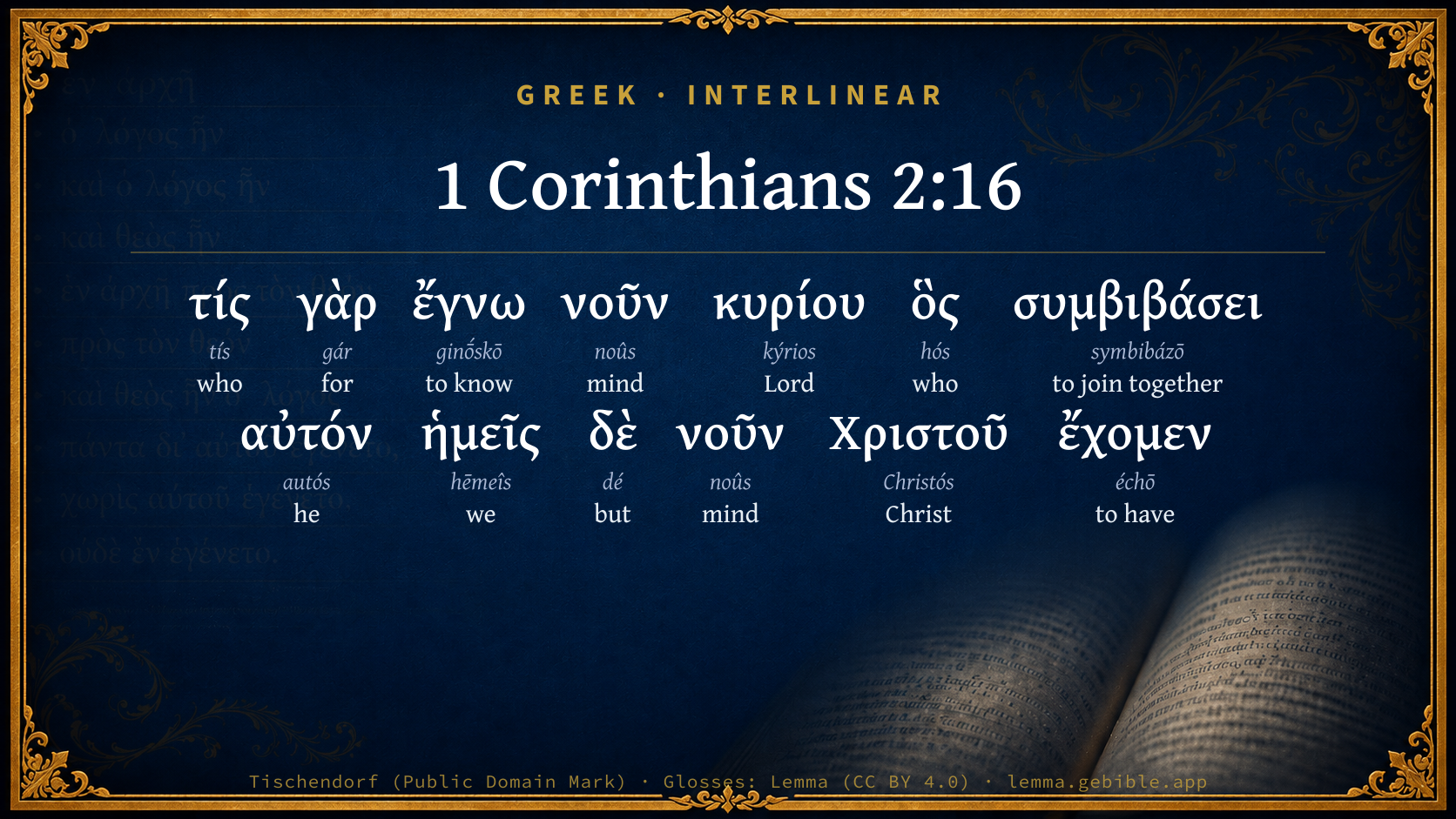
  1. τίς tís G5101 “who” Interrogative pronoun, Nominative, Singular, Masculine
  2. γὰρ gár G1063 “for” Conjunction
  3. ἔγνω ginṓskō G1097 “to know” Verb, Aorist, Active, Indicative, 3rd person, Singular
  4. νοῦν noûs G3563 “mind” Noun, Accusative, Singular, Masculine
  5. κυρίου kýrios G2962 “Lord” Noun, Genitive, Singular, Masculine
  6. ὃς hós G3739 “who” Relative pronoun, Nominative, Singular, Masculine
  7. αὐτόν autós G846 “he” Personal pronoun, Accusative, Singular, Masculine
  8. ἡμεῖς hēmeîs G2249 “we” Personal pronoun, 1st person, Nominative, Plural
  9. δὲ dé G1161 “but” Conjunction
  10. νοῦν noûs G3563 “mind” Noun, Accusative, Singular, Masculine
  11. Χριστοῦ Christós G5547 “Christ” Noun, Genitive, Singular, Masculine
  12. ἔχομεν échō G2192 “to have” Verb, Present, Active, Indicative, 1st person, Plural

About this verse

These counts appear in no published source. They are computed here, from the morphology-tagged text and Lemma’s own curated glosses. What Lemma adds →

13
words
12
distinct lemmas
Pauline Epistles
section

Notable vocabulary

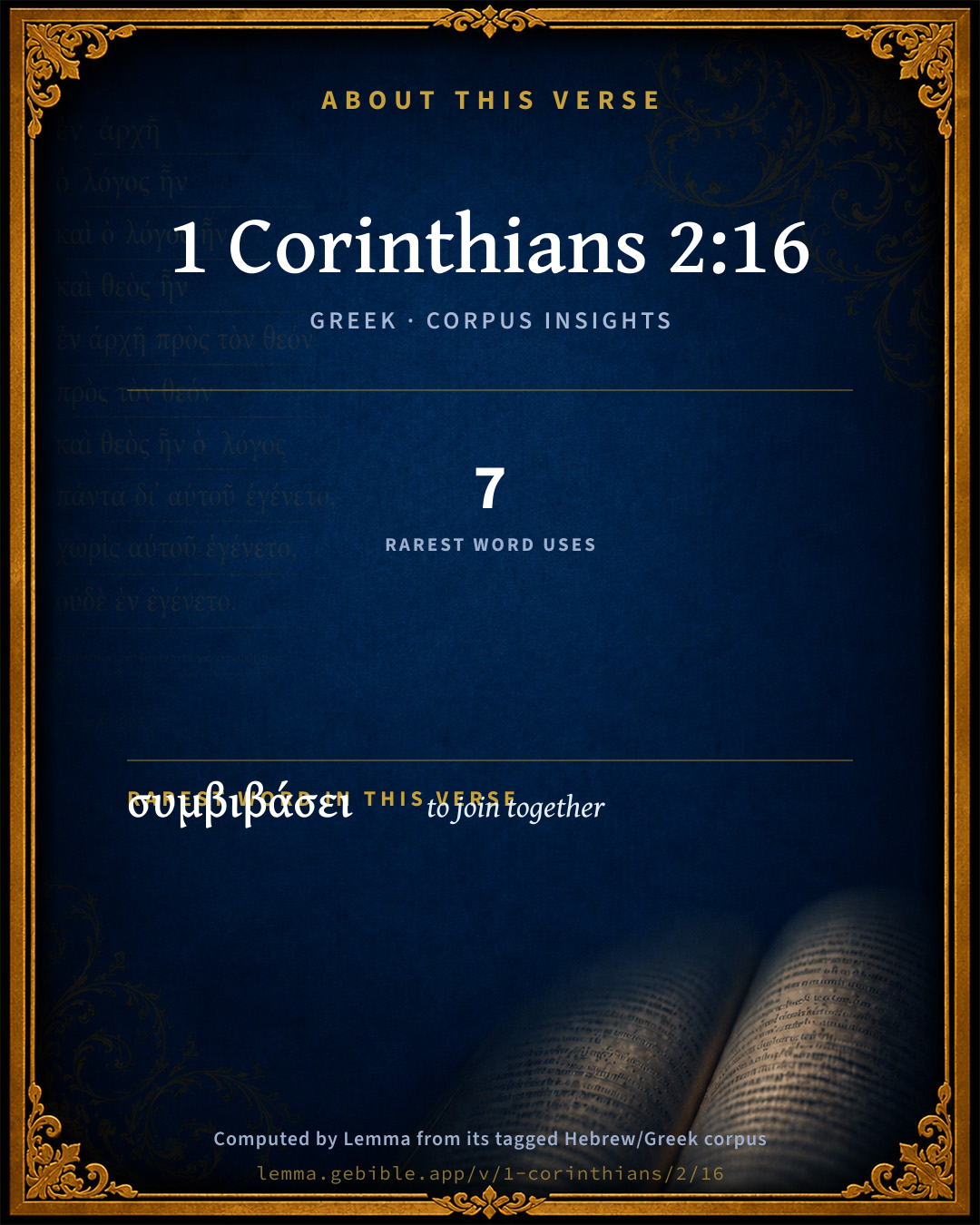
The rarest word here is συμβιβάσει to join together G4822 — appearing just 7 times in the whole Greek New Testament.

Shared distinctive vocabulary

συμβιβάσει to join together G4822 occurs in 7 verses of the Greek New Testament. Also found in:

Repetition

A word recurs within this verse:

  • νοῦν mind G3563 ×2

Cross-references

11

Topical passages linked to 1 Corinthians 2:16 in the Treasury of Scripture Knowledge — connected by theme and wording, ordered by reader-vote popularity; previews shown in the World English Bible.

  • Isaiah 40:13–14 Who has directed the Spirit of Yahweh, or being his counselor has taught him?
  • Romans 11:34 "For who has known the mind of the Lord? Or who has been his counselor?"
  • John 16:13–16 However when he, the Spirit of truth, has come, he will guide you into all truth, for he will not speak from himself; but whatever he hears, he will speak. He will declare to you things that are coming.
  • John 15:15 No longer do I call you servants, for the servant doesn't know what his lord does. But I have called you friends, for everything that I heard from my Father, I have made known to you.
  • Job 15:8 Have you heard the secret counsel of God? Do you limit wisdom to yourself?
  • Jeremiah 23:18 For who has stood in the council of Yahweh, that he should perceive and hear his word? who has marked my word, and heard it?
  • Ephesians 3:3–4 how that by revelation the mystery was made known to me, as I wrote before in few words,
  • Job 40:2 "Shall he who argues contend with the Almighty? He who argues with God, let him answer it."
  • John 17:6–8 I revealed your name to the people whom you have given me out of the world. They were yours, and you have given them to me. They have kept your word.
  • Job 22:2 "Can a man be profitable to God? Surely he who is wise is profitable to himself.
  • Genesis 1:12 The earth brought forth grass, herbs yielding seed after their kind, and trees bearing fruit, with its seed in it, after their kind: and God saw that it was good.

Cross-references courtesy of OpenBible.info (CC BY 4.0).

Commentary

Notes on 1 Corinthians 2:16 from classic Christian and Jewish commentators (each source and its license shown beneath its notes). The classic Christian expositions comment on the surrounding passage and are grouped to its opening verse, so a note may address several verses; the Jewish commentaries on the Tanakh (Rashi and others) are per-verse, so they appear only where the commentator wrote on this verse.

Lemma curates 59 commentaries, every one of them public domain or Creative Commons licensed, each selected and text-cleaned for this edition rather than reprinted as found. About our sources →

Tyndale Open Study Notes

Tyndale Open Resources

2:16 This quotation from Isa 40:13 shows how divine wisdom transcends the limitations of human reasoning (cp. Rom 11:34). • we have the mind of Christ: Linked to Christ, believers have the Spirit of Christ to reveal Christ’s thinking to them.

Tyndale Open Study Notes — © Tyndale Open Resources, licensed CC BY-SA 4.0. Text via the HelloAO Bible API.

Bengel's Gnomon

Johann Albrecht Bengel

1Co 2:16. Τίς, who) no one who is a mere man; comp. Jer 23:18; Isa 40:13; the LXX., τίς ἔγνω νοῦν Κυρίου—ὃς συμβιβάσει αὐτὸν.—ὃς, who) This is not the interrogative, but the relative, by which the force of the question, which is in the τίς, is extended [continued to the latter clause, ὃς συμβιβ. αὐτὸν], it means, and therefore.—νοῦν Χριστοῦ, the mind of Christ) The Spirit of the Father and of the Son is the same.—ἔχομεν, we have) That is both more and less than to know: he who has the mind of Christ, judges [judicially decides upon] all things, and is judged by no man.

Bengel's Gnomon of the New Testament — English translation (T&T Clark, Edinburgh, 1860) — public domain. Text from a community e-Sword module.

Meyer's Critical & Exegetical Commentary

Heinrich August Wilhelm Meyer

1Co_2:16. Proof for the αὐτὸς δὲ ὑπʼ οὐδενὸς ἀνακρινεται. For in order to judge of the πνευματικός, one would need to have known the mind of Christ, which we πνευματικοί are in possession ofto be able to act the part of teacher to Christ. The form of this proof is an imperfect syllogism, the last proposition in which, as being self-evident, is not expressed.[431] The major proposition is clothed in the words of Isa_40:13 (substantially after the LXX.), comp Rom_11:34. There, indeed, ΚΎΡΙΟς applies to God; but Paul, appropriating the words freely for the expression of his own thought, applies it here to Christ (against Calvin, Grotius, and most older interpreters, also Flatt, Osiander, Ewald, Hofmann), as the minor proposition ἡμεῖς δὲ Κ.Τ.Λ[433] proves.

The νοῦς Κυρίου is the understanding of the Lord, embracing His thoughts, judgments, measures, plans, etc., the νοῦς being the faculty where these originate and are elaborated. The conception is not identical with that of the πνεῦμα Χριστοῦ (against Billroth, Neander, and many others), which rather, when imparted to man, makes his νοῦς the νοῦς Χριστοῦ, not being itself the νοῦς Χ., but that which constitutes its substratum.

ὃς συμβιβ. αὐτόν] qui instructurus sit eum, i.e. in order (after thus coming to know him) to instruct Him. See on this use of ὅς, Matthiae, II. p. 1068; Kühner, II. p. 529 ff. Regarding συμβιβάζειν, which is frequent in the LXX. in the sense of instruere, docere, but does not occur with that meaning in Greek writers, see Schleusner, Thes. V. p. 154. This ὃς συμβ. αὐτόν is not rather superfluously taken in along with the rest of the quotation (Rückert), but is included as essential to the proof of the ὑπʼ οὐδενὸς ἀνακρίνεται, since the forming a judgment assumes the capacity to instruct (act as master). This, then, is what he who would judge the πνευματικοί must be capable of doing with respect to Christ, since these have the mind of Christ. Chrysostom says well: ὃς συμβιβάσει αὐτὸν, οὐχ ἁπλῶς προσέθηκεν, ἀλλὰ πρὸς ὃ εἶπεν ἤδη, ὅτι τὸν πνευματικὸν οὐδεὶς ἀνακρίνει· εἰ γὰρ εἰδέναι οὐδεὶς δύναται τοῦ Θεοῦ (rather Christs) τὸν νοῦν, πολλῷ μᾶλλον διδάσκειν καὶ διορθοῦσθαι.

To refer αὐτόν, with Nösselt (Opusc. II. p. 137 f.), to the πνευματικός (so, too, Rosenmüller and Tittmann, l.c[434] p. 294), is an involved construction rendered necessary only by failure to catch the simple course of proof.

ἡμεῖς δὲ νοῦν Χ. ἔχ.] the minor proposition, with the emphasis on ἡμεῖς, and the explanatory Χριστοῦ in place of Κυρίου. Paul includes himself along with the rest among the πνευματικοί. These are the possessors (ἔχομεν) of the mind of Christ. For, since they have the Spirit of Christ (Rom_8:9; Rom_8:16), and since Christ is in them (Rom_8:10; 2Co_13:5), their νοῦς, too, can be no mental faculty different in kind from the νοῦς Χριστοῦ, but must, on the contrary, be as ideally one with it, as it is true that Christ Himself lives in them (Gal_2:20), and the heart of Christ beats in them (Php_1:8), and He speaks in them (2Co_13:3). Comp respecting this indwelling of Christ in His believers, the idea in Gal_3:27; Rom_13:14. Οὐ γὰρ Πλάτωνος, οὐδὲ Πυθαγόρου, says Chrysostom, ἀλλʼ ὁ Χριστὸς τὰ ἑαυτοῦ τῇ ἡμετέρᾳ ἐνέθηκε διανοίᾳ. Many commentators (not recognising the process of proof) have interpreted ἔχομεν as perspectam habemus (see Tittmann, l.c[436]), as e.g. Rosenmüller and Flatt: We know the meaning of the doctrine of Christ; or Grotius: Novimus Dei consilia, quae Christo fuere revelata.

[431] Fully expressed, it would run thus: No one can know the mind of Christ so as to instruct Him: but we, πνευματικοί, are they who have the mind of Christ; therefore we are they also whom no one can know so as to instruct them, that is, just they who ὑπʼ οὐδενὸς ἀνακρίνονται, ver. 15.

[433] .τ.λ. καὶ τὰ λοιπά.

[434] .c. loco citato or laudato.

[436] .c. loco citato or laudato.

Meyer — Critical and Exegetical Commentary on the New Testament — English translation by Peter Christie, edited by Frederick Crombie (T&T Clark, 1880) — public domain. Text from a community e-Sword module.

Expositor's Greek Testament

ed. W. Robertson Nicoll

1Co 2:16 . Of the three clauses of Isa 40:13 , P. adopts in Rom 11:34 the 1James , 2 nd, here the 1James , 3 rd; in both instances from the LXX (which renders the Heb. freely), in both instances without the καθὼς γέγραπται of formal quotation. ὃς συνβιβάσει αὐτόν ( qui instructurus sit eum , Bz [445] : on the rel [446] pron [447] with fut [448] ind [449] of contemplated result , see Krüger’s Gr [450] Sprachl. , I., § 53, 7, Anm. 8; Bn [451] , § 318) indicates the Divine superiority to creaturely correction, which justifies the enormous claim of 1Co 2:15 b . Συνβιβάζω means (1) to bring together, combine (Col 2:2 , etc.); (2) to compare, gather, prove by putting things together (Act 16:10 ); (3) widened in later Gr [452] to the sense to teach, instruct . The prophet pointed in evidence of God’s incomparable wisdom and power to the vastness of creation, wherein lie unimaginable resources for Israel’s redemption, that forbid despair. Here too the νοῦς in question is God’s infinite wisdom, directing man’s salvation through inscrutable ways (1Co 2:6-9 ); but the Apostle’s contention is that this “mind” inspires the organs of revelation (1Co 2:10 ff.), and its superiority to the judgment of the world is relatively also theirs (1Co 2:14 ff.). Paul translates the νοῦν Κυρίου of Isaiah into his own νοῦν Χριστοῦ ; to him these minds are identical ( cf. Mat 11:27 , Joh 5:20 , etc.). Such interchanges betray his “innermost conviction of the Godhead of Christ” (El [453] ). νοῦς serves his turn better than the literal πνεῦμα of the original ( ruach ); the intellectual side of the πνεῦμα is concerned, the θεῖον ὄμμα (see note on νοῦς , 1Co 1:10 ). For the emphatic ἡμεῖς , cf. 1Co 2:10 ; 1Co 2:12 , and notes; for the anarthrous nouns, note on 1Co 2:4 ; νοῦν Χ . is quasi-predicative “it is Christ’s mind no other that we have”. ἔχομεν is not to be softened into perspectam habemus, novimus (Gr [454] ): Christ lives and thinks in the πνευματικός (1Co 6:17 , 2Co 13:3 ff., etc.; Joh 15:1-8 ); the unio mystica is the heart of Paul’s experience.

[445] Beza’s Nov. Testamentum: Interpretatio et Annotationes (Cantab., 1642).

[446] relative pronoun.

[447]ron. pronoun.

[448] future tense.

[449] indicative mood.

[450] Greek, or Grotius’ Annotationes in N.T.

[451] E. Burton’s Syntax of the Moods and Tenses in the N.T. (1894).

[452] Greek, or Grotius’ Annotationes in N.T.

[453] C. J. Ellicott’s St. Paul’s First Epistle to the Corinthians .

[454] Greek, or Grotius’ Annotationes in N.T.

The Expositor's Greek Testament, edited by W. Robertson Nicoll (1897–1910) — public domain. Text from a community e-Sword module.

Hodge's Commentary on Romans, Ephesians & First Corinthians

Charles Hodge

1Co_2:16

For who hath known the mind of the Lord, that he may instruct him? But we have the mind of Christ.

This is a confirmation of what precedes. No one can judge a spiritual man, for that would be to judge the Lord. The Lord had revealed certain doctrines. The spiritual discern those doctrines to be true. For any man to pronounce them false, and to judge those who held them, supposes he is able to teach the Lord. As no one can do this, no one can judge those who have the mind of Christ, that is, those whom Christ by his Spirit has taught the truth. Syllogistically stated, the argument would stand thus: No one can instruct the Lord. We have the mind of the Lord. Therefore no one can instruct or judge us. The first member of this syllogism is expressed in the language of Isa_40:15, according to the Septuagint. The philosophers of Greece and the scribes among the Jews had sat in judgment upon Paul, and pronounced his preaching foolishness. He tells them they were not competent judges. The natural man cannot discern the things of the Spirit, and is incompetent to judge those whom the Spirit has taught. As what we teach is the mind of the Lord, to condemn our doctrine, or to judge us as the teachers of those doctrines, is to condemn the Lord.

What in the Old Testament is said of Jehovah is often in the New Testament applied to Christ. This is the case here. Who hath known the mind of the Lord? means, who hath known the mind of Jehovah? We have the mind of Christ, therefore, means, we have the mind of Jehovah. What is true of the one is true of the other. The same person who is revealed in the New Testament as the Son of God, was revealed of old as Jehovah. This teaches how firm a foundation the believer has for his faith, and how impossible it is for any one taught by the Spirit to give up his convictions to the authority of men.

Charles Hodge — Commentary on Romans (1835), First Corinthians (1857), and Ephesians (1856) — public domain. Text from a community e-Sword module.

Geneva Bible (1599)

Geneva Bible translators

Lay his head to his, and teach him what he should do.

A reason of the former saying: for he is called spiritual, which hath learned that by the virtue of the Spirit, which Christ hath taught us. Now if that which we have learned of that Master, could be reproved of any man, he must needs be wiser than God: whereupon it followeth, that they are not only foolish, but also wicked, which think that they can devise something that is either more perfect, or that they can teach the wisdom of God a better way than they knew or taught, which undoubtedly, were endued with God’s Spirit.

We are endued with the Spirit of Christ, who openeth unto us those secrets, which by all other means are unsearchable, and also all truth whatsoever.

Geneva Bible (1599) marginal notes — public domain. Text via Bolls.life.

Jamieson, Fausset & Brown

Robert Jamieson, A. R. Fausset & David Brown

For--proof of Co1 2:15, that the spiritual man "is judged of no man." In order to judge the spiritual man, the ordinary man must "know the mind of the Lord." But "who of ordinary men knows" that?

that he may instruct him--that is, so as to be able to set Him right as His counsellor (quoted from Isa 40:13-14). So the Septuagint translates the Greek verb, which means to "prove," in Act 9:22. Natural men who judge spiritual men, living according to the mind of God ("We have the mind of Christ"), are virtually wishing to instruct God, and bring Him to another mind, as counsellors setting to right their king.

we have the mind of Christ--in our degree of capability to apprehend it. Isa 40:13-14 refers to JEHOVAH: therefore, as it is applied here to Christ, He is Jehovah.

Next: 1 Corinthians Chapter 3

Jamieson, Fausset & Brown — Commentary Critical and Explanatory on the Whole Bible (1871) — public domain (CC PDM 1.0). Text via the HelloAO Bible API.

Adam Clarke's Commentary

Verse 16. For who hath known the mind of the Lord] Who that is still an animal man can know the mind of God? so as to instruct him, viz. the spiritual man, the same that is spoken of, 1Co 2:15. But the words may be better understood thus: How can the animal man know the mind of the Lord? and how can any man communicate that knowledge which he has never acquired, and which is foolishness to him, because it is spiritual, and he is animal? This quotation is made from Isa 40:13.

But we have the mind of Christ.] He has endowed us with the same disposition, being born again by his Spirit; therefore we are capable of knowing his mind and receiving the teachings of his Spirit. These teachings we do receive, and therefore are well qualified to convey them to others.

The words, that he may instruct him, ος συμβιβασει αυτον, should be translated that he may teach IT: that is, the mind of God; not instruct God, but teach his mind to others. And this interpretation the Hebrew will also bear.

Bishop Pearce observes: "The principal questions here are,, what συμβιβασει signifies, and what αυτον is relative to. The Hebrew word which the Septuagint translate by these two is יודיענו yodiennu: now, since ידיע yodia signifies as well to make known as to know, (and indeed this is the most frequent sense of it in the Old Testament,) the suffix (postfix) נו nu, may relate to a thing, as well as to a person; and therefore it may be rendered not by him, but by it, i.e. the mind of the Lord. And in this sense the apostle seems to have used the words of the Seventy; for, if we understand αυτον here to be the relative to κυριου, Lord, this verse contains no reason for what went before; whereas, if it be a relative to νουν, mind, it affords a reason for what had been said before, 1Co 2:14." The true translation of the passage, as used by the apostle, appears to be this: For who hath known the mind of the Lord, that he should TEACH IT? And this translation agrees with every part of the context, and particularly with what follows.

1. THIS chapter might be considered a good model for a Christian minister to regulate his conduct by, or his public ministry; because it points out the mode of preaching used by St. Paul and the apostles in general. This great apostle came not to the people with excellency of speech and of wisdom, when he declared unto them the counsel of God. They know little, either of the spirit of St. Paul or the design of the Gospel, who make the chief excellence of their preaching to consist in the eloquence of language, or depth of human reasoning. That may be their testimony, but it is not God's. The enticing words of man's wisdom are seldom accompanied by the demonstration and power of the Holy Spirit.

2. One justly remarks, that "the foolishness of preaching has its wisdom, loftiness, and eloquence; but this consists in the sublimity of its truths, the depth of its mysteries, and the ardour of the Spirit of God." In this respect Paul may be said to have preached wisdom among those which were perfect. The wisest and most learned men in the world, who have seriously read the Bible, have acknowledged that there is a depth and height of wisdom and knowledge in that book of God which are sought in vain any where else: and indeed it would not be a revelation from God were it not so. The men who can despise and ridicule this sacred book are those who are too blind to discover the objects presented to them by this brilliant light, and are too sensual to feel and relish spiritual things. They, above all others, are incapable of judging, and should be no more regarded when employed in talking against the sacred writings than an ignorant peasant should be, who, not knowing his alphabet, pretends to decry mathematical learning.

3. A new mode of preaching has been diligently recommended,- "Scriptural phraseology should be generally avoided where it is antiquated, or conveys ideas inconsistent with modern delicacy." St. Paul did not preach in the words which man's wisdom teacheth- such words are too mean and too low for a religion so Divine. That which the Holy Spirit alone can discover, he alone can explain. Let no man dare to speak of God in any other way than he speaks of himself in his word. Let us take care not to profane his truths and mysteries, either by such low and abject ideas as are merely human, or by new and worldly expressions altogether unworthy of the Spirit of God.

4. It is the glory of God, and ought to be ours, not to be acceptable to carnal men. The natural man always finds some pretence to excuse himself from believing, by looking on the mysteries of religion as being either too much above man or too much below God; the spiritual man judges them to be so much the more credible, the less credible they are to the natural man.

The opposition, contempt, and blindness of the world, with regard to the things of God, render all its judgments concerning them liable to exception: this blindness in spiritual things is the just punishment of a carnal life. The principal part of the above is extracted from the reflections of the pious Quesnel.

Adam Clarke's Commentary on the Bible (1810–1826) — public domain. Text from a community e-Sword/MySword module.

John Calvin's Commentaries

16. For who hath known? It is probable that Paul had an eye to what we read in the 40th chapter of Isaiah. The Prophet there asks,

Who hath been God’s counselor? Who hath weighed his Spirit, (Isaiah 40:13,)

or hath aided him both in the creation of the world and in his other works? and, in fine, who hath comprehended the reason of his works? Now, in like manner Paul, by this interrogation, designs to teach, that his secret counsel which is contained in the gospel is far removed from the understanding of men. This then is a confirmation of the preceding statement.

But we have the mind of Christ. It is uncertain whether he speaks of believers universally, or of ministers exclusively. Either of these meanings will suit sufficiently well with the context, though I prefer to view it as referring more particularly to himself and other faithful ministers. He says, then, that the servants of the Lord are taught by the paramount authority of the Spirit, what is farthest removed from the judgment of the flesh, that they may speak fearlessly as from the mouth of the Lord, — which gift flows out afterwards by degrees to the whole Church.

John Calvin's Commentaries (1540-1563) — public domain. Text from the Calvin Translation Society English edition (1840s-50s) via the Christian Classics Ethereal Library (ccel.org). Calvin's coverage is partial (roughly two-thirds of the Bible); uncommented books and verses are honest gaps, never fabricated. The 19th-century editor's footnotes and remarks are omitted so the notes are faithfully Calvin's own voice.

Ellicott's Commentary for English Readers

(16) For.—This is the proof that the enlightened spiritual man cannot be judged by any one who is not thus enlightened. “Who (thus uninstructed) can know the mind of the Lord Jesus, that he may instruct Him?”

But we.—That is, spiritual men, including the Apostles. The Apostle here identifies Christ with the Spirit, whom he has previously spoken of as the Teacher of spiritual things. He does not mean to assert that the Apostles knew all that the mind of Christ knew, but that all things which they did know were from Him and spiritual (Joh_15:15).

A Bible Commentary for English Readers, edited by Charles John Ellicott (1878–1897) — public domain. Text from a community e-Sword module.

The Cambridge Bible for Schools and Colleges

gen. ed. J. J. S. Perowne

16. For who hath known the mind of the Lord] See note on 1Co_1:10. The Hebrew of Isa_40:13, here quoted, has spirit, the Septuagint mind. St Paul here follows the Septuagint, which is nearer to the original than our version, ‘Who hath directed the Spirit of the Lord?’ The literal translation is, ‘Who hath measured the Spirit of the Lord?’ As none but the believer possesses the mind of the Lord, and as none can venture to assume a position of intellectual superiority to Him, the assertion in the preceding verse is established. The possession of this mind of Christ renders him who has it a mystery to him who has it not. The workings of his soul, thus enlightened by a higher power, are inscrutable to those who are destitute of spiritual vision. We must not omit to notice that in the passage which the Apostle here quotes as referring to Christ the original has Jehovah. See also Jer_23:18.

The Cambridge Bible for Schools and Colleges (gen. ed. J. J. S. Perowne; Cambridge University Press, 1878–1918) — public domain. Text from a community e-Sword module.

Trapp's Complete Commentary

John Trapp

16 For who hath known the mind of the Lord, that he may instruct him? But we have the mind of Christ.

Ver. 16. But we have the mind of Christ] This is a privilege confined to the communion of saints, to have communication of Christ’s secrets, to be as it were of his court and council. One saith of Dr Sibbs, that he was a man spiritually rational, and rationally spiritual, one that seemed to see the insides of nature and grace, and the world and heaven, by those perfect anatomies he had made of them all.

John Trapp, A Commentary or Exposition upon All the Books of the Old and New Testament (1647–1656) — public domain. Text from a community e-Sword module.

Albert Barnes' Notes on the Bible

For who hath known ... - This passage is quoted from Isa 40:13. The interrogative form is a strong mode of denying that anyone has ever known the mind of the Lord. The argument of Paul is this, “No one can understand God. No one can fully comprehend his plans, his feelings, his views, his designs. No one by nature, under the influence of sense and passion, is either disposed to investigate his truths, or loves them when they are revealed. But the Christian is influenced by God. He has his Spirit. He has the mind of Christ; who had the mind of God. He sympathizes with Christ; he has his feelings, desires, purposes, and plans. And as no one can fully understand God by nature, so neither can he understand him who is influenced by God, and is like him; and it is not to be wondered at that he regards the Christian religion as folly, and the Christian as a fool.

The mind of Christ - The views, feelings, and temper of Christ. We are influenced by his Spirit.

Remarks On 1 Corinthians 2

1. Ministers of the gospel should not be too anxious to be distinguished for excellency of speech or language, 1Co 2:1. Their aim should be to speak the simple truth, in language pure and intelligible to all. Let it be remembered, that if there ever was any place where it would be proper to seek such graces of eloquence, it was Corinth. If in any city now, or in any refined and genteel society it would be proper, it would have been proper in Corinth. Let this thought rebuke those, who, when they preach to a frivilous and fashionable auditory, seek to fill their sermons with ornament rather than with solid thought; with the tinsel of rhetoric, rather than with pure language. Paul was right in his course; and was wise. True taste abhors meretricious ornaments, as much as the gospel does. And the man who is called to preach in a rich and fashionable congregation, should remember, that he is stationed there not to please the ear, but to save the soul; that his object is not to display his talent or his eloquence, but to rescue his hearers from ruin. This purpose will make the mere ornaments of rhetoric appear small. It will give: seriousness to his discourse; gravity to his diction; unction to his eloquence; heart to his arguments; and success to his ministry.

2. The purpose of every minister should be like that of Paul, to preach Christ and only him crucified. See the note on 1Co 2:2.

3. If Paul trembled at Corinth in view of dangers and difficulties; if he was conscious of his own weakness and feebleness, then we should learn also to be humble. He is not much in danger of erring who imitates the example of this great apostle. And if he who had received a direct commission from the great Head of the church, and who was endowed with such mighty powers, was modest, unassuming, and diffident, then it becomes ministers of the gospel now, and all others to be humble also. We should not, indeed, be afraid of people; but we should be modest, humble, and lowly; much impressed, as if conscious of our mighty charge; and anxious to deliver just such a message as God will approve and bless.

Would I describe a preacher, such an Paul,

Were he on earth, would hear, approve, and own,

Paul should himself direct me. I would trace.

His master-strokes, and draw from his design.

I would express him simple, grave, sincere;

In doctrine uncorrupt; in language plain;

And plain in manner, decent, solemn, chaste,

And natural in gesture: much impress’d.

Himself, an conscious of his awful charge;

And anxious mainly that the flock he feeds.

May feel it too. Affectionate in look,

And tender in address, as well becomes.

A messenger of grace to guilty men.

Task, B.

Our aim should be to commend our message to every man’s conscience; and to do it with humility toward God, and deep solicitude; with boldness toward our fellow man - respectfully toward them - but still resolved to tell the truth, 1Co 2:3.

4. The faith of Christians does not stand in the wisdom of man. Every Christian has evidence in his own heart, in his experience, and in the transformation of his character, that none but God could have made the change on his soul. His hopes, his joys, his peace, his sanctification, his love of prayer, of the Bible, of Christians, of God, and of Christ, are all such as nothing could have produced but the mighty power of God. All these bear marks of their high origin. They are the work of God on the soul. And as the Christian is fully conscious that these are not the native feelings, of his heart - that if left to himself he would never have had them; so he has the fullest demonstration that they are to be traced to a divine source. And can he be mistaken about their existence? Can a man doubt whether he has joy, and peace, and happiness? Is the infidel to tell him coolly that he must be mistaken in regard to the existence of these emotions, and that it is all delusion?

Can a child doubt whether it loves a parent? Can a husband doubt whether he loves his wife? Can a friend question whether he loves a friend? Or a man whether he loves his country? And can he doubt whether this emotion produces joy? And can a person doubt whether he loves God? Whether he has different views from what he once had? Whether he has peace and joy in view of the character of God, and the hope of heaven? And by what right shall the infidel tell him that he is mistaken, and that all this is delusion? How can he enter into the soul, and pronounce the man who professes to have these feelings mistaken? What should we think of the man who would tell a wife that she did not love her husband; or a father that he did not love his children? How can he know this? And, in like manner, how can an infidel and a scoffer say to a Christian, that all his hopes and joys, his love and peace are delusion and fanaticism? The truth is, that the great mass of Christians are just as well satisfied of the truth of religion, as they are of their own existence; and that a Christian will die for his love to the Saviour, just as he will die for his wife, and children, and country. Martyrdom in the one case is on the same principle as martyrdom in the other. Martyrdom in either is noble and honorable, and evinces the highest qualities and principles of the human mind.

5. Christians are influenced by true wisdom, 1Co 2:6. They are not fools; though they appear to be to their fellow man. They see a real beauty and wisdom in the plan of redemption which the world does not discern. It is not the wisdom of this world; but it is the wisdom which looks to eternity. Is a man a fool who acts with reference to the future? Is he a fool who believes that he shall live to all eternity, and who regards it as proper to make preparation for that eternity? Is he a fool who acts as if he were to die - to be judged - to enter on an unchanging destiny? Folly is manifested in closing the eyes on the reality of the condition; not in looking at it as it is. The man who is sick, and who strives to convince himself that he is well; the man whose affairs are in a state of bankruptcy, and who is unwilling to know it, is a fool. The man who is willing to know all about his situation, and to act accordingly, is a wise man. The one represents the conduct of a sinner, the other that of a Christian. A man who should see his child drowning, or his house on fire, or the pestilence breathing around him, and be unconcerned, or dance amidst such scenes, would be a fool or a madman. And is not the sinner who is frivilous and thoughtless over the grave and over hell equally foolish and mad? And if there is a God, a heaven, a Saviour, and a hell; if people are to die, and to be judged, is he not wise who acts as if it were so, and who lives accordingly? While Christians, therefore, may not be distinguished for the wisdom of this world - while many are destitute of learning, science, and eloquence, they have a wisdom which will survive when all other is vanished away.

6. All the wisdom of this world shall come to nothing, 1Co 2:6. What will be the value of political sagacity, when all governments shall come to an end but the divine government? What will be the value of eloquence, and graceful diction, when we stand at the judgment seat of Christ? What will be the value of science in this world, when all shall be revealed with the clearness of noonday? How low will all human attainments appear in that world, when the light of eternal day shall be shed over all the works of God? How little can human science do to advance the eternal interests of man? And how shall all fade away in the future world of glory - just as the feeble glimmering of the stars fades away before the light of the morning sun! How little, therefore, should we pride ourselves on the highest attainments of science, and the most elevated distinctions of learning and eloquence.

7. God has a purpose in regard to the salvation of people, 1Co 2:7. This scheme was ordained before the world. It was not a new device. It was not the offspring of chance, an accident, or an “after thought.” It was because God purposed it from eternity. God has a plan; and this plan contemplates the salvation of his people. And it greatly enhances the value of this benevolent plan in the eyes of his people, that it has been the object of “the eternal earnest desire and purpose of God.” How much a gift is enhanced in value from the fact that it has been long the purpose of a parent to bestow it; that he has toiled for it; that he has made arrangements for it; and that this has been the chief object of his efforts and his plan for years. So the favors of eternal redemption are bestowed on Christians as the fruit of the eternal purpose and desire of God. And how should our hearts rise in gratitude to him for his unspeakable gift!

8. One great and prominent cause of sin is the fact that people are blind to the reality and beauty of spiritual objects. So it was with those who crucified the Lord, 1Co 2:8. Had they seen his glory as it was, they would not have crucified him. And so it is now. When people blaspheme God, they see not his excellency; when they revile religion, they know not its real value; when they break the laws of God, they do not fully discern their purity and their importance. It is true they are willfully ignorant, and their crime is often enhanced by this fact; but it is equally true that “they know not what they do.” For such poor, blinded, deluded mortals, the Saviour prayed; and for such we should all pray. The man that curses God, has no just sense of what he is doing. The man who is profane, and a scoffer, and a liar, and an adulterer, has no just sense of the awful nature of his crime; and is an object of commiseration while his Sin should be HAted - and is a proper subject of prayer.

9. People are often committing the most awful crimes when they are unconscious of it 1Co 2:8. What crime could compare with that of crucifying the only Son of God? And what crime could be attended with more dreadful consequences to its perpetrators? So of sinners now. They little know what they do; and they little know the consequences of their sins. A man may curse his Maker, and say it is in sport! But how will it be regarded on the Day of Judgment? A person may revile the Saviour! But how will it appear when he dies? It is a solemn thing to trifle with God and with His laws. A man is safer when he plays on top of a volcano, or when he makes a jest of the pestilence or the forked lightnings of heaven, than when he makes fun of religion and God! In a world like this, people should be serious and revere God. A single deed, like that of the crucifixion of Christ, may be remembered, when all the circumstances of sport and mockery shall have passed away - remembered when the world shall be destroyed, and stars and suns shall rush to ruin.

10. Christians have views of the beauties of religion, and have consolations arising from these views, which the world does not have, 1Co 2:9. They have different views of God, of Christ, of heaven, of eternity. They see a beauty in all these things, and a wisdom in the plan of salvation, which the people of the world do not see. The contemplations of this beauty and wisdom, and the evidence which they have that they are interested in all this, gives them a joy which the world does not possess. They see what the eye has not elsewhere seen; they enjoy what people elsewhere have not enjoyed; and they are elevated to privileges which people elsewhere do not possess. On earth, they partake of happiness which the world never can give, and in heaven they shall partake of the fulness of that joy - of pleasures there which the eye had not before seen, nor the ear heard, nor the heart of man conceived. Who would not want to be a Christian?

11. The Holy Spirit is in some sense distinct from the Father. This is implied in his action as an agent - in searching, knowing, etc. 1Co 2:10-11. An attribute; a quality, does not search and know.

12. The Holy Spirit is divine. None can know God but one equal to himself. If the Spirit intimately knows the wisdom, the goodness, the omniscience, the eternity, the power of God, he must be divine. No created being can have this intelligence, 1Co 2:10-11.

13. Christians are actuated by a different Spirit from the people of this world, 1Co 2:12. They are influenced by a regard to God and His glory. The people of the world are under the influence of pride, avarice, sensuality, ambition, and vain glory.

14. The sinner does not perceive the beauty of the things of religion. To all this beauty, he is blind. This is a sober and a most melancholy fact. Whatever may be the cause of it, the fact is undeniable and sad. It is so with the sensualist; with the people of avarice, pride, ambition, and licentiousness. The gospel is regarded as folly, and is despised and scorned by the people of this world. This is true in all places, among all people, and at all times. To this there are no exceptions in human nature; and over this we should sit down and weep.

15. The reason of this is, that people love darkness. It is not that they are destitute of the natural faculties for loving God, for they have as strong native powers as those who become Christians. It is because they love sin - and this simple fact, carried out into all its bearings, will account for all the difficulties in the way of the sinner’s conversion. There is nothing else; and,

16. We see here the value of the influences of the Spirit. It is by this Spirit alone that the mind of the Christian is enlightened, sanctified, and comforted. It is by Him alone that he sees the beauty of the religion which he loves; it is by His influence alone that he differs from his fellow man. And no less important is it for the sinner. Without the influences of that Spirit his mind will always be in darkness, and his heart will always hate the gospel. How anxiously, therefore, should he cherish His influences! How careful should he be not to grieve Him away!

17. There is a difference between Christians and other people. One is enlightened by the Holy Spirit, the other not; one sees a beauty in religion, to the other it is folly; the one has the mind of Christ, the other has the spirit of the world; the one discerns the excellency of the plan of salvation, to the other all is darkness and folly. How could beings differ more in their moral feelings and views than do Christians and the people of this world?

Albert Barnes' Notes on the Bible (1834–1885) — public domain. Text from a community e-Sword/MySword module.

Haydock's Catholic Bible Commentary

For who among the sensual men of the world, hath known the mind of the Lord, so as to be able to instruct him, or them, whom he guides by his spirit. --- But we, whom he has chosen to be his apostles, have the mind of Christ; having been taught and instructed by the Spirit of Christ. Some enthusiasts and fanatics pretend from this passage of St. Paul, that they being led and inspired by the spirit, can be judged by no one in matters of faith and religion. They pervert and wrest the words of St. Paul, as they do also other Scriptures, to their own perdition. (2 Peter iii. 16.) First, because no one knows by his pretended private spirit, that he is truly such a spiritual man, who has the Spirit of God in him: and many have too much reason to know by their sensual carnal lives, that they have it not. Secondly, St. Paul here speaks only of spiritual men in opposition to sensual men, and only says that they who are spiritual, have the spirit of discretion to judge what things are spiritual, and what are not; and that none can judge rightly of these matters, but they who are spiritual, guided by the Spirit. Thirdly, as to controversies about religion, the proper spiritual judge appointed by our Saviour, Christ, are the bishops, whom he has appointed to govern his Church, with an entire submission of every man’s private judgment, and private spirit, to the judgment of the Catholic Church, which he has commanded us to hear and obey, with which he has promised to remain to the end of the world, and to direct her in all things by the spirit of truth. (Witham)

====================

George Leo Haydock (1774–1849), Haydock's Catholic Family Bible and Commentary, 1859 edition — public domain. Excludes Psalms (Douay-Rheims chapter numbering differs from Protestant) and Deuterocanonical books (Catholic canon only).

Matthew Poole's English Annotations

For who hath known the mind of the Lord, that he may instruct him? This phrase is taken out of Isa 40:13, and was quoted by our apostle before, Rom 11:34; the sense of it, as here used, is: For what natural man, that never was taught and enlightened by the Spirit of God, could ever know the secret counsels of God, and the Divine mysteries of man’s salvation? Nor can any instruct him what to do. It is by some observed, that συμβιβασει signifies, by arguments to bring one over to be of his mind, which indeed is a kind of instruction.

But (saith the apostle) we, who have the Spirit of God given to us, dwelling and working in us, and instructing us, we have the mind of Christ; for the Spirit of Christ, which is our teacher, knoweth his mind, and hath revealed it unto us.

Matthew Poole's English Annotations on the Holy Bible (1683–1685) — public domain. Text from a community e-Sword/MySword module.

Whedon's Commentary on the Bible

Daniel D. Whedon

16. We—The spiritual.

Mind of Christ—We having the mind of Christ, whom none can instruct, cannot be judged by any natural man. Our experience and gifts from God the world knows not of, and has no right or power to pronounce judgment upon. High communion with God, with exalted excitement of emotions, while it has its blessedness is not without its dangers. The human imagination is therein liable to catch fire, and a wild fire it is liable to be. The experience of the Church suggests the following cautions:—

1. Our spiritual experiences must be in accordance with the teachings of Christ, and regulated by the laws of the inspired written word. Those whose spiritual emotions, impressions, or cognitions contradict the word of God, are actuated by a delusive spirit.

2. Such spiritual exercises should accord with natural decency and becomingness; for “nature itself teaches” that decency and propriety are of God.

3. Our spiritual enjoyments should not exert themselves in mere emotional pleasure; but purify our daily life, make us honest in business, courteous in manners, faithful in our secular duties, and enterprising in good-doing. A mere contemplative or monastic piety lacks the true spirit of Christ.

4. True communion with God is modest and not boastful. It can bear with patience the pretence of the world to sit in judgment upon it. Nor does it endow its own personal opinions with the attribute of divine omniscience.

5. Our spiritual joy should give us firm faith, and a holy yet modest boldness in presenting religion to others; not obtrusively, but studying the occasion; not driving or persecuting, but winning souls to Christ and goodness. When we truly feel our religion to be a great treasure, we are most likely best to succeed in the effort to impart it to others.

Daniel D. Whedon (gen. ed.), Commentary on the Old and New Testaments (1874–1909) — public domain. Text from a community e-Sword module.

The Pulpit Commentary

Who hath known the mind of the Lord? "The Lord" is Jehovah. (see Isa_40:13, LXX; Rom_11:34) This is the reason why no one can judge the spiritual man in his spiritual life. To do so is like judging God. We have the mind of Christ. So Christ himself had told the apostles; (Joh_15:15) and St. Paul always claimed to have been taught by direct revelation from Christ. (Gal_1:11, Gal_1:12) They had the Spirit of Christ, (Rom_8:9) and therefore the mind of Christ.

The mind of Christ.

Some professed Christians have the name, and only the name, of Christ. Some are satisfied to have in sacramental bread what represents the body of Christ. "We," says the apostle, and all true Christians will in a lowly grateful spirit unite in the same profession have the mind of Christ.

I WHAT IS MEANT BY "THE MIND OF CHRIST"? His earthly ministry, his counsels and promises to his disciples, his willing sacrifice, revealed that mind; and that so fully and so clearly that we may justly say, that mind has become and. is the richest heritage and possession of humanity.

1. His was the mind that saw the truth. He did not reason it out or accept it from authority; he looked it in the face; he was naturally and perfectly and always acquainted with it.

2. His was the mind that loved the good. It was through no fierce struggle that Jesus came to admire and to appreciate moral beauty; for goodness was natural to him and perfectly congenial and delightful to his being.

3. His was the mind that chose the right. The will of man is often vacillating and varying, and in some cases it persistently chooses evil. But throughout Christ"s ministry, righteousness was not the law to which he submitted, but the very life he lived. There is no instance of his preferring the wrong; he was without sin.

4. His was the mind that thought and planned and suffered for all men. It is not a just view of the mind of the Lord Christ to regard it as personal character. For he was the Son of man, and took all humanity into the embrace of his great and comprehensive mind. He thought and spake of all men as most closely related to himself. To know his mind is to know alike the mind of man and the mind of God.

II How can WE PARTAKE "THE MIND OF CHRIST"? When we consider what that mind was, we may well be all but hopeless of possessing and of sharing it. Yet it is his will that his mind should be ours, and he has made provision for our participation in, our appropriation of, his mind.

1. We acquire knowledge of that mind through the record of the gospel. His words, his miracles, his conduct, his sufferings, were all a revelation of his mind; pondering them, we come near to the thought, to the heart, of our Saviour.

2. We receive with faith the all sufficient redemption he has effected. He is not only a Teacher, he is not only a Revelation of the Father; he is the Saviour. And it is in accepting the salvation which is through him that we are re-created in the likeness of his holy mind and nature.

3. We do his will, and learn that obedience is the method by which we attain to a more thorough sympathy with him. Thus a growing revelation on his part brings about a growing appropriation on ours.

III HOW CAN WE PROVE OURSELVES TO HAVE "THE MIND OF CHRIST"?

1. By our judgment concerning spiritual things; for these are spiritually discerned by the disciplined, the sympathetic, mind.

2. By our life of loving service; for "if a man have not the Spirit of Christ, he is none of his. T.

The Pulpit Commentary (1880–1919), ed. H.D.M. Spence-Jones & Joseph S. Exell — public domain. Text from a community e-Sword module.

John Wesley's Explanatory Notes

Who - What natural man. We - Spiritual men; apostles in particular. Have - Know, understand. The mind of Christ - Concerning the whole plan of gospel salvation. Isaiah xl, 13

John Wesley, Explanatory Notes Upon the Whole Bible (1754–1765) — public domain. Text via the GEBible commentary corpus.

Burkitt's Expository Notes on the New Testament

William Burkitt

That is, "What man, without divine revelation and spiritual illumination, ever knew or understood the mind of God so well, as to be able to instruct, direct, and inform the spiritual man about it? But we who are spiritual have the mind of Christ, and so are able to discern and direct, to guide and instruct, others about it."

Learn hence, That none are fit and sufficient to interpret the mind of God unto others, who are not acquainted with it themselves. We have the mind of Christ, saith the apostle of himself, and his fellow-labourers in the gospel: his meaning is not only this, that they had the mind of Christ written in a book, but that they had a clear understanding of it, and so were fitted to interpret it to others.

There is no such knowledge as the knowledge of experience, no teaching like unto experimental teaching.

William Burkitt's Expository Notes on the New Testament (1700–1703) — public domain. Text from a community e-Sword module.

Godbey's Commentary on the New Testament

William B. Godbey

16. “For who hath known the mind of the Lord, who shall give him counsel? But we have the mind of Christ.” This verse tells the deep secret. As no one but the spirit which dwells in a man can know the affairs of that man, unless his spirit reveals them, even so no one but the Spirit of God knows the things of God (1Co 2:11); hence the people who have not the Holy Spirit dwelling in them, which is peculiar only to the wholly sanctified, can not possibly know the mind of the Lord. You are surrounded by a grave council of men, pre-eminent for intelligence, learning and official position, yet they are as ignorant of the Lord’s mind in reference to the matter under consideration as the illiterate Hottentot, if the things of God have not been revealed to them by the Holy Spirit. Truly spiritual people have the mind of Christ only. The wicked have but one mind, and that is a bad one. The wholly sanctified have but one mind, and that is the mind of Christ; while unsanctified Christians have the carnal mind in a subjugated state, and the mind of Christ in its incipient manifestation. Hence they are the “double minded” people (Jas 1:4; Jas 4:8); while wholly sanctified people, having been completely delivered from the last and least remains of the carnal mind, have the mind of Christ constantly abiding in them; yet it is their privilege to receive the especial intent of the Lord in every emergency of probationary life, revealed to them by the Holy Spirit. It is nonsense to depend on human wisdom, as the mind of the Lord can not be reached in that way. No one can go up to the court of Heaven, and there ascertain the mind of the Lord with reference to any special matter. For this reason human counsel, independent of the Divine mind, is an utter failure, from the simple fact that the combined wisdom and learning of the world can never ascertain the mind of the Lord in a solitary instance. Then what shall we do? Why, the Holy Ghost is right here with us. He is none other than the Spirit of the Lord. Just as my spirit knows all about my mind and my affairs, and is the only being in all the world that does know, so the Holy Spirit alone knows the mind of the Lord, the “things of God.” Hence He alone can reveal them. If you do not have the mind of the Lord in all of your enterprises, aspirations and labors, you are moving at random. Here we have it positively revealed in these Scriptures that none but the truly spiritual can know the mind of the Lord. Here you see the reason why churches cease to be the light, life and power of God. They are usurped and conducted by carnal people, who can not know the mind of the Lord. The result is, the church is turned over to the devil, and becomes a persecutor of the Lord’s true people. The New Testament clearly specifies that all the church officers, even the deacons, who have charge, not only of the spiritual interests, but also the temporal, e. g., feeding the preachers and the poor, are to be filled with the Holy Ghost and wisdom, i. e., not only sanctified wholly, but endued with that spiritual gift (Ch. 1Co 12:8) called “wisdom,” and indispensable to qualify them for the duties of their office; while the episcopos, “bishop,” i. e., pastor, leader of the band, having charge of the spiritual interests, is not only to be filled with the Holy Ghost, i. e., sanctified wholly, but endued with such spiritual gifts as qualify him for his work, especially that of “prophecy” (Ch. 1Co 12:10). While the Holy Ghost is sole arbiter and ruler of God’s Church, He prosecutes His administration through His Spirit- filled officers, i. e., the bishop or pastor having charge of the spiritual interest, the deacons in charge of the temporal interest, and elders in charge of the general interest; all of these truly “spiritual,” i. e., filled with the Spirit, and thus qualified to receive from the Holy Ghost the mind of the Lord in every case, which is always in perfect harmony with His Word and Providence. Thus God has provided a perfect organization for His Church, so that it shall never go out of the hands of the Holy Ghost. If you want to see the glory of God and a Heaven on earth, just try this New Testament economy of running the church in the clear and unequivocal leadership of the Holy Ghost, through the Spirit-filled people to whom He incessantly reveals the mind of Christ, honoring and utilizing His infallible revealed Word, and harmonizing with current providential environments.

William B. Godbey, Commentary on the New Testament (1896–1900) — public domain. Text from a community e-Sword module.

McGarvey & Pendleton's Commentaries

J. W. McGarvey

For who hath known the mind of the Lord, that he should instruct him? But we have the mind of Christ [A spiritual man, helped by the indwelling Spirit of God, is enabled to judge of things divine, and much more of things human. But he himself can not be judged of carnal men, because they have no knowledge of those things by which they should weigh or estimate him. Could a man know God so as to instruct him? Surely not. No more, then, could a man counsel, judge or instruct a man who, by the inspiring power of the Spirit, thinks the thoughts and has the mind of Christ. Jesus revealed his mind to the apostles ( Joh_15:15 ), and also to Paul as one of them-- Gal_1:11-12 ]

J. W. McGarvey (with Philip Y. Pendleton), Commentaries on the New Testament (The Fourfold Gospel, 1914; Acts; and the epistles) — public domain. Text from a community e-Sword/MySword module.

The People's New Testament

B. W. Johnson

16. For who hath known the mind of the Lord? etc. No man, not even the most spiritual, knows the mind of the Lord so as to instruct him. If there was such a one, he, and he only, might instruct those who have the mind of Christ.

Two things are learned from this chapter: (1) There is a divine wisdom or philosophy. (2) This divine wisdom, or mystery, is an absurdity or perplexity to the world, but the wisdom of God to the saints.

B. W. Johnson's The People's New Testament with Notes (1889–1891) — public domain. Electronic text from the Christian Classics Ethereal Library (CCEL) ThML edition.

Cambridge Greek Testament for Schools and Colleges

16. τίς γὰρ ἔγνω νοῦν κυρίου. See note on 1Co 1:10. The Hebrew of Isa 40:13, here quoted (and also in Rom 11:34), has spirit, the Septuagint mind. St Paul here follows the Septuagint, which is nearer to the original than our version, ‘Who hath directed the Spirit of the Lord?’ The literal translation is, ‘Who hath measured (or weighed) the Spirit of the Lord?’ As none but the believer possesses the mind of the Lord, and as none can venture to assume a position of intellectual superiority to Him, the assertion in the preceding verse is established. The possession of this mind of Christ renders him who has it a mystery to him who has it not. The workings of his soul, thus enlightened by a higher power, are inscrutable to those who are destitute of spiritual vision. We must not omit to notice that in the passage which the Apostle here quotes as referring to Christ the original has JEHOVAH. See also Jer 23:18. The aorist here is the LXX. rendering of the Hebrew perfect, and indicates the process, as the Hebrew perfect indicates the result. Translate hath known.

ὃς συμβιβάσει αὐτόν. συμβιβάζω is originally to compact (cf. Eph 4:16, Col 2:2-19). Hence to prove (by arguments combined together) (Act 9:22). Next to conclude, by such arguments (Act 16:10). And here to instruct, by the careful arrangement of facts. The future, as in ch. 1Co 14:16, Rom 3:6, has the sense of possibility, ‘who is able to instruct Him.’ See Winer, Gr. Gram. Pt III., § 40.

ἡμεῖς δέ. If we attempt to speak with authority, it is on the ground of our spiritual enlightenment. We who instruct you in the mysteries of the Christian faith derive our inspiration from Christ.

νοῦν Χριστοῦ. This passage is decisive in favour of the fact that in N. T. Greek the article is often omitted where in English it must be inserted.

Cambridge Greek Testament for Schools and Colleges (Cambridge University Press, 1896; 21 vols, various authors incl. Carr, Maclear, Plummer, Farrar, Lumby, Moule, M. R. James, Simcox) — public domain. Text from a community e-Sword module.

Alford’s Greek Testament

Henry Alford

16.] Proof of αὐτὸς δὲ ὑπʼ οὐδ. ἀνακρίνεται. In order for an unassisted man, not gifted from Christ, to judge the πνευματικός, he must know the νοῦς κυρίου, the intent and disposition of Christ; yea more, must be able to teach, to instruct, Christ—being not, as the πνευματικός,—taught by Him, he must have an independent wisdom of his own, which Christ has not:—and who is there, of whom this can be said? But we (πνευματικοί, among whom he includes himself and the other Apostles) have (not a wisdom independent of Christ, nor do we know His mind, nor can we teach Him, but) the mind of Christ: the same mind, in our degree of apprehensiveness of it, by the imparting of His Spirit, which is in Him, and so can judge all things. The νοῦς κυρίου is the spiritual intent and designs of Christ.

κυρίου in the prophecy is spoken of Jehovah; but in the whole of Isa_40, the incarnate Jehovah is the subject. The meaning of συμβιβάζω, to teach, belongs to the LXX: in the N. T. it is to conclude, to prove, to confirm, see reff.

Henry Alford, The Greek Testament (1849–1861) — public domain. Text from a community e-Sword module.

International Critical Commentary

16. τίς γὰρ ἔγνω. Proof of what has just been claimed for the πνεμυατικός: he has direct converse with a source of light which is not to be superseded by any merely external norm. The quotation (τίς … αὐτόν) is from the LXX of Isa 40:13, adapted by the omission of the middle clause, καὶ τίς αὐτοῦ σύνβουλος ἐγένετο; This clause is retained in Rom 11:34, while ὃς συνβιβάσει αὐτόν is omitted. The aorist (ἔγνω) belongs to the quotation, and must not be pressed as having any special force here; ‘hath known’ (AV., RV.). On the other hand, the immediate transition from νοῦν Κυρίου to νοῦν Χριστοῦ as equivalent is full of deep significance. Cf. Wisd. 9:13; Ecclus. 1:6; Job 36:22, Job 36:23, Job 36:26; and see on Rom 10:12, Rom 10:13.

νοῦν Κυρίου. The νοῦν (LXX) corresponds to the Hebrew for πνεῦμα in the original. In God, νοῦς and πνεῦμα are identical (see, as to man, on v. 14), but not in aspect, νοῦς being suitable to denote the Divine knowledge or counsel, πνεῦμα the Divine action, either in creation or in grace.

ὃς συνβιβάσει αὐτόν. The relative refers to σύνβουλος in Isa 40:13. As St Paul omits the clause containing σύνβουλος, the ὅς is left without any proper construction. But it finds a kind of antecedent in τίς; ‘Who hath known … that he should instruct’ (RV.). Συνβιβάχειν occurs several times in N.T. in its classical meanings of ‘join together,’ ‘conclude,’ ‘prove’; but in Biblical Greek, though not in classical, it has also the meaning of ‘instruct.’ Thus in Act 19:33, where the true reading (א A B E) seems to be συνεβίβασαν Ἀλέξανδρον, Alexander is ‘primed’ with a defence of the Jews, for which he cannot get a hearing. This meaning of ‘instruct’ is frequent in LXX. In class. Grk. we should have ἐνβιβάζειν.

ἡμεῖς δὲ νοῦν Χριστοῦ ἔχομεν. We have this by the agency of the Spirit of God; and the mind of the Spirit of God is known to the Searcher of hearts (Rom 8:27). The mind of Christ is the correlative of His Spirit, which is the Spirit of God (Rom 8:9; Gal 4:6), and this mind belongs to those who are His by virtue of their vital union with Him (Gal 2:20, Gal 2:21, Gal 2:3:27; Php 1:8; Rom 13:14). The thought is that of v. 12 in another form: see also 7:40; and 2Co 13:3, τοῦ ἐν ἐμοὶ λαλοῦντος Χριστοῦ. The emphatic ἡμεῖς (see on 1:18, 23, 30, 2:10, 12) serves to associate all πνευματικοί with the Apostle, and also all his readers, so far as they are, as they ought to be, among οἱ σωζόμενοι (1:18).

We ought probably to prefer Χριστοῦ (א A C D3 E L P, Vulg. Syrr. Copt. Arm., Orig.) to Κυριον (B D* F G, Aug. Ambrst.). Χριστοῦ would be likely to be altered to conform with the previous Κυρίου.

אԠא (Fourth century.) The Sinaitic MS., now at St Petersburg, the only MS. containing the whole N.T.

B B (Fourth century.) The Vatican MS.

D D (Sixth century.) Codex Clarmontanus; now at Paris. A Graeco-Latin MS. 14:13 διο͂ ὁ λαλῶν-22 σημεῖον ἐστίν is supplied by a later but ancient hand. Many subsequent hands (sixth to ninth centuries) have corrected the MS. (See Gregory, Prolegomena , pp. 418-422).

E E (Ninth century). At Petrograd. A copy of D, and unimportant

F F (Late ninth century). Codex Augiensis (from Reichenau); now at Trin. Coll. Cambr. Probably a copy of G in any case, secondary to G, from which it very rarely varies (see Gregory, p. 429).

G G (Late ninth century). Codex Boernerianus; at Dresden. Interlined with the Latin (in minluscules). Lacks 1Co 3:8-16, 1Co 6:7-14 (F).

L L (Ninth century). Codex Angelicus; At Rome.

P P (Ninth century). Porfirianus Chiovensis. A palimpsest acquired in the East by Porphyrius Bishop of Kiew. Lacks 7:15 ὑμᾶς ὁ θεός-17 περιπάτει: 12:23 τοῦ σώματος-13:5 οὐ λογί-: 14:23 τὸ λαλεῖν μή. A good type of text in St Paul’s Epistles.

A A (Fifth century.) The Codex Alexandrinus; now at the British Museum.

C C (Fifth century). The Codex Ephraem, a Palimpsest; now at Paris. Lacks 7:18 ἐν ἀκροβυστίᾳ-9:6 τοῦ μὴ ἐργάζεσθαι: 13:8 παύσονται-14:40 ἀλλὰ ἕτερα.

17 17. (Ev. 33, Act_13. Ninth century.) At Paris (Nat. Gr. 14). See Westcott and Hort., Introd. §§ 211, 212.

* ,Three times in Acts (18:9, 28:11, 27:24) St Paul receives encouragement from the Lord. There was something in his temperament which needed this. In Corinth the vision assured him that his work was approved and would sncceed. He not only might work, he must do so (9:16.)

† It is remarkable that the word has not been adopted by ecclesiastical writers.

* In papyri, ἀπόδειξις is used of official evidence or proof. Bachmann quotes; ἀπόδειξιν δοὺς τοῦ ἐπίστασθαι ἱερατικὰ γράμματα (Tebt. Pap. ii. 291, 41).

* See ch. x. in Chadwick, Pastoral Teaching, pp. 356 f., and note the emphatic position of σοφίαν.

† This sense is frequent in papyri and elsewhere. ‘Initiated’ would be τετελεσμένοι.

* Crux servorum supplicium. Eo Dominum gloriae affecerunt (Beng.). “The levity of philosophers in rejecting the cross was only surpassed by the stupidity of politicians in inflicting it” (Findlay). The placing of τ.κ.τ. δόξης between οὐκ ἄν and the verb throws emphasis on the words; ‘they would never have crucified the Lord of Glory’ cf, Heb 4:8, Heb 8:7 (Abbot, Johannine Gr., 2566).

d d The Latin text of D

e e The Latin text of E

f f The Latin text of F

g g The Latin text of G

r r (Sixth century.) The Freisingen MS., now at Munich. The two last named contain fragments only.

* Lightfoot, S. Clement of Rome I. pp. 389 f., II. pp. 106 f.; Hammond, liturgies Eastern and western, p. x. Neither Origen nor Jerome know of any liturgical source.

* Is it true that “revelation is distinguished from oridinary spiritual influences by its suddenness”? May there not be a gradual unveitling? Revelation implies that, without special aid from God, the truth in question would not have been discovered. Human ability and research would not have sufficed.

* Clem. Rom. (Cor. 40) has προδήλων οὖν ἡμῖν ὄντων τούτων, και ἐγκεκυφότες εἰς τὰ βάθη τῆς θείας γνώσεως.

* Cf. Juvenal (xv. 147f.), Mundi Principio indulsit communis conditor illis Tantum animas, nobis animum quoque. See Chadwick, Pastoral Teaching, p. 153.

International Critical Commentary — older volumes (1896–1929), various authors — public domain. Text from a community e-Sword module.

Vincent's Word Studies in the New Testament

Marvin R. Vincent

Mind [νουν] . See on Rom 7:23. The understanding of the Lord. The divine counsels or purposes which are the results of the divine thought. See on Rom 11:34.

Instruct [συμβιβασει] . See on proving, Act 9:22.

Marvin R. Vincent, Word Studies in the New Testament (1887–1900) — public domain. Text from a community e-Sword/MySword module.

Godet's Commentaries

Frédéric Louis Godet

Vv. 16. “With the humble, more humble; with the proud, more proud,” says some one. Never did any one practise this maxim better than the Apostle Paul. Face to face with those who disparage him, he rises to an incomparable height. Jehovah, in Isaiah, addressing ignorant man, threw out this challenge: “Who hath measured the Spirit of the Lord? Who being His counsellor hath taught Him?” Such is the position which the apostle takes up as against his detractors. He quotes this saying after the LXX. (omitting the words of the middle clause, whereas he preserves them, Rom 11:34, while omitting the end), and says with them, who hath known? instead of, who hath measured? Just as the natural man is incapable of judging by his simple reason the ways of God in creation and the government of the world, so is he in no position to appreciate the procedure of the spiritual man. Why so? Because the latter, having the mind of the Lord, stands over against him in the same position as the Lord Himself.

The word συμβιβάζειν signifies strictly, to cause to walk together, and hence, to adjust, combine, conclude (Act 16:10), to demonstrate (Act 9:22); it is used in the classics only with the thing as object (to demonstrate a thing), while in the LXX. it is used with the person as object; and so in them it takes the sense of instructing, which it has here.

In the ἡμεῖς, we, there is a well-marked contrast to the ὑμεῖς, ye, of 1Co 3:1-3. It is obvious how profoundly, in virtue of the revelation he has received, the apostle distinguishes himself from the Church. — The term νοῦς, properly, understanding, and hence mind, is not synonymous with Spirit. It denotes the mind of God as to the destination of humanity and the best means of realizing it. The Spirit is the agent by whom this mind of God is communicated to the spiritual man.

Of the two readings, of the Lord and of Christ, the second seems to us preferable; the copyists have been naturally led to substitute Κυρίου (of the Lord) for Χρίστου (of Christ), to give this passage the form of a regular syllogism: “Who hath known the mind of God? But we know it; therefore no one can judge our mode of acting.” But Paul has substituted for, the mind of the Lord (of God), the mind of Christ, which he tacitly identifies with that of God, because the former is only the reflection of the latter in a human intelligence. By the ἔχομεν, we hold, we possess, the mind of Christ is identified in its turn with that of Paul, who knows it by the revelation of the Spirit. Thus the minister of a sovereign could say, after an intimate conversation with his king, I am in full possession of my master’s mind. From this moment, therefore, to criticize the servant is to criticize the master.

Frédéric Louis Godet — Commentaries on Luke, John, Romans, and 1 Corinthians — English translation (T&T Clark, Edinburgh, 1870s–1890s) — public domain. Text from a community e-Sword module.

Lesson kit

Teaching starters — assembled from the data on this page, not authored interpretation. Every prompt links to the verse data it draws on. Edit before teaching.

1 Corinthians, in the Pauline Epistles, opens this verse with 13 words (12 distinct Greek lemmas). Its most distinctive word is symbibázō (“to join together”). A historical commentator’s framing appears above. Read the whole chapter for the surrounding context.

Discussion questions

  1. The word symbibázō carries the sense “to join together.” How does it shape the verse?
  2. Acts 9:22 shares the word «to join together» with this verse. How do the two illuminate each other?
  3. “mind” occurs 2× in this one verse. What is the effect of the repetition?
  4. These translations render this verse differently. What is at stake in choosing one wording over another?
  5. Reading how Tyndale Open Study Notes and Bengel's Gnomon read this verse, where do the two commentators agree and where do they part?

Things to notice

  • These translations choose different wording for 8 words in this verse.
  • “mind” occurs 2× in this single verse.
  • 12 distinct Greek lemmas span 13 words in this verse.

Reading settings

Reading text

Shown beneath each verse's original-language words.

Old Testament
Old Testament edition

Read the OT as the Masoretic Hebrew (MT) or the Greek Septuagint (LXX).

English shown for the Greek Septuagint (in the Hebrew ↔ Greek comparison).

Comparing translations? Open the Compare panel on any verse page to stack up to four side by side.