
1 John 3:16

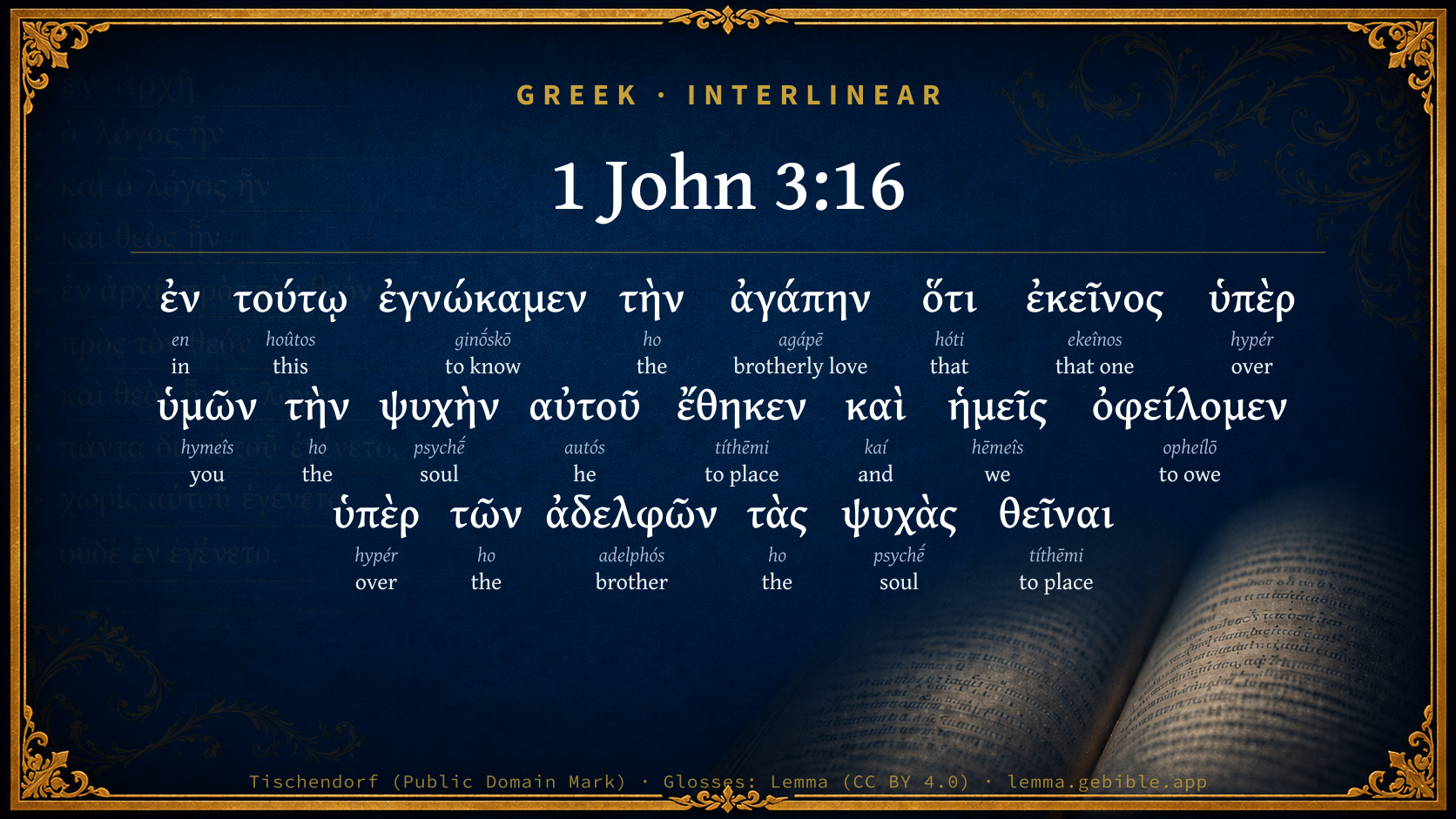
Greek (Tischendorf 8th ed.) 1 John 3:16 appears in the Greek New Testament. The text above is from the Tischendorf 8th edition. Each word links to its Strong’s number and a concise gloss. Click any word for its full Thayer’s Greek Lexicon entry.
Download image
Cite this verse

1 John 3:16 (World English Bible). Public Domain. Lemma interlinear Bible study tool, https://lemma.gebible.app/v/1-john/3/16.

Show BibTeX & RIS
BibTeX
RIS
English Translation
By this we know love, because he laid down his life for us. And we ought to lay down our lives for the brothers.
World English Bible · Public Domain
Download a study sheet

One document with this verse’s original text, its word-by-word gloss line, the meaning frame, cross-references with their text, attributed commentary, and full source and license credits — printable, and it pastes into notes with its structure intact.

This verse Autodidact and up

Study sheet (.html) Plain text (.txt)

A passage Seminary Student

Up to 50 verses in one chapter. A passage sheet keeps up to 6 commentary sources and 12 cross-references per verse, in the order this page ranks them, and says so on the sheet whenever that leaves anything out. Ask for a single verse and you get the Autodidact verse sheet above.

Everything on this page stays free to read, with no account — the sheet is a download of what is already on screen, not access to it.

Want to remove ads? Support Godless Engineer
Compare translations 3

The same verse in 3 English versions, stacked beneath the original-language interlinear above. Click any original word for its lexicon entry.

Each is an independent rendering of the whole verse — the interlinear is not word-aligned to these translations.

Highlighted words mark where these versions differ — a whole-verse word diff, not a word-by-word alignment.

  • World English Bible Public Domain
    By this we know love, because he laid down his life for us. And we ought to lay down our lives for the brothers.
  • King James Version Public Domain
    Hereby perceive we the love of God, because he laid down his life for us: and we ought to lay down our lives for the brethren.
  • unfoldingWord Literal Text CC BY-SA 4.0
    In this we have known love, that that one laid down his life for us. And we ought to lay down our lives for the brothers.

unfoldingWord Literal Text — © unfoldingWord, licensed CC BY-SA 4.0. Word-aligned USFM3 via Door43 (git.door43.org/unfoldingWord/en_ult).

Versions to compare (up to 4)

3 of 4 selected

Show all 19 translations

Every available English version of this verse, each an independent rendering of the whole verse.

  • World English Bible Public Domain
    By this we know love, because he laid down his life for us. And we ought to lay down our lives for the brothers.
  • Berean Standard Bible Public Domain
    By this we know what love is: Jesus laid down His life for us, and we ought to lay down our lives for our brothers.
  • Majority Standard Bible Public Domain
    By this we know what love is: Jesus laid down His life for us, and we ought to lay down our lives for our brothers.
  • King James Version Public Domain
    Hereby perceive we the love of God, because he laid down his life for us: and we ought to lay down our lives for the brethren.
  • American Standard Version (1901) Public Domain
    Hereby know we love, because he laid down his life for us: and we ought to lay down our lives for the brethren.
  • Revised Version (1885) Public Domain
    Hereby know we love, because he laid down his life for us: and we ought to lay down our lives for the brethren.
  • Geneva Bible (1599) Public Domain
    Hereby haue we perceiued loue, that he layde downe his life for vs: therefore we ought also to lay downe our liues for the brethren.
  • Douay-Rheims (1899) Public Domain
    In this we have known the charity of God, because he hath laid down his life for us: and we ought to lay down our lives for the brethren.
  • Young's Literal Translation Public Domain
    in this we have known the love, because he for us his life did lay down, and we ought for the brethren the lives to lay down;
  • Literal Standard Version CC BY-SA 4.0
    in this we have known love, because He laid down His life for us, and we ought to lay down [our] lives for the brothers;
  • Unlocked Literal Bible CC BY-SA 4.0
    By this we know love, because Christ laid down his life for us. We also ought to lay down our lives for the brothers.
  • unfoldingWord Literal Text CC BY-SA 4.0
    In this we have known love, that that one laid down his life for us. And we ought to lay down our lives for the brothers.
  • Darby Bible Public Domain
    Hereby we have known love, because *he* has laid down his life for us; and *we* ought for the brethren to lay down [our] lives.
  • World Messianic Bible Public Domain
    By this we know love, because he laid down his life for us. And we ought to lay down our lives for the brothers.
  • Webster's Bible Public Domain
    By this we perceive the love of God, because he laid down his life for us: and we ought to lay down our lives for the brethren.
  • Free Bible Version CC BY-SA 4.0
    This is how we know what love is: Jesus laid down his life for us, and we ought to lay down our lives for our Christian brothers and sisters.
  • Bible in Basic English Public Domain
    In this we see what love is, because he gave his life for us; and it is right for us to give our lives for the brothers.
  • Text-Critical English NT CC BY 4.0
    By this we know love, that he laid down his life for us. And we ought to lay down our lives for our brothers.
  • Tyndale New Testament (1534) Public Domain
    Herby perceave we love: that he gave his lyfe for vs: and therfore ought we also to geve oure lyves for the brethren.

Literal Standard Version (2020), Covenant Press — licensed CC BY-SA 4.0. Text via the HelloAO Bible API (eBible.org). Unlocked Literal Bible (unfoldingWord) — licensed CC BY-SA 4.0. Text via the HelloAO Bible API (eBible.org). unfoldingWord Literal Text — © unfoldingWord, licensed CC BY-SA 4.0. Word-aligned USFM3 via Door43 (git.door43.org/unfoldingWord/en_ult). Free Bible Version, Dr. Jonathan Gallagher — licensed CC BY-SA 4.0. Text via the HelloAO Bible API (eBible.org).

Word by word

More ways to search: Search by grammar → Find every occurrence → Compare this word →

Practice this passage: Drill this verse → Learn its vocabulary →

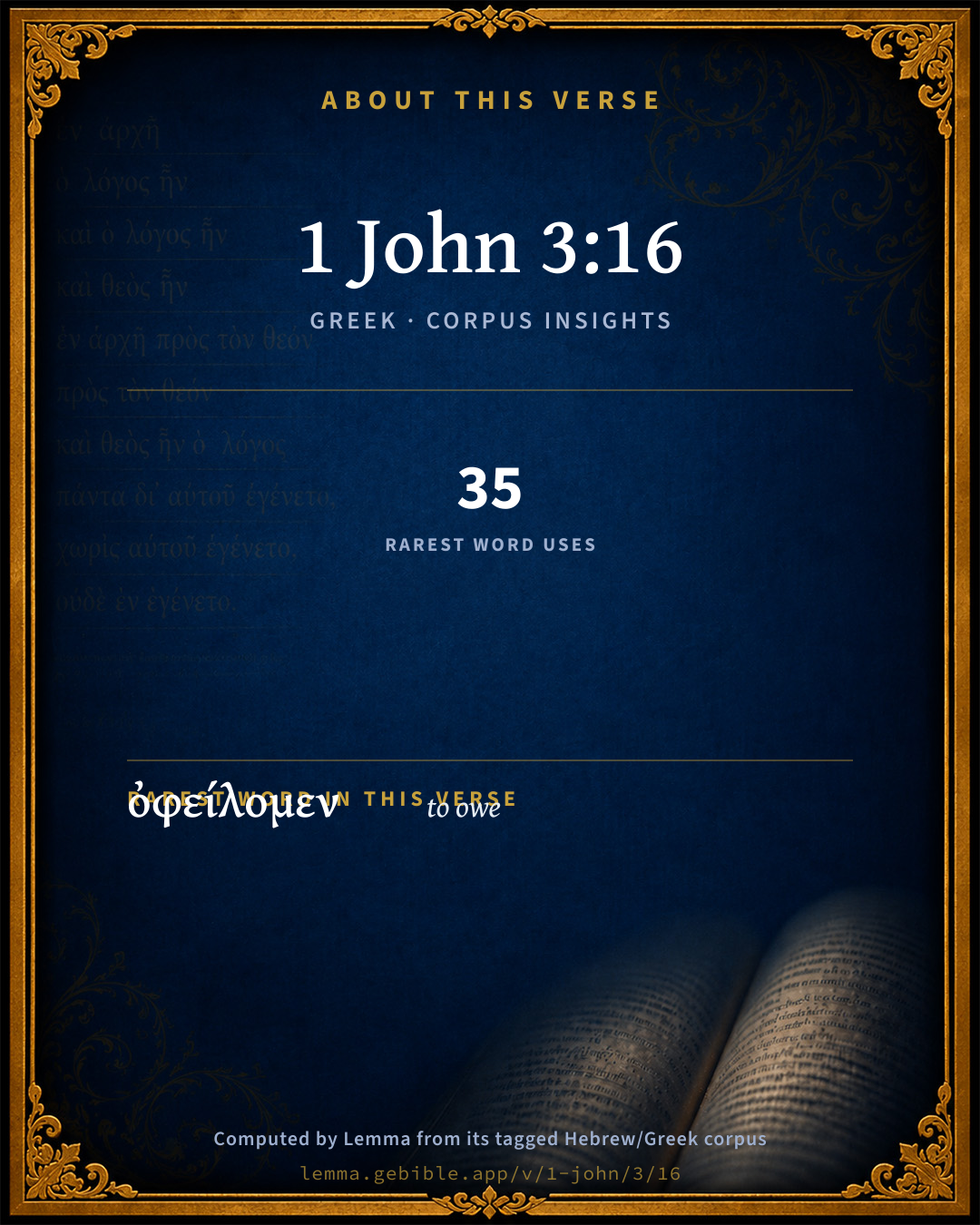
ὀφείλομεν
opheílō
G3784
“to owe”
Verb, Present, Active, Indicative, 1st person, Plural
Part of Speech
Verb
Tense
Present
Voice
Active
Mood
Indicative
Person
1st person
Number
Plural
Full Thayer's Definition

Origin: "or (in certain tenses) its prolonged form opheileo of-i-leh'-o; probably from the base of G3786 (through the idea of accruing)"

TDNT: 14:19,7

1. to owe a. to owe money, be in debt for 1. that which is due, the debt 2. metaph. the goodwill due
  1. ἐν en G1722 “in” Preposition
  2. τούτῳ hoûtos G3778 “this” Demonstrative pronoun, Dative, Singular, Neuter
  3. ἐγνώκαμεν ginṓskō G1097 “to know” Verb, Perfect, Active, Indicative, 1st person, Plural
  4. τὴν ho G3588 “the” Article, Accusative, Singular, Feminine
  5. ἀγάπην agápē G26 “brotherly love” Noun, Accusative, Singular, Feminine
  6. ὅτι hóti G3754 “that” Conjunction
  7. ἐκεῖνος ekeînos G1565 “that one” Demonstrative pronoun, Nominative, Singular, Masculine
  8. ὑπὲρ hypér G5228 “over” Preposition
  9. ὑμῶν hymeîs G5210 “you” Personal pronoun, 2nd person, Genitive, Plural
  10. τὴν ho G3588 “the” Article, Accusative, Singular, Feminine
  11. ψυχὴν psychḗ G5590 “soul” Noun, Accusative, Singular, Feminine
  12. αὐτοῦ autós G846 “he” Personal pronoun, Genitive, Singular, Masculine
  13. ἔθηκεν títhēmi G5087 “to place” Verb, Aorist, Active, Indicative, 3rd person, Singular
  14. καὶ kaí G2532 “and” Conjunction
  15. ἡμεῖς hēmeîs G2249 “we” Personal pronoun, 1st person, Nominative, Plural
  16. ὑπὲρ hypér G5228 “over” Preposition
  17. τῶν ho G3588 “the” Article, Genitive, Plural, Masculine
  18. ἀδελφῶν adelphós G80 “brother” Noun, Genitive, Plural, Masculine
  19. τὰς ho G3588 “the” Article, Accusative, Plural, Feminine
  20. ψυχὰς psychḗ G5590 “soul” Noun, Accusative, Plural, Feminine
  21. θεῖναι títhēmi G5087 “to place” Verb, Aorist, Active, Infinitive

About this verse

These counts appear in no published source. They are computed here, from the morphology-tagged text and Lemma’s own curated glosses. What Lemma adds →

22
words
16
distinct lemmas
General Epistles
section

Shared distinctive vocabulary

ὀφείλομεν to owe G3784 occurs in 34 verses of the Greek New Testament. Also found in:
Repetition

Words recur within this verse:

  • ὑπὲρ over G5228 ×2
  • ψυχὴν soul G5590 ×2
  • ἔθηκεν to place G5087 ×2
  • τὴν the G3588 ×4

Cross-references

20

Topical passages linked to 1 John 3:16 in the Treasury of Scripture Knowledge — connected by theme and wording, ordered by reader-vote popularity; previews shown in the World English Bible.

  • 1 John 4:9–11 By this was God's love revealed in us, that God has sent his one and only Son into the world that we might live through him.
  • Ephesians 5:2 Walk in love, even as Christ also loved you, and gave himself up for us, an offering and a sacrifice to God for a sweet-smelling fragrance.
  • John 13:34 A new commandment I give to you, that you love one another, just like I have loved you; that you also love one another.
  • John 3:16 For God so loved the world, that he gave his one and only Son, that whoever believes in him should not perish, but have eternal life.
  • Romans 5:8 But God commends his own love toward us, in that while we were yet sinners, Christ died for us.
  • John 15:12–13 "This is my commandment, that you love one another, even as I have loved you.
  • Revelation 1:5 and from Jesus Christ, the faithful witness, the firstborn of the dead, and the ruler of the kings of the earth. To him who loves us, and washed us from our sins by his blood;
  • 1 Peter 3:18 Because Christ also suffered for sins once, the righteous for the unrighteous, that he might bring you to God; being put to death in the flesh, but made alive in the spirit;
  • Acts 20:28 Take heed, therefore, to yourselves, and to all the flock, in which the Holy Spirit has made you overseers, to shepherd the assembly of the Lord and God which he purchased with his own blood.
  • Matthew 20:28 even as the Son of Man came not to be served, but to serve, and to give his life as a ransom for many."
  • Ephesians 5:25 Husbands, love your wives, even as Christ also loved the assembly, and gave himself up for it;
  • Titus 2:13 looking for the blessed hope and appearing of the glory of our great God and Savior, Jesus Christ;
  • 1 John 2:6 he who says he remains in him ought himself also to walk just like he walked.
  • Romans 16:4 who for my life, laid down their own necks; to whom not only I give thanks, but also all the assemblies of the Gentiles.
  • Revelation 5:9 They sang a new song, saying, "You are worthy to take the book, And to open its seals: For you were killed, And bought us for God with your blood, Out of every tribe, language, people, and nation,
  • John 10:15 even as the Father knows me, and I know the Father. I lay down my life for the sheep.
  • Philippians 2:17 Yes, and if I am poured out on the sacrifice and service of your faith, I rejoice, and rejoice with you all.
  • 1 Peter 2:24 who his own self bore our sins in his body on the tree, that we, having died to sins, might live to righteousness; by whose stripes you were healed.
  • Philippians 2:30 because for the work of Christ he came near to death, risking his life to supply that which was lacking in your service toward me.
  • 1 Peter 1:18 knowing that you were redeemed, not with corruptible things, with silver or gold, from the useless way of life handed down from your fathers,

Cross-references courtesy of OpenBible.info (CC BY 4.0).

Commentary

Notes on 1 John 3:16 from classic Christian and Jewish commentators (each source and its license shown beneath its notes). The classic Christian expositions comment on the surrounding passage and are grouped to its opening verse, so a note may address several verses; the Jewish commentaries on the Tanakh (Rashi and others) are per-verse, so they appear only where the commentator wrote on this verse.

Lemma curates 59 commentaries, every one of them public domain or Creative Commons licensed, each selected and text-cleaned for this edition rather than reprinted as found. About our sources →

Albert Barnes' Notes on the Bible

Hereby perceive we the love of God - The words “of God” are not in the original, and should not have been introduced into the translation, though they are found in the Latin Vulgate, and in the Genevan versions, and in one manuscript. They would naturally convey the idea that “God” laid down his life for us; or that God himself, in his divine nature, suffered. But this idea is not expressed in this passage as it is in the original, and of course no argument can be derived from it either to prove that Christ is God, or that the divine nature is capable of suffering. The original is much more expressive and emphatic than it is with this addition: “By this we know love;” that is, we know what true love is; we see a most affecting and striking illustration of its nature. “Love itself” - its real nature, its power, its sacrifices, its influences - was seen in its highest form, when the Son of God gave himself to die on a cross. For an illustration of the sentiment, see the notes at Joh 3:16; Joh 15:13.

Because he laid down his life for us - There can be no doubt that the Saviour is here referred to, though his name is not mentioned particularly. There are several instances in the New Testament where he is mentioned under the general appellation “he,” as one who was well known, and about whom the writers were accustomed to speak.

And we ought to lay down our lives for the brethren - For the good of our fellow Christians, if it be necessary. That is, circumstances may occur where it would be proper to do it, and we ought always to be ready to do it. The spirit which led the Saviour to sacrifice his life for the good of the church, should lead us to do the same thing for our brethren if circumstances should require it. That this is a correct principle no one can doubt; for:

(1)The Saviour did it, and we are bound to imitate his example, and to possess his spirit;

(2)The prophets, apostles, and martyrs did it, laying down their lives in the cause of truth, and for the good of the church and the world; and,

(3)It has always been held that it is right and proper, in certain circumstances, for a man to lay down his life for the good of others.

So we speak of the patriot who sacrifices his life for the good of his country; so we feel in the case of a shipwreck, that it may be the duty of a captain to sacrifice his life for the good of his passengers and crew; so in case of a pestilential disease, a physician should not regard his own life, if he may save others; and so we always hold the man up to honor who is willing to jeopard his own life on noble principles of self-denial for the good of his fellow-men. In what cases this should occur the apostle does not state; but the general principle would seem to be, that it is to be done when a greater good would result from our self-sacrifice than from carefully guarding our own lives. Thus, in the case of a patriot, his death, in the circumstances, might be of greater value to his country than his life would be; or, his exposing himself to death would be a greater service to his country, than if that should not be done.

Thus, the Saviour laid down his life for the good of mankind; thus the apostles exposed their lives to constant peril in extending the principles of religion; and thus the martyrs surrendered their lives in the cause of the church and of truth. In like manner, we ought to be ready to hazard our lives, and even to lay them down, if in that way we may promote the cause of truth, and the salvation of sinners, or serve our Christian brethren. In what way this injunction was understood by the primitive Christians, may be perceived from what the world is reported to have said of them, “Behold, how they love one another; they are ready to die for one another.” - Tertullian, Apol. c. 39. So Eusebius (Eccl. His. vii. 22) says of Christians, that “in a time of plague they visited one another, and not only hazarded their lives, but actually lost them in their zeal to preserve the lives of others.” We are not indeed to throw away our lives; we are not to expose them in a rash, reckless, imprudent manner; but when, in the discharge of duty, we are placed in a situation where life is exposed to danger, we are not to shrink from the duty, or to run away from it. Perhaps the following would embrace the principal instances of the duty here enjoined by the apostle:

We ought to have such love for the church that we should be willing to die for it, as patriot is willing to die for his country.

(2)We ought to have such love for Christians as to be willing to jeopard our lives to aid them - as in case of a pestilence or plague, or when they are in danger by fire, or flood, or foes.

(3)We ought to have such love for the truth as to be willing to sacrifice our lives rather than deny it.

(4)We ought to have such love for the cause of our Master as to be willing to cross oceans, and snows, and sands; to visit distant and barbarous regions, though at imminent risk of our lives, and though with the prospect that we shall never see our country again.

(5)We ought to have such love for the church that we shall engage heartily and constantly in services of labor and self-sacrifice on its account, until, our work being done, exhausted nature shall sink to rest in the grave. In one word, we should regard ourselves as devoted to the service of the Redeemer, living or dying to be found engaged in his cause. If a case should actually occur where the question would arise whether a man would abandon his Christian brother or die, he ought not to hesitate; in all cases he should regard his life as consecrated to the cause of Sion and its friends. Once, in the times of primitive piety, there was much of this spirit in the world; how little, it is to be feared, does it prevail now!

Albert Barnes' Notes on the Bible (1834–1885) — public domain. Text from a community e-Sword/MySword module.

The Biblical Illustrator

Joseph S. Exell

1Jn_3:16-18

Hereby perceive we the love of God, because he laid down his life for us; and we ought to lay down our lives for the brethren,

Lofty ideals perilous unless applied

Even the world sees that the Incarnation of Jesus Christ has very practical results.

Even the Christmas which the world keeps is fruitful in two of these results--forgiving and giving. Love, charity (as we rather prefer to say), in its effects upon all our relations to others, is the beautiful subject of this section of our Epistle.

I. We have here love in its idea. Hereby know we the love. It is continuous unselfishness, to be crowned by voluntary death, if death is necessary. The beautiful old Church tradition shows that this language was the language of St. Johns life. Who has forgotten how the apostle in his old age is said to have gone on a journey to find the young man who had fled from Ephesus and joined a band of robbers; and to have appealed to the fugitive in words which are the pathetic echo of these--if needs be I would die for thee as He for us?

II. The idea of charity is then practically illustrated by an incident of its opposite (verse 17). The reason for this descent in thought is wise and sound. High abstract ideas expressed in lofty language are at once necessary and dangerous for creatures like us. They are necessary, because without these grand conceptions our moral language and our moral life would be wanting in dignity, in amplitude, in the inspiration and impulse which are often necessary for duty and always for restoration. But they are dangerous in proportion to their grandeur. Men are apt to mistake the emotion awakened by the very sound of these magnificent expressions of duty for the discharge of the duty itself. Every large speculative ideal then is liable to this danger; and he who contemplates it requires to be brought down from his transcendental region to the test of some commonplace duty. It is helpful compassion to a brother who is known to be in need, manifested by giving to him something of this worlds good--of the living of this world which he possesses.

III. We have next the characteristics of love in action. My sons, let us not love in word nor with the tongue; but in work and truth. There is love in its energy and reality; in its effort and sincerity--active and honest, without indolence and without pretence.

IV. This passage supplies an argument against mutilated views, fragmentary versions of the Christian life.

1. The first of these is emotionalism, which makes the entire Christian life consist in a series or bundle of emotions. This reliance upon feelings is in the last analysis reliance upon self. It is a form of salvation by works, for feelings are inward actions.

2. The next of these mutilated views of the Christian life is doctrinalism--which makes it consist of a series or bundle of doctrines apprehended and expressed correctly, at least according to certain formulas, generally of a narrow and unauthorised character. According to this view the question to be answered is--has one quite correctly understood, can one verbally formulate certain almost scholastic distinctions in the doctrine of justification?

3. The third mutilated view of the Christian life is humanitarianism--which makes it a series or bundle of philanthropic actions. There are some who work for hospitals or try to bring more light and sweetness into crowded dwelling houses. Their lives are pure and noble. But the one article of their creed is humanity. Altruism is their highest duty. With others the case is different. Certain forms of this busy helpfulness--especially in the laudable provision of recreations for the poor--are an innocent interlude in fashionable life; sometimes, alas! a kind of work of supererogation, to atone for the want of devotion or of purity--possibly an untheological survival of a belief in justification by works.

4. Another fragmentary view of the Christian life is observationism, which makes it to consist in a bundle or series of observances. Frequent services and communions, perhaps with exquisite forms and in beautifully decorated churches, have their dangers as well as their blessings. However closely linked these observances may be, there must still in every life be interstices between them. How are these filled up? What spirit within connects together, vivifies, and unifies this series of external acts of devotion? Now, in distinction from all these fragmentary views, St. Johns Epistle is a survey of the completed Christian life, founded upon his gospel. It is a consummate fruit ripened in the long summers of his experience. It is not a treatise upon the Christian affections, nor a system of doctrine, nor an essay upon works of charity, nor a companion to services. Yet this wonderful Epistle presupposes at least much that is most precious of all these elements.

(1) It is far from being a burst of emotionalism. Yet almost at the outset it speaks of an emotion as being the natural result of rightly received objective truth (1Jn_1:4).

(2) This Epistle is no dogmatic summary. Yet combining its proemium with the other of the fourth Gospel, we have the most perfect statement of the dogma of the Incarnation.

(3) If the apostles Christianity is no mere humanitarian sentiment to encourage the cultivation of miscellaneous acts of good nature, yet it is deeply pervaded by a sense of the integral connection of practical love of man with the love of God.

(4) No one can suppose that for St. John religion was a mere string of observances. This Epistle, with its calm, unhesitating conviction of the sonship of all to whom it is addressed; with its view of the Christian life as in idea a continuous growth from a birth the secret of whose origin is given in the gospel; with its expressive hints of sources of grace and power and of a continual presence of Christ; with its deep mystical realisation of the double flow from the pierced side upon the Cross, and its thrice-repeated exchange of the sacramental order water and blood, for the historical order, blood and water; unquestionably has the sacramental sense diffused throughout it. The sacraments are not in obtrusive prominence; yet for those who have eyes to see they lie in deep and tender distances. Such is the view of the Christian life in this letter--a life in which Christs truth is blended with Christs love; assimilated by thought, exhaling in worship, softening into sympathy with mans suffering and sorrow. It calls for the believing soul, the devout heart, the helping hand. It is the perfect balance in a saintly soul of feeling, creed, communion, and work. (Bp. Wm. Alexander.)

The sacrifice of love

The laws of nature and the laws of grace come from the same Lawgiver, and they have the same fundamental quality. All life depends on this--that some one is willing to lay down his life for another. From the very earliest stages to the very oldest and highest this is the condition not only of progress but of the continuance of life. The tree grows, produces its leaf, its bud, its blossom, its fruit, in order that it may drop seeds upon the wings of the wind, or give them to the birds, that those seeds may be carried to the soil and from them other trees may spring up. And when the tree has given forth this consummation of its life, its years work is over, and it goes to sleep that it may get ready to repeat the operation next year. The annual dies in giving its life to another; the perennial does not die, but it gives its life, then ceases for a little while, gathers up its forces, and resumes its life the next year in order to repeat the gift. The babe is not dropped out of the clouds into the life of the waiting family. The mother hazards her own life that she may give a new life to the world; and when she has given it, then she begins to devote her life to it; her thoughts concentrate on it, her life flows out to it. It is for this child that the father does his work; it is for this child that the mother gives her prayers, her night watchings, her energies. Her own life is laid down for another life. The child, we say, grows older, wiser. How does it grow older? how does it grow wiser? how does it grow in wisdom and in stature? In stature, because a hundred lives are busy all over the world gathering fruit for it, and food for it, and ministering to it; and wiser, because a hundred brains are thinking for it and a hundred hearts are gathering equipment of love and pouring into it. The teacher is giving her life to her pupils, laying down her life for them. If she does not care for them, if she simply goes into the schoolroom for her six or eight hours to earn her salary, and then goes away, and no life flows out from her, she is a mere perfunctory thing and no true teacher. We build a fence around a tribe of Indians and shut them up by themselves and say, Now grow. A hundred years go by, and they are the same barbarians they were a hundred years before. Then we say, Let civilisation see what it can do with them--a selfish civilisation. We will let in the railroad, we will let in the trader, the whisky dealer, we will let in selfishness. And barbarism simply grows more barbaric; the growth is degeneracy. Not until you can find an Armstrong or a Pratt who will lay down his life for them, not until you can find men and women who will devote their lives to pouring truth and purity and life into these barbaric minds, is there growth; and the moment you find such life given, true growth begins. Life goes by transmission, and there is no hope for a lower race except as some higher race will transmit its life thereto. This is the significance of, the fundamental principle underlying, all foreign missionary service. Now, the Bible takes this generic law and carries it up a little higher. Follow up the stream to its source and you will find the springs among the hills; and these, you say, fed it. But where did these springs come from? You must look up, and there in the blue above sails the clouds; and the rainfall from these clouds has first fed the springs that fed the rills that fed the streams that made the river. So all life, its progress, its development, come from the One above all, who pours out His life that others may live. This is what love means. Love is life giving. Love is not caress. The mother does not love her child simply because she folds it to her arms and caresses it with her kisses. This is but the expression of love. Love is not joy. The mother does not love her child because a strange joy thrills her heart as she looks into babys eyes. This is simply the fruit of love. Love is giving ones life to another. To lay down ones life for another is not, then, the same as to die for another. That is very clear. Hereby we know love, that He laid down His life for us; and we ought to lay down our lives for the brethren. Ought we all to die for the brethren? Not at all. No man thinks that. But we all ought to lay down our lives for the brethren. That is another matter. To live for another may involve with it dying for another, and certainly does involve willingness to die for another, but the value is in laying down the life, not in dying. Here are two nurses going out into a city that is plague stricken. One catches the plague, dies, is buried in a nameless grave under a nameless headstone in the cemetery. The other lives through the plague and goes back to her home. One has laid down her life for the plague stricken city as truly as the other. To lay down ones life is not to die; it is only to be willing to die. But no man does lay down his life truly and really for another unless he is willing to die. If a young man goes into the medical profession, and, when pestilence appears in a house, he says, I cannot go there; I should risk my life and the life of my children, he has not laid down his life. The value of Christs life was not in the crucifixion. It was not by His death that He saved the world. I know how that sentence will be picked out, and perhaps sent abroad, and I misinterpreted; nevertheless, I repeat it--it is not by His death He saves the world, but by laying down His life for the world. Passion week began when He was born. From the beginning to the end His life was laid down for humanity. So to lay down ones life does not necessarily involve pain and suffering. It may or may not. You may be a lover without pain; you cannot be a saviour without pain. And when the Christ came into the world, bringing the message of infinite and eternal love, it was not the spear thrust that made Him the Saviour--it was the spear thrust that proved Him the Saviour; it was the spear thrust that showed that there was such love in this heart of the Christ that He was willing to die for loves sake. The Cross is the glory of Christ, because it shows how far love would carry Him in laying down His life for sinful man. Christs Cross is witness of the Divine life that is saving the world. Christ lays down His life for us. We are to lay down our lives for one another. This is the simple lesson of this communion Sunday--Life poured out from one full heart into another empty heart; from one joyous heart into an aching heart; from one pure heart into a sinful and shameful heart. (Lyman Abbott, D. D.)

The Biblical Illustrator, edited by Joseph S. Exell (c. 1880s–1900s) — public domain. Text from a community e-Sword module.

Joseph Benson's Commentary

1Jn 3:16-17. Hereby perceive we the love of God — The word God is not in the original: it seems to be omitted by the apostle just as the name of Jesus is omitted by Mary, when she says to the gardener Sir, if thou hast borne him hence, &c., Joh 20:15; in which place there is a very emphatical language, even in silence. It declares how totally her thoughts were possessed by the blessed and glorious subject. It expresses also the superlative dignity and amiableness of the person meant; as though he, and he alone, were, or deserved to be, both known and admired by all. Because he laid down his life — Not merely for sinners, but for us in particular. From this truth believed, and salvation received by that faith, the love of Christ, and, in consequence thereof, the love of the brethren, take their rise, which may very justly be admitted as an evidence that our faith is no delusion. But whoso hath this world’s good — Worldly substance, far less valuable than life; and seeth his brother have need — (The very sight of want knocks at the door of the spectator’s heart;) and shutteth up — Restraineth, whether asked or not; his bowels of compassion — Excited, it may be, by the view of misery; how dwelleth the love of God in him? — Certainly not at all, however he may talk of it, as the next verse supposes him to do. Thus the apostle having, in the preceding verse, observed, that we know the love of Christ by his laying down his life for us, and that the consideration of his love to us should induce us “so to love him as, at his call, to lay down our lives for the brethren; here tells us, that if, so far from laying down our lives for them, we refuse them, when in need, some part of our worldly goods to support their lives, the love of God can in no sense be said to be in us.”

Joseph Benson's Commentary on the Old and New Testaments (1811–1818) — public domain. Text from a community e-Sword module.

The Expositor's Bible

Chapter 13

LOFTY IDEALS PERILOUS UNLESS APPLIED

1Jn_3:16-18

Even the world sees that the Incarnation of Jesus Christ has very practical results. Even the Christmas which the world keeps is fruitful in two of these results- forgiving and giving. How many of the multitudinous letters at that season contain one or other of these things-either the kindly gift, or the tender of reconciliation; the confession "I was wrong," or the gentle advance "we were both wrong."

Love, charity (as we rather prefer to say), in its effects upon all our relations to others, is the beautiful subject of this section of our Epistle. It begins with the message of love itself-yet another asterisk referring to the Gospel, to the very substance of the teaching which the believers of Ephesus had first received from St. Paul, and which had been emphasised by St. John. This message is announced not merely as a sounding sentiment, but for the purpose of being carried out into action. As in moral subjects virtues and vices are best illustrated by their contraries; so, beside the bright picture of the Son of God, the Apostle points to the sinister likeness of Cain. After some brief and parenthetic words of pathetic consolation, he states as the mark of the great transition from death to life, the existence of love as a pervading spirit effectual in operation. The dark opposite of this is then delineated in consonance with the mode of representation just above. But two such pictures of darkness must not shadow the sunlit gallery of love. There is another-the fairest and brightest. Our love can only be estimated by likeness to it; it is imperfect unless it is conformed to the print of the wounds, unless it can be measured by the standard of the great Self-sacrifice. But if this may be claimed as the one real proof of conformity to Christ, much more is the limited partial sacrifice of "this worlds good" required. This spirit, and the conduct which it requires in the long run, will be found to be the test of all solid spiritual comfort, of all true self-condemnation or self-acquittal.

We may say of the verses prefixed to this discourse, that they bring before us charity in its idea, in its example, in its characteristics-in theory, in action, in life.

I We have here love in its idea, "hereby know we love." Rather "hereby know we The Love."

Here the idea of charity in us runs parallel with that in Christ. It is a subtle but true remark, that there is here no logical inferential particle. "Because He laid down His life for us," is not followed by its natural correlative "therefore we," but by a simple connective "and we." The reason is this, that our duty herein is not a mere cold logical deduction. It is all of one piece with The Love. "We know The Love because He laid down His life for us; and we are in duty bound for the brethren to lay down our lives."

Here, then, is the idea of love, as capable of realisation in us. It is continuous unselfishness, to be crowned by voluntary death, if death is necessary. The beautiful old Church tradition shows that this language was the language of St. Johns life. Who has forgotten how the Apostle in his old age is said to have gone on a journey to find the young man who had fled from Ephesus and joined a band of robbers; and to have appealed to the fugitive in words which are the pathetic echo of these-"if needs be I would die for thee as He for us"?

II The idea of charity is then practically illustrated by an incident of its opposite. "But whoso hath this worlds good, and gazes upon his brother in need, and shuts up his heart against him, how doth the love of God abide in him?" The reason for this descent in thought is wise and sound. High abstract ideas, expressed in lofty and transcendent language, are at once necessary and dangerous for creatures like us. They are necessary, because without these grand conceptions our moral language and our moral life would be wanting in dignity, in amplitude, in the inspiration and impulse which are often necessary for duty and always for restoration. But they are dangerous in proportion to their grandeur. Men are apt to mistake the emotion awakened by the very sound of these magnificent expressions of duty for the discharge of the duty itself. Hypocrisy delights in sublime speculations, because it has no intention of their costing anything. Some of the most abject creatures embodied by the masters of romance never fail to parade their sonorous generalisations. One of such characters, as the world will long remember, proclaims that sympathy is one of the holiest principles of our common nature, while he shakes his fist at a beggar.

Every large speculative ideal then is liable to this danger; and he who contemplates it requires to be brought down from his transcendental region to the test of some commonplace duty. This is the latent link of connection in this passage. The ideal of love to which St. John points is the loftiest of all the moral and spiritual emotions which belong to the sentiments of man. Its archetype is in the bosom of God, in the eternal relations of the Father, Son, and Holy Ghost. "God is love." Its home in humanity is Christs heart of fire and flesh; its example is the Incarnation ending in the Cross.

Now of course the question for all but one in thousands is not the attainment of this lofty ideal-laying down his life for the brethren. Now and then, indeed, the physician pays with his own death for the heroic rashness of drawing out from his patient the fatal matter. Sometimes the pastor is cut off by fever contracted in ministering to the sick, or by voluntarily living and working in an unwholesome atmosphere. Once or twice in a decade some heart is as finely touched by the spirit of love as Father Damien, facing the certainty of death from a long slow putrefaction, that a congregation of lepers may enjoy the consolations of faith. St. John here reminds us that the ordinary test of charity is much more commonplace. It is helpful compassion to a brother who is known to be in need, manifested by giving to him something of this worlds "good"-of the "living" of this world which he possesses.

III We have next the characteristics of love in action. "My sons, let us not love in word nor with the tongue; but in work and truth." There is love in its energy and reality; in its effort and sincerity-active and honest, without indolence and without pretence. We may well be reminded here of another familiar story of St. John at Ephesus. When too old to walk himself to the assembly of the Church, he was carried there. The Apostle who had lain upon the breast of Jesus; who had derived from direct communication with Him those words and thoughts which are the life of the elect, was expected to address the faithful. The light of the Ephesian summer fell upon his white hair; perhaps glittered upon the mitre which tradition has assigned to him. But when he had risen to speak, he only repeated-"little children, love one another." Modern hearers are sometimes tempted to envy the primitive Christians of the Ephesian Church, if for nothing else, yet for the privilege of listening to the shortest sermon upon record in the annals of Christianity. When Christian preachers have behind them the same long series of virgin years, within them the same love of Christ and knowledge of His mysteries; when their very presence evinces the same sad, tender, smiling, weeping, all-embracing sympathy with the wants and sorrows of humanity; they may perhaps venture upon the perilous experiment of contracting their sermons within the same span as St. Johns. And when some who, like the hearers. at Ephesus, are not prepared for the repetition of an utterance so brief, begin to ask-"why are you always saying this?"-the answer may well be in the spirit of the reply which the aged Apostle is said to have made-"because it is the commandment of the Lord, and sufficient, if it only be fulfilled indeed."

IV This passage supplies an argument (capable, as we have seen in the Introduction, of much larger expansion from the Epistle as a whole) against mutilated views, fragmentary versions of the Christian life.

There are four such views which are widely prevalent at the present time.

(1) The first of these is emotionalism; which makes the entire Christian life consist in a series or bundle of emotions. Its origin is the desire of having the feelings touched, partly from sheer love of excitement; partly from an idea that if and when we have worked up certain emotions to a fixed point we are saved and safe. This reliance upon feelings is in the last analysis reliance upon self. It is a form of salvation by works; for feelings are inward actions. It is an unhappy anachronism which inverts the order of Scripture; which substitutes peace and grace (the compendious dogma of the heresy of the emotions) for grace and peace, the only order known to St. Paul and St. John. The only spiritual emotions spoken of in this Epistle are "joy, confidence, assuring our hearts before Him": the first as the result of receiving the history of Jesus in the Gospel, the Incarnation, and the blessed communion with God and the Church which it involves; the second as tried by tests of a most practical kind.

(2) The next of these mutilated views of the Christian life is doctrinalism-which makes it consist of a series or bundle of doctrines apprehended and expressed correctly, at least according to certain formulas, generally of a narrow and unauthorised character. According to this view the question to be answered is-has one quite correctly understood, can one verbally formulate certain almost scholastic distinctions in the doctrine of justification? The well known standard-"the Bible only"-must be reduced by the excision of all within the Bible except the writings of St. Paul; and even in this selected portion faith must be entirely guided by certain portions more selected still, so that the question finally may be reduced to this shape -"am I a great deal sounder than St. John and St. James, a little sounder than an unexpurgated St. Paul, as sound as a carefully expurgated edition of the Pauline Epistles?"

(3) The third mutilated view of the Christian life is humanitarianism-which makes it a series or bundle of philanthropic actions.

There are some who work for hospitals, or try to bring more light and sweetness into crowded dwelling houses. Their lives are pure and noble. But the one article of their creed is humanity. Altruism is their highest duty. Their object, so far as they have any object apart from the supreme rule of doing right, is to lay hold on subjective immortality by living on in the recollection of those whom they have helped, whose existence has been soothed and sweetened by their sympathy. With others the case is different. Certain forms of this busy helpfulness-especially in the laudable provision of recreations for the poor-are an innocent interlude in fashionable life; sometimes, alas! a kind of work of supererogation, to atone for the want of devotion or of purity-possibly an untheological survival of a belief in justification by works.

(4) A fourth fragmentary view of the Christian life is observationism, which makes it to consist in a bundle or series of observances. Frequent services and communions, perhaps with exquisite forms and in beautifully decorated churches, have their dangers as well as their blessings. However closely linked these observances may be, there must still in every life be interstices between them. How are these filled up? What spirit within connects together, vivifies and unifies, this series of external acts of devotion? They are means to an end. What if the means come to interpose between us and the end-just as a great political thinker has observed that with legal minds the forms of business frequently overshadow the substance of business, which is their end, and for which they were called into existence. And what is the end of our Christian calling? A life pardoned; in process of purification; growing in faith, in love of God and man, in quiet joyful service. Certainly a "rage for ceremonials and statistics," a long list of observances, does not infallibly secure such a life, though it may often be not alone the delighted and continuous expression, but the constant food and support of such a life. But assuredly if men trust in any of these things-in their emotions, in their favourite formulas, in their philanthropic, works, in their religious observances-in anything but Christ, they greatly need to go back to the simple text, "His name shall be called Jesus, for He shall save His people from their sins."

Now, as we have said above, in distinction from all these fragmentary views, St. Johns Epistle is a survey of the completed Christian life, founded upon his Gospel. It is a consummate fruit ripened in the long summers of his experience. It is not a treatise upon the Christian affections, nor a system of doctrine, nor an essay upon works of charity, nor a companion to services.

Yet this wonderful Epistle presupposes at least much that is most precious of all these elements.

(1) It is far from being a burst of emotionalism. Yet almost at the outset it speaks of an emotion as being the natural result of rightly received objective truth. St. John recognises feeling, whether of supernatural or natural origin; but he recognises it with a certain majestic reserve. Once only does he seem to be carried away. In a passage to which reference has just been made, after stating the dogma of the Incarnation, he suffuses it with a wealth of emotional colour. It is Christmas in his soul; the bells ring out good tidings of great joy. "These things write we unto you, that your joy may be full."

(2) This Epistle is no dogmatic summary. Yet combining its procemium with the other of the fourth Gospel, we have the most perfect statement of the dogma of the Incarnation. As we read thoughtfully on, dogma after dogma stands out in relief. The divinity of the Word, the reality of His manhood, the effect of His atonement, His intercession, His continual presence, the personality of the Holy Spirit, His gifts to us, the relation of the Spirit to Christ, the Holy Trinity-all these find their place in these few pages. If St. John is no mere doctrinalist he is yet the greatest theologian the Church has ever seen.

(3) Once more; if the Apostles Christianity is no mere humanitarian sentiment to encourage the cultivation of miscellaneous acts of good nature, yet it is deeply pervaded by a sense of the integral connection of practical love of man with the love of God. So much is this the case, that a large gathering of the most emotional of modern sects is said to have gone on with a Bible reading in St. Johns Epistle until they came to the words -" we know that we have passed from death unto life, because we love the brethren." The reader immediately closed the book, pronouncing with general assent the verse was likely to disturb the peace of the children of God. Still St. John puts humanitarianism in its right place as a result of something higher. "This commandment have we from Him, that he who loveth God love his brother also." As if he would say-"do not sever the law of social life from the law of supernatural life; do not separate the human fraternity from a Divine Fatherhood."

(4) No one can suppose that for St. John religion was a mere string of observances. Indeed, to some his Epistle has given the notion of a man living in an atmosphere where external ordinances and ministries either did not exist at all, or only in almost impalpable forms. Yet in that wonderful manual, "The Imitation of Christ," there is scarcely the faintest trace of any of these external things; while no one could possibly argue that the author was ignorant of, or lightly esteemed, the ordinances and sacraments amongst which his life must have been spent. Certainly the fourth Gospel is deeply sacramental. This Epistle, with its calm, unhesitating conviction of the sonship of all to whom it is addressed; with its view of the Christian life as in idea a continuous growth from a birth the secret of whose origin is given in the Gospel; with its expressive hints of sources of grace and power and of a continual presence of Christ; with its deep mystical realisation of the double flow from the pierced side upon the cross, and its thrice-repeated exchange of the sacramental order "water and blood," for the historical order "blood and water"; unquestionably has the sacramental sense diffused throughout it. The Sacraments are not in obtrusive prominence; yet for those who have eyes to see they lie in deep and tender distances. Such is the view of the Christian life in this letter-a life in which Christs truth is blended with Christs love; assimilated by thought, exhaling in worship, softening into sympathy with mans suffering and sorrow. It calls for the believing soul, the devout heart, the helping hand. It is the perfect balance in a saintly soul, of feeling, creed, communion, and work.

For of work for our fellow man it is that the question is asked half despairingly -"whoso hath this worlds good, and seeth" (gazes at) "his brother have need, and shutteth up his heart against him, how doth the love of God dwell in him." Some can quietly look at the poor brother; they see him in need. They may belong to "the sluggard Pitys vision-weaving tribe," who expend a sigh of sentiment upon such spectacles, and nothing more. Or they may be hardened professors of the "dismal science," who have learned to consider a sigh as the luxury of ignorance or of feebleness. But for all practical purposes both these classes interpose a too effectual barrier between their heart and their brothers need. But true Christians are made partakers in Christ of the mystery of human suffering. Even when they are not actually in sight of brethren in want, their ears are ever hearing the ceaseless moaning of the sea of human sorrow, with a sympathy which involves its own measure of pain, though a pain which brings with it abundant compensation. Their inner life has not merely won for itself the partly selfish satisfaction of personal escape from punishment, great as that blessing may be. They have caught something of the meaning of the secret of all love-"we love because He first loved us." {1Jn_4:19} In those words is the romance (if we may dare to call it so) of the divine love tale. Under its influence the face once hard and narrow often becomes radiant and softened; it smiles, or is tearful, in the light of the love of His face who first loved. It is this principle of St. John which is ever at work in Christian lands. In hospitals it tells us that Christ is ever passing down the wards: that He will have no stinted service; that He must have more for His sick, more devotion, a gentler touch, a finer sympathy; that where His hand has broken and blessed, every particle is a sacred thing, and must be treated reverently.

Are there any who are tempted to think that our text has become antiquated; that it no longer holds true in the light of organised charity, of economic science? Let them listen to one who speaks with the weight of years of active benevolence, and with consummate knowledge of its method and duties. "There are men who, in their detestation of roguery, forget that by a wholesale condemnation of charity, they run the risk of driving the honest to despair and of turning them into the very rogues of whom they desire so ardently to be quit. These men are unconsciously playing into the hands of the Socialists and the Anarchists, the only sections of society whose distinct interest it is that misery and starvation should increase. No doubt indiscriminate almsgiving is hurtful to the State as well as to the individual who receives the dole, but not less dangerous would it be to society if the principles of these stern political economists were to be literally accepted by any large number of the rich, and if charity ceased to be practised within the land. We cannot yet afford to shut ourselves up in the castle of philosophic indifference, regardless of the fate of those who have the misfortune to find themselves outside its walls."

William Robertson Nicoll, ed., The Expositor's Bible (London: Hodder & Stoughton, 1887–1910) — public domain. 65 of 66 books (1 Corinthians is not separately keyed, as that volume carries no machine-parseable verse references); section-level commentary keyed to the opening verse. Introductory and overview sections not keyed to a specific passage are excluded.

Tyndale Open Study Notes

Tyndale Open Resources

3:16-18 Christ’s example shows that real love involves self-sacrifice. We do this by becoming truly concerned about the needs of others and by unselfishly giving time, effort, prayer, possessions, and even our lives to supply those needs.

Tyndale Open Study Notes — © Tyndale Open Resources, licensed CC BY-SA 4.0. Text via the HelloAO Bible API.

Bengel's Gnomon

Johann Albrecht Bengel

1Jn 3:16. Τὴν ἀγάπην, love) the nature of love.

Bengel's Gnomon of the New Testament — English translation (T&T Clark, Edinburgh, 1860) — public domain. Text from a community e-Sword module.

Meyer's Critical & Exegetical Commentary

Heinrich August Wilhelm Meyer

1Jn_3:16. Whilst he who belongs to the world hates his brother and is therefore an ἀνθρωποκτόνος, Christians, on the contrary, are by the example of Christ to lay down their life for their brethren.

ἐν τούτῳ refers to the following ὅτι.

ἐγνώκαμεν τὴν ἀγάπην] we have known the love, i.e. the character or the nature of the love (Bengel, de Wette, Baumgarten-Crusius, Lücke, Sander); some commentators (Carpzov, Paulus, etc.) erroneously supply with τὴν ἀγάπην as a more particular definition: τοῦ Χριστοῦ; others (Grotius, Spener, etc.): τοῦ Θεοῦ. In Christs self-devotion to death, love itself became concrete. Without adequate reason Ebrard supplies with ἐν τούτῳ an οὖσαν, so that ἐν τούτῳ forms the predicate of τὴν ἀγάπην; thus: we have known love as consisting in this; and ἐγνώκαμεν is only used as an accessory.

ὅτι ἐκεῖνος] i.e. Christ; comp. 1Jn_3:7, chap. 1Jn_2:6. He, says the apostle, without mentioning him by name, for He is to every believer the well-known, Rickli.

The phrase: τὴν ψυχὴν τιθέναι, besides here and frequently in the Gospel of John, never appears elsewhere either in the N. T. or in the classics. Meyer on Joh_10:11 explains it by the representation of the sacrificial death as a ransom paid: to lay down, to pay; according to the classical usage of τιθέναι, according to which it is used of payment; Hengstenberg (on the same passage) explains it by Isa_53:10; but it is unsuitable to supply the idea ransom or an offering for sin, for the τιθέναι τὴν ψυχήν is not merely ascribed to Christ, but is also made the duty of Christians; besides, in that case ὑπέρ could not be wanting, as is the case in the Gospel of Joh_10:17-18. The derivation of it from the Hebrew שִׂים נֶפֶשׁ בְּכַף (Ebrard) is equally unsuitable, because here the בְּכַף is essential (Meyer). According to Joh_13:4, τίθημι may in this phrase also be interpreted = deponere (so most commentators), which is so much the more appropriate as in John 10. ἵνα πάλιν λάβω αὐτήν is conjoined with τίθημι τὴν ψυχήν μου, just as in Joh_13:12 it runs: καὶ ἔλαβεν τὰ ἱμάτια αὐτοῦ; comp. animam ponere in Propert. II. 10, 43, and animam deponere in Corn. Nep. vita Hannib. I. 3 (Brückner). Perhaps τίθημι might also be taken in the meaning of to give up (Il. xxiii. 704: θεῖναι εἰς μέσσον, τιθέναι εἰς τὸ κοινόν, in Pape see τίθημι).

ὑπὲρ ἡμῶν is: for our good i.e. to save us from destruction; for the idea, comp. chap. 1Jn_2:2.

καὶ ἡμεῖς κ.τ.λ.] comp. chap. 1Jn_2:6. By this the climax is stated (Joh_15:13); but even every self-denying sacrifice for our brethren belongs to the τιθέναι τὴν ψυχήν, to which we are bound by the example of Christ by virtue of our fellowship with Him.

The reading θεῖναι is just as conformable to the N. T. usus loquendi as the Rec. τιθέναι, for ὀφείλειν is sometimes connected with the pres. inf., and sometimes with the aor. inf. For the idea, comp. Rom_16:4.[228]

[228] The thought of this verse is, according to Ebrard, the surest proof that John in this section is not treating of the general and vague (!) idea of brotherly love, but of the relation of the τέκνα Θεοῦ to those who are not τέκνα Θεοῦ, because the apostle cannot possibly limit the duty of loving sacrifice of life to the relationship of the regenerate to one another. But (1) the idea of Christian brotherly love is very far from being a vague idea; (2) when Christians are exhorted so to love one another as to lay down their lives for one another, that is not a limitation of the commandment of love; (3) those who are not τέκνα Θεοῦ, and are therefore τέκνα τοῦ διαβόλου, John cannot possibly call ἀδελφοί without any further statement; (4) the whole section is an explication of ἀγαπῶμεν ἀλλήλους, ver. 11; but by ἀλλήλους cannot be understood the children of God and the children of the devil in their relation to one another; comp. besides, 1Jn_4:2-11.

1Jn_3:16-18. Description of true love.

Meyer — Critical and Exegetical Commentary on the New Testament — English translation by Peter Christie, edited by Frederick Crombie (T&T Clark, 1880) — public domain. Text from a community e-Sword module.

Expositor's Greek Testament

ed. W. Robertson Nicoll

1Jn 3:16 . τὴν ἀγάπην , “the thing called ‘love’ ”. The love of God in Christ Jesus our Lord is the perfect type. Till the world saw that, it never knew what love is. ἐκεῖνος , Christ; see note on 1Jn 2:6 . ἡμεῖς emphatic, “we on our part”. ὀφείλομεν , see note on 1Jn 2:6 .

The Expositor's Greek Testament, edited by W. Robertson Nicoll (1897–1910) — public domain. Text from a community e-Sword module.

Alford’s Greek Testament

Henry Alford

16-18.] Description and enforcement of true love. “Exposui hactenus et probavi, quod dilectio fratrum verissima et optima nota sit discernendi filios Dei et filios diaboli. Sed ne quis hic loci vel seipsum decipiat, vel ab aliis decipiatur,.… exponendum etiam erit,.… quæ sit vera et Christiana caritas.” Seb.-Schmidt, in Düsterd.

16.] Example of true love in Christ, and enforcement of it on us. In this (on ἐν τούτῳ, see above, ver. 10, and note, ch. 2:3) we have the knowledge of (ἐγνώκαμεν, “we have arrived at and possess the apprehension of:” γινώσκειν implying knowledge as an act of the understanding proceeding on intellectual grounds. Here however it is used entirely within the sphere of the Christian life of union with Christ. None can understand true love as shewn in this its highest example, but he who is one with Christ, and has felt and does feel that love of His in its power on himself. See note on ch. 2:3) love (i. e. what love is: the nature of love true and genuine: “amoris naturam,” Bengel; “veram indolem amoris,” Rosenmüller. And Aug., “perfectionem dilectionis dicit, perfectionem illam quam commendavimus.” And so most of the Commentators. Some have held to the insertion of τοῦ θεοῦ after ἀγάπην, which has hardly any authority (only one cursive (“52”) vulg. arm-usc). So Beza, Socinus, Whitby, Grot., Seb.-Schmidt, Calov. And others, as Spener, Carpzov., Episcopius, though they do not read θεοῦ, yet would supply it, or χριστοῦ, in the sense of Rom 5:8, Joh 3:16. But there can be but little doubt that the other is the right view. The love of God to us is not that which would, as such, be adduced as a pattern to us of brotherly love; it is true that in the depth of the matter, all true love is love after that pattern: but in a passage so logically bound together it is much more probable that the term common to the two, Christ and ourselves, would be, not divine love, which as such is peculiar to Him, but love itself simply, that of which He has given the great example which we are to follow), that He (Christ, as the words beyond question shew) laid down His life for us (ψυχὴν τιθέναι, as “vitam ponere” in Latin, to lay aside life, to die: not as Grot., who in all the places where it occurs maintains that it is only “vitam objicere periculis,” which would entirely enervate the Apostle’s saying here. ὑπὲρ ἡμῶν carries in it and behind it all that we know of the nature of the death which is spoken of: but the vicariousness and atoning power of Christ’s death are not here in consideration: it is looked on here as the greatest possible proof of love, as in Joh 15:13. It is the very perversity of unsound reasoning to maintain, as Paulas (in Düsterd.), that because our imitation of Christ’s example, insisted on below, cannot have the virtue commonly ascribed to his death, therefore his death had in reality no such virtue): and we (ἡμεῖς, emphatic: we on our part, as followers of Christ) ought on behalf of the brethren to lay down our lives (on ψυχάς, Socinus says well: “Non dicit nos debere animam ponere, quasi ut unus pro multis morti sit obstrictus, sed animas, quia singuli pro singulis mori debemus.” The Apostle states the duty generally: and thus stated it is clear enough. As Christ did in pursuance of His love, so ought we to do in pursuance of ours, bound as we are to Him not by the mere force of an outward example, but by the power of an inward life. But naturally and necessarily the precept finds its application only in those cases where our Heavenly Father’s will sets the offering of such a sacrifice in the course and pursuance of our brotherly love, which He has ordained. Of such an occasion the aor. θεῖναι gives perhaps a hint: not τιθέναι, as a habit of mind ever ready: but θεῖναι, once for all, on occasion given. It is not the place here to enter on, or even to enumerate, the various cases of conscience which casuists have raised as to the question, when a Christian ought to lay down his life for a brother. The subject will be found discussed in such commentaries as those of Corn.-a-lap., Justiniani, Estius, Episcopius; and a summary is given by Düsterdieck h. l.).

Henry Alford, The Greek Testament (1849–1861) — public domain. Text from a community e-Sword module.

Geneva Bible (1599)

Geneva Bible translators

Now he showeth how far Christian charity extendeth, even so far, that according to the example of Christ, every man forget himself, to provide for and help his brethren.

Geneva Bible (1599) marginal notes — public domain. Text via Bolls.life.

Jamieson, Fausset & Brown

Robert Jamieson, A. R. Fausset & David Brown

What true love to the brethren is, illustrated by the love of Christ to us.

Hereby--Greek, "Herein."

the love of God--The words "of God" are not in the original. Translate, "We arrive at the knowledge of love"; we apprehend what true love is.

he--Christ.

and we--on our part, if absolutely needed for the glory of God, the good of the Church, or the salvation of a brother.

lives--Christ alone laid down His one life for us all; we ought to lay down our lives severally for the lives of the brethren; if not actually, at least virtually, by giving our time, care, labors, prayers, substance: Non nobis, sed omnibus. Our life ought not to be dearer to us than God's own Son was to Him. The apostles and martyrs acted on this principle.

Jamieson, Fausset & Brown — Commentary Critical and Explanatory on the Whole Bible (1871) — public domain (CC PDM 1.0). Text via the HelloAO Bible API.

Adam Clarke's Commentary

Verse 16. Hereby perceive we the love of God] This sixteenth verse of this third chapter of John's first epistle is, in the main, an exact counterpart of the sixteenth verse of the third chapter of St. John's gospel: God so loved the world, that he gave his only-begotten Son, c. Here the apostle says, We perceive, εγνωκαμεν, we have known, the love of God, because he laid down his life for us. Of God is not in the text, but it is preserved in one MS., and in two or three of the versions but though this does not establish its authenticity, yet τουθεου, of God, is necessarily understood, or τουχριστου, of Christ, as Erpen's Arabic has it; or αυτουειςημας, his love to us, as is found in the Syriac. A higher proof than this of his love Christ could not have possibly given to the children of men.

We ought to lay down our lives for the brethren.] We should risk our life to save the lives of others; and we should be ready to lay down our lives to redeem their souls when this may appear to be a means of leading them to God.

Adam Clarke's Commentary on the Bible (1810–1826) — public domain. Text from a community e-Sword/MySword module.

John Calvin's Commentaries

16 Hereby perceive we, or, By this we know. He now shews what true love is; for it would not have been enough to commend it, unless its power is understood. As an instance of perfect love, he sets before us the example of Christ; for he, by not sparing his own life, testified how much he loved us. This then is the mark to which he bids them to advance. The sum of what is said is, that our love is approved, when we transfer the love of ourselves to our brethren, so that every one, in a manner forgetting himself, should seek the good of others.

It is, indeed, certain, that we are far from being equal to Christ: but the Apostle recommends to us the imitation of him; for though we do not overtake him, it is yet meet, that we should follow his steps, though at a distance. Doubtless, since it was the Apostle’s object to beat down the vain boasting of hypocrites, who gloried that they had faith in Christ though without brotherly love, he intimated by these words, that except this feeling prevails in our hearts, we have no connection with Christ. Nor does he yet, as I have said, set before us the love of Christ, so as to require us to be equal to him; for what would this be but to drive us all to despair? But he means that our feelings should be so formed and regulated, that we may desire to devote our life and also our death, first to God, and then to our neighbors.

There is another difference between us and Christ, — the virtue or benefit of our death cannot be the same. For the wrath of God is not pacified by our blood, nor is life procured by our death, nor is punishment due to others suffered by us. But the Apostle, in this comparison, had not in view the end or the effect of Christ’s death; but he meant only that our life should be formed according to his example.

John Calvin's Commentaries (1540-1563) — public domain. Text from the Calvin Translation Society English edition (1840s-50s) via the Christian Classics Ethereal Library (ccel.org). Calvin's coverage is partial (roughly two-thirds of the Bible); uncommented books and verses are honest gaps, never fabricated. The 19th-century editor's footnotes and remarks are omitted so the notes are faithfully Calvin's own voice.

The Cambridge Bible for Schools and Colleges

gen. ed. J. J. S. Perowne

16. Hereby perceive we the love of God] Better, Herein know we love: see on 1Jn_2:3. The Greek is literally, ‘we have perceived,’ and therefore we know, as R. V., and there is no ‘of God’. The A. V. here collects the errors of other Versions: Tyndale and Cranmer have ‘perceave’, Wiclif and the Rhemish insert ‘of God’; the Genevan is right on both points, ‘Herby have we perceaved love.’ We have obtained the knowledge of what love is, in the concrete example of Christ’s vicarious death. Christ is the archetype of self-sacrificing love, as Cain is of brother-sacrificing hate. Love and hate are known by their works.

because he laid down his life] For ‘herein’ followed by ‘because’ see on 1Jn_2:3. ‘To lay down’ may mean either ‘to pay down’ in the way of ransom or propitiation, or simply ‘to lay aside.’ Classical usage sanctions the former interpretation: Demosthenes uses the verb (τίθεσθαι) of paying interest, tribute, taxes. And this is supported by ‘for us’ (ὑπὲρ ἡμῶν), i.e. ‘on our behalf’. But ‘I lay down My life that I may take it again’ (Joh_10:17-18), and ‘layeth aside His garments’ (Joh_13:4; comp. Joh_13:12), are in favour of the latter: they are quite against the rendering ‘He pledged His life’. The phrase ‘to lay down one’s life’ is peculiar to S. John (Joh_10:11; Joh_10:15; Joh_10:17, Joh_13:37-38, Joh_15:13). In Greek the pronoun (ἐκεῖνος as in 1Jn_2:6 and 1Jn_3:7) marks more plainly than in English who laid down His life: but S. John’s readers had no need to be told.

and we ought] The ‘we’ is emphatic: this on our side is a Christian’s duty; he ‘ought himself also to walk even as He walked’ (1Jn_2:6). The argument seems to shew that though ‘the brethren’ specially means believers, yet heathen are not to be excluded. Christ laid down His life not for Christians only, ‘but also for the whole world’ (1Jn_2:2). Christians must imitate Him in this: their love must be (1) practical, (2) absolutely self-sacrificing, (3) all-embracing. ‘God commendeth His own love toward us, in that, while we were yet sinners, Christ died for us’ (Rom_5:8). Tertullian quotes this dictum of the Apostle in urging the duty of martyrdom: “If he teaches that we must die for the brethren, how much more for the Lord” (Scorp. xii.). Comp. Pro_24:11. See on 1Jn_4:18.

The Cambridge Bible for Schools and Colleges (gen. ed. J. J. S. Perowne; Cambridge University Press, 1878–1918) — public domain. Text from a community e-Sword module.

John Gill's Exposition

But whoso hath this world's good,.... The possessions of this world, worldly substance, the temporal good things of it; for there are some things in it, which are honestly, pleasantly, and profitably good, when used lawfully, and not abused, otherwise they are to the owner's hurt: or "the living of this world"; that which the men of the world give up themselves to, are bent upon, and pursue after; or on which men live, and by which life is maintained, and preserved, and made comfortable in the present state of things; such as meat, drink, apparel, money, houses, lands, &c. The Ethiopic version renders it, "he that hath the government of this world"; as if it pointed at a person that is in some high office of worldly honour and profit, and is both great and rich; but the words are not to be restrained to such an one only, but refer to any man that has any share of the outward enjoyments of life; that has not only a competency for himself and family, but something to spare, and especially that has an affluence of worldly substance; but of him that has not, it is not required; for what a man distributes ought to be his own, and not another's, and in proportion to what he has, or according to his ability:

and seeth his brother have need; meaning, not merely a brother in that strict and natural relation, or bond of consanguinity; though such an one in distress ought to be, in the first place, regarded, for no man should hide himself from, overlook and neglect his own flesh and blood; but any, and every man, "his neighbour", as the Ethiopic version reads, whom he ought to love as himself; and especially a brother in a spiritual relation, or one that is of the household of faith: if he has need; that is, is naked and destitute of daily food, has not the common supplies of life, and what nature requires; and also, whose circumstances are low and mean, though not reduced to the utmost extremity; and if he sees him in this distress with his own eyes, or if he knows it, hears of it, and is made acquainted with it, otherwise he cannot be blameworthy for not relieving him.

And shutteth up his bowels of compassion from him; hardens his heart, turns away his eyes, and shuts his hand; has no tenderness in him for, nor sympathy with his distressed brother, nor gives him any succour: and this shows, that when relief is given, it should be not in a morose and churlish manner, with reflection and reproach, but with affection and pity; and where there is neither one nor the other,

how dwelleth the love of God in him? neither the love with which God loves men; for if this was shed abroad in him, and had a place, and dwelt in him, and he was properly affected with it, it would warm his heart, and loosen his affections, and cause his bowels to move to his poor brother: nor the love with which God is loved; for if he does not love his brother whom he sees in distress, how should he love the invisible God? Jo1 4:20; nor that love which God requires of him, which is to love his neighbour as himself.

John Gill's Exposition of the Whole Bible (1746–1763) — public domain (CC PDM 1.0). Text via the HelloAO Bible API.

Trapp's Complete Commentary

John Trapp

16 Hereby perceive we the love of God, because he laid down his life for us: and we ought to lay down our lives for the brethren.

Ver. 16. Because he laid down] {See Trapp on "Joh 15:13"} {See Trapp on "Rom 5:8"}

We ought also to lay down our lives] If Pylades can offer to die for Orestes merely for a name, or out of carnal affection at the best; should not Christians lay down their own necks one for another, as Aquila and Priscilla did for Paul? Rom 16:4.

John Trapp, A Commentary or Exposition upon All the Books of the Old and New Testament (1647–1656) — public domain. Text from a community e-Sword module.

Haydock's Catholic Bible Commentary

The charity of God,[2] because he hath laid down his life for us. Jesus Christ, therefore, who laid down his life for us, was God. It is true at present the words of God are wanting in most Greek manuscripts: yet the Protestant translation has them. (Witham)

===============================

[BIBLIOGRAPHY]

Charitatem Dei, Greek: tou Theou: scarce in any manuscripts nor read by St. Augustine in his commentary on this verse.

====================

George Leo Haydock (1774–1849), Haydock's Catholic Family Bible and Commentary, 1859 edition — public domain. Excludes Psalms (Douay-Rheims chapter numbering differs from Protestant) and Deuterocanonical books (Catholic canon only).

Matthew Poole's English Annotations

He laid down his life for us: the intimate union between the Divine nature and the human in Christ, gives ground for the calling Christ’s life as man the life of God; as, Act 20:28, his blood is said to be God’s

own blood. And this testimony of God’s love to us, his laying down his life for us, ought so to transform us into his likeness, that out of the power of that Divine principle, the love of God in us, (so that implanted love is called, 1Jo 3:17,

the love of God), we should never hesitate, or make a difficulty, to lay down our lives for the Christian community, or even for the common good and welfare of men, being duly called thereto.

Matthew Poole's English Annotations on the Holy Bible (1683–1685) — public domain. Text from a community e-Sword/MySword module.

Whedon's Commentary on the Bible

Daniel D. Whedon

16. Of God, as the italics indicate, is not in the Greek, and should be omitted. He has no antecedent, and refers to our true Abel, the unnamed Jesus. Between him, the Unnamed, and Cain is a solemn contrast; the latter exemplifies what hate is in its completion, the former the consummation of love. As hate is the element that murders a brother, so love is the element that would die for a brother.

Daniel D. Whedon (gen. ed.), Commentary on the Old and New Testaments (1874–1909) — public domain. Text from a community e-Sword module.

The Pulpit Commentary

Vers. 16, 17. The nature of love as shown by Christ, and its obligation on Christians. Love has been declared the criterion for distinguishing the children of God from the children of the devil. It remains to show what love is; and this is best seen in a concrete example. "The Eternal Word, incarnate and dying for the truth, inspires St. John to guard it with apostolic chivalry; but also this revelation of the heart of God melts him into tenderness towards the race which Jesus has loved so well. To St. John a lack of love for men seems sheer dishonour to the love of Christ" (Liddon).

In this; (verse 10 1Jn_2:3) we have come to know (have acquired and possess the knowledge of) love (what love is), in that he laid down his life for us. This is better than "We have come to know love as consisting in this, that he laid down his life for us," which would have been ejn toutw ou+san. Cain is the type of hate; Christ, of love. Cain took his brother"s life to benefit himself; Christ laid down his own life to benefit his enemies. (see on Joh_10:12) This realized ideal of love we mustimitate; ready to sacrifice ourselves, and even our lives, for the good of others. The effacement of another"s rights and perhaps existence for one"s own sake is the essence of hatred; the effacement of one"s self for another"s sake is the essence of love. Christ died for those who hated him; and the Christian must confront the hatred of the world with a love that is ready even to die for the haters. This shows that the "brethren" here and in verse 14, though used primarily of Christians, does not exclude unbelievers; otherwise the parallel with Christ would be spoiled (see on verse 10).

Vers. 16-18.

The exhibition and obligation of true love.

perceive we the love of God, because he laid down his life for us," etc. Our subject naturally divides itself into two main branches.

I THE EXHIBITION OF THE NATURE OF TRUE LOVE. "Hereby know we love, because he laid down his life for us." "The meaning is not," as Ebrard says, "wherein we (subjectively) have perceived love, but in what (objectively) the nature of love consists.

1. It is of the nature of love to make sacrifices. Love is essentially communicative. It seeks to impart itself and its treasures to others. It does not ask What shall I receive? but What shall I give? It takes upon itself the burdens and sorrows of others.

2. The greatest sacrifice is the surrender of life. The strongest self-love in human nature is that of life. Man will perform any labours, confront any perils, make almost any sacrifice, to save his life. "All that a man hath will he give for his life." Therefore the surrender of life is the costliest sacrifice that even true love can offer. "Greater love hath no man than this, that a man lay down his life for his friends;" "Hereby know we love, because he laid down his life for us.

3. But Christ sacrificed his life for his enemies. "For us." That it was for sinners is not mentioned here; but it is elsewhere. "Herein is love, not that we loved God, but that he loved us," etc.. (1Jn_4:10) "Christ died for the ungodly," etc.. (Rom_5:6-8) And the manner in which his life was sacrificed was most painful. He was "obedient unto death, even the death of the cross." The derision and degradation, the ignominy and anguish, associated with his great self-sacrifice were such that death itself was but a small portion of what he endured for us. Behold, then, in him who laid down his life for us what genuine love is.

II THE OBLIGATION TO EXERCISE TRUE LOVE. "And we ought to lay down our lives for the brethren. But whoso hath the world"s goods," etc. It is implied that all true love is one in its essential nature; the love in the heart of God and pure love in the heart of man are alike in kind; the love which we ought to exercise should resemble that of our Lord Jesus Christ. It should be like his, not in its degree, but in its character; not in its intensity and force, but in its kind. Like his in extent and degree our love can never be; for his is infinite, ours must ever be finite. "A pearl of dew will not hold the sun, but it may hold a spark of its light. A child, by the sea, trying to catch the waves as they dash in clouds of crystal spray upon the sand, cannot hold the ocean in a tiny shell, but he may hold a drop of the ocean water." So our love, though utterly unlike Christ"s in its measure, may be like it in its essential nature it may be as a spark from the infinite fire. Two forms of expression of genuine affection are here set forth as obligatory.

1. Willingness to make the great sacrifice for our brethren. "We ought to lay down our lives for the brethren." The principle, as we apprehend it, may be thus stated, that, when a greater good will be accomplished by the sacrifice of our life than by the saving of it, we should be willing to surrender it. We should have such love for the brethren as would inspire us to lay down our life for them, if it were necessary, and we could thereby effectually promote their salvation. Such was the love of St. Paul: "Yea, and if I am offered upon the sacrifice and service of your faith, I joy, and rejoice with you all." Love which would enable us to imperil our life if by so doing we may save others from death. Such love for our Lord and Saviour as would lead us to choose death rather than deny him. Such love for his cause as would impel us to sacrifice our comforts, our home, and even life itself, if thereby we may advance its interests and spread its triumphs. So St. Paul: "I hold not my life of any account, as dear unto myself, so that I may accomplish my course, and the ministry which I received from the Lord Jesus, to testify the gospel of the grace of God." And zeal in this cause is surely one of the highest forms of love for our brethren.

2. Readiness to relieve the needs of our brethren. "But whoso hath the world"s goods, and beholdeth his brother in need," etc. (verse 17). True love expresses itself not only in great and heroic acts, but in little deeds of thoughtful kindness, in lowly ministries to the poor and needy. Our Lord not only gave his life for men, but he helped them in other ways. He fed the hungry thousands. (Mar_8:1-9) He vindicated the loving woman who, having anointed him with her costly perfume, was blamed for so doing. (Mat_26:6-13) He prepared a meal for his hungry, weary, and discouraged disciples. (Joh_21:4-13) We ought to imitate him in this respect. We shall not fail to do so if true love dwells in our hearts. If we do not help our needy brethren when it is in our power to do so, it is clear that a love like Christ"s is not in us. Look at the case stated in the text.

(1) Here is a brother requiring help a "brother in need.

(2) Here is another who has power to render the help which is needed. He "hath the world"s goods the things needful for the sustenance of the bodily life.

(3) The latter is aware of the need of the former. He "beholdeth his brother in need;" he has not only seen, but looked upon, considered, his needy brother.

(4) Yet he does nothing to relieve the need; he bestows nothing out of his store to supply the wants of his brother; he closes his heart against him.

(5) "How doth the love of God abide in him?" Whatever may be his professions, his conduct proves him destitute of Divine love.

children, let us not love in word, neither with the tongue; but in deed and in truth." Let our love be not merely a profession, but a reality; not an empty sentiment, but a hearty service. Let the beneficence of our hand be joined with the benevolence of our heart. In the spirit of our Lord, let us give to our brethren, not only genuine sympathy, but generous self-sacrifice whenever it is needful so to do. W.J.

Vers. 16-18.

Love others, for God hath loved thee!

Connecting link: The great contrast has been presented between the love abiding in those who have passed from death unto life and the enmity abiding in the world. That hatred has been illustrated by a reference to Cain, and believers are told they must not be surprised if the murderous spirit still survives. The apostle then reverts to his favourite theme love. He seems to say, "As for us, we have learnt a different lesson. We have come to know ejgnwka "the love" the words "of God" are not in the Greek nor the Revised Version the supreme love in the universe. The lesson it has taught us is that we ought to love as God loves. He emphatic laid down his life for us: we ought to lay down our lives for the brethren." Divine love has not merely been taught us merely in a book, or by teachers, but in the most stupendous act of self-sacrifice that was possible either in heaven or on earth. If, after this, any one can close up his heart against a needy brother, it is too clear that no love, either of God, or like to God"s, dwells in him. Be it ours to show, as God has shown, that with us, love is not merely in word, but also in power. TopicThe supreme love: its act and its lessons.

I LET US STUDY LOVE"S GREATEST ACT. "He ejkeinov laid down his life for us." We have already had one study in God"s love (homily on verse 2). But the theme is exhaustless. The precise point here is that by what God has done for us we have come to learn the supreme love; such a love as outshines all else a love which is not only unique as a model, but also as a creative power! Nine features thereof may here be suggested.

1. Love in its highest origin. God. (cf 1Jn_4:10)

2. Love"s manifestation. Through the Son.

3. Love"s channel. The incarnate Son.

4. Love"s method. "Laid down his life.

5. Love"s meaning in its method. "A propitiation"; (1Jn_2:1, 2 4:10) "A demonstration of righteousness"; (Rom_3:20, Rom_3:21) "An offering for sin". (Heb_9:26-28)

6. Love under strangest circumstances. "When we were yet sinners"; (Rom_5:8) "Ye who sometime were alienated," etc. (Col_1:21; cf. Rom_5:6)

1. Love"s extent. "A propitiation for the sins of the whole world"; (1Jn_2:2) "He died for all". (2Co_5:15)

2. Love"s intent. To save from sin. To purify. To remove for ever the onestumbling-block and bar to human progress. To see men perfect. (cf Eph_5:25-28; Col_1:26-28; Tit_2:14) This this is love; this is the love; herein is love. This is the supreme lesson taught us in Christthat the supreme energy is infinite, eternal, boundless, out-gushing love! Mr. Herbert Spencer tells us that "amid the mysteries which become the more mysterious the more they are thought about, there will remain the one absolute certainty that we are ever in presence of an Infinite and Eternal Energy, from which all things proceed" (Nineteenth Century, January, 1884). Where the agnostic ends, acknowledging that there is an Infinite Energy, though he knows not what it is, the gospel messenger begins, and says, "That Energy I declare unto you." The Infinite Energy is a self-existing, self-outpouring love! a love that makes the greatest possible sacrifice in order to redeem the lost!

II LET US LEARN LOVE"S GREATEST LESSON. How much the lesson of love needed to be taught can only be learnt from the study of the period at which the Apostle John wrote. The space at our disposal forbids our doing more than to refer the student to works touching thereon. This love of God for man is seen to have a fivefold effect.

1. It teaches new truth about man.

(1) That man is very precious in the eye of God.

(2) That the life of self-sacrifice on behalf of man is the noblest possible expenditure of spiritual energy.

(3) That when so expended, it should be for the purpose

(a) of removing obstructions to human advancement, whether

(a) from within or

(b) from without; and

(b) of creating and sustaining such new forces as will raise him in the scale of being.

(4) That to teach us all this, Heaven itself has led the way. The highest Being in the universe finds his highest glory in stooping to redeem and save!

1. It creates a new duty, viz. that of laying ourselves out for others. "And we ought," etc. The vastly higher plane to which the revelation of Divine love lifted human nature, ipso facto made the claims of manhood on redeemed and sanctified man enormously greater than before. It warranted and even demanded the "enthusiasm of humanity." The measure of self-devotion to others" weal, indicated in the words, "we ought to lay down our lives for the brethren," is very far greater than the phrase just quoted implies. The Church of God has "left its first love;" a return to it would revolutionize and regenerate society.

2. It becomes a new inspiration in man. Of this the text, looked at historically, is a proof. Such precepts as it contains were never considered a part of human duty till God so loved the world. The apostles and the early Christians had learnt of God to love one another and to do good unto all men.

3. It at once led to the adoption of a new test of character. E.g., take the case of a rich man and a poor one of Dives and Lazarus. "Whoso hath this world"s good biov, and seeth his brother have need," etc. In such a hard-hearted one it is perfectly clear the love of God does not dwell, i.e., either the love which is like God"s, or which he imparts, or which he commands, or of which he is the Object. For love to God is nothing if it be not loyal. He commands us to love our brethren. Therefore, if we do not, we cannot truly love God.

4. It supplies a new and tender persuasive plea. "Let us not love in word, neither in tongue, but in deed and in truth." In every case our love is to become a practical power. If a man, out of passionate love for his Lord, spends his strength in defending the doctrines of the gospel, it is so far well. But in doing this, his work is but half-done. He is equally bound to devote himself to insisting on the practice of the gospel, and to inspire men to practical philanthropy as well as to penitence and faith. And while the former ages have been those in which Christian doctrines had

(1) to be formulated, and

(2) then to be defended, the great work for Christians and Churches in this age is practically to apply them by exercising philanthropy in every needed form. Not by the lavish and indiscriminate distribution of alms, but by making people strong enough to do without them. (cf Act_3:6) And he will best carry out the "imitation of God" (Eph_5:1) who takes some distinctive part in removing stumbling-blocks out of the people"s way, and in leading them, by the grace of God, to repent of sin, to turn to God, and to live on the Lord Jesus for power to tread the right way. Let each one choose his own department of duty, and be faithful therein. There is variety enough for all. Some may work in the home, some in the school, some in the Church, some in the state; some on sacred lines, others on secular. But be it in the direction of removing a bane, or supplying a boon, by means whereof the people may be made happier, cleaner, purer, kinder, holier. In any or all of these a man may prove the love of God in him to be a practical force, yea, the restorative power of the world!

We confess we are jealous for the honour of our glorious faith. We see men by thousands deserting the Christian camp because they think Christianity has nothing to say to the temporal concerns of working men. We see secularists and others taking up such questions, and coming to the front as the working men"s benefactors! and all because we Christians have so much more ground yet to occupy in working out and solving the social problems of the age. Oh! let us to the fore at once in God"s Name, and, inspired by everlasting love, let us show to men of every class and calling that while there is not a sin of man against man which the gospel does not condemn, neither is there a right of man which the gospel does not press on his behalf, when it summons us to be "imitators of him" who laid down his life to save our race.

The Pulpit Commentary (1880–1919), ed. H.D.M. Spence-Jones & Joseph S. Exell — public domain. Text from a community e-Sword module.

John Wesley's Explanatory Notes

The word God is not in the original. It was omitted by the apostle just as the particular name is omitted by Mary, when she says to the gardener, "Sir, if thou hast born him hence;" and by the church, when she says, "Let him kiss me with the kisses of his mouth," So i, 2; in both which places there is a language, a very emphatical language, even in silence. It declares how totally the thoughts were possessed by the blessed and glorious subject. It expresses also the superlative dignity and amiableness of the person meant, as though He, and He alone, was, or deserved to be, both known and admired by all. Because he laid down his life - Not merely for sinners, but for us in particular. From this truth believed, from this blessing enjoyed, the love of our brethren takes its rise, which may very justly be admitted as an evidence that our faith is no delusion.

John Wesley, Explanatory Notes Upon the Whole Bible (1754–1765) — public domain. Text via the GEBible commentary corpus.

Burkitt's Expository Notes on the New Testament

William Burkitt

Here our apostle presses brotherly love from another argument, namely, from the example of Jesus Christ, who being God, as well as man, laid down his life, as man, for us.

Where note, That the intimate union betwixt the divine and human nature in Christ, gives ground for the calling Christ’s life, as man, the life of God: as his blood is said, Act 20:28 to be God’s own blood; Hereby perceive we the love of God, that is, of Jesus Christ the Redeemer, in that he laid down his life for us.

Thence learn, That the death of Christ for us is a special manifestation of his singular love unto us.

Observe farther, The inference which our apostle draws from Christ’s love in laying down his life for us, namely, that we therefore ought to lay down our lives for the brethren: That is, in a time of persecution, when the glory of God, the edification of the church, and the eternal salvation of our brethren, do require it, and stand in need of it: We must never stick at laying down our lives when God calls us to it, as needful for better ends than our lives. It is not needful that we live, but needful and necessary that we glorify God, both in life and death.

William Burkitt's Expository Notes on the New Testament (1700–1703) — public domain. Text from a community e-Sword module.

The People's New Testament

B. W. Johnson

16. Hereby perceive we the love. The love of God in Christ is meant. His love is shown on the cross. Christ is love. If we love as he loved, we must be willing even to die for each other.

B. W. Johnson's The People's New Testament with Notes (1889–1891) — public domain. Electronic text from the Christian Classics Ethereal Library (CCEL) ThML edition.

unfoldingWord translationNotes

Door43 World Missions Community

Christ laid down his life for us

This expression means "Christ willingly gave his life for us" or "Christ willingly died for us" (See: Idiom)

the world's goods

material possessions like money, food, or clothing

sees his brother in need

"realizes a fellow believer needs help"

shuts up his heart of compassion from him

Here "heart" is a metonym for "thoughts" or "emotions." Here "shuts up his heart of compassion" is a metaphor for no longer showing someone compassion. AT: "does not show him compassion" or "does not willingly help him" (See: Metonymy and Metaphor)

how does the love of God remain in him?

John uses a question to teach his audience. AT: "God's love is not in him" (See: Rhetorical Question)

My dear children

John was an elderly man and their leader. He used this expression to show his love for them. See how you translated this in 1 John 2:1. AT: "My dear children in Christ" or "You who are as dear to me as my own children" (See: Metaphor)

let us not love in word nor in tongue, but in actions and truth

The phrases "in word" and "in tongue" both refer to what a person says. The word "love" is understood in the second part of the sentence. AT: "do not just say that you love people, but show that you truly love people by helping them" (See: Doublet and Metonymy and Ellipsis)

translationWords

love

Christ

heart

compassion

word

tongue

true

unfoldingWord translationNotes — © Distant Shores Media and the Door43 World Missions Community, licensed CC BY-SA 4.0. Source: git.door43.org/Door43/en_tn.

Cambridge Greek Testament for Schools and Colleges

16. For τιθέναι ([635][636]) read θεῖναι ([637][638][639][640]).

[635] 9th century. All three Epistles.

[636] 9th century. All three Epistles.

[637] 4th century. Discovered by Tischendorf in 1859 at the monastery of S. Catherine on Mount Sinai, and now at Petersburg. All three Epistles.

[638] 5th century. Brought by Cyril Lucar, Patriarch of Constantinople, from Alexandria, and afterwards presented by him to Charles I. in 1628. In the British Museum. All three Epistles.

[639] 4th century. Brought to Rome about 1460. It is entered in the earliest catalogue of the Vatican Library, 1475. All three Epistles.

[640] 5th century. A palimpsest: the original writing has been partially rubbed out and the works of Ephraem the Syrian have been written over it. In the National Library at Paris. Part of the First and Third Epistles; 1Jn 1:1 to 1Jn 4:2; 3Jn 1:3-14. Of the whole N.T. the only Books entirely missing are 2 John and 2 Thessalonians.

16. ἐν τούτῳ ἐγνώκαμεν τ. ἀγ. The A.V. here collects the errors of previous Versions. Tyndale and Cranmer have ‘perceave we.’ Wiclif, Purvey, and the Rhemish insert ‘of God’ from the Vulgate without any support from Gk. MSS. The Genevan is right on both points; ‘Hereby have we perceaved love.’ Better, as R.V., Hereby know we love. Why not ‘Herein’? In the concrete example of Christ’s vicarious death we have obtained the knowledge of what love is. Christ is the archetype of self-sacrificing love, as Cain is of brother-sacrificing hate. Love and hate are known by their works. The article has its full force; τὴν ἀγάπην, love in its very essence: comp. 1Jn 4:10. The Vulgate here, as in 1Jn 4:16, inserts Dei after caritas: Western interpolation.

ὄτι … ἔθηκεν. For ἐν τούτῳ followed by ὅτι see on 1Jn 2:3. Τιθέναι may mean ‘to pay down’ in the way of ransom or propitiation, or simply ‘to lay aside.’ Classical usage sanctions the former interpretation: Demosthenes uses the verb of paying interest, tribute, taxes. And this is supported by ‘for us’ (ὑπὲρ ἡμῶν), i.e. ‘on our behalf.’ But ‘I lay down My life that I may take it again’ (Joh 10:17-18), and ‘layeth aside His garments’ (Joh 13:4; comp. Joh 13:12), are in favour of the latter: they are quite against the rendering ‘He pledged His life.’ The phrase τιθέναι τὴν ψυχὴν αὑτοῦ is peculiar to S. John (Joh 10:11; Joh 10:15; Joh 10:17; Joh 13:37-38; Joh 15:13). In Greek the pronoun (ἐκεῖνος as in 1Jn 2:6 and 1Jn 3:7) marks more plainly than in English who laid down His life: but S. John’s readers had no need to be told. Ἐκεῖνος and ὑπὲρ ἡμῶν are in emphatic juxtaposition: ‘He for us His life laid down.’

καὶ ἡμεῖς ὀφείλομεν. The ἡμεῖς is emphatic: this on our side is a Christian’s duty; he ‘ought himself also to walk even as He walked’ (1Jn 2:6). The argument seems to shew that though ‘the brethren’ specially means believers, yet heathen are not to be excluded. Christ laid down His life not for Christians only, ‘but also for the whole world’ (1Jn 2:2). Christians must imitate Him in this: their love must be (1) practical, (2) absolutely self-sacrificing, (3) all-embracing. ‘God commendeth His own love toward us, in that, while we were yet sinners, Christ died for us’ (Rom 5:8). Tertullian quotes this dictum of the Apostle in urging the duty of martyrdom: “If he teaches that we must die for the brethren, how much more for the Lord” (Scorp. xii.). Comp. Pro 24:11. See on 1Jn 4:18. Ὀφείλειν occurs four times in these Epistles (1Jn 2:6; 1Jn 4:11; 3Jn 1:8), twice in the Gospel (Joh 13:14; Joh 19:7), and not at all in Revelation. In the Gospel and Revelation we commonly have δεῖ. Bengel on 1Co 11:10 thus distinguishes the two: “ὀφείλει notat obligationem, δεῖ necessitatem; illud morale est, hoc quasi physicum; ut in vernaculâ, wir sollen und müssen.”

Cambridge Greek Testament for Schools and Colleges (Cambridge University Press, 1896; 21 vols, various authors incl. Carr, Maclear, Plummer, Farrar, Lumby, Moule, M. R. James, Simcox) — public domain. Text from a community e-Sword module.

International Critical Commentary

16-18. Description of true love, and exhortation to its practice. The essence of love was manifested once for all, finally and completely, when the Christ gave His life for men. We know what true love really is in the light of that example. And we cannot but recognize our obligation to follow it, if need be even to the last sacrifice, for our brethren. There is, however, a simple test by which we can know at once whether we are at least on the road which leads to the possession of true love. He who is unwilling to give of his external possessions, where need is obvious and well known to him, has not even begun to cherish true love for God in his soul. True love proves itself in action. It cannot stop short at expressions of which the tongue is the instrument. It must show by actual deeds that the words in which it is professed correspond to real feelings of the heart.

16. ἐν τούτῳ] The reference is to what follows, according to the writer’s usual custom, especially when a clause with ὅτι follows.

τὴν ἀγάπην] Absolute. There is no need to supply a genitive, τοῦ Χριστοῦ or τοῦ θεοῦ. The true nature of love was manifested in such a way that men could learn to realize it, with abiding effects on their character and life (ἐγνώκαμεν).

ἐκεῖνος] He: neither writer nor readers feel the need for further definition by the addition of a name. Cf. the notes on vv. 3, 4.

ἐκεῖνος ὑπὲρ ἡμῶν] He for us: the Christ, the Son of God, for such as we are. The contrast is heightened by the order of the words. There are no depths of sacrifice to which true love will not stoop.τὴν ψυχὴν αὐτοῦ ἔθηκεν] Neither of the O.T. phrases, which are usually quoted, שׂים נפשׁ בכפו and השׂים נפשׁ אשׁם (Isa 53:10), afford a sufficiently close parallel to suggest an interpretation. The additions, of בכפו in the one case, and אשׁם in the other, determine the exact sense of שׂים.The Rabbinic phrases quoted by Schlatter (on Joh 10:11) all have נתן. The usage of the Fourth Gospel is a safer guide. Cf. Joh 10:11, Joh 10:15, Joh 10:17, Joh 10:18, 13:Joh 10:37-38, Joh 10:15:13, and also 13:4, τίθησι τὰ ἱμάτια. The latter passage suggests the idea of laying aside, as a garment is put off, which agrees well with the use of the phrase in Joh 10:18. The usage of τιθέναι in Joh 2:10, τὸν καλὸν οἶνον τίθησιν, can hardly help us to determine its meaning here. The phrase does not occur again in the Johannine Books. The Latin translation “dat” in Joh 10:11 is, of course, derived from the Western variant δίδωσιν (א D). Elsewhere the Vulgate uses ponere. Spitta’s suggestions (ZNTW x. [1909] p. 78), that the phrase is used rightly in vv. 11, 15, in the sense of risking or staking his life for the sheep, and taken up in a different sense (of giving, or laying down) in the later interpolation of vv. 17, 18, is worthy of consideration, but it has perhaps been influenced by the Hebrew phrase, where the meaning, as has been pointed out, is determined by the added בכפו. If the distinction is to be maintained, the present verse agrees with the “later” passage.

καὶ ἡμεῖς κ.τ.λ.] It is not clear whether this clause is added to the first clause, ἐκεῖνος… ἔθηκεν, and governed by ὅτι, or is to be regarded as a consequence of the example set by the Christ. The obligation, which all good men recognize, to sacrifice their lives, if need be, for others, may be part of the means whereby we learn what true love is. Such a κοινὴ ἐννοία of good men throws the clearest light on the nature of love. But the obligation, as felt by “us,” may also be regarded as the consequence of what Christ has done. When once the perfect example has been set, the duty of all disciples to follow it is clear. Grammatically the first is preferable. But the use of καί in this Epistle is wide. The writer always thinks as a Hebrew, and this is reflected in his forms of expression. The second interpretation is therefore grammatically admissible. And it has the advantage of far greater simplicity and directness. The emphatic ἡμεῖς, moreover, is in favour of it.

εγνωκαμεν] εγνωμενIc 551 (216): γινωσκομενIc 114 (335).

την αγαπην] + του θεου 52 vg. (am. demid. harl.) arm-codd. boh- codd.: + ipsius m tol. Vig.: + eius, Ambrst.

την ψυχην αυτου εθηκεν υπερ ημων Ia 200f (83).

ημων] υμωνIa 175, 502 (319) Ib 398, 78, δ507, δ368 (69).

υπερ των αδελφων] post ψυχας Ia δ457 (209) Ib δ507 (241) Ic 551 (216) K δ200 (922).

εθηκεν] τεθεικεν 4. 31. 40: τεθηκεν Ia 264. δ505 (233): ponit ante την φυχ. αυτου31*.

υπερ] περι P.

των αδελφων] αλληλων boh. Ic 114 (335): + ημωνIa 101. 7 (40).

θειναι א A B C P 5. 15. 26. 27. 29. 68] τιθεναι K. L al. pler. Thphyl. Oec.

International Critical Commentary — older volumes (1896–1929), various authors — public domain. Text from a community e-Sword module.

Vincent's Word Studies in the New Testament

Marvin R. Vincent

Hereby [εν τοιτω] . See on 2 3.

Perceive [εγνωκαμεν] . Rev., correctly, know.

The love. Omit the italics of A. V., of God, and render as Rev., hereby know we love.

Laid down His life [την ψυχην αυτου εθηκεν] . See on Joh 10:11. We ought [οφειλομεν] . See on 2 6.

Marvin R. Vincent, Word Studies in the New Testament (1887–1900) — public domain. Text from a community e-Sword/MySword module.

Westcott on Hebrews & the Epistles of John

Brooke Foss Westcott

16. Ἔν τούτῳ] In this, see c. ii. 3 note. The truth which has been enunciated, the self-sacrificing character of love, as opposed to the murderous character of hatred, opens the way to the most complete revelation of love. The ‘this, as elsewhere, looks both backwards and forwards.

ἐγνώκαμεν] cognovimus V., cognoscimus Aug., 106 know as the result of divine teaching: we have learnt and now hold the lesson for ever. This knowledge of experience is contrasted with the knowledge of intuition (o7- Bare) i in δι 15. Comp. John xv. 13.

τὴν ἀγάπην] See Additional Note.

ἐκεῖνος] He, Christ. See ii. 6 note.

τὴν ψυχὴν αὐτοῦ ἔθηκεν] animam suam posuit V., laid down His life. The phrase is peculiar to St John, John x. 11 (note), 15, 17 ff, xiii. 37 ff, Xv. 13.

This is the only passage in the Epistle in which St John uses ὑπέρ in behalf of (comp. 3 John 7). It occurs in the Gospel in similar connexions not unfrequently: vi. 51; x. 11, 15; xi. 50 ff.; xiii. 37 ἢν; xv. 13; xvii. 19; xviii.

The image appears to be that of divesting oneself of a thing (John xiii. 4). Compare ‘animam ponere,’ ‘deponere.’

καὶ ἡμεῖς ὀφείλομεν] and we ought... as a consequence of this knowledge; but St John regards the duty as included in the knowledge (and we ought) and not as logically deduced from it (wherefore we ought). Comp. o. 3 ‘The obligation lies in the perception of the relation in which we

stand to one another and to Christ: That which constrains us is not only His example, but the truth which that example reveals. Comp. Ὁ. 7. For ὀφείλομεν see ii. 6 note. Ignatius speaking of himself in the spirit of this passage says to the Ephesians: comp. ad Smyrn. 10; ad Polyc. 2, 6). The words addressed by St John to the young Robber sound like an echo μενῶ, ὡς ὁ Κύριος τὸν ὑπὲρ ἡμῶν᾽ ὑπὲρ σοῦ τὴν Ψυχὴν ἀντιδώσω τὴν ἐμήν (Euseb. 12. £. iii. 23).

17. St John turns from considering the greatness of our obligation to notice the ordinary character of failure. By the transition he suggests that there is a danger in indulging ourselves in lofty views which lie out of the way of common experience. We may therefore try ourselves by a far more homely test. The question is commonly not of dying for another but of communicating to another the outward means of living. If we are found wanting here, we need look no further for t Judgment.

os δ᾽ ἂν ἔχῃ] Qui habuerit V. Comp. iL 5 note.

τὸν βίον τοῦ κόσμου] substantiam vite V., facultates mundi Aug., the life of the world, ‘the substance ‘of the world,’ as contrasted with ‘life eternal’ (9. 15). Comp. Luke xv. 12 includes all the endowments which make up our earthly riches, wealth, station, intellect. It has been finely said of a great teacher that ‘he was tender to dulness as to all forms of

poverty.’

found here only in the writings of St John (it occurs in St Luke and St Paul).

awos...3| how doth...? The interrogative construction is similar to that in ©. 12.

ἡ a. τοῦ 6.) caritas Det V., dilectio Dei Aug., the love of God, the love of which God is at once the object and the author and the pattern. Comp. ii. 5 note.

μένει] abide...as a continuous active power. Comp. 2. 15.

Brooke Foss Westcott (1825–1901), The Epistle to the Hebrews (1889) and The Epistles of St John (1883) — public domain (pre-1929). Text recovered from Internet Archive / Google Books OCR scans. Westcott’s Gospel of John commentary is not included (its OCR lost the chapter running-heads required for reliable verse-keying). Some Greek quoted in the Hebrews volume is imperfectly rendered by the OCR.

Lesson kit

Teaching starters — assembled from the data on this page, not authored interpretation. Every prompt links to the verse data it draws on. Edit before teaching.

1 John, in the General Epistles, opens this verse with 22 words (16 distinct Greek lemmas). Its most distinctive word is opheílō (“to owe”). A historical commentator’s framing appears above. Read the whole chapter for the surrounding context.

Discussion questions

  1. The word opheílō carries the sense “to owe.” How does it shape the verse?
  2. Matthew 18:28 shares the word «to owe» with this verse. How do the two illuminate each other?
  3. “over” occurs 2× in this one verse. What is the effect of the repetition?
  4. The translations on this page render this verse differently — a whole-verse word diff, not a word-by-word alignment. What might account for the different wordings?
  5. Reading how Albert Barnes' Notes on the Bible and The Biblical Illustrator read this verse, where do the two commentators agree and where do they part?

Things to notice

Reading settings

Reading text

Shown beneath each verse's original-language words.

Old Testament
Old Testament edition

Read the OT as the Masoretic Hebrew (MT) or the Greek Septuagint (LXX).

English shown for the Greek Septuagint (in the Hebrew ↔ Greek comparison).

Comparing translations? Open the Compare panel on any verse page to stack up to four side by side.