Hebrews 10:34

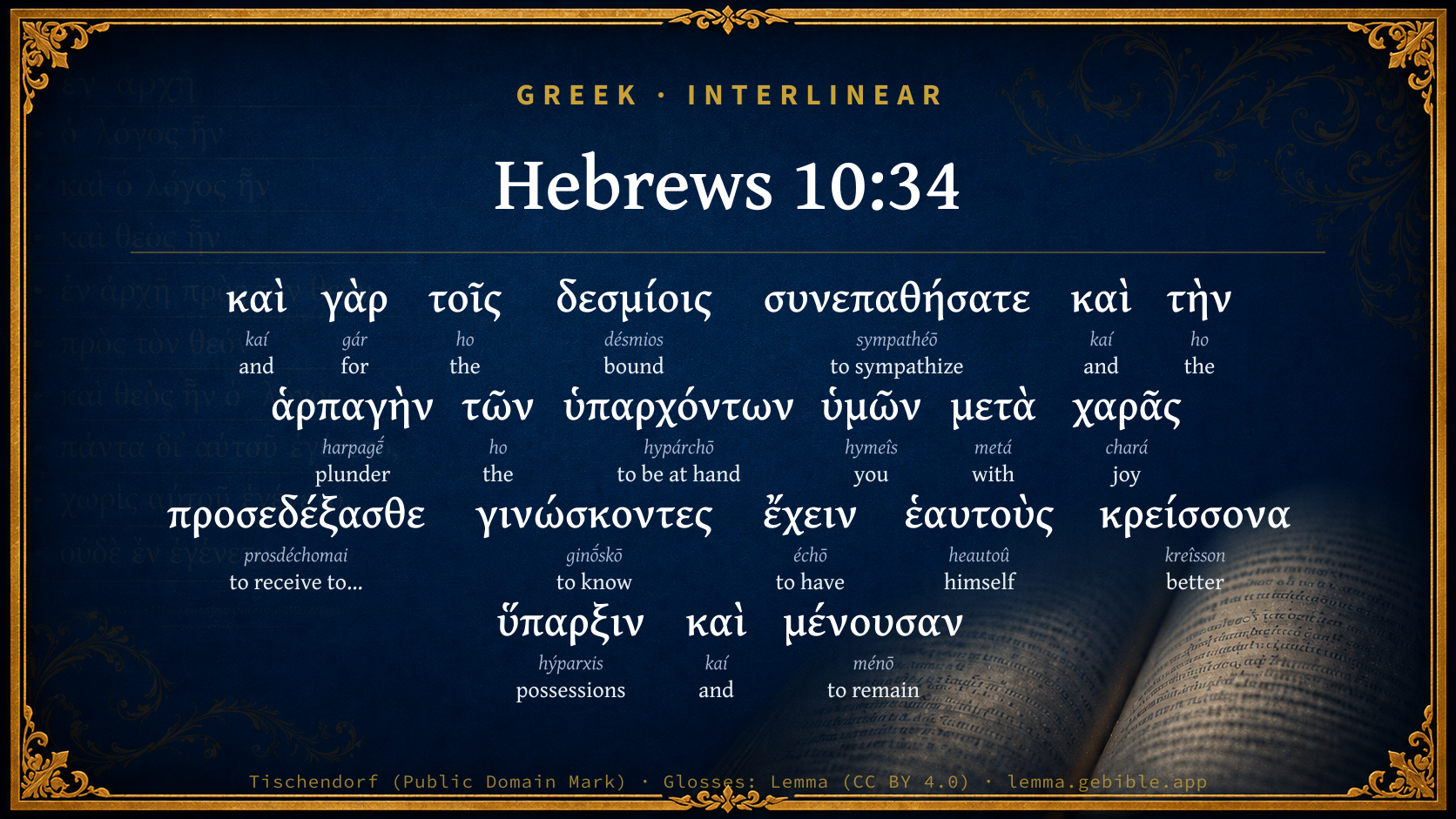
Greek (Tischendorf 8th ed.) Hebrews 10:34 appears in the Greek New Testament. The text above is from the Tischendorf 8th edition. Each word links to its Strong’s number and a concise gloss. Click any word for its full Thayer’s Greek Lexicon entry.
Download image
Cite this verse

Hebrews 10:34 (World English Bible). Public Domain. Lemma interlinear Bible study tool, https://lemma.gebible.app/v/hebrews/10/34.

Show BibTeX & RIS
BibTeX
RIS
English Translation
For you both had compassion on me in my chains, and joyfully accepted the plundering of your possessions, knowing that you have for yourselves a better possession and an enduring one in the heavens.
World English Bible · Public Domain
Download a study sheet

One document with this verse’s original text, its word-by-word gloss line, the meaning frame, cross-references with their text, attributed commentary, and full source and license credits — printable, and it pastes into notes with its structure intact.

This verse Autodidact and up

Study sheet (.html) Plain text (.txt)

A passage Seminary Student

Up to 50 verses in one chapter. A passage sheet keeps up to 6 commentary sources and 12 cross-references per verse, in the order this page ranks them, and says so on the sheet whenever that leaves anything out. Ask for a single verse and you get the Autodidact verse sheet above.

Everything on this page stays free to read, with no account — the sheet is a download of what is already on screen, not access to it.

Want to remove ads? Support Godless Engineer
Compare translations 3

The same verse in 3 English versions, stacked beneath the original-language interlinear above. Click any original word for its lexicon entry.

Each is an independent rendering of the whole verse — the interlinear is not word-aligned to these translations.

Highlighted words mark where these versions differ — a whole-verse word diff, not a word-by-word alignment.

  • World English Bible Public Domain
    For you both had compassion on me in my chains, and joyfully accepted the plundering of your possessions, knowing that you have for yourselves a better possession and an enduring one in the heavens.
  • King James Version Public Domain
    For ye had compassion of me in my bonds, and took joyfully the spoiling of your goods, knowing in yourselves that ye have in heaven a better and an enduring substance.
  • unfoldingWord Literal Text CC BY-SA 4.0
    For you also sympathized with the prisoners, and you welcomed with joy the seizure of your possessions, knowing yourselves to have a better and abiding possession.

unfoldingWord Literal Text — © unfoldingWord, licensed CC BY-SA 4.0. Word-aligned USFM3 via Door43 (git.door43.org/unfoldingWord/en_ult).

Versions to compare (up to 4)

3 of 4 selected

Show all 19 translations

Every available English version of this verse, each an independent rendering of the whole verse.

  • World English Bible Public Domain
    For you both had compassion on me in my chains, and joyfully accepted the plundering of your possessions, knowing that you have for yourselves a better possession and an enduring one in the heavens.
  • Berean Standard Bible Public Domain
    You sympathized with those in prison and joyfully accepted the confiscation of your property, knowing that you yourselves had a better and permanent possession.
  • Majority Standard Bible Public Domain
    You sympathized with me in my chains and joyfully accepted the confiscation of your property, knowing that you yourselves had a better and permanent possession in heaven.
  • King James Version Public Domain
    For ye had compassion of me in my bonds, and took joyfully the spoiling of your goods, knowing in yourselves that ye have in heaven a better and an enduring substance.
  • American Standard Version (1901) Public Domain
    For ye both had compassion on them that were in bonds, and took joyfully the spoiling of you possessions, knowing that ye have for yourselves a better possession and an abiding one.
  • Revised Version (1885) Public Domain
    For ye both had compassion on them that were in bonds, and took joyfully the spoiling of your possessions, knowing that ye yourselves have a better possession and an abiding one.
  • Geneva Bible (1599) Public Domain
    For both ye sorowed with mee for my bonds, and suffered with ioy the spoyling of your goods, knowing in your selues howe that ye haue in heauen a better, and an enduring substance.
  • Douay-Rheims (1899) Public Domain
    For you both had compassion on them that were in bands, and took with joy the being stripped of your own goods, knowing that you have a better and a lasting substance.
  • Young's Literal Translation Public Domain
    for also with my bonds ye sympathised, and the robbery of your goods with joy ye did receive, knowing that ye have in yourselves a better substance in the heavens, and an enduring one.
  • Literal Standard Version CC BY-SA 4.0
    for you also sympathized with my bonds, and the robbery of your goods you received with joy, knowing that you have in yourselves a better substance in the heavens, and an enduring one.
  • Unlocked Literal Bible CC BY-SA 4.0
    For you had compassion on those who were prisoners, and you accepted with joy the seizure of your possessions. You knew that you yourselves had a better and everlasting possession.
  • unfoldingWord Literal Text CC BY-SA 4.0
    For you also sympathized with the prisoners, and you welcomed with joy the seizure of your possessions, knowing yourselves to have a better and abiding possession.
  • Darby Bible Public Domain
    For ye both sympathised with prisoners and accepted with joy the plunder of your goods, knowing that ye have for yourselves a better substance, and an abiding one.
  • World Messianic Bible Public Domain
    For you both had compassion on me in my chains and joyfully accepted the plundering of your possessions, knowing that you have for yourselves a better possession and an enduring one in the heavens.
  • Webster's Bible Public Domain
    For ye had compassion of me in my bonds, and took joyfully the seizing of your goods, knowing in yourselves that ye have in heaven a better and an enduring substance.
  • Free Bible Version CC BY-SA 4.0
    You showed your sympathy for those in prison, and took it cheerfully when your possessions were confiscated, knowing that you have something better coming that will truly last.
  • Bible in Basic English Public Domain
    For you had pity on those who were in prison, and had joy in the loss of your property, in the knowledge that you still had a better property and one which you would keep for ever.
  • Text-Critical English NT CC BY 4.0
    For you sympathized with me when I was in prison, and you accepted the plundering of your possessions with joy, knowing that you have for yourselves a better and lasting possession in heaven.
  • Tyndale New Testament (1534) Public Domain
    For ye suffered also with my bondes and toke a worth the spoylynge of youre goodes and that with gladnes knowynge in youre selves how that ye had in heven a better and an endurynge substaunce

Literal Standard Version (2020), Covenant Press — licensed CC BY-SA 4.0. Text via the HelloAO Bible API (eBible.org). Unlocked Literal Bible (unfoldingWord) — licensed CC BY-SA 4.0. Text via the HelloAO Bible API (eBible.org). unfoldingWord Literal Text — © unfoldingWord, licensed CC BY-SA 4.0. Word-aligned USFM3 via Door43 (git.door43.org/unfoldingWord/en_ult). Free Bible Version, Dr. Jonathan Gallagher — licensed CC BY-SA 4.0. Text via the HelloAO Bible API (eBible.org).

Word by word

More ways to search: Search by grammar → Find every occurrence → Compare this word →

Practice this passage: Drill this verse → Learn its vocabulary →

συνεπαθήσατε
sympathéō
G4834
“to sympathize”
Verb, Aorist, Active, Indicative, 2nd person, Plural
Part of Speech
Verb
Tense
Aorist
Voice
Active
Mood
Indicative
Person
2nd person
Number
Plural
Full Thayer's Definition

Origin: from G4835

TDNT: 20:35,8

1. to be affected with the same feeling as another, to sympathise with 2. to feel for, have compassion on
  1. καὶ kaí G2532 “and” Conjunction
  2. γὰρ gár G1063 “for” Conjunction
  3. τοῖς ho G3588 “the” Article, Dative, Plural, Masculine
  4. δεσμίοις désmios G1198 “bound” Noun, Dative, Plural, Masculine
  5. καὶ kaí G2532 “and” Conjunction
  6. τὴν ho G3588 “the” Article, Accusative, Singular, Feminine
  7. ἁρπαγὴν harpagḗ G724 “plunder” Noun, Accusative, Singular, Feminine
  8. τῶν ho G3588 “the” Article, Genitive, Plural, Neuter
  9. ὑπαρχόντων hypárchō G5225 “to be at hand” Verb, Present, Active, Participle, Genitive, Plural, Neuter
  10. ὑμῶν hymeîs G5210 “you” Personal pronoun, 2nd person, Genitive, Plural
  11. μετὰ metá G3326 “with” Preposition
  12. χαρᾶς chará G5479 “joy” Noun, Genitive, Singular, Feminine
  13. προσεδέξασθε prosdéchomai G4327 “to receive to oneself” Verb, Aorist, Middle deponent, Indicative, 2nd person, Plural
  14. γινώσκοντες ginṓskō G1097 “to know” Verb, Present, Active, Participle, Nominative, Plural, Masculine
  15. ἔχειν échō G2192 “to have” Verb, Present, Active, Infinitive
  16. ἑαυτοὺς heautoû G1438 “himself” Reflexive pronoun, 2nd person, Accusative, Plural, Masculine
  17. κρείσσονα kreîsson G2908 “better” Adjective, Accusative, Plural, Neuter
  18. ὕπαρξιν hýparxis G5223 “possessions” Noun, Accusative, Singular, Feminine
  19. καὶ kaí G2532 “and” Conjunction
  20. μένουσαν ménō G3306 “to remain” Verb, Present, Active, Participle, Accusative, Singular, Feminine

About this verse

These counts appear in no published source. They are computed here, from the morphology-tagged text and Lemma’s own curated glosses. What Lemma adds →

21
words
17
distinct lemmas
General Epistles
section

Notable vocabulary

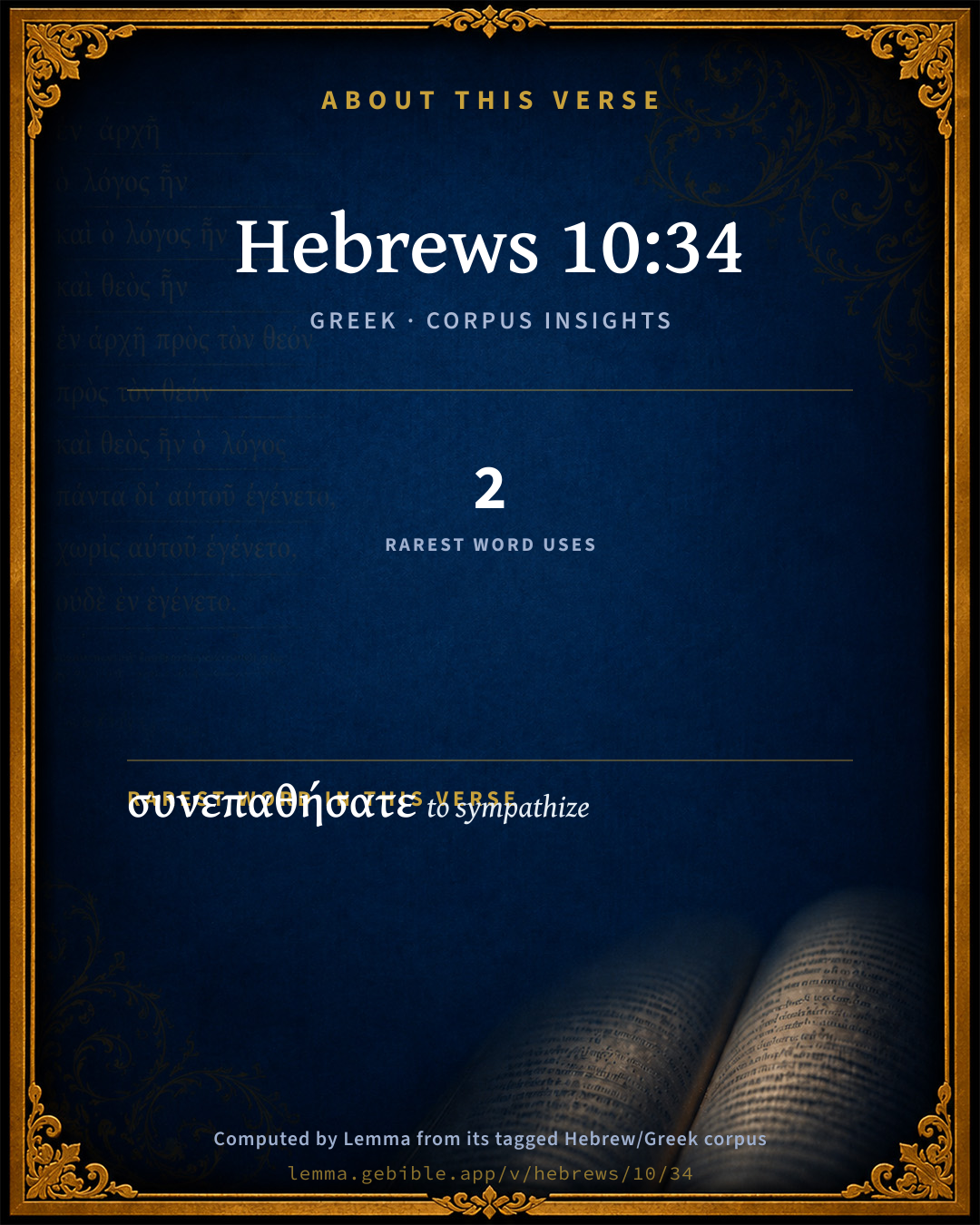
The rarest word here is συνεπαθήσατε to sympathize G4834 — appearing just 2 times in the whole Greek New Testament.

Shared distinctive vocabulary

συνεπαθήσατε to sympathize G4834 occurs in 2 verses of the Greek New Testament. Also found in:

Repetition

Words recur within this verse:

Cross-references

22

Topical passages linked to Hebrews 10:34 in the Treasury of Scripture Knowledge — connected by theme and wording, ordered by reader-vote popularity; previews shown in the World English Bible.

  • 1 Peter 1:4 to an incorruptible and undefiled inheritance that doesn't fade away, reserved in heaven for you,
  • 2 Timothy 1:16 May the Lord grant mercy to the house of Onesiphorus, for he often refreshed me, and was not ashamed of my chain,
  • Matthew 5:11–12 "Blessed are you when people reproach you, persecute you, and say all kinds of evil against you falsely, for my sake.
  • Matthew 6:19–20 "Don't lay up treasures for yourselves on the earth, where moth and rust consume, and where thieves break through and steal;
  • Ephesians 6:20 for which I am an ambassador in chains; that in it I may speak boldly, as I ought to speak.
  • Luke 12:33 Sell that which you have, and give gifts to the needy. Make for yourselves purses which don't grow old, a treasure in the heavens that doesn't fail, where no thief approaches, neither moth destroys.
  • Acts 5:41 They therefore departed from the presence of the council, rejoicing that they were counted worthy to suffer dishonor for Jesus' name.
  • Acts 21:33 Then the commanding officer came near, arrested him, commanded him to be bound with two chains, and inquired who he was and what he had done.
  • Ephesians 3:1 For this cause I, Paul, am the prisoner of Christ Jesus on behalf of you Gentiles,
  • Ephesians 4:1 I therefore, the prisoner in the Lord, beg you to walk worthily of the calling with which you were called,
  • Philippians 1:7 It is even right for me to think this way on behalf of all of you, because I have you in my heart, because, both in my bonds and in the defense and confirmation of the Gospel, you all are partakers with me of grace.
  • Colossians 1:5 because of the hope which is laid up for you in the heavens, of which you heard before in the word of the truth of the Gospel,
  • Colossians 3:2–4 Set your mind on the things that are above, not on the things that are on the earth.
  • 1 Timothy 6:19 laying up in store for themselves a good foundation against the time to come, that they may lay hold of eternal life.
  • Hebrews 11:16 But now they desire a better country, that is, a heavenly one. Therefore God is not ashamed of them, to be called their God, for he has prepared a city for them.
  • Hebrews 13:3 Remember those who are in bonds, as bound with them; and those who are ill-treated, since you are also in the body.
  • James 1:2 Count it all joy, my brothers, when you fall into various temptations,
  • 1 John 3:2 Beloved, now we are children of God, and it is not yet revealed what we will be. But we know that, when he is revealed, we will be like him; for we will see him just as he is.
  • Matthew 19:21 Jesus said to him, "If you want to be perfect, go, sell what you have, and give to the poor, and you will have treasure in heaven; and come, follow me."
  • Luke 10:42 but one thing is needed. Mary has chosen the good part, which will not be taken away from her."
  • Acts 28:20 For this cause therefore I asked to see you and to speak with you. For because of the hope of Israel I am bound with this chain."
  • 2 Timothy 2:9 in which I suffer hardship to the point of chains as a criminal. But God's word isn't chained.

Cross-references courtesy of OpenBible.info (CC BY 4.0).

Where the printed editions differ

2 variants

Places in this verse where the major printed Greek editions disagree on the wording in a way that affects the translation — a comparison of editions, not a manuscript-by-manuscript collation. The editions are the modern critical texts (Nestlé-Aland 28/27, SBL, Westcott-Hort, Tregelles, Tyndale House) and the traditional texts behind the KJV (the Textus Receptus and the Byzantine/Majority text). It is not a claim about which reading is original.

  1. Different wording
    δεσμίοις

    “prisoners”

    In NA28NA27TynSBLWHTreg Not in TRByz

    δεσμοῖς μου (desmois mou) 'my imprisonments' occurs in traditional manuscripts (TR+Byz) instead of δεσμίοις (desmiois) 'prisoners' in older manuscripts (NA28+NA27+Tyn+SBL+WH+Treg)

  2. Extra text
    ἐν οὐρανοῖς

    “in heavens”

    In TRByz Not in NA28NA27TynSBLWHTreg

    ἐν οὐρανοῖς (en ouranois) 'in heavens' is only in traditional manuscripts (TR+Byz)

Textual data: Translators Amalgamated Greek New Testament (STEPBible TAGNT) · CC BY 4.0.

Commentary

Notes on Hebrews 10:34 from classic Christian and Jewish commentators (each source and its license shown beneath its notes). The classic Christian expositions comment on the surrounding passage and are grouped to its opening verse, so a note may address several verses; the Jewish commentaries on the Tanakh (Rashi and others) are per-verse, so they appear only where the commentator wrote on this verse.

Lemma curates 59 commentaries, every one of them public domain or Creative Commons licensed, each selected and text-cleaned for this edition rather than reprinted as found. About our sources →

MacLaren's Expositions of Holy Scripture

Alexander MacLaren

Hebrews

A BETTER AND AN ENDURING SUBSTANCE

Heb 10:34

THE words ‘in heaven’ are probably no part of the original text, but have somehow or other crept in, in order to make more plain what some one supposed to be the reference of these words to the future inheritance of the saints. They, however, rather disturb than help the writer’s thought. He is speaking of a present and not of a future possession. ‘Ye have,’ and not ‘ye shall have,’ a better and an ‘enduring possession,’ not in heaven, but here and now.

But even if these words be expelled from the text as disturbing the writer’s thought, there still remains a variation in the reading of some importance. It is a very slight difference of form in the original, but the two meanings between which we have to choose are these: ‘Knowing that ye have yourselves as a better and an enduring possession’; or, ‘a better and an enduring possession for yourselves.’ I am inclined rather to the former of the two, both from external authority and internal congruity, though the choice between them is difficult. But, if we accept this as the meaning of these words, we can gather from them important lessons, of which I ask your consideration.

I. The true possession.

If we adopt the other reading, and take the words to mean that, in so far as we are truly resting on Jesus, we have for ourselves an inheritance or possession better than all external ones, the text will then be pointing to the old thought that God is the true joy and treasure of a man’s soul. If, on the other hand, we may venture to adopt the other meaning, there is great depth and beauty in it, representing, as it does, the Christian as having himself as a treasure. It may strike one as strange, but a little consideration will show its truth and perfect harmony with the other thought, that God is the treasure of every soul which is not poor and in need of all things. ‘A good man shall be satisfied from himself, says the Book of Proverbs, and that is no arrogant denial of the need for God, but completely accords with the devout acknowledgment, ‘All my springs are in Thee.’ In the very same chapter as our text we read: ‘We are not of them who draw back unto perdition; but of them that believe to the saving of their souls,’ which might be more accurately rendered, ‘to the acquisition as their own of their souls.’ Remember, too, our Lord’s words: ‘In your patience ye shall acquire possession of your souls.’ If we take these sayings into account, we need not hesitate to admit that, at all events, there is a great deal to be said for the somewhat remarkable expression in the text.

It just comes to this. No man possesses himself until he has given up himself. We only own ourselves when we have parted with ourselves. Until we have yielded ourselves in acts of dependent faith and rejoicing love and docile obedience unto God, we have no real possession of ourselves. He, and only he, who says, ‘I give myself away to Thee,’ gets himself back again sanctified, gladdened, ennobled, and on the way to be perfected by his surrender and God’s reception.

We own ourselves only on condition of being Christian men. For, under all other circumstances and forms of life, the true self is domineered over and brought into slavery and dragged away from its proper bearings by storms and swarms of lusts and passions and inclinations and ambitions and senses. A man’s flesh is his master, or his pride is his master, or some fraction of his nature is his master, and he himself is an oppressed slave, tyrannised over by rebellious powers. The only way to get the mastery of yourselves, to be able to keep a tight hand upon all inferior parts of your nature, and to have that self-command and self-possession without which there is nothing noble in life, is to go to God and say, ‘Oh, Lord! I cannot rule this anarchic being of mine. Do Thou take it into Thine hands. Here are the reins: do with me what Thou wilt.’ Then you will be your own masters, not till then. Then you will own yourselves; till then, the devil and the world and the flesh, and the pomps and prides and passions and lusts and lazinesses that are in your nature will own you. But if we have exercised the faith which casts itself wholly upon God, we therein and thereby win God and our own selves also, and that is one of the meanings of ‘saving our own souls.’

Or, to put it in another light, the only things worth calling treasures and possessions are true thoughts that we have learned from God; pure affections that go out to Him; yearning desires after Him, which, in their very yearning, bear the prophecy, and are to a large extent the foretaste, of their own fruition.

These are the things that make a man’s treasure. The inner life of obedience, of love, of trust, the conscience cleansed, the will made plastic and docile, the heart filled with all pure and heavenward affections, aspirations that lift us above self and time, and bring us into the sweet and calm light of the Eternal Love whose name is God - these are the possessions which are worth possessing. And he, and only he, has such who has found them in lowly submission of his sinful self to Christ who has died that our spirits might be cleansed and given back unto us.

Brethren, the realisation of this possession of ourselves depends on our faith. Stoics and moralists and lofty souled men in all ages have talked about the true possession of oneself, which comes by self-surrender and annihilation, but Christian faith realises the dream, and they only find the reality who pass towards it through the gate of trust in Jesus Christ. Then, and only then, will the old English poet’s lovely picture be fulfilled, and the man’s soul

Made free from slavish bands, Of hope to rise, or fear to fall;

Lord of himself, though not of lands; And having nothing, yet hath all.’

II. Note, again, how here we hear asserted the superiority of this possession.

It is ‘better’ in its essential quality. That does not need many words. Surely these possessions of heart and mind and will and desires all brought into fellowship with and filled by God are things more correspondent with the nature of man and his needs than any accumulation of outward possessions can ever be. And surely it is a plain piece of prose, and no exaggerated religious enthusiasm, which says, ‘Whom have I in heaven but Thee, and there is none upon earth that I desire besides Thee.’ Men call it mysticism. It is the very foundation of all true religion. The apprehension of union with God is the one thing that will satisfy the sold; the one thing that we need, width having, we cannot be wholly desolate, however dark may be our path, nor wholly solitary, however lonely may be our lot, nor utterly bereaved, however Blessings may be dragged from our hands; and without which we cannot be at rest, however compassed with stays and succours and treasures and friends; nor rich, however we may have Bursting coffers and all things to enjoy.

The possession which we tarry within us is better than any which we can gather round us. ‘Surely he is disquieted in vain, he heapeth up treasures’- and the very fact that they need to be ‘heaped,’ and that that is all that he can do with them, shows the vanity of the disquiet that raked them together. Not what a man has, but what a man is, is his wealth.

And the better treasure is an enduring possession. That is the second element of its excellence. These things, the calm joys, the pure delights of still fellowship with God in heart and mind and will - these things have in them no seed of decay. These cannot be separated from their possessor by anything but his own unfaithfulness. There will never come the time when they shall have to be left behind. Use does not wear these out, but strengthens and increases them. The things which are destined ‘to perish with the using’ belong to an inferior category. All the best things are intended and destined to increase with the using, and this treasure, the more it is expended the fuller is the coffer, and the more we exercise the love, the communion, the obedience which make our true riches, the more do the riches increase. And then, when all other things drop from their nerveless hands; and ‘His glory’ - whose glory was in outward things -’shall not descend after him,’ we shall carry these treasures with us wherever we go, and find that they were the pledge of immortality.

III. My text, lastly, suggests to us the quiet superiority to earthly loss and change which the possession of this treasure involves.

The writer is speaking to Christian men who have endured a great fight of afflictions, and he says of them, ‘Ye took joyfully the spoiling of your goods, because you knew that you had this Better and enduring substance.’ Joyfully! When you strike away the false props the strength of the real ones becomes more conspicuous. And many and many a time we may experience, unless we waste our discipline and our sorrows, that the surest way to become richer towards God is to lose the earthly stays and supports. But whether that be so or no, he who sits in the centre, and has the light round him, need not mind much what storms are raging without, and he whose inexpugnable fortress is within the depths of God may smile at all the hubbub and confusion down in the valley. If we possess this true treasure which lies at our doors, and may be had for the taking, we shall be like men in some strong fortress, with firm walls, abundant provisions, and a well in the courtyard, and we can laugh at besiegers ‘His abiding place shall be the munitions of rooks; his bread shall be given him and his water shall be made sure.’ We may be quiet and lofty, infinitely above the fear of chance and change, if we keep the firm hold which we may keep of the enduring riches which God brings with Him into our souls.

Some of you may be in circumstances which make such thoughts as these specially applicable, either because dark days may be threatening, or because the sunshine of prosperity may be dazzling some eyes and making them lose sight of their true wealth. To the one class the thought of my text is gathered up in the warning, ‘Charge them that they trust not in the uncertainty of riches, but in the living God.’ And, to the other class, the text should quicken and consolidate the resolve, ‘What time I am afraid I will trust in Thee. Thou art the strength of my heart, and mine inheritance for ever.’

Alexander MacLaren, Expositions of Holy Scripture (1904–1910) — public domain. Text from a community e-Sword module.

Tyndale Open Study Notes

Tyndale Open Resources

10:34 those who were thrown into jail: Prisoners were dependent on friends and family for the most basic daily needs (cp. 13:3). • when all you owned was taken from you: At times, the Roman government evicted groups of people from their homes and forced them to leave a city (see Acts 18:2-3). These Christians had faced this kind of persecution in the past and accepted it with joy (cp. Rom 5:3; Jas 1:2-4; 1 Pet 1:6). They anticipated better things . . . that will last forever (see Heb 11:35). God promises rewards to those who persevere faithfully.

Tyndale Open Study Notes — © Tyndale Open Resources, licensed CC BY-SA 4.0. Text via the HelloAO Bible API.

Bengel's Gnomon

Johann Albrecht Bengel

Heb 10:34. Δεσμίοις, those in bonds) The persons in bonds are mentioned at ch. Heb 13:3: and Timothy had been also among them, ibid. Heb 10:23: wherefore Paul is speaking not of himself, or at least not of himself alone; comp. ch. Heb 6:10. Some, however, have δεσμοῖς, and moreover δεσμοῖς μου,[66] a reading that arose from the rhythm ὀνειδισμοῖς (Heb 10:33), or from the frequent mention of Paul’s bonds in other places.—ὑπαρχόντων, of goods) The word ὑπαρξιν, substance, among the Greeks, is the conjugate word.—προσεδέξασθε, ye welcomed, ye took) An elegant Oxymoron, as is seen by comparing the word spoiling or plunder with it.—γινώσκοντες, knowing) determining with confidence.—ἔχειν ἑαυτοῖς, that ye have to (for) yourselves[67]) The Dative signifying property, as ch. Heb 5:4, to take to himself. So the Latins say, tibi habe. The goods peculiarly our property are described, Luk 16:12 (Luk 12:33).—κρείττονα, a better) viz. heavenly; comp. ch. Heb 11:16.—καὶ μένουσαν) exposed to no spoiling.

[66] But the margin of the 2d Ed. has raised the reading δεσμιοῖς, formerly on an equal footing with the other, to the mark β, and hence the Germ. Vers. interprets it, mit den Gebundenen.—E. B.

[67] D reads ἑαυτοῖς; and so Tisch. A reads ἑαυτοὺς: similarly f and Vulg., ‘vos:’ and Origen ὅτι ἔχετε. Rec. Text, without good authority, has ἐν ἑαυτοῖς.—ED.

AD(Δ) corrected Vulg. Memph. and both Syr. Versions read δεσμίοις. Orig. 1, 303b reads δεσμοῖς. Rec. Text adds μου. f adds ‘eorum.’—ED.

Bengel's Gnomon of the New Testament — English translation (T&T Clark, Edinburgh, 1860) — public domain. Text from a community e-Sword module.

Meyer's Critical & Exegetical Commentary

Heinrich August Wilhelm Meyer

Heb_10:34. Confirmatory elucidation of Heb_10:33, and that in such form that καὶ … συνεπαθήσατε corresponds to the latter half of Heb_10:33, and καὶ … προσεδέξασθε to the former half thereof.

καὶ γὰρ τοῖς δεσμίοις συνεπαθήσατε] for ye had both compassion (Heb_4:15) on the prisoners, in that ye bestowed upon them active sympathy.

καὶ τὴν ἁρπαγὴν τῶν ὑπαρχόντων ὑμῶν κ.τ.λ.] and also accepted (comp. Heb_11:35) with joy the plundering of your goods, with joy, or willingly submitted to it. Wrongly Heinrichs, according to whom προσδέχεσθαι, here expresses, at the same time, the idea of exspectare and of recipere, so that we have to translate: ye looked for it.

γινώσκοντες ἔχειν ἑαυτοῖς κρείττονα ὕπαρξιν καὶ μένουσαν] indication of motive for καὶ τὴν ἁρπαγὴν κ.τ.λ.: knowing that ye have for yourselves (as your true possession) a better property (Act_2:45), and that an abiding one, namely, the spiritual, everlasting blessings of Christianity, of which no power of the earth can deprive you. Comp. Mat_6:20; Luk_12:33.

Meyer — Critical and Exegetical Commentary on the New Testament — English translation by Peter Christie, edited by Frederick Crombie (T&T Clark, 1880) — public domain. Text from a community e-Sword module.

Geneva Bible (1599)

Geneva Bible translators

Goods and riches.

Geneva Bible (1599) marginal notes — public domain. Text via Bolls.life.

Jamieson, Fausset & Brown

Robert Jamieson, A. R. Fausset & David Brown

ye had compassion on me in my bonds--The oldest manuscripts and versions omit "me," and read, "Ye both sympathized with those in bonds (answering to the last clause of Heb 10:33; compare Heb 13:3, Heb 13:23; Heb 6:10), and accepted (so the Greek is translated in Heb 11:35) with joy (Jam 1:2; joy in tribulations, as exercising faith and other graces, Rom 5:3; and the pledge of the coming glory, Mat 5:12) the plundering of your (own) goods (answering to the first clause of Heb 10:33)."

in yourselves--The oldest manuscripts omit "in": translate, "knowing that ye have for (or 'to') yourselves."

better--a heavenly (Heb 11:16).

enduring--not liable to spoiling.

substance--possession: peculiarly our own, if we will not cast away our birthright.

Jamieson, Fausset & Brown — Commentary Critical and Explanatory on the Whole Bible (1871) — public domain (CC PDM 1.0). Text via the HelloAO Bible API.

Adam Clarke's Commentary

Verse 34. Ye had compassion of me in my bonds] συνεπαθησατε. Ye suffered with me, ye sympathized with me, when bound for the testimony of Jesus. This probably refers to the sympathy they showed towards him, and the help they afforded him, during his long imprisonment in Caesarea and Jerusalem. But instead of τοις δεσμοιςμου, my bonds, τοιςδεσμιοις, the prisoners, is the reading of AD, and several others, both the Syriac, the Arabic of Erpen, the Coptic, Armenian, Vulgate, some of the Itala, and several of the Greek fathers. This reading appears to be so well supported, that Griesbach has admitted it into the text. If it be genuine, it shows that there had been, and perhaps were then, several bound for the testimony of Jesus, and that the Church in Judea had shown its attachment to Christ by openly acknowledging these prisoners, and ministering to them.

Took joyfully the spoiling of your goods] They were deprived of their inheritances, turned out of their houses, and plundered of their goods; they wandered about in sheepskins and goatskins, being destitute, afflicted, tormented. To suffer such persecution patiently was great; to endure it without a murmur was greater; to rejoice in it was greatest of all. But how could they do all this? The next clause informs us.

Knowing in yourselves] They had the fullest evidence that they were the children of God, the Spirit itself bearing this witness to their spirits; and if children than heirs, heirs of God and joint heirs with Christ. They knew that heaven was their portion, and that to it they had a sure right and indefeasible title by Christ Jesus. This accounts, and this alone can account, for their taking joyfully the spoiling of their goods: they had Christ in their hearts; they knew that they were his children, and that they had a kingdom, but that kingdom was not of this world. They had the support they needed, and they had it in the time in which they needed it most.

Adam Clarke's Commentary on the Bible (1810–1826) — public domain. Text from a community e-Sword/MySword module.

John Calvin's Commentaries

34. And took joyfully, etc. There is no doubt but as they were men who had feelings, the loss of their goods caused them grief; but yet their sorrow was such as did not prevent the joy of which the Apostle speaks. As poverty is deemed an evil, the plunder of their goods considered in itself touched them with grief; but as they looked higher, they found a cause for joy, which allayed whatever grief they felt. It is indeed thus necessary that our thoughts should be drawn away from the world, by looking at the heavenly recompense; nor do I say any other thing but what all the godly find to be the case by experience. And no doubt we joyfully embrace what we are persuaded will end in our salvation; and this persuasion the children of God doubtless have respecting the conflicts which they undertake for the glory of Christ. Hence carnal feelings never so prevail in overwhelming them with grief, but that with their minds raised up to heaven they emerge into spiritual joy.

And this is proved by what he subjoins, knowing that ye have in heaven a better and an enduring substance. Joyfully then did they endure the plundering of their goods, not because they were glad to find themselves plundered; but as their minds were fixed on the recompense, they easily forgot the grief occasioned by their present calamity. And indeed wherever there is a lively perception of heavenly things, the world with all its allurements is not so relished, that either poverty or shame can overwhelm our minds with grief. If then we wish to bear anything for Christ with patience and resigned minds, let us accustom ourselves to a frequent meditation on that felicity, in comparison with which all the good things of the world are nothing but refuse. Nor are we to pass by these words, “knowing that ye have”; for except one be fully persuaded that the inheritance which God has promised to his children belongs to him, all his knowledge will be cold and useless.

John Calvin's Commentaries (1540-1563) — public domain. Text from the Calvin Translation Society English edition (1840s-50s) via the Christian Classics Ethereal Library (ccel.org). Calvin's coverage is partial (roughly two-thirds of the Bible); uncommented books and verses are honest gaps, never fabricated. The 19th-century editor's footnotes and remarks are omitted so the notes are faithfully Calvin's own voice.

Ellicott's Commentary for English Readers

(34) For ye had compassion of me in my bonds.—Rather (according to the true reading of the Greek), for ye had sympathy with them that were in bonds (comp. Heb_13:3, “Remember them that are in bonds as bound with them”). The change of reading is very important in connection] with the question of authorship. (See the Introduction.)

And took joyfully.—Better, and accepted with joy the spoiling of your possessions. In the spirit of Mat_5:12 (Act_5:41; 2Co_12:10), they accepted persecution not with “patience and long suffering” only, but “with joy” (Col_1:11). The rendering “possessions” is necessary because a similar word (“substance” in the Authorised version) will immediately occur. In the last clause two remarkable changes in the Greek text are made necessary by the testimony of our best authorities. The words “in heaven” must certainly be removed; they are omitted in the oldest MSS., and are evidently an explanatory comment which has found its way into the text. For the reading, “in yourselves,” there is hardly any evidence whatever. The MSS. are divided between two readings, “yourselves” and “for yourselves;” the former having also the support of the Latin and Coptic versions. There is little doubt that we must read “yourselves;” and the most probable translation will now be, perceiving that ye have your own selves for a better possession and one that abideth. They had been taught the meaning of the words spoken by Jesus of the man who gains the world and loses himself (Luk_9:25), and of those who win their souls by their endurance (Luk_21:19); so in Heb_10:39 the writer speaks of “the gaining of the soul.” Thus trained, they could accept with joy the loss of possessions for the sake of Christ, perceiving that in Him they had received themselves as a possession, a better and a lasting possession. (It would be possible to render the clause, “knowing that ye yourselves have a better possession,” &c.; but the parallelism of Heb_10:39 renders it almost certain that the former view of the words is correct.)

A Bible Commentary for English Readers, edited by Charles John Ellicott (1878–1897) — public domain. Text from a community e-Sword module.

The Cambridge Bible for Schools and Colleges

gen. ed. J. J. S. Perowne

34. ye had compassion of me in my bonds] This reading had more to do than anything else with the common assumption that this Epistle was written by St Paul. The true reading however undoubtedly is not τοῖς δεσμοῖς μου, but τοῖς δεσμίοις, “ye sympathised with the prisoners.” The reading of our text was probably introduced from Col_4:18; Php_1:7, &c. In the first persecutions many confessors were thrown into prison (Act_26:10), and from the earliest days Christians were famed for their kindness to their brethren who were thus confined. See too Heb_13:3. The verb συμπαθεῖν occurs only here and in Heb_4:15. St Paul uses συμπάσχειν “to suffer with” in Rom_8:17.

took joyfully the spoiling of your goods] Christians were liable to be thus plundered by lawless mobs. Epictetus, by whose time Stoicism had become unconsciously impregnated with Christian feeling, says, “I became poor at thy will, yea and gladly.” On the supposition that the letter was addressed to Rome, “the spoiling of goods” has been referred to the edict of Claudius which expelled the Jews (and with them the Christian Jews) from Rome; or to the Neronian persecution. But the supposition is improbable.

knowing in yourselves that ye have in heaven] The “in heaven” is almost certainly a spurious gloss, and the “in” before “yourselves” should be unquestionably omitted. If the true reading be ἐαυτοῖς, the meaning is “recognising that ye have for yourselves,” but if we may accept ἑαυτούς, the reading of א, we have the very beautiful and striking thought, “recognising that ye have yourselves as a better possession and an abiding.” He points them to the tranquil self-possession of a holy heart (Luk_9:25; Luk_21:19), the acquisition of our own souls, as a sufficient present consolation for the loss of earthly goods (Heb_11:26), independently of the illimitable future hope (Mat_6:20; Rom_8:18; 1Pe_1:4-8).

The Cambridge Bible for Schools and Colleges (gen. ed. J. J. S. Perowne; Cambridge University Press, 1878–1918) — public domain. Text from a community e-Sword module.

John Gill's Exposition

For yet a little while, and he that shall come will come,.... That the person spoken of is the Lord Jesus Christ, is evident from the prophecy in Hab 2:3 here referred to, and from the character of him that is to come, Mat 11:3 and from parallel places, Jam 5:7 and this is to be understood, not of his coming in the flesh, for he was come in the flesh already; though Habakkuk indeed refers to his first coming, yet not to that only, but including his second coming also; but of his coming in his kingdom and power to destroy Jerusalem, and take vengeance on the Jews, for their rejection of him: the kingdom of Christ was at hand, when he began to preach; upon his ascension to heaven, it began to appear more visible; but still the temple was standing, and that worship continued, which stood in the way of the glory of his kingdom; during which time the saints suffered much: but in a little while from the writing of this epistle, he, who was to come, did come, even within about ten years after this, and showed his power and his glory, in delivering his people, and destroying his enemies; see Mat 16:28. It may be applied to his coming to help his people in time of need; the afflictions of the saints are many; they are all for an appointed time, and but for a while; and Christ has promised to come, and visit them; and which he does often, and speedily, and seasonably: it may also be accommodated to Christ coming to take his people to himself by death; Christ may be said to come in this sense, and he will certainly come; and this will be in a little while; man is but of few days; death is certain, and should be patiently expected: and it may likewise be suitably improved, with respect to Christ's coming to judgment; that he will come is certain, from prophecies, particularly from the prophecy of Enoch, from his own words, from the testimony of angels, from the institution of the Lord's supper, till he comes, and from the general expectation of the saints; and this coming of his is desirable, because it will be the marriage of the Lamb, and the redemption of the saints, and because of the grace and glory that will be brought unto them, and because they shall then be for ever with him; and this will be quickly, in a little time, in comparison of the time that went before his first coming, and of the eternity that will follow after this; and though it may seem long, yet with God it is but a little while, with whom a thousand years are as one day; and however, since it is certain that he will come,

and will not tarry, beyond the appointed time, patience should be exercised.

John Gill's Exposition of the Whole Bible (1746–1763) — public domain (CC PDM 1.0). Text via the HelloAO Bible API.

Trapp's Complete Commentary

John Trapp

34 For ye had compassion of me in my bonds, and took joyfully the spoiling of your goods, knowing in yourselves that ye have in heaven a better and an enduring substance.

Ver. 34. For ye had compassion] Gr. Ye sympathized. {See Trapp on "Heb 10:33"}

And took joyfully] The joy of the Lord was their strength, as it was theirs, Act 5:41, who took it for a grace to be disgraced for Christ.

The spoiling of their goods] If a heathen could say when he saw a sudden shipwreck of all his wealth, Well, Fortune, I see thou wouldest not have me to be a philosopher; should not we, when called to give up our treasures, say, Well, I see that God would have me to lay up treasure in heaven, that is subject neither to vanity nor violence

Knowing in yourselves] Not in others, in books, &c., but in your own experience and apprehension, in the workings of your own hearts.

That ye have in heaven] When we lose anything for God, he seals us a bill of exchange of better things, or a double return. He will recompense our losses, as the king of Poland did his noble servant Zelislaus; having lost his hand in his wars, he sent him a golden hand. These Hebrews had lost their goods, but not their God. Here is the dry rod blossoming.

John Trapp, A Commentary or Exposition upon All the Books of the Old and New Testament (1647–1656) — public domain. Text from a community e-Sword module.

Albert Barnes' Notes on the Bible

For ye had compassion of me in my bonds - You sympathized with me when a prisoner, and sent to my relief. It is not known to what particular instance of imprisonment the apostle here refers. It is probable, however, that it was on some occasion when he was a prisoner in Judea, for the persons to whom this Epistle was sent most probably resided there. Paul was at one time a prisoner more than two years at Cesarea Act 24:27, and during this time he was kept in the charge of a centurion, and his friends had free access to him; Act 24:23. It would seem not improbable that this was the occasion to which he here refers.

And took joyfully the spoiling of your goods - The plunder of your property. It was not an uncommon thing for the early Christians to be plundered. This was doubtless a part of the “afflictions” to which the apostle refers in this case. The meaning is, that they yielded their property not only without resistance, but with joy. They, in common with all the early Christians, counted it a privilege and honor to suffer in the cause of their Master; see the notes on Phi 3:10; compare Rom 5:3. Men may be brought to such a state of mind as to part with their property with joy. It is not usually the case; but religion will enable a man to do it.

Knowing in yourselves - Marg “or, that ye have in yourselves; or, for yourselves.” The true rendering is, “knowing that ye have for yourselves.” It does not refer to any internal knowledge which they had of this, but to the fact that they were assured that they had laid up for themselves a better inheritance in heaven.

That ye have in heaven a better and an enduring substance - Better than any earthly possession, and more permanent. It is:

(1) Better; it is worth more; it gives more comfort; it makes a man really richer. The treasure laid up in heaven is worth more to a man than all the wealth of Croesus. It will give him more solid peace and comfort; will better serve his turn in the various situations in which he may be placed in life, and will do more on the whole to make him happy. It is not said here that property is worth nothing to a man - which is not true, if he uses it well - but that the treasures of heaven are worth more.

(2) It is more enduring. Property here soon vanishes. Riches take to themselves wings and fly away, or at any rate all that we possess must soon be left. But in heaven all is permanent and secure. No calamity of war, pestilence, or famine; no change of times; no commercial embarrassments; no failure of a crop, or a bank; no fraud of sharpers and swindlers, and no act of a pick-pocket or highwayman can take it away; nor does death ever come there to remove the inhabitants of heaven from their “mansions.” With this hope, therefore, Christians may cheerfully see their earthly wealth vanish, for they can look forward to their enduring and their better inheritance.

Albert Barnes' Notes on the Bible (1834–1885) — public domain. Text from a community e-Sword/MySword module.

Matthew Poole's English Annotations

For ye had compassion of me in my bonds; for ye sympathized in my bonds, &c., is a proof of both kinds of their sufferings forementioned. As to their suffering with others, he instanceth in himself, as a witness of it; for when he was in bonds for preaching the gospel, both at Jerusalem, Act 21:33,37; 22:24,25, at Cesarea, Act 23:1-24:27, at Rome, Act 28:1-31, they forewarned him of his danger, bore his burden with him, supplied, relieved him, and endeavoured, what in them lay, his release.

And took joyfully the spoiling of your goods; and in their own sufferings, by being rifled for the gospel; their goods, estates, and means of subsistence, were either by fines, confiscations, or violence, ravished from them; their enemies, like so many harpies, preying on them, 1Th 2:14. So as these Christian Hebrews at this time had their respective properties, and all was not levelled among them. Though they were so impoverished to make them comply with the Gentile superstition and idolatry, yet they cheerfully bore it, esteeming it their honour and privilege thus to suffer for Christ, and herein obeyed him, as Mat 5:11,12, and as the apostles did before them, in Act 5:41.

Knowing in yourselves that ye have in heaven a better and an enduring substance; they were fully assured of this by faith in God’s promise, and by God’s work on their own hearts, qualifying and fitting them for it, Rom 8:15-17. That they have by promise given them as theirs, as fitted for them, a spiritual substance, an estate beyond what this world could afford them; riches, honours, and pleasures, better for their quality than all terrene ones; spiritual ones, proper for their souls, 1Pe 1:3,4. The sum of which is God in Christ, their exceeding great reward, Gen 15:1, and all he can be to or do for them. He is their portion and their inheritance, the most excellent in itself, and the most enduring, out of the reach of men or devils, who can neither take it from them, nor them from it, it is safe enough in the heavens, Mat 6:19,20; 19:28,29; Psa 16:5; 2Co 5:1; 2Th 1:4,5.

Matthew Poole's English Annotations on the Holy Bible (1683–1685) — public domain. Text from a community e-Sword/MySword module.

Whedon's Commentary on the Bible

Daniel D. Whedon

34. Me in my bonds—The more authoritative reading is, Ye had compassion on the imprisoned Christians.

Spoiling of your goods— Ebrard applies the words to that disinheriting which even now takes place when a Jew becomes a Christian.

Ye have—Ye even now have in reversion the better substance.

Enduring—Not transient, like the earthly goods and the earthly city.

Daniel D. Whedon (gen. ed.), Commentary on the Old and New Testaments (1874–1909) — public domain. Text from a community e-Sword module.

The Pulpit Commentary

For ye had compassion on those who were in bonds, and took joyfully the spoiling of your goods, knowing that ye have for yourselves a better possession, and an abiding one. For toiv desmioiv , the Receptus has toiv desmoiv mou , which the A.V, so as to avoid the impropriety of expressing sympathy with the bonds themselves, renders "me in my bonds." Even apart from manuscript authority, desmioiv is evidently to be preferred, both as suiting the verb sunepayhsate and as being more likely to have been altered to the common Pauline expression, desmoiv mou , than vice versa, especially on the supposition of the writer being St. Paul himself. Thus no evidence as to the authorship of the Epistle is hence deducible. The allusion is to persecutions of Christians, under which the Hebrews addressed had been plundered, and had succored others who were prisoners for the faith, as is intimated also in Heb_6:10. More than one such persecution might be in the writer"s view, including, perhaps, that after the stoning of Stephen; (Act_8:1 Act_11:19) that instituted by Herod Agrippa, under which James the elder suffered; (Ac 12) that which led to the martyrdom of James the Just (Josephus, "Ant.," 20:9. 1) and others.

The right estimate of temporal possession.

I THE RIGHT ESTIMATE ITSELF. This is a mean between extremes. To despise worldly possessions, to speak of them as if they were to be trampled underfoot as always worthless, is not a Christian state of mind. The worldly man overvalues and the ascetic undervalues. The Christian, taught by his Master, learns to use the world as not abusing. It is not well in ordinary circumstances to make comparisons; a wise and devout man will use everything for God according to its nature and its scope. But there may come a time when the man has to make his election between the temporal and the eternal, between what the world has to give and what Christ has to give. Then it will be seen where the affections are. A treasure is rot a treasure in itself; it is a treasure relatively to its possessor. Where the heart is, there the treasure is. One may see the pearl of great price where another sees a trifle, as it were a mere nothing. No one estimates temporal possessions rightly unless he is willing to sacrifice them for eternal interests. There is only one answer to the question, "What shall it profit a man, if he gain the whole world, and lose his own soul?" A man will surrender all his wealth to keep his life. How much more, then, should he be willing to surrender his wealth to keep his spiritual hope, his vital connection with the boundless spiritual wealth resident in Christ? This is not a question for the few rich men only; it is for every one who has possessions to lose. They may not have to be given up outright; they may not be in danger of loss through persecution; but they may have to be risked through adopting truly Christian principles of life.

II THOSE WHO ARE TO GAIN THE RIGHT ESTIMATE. In making the estimate, everything depends on the life and character of him who has to make it. The estimate is made, if one may say so, in an unconscious kind of way. It is a personal, practical decision, not a mere speculative one with little or no influence on the life. The decision is made, and some of the consequences of it attained, before the critical character of those consequences is discerned. In great moments of life we may have to decide on the spur of the moment; and the only man who can decide rightly is the spiritual man he whose inner eye is open to see things as they really are. The pearl of great price is to be seen intuitively or not at all. There must be a firm resolution fixed in the heart to gain and to keep this pearl at whatever cost. Once we have got into right relations with Christ, comparisons between his claims and the claims of other beings are not hard to make. In making comparisons between one temporal possession and another, the character of those who make the comparison may or may not be a matter of importance. But in distinguishing between the temporal and the eternal, character is everything. We must have the Spirit of Christ working in us most energetically if we would be lifted above all danger of sacrificing the eternal to the temporal. Y.

The Pulpit Commentary (1880–1919), ed. H.D.M. Spence-Jones & Joseph S. Exell — public domain. Text from a community e-Sword module.

John Wesley's Explanatory Notes

For ye sympathized with all your suffering brethren, and with me in particular; and received joyfully the loss of your own goods.

John Wesley, Explanatory Notes Upon the Whole Bible (1754–1765) — public domain. Text via the GEBible commentary corpus.

Burkitt's Expository Notes on the New Testament

William Burkitt

The first words of this verse, Ye had compassion on me in my bonds, prove St. Paul to be the author of this epistle; for who else could there be, whose bonds for the gospel were so known, and so famous among the believing Jews?

His bonds were first at Jerusalem, afterwards at Rome, the two capital cities of the Jews and Gentiles. And St. Paul declares here what a tender sympathy and fellow feeling with him in his suffering they did express: ye had compassion on me in my bonds, that is, ye owned me in my sufferings, ye sympathized with me under my sufferings, ye administered to my succour and relief when burthened with my sufferings.

Observe next, he reminds them of their deportment under their own sufferings; Ye took joyfully by the spoilers, than it was by the spoiled.

Learn, It is the peculiar glory and excellency of the gospel, that is gives insuperable joy unto the Christian’s mind, under the greatest outword sufferings: They endured joyfully the spoiling of their goods.

Observe lastly, THe reason of this their Christian patience under sufferings; they had a substance; they had a substance in heaven; and they had a better substance in heaven that they lost upon earth; and they knew they had it, knowing in yourselves that ye have in heaven a better and more enduring substance.

Learn hence, That faith by giving and incomparable preference to the things of heaven, above all perishing things on earth, affords abundant joy and full satisfaction in the loss of them all, upon the account of an assured interest in better things.

William Burkitt's Expository Notes on the New Testament (1700–1703) — public domain. Text from a community e-Sword module.

Godbey's Commentary on the New Testament

William B. Godbey

34. “For truly you suffered along with the prisoners and received with joy the confiscation of your goods, knowing that you have a better and an abiding possession.” Not only did the Jews turn on the poor Nazarenes a most implacable persecution into bonds, imprisonment and martyrdom, but they drove them from their homes, confiscating their property because of their religion. Here we see how they shouted over their persecutors when they drove them away from their homes, because their spiritual eyes were on their heavenly home, which will never grow old, he sold, nor burned down.

William B. Godbey, Commentary on the New Testament (1896–1900) — public domain. Text from a community e-Sword module.

The People's New Testament

B. W. Johnson

34. For ye had compassion on them in bonds (Revision). And actively showed their sympathy. Took joyfully the spoiling of your goods. The losses made necessary by becoming Christians. Knowing. Knowing that if they lost on earth they would gain in heaven.

B. W. Johnson's The People's New Testament with Notes (1889–1891) — public domain. Electronic text from the Christian Classics Ethereal Library (CCEL) ThML edition.

Cambridge Greek Testament for Schools and Colleges

34. τοῖς δεσμίοις AD Vulg. and many Fathers. This seems to have first changed by oversight into τοῖς δεσμοῖς, to which μου (אEKL) was perhaps added as an explanatory gloss.

ἑαυτούς אA. ἑαυτοῖς DEKL, ἐν ἑαυτοῖς only a few cursive MSS. See the note.

[ἐν οὐρανοῖς]. Omitted in אAD Copt. Aeth. Vulg. It. and many fathers. It is an explanatory gloss, and a mistaken one. See the note.

34. τοῖς δεσμίοις συνεπαθήσατε. “Ye pitied the prisoners.” The other reading of the A.V. had more to do than anything else with the common assumption that this Epistle was written by St Paul. The true reading however undoubtedly is not τοῖς δεσμοῖς μου, but τοῖς δεσμίοις, “ye sympathised with the prisoners.” The reading of our text was probably introduced from Col 4:18; Php 1:7, &c. In the first persecutions many confessors were thrown into prison (Act 26:10), and from the earliest days Christians were famed for their kindness to their brethren who were thus confined. See too Heb 13:3. The verb συμπαθεῖν occurs only here and in Heb 4:15. St Paul uses συμπάσχειν “to suffer with” in Rom 8:17. The extreme care and attention paid by Christians to imprisoned confessors is illustrated in the letters of Ignatius, and in those of Cyprian. It had even attracted the astonished notice of the heathen, and Lucian in his satirical romance De Morte Peregrini indicates that it was one of the motives for the sham-conversion of that charlatan.

τὴν ἀρπαγήν. Christians were liable to be thus plundered by lawless mobs. Epictetus, by whose time Stoicism had become unconsciously impregnated with Christian feeling, says, “I became poor at thy will, yea and gladly.” On the supposition that the letter was addressed to Rome, “the spoiling of goods” has been referred to the edict of Claudius which expelled the Jews (and with them the Christian Jews) from Rome; or to the Neronian persecution. But the supposition is improbable; and indeed confiscation was one of the most ordinary incidents of persecution, as we see in the letters of Cyprian.

γινώσκοντες ἔχειν ἑαυτοὺς κρείσσονα ὕπαρξιν. The “in heaven” (of the A. V.) is almost certainly a spurious gloss, and the “in” before “yourselves” should be unquestionably omitted. If the true reading be ἑαυτοῖς, the meaning is “recognising that ye have for yourselves,” but if we may accept ἑαυτούς, the reading of א, we have the very beautiful and striking thought—“recognising that ye have yourselves as a better possession and an abiding.” He points them to the tranquil self-possession of a holy heart (Luk 9:25; Luk 21:19), the acquisition of our own souls, as a sufficiently present consolation for the loss of earthly goods (Heb 11:26), independently of the illimitable future hope (Mat 6:20; Rom 8:18; 1Pe 1:4-8).

Cambridge Greek Testament for Schools and Colleges (Cambridge University Press, 1896; 21 vols, various authors incl. Carr, Maclear, Plummer, Farrar, Lumby, Moule, M. R. James, Simcox) — public domain. Text from a community e-Sword module.

Alford’s Greek Testament

Henry Alford

34.] Illustration, in reverse order, of the two particulars mentioned in ver. 33. For ye both (better than ‘also,’ seeing that this sentence is not additional to, but illustrative of the last in both its members) sympathized with (see on συμπαθέω, ch. 4:15) them who were in bonds (first as to the reading. The mere diplomatic evidence is given in the var. read. Estius appears to be right when he says, “Porro facillimum fuit, Græca mutari unius literulæ ablatione, ut scriberetur δεσμοῖς pro δεσμίοις, cui lectioni deinde addiderunt pronomen μοῦ, eo quod Paulus alibi sæpe vinculorum suorum mentionem faciat.” It is not easy on the other hand to explain how δεσμίοις should ever have been substituted for δεσμοῖς μου. The idea that συμπαθῆσαι requires a person and not a thing as its object, which is supposed by some to have caused the alteration to δεσμίοις, is not likely to have influenced a Greek copyist, seeing that it is wholly unfounded in Greek. We have συμπαθεῖν ταῖς ἀσθενείαις, ch. 4:15; συμπ. καὶ ταῖς μικραῖς ἀτυχίαις, Isocr. p. 64 b, and δεσμοί are, after all, the state of the captive person. δεσμίοις is held to be the original by Grot., Beng., Wetst., Griesb., Scholz, Knapp, Lachm., Tischendorf, and is rejected, out of critical editors, only by Matthæi and Rink, who read δεσμοῖς μου, and Mill and Nösselt, who omit μου. Of commentators, the rec. is defended by Wolf, Carpzov, Michaelis, al. A full account is given of all the testimonies each way by Bleek: see also Delitzsch’s note), and ye took (προσδέχομαι not only of expectation, but of reception: so in ref., οὐ προσδεξάμενοι τὴν ἀπολύτρωσιν. So Chrys. and Thl. here, τὸ προσεδέξασθε τὴν ἑκούσιον αὐτῶν ὑπομονὴν δηλοῖ) with joy the plundering of your goods (so reff.: in Luk 8:3, we have τὰ ὑπάρχοντά τινι. Bleek quotes ἁρπαγὰς ὑπαρχόντων from Polyb. iv. 17. 4), knowing that ye have for yourselves (ἑαυτοῖς dat. commodi) a better possession (reff.: a word of St. Luke’s) and abiding (τί ἐστι μένουσαν; βεβαίαν, οὐχ οὕτως ἀπολλυμένην ὥσπερ ταύτην [cf. Mat 6:20]).

Henry Alford, The Greek Testament (1849–1861) — public domain. Text from a community e-Sword module.

Vincent's Word Studies in the New Testament

Marvin R. Vincent

For ye had compassion of me in my bonds [και γαρ τοις δεσμιοις συνεπαθησατε] . Entirely wrong, following T. R. toiv desmoiv mou. Rend. "ye had compassion on the prisoners." So Vulg. vinctis compassi estis. The corrupt reading has furnished one of the stock arguments for the Pauline authorship of the Epistle.

Took joyfully [μετα χαρας προσεδεξασθε] . The verb primarily to receive to one's self, accept, as here. Comp. Luk 14:2; Phi 2:29. Mostly, in N. T. however, to wait for, expect, as Mr 14:43; Luk 2:25, 38; Act 23:21.

Spoiling [αρπαγην] . Only here Mt 23:25; Luk 11:39. Allied with aJrpazein to snatch away.

Of your goods [των υπαρχοντων υμων] . The verb uJparceinmeans originally to begin, or begin to be; hence of anything that has begun to be, to come forth, be there; then simply to be. Accordingly the phrase uJparcei moi ti means there is something to me, I have something. See Act 3:6; Act 4:37; Act 28:7. Hence ta uJparconta things which are to one; possessions, goods. See Mt 19:21; Mt 24:27; Luk 8:3; Act 4:32. 22 2 Knowing in yourselves that ye have, etc. [γινωσκοντες εχειν εαυτους] . Rend. "knowing that ye yourselves have a better," etc. The A. V. follows T. R. ejn eJautoiv. 223 Ye yourselves in contrast with your spoilers.

Substance [υπαρξιν] . Only here and Act 2:45. Occasionally in LXX Rend. possession.

Marvin R. Vincent, Word Studies in the New Testament (1887–1900) — public domain. Text from a community e-Sword/MySword module.

Lesson kit

Teaching starters — assembled from the data on this page, not authored interpretation. Every prompt links to the verse data it draws on. Edit before teaching.

Hebrews, in the General Epistles, opens this verse with 21 words (17 distinct Greek lemmas). Its most distinctive word is sympathéō (“to sympathize”). A historical commentator’s framing appears above. Read the whole chapter for the surrounding context.

Discussion questions

  1. What does “to sympathize” (sympathéō) contribute to the verse as a whole?
  2. Hebrews 4:15 shares the word «to sympathize» with this verse. How do the two illuminate each other?
  3. “and” occurs 3× in this one verse. What is the effect of the repetition?
  4. These translations render this verse differently; the difference is in the English rendering, not the original. What questions does that raise?
  5. Reading how MacLaren's Expositions of Holy Scripture and Tyndale Open Study Notes read this verse, where do the two commentators agree and where do they part?

Things to notice

Reading settings

Reading text

Shown beneath each verse's original-language words.

Old Testament
Old Testament edition

Read the OT as the Masoretic Hebrew (MT) or the Greek Septuagint (LXX).

English shown for the Greek Septuagint (in the Hebrew ↔ Greek comparison).

Comparing translations? Open the Compare panel on any verse page to stack up to four side by side.