John 21:17

Greek (Tischendorf 8th ed.) John 21:17 appears in the Greek New Testament. The text above is from the Tischendorf 8th edition. Each word links to its Strong’s number and a concise gloss. Click any word for its full Thayer’s Greek Lexicon entry.
Download image
Cite this verse

John 21:17 (World English Bible). Public Domain. Lemma interlinear Bible study tool, https://lemma.gebible.app/v/john/21/17.

Show BibTeX & RIS
BibTeX
RIS
English Translation
He said to him the third time, "Simon, son of Jonah, do you have affection for me?" Peter was grieved because he asked him the third time, "Do you have affection for me?" He said to him, "Lord, you know everything. You know that I have affection for you." Jesus said to him, "Feed my sheep.
World English Bible · Public Domain
Download a study sheet

One document with this verse’s original text, its word-by-word gloss line, the meaning frame, cross-references with their text, attributed commentary, and full source and license credits — printable, and it pastes into notes with its structure intact.

This verse Autodidact and up

Study sheet (.html) Plain text (.txt)

A passage Seminary Student

Up to 50 verses in one chapter. A passage sheet keeps up to 6 commentary sources and 12 cross-references per verse, in the order this page ranks them, and says so on the sheet whenever that leaves anything out. Ask for a single verse and you get the Autodidact verse sheet above.

Everything on this page stays free to read, with no account — the sheet is a download of what is already on screen, not access to it.

Want to remove ads? Support Godless Engineer
Compare translations 3

The same verse in 3 English versions, stacked beneath the original-language interlinear above. Click any original word for its lexicon entry.

Each is an independent rendering of the whole verse — the interlinear is not word-aligned to these translations.

Highlighted words mark where these versions differ — a whole-verse word diff, not a word-by-word alignment.

  • World English Bible Public Domain
    He said to him the third time, "Simon, son of Jonah, do you have affection for me?" Peter was grieved because he asked him the third time, "Do you have affection for me?" He said to him, "Lord, you know everything. You know that I have affection for you." Jesus said to him, "Feed my sheep.
  • King James Version Public Domain
    He saith unto him the third time, Simon, son of Jonas, lovest thou me? Peter was grieved because he said unto him the third time, Lovest thou me? And he said unto him, Lord, thou knowest all things; thou knowest that I love thee. Jesus saith unto him, Feed my sheep.
  • unfoldingWord Literal Text CC BY-SA 4.0
    He says to him the third, “Simon, son of John, do you love me?” Peter was grieved because he said to him the third, “Do you love me?” And he says to him, “Lord, you know all things; you know that I love you.” Jesus says to him, “Feed my sheep.

unfoldingWord Literal Text — © unfoldingWord, licensed CC BY-SA 4.0. Word-aligned USFM3 via Door43 (git.door43.org/unfoldingWord/en_ult).

Versions to compare (up to 4)

3 of 4 selected

Show all 19 translations

Every available English version of this verse, each an independent rendering of the whole verse.

  • World English Bible Public Domain
    He said to him the third time, "Simon, son of Jonah, do you have affection for me?" Peter was grieved because he asked him the third time, "Do you have affection for me?" He said to him, "Lord, you know everything. You know that I have affection for you." Jesus said to him, "Feed my sheep.
  • Berean Standard Bible Public Domain
    Jesus asked a third time, “Simon son of John, do you love Me?” Peter was deeply hurt that Jesus had asked him a third time, “Do you love Me?” “Lord, You know all things,” he replied. “You know I love You.” Jesus said to him, “Feed My sheep.
  • Majority Standard Bible Public Domain
    Jesus asked a third time, “Simon son of Jonah, do you love Me?” Peter was deeply hurt that Jesus had asked him a third time, “Do you love Me?” “Lord, You know all things,” he replied. “You know I love You.” Jesus said to him, “Feed My sheep.
  • King James Version Public Domain
    He saith unto him the third time, Simon, son of Jonas, lovest thou me? Peter was grieved because he said unto him the third time, Lovest thou me? And he said unto him, Lord, thou knowest all things; thou knowest that I love thee. Jesus saith unto him, Feed my sheep.
  • American Standard Version (1901) Public Domain
    He saith unto him the third time, Simon, `son' of John, lovest thou me? Peter was grieved because he said unto him the third time, Lovest thou me? And he said unto him, Lord, thou knowest all things; thou knowest that I love thee. Jesus saith unto him, Feed my sheep.
  • Revised Version (1885) Public Domain
    He saith unto him the third time, Simon, son of John, lovest thou me? Peter was grieved because he said unto him the third time, Lovest thou me? And he said unto him, Lord, thou knowest all things; thou knowest that I love thee. Jesus saith unto him, Feed my sheep.
  • Geneva Bible (1599) Public Domain
    He said vnto him the third time, Simon the sonne of Iona, louest thou me? Peter was sorie because he said to him the third time, Louest thou me? and said vnto him, Lord, thou knowest all things: thou knowest that I loue thee. Iesus saide vnto him, Feede my sheepe.
  • Douay-Rheims (1899) Public Domain
    He said to him the third time: Simon, son of John, lovest thou me Peter was grieved, because he had said to him the third time: Lovest thou me And he said to him: Lord, thou knowest all things: thou knowest that I love thee. He said to him: Feed my sheep.
  • Young's Literal Translation Public Domain
    He saith to him the third time, `Simon, `son' of Jonas, dost thou dearly love me?' Peter was grieved that he said to him the third time, `Dost thou dearly love me?' and he said to him, `Lord, thou hast known all things; thou dost know that I dearly love thee.' Jesus saith to him, `Feed my sheep;
  • Literal Standard Version CC BY-SA 4.0
    He says to him the third time, “Simon, [son] of Jonas, do you cherish Me?” Peter was grieved that He said to him the third time, “Do you cherish Me?” And he said to Him, “Lord, You have known all things; You know that I cherish You.” Jesus says to him, “Feed My sheep;
  • Unlocked Literal Bible CC BY-SA 4.0
    He said to him a third time, “Simon son of John, do you love me?” Peter was sad because Jesus had said to him a third time, “Do you love me?” He said to him, “Lord, you know all things, you know that I love you.” Jesus said to him, “Feed my sheep.
  • unfoldingWord Literal Text CC BY-SA 4.0
    He says to him the third, “Simon, son of John, do you love me?” Peter was grieved because he said to him the third, “Do you love me?” And he says to him, “Lord, you know all things; you know that I love you.” Jesus says to him, “Feed my sheep.
  • Darby Bible Public Domain
    He says to him the third time, Simon, [son] of Jonas, art thou attached to me? Peter was grieved because he said to him the third time, Art thou attached to me? and said to him, Lord, thou knowest all things; thou knowest that I am attached to thee. Jesus says to him, Feed my sheep.
  • World Messianic Bible Public Domain
    He said to him the third time, “Simon, son of Jonah, do you have affection for me?” Peter was grieved because he asked him the third time, “Do you have affection for me?” He said to him, “Lord, you know everything. You know that I have affection for you.” Yeshua said to him, “Feed my sheep.
  • Webster's Bible Public Domain
    He saith to him the third time, Simon son of Jonas, lovest thou me? Peter was grieved, because he said to him the third time, Lovest thou me? And he said to him, Lord, thou knowest all things; thou knowest that I love thee. Jesus saith to him, Feed my sheep.
  • Free Bible Version CC BY-SA 4.0
    “Simon, son of John, do you love me?” he asked a third time. Peter was hurt that Jesus had asked him for the third time if he loved him. “Lord, you know everything. You know I love you,” Peter told him. “Take care of my sheep,” said Jesus.
  • Bible in Basic English Public Domain
    He said to him a third time, Simon, son of John, am I dear to you? Now Peter was troubled in his heart because he put the question a third time, Am I dear to you? And he said to him, Lord, you have knowledge of all things; you see that you are dear to me. Jesus said to him, Then give my sheep food.
  • Text-Critical English NT CC BY 4.0
    Then Jesus said to him the third time, “Simon, son of Jonah, do yoʋ care for me?” Peter was grieved that Jesus said to him the third time, “Do yoʋ care for me?” And he said to him, “Lord, yoʋ know everything; yoʋ know that I care for yoʋ.” Jesus said to him, “Feed my sheep.
  • Tyndale New Testament (1534) Public Domain
    He sayde vnto him the thyrde tyme: Simon Ioanna lovest thou me? And Peter sorowed because he sayde to him the thyrde tyme lovest thou me and sayde vnto him: Lorde thou knowest all thinge thou knowest that I love the. Iesus sayde vnto him: fede my shepe.

Literal Standard Version (2020), Covenant Press — licensed CC BY-SA 4.0. Text via the HelloAO Bible API (eBible.org). Unlocked Literal Bible (unfoldingWord) — licensed CC BY-SA 4.0. Text via the HelloAO Bible API (eBible.org). unfoldingWord Literal Text — © unfoldingWord, licensed CC BY-SA 4.0. Word-aligned USFM3 via Door43 (git.door43.org/unfoldingWord/en_ult). Free Bible Version, Dr. Jonathan Gallagher — licensed CC BY-SA 4.0. Text via the HelloAO Bible API (eBible.org).

Word by word

More ways to search: Search by grammar → Find every occurrence → Compare this word →

Practice this passage: Drill this verse → Learn its vocabulary →

βόσκε
bóskō
G1006
“to feed”
Verb, Present, Active, Imperative, 2nd person, Singular
Part of Speech
Verb
Tense
Present
Voice
Active
Mood
Imperative
Person
2nd person
Number
Singular
Full Thayer's Definition

Origin: a prol. form of a primary verb, cf G977 &version=kjv& G1016

TDNT: None

1. to feed a. portraying the duty of a Christian teacher to promote in every way the spiritual welfare of the members of the church
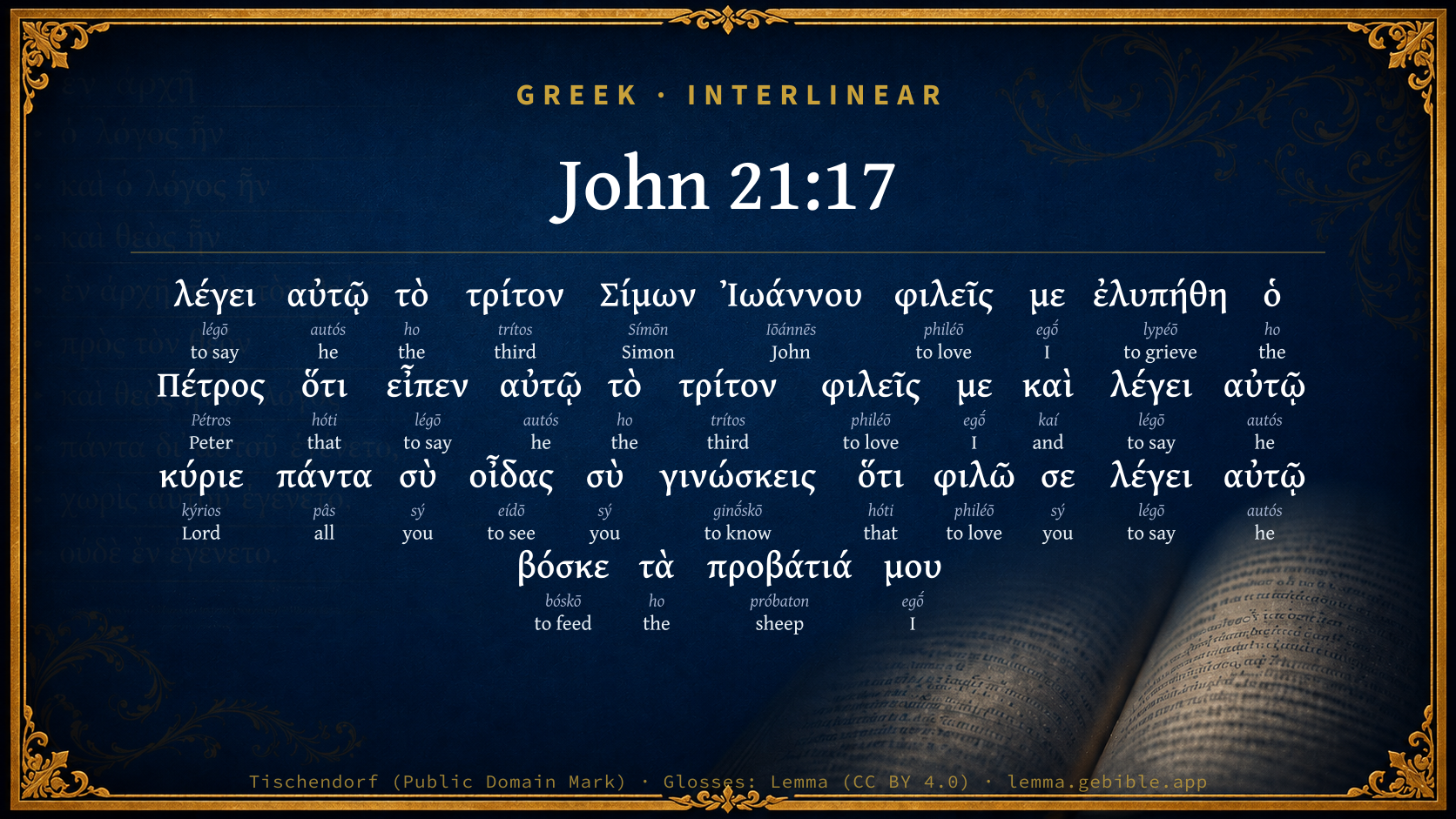
  1. λέγει légō G3004 “to say” Verb, Present, Active, Indicative, 3rd person, Singular
  2. αὐτῷ autós G846 “he” Personal pronoun, Dative, Singular, Masculine
  3. τὸ ho G3588 “the” Article, Accusative, Singular, Neuter
  4. τρίτον trítos G5154 “third” Adjective, Accusative, Singular, Neuter
  5. Σίμων Símōn G4613 “Simon” Noun, Vocative, Singular, Masculine
  6. Ἰωάννου Iōánnēs G2491 “John” Noun, Genitive, Singular, Masculine
  7. φιλεῖς philéō G5368 “to love” Verb, Present, Active, Indicative, 2nd person, Singular
  8. με egṓ G1473 “I” Personal pronoun, 1st person, Accusative, Singular
  9. ἐλυπήθη lypéō G3076 “to grieve” Verb, Aorist, Passive, Indicative, 3rd person, Singular
  10. ὁ ho G3588 “the” Article, Nominative, Singular, Masculine
  11. Πέτρος Pétros G4074 “Peter” Noun, Nominative, Singular, Masculine
  12. ὅτι hóti G3754 “that” Conjunction
  13. εἶπεν légō G3004 “to say” Verb, Aorist, Active, Indicative, 3rd person, Singular
  14. αὐτῷ autós G846 “he” Personal pronoun, Dative, Singular, Masculine
  15. τὸ ho G3588 “the” Article, Accusative, Singular, Neuter
  16. τρίτον trítos G5154 “third” Adjective, Accusative, Singular, Neuter
  17. φιλεῖς philéō G5368 “to love” Verb, Present, Active, Indicative, 2nd person, Singular
  18. με egṓ G1473 “I” Personal pronoun, 1st person, Accusative, Singular
  19. καὶ kaí G2532 “and” Conjunction
  20. λέγει légō G3004 “to say” Verb, Present, Active, Indicative, 3rd person, Singular
  21. αὐτῷ autós G846 “he” Personal pronoun, Dative, Singular, Masculine
  22. κύριε kýrios G2962 “Lord” Noun, Vocative, Singular, Masculine
  23. πάντα pâs G3956 “all” Adjective, Accusative, Plural, Neuter
  24. σὺ sý G4771 “you” Personal pronoun, 2nd person, Nominative, Singular
  25. οἶδας eídō G1492 “to see” Verb, Perfect, Active, Indicative, 2nd person, Singular
  26. σὺ sý G4771 “you” Personal pronoun, 2nd person, Nominative, Singular
  27. γινώσκεις ginṓskō G1097 “to know” Verb, Present, Active, Indicative, 2nd person, Singular
  28. ὅτι hóti G3754 “that” Conjunction
  29. φιλῶ philéō G5368 “to love” Verb, Present, Active, Indicative, 1st person, Singular
  30. σε sý G4771 “you” Personal pronoun, 2nd person, Accusative, Singular
  31. λέγει légō G3004 “to say” Verb, Present, Active, Indicative, 3rd person, Singular
  32. αὐτῷ autós G846 “he” Personal pronoun, Dative, Singular, Masculine
  33. τὰ ho G3588 “the” Article, Accusative, Plural, Neuter
  34. προβάτιά próbaton G4263 “sheep” Noun, Accusative, Plural, Neuter
  35. μου egṓ G1473 “I” Personal pronoun, 1st person, Genitive, Singular

About this verse

These counts appear in no published source. They are computed here, from the morphology-tagged text and Lemma’s own curated glosses. What Lemma adds →

36
words
19
distinct lemmas
Gospels
section

Notable vocabulary

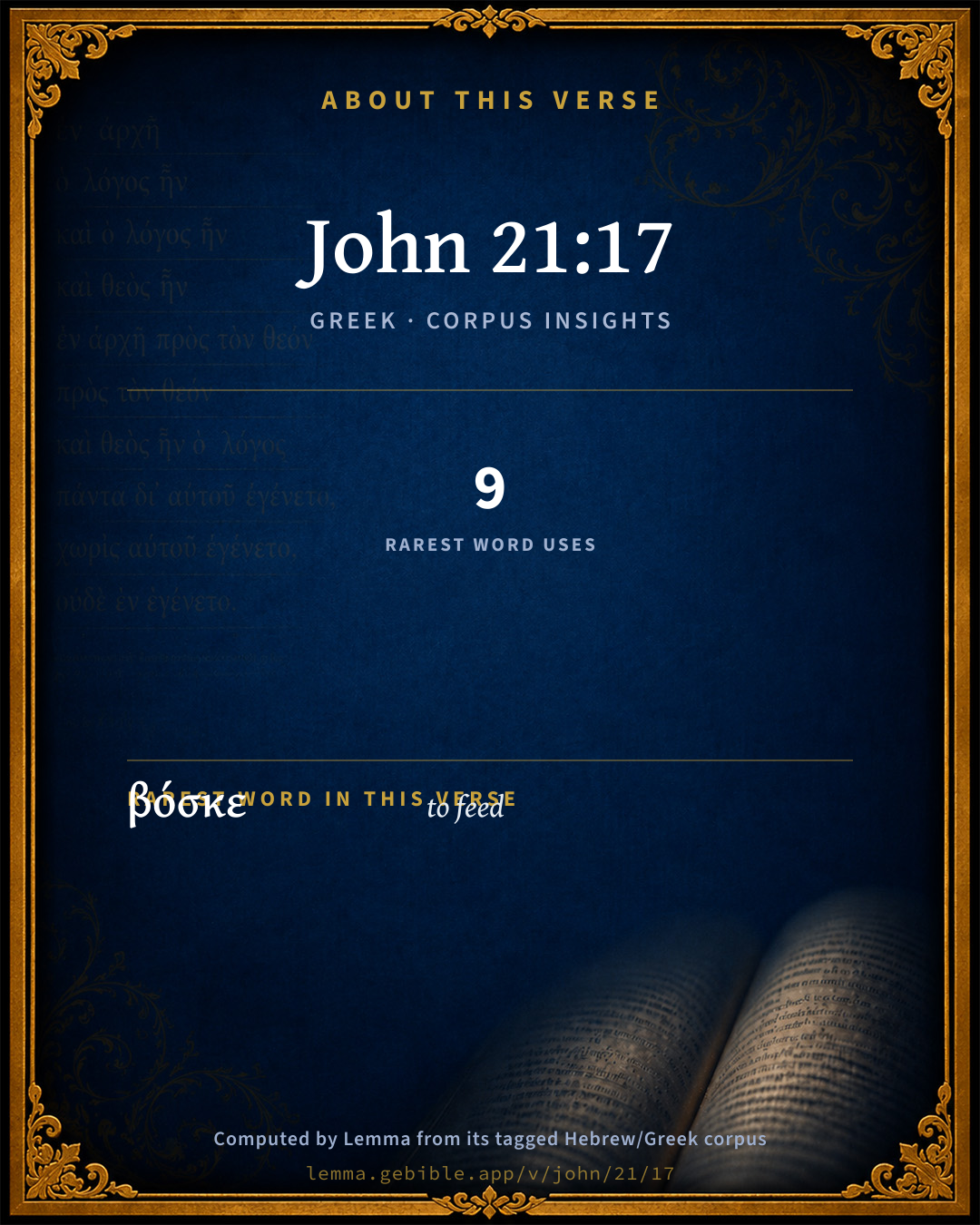
The rarest word here is βόσκε to feed G1006 — appearing just 9 times in the whole Greek New Testament.

Shared distinctive vocabulary

βόσκε to feed G1006 occurs in 9 verses of the Greek New Testament. Also found in:

Repetition

Words recur within this verse:

Cross-references

34

Topical passages linked to John 21:17 in the Treasury of Scripture Knowledge — connected by theme and wording, ordered by reader-vote popularity; previews shown in the World English Bible.

  • John 13:38 Jesus answered him, "Will you lay down your life for me? Most assuredly I tell you, the rooster won't crow until you have denied me three times.
  • Mark 14:72 The rooster crowed the second time. Peter remembered the word, how that Jesus said to him, "Before the rooster crows twice, you will deny me three times." When he thought about that, he wept.
  • John 16:30 Now we know that you know all things, and don't need for anyone to question you. By this we believe that you came forth from God."
  • John 14:15 If you love me, keep my commandments.
  • John 15:10 If you keep my commandments, you will remain in my love; even as I have kept my Father's commandments, and remain in his love.
  • John 18:27 Peter therefore denied it again, and immediately the rooster crowed.
  • John 21:15–16 So when they had eaten their breakfast, Jesus said to Simon Peter, "Simon, son of Jonah, do you love me more than these?" He said to him, "Yes, Lord; you know that I have affection for you." He said to him, "Feed my lambs."
  • Ephesians 4:30 Don't grieve the Holy Spirit of God, in whom you were sealed for the day of redemption.
  • Revelation 2:23 I will kill her children with Death, and all the assemblies will know that I am he who searches the minds and hearts. I will give to each one of you according to your deeds.
  • John 18:4 Jesus therefore, knowing all the things that were happening to him, went forth, and said to them, "Who are you looking for?"
  • Acts 1:24 They prayed, and said, "You, Lord, who know the hearts of all men, show which one of these two you have chosen
  • Acts 15:8 God, who knows the heart, testified about them, giving them the Holy Spirit, just like he did to us.
  • 2 Corinthians 1:12 For our boasting is this: the testimony of our conscience, that in holiness and sincerity of God, not in fleshly wisdom but in the grace of God we behaved ourselves in the world, and more abundantly toward you.
  • 2 Peter 1:12–15 Therefore I will not be negligent to remind you of these things, though you know them, and are established in the present truth.
  • 1 John 3:16–24 By this we know love, because he laid down his life for us. And we ought to lay down our lives for the brothers.
  • Joshua 22:22 The Mighty One, God, Yahweh, the Mighty One, God, Yahweh, he knows; and Israel he shall know: if it be in rebellion, or if in trespass against Yahweh (don't save us this day),
  • 1 Kings 17:18 She said to Elijah, What have I to do with you, you man of God? You have come to me to bring my sin to memory, and to kill my son!
  • 1 Chronicles 29:17 I know also, my God, that you try the heart, and have pleasure in uprightness. As for me, in the uprightness of my heart I have willingly offered all these things: and now have I seen with joy your people, that are present here, offer willingly to you.
  • Job 31:4–6 Doesn't he see my ways, And number all my steps?
  • Psalms 7:8–9 Yahweh administers judgment to the peoples. Judge me, Yahweh, according to my righteousness, And to my integrity that is in me.
  • Psalms 17:3 You have proved my heart; you have visited me in the night; You have tried me, and found nothing; I have resolved that my mouth shall not disobey.
  • Jeremiah 17:10 I, Yahweh, search the mind, I try the heart, even to give every man according to his ways, according to the fruit of his doings.
  • Lamentations 3:33 For he does not afflict willingly, nor grieve the children of men.
  • Matthew 26:73–75 After a little while those who stood by came and said to Peter, "Surely you are also one of them, for your speech makes you known."
  • Luke 22:61–62 The Lord turned, and looked at Peter. Then Peter remembered the Lord's word, how he said to him, "Before the rooster crows you will deny me three times."
  • John 12:8 For you always have the poor with you, but you don't always have me."
  • 2 Corinthians 2:4–7 For out of much affliction and anguish of heart I wrote to you with many tears, not that you should be made sorry, but that you might know the love that I have so abundantly for you.
  • 2 Corinthians 7:8–11 For though I made you sorry with my letter, I do not regret it, though I did regret it. For I see that my letter made you sorry, though just for a while.
  • 2 Corinthians 8:8–9 I speak not by way of commandment, but as proving through the earnestness of others the sincerity also of your love.
  • 1 Peter 1:6 Wherein you greatly rejoice, though now for a little while, if need be, you have been put to grief in various trials,
  • 2 Peter 3:1 This is now, beloved, the second letter that I have written to you; and in both of them I stir up your sincere mind by reminding you;
  • 3 John 1:7–8 because for the sake of the Name they went out, taking nothing from the Gentiles.
  • John 2:24–25 But Jesus didn't trust himself to them, because he knew everyone,
  • Revelation 3:19 As many as I love, I reprove and chasten. Be zealous therefore, and repent.

Cross-references courtesy of OpenBible.info (CC BY 4.0).

Where the printed editions differ

1 variant

Places in this verse where the major printed Greek editions disagree on the wording in a way that affects the translation — a comparison of editions, not a manuscript-by-manuscript collation. The editions are the modern critical texts (Nestlé-Aland 28/27, SBL, Westcott-Hort, Tregelles, Tyndale House) and the traditional texts behind the KJV (the Textus Receptus and the Byzantine/Majority text). It is not a claim about which reading is original.

  1. Different wording
    Ἰωάννου,

    “[son] of John,”

    In NA28NA27TynSBLWHTreg Not in TRByz

    Ἰωνᾶ (Iōna) 'of Jonah' occurs in traditional manuscripts (TR+Byz) instead of Ἰωάννου, (Iōannou) '[son] of John,' in older manuscripts (NA28+NA27+Tyn+SBL+WH+Treg)

Textual data: Translators Amalgamated Greek New Testament (STEPBible TAGNT) · CC BY 4.0.

Commentary

Notes on John 21:17 from classic Christian and Jewish commentators (each source and its license shown beneath its notes). The classic Christian expositions comment on the surrounding passage and are grouped to its opening verse, so a note may address several verses; the Jewish commentaries on the Tanakh (Rashi and others) are per-verse, so they appear only where the commentator wrote on this verse.

Lemma curates 59 commentaries, every one of them public domain or Creative Commons licensed, each selected and text-cleaned for this edition rather than reprinted as found. About our sources →

Ellicott's Commentary for English Readers

(17) He saith unto him the third time.—Again the question is asked, but this time the Lord uses Peter’s own word, and His question seems to say, “Dost thou, in personal affection and devotion, really love Me?” The third time, to him who had three times denied! and this time the love which Peter knows has ever filled his soul seems to be doubted. The question cuts to the very quick, and in the agony of the heart smarting beneath the wound, he appeals in more emphatic words than before to the all-seeing eye that could read the very inmost secrets of his life, “Lord, Thou knowest all things; Thou knowest that I love Thee.”

Feed my sheep.—The better reading is, probably, little sheep. The difference is of one letter only (πρόβατα and προβατία), and a mistake would therefore be easily made by a copyist. The diminutive word occurs nowhere else in Biblical Greek, and is almost certainly, therefore, part of the original text; but whether it was first written here or in Joh_21:16, or in both, must with our present knowledge be left undetermined. The order of the Received text is “lambs” (Joh_21:15), “sheep” (Joh_21:16), “sheep” (Joh_21:17). The Peshito Syriac must have read “lambs,” “little sheep,” “sheep”; and this is in part supported by the Vulgate, which has “agnos,” “agnos,” “oves,” and more exactly by the Latin of St. Ambrose, who has “agnos,” “oviculas,” “oves.” This would point to a three-fold gradation answering to the three-fold question, and committing to the Apostle’s care the lambs, the little sheep, the sheep of the flock of Christ. Still, it must be admitted that the more probable reading is lambs, little sheep, little sheep, and that the difference of thought is in the difference of the verbs. “Feed My lambs; be a shepherd to the weak ones of the flock; feed these weak ones.” He who loved Christ is to be like Christ, a good shepherd, giving his life for the sheep who are Christ’s. He who had been loved and forgiven, held up that he might not fall, restored after he had fallen, is to be to others what Christ had been to him—feeding men with spiritual truths as they can bear them, gently guiding and caring for those who are as the weak ones of the flock through ignorance, prejudice, waywardness. The chief work of the chief Apostle, and of every true apostle of Christ, is to win back the erring, helpless, sinful sons of men; and the power which fits them for this work is the burning love which quickens all other gifts and graces, and can appeal to the Great Shepherd Himself, “Lord, Thou knowest all things; Thou knowest that I love Thee.” As a remarkable instance of how the Great Shepherd’s words impressed themselves upon the Apostle’s mind, comp. 1Pe_2:25.

A Bible Commentary for English Readers, edited by Charles John Ellicott (1878–1897) — public domain. Text from a community e-Sword module.

Tyndale Open Study Notes

Tyndale Open Resources

21:17 feed my sheep: Jesus, who knows all things (1:42; 2:25; 16:30), understood that despite Peter’s terrible failing, he still had faith and commitment to Jesus. These words called Peter to nurture and protect Christ’s followers.

Tyndale Open Study Notes — © Tyndale Open Resources, licensed CC BY-SA 4.0. Text via the HelloAO Bible API.

Bengel's Gnomon

Johann Albrecht Bengel

Joh 21:17. Τὸ τρίτον, the third time) Comp. ch. Joh 13:38. The decisive number.—ἐλυπήθη, was grieved) In feeling so, his distress was with good reason.—καὶ εἶπεν, and he said unto Him) At this point, as it were wearied out, he pours out his whole self [in a one final appeal to His omniscience].—[Κύριε, σὺ πάντα οἶδας, Lord, Thou knowest all things) Peter in truth had most largely had proof of the OMNISCIENCE of the Lord Jesus, along with the rest of the disciples. Let us first collect the testimonies of it which occur in the Gospel of John. Jesus knew who Simon was, ch. Joh 1:42: The mind and action of Nathanael, Joh 1:47-48: What is in every man, ch. Joh 2:25: The deeds of the woman of Samaria, ch. Joh 4:29: What He Himself was about to do, ch. Joh 6:6: The treachery of Judas and of others, ch. Joh 6:64; Joh 6:70: The death of Lazarus, ch. Joh 11:11: That His hour had come, ch. Joh 13:1: The treachery of Judas, Joh 13:8: The denial of Peter, Joh 13:38: The disciples’ desire to question Him, ch. Joh 16:19: And all things, Joh 16:30: The several things which should come upon Him, ch. Joh 18:4: And their consummation, ch. Joh 19:28. Furthermore He knew, according to the report of the rest of the Evangelists, the thoughts of men, Mar 2:6; Mar 2:8; Luk 6:8; Luk 7:47 (with which comp. Joh 19:39): Mat 12:25; Mat 16:8; Luk 9:47; Luk 11:17. Also what was the raiment of Solomon, Mat 6:29: What Sodom, Tyre, and Sidon would have done had they seen the works of Christ, ch. Joh 11:21; Joh 11:23. He predicted His Passion, Mat 16:21; Mar 8:31; Luk 9:22, etc.: The destruction of Jerusalem, Luk 19:43; Mat 23:35, etc., Mat 24:2, etc; Luk 23:28, etc.: The circumstances which were about to accompany His entrance into the city and the Passover feast, Mar 11:2, etc., Joh 14:13; Joh 14:15; Joh 14:27: And very many other things of that kind.—Harm., p. 609, 610.]

Bengel's Gnomon of the New Testament — English translation (T&T Clark, Edinburgh, 1860) — public domain. Text from a community e-Sword module.

Expositor's Greek Testament

ed. W. Robertson Nicoll

Joh 21:17 . But to him who had uttered a threefold denial, opportunity is given of a threefold confession, although Peter at first resented the reiterated inquiry: Ἐλυπήθη … He was grieved because doubt was implied, and he knew he had given cause for doubt. His reply is therefore more earnest than before, Κύριε … φιλῶ σε . He is so conscious of deep and abiding love that he can appeal to the Lord’s omniscience. The σὺ πάντα οἶδας [or πάντα σὺ οἶδας with recent editors] reflects a strong light on the belief which had sprung up in the disciples from their observation of our Lord. And again he is commissioned, or commanded to manifest his love in the feeding of Christ’s sheep. The one qualification for this is love to Christ. It is not for want of time no other questions are asked. There was time to put this one question three times over; and it was put because love is the one essential for the ministry to which Peter and the rest are called.

The Expositor's Greek Testament, edited by W. Robertson Nicoll (1897–1910) — public domain. Text from a community e-Sword module.

Geneva Bible (1599)

Geneva Bible translators

It was meet that he that had denied him thrice, should confess him thrice, that Peter might neither doubt of the forgiveness of his so grievous a sin, nor of his restoring to the office of the Apostleship.

Geneva Bible (1599) marginal notes — public domain. Text via Bolls.life.

Jamieson, Fausset & Brown

Robert Jamieson, A. R. Fausset & David Brown

He saith unto him the third time, Simon, son of Jonas, lovest thou me? Peter was grieved because he said the third time, &c.--This was the Physician's deepest incision into the wound, while yet smarting under the two former probings. Not till now would Peter discern the object of this succession of thrusts. The third time reveals it all, bringing up such a rush of dreadful recollections before his view, of his "thrice denying that he knew Him," that he feels it to the quick. It was fitting that he should; it was meant that he should. But this accomplished, the painful dialogue concludes with a delightful "Feed My sheep"; as if He should say, "Now, Simon, the last speck of the cloud which overhung thee since that night of nights is dispelled: Henceforth thou art to Me and to My work as if no such scene had ever happened."

Jamieson, Fausset & Brown — Commentary Critical and Explanatory on the Whole Bible (1871) — public domain (CC PDM 1.0). Text via the HelloAO Bible API.

Adam Clarke's Commentary

Verse 17. Peter was grieved] Fearing, says St. Chrysostom, lest Christ saw something in his heart which he saw not himself, and which might lead to another fall; and that Christ was about to tell him of it, as he had before predicted his denial.

Adam Clarke's Commentary on the Bible (1810–1826) — public domain. Text from a community e-Sword/MySword module.

John Calvin's Commentaries

17. Peter was grieved. Peter undoubtedly did not perceive the object which Christ had in view, in putting the same question so frequently; and therefore he thinks that he is-in-directly accused, as if he had not answered with sincerity. But we have already showed that the repetition was not superfluous. Besides, Peter was not yet sufficiently aware how deeply the love of Christ must be engraven on the hearts of those who have to struggle against innumerable difficulties. He afterwards learned by long experience, that such a trial had not been made in vain. Those who are to undertake the charge of governing the Church are also taught, in his person, not to examine themselves slightly, but to make a thorough scrutiny what zeal they possess, that they may not shrink or faint in the middle of their course. We are likewise taught, that we ought patiently and mildly to submit, if at any time the Lord subject us to a severe trial; because he has good reasons for doing so, though they are generally unknown to us.

John Calvin's Commentaries (1540-1563) — public domain. Text from the Calvin Translation Society English edition (1840s-50s) via the Christian Classics Ethereal Library (ccel.org). Calvin's coverage is partial (roughly two-thirds of the Bible); uncommented books and verses are honest gaps, never fabricated. The 19th-century editor's footnotes and remarks are omitted so the notes are faithfully Calvin's own voice.

The Cambridge Bible for Schools and Colleges

gen. ed. J. J. S. Perowne

17. the third time] He had denied thrice, and must thrice affirm his love. This time Jesus makes a further concession: He not only ceases to urge the ‘more than these,’ but He adopts S. Peter’s own word, philein. The Apostle had rejected Christ’s standard and taken one of his own, about which he could be more sure; and Christ now questions the Apostle’s own standard. This is why ‘Peter was grieved’ so much; not merely at the threefold question recalling his threefold denial, not merely at his devotion being questioned more than once, but that the humble form of love which he had professed, and that without boastful comparison with others, and without rash promises about the future, should seem to be doubted by his Lord.

thou knowest all things; thou knowest] Once more we have two words for ‘know’ in the original and only one in the A. V. (Comp. Joh_7:27, Joh_8:55, Joh_13:7, Joh_14:7.) The first ‘knowest’ (oidas) refers to Christ’s supernatural intuition, as in Joh_21:15-16 : the second ‘knowest’ (ginôskeis) to His experience and discernment; Thou recognisest, perceivest, seest, that I love Thee. See on Joh_2:24-25.

Feed my sheep] It is doubtful whether we have or have not precisely the same word for ‘sheep’ here as in Joh_21:16. The Greek word here according to the best authorities is undoubtedly a diminutive (probatia, not probata); in Joh_21:16 the evidence is pretty evenly balanced between probatia and probata (‘little sheep’ and ‘sheep’). One is tempted to adopt S. Ambrose’s order in Joh_21:15-17—‘lambs,’ ‘little sheep,’ ‘sheep’ (agnos, oviculas, oves), which seems also to have been the reading of the old Syriac: but the balance of evidence is against it. But without counting the possible difference between ‘little sheep’ and ‘sheep,’ there are three important distinctions obliterated in the A. V.,—the two words rendered ‘love,’ the two rendered ‘feed,’ and the two rendered ‘know.’

S. Peter seems to recall this charge in his First Epistle (Joh_5:2-3), a passage which in the plainest terms condemns the policy of those who on the strength of this charge have claimed to rule as his successors over the whole of Christ’s flock.

The Cambridge Bible for Schools and Colleges (gen. ed. J. J. S. Perowne; Cambridge University Press, 1878–1918) — public domain. Text from a community e-Sword module.

John Gill's Exposition

He saith unto him the third time,.... That by these three testimonies, out of his mouth, the thing might be established, and be out of all doubt:

Simon, son of Jonas, lovest thou me? is it so indeed that thou lovest me? is thy love really so hearty and sincere as thou savest? may it be depended upon?

Peter was grieved, because he said unto him the third time, lovest thou me? because it put him in mind of his having denied his Lord three times; the remembrance of which cut him to the heart and it added to his grief, that his love, which he knew was unfeigned, notwithstanding his conduct, should seem to be suspected:

and he said unto him, Lord, thou knowest all things, thou knowest that I love thee; he appeals with great warmth and earnestness to him, as the omniscient God, and the searcher of all hearts, who knows all persons and things, and the secret thoughts, dispositions, and affections of men's minds, for the truth of his love to him; for though he knew the treachery of his own heart, and durst not trust to it; and therefore chose not to be determined by his own assertions, and was well aware that the sincerity of his love might be called in question by fellow Christians, because of his late conduct; but as everything was naked and open to his Lord, with whom he had to do, he lodges and leaves the appeal with him: so every soul that truly loves Christ, whatever Satan, the world, professors, or their own hearts under unbelieving frames, may suggest to the contrary, can appeal to Christ, as the trier of the reins of the children of men, that he it is whom their souls love; and though their love may be greatly tried, and they themselves be sorely tempted by Satan, and suffered to fall greatly; yet their love to Christ can never be lost; the fervency of it may be abated, the exercise of it may be very languid, but the principle itself always remains, as it did in Peter:

Jesus saith unto him, feed my sheep. It may be observed from the repetition of this phrase following upon Peter's declaration of his love to Christ, that such only are proper persons to feed the lambs and sheep of Christ, who truly and sincerely love him: and in doing which they show their love to him: and who indeed would be concerned in this service, but such? since the work is so laborious, the conduct of those to whom they minister oftentimes is so disagreeable, the reproach they meet with from the world, and the opposition made unto them by Satan, and all the powers of darkness: it is true indeed, there are some that take upon them this work, and pretend to do it, who do not love Christ; but then they are such who feed themselves, and not the flock; and who feed the world's goats, and not Christ's lambs and sheep, and in time of danger leave the flock; only the true lovers of Christ faithfully perform this service, and abide in it by preaching the pure Gospel of Christ, by administering his ordinances, in their right manner, and by directing souls in all to Christ, the heavenly manna, and bread of life. Dr. Lightfoot thinks that by the threefold repetition of the order to feed Christ's lambs and sheep, is meant the threefold object of Peter's ministry; the Jews in their own land, the Gentiles, and the Israelites of the ten tribes, that were in Babylon.

John Gill's Exposition of the Whole Bible (1746–1763) — public domain (CC PDM 1.0). Text via the HelloAO Bible API.

Trapp's Complete Commentary

John Trapp

17 He saith unto him the third time, Simon, son of Jonas, lovest thou me? Peter was grieved because he said unto him the third time, Lovest thou me? And he said unto him, Lord, thou knowest all things; thou knowest that I love thee. Jesus saith unto him, Feed my sheep.

Ver. 17. Jesus saith unto him the third time] To confirm him doubtless against the consciousness of his three-fold denial, and to re-authorize him in his apostleship.

Lovest thou me?] A minister had need have his heart inflamed with a most ardent affection to Christ; for else he will never suffer that hardship devour those difficulties, and get over all those impediments that he is sure to be encumbered with. The ministry, believe it, is not an idle man’s occupation, he must preach the word, be instant in season, out of season, &c., cry in the throat ( Clamare ut Stentora vincat), lift up his voice like a trumpet, speak till he spit forth his lungs, and yet to no more purpose many times than Beda did when he preached to a heap of stones. Now this he will never do, unless the love of Christ constrain him, 2Co 5:14; cf. 1Co 16:22.

Peter was grieved] Either in remembrance of his former false play; or else, as thinking our Saviour somewhat distrusted his fidelity; or else, surely, he was as much to blame to be grieved, as David was to be angry, when God had made a breach upon Uzzah, 2Sa 6:8.

Feed my sheep] My sheep with golden fleeces, with precious souls; every soul being more worth than a world, as our Saviour reckons it, who only went to the price of it, Mat 16:26. Can that be wholesome meat then that is sauced with the blood of souls? Will it not be bitterness in the end?

John Trapp, A Commentary or Exposition upon All the Books of the Old and New Testament (1647–1656) — public domain. Text from a community e-Sword module.

Albert Barnes' Notes on the Bible

The third time - It is probable that Jesus proposed this question three times because Peter had thrice denied him. Thus he tenderly admonished him of his fault and reminded him of his sin, while he solemnly charged him to be faithful and vigilant in the discharge of the duties of the pastoral office. The reason why the Saviour addressed Peter in this manner was doubtless because he had just denied him - had given a most melancholy instance of the instability and weakness of his faith, and of his liability to fall. As he had thus been prominent in forsaking him, he took this occasion to give to him a special charge, and to secure his future obedience. Hence, he so administered the charge as to remind him of his fault; and he made him so prominent as to show the solicitude of the Saviour that, henceforward, he might not be left to dishonor his high calling. This same charge, in substance, he had on other occasions given to the apostles Mat 18:18, and there is not the slightest evidence here that Christ intended, as the Papists pretend, to give Peter any special primacy or eminence in the church. The charge to Peter arose, manifestly, from his prominent and melancholy act in denying him, and was the kind and tender means used by a faithful Saviour to keep him from similar acts in the future dangers and trials of life. It is worthy of remark that the admonition was effectual. Henceforward, Peter was one of the most firm and unwavering of all the apostles, and thus fully justified the appellation of a rock, which the Saviour by anticipation had given him. See the notes at Joh 1:42.

Albert Barnes' Notes on the Bible (1834–1885) — public domain. Text from a community e-Sword/MySword module.

Whedon's Commentary on the Bible

Daniel D. Whedon

17. Lovest thou—Jesus now, at last, uses the affectional term for love. This affectional term is lower than the moral term, but yet tenderer. But the cherishing of the moral tends to produce the affectional; and it is when both are united that the love is perfected. This blending in spiritual perfection is impossible without the aid of the blessed and Divine Spirit of love.

Peter was grieved—Peter now sees that it is his threefold denial that demands this threefold confession. He is grieved, not because the demand is made, but for the sad cause that renders it necessary. He had thrice said, I know not the man; he may now thrice declare how he loves the man. But the recollection of the sad scene of apostacy melts him to sorrow in this his hour of restoration.

Knowest all things—The man whom he denies is divine. The man whom, in the hour of the denial, he knew not, knows all things.

I love thee—The full profession is uttered, and the full absolution will now be made.

Feed my sheep—Shepherd my full-grown sheep. Peter passes by humble degrees to his full pastoral office. But he receives no popedom, no triple crown over the universal Church. Nothing indicates that he is restored more than to the level of his fellow-disciples.

Daniel D. Whedon (gen. ed.), Commentary on the Old and New Testaments (1874–1909) — public domain. Text from a community e-Sword module.

The Pulpit Commentary

And now Peter seems to have conquered, by his persistence, the heart of his Lord, and Jesus adopts the very phrase which Peter twice over had substituted for that which he had himself used; for he saith unto him the third time, Simon, son of Jonas (John), lovest thou me? (fileiv me; ); as if he had said, "Dost thou indeed love me dearly, love me as a friend, love me with the earnestness and fervor that twice over has corrected my word into one more congenial to thee, and more ample and true than that used by myself?" This trait of Peter"s character, which John has hinted on several occasions, is abundantly illustrated in the synoptic narrative and in the Acts of the Apostles. Peter was grieved because he said unto him the third time, Lovest thou me? The grief was natural. The repeated question suggests some doubt about his sincerity, and the adoption of the apostle"s own word cut him with a more poignant heart-thrust? He may have thought thus: Jesus seems to distrust the reality of my personal affection. and will not accept my implication that this is more to me than the most thoughtful agaph , the most deeply meditated and measured reverence. He was grieved because a third time seems like an infinite repetition, and, if repeated thus a third time, it may be asked me again and again every day of my life. He was grieved from the irresistible analogy between the threefold denial of which he had been guilty, and this threefold interrogatory. He does not say as before, "Yea, Lord;" but commences, Lord, thou knowest (oidav) all things. Omniscience is freely conceded to the Lord. All things that Peter did, thought, or felt, all his bewilderment, all his mistakes, all his impulsiveness and mixture of motive, all his self-assertion, all his weakness and disloyalty, are known; but so also all the inner springs and lines of his nobler nature, and that though he played the fool, he was a hypocrite in his denials. The Lord knew that his faith did not really fail, though his courage did; and in virtue of this breadth of the Lord"s knowing, he must have come to full cognizance of the entire meaning of Peter"s life. Thou (seest) hast come fully to know that I love thee! Just because thou intuitively knowest all things. The play on oidav and ginwskeiv is obvious. (see Joh_10:14 Joh_17:3, etc.) Jesus saith to him, Feed my little sheep. It is said by some that, even if this be the true reading, we have simply a renewal of the tenderness and strong emotion which led the Lord to speak of the arnia on the first occasion. Doubtless deep and glowing affection pervades the use of these epithets; but if this be the sole explanation, then the reason of the adoption of probata in the second commission is not evident, arnia would have answered the purpose. There is distinct progress in the ideas:

(1) "Feed my lambs;

(2) "Rule (shepherd) my sheep;

(3) "Feed my little sheep.

First, let Peter, let the apostolic company, let any one of the successors of the apostles, learn the delicate duty of supplying the just and appropriate nourishment to those that are young in years or in graces; then let him also learn to guide, direct, protect from outward foes, the mature disciples, and preserve the discipline of the flock, seeking the lost sheep until it be found; and he will find that then a third duty emerges. The sheep that are young in heart, the old men that are childlike in spirit, the trembling sheep that need even more care than the lambs themselves, are specially thrown upon the shepherd"s care. Was not Peter himself a probation ? Had he not shown that he was a most imperfect master of himself? He was mature in years, but childish as well as childlike in character. He could (for a while) only see one thing at a time, and he was impatient of the future. Mark welt his characteristic words, "Depart from me, for I am a sinful man. O Lord!" "That be far from thee, O Lord!" "Why cannot I follow thee now?" "Thou shall never wash my feet!" "Not my feet only, but my hands and my head!" "Let us build for thee three tabernacles!" "Not so; I have never eaten anything common or unclean!" These are familiar illustrations of the childishness and infantile simplicity, babyish audacity, of the old disciple. Even after the Lord has risen from the dead, Peter ventures to correct his language. Christ, moreover, accepts his persistent alteration of the word for "love" item the lips of this probation . Thus the Lord summons him to undertake a duty which he would on reflection be specially able to appreciate.

The Pulpit Commentary (1880–1919), ed. H.D.M. Spence-Jones & Joseph S. Exell — public domain. Text from a community e-Sword module.

John Wesley's Explanatory Notes

Because he said the third time - As if he did not believe him.

John Wesley, Explanatory Notes Upon the Whole Bible (1754–1765) — public domain. Text via the GEBible commentary corpus.

Scofield Reference Notes

C. I. Scofield

lovest Our Lord here takes Peter’s word, phileis.

love (Greek - καταφιλέω, am fond of). It is a lesser degree of love than agapas.

Feed Joh 21:15; Joh 10:9

The Scofield Reference Bible (1917 edition), notes by C. I. Scofield — public domain. Text from a community e-Sword module.

unfoldingWord translationNotes

Door43 World Missions Community

He said to him a third time

The pronoun "he" refers to Jesus. Here "a third time" means "time number 3." AT: "Jesus said to him a third time" (See: Ordinal Numbers)

do you love me

This time when Jesus asks this question he uses the word for "love" that refers to brotherly love or love for a friend or family member.

Feed my sheep

Here "sheep" is a metaphor that represents those who belong to Jesus and follow him. AT: "Care for the people I care for" (See: Metaphor)

Truly, truly

See how you translated this in John 1:51.

translationWords

love

amen

unfoldingWord translationNotes — © Distant Shores Media and the Door43 World Missions Community, licensed CC BY-SA 4.0. Source: git.door43.org/Door43/en_tn.

Cambridge Greek Testament for Schools and Colleges

17. πάντα before σύ, with אBC1D against Acts 3.

17. τρίτον. He had denied thrice, and must thrice affirm his love. This time Jesus makes a further concession: He not only ceases to urge the ‘more than these,’ but He adopts S. Peter’s own word φιλεῖν. The Apostle had rejected Christ’s standard and taken one of his own, about which he could be more sure; and Christ now questions the Apostle’s own standard. This is why ‘Peter was grieved’ so much; not merely at the threefold question recalling his threefold denial, not merely at his devotion being questioned more than once, but that the humble form of love which he had professed, and that without boastful comparison with others, and without rash promises about the future, should seem to be doubted by his Lord.

σὺ οἶδας· σὺ γινώσκεις. Once more (Joh 7:27, Joh 8:55, Joh 13:7, Joh 14:7) we have a sudden change between οἶδα and γινώσκε: οἶδας refers to Christ’s supernatural intuition; γινώσκεις to His experience and discernment; Thou recognisest, seest, that I love Thee. see on Joh 2:25.

β. τ. προβάτιά μ. One is tempted to think that ἀρνία, προβάτια, πρόβατα, supported by S. Augustine’s agnos, oviculas, oves, and apparently by the old Syriac, is right: but the balance of evidence is against it. If πρόβατα is admissible, it must (on the external evidence) come second, not third. But in any case there is a climax: leading the sheep is more difficult work than feeding the lambs; and feeding the sheep is the most difficult of all. To find healthful στερεὰ τροφή for τέλειοι Christians tasks the shepherd’s powers more than finding γάλα for νήπιοι (Heb 5:13).

S. Peter seems to recall this charge in his First Epistle (Joh 5:2-3), a passage which in the plainest terms condemns the policy of those who on the strength of this charge have claimed to rule as his successors over the whole of Christ’s flock.

Cambridge Greek Testament for Schools and Colleges (Cambridge University Press, 1896; 21 vols, various authors incl. Carr, Maclear, Plummer, Farrar, Lumby, Moule, M. R. James, Simcox) — public domain. Text from a community e-Sword module.

Alford’s Greek Testament

Henry Alford

17. φιλεῖς] See above on ver. 15.

ἐλυπήθη—not merely on account of the repetition of the question, but because of τὸ τρίτον, the number of his own denials of Christ.

πάντα οἶδας] See above.

Henry Alford, The Greek Testament (1849–1861) — public domain. Text from a community e-Sword module.

International Critical Commentary

17. τὸ τρίτον. Cf. δεύτερον in v. 16. This is the same question as before, repeated for the third time, and not a new question, as it would be if φιλεῖς με; were different in meaning from ἀγαπᾷς με; of vv. 15, 16.

W has ἀγαπᾷς here, as in vv. 15, 16.

ἐλυπήθη ὁ Πέτρος. He knew that he had given cause for the doubting of his love, and it grieved him that his repeated assurance that it still inspired him was not treated as sufficient by his Master. For ὁ Πέτρος here, see on 18:15.

καὶ εἶπεν αὐτῷ. אBCDΘ prefix καί, which is omitted by A. For εἶπεν (BCΓΔ), אADWΘ have λέγει.

Peter leaves out ναί in this third answer. He appeals to the knowledge of his feelings which he is assured Jesus must have.

πάντα σὺ οἶδας (cf. 16:30). Long before this, the chosen companions of Jesus had learnt that His insight into human character and motive was unerring; cf. 2:25 αὐτὸς γὰρ ἐγίνωσκεν τί ἦν ἐν τῷ ἀνθρώπῳ, the verb γινώσκειν, of immediate observation, being used there, as here.

Ἰησοῦς: om. אDW, ins. ANΓΔ BC om. ὁ.

Βόσκε τὰ πρόβατά μου. This is the final charge, pasce oues meas. τὰ πρόβατα includes the whole flock, young and old.

Prediction of Peter’s Martyrdom (vv. 18, 19); And a Misunderstood Saying About John (vv. 20-23)

International Critical Commentary — older volumes (1896–1929), various authors — public domain. Text from a community e-Sword module.

Vincent's Word Studies in the New Testament

Marvin R. Vincent

Lovest [φιλεις] . Here Jesus adopts Peter's word. Canon Westcott, however, ascribes Peter's use of filew to his humility, and his hesitation in claiming that higher love which is implied in ajgapav. This seems to me to be less natural, and to be refining too much.

Marvin R. Vincent, Word Studies in the New Testament (1887–1900) — public domain. Text from a community e-Sword/MySword module.

Godet's Commentaries

Frédéric Louis Godet

ADDITIONAL NOTES BY THE AMERICAN EDITOR.

Vv. 17-30.

1. The title which was placed upon the cross was, according to Matthew, This is Jesus, the King of the Jews; according to Mark, The King of the Jews; according to Luke, This is the King of the Jews; according to John, Jesus of Nazareth, the King of the Jews. The resemblances and variations in these forms given by the four evangelists are indicative of the character of their writings, and suggestive as to the view which is to be held respecting the relation of the Divine guidance to the words of the writers. That all the evangelists knew the substantial fact in the case is beyond question.

2. The fact that Pilate caused the title to be written, and the words which passed between him and the Jews in Joh 21:21-22, are details of the history recorded by John alone, in consistency with his more graphic account of the whole matter. The life-like manifestation of Pilate’s character appears even at the end of the story, in the title which he wrote, and especially in the words, “What I have written, I have written.” These words exhibit the sort of apparent boldness and decision which seems to men like him to be a true assertion of themselves and truly courageous, notwithstanding their yielding to the pressure of the hostile party in the only vital point.

3. The recording of the two scenes which follow is, not improbably, intended to bring before the reader the same contrast at the scene of the crucifixion which is presented elsewhere in this Gospel. The soldiers, as the representatives of those on whom no impression at all had been made by the words and works of Jesus, appear as acting with the harshness and brutality of coarse men who were dealing with a criminal, and appropriating what the law allowed them, without sympathy. The explanation of the ἵνα clause in Joh 21:24 is the same with that which has been mentioned in other cases—namely, that the New Testament writers saw in Christ the meaning and end of the whole Old Testament, and, in view of this, carried the fulfilment of the latter into all its parts, wherever these corresponded with the experiences of Christ.

4. The reference to the fulfilment of the Old Testament passage indicates that, to the view of the evangelist, the action of these soldiers was, though unconsciously on their own part, a testimony to the Messiahship of Jesus. The story is thus brought within the plan of the Gospel in the matter of proof or (in the more extended sense of that word) of σημεῖα, as it is also introduced, as already remarked, in connection with the matter of belief and unbelief.

5. The question as to whether three or four women are mentioned in Joh 21:25 is one which cannot be decisively answered on either side. That there were four, however, is the more probable view. This view is favored by the following considerations: —

(a) The fact that Jesus committed His mother to John, and that John’s house became her home, is more easily explained if John’s mother was the sister of the mother of Jesus.

(b) The mother of John was present at the crucifixion scene, according to Mar 15:40 and Mat 27:56, with Mary Magdalene and Mary the wife of Alphaeus (Klopas). As she was associated with these women in a part of the scene, it is altogether probable that she may have been with them, also, throughout the whole. If, however, she was present at the time alluded to in Joh 21:25, there seems to be no reason why John should omit all reference to her. It would be rather in accordance with his custom when speaking of himself and his family, so far as we can judge, to mention or allude to her presence, while omitting her name. This would be what he does here, provided she is the one designated as the sister of Jesus’ mother.

(c) If we hold that Salome was in this relation to Jesus’ mother, the request which she makes in Mat 20:20 ff. is most satisfactorily explained.

(d) The supposition that Salome was the sister of Jesus’ mother relieves us of the difficulty of supposing that two sisters had the name Mary. The only objection to this view which has any special weight is the one derived from the entire absence elsewhere in the Gospels of any distinct allusion to the existence of such a relationship. This objection must be admitted to be somewhat serious, but it may be questioned whether it can, by any means, overbalance the arguments which have just been presented.

6. The committing of Mary to the care of John cannot be accounted for simply on the ground that he was her nephew, for she had children of her own, or children of her husband by a former marriage, living with her, and these children were soon to be believers. John’s relationship as nephew makes such an act on Jesus’ part more natural than it would be otherwise, but there must have been something more than this in the case. There must have been a rising above all earthly relationships (see Vol. I., p. 510). The story becomes in this way an evidence of the living experience of the writer, and it enters into his plan as one of the things which marked the progress of his inner life. He tells his readers this fact which belonged to his own friendship with Jesus, believing that it would bear witness of what Jesus was in His union with individual souls, and would thus tend to bring them to seek after the life in and with Him.

7. The words “in order that the Scripture might be accomplished” are to be taken, according to Meyer, in connection with the previous clause, “that all things are now finished,” but Weiss ed. Mey. agrees with Godet in connecting them with λέγει, Δίψω . The latter view is probably, though not certainly, the correct one.

8. Meyer holds that the words of Luk 23:46, “Father, into thy hands I commend my Spirit,” belong to “the enlarging representations of tradition.” But it can hardly be considered inconsistent with the probabilities of the case that Jesus should have accompanied the word “It is finished,” recorded in John, with these additional words addressed to His Father.

Frédéric Louis Godet — Commentaries on Luke, John, Romans, and 1 Corinthians — English translation (T&T Clark, Edinburgh, 1870s–1890s) — public domain. Text from a community e-Sword module.

Lesson kit

Teaching starters — assembled from the data on this page, not authored interpretation. Every prompt links to the verse data it draws on. Edit before teaching.

John, in the Gospels, opens this verse with 36 words (19 distinct Greek lemmas). Its most distinctive word is bóskō (“to feed”). A historical commentator’s framing appears above. Read the whole chapter for the surrounding context.

Discussion questions

  1. What does “to feed” (bóskō) contribute to the verse as a whole?
  2. Matthew 8:30 shares the word «to feed» with this verse. How do the two illuminate each other?
  3. “to say” occurs 4× in this one verse. What is the effect of the repetition?
  4. These translations render this verse differently; the difference is in the English rendering, not the original. What questions does that raise?
  5. Reading how Ellicott's Commentary for English Readers and Tyndale Open Study Notes read this verse, where do the two commentators agree and where do they part?

Things to notice

Reading settings

Reading text

Shown beneath each verse's original-language words.

Old Testament
Old Testament edition

Read the OT as the Masoretic Hebrew (MT) or the Greek Septuagint (LXX).

English shown for the Greek Septuagint (in the Hebrew ↔ Greek comparison).

Comparing translations? Open the Compare panel on any verse page to stack up to four side by side.