

Luke 16:15
Greek (Tischendorf 8th ed.) Luke 16:15 appears in the Greek New Testament. The text above is from the Tischendorf 8th edition. Each word links to its Strong’s number and a concise gloss. Click any word for its full Thayer’s Greek Lexicon entry.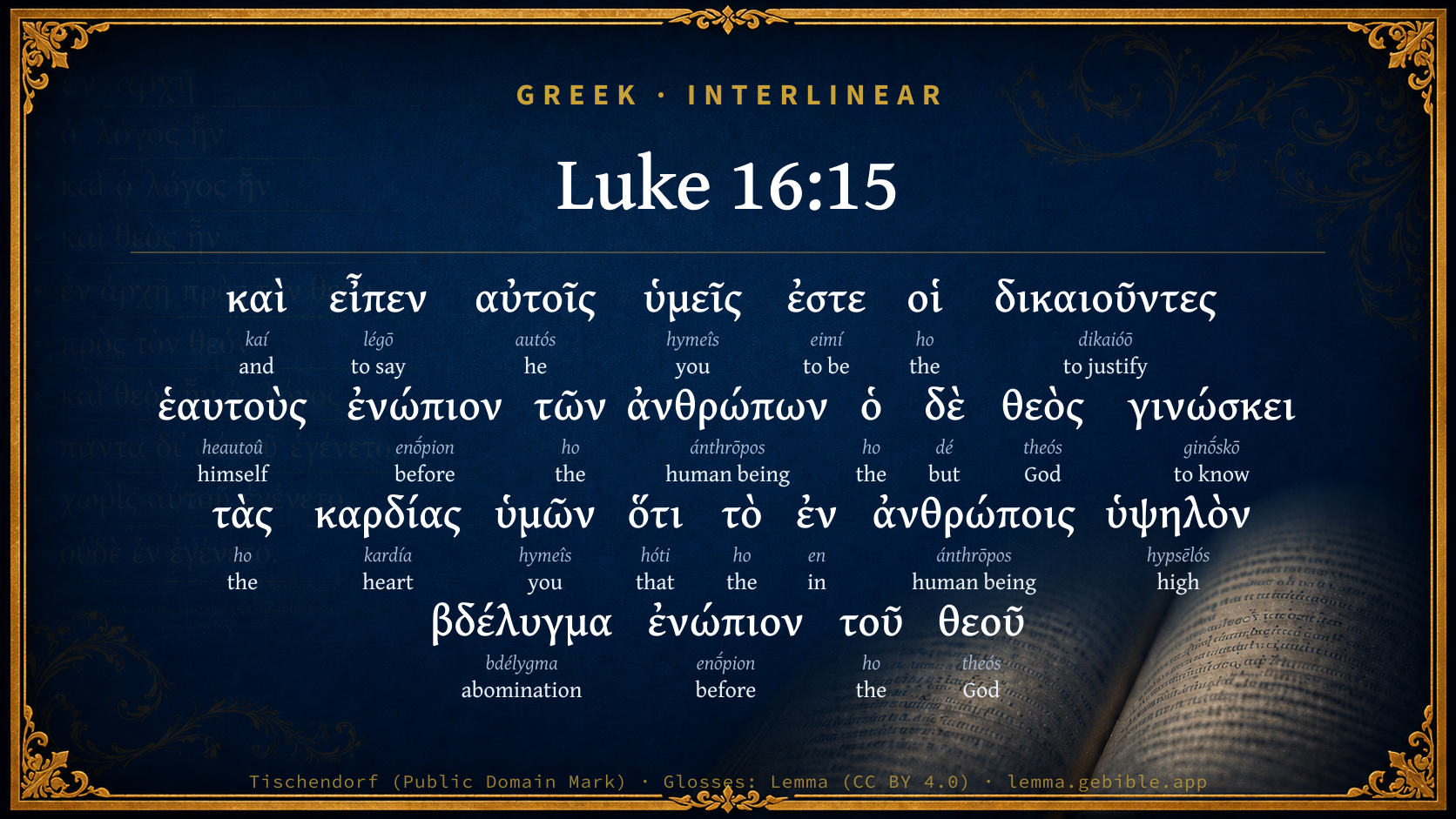
He said to them, "You are those who justify yourselves in the sight of men, but God knows your hearts. For that which is exalted among men is an abomination in the sight of God.
Download a study sheet
One document with this verse’s original text, its word-by-word gloss line, the meaning frame, cross-references with their text, attributed commentary, and full source and license credits — printable, and it pastes into notes with its structure intact.
This verse Autodidact and up
A passage Seminary Student
Up to 50 verses in one chapter. A passage sheet keeps up to 6 commentary sources and 12 cross-references per verse, in the order this page ranks them, and says so on the sheet whenever that leaves anything out. Ask for a single verse and you get the Autodidact verse sheet above.
Everything on this page stays free to read, with no account — the sheet is a download of what is already on screen, not access to it.
Compare translations 3
The same verse in 3 English versions, stacked beneath the original-language interlinear above. Click any original word for its lexicon entry.
Each is an independent rendering of the whole verse — the interlinear is not word-aligned to these translations.
Highlighted words mark where these versions differ — a whole-verse word diff, not a word-by-word alignment.
-
World English Bible Public Domain
He said to them, "You are those who justify yourselves in the sight of men, but God knows your hearts. For that which is exalted among men is an abomination in the sight of God.
-
King James Version Public Domain
And he said unto them, Ye are they which justify yourselves before men; but God knoweth your hearts: for that which is highly esteemed among men is abomination in the sight of God.
-
unfoldingWord Literal Text CC BY-SA 4.0
And he said to them, “You are the ones justifying yourselves before men, but God knows your hearts. For exalted among men an abomination before God.
unfoldingWord Literal Text — © unfoldingWord, licensed CC BY-SA 4.0. Word-aligned USFM3 via Door43 (git.door43.org/unfoldingWord/en_ult).
Show all 19 translations
Every available English version of this verse, each an independent rendering of the whole verse.
-
World English Bible Public Domain
He said to them, "You are those who justify yourselves in the sight of men, but God knows your hearts. For that which is exalted among men is an abomination in the sight of God.
-
Berean Standard Bible Public Domain
So He said to them, “You are the ones who justify yourselves before men, but God knows your hearts. For what is prized among men is detestable before God.
-
Majority Standard Bible Public Domain
So He said to them, “You are the ones who justify yourselves before men, but God knows your hearts. For what is prized among men is detestable before God.
-
King James Version Public Domain
And he said unto them, Ye are they which justify yourselves before men; but God knoweth your hearts: for that which is highly esteemed among men is abomination in the sight of God.
-
American Standard Version (1901) Public Domain
And he said unto them, Ye are they that justify yourselves in the sight of men; but God knoweth your hearts: for that which is exalted among men is an abomination in the sight of God.
-
Revised Version (1885) Public Domain
And he said unto them, Ye are they that justify yourselves in the sight of men; but God knoweth your hearts: for that which is exalted among men is an abomination in the sight of God.
-
Geneva Bible (1599) Public Domain
Then he sayde vnto them, Yee are they, which iustifie your selues before men: but God knoweth your heartes: for that which is highly esteemed among men, is abomination in the sight of God.
-
Douay-Rheims (1899) Public Domain
And he said to them: You are they who justify yourselves before men, but God knoweth your hearts; for that which is high to men, is an abomination before God.
-
Young's Literal Translation Public Domain
and he said to them, `Ye are those declaring yourselves righteous before men, but God doth know your hearts; because that which among men is high, `is' abomination before God;
-
Literal Standard Version CC BY-SA 4.0
and He said to them, “You are those declaring yourselves righteous before men, but God knows your hearts; because that which is high among men [is] abomination before God;
-
Unlocked Literal Bible CC BY-SA 4.0
He said to them, “You justify yourselves in the sight of men, but God knows your hearts. That which is exalted among men is detestable in the sight of God.
-
unfoldingWord Literal Text CC BY-SA 4.0
And he said to them, “You are the ones justifying yourselves before men, but God knows your hearts. For exalted among men an abomination before God.
-
Darby Bible Public Domain
And he said to them, *Ye* are they who justify themselves before men, but God knows your hearts; for what amongst men is highly thought of is an abomination before God.
-
World Messianic Bible Public Domain
He said to them, “You are those who justify yourselves in the sight of men, but God knows your hearts. For that which is exalted among men is an abomination in the sight of God.
-
Webster's Bible Public Domain
And he said to them, Ye are they who justify yourselves before men; but God knoweth your hearts: for that which is highly esteemed among men, is abomination in the sight of God.
-
Free Bible Version CC BY-SA 4.0
But Jesus told them, “You appear pious to people, but God knows what you're thinking. What people value highly is detested by God.
-
Bible in Basic English Public Domain
And he said, You take care to seem right in the eyes of men, but God sees your hearts: and those things which are important in the opinion of men, are evil in the eyes of God.
-
Text-Critical English NT CC BY 4.0
So he said to them, “You present yourselves as righteous in the sight of men, but God knows your hearts. For what is highly esteemed among men is an abomination in the sight of God.
-
Tyndale New Testament (1534) Public Domain
And he sayd vnto them: Ye are they which iustifie youre selves before me: but God knoweth youre hertes. For ye which is highlie estemed amonge me is abhominable in the sight of god.
Literal Standard Version (2020), Covenant Press — licensed CC BY-SA 4.0. Text via the HelloAO Bible API (eBible.org). Unlocked Literal Bible (unfoldingWord) — licensed CC BY-SA 4.0. Text via the HelloAO Bible API (eBible.org). unfoldingWord Literal Text — © unfoldingWord, licensed CC BY-SA 4.0. Word-aligned USFM3 via Door43 (git.door43.org/unfoldingWord/en_ult). Free Bible Version, Dr. Jonathan Gallagher — licensed CC BY-SA 4.0. Text via the HelloAO Bible API (eBible.org).
Word by word
More ways to search: Search by grammar → Find every occurrence → Compare this word →
Practice this passage: Drill this verse → Learn its vocabulary →
- Appears 6× in the Greek New Testament
- First appears at Matthew 24:15
- Part of Speech
- Noun
- Case
- Nominative
- Number
- Singular
- Gender
- Neuter
Full Thayer's Definition
- καὶ kaí G2532 “and” Conjunction
- εἶπεν légō G3004 “to say” Verb, Aorist, Active, Indicative, 3rd person, Singular
- αὐτοῖς autós G846 “he” Personal pronoun, Dative, Plural, Masculine
- ὑμεῖς hymeîs G5210 “you” Personal pronoun, 2nd person, Nominative, Plural
- ἐστε eimí G1510 “to be” Verb, Present, Active, Indicative, 2nd person, Plural
- οἱ ho G3588 “the” Article, Nominative, Plural, Masculine
- δικαιοῦντες dikaióō G1344 “to justify” Verb, Present, Active, Participle, Nominative, Plural, Masculine
- ἑαυτοὺς heautoû G1438 “himself” Reflexive pronoun, 2nd person, Accusative, Plural, Masculine
- ἐνώπιον enṓpion G1799 “before” Adverb
- τῶν ho G3588 “the” Article, Genitive, Plural, Masculine
- ἀνθρώπων ánthrōpos G444 “human being” Noun, Genitive, Plural, Masculine
- ὁ ho G3588 “the” Article, Nominative, Singular, Masculine
- δὲ dé G1161 “but” Conjunction
- θεὸς theós G2316 “God” Noun, Nominative, Singular, Masculine
- γινώσκει ginṓskō G1097 “to know” Verb, Present, Active, Indicative, 3rd person, Singular
- τὰς ho G3588 “the” Article, Accusative, Plural, Feminine
- καρδίας kardía G2588 “heart” Noun, Accusative, Plural, Feminine
- ὑμῶν hymeîs G5210 “you” Personal pronoun, 2nd person, Genitive, Plural
- ὅτι hóti G3754 “that” Conjunction
- τὸ ho G3588 “the” Article, Nominative, Singular, Neuter
- ἐν en G1722 “in” Preposition
- ἀνθρώποις ánthrōpos G444 “human being” Noun, Dative, Plural, Masculine
- ὑψηλὸν hypsēlós G5308 “high” Adjective, Nominative, Singular, Neuter
- βδέλυγμα bdélygma G946 “abomination” Noun, Nominative, Singular, Neuter
- ἐνώπιον enṓpion G1799 “before” Adverb
- τοῦ ho G3588 “the” Article, Genitive, Singular, Masculine
- θεοῦ theós G2316 “God” Noun, Genitive, Singular, Masculine
About this verse
These counts appear in no published source. They are computed here, from the morphology-tagged text and Lemma’s own curated glosses. What Lemma adds →
- 27
- words
- 18
- distinct lemmas
- Gospels
- section
Cross-references
36Topical passages linked to Luke 16:15 in the Treasury of Scripture Knowledge — connected by theme and wording, ordered by reader-vote popularity; previews shown in the World English Bible.
- 1 Samuel 16:7 But Yahweh said to Samuel, "Don't look on his face, or on the height of his stature; because I have rejected him: for [Yahweh sees] not as man sees; for man looks at the outward appearance, but Yahweh looks at the heart."
- Proverbs 21:2 Every way of a man is right in his own eyes, But Yahweh weighs the hearts.
- 1 Corinthians 4:5 Therefore judge nothing before the time, until the Lord comes, who will both bring to light the hidden things of darkness, and reveal the counsels of the hearts. Then each man will get his praise from God.
- Jeremiah 17:10 I, Yahweh, search the mind, I try the heart, even to give every man according to his ways, according to the fruit of his doings.
- Proverbs 16:5 Everyone who is proud in heart is an abomination to Yahweh: They shall assuredly not be unpunished.
- Acts 15:8 God, who knows the heart, testified about them, giving them the Holy Spirit, just like he did to us.
- Luke 11:39 The Lord said to him, "Now you Pharisees cleanse the outside of the cup and of the platter, but your inward part is full of extortion and wickedness.
- 1 Peter 3:4 but in the hidden person of the heart, in the incorruptible adornment of a gentle and quiet spirit, which is in the sight of God very precious.
- 1 Chronicles 29:17 I know also, my God, that you try the heart, and have pleasure in uprightness. As for me, in the uprightness of my heart I have willingly offered all these things: and now have I seen with joy your people, that are present here, offer willingly to you.
- Luke 10:29 But he, desiring to justify himself, asked Jesus, "Who is my neighbor?"
- Revelation 2:23 I will kill her children with Death, and all the assemblies will know that I am he who searches the minds and hearts. I will give to each one of you according to your deeds.
- 1 Peter 5:5 Likewise, you younger ones, be subject to the elder. Yes, all of you gird yourselves with humility, to subject yourselves to one another; for "God resists the proud, but gives grace to the humble."
- Matthew 23:5 But all their works they do to be seen by men. They make their phylacteries broad, enlarge the fringes of their garments,
- Matthew 23:25–27 "Woe to you, scribes and Pharisees, hypocrites! For you clean the outside of the cup and of the platter, but within they are full of extortion and unrighteousness.
- John 2:25 and because he didn't need for anyone to testify concerning man; for he himself knew what was in man.
- Romans 3:20 Because by the works of the law, no flesh will be justified in his sight. For through the law comes the knowledge of sin.
- Proverbs 20:6 Many men claim to be men of unfailing love, But who can find a faithful man?
- Luke 18:21 He said, "I have observed all these things from my youth up."
- 2 Chronicles 6:30 then hear from heaven, your dwelling-place and forgive, and render to every man according to all his ways, whose heart you know; (for you, even you only, know the hearts of the children of men;)
- Luke 18:11 The Pharisee stood and prayed to himself like this: 'God, I thank you, that I am not like the rest of men, extortioners, unrighteous, adulterers, or even like this tax collector.
- Psalms 7:9 Oh let the wickedness of the wicked come to an end, But establish the righteous; Their minds and hearts are searched by the righteous God.
- Psalms 49:13 This is the destiny of those who are foolish, And of those who approve their sayings. Selah.
- Psalms 49:18 Though while he lived he blessed his soul-- And men praise you when you do well for yourself--
- Psalms 139:1–2 Yahweh, you have searched me, And you know me.
- Isaiah 1:10–14 Hear the word of Yahweh, you rulers of Sodom! Listen to the law of our God, you people of Gomorrah!
- Amos 5:21–22 I hate, I despise your feasts, And I can't stand your solemn assemblies.
- Malachi 3:15 Now we call the proud happy; yes, those who work wickedness are built up; yes, they tempt God, and escape.'
- Matthew 6:2 Therefore when you do merciful deeds, don't sound a trumpet before yourself, as the hypocrites do in the synagogues and in the streets, that they may get glory from men. Most assuredly I tell you, they have received their reward.
- Matthew 6:5 "When you pray, you shall not be as the hypocrites, for they love to stand and pray in the synagogues and in the corners of the streets, that they may be seen by men. Most assuredly, I tell you, they have received their reward.
- Matthew 6:16 "Moreover when you fast, don't be like the hypocrites, with sad faces. For they disfigure their faces, that they may be seen by men to be fasting. Most assuredly I tell you, they have received their reward.
- Luke 20:20 They watched him, and sent out spies, who pretended to be righteous, that they might trap him in something he said, so as to deliver him up to the power and authority of the governor.
- Luke 20:47 who devour widows' houses, and for a pretense make long prayers: these will receive greater condemnation."
- Acts 1:18 Now this man obtained a field with the reward for his wickedness, and falling headlong, his body burst open, and all his intestines gushed out.
- Psalms 10:3 For the wicked boasts of his heart's cravings, He blesses the greedy, and condemns Yahweh.
- John 21:17 He said to him the third time, "Simon, son of Jonah, do you have affection for me?" Peter was grieved because he asked him the third time, "Do you have affection for me?" He said to him, "Lord, you know everything. You know that I have affection for you." Jesus said to him, "Feed my sheep.
- James 2:21–25 Wasn't Abraham our father justified by works, in that he offered up Isaac his son on the altar?
Cross-references courtesy of OpenBible.info (CC BY 4.0).
Lesson kit
Teaching starters — assembled from the data on this page, not authored interpretation. Every prompt links to the verse data it draws on. Edit before teaching.
Luke, in the Gospels, opens this verse with 27 words (18 distinct Greek lemmas). Its most distinctive word is bdélygma (“abomination”). A historical commentator’s framing appears above. Read the whole chapter for the surrounding context.
Discussion questions
- How does “abomination” (bdélygma) shape what this verse is saying?
- Matthew 24:15 shares the word «abomination» with this verse. How do the two illuminate each other?
- “before” occurs 2× in this one verse. What is the effect of the repetition?
- The translations on this page render this verse differently — a whole-verse word diff, not a word-by-word alignment. What might account for the different wordings?
- Reading how Whedon's Commentary on the Bible and Bengel's Gnomon read this verse, where do the two commentators agree and where do they part?
Things to notice
- These translations choose different wording for 13 words in this verse.
- “before” occurs 2× in this single verse.
- 18 distinct Greek lemmas span 27 words in this verse.
Commentary
Notes on Luke 16:15 from classic Christian and Jewish commentators (each source and its license shown beneath its notes). The classic Christian expositions comment on the surrounding passage and are grouped to its opening verse, so a note may address several verses; the Jewish commentaries on the Tanakh (Rashi and others) are per-verse, so they appear only where the commentator wrote on this verse.
Lemma curates 59 commentaries, every one of them public domain or Creative Commons licensed, each selected and text-cleaned for this edition rather than reprinted as found. About our sources →
Whedon's Commentary on the Bible
Daniel D. Whedon
Daniel D. Whedon (gen. ed.), Commentary on the Old and New Testaments (1874–1909) — public domain. Text from a community e-Sword module.
Bengel's Gnomon
Johann Albrecht Bengel
Bengel's Gnomon of the New Testament — English translation (T&T Clark, Edinburgh, 1860) — public domain. Text from a community e-Sword module.
Expositor's Greek Testament
ed. W. Robertson Nicoll
The Expositor's Greek Testament, edited by W. Robertson Nicoll (1897–1910) — public domain. Text from a community e-Sword module.
Geneva Bible (1599)
Geneva Bible translators
Geneva Bible (1599) marginal notes — public domain. Text via Bolls.life.
Jamieson, Fausset & Brown
Robert Jamieson, A. R. Fausset & David Brown
Jamieson, Fausset & Brown — Commentary Critical and Explanatory on the Whole Bible (1871) — public domain (CC PDM 1.0). Text via the HelloAO Bible API.
Adam Clarke's Commentary
Adam Clarke's Commentary on the Bible (1810–1826) — public domain. Text from a community e-Sword/MySword module.
Ellicott's Commentary for English Readers
A Bible Commentary for English Readers, edited by Charles John Ellicott (1878–1897) — public domain. Text from a community e-Sword module.
The Cambridge Bible for Schools and Colleges
gen. ed. J. J. S. Perowne
The Cambridge Bible for Schools and Colleges (gen. ed. J. J. S. Perowne; Cambridge University Press, 1878–1918) — public domain. Text from a community e-Sword module.
John Gill's Exposition
John Gill's Exposition of the Whole Bible (1746–1763) — public domain (CC PDM 1.0). Text via the HelloAO Bible API.
Trapp's Complete Commentary
John Trapp
John Trapp, A Commentary or Exposition upon All the Books of the Old and New Testament (1647–1656) — public domain. Text from a community e-Sword module.
Haydock's Catholic Bible Commentary
George Leo Haydock (1774–1849), Haydock's Catholic Family Bible and Commentary, 1859 edition — public domain. Excludes Psalms (Douay-Rheims chapter numbering differs from Protestant) and Deuterocanonical books (Catholic canon only).
Matthew Poole's English Annotations
Matthew Poole's English Annotations on the Holy Bible (1683–1685) — public domain. Text from a community e-Sword/MySword module.
The Pulpit Commentary
The Pulpit Commentary (1880–1919), ed. H.D.M. Spence-Jones & Joseph S. Exell — public domain. Text from a community e-Sword module.
John Wesley's Explanatory Notes
John Wesley, Explanatory Notes Upon the Whole Bible (1754–1765) — public domain. Text via the GEBible commentary corpus.
Burkitt's Expository Notes on the New Testament
William Burkitt
William Burkitt's Expository Notes on the New Testament (1700–1703) — public domain. Text from a community e-Sword module.
Cambridge Greek Testament for Schools and Colleges
Cambridge Greek Testament for Schools and Colleges (Cambridge University Press, 1896; 21 vols, various authors incl. Carr, Maclear, Plummer, Farrar, Lumby, Moule, M. R. James, Simcox) — public domain. Text from a community e-Sword module.
Alford’s Greek Testament
Henry Alford
Henry Alford, The Greek Testament (1849–1861) — public domain. Text from a community e-Sword module.
International Critical Commentary
International Critical Commentary — older volumes (1896–1929), various authors — public domain. Text from a community e-Sword module.
Vincent's Word Studies in the New Testament
Marvin R. Vincent
Marvin R. Vincent, Word Studies in the New Testament (1887–1900) — public domain. Text from a community e-Sword/MySword module.