

Acts 22:30
Greek (Tischendorf 8th ed.) Acts 22:30 appears in the Greek New Testament. The text above is from the Tischendorf 8th edition. Each word links to its Strong’s number and a concise gloss. Click any word for its full Thayer’s Greek Lexicon entry.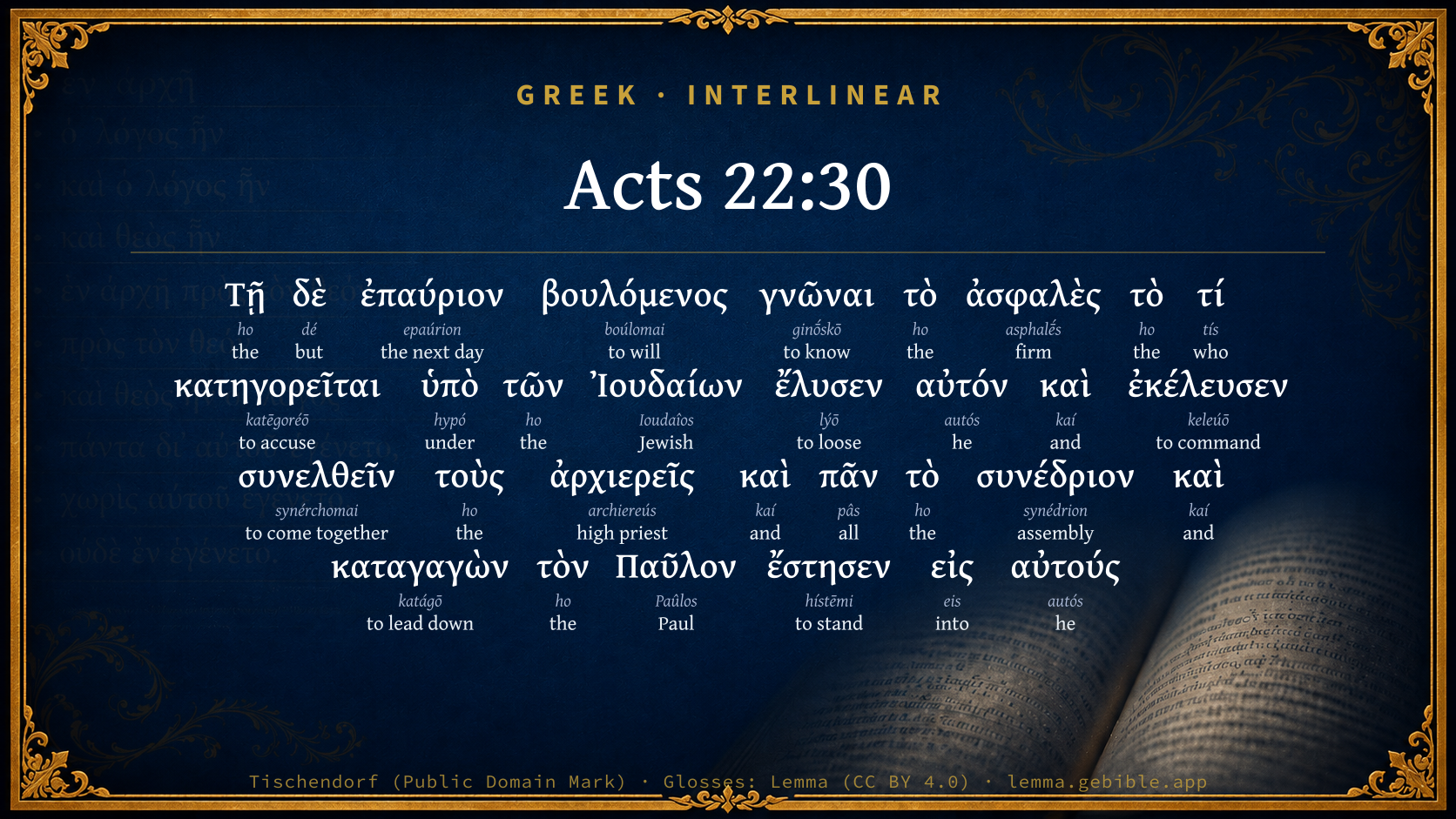
But on the next day, desiring to know the truth about why he was accused by the Jews, he freed him from the bonds, and commanded the chief priests and all the council to come together, and brought Paul down and set him before them.
Download a study sheet
One document with this verse’s original text, its word-by-word gloss line, the meaning frame, cross-references with their text, attributed commentary, and full source and license credits — printable, and it pastes into notes with its structure intact.
This verse Autodidact and up
A passage Seminary Student
Up to 50 verses in one chapter. A passage sheet keeps up to 6 commentary sources and 12 cross-references per verse, in the order this page ranks them, and says so on the sheet whenever that leaves anything out. Ask for a single verse and you get the Autodidact verse sheet above.
Everything on this page stays free to read, with no account — the sheet is a download of what is already on screen, not access to it.
Compare translations 3
The same verse in 3 English versions, stacked beneath the original-language interlinear above. Click any original word for its lexicon entry.
Each is an independent rendering of the whole verse — the interlinear is not word-aligned to these translations.
Highlighted words mark where these versions differ — a whole-verse word diff, not a word-by-word alignment.
-
World English Bible Public Domain
But on the next day, desiring to know the truth about why he was accused by the Jews, he freed him from the bonds, and commanded the chief priests and all the council to come together, and brought Paul down and set him before them.
-
King James Version Public Domain
On the morrow, because he would have known the certainty wherefore he was accused of the Jews, he loosed him from his bands, and commanded the chief priests and all their council to appear, and brought Paul down, and set him before them.
-
unfoldingWord Literal Text CC BY-SA 4.0
And on the next day, wanting to know the certain, why he was being accused by the Jews, he released him and commanded the chief priests and all the Sanhedrin to assemble. And having brought down Paul, he placed him among them.
unfoldingWord Literal Text — © unfoldingWord, licensed CC BY-SA 4.0. Word-aligned USFM3 via Door43 (git.door43.org/unfoldingWord/en_ult).
Show all 19 translations
Every available English version of this verse, each an independent rendering of the whole verse.
-
World English Bible Public Domain
But on the next day, desiring to know the truth about why he was accused by the Jews, he freed him from the bonds, and commanded the chief priests and all the council to come together, and brought Paul down and set him before them.
-
Berean Standard Bible Public Domain
The next day the commander, wanting to learn the real reason Paul was accused by the Jews, released him and ordered the chief priests and the whole Sanhedrin to assemble. Then he brought Paul down and had him stand before them.
-
Majority Standard Bible Public Domain
The next day the commander, wanting to learn the real reason Paul was accused by the Jews, released him from the bonds and ordered the chief priests and their whole Sanhedrin to assemble. Then he brought Paul down and had him stand before them.
-
King James Version Public Domain
On the morrow, because he would have known the certainty wherefore he was accused of the Jews, he loosed him from his bands, and commanded the chief priests and all their council to appear, and brought Paul down, and set him before them.
-
American Standard Version (1901) Public Domain
But on the morrow, desiring to know the certainty wherefore he was accused of the Jews, he loosed him, and commanded the chief priests and all the council to come together, and brought Paul down and set him before them.
-
Revised Version (1885) Public Domain
But on the morrow, desiring to know the certainty, wherefore he was accused of the Jews, he loosed him, and commanded the chief priests and all the council to come together, and brought Paul down, and set him before them.
-
Geneva Bible (1599) Public Domain
On the next day, because hee would haue knowen the certaintie wherefore he was accused of the Iewes, he loosed him from his bonds, and commanded the hie Priests and all their Councill to come together: and he brought Paul, and set him before them.
-
Douay-Rheims (1899) Public Domain
But on the next day, meaning to know more diligently for what cause he was accused by the Jews, he loosed him, and commanded the priests to come together, and all the council: and bringing forth Paul, he set him before them.
-
Young's Literal Translation Public Domain
and on the morrow, intending to know the certainty wherefore he is accused by the Jews, he did loose him from the bonds, and commanded the chief priests and all their sanhedrim to come, and having brought down Paul, he set `him' before them.
-
Literal Standard Version CC BY-SA 4.0
and the next day, intending to know the certainty for what reason he is accused by the Jews, he loosed him from the bonds, and commanded the chief priests and all their Sanhedrin to come, and having brought down Paul, he set [him] before them.
-
Unlocked Literal Bible CC BY-SA 4.0
On the next day, the chief captain wanted to know the truth about the Jews' accusations against Paul. So he untied his bonds and ordered the chief priests and all the council to meet. Then he brought Paul down and placed him in their midst.
-
unfoldingWord Literal Text CC BY-SA 4.0
And on the next day, wanting to know the certain, why he was being accused by the Jews, he released him and commanded the chief priests and all the Sanhedrin to assemble. And having brought down Paul, he placed him among them.
-
Darby Bible Public Domain
And on the morrow, desirous to know the certainty [of the matter] why he was accused of the Jews, he loosed him, and commanded the chief priests and all the council to meet, and having brought Paul down set him before them.
-
World Messianic Bible Public Domain
But on the next day, desiring to know the truth about why he was accused by the Judeans, he freed him from the bonds and commanded the chief priests and all the council to come together, and brought Paul down and set him before them.
-
Webster's Bible Public Domain
On the morrow, because he would have known the certainty why he was accused by the Jews, he loosed him from his bands, and commanded the chief priests and all their council to appear, and brought Paul down, and set him before them.
-
Free Bible Version CC BY-SA 4.0
The next day, wanting to find out the reason why the Jews were accusing Paul, he had him released and taken before the chief priests and the whole council which he ordered to assemble. He had Paul brought down and placed him before them.
-
Bible in Basic English Public Domain
But on the day after, desiring to have certain knowledge of what the Jews had to say against him, he made him free, and gave orders for the chief priests and all the Sanhedrin to come together, and he took Paul and put him before them.
-
Text-Critical English NT CC BY 4.0
So the next day, wishing to know for certain why Paul was being accused by the Jews, the commander released him from his bonds and commanded the chief priests and their entire Sanhedrin to come. Then he brought Paul down and had him stand before them.
-
Tyndale New Testament (1534) Public Domain
On the morowe because he wolde have knowen the certayntie wherfore he was accused of the Iewes he lowsed him from his bondes and commaunded the hye Prestes and all the counsell to come together and brought Paul and set him before them.
Literal Standard Version (2020), Covenant Press — licensed CC BY-SA 4.0. Text via the HelloAO Bible API (eBible.org). Unlocked Literal Bible (unfoldingWord) — licensed CC BY-SA 4.0. Text via the HelloAO Bible API (eBible.org). unfoldingWord Literal Text — © unfoldingWord, licensed CC BY-SA 4.0. Word-aligned USFM3 via Door43 (git.door43.org/unfoldingWord/en_ult). Free Bible Version, Dr. Jonathan Gallagher — licensed CC BY-SA 4.0. Text via the HelloAO Bible API (eBible.org).
Word by word
More ways to search: Search by grammar → Find every occurrence → Compare this word →
Practice this passage: Drill this verse → Learn its vocabulary →
- Appears 5× in the Greek New Testament
- First appears at Acts 21:34
- Part of Speech
- Adjective
- Case
- Accusative
- Number
- Singular
- Gender
- Neuter
Full Thayer's Definition
- Τῇ ho G3588 “the” Article, Dative, Singular, Feminine
- δὲ dé G1161 “but” Conjunction
- ἐπαύριον epaúrion G1887 “the next day” Adverb
- βουλόμενος boúlomai G1014 “to will” Verb, Present, Middle or Passive deponent, Participle, Nominative, Singular, Masculine
- γνῶναι ginṓskō G1097 “to know” Verb, Aorist, Active, Infinitive
- τὸ ho G3588 “the” Article, Accusative, Singular, Neuter
- ἀσφαλὲς asphalḗs G804 “firm” Adjective, Accusative, Singular, Neuter
- τὸ ho G3588 “the” Article, Accusative, Singular, Neuter
- τί tís G5101 “who” Interrogative pronoun, Accusative, Singular, Neuter
- κατηγορεῖται katēgoréō G2723 “to accuse” Verb, Present, Passive, Indicative, 3rd person, Singular
- ὑπὸ hypó G5259 “under” Preposition
- τῶν ho G3588 “the” Article, Genitive, Plural, Masculine
- Ἰουδαίων Ioudaîos G2453 “Jewish” Adjective, Genitive, Plural, Masculine
- ἔλυσεν lýō G3089 “to loose” Verb, Aorist, Active, Indicative, 3rd person, Singular
- αὐτόν autós G846 “he” Personal pronoun, Accusative, Singular, Masculine
- καὶ kaí G2532 “and” Conjunction
- ἐκέλευσεν keleúō G2753 “to command” Verb, Aorist, Active, Indicative, 3rd person, Singular
- συνελθεῖν synérchomai G4905 “to come together” Verb, Aorist, Active, Infinitive
- τοὺς ho G3588 “the” Article, Accusative, Plural, Masculine
- ἀρχιερεῖς archiereús G749 “high priest” Noun, Accusative, Plural, Masculine
- καὶ kaí G2532 “and” Conjunction
- πᾶν pâs G3956 “all” Adjective, Accusative, Singular, Neuter
- τὸ ho G3588 “the” Article, Accusative, Singular, Neuter
- συνέδριον synédrion G4892 “assembly” Noun, Accusative, Singular, Neuter
- καὶ kaí G2532 “and” Conjunction
- καταγαγὼν katágō G2609 “to lead down” Verb, Aorist, Active, Participle, Nominative, Singular, Masculine
- τὸν ho G3588 “the” Article, Accusative, Singular, Masculine
- Παῦλον Paûlos G3972 “Paul” Noun, Accusative, Singular, Masculine
- ἔστησεν hístēmi G2476 “to stand” Verb, Aorist, Active, Indicative, 3rd person, Singular
- εἰς eis G1519 “into” Preposition
- αὐτούς autós G846 “he” Personal pronoun, Accusative, Plural, Masculine
About this verse
These counts appear in no published source. They are computed here, from the morphology-tagged text and Lemma’s own curated glosses. What Lemma adds →
- 31
- words
- 22
- distinct lemmas
- Acts
- section
Cross-references
10Topical passages linked to Acts 22:30 in the Treasury of Scripture Knowledge — connected by theme and wording, ordered by reader-vote popularity; previews shown in the World English Bible.
- Acts 23:28 Desiring to know the cause why they accused him, I brought him down to their council.
- Acts 21:33 Then the commanding officer came near, arrested him, commanded him to be bound with two chains, and inquired who he was and what he had done.
- Acts 5:21 When they heard this, they entered into the temple about daybreak, and taught. But the high priest came, and those who were with him, and called the council together, and all the senate of the children of Israel, and sent to the prison to have them brought.
- Acts 21:11 Coming to us, and taking Paul's belt, he bound his own feet and hands, and said, "Thus says the Holy Spirit: 'So will the Jews at Jerusalem bind the man who owns this belt, and will deliver him into the hands of the Gentiles.'"
- Acts 22:5 As also the high priest and all the council of the elders testify, from whom also I received letters to the brothers, and traveled to Damascus to bring them also who were there to Jerusalem in bonds to be punished.
- Acts 23:15 Now therefore, you with the council inform the commanding officer that he should bring him down to you tomorrow, as though you were going to judge his case more exactly. We are ready to kill him before he comes near."
- Acts 26:29 Paul said, "I pray to God, that whether with little or with much, not only you, but also all that hear me this day, might become such as I am, except for these bonds."
- Matthew 5:22 But I tell you, that everyone who is angry with his brother without a cause shall be in danger of the judgment; and whoever shall say to his brother, 'Raca!' shall be in danger of the council; and whoever shall say, 'You fool!' shall be in danger of the fire of Gehenna.
- Matthew 10:17 But beware of men: for they will deliver you up to councils, and in their synagogues they will scourge you.
- Matthew 27:2 and they bound him, and led him away, and delivered him up to Pontius Pilate, the governor.
Cross-references courtesy of OpenBible.info (CC BY 4.0).
Where the printed editions differ
1 variantPlaces in this verse where the major printed Greek editions disagree on the wording in a way that affects the translation — a comparison of editions, not a manuscript-by-manuscript collation. The editions are the modern critical texts (Nestlé-Aland 28/27, SBL, Westcott-Hort, Tregelles, Tyndale House) and the traditional texts behind the KJV (the Textus Receptus and the Byzantine/Majority text). It is not a claim about which reading is original.
-
Extra text
ἀπὸ τῶν δεσμῶν
“from the chains”
In TRByz Not in NA28NA27TynSBLWHTregἀπὸ τῶν δεσμῶν (apo tōn desmōn) 'from the chains' is only in traditional manuscripts (TR+Byz)
Textual data: Translators Amalgamated Greek New Testament (STEPBible TAGNT) · CC BY 4.0.
Lesson kit
Teaching starters — assembled from the data on this page, not authored interpretation. Every prompt links to the verse data it draws on. Edit before teaching.
Acts, in the Acts, opens this verse with 31 words (22 distinct Greek lemmas). Its most distinctive word is asphalḗs (“firm”). A historical commentator’s framing appears above. Read the whole chapter for the surrounding context.
Discussion questions
- How does “firm” (asphalḗs) shape what this verse is saying?
- Acts 21:34 shares the word «firm» with this verse. How do the two illuminate each other?
- “the” occurs 7× in this one verse. What is the effect of the repetition?
- These translations render this verse differently. What is at stake in choosing one wording over another?
- Reading how Joseph Benson's Commentary and Lange's Commentary on the Holy Scriptures read this verse, where do the two commentators agree and where do they part?
Things to notice
- These translations choose different wording for 33 words in this verse.
- “the” occurs 7× in this single verse.
- 22 distinct Greek lemmas span 31 words in this verse.
Commentary
Notes on Acts 22:30 from classic Christian and Jewish commentators (each source and its license shown beneath its notes). The classic Christian expositions comment on the surrounding passage and are grouped to its opening verse, so a note may address several verses; the Jewish commentaries on the Tanakh (Rashi and others) are per-verse, so they appear only where the commentator wrote on this verse.
Lemma curates 59 commentaries, every one of them public domain or Creative Commons licensed, each selected and text-cleaned for this edition rather than reprinted as found. About our sources →
Joseph Benson's Commentary
Joseph Benson's Commentary on the Old and New Testaments (1811–1818) — public domain. Text from a community e-Sword module.
Lange's Commentary on the Holy Scriptures
Lange's Commentary on the Holy Scriptures (Critical, Doctrinal, and Homiletical), ed. John Peter Lange, English translation edited by Philip Schaff (1864–1880) — public domain. Text from a community e-Sword module.
F. W. Grant's Numerical Bible
F. W. Grant, The Numerical Bible (4th ed., 1903) — public domain. Text from a community e-Sword module.
Bengel's Gnomon
Johann Albrecht Bengel
Bengel's Gnomon of the New Testament — English translation (T&T Clark, Edinburgh, 1860) — public domain. Text from a community e-Sword module.
Meyer's Critical & Exegetical Commentary
Heinrich August Wilhelm Meyer
Meyer — Critical and Exegetical Commentary on the New Testament — English translation by Peter Christie, edited by Frederick Crombie (T&T Clark, 1880) — public domain. Text from a community e-Sword module.
Expositor's Greek Testament
ed. W. Robertson Nicoll
The Expositor's Greek Testament, edited by W. Robertson Nicoll (1897–1910) — public domain. Text from a community e-Sword module.
Jamieson, Fausset & Brown
Robert Jamieson, A. R. Fausset & David Brown
Jamieson, Fausset & Brown — Commentary Critical and Explanatory on the Whole Bible (1871) — public domain (CC PDM 1.0). Text via the HelloAO Bible API.
Adam Clarke's Commentary
Adam Clarke's Commentary on the Bible (1810–1826) — public domain. Text from a community e-Sword/MySword module.
Ellicott's Commentary for English Readers
A Bible Commentary for English Readers, edited by Charles John Ellicott (1878–1897) — public domain. Text from a community e-Sword module.
The Cambridge Bible for Schools and Colleges
gen. ed. J. J. S. Perowne
The Cambridge Bible for Schools and Colleges (gen. ed. J. J. S. Perowne; Cambridge University Press, 1878–1918) — public domain. Text from a community e-Sword module.
Trapp's Complete Commentary
John Trapp
John Trapp, A Commentary or Exposition upon All the Books of the Old and New Testament (1647–1656) — public domain. Text from a community e-Sword module.
Albert Barnes' Notes on the Bible
Albert Barnes' Notes on the Bible (1834–1885) — public domain. Text from a community e-Sword/MySword module.
Matthew Poole's English Annotations
Matthew Poole's English Annotations on the Holy Bible (1683–1685) — public domain. Text from a community e-Sword/MySword module.
Whedon's Commentary on the Bible
Daniel D. Whedon
Daniel D. Whedon (gen. ed.), Commentary on the Old and New Testaments (1874–1909) — public domain. Text from a community e-Sword module.
The Pulpit Commentary
The Pulpit Commentary (1880–1919), ed. H.D.M. Spence-Jones & Joseph S. Exell — public domain. Text from a community e-Sword module.
McGarvey & Pendleton's Commentaries
J. W. McGarvey
J. W. McGarvey (with Philip Y. Pendleton), Commentaries on the New Testament (The Fourfold Gospel, 1914; Acts; and the epistles) — public domain. Text from a community e-Sword/MySword module.
unfoldingWord translationNotes
Door43 World Missions Community
unfoldingWord translationNotes — © Distant Shores Media and the Door43 World Missions Community, licensed CC BY-SA 4.0. Source: git.door43.org/Door43/en_tn.
Cambridge Greek Testament for Schools and Colleges
Cambridge Greek Testament for Schools and Colleges (Cambridge University Press, 1896; 21 vols, various authors incl. Carr, Maclear, Plummer, Farrar, Lumby, Moule, M. R. James, Simcox) — public domain. Text from a community e-Sword module.
Alford’s Greek Testament
Henry Alford
Henry Alford, The Greek Testament (1849–1861) — public domain. Text from a community e-Sword module.
Vincent's Word Studies in the New Testament
Marvin R. Vincent
Marvin R. Vincent, Word Studies in the New Testament (1887–1900) — public domain. Text from a community e-Sword/MySword module.