Romans 7:15

Greek (Tischendorf 8th ed.) Romans 7:15 appears in the Greek New Testament. The text above is from the Tischendorf 8th edition. Each word links to its Strong’s number and a concise gloss. Click any word for its full Thayer’s Greek Lexicon entry.
Download image
Cite this verse

Romans 7:15 (World English Bible). Public Domain. Lemma interlinear Bible study tool, https://lemma.gebible.app/v/romans/7/15.

Show BibTeX & RIS
BibTeX
RIS
English Translation
For I don't know what I am doing. For I don't practice what I desire to do; but what I hate, that I do.
World English Bible · Public Domain
Download a study sheet

One document with this verse’s original text, its word-by-word gloss line, the meaning frame, cross-references with their text, attributed commentary, and full source and license credits — printable, and it pastes into notes with its structure intact.

This verse Autodidact and up

Study sheet (.html) Plain text (.txt)

A passage Seminary Student

Up to 50 verses in one chapter. A passage sheet keeps up to 6 commentary sources and 12 cross-references per verse, in the order this page ranks them, and says so on the sheet whenever that leaves anything out. Ask for a single verse and you get the Autodidact verse sheet above.

Everything on this page stays free to read, with no account — the sheet is a download of what is already on screen, not access to it.

Want to remove ads? Support Godless Engineer
Compare translations 3

The same verse in 3 English versions, stacked beneath the original-language interlinear above. Click any original word for its lexicon entry.

Each is an independent rendering of the whole verse — the interlinear is not word-aligned to these translations.

Highlighted words mark where these versions differ — a whole-verse word diff, not a word-by-word alignment.

  • World English Bible Public Domain
    For I don't know what I am doing. For I don't practice what I desire to do; but what I hate, that I do.
  • King James Version Public Domain
    For that which I do I allow not: for what I would, that do I not; but what I hate, that do I.
  • unfoldingWord Literal Text CC BY-SA 4.0
    For what I produce, I do not understand. For what I do not want, this I practice. But what I hate, this I do.

unfoldingWord Literal Text — © unfoldingWord, licensed CC BY-SA 4.0. Word-aligned USFM3 via Door43 (git.door43.org/unfoldingWord/en_ult).

Versions to compare (up to 4)

3 of 4 selected

Show all 19 translations

Every available English version of this verse, each an independent rendering of the whole verse.

  • World English Bible Public Domain
    For I don't know what I am doing. For I don't practice what I desire to do; but what I hate, that I do.
  • Berean Standard Bible Public Domain
    I do not understand what I do. For what I want to do, I do not do. But what I hate, I do.
  • Majority Standard Bible Public Domain
    I do not understand what I do. For what I want to do, I do not do. But what I hate, I do.
  • King James Version Public Domain
    For that which I do I allow not: for what I would, that do I not; but what I hate, that do I.
  • American Standard Version (1901) Public Domain
    For that which I do I know not: for not what I would, that do I practise; but what I hate, that I do.
  • Revised Version (1885) Public Domain
    For that which I do I know not: for not what I would, that do I practise; but what I hate, that I do.
  • Geneva Bible (1599) Public Domain
    For I alow not that which I do: for what I would, that do I not: but what I hate, that do I.
  • Douay-Rheims (1899) Public Domain
    For that which I work, I understand not. For I do not that good which I will; but the evil which I hate, that I do.
  • Young's Literal Translation Public Domain
    for that which I work, I do not acknowledge; for not what I will, this I practise, but what I hate, this I do.
  • Literal Standard Version CC BY-SA 4.0
    for that which I work, I do not acknowledge; for not what I will, this I practice, but what I hate, this I do.
  • Unlocked Literal Bible CC BY-SA 4.0
    For what I do, I do not really understand. For what I want to do, I do not do, and what I hate, I do.
  • unfoldingWord Literal Text CC BY-SA 4.0
    For what I produce, I do not understand. For what I do not want, this I practice. But what I hate, this I do.
  • Darby Bible Public Domain
    For that which I do, I do not own: for not what I will, this I do; but what I hate, this I practise.
  • World Messianic Bible Public Domain
    For I don’t understand what I am doing. For I don’t practice what I desire to do; but what I hate, that I do.
  • Webster's Bible Public Domain
    For that which I do, I allow not: for what I would, that I do not; but what I hate, that I do.
  • Free Bible Version CC BY-SA 4.0
    I really don't understand what I'm doing. I do the things I don't want to do, and what I hate doing, that's what I do!
  • Bible in Basic English Public Domain
    And I have no clear knowledge of what I am doing, for that which I have a mind to do, I do not, but what I have hate for, that I do.
  • Text-Critical English NT CC BY 4.0
    I do not understand what I do. Instead of doing what I want to do, I do the very thing I hate.
  • Tyndale New Testament (1534) Public Domain
    because I wote not what I doo. For what I wold that do I not: but what I hate that do I.

Literal Standard Version (2020), Covenant Press — licensed CC BY-SA 4.0. Text via the HelloAO Bible API (eBible.org). Unlocked Literal Bible (unfoldingWord) — licensed CC BY-SA 4.0. Text via the HelloAO Bible API (eBible.org). unfoldingWord Literal Text — © unfoldingWord, licensed CC BY-SA 4.0. Word-aligned USFM3 via Door43 (git.door43.org/unfoldingWord/en_ult). Free Bible Version, Dr. Jonathan Gallagher — licensed CC BY-SA 4.0. Text via the HelloAO Bible API (eBible.org).

Word by word

More ways to search: Search by grammar → Find every occurrence → Compare this word →

Practice this passage: Drill this verse → Learn its vocabulary →

κατεργάζομαι
katergázomai
G2716
“to accomplish”
Verb, Present, Middle or Passive deponent, Indicative, 1st person, Singular
Part of Speech
Verb
Tense
Present
Voice
Middle or Passive deponent
Mood
Indicative
Person
1st person
Number
Singular
Full Thayer's Definition

Origin: from G2596 and G2038

TDNT: 13:34,4

1. to perform, accomplish, achieve 2. to work out i.e. to do that from which something results a. of things: bring about, result in 3. to fashion i.e. render one fit for a thing
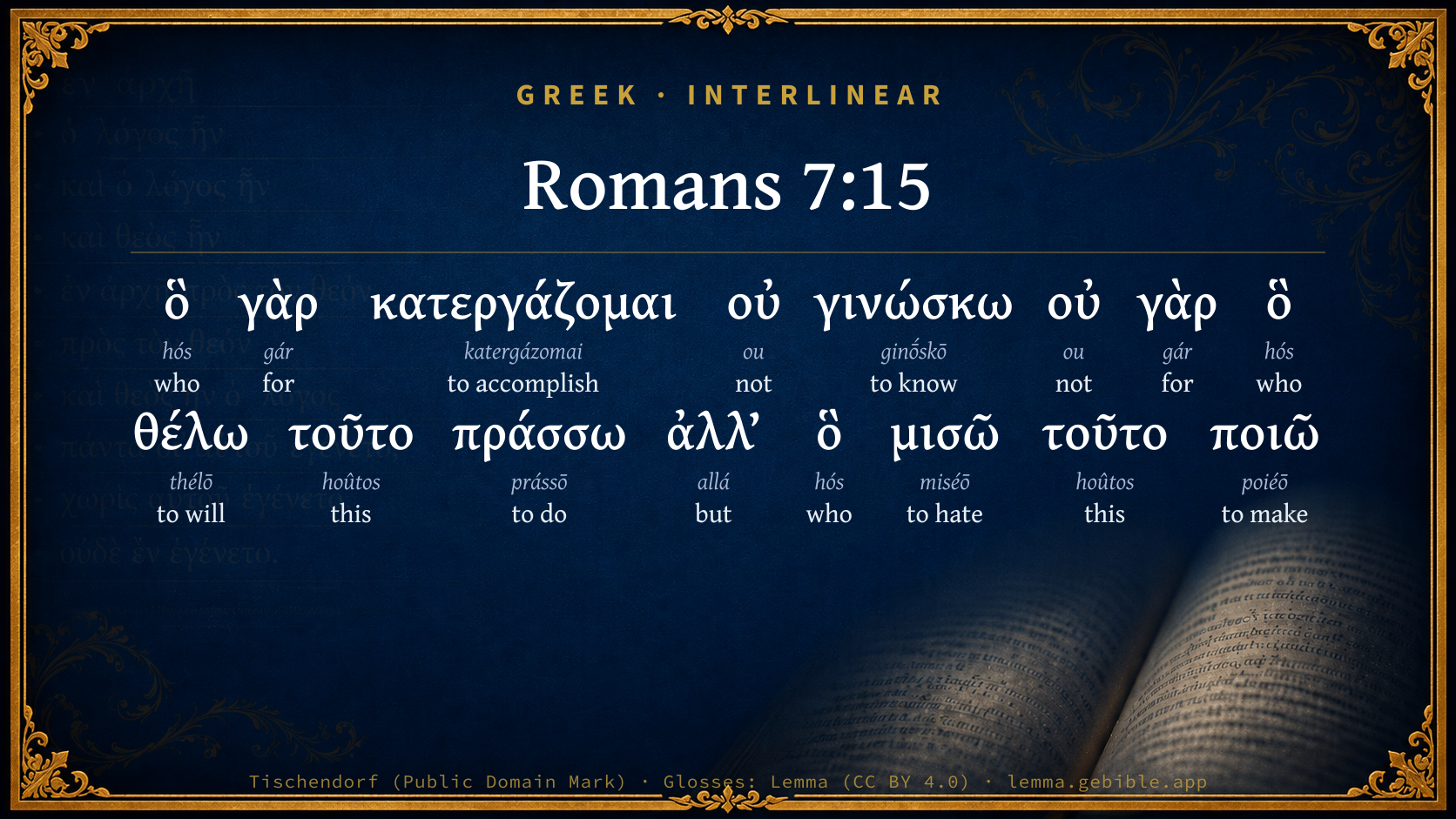
  1. ὃ hós G3739 “who” Relative pronoun, Accusative, Singular, Neuter
  2. γὰρ gár G1063 “for” Conjunction
  3. οὐ ou G3756 “not” Particle, Negative
  4. γινώσκω ginṓskō G1097 “to know” Verb, Present, Active, Indicative, 1st person, Singular
  5. οὐ ou G3756 “not” Particle, Negative
  6. γὰρ gár G1063 “for” Conjunction
  7. ὃ hós G3739 “who” Relative pronoun, Accusative, Singular, Neuter
  8. θέλω thélō G2309 “to will” Verb, Present, Active, Indicative, 1st person, Singular
  9. τοῦτο hoûtos G3778 “this” Demonstrative pronoun, Accusative, Singular, Neuter
  10. πράσσω prássō G4238 “to do” Verb, Present, Active, Indicative, 1st person, Singular
  11. ἀλλ’ allá G235 “but” Conjunction
  12. ὃ hós G3739 “who” Relative pronoun, Accusative, Singular, Neuter
  13. μισῶ miséō G3404 “to hate” Verb, Present, Active, Indicative, 1st person, Singular
  14. τοῦτο hoûtos G3778 “this” Demonstrative pronoun, Accusative, Singular, Neuter
  15. ποιῶ poiéō G4160 “to make” Verb, Present, Active, Indicative, 1st person, Singular

About this verse

These counts appear in no published source. They are computed here, from the morphology-tagged text and Lemma’s own curated glosses. What Lemma adds →

16
words
11
distinct lemmas
Pauline Epistles
section

Notable vocabulary

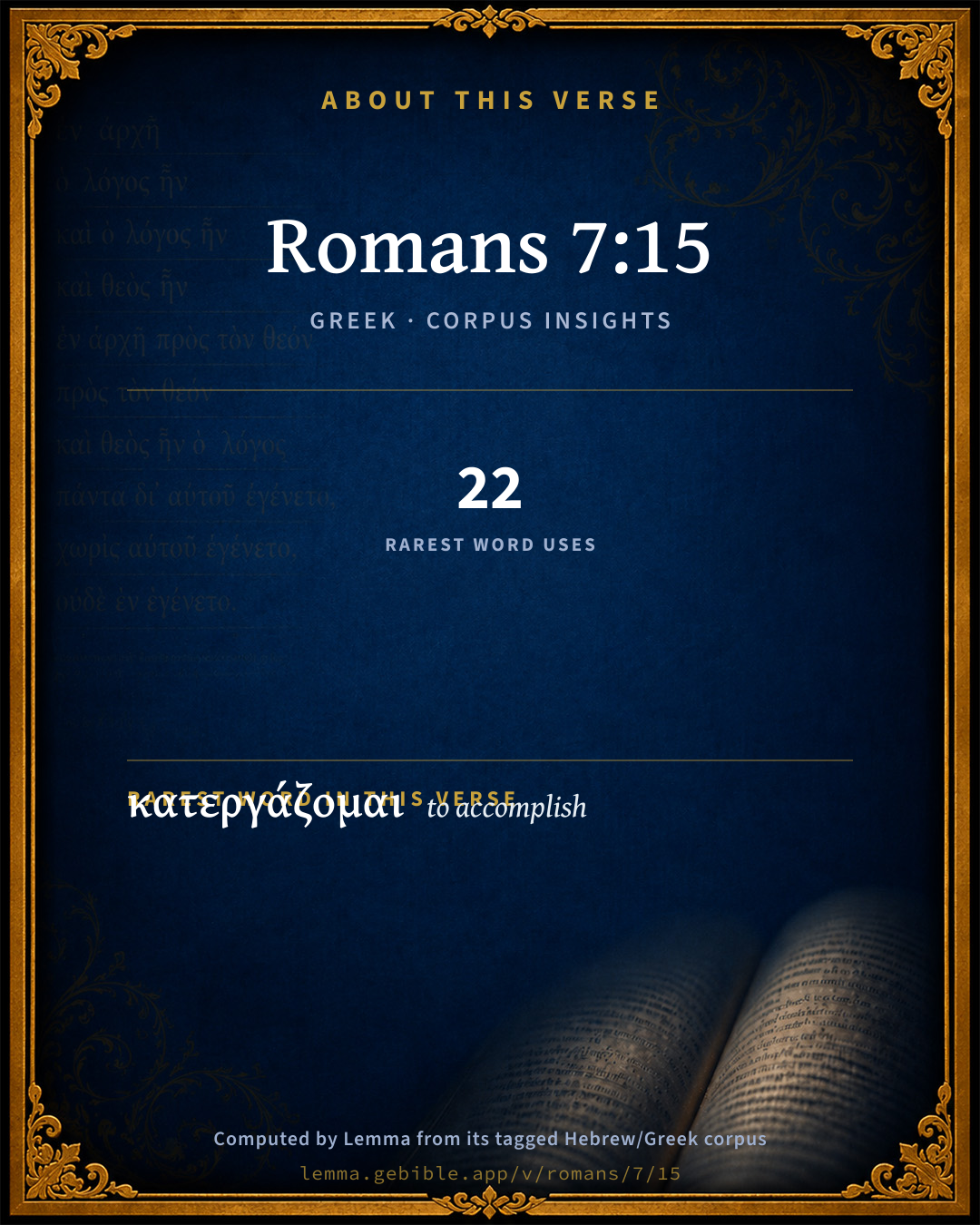
The rarest word here is κατεργάζομαι to accomplish G2716 — appearing just 22 times in the whole Greek New Testament.

Shared distinctive vocabulary

κατεργάζομαι to accomplish G2716 occurs in 22 verses of the Greek New Testament. Also found in:

Repetition

Words recur within this verse:

Cross-references

31

Topical passages linked to Romans 7:15 in the Treasury of Scripture Knowledge — connected by theme and wording, ordered by reader-vote popularity; previews shown in the World English Bible.

  • Galatians 5:17 For the flesh lusts against the Spirit, and the Spirit against the flesh; and these are contrary to one other, that you may not do the things that you desire.
  • Romans 7:19–20 For the good which I desire, I don't do; but the evil which I don't desire, that I practice.
  • Ecclesiastes 7:20 Surely there is not a righteous man on earth, who does good and doesn't sin.
  • Nahum 1:7 Yahweh is good, a stronghold in the day of trouble; and he knows those who take refuge in him.
  • James 3:2 For in many things we all stumble. If anyone doesn't stumble in word, the same is a perfect man, able to bridle the whole body also.
  • Philippians 3:12–14 Not that I have already obtained, or am already made perfect; but I press on, if it is so that I may take hold of that for which also I was taken hold of by Christ Jesus.
  • Romans 12:9 Let love be without hypocrisy. Abhor that which is evil. Cling to that which is good.
  • 1 John 1:7–8 But if we walk in the light, as he is in the light, we have fellowship with one another, and the blood of Jesus Christ, his Son, cleanses us from all sin.
  • Psalms 19:12 Who can discern his errors? Forgive me from hidden errors.
  • Romans 14:22 Do you have faith? Have it to yourself before God. Happy is he who doesn't judge himself in that which he approves.
  • Jude 1:23 and some save, snatching them out of the fire with fear, hating even the clothing stained by the flesh.
  • 2 Timothy 2:19 However God's firm foundation stands, having this seal, "The Lord knows those who are his," and, "Let every one who names the name of the Lord depart from unrighteousness."
  • Proverbs 8:13 The fear of Yahweh is to hate evil. I hate pride, arrogance, the evil way, and the perverse mouth.
  • Psalms 1:6 For Yahweh knows the way of the righteous, But the way of the wicked shall perish.
  • Psalms 101:3 I will set no vile thing before my eyes. I hate the deeds of faithless men. They will not cling to me.
  • Amos 5:15 Hate evil, love good, And establish justice in the courts. It may be that Yahweh, the God of hosts, will be gracious to the remnant of Joseph."
  • Romans 7:16 But if what I don't desire, that I do, I consent to the law that it is good.
  • Hebrews 1:9 You have loved righteousness, and hated iniquity; Therefore God, your God, has anointed you with the oil of gladness above your fellows."
  • 1 Kings 8:46 If they sin against you (for there is no man who doesn't sin), and you are angry with them, and deliver them to the enemy, so that they carry them away captive to the land of the enemy, far off or near;
  • Psalms 65:3 Sins overwhelmed me, But you atoned for our transgressions.
  • Psalms 119:113 I hate double-minded men, But I love your law.
  • Psalms 119:128 Therefore I consider all of your precepts to be right. I hate every false way.
  • Psalms 119:163 I hate and abhor falsehood. I love your law.
  • Proverbs 13:5 A righteous man hates lies, But a wicked man brings shame and disgrace.
  • Psalms 97:10 You who love Yahweh, hate evil. He preserves the souls of his saints. He delivers them out of the hand of the wicked.
  • Psalms 119:1–6 Blessed are those whose ways are blameless, Who walk according to Yahweh's law.
  • Psalms 119:32 I run in the path of your commandments, For you have set my heart free.
  • Psalms 119:40 Behold, I long for your precepts! Revive me in your righteousness.
  • Psalms 119:104 Through your precepts, I get understanding; Therefore I hate every false way.
  • Luke 11:48 So you testify and consent to the works of your fathers. For they killed them, and you build their tombs.
  • Psalms 36:4 He plots iniquity on his bed. He sets himself in a way that is not good; He doesn't abhor evil.

Cross-references courtesy of OpenBible.info (CC BY 4.0).

Commentary

Notes on Romans 7:15 from classic Christian and Jewish commentators (each source and its license shown beneath its notes). The classic Christian expositions comment on the surrounding passage and are grouped to its opening verse, so a note may address several verses; the Jewish commentaries on the Tanakh (Rashi and others) are per-verse, so they appear only where the commentator wrote on this verse.

Lemma curates 59 commentaries, every one of them public domain or Creative Commons licensed, each selected and text-cleaned for this edition rather than reprinted as found. About our sources →

Joseph Benson's Commentary

Rom 7:15. For that which I do — Greek, κατεργαζομαι, what I thoroughly work, the word signifying earnestness and perseverance in working till the work in which the agent is employed is finished. It is therefore used by the apostle to denote the continued employment of God’s people in his service unto the end of their lives; Php 2:12, Work out your own salvation. That is, as you have, in time past, laboured to serve God in all things, so persevere in that service to the end. The word here denotes a continued employment of a very different nature. Therefore he says, What I work, I allow not, or, approve not; for the word,

γινωσκω, which literally signifies I know, is used in the sense of approving, Mat 7:21. For what I would — That is, incline to, or desire, as Macknight renders θελω, which, he observes, cannot here signify the last determination of the will, “actions always following that determination; but such a faint ineffectual desire as reason and conscience, opposed by strong passions, and not strengthened by the Spirit of God, often produce.” These corrupt passions frequently darken the understanding, mislead the judgment, and stupify the conscience; in consequence whereof the will, strongly impelled by criminal desires, in the place of being governed by these higher powers of the mind, governs them herself. But, “when order is restored to the soul by regeneration, then the enlightened understanding determines the judgment, and the decisions thereof, enforced by the voice of conscience, determine the will, whose volitions, thus excited, become the spring of action; so that the good the regenerated man would, he doth, — and the evil he hates, he doth not. But, in the unregenerate, those volitions neither obey the directions of reason nor conscience; hence there is a continual conflict in his breast, between appetites and passions on the one side, and reason and conscience on the other. The latter, however, are generally overcome; and in this state the person, with propriety, may say, What I would, that do I not; but what I hate, that I do: or, as it is expressed, Rom 7:19, The good, that I would I do not; but the evil which I would not, that I do. Ovid, a heathen, describes the conduct of depraved men in words very similar to these:

Sed trahit invitam nova vis, aliudque cupido, Mens aliud suadet. Video meliora, proboque; Deteriora sequor. OVID, Metam., lib. 7. Rom 7:19. ‘My reason this, my passion that persuades; I see the right, and I approve it too; Condemn the wrong, and yet the wrong pursue.’

The apostle does not say that this took place in his conduct on some particular occasions merely, but he gives us this account of himself as his general conduct, while he was carnal and sold under sin, as appears from Rom 7:21. where see the note.” — Smith, On the Carnal Man’s Character.

Joseph Benson's Commentary on the Old and New Testaments (1811–1818) — public domain. Text from a community e-Sword module.

Bengel's Gnomon

Johann Albrecht Bengel

Rom 7:15. Ὁ γὰρ, for that which) He describes slavery in such a way as not to excuse himself, but to accuse the tyranny of sin, and to deplore his own misery, Rom 7:17; Rom 7:20. Γὰρ, for, tends to strengthen the word sold. The slave serves an unworthy master, first, with joy, then afterwards, with grief, lastly, he shakes off the yoke.—οὐ γινώσκω, I do not acknowledge [allow]) as good; ([γινώσκω] the same as to consent to it, that it is good, Rom 7:16, which forms the antithesis); its opposite is I hate.—θέλω, I would, [wish]) he does not say, I love, which would imply more, but I would, intending to oppose this [I would] to, I hate, following immediately after.—πράσσω—ποιῶ) There is a distinction between πράσσω and ποιῶ commonly acknowledged among the Greeks;[74]—the former implies something weightier than the latter. The former is put twice in the present tense, first in a negative assertion, and then in an affirmative assertion, οὐ πράσσω I practise not, the thing is not put in practice; ποιῶ I do, refers to action both internal and external. These words are interchanged, Rom 7:19; Rom 13:3-4; and this interchange is not only not contrary to the nature of the discourse which is gradually rising to a climax, but it even supports and strengthens it; for at Rom 7:15, the sense of the evil is not yet so bitter, and therefore he does not so much as name it, but by the time he reaches Rom 7:19, he is now become very impatient [takes it exceedingly ill] that he should thus impose evil on himself. The farther the soul is from evil, the greater is its distress [torture], to touch even the smallest particle of evil with so much as one finger.

[74] See my previous note. Πράσσω is ago. Ποιέω, facio. Ἐργαζομαι, operor.—ED.

Bengel's Gnomon of the New Testament — English translation (T&T Clark, Edinburgh, 1860) — public domain. Text from a community e-Sword module.

Meyer's Critical & Exegetical Commentary

Heinrich August Wilhelm Meyer

Rom_7:15 elucidates and assigns the reason of this relation of slavery. For what I perform I know not, i.e. it takes place on my part without cognition of its ethical bearing, in the state of bondage of my moral reason. Analogous is the position of the slave, who acts as his masters tool without perceiving the proper nature and the aim of what he does. Augustine, Beza, Grotius, Estius, and others, including Flatt, Glöckler, Reiche, and Reithmayr, erroneously take γινώσκω as I approve, which it never means, not even in Mat_7:23; Joh_10:14; 1Co_8:3; Rom_10:19; 2Ti_2:19; Psa_1:6; Hos_8:4; Sir_18:27. Hofmanns view, however, is also incorrect, that the cognition is meant, which includes the object in the subjectivity of the person knowing, so that the passage denies that the work and the inner life have anything in common. In this way the idea of the divine cognition, whose object is man (Gal_4:9; Mat_12:23), is extraneously imported into the passage.

οὐ γὰρ ὃ θέλω κ.τ.λ.] The proof of the ὁ κατεργ. οὐ γινώσκω. For whosoever acts in the light of the moral cognition does not, of course, do that which is hateful to him following his practical reason (ὃ μισῶ), but, on the contrary, that towards which his moral desire is directed (ὃ θέλω). The person acting without that cognition, carried away by the power of sin in him, does not pursue as the aim of his activity (πράσσει, comp. on Rom_1:32) that which in the morally conscious state he would pursue, but, on the contrary, does (ποιεῖ) what in that state is abhorrent to him. The ethical power of resolution, which decides for the good, is inactive, and man does the evil that he abhors. Paul consequently ascribes to the unregenerate man also the moral wish, which he has in rational self-determination; but he denies to him the action corresponding thereto, because his moral self-determination does not come into exercise in the state of his natural bondage, but he is, on the contrary, hurried away to the performance of the opposite. His θέλειν of the good and his ΜΙΣΕῖΝ of the evil are not, therefore, those of the regenerate man, because the new man, in virtue of the holy ΠΝΕῦΜΑ, emerges from the conflict with the ΣΆΡΞ as a conqueror (against Philippi); nor yet the weak velleitas of the schoolmen (Tholuck, Reithmayr, comp. Baumgarten-Crusius); but a real, decided wishing and hating (comp. Rom_7:16), which present, indeed, for the moral consciousness the theory of self-determination, but without the corresponding result in the issue. The I in θέλω and ΜΙΣῶ is conceived according to its moral self-consciousness, but in ΠΡΆΣΣΩ and ΠΟΙῶ, according to its empiric practice, which runs counter to the self-determination of that consciousness. Reiche, in consistency with his misconception of the entire representation, brings out as the pure thought of Rom_7:15 : the sinful Jew, as he appears in experience and history, does the evil which the Jew free from sin, as he might and should have been, does not approve. As profane analogies of the moral conflict meant by Paul, comp. Epict. Enchir. ii. 26. 4 : ὃ μὲν θέλει (ὁ ἁμαρτάνων) οὐ ποιεῖ, καὶ ὃ μὴ θέλει ποιεῖ; Eur. Med. 1079: θυμὸς δὲ κρείσσων (stronger) ΤῶΝ ἘΜῶΝ ΒΟΥΛΕΥΜΆΤΩΝ, and the familiar video meliora proboque, deteriora sequor (Ovid, Met. vii. 19). See also Wetstein, and Spiess, Logos spermat. p. 228 f.

Meyer — Critical and Exegetical Commentary on the New Testament — English translation by Peter Christie, edited by Frederick Crombie (T&T Clark, 1880) — public domain. Text from a community e-Sword module.

Expositor's Greek Testament

ed. W. Robertson Nicoll

Rom 7:15 . Only the hypothesis of slavery explains his acts. For what I do οὐ γινώσκω , i.e. , I do not recognise it as my own, as a thing for which I am responsible and which I can approve: my act is that of a slave who is but the instrument of another’s will. οὐ γὰρ ὃ θέλω κ . τ . λ . There is “an incomprehensible contradiction in his action”. κατεργὰζεσθαι is to effect, to bring about by one’s own work; πράσσειν is to work at, to busy oneself with, a thing, with or without success, but with purpose; ποιεῖν is simply to make or produce.

The Expositor's Greek Testament, edited by W. Robertson Nicoll (1897–1910) — public domain. Text from a community e-Sword module.

Hodge's Commentary on Romans, Ephesians & First Corinthians

Charles Hodge

Rom_7:15

For that which I do, I allow not, etc. This is an explanation and confirmation of the preceding declaration. I am sold under sin, for that which I do, I allow not, etc. The word γινώσκω, rendered I allow, properly signifies, I know, and as it is used in different senses in the Scriptures, its meaning in this case is a matter of doubt. Retaining its ordinary sense, the word may be used here as in the common phrase, I know not what I do, expressive of the absence of a calm and deliberate purpose, and of the violence of the impulse under which one acts. Inscius et invitus facio, quae facio. Or the meaning may be, that what is done, is done thoughtlessly. Non cum pleno mentis proposito. Morus. This view is a very common one, expressed in different forms. The sinful decision occurs not by rational self-determination, and, therefore, not with the full consciousness with which we should act. De Wette. To the same effect Meyer, the act occurs without the consciousness of its moral character, in a state of bondage of the practical reason, as a slave acts without a consciousness of the nature or design of what he does. Or, I do not do it knowingly, because I know it to be right. This comes very near the old interpretation, according to which to know means to approve, See Psa_1:6, The Lord knoweth the way of the righteous. With regard to moral objects, knowledge is not mere cognition. It is the apprehension of the moral quality, and involves of necessity approbation or disapprobation. Hence the pious are described in Scripture as those who know God, or the knowers of his name. Psa_9:10; Psa_36:10; Hos_8:2. What the apostle, therefore, here says, is, what I perform, i.e., what I actually carry out into action, (κατεργάζομαι,) I approve not, i.e., I do not recognize as right and good.

For what I would, that do I not; but what I hate, that do I. This is a further description of this state of bondage. As the expressions what I would, and what I hate, are in antithesis, the former must mean what I love or delight in. This use of the Greek word (θέλω) is accommodated to the corresponding Hebrew term, and occurs several times in the New Testament. Mat_27:43, Let him deliver him, if he will have him (εἰ θέλει αὐτόνς, i.e. if he delight in him; Mat_9:13; Mat_12:7; Heb_10:5, Heb_10:8; and Psa_21:9; Psa_39:7, in the Septuagint. The word will, therefore, does not express so much a mere determination of the mind, as a state of the feelings and judgment. What I love and approve, that I omit; what I hate and disapprove, that I do. This may not be philosophical, though it is perfectly correct language. It is the language of common life, which, as it proceeds from the common consciousness of men, is often a better indication of what that consciousness teaches, than the language of the schools. Philosophers themselves, however, at times speak in the same simple language of nature. Epictetus, Enchirid. 1:2. c. 26, has a form of expression almost identical with that of the apostle; ὁ ἁμαρτάνων ὅ μὲν θέλει, οὐ ποιεῖ, καὶ ὃ μὴ θέλει ποιεῖ. The language of the apostle, in this passage, expresses a fact of consciousness, with which every Christian is familiar. Whether the conflict here described is that which, in a greater or less degree, exists in every man, between the natural authoritative sense of right and wrong, and his corrupt inclinations; or whether it is peculiar to the Christian, must be decided by considerations drawn from the whole description, and from the connection of this passage with the preceding and succeeding portions of the apostles discourse. It is enough to remark here, that every Christian can adopt the language of this verse. Pride, coldness, slothfulness, and other feelings which he disapproves and hates, are, day by day, reasserting their power over him. He struggles against their influence, groans beneath their bondage, longs to be filled with meekness, humility, and all other fruits of the love of God, but finds he can neither of himself, nor by the aid of the law, effect his freedom from what he hates, or the full performance of what he desires and approves. Every evening witnesses his penitent confession of his degrading bondage, his sense of utter helplessness, and his longing desire for aid from above. He is a slave looking and longing for liberty.

Two consequences flow from this representation of the experience of the Christian. First, the fault is felt and acknowledged to be his own; the law is not to be blamed, Rom_7:16. Second, this state of feeling is consistent with his being a Christian, Rom_7:17.

Charles Hodge — Commentary on Romans (1835), First Corinthians (1857), and Ephesians (1856) — public domain. Text from a community e-Sword module.

Geneva Bible (1599)

Geneva Bible translators

The deeds of my life, saith he, answer not, nay they are contrary to my will: Therefore by the consent of my will with the Law, and repugnancy with the deeds of my life, it appeareth evidently, that the Law and a right ruled do persuade one thing, but corruption which hath her seat also in the regenerate, another thing.

It is to be noted, that one selfsame man is said to will and not to will, in divers respects: to wit, he is said to will, in that, that he is regenerate by grace: and not to will, in that, that he is not regenerate, or in that, that he is such an one as he was born. But because the part which is regenerate, at length becometh conqueror, therefore Paul sustaining the part of the regenerate, speaketh in such sort as if the corruption which sinneth willingly, were something without a man: although afterward he granteth that this evil is in his flesh, or in his members.

He setteth himself, being regenerate, before us, for an example, in whom may easily appear the strife of the Spirit and the flesh, and therefore of the Law of God, and our wickedness. For since that the Law in a man not regenerate bringeth forth death only, therefore in him it may easily be accused: but seeing that in a man which is regenerate, it bringeth forth good fruit, it doth better appear that evil actions proceed not from the Law, but from sin, that is, from our corrupt nature: And therefore the Apostle teacheth also, what the true use of the Law is, in reproving sin in the regenerate, unto the end of the chapter, as a little before (to wit, from the seventh verse unto this fifteenth) he declared the use of it in them which are not regenerate.

Geneva Bible (1599) marginal notes — public domain. Text via Bolls.life.

Jamieson, Fausset & Brown

Robert Jamieson, A. R. Fausset & David Brown

For, &c.--better, "For that which I do I know not"; that is, "In obeying the impulses of my carnal nature I act the slave of another will than my own as a renewed man?"

for, &c.--rather, "for not what I would (wish, desire) that do I, but what I hate that I do."

Jamieson, Fausset & Brown — Commentary Critical and Explanatory on the Whole Bible (1871) — public domain (CC PDM 1.0). Text via the HelloAO Bible API.

Adam Clarke's Commentary

Verse 15. For, that which I do, I allow not, c.] The first clause of this verse is a general assertion concerning the employment of the person in question in the state which the apostle calls carnal, and sold under sin. The Greek word κατεργαξομαι which is here translated I do, means a work which the agent continues to perform till it is finished, and is used by the apostle, Php 2:12, to denote the continued employment of God's saints in his service to the end of their lives. WORK OUT your own salvation the word here denotes an employment of a different kind; and therefore the man who now feels the galling dominion of sin says, What I am continually labouring at I allow not, ου γινωσκω, I do not acknowledge to be right, just, holy, or profitable.

But what I hate, that do I.] I am a slave, and under the absolute control of my tyrannical master: I hate his service, but am obliged to work his will. Who, without blaspheming, can assert that the apostle is speaking this of a man in whom the Spirit of the Lord dwells? From Ro 7:7 to this one the apostle, says Dr. Taylor, denotes the Jew in the flesh by a single I; here, he divides that I into two I's, or figurative persons; representing two different and opposite principles which were in him. The one I, or principle, assents to the law that it is good, and wills and chooses what the other does not practise, Ro 7:16. This principle he expressly tells us, Ro 7:22, is the inward man; the law of the mind, Ro 7:23; the mind, or rational faculty, Ro 7:25; for he could find no other inward man, or law of the mind, but the rational faculty, in a person who was carnal and sold under sin. The other I, or principle, transgresses the law, Ro 7:23, and does those things which the former principle allows not. This principle he expressly tells us, Ro 7:18, is the flesh, the law in the members, or sensual appetite, Ro 7:23; and he concludes in the last verse, that these two principles were opposite to each other; therefore it is evident that those two principles, residing and counteracting each other in the same person; are reason and lust, or sin that dwells in us. And it is very easy to distinguish these two I's, or principles, in every part of this elegant description of iniquity, domineering over the light and remonstrances of reason. For instance, Ro 7:17: Now then, it is no more I that do it, but SIN that dwelleth in me. The I he speaks of here is opposed to indwelling or governing sin; and therefore plainly denotes the principle of reason, the inward man, or law of the mind; in which, I add, a measure of the light of the Spirit of God shines, in order to show the sinfulness of sin. These two different principles he calls, one flesh, and the other spirit, Ga 5:17; where he speaks of their contrariety in the same manner that he does here.

And we may give a probable reason why the apostle dwells so long upon the struggle and opposition between these two principles; it appears intended to answer a tacit but very obvious objection. The Jew might allege: "But the law is holy and spiritual; and I assent to it as good, as a right rule of action, which ought to be observed; yea, I esteem it highly, I glory and rest in it, convinced of its truth and excellency. And is not this enough to constitute the law a sufficient principle of sanctification?" The apostle answers, "No; wickedness is consistent with a sense of truth. A man may assent to the best rule of action, and yet still be under the dominion of lust and sin; from which nothing can deliver him but a principle and power proceeding from the fountain of life."

The sentiment in this verse may be illustrated by quotations from the ancient heathens; many of whom felt themselves in precisely the same state, (and expressed it in nearly the same language,) which some most monstrously tell us was the state of this heavenly apostle, when vindicating the claims of the Gospel against those of the Jewish ritual! Thus OVID describes the conduct of a depraved man:-

Sed trahit invitam nova vis; aliudque cupido,

Mens aliud suadet. Video meliora, proboque;

Deteriora sequor. OVID, Met. lib. vii. ver. 19.

My reason this, my passion that persuades;

I see the right, and I approve it too;

Condemn the wrong, and yet the wrong pursue.

--------indignum facinus! nunc ego et

Illam scelestam esse, et me miserum sentio:

Et taedet: et amore ardeo: et prudens, sciens,

Vivus, vidensque pereo: nec quid agam scio.

TERENT. Eun. ver. 70.

An unworthy act! Now I perceive that she is wicked, and I am wretched. I burn with love, and am vexed at it. Although prudent, and intelligent, and active, and seeing, I perish; neither do I know what to do.

Sed quia mente minus validus, quam corpore toto,

Quae nocuere, sequar; fugiam, quae profore credam.

HOR. Ep. lib. i. E. 8, ver. 7.

More in my mind than body lie my pains:

Whate'er may hurt me, I with joy pursue;

Whate'er may do me good, with horror view.

Francis.

Επει γαρ ὁ ἁμαρτανων ου θελει ἁμαρτανειν, αλλα κατορθωσαι δηλον ὁτι, ὁ μεν θελει, ου ποιει, και ὁμη θελει, ποιει.

ARRIAN. Epist. ii. 26.

For, truly, he who sins does not will sin, but wishes to walk uprightly: yet it is manifest that what he wills he doth not; and what he wills not he doth.

- αλλα νικωμαι κακοις,

Και μανθανω μεν, οἱα τολμησω κακα

Θυμος δε κρεισσῳν των εμων βουλευματων,

Ὁσπερ μεγιστων αιτος κακων βροτοις.

EURIP. Med. v. 1077.

-----------But I am overcome by sin,

And I well understand the evil which I presume to commit.

Passion, however, is more powerful than my reason;

Which is the cause of the greatest evils to mortal men.

Thus we find that enlightened heathens, both among the Greeks and Romans, had that same kind of religious experience which some suppose to be, not only the experience of St. Paul in his best state, but to be even the standard of Christian attainments! See more examples in Wetstein.

The whole spirit of the sentiment is well summed up and expressed by St. Chrysostom: ὁταν τινος επιθυμωμεν, ειτε κωλυωμεθα, αιρεται μαλλον της επιθυμιας ἡ φλοξ. If we lust after any thing which is afterwards prohibited, the flame of this desire burns the more fiercely.

Adam Clarke's Commentary on the Bible (1810–1826) — public domain. Text from a community e-Sword/MySword module.

John Calvin's Commentaries

15. For what I do I know not, etc. He now comes to a more particular case, that of a man already regenerated; in whom both the things which he had in view appear more clearly; and these were, — the great discord there is between the Law of God and the natural man, — and how the law does not of itself produce death. For since the carnal man rushes into sin with the whole propensity of his mind, he seems to sin with such a free choice, as though it were in his power to govern himself; so that a most pernicious opinion has prevailed almost among all men — that man, by his own natural strength, without the aid of Divine grace, can choose what he pleases. But though the will of a faithful man is led to good by the Spirit of God, yet in him the corruption of nature appears conspicuously; for it obstinately resists and leads to what is contrary. Hence the case of a regenerated man is the most suitable; for by this you may know how much is the contrariety between our nature and the righteousness of the law. From this case, also, a proof as to the other clause may more fitly be sought, than from the mere consideration of human nature; for the law, as it produces only death in a man wholly carnal, is in him more easily impeached, for it is doubtful whence the evil proceeds. In a regenerate man it brings forth salutary fruits; and hence it appears, that it is the flesh only that prevents it from giving life: so far it is from producing death of itself.

That the whole, then, of this reasoning may be more fully and more distinctly understood, we must observe, that this conflict, of which the Apostle speaks, does not exist in man before he is renewed by the Spirit of God: for man, left to his own nature, is wholly borne along by his lusts without any resistance; for though the ungodly are tormented by the stings of conscience, and cannot take such delight in their vices, but that they have some taste of bitterness; yet you cannot hence conclude, either that evil is hated, or that good is loved by them; only the Lord permits them to be thus tormented, in order to show to them in a measure his judgment; but not to imbue them either with the love of righteousness or with the hatred of sin.

There is then this difference between them and the faithful — that they are never so blinded and hardened, but that when they are reminded of their crimes, they condemn them in their own conscience; for knowledge is not so utterly extinguished in them, but that they still retain the difference between right and wrong; and sometimes they are shaken with such dread under a sense of their sin, that they bear a kind of condemnation even in this life: nevertheless they approve of sin with all their heart, and hence give themselves up to it without any feeling of genuine repugnance; for those stings of conscience, by which they are harassed, proceed from opposition in the judgment, rather than from any contrary inclination in the will. The godly, on the other hand, in whom the regeneration of God is begun, are so divided, that with the chief desire of the heart they aspire to God, seek celestial righteousness, hate sin, and yet they are drawn down to the earth by the relics of their flesh: and thus, while pulled in two ways, they fight against their own nature, and nature fights against them; and they condemn their sins, not only as being constrained by the judgment of reason, but because they really in their hearts abominate them, and on their account loathe themselves. This is the Christian conflict between the flesh and the spirit of which Paul speaks in Galatians 5:17.

It has therefore been justly said, that the carnal man runs headlong into sin with the approbation and consent of the whole soul; but that a division then immediately begins for the first time, when he is called by the Lord and renewed by the Spirit. For regeneration only begins in this life; the relics of the flesh which remain, always follow their own corrupt propensities, and thus carry on a contest against the Spirit.

The inexperienced, who consider not the subject which the Apostle handles, nor the plan which he pursues, imagine, that the character of man by nature is here described; and indeed there is a similar description of human nature given to us by the Philosophers: but Scripture philosophizes much deeper; for it finds that nothing has remained in the heart of man but corruption, since the time in which Adam lost the image of God. So when the Sophisters wish to define free-will, or to form an estimate of what the power of nature can do, they fix on this passage. But Paul, as I have said already, does not here set before us simply the natural man, but in his own person describes what is the weakness of the faithful, and how great it is. Augustine was for a time involved in the common error; but after having more clearly examined the passage, he not only retracted what he had falsely taught, but in his first book to Boniface, he proves, by many strong reasons, that what is said cannot be applied to any but to the regenerate. And we shall now endeavor to make our readers clearly to see that such is the case.

I know not. He means that he acknowledges not as his own the works which he did through the weakness of the flesh, for he hated them. And so Erasmus has not unsuitably given this rendering, “I approve not,” (non probo.) We hence conclude, that the doctrine of the law is so consentaneous to right judgment, that the faithful repudiate the transgression of it as a thing wholly unreasonable. But as Paul seems to allow that he teaches otherwise than what the law prescribes, many interpreters have been led astray, and have thought that he had assumed the person of another; hence has arisen the common error, that the character of an unregenerate man is described throughout this portion of the chapter. But Paul, under the idea of transgressing the law, includes all the defects of the godly, which are not inconsistent with the fear of God or with the endeavor of acting uprightly. And he denies that he did what the law demanded, for this reason, because he did not perfectly fulfil it, but somewhat failed in his effort.

For not what I desire, etc. You must not understand that it was always the case with him, that he could not do good; but what he complains of is only this — that he could not perform what he wished, so that he pursued not what was good with that alacrity which was meet, because he was held in a manner bound, and that he also failed in what he wished to do, because he halted through the weakness of the flesh. Hence the pious mind performs not the good it desires to do, because it proceeds not with due activity, and doeth the evil which it would not; for while it desires to stand, it falls, or at least it staggers. But the expressions to will and not to will must be applied to the Spirit, which ought to hold the first place in all the faithful. The flesh indeed has also its own will, but Paul calls that the will which is the chief desire of the heart; and that which militates with it he represents as being contrary to his will.

We may hence learn the truth of what we have stated — that Paul speaks here of the faithful, in whom the grace of the Spirit exists, which brings an agreement between the mind and the righteousness of the law; for no hatred of sin is to be found in the flesh.

John Calvin's Commentaries (1540-1563) — public domain. Text from the Calvin Translation Society English edition (1840s-50s) via the Christian Classics Ethereal Library (ccel.org). Calvin's coverage is partial (roughly two-thirds of the Bible); uncommented books and verses are honest gaps, never fabricated. The 19th-century editor's footnotes and remarks are omitted so the notes are faithfully Calvin's own voice.

Ellicott's Commentary for English Readers

(15) That which I do I allow not.—Rather, that which I perform I know not. I act blindly, and without any conscious direction of the will; that higher part of me which should preside over and direct my actions, is kept down by the lower physical nature.

Which I do.—St. Paul uses three words for “to do” in this passage, the distinction between which is hard to represent in English. That which is employed here and in Rom_7:17; Rom_7:20, is the strongest, “perform”—deliberate action, thoroughly carried out. The other two words differ, as “do” and “practise,” the one referring to single, the other to habitual and repeated actions.

What I would.—If my will had free course I should act very differently.

A Bible Commentary for English Readers, edited by Charles John Ellicott (1878–1897) — public domain. Text from a community e-Sword module.

The Cambridge Bible for Schools and Colleges

gen. ed. J. J. S. Perowne

15. I do] The Gr. word is strong; carry out; perhaps with allusion to servile task-work.

allow] In the old English sense of the word; “to allaud,” “to praise, or approve:” so “the Lord alloweth the righteous,” Psa_11:6, Prayer-Book. But the common meaning of the Gr. is I know, in the sense of recognition; and this has a fit application here: q. d., “I know not, in a proper sense, what I do; it is done only under the (partial) obscuration due to the presence of the flesh.” This is further explained in the next clauses.

what I would, &c.] Lit., and better, not what I will, do I; but what I hate, that do I. Here the “willing” and the “hating,” if carefully weighed, are good evidence for the reference of this whole section to the regenerate soul in its conflicts. It is certainly out of harmony with St Paul’s doctrine of grace to represent the soul, before special grace, as “hating” sin as sin, and “willing” pure holiness as holiness.—On the whole passage we must again remember that a soul fully alive to the profound sanctity of the Law is in view. Not gross but minute deviations (minute on the human standard) occasion these complaints.

The Cambridge Bible for Schools and Colleges (gen. ed. J. J. S. Perowne; Cambridge University Press, 1878–1918) — public domain. Text from a community e-Sword module.

John Gill's Exposition

For that which I do, I allow not,.... The apostle having cleared the law from the charge of being the cause either of sin or death, and taken the blame to himself, proceeds to give an account of the struggle and combat he found in himself between the flesh and spirit; "that which I do, I allow not". That which he did was evil, since he allowed not of it; but this is to be understood not of any notorious crime committed by him, and repeated again and again; nor of a sinful course of life, for before his conversion he was not a profane man, but externally moral; and after his conversion, had his conversation in the world by the grace of God in righteousness and holiness; a vicious course of life being contrary to the grace of God implanted in him, and the doctrines of grace professed by him; but of internal lusts, the workings of corruptions in his heart, and which are real actions of the mind, together with the various frailties and infirmities of life: when that apostle says that what he did, "I know not": his meaning is, not that he was utterly ignorant of them, of their nature and operations; that he was insensible of their motions, and unconcerned about them; for his sense of them, and concern for them, are expressed by him in the strongest terms, "I know", "I find", "I see", "O wretched man", &c. Rom 7:18; but either that the efforts and effects of sin in him were so sadden, and at an unawares, that he was sometimes overtaken and held captive, before he knew well where he was, or, what he was doing; or the sense is, that he had not a full knowledge of the evil of his heart, the corruptions of his nature, nor did he understand all his infirmities and the errors of his life; or else the meaning is, I own it not as right, but confess it to be wrong, I do not acknowledge these actions as the productions of the new man, they are alien to him, but as the deeds of the old man; or rather, "I do not approve" of them, I dislike, abhor, and detest them; I cannot excuse or palliate them, but must condemn them; so words of knowledge in the Hebrew language are expressive of love, liking, and approbation; see Psa 1:6; on which last text, "I know him", says Jarchi, , "it is the language of love", or a phrase expressive of strong affection; and so here, I know not, I do not like, love, and approve of these things, or I do not "allow" of them, and indulge myself in them, I loathe them and myself for them; and is this talking like an unregenerate man? can it be thought that the apostle speaks of himself as unregenerate, or represents such a man?

for what I would, that do I not; what he desired and willed was good, though he did it not; and so the Vulgate Latin version reads, "for not the good which I would, I do": and so the next clause, "but the evil which I hate, I do": and what was that? he would have had his thoughts always employed about the best things; he would have had his affections continually and alone set on God, Christ, and the things of another world; he would he was desirous to keep the whole law of God, and do the whole will of God, and live without sin, and as the angels do in heaven: now such a will as this is never to be found in unregenerate persons; this is from God, and the power of his grace: when he says he did not what he willed, what he was desirous of, and bent upon, his sense is, not that he never did any good thing he willed; for he did many good things, as every good man does, but he did not always do the good he willed, and never perfectly, nor anything without grace and strength from Christ: he adds,

but what I hate, that do I; sin was what he hated; it being contrary to the pure and holy nature of God, to the good and righteous law of God, and was in itself, to his view, exceeding sinful: he hated vain thoughts, unclean desires, revengeful lusts, the secret motions of all sin in his heart, and the various evil actions of life; which can never be said of an unregenerate man; who loves sin, delights in iniquity, and takes pleasure in them that do it; and yet what the apostle hated he did; he wrought with his carnal I, his flesh, and through the power of it, and force of temptation, though not without reluctance, remorse, and repentance. The Karaite Jews, which were the better sort of them, say and hold some things, not much unlike to what is here delivered;

"though a man (say they (i)) should transgress some of the commandments, or the commandments in part, , "through the strength of lust, and not on account of, or with pleasure not delight", he shall be one of those that shall enter into paradise.''

(i) R. Eliahu in Addareth, c. 3. apud Triglaud de Sect. Karaeorum, c. 10. p. 176.

John Gill's Exposition of the Whole Bible (1746–1763) — public domain (CC PDM 1.0). Text via the HelloAO Bible API.

Trapp's Complete Commentary

John Trapp

15 For that which I do I allow not: for what I would, that do I not; but what I hate, that do I.

Ver. 15. I allow not] Gr. ου γινωσκω, I know not, as being preoccupated, Gal 6:1, wherried and whirled away by sin before I am aware or have time to consider.

John Trapp, A Commentary or Exposition upon All the Books of the Old and New Testament (1647–1656) — public domain. Text from a community e-Sword module.

Albert Barnes' Notes on the Bible

For that which I do - That is, the evil which I do, the sin of which I am conscious, and which troubles me.

I allow not - I do not approve; I do not wish it; the prevailing bent of my inclinations and purposes is against it. Greek, “I know not;” see the margin. The word “know,” however, is sometimes used in the sense of approving, Rev 2:24, “Which have not known (approved) the depths of Satan;” compare Psa 101:4, I will not know a wicked person.” Jer 1:5.

For what I would - That which I approve; and which is my prevailing and established desire. What I would wish always to do.

But what I hate - What I disapprove of: what is contrary to my judgment; my prevailing inclination; my established principles of conduct.

That do I - Under the influence of sinful propensities, and carnal inclinations and desires. This represents the strong native propensity to sin; and even the power of corrupt propensity under the restraining influence of the gospel. On this remarkable and important passage we may observe,

(1) That the prevailing propensity; the habitual fixed inclination of the mind of the Christian, is to do right. The evil course is hated, the right course is loved. This is the characteristic of a pious mind. It distinguishes a holy man from a sinner.

(2) The evil which is done is disapproved; is a source of grief; and the habitual desire of the mind is to avoid it, and be pure. This also distinguishes the Christian from the sinner.

(3) There is no need of being embarrassed here with any metaphysical difficulties or inquiries how this can be; for.

(a) it is in fact the experience of all Christians. The habitual, fixed inclination and desire of their minds is to serve God. They have a fixed abhorrence of sin; and yet they are conscious of imperfection, and error, and sin, that is the source of uneasiness and trouble. The strength of natural passion may in an unguarded moment overcome them. The power of long habits of previous thoughts may annoy them. A man who was an infidel before his conversion, and whose mind was filled with scepticism, and cavils, and blasphemy, will find the effect of his former habits of thinking lingering in his mind, and annoying his peace for years. These thoughts will start up with the rapidity of lightning. Thus, it is with every vice and every opinion. It is one of the effects of habit. “The very passage of an impure thought through the mind leaves pollution behind it,” and where sin has been long indulged, it leaves its withering, desolating effect on the soul long after conversion, and produces that state of conflict with which every Christian is familiar.

(b) An effect somewhat similar is felt by all people. All are conscious of doing that, under the excitement of passion and prejudice, which their conscience and better judgment disapprove. A conflict thus exists, which is attended with as much metaphysical difficulty as the struggle in the Christian’s mind referred to here.

(c) The same thing was observed and described in the writings of the heathen. Thus, Xenophon (Cyrop. vi. 1), Araspes, the Persian, says, in order to excuse his treasonable designs,” Certainly I must have two souls; for plainly it is not one and the same which is both evil and good; and at the same time wishes to do a thing and not to do it. Plainly then, there are two souls; and when the good one prevails, then it does good; and when the evil one predominates, then it does evil.” So also Epictetus (Enchixid. ii. 26) says, “He that sins does not do what he would, but what he would not, that he does.” With this passage it would almost seem that Paul was familiar, and had his eye on it when he wrote. So also the well-known passage from Ovid, Meta. vii. 9.

Aliudque Cupido,

Mens aliud suadet. Video meliora, proboque,

Deteriora sequor.

“Desire prompts to one thing, but the mind persuades to another. I see the good, and approve it, and yet pursue the wrong.” - See other passages of similar import quoted in Grotius and Tholuck.

Albert Barnes' Notes on the Bible (1834–1885) — public domain. Text from a community e-Sword/MySword module.

Haydock's Catholic Bible Commentary

For that which I work, I understand not. To know, or understand is often, in the style of the Scriptures, the same as to approve or love: so the sense here is: I approve not what I do, that is, what happens to me in my sensitive part, in my imagination, or in the members of my body, which indeed the just man rather suffers than does; and this is the sense, by what immediately follows, the evil which I hate, that I do, i.e. that I suffer, being against my will; and I do that which I would not. (Witham) --- I do not that good which I will, &c. The apostle here describes the disorderly motions of passion and concupiscence; which oftentimes in us get the start of reason, and by means of which even good men suffer in the inferior appetite what their will abhors: and are much hindered in the accomplishment of the desires of their spirit and mind. But these evil motions, (though they are called the law of sin, because they come from original sin, and violently tempt and incline to sin) as long as the will does not consent to them, are not sins, because they are not voluntary. (Challoner)

George Leo Haydock (1774–1849), Haydock's Catholic Family Bible and Commentary, 1859 edition — public domain. Excludes Psalms (Douay-Rheims chapter numbering differs from Protestant) and Deuterocanonical books (Catholic canon only).

Matthew Poole's English Annotations

For that which I do; i.e. what I do contrary to the command of God.

I allow not: in the Greek it is, I know not: q.d. Many times I am surprised and overtaken, not knowing or considering what I do. Or when he says, I know not, his meaning is, (as our translation renders it), I allow or approve not. So the word is used, Mat 7:23, and elsewhere: q.d. Even now, in my converted and regenerate state, I am many times greatly divided, and feel a strife or combat in myself; so that the good I would do upon the motions of God’s Spirit in me, I do not; and the evil that I hate, and am utterly averse to, so far as I am regenerated, that I do. See a parallel place, Gal 5:17.

But what I hate, that do I: he doth not speak here so much of outward actions, as of inward motions and affections: he doth not speak of gross sins, as drunkenness, uncleanness, &c., but of such infirmities as flow from the polluted nature, and from which we can never be thoroughly cleansed in this life.

Matthew Poole's English Annotations on the Holy Bible (1683–1685) — public domain. Text from a community e-Sword/MySword module.

Whedon's Commentary on the Bible

Daniel D. Whedon

15. I do, I allow not—Here begins the battle of the I’s. It is the corrupt I of carnality and indwelling sin asserting its law in the members, and overwhelming the I of conscience, awakened by the Spirit, with the body of death. What I wickedly do, I conscientiously allow not.

Daniel D. Whedon (gen. ed.), Commentary on the Old and New Testaments (1874–1909) — public domain. Text from a community e-Sword module.

The Pulpit Commentary

Vers. 15-25. For that which I do (rather, work, or perform, or accomplish, katergazomai) I know not (rather than I allow not, as in the English Version, this being the proper meaning of the verb ginwskw . The idea may be that, when under the delusion of sin I do wrong, I do not know what I am accomplishing): for not what I would, that I do (rather, practise; the verb here is prassw); but what I hate, that I do (poiw). But if what I would not that I do, I consent unto the Law that it is good (kalov). Now then (nuni de , not in temporal sense, but meaning, as the case is) it is no more I that work (katergazomai , as before) it, but sin that dwelleth in me. For I know that in me (that is, in my flesh,) dwelleth not good (agayon): for to will is present with me; but to perform (katergazesyyai) that which is good (to kalon) is not (ou , rather than ouc auriskw as in the Textus Receptus, is the best-supported reading). For the good (agayon) that I would I do not (oi poiw): but the evil which I would not, that I practise (prassw). But if what I (egw , emphatic) would not, that I do (poiw), it is no longer I (egw , again emphatic) that work (katergazomai) it, but sin that dwelleth in me. I find then the law, that to me who would do good, evil is present. For I delight in the Law of God after the inward man. But I see a different law in my members (on what is meant by "members" (melesi) see note under Rom_6:13) warring against the law of my mind, and brining me into captivity to (or, according to some readings, by) the law of sin which is in my members. O wretched man that I am! who shall deliver me from the body of this death? (probably in the same sense as "the body of sin" in Rom_6:6; see note thereon. Translate certainly as in the English Version; not this body of death, as if it meant this mortal body) Thanks be to God through Jesus Christ our Lord. So then with the mind I myself serve the Law of God; but with the flesh the law of sin. In the note introducing this whole section (vers. 7-25) its general drift has been intimated. The following additional comments may further explain the part of it which begins at ver. 15.

(1) The initial gar introduces proof of the egw being in the condition spoken of in the preceding clause, viz. "sold under sin." For (the meaning is) am I not a bond-slave, when, as I feel is the case with me, I am not my own master? But, observe, the state that goes on to be described is that of an unwilling bond-slave; not of one who likes his bondage, and has no desire to be free. The conscience is supposed already, through the operation of law, to protest against sin; to hate its thraldom; not willingly to acquiesce in it.

(2) The distinction between the verbs poiw, prassw katergazomai , not observed in the English Version, but to which attention has been drawn in the above translation, has its meaning. Attention to the places where they occur will show their appropriateness in each case, denoting severally single acts, habitual practice, and general working, performance, or accomplishment.

(3) The English Version is wrong in rendering, in ver. 15, "What I would, that I do not," so as to make the idea the same as that in ver. 19. There are really two different statements in the two verses the first, of our doing what we wish not to do; the second, of our not doing what we wish to do; and after each the same conclusion is drawn in the same words, viz. that sin is the real worker (katergazomai being here the word appropriately used).

(4) The conflicting principles, or energies, of human nature, between which the individual egw , which wills and acts, is here regarded as being distracted, are the sarx in which sin dwells (which has been explained above; see note under ver. 14) on the one hand, and the nouv (ver. 23) of the esw anyrwpov (ver. 22) on the other. The egw is identified with the esw anyrwpov , rather than regarded as an intermediate personality between the two. For it is spoken of throughout as willing what is good; and though in ver. 14 it is said to be sarkinov , and though, in ver. 18, good dwells not in it, yet the first of these expressions only means that it is in the flesh at present, and therefore in bondage; and the latter is at once qualified by the addition, toutestin en th sarki mou ; it does not identify the egw with the sarx . It is, we may remark in passing, this egw o esw anyrwpov that is regarded as rising to a new life with Christ, so as to become a new man, delivered from bondage; this last expression, of course, involving a different idea from that of the inward man). It is to be observed, further, that throughout this section beginning at ver. 7, there is no distinction drawn (as elsewhere by St. Paul) between pneuma and sarx ; the idea of pneuma , in fact, does not come in at all, except with regard to the Law, which is called pneumatikov . The reason is that the apostle is confining himself here to an examination of what man, even at his best, is in his mere human nature; of what thoughtful observers, though not theologians, may perceive him to be. It is a philosophical rather than a theological analysis. It is one that might commend itself to heathen philosophers, some of whom have, in fact, expressed themselves much to the same effect. Hence it is not till Ro 8, where man"s regeneration by the Divine pneuma is portrayed, that the spiritual principle in himself, through which he is capable of such regeneration, comes into view. And it will be seen that it is this very idea of pneuma that pervades that whole chapter. This essential distinction between the two chapters is sufficient in itself to disprove the theory that the regenerate state is described in Ro 7.

(5) The senses in which the word nomov is used in this chapter require to be perceived and distinguished, its usual sense (see under Rom_2:13) not being uniformly retained. There is, however, always some appended expression to indicate any new application of the word. We find it

(a) in its usual sense, with the usual significance of the absence or the presence of the article, in vers. 7, 9, 12, 14, 16; and in ver. 22, still in the same sense, we have "the Law of God." We find also,

(b) in ver. 23, "the law of my mind," whereby I delight in the "Law of God." Here "law" assumes a different sense from the other, but one in which the word is often used; as when we speak of the laws of nature, having in view, not so much a fiat external to nature which nature must obey, as the uniform rule according to which nature is found to work. The Latin word norma expresses the idea. Thus "the law of my mind" means the normal constitution of my higher and better self, whereby it cannot but assent to "the Law of God. Then

(c) we have "the law of sin in my members;" i.e., in a similar sense, an antagonistic rule or constitution dominant in my sarx . Lastly,

(d) in ver. 21, the general law (in like sense) of my complex human nature, which necessitates this antagonism: "the law, that when I would do good" (in accordance with the law of the mind), "evil is present with me" (in virtue of the other law). Ancient and other commentators have been much puzzled as to the meaning of ver. 21, from taking tomon at the beginning to denote the Mosaic Law, as nomov usually does when preceded by the article. But not so when there is something after it to denote a different meaning; as there is here in the oti at the end of the verse, meaning that, not (as some have understood it) because.

(6) Difficulty has been found in the concluding clause of ver. 25, ara oun , etc. It follows the expression of thanksgiving, "Thanks be to God," etc., which certainly introduced the thought of deliverance from the state that had been described; and hence it is supposed by some that this clause must be a continuance of that thought, and so to be taken as an introduction to Ro 8 rather than a summing up of the preceding argument. It is said also, in support of this view, that more entire association of the egw with the Law of God than was before intimated is here expressed; auto being written instead of simply egw , and douleuw being a stronger word than sunhdomai (ver. 22). Thus the meaning would be, "Though in my flesh I still serve the law of sin (the fronhma sarkov still remains in me, notwithstanding my regeneration), yet now in my very real self I not only approve, but am in subjection to, the Law of God." It is, however, at least a question whether these slight differences of expression come to much; and both the introductory ara oun and the form of the clause suggest rather its being the summarized result of Ro 7. The additional emphasis added to egw (which had, indeed, already been emphatic), and the substitution of doeleuw for sunhdomai , may serve only to bring out all the more strongly in the end what it had been the purpose of the whole passage to lead up to, viz. that man"s real self, when conscience is fully aroused, yearns for and is ready for redemption. There is no difficulty in so understanding the clause (as we should surely understand it naturally but for the preceding thanksgiving), if we regard the thanksgiving as a parenthetical exclamation, anticipating for a moment the purport of Ro 8.

Such an exclamation is characteristic of St. Paul, and it adds life to the passage.

The Pulpit Commentary (1880–1919), ed. H.D.M. Spence-Jones & Joseph S. Exell — public domain. Text from a community e-Sword module.

Scofield Reference Notes

C. I. Scofield

I do I allow not

The apostle personifies the strife of the two natures in the believer, the old or Adamic nature, and the divine nature received through the new birth 1Pe 1:23; 2Pe 1:4; Gal 2:20; Col 1:27. The "I" which is Saul of Tarsus, and the "I" which is Paul the apostle are at strife, and "Paul" is in defeat. In Chapter 8, this strife is effectually taken up on the believer’s behalf by the Holy Spirit; Rom 8:2; Gal 5:16; Gal 5:17 and Paul is victorious.

Contra, Eph 6:12 where the conflict is not fleshly, but spiritual.

The Scofield Reference Bible (1917 edition), notes by C. I. Scofield — public domain. Text from a community e-Sword module.

Burkitt's Expository Notes on the New Testament

William Burkitt

These words are an argument to prove what the apostle had asserted in the foregoing verse; namely, That he was held under the power of sin unwillingly, because he did not allow or approve of any evil which he did contrary to the holy law of God, but did hate and abominate it, was displeased with it, and with himself for it.

An unregenerate man’s judgment and conscience is sometimes against sin; which makes him afraid to commit it; but a gracious person’s will, heart and affections, are all set against sin;: Indeed there is a regenerate and an unregenerate part in the Christians will (he is sanctified totus, but not totaliter;) so far the will is renewed, it hates all sin, and meditates the ruin and destruction of it.

And observe, It was not this or that particular evil, but all evil which the apostle hated. A wicked man may hate a particular evil, as Absalom hated Ammon’s uncleanness; but to hate all sin, is the character of none but a regenerate person.

Observe, lastly, That a good man sometimes, through the power of corruption, and the prevalency of temptation, doth that evil which is disallowed and disapproved by him; yea, which is very odious and hateful to him: he loaths in part what he doth, and afterwards loaths himself for the doing of it; and when he doth evil, allows not of the evil that he doth.

William Burkitt's Expository Notes on the New Testament (1700–1703) — public domain. Text from a community e-Sword module.

Godbey's Commentary on the New Testament

William B. Godbey

15. “For that which I do I know not; for I do that which I do not wish, but I do that which I hate.

William B. Godbey, Commentary on the New Testament (1896–1900) — public domain. Text from a community e-Sword module.

McGarvey & Pendleton's Commentaries

J. W. McGarvey

For that which I do I know not: for not what I would, that do I practise; but what I hate, that I do .

J. W. McGarvey (with Philip Y. Pendleton), Commentaries on the New Testament (The Fourfold Gospel, 1914; Acts; and the epistles) — public domain. Text from a community e-Sword/MySword module.

unfoldingWord translationNotes

Door43 World Missions Community

Connecting Statement:

Paul talks about the struggle inside his inner man between his flesh and the law of God—between sin and good.

For what I do, I do not really understand

"I am not sure why I do some of the things that I do"

For what I do

"because what I do"

what I want to do, I do not do

The words "I do not do" are an exaggeration to emphasize that Paul does not do what he wants to do as often as he would like or that he does what he does not want to do too often. AT: "I do not always do what I want to do" (See: Hyperbole and Generalization)

what I hate, I do

The words "I do," which implies that he always does what he hates to do, are an exaggeration to emphasize that Paul does what he does not want to do too often. AT: "the things that I know are not good are the things that I sometimes do" (See: Hyperbole and Generalization)

But if I do

"However, if I do"

I agree with the law

"I know God's law is good"

translationWords

law

good

unfoldingWord translationNotes — © Distant Shores Media and the Door43 World Missions Community, licensed CC BY-SA 4.0. Source: git.door43.org/Door43/en_tn.

Cambridge Greek Testament for Schools and Colleges

15. γὰρ amplifies the idea of πεπραμένος; he is no longer his own master but under a tyranny he hates.

δ κατεργάζομαι. The effects I produce are not the outcome of my own knowledge and purpose.

οὐ γινώσκω = I form no true conception of, I do not thoroughly realise—the durative present. Cf. ἐξηπάτησεν, Rom 7:11.

πράσσω, put into practice. ποιῶ, commit in act.

Cambridge Greek Testament for Schools and Colleges (Cambridge University Press, 1896; 21 vols, various authors incl. Carr, Maclear, Plummer, Farrar, Lumby, Moule, M. R. James, Simcox) — public domain. Text from a community e-Sword module.

Alford’s Greek Testament

Henry Alford

15.] For (a proof of this πεπράσθαι under sin, viz. not being able to do what I would, vv. 15-17) that which I perform (am in the habit of doing) I know not (act blindly, at the dictates of another: which is proper to a slave. σκοτοῦμαι φησί, συναρπάζομαι, ἐπήρειαν ὑπομένω, οὐκ οἶδα πῶς ὑποσκελίζομαι, Chrys. The meaning, ‘I approve not,’ introduced by Aug. and held by Erasm., Beza, Grot., Estius, Semler, al., is not sanctioned by usage,—see note on 1Co 8:3,—and would make the following clause almost a tautology): for (explanation of last assertion, shewing how such blind service comes to pass) not what I desire, that do I (this θέλω is not the full determination of the will, the standing with the bow drawn and the arrow aimed; but rather the inclination of the will,—the taking up the bow and pointing at the mark, but without power to draw it:—-we have θέλω in the sense of to wish, 1Co 7:7, 1Co 7:32; 1Co 14:5; 2Co 12:20), but what I hate (= οὐ θέλω, ver. 19: no distinction in intensity between θέλω and μισῶ), that I do (no distinction here between πράσσω and ποιῶ, as apparently in Joh 3:20, Joh 3:21, where see note: for they are interchanged in vv. 19, 20).

The Commentators cite several parallel passages from profane writers: e.g. Seneca, Hippol. 604, ‘Vos testor omnes cœlites, hoc quod volo, me nolle;’—Epictetus, Enchiridion ii. 26, ἐπεὶ γὰρ ὁ ἁμαρτάνων οὐ θέλει ἁμαρτάνειν, ἀλλὰ κατορθῶσαι, δῆλον ὅτι ὃ μὲν θέλει οὐ ποιεῖ, καὶ ὃ μὴ θέλει ποιεῖ:—the well-known lines of Ovid, Met. 7:19, ‘aliudque cupido, Mens aliud suadet: video meliora proboque, Deteriora sequor:’—Plautus, Trinummus iii. 2. 31, ‘Scibam ut esse me deceret, facere non quibam miser:’—&c.

Henry Alford, The Greek Testament (1849–1861) — public domain. Text from a community e-Sword module.

International Critical Commentary

15. κατεργάζομαι= perficio, perpetro, ‘to carry into effect,’ ‘put into execution’: πράσσω = ago, to act as a moral and responsible being: ποιῶ = facio,to produce a certain result without reference to its moral character, and simply as it might be produced by inanimate mechanism (see also the notes on ch. 1:32: 2:9). Of course the specific sense may not be always marked by the context, but here it is well borne out throughout. For a fuller account of the distinction see Schmidt, Lat. u. Gr. Synonymik, p. 294 ff.

οὐ γινώσκω appears to describe the harmonious and conscious working of will and motive, the former deliberately accepting and carrying out the promptings of the latter. The man acts, so to speak, blindly: he is not a fully conscious agent: a force which he cannot resist takes the decision out of his hands.

ὃ θέλω. The exact distinction between θέλω and βούλομαι has been much disputed, and is difficult to mark. On the whole it seems that, especially in N. T. usage, βούλομαι lays the greater stress on the idea of purpose, deliberation, θέλω on the more emotional aspect of will: in this context it is evidently something short of the final act of volition, and practically = ‘wish,’ ‘desire.’ See especially the full and excellent note in Grm.-Thay.

International Critical Commentary — older volumes (1896–1929), various authors — public domain. Text from a community e-Sword module.

Vincent's Word Studies in the New Testament

Marvin R. Vincent

I do [κατεργαζομαι] . See on ver. 8. Accomplish, achieve. Here appropriately used of carrying out another's will. I do not perceive the outcome of my sinful life.

I allow not [ου γινωσκω] . Allow is used by A. V. in the earlier English sense of approve. Compare Luk 11:48; Rom 14:22; 1Th 2:4. Shakespeare : "Thou shalt hold the opinion of Pythagoras as I will allow of thy wits" (" Twelfth Night, "4, 2). But the meaning of ginwskw is not approve, but recognize, come to know, perceive. Hence Rev., I know not. Paul says :" What I carry out I do not recognize in its true nature, as a slave who ignorantly performs his master's behest without knowing its tendency or result. "

I would [θελω] . See on Mt 1:19. Rather desire than will in the sense of full determination, as is shown by I consent (ver. 16), and I delight in (ver. 22).

Do I not [πρασσω] . See on Joh 3:21. Rev., correctly, practice : the daily doing which issues in accomplishment [κατεργαζομαι] .

Do I [ποιω] . See on Joh 3:21. More nearly akin to katergazomai I accomplish, realize. "When I have acted [πρασσω] I find myself face to face with a result which my moral instinct condemns" (Godet). I do not practice what I would, and the outcome is what I hate.

Marvin R. Vincent, Word Studies in the New Testament (1887–1900) — public domain. Text from a community e-Sword/MySword module.

Godet's Commentaries

Frédéric Louis Godet

Vv. 15. “Indeed what I perform I know not: for what I would, that do I not; but what I hate, that do I.”

This verse contains the proof from fact of the state of slavery which Paul has just affirmed. The slave knows not what he does, for he does the will of another. So Paul complains that his work is not the result of a distinct view in which he has, as it were, intellectually possessed himself beforehand of what he was going to do; it is the result of blind instinct, which drags him along as if without his knowledge, so that when he sees it realized, it is not what he wished; it is, on the contrary, what he detests. The expression: I know not, should not be taken in the sense: “I do not own as good,” a forced sense, and one which is not necessary.

The θέλειν, will, which Paul does not execute, is of course the willing of good, and what he hates and yet executes is certainly evil. The moral tendency of his will to purpose good and hate evil, is connected with the acknowledgment of the perfection of the law of which he spoke in Rom 7:14. But this will which puts itself on the side of the law is nothing more than a desire, a wish, a simple I should like, which gives way in practice. Such, indeed, is the frequent meaning of θέλειν, to will, in Paul (1Co 7:7; 2Co 5:4; 2Co 12:20; Col 2:18).

The term πράσσειν, to do, has the meaning of working at, and expresses the idea that his practical activity does not follow the direction of his will.—Μισεῖν, to hate, here denotes moral reprobation; and ποιεῖν, to do, which has the sense of accomplishing, realizing, refers not to activity in exercise (πράσσειν), but to the product of the activity, so that the exact paraphrase of the two last propositions would be this: “At the time when I act, I am not working in the direction of my desire to fulfil the law; and when I have acted, I find myself face to face with a result which my moral instinct condemns.”

It is asked how Paul could ascribe to himself this desire of good and hatred of evil, while speaking of the time when he was yet under the law? but we ask in turn of those who refer this verse to Paul in his regenerate state, how he could in this state ascribe to himself the powerlessness with which he charges himself, especially if we compare the contrast he brings out between the state described here and the delineation of the Christian he draws in chap. 8? In fact, what this verse expresses is nothing else than what is contained in the words of Jesus, Joh 3:24 : “He that doeth truth cometh to the light.” To do the truth certainly denotes the loyal desire of goodness; and this disposition precedes faith in the case of the men of whom Jesus is speaking, since the latter is its consequence: cometh to the light. We meet with the same thought in the parable of the sower, Luk 8:15, when Jesus speaks of the honest and good heart in which the gospel seed produces its fruit; comp. also Rom 2:7 and Act 10:34-35. It is understood, of course, that such a disposition exists only as the work of Him who is alone good. But there is a way of regarding the corruption of human nature contrary to the gospel, and which when thoroughly weighed is self-destructive.

Frédéric Louis Godet — Commentaries on Luke, John, Romans, and 1 Corinthians — English translation (T&T Clark, Edinburgh, 1870s–1890s) — public domain. Text from a community e-Sword module.

Lesson kit

Teaching starters — assembled from the data on this page, not authored interpretation. Every prompt links to the verse data it draws on. Edit before teaching.

Romans, in the Pauline Epistles, opens this verse with 16 words (11 distinct Greek lemmas). Its most distinctive word is katergázomai (“to accomplish”). A historical commentator’s framing appears above. Read the whole chapter for the surrounding context.

Discussion questions

  1. How does “to accomplish” (katergázomai) shape what this verse is saying?
  2. How does Romans 1:27, which shares the word «to accomplish», read alongside this verse?
  3. What does the repetition of “who” (3× in this one verse) do in this verse?
  4. These translations render this verse differently; the difference is in the English rendering, not the original. What questions does that raise?
  5. Compare how Joseph Benson's Commentary and Bengel's Gnomon read this verse. Where do they agree or differ?

Things to notice

Reading settings

Reading text

Shown beneath each verse's original-language words.

Old Testament
Old Testament edition

Read the OT as the Masoretic Hebrew (MT) or the Greek Septuagint (LXX).

English shown for the Greek Septuagint (in the Hebrew ↔ Greek comparison).

Comparing translations? Open the Compare panel on any verse page to stack up to four side by side.