

2 Corinthians 8:9
Greek (Tischendorf 8th ed.) 2 Corinthians 8:9 appears in the Greek New Testament. The text above is from the Tischendorf 8th edition. Each word links to its Strong’s number and a concise gloss. Click any word for its full Thayer’s Greek Lexicon entry.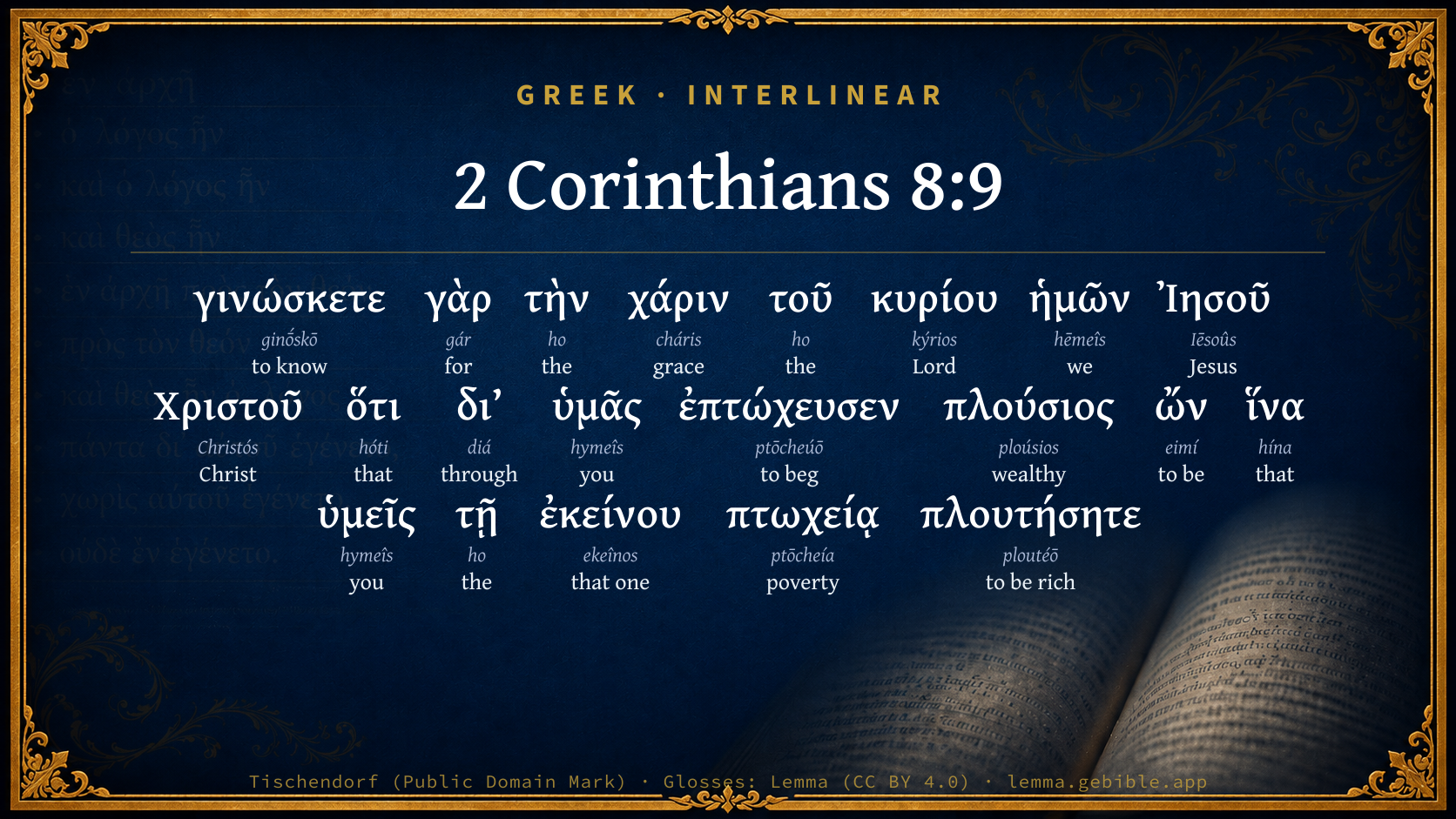
For you know the grace of our Lord Jesus Christ, that, though he was rich, yet for your sakes he became poor, that you through his poverty might become rich.
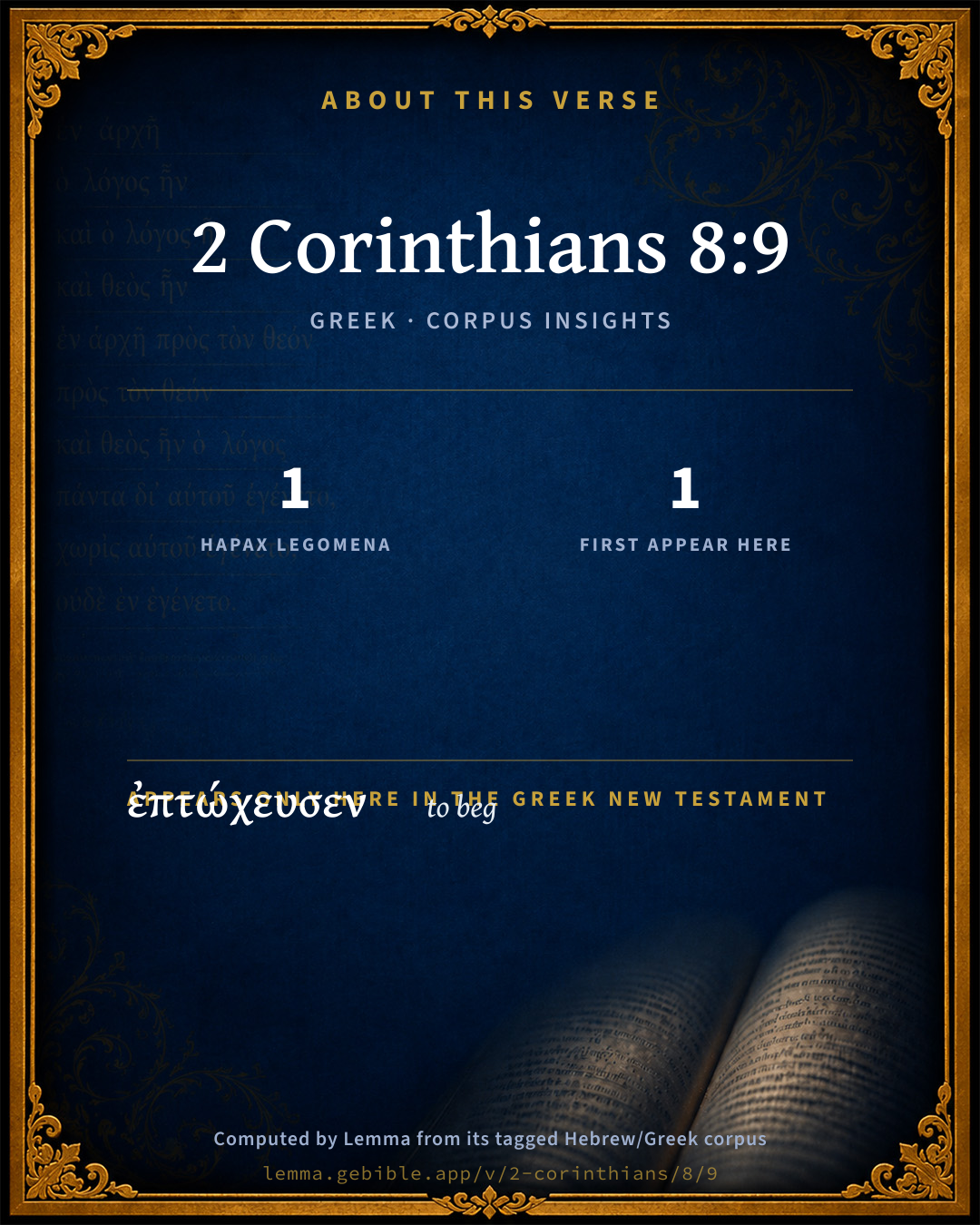
- 1 hapax legomenon — only here in the Greek New Testament
- 1 first appearance in the Greek New Testament
Download a study sheet
One document with this verse’s original text, its word-by-word gloss line, the meaning frame, cross-references with their text, attributed commentary, and full source and license credits — printable, and it pastes into notes with its structure intact.
This verse Autodidact and up
A passage Seminary Student
Up to 50 verses in one chapter. A passage sheet keeps up to 6 commentary sources and 12 cross-references per verse, in the order this page ranks them, and says so on the sheet whenever that leaves anything out. Ask for a single verse and you get the Autodidact verse sheet above.
Everything on this page stays free to read, with no account — the sheet is a download of what is already on screen, not access to it.
Compare translations 3
The same verse in 3 English versions, stacked beneath the original-language interlinear above. Click any original word for its lexicon entry.
Each is an independent rendering of the whole verse — the interlinear is not word-aligned to these translations.
Highlighted words mark where these versions differ — a whole-verse word diff, not a word-by-word alignment.
-
World English Bible Public Domain
For you know the grace of our Lord Jesus Christ, that, though he was rich, yet for your sakes he became poor, that you through his poverty might become rich.
-
King James Version Public Domain
For ye know the grace of our Lord Jesus Christ, that, though he was rich, yet for your sakes he became poor, that ye through his poverty might be rich.
-
unfoldingWord Literal Text CC BY-SA 4.0
For you know the grace of our Lord Jesus Christ, that he became poor for your sake being rich so that by the poverty of that one, you might become rich.
unfoldingWord Literal Text — © unfoldingWord, licensed CC BY-SA 4.0. Word-aligned USFM3 via Door43 (git.door43.org/unfoldingWord/en_ult).
Show all 19 translations
Every available English version of this verse, each an independent rendering of the whole verse.
-
World English Bible Public Domain
For you know the grace of our Lord Jesus Christ, that, though he was rich, yet for your sakes he became poor, that you through his poverty might become rich.
-
Berean Standard Bible Public Domain
For you know the grace of our Lord Jesus Christ, that though He was rich, yet for your sakes He became poor, so that you through His poverty might become rich.
-
Majority Standard Bible Public Domain
For you know the grace of our Lord Jesus Christ, that though He was rich, yet for your sake He became poor, so that you through His poverty might become rich.
-
King James Version Public Domain
For ye know the grace of our Lord Jesus Christ, that, though he was rich, yet for your sakes he became poor, that ye through his poverty might be rich.
-
American Standard Version (1901) Public Domain
For ye know the grace of our Lord Jesus Christ, that, though he was rich, yet for your sakes he became poor, that ye through his poverty might become rich.
-
Revised Version (1885) Public Domain
For ye know the grace of our Lord Jesus Christ, that, though he was rich, yet for your sakes he became poor, that ye through his poverty might become rich.
-
Geneva Bible (1599) Public Domain
For ye knowe the grace of our Lord Iesus Christ, that hee being rich, for your sakes became poore, that yee through his pouertie might be made rich.
-
Douay-Rheims (1899) Public Domain
For you know the grace of our Lord Jesus Christ, that being rich he became poor, for your sakes; that through his poverty you might be rich.
-
Young's Literal Translation Public Domain
for ye know the grace of our Lord Jesus Christ, that because of you he became poor -- being rich, that ye by that poverty may become rich.
-
Literal Standard Version CC BY-SA 4.0
for you know the grace of our Lord Jesus Christ, that because of you He became poor—being rich, that you may become rich by that poverty.
-
Unlocked Literal Bible CC BY-SA 4.0
For you know the grace of our Lord Jesus Christ. Even though he was rich, for your sakes he became poor, so that through his poverty you might become rich.
-
unfoldingWord Literal Text CC BY-SA 4.0
For you know the grace of our Lord Jesus Christ, that he became poor for your sake being rich so that by the poverty of that one, you might become rich.
-
Darby Bible Public Domain
For ye know the grace of our Lord Jesus Christ, that for your sakes he, being rich, became poor, in order that *ye* by *his* poverty might be enriched.
-
World Messianic Bible Public Domain
For you know the grace of our Lord Yeshua the Messiah, that though he was rich, yet for your sakes he became poor, that you through his poverty might become rich.
-
Webster's Bible Public Domain
For ye know the grace of our Lord Jesus Christ, that though he was rich, yet for your sakes he became poor, that ye through his poverty might be rich.
-
Free Bible Version CC BY-SA 4.0
For you know the grace of our Lord Jesus Christ. Even though he was rich, he became poor for you, so that through his poverty you could become rich.
-
Bible in Basic English Public Domain
For you see the grace of our Lord Jesus Christ, how though he had wealth, he became poor on your account, so that through his need you might have wealth.
-
Text-Critical English NT CC BY 4.0
For you know the grace of our Lord Jesus Christ, that though he was rich, yet for your sakes he became poor, so that by his poverty you could become rich.
-
Tyndale New Testament (1534) Public Domain
Ye knowe the liberalitie of oure lorde Iesus Christ which though he were riche yet for youre sakes be came poore: that ye thorow his povertie myght be made ryche.
Literal Standard Version (2020), Covenant Press — licensed CC BY-SA 4.0. Text via the HelloAO Bible API (eBible.org). Unlocked Literal Bible (unfoldingWord) — licensed CC BY-SA 4.0. Text via the HelloAO Bible API (eBible.org). unfoldingWord Literal Text — © unfoldingWord, licensed CC BY-SA 4.0. Word-aligned USFM3 via Door43 (git.door43.org/unfoldingWord/en_ult). Free Bible Version, Dr. Jonathan Gallagher — licensed CC BY-SA 4.0. Text via the HelloAO Bible API (eBible.org).
Word by word
More ways to search: Search by grammar → Find every occurrence → Compare this word →
Practice this passage: Drill this verse → Learn its vocabulary →
- Appears 1× in the Greek New Testament
- First appears here
- Part of Speech
- Verb
- Tense
- Aorist
- Voice
- Active
- Mood
- Indicative
- Person
- 3rd person
- Number
- Singular
Full Thayer's Definition
- γινώσκετε ginṓskō G1097 “to know” Verb, Present, Active, Indicative, 2nd person, Plural
- γὰρ gár G1063 “for” Conjunction
- τὴν ho G3588 “the” Article, Accusative, Singular, Feminine
- χάριν cháris G5485 “grace” Noun, Accusative, Singular, Feminine
- τοῦ ho G3588 “the” Article, Genitive, Singular, Masculine
- κυρίου kýrios G2962 “Lord” Noun, Genitive, Singular, Masculine
- ἡμῶν hēmeîs G2249 “we” Personal pronoun, 1st person, Genitive, Plural
- Ἰησοῦ Iēsoûs G2424 “Jesus” Noun, Genitive, Singular, Masculine
- Χριστοῦ Christós G5547 “Christ” Noun, Genitive, Singular, Masculine
- ὅτι hóti G3754 “that” Conjunction
- δι’ diá G1223 “through” Preposition
- ὑμᾶς hymeîs G5210 “you” Personal pronoun, 2nd person, Accusative, Plural
- ἐπτώχευσεν ptōcheúō G4433 “to beg” Verb, Aorist, Active, Indicative, 3rd person, Singular
- πλούσιος ploúsios G4145 “wealthy” Adjective, Nominative, Singular, Masculine
- ὤν eimí G1510 “to be” Verb, Present, Active, Participle, Nominative, Singular, Masculine
- ἵνα hína G2443 “that” Conjunction
- ὑμεῖς hymeîs G5210 “you” Personal pronoun, 2nd person, Nominative, Plural
- τῇ ho G3588 “the” Article, Dative, Singular, Feminine
- ἐκείνου ekeînos G1565 “that one” Demonstrative pronoun, Genitive, Singular, Masculine
- πτωχείᾳ ptōcheía G4432 “poverty” Noun, Dative, Singular, Feminine
- πλουτήσητε ploutéō G4147 “to be rich” Verb, Aorist, Active, Subjunctive, 2nd person, Plural
About this verse
These counts appear in no published source. They are computed here, from the morphology-tagged text and Lemma’s own curated glosses. What Lemma adds →
- 21
- words
- 18
- distinct lemmas
- Pauline Epistles
- section
Notable vocabulary
1 hapax legomenon — a word that appears only here in the entire Greek New Testament:
- ἐπτώχευσεν to beg G4433
First appearance in Scripture
This word makes its first canonical appearance in the Greek New Testament here:
- ἐπτώχευσεν to beg G4433
Shared distinctive vocabulary
πτωχείᾳ poverty G4432 occurs in 3 verses of the Greek New Testament. Also found in:
Cross-references
38Topical passages linked to 2 Corinthians 8:9 in the Treasury of Scripture Knowledge — connected by theme and wording, ordered by reader-vote popularity; previews shown in the World English Bible.
- Romans 8:32 He who didn't spare his own Son, but delivered him up for us all, how would he not also with him freely give us all things?
- Philippians 2:6–8 who, existing in the form of God, didn't consider it robbery to be equal with God,
- Matthew 20:28 even as the Son of Man came not to be served, but to serve, and to give his life as a ransom for many."
- Romans 5:8 But God commends his own love toward us, in that while we were yet sinners, Christ died for us.
- 2 Corinthians 6:10 as sorrowful, yet always rejoicing; as poor, yet making many rich; as having nothing, and yet possessing all things.
- John 1:14 The Word became flesh, and lived among us. We saw his glory, such glory as of the one and only Son of the Father, full of grace and truth.
- Ephesians 2:7 that in the ages to come he might show the exceeding riches of his grace in kindness toward us in Christ Jesus;
- James 2:5 Listen, my beloved brothers. Didn't God choose those who are poor in this world to be rich in faith, and heirs of the Kingdom which he promised to those who love him?
- Ephesians 1:6–8 to the praise of the glory of his grace, by which he freely bestowed favor on us in the Beloved,
- Ephesians 3:8 To me, the very least of all saints, was this grace given, to preach to the Gentiles the unsearchable riches of Christ,
- Romans 5:20–21 The law came in besides, that the trespass might abound; but where sin abounded, grace did abound more exceedingly;
- Luke 16:11 If therefore you have not been faithful in the unrighteous mammon, who will commit to your trust the true riches?
- 1 Timothy 6:18 that they do good, that they be rich in good works, that they be ready to distribute, willing to communicate;
- Hebrews 1:6–14 Again, when he brings in the firstborn into the world he says, "Let all the angels of God worship him."
- Luke 9:58 Jesus said to him, "The foxes have holes, and the birds of the sky have nests, but the Son of Man has no place to lay his head."
- 2 Corinthians 13:14 The grace of the Lord Jesus Christ, the love of God, and the communion of the Holy Spirit, be with you all. Amen.
- Hebrews 1:2 has at the end of these days spoken to us by his Son, whom he appointed heir of all things, through whom also he made the worlds.
- 1 Corinthians 1:4 I always thank my God concerning you, for the grace of God which was given you in Christ Jesus;
- Ephesians 3:19 and to know Christ's love which surpasses knowledge, that you may be filled with all the fullness of God.
- Revelation 3:18 I counsel you to buy from me gold refined by fire, that you may become rich; and white garments, that you may clothe yourself, and that the shame of your nakedness may not be revealed; and eye salve to anoint your eyes, that you may see.
- Isaiah 53:2 For he grew up before him as a tender plant, and as a root out of a dry ground: he has no form nor comeliness; and when we see him, there is no beauty that we should desire him.
- Luke 2:7 She brought forth her firstborn son, and she wrapped him in bands of cloth, and laid him in a feeding trough, because there was no room for them in the inn.
- Matthew 8:20 Jesus said to him, "The foxes have holes, and the birds of the sky have nests, but the Son of Man has nowhere to lay his head."
- John 1:1–4 In the beginning was the Word, and the Word was with God, and the Word was God.
- John 16:15 All things whatever the Father has are mine; therefore I said that he takes of mine, and will declare it to you.
- Psalms 102:25–27 Of old, you laid the foundation of the earth. The heavens are the work of your hands.
- Isaiah 62:1 For Zion's sake will I not hold my peace, and for Jerusalem's sake I will not rest, until her righteousness go forth as brightness, and her salvation as a lamp that burns.
- Isaiah 65:8 Thus says Yahweh, As the new wine is found in the cluster, and one says, Don't destroy it, for a blessing is in it: so will I do for my servants' sake, that I may not destroy them all.
- Matthew 17:27 But, lest we cause them to stumble, go to the sea, and cast a hook, and take up the first fish that comes up. When you have opened its mouth, you will find a stater coin. Take that, and give it to them for me and you."
- Mark 6:3 Isn't this the carpenter, the son of Mary, and brother of James, Joses, Judas, and Simon? Aren't his sisters here with us?" They were offended at him.
- John 1:10 He was in the world, and the world was made through him, and the world didn't recognize him.
- John 1:17 For the law was given through Moses. Grace and truth came through Jesus Christ.
- John 12:30 Jesus answered, "This voice hasn't come for my sake, but for your sakes.
- John 17:19 For their sakes I sanctify myself, that they themselves also may be sanctified in truth.
- Romans 11:12 Now if their fall is the riches of the world, and their loss the riches of the Gentiles; how much more their fullness?
- 1 Corinthians 3:21–22 Therefore let no one boast in men. For all things are yours,
- 1 Corinthians 15:47 The first man is of the earth, made of dust. The second man is the Lord from heaven.
- Colossians 1:16–17 For by him were all things created, in the heavens and on the earth, things visible and things invisible, whether thrones or dominions or principalities or powers; all things have been created through him, and for him.
Cross-references courtesy of OpenBible.info (CC BY 4.0).
Lesson kit
Teaching starters — assembled from the data on this page, not authored interpretation. Every prompt links to the verse data it draws on. Edit before teaching.
2 Corinthians, in the Pauline Epistles, opens this verse with 21 words (18 distinct Greek lemmas). Its most distinctive word is ptōcheúō (“to beg”). A historical commentator’s framing appears above. Read the whole chapter for the surrounding context.
Discussion questions
- The word ptōcheúō carries the sense “to beg.” How does it shape the verse?
- 1 word here appears nowhere else in the Greek New Testament. Why might the author reach for such rare wording?
- This is the first place “to beg” appears in Scripture (first appears here). What does its debut here establish?
- How does 2 Corinthians 8:2, which shares the word «poverty», read alongside this verse?
- What does the repetition of “the” (3× in this one verse) do in this verse?
- The translations on this page render this verse differently — a whole-verse word diff, not a word-by-word alignment. What might account for the different wordings?
- Compare how The Biblical Illustrator and Joseph Benson's Commentary read this verse. Where do they agree or differ?
Things to notice
- 1 word in this verse appears nowhere else in the Greek New Testament.
- 1 word makes its first canonical appearance in Scripture here.
- These translations choose different wording for 8 words in this verse.
- “the” occurs 3× in this single verse.
- 18 distinct Greek lemmas span 21 words in this verse.
Commentary
Notes on 2 Corinthians 8:9 from classic Christian and Jewish commentators (each source and its license shown beneath its notes). The classic Christian expositions comment on the surrounding passage and are grouped to its opening verse, so a note may address several verses; the Jewish commentaries on the Tanakh (Rashi and others) are per-verse, so they appear only where the commentator wrote on this verse.
Lemma curates 59 commentaries, every one of them public domain or Creative Commons licensed, each selected and text-cleaned for this edition rather than reprinted as found. About our sources →
The Biblical Illustrator
Joseph S. Exell
The Biblical Illustrator, edited by Joseph S. Exell (c. 1880s–1900s) — public domain. Text from a community e-Sword module.
Joseph Benson's Commentary
Joseph Benson's Commentary on the Old and New Testaments (1811–1818) — public domain. Text from a community e-Sword module.
MacLaren's Expositions of Holy Scripture
Alexander MacLaren
Alexander MacLaren, Expositions of Holy Scripture (1904–1910) — public domain. Text from a community e-Sword module.
Tyndale Open Study Notes
Tyndale Open Resources
Tyndale Open Study Notes — © Tyndale Open Resources, licensed CC BY-SA 4.0. Text via the HelloAO Bible API.
Bengel's Gnomon
Johann Albrecht Bengel
Bengel's Gnomon of the New Testament — English translation (T&T Clark, Edinburgh, 1860) — public domain. Text from a community e-Sword module.
Meyer's Critical & Exegetical Commentary
Heinrich August Wilhelm Meyer
Meyer — Critical and Exegetical Commentary on the New Testament — English translation by Peter Christie, edited by Frederick Crombie (T&T Clark, 1880) — public domain. Text from a community e-Sword module.
Expositor's Greek Testament
ed. W. Robertson Nicoll
The Expositor's Greek Testament, edited by W. Robertson Nicoll (1897–1910) — public domain. Text from a community e-Sword module.
Geneva Bible (1599)
Geneva Bible translators
Geneva Bible (1599) marginal notes — public domain. Text via Bolls.life.
Jamieson, Fausset & Brown
Robert Jamieson, A. R. Fausset & David Brown
Jamieson, Fausset & Brown — Commentary Critical and Explanatory on the Whole Bible (1871) — public domain (CC PDM 1.0). Text via the HelloAO Bible API.
Adam Clarke's Commentary
Adam Clarke's Commentary on the Bible (1810–1826) — public domain. Text from a community e-Sword/MySword module.
John Calvin's Commentaries
John Calvin's Commentaries (1540-1563) — public domain. Text from the Calvin Translation Society English edition (1840s-50s) via the Christian Classics Ethereal Library (ccel.org). Calvin's coverage is partial (roughly two-thirds of the Bible); uncommented books and verses are honest gaps, never fabricated. The 19th-century editor's footnotes and remarks are omitted so the notes are faithfully Calvin's own voice.
Ellicott's Commentary for English Readers
A Bible Commentary for English Readers, edited by Charles John Ellicott (1878–1897) — public domain. Text from a community e-Sword module.
The Cambridge Bible for Schools and Colleges
gen. ed. J. J. S. Perowne
The Cambridge Bible for Schools and Colleges (gen. ed. J. J. S. Perowne; Cambridge University Press, 1878–1918) — public domain. Text from a community e-Sword module.
John Gill's Exposition
John Gill's Exposition of the Whole Bible (1746–1763) — public domain (CC PDM 1.0). Text via the HelloAO Bible API.
Trapp's Complete Commentary
John Trapp
John Trapp, A Commentary or Exposition upon All the Books of the Old and New Testament (1647–1656) — public domain. Text from a community e-Sword module.
Albert Barnes' Notes on the Bible
Albert Barnes' Notes on the Bible (1834–1885) — public domain. Text from a community e-Sword/MySword module.
Matthew Poole's English Annotations
Matthew Poole's English Annotations on the Holy Bible (1683–1685) — public domain. Text from a community e-Sword/MySword module.
Whedon's Commentary on the Bible
Daniel D. Whedon
Daniel D. Whedon (gen. ed.), Commentary on the Old and New Testaments (1874–1909) — public domain. Text from a community e-Sword module.
The Pulpit Commentary
The Pulpit Commentary (1880–1919), ed. H.D.M. Spence-Jones & Joseph S. Exell — public domain. Text from a community e-Sword module.
John Wesley's Explanatory Notes
John Wesley, Explanatory Notes Upon the Whole Bible (1754–1765) — public domain. Text via the GEBible commentary corpus.
Burkitt's Expository Notes on the New Testament
William Burkitt
William Burkitt's Expository Notes on the New Testament (1700–1703) — public domain. Text from a community e-Sword module.
McGarvey & Pendleton's Commentaries
J. W. McGarvey
J. W. McGarvey (with Philip Y. Pendleton), Commentaries on the New Testament (The Fourfold Gospel, 1914; Acts; and the epistles) — public domain. Text from a community e-Sword/MySword module.
The People's New Testament
B. W. Johnson
B. W. Johnson's The People's New Testament with Notes (1889–1891) — public domain. Electronic text from the Christian Classics Ethereal Library (CCEL) ThML edition.
Cambridge Greek Testament for Schools and Colleges
Cambridge Greek Testament for Schools and Colleges (Cambridge University Press, 1896; 21 vols, various authors incl. Carr, Maclear, Plummer, Farrar, Lumby, Moule, M. R. James, Simcox) — public domain. Text from a community e-Sword module.
Alford’s Greek Testament
Henry Alford
Henry Alford, The Greek Testament (1849–1861) — public domain. Text from a community e-Sword module.
International Critical Commentary
International Critical Commentary — older volumes (1896–1929), various authors — public domain. Text from a community e-Sword module.
Vincent's Word Studies in the New Testament
Marvin R. Vincent
Marvin R. Vincent, Word Studies in the New Testament (1887–1900) — public domain. Text from a community e-Sword/MySword module.