
1 Corinthians 14:7

Greek (Tischendorf 8th ed.) 1 Corinthians 14:7 appears in the Greek New Testament. The text above is from the Tischendorf 8th edition. Each word links to its Strong’s number and a concise gloss. Click any word for its full Thayer’s Greek Lexicon entry.
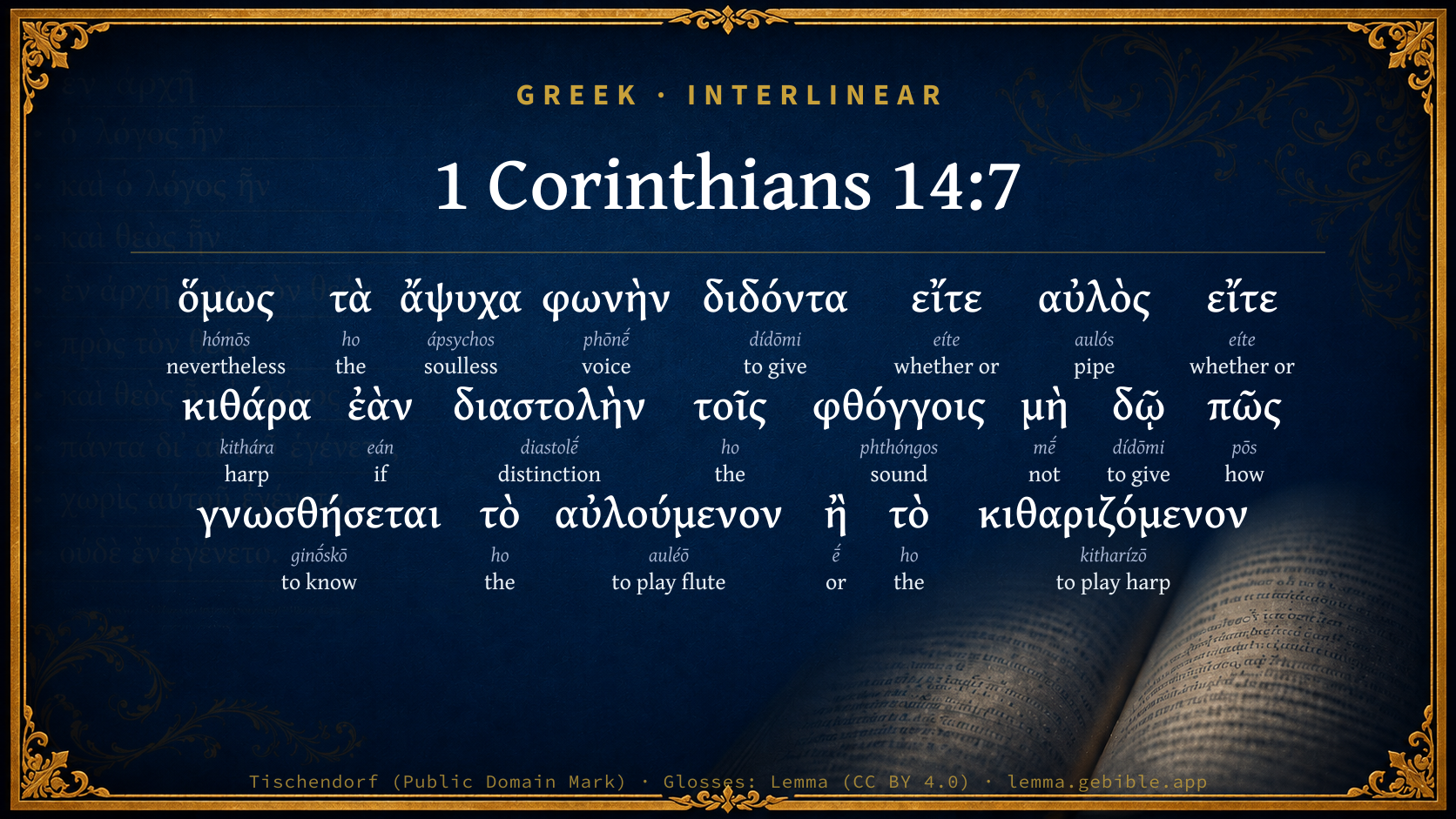
Download image
Cite this verse

1 Corinthians 14:7 (World English Bible). Public Domain. Lemma interlinear Bible study tool, https://lemma.gebible.app/v/1-corinthians/14/7.

Show BibTeX & RIS
BibTeX
RIS
English Translation
Even things without life, giving a voice, whether pipe or harp, if they didn't give a distinction in the sounds, how would it be known what is piped or harped?
World English Bible · Public Domain
Highlights
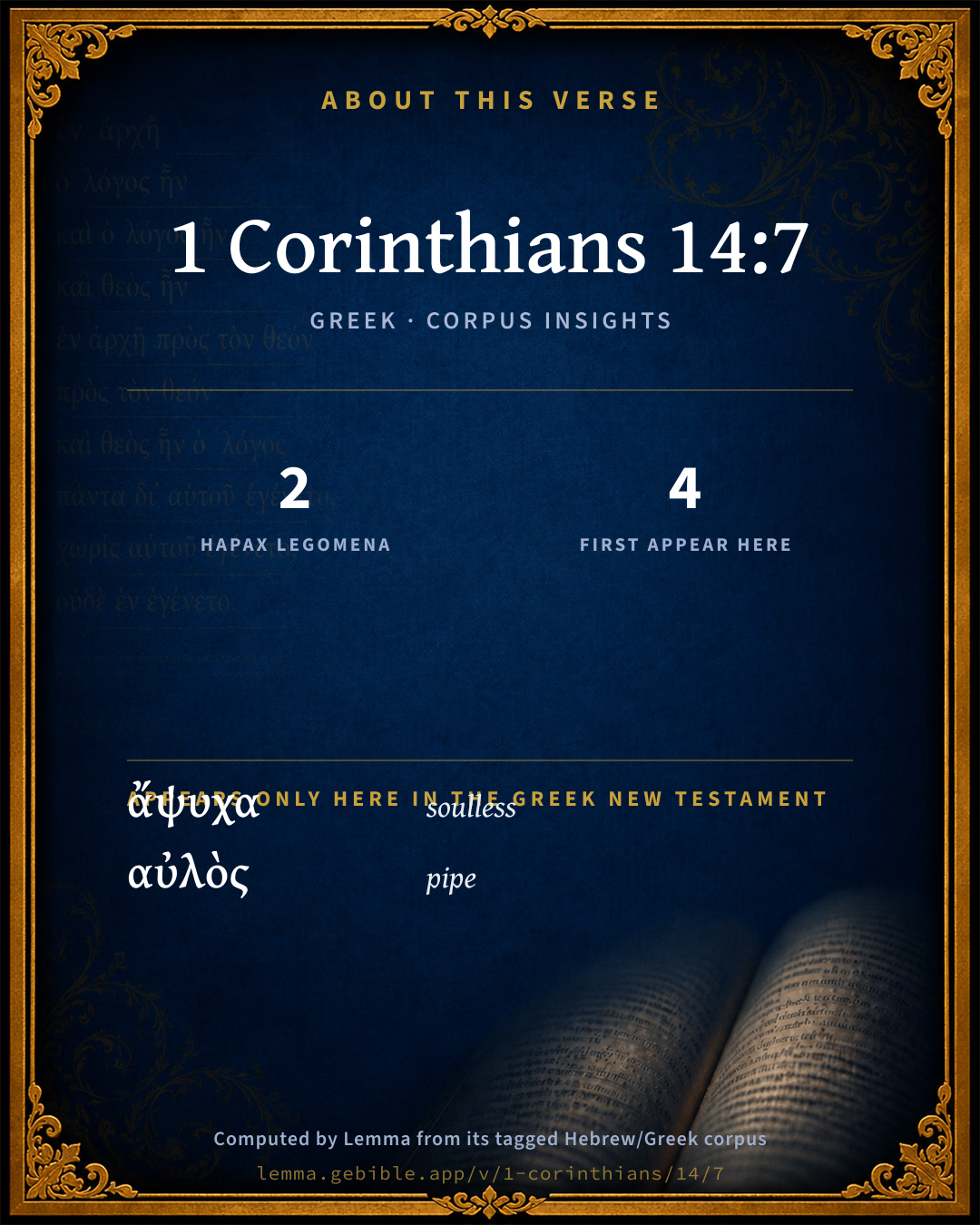
  • 2 hapax legomena — only here in the Greek New Testament
  • 4 first appearances in the Greek New Testament
Full analysis ↓
Download a study sheet

One document with this verse’s original text, its word-by-word gloss line, the meaning frame, cross-references with their text, attributed commentary, and full source and license credits — printable, and it pastes into notes with its structure intact.

This verse Autodidact and up

Study sheet (.html) Plain text (.txt)

A passage Seminary Student

Up to 50 verses in one chapter. A passage sheet keeps up to 6 commentary sources and 12 cross-references per verse, in the order this page ranks them, and says so on the sheet whenever that leaves anything out. Ask for a single verse and you get the Autodidact verse sheet above.

Everything on this page stays free to read, with no account — the sheet is a download of what is already on screen, not access to it.

Want to remove ads? Support Godless Engineer
Compare translations 3

The same verse in 3 English versions, stacked beneath the original-language interlinear above. Click any original word for its lexicon entry.

Each is an independent rendering of the whole verse — the interlinear is not word-aligned to these translations.

Highlighted words mark where these versions differ — a whole-verse word diff, not a word-by-word alignment.

  • World English Bible Public Domain
    Even things without life, giving a voice, whether pipe or harp, if they didn't give a distinction in the sounds, how would it be known what is piped or harped?
  • King James Version Public Domain
    And even things without life giving sound, whether pipe or harp, except they give a distinction in the sounds, how shall it be known what is piped or harped?
  • unfoldingWord Literal Text CC BY-SA 4.0
    Even lifeless things giving sounds—whether flute or harp—if they would not give different sounds, how will the thing being played on the flute or the thing being played on the harp be known?

unfoldingWord Literal Text — © unfoldingWord, licensed CC BY-SA 4.0. Word-aligned USFM3 via Door43 (git.door43.org/unfoldingWord/en_ult).

Versions to compare (up to 4)

3 of 4 selected

Show all 19 translations

Every available English version of this verse, each an independent rendering of the whole verse.

  • World English Bible Public Domain
    Even things without life, giving a voice, whether pipe or harp, if they didn't give a distinction in the sounds, how would it be known what is piped or harped?
  • Berean Standard Bible Public Domain
    Even in the case of lifeless instruments, such as the flute or harp, how will anyone recognize the tune they are playing unless the notes are distinct?
  • Majority Standard Bible Public Domain
    Even in the case of lifeless instruments, such as the flute or harp, how will anyone recognize the tune they are playing unless the notes are distinct?
  • King James Version Public Domain
    And even things without life giving sound, whether pipe or harp, except they give a distinction in the sounds, how shall it be known what is piped or harped?
  • American Standard Version (1901) Public Domain
    Even things without life, giving a voice, whether pipe or harp, if they give not a distinction in the sounds, how shall it be known what is piped or harped?
  • Revised Version (1885) Public Domain
    Even things without life, giving a voice, whether pipe or harp, if they give not a distinction in the sounds, how shall it be known what is piped or harped?
  • Geneva Bible (1599) Public Domain
    Moreouer things without life which giue a sounde, whether it be a pipe or an harpe, except they make a distinction in the soundes, how shall it be knowen what is piped or harped?
  • Douay-Rheims (1899) Public Domain
    Even things without life that give sound, whether pipe or harp, except they give a distinction of sounds, how shall it be known what is piped or harped?
  • Young's Literal Translation Public Domain
    yet the things without life giving sound -- whether pipe or harp -- if a difference in the sounds they may not give, how shall be known that which is piped or that which is harped?
  • Literal Standard Version CC BY-SA 4.0
    Yet the things without life giving sound—whether pipe or harp—if they may not give a difference in the sounds, how will be known that which is piped or that which is harped?
  • Unlocked Literal Bible CC BY-SA 4.0
    If lifeless instruments are producing sounds—like the flute or the harp—and they do not produce different tones, how will anyone know what tune the flute or harp is playing?
  • unfoldingWord Literal Text CC BY-SA 4.0
    Even lifeless things giving sounds—whether flute or harp—if they would not give different sounds, how will the thing being played on the flute or the thing being played on the harp be known?
  • Darby Bible Public Domain
    Even lifeless things giving a sound, whether pipe or harp, if they give not distinction to the sounds, how shall it be known what is piped or harped?
  • World Messianic Bible Public Domain
    Even lifeless things that make a sound, whether pipe or harp, if they didn’t give a distinction in the sounds, how would it be known what is piped or harped?
  • Webster's Bible Public Domain
    And even things without life giving sound, whether pipe or harp, except they give a distinction in the sounds, how shall it be known what is piped or harped?
  • Free Bible Version CC BY-SA 4.0
    Even when it comes to something non-living such as musical instruments like a flute or a harp—if they don't produce clear notes, how will you know what tune is being played?
  • Bible in Basic English Public Domain
    Even things without life, having a voice, such as a music-pipe or other instrument, if they do not give out different sounds, who may be certain what is being played?
  • Text-Critical English NT CC BY 4.0
    It is the same way with lifeless instruments that produce sound, such as the flute or harp. If they do not produce distinct notes, how will anyone recognize what is being played?
  • Tyndale New Testament (1534) Public Domain
    Moreover when thinges with out lyfe geve sounde: whether it be a pype or an harpe: except they make a distinccion in the soundes: how shall it be knowen what is pyped or harped?

Literal Standard Version (2020), Covenant Press — licensed CC BY-SA 4.0. Text via the HelloAO Bible API (eBible.org). Unlocked Literal Bible (unfoldingWord) — licensed CC BY-SA 4.0. Text via the HelloAO Bible API (eBible.org). unfoldingWord Literal Text — © unfoldingWord, licensed CC BY-SA 4.0. Word-aligned USFM3 via Door43 (git.door43.org/unfoldingWord/en_ult). Free Bible Version, Dr. Jonathan Gallagher — licensed CC BY-SA 4.0. Text via the HelloAO Bible API (eBible.org).

Word by word

More ways to search: Search by grammar → Find every occurrence → Compare this word →

Practice this passage: Drill this verse → Learn its vocabulary →

ἄψυχα
ápsychos
G895
“soulless”
Adjective, Nominative, Plural, Neuter
Part of Speech
Adjective
Case
Nominative
Number
Plural
Gender
Neuter
Full Thayer's Definition

Origin: from G1 (as a negative particle) and G5590

TDNT: None

1. without a soul, lifeless
  1. ὅμως hómōs G3676 “nevertheless” Conjunction
  2. τὰ ho G3588 “the” Article, Nominative, Plural, Neuter
  3. φωνὴν phōnḗ G5456 “voice” Noun, Accusative, Singular, Feminine
  4. διδόντα dídōmi G1325 “to give” Verb, Present, Active, Participle, Nominative, Plural, Neuter
  5. εἴτε eíte G1535 “whether or” Conjunction
  6. αὐλὸς aulós G836 “pipe” Noun, Nominative, Singular, Masculine
  7. εἴτε eíte G1535 “whether or” Conjunction
  8. κιθάρα kithára G2788 “harp” Noun, Nominative, Singular, Feminine
  9. ἐὰν eán G1437 “if” Conditional
  10. διαστολὴν diastolḗ G1293 “distinction” Noun, Accusative, Singular, Feminine
  11. τοῖς ho G3588 “the” Article, Dative, Plural, Masculine
  12. φθόγγοις phthóngos G5353 “sound” Noun, Dative, Plural, Masculine
  13. μὴ mḗ G3361 “not” Particle, Negative
  14. δῷ dídōmi G1325 “to give” Verb, Aorist, Active, Subjunctive, 3rd person, Singular
  15. πῶς pōs G4459 “how” Adverb, Interrogative
  16. γνωσθήσεται ginṓskō G1097 “to know” Verb, Future, Passive, Indicative, 3rd person, Singular
  17. τὸ ho G3588 “the” Article, Nominative, Singular, Neuter
  18. αὐλούμενον auléō G832 “to play flute” Verb, Present, Passive, Participle, Nominative, Singular, Neuter
  19. ἢ ḗ G2228 “or” Particle
  20. τὸ ho G3588 “the” Article, Nominative, Singular, Neuter
  21. κιθαριζόμενον kitharízō G2789 “to play harp” Verb, Present, Passive, Participle, Nominative, Singular, Neuter

About this verse

These counts appear in no published source. They are computed here, from the morphology-tagged text and Lemma’s own curated glosses. What Lemma adds →

22
words
17
distinct lemmas
Pauline Epistles
section

Notable vocabulary

2 hapax legomena — words that appear only here in the entire Greek New Testament:

  • ἄψυχα soulless G895
  • αὐλὸς pipe G836

First appearance in Scripture

These words make their first canonical appearance in the Greek New Testament here:

  • ἄψυχα soulless G895
  • αὐλὸς pipe G836
  • κιθάρα harp G2788
  • κιθαριζόμενον to play harp G2789

Shared distinctive vocabulary

φθόγγοις sound G5353 occurs in 2 verses of the Greek New Testament. Also found in:
Repetition

Words recur within this verse:

  • διδόντα to give G1325 ×2
  • εἴτε whether or G1535 ×2
  • τὰ the G3588 ×4

Cross-references

5

Topical passages linked to 1 Corinthians 14:7 in the Treasury of Scripture Knowledge — connected by theme and wording, ordered by reader-vote popularity; previews shown in the World English Bible.

  • 1 Corinthians 13:1 If I speak with the languages of men and of angels, but don't have love, I have become sounding brass, or a clanging cymbal.
  • 1 Corinthians 14:8 For if the trumpet gave an uncertain sound, who would prepare himself for war?
  • Numbers 10:2–10 Make you two trumpets of silver; of beaten work shall you make them: and you shall use them for the calling of the congregation, and for the journeying of the camps.
  • Matthew 11:17 and say, 'We played the flute for you, and you didn't dance. We mourned for you, and you didn't lament.'
  • Luke 7:32 They are like children who sit in the marketplace, and call one to another, saying, 'We piped to you, and you didn't dance. We mourned, and you didn't weep.'

Cross-references courtesy of OpenBible.info (CC BY 4.0).

Where the printed editions differ

1 variant

Places in this verse where the major printed Greek editions disagree on the wording in a way that affects the translation — a comparison of editions, not a manuscript-by-manuscript collation. The editions are the modern critical texts (Nestlé-Aland 28/27, SBL, Westcott-Hort, Tregelles, Tyndale House) and the traditional texts behind the KJV (the Textus Receptus and the Byzantine/Majority text). It is not a claim about which reading is original.

  1. Different wording
    δῷ,

    “they shall give,”

    In NA28NA27TynSBLWHTregTR Not in Byz

    διδῶ (didō) 'I shall give' occurs in a few manuscripts (Byz) instead of δῷ, (dō) 'they shall give,' in older manuscripts (NA28+NA27+Tyn+SBL+WH+Treg+TR)

Textual data: Translators Amalgamated Greek New Testament (STEPBible TAGNT) · CC BY 4.0.

Commentary

Notes on 1 Corinthians 14:7 from classic Christian and Jewish commentators (each source and its license shown beneath its notes). The classic Christian expositions comment on the surrounding passage and are grouped to its opening verse, so a note may address several verses; the Jewish commentaries on the Tanakh (Rashi and others) are per-verse, so they appear only where the commentator wrote on this verse.

Lemma curates 59 commentaries, every one of them public domain or Creative Commons licensed, each selected and text-cleaned for this edition rather than reprinted as found. About our sources →

Joseph Benson's Commentary

1Co 14:7-9. And even — Greek, ομως, in like manner, (the word, it seems, being here used for ομοιως, as it sometimes is by the poets, see Beza and Macknight,) things without life — Inanimate things; whether pipe or harp — Or any other instrument of music; except they give a distinction — Greek, διαστολην φθογγοις, a difference to the notes. “Among musicians, the former word signifies the measured distance between sounds, according to certain proportions, from which the melody of a tune results.” And Raphelius has shown that the latter word, as distinguished from φωνη, voice, signifies a musical sound, a note in music. How shall it be known what is piped or harped — What music can be made, or what end answered? For — Or, moreover; in war, if — Instead of sounding those notes whose meaning is understood by the soldiers, the trumpet give an uncertain sound, who shall prepare himself to the battle — How could soldiers know when to advance or when to retreat, unless the trumpet sounds were adjusted, and constantly adhered to? So likewise — In your religious assemblies; except ye utter words easy to be understood — Significant words, to which the ears of your auditory are accustomed; how shall it be known what is spoken — What is intended to be signified by your expressions? For ye shall speak into the air — (A proverbial expression,) you will utterly lose your labour.

Joseph Benson's Commentary on the Old and New Testaments (1811–1818) — public domain. Text from a community e-Sword module.

Tyndale Open Study Notes

Tyndale Open Resources

14:7-12 A message needs to be clearly intelligible if it is to communicate effectively.

Tyndale Open Study Notes — © Tyndale Open Resources, licensed CC BY-SA 4.0. Text via the HelloAO Bible API.

Bengel's Gnomon

Johann Albrecht Bengel

1Co 14:7. Αὐλὸς—κιθάρα, a pipe—a harp) Two of the chief musical instruments; not only the pipe, which is, as it were, animated by the breath of the piper, but also the harp.—τοῖς φθόγγοις, in the sounds) The ablative case comp. by, 1Co 14:9.—πῶς γνωσθήσειται, how shall it be known) how shall pipe be distinguished from pipe, and harp from harp? There is one and then another sound of one and the same instrument, when it is directed to different things.

Bengel's Gnomon of the New Testament — English translation (T&T Clark, Edinburgh, 1860) — public domain. Text from a community e-Sword module.

Meyer's Critical & Exegetical Commentary

Heinrich August Wilhelm Meyer

1Co_14:7. The uselessness of a discourse remaining in this way unintelligible is now shown by the analogy of musical instrument.

ὅμως] is paroxytone, and means nothing else than tamen (Vulgate), but is put first here and in Gal_3:15, although logically it ought to come in only before ἐὰν διαστολήν κ.τ.λ.; hence it is to be explained as if the order was: τὰ ἄψυχα, καίπερ φων. διδόντα, εἴτε αὐλός, εἴτε κιθάρα, ὅμως, ἐὰν διαστολὴν τ. φθ. μὴ δῷ, πῶς γνωσθήσεται κ.τ.λ. It is rightly taken by Chr. F. Fritzsche, Nov. opusc. p. 329. Comp. C. F. A. Fritzsche, Conject. I. p 52: instrumenta vitae expertia, etiamsi sonum edunt, tamen, nisi distincte sonent, qui dignoscas, etc. So Winer, also, at last (ed. 6; ed. 7, p. 515 [E. T. 693]), and, in like manner, Buttmann, neut. Gr. p. 264 [E. T. 308]. To analyse it into τὰ ἄψυχα, καίπερ ἄψυχα, ὅμως φωνὴν διδόντα κ.τ.λ. (Winer formerly, comp. Rückert), brings out an antithetic relation which could not be calculated on from the context. For what is to be expressed is not that the instruments, although lifeless, nevertheless sound; but this, that the lifeless instruments, although they sound, nevertheless give out no intelligible melody, unless, etc. As regards the hyperbaton, common with classical writers also, by which ὅμως, instead of following the participle, goes before it,[3] see Matthiae, § 566, 3; Krüger, § lvi. 13. 3; Stallbaum, ad Plat. Rep. p. 495 D; Ast, Lex. Plat. II. p. 447; Jacobs, ad Del. epigr. p. 232. That ὅμως stands for ὁμοίως, and should be accented (comp. Lobeck, ad Soph. Aj. p. 480, ed. 2) ὁμῶς (Faber, Alberti, Wetstein, Hoogeveen, and others), is as erroneous (ὅμως means: equally, together) as Kypkes assertion that the paroxytone ὅμως means similiter.

διδόντα] giving forth, as Pind. Nem. v. 93; Jdt_14:9. Φωνή is used of the voice of musical instruments in Sir_50:16; 1Es_5:64; 1Ma_5:31, al. Comp. Plat. Tim. p. 47 C; μουσικὴ φωνή, Pol. iii. p. 397 A; Plut. Mor. p. 713 C; Eur. Tro. 127.

ἐὰν διαστολὴν κ.τ.λ.] If they (the ἄψυχα φωνὴν διδόντα) shall not have given a distinction to the sounds, if they shall have sounded without bringing out the sounds in definite, distinctive modulation. Harmoniam autem ex intervallis sonorum nosse possumus, Cic. Tusc. i. 18. 41. Comp. Plat. Phileb. p. 7 C D, and Stallbaum in loc.

πῶς γνωσθήσ. τὸ αὐλ. κ.τ.λ.] how shall that be recognised which is played upon the flute or upon the cithern? i.e. how can it then possibly happen that one should recognise a definite piece of music (a melody) from the sounds of the flute or the cithern? One is none the wiser from them as to what is being played. The repetition of the article is quite correct: what is being played on the flute, or again, in the other supposed case, what is played upon the cithern. Rückert takes it as meaning, How is it possible to distinguish between flute and cithern? Inappropriate, in view of the essentially different character of the two instruments, and seeing that the question in the context (comp. 1Co_14:9) is not as to distinguishing between the instruments, but as to understanding the melody.

It may be observed, further, that the analogy in 1Co_14:7 would be unsuitable, if Paul had been thinking of foreign languages, since these would not have lacked the διαστολή of the sounds. This holds also in opposition to the view of the matter which makes it an utterance of glosses, as likewise in opposition to Wieselers conception of a soft γένος γλωσσῶν, seeing that in 1Co_14:7 it is not the strength of the sound, but its distinctness (comp. Wieseler himself in 1860, p. 114), in virtue of which it expresses a melody, which is the point of comparison.

[3] Not always immediately before, as Hofmann opines that Paul must have written: τὰ ἄψυχα ὅμως φων. διδόντα. See Jacobs, l.c.; also Reisig, Enarr. Oed. Col. p. xlvi. Comp., too, 4Ma_13:26.

Meyer — Critical and Exegetical Commentary on the New Testament — English translation by Peter Christie, edited by Frederick Crombie (T&T Clark, 1880) — public domain. Text from a community e-Sword module.

Expositor's Greek Testament

ed. W. Robertson Nicoll

1Co 14:7-13 . § 45. UTTERANCE USELESS WITHOUT CLEAR SENSE. P. has just asked what the Cor [2034] would think of him, if in their present need he came exhibiting his power as a speaker with Tongues, but without a word of prophetic inspiration or wise teaching to offer. Such speech would be a mockery to the hearers. This holds good of sound universally, when considered as a means of communication in the case, e.g ., of lifeless instruments, the flute and lyre with their modulated notes, or the military trumpet with its varied signals (1Co 14:7 f.); so with articulate speech, in its numberless dialects. To the instructed ear every syllable carries a meaning; to the foreigner it is gibberish (1Co 14:10 f.). Just as useless are the Tongues in the Church without interpretation (1Co 14:9 ; 1Co 14:12 f.).

[2034] Corinth, Corinthian or Corinthians.

1Co 14:7 . Ὅμως τὰ ἄψυχα , “Quin et inanima” (Cv [2035] ); as in Gal 3:15 , the part [2036] emphasises the word immediately following, not ψωνὴν διδόντα (“though giving sound”) in contrast to ἐὰν διαστολὴν … μὴ δῷ (so however Wr [2037] , Gm [2038] , Mr [2039] , Sm [2040] : “yet unless they give a distinction, etc.”). The argument is a minori ad majus , from dead instruments to living speech: “Yet even in the case of lifeless things ( τὰ ἄψυχα , generic art [2041] ) when they give sound, unless they give a distinction in their notes” (so Hf [2042] , Ed [2043] , Gd [2044] , El [2045] ). φθόγγος denotes a measured, harmon ous sound, whether of voice (Rom 10:18 ) or instrument; see Plato, Tim . 80 διαστολὴ is referred by Lidd [2046] , and by Ev [2047] ad loc [2048] , to the pause between notes; by most others (after Plato, Phileb ., 17C; cf. Oec [2049] ad loc [2050] ) to the interval (= διάστημα ) or distinction of pitch; possibly (so Cv [2051] , El [2052] ) it includes both in untechnical fashion whatever in fact distinguishes the φθόγγοι . πῶς γνωσθήσεται κ . τ . λ .; “How will that which is being piped or harped be discerned?” how will the air be made out, if the notes run confusedly into one another? The double art [2053] , τὸ αὐλ .… τὸ κιθαρ ., separates the two sorts of music. This comparison used applies to inarticulate γλωσσολαλία , not to foreign languages.

[2035] Calvin’s In Nov. Testamentum Commentarii .

[2036]art. grammatical particle.

[2037] Winer-Moulton’s Grammar of N.T. Greek (8th ed., 1877).

[2038] Grimm-Thayer’s Greek-English Lexicon of the N.T.

[2039] Meyer’s Critical and Exegetical Commentary (Eng. Trans.).

[2040] P. Schmiedel, in Handcommentar zum N.T. (1893).

[2041] grammatical article.

[2042] J. C. K. von Hofmann’s Die heilige Schrift N.T. untersucht , ii. 2 (2te Auflage, 1874).

[2043] T. C. Edwards’ Commentary on the First Ep. to the Corinthians . 2

[2044] F. Godet’s Commentaire sur la prem. Ép. aux Corinthiens (Eng. Trans.).

[2045] C. J. Ellicott’s St. Paul’s First Epistle to the Corinthians .

[2046]idd. Liddell and Scott’s Greek-English Lexicon.

[2047] T. S. Evans in Speaker’s Commentary .

[2048] ad locum , on this passage.

[2049] Oecumenius, the Greek Commentator.

[2050] ad locum , on this passage.

[2051] Calvin’s In Nov. Testamentum Commentarii .

[2052] C. J. Ellicott’s St. Paul’s First Epistle to the Corinthians .

[2053] grammatical article.

The Expositor's Greek Testament, edited by W. Robertson Nicoll (1897–1910) — public domain. Text from a community e-Sword module.

Hodge's Commentary on Romans, Ephesians & First Corinthians

Charles Hodge

1Co_14:7

And even things without life giving sound, whether pipe or harp, except they give a distinction in the sounds, how shall it be known what is piped or harped?

This verse in Greek begins with the word ὅμως, yet, which is variously explained. The most natural interpretation is to assume that the word here, as in Gal_3:15, is out of its logical place, and that the sentence should read thus: Things without life giving sound, yet, unless they give a distinction of sound, how shall it be known, etc. The obvious design of the illustration is to show the uselessness of making sounds which are not understood. But what is the point of the analogy? According to some it is this, as musical instruments emit a mere jargon of sounds, unless the regular intervals be observed, so the speakers with tongues utter a mere jargon. The sounds which they utter are not articulate words, but a confused noise.‹25› From this it is inferred that the speaking with tongues was not the gift of speaking foreign languages. This would make Paul wish (1Co_14:5) that all the Corinthians would utter unmeaning sounds, and give thanks that he produced more such jargon than any of them! It is plain from what follows, as well as from the drift of the whole discourse, that the simple point of the analogy is, that as we cannot know what is piped or harped, or be benefited by it, unless we can discriminate the sounds emitted; so we cannot be benefited by listening to one who speaks a language which we do not understand. It is not the nature of the gift, but the folly of the use made of it, which is the point which the apostle has in view.

Charles Hodge — Commentary on Romans (1835), First Corinthians (1857), and Ephesians (1856) — public domain. Text from a community e-Sword module.

Geneva Bible (1599)

Geneva Bible translators

He setteth forth that which he said, by a similitude, which he borroweth and taketh from instruments of music, which although they speak not perfectly, yet they are distinguished by their sounds, that they may be the better used.

Geneva Bible (1599) marginal notes — public domain. Text via Bolls.life.

Jamieson, Fausset & Brown

Robert Jamieson, A. R. Fausset & David Brown

Translate, "And things without life-giving sound, whether pipe or harp, YET (notwithstanding their giving sound) if they give not a distinction in the tones (that is, notes) how?" &c.

what is piped or harped--that is, what tune is played on the pipe or harp.

Jamieson, Fausset & Brown — Commentary Critical and Explanatory on the Whole Bible (1871) — public domain (CC PDM 1.0). Text via the HelloAO Bible API.

Adam Clarke's Commentary

Verse 7. And even things without life] I may, as if he had said, illustrate this farther by referring to a pipe or harp; if these were to utter mere sounds without order, harmony, or melody, though every tone of music might be in the sounds, surely no person could discern a tune in such sounds, nor receive pleasure from such discords: even so is the person who speaks in an unknown tongue, but does not interpret. His speech tends no more to edification than those discordant and unmeaning sounds do to pleasure and delight.

Adam Clarke's Commentary on the Bible (1810–1826) — public domain. Text from a community e-Sword/MySword module.

John Calvin's Commentaries

7. Nay even things without life. He brings forward similitudes, first from musical instruments, and then afterwards from the nature of things generally, there being no voice that has not some peculiarity, suitable for distinction. “Even things without life,” says he, “instruct us.” There are, it is true, many random sounds or crashes, without any modulation, but Paul speaks here of voices in which there is something of art, as though he had said — “A man cannot give life to a harp or flute, but he makes it give forth a sound that is regulated in such a manner, that it can be distinguished. How absurd then it is, that even men, endowed with intelligence, should utter a confused, indistinguishable sound!”

We must not, however, enter here upon any minute discussion as to musical harmonies, inasmuch as Paul has merely taken what is commonly understood; as, for example, the sound of the trumpet, of which he speaks shortly afterwards; for it is so much calculated to raise the spirits, that it rouses up — not only men, but even horses. Hence it is related in historical records, that the Lacedemonians, when joining battle, preferred the use of the flute, lest the army should, at the first charge, rush forward upon the enemy with too keen an onset. In fine, we all know by experience what power music has in exciting men’s feelings, so that Plato affirms, and not without good reason, that music has very much effect in influencing, in one way or another, the manners of a state. To speak into the air is to beat the air (1 Corinthians 9:26) to no purpose. “Thy voice will not reach either God or man, but will vanish into air.”

John Calvin's Commentaries (1540-1563) — public domain. Text from the Calvin Translation Society English edition (1840s-50s) via the Christian Classics Ethereal Library (ccel.org). Calvin's coverage is partial (roughly two-thirds of the Bible); uncommented books and verses are honest gaps, never fabricated. The 19th-century editor's footnotes and remarks are omitted so the notes are faithfully Calvin's own voice.

Ellicott's Commentary for English Readers

(7) And even things without life.—The pipe and harp were the best-known instruments, and the principle just laid down of the inutility of sounds unless they be distinctive is illustrated by reference to them. Whether it was a harp or a pipe which was being played you could not know unless each gives a distinct sound of its own. The point here is not, as the English seems to suggest, that there must be a difference in tune, so as know what is being piped or harped—that illustration comes in in the next verse—but that each instrument has its own peculiar sound.

A Bible Commentary for English Readers, edited by Charles John Ellicott (1878–1897) — public domain. Text from a community e-Sword module.

The Cambridge Bible for Schools and Colleges

gen. ed. J. J. S. Perowne

7. except they give a distinction in the sounds] The effect of a melody depends entirely upon the distinction of its musical intervals. The effect of speech in like manner is dependent upon its being the communication of definite ideas.

The Cambridge Bible for Schools and Colleges (gen. ed. J. J. S. Perowne; Cambridge University Press, 1878–1918) — public domain. Text from a community e-Sword module.

John Gill's Exposition

And even things without life giving sound,.... He instances in things inanimate, that have neither reason, sense, nor life, in musical instruments, and these of various sorts:

whether pipe or harp; wind music, or hand music; either that which is blown with the breath, or pressed or stricken with the hand:

except they give a distinction in the sounds; or "tunes", so as one may be discerned from another; as that this is such a musical note, and that is another:

how shall it be known what is piped or harped? what tune is played; such an use of instruments would be a mere jargon, and not music, and so yield no pleasure to the ear, or mind; and just the like must speaking in an unknown tongue be, to one that understands it not.

John Gill's Exposition of the Whole Bible (1746–1763) — public domain (CC PDM 1.0). Text via the HelloAO Bible API.

Trapp's Complete Commentary

John Trapp

7 And even things without life giving sound, whether pipe or harp, except they give a distinction in the sounds, how shall it be known what is piped or harped?

Ver. 7. Except they give a distinction] Unisono nihil auribus molestius. Discords in music make the best harmony. Through all Turkey there runs one tune, nor can every man play that; yet scarcely any but hath a fiddle with two strings.

John Trapp, A Commentary or Exposition upon All the Books of the Old and New Testament (1647–1656) — public domain. Text from a community e-Sword module.

Albert Barnes' Notes on the Bible

Things without life - Instruments of music.

Whether pipe - This instrument (αὐλὸς aulos) was usually made of reeds, and probably had a resemblance to a flageolet.

Or harp - This instrument (κιθάρα kithara) was a stringed instrument, and was made in the same way as a modern harp. It usually had ten strings, and was struck with the plectrum, or with a key. It was commonly employed in praise.

Except they give a distinction in the sounds - Unless they give a difference in the “tones,” such as are indicated in the gamut for music.

How shall it be known ... - That is, there would be no time, no music. Nothing would be indicated by it. It would not be suited to excite the emotions of sorrow or of joy. All music is designed to excite emotions; but if there be no difference in the tones, no emotion would be produced. So it would be in words uttered. Unless there was something that was suited to excite thought or emotion; unless what was spoken was made “intelligible,” no matter how important in itself it might be, yet it would be useless.

Albert Barnes' Notes on the Bible (1834–1885) — public domain. Text from a community e-Sword/MySword module.

Matthew Poole's English Annotations

In the sounds which are artificially made by the use of wind music, or other music, nothing could be understood, if art had not also devised a distinction in the sounds; that one sound should signify one thing, another sound should signify another thing: so unless the voice of the teacher be significant to, and understood by, the person instructed or taught, the sound is of no use at all.

Matthew Poole's English Annotations on the Holy Bible (1683–1685) — public domain. Text from a community e-Sword/MySword module.

Whedon's Commentary on the Bible

Daniel D. Whedon

7-9. Paul illustrates the inutility of uninterpreted tongues by the worthlessness of a signal instrument—as a trumpet signaling the commencement of battle—which has no significant notes.

7. Distinction—Into high or low, sharp or obtuse, etc.

Daniel D. Whedon (gen. ed.), Commentary on the Old and New Testaments (1874–1909) — public domain. Text from a community e-Sword module.

The Pulpit Commentary

Even things without life giving sound. Even musical instruments flute or harp dead instruments as they are, must be so played as to keep up the distinction of intervals, without which the melody is ruined and the tune is unrecognizable. Much more is this the ease with the human voice.

How sour sweet music is, When time is broke and no proportion kept!

The indiscriminate use of the tongue is here compared to the dissonance of jarring and unmodulated instrumental sounds, In harmony there must be due sequence and intervals of sound.

Vers. 7-11.

Christian intelligence the medium of Christian growth.

The point presented in these verses appears to be that the Church is not really edified, save as the teachings presented to it appeal to the understanding. "Everything for use, and everything in its place, is a rule, the apostle is saying, that holds in spiritual gifts and exercises, as in everything else. If you speak with tongues, let it not be as only making strange noises, but let some one interpret, that the tongues may edify, and not be sounds without a meaning. It will not do for Christians to be more unmeaning and idle in spiritual gifts than even things without life themselves, the pipes, and harps, and trumpets, and drums of music; for these, when they give a sound, give it with distinctions that have a meaning and a power, else they are nought to us. Are voices and tongues to be less intelligent and significant than tubes of unconscious horn or metal?" (H. Bushnell, D.D.). Inquire:

1. How far it is true that all influences bearing upon the edification of the Church must appeal to the understanding. So far as edification includes right views of truth and right feelings about truth, the fitting acceptance of a Divine revelation, and the worthy expression of the principles declared in that revelation, the appeal must be to the mind.

2. Under what limitations must this statement be set. John Howe ("Works," vol. 2 p. 75) says, "Nor do I believe it can ever be proved that God never doth immediately testify his own special love to holy souls, without the intervention of some part of his eternal Word, made use of as a present instrument to that purpose, or that he always doth it in a way of methodical reasoning therefrom." God usually works through the understanding, but

3. he may use influences which bear at once upon heart and emotion. It must be observed, however, that such influences are but of temporary benefit, if they are not duly supported by intellectual considerations and mentally established principles.

4. Argue from these points the value and importance of an adequately educated and fully cultured ministry; showing, and efficiently illustrating, the relations of such an instructive ministry to

1. family piety,

2. liberal apprehensions of revealed truth,

3. social intercourse of Christian people, and

4. sober Christian activities. R.T.

The Pulpit Commentary (1880–1919), ed. H.D.M. Spence-Jones & Joseph S. Exell — public domain. Text from a community e-Sword module.

John Wesley's Explanatory Notes

How shall it be known what is piped or harped - What music can be made, or what end answered?

John Wesley, Explanatory Notes Upon the Whole Bible (1754–1765) — public domain. Text via the GEBible commentary corpus.

Kretzmann's Popular Commentary

Paul E. Kretzmann

Public utterance is valueless without clear understanding:

v. 7. And even things without life, giving sound, whether pipe or harp, except they give a distinction in the sounds, how shall it be known what is piped or harped?

v. 8. For if the trumpet give an uncertain sound, who shall prepare himself to the battle?

v. 9. So likewise ye, except ye utter by the tongue words easy to be understood, how shall it be known what is spoken? For ye shall speak into the air.

v. 10. There are, it may be, so many kinds of voices in the world, and none of them is without signification.

v. 11. Therefore, if I know not the meaning of the voice, I shall be unto him that speaketh a barbarian, and he that speaketh shall be a barbarian unto me.

v. 12. Even so ye, forasmuch as ye are zealous of spiritual gifts, seek that ye may excel to the edifying of the church.

v. 13. Wherefore, let him that speaketh in an unknown tongue pray that he may interpret.

The apostle here draws an inference from the lesser to the greater: Likewise lifeless things, though they give forth sound, such as the flute or the harp, yet unless there is a distinction in their tones or sounds, how will that which is being piped or harped be distinguished? The apostle is here referring either to the quality of the sounds or to the intervals or to the distinction of pitch, whatever distinguishes the music of various instruments. If players permit the notes to run together in absolute confusion, with an utter disregard of the laws of harmony and of the limitations of the several instruments, how can the listener make out the air? Instead of a melody, he will hear nothing but confused noises. And likewise, if the trumpet that gives the signals in war or in battle gives forth an uncertain voice, the soldiers will not be able to distinguish whether they are to advance or to retreat or to execute some other movement: a disastrous situation.

The application of the two figures of comparison is easy: Likewise also unless you with the tongue, in making use of the gift of tongues, give forth a distinct speech, words whose meaning is clear to the hearers, how will that which is spoken be distinguished, understood, by the hearers? For you will be such as speak into the air. All the fine speaking in the church assemblies, whether it is done in strange languages or in that which the people themselves have asked for, is without value and worse than useless, if its content is not clear to the congregation, if the hearers do not get the speaker’s finely articulated words and well-modulated sentences. Note: There is far too much preaching in our days which embodies all the excellencies of the text-books as to outline, diction, paragraphing, etc. , but lacks that one most important point: edifying clearness. The motto of our days seems to be: Wash me, but do not make me wet; that is, either: Smooth down the rugged text to ears polite, and snugly keep damnation out of sight, or: Keep out the love of God with all your might, and snugly shut salvation out of sight.

For the sake of making the situation plain, Paul adds the example of the multitude of human languages and dialects: Ever so many kinds of voices are, as it happens, in the world, and none of them voiceless. In all the great number of languages throughout the world, wherever people use their voice as a medium of communication, there is not one that has not the fundamental requirement of a language: It has a meaning for somebody; it may be understood by such as are familiar with it. It follows, then, that if I do not know the meaning of the voice, if I do not comprehend its significance, I shall be to him that speaks a barbarian, and he that speaks a barbarian in relation to me. The word barbarian was applied by the Greeks and Romans to all people that did not speak their tongue. A strange language will be to me a confused jargon of sounds, and I cannot comprehend its meaning; there can be no understanding. Thus all uninterpreted tongues in the public service of the congregation are useless, and the very fact that the foreign tongue may convey a precious meaning may be all the more provoking.

The apostle now makes the application to the situation in Corinth: Likewise yourselves, so also in your case; since you are eager for spiritual gifts, for the edification of the congregation make all efforts that you may excel in them. That is the proper zeal in seeking spiritual gifts, not to covet them for one’s own gratification and self-glorification, but to have in mind always the real object of all spiritual gifts, the edification of the congregation, the service of the Church. Therefore let him that speaks with a tongue pray that he may interpret. Outward impression and prestige count for nothing in the Church, and may even work great harm. If the speaker with tongues could therefore afterwards recall some of the things which he uttered while his mouth was the instrument of the Holy Spirit and could translate the sayings into ordinary rational speech, that would be worthwhile, that would make his gift of value to the congregation. And therefore he should earnestly covet, by means of prayer, this interpretation of his own utterances.

Paul E. Kretzmann, Popular Commentary of the Bible (1921–1924) — public domain. Text from a community e-Sword module.

Burkitt's Expository Notes on the New Testament

William Burkitt

Our apostle here proceeds to illustrate his former arguments by a similitude taken from musical instruments, the one used in peace, to wit, the harp; the other in war, to wit, the trumpet; as they are useless, if by distinction their signification is not perceived; for if a man hears not, or understands not, the sound of the harp or trumpet, he cannot prepare himself either for the dance, or the battle: so if persons in the church do not speak intelligibly, they will nothing edify: it is like beating the air, all is vain and to no purpose.

William Burkitt's Expository Notes on the New Testament (1700–1703) — public domain. Text from a community e-Sword module.

McGarvey & Pendleton's Commentaries

J. W. McGarvey

Even things without life, giving a voice, whether pipe or harp, if they give not a distinction in the sounds, how shall it be known what is piped or harped?

J. W. McGarvey (with Philip Y. Pendleton), Commentaries on the New Testament (The Fourfold Gospel, 1914; Acts; and the epistles) — public domain. Text from a community e-Sword/MySword module.

The People's New Testament

B. W. Johnson

7. Even things without life. Musical instruments that give forth a sound, such as a pipe or a harp, the chief musical instruments of the Greeks, must give a distinction of sounds, if one would know what is played.

B. W. Johnson's The People's New Testament with Notes (1889–1891) — public domain. Electronic text from the Christian Classics Ethereal Library (CCEL) ThML edition.

unfoldingWord translationNotes

Door43 World Missions Community

they do not produce different tones

This refers to sounds of different pitch that make up the melody, not to the difference between a flute sound and a harp sound.

how will anyone know what tune the flute or harp is playing?

Paul wants the Corinthians to answer this themselves. AT: "no one will know what tune the flute or harp is playing." (See: Rhetorical Question)

tune

melody or song

how will anyone know when it is time to prepare for battle?

Paul wants the Corinthians to answer this themselves. AT: "no one would know when it is time to prepare for battle." (See: Rhetorical Question)

translationWords

flute

harp

know

trumpet

unfoldingWord translationNotes — © Distant Shores Media and the Door43 World Missions Community, licensed CC BY-SA 4.0. Source: git.door43.org/Door43/en_tn.

Cambridge Greek Testament for Schools and Colleges

7. ὅμως. Not, as A.V. ὁμῶς, equally, but notwithstanding. Its place is properly after κιθάρα. ‘In the case of things without life, whether pipe or harp, which give out a sound, yet nevertheless, if there be no distinction in the sounds, &c.’ So Meyer and Winer, Gr. Gram. §§ 45, 61.

αὐλός. Lat. tibia. In English, flute. ‘A hollow cane perforated with holes.’ See Smith’s Dictionary of Greek and Roman Antiquities, s. v. tibia.

κιθάρα. Lat. cithara; German, zither; English, guitar. The peculiarity of the instrument is that the strings are drawn across a sounding-board, but unlike the violin it is played by the hand or with a plectrum.

διαστολὴν τοῖς φθόγγοις. The effect of a melody depends entirely upon the distinction of its musical intervals. The effect of speech in like manner is dependent upon its being the communication of definite ideas. φθόγγοι are clear, resonant sounds. Translate notes.

Cambridge Greek Testament for Schools and Colleges (Cambridge University Press, 1896; 21 vols, various authors incl. Carr, Maclear, Plummer, Farrar, Lumby, Moule, M. R. James, Simcox) — public domain. Text from a community e-Sword module.

Alford’s Greek Testament

Henry Alford

7-11.] Instances to shew that unintelligible discourse profits nothing. And first,—

7-9.] from musical instruments.

7.] ὅμως occurs here and in the two other places where it is used in the N. T. (reff.) at the beginning of the sentence, out of its logical order, which would be before ἐὰν διαστολὴν …, thus: Things without life which yield sound, whether flute or harp, yet, if they do not, &c.

The renderings, ‘even things without life’ (E. V.), or ‘things which, though without life, yet give sound’ (Winer, edn. 6, § 61. 5. f.), are inadmissible,—the former because of the usage of ὅμως the latter because no such idea as any surprise at a thing without life yielding sound is here in place.

φων. διδ.] so δίδου φωνάν Pind. Nem. 5:93.

ἐὰν διαστ.] If they (the ἄψυχα φ. δ.) shall not have yielded a distinction (of musical intervals) in their tones, how shall be known that which is being played on the flute or that which is being played on the harp (i.e. what tune is played in either case: the art. being repeated to shew that two distinct instances are contemplated, not necessarily ‘one tune, either piped, or harped’ = τὸ αὐλούμενον ἢ κιθαριζόμενον;)? The observation of Meyer, that this example is decisive against foreign languages being spoken in the exercise of this gift, is shewn to be irrelevant by the next example, from which the contrary might be argued—the ἄδηλος φωνή of the trumpet being exactly analogous to an unknown language, not to an inarticulate sound. But the fact is that all such inferences, from pressing analogies close, are insecure.

Henry Alford, The Greek Testament (1849–1861) — public domain. Text from a community e-Sword module.

International Critical Commentary

7. Second argument, from the sounds of inanimate instruments. What use would they be, if the notes were indistinguishable? The αὐλός (here only in N.T.) and κιθάρα (Rev 14:2) are given as representatives of all wind and stringed instruments. They were the commonest in use at banquets, funerals, and religious ceremonies. The music must be different, if it is to guide people to be joyous, or sorrowful, or devout. Soulless instruments can be made to speak a language, but not if all the notes are alike.

‘Yet things without life giving a voice, whether pipe or harp, if they should give no distinction to the sounds, how shall be known what is piped and what is harped?’ AV. has ‘sound’ for both φωνή and φθόγγος, and both AV. and RV. ignore the repetition of the τό. Except for Rom 10:18, φθόγγοις might be translated ‘notes.’ Perhaps, as in Gal 3:15, the ὅμως is attracted out of its place, and the sentence is meant to run—‘Inanimate things, although giving a voice, yet, unless,’ etc. Ἄψυχος occurs Wisd. 13:17, 14:29, but nowhere else in N.T.

In Judith 14:9 we have ἔδωκεν φωνήν, and in Wisd. 19:18, ὤσπερ ἐν ψαλτηρίῳ φθόγγοι τοῦ ῥυθμοῦ τὸ ὄνομα διαλλάσσουσιν. For τοῖς φθόγγοις א A D E K L P, Vulg.), B, d e Arm., Ambrst. have φθόγγου, and for δῷ (א A B D*), E F L P have διδῷ. See Mat 24:31; Rev 14:2, Rev 18:22 for φωνή, of musical sound; and Rom 3:22, Rom 10:12 for διαστολή as meaning ‘distinction’ and not ‘interval’ (διάστημα). But in music the difference of meaning is not great.

International Critical Commentary — older volumes (1896–1929), various authors — public domain. Text from a community e-Sword module.

Vincent's Word Studies in the New Testament

Marvin R. Vincent

Voice [φωνην] . See on sound, Rom 10:18. The sound generally. Used sometimes of sounds emitted by things without life, as a trumpet or the wind. See Mt 24:31; Joh 3:8.

Harp [κιθαρα] . See on Rev 5:8.

Distinction [διαστολην] . Proper modulation. Compare the use of the word in Rom 3:22; Rom 10:12.

Sounds [φθογγοις] . The distinctive sounds as modulated. See on Rom 10:18.

Marvin R. Vincent, Word Studies in the New Testament (1887–1900) — public domain. Text from a community e-Sword/MySword module.

Godet's Commentaries

Frédéric Louis Godet

Vv. 7, 8. “Even things without life giving sound, whether pipe or harp, except they give a distinction in the sounds..., how shall it be known what is piped or harped? 8. For, also, if the trumpet give an uncertain sound, who shall prepare himself to the battle?”

If the sound of instruments is to furnish to the ear an intelligible and significant melody, it must be subject to the laws of tone and rhythm, to the intervals of scale and measure. — The adverb ὅμως, which stands first, should not be confounded with ὁμῶς or ὁμοίως, likewise; it signifies: however; so Gal 3:15, where it applies to the word ἀνθρώπου, of a man: “The covenant of a being who after all (however) is only a man.” So here this adverb, as Hofmann well observes, bears on the word ἄψυχα, inanimate: “Instruments, which after all are only inanimate beings, are also subject to this law of being intelligible only by means of the distinction of sounds.” How much more human language, which is the expression of intelligent thought! It is therefore by no means necessary to apply this ὅμως, as Meyer does, to the participle φωνὴν διδόντα: “Though, however, giving a sound.” This meaning does not agree so well with the position of the adverb.

The pipe and the harp represent, the one wind instruments, the other stringed instruments; they were the two principal instruments which the ancients used in worship and in sad or joyful ceremonies.

How shall it be known: “How shall one apprehend the air, and know whether he should weep, dance, etc.?”

Vv. 8. The trumpet itself, whose sounds are yet so powerful, is subject to the same law. Its signals are not understood except on condition of being distinct. This example is added to the foregoing—hence the also; and it confirms them—hence the for. The word πόλεμος, war, is here taken, as often, in the restricted sense of battle. What follows, 1Co 14:9, may be regarded either as the application of the examples quoted, to the gift of tongues, or as a new example borrowed from human speech in general. We shall have to decide between these two interpretations.

Frédéric Louis Godet — Commentaries on Luke, John, Romans, and 1 Corinthians — English translation (T&T Clark, Edinburgh, 1870s–1890s) — public domain. Text from a community e-Sword module.

Lesson kit

Teaching starters — assembled from the data on this page, not authored interpretation. Every prompt links to the verse data it draws on. Edit before teaching.

1 Corinthians, in the Pauline Epistles, opens this verse with 22 words (17 distinct Greek lemmas). Its most distinctive word is ápsychos (“soulless”). A historical commentator’s framing appears above. Read the whole chapter for the surrounding context.

Discussion questions

  1. How does “soulless” (ápsychos) shape what this verse is saying?
  2. 2 words here appear nowhere else in the Greek New Testament. Why might the author reach for such rare wording?
  3. 4 words make their first appearance in Scripture here. What does this debut establish?
  4. How does Romans 10:18, which shares the word «sound», read alongside this verse?
  5. What does the repetition of “to give” (2× in this one verse) do in this verse?
  6. The translations on this page render this verse differently — a whole-verse word diff, not a word-by-word alignment. What might account for the different wordings?
  7. Compare how Joseph Benson's Commentary and Tyndale Open Study Notes read this verse. Where do they agree or differ?

Things to notice

  • 2 words in this verse appear nowhere else in the Greek New Testament.
  • 4 words make their first canonical appearance in Scripture here.
  • These translations choose different wording for 23 words in this verse.
  • “to give” occurs 2× in this single verse.
  • 17 distinct Greek lemmas span 22 words in this verse.

Reading settings

Reading text

Shown beneath each verse's original-language words.

Old Testament
Old Testament edition

Read the OT as the Masoretic Hebrew (MT) or the Greek Septuagint (LXX).

English shown for the Greek Septuagint (in the Hebrew ↔ Greek comparison).

Comparing translations? Open the Compare panel on any verse page to stack up to four side by side.