2 Corinthians 3:2

Greek (Tischendorf 8th ed.) 2 Corinthians 3:2 appears in the Greek New Testament. The text above is from the Tischendorf 8th edition. Each word links to its Strong’s number and a concise gloss. Click any word for its full Thayer’s Greek Lexicon entry.
Download image
Cite this verse

2 Corinthians 3:2 (World English Bible). Public Domain. Lemma interlinear Bible study tool, https://lemma.gebible.app/v/2-corinthians/3/2.

Show BibTeX & RIS
BibTeX
RIS
English Translation
You are our letter, written in our hearts, known and read by all men;
World English Bible · Public Domain
Download a study sheet

One document with this verse’s original text, its word-by-word gloss line, the meaning frame, cross-references with their text, attributed commentary, and full source and license credits — printable, and it pastes into notes with its structure intact.

This verse Autodidact and up

Study sheet (.html) Plain text (.txt)

A passage Seminary Student

Up to 50 verses in one chapter. A passage sheet keeps up to 6 commentary sources and 12 cross-references per verse, in the order this page ranks them, and says so on the sheet whenever that leaves anything out. Ask for a single verse and you get the Autodidact verse sheet above.

Everything on this page stays free to read, with no account — the sheet is a download of what is already on screen, not access to it.

Want to remove ads? Support Godless Engineer
Compare translations 3

The same verse in 3 English versions, stacked beneath the original-language interlinear above. Click any original word for its lexicon entry.

Each is an independent rendering of the whole verse — the interlinear is not word-aligned to these translations.

Highlighted words mark where these versions differ — a whole-verse word diff, not a word-by-word alignment.

  • World English Bible Public Domain
    You are our letter, written in our hearts, known and read by all men;
  • King James Version Public Domain
    Ye are our epistle written in our hearts, known and read of all men:
  • unfoldingWord Literal Text CC BY-SA 4.0
    You yourselves are our letter, written in our hearts, known and read by all men,

unfoldingWord Literal Text — © unfoldingWord, licensed CC BY-SA 4.0. Word-aligned USFM3 via Door43 (git.door43.org/unfoldingWord/en_ult).

Versions to compare (up to 4)

3 of 4 selected

Show all 19 translations

Every available English version of this verse, each an independent rendering of the whole verse.

  • World English Bible Public Domain
    You are our letter, written in our hearts, known and read by all men;
  • Berean Standard Bible Public Domain
    You yourselves are our letter, inscribed on our hearts, known and read by everyone.
  • Majority Standard Bible Public Domain
    You yourselves are our letter, inscribed on our hearts, known and read by everyone.
  • King James Version Public Domain
    Ye are our epistle written in our hearts, known and read of all men:
  • American Standard Version (1901) Public Domain
    Ye are our epistle, written in our hearts, known and read of all men;
  • Revised Version (1885) Public Domain
    Ye are our epistle, written in our hearts, known and read of all men;
  • Geneva Bible (1599) Public Domain
    Yee are our epistle, written in our hearts, which is vnderstand, and read of all men,
  • Douay-Rheims (1899) Public Domain
    You are our epistle, written in our hearts, which is known and read by all men:
  • Young's Literal Translation Public Domain
    our letter ye are, having been written in our hearts, known and read by all men,
  • Literal Standard Version CC BY-SA 4.0
    You are our letter, having been written in our hearts, known and read by all men,
  • Unlocked Literal Bible CC BY-SA 4.0
    You yourselves are our letter of recommendation, written on our hearts, known and read by all people.
  • unfoldingWord Literal Text CC BY-SA 4.0
    You yourselves are our letter, written in our hearts, known and read by all men,
  • Darby Bible Public Domain
    *Ye* are our letter, written in our hearts, known and read of all men,
  • World Messianic Bible Public Domain
    You are our letter, written in our hearts, known and read by all men,
  • Webster's Bible Public Domain
    Ye are our epistle written in our hearts, known and read by all men:
  • Free Bible Version CC BY-SA 4.0
    You are our letter, written in our experience with you, that everybody reads and knows about.
  • Bible in Basic English Public Domain
    You yourselves are our letter, whose writing is in our heart, open for every man's reading and knowledge;
  • Text-Critical English NT CC BY 4.0
    You are our letter, written on our hearts, known and read by all.
  • Tyndale New Testament (1534) Public Domain
    Ye are oure pistle written in oure hertes which is vnderstonde and reed of all men

Literal Standard Version (2020), Covenant Press — licensed CC BY-SA 4.0. Text via the HelloAO Bible API (eBible.org). Unlocked Literal Bible (unfoldingWord) — licensed CC BY-SA 4.0. Text via the HelloAO Bible API (eBible.org). unfoldingWord Literal Text — © unfoldingWord, licensed CC BY-SA 4.0. Word-aligned USFM3 via Door43 (git.door43.org/unfoldingWord/en_ult). Free Bible Version, Dr. Jonathan Gallagher — licensed CC BY-SA 4.0. Text via the HelloAO Bible API (eBible.org).

Word by word

More ways to search: Search by grammar → Find every occurrence → Compare this word →

Practice this passage: Drill this verse → Learn its vocabulary →

ἐνγεγραμμένη
engráphō
G1449
“to inscribe”
Verb, Perfect, Passive, Participle, Nominative, Singular, Feminine
Part of Speech
Verb
Tense
Perfect
Voice
Passive
Mood
Participle
Case
Nominative
Number
Singular
Gender
Feminine
Full Thayer's Definition

Origin: from G1722 and G1125

TDNT: 13:49,1

1. to engrave, inscribe, write in or on a. to record, enrol
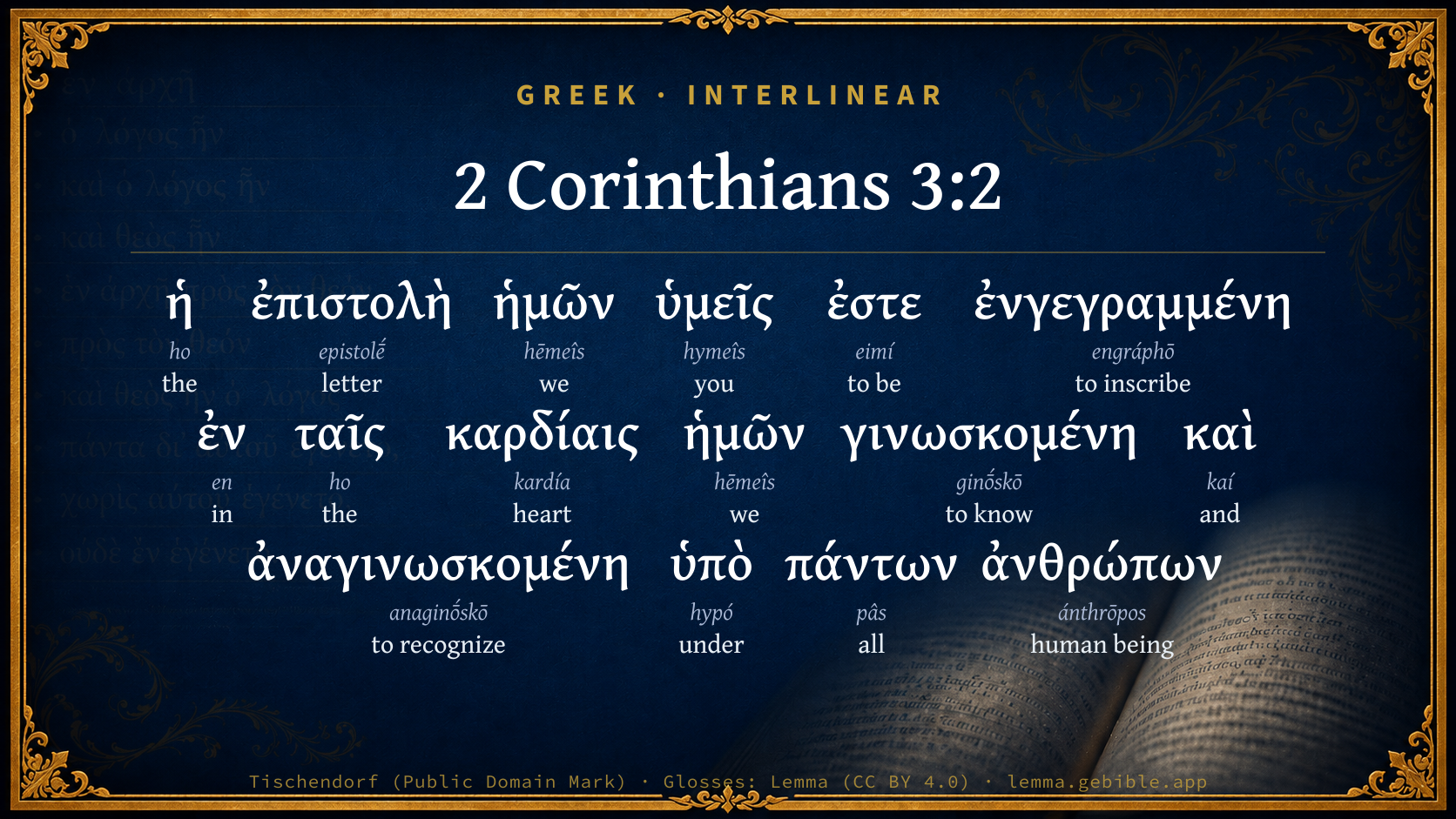
  1. ἡ ho G3588 “the” Article, Nominative, Singular, Feminine
  2. ἐπιστολὴ epistolḗ G1992 “letter” Noun, Nominative, Singular, Feminine
  3. ἡμῶν hēmeîs G2249 “we” Personal pronoun, 1st person, Genitive, Plural
  4. ὑμεῖς hymeîs G5210 “you” Personal pronoun, 2nd person, Nominative, Plural
  5. ἐστε eimí G1510 “to be” Verb, Present, Active, Indicative, 2nd person, Plural
  6. ἐν en G1722 “in” Preposition
  7. ταῖς ho G3588 “the” Article, Dative, Plural, Feminine
  8. καρδίαις kardía G2588 “heart” Noun, Dative, Plural, Feminine
  9. ἡμῶν hēmeîs G2249 “we” Personal pronoun, 1st person, Genitive, Plural
  10. γινωσκομένη ginṓskō G1097 “to know” Verb, Present, Passive, Participle, Nominative, Singular, Feminine
  11. καὶ kaí G2532 “and” Conjunction
  12. ἀναγινωσκομένη anaginṓskō G314 “to recognize” Verb, Present, Passive, Participle, Nominative, Singular, Feminine
  13. ὑπὸ hypó G5259 “under” Preposition
  14. πάντων pâs G3956 “all” Adjective, Genitive, Plural, Masculine
  15. ἀνθρώπων ánthrōpos G444 “human being” Noun, Genitive, Plural, Masculine

About this verse

These counts appear in no published source. They are computed here, from the morphology-tagged text and Lemma’s own curated glosses. What Lemma adds →

16
words
14
distinct lemmas
Pauline Epistles
section

Notable vocabulary

The rarest word here is ἐνγεγραμμένη to inscribe G1449 — appearing just 3 times in the whole Greek New Testament.

Shared distinctive vocabulary

ἐνγεγραμμένη to inscribe G1449 occurs in 3 verses of the Greek New Testament. Also found in:

Repetition

Words recur within this verse:

Cross-references

8

Topical passages linked to 2 Corinthians 3:2 in the Treasury of Scripture Knowledge — connected by theme and wording, ordered by reader-vote popularity; previews shown in the World English Bible.

  • Romans 1:8 First, I thank my God through Jesus Christ for all of you, that your faith is proclaimed throughout the whole world.
  • 1 Corinthians 9:1–2 Am I not free? Am I not an apostle? Haven't I seen Jesus Christ, our Lord? Aren't you my work in the Lord?
  • 1 Thessalonians 1:8 For from you has sounded forth the word of the Lord, not only in Macedonia and Achaia, but also in every place your faith toward God has gone forth; so that we need not to say anything.
  • Philippians 1:7 It is even right for me to think this way on behalf of all of you, because I have you in my heart, because, both in my bonds and in the defense and confirmation of the Gospel, you all are partakers with me of grace.
  • 1 Corinthians 3:10 According to the grace of God which was given to me, as a wise master builder I laid a foundation, and another builds on it. But let each man be careful how he builds on it.
  • 2 Corinthians 7:3 I say this not to condemn you, for I have said before, that you are in our hearts to die together and live together.
  • 2 Corinthians 11:11 Why? Because I don't love you? God knows.
  • 2 Corinthians 12:15 I will most gladly spend and be spent for your souls. If I love you more abundantly, am I loved the less?

Cross-references courtesy of OpenBible.info (CC BY 4.0).

Commentary

Notes on 2 Corinthians 3:2 from classic Christian and Jewish commentators (each source and its license shown beneath its notes). The classic Christian expositions comment on the surrounding passage and are grouped to its opening verse, so a note may address several verses; the Jewish commentaries on the Tanakh (Rashi and others) are per-verse, so they appear only where the commentator wrote on this verse.

Lemma curates 59 commentaries, every one of them public domain or Creative Commons licensed, each selected and text-cleaned for this edition rather than reprinted as found. About our sources →

Bengel's Gnomon

Johann Albrecht Bengel

2Co 3:2. Ἐν ταῖς καρδίαις ἡμῶν, in our hearts) Your faith was written in our heart, in which we carry about it and yourselves—a faith everywhere to be known and read. It was reflected from the heart of the Corinthians to the heart of the apostle.—πάντων, by all men) by you and others. This is an argument for the truth of the Gospel, obvious to all, to be derived from believers themselves [2Co 4:2; 1Co 14:25].

Bengel's Gnomon of the New Testament — English translation (T&T Clark, Edinburgh, 1860) — public domain. Text from a community e-Sword module.

Meyer's Critical & Exegetical Commentary

Heinrich August Wilhelm Meyer

2Co_3:2 f. This ironical excitement, 2Co_3:1, is succeeded by earnestness and pathos. Paul, as conscious of his deserts in regard to the Corinthians as he is faithful to his Christian humility (see 2Co_3:3), gives a skilful explanation of the thought contained in 2Co_3:1 : we need no letters of introduction either to you or from yo.

ἡ ἐπιστολὴ ἡμῶν] i.e. the letter (the letter of recommendation) which we have, have to show, namely, as well to you as from you. That we should understand both, is required by 2Co_3:1, and to this 2Co_3:2-3 are admirably suited, since what is said in them represents every letter of recommendation as well to the Corinthians as from them as superfluous. This in opposition to Flatt, Rückert, Osiander, and others, who are of opinion that Paul has reference merely to his previous ἐξ ὑμῶν, and (Rückert) that the πρὸς ὑμᾶς has been said only to hit his opponent.

ὑμεῖς ἐστε] in so far, namely, as your conversion, and your whole Christian being and life, is our work, redounding to our commendation. Comp. 1Co_9:2.

ἐγγεγραμμ. ἐν ταῖς καρδ. ἡμ.] A more precise definition of the manner of the ἐπιστολὴ ἡμῶν: inscribed in our hearts. This is the modeadapted to the imageof conveying the thought: since we have in our own consciousness the certainty of being recommended to you by yourselves and to others by you. That you yourselves are our recommendation (to yourselves and to others) our own hearts tell us, and it is known by all. Paul did not write ὑμῶν, as א and a few cursives, also the Ethiopic, have the reading, which Olearius, Emmerling, Flatt, and especially Rinck (Lucubr. crit. p. 160), recommend to our adoption: for in that case there would result an incongruity in the figurative conception, since the Corinthians themselves are the letter. Besides, there were so many malevolents in the church. But the apostles own good consciousness was, as it were, the tablet on which this living Epistle of the Corinthians stood, and that had to be left unassailed even by the most malevolent. Of the love (comp. 2Co_7:3; Php_1:7) of which Chrysostom and others explain ἐν τ. καρδ. ἡμ. (comp. Wetstein: quam tenero vos amore prosequar, omnes norunt), there is no mention in the whole context. Emmerling is wrong, however, also in saying that ἐγγεγρ. ἐν τ. καρδ. ἡμ. is equivalent to the mere nobis inscriptae, i.e. quas ubique nobiscum gestamus, ut cognosci et legi ab omnibus possint. Just because what is written stands within in the consciousness, ἐν ταῖς καρδ. ἡμ.[157] is used.

The plural is neither to be explained, with Billroth, from the analogy of σπλάγχνα (without such usage existing), nor to be considered with Rückert and de Wette as occasioned by the plural of the speaking person (to whom, however, the plural hearts would not be suitable), but Paul writes in name of himself and of Timothy. Comp. also 2Co_4:6, 2Co_7:3, and see Calvin, who, however, in an arbitrary way (see 2Co_1:1) includes Silvanus also (2Co_1:19).

γινωσκομένη κ.τ.λ.] This appears to contradict the previous words, according to which the Epistle is written ἘΝ ΤΑῖς ΚΑΡΔΊΑΙς ἩΜῶΝ; hence Fritzsche, Diss. I. p. 19 f. (Billroth follows him), says that Paul nonnulla adjicere, in quibus Corinthiorum potius, quam epistolae, cum qua eos comparat, memor esse videatur. But he rather presents the thing as it is, and hence cannot otherwise delineate the image of the Epistle in which he presents it, than as it corresponds to the thing. In so far, namely, as Paul and Timothy have in their hearts the certainty of being recommended by the Corinthians themselves, these are a letter of recommendation which stands inscribed in the hearts of those teachers; and yet, since from the whole phenomenon of the Christian life of the church it cannot remain unknown to any one that the Corinthians redound to the commendation of Paul and Timothy, and how they do so, this letter is known as what it is, and read[158] by all men. The Epistle has therefore in fact the two qualities, which in a letter proper would be contradictory, and the image is not confounded with the thing, but is adapted to the thing. Rückert, who likewise (see above) finds for ἐν τ. καρδ. the reference to the apostles love, explains it: In his heart they stand written … and where he himself arrives, there he, as it were, reads out this writing, when from a loving heart gives forth tidings everywhere, what a prosperous church the Lord has gathered to Himself in Corinth. Comp. Chrysostom. But in that case the πάντες would not in fact be the readersas yet they ought to be according to ὑπὸ πάντων ἀνθρ.but Paul; and the thing would resolve itself into a self-recommendation, which is yet held to be disclaimed in 2Co_3:1.

[157] Olshausen thinks strangely that Paul refers to the official badge which the high priest wore on his heart, and on whose twelve precious stones stood engraven the twelve names of the children of Israel. This arrangement, he holds, Paul takes in a spiritual sense, and applies it to the relation of himself and other teachers to their spiritual children; they bore the names of these engraven on their hearts, and brought them always in prayer before God.Sheer fancifulness, since the context has nothing pointing to a reference so entirely peculiar.

[158] Grotius: prius agnoscitur manus, deinde legitur epistola. Here γινωσκ. precedes; it is different in 2Co_1:13.

Meyer — Critical and Exegetical Commentary on the New Testament — English translation by Peter Christie, edited by Frederick Crombie (T&T Clark, 1880) — public domain. Text from a community e-Sword module.

Expositor's Greek Testament

ed. W. Robertson Nicoll

2Co 3:2 . ἡ ἐπιστολὴ ἡμῶν κ . τ . λ .: ye are our epistle . They are his credentials. Cf. 1Co 9:2 , where he tells them that they are the “seal” of his apostleship. Note the emphasis laid on ἐπιστολή by its position in the sentence. ἐγγεγραμμένη ἐν ταῖς καρδίαις ἡμῶν : written in our hearts, i.e. , in the heart of me, Paul ( cf. 2Co 7:3 ); a somewhat unexpected, and, as it were, parenthetic application of the metaphor, suggested by the memory of his labours among them which had left an indelible impression upon his heart. γινωσκ . καὶ ἀναγινωσκ . κ . τ . λ .: known and read of all men . This is the legitimate application of the metaphor, and is expanded in the next verse. The letter written on St. Paul’s heart was not open to the world; but the letter written on the heart of the Corinthians by Christ through St. Paul’s ministry was patent to the world’s observation, as it was reflected in their Christian mode of life. Facts speak louder than words. For the jingle γινωσκομένη … ἀναγινωσκομένη cf. Act 8:30 , γινώσκεις ἂ ἀναγινώσκεις , and see the note on 2Co 1:13 above.

The Expositor's Greek Testament, edited by W. Robertson Nicoll (1897–1910) — public domain. Text from a community e-Sword module.

Jamieson, Fausset & Brown

Robert Jamieson, A. R. Fausset & David Brown

our epistle--of recommendation.

in our hearts--not letters borne merely in the hands. Your conversion through my instrumentality, and your faith which is "known of all men" by widespread report (Co1 1:4-7), and which is written by memory and affection on my inmost heart and is borne about wherever I go, is my letter of recommendation (Co1 9:2).

known and read--words akin in root, sound, and sense (so Co2 1:13). "Ye are known to be my converts by general knowledge: then ye are known more particularly by your reflecting my doctrine in your Christian life." The handwriting is first "known," then the Epistle is "read" [GROTIUS] (Co2 4:2; Co1 14:25). There is not so powerful a sermon in the world, as a consistent Christian life. The eye of the world takes in more than the ear. Christians' lives are the only religious books the world reads. IGNATIUS [Epistle to the Ephesians, 10] writes, "Give unbelievers the chance of believing through you. Consider yourselves employed by God; your lives the form of language in which He addresses them. Be mild when they are angry, humble when they are haughty; to their blasphemy oppose prayer without ceasing; to their inconsistency, a steadfast adherence to your faith."

Jamieson, Fausset & Brown — Commentary Critical and Explanatory on the Whole Bible (1871) — public domain (CC PDM 1.0). Text via the HelloAO Bible API.

Adam Clarke's Commentary

Verse 2. Ye are our epistle] I bear the most ardent love to you. I have no need to be put in remembrance of you by any epistles or other means; ye are written in my heart - I have the most affectionate remembrance of you.

Known and read of all men] For wherever I go I mention you; speak of your various gifts and graces; and praise your knowledge in the Gospel.

Adam Clarke's Commentary on the Bible (1810–1826) — public domain. Text from a community e-Sword/MySword module.

John Calvin's Commentaries

2. Ye are our Epistle. There is no little ingenuity in his making his own glory hinge upon the welfare of the Corinthians. “So long as you shall remain Christians, I shall have recommendation enough. For your faith speaks my praise, as being the seal of my apostleship.” (1 Corinthians 9:2.)

When he says — written in our hearts, this may be understood in reference to Silvanus and Timotheus, and in that case the meaning will be: “We are not contented with this praise, that we derive from the thing itself. The recommendations, that others have, fly about before the eyes of men, but this, that we have, has its seat in men’s consciences.” It may also be viewed as referring in part to the Corinthians, in this sense: “Those that obtain recommendations by dint of entreaty, have not in the conscience what they carry about written upon paper, and those that recommend others often do so rather by way of favor than from judgment. We, on the other hand, have the testimony of our apostleship, on this side and on that, engraven on men’s hearts.”

Which is known and read It might also be read — “Which is known and acknowledged,” owing to the ambiguity of the word ἀναγινωσκεσαι, and I do not know but that the latter might be more suitable. I was unwilling, however, to depart from the common rendering, when not constrained to do so. Only let the reader have this brought before his view, that he may consider which of the two renderings is the preferable one. If we render it acknowledged, there will be an implied contrast between an epistle that is sure and of unquestionable authority, and such as are counterfeit. And, unquestionably, what immediately follows, is rather on the side of the latter rendering, for he brings forward the Epistle of Christ, in contrast with those that are forged and pretended.

John Calvin's Commentaries (1540-1563) — public domain. Text from the Calvin Translation Society English edition (1840s-50s) via the Christian Classics Ethereal Library (ccel.org). Calvin's coverage is partial (roughly two-thirds of the Bible); uncommented books and verses are honest gaps, never fabricated. The 19th-century editor's footnotes and remarks are omitted so the notes are faithfully Calvin's own voice.

Ellicott's Commentary for English Readers

(2) Ye are our epistle written in our hearts.—This is an answer. They, the Corinthian converts, are written on his heart. In his thoughts and prayers for them he finds his true commendatory letter, and this a letter which is patent to the eyes of all men. In “known and read” we find the familiar play on the two words, epiginoskein and anaginoskein. (See Note on 2Co_1:13.) All who knew St. Paul could read what was there written.

A Bible Commentary for English Readers, edited by Charles John Ellicott (1878–1897) — public domain. Text from a community e-Sword module.

The Cambridge Bible for Schools and Colleges

gen. ed. J. J. S. Perowne

2. Ye are our epistle] See note on last verse.

written in our hearts] ‘Others bear their letters of commendation in their hands, we in our consciences, being fully aware that the existence of the Church of Corinth, due, under God, to us, is a sufficient authentication of the genuineness of our ministry.’ See 1Co_9:2. Olshausen, however, regards the words as referring to St Paul’s intercession for the Corinthians, just as the High Priest (Exo_28:15-30) bore the names of the tribes of Israel on his breast when he went into the holy place to intercede with God. “The regenerate,” he adds, “are linked to the heart of their spiritual father by a spiritual bond.” See notes above, ch. 2Co_1:9, 2Co_2:3.

known and read of all men] See note on ch. 2Co_1:13. The play upon words so characteristic of the Apostle cannot be rendered into English.

The Cambridge Bible for Schools and Colleges (gen. ed. J. J. S. Perowne; Cambridge University Press, 1878–1918) — public domain. Text from a community e-Sword module.

John Gill's Exposition

Ye are our epistle,.... Here a reason is given why they stood in no need of letters of commendation, to or from the church at Corinth, because that church was their living epistle, and which was much preferable to any written one. The apostle calls them their epistle in the same sense, as they are said to be his "work in the Lord, and the seal of his apostleship", Co1 9:1 they were so as persons regenerated by the Spirit and grace of God, in whose conversion he was an instrument; now it was the work of conversion in them, which was the epistle said to be

written in our hearts; some think it should be read, "in your hearts"; and so the Ethiopic version reads it; and it looks as if it should be so read, from the following verse, and from the nature of the thing itself; for the conversion of the Corinthians was not written in the heart of the apostle, but in their own; and this was so very notorious and remarkable, that it was

known and read of all men; everyone could read, and was obliged to acknowledge the handwriting; it was so clear a case, what hand the apostle, as an instrument, had in the turning of these persons from idols to serve the living God; and which was so full a proof of the divinity, efficacy, truth, and sincerity of his doctrine, that he needed no letters from any to recommend him.

John Gill's Exposition of the Whole Bible (1746–1763) — public domain (CC PDM 1.0). Text via the HelloAO Bible API.

Trapp's Complete Commentary

John Trapp

2 Ye are our epistle written in our hearts, known and read of all men:

Ver. 2. You are our epistle] The fruitfulness of the people is the preacher’s testimonial; as the profiting of the scholar is the teacher’s commendation.

Written in our hearts] Or rather in your hearts, as tables; the Spirit writing thereon, by his ministers as pens, that form of doctrine, Rom 6:17, that law of their minds, Rom 7:23; Heb 8:10, to be known and read of all men.

John Trapp, A Commentary or Exposition upon All the Books of the Old and New Testament (1647–1656) — public domain. Text from a community e-Sword module.

Albert Barnes' Notes on the Bible

Ye are our epistle - compare 1Co 9:2. This is a most beautiful and happy turn given to the whole subject. The sense is plain. It is, that the conversion of the Corinthians, under the faithful labors of the apostle, was a better testimonial of his character and fidelity than any letters could be. To see the force of this, it must be remembered:

That Corinth was an exceedingly dissolute and abandoned place (see the introduction to the First Epistle); That a large number of them had been converted, and a church organized; That their conversion, and the organization of a church in such a city were events that would be known abroad; and, That it had been accomplished entirely under the labor of Paul and his companions.

To their knowledge of him, therefore, and to his success there, he could confidently appeal as a testimonial of his character. The characteristics of this commendatory epistle, he proceeds immediately to state. The general sense is, that they were the letter of recommendation which God had given to him; and that their conversion under his ministry was the public testimonial of his character which all might see and read.

Written in our hearts - A few mss. and versions read thus, “your hearts;” and Doddridge has adopted this reading, and supposes that it means that the change produced not only in their external conduct, but in their inward temper, was so great, that all must see that it was an unanswerable attestation to his ministry. But there is not sufficient authority for changing the text; nor is it necessary. The sense is, probably, that this letter was. as it were, written on his heart. It was not merely that Paul had a tender affection for them, as Clarke supposes; nor was it that he regarded them as “a copy of the letter of recommendation from Christ written in his heart,” according to the fanciful conceit of Macknight; but Paul’s idea seems to have been this. He is speaking of the testimonial which he had from God. That testimonial consisted in the conversion of the Corinthians. This he says was written on his heart. It was not a cold letter of introduction, but it was such as, while it left him no room to doubt that God had sent him, also affected his feelings, and was engraved on his soul. It was to him, therefore, far more valuable than any mere letter of commendation or of introduction could be. It was a direct testimonial from God to his own heart of his approbation, and of his having appointed him to the apostolic office. All the difficulty, therefore, which has been felt by commentators in this passage, may be obviated by supposing that Paul here speaks of this testimonial or epistle as addressed to himself, and as satisfactory to him, In the other characteristics which he enumerates, he speaks of it as suited to be a letter commendatory of himself to others.

Known and read of all men - Corinth was a large, splendid, and dissipated city. Their conversion, therefore, would be known afar. All people would hear of it; and their reformation, their subsequent life under the instruction of Paul, and the attestation which God had given among them to his labors, was a sufficient testimonial to the world at large, that God had called him to the apostolic office.

Albert Barnes' Notes on the Bible (1834–1885) — public domain. Text from a community e-Sword/MySword module.

Haydock's Catholic Bible Commentary

You are our epistle, better, and of greater force, than any commendatory epistle, written and engraven in my heart, by the love and affection I bear you. You may also be looked upon as the epistle of Christ, because of your zeal for the Christians religion, written upon the soft and fleshy tables of your tender affections, with which you have received, and kept his precepts; and not like the precepts of the law, which were engraven on tables of stone, which the hard-hearted Jews did not keep. (Witham)

George Leo Haydock (1774–1849), Haydock's Catholic Family Bible and Commentary, 1859 edition — public domain. Excludes Psalms (Douay-Rheims chapter numbering differs from Protestant) and Deuterocanonical books (Catholic canon only).

Matthew Poole's English Annotations

Your Christianity, and embracing of the gospel of Christ, your fiath and holiness, are instead of an epistle to me, to let the world know, both with what faithfulness, and with what blessing of God, and success upon my labours, I have preached the gospel; and you are such an epistle as I do not carry about in my pockets, or lay up in my closet, but it is written in my heart, where I carry continually both a thankful and honourable remembrance of you. Nor are you only taken notice of by me as a famous church, to the planting and watering of which God hath blessed my labours, and the labours of other ministers; but, as he saith to the Romans, Rom 1:8; Your faith is spoken of throughout the whole world, so he saith here:

Ye are our epistle, known and read of all men; that is, all Christians take notice of you as a church to which God hath particularly blessed my ministry; so as I need no other recommendation than what I have from your receiving, and the proficiency you have made in, the gospel. Nothing so commends a minister as the proficiency of his people.

Matthew Poole's English Annotations on the Holy Bible (1683–1685) — public domain. Text from a community e-Sword/MySword module.

Whedon's Commentary on the Bible

Daniel D. Whedon

2. Ye are our epistle—Powerful emphasis to be placed on ye and our. Bring epistles to you? Yourselves are our epistle! A lofty turn that places him at once on the platform of their founder-apostle. And by the immediate additional term, written in our hearts, he evades the charge of arrogance with a touch of deep affection. By our epistle, he does not mean our letter to or for others, but an epistle in our behalf, certifying us to the world. But though written in his heart, the epistle is not a hidden inscription, but known and read of all men. The wide world knows Corinth, and knows it as a Pauline Christian Church.

Daniel D. Whedon (gen. ed.), Commentary on the Old and New Testaments (1874–1909) — public domain. Text from a community e-Sword module.

The Pulpit Commentary

Ye are our epistle. Their very existence as a Church was the most absolute "commendatory letter" of St. Paul, both from them and to them. (comp. 1Co_9:2, "The seal of mine apostleship are ye in the Lord Written in our hearts. The expression has no connection with the fact that the high priest bore the names of Israel graven on the jewelled Urim, which he wore upon his breast. St. Paul means that others may bring their "letters of commendation" in their hands. His letter of commendation is the very name and existence of the Church of Corinth written on his heart. Known and read of all men. The metaphor is subordinated to the fact. All men may recognize the autograph, and in it were read the history of the Corinthian converts, which was written on the apostle"s heart, and which therefore rendered the notion of any other letter of commendation to or from them superfluous and even absurd. The play on words (epigignosko and anagignosko) is similar to that in 2Co_1:13.

HOMILIES BY J.R. THOMSON Ver. 2.

Our epistle.

Paul did the work of his life partially by his voice, but to no small extent by his pen. His compositions which have come down to us, and by which we chiefly know him, are epistolary. His letters were admitted, in his own time, and even by his enemies and traducers, to be weighty and powerful. But in his own view the best of all his epistles those which most unmistakably witnessed to his apostleship were the characters, the new lives, of those who by his ministry had received the gospel of Christ. Whether as amanuenses who had indited these spiritual epistles, or as tabellarii, or letter carriers, who had charge of them, and delivered them to human society, the apostles "ministered" their converts, who attested their skill and fidelity. At the expense of complicating the figure, Paul observes of the Corinthians that they were written in the hearts of himself and his colleagues. The lesson of the text is that Christians are ever authenticating the ministry of faithful preachers of the gospel.

I MEN MAY READ IN THE HEART AND LIFE OF THE CONVERT THE DIVINE COMMISSION OF THE MINISTER. There are such proofs of the divinity of the doctrine in its effects upon the character and conduct of its sincere recipients as point up to the heavenly authority by which the agents were appointed and authenticated.

I AND THE FAITHFULNESS AND ZEAL OF THE MINISTER. Paul had a good conscience with regard to the manner in which he had discharged his sacred and benevolent service to his fellow men. Especially was this the case with his ministry to the Corinthians. In his First Epistle to them he had written, "If I be not an apostle unto others, yet doubtless I am to you; for the seal of mine apostleship are ye in the Lord.

III AND THE ADAPTATION OF THE MINISTRY TO THE NEEDS AND THE CIRCUMSTANCES OF MEN. Events proved that to Jew and to Gentile, to men of every class and character, the gospel of Christ was the power of God unto salvation. This Church at Corinth was as an epistle written in various languages, in various styles, addressed to all nations and to all conditions of men, and assuring them that the apostles of Christ were laden with treasure which was able to enrich and to bless the world. T.

HOMILIES BY D. FRASER Vers, 2, 3.

A living letter.

Apollos had carried to Corinth written credentials. (see Act_18:27 Act_19:1) Why had Paul not done so too? He claims that he needed them not. The converts in that city were themselves his credentials. His appeal to the Corinthians on this point proceeds on a principle easily understood and often applied. The best testimonial a teacher can produce is the proficiency of his pupils. The most satisfactory evidences of the skill of a physician are the patients who have recovered health under his care. The convincing proofs of the competency of a gardener are the prosperity of the plants and the abundance of flowers and fruits which he produces from the ground. So was the Church at Corinth itself the best diploma or commendation of the apostle who had founded it and watched over it. (see 1Co_4:14-16) A good teacher needs no letter of commendation to his own pupils, or a father to his own children. Seizing the idea of a letter, and showing that the Corinthian saints themselves formed the only letter he needed to produce, St. Paul used this as an illustration in two forms.

1. The Christians at Corinth were written on his heart, for they were dearto him (2Co_7:3; Php_1:7) And this was no secret. The tie of affection between St. Paul and the Corinthian brethren was "known and read of all.

2. Christ had written upon their hearts what served as a powerful letter ofcommendation for his servant Paul. Let us pursue the second use of the metaphor. A Church is an epistle of Christ, open for all men to read.

I THE AUTHOR OF THE LETTER. This is Christ. Whatever Divine thoughts are given to human minds, or spiritual impressions are stamped on human hearts, proceed from Christ. And it is true of Churches in all ages. As Christ is the living One, he is ever writing new epistles in harmony with those which were written at the beginning and yet new and fresh and suited to the current time.

II THE AMANUENSIS. At Corinth this was Paul. In modem Churches it is the faithful ministry of the Word. The epistle is not invented or dictated by us, but "ministered by us." The mind of Christ is thereby conveyed to and impressed on the company of believers.

III THE TABLETS. They are not of stone, but of the heart. The ministration of neath was written and engraven on stone in the form of ten commandments. The more glorious ministration of the spirit and of righteousness is inscribed on the convictions and affections of living men. The law of Christ is put into the inward parts and written on the heart. For this end, too, the Lord knows how to soften the tablets, to make the heart tender and warm, and so susceptible of the instruction and impression of the Word. Oh to have a still heart, not restless, that the writing may be plain, and to have a lowly heart, not hard, that the engraving may be deep!

IV THE MANNER OF WRITING. "Not with ink." St. Paul"s letters were so written, as were those of other apostles; (2Jn_1:12) and by ink of the scribe and the printer have they been preserved and propagated. But for writing on the heart perishable material is unsuited. Jehovah wrote the Law on the tablets of stone with his own hand; and on the tablets of the human heart Jesus Christ writes, using ministry as he pleases in the process with the finger or power of God Spirit of the living God." And so, in all times and all Churches of the saints, the application of the truth is by the living Spirit.

V THE THING WRITTEN. It is the mind of Christ. Ye "have learned Christ, and the truth as it is in Jesus." There is no higher truth to learn, no better message to carry.

VI THE PUBLICATION OF THE LETTER. It is "manifestly declared," and may be known and read of all men. This is said of the Church collective, for such is the temple of God and such is the epistle of Christ an argument surely for Christian consistency and for brotherly concord, that the sacred epistle may not be rendered unintelligible. It each member of a Church abide in his place, and all together dwell in peace and walk in the truth, there is produced an epistle of Christ which puts the gainsayer to silence. Thank God that even a faulty Church or blotted epistle has something of a Divine element, some impression and expression of Christ! The obligation which lies on the Church may be pressed on each member thereof. Would that Christ were more apparent and more legible in Christians! Let your character be a consistent representation or epistle of your Lord, and let it be an original, not a copy of some other man"s religion, but a genuine production of Jesus Christ by "the Spirit of the living God." If you go to the Lord justifying yourself and accusing others, he will only write on the ground; but if you with a penitent heart accuse yourself, he will write on you his grace and truth. Hereafter, when you have overcome, he will write on you his new Name. F.

The Pulpit Commentary (1880–1919), ed. H.D.M. Spence-Jones & Joseph S. Exell — public domain. Text from a community e-Sword module.

John Wesley's Explanatory Notes

Ye are our recommendatory letter - More convincing than bare words could be. Written on our hearts - Deeply engraven there, and plainly legible to all around us.

John Wesley, Explanatory Notes Upon the Whole Bible (1754–1765) — public domain. Text via the GEBible commentary corpus.

McGarvey & Pendleton's Commentaries

J. W. McGarvey

Ye are our epistle, written in our hearts, known and read of all men ;

J. W. McGarvey (with Philip Y. Pendleton), Commentaries on the New Testament (The Fourfold Gospel, 1914; Acts; and the epistles) — public domain. Text from a community e-Sword/MySword module.

The People's New Testament

B. W. Johnson

2. Ye are our epistle. The church itself owed its existence to him. He could point to his work, to the disciples, as his letter of commendation. He was known by his fruits. Written in our hearts. When he looked into his heart, he saw them enshrined there, and felt that he needed no commendation to them.

B. W. Johnson's The People's New Testament with Notes (1889–1891) — public domain. Electronic text from the Christian Classics Ethereal Library (CCEL) ThML edition.

Cambridge Greek Testament for Schools and Colleges

2. ἡ ἐπιστολὴ ἡμῶν ὑμεῖς ἐστέ. The metaphor is loosely used. The Corinthians are themselves a letter; the letter is written on the Apostle’s heart; it is also written on their hearts. There are two main points. 1. ‘We have got something better than ordinary letters; we have got yourselves, and the affectionate ties which bind us to you can be discerned by all the world.’ 2. ‘The testimony is not traced with ink on a perishable surface; it is written in living characters by the Spirit on imperishable souls.’ See Deissmann, Bible Studies, p. 59. In Polycarp (11) there is a clear reference to this.

ἐν ταῖς καρδίαις ἡμῶν. It is probable that in saying ‘hearts,’ not ‘heart’ (comp. 2Co 4:6, 2Co 7:3), the Apostle includes others with himself. Contrast ἡ καρδία ἡμῶν πεπλάτυνται (2Co 6:11), and see Lightfoot on 1Th 2:4 as against Conybeare and Howson II. pp. 95, 419. The Corinthians are his (and Timothy’s) συστατικὴ ἐπιστολή, because his message has found a place in their hearts (2Co 3:6), and because they had given him too a place in their affections (1Co 4:15).

γινωσκομένη καὶ ἀναγινωσκομένη. Another play upon words: see on 2Co 1:13. The translation ‘read’ is here so entirely appropriate, that to render ἀναγινωσκομένη ‘acknowledged, recognized, admitted’ is not allowable: see 2Co 3:15, where ‘read’ must be the meaning. All men, including the Corinthians themselves, could see the ties which bound S. Paul to them. Comp. 2Co 6:11, 2Co 7:3; Php 1:7. ἐπιστολὴν ἔμψυχον ἔχομεν τὰ καθʼ ἡμᾶς συνιστῶσαν ὑμῖν, τὴν πίστιν τὴν ὑμετέραν, τὴν πανταχοῦ γῆς καὶ θαλάττης ᾀδομένην (Theodoret).

Cambridge Greek Testament for Schools and Colleges (Cambridge University Press, 1896; 21 vols, various authors incl. Carr, Maclear, Plummer, Farrar, Lumby, Moule, M. R. James, Simcox) — public domain. Text from a community e-Sword module.

Alford’s Greek Testament

Henry Alford

2.] Ye are our epistle (of commendation), written on our hearts (not borne in our hands to be shewn, but engraven, in the consciousness of our work among you, on our hearts. There hardly can be any allusion, as Olsh. thinks, to the twelve jewels engraven with the names of the tribes and borne on the breast-plate of the High Priest, Exo 28:21. The plural seems to be used, as so often in this Epistle,—see e.g. ch. 7:3, 5,—of Paul himself only), known and read (a play on γιν. and ἀναγιν., as at ch. 1:13) by all men (because all men are aware, what issue my work among you has had, and receive me the more favourably on account of it. But ‘all men’ includes the Corinthians themselves; his success among them was his letter of recommendation to them as well as to others from them),

Henry Alford, The Greek Testament (1849–1861) — public domain. Text from a community e-Sword module.

International Critical Commentary

2. ἡ ἐπιστολὴ ἡμῶν ὑμεῖς ἐστέ. The asyndeton is effective, and the two pronouns are in telling juxtaposition. The convincing statement is flashed out with emphatic suddenness and brevity; ‘The letter of recommendation which we have to show are ye.’* No other testimonial is needed, either to the Corinthians or from them. They know what Apostolic teaching has done for them ; and all the world can see this also. Their changed life is an object lesson to themselves and to all outside ; and both they and the outsiders know how this change has been produced; it is writ large in the history of the foundation of a Church in such a city as Corinth. The Apostle appeals, not to written testimony, which may be false, but to the experience of all who know the facts. There seems to be an allusion to this passage in the Ep. of Polycarp (11:3), where he says “among whom the blessed Paul laboured, who were his letters in the beginning.” See on 4:14 and 8:21.

The details which follow are neither quite clear nor quite harmonious. St Paul dictates bold metaphors, in order to set forth the convincing character of his credentials, and he does not stop to consider whether they can all be combined in one consistent picture. ‘Written in our hearts’ does not agree well with ‘read by all men,’ and yet both were true. The Christian life of the Corinthians was impressed in thankful remembrance on the hearts of those who had converted them, and it was recognized by all who knew them. It was also impressed on the hearts of the Corinthians themselves. See on 1Co 9:2. Experience showed to the teachers that their ministry had been blessed by God; the existence of the Corinthian Church convinced them of this, and they could appeal to that conviction with a good conscience. Experience also taught the world at large that the men who had produced this change at Corinth were no charlatans ; and it had taught the Corinthians themselves the same truth.

ἐνγεγραμμένη ἐν ταῖς καρδίαις ἡμῶν. There is probably no allusion to Aaron ‘bearing the names of the children of Israel in the breastplate (pouch) of judgment upon his heart, when he goeth in unto the holy place, for a memorial before the Lord continually’ (Exo 28:36). The idea of intercession is foreign to this passage. ‘Written on our hearts’ suggests to us the idea of deep affection, and Chrys. interprets the words of the love to the Corinthians which causes Paul to sing their praises in other Churches. But it may be doubted whether this is the exact meaning of the words. The context seems to require some such meaning as this; ‘Our own hearts tell us that you are our recommendation, and everybody else can see this also.’ The compound ἐνγεγρ implies that this fact cannot slip from our hearts, cannot be forgotten ; cf. ἣν ἐγγράφου σὺ μνήμοσιν δέλτοις φρενῶν (Aesch. Pr. V. 789) ; and ἐπίγραψον ἐπὶ τὸ πλάτος τῆς καρδίας σου (Pro 7:3). The plur. ‘hearts’ probably implies that other teachers are included with the Apostle; contrast ‘our heart’ in 6:11 The ‘heart’ in Scripture is the inner man, the centre of personality, known only to God; Rom 5:5, Rom 5:8:27; Eph 1:18, Eph 1:3:17; 1Pe 3:4; Rev 2:23. See art. ‘Heart’ in Hastings, DB. and DCG.; Milligan on 1Th 2:4.

Lietzmann and Bousset would read ὑμῶν for ἡμῶν with א 17 after καρδίαις. Confusion between the two pronouns is often found in MSS., and might easily be made at the outset in dictating, the pronunciation being similar.

‘My testimonial is written in your hearts and can be read by all, for all can see that you are Christians.’ Schmiedel and J. Weiss would omit the whole clause as a gloss.

γινωσκομένη καὶ ἀναγινωσκομένη. Note the change from perf. to pres. participles. It was written long ago and the writing still remains, and this is continually becoming known and being read. See on 1:13 respecting the word-play* and the meaning of ἀναγινωσκομένη. Some suggest that these participles are in the wrong order, for one reads a letter before one knows its purport. Has St Paul been careless, or has he sacrificed sense to sound? Probably neither: one recognizes the hand-writing before one reads the letter; at any rate, one perceives that it is a letter before one reads it.

ὑπὸ πάντων ἀνθρώπων. Another blow, whether intended or not, to his opponents, whose testimonials were not published.

International Critical Commentary — older volumes (1896–1929), various authors — public domain. Text from a community e-Sword module.

Vincent's Word Studies in the New Testament

Marvin R. Vincent

Our epistle. The figure which follows is freely and somewhat loosely worked out, and presents different faces in rapid succession. The figure itself is that of a commendatory letter representing the Corinthian Church : "Ye are our letter." This figure is carried out in three directions :

1. As related to the apostles ' own consciousness. The Corinthian Church is a letter written on the apostles ' hearts. Their own consciousness testifies that that Church is the fruit of a divinely accredited, honest, and faithful ministry.

2. As related to the Corinthians themselves. The Church needs no letter to commend the apostles to it. It is its own commendation. As the visible fruit of the apostles ' ministry they are a commendatory letter to themselves. If the question arises among them, "Were Paul and his colleagues duly commissioned?" - the answer is, "We ourselves are the proof of it."

3. As related to others outside of the Corinthian Church. The answer to the charge that the Corinthians have been taught by irregular and uncommissioned teachers is the same : "Behold the fruit of their labors in us. We are their commission."

At this point the figure again shifts; the letter being now conceived as written on the Corinthians' hearts, instead of on the hearts of the apostles : written by Christ through the apostles ' ministry. This suggests the comparison with the law written on tables of stone, which are used as a figure of the heart, fleshy tables, thus introducing two incongruities, namely, an epistle written on stone, and writing with ink on stone tables. Written in our hearts. See above. Compare Plato : "I am speaking of an intelligent writing which is graven in the soul of him who has learned, and can defend itself" (" Phaedrus, " 276).

Marvin R. Vincent, Word Studies in the New Testament (1887–1900) — public domain. Text from a community e-Sword/MySword module.

Lesson kit

Teaching starters — assembled from the data on this page, not authored interpretation. Every prompt links to the verse data it draws on. Edit before teaching.

2 Corinthians, in the Pauline Epistles, opens this verse with 16 words (14 distinct Greek lemmas). Its most distinctive word is engráphō (“to inscribe”). A historical commentator’s framing appears above. Read the whole chapter for the surrounding context.

Discussion questions

  1. How does “to inscribe” (engráphō) shape what this verse is saying?
  2. How does Luke 10:20, which shares the word «to inscribe», read alongside this verse?
  3. What does the repetition of “the” (2× in this one verse) do in this verse?
  4. These translations render this verse differently; the difference is in the English rendering, not the original. What questions does that raise?
  5. Compare how Bengel's Gnomon and Meyer's Critical & Exegetical Commentary read this verse. Where do they agree or differ?

Things to notice

Reading settings

Reading text

Shown beneath each verse's original-language words.

Old Testament
Old Testament edition

Read the OT as the Masoretic Hebrew (MT) or the Greek Septuagint (LXX).

English shown for the Greek Septuagint (in the Hebrew ↔ Greek comparison).

Comparing translations? Open the Compare panel on any verse page to stack up to four side by side.