1 John 3:24

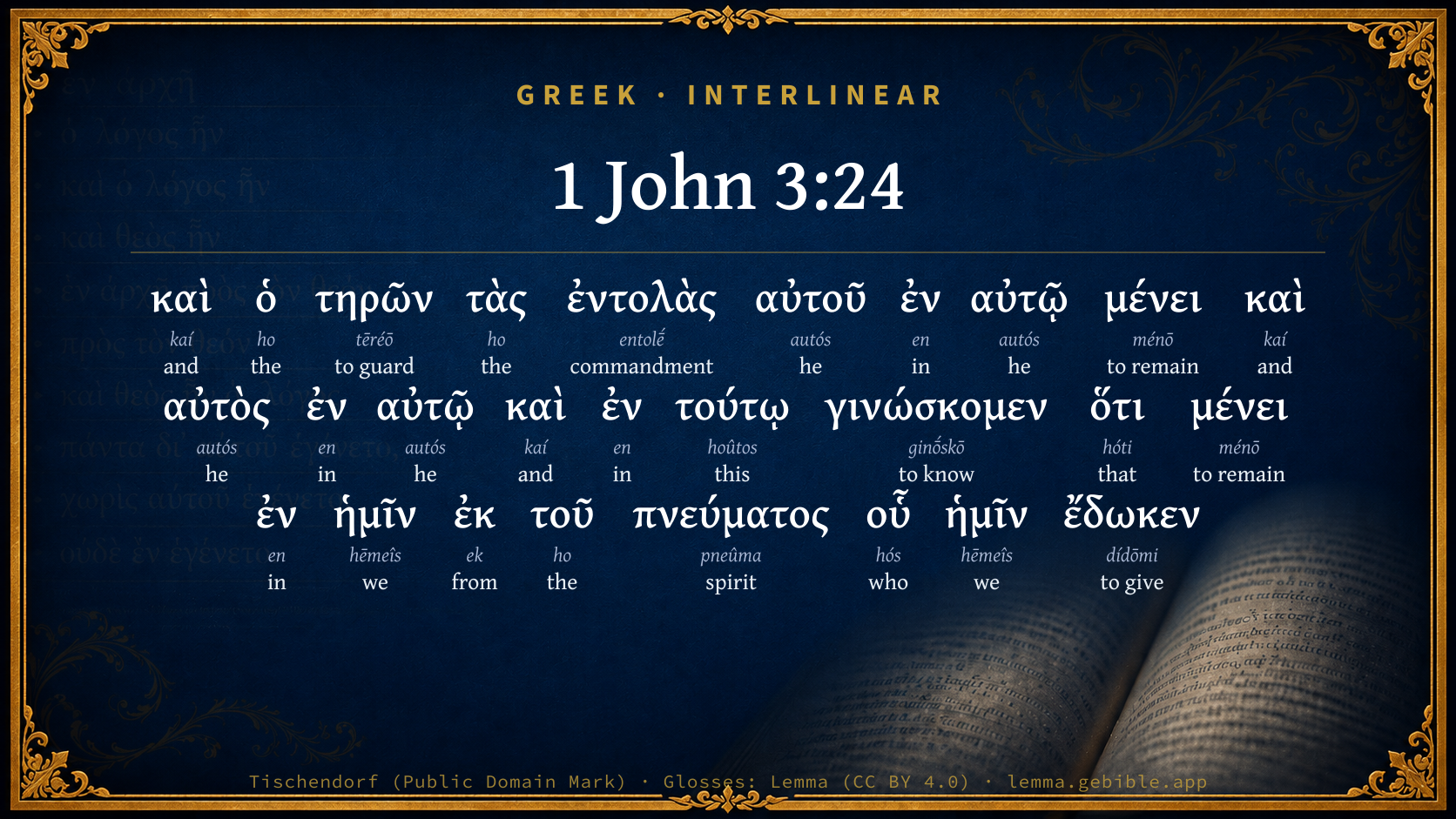
Greek (Tischendorf 8th ed.) 1 John 3:24 appears in the Greek New Testament. The text above is from the Tischendorf 8th edition. Each word links to its Strong’s number and a concise gloss. Click any word for its full Thayer’s Greek Lexicon entry.
Download image
Cite this verse

1 John 3:24 (World English Bible). Public Domain. Lemma interlinear Bible study tool, https://lemma.gebible.app/v/1-john/3/24.

Show BibTeX & RIS
BibTeX
RIS
English Translation
He who keeps his commandments remains in him, and he in him. By this we know that he remains in us, by the Spirit which he gave us.
World English Bible · Public Domain
Download a study sheet

One document with this verse’s original text, its word-by-word gloss line, the meaning frame, cross-references with their text, attributed commentary, and full source and license credits — printable, and it pastes into notes with its structure intact.

This verse Autodidact and up

Study sheet (.html) Plain text (.txt)

A passage Seminary Student

Up to 50 verses in one chapter. A passage sheet keeps up to 6 commentary sources and 12 cross-references per verse, in the order this page ranks them, and says so on the sheet whenever that leaves anything out. Ask for a single verse and you get the Autodidact verse sheet above.

Everything on this page stays free to read, with no account — the sheet is a download of what is already on screen, not access to it.

Want to remove ads? Support Godless Engineer
Compare translations 3

The same verse in 3 English versions, stacked beneath the original-language interlinear above. Click any original word for its lexicon entry.

Each is an independent rendering of the whole verse — the interlinear is not word-aligned to these translations.

Highlighted words mark where these versions differ — a whole-verse word diff, not a word-by-word alignment.

  • World English Bible Public Domain
    He who keeps his commandments remains in him, and he in him. By this we know that he remains in us, by the Spirit which he gave us.
  • King James Version Public Domain
    And he that keepeth his commandments dwelleth in him, and he in him. And hereby we know that he abideth in us, by the Spirit which he hath given us.
  • unfoldingWord Literal Text CC BY-SA 4.0
    And the one keeping his commandments remains in him, and he in him. And in this we know that he remains in us, from the Spirit whom he gave to us.

unfoldingWord Literal Text — © unfoldingWord, licensed CC BY-SA 4.0. Word-aligned USFM3 via Door43 (git.door43.org/unfoldingWord/en_ult).

Versions to compare (up to 4)

3 of 4 selected

Show all 19 translations

Every available English version of this verse, each an independent rendering of the whole verse.

  • World English Bible Public Domain
    He who keeps his commandments remains in him, and he in him. By this we know that he remains in us, by the Spirit which he gave us.
  • Berean Standard Bible Public Domain
    Whoever keeps His commandments remains in God, and God in him. And by this we know that He remains in us: by the Spirit He has given us.
  • Majority Standard Bible Public Domain
    Whoever keeps His commandments remains in God, and God in him. And by this we know that He remains in us: by the Spirit He has given us.
  • King James Version Public Domain
    And he that keepeth his commandments dwelleth in him, and he in him. And hereby we know that he abideth in us, by the Spirit which he hath given us.
  • American Standard Version (1901) Public Domain
    And he that keepeth his commandments abideth in him, and he in him. And hereby we know that he abideth in us, by the Spirit which he gave us.
  • Revised Version (1885) Public Domain
    And he that keepeth his commandments abideth in him, and he in him. And hereby we know that he abideth in us, by the Spirit which he gave us.
  • Geneva Bible (1599) Public Domain
    For hee that keepeth his commandements, dwelleth in him, and he in him: and hereby we knowe that hee abideth in vs, euen by that Spirit which he hath giuen vs.
  • Douay-Rheims (1899) Public Domain
    And he that keepeth his commandments, abideth in him, and he in him. And in this we know that he abideth in us, by the Spirit which he hath given us.
  • Young's Literal Translation Public Domain
    and he who is keeping His commands, in Him he doth remain, and He in him; and in this we know that He doth remain in us, from the Spirit that He gave us.
  • Literal Standard Version CC BY-SA 4.0
    and he who is keeping His commands, remains in Him, and He in him; and in this we know that He remains in us, from the Spirit that He gave us.
  • Unlocked Literal Bible CC BY-SA 4.0
    The one who keeps God's commandments remains in him, and God remains in him. By this we know that he remains in us, by the Spirit whom he gave to us.
  • unfoldingWord Literal Text CC BY-SA 4.0
    And the one keeping his commandments remains in him, and he in him. And in this we know that he remains in us, from the Spirit whom he gave to us.
  • Darby Bible Public Domain
    And he that keeps his commandments abides in him, and he in him. And hereby we know that he abides in us, by the Spirit which he has given to us.
  • World Messianic Bible Public Domain
    He who keeps his commandments remains in him, and he in him. By this we know that he remains in us, by the Spirit which he gave us.
  • Webster's Bible Public Domain
    And he that keepeth his commandments, dwelleth in him, and he in him. And by this we know that he abideth in us, by the Spirit which he hath given us.
  • Free Bible Version CC BY-SA 4.0
    Those who keep his commands continue to live in him, and he lives in them. We know that he lives in us by the Spirit he has given us.
  • Bible in Basic English Public Domain
    He who keeps his laws is in God and God is in him. And the Spirit which he gave us is our witness that he is in us.
  • Text-Critical English NT CC BY 4.0
    Whoever keeps his commandments abides in God, and God abides in him. And we know that he abides in us because of the Spirit he has given us.
  • Tyndale New Testament (1534) Public Domain
    And he that kepeth his commaundementes dwelleth in him and he in him: and therby we knowe that ther abydeth in vs of the sprete which he gave vs.

Literal Standard Version (2020), Covenant Press — licensed CC BY-SA 4.0. Text via the HelloAO Bible API (eBible.org). Unlocked Literal Bible (unfoldingWord) — licensed CC BY-SA 4.0. Text via the HelloAO Bible API (eBible.org). unfoldingWord Literal Text — © unfoldingWord, licensed CC BY-SA 4.0. Word-aligned USFM3 via Door43 (git.door43.org/unfoldingWord/en_ult). Free Bible Version, Dr. Jonathan Gallagher — licensed CC BY-SA 4.0. Text via the HelloAO Bible API (eBible.org).

Word by word

More ways to search: Search by grammar → Find every occurrence → Compare this word →

Practice this passage: Drill this verse → Learn its vocabulary →

ἐντολὰς
entolḗ
G1785
“commandment”
Noun, Accusative, Plural, Feminine
Part of Speech
Noun
Case
Accusative
Number
Plural
Gender
Feminine
Full Thayer's Definition

Origin: from G1781

TDNT: 11:05,2

1. an order, command, charge, precept, injunction a. that which is prescribed to one by reason of his office 2. a commandment a. a prescribed rule in accordance with which a thing is done 1. a precept relating to lineage, of the Mosaic precept concerning the priesthood 2. ethically used of the commandments in the Mosaic law or Jewish tradition
  1. καὶ kaí G2532 “and” Conjunction
  2. ὁ ho G3588 “the” Article, Nominative, Singular, Masculine
  3. τηρῶν tēréō G5083 “to guard” Verb, Present, Active, Participle, Nominative, Singular, Masculine
  4. τὰς ho G3588 “the” Article, Accusative, Plural, Feminine
  5. αὐτοῦ autós G846 “he” Personal pronoun, Genitive, Singular, Masculine
  6. ἐν en G1722 “in” Preposition
  7. αὐτῷ autós G846 “he” Personal pronoun, Dative, Singular, Masculine
  8. μένει ménō G3306 “to remain” Verb, Present, Active, Indicative, 3rd person, Singular
  9. καὶ kaí G2532 “and” Conjunction
  10. αὐτὸς autós G846 “he” Personal pronoun, Nominative, Singular, Masculine
  11. ἐν en G1722 “in” Preposition
  12. αὐτῷ autós G846 “he” Personal pronoun, Dative, Singular, Masculine
  13. καὶ kaí G2532 “and” Conjunction
  14. ἐν en G1722 “in” Preposition
  15. τούτῳ hoûtos G3778 “this” Demonstrative pronoun, Dative, Singular, Neuter
  16. γινώσκομεν ginṓskō G1097 “to know” Verb, Present, Active, Indicative, 1st person, Plural
  17. ὅτι hóti G3754 “that” Conjunction
  18. μένει ménō G3306 “to remain” Verb, Present, Active, Indicative, 3rd person, Singular
  19. ἐν en G1722 “in” Preposition
  20. ἡμῖν hēmeîs G2249 “we” Personal pronoun, 1st person, Dative, Plural
  21. ἐκ ek G1537 “from” Preposition
  22. τοῦ ho G3588 “the” Article, Genitive, Singular, Neuter
  23. πνεύματος pneûma G4151 “spirit” Noun, Genitive, Singular, Neuter
  24. οὗ hós G3739 “who” Relative pronoun, Genitive, Singular, Neuter
  25. ἡμῖν hēmeîs G2249 “we” Personal pronoun, 1st person, Dative, Plural
  26. ἔδωκεν dídōmi G1325 “to give” Verb, Aorist, Active, Indicative, 3rd person, Singular

About this verse

These counts appear in no published source. They are computed here, from the morphology-tagged text and Lemma’s own curated glosses. What Lemma adds →

27
words
15
distinct lemmas
General Epistles
section

Repetition

Words recur within this verse:

Cross-references

15

Topical passages linked to 1 John 3:24 in the Treasury of Scripture Knowledge — connected by theme and wording, ordered by reader-vote popularity; previews shown in the World English Bible.

  • 1 Corinthians 3:16 Don't you know that you are a temple of God, and that God's Spirit lives in you?
  • 1 John 4:15–16 Whoever confesses that Jesus is the Son of God, God remains in him, and he in God.
  • 1 John 4:12–13 No one has seen God at any time. If we love one another, God remains in us, and his love has been perfected in us.
  • 1 Corinthians 6:19 Or don't you know that your body is a temple of the Holy Spirit which is in you, which you have from God? You are not your own,
  • 2 Timothy 1:14 That good thing which was committed to you, guard through the Holy Spirit who dwells in us.
  • 1 John 2:6 he who says he remains in him ought himself also to walk just like he walked.
  • John 14:21–23 One who has my commandments, and keeps them, that person is one who loves me. One who loves me will be loved by my Father, and I will love him, and will reveal myself to him."
  • Romans 8:9–17 But you are not in the flesh but in the Spirit, if it is so that the Spirit of God dwells in you. But if any man doesn't have the Spirit of Christ, he is not his.
  • John 17:21 that they may all be one; even as you, Father, are in me, and I in you, that they also may be one in us; that the world may believe that you sent me.
  • 1 John 4:7 Beloved, let us love one another, for love is of God; and everyone who loves is born of God, and knows God.
  • John 6:54–56 He who eats my flesh and drinks my blood has eternal life, and I will raise him up at the last day.
  • John 15:7–10 If you remain in me, and my words remain in you, you will ask whatever you desire, and it will be done for you.
  • 2 Corinthians 6:16 What agreement has a temple of God with idols? For you are a temple of the living God. Even as God said, "I will dwell in them, and walk in them; and I will be their God, and they will be my people."
  • Galatians 4:5–6 that he might redeem those who were under the law, that we might receive the adoption of children.
  • 1 John 3:22 and whatever we ask, we receive from him, because we keep his commandments and do the things that are pleasing in his sight.

Cross-references courtesy of OpenBible.info (CC BY 4.0).

Commentary

Notes on 1 John 3:24 from classic Christian and Jewish commentators (each source and its license shown beneath its notes). The classic Christian expositions comment on the surrounding passage and are grouped to its opening verse, so a note may address several verses; the Jewish commentaries on the Tanakh (Rashi and others) are per-verse, so they appear only where the commentator wrote on this verse.

Lemma curates 59 commentaries, every one of them public domain or Creative Commons licensed, each selected and text-cleaned for this edition rather than reprinted as found. About our sources →

The Biblical Illustrator

Joseph S. Exell

1Jn_3:24

And he that keepeth His commandments dwelleth in Him, and He in him.

And hereby we know that He abideth in us, by the Spirit which He hath given us

Our abiding in God by obedience

1. In the keeping of Gods commandments there is this great reward, that he that doeth so dwelleth in God, and God in him. If this mutual indwelling is not to be mere absorption, which some dreamers in Johns day held it to be; if it is not to be the swallowing up of our conscious individual personality in the infinite mind or intelligence of God; if it is to conserve the distinct relationship of God to man, the Creator to the creature, the Ruler to the subject, the Father to the child; it must be realised and must develop itself, or act itself out, through the means of authority or law on the one side, and obedience or the keeping of the commandments on the other. It is, in fact, the very consummation and crown of mans old, original relation to God--as that relation is not only restored, but perfected and gloriously fulfilled, in the new economy of grace.

2. The manner of Gods abiding in us, or at least the way in which we may know that He abides in us, is specified:--Hereby we know that He abideth in us, by the Spirit which He hath given us. We are to distinguish here between our dwelling in God and His dwelling in us. Our dwelling in God is to be known by our keeping His commandments; Gods dwelling in us, by the Spirit which He giveth us. And yet, the two means of knowledge are not far apart. They are not only strictly consistent with one another; they really come together in one point. For the Spirit is here said to be given to us--not in order to our knowing that God abideth in us, in the sense of His opening our spiritual eye and quickening our spiritual apprehension--but rather as the medium of our knowing it, the evidence or proof by which we know it. And how are we to recognise the Spirit as given to us? How otherwise than by recognising the fruit of the gift? The Spirit given to us is, as to His movement or operation, unseen and unfelt. But the fruit of the Spirit is palpable and patent. It is love, joy, peace, long suffering, gentleness, goodness, faith, meekness, temperance. For against such there is no law (Gal_5:22-23).

3. From all this it follows that the counsel or warning, Believe not every spirit, but try the spirits whether they be of God (1Jn_4:1), is as needful for us as it was for those to whom John wrote. We may think that it is the Spirit of God whom we are receiving into our hearts and cherishing there, when it may really be another spirit altogether--one of the many spirits inspiring the many false prophets that are gone out into the world. Therefore we must try the spirits. (R. S. Candlish, D. D.)

Of the manner and importance of the Spirits indwelling

I. What the giving of the spirit imports and signifies. The Spirit of God is said to come upon men in a transient way, for their present assistance in some particular service, though in themselves they be unsanctified persons. Thus the Spirit of God came upon Balaam (Num_24:2), enabling him to prophesy of things to come. But whatever gifts He gives to others, He is said to be given, to dwell, and to abide only in believers (1Co_3:6). An expression denoting both His special propriety in them, and gracious familiarity with them. There is a great difference betwixt the assisting and the indwelling of the Spirit; the one is transient, the other permanent.

II. How this giving of the Spirit evidently proves and strongly concludes that souls interest in Christ unto whom He is given.

1. The Spirit of God in believers is the very bond by which they are united unto Christ. If, therefore, we find in ourselves the bond of union, we may warrantably conclude that we have union with Jesus Christ.

2. The Scripture everywhere makes this giving, or indwelling of the Spirit, the great mark and trial of our interest in Christ; concluding from the presence of it in us, positively, as in the text; and from the absence of it, negatively, as in Rom_8:1-39.

3. That which is a certain mark of our freedom from the covenant of works, and our title to the privileges of the covenant or grace, must needs also infer our union with Christ and special interest in Him; but the giving or indwelling of the sanctifying Spirit in us is a certain mark of our freedom from the first covenant, under which all Christless persons still stand, and our title to the special privileges of the second covenant, in which none but the members are interested; and, consequently, it fully proves our union with the Lord Jesus.

4. If the eternal decree of Gods electing love be executed, and the virtues and benefits of the death of Christ applied by the Spirit unto every soul in whom He dwelleth, as a spirit of santification, then such a giving of the Spirit unto us must needs be a certain mark and proof of our special interest in Christ; but the decree of Gods electing love is executed, and the benefits of the blood of Christ are applied to every soul in whom He dwelleth, as a spirit sanctification. This is plain from 1Pe_1:2.

5. The giving of the Spirit to us, or His residing in us, as a sanctifying Spirit, is everywhere in Scripture made the pledge and earnest of eternal salvation, and consequently must abundantly confirm and prove the souls interest in Christ (Eph_1:13-14). Uses: I shall lay down some general rules for the due information of our minds in this point, upon which so much depends.

(1) Though the Spirit of God be given to us, and worketh in us, yet He worketh not as a natural and necessary, but as a free and arbitrary agent: He neither assists nor sanctifies, as the fire burneth, as much as He can assist and sanctify, but as much as He pleaseth; dividing to every man severally as He will (1Co_12:11).

(2) There is a great difference in the manner of the Spirits working before and after the work of regeneration. Whilst we are unregenerate He works upon us as upon dead creatures that work not at all with Him; and what motion there is in our souls is a counter motion to the Spirit; but after regeneration it is not so, He then works upon a complying and willing mind; we work, and He assists (Rom_8:26).

(3) Though the Spirit of God be given to believers, and worketh in them yet believers themselves may do or omit such things as may obstruct the working and obscure the very being of the Spirit of God in them.

(4) Those things which discover the indwelling of the Spirit in believers are not so much the matter of their duties, or substance of their actions, as the more secret springs, holy aims, and spiritual manner of their doing or performing of them.

(5) All the motions and operations of the spirit are always harmonious, and suitable to the written Word. (Isa_8:20).

(6) Although the works of the Spirit, in all sanctified persons, do substantially agree, both with the written Word and with one another, yet as to the manner of infusion and operation there are found many circumstantial differences.

(7) There is a great difference found betwixt the sanctifying and the comforting influences of the Spirit upon believers, in respect of constancy and permanency.

Evidence 1. In whomsoever the Spirit of Christ is a Spirit of sanctification, to that man or women He hath been, more or less, a Spirit of conviction and humiliation.

Evidence 2. As the Spirit of God hath been a convincing, so He is a quickening Spirit, to all those to whom He is given (Rom_8:2).

Evidence 3. These to whom God giveth His Spirit have a tender sympathy with all the interests and concernments of Christ.

Evidence 4. Wherever the Spirit of God dwelleth, He doth in some degree mortify and subdue the evils and corruptions of the soul in which He resides.

Evidence 5. Wherever the Spirit of God dwelleth in the way of sanctification, in all such He is the Spirit of prayer and supplication (Rom_8:26).

Evidence 6. Wherever the Spirit of grace inhabits, there is an heavenly, spiritual frame of mind accompanying and evidencing the indwelling of the Spirit (Rom_8:5-6).

Evidence 7. Those to whom the Spirit of grace is given are led by the Spirit, Sanctified souls give themselves up to the government and conduct of the Spirit; they obey His voice, beg His direction, follow His motions, deny the solicitations of the flesh and blood, in obedience to Him (Gal_1:16). And they that do so, they are the sons of God. (John Flavel.)

The indwelling of God

I. The privilege. It is the indwelling of God in the soul--His abiding in us. The sentiment is not peculiar to John, but the frequency of it is. Let us look at this abiding. There was a time when the persons here referred to were without God in the world; when another being had possession of them--the prince of the power of the air, the spirit that now worketh in the children of disobedience. But God hath delivered them from the power of darkness, and translated them into the kingdom of His dear Son. God has entered, and taken possession of the heart. Perhaps, too, after the parent had pleaded to no purpose; perhaps after the minister had long laboured for nought; perhaps after he had been wooed and awed, blest and chastised, in vain. Then, God says, I will work, and who shall let it? His abiding in us supposes not only entrance, but continuance. But how does He abide in them? If I should answer this question negatively, I should say, not personally, as it was in the Redeemer Himself. In Him, says the apostle, dwelleth all the fulness of the Godhead bodily. He that hath seen Me, said He, hath seen the Father. Nor does He abide in them essentially. Thus indeed He is in them, as to the perfection of His nature, as to His Omnipresence, as to the presence by which He fills heaven and earth; but when His presence is spoken of by the way of providence or privilege, it intends some peculiar regard. The Lord is nigh unto all those who are of a broken heart; and sayeth such as be of a contrite spirit. But if I am required to answer this question positively, I should say, first, objectively. He dwells in His people by a real union; a gracious union; by a spiritual operative influence in all the powers of their souls. Thus He dwells in them as water in a well, our Saviours own image. The water that I shall give him shall be in him, a well of water springing up into everlasting life. He dwells in them as the sap in the tree, sustaining its life and producing fertility. He dwells in them as the soul dwells in the body, enlivening every limb and pervading every part. Can you explain this? Why the doctrine of union is one of the hardest chapters in all natural philosophy? First, explain to me how the soul is in the body; the spirit, without parts, combining with matter and coalescing with substance; explain first, how God is in the highest heavens, and is also about our path, and about our bed, and spying out all our ways, words, and thoughts.

II. How it is to be ascertained. The apostle says, We know that He abideth in us by the Spirit which He hath given us. Now, what was the Spirit God had given to them? Not the Spirit of miraculous agency. No, but the Spirit which we call the common influences of the Spirit of God. We call it common, not because all men have it, but because all Christians have it; and all Christians will experience it to the very end of time. But as the thing exemplified should always be plainer than the thing proved, let us inquire what manner of spirit that is which evinces the privilege of union with God? We know that He abideth in us, by the Spirit which He hath given us. I am aware the Spirit is said to anoint us; He is said to seal us to the day of redemption; and to bear witness with our spirits, that we are the children of God. But this is not done by the sounds in the air, and by sudden impulses in the mind, but by His residing in us. Our having this Spirit is the anointing; our having this Spirit is the sealing; and our having it is the witness. This Spirit is known by five attributes.

1. It is the Spirit of conviction; and the process is generally this:--He first convinces of the guilt of sin; then of its pollution; and then awakens in us a sense of its abhorrence; causing us to repent before God as in dust and ashes.

2. It is the Spirit of faith. The work of the Spirit puts the man into the position of looking to Christ, and of coming to Christ, and of dealing with Christ, concerning all the affairs of the soul and eternity. When He is come, says the Saviour, He shall glorify me.

3. It is the Spirit of grace. It is expressly called the Spirit of grace and of supplication, which was to be poured upon the house of David and upon the inhabitants of Jerusalem.

4. It is a Spirit of sanctification. Hence, He is so often called the Holy Spirit, and in one place, the Spirit of holiness,

5. It is the Spirit of affection. We read therefore of the Spirit of love. He that loveth Him that begat, says John, loveth Him also that is begotten of Him. And, says the Saviour, By this shall all men know that ye are My disciples, if ye have love one to another.

III. The usefulness of this subject.

1. The subject is useful to induce us to adore the condescension of God. David was struck with this; he was astonished that God should try man and visit him. Solomon was still more struck with His dwelling with man, Will God in very deed dwell with man upon earth? But John goes further than this, and speaks of God as not only visiting man, as not only dwelling with man, but of His abiding in him! Who is a God like unto Thee?

2. This subject is useful, also, as it reproves those who think there is nothing in religion connected with certainty. There are marks enough, if you are in the way everlasting, to show that you are not in a mistaken direction, but in a right road.

3. This subject is useful also, as it censures those who seek to determine their religious state by any other standard than that which is Divine. If any man have not the Spirit of Christ, he is none of His.

4. Then this subject is useful to comfort those who are partakers of the Holy Ghost. They should rejoice in the Lord always.

5. Lastly, let us turn the medal, and then we shall see the subject is useful to alarm those who, as the apostle terms it, are sensual, not having the Spirit of God in you. Have you the Spirit?--the spirit of prayer, and the spirit of love, and the spirit of meekness? Rather, have you not a proud spirit? an ungrateful spirit? a careless spirit? a revengeful spirit? or a covetous spirit? This spirit cometh not from Him that calleth you. And if you have nothing better to actuate you than this, you are in the gall of bitterness and in the bond of iniquity. (W. Jay.)

The abiding witness

Some persons crave for Christian assurance under a mistaken apprehension of its nature. They seem to regard it as something over and above the ordinary processes of grace. The assurance of faith is simply an exalted and confirmed faith, and rests therefore on the promises which are the common foundation of all faith. There are persons, on the other hand, who shrink from the name of assurance, and repudiate the thing as if it were arrogant and presumptuous. If our salvation were our own work, or if it were half our own work and half Gods work; if our own wisdom, strength, or righteousness had anything whatever to do with the meritorious grounds of our acceptance, the scruple would be a just one. But the work is altogether Gods work. Hence to doubt the full completion of the work is to doubt God, not ourselves.

I. The dignity, not only of the state of the saint, but also of the evidence by which he is assured of it. This state consists in the abiding presence of God; and this not only above us and around us, but in us. He who is Omnipotent, Omniscient, Omnipresent--the Creator who called this world into being--the Preserver, who maintains it in being--the King who rules and governs us--the Judge before whose tremendous throne we shall hereafter stand to give an account of the things we have done in the body--that God who is Indivisible, but is everywhere at once, the whole Deity with power and wisdom, majesty and truth, with every attribute and glory complete--He, He Himself, dwells within the saints. He dwells--not flashing a ray of His glory now and then, breaking the natural darkness of the soul for a moment, and then leaving it again darker than before, but abiding there, dwelling--like the sun in the heavens, with His beams hidden, it may be, sometimes with earthly clouds and mists, but like the sun behind the clouds filling the soul, as in ancient times He filled the material temple, with the glory of His presence. Yet let us take care not to mistake this matter. The cleansing blood of Christ must be sprinkled upon us, and in that fountain opened for sin and for uncleanness must we be washed from the guilt of sin; the quickening power of the Holy Ghost must have descended upon us, dispelled the darkness, broken down the strength and taken away the love of sin, before this state can be ours. But even when this is done, the motions of sin still remain. Sanctification is so imperfect here below, our strongest faith so feeble, our brightest hope so dim, our most fervent love so cold and selfish, our waywardnesses and inconsistencies so many, that it is wonderful that God should dwell within such hearts. Yet, child of God, it is the sober, literal fact.

II. With this dignity we must combine the definite clearness of the test, which proves our possession of it, for we might otherwise find great difficulty. Hereby we know--by what? The word hereby is not to be thrown forward as a mere synonym for the words by the Spirit whom He hath given us; but it is to be thrown back to the words, He that keepeth His commandments. Hereby--namely, by keeping His commandments--we know. We have great cause to bless God for thus resting our hopes on our obedience, which every honest mind can see and recognise. The lesson draws close and indissoluble the connection between faith and holiness, the heart and the life, the religion and the character and conduct. It makes Christianity to be a real practical working power. Step by step, link by link, assurance of faith and hope is inseparably united to practical holiness of life. Yet there are one or two cautions to be borne in mind. The obedience which is the proof of the Spirits presence is not a holiness finished or perfect; otherwise it would belong to none of us on this side heaven; it would be a hope of the future, not a blessing of the present. It is not a finished holiness, but only a holiness begun. The will is like a river which here and there beneath an overhanging bank may seem to stand still, and here and there in some narrow bay may seem to retrograde, but which in its main current still sets slowly, but surely, towards the ocean. It is, further, a holiness not complete, but progressive. Every day brings its struggle, but brings likewise its victory. Further yet, this Christian obedience is not partial. Christian obedience accepts and follows the whole law.

III. The infinite blessedness both of the state and of the evidence. If Christian obedience were an outward and compulsory thing, bringing by mere force the unwilling heart into subjection to the letter of a law, it would be painful. But it is not this. It is a willing, loving, generous thing. It is a law working from within the soul itself, not a compulsion from the outside. It is not like a stream of water thrown from without upon us, but like a living fountain springing up within us--a well of water springing up into everlasting life. And why is it this, but because it is the Spirits work, and because God abideth in us? Is there not always joy in life? Is there not joy in natures life, as, bursting the chains of death-like winter, happy creation breaks into beauty, and flowers and fruits and trees and birds sing together? Is there not joy in human life when, fresh and sweet as a spring flower, the buoyant child laughs, and sings, and plays? Is there not joy in the sense of life, and only so far pain in it as the mortality of a fallen nature interrupts it with the seeds of decay, and clouds it with the shadows of death? And is there not joy in the life of the soul, since it is the very life of God fresh from the indwelling Deity, as if He became a part of ourselves and filled us with His glory? (Canon Garbett.)

.

The Biblical Illustrator, edited by Joseph S. Exell (c. 1880s–1900s) — public domain. Text from a community e-Sword module.

Bengel's Gnomon

Johann Albrecht Bengel

1Jn 3:24. Ἐκ τοῦ Πνεύματος, from or by the Spirit) This is the first mention of the Holy Spirit in this Epistle, in accordance with the Divine economy here, as also in the Gospel of John, Joh 14:1-3; Joh 14:26. And in this verse there is a kind of transition to the discussion respecting the Holy Spirit, which follows immediately in the beginning of ch. 4. It is given to us by the Spirit, and it is the Spirit which is given.

Bengel's Gnomon of the New Testament — English translation (T&T Clark, Edinburgh, 1860) — public domain. Text from a community e-Sword module.

Meyer's Critical & Exegetical Commentary

Heinrich August Wilhelm Meyer

1Jn_3:24. After the apostle has mentioned the substance of the divine commandment, he describes the keeping of it as the condition of fellowship with God, and states the mark whereby the Christian knows that God is in him.

καί is the simple copula, not = itaque; τὰς ἐντολὰς αὐτοῦ is a resumption of the ἡ ἐντολὴ αὐτοῦ of 1Jn_3:23; the plural is used because the commandment is described as containing two elements; αὐτοῦ = τοῦ Θεοῦ, not Χριστοῦ (Sander, Neander, Besser).

ἐν αὐτῷ μένει κ.τ.λ.] The mention of fellowship with God, which consists in this, that we abide in God and God abides in us,[251] is explained by the purpose of the Epistle.

ΚΑῚ ἘΝ ΤΟΎΤῼ ΓΙΝΏΣΚΟΜΕΝ] ἘΝ ΤΟΎΤῼ is referred by Lücke and Ebrard to the preceding, namely to ΤΗΡΕῖΝ ΤᾺς ἘΝΤΟΛᾺς ΑὐΤΟῦ; but thus there results a superfluous thought, for with the connection which according to the apostle exists between the keeping of Gods commandments and Gods abiding in us, and which he has expressed in the first half of the verse, it is plainly superfluous to say once more that we know the latter by the former; it is, besides, contradicted by the following ἘΚ ΤΟῦ ΠΝΕΎΜΑΤΟς, which has induced Lücke to assume a combination of two trains of thought and an ambiguity of ἘΝ ΤΟΎΤῼ,[252] and Ebrard arbitrarily to supply with ἐκ τ. πνεύματος the words we know; Düsterdieck, de Wette, Erdmann, Braune, etc., refer ἐν τούτῳ to ἐκ τοῦ πνεύματος, so that according to the apostle it is from the πνεῦμα which is given to us that we know that God is in us if we keep His commandments; comp. 1Jn_4:12-13, where the same connection of ideas occurs. The change of the prepositions ἐν and ἐκ is certainly strange, but does not render this interpretation impossible (Ebrard); for, on the one hand, the form: ἐν τούτῳ γινώσκομεν, is too familiar to the apostle not to have suggested itself to him here; and, on the other hand, by ἐκ the πνεῦμα is indicated as the source from which that γινώσκειν flows; besides, the construction with ἐκ appears also in chap. 1Jn_4:6.

By πνεῦμα is here to be understood, just as by χρῖσμα in chap. 1Jn_2:20, the Holy Ghost, who lives and works in the believer, but not, with Socinus, the disposition or the love produced by Him; or, with de Wette, first of all the true knowledge and doctrine of the person of Jesus. With this verse the apostle makes the transition to the following section, in which, with reference to the false teachers, the distinction is made between the πνεῦμα τοῦ Θεοῦ and the πνεῦμα which is not ἐκ τοῦ Θεοῦ.

[251] When Weiss defines the abiding or being of God in him who keeps His commandments, in this way, that God who is known, or the knowledge of God, is the determining principle of his spiritual life, this seems to weaken the powerful realism of Johns conception; yet Weiss guards himself against this when he says that he does not in any way diminish the divine causality in the act of regeneration, but only means thereby that God accomplishes this act by means of His revelation in Christ, which must be accepted into knowledge.

[252] The two thoughts which Lücke considers as combined here are(1) that we in the keeping of Gods commandments know that we are in fellowship with Him, and (2) that the τηρεῖν τὰς ἐντολάς is nothing else than the expression and operation of the Divine Spirit.It is plainly quite mistaken for Paulus to regard ἐκ τοῦ πνεύματος as the subject belonging to μένει.

Meyer — Critical and Exegetical Commentary on the New Testament — English translation by Peter Christie, edited by Frederick Crombie (T&T Clark, 1880) — public domain. Text from a community e-Sword module.

Expositor's Greek Testament

ed. W. Robertson Nicoll

1Jn 3:24 . τὰς ἐντ . αὐτ ., “the commandments of God,” resuming 1Jn 3:22 . Cf. 1Jn 4:15 . ἐκ , the assurance is begotten of the Spirit; see note on 1Jn 2:21 . οὗ for ὅ , by attraction to the case of the antecedent ( cf. Luk 2:20 ; Rev 18:6 ). ἔδωκεν , “gave,” i.e. , when first we believed. For the thought cf. 2Co 1:21-22 ; Eph 1:13-14 ; also Rom 8:15-16 .

The Expositor's Greek Testament, edited by W. Robertson Nicoll (1897–1910) — public domain. Text from a community e-Sword module.

Geneva Bible (1599)

Geneva Bible translators

He meaneth the Spirit of sanctification whereby we are born anew, and live unto God.

Geneva Bible (1599) marginal notes — public domain. Text via Bolls.life.

Jamieson, Fausset & Brown

Robert Jamieson, A. R. Fausset & David Brown

dwelleth in him--The believer dwelleth in Christ.

and he in him--Christ in the believer. Reciprocity. "Thus he returns to the great keynote of the Epistle, abide in Him, with which the former part concluded" (Jo1 2:28).

hereby--herein we (believers) know that he abideth in us, namely, from (the presence in us of) the Spirit "which He hath given us." Thus he prepares, by the mention of the true Spirit, for the transition to the false "spirit," Jo1 4:1-6; after which he returns again to the subject of love.

Next: 1 John Chapter 4

Jamieson, Fausset & Brown — Commentary Critical and Explanatory on the Whole Bible (1871) — public domain (CC PDM 1.0). Text via the HelloAO Bible API.

Adam Clarke's Commentary

Verse 24. Dwelleth in him] i.e. in God; and he-God, in him-the believer.

And hereby we know] We know by the Spirit which he hath given us that we dwell in God, and God in us. It was not by conjecture or inference that Christians of old knew they were in the favour of God, it was by the testimony of God's own Spirit in their hearts; and this testimony was not given in a transient manner, but was constant and abiding while they continued under the influence of that faith that worketh by love. Every good man is a temple of the Holy Ghost, and wherever he is, he is both light and power. By his power he works; by his light he makes both himself and his work known. Peace of conscience and joy in the Holy Ghost must proceed from the indwelling of that Holy Spirit; and those who have these blessings must know that they have them, for we cannot have heavenly peace and heavenly joy without knowing that we have them. But this Spirit in the soul of a believer is not only manifest by its effects, but it bears its own witness to its own indwelling. So that a man not only knows that he has this Spirit from the fruits of the Spirit, but he knows that he has it from its own direct witness. It may be said, "How can these things be?" And it may be answered, By the power, light, and mercy of God. But that such things are, the Scriptures uniformly attest, and the experience of the whole genuine Church of Christ, and of every truly converted soul, sufficiently proves. As the wind bloweth where it listeth, and we cannot tell whence it cometh and whither it goeth, so is every one that is born of the Spirit: the thing is certain, and fully known by its effects; but how this testimony is given and confirmed is inexplicable. Every good man feels it, and knows he is of God by the Spirit which God has given him.

Adam Clarke's Commentary on the Bible (1810–1826) — public domain. Text from a community e-Sword/MySword module.

John Calvin's Commentaries

24 And he that keepeth his commandments He confirms what I have already stated, that the union we have with God is evident when we entertain mutual love: not that our union begins thereby, but that it cannot be fruitless or without effect whenever it begins to exist. And he proves this by adding a reason, because God does not abide in us, except his Spirit dwells in us. But wherever the Spirit is, he necessarily manifests his power and efficiency. We hence readily conclude, that none abide in God and are united to him, but those who keep his commandments.

When, therefore, he says, and by this we know, the copulative, and, as a reason is here given, is to be rendered, “for,” or, “because.” But the character of the present reason ought to be considered; for though the sentence in words agrees with that of Paul, when he says that the Spirit testifies to our hearts that we are the children of God, and that we through him cry to God, Abba, Father, yet there is some difference in the sense; for Paul speaks of the certainty of gratuitous adoption, which the Spirit of God seals on our hearts; but John here regards the effects which the Spirit produces while dwelling in us, as Paul himself does, when he says, that those are God’s children who are led by the Spirit of God; for there also he is speaking of the mortification of the flesh and newness of life.

The sum of what is said is, that it hence appears that we are God’s children, that is, when his Spirit rules and governs our life. John at the same time teaches us, that whatever good works are done by us, proceed from the grace of the Spirit, and that the Spirit is not obtained by our righteousness, but is freely given to us.

John Calvin's Commentaries (1540-1563) — public domain. Text from the Calvin Translation Society English edition (1840s-50s) via the Christian Classics Ethereal Library (ccel.org). Calvin's coverage is partial (roughly two-thirds of the Bible); uncommented books and verses are honest gaps, never fabricated. The 19th-century editor's footnotes and remarks are omitted so the notes are faithfully Calvin's own voice.

The Cambridge Bible for Schools and Colleges

gen. ed. J. J. S. Perowne

24. And he that keepeth his commandments] This looks back to the same phrase in 1Jn_3:22, not to the conclusion of 1Jn_3:23, which is parenthetical. Therefore ‘His’ means God’s, not Christ’s.

dwelleth in him] Better, abideth in Him: it is S. John’s favourite word, which occurs twice in this verse (see on 1Jn_2:24). “Let God be a home to thee, and be thou a home of God” (Bede). This mutual abiding expresses union of the strongest and closest kind: comp. 1Jn_4:13; 1Jn_4:16; Joh_6:56; Joh_15:4-5. S. John once more insists on what may be regarded as the main theme of this exposition of Christian Ethics; that conduct is not only not a matter of indifference, but is all-important. We may possess many kinds of enlightenment, intellectual and spiritual; but there is no union with God, and indeed no true knowledge of Him, without obedience: comp. 1Jn_1:6, 1Jn_2:4; 1Jn_2:6; 1Jn_2:29, 1Jn_3:6-7; 1Jn_3:9. ‘He that willeth to do His will shall know’ (Joh_7:17).

and hereby] Or, and herein, as in 1Jn_3:16; 1Jn_3:19, 1Jn_2:3; 1Jn_2:5, 1Jn_4:9-10; 1Jn_4:13; 1Jn_4:17, 1Jn_5:2. This probably refers to what follows; but the change of preposition in the Greek, a change obliterated in both A. V. and R. V., renders this not quite certain. S. John writes, not ‘hereby we know … by the Spirit’ (which would place the connexion beyond a doubt), but ‘herein (ἐν) we know … from (ἐκ) the Spirit’.

we know] Literally, we come to know; it is a matter of Christian experience.

by the Spirit] Better, from the Spirit: this is the source from which the knowledge is derived. This is the first mention of the Spirit in the Epistle, although He is alluded to in 1Jn_2:20.

which he hath given us] Or, which He gave us. The verb is aorist, not perfect; and though this is a case where the English perfect might represent the Greek aorist, yet as the Apostle probably refers to the definite occasion when the Spirit was given, the aorist seems better. This occasion in S. John’s case would be Pentecost, in that of his readers, their baptism. Thus in our Baptismal Service we are exhorted to pray that the child “may be baptized with water and the Holy Ghost”; and in what follows we pray, “wash him and sanctify him with the Holy Ghost”; and again, “give Thy Holy Spirit to this infant, that he may be born again”: after which follows the baptism.

It would be possible to translate ‘by the Spirit of which He has given us’, a partitive genitive, meaning ‘some of which’ as in Macbeth, I. iii. 80,

“The earth hath bubbles as the water has,

And these are of them”.

And in Bacon’s Essays, Of Atheisme, “You shall have of them, that will suffer for Atheisme, and not recant”. But the Greek genitive here is probably not partitive but the result of attraction. S. John commonly inserts a preposition (ἐκ) with the partitive genitive (2Jn_1:4; Joh_1:24; Joh_7:40; Joh_16:17; Rev_2:10; Rev_11:9; comp. Joh_21:10). Tyndale here translates ‘Therby we knowe that ther abydeth in us of the sprete which He gave us’, making ‘of the Spirit’ (= a portion of the Spirit) the nominative to ‘abideth’; which is grammatically possible, but scarcely in harmony with what precedes. The change from Tyndale’s rendering to the one adopted in A. V., and (with change of ‘hath given’ to ‘gave’) in R. V. also, is due to Coverdale.

Once more (see note between 1Jn_2:28-29 and on 1Jn_3:10) we are led to a fresh section almost without knowing it. In the last six verses of this chapter (19–24) the transition from verse to verse is perfectly smooth and natural; so also in the previous six verses (13–18). Nor is the transition from 1Jn_3:18 to 1Jn_3:19 at all violent or abrupt. By a very gradual movement we have been brought from the contrast between love and hate to the gift of the Spirit. And this prepares the way for a new subject; or rather for an old subject treated from a new point of view. Like the doublings of the Maeander near which he lived, the progress of the Apostle at times looks more like retrogression than advance: but the progress is unmistakable when the whole field is surveyed. Here we seem to be simply going back to the subject of the antichrists (1Jn_2:18-28); but whereas there the opposition between the Holy Spirit in true believers and the lying spirit in the antichrists is only suggested (1Jn_2:20; 1Jn_2:22; 1Jn_2:27), here it is the dominant idea.

The Cambridge Bible for Schools and Colleges (gen. ed. J. J. S. Perowne; Cambridge University Press, 1878–1918) — public domain. Text from a community e-Sword module.

Trapp's Complete Commentary

John Trapp

24 And he that keepeth his commandments dwelleth in him, and he in him. And hereby we know that he abideth in us, by the Spirit which he hath given us.

Ver. 24. By the Spirit] Christ hath satisfied the wrath of the Father; and now the Father and Christ both, as reconciled, send the Spirit, as the fruit of both their loves, to inherit our hearts. And truly, next unto the love of Christ indwelling in our nature, we may well wonder at the love of the Holy Ghost that will dwell in our defiled souls.

John Trapp, A Commentary or Exposition upon All the Books of the Old and New Testament (1647–1656) — public domain. Text from a community e-Sword module.

Albert Barnes' Notes on the Bible

And he that keepeth his commandments ... - See the notes at Joh 14:23.

And hereby we know that he abideth in us - That is, this is another certain evidence that we are true Christians. The Saviour had promised Joh 14:23 that he would come and take up his abode with his people. John says that we have proof that he does this by the Spirit which he has given us. That is, the Holy Spirit is imparted to his people to enlighten their minds; to elevate their affections; to sustain them in times of trial; to quicken them in the performance of duty; and to imbue them with the temper and spirit of the Lord Jesus. When these effects exist, we may be certain that the Spirit of God is with us; for these are the “fruits” of that Spirit, or these are the effects which he produces in the lives of men. Compare the notes at Gal 5:22-23. On the evidence of piety here referred to, see the notes at Rom 8:9, Rom 8:14, Rom 8:16. No man can be a true Christian in whom that Spirit does not constantly dwell, or to whom he is not “given.” And yet no one can determine that the Spirit dwells in him, except by the “effects” produced in his heart and life. In the following chapter, the apostle pursues the subject suggested here, and shows that we should examine ourselves closely, to see whether the “Spirit” to which we trust, as furnishing evidence of piety, is truly the Spirit of God, or is a spirit of delusion.

Albert Barnes' Notes on the Bible (1834–1885) — public domain. Text from a community e-Sword/MySword module.

Haydock's Catholic Bible Commentary

We know that he abideth in us, by the Spirit which he hath given us. These words may be either referred to the body of the Church in general or to the apostles, or to every one in particular. It is certain that God gave his Spirit to his Church and to the apostles, by the coming of the Holy Ghost in a visible manner, and by the miraculous gifts bestowed upon the apostles; but every one in particular has only a moral certainty that he has the Spirit of God, and his sanctifying grace in his soul. (Witham)

George Leo Haydock (1774–1849), Haydock's Catholic Family Bible and Commentary, 1859 edition — public domain. Excludes Psalms (Douay-Rheims chapter numbering differs from Protestant) and Deuterocanonical books (Catholic canon only).

Matthew Poole's English Annotations

He that keepeth his commandments, i.e. he whose whole soul is thus formed to obediential compliance with the Divine will,

dwelleth in him; hath most intimate union with God in Christ; which is evident by that Spirit given to us, which hath effected both that holy frame, and that union: see Joh 14:23.

Matthew Poole's English Annotations on the Holy Bible (1683–1685) — public domain. Text from a community e-Sword/MySword module.

Whedon's Commentary on the Bible

Daniel D. Whedon

24. Keepeth his commandments—Our apostle is no Nicolaitan, and no antinomian. This keeping the commandments before the eyes of men, in the spirit of faith and love, is the best profession and showing forth of our holiness to the world that we can make. And all our state thus attained we may finally know… by the Spirit, the direct testimony given by him in our hearts uniting with the testimony of our open practical life.

Daniel D. Whedon (gen. ed.), Commentary on the Old and New Testaments (1874–1909) — public domain. Text from a community e-Sword module.

The Pulpit Commentary

We are again in doubt as to whether aujtou and aujtov refer to God the Father or to Christ. The former seems better on account of verse 22; but the latter may be right. (Joh_14:15 Joh_15:5) Compare theconclusion of the first main division. (1Jn_2:24-28) In this (or, hereby) probably refers to what follows; the ejn does not disprove this, in spite of the ejk which follows. St. John has combined two constructions: "In this we know in that ejn toutw ginwskomen oti, as in verse 16; and "From this we know from ejk toutou ginwskomen ejk tou; 1Jn_4:6. From the Spirit which he gave us. "He" is probably the Father, (Joh_14:16, Joh_14:17) and the aorist e]dwken refers to the special occasion of Pentecost. Hitherto St. John has mentioned only the Father and the Son; now the Spirit also (alluded to in 1Jn_2:20, 1Jn_2:27) is introduced by name as a witness and test of the truth. The sentence forms the transition to the subject of the next section, (1Jn_4:1-6) which is a sort of digression, the subject of love being mentioned in verse 7. This verse is said to have been a favourite with Spinoza.

The Pulpit Commentary (1880–1919), ed. H.D.M. Spence-Jones & Joseph S. Exell — public domain. Text from a community e-Sword module.

John Wesley's Explanatory Notes

And he that keepeth his commandments - That thus believes and loves. Abideth in him, and God in him: and hereby we know that he abideth in us, by the Spirit which he hath given us - Which witnesses with our spirits that we are his children, and brings forth his fruits of peace, love, holiness. This is the transition to the treating of the Holy Spirit which immediately follows.

John Wesley, Explanatory Notes Upon the Whole Bible (1754–1765) — public domain. Text via the GEBible commentary corpus.

Burkitt's Expository Notes on the New Testament

William Burkitt

Observe here, 1. The benefit of obedience to God’s command. God dwelleth in us, and we in him. God’s dwelling in us implies,

1. Right and property; what a man dwells in is his own.

2. Command and authority; the master and owner is the commander and disposer of the house.

It also, 3. Implies residence and continuance, settlement and fixedness of abode; there a man dwells where he constantly resides.

And our dwelling in God imports, 1. Reconciliation with God. Can two dwell together except they be agreed?

2. Affiance and trust in him.

3. An upholding constant communion with him; it is one thing to run to God for refuge in a storm, and another thing to make him our dwelling place at all times, and in all conditions; he that keepeth God’s commandments thus dwelleth in God, and God in him; it follows, And hereby we know that he abideth in us, by the Spirit which he hath given us.

Learn hence, That the Spirit of God, bestowed upon us in his sanctifying gifts and saving graces, is an evident sign of God’s dwelling in us, and we in him.

William Burkitt's Expository Notes on the New Testament (1700–1703) — public domain. Text from a community e-Sword module.

The People's New Testament

B. W. Johnson

24. He that keepeth his commandments. By keeping them we dwell in him and he in us. See John 14:23. We know that he abideth in us, by the Spirit. The Spirit that dwells in us is manifest by its fruits. If we bear the fruits of the Spirit in our lives it is proof that Christ dwells in us. If we are led by the Spirit we are the sons of God (Rom. 8:14).

B. W. Johnson's The People's New Testament with Notes (1889–1891) — public domain. Electronic text from the Christian Classics Ethereal Library (CCEL) ThML edition.

Cambridge Greek Testament for Schools and Colleges

24. καὶ ὁ τηρῶν τ. ἐντ. This looks back to the same phrase in 1Jn 3:22, not to καθὼς ἔδωκεν ἐντ. in 1Jn 3:23, which is parenthetical. Therefore αὐτοῦ means God’s, not Christ’s. A.V. again spoils S. John’s telling repetition of a favourite word by translating μένει first ‘dwelleth’ and then ‘abideth’: see on 1Jn 2:24. “Let God be a home to thee, and be thou a home of God” (Bede). Comp. ‘Lord, Thou hast been our dwelling-place in all generations’ (Psa 90:1). This mutual abiding expresses union of the strongest and closest kind: comp. 1Jn 4:13; 1Jn 4:16; Joh 6:56; Joh 15:4-5. S. John once more insists on what may be regarded as the main theme of this exposition of Christian Ethics; that conduct is not only not a matter of indifference, but is all-important. We may possess many kinds of enlightenment, intellectual and spiritual; but there is no union with God, and indeed no true knowledge of Him, without obedience: comp. 1Jn 1:6, 1Jn 2:4; 1Jn 2:6; 1Jn 2:29; 1Jn 3:6-7; 1Jn 3:9. ‘He that willeth to do His will shall know’ (Joh 7:17).

καὶ ἐν τούτῳ. And herein, as in 1Jn 3:16; 1Jn 3:19; 1Jn 2:3; 1Jn 2:5; 1Jn 4:9-10; 1Jn 4:13; 1Jn 4:17; 1Jn 5:2. This probably refers to what follows; but the change of preposition in the Greek, a change obliterated in both A.V. and R.V., renders this not quite certain. S. John writes, not ἐν τούτῳ γιν … ἐν τῷ πνεύματι, nor ἐκ τούτου γιν … ἐκ τοῦ πνεύματος, either of which would have made the connexion certain, but ἐν … ἐκ, which leaves us in doubt: comp. 1Jn 4:12-13. The Vulgate preserves the change of preposition: in hoc … de Spiritu. The indwelling of God is a matter of Christian experience (γινώσκομεν not οἴδαμεν), and the source (ἐκ) whence the knowledge of it springs is the Spirit. This is the first express mention of the Spirit in the Epistle; but in 1Jn 2:20 He is plainly indicated. It was at Ephesus that S. Paul found disciples who had not so much as heard whether the Holy Spirit was given (Act 19:2). There was perhaps still need of explicit teaching on this point.

οὗ ἡμῖν ἕδωκεν. Which He gave us. Although this is a case where the English perfect might represent the Greek aorist, yet as the Apostle probably refers to the definite occasion when the Spirit was given, the aorist seems better. This occasion in S. John’s case would be Pentecost, in that of his readers, their baptism. Thus in our Baptismal Service we are exhorted to pray that the child “may be baptized with water and the Holy Ghost”; and in what follows we pray, “wash him and sanctify him with the Holy Ghost”; and again, “give Thy Holy Spirit to this infant, that he may be born again”: after which follows the baptism.

It would be possible to translate ‘by the Spirit of which He has given us,’ a partitive genitive, meaning ‘some of which’ as in Macbeth, I. iii. 80,

“The earth hath bubbles as the water has,

And these are of them.”

And in Bacon’s Essays, Of Atheisme, “You shall have of them, that will suffer for Atheisme, and not recant.” But the Greek genitive here is probably not partitive but the result of attraction. S. John commonly inserts a preposition (ἐκ) with the partitive genitive (2Jn 1:4; Joh 1:24; Joh 7:40; Joh 16:17; Rev 2:10; Rev 11:9; comp. Joh 21:10). Tyndale here translates ‘Therby we knowe that ther abydeth in us of the sprete which He gave us,’ making ‘of the Spirit’ (= a portion of the Spirit) the nominative to ‘abideth’; which is grammatically possible, but scarcely in harmony with what precedes. The change from Tyndale’s rendering to the one adopted in A.V., and (with change of ‘hath given’ to ‘gave’) in R.V. also, is due to Coverdale.

Once more (see notes between 1Jn 2:28-29 and on 1Jn 3:10) we are led to a fresh section almost without knowing it. In the last six verses of this chapter (19–24) the transition from verse to verse is perfectly smooth and natural; so also in the previous six verses (13–18). Nor is the transition from 1Jn 3:18 to 1Jn 3:19 at all violent or abrupt. By a very gradual movement we have been brought from the contrast between love and hate to the gift of the Spirit. And this prepares the way for a new subject; or rather for an old subject treated from a new point of view. Like the doublings of the Maeander near which he lived, the progress of the Apostle at times looks more like retrogression than advance: but the progress is unmistakable when the whole field is surveyed. Here we seem to be simply going back to the subject of the antichrists (1Jn 2:18-28); but whereas there the opposition between the Holy Spirit in true believers and the lying spirit in the antichrists is only suggested (1Jn 2:20; 1Jn 2:22; 1Jn 2:27), here it is the dominant idea.

“The Apostle speaks first of the Spirit by which we know that God dwells in us; then of other spirits that were in the world which might or might not be of God … They require to be tried. And he intimates very distinctly that there were men in his day who were turning the faith in spiritual influence to an immoral account” (Maurice).

Cambridge Greek Testament for Schools and Colleges (Cambridge University Press, 1896; 21 vols, various authors incl. Carr, Maclear, Plummer, Farrar, Lumby, Moule, M. R. James, Simcox) — public domain. Text from a community e-Sword module.

Alford’s Greek Testament

Henry Alford

24 a.] General return, with reference to what has been said in the last verses, to the great key-note of the Epistle, μένετε ἐν αὐτῷ, with which the former part of it concluded, ch. 2:28. This keeping of His (God’s) commandments is the abiding in God: this of which brotherly love is the first and most illustrious example and summary. So that the exhortation given at the beginning of this portion of the Epistle is still in the Apostle’s mind, as again ch. 4:15, 16, and 5:20; see also ch. 2:6, 3:6, 9. And he that keepeth His (God’s) commandments abideth in Him (God), and He (God) in him (Sander, Neander, al., hold that αὐτός, αὐτῷ are to be referred to Christ. And no doubt they would be perfectly true, and according to our Lord’s own words, when thus applied: cf. Joh 14:15, Joh 15:5 ff. Still, from the context (cf. on ἔδωκεν below), it is better to refer them to the chief subject, viz. to God. In the sense, the difference is not important. It is one of the most difficult questions in the exegesis of this most difficult of Epistles, to assign such expressions as the present definitely to their precise personal object).

24 b.] And of one part of this mutual indwelling there is a sign and token, given us by God Himself, viz. the Holy Spirit. By the mention of the Spirit, the Apostle makes these words the note of transition to the subject of the next section, ch. 4:1-6, which is parenthetical, of the discerning of true and false spirits, and after which the main subject of brotherly love is resumed again. And in this we (all the children of God; not as the R.-Cath. expositors, Lyra, Corn.-a-lap., Estius, the Apostles, or the apostolic church, only) know that He abideth in us, from the Spirit (the change of construction is unusual. It arises from the Apostle having combined together two ways of speaking in this connexion,—ἐν τούτῳ γινώσκομεν, ὅτι …, see vv. 16, 19, and ἐκ τούτου γινώσκομεν, ch. 4:6. The knowledge is ἐν τούτῳ, in this element or department of fact, and it is ἐκ τούτου, derived from, as its source, that which follows) which He gave us (ἔδωκεν, aor.; at a certain time, by a definite act, viz. on the day of Pentecost, when the Father bestowed the Holy Spirit on the Church. And this ἔδωκεν is one sign that the whole is to be referred to the Father: seeing that our Lord says, κἀγὼ ἐρωτήσω τὸν πατέρα, καὶ ἄλλον παράκλητον δώσει ὑμῖν … τὸ πνεῦμα τῆς ἀληθείας, Joh 14:16, Joh 14:17. This indwelling Spirit of God is to the child of God the spring and source of his spiritual life, the sure token of his sonship, Rom 8:14, Rom 8:15, Gal 4:6, and of his union with God in Christ).

Henry Alford, The Greek Testament (1849–1861) — public domain. Text from a community e-Sword module.

International Critical Commentary

24. καὶ ὁ τηρῶν κ.τ.λ.] Cf. Joh 14:10, etc., and the latter part of 17. The chief point in dispute in this verse is the reference of the pronouns. At first sight the reference to Christ’s command in ver. 23 would suggest that in this verse αὐτοῦ, etc., must be referred to Christ. But in ver. 22 the ἐντολαί are spoken of as God’s commands, and the αὐτοῦ of ver. 23 must refer to God (τοῦ υἱοῦ αὐτοῦ). It is therefore more natural to interpret them in the same way in this verse. Cf. 4:13, where the reference must be to God. It is true that in the Last Discourses μένειν is generally connected with Christ, but cf. 17:21, ἵνα αὐτοὶ ἐν ἡμῖν ὦσιν. It is in Christ that fellowship with God is realized.

τηρεῖν] Cf. the note on 2:4.

αὐτὸς ἐν αὐτῷ] See the note above (2). The divine side of the relation is brought out in ch. 4.

ἐν τούτῳ] Either (1) ἐν τῷ τηρεῖν τὰς ἐντολὰς αὐτοῦ, in the fact of our obedience to His commands we realize His fellowship with us, or (2) ἐκ τοῦ πνεύματος, the gift of the Spirit, of which we are conscious, assures us of the fact of fellowship. The repetition of the verse, in a slightly altered form, in 4:13 makes it almost necessary to interpret the phrase thus.

οὗ] An ordinary instance of attraction. The genitive is not partitive. With the partitive genitive S. John commonly has ἐκ: 2Jn 1:4; Joh 1:24, Joh 7:40, etc.

ἔδωκεν] emphasizes the fact. In 4:13 the permanent effects of the gift are brought into prominence.

και 3:0 אc A B C K L al. pler. vg. syr. cop. rell.] om. א* 18. 38. 80. 95**. 137 cscr Rev_2 scr sah. Aug.

εν τουτω] εκ τουτουIc 114 (335).

εν ημιν μενει Ia δ 180(1319) Ic 551 (216).

ημιν 2:0 A B C L al. pler. cat. fu. Bas.] post εδωκεν א K 22. 25. 31. 34. 38. 42. 57. 68. 69. 80. 137 ascr alplus 10 vg. (am. demid. harl. tol.) sah. cap. syr. arm. Ath. Cyr. Thphyl. Oec. Aug.

Ψ̠δ6. Athos. Lawra 172 (β52) (viii.-ix.).

אԠא. δ2. Codex Sinaiticus. Petersburg (iv.).

B δ1. Codex Vaticanus. Rome. Vat. Gr. 1209 (iv.).

C δ3. Codex Ephraimi. Paris. Bibl. Nat. 9 (v.); 1Jn 1:1 τους—(2) εωρα[κομεν]. 4:2 εστιν—(3Jn 1:2) ψυχη.

L α5. Rome. Angel. 39 (ol. A. 2. 15) (ix.).

P P. α3. Petersburg. Bibl. Roy. 225 (ix.). Palimpsest. 1Jn 3:2-1 του.

A δ4. Codex Alexandrinus. London. Brit. Mus. Royal Libr. I. D. v.-viii. (v.).

13 13 ( = 33gosp.). δ48. Paris. Bibl. Nat. Gr. 14 (ix.-x.).

m m. Liber de divinis Scripturis sive Speculum, ed. Weihrich. Vienna Corpus xii., 1887. The following verses are quoted: 1Jn 1:2, 1Jn 1:3, 1Jn 1:8, 1Jn 1:9, 1Jn 1:2:9, 1Jn 1:10, 21, 23, 3:1Jn 1:7-10, 16-18, 1Jn 1:4:1, 1Jn 1:9, 15, 18, 1Jn 1:5:1, 1Jn 1:6-8, 1Jn 1:10, 20, 21; 2Jn 1:7, 2Jn 1:10, 2Jn 1:11.

1 Cf. Philo, De Ebriet. 30 (Cohn, ii. p. 176), τὰ τοῦ θεοῦ σπέρματα.

2 οἱ πιστεύοντες αὐτῷ ἄνθρωποι ἐν οἷς οἰκεῖ τὸ παρὰ τοῦ θεοῦ σπέρμα, ὁ λόγος.

h. h. Fleury Palimpsest, ed. S. Berger, paris, 1889, and Buchanan, Old Latin Biblical Texts, Oxford (v.). 1Jn 1:8-20.

25 25. α103. London. Brit. Mus. Harley 5537 (a.d. 1087). 2Jn 1:5 missing.

International Critical Commentary — older volumes (1896–1929), various authors — public domain. Text from a community e-Sword module.

Vincent's Word Studies in the New Testament

Marvin R. Vincent

Abideth in Him and He in Him. "Therefore let God be a home to thee, and be thou the home of God : abide in God, and let God abide in thee" (Bede).

Spirit. The first mention of the Spirit in the Epistle. Never found with Holy in the Epistles or Revelation.

CRITICAL NOTE ON 1Jo 3:19 - 22.

The second great division of John's First Epistle treats of the conflict of truth and falsehood. This section extends from ch. 2 18. to ch. 4 6, and is subdivided under the following topics :

1. The revelation of falsehood and truth (ii. 18 - 29).

2. The children of God and the children of the devil (iii. 1 - 12).

3. Brotherhood in Christ and the hatred of the world (iii. 13 - 24).

4. The Rival Spirits of Truth and Error (iv. 1 - 6).

This passage lies within the third of these subdivisions; but the line of thought runs up into the second subdivision, which begins with this chapter, - the children of God and the children of the Devil.

Let us first briefly review the contents of this chapter down to the point of our text.

God shows His wonderful love in calling us children of God [τεκνα] ; as expressing community of nature, rather than uiJoi (sons), which expresses the position of privilege.

The world, therefore, does not know us, even as it did not know Him. We are children of God; and in this fact lies enfolded our future, the essence of which will be likeness to God, coming through unveiled and transfiguring vision.

The result of such a relation and hope is persistent effort after moral purity. "Every one that hath this hope in Him, purifieth himself, even as He is pure."

This attempt to purify corresponds with the fulfillment of our true destiny which Christ has made possible. Sin is irreconcilable with a right relation to God, for Christianity emphasizes the law of God, and "sin is lawlessness." The object of Christ 's manifestation was to "take away sin;" therefore, "everyone that abideth in Him sinneth not." " He that doeth righteousness is righteous, even as He is righteous. "" He that committeth sin is of the devil;" but the Son of God was manifested in order to destroy the works of the devil. The divine seed - the divine principle of growth - the germ of the new life is in the true believer; and the ideas of divine sonship and sin are mutually exclusive.

The being a child of God will manifest itself not only in doing righteousness, but in love - the love to God, taking shape in love and ministry to the brethren. This is the highest expression of righteousness. The whole aim of the Gospel is the creation and strengthening of love; and the type of life in God through Christ is therefore the direct opposite of Cain, who being of the evil one, slew his brother.

Over against this love is the world 's hatred. This is bound up, as love is, with the question of origin. God 's children share God 's nature, which is love. The children of the world are the children of the evil one, whose nature is lawlessness and hatred. Love is the outgrowth of life; hatred, of death. He that loveth not, abideth in death. For ourselves, children of God, we know that we have passed from death unto life because we love the brethren.

Christ is the perfect type and revelation of love, since He gave His life for us. We, likewise, ought to lay down our lives for the brethren. The practical test of our brotherly love is ministry. The love of God does not dwell in us if we refuse to relieve our brother 's need.

The fruit of love is confidence. " In this, we perceive that we are of the truth; and, perceiving this, we shall assure our hearts in the presence of God, in whom we live and move and have our being. It is of the very essence of Christian life that it is lived and tested before God. No assurance or confidence is possible except from being in right relation to God.

Through the consciousness of love, then, which is of God, and which marks the children of God, we perceive that we are children of God - of the truth; and in this knowledge we find assurance and confidence before the very highest tribunal. "We shall assure our heart before Him."

This brings us to the heart of our passage. What is the specific character and direction of our assurance? Of what are we confident? Here we strike the differences in the exposition of the passage. The questions resolve themselves into three :

1. What is the meaning of peisomen (we shall assure or persuade)?

2. How are the otiv (that or because) to be explained?

3. What is the meaning of meizw (greater)? Peisomen may be taken either according to its primitive meaning, persuade, induce, prevail upon (Act 19:26; Act 18:4; 2Co 5:11), or in its secondary and consequent sense, to assure, quiet, appease (Mt 28:14).

1. If we render persuade, two courses are possible.

(a.) Either we may use it absolutely, and mentally supply something as the substance of the persuasion. "Hereby know we that we are of the truth, and shall persuade our hearts before Him." The mind might then supply : We shall persuade our heart to be confident in asking anything from God. Objection. This would anticipate ver. 21. "If our heart condemn us not, then have we boldness toward God, and whatsoever we ask of Him we receive," etc.; or, We shall persuade our heart to show love in life and act.

Objection. This does not suit the connection; for we recognize ourselves by our love as children of faith, and do not need first to move our hearts to love which already dwells there; or, We shall persuade our heart that we are of the truth.

Objection. This is tautological. We know or perceive that we are of the truth, by the fact of our love. We therefore reject the absolute use of peisomen.

(b.) Still rendering persuade, we may attempt to find the substance of the persuasion in the following clauses. Here we run into the second of our three questions, the double oti, for oti becomes the sign of definition of peisomen. The different combinations and translations proposed center in two possible renderings for oti : because or that.

If we render because, it leaves us with the absolute peisomen which we have rejected. We have then to render - "Hereby perceive we that we are of the truth, and shall persuade our heart before Him : because, if our heart condemn us, because, I say (second oti), God is greater than our heart," etc.

All the other renderings, like this, involve what is called the epanaleptic use of oti; the second taking up and carrying forward the sense of the first. This is very objectionable here, because

1. There is no reason for it. This use of oti or similar words is appropriate only in passages where the course of thought is broken by a long, interjected sentence or parenthesis, and where the conjunction takes up again the thread of discourse. It is entirely out of place here after the interjection of only a few words.

2. There is no parallel to it in the writings of John, nor elsewhere in the New Testament, so far as I know (but see 1Jo 5:9).

The case is no better if we translate oti that. Here indeed we get rid of the absolute peisomen, but we are compelled to hold by the resumptive oti. For instance, "We shall persuade ourselves that, if our heart condemn us, that, I say, God is greater than our heart."

Moreover, some of these explanations at least, commit the apostle to misstatement. Suppose, for example, we read : "We shall persuade our heart that God is greater than our heart :" we make the apostle say that the consciousness of brotherly love, and of our consequent being "of the truth," is the basis of our conviction of the sovereign greatness of God. Thus : "Herein (in our brotherly love) do we perceive that we are of the truth, and herein we shall persuade ourselves that God is greater than our heart, and knoweth all things."

The case is not improved if we render the first oti as pronominal, and read as follows : "We shall persuade ourselves in whatever our heart condemn us, that God is greater than our heart." The object of persuasion, then, is the greatness of God. The sense of condemnation is the occasion of our persuading ourselves : the foundation of our persuasion of God 's greatness is our consciousness of being of the truth.

We conclude therefore,

1. That we must reject all renderings founded on the absolute use of peisomen.

(a.) Because it leaves the mind to supply something which the text leads us to expect that it will supply.

(b.) Because the conception of persuasion or assurance takes its character from the idea of condemning or accusing [καταγινωσκη] , and becomes vague if we separate it from that.

1Jo 3:2We must reject explanations founded on the epanaleptic use of oti for the reasons already given.

We turn now to the rendering adopted by the New Testament Revisers. This rendering takes the first oti with ejan as relative pronominal, and the second as casual; and is as follows :

"Herein do we know (or, more properly, perceive) that we are of the truth; and shall assure (or quiet) our heart before Him in whatsoever our heart may condemn (or accuse) us; because God is greater than our heart and knoweth all things."

The only grammatical objection to this rendering, which is entitled to any weight, is that the exact pronominal phrase oti ejan does not occur elsewhere in the New Testament; but this is little better than a quibble, since we have really the same combination under another form, viz., Gal 5:10, ostiv ejan (so Lach., West. and H., Tisch., Lightfoot), and possibly in Act 3:23, where Tisch. reads htiv ejan. In Col 3:17, West. and H., Lightfoot, and Ellicott, read oti ejan (" whatsoever ye do in word or deed "). Moreover, it is born out by the frequent use of ejan for ajn after relatives (Mt 5:19; Mt 8:19; Mt 10:42; Mt 11:27; Joh 14:7). See Moulton's "Winer," 2nd ed., p. 390.

This rendering introduces the third question : What is the meaning of meizwn? Shall we take it as indicating judgment or compassion on the part of God ? i e. :

1st. Shall we allay the accusation of heart by saying : "God is greater than our heart, His judgment is therefore stricter than ours; and so, apart from fellowship with Him we can have no hope;" or, as Meyer puts it, "Only in conscious brotherly love shall we calm our hearts, for, if we do not love, our heart condemns us, and God is greater than our heart, and there is no peace for the accusing conscience :" or, again, as it is popularly interpreted :

"If our heart condemn us, then God, who is greater than our hearts, and knows all things, must not only endorse, but emphasize our self - accusation." If our heart condemn, how much more God ?

Or, 2nd. Shall we take meizwn as the expression of God 's compassionate love, and say, " when our heart condemns us, we shall quiet it with the assurance that we are the proved children of God, and therefore, in fellowship with a God who is greater than our heart, greater in love and compassion no less than in knowledge ?

The choice between these must be largely determined by the drift of the whole discussion, and here, therefore, we leave the textual and grammatical side of the question, and proceed to the homiletical aspect of the passage. Generally, we may observe that the whole drift of the chapter is consolatory and assuring. The chapter is introduced with a burst of affectionate enthusiasm. "Behold what manner of love the Father has bestowed upon us that we should be called the children of God, and such we are." The darker shades - the origin and nature of sin; the truth that sinners are of the evil one; the hatred of the world, springing out of this radical opposition between the origin and motive of children of God and children of the evil one - are thrown in to heighten and emphasize the position and privilege of God 's children. They are to be left in no doubt as to their relation to God. They are thrown for decisive testimony upon the su

Marvin R. Vincent, Word Studies in the New Testament (1887–1900) — public domain. Text from a community e-Sword/MySword module.

Lesson kit

Teaching starters — assembled from the data on this page, not authored interpretation. Every prompt links to the verse data it draws on. Edit before teaching.

1 John, in the General Epistles, opens this verse with 27 words (15 distinct Greek lemmas). Its most distinctive word is entolḗ (“commandment”). A historical commentator’s framing appears above. Read the whole chapter for the surrounding context.

Discussion questions

  1. How does “commandment” (entolḗ) shape what this verse is saying?
  2. How does 1 Corinthians 3:16, which shares this passage’s theme, read alongside this verse?
  3. What does the repetition of “to remain” (2× in this one verse) do in this verse?
  4. These translations render this verse differently; the difference is in the English rendering, not the original. What questions does that raise?
  5. Compare how The Biblical Illustrator and Bengel's Gnomon read this verse. Where do they agree or differ?

Things to notice

  • These translations choose different wording for 13 words in this verse.
  • “to remain” occurs 2× in this single verse.
  • 15 distinct Greek lemmas span 27 words in this verse.

Reading settings

Reading text

Shown beneath each verse's original-language words.

Old Testament
Old Testament edition

Read the OT as the Masoretic Hebrew (MT) or the Greek Septuagint (LXX).

English shown for the Greek Septuagint (in the Hebrew ↔ Greek comparison).

Comparing translations? Open the Compare panel on any verse page to stack up to four side by side.