Romans 2:18

Greek (Tischendorf 8th ed.) Romans 2:18 appears in the Greek New Testament. The text above is from the Tischendorf 8th edition. Each word links to its Strong’s number and a concise gloss. Click any word for its full Thayer’s Greek Lexicon entry.
Download image
Cite this verse

Romans 2:18 (World English Bible). Public Domain. Lemma interlinear Bible study tool, https://lemma.gebible.app/v/romans/2/18.

Show BibTeX & RIS
BibTeX
RIS
English Translation
and know his will, and approve the things that are excellent, being instructed out of the law,
World English Bible · Public Domain
Download a study sheet

One document with this verse’s original text, its word-by-word gloss line, the meaning frame, cross-references with their text, attributed commentary, and full source and license credits — printable, and it pastes into notes with its structure intact.

This verse Autodidact and up

Study sheet (.html) Plain text (.txt)

A passage Seminary Student

Up to 50 verses in one chapter. A passage sheet keeps up to 6 commentary sources and 12 cross-references per verse, in the order this page ranks them, and says so on the sheet whenever that leaves anything out. Ask for a single verse and you get the Autodidact verse sheet above.

Everything on this page stays free to read, with no account — the sheet is a download of what is already on screen, not access to it.

Want to remove ads? Support Godless Engineer
Compare translations 3

The same verse in 3 English versions, stacked beneath the original-language interlinear above. Click any original word for its lexicon entry.

Each is an independent rendering of the whole verse — the interlinear is not word-aligned to these translations.

Highlighted words mark where these versions differ — a whole-verse word diff, not a word-by-word alignment.

  • World English Bible Public Domain
    and know his will, and approve the things that are excellent, being instructed out of the law,
  • King James Version Public Domain
    And knowest his will, and approvest the things that are more excellent, being instructed out of the law;
  • unfoldingWord Literal Text CC BY-SA 4.0
    and know his will and approve of the things that are excellent, being instructed from the law;

unfoldingWord Literal Text — © unfoldingWord, licensed CC BY-SA 4.0. Word-aligned USFM3 via Door43 (git.door43.org/unfoldingWord/en_ult).

Versions to compare (up to 4)

3 of 4 selected

Show all 19 translations

Every available English version of this verse, each an independent rendering of the whole verse.

  • World English Bible Public Domain
    and know his will, and approve the things that are excellent, being instructed out of the law,
  • Berean Standard Bible Public Domain
    if you know His will and approve of what is superior because you are instructed by the law;
  • Majority Standard Bible Public Domain
    And you know His will and approve of what is superior because you are instructed by the law.
  • King James Version Public Domain
    And knowest his will, and approvest the things that are more excellent, being instructed out of the law;
  • American Standard Version (1901) Public Domain
    and knowest his will, and approvest the things that are excellent, being instructed out of the law,
  • Revised Version (1885) Public Domain
    and knowest his will, and approvest the things that are excellent, being instructed out of the law,
  • Geneva Bible (1599) Public Domain
    And knowest his will, and triest the things that dissent from it, in that thou art instructed by the Lawe:
  • Douay-Rheims (1899) Public Domain
    And knowest his will, and approvest the more profitable things, being instructed by the law,
  • Young's Literal Translation Public Domain
    and dost know the will, and dost approve the distinctions, being instructed out of the law,
  • Literal Standard Version CC BY-SA 4.0
    and know the will, and approve the distinctions, being instructed out of the Law,
  • Unlocked Literal Bible CC BY-SA 4.0
    and know his will and approve of what is excellent because you have been instructed from the law;
  • unfoldingWord Literal Text CC BY-SA 4.0
    and know his will and approve of the things that are excellent, being instructed from the law;
  • Darby Bible Public Domain
    and knowest the will, and discerningly approvest the things that are more excellent, being instructed out of the law;
  • World Messianic Bible Public Domain
    know his will, and approve the things that are excellent, being instructed out of the law,
  • Webster's Bible Public Domain
    And knowest his will, and approvest the things that are more excellent, being instructed out of the law,
  • Free Bible Version CC BY-SA 4.0
    You know what he wants; you do what's right because you've been taught from the law.
  • Bible in Basic English Public Domain
    And have knowledge of his desires, and are a judge of the things which are different, having the learning of the law,
  • Text-Critical English NT CC BY 4.0
    Yoʋ know his will and approve what is excellent, because yoʋ are instructed from the law.
  • Tyndale New Testament (1534) Public Domain
    and knowest his will and hast experience of good and bad in that thou arte informed by the lawe:

Literal Standard Version (2020), Covenant Press — licensed CC BY-SA 4.0. Text via the HelloAO Bible API (eBible.org). Unlocked Literal Bible (unfoldingWord) — licensed CC BY-SA 4.0. Text via the HelloAO Bible API (eBible.org). unfoldingWord Literal Text — © unfoldingWord, licensed CC BY-SA 4.0. Word-aligned USFM3 via Door43 (git.door43.org/unfoldingWord/en_ult). Free Bible Version, Dr. Jonathan Gallagher — licensed CC BY-SA 4.0. Text via the HelloAO Bible API (eBible.org).

Word by word

More ways to search: Search by grammar → Find every occurrence → Compare this word →

Practice this passage: Drill this verse → Learn its vocabulary →

κατηχούμενος
katēchéō
G2727
“to teach”
Verb, Present, Passive, Participle, Nominative, Singular, Masculine
Part of Speech
Verb
Tense
Present
Voice
Passive
Mood
Participle
Case
Nominative
Number
Singular
Gender
Masculine
Full Thayer's Definition

Origin: from G2596 and G2279

TDNT: 13:38,4

1. to sound towards, sound down upon, resound a. to charm with resounding sound, to fascinate 2. to teach orally, to instruct 3. to inform by word of mouth a. to be orally informed
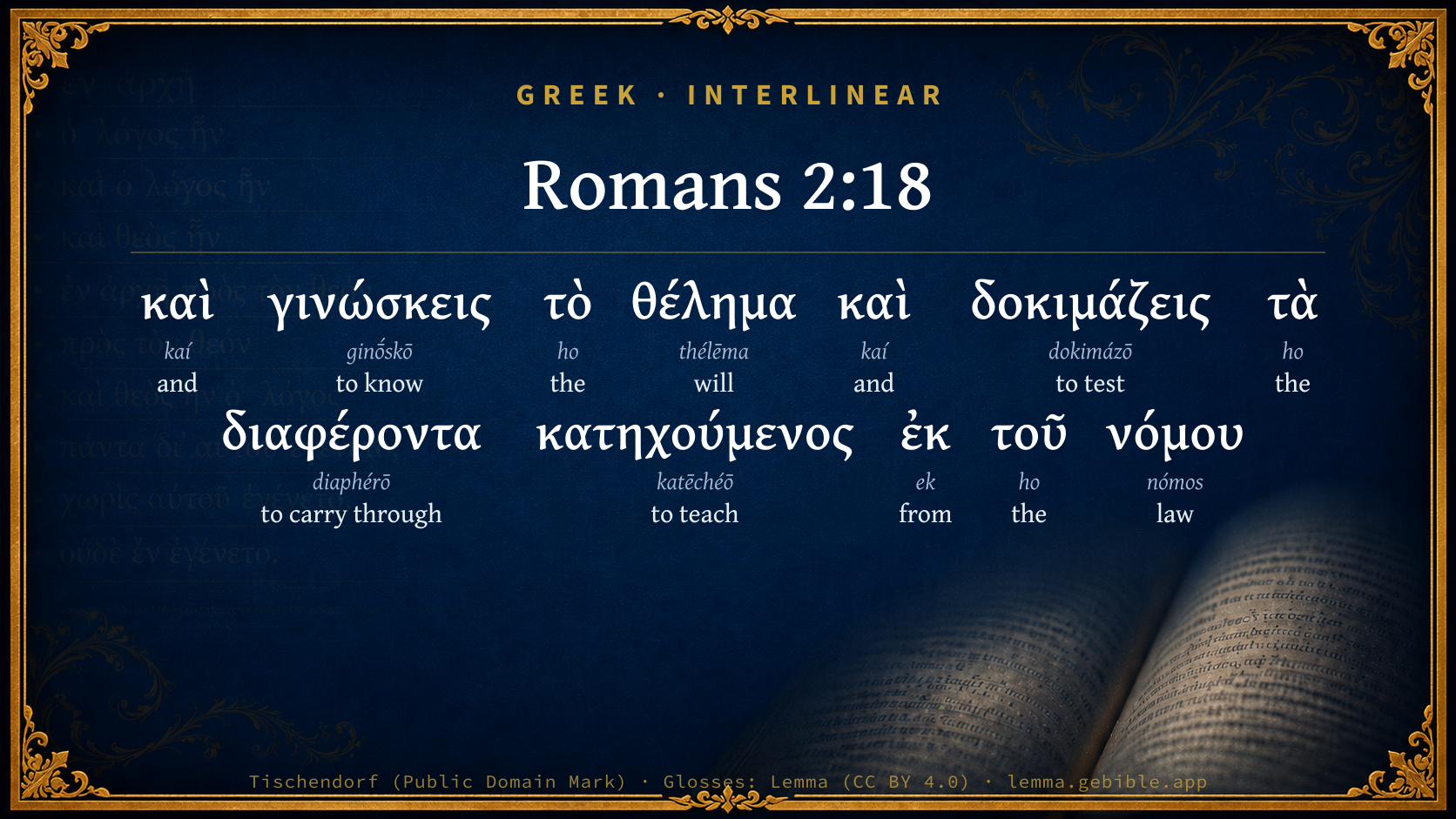
  1. καὶ kaí G2532 “and” Conjunction
  2. γινώσκεις ginṓskō G1097 “to know” Verb, Present, Active, Indicative, 2nd person, Singular
  3. τὸ ho G3588 “the” Article, Accusative, Singular, Neuter
  4. θέλημα thélēma G2307 “will” Noun, Accusative, Singular, Neuter
  5. καὶ kaí G2532 “and” Conjunction
  6. δοκιμάζεις dokimázō G1381 “to test” Verb, Present, Active, Indicative, 2nd person, Singular
  7. τὰ ho G3588 “the” Article, Accusative, Plural, Neuter
  8. διαφέροντα diaphérō G1308 “to carry through” Verb, Present, Active, Participle, Accusative, Plural, Neuter
  9. ἐκ ek G1537 “from” Preposition
  10. τοῦ ho G3588 “the” Article, Genitive, Singular, Masculine
  11. νόμου nómos G3551 “law” Noun, Genitive, Singular, Masculine

About this verse

These counts appear in no published source. They are computed here, from the morphology-tagged text and Lemma’s own curated glosses. What Lemma adds →

12
words
9
distinct lemmas
Pauline Epistles
section

Notable vocabulary

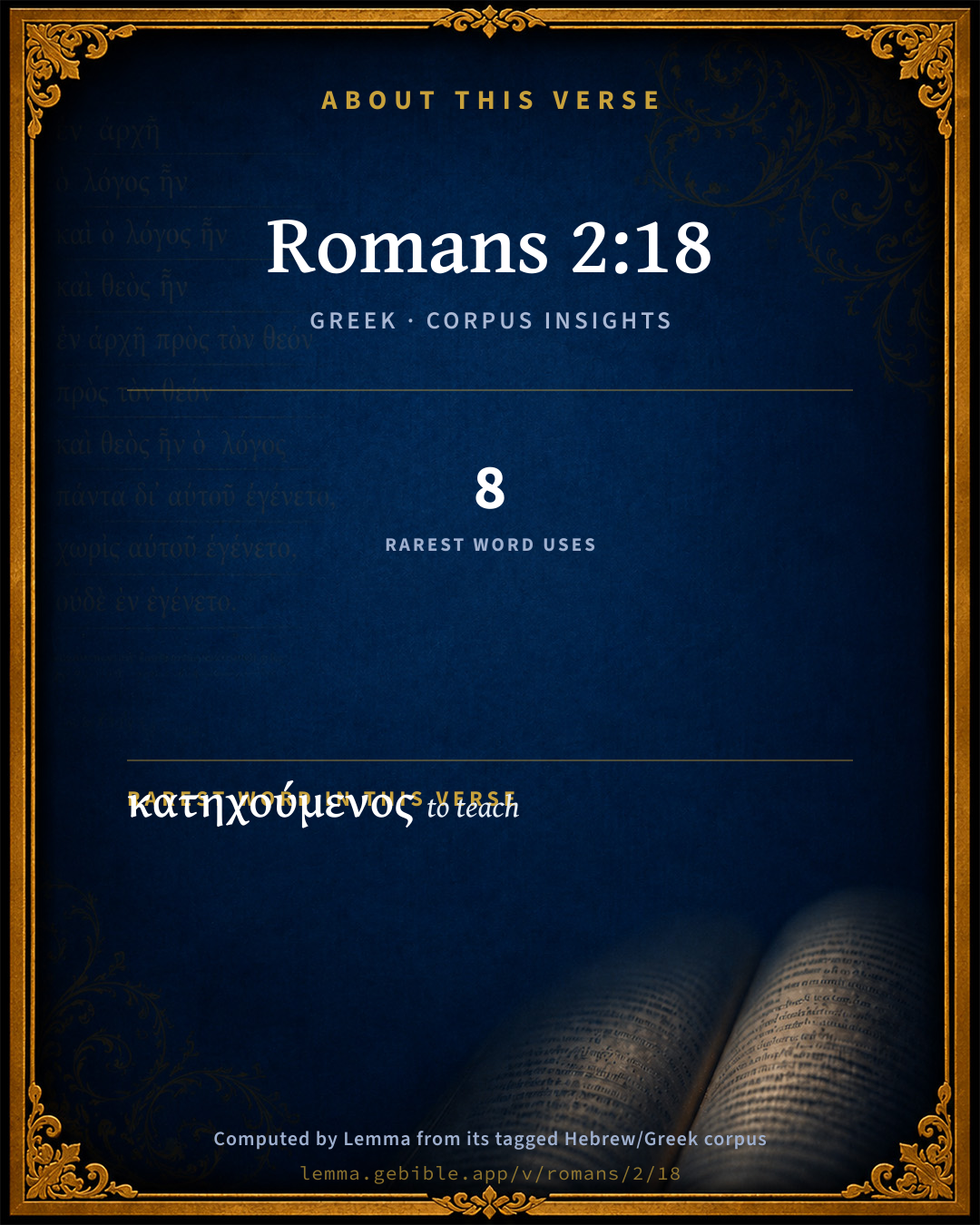
The rarest word here is κατηχούμενος to teach G2727 — appearing just 8 times in the whole Greek New Testament.

Shared distinctive vocabulary

κατηχούμενος to teach G2727 occurs in 7 verses of the Greek New Testament. Also found in:

Repetition

Words recur within this verse:

Cross-references

17

Topical passages linked to Romans 2:18 in the Treasury of Scripture Knowledge — connected by theme and wording, ordered by reader-vote popularity; previews shown in the World English Bible.

  • 1 Thessalonians 5:21 Test all things, and hold firmly that which is good.
  • James 4:17 To him therefore who knows to do good, and doesn't do it, to him it is sin.
  • Deuteronomy 4:8 What great nation is there, that has statutes and ordinances so righteous as all this law, which I set before you this day?
  • Philippians 1:10 so that you may approve the things that are excellent; that you may be sincere and without offense to the day of Christ;
  • Nehemiah 9:13–14 You came down also on Mount Sinai, and spoke with them from heaven, and gave them right ordinances and true laws, good statutes and commandments,
  • Psalms 19:8 Yahweh's precepts are right, rejoicing the heart. Yahweh's commandment is pure, enlightening the eyes.
  • Psalms 119:98–100 Your commandments make me wiser than my enemies, For your commandments are always with me.
  • Psalms 119:104–105 Through your precepts, I get understanding; Therefore I hate every false way.
  • Psalms 119:130 The entrance of your words gives light. It gives understanding to the simple.
  • Psalms 147:19–20 He shows his word to Jacob; His statutes and his ordinances to Israel.
  • Proverbs 6:23 For the commandment is a lamp, And the law is light. Reproofs of instruction are the way of life,
  • Luke 12:47 That servant, who knew his lord's will, and didn't prepare, nor do what he wanted, will be beaten with many stripes,
  • John 13:17 If you know these things, blessed are you if you do them.
  • Romans 15:4 For whatever things were written before were written for our learning, that through patience and through encouragement of the Scriptures we might have hope.
  • 1 Corinthians 8:1–2 Now concerning things sacrificed to idols: We know that we all have knowledge. Knowledge puffs up, but love builds up.
  • 2 Timothy 3:15–17 From infancy, you have known the sacred writings which are able to make you wise for salvation through faith, which is in Christ Jesus.
  • Hebrews 5:14 But solid food is for those who are full grown, who by reason of use have their senses exercised to discern good and evil.

Cross-references courtesy of OpenBible.info (CC BY 4.0).

Commentary

Notes on Romans 2:18 from classic Christian and Jewish commentators (each source and its license shown beneath its notes). The classic Christian expositions comment on the surrounding passage and are grouped to its opening verse, so a note may address several verses; the Jewish commentaries on the Tanakh (Rashi and others) are per-verse, so they appear only where the commentator wrote on this verse.

Lemma curates 59 commentaries, every one of them public domain or Creative Commons licensed, each selected and text-cleaned for this edition rather than reprinted as found. About our sources →

Bengel's Gnomon

Johann Albrecht Bengel

Rom 2:18. Τό θέλημα) the will, that is, whatever has been ratified by the law; so, the will, absolutely, Mat 18:14; 1Co 16:12. But this will is nothing else, than the will of God; but a strong feeling of piety [εὐλάβεια, pious caution] prevented Paul from adding, of God.—δοκιμαζεὶς) provest, approvest.

Bengel's Gnomon of the New Testament — English translation (T&T Clark, Edinburgh, 1860) — public domain. Text from a community e-Sword module.

Expositor's Greek Testament

ed. W. Robertson Nicoll

Rom 2:18 . τὸ θέλημα is God’s will. Lipsius compares the absolute use of ὁδός , θύρα and ὄνομα . Cf. Act 9:2 ; Act 19:9 ; Act 19:23 ; Act 14:27 ; Act 5:41 . Also 1Co 16:12 , where God’s will is meant, not the will of Apollos. The words δοκιμάζεις τὰ διαφέροντα κατηχούμενος ἐκ τοῦ νόμου are to be taken together. In virtue of being taught out of the law (in the synagogue and the schools) the Jew possesses moral discernment: he does not sink to the νοῦς ἀδόκιμος , the mind which has lost all moral capacity (Rom 1:28 ). But a certain ambiguity remains in δοκιμάζειν τὰ διαφέροντα : it may mean either (1) to distinguish, by testing, between things which differ i.e. , to discriminate experimentally between good and evil; or (2) to approve, after testing, the things which are more excellent. There are no grounds on which we can decide positively for either.

The Expositor's Greek Testament, edited by W. Robertson Nicoll (1897–1910) — public domain. Text from a community e-Sword module.

Hodge's Commentary on Romans, Ephesians & First Corinthians

Charles Hodge

Rom_2:18

And knowest the will, etc., of God. Superior knowledge was another of the peculiar distinctions of the Jews. The particulars to which the apostle refers in this, as well as in the preceding and succeeding verses, constituted real and great privileges, by which the Jews were distinguished from all other people. To be the people of God, to have the law, to know the divine will, were indeed great advantages; but these advantages only increased the obligations of those who enjoyed them. They did not of themselves constitute any ground of continence of acceptance with God; much less did the mere possession of these distinguishing favors give exemption from those principles of just retribution, according to which God will judge the world. The apostle, however, grants the Jews all they claimed: he grants that they were the people of God; that they had the law, knew the divine will, etc., and then shows that they were, nevertheless, exposed to condemnation. If real advantages, such as distinguished the Jews above all other nations, were of no avail to their justification or acceptance before God, what is to be said or thought of those who place their confidence in fictitious advantages, in mere imaginary superiority to their fellow men or fellow Christians; as belonging to the true Church, having the true succession, the real sacraments, when in fact in these respects they are even less favored than those whom they look upon as outside the Church and the covenant? And approvest the things that are more excellent. Δοκιμάζειν is to try, to examine, as in 1Co_3:13; and then, to regard as tried, i.e., to approve, as in 1Co_16:3. Διαφέρειν means to differ, as in Gal_2:6; and also, to excel, as in Mat_10:31. See also Mat_6:26; Luk_12:7, etc. This is the most common meaning of the word in the New Testament. We have then the choice of the two interpretations, Thou approvest the things that are more excellent, or, Thou dost distinguish the things that are different. Our version gives the former; both here and in Phi_1:10 where the same words occur. The latter is adopted by Theodoret, who explains διαφέροντα by ἐναντία ἀλλήλοις, δικαιοσύνην καὶ ἀδικίαν; and Theophylact, τί δεῖ πρᾶξαι καὶ τί μὴ δεῖ πρᾶξαι. The same view is taken by most of the recent commentators. It is suitable to the context, in as much as the apostle is here speaking of the peculiar advantages of the Jews, one of which was their superior knowledge, and their ability to do what others could not, that is, decide what was and what was not consistent with the will of God. On the other hand, however, to approve of what is right, to discern it to be right, is a higher attainment than merely to discriminate between good and evil. And as the apostle is here conceding to the Jews everything they could claim, it is better to give his words their highest sense. He admits that theoretically they were right in their judgments. It was not their moral judgments, but their moral conduct that was in fault. Being instructed, κατηχούμενος, (orally instructed, as the word literally means,) out of the law, i.e., the Scriptures, as νόμος often means. The word or law of God was a light to their feet, to which they could, at all times, refer to guide their steps.

Charles Hodge — Commentary on Romans (1835), First Corinthians (1857), and Ephesians (1856) — public domain. Text from a community e-Sword module.

Geneva Bible (1599)

Geneva Bible translators

Canst try and discern what things swerve from God’s will.

Or allowest the things that are excellent.

Geneva Bible (1599) marginal notes — public domain. Text via Bolls.life.

Jamieson, Fausset & Brown

Robert Jamieson, A. R. Fausset & David Brown

approvest the things that are excellent--"triest the things that differ" (Margin). Both senses are good, and indeed the former is but the result of the latter action. (See on Phi 1:10).

Jamieson, Fausset & Brown — Commentary Critical and Explanatory on the Whole Bible (1871) — public domain (CC PDM 1.0). Text via the HelloAO Bible API.

Adam Clarke's Commentary

Verse 18. Knowest his will] Hast been favoured with a revelation of his own will, immediately from himself.

The things that are more excellent] τα δισφεροντα, The things that differ-that revelation which God has given of himself makes the nicest distinctions between right and wrong; between vice and virtue; showing how you should walk so as to please God, and, consequently, acquire the most excellent portion that human spirits can have on this side heaven: for all these blessings ye acknowledge to receive from your law, being instructed, κατηχουμενος, being catechized, from your infancy, in the knowledge of Divine things.

Adam Clarke's Commentary on the Bible (1810–1826) — public domain. Text from a community e-Sword/MySword module.

John Calvin's Commentaries

18. And knowest his will, and approvest things excellent, etc. He now concedes to them the knowledge of the divine will, and the approval of things useful; and this they had attained from the doctrine of the law. But there is a twofold approval, — one of choice, when we embrace the good we approve; the other of judgment, by which indeed we distinguish good from evil, but by no means strive or desire to follow it. Thus the Jews were so learned in the law that they could pass judgment on the conduct of others, but were not careful to regulate their life according to that judgment. But as Paul reproves their hypocrisy, we may, on the other hand, conclude, that excellent things are then only rightly approved (provided our judgment proceeds from sincerity) when God is attended to; for his will, as it is revealed in the law, is here appointed as the guide and teacher of what is to be justly approved.

John Calvin's Commentaries (1540-1563) — public domain. Text from the Calvin Translation Society English edition (1840s-50s) via the Christian Classics Ethereal Library (ccel.org). Calvin's coverage is partial (roughly two-thirds of the Bible); uncommented books and verses are honest gaps, never fabricated. The 19th-century editor's footnotes and remarks are omitted so the notes are faithfully Calvin's own voice.

Ellicott's Commentary for English Readers

(18) His will.—Literally, the will—i.e., “the supreme will.”

Approvest the things that are more excellent.—Probably rightly given in the Authorised version, though the marginal rendering also is possible, “triest the things that differ”—i.e., “art able to discriminate between good and evil.”

Being instructed.—With reference to the constant reading of the Law in the synagogue.

A Bible Commentary for English Readers, edited by Charles John Ellicott (1878–1897) — public domain. Text from a community e-Sword module.

The Cambridge Bible for Schools and Colleges

gen. ed. J. J. S. Perowne

18. his will] Lit. the will. Cp. 3Jn_1:7, where the original is “for the sake of the Name.” Possibly the phrase here was a “stereotyped” formula, which St Paul quotes. But in any case its form (as that of the parallel above) is one of peculiar solemnity and dignity.

approvest the things that are more excellent] Better, assayest, puttest to the test, things which differ. Exactly the same words occur Php_1:10. The Jew had the touchstone of Divine Revelation to apply to questions of wrong and right; he claimed to be a perfect casuist.

The Cambridge Bible for Schools and Colleges (gen. ed. J. J. S. Perowne; Cambridge University Press, 1878–1918) — public domain. Text from a community e-Sword module.

John Gill's Exposition

An instructor of the foolish,.... All men in a state of unregeneracy are foolish, and need instruction; here the common people among the Jews, who knew not the law, are meant; it was very usual to call anyone of their doctors and masters "an instructor": it follows,

a teacher of babes; either in age or in understanding; such who taught either of them were called by the Jews , "teachers of babes". Thus they paraphrase the text in Dan 12:3,

"they that be wise, shall shine as the brightness of the firmament. This is the Judge who judges, the judgment of truth truly, and the collectors of alms: and they that turn, many to righteousness, as the stars for ever and ever; these are, , "the teachers of babes" (z).''

Though these are said (a) to be inferior to the wise men, or doctors:

which hast the form of knowledge, and of the truth in the law: they had not a true knowledge of the law; only a draught and scheme, the outward form of the law, and a mere shadow and appearance of the knowledge of the truth of it. From hence the apostle would have it concluded, that though the Jews had the law, and in some sense knew it, yet inasmuch as they did not perform it, they could not be justified by it; and that even their teachers, their greatest masters and doctors, were very deficient, as appears from what follows; and since they could not be instilled by it, who taught others the knowledge of it, the hearers of it could not expect justification from it.

(z) T. Bab. Bava Bathra, fol. 8. 2. & 21. 1, 2. Maimon. Hilchot Talmud Tora, c. 2. sect. 1. (a) Gloss in Sota, fol. 49. 1.

John Gill's Exposition of the Whole Bible (1746–1763) — public domain (CC PDM 1.0). Text via the HelloAO Bible API.

Trapp's Complete Commentary

John Trapp

18 And knowest his will, and approvest the things that are more excellent, being instructed out of the law;

Ver. 18. Being instructed out of the law] Gr. κατηχουμενος, Being well catechised and principled, thou art able to discern the doctrines, and choose the best. Luther somewhere professeth himself to be discipulum catechismi, a scholar to the catechism; and those that are not well seen in the principles, can make no good progress in religion.

John Trapp, A Commentary or Exposition upon All the Books of the Old and New Testament (1647–1656) — public domain. Text from a community e-Sword module.

Albert Barnes' Notes on the Bible

And knowest his will - The will or commands of God. This knowledge they obtained from the Scriptures; and of course in this they were distinguished from other nations.

And approvest - The word used here is capable of two interpretations. It may mean either to distinguish, or to approve. The word is properly and usually applied to the process of testing or trying metals by fire. Hence, it comes to be used in a general sense to try or to distinguish anything; to ascertain its nature, quality, etc.; Luk 12:56. This is probably its meaning here, referring rather to the intellectual process of discriminating, than to the moral process of approving. It could not, perhaps, be said with propriety, at least the scope of the passage does not properly suppose this, that the Jew approved or loved the things of God: but the scope of the passage is, that the Jew valued himself on his knowledge of what was conformable to the will of God; see the notes at Rom. 14.

The things that are more excellent - The word translated here “more excellent” denotes properly the things that differ from others, and then also the things that excel. It has an ambiguity similar to the word translated “approved.” If the interpretation of that word above given is correct, then this word here means those things that differ from others. The reference is to the rites and customs, to the distinctions of meats and days, etc., prescribed by the Law of Moses. The Jew would pride himself on the fact that he had been taught by the Law to make these distinctions, while all the pagan world had been left in ignorance of them. This was one of the advantages on which he valued himself and his religion.

Being instructed ... - That is, in regard to the one God, his will, and the distinguishing rites of his worship.

Albert Barnes' Notes on the Bible (1834–1885) — public domain. Text from a community e-Sword/MySword module.

Matthew Poole's English Annotations

Art confident; thou dost proudly arrogate all that follows to thyself, and conceitest that thou hast all the points of the law in thy breast, and full knowledge of all the secrets thereof.

Matthew Poole's English Annotations on the Holy Bible (1683–1685) — public domain. Text from a community e-Sword/MySword module.

Whedon's Commentary on the Bible

Daniel D. Whedon

18. Approvest… more excellent—That is, after due testing thou decidest the true superiority.

Daniel D. Whedon (gen. ed.), Commentary on the Old and New Testaments (1874–1909) — public domain. Text from a community e-Sword module.

The Pulpit Commentary

And knowest his will, and approvest the things that are more excellent (dokimazeiv ta diaferonta , a phrase capable also of the meaning, "provest the things which differ," i.e. distinguishest between right and wrong; for dokimazein may mean either "to prove," or "to approve" after trial, and ta diaferonta either "things which differ," or "things which surpass." Exactly the same expression occurs in Php_1:10, with the same uncertainty of meaning. The difference is unimportant, both interpretations coming to the same thing), being instructed (kathcoumenov , which implies regular training, whether catechetically in youth, or through rabbinical and synagogic teaching) out of the Law. So far the Jew"s own claims on the ground of his own position have been touched on; what follows expresses his attitude with regard to others. We may observe throughout a vein of irony.

The Pulpit Commentary (1880–1919), ed. H.D.M. Spence-Jones & Joseph S. Exell — public domain. Text from a community e-Sword module.

Godbey's Commentary on the New Testament

William B. Godbey

18. “Thou knowest us well, and discriminatest the things which differ, making thy boast from the law.” We are in a mixed world; soul-poison on all sides, the spiritually dead feeding on it. Though a dead man has eyes, he sees not; ears, he hears not; a nose, he smells not; a tongue, he tastes not; nerves, he feels not. Satan has his poison greeting us on all sides. If you eat, you die. Spiritual resurrection alone can open eyes, ears, olfactory, gustatory, and sentient organs, while sanctification gives them healthy and efficient activity.

William B. Godbey, Commentary on the New Testament (1896–1900) — public domain. Text from a community e-Sword module.

McGarvey & Pendleton's Commentaries

J. W. McGarvey

and knowest his will, and approvest the things that are excellent, being instructed out of the law ,

J. W. McGarvey (with Philip Y. Pendleton), Commentaries on the New Testament (The Fourfold Gospel, 1914; Acts; and the epistles) — public domain. Text from a community e-Sword/MySword module.

The People's New Testament

B. W. Johnson

18. Knowest his will. As revealed in the Old Testament Scriptures in the hands of the Jews. Approvest the things that are more excellent. Instructed in the law, the Jew approved by word its excellent moral principles.

B. W. Johnson's The People's New Testament with Notes (1889–1891) — public domain. Electronic text from the Christian Classics Ethereal Library (CCEL) ThML edition.

Cambridge Greek Testament for Schools and Colleges

18. τὸ θέλημα. cf. Lft, Revision, p. 106, ed. 1; p. 118, ed. 2 (S.H.).

δοκιμάζεις. As above, Rom 1:28, ‘approvest, after testing.’

τὰ διαφέροντα = the things that are better, the better courses of conduct; cf. Php 1:10, and for the verb 1Co 15:41; Gal 4:1.

κατηχούμενος = being taught—all teaching at this time being oral; cf. Luk 1:4; Gal 6:6.

Cambridge Greek Testament for Schools and Colleges (Cambridge University Press, 1896; 21 vols, various authors incl. Carr, Maclear, Plummer, Farrar, Lumby, Moule, M. R. James, Simcox) — public domain. Text from a community e-Sword module.

Alford’s Greek Testament

Henry Alford

18. γιν. τὸ θέλ.] θεός having been just mentioned, it is left to be inferred that θέλημα refers to Him.

δοκιμ. τ. διαφ.] provest (in the sense of sifting and coming to a conclusion on) things which differ,—ἐναντία ἀλλήλοις, δικαιοσύνην κ. ἀδικίαν, κ.τ.λ. Theod. κρίνεις τί δεῖ πρᾶξαι κ. τί μὴ δεῖ πρᾶξαι, Theophylact. The Vulg. ‘probas utiliora,’ and E. V. ‘approvest the things that are more excellent,’ is somewhat flat in meaning, and not so applicable.

κατηχ. ἐκ τοῦ νόμ.] being (habitually, not in youth only,—force of pres.) instructed (not merely catechetically but didactically, in the synagogues, &c.) out of the law (τοῦ νόμου, though after a preposition—because the law is distributed—it is the book of the law, the law itself, out of which the κατήχησις takes place).

Henry Alford, The Greek Testament (1849–1861) — public domain. Text from a community e-Sword module.

International Critical Commentary

18. τὸ θέλημα. Bp. Lightfoot has shown that this phrase was so constantly used for ‘the Divine Will’ that even without the art. it might have that signification, as in 1Co 16:12 (On Revision, p. 106 Exo_1, p. 118 Exo_2).

δοκιμάζεις τὰ διαφέροντα: probas utiliora Cod. Clarom. Rufin. Vulg.; non modo prae malis bona sed in bonis optima Beng. on Php 1:10, where the phrase recurs exactly. Both words are ambiguous: δοκιμάζειν = (i) ‘to test, assay, discern’; (ii) ‘to approve after testing’ (see on 1:28); and τὰ διαφέροντα may be either ‘things which differ,’ or ‘things which stand out, or excel.’ Thus arise the two interpretations represented in RV. and RV. marg., with a like division of commentators. The rendering of RV. marg. (‘provest the things that differ,’ ‘hast experience of good and bad’ Tyn.) has the support of Euthym.-Zig. (διακρίνεις τὰ διαφέροντα ἀλλήλων· οἷον καλὸν καὶ κακόν, ἀρετὴν καὶ κακίαν), Fri. De W. Oltr. Go. Lips. Mou. The rendering of RV. (‘approvest the things that are excellent’) is adopted by Latt. Orig. (ita ut non solum quae sint bona scias, verum etiam quae sint meliora et utiliora discernas), most English Versions, Mey. Lft. Gif. Lid. (Chrys. does not distinguish; Va is undecided). The second rendering is the more pointed.

κατηχούμενος ἐκ τοῦ νόμου : cf. Act 15:21.

International Critical Commentary — older volumes (1896–1929), various authors — public domain. Text from a community e-Sword module.

Vincent's Word Studies in the New Testament

Marvin R. Vincent

The things that are more excellent [τα διαφεροντα] . This may be the meaning, and it is adopted by Rev. with the proper omission of more. But it may also mean the things which differ; in which case we shall render provest instead of approvest. The sense will then be : thou dost test with nice discrimination questions of casuistry. Compare Phi 1:10. The latter interpretation seems preferable, being borne out by the succeeding being instructed.

Being instructed [κατηχουμενος] . Systematically through catechetical and synagoguic instruction. See on Luk 1:4. This formal instruction is the basis of the critical discrimination.

Marvin R. Vincent, Word Studies in the New Testament (1887–1900) — public domain. Text from a community e-Sword/MySword module.

Lesson kit

Teaching starters — assembled from the data on this page, not authored interpretation. Every prompt links to the verse data it draws on. Edit before teaching.

Romans, in the Pauline Epistles, opens this verse with 12 words (9 distinct Greek lemmas). Its most distinctive word is katēchéō (“to teach”). A historical commentator’s framing appears above. Read the whole chapter for the surrounding context.

Discussion questions

  1. The word katēchéō carries the sense “to teach.” How does it shape the verse?
  2. How does Luke 1:4, which shares the word «to teach», read alongside this verse?
  3. What does the repetition of “the” (3× in this one verse) do in this verse?
  4. The translations on this page render this verse differently — a whole-verse word diff, not a word-by-word alignment. What might account for the different wordings?
  5. Compare how Bengel's Gnomon and Expositor's Greek Testament read this verse. Where do they agree or differ?

Things to notice

  • These translations choose different wording for 6 words in this verse.
  • “the” occurs 3× in this single verse.
  • 9 distinct Greek lemmas span 12 words in this verse.

Reading settings

Reading text

Shown beneath each verse's original-language words.

Old Testament
Old Testament edition

Read the OT as the Masoretic Hebrew (MT) or the Greek Septuagint (LXX).

English shown for the Greek Septuagint (in the Hebrew ↔ Greek comparison).

Comparing translations? Open the Compare panel on any verse page to stack up to four side by side.