
Luke 21:20

Greek (Tischendorf 8th ed.) Luke 21:20 appears in the Greek New Testament. The text above is from the Tischendorf 8th edition. Each word links to its Strong’s number and a concise gloss. Click any word for its full Thayer’s Greek Lexicon entry.
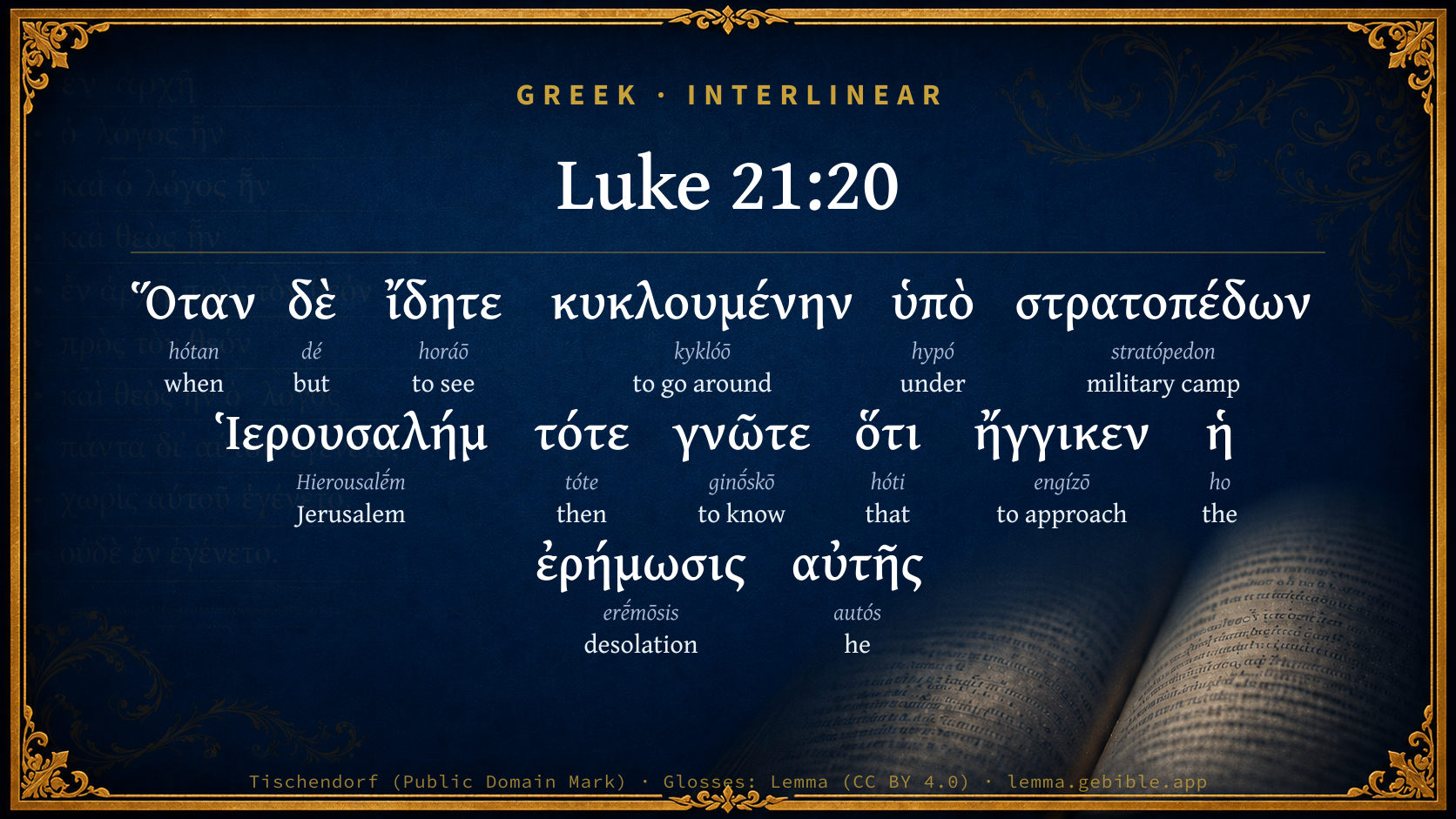
Download image
Cite this verse

Luke 21:20 (World English Bible). Public Domain. Lemma interlinear Bible study tool, https://lemma.gebible.app/v/luke/21/20.

Show BibTeX & RIS
BibTeX
RIS
English Translation
"But when you see Jerusalem surrounded by armies, then know that its desolation is at hand.
World English Bible · Public Domain
Highlights
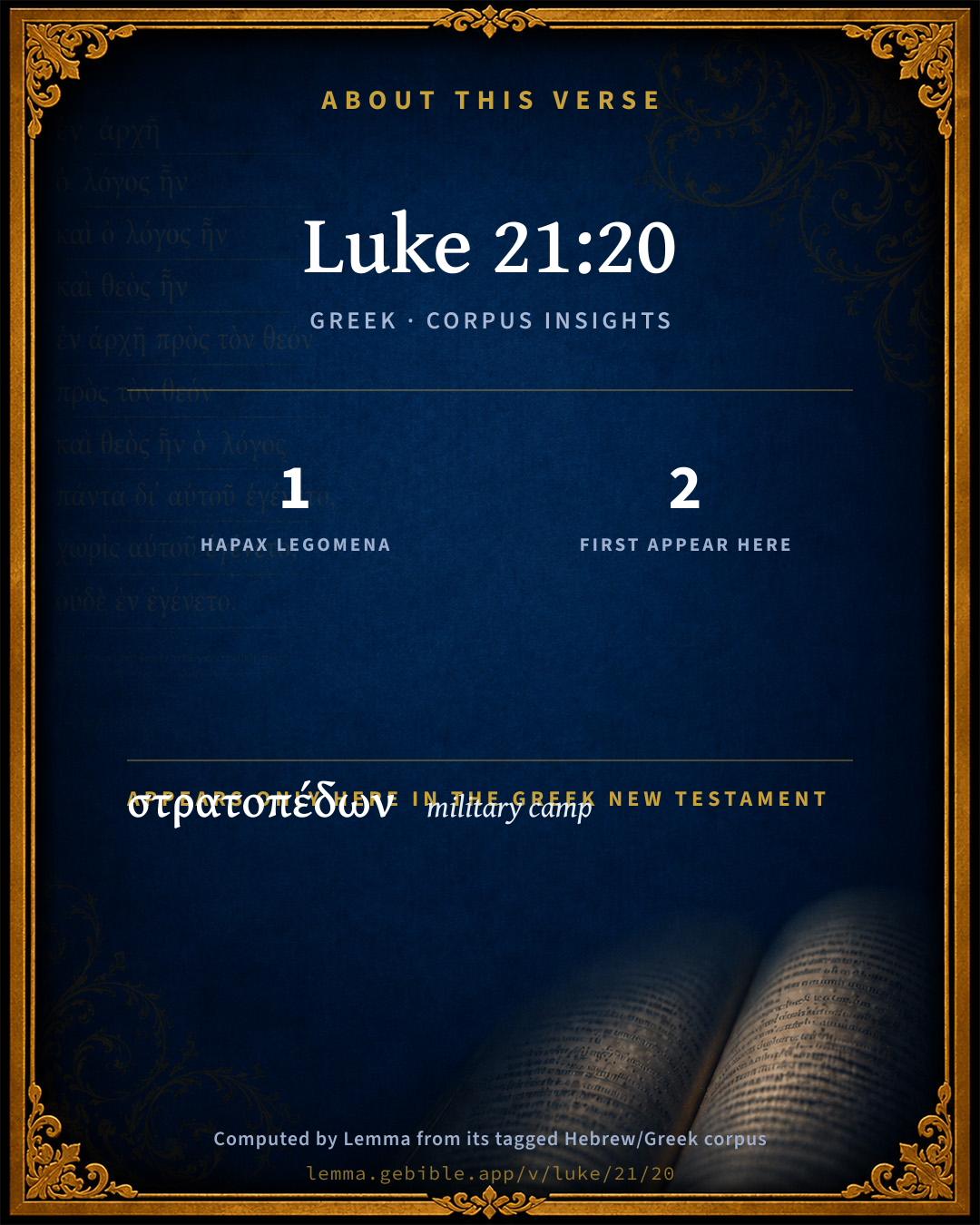
  • 1 hapax legomenon — only here in the Greek New Testament
  • 2 first appearances in the Greek New Testament
Full analysis ↓
Download a study sheet

One document with this verse’s original text, its word-by-word gloss line, the meaning frame, cross-references with their text, attributed commentary, and full source and license credits — printable, and it pastes into notes with its structure intact.

This verse Autodidact and up

Study sheet (.html) Plain text (.txt)

A passage Seminary Student

Up to 50 verses in one chapter. A passage sheet keeps up to 6 commentary sources and 12 cross-references per verse, in the order this page ranks them, and says so on the sheet whenever that leaves anything out. Ask for a single verse and you get the Autodidact verse sheet above.

Everything on this page stays free to read, with no account — the sheet is a download of what is already on screen, not access to it.

Want to remove ads? Support Godless Engineer
Compare translations 3

The same verse in 3 English versions, stacked beneath the original-language interlinear above. Click any original word for its lexicon entry.

Each is an independent rendering of the whole verse — the interlinear is not word-aligned to these translations.

Highlighted words mark where these versions differ — a whole-verse word diff, not a word-by-word alignment.

  • World English Bible Public Domain
    "But when you see Jerusalem surrounded by armies, then know that its desolation is at hand.
  • King James Version Public Domain
    And when ye shall see Jerusalem compassed with armies, then know that the desolation thereof is nigh.
  • unfoldingWord Literal Text CC BY-SA 4.0
    But when you see Jerusalem being surrounded by armies, then know that its desolation is near.

unfoldingWord Literal Text — © unfoldingWord, licensed CC BY-SA 4.0. Word-aligned USFM3 via Door43 (git.door43.org/unfoldingWord/en_ult).

Versions to compare (up to 4)

3 of 4 selected

Show all 19 translations

Every available English version of this verse, each an independent rendering of the whole verse.

  • World English Bible Public Domain
    "But when you see Jerusalem surrounded by armies, then know that its desolation is at hand.
  • Berean Standard Bible Public Domain
    But when you see Jerusalem surrounded by armies, you will know that her desolation is near.
  • Majority Standard Bible Public Domain
    But when you see Jerusalem surrounded by armies, you will know that her desolation is near.
  • King James Version Public Domain
    And when ye shall see Jerusalem compassed with armies, then know that the desolation thereof is nigh.
  • American Standard Version (1901) Public Domain
    But when ye see Jerusalem compassed with armies, then know that her desolation is at hand.
  • Revised Version (1885) Public Domain
    But when ye see Jerusalem compassed with armies, then know that her desolation is at hand.
  • Geneva Bible (1599) Public Domain
    And when ye see Hierusalem besieged with souldiers, then vnderstand that the desolation thereof is neere.
  • Douay-Rheims (1899) Public Domain
    And when you shall see Jerusalem compassed about with an army; then know that the desolation thereof is at hand.
  • Young's Literal Translation Public Domain
    `And when ye may see Jerusalem surrounded by encampments, then know that come nigh did her desolation;
  • Literal Standard Version CC BY-SA 4.0
    And when you may see Jerusalem surrounded by encampments, then know that her desolation has come near;
  • Unlocked Literal Bible CC BY-SA 4.0
    When you see Jerusalem surrounded by armies, then know that its destruction is near.
  • unfoldingWord Literal Text CC BY-SA 4.0
    But when you see Jerusalem being surrounded by armies, then know that its desolation is near.
  • Darby Bible Public Domain
    But when ye see Jerusalem encompassed with armies, then know that its desolation is drawn nigh.
  • World Messianic Bible Public Domain
    “But when you see Jerusalem surrounded by armies, then know that its desolation is at hand.
  • Webster's Bible Public Domain
    And when ye shall see Jerusalem compassed with armies, then know that its desolation is nigh.
  • Free Bible Version CC BY-SA 4.0
    However, when you see Jerusalem surrounded by armies, then you know that its destruction is near.
  • Bible in Basic English Public Domain
    But when you see armies all round about Jerusalem, then be certain that her destruction is near.
  • Text-Critical English NT CC BY 4.0
    “When you see Jerusalem surrounded by armies, know that its desolation is near.
  • Tyndale New Testament (1534) Public Domain
    And when ye se Ierusalem beseged with an hoste then vnderstonde that the desolacion of the same is nye.

Literal Standard Version (2020), Covenant Press — licensed CC BY-SA 4.0. Text via the HelloAO Bible API (eBible.org). Unlocked Literal Bible (unfoldingWord) — licensed CC BY-SA 4.0. Text via the HelloAO Bible API (eBible.org). unfoldingWord Literal Text — © unfoldingWord, licensed CC BY-SA 4.0. Word-aligned USFM3 via Door43 (git.door43.org/unfoldingWord/en_ult). Free Bible Version, Dr. Jonathan Gallagher — licensed CC BY-SA 4.0. Text via the HelloAO Bible API (eBible.org).

Word by word

More ways to search: Search by grammar → Find every occurrence → Compare this word →

Practice this passage: Drill this verse → Learn its vocabulary →

στρατοπέδων
stratópedon
G4760
“military camp”
Noun, Genitive, Plural, Neuter
Part of Speech
Noun
Case
Genitive
Number
Plural
Gender
Neuter
Full Thayer's Definition

Origin: from the base of G4756 and the same as G3977

TDNT: 18:41,1

1. a military camp 2. soldiers in camp, an army
  1. Ὅταν hótan G3752 “when” Conjunction
  2. δὲ dé G1161 “but” Conjunction
  3. ἴδητε horáō G3708 “to see” Verb, Aorist, Active, Subjunctive, 2nd person, Plural
  4. κυκλουμένην kyklóō G2944 “to go around” Verb, Present, Passive, Participle, Accusative, Singular, Feminine
  5. ὑπὸ hypó G5259 “under” Preposition
  6. Ἱερουσαλήμ Hierousalḗm G2419 “Jerusalem” Noun, Proper, indeclinable
  7. τότε tóte G5119 “then” Adverb
  8. γνῶτε ginṓskō G1097 “to know” Verb, Aorist, Active, Imperative, 2nd person, Plural
  9. ὅτι hóti G3754 “that” Conjunction
  10. ἤγγικεν engízō G1448 “to approach” Verb, Perfect, Active, Indicative, 3rd person, Singular
  11. ἡ ho G3588 “the” Article, Nominative, Singular, Feminine
  12. ἐρήμωσις erḗmōsis G2050 “desolation” Noun, Nominative, Singular, Feminine
  13. αὐτῆς autós G846 “he” Personal pronoun, Genitive, Singular, Feminine

About this verse

These counts appear in no published source. They are computed here, from the morphology-tagged text and Lemma’s own curated glosses. What Lemma adds →

14
words
14
distinct lemmas
Gospels
section

Notable vocabulary

1 hapax legomenon — a word that appears only here in the entire Greek New Testament:

  • στρατοπέδων military camp G4760

First appearance in Scripture

These words make their first canonical appearance in the Greek New Testament here:

  • κυκλουμένην to go around G2944
  • στρατοπέδων military camp G4760

Shared distinctive vocabulary

ἐρήμωσις desolation G2050 occurs in 3 verses of the Greek New Testament. Also found in:
Cross-references

5

Topical passages linked to Luke 21:20 in the Treasury of Scripture Knowledge — connected by theme and wording, ordered by reader-vote popularity; previews shown in the World English Bible.

  • Luke 19:43 For the days will come on you, when your enemies will throw up a barricade against you, surround you, hem you in on every side,
  • Daniel 9:27 He shall make a firm covenant with many for one week: and in the midst of the week he shall cause the sacrifice and the offering to cease; and on the wing of abominations [shall come] one who makes desolate; and even to the full end, and that determined, shall [wrath] be poured out on the desolate.
  • Mark 13:14 But when you see the abomination of desolation, spoken of by Daniel the prophet, standing where it ought not (let the reader understand), then let those who are in Judea flee to the mountains,
  • Matthew 24:15 "When, therefore, you see the abomination of desolation, which was spoken of through Daniel the prophet, standing in the holy place (let the reader understand),
  • Luke 21:7 They asked him, "Teacher, so when will these things be? What is the sign that these things are about to happen?"

Cross-references courtesy of OpenBible.info (CC BY 4.0).

Commentary

Notes on Luke 21:20 from classic Christian and Jewish commentators (each source and its license shown beneath its notes). The classic Christian expositions comment on the surrounding passage and are grouped to its opening verse, so a note may address several verses; the Jewish commentaries on the Tanakh (Rashi and others) are per-verse, so they appear only where the commentator wrote on this verse.

Lemma curates 59 commentaries, every one of them public domain or Creative Commons licensed, each selected and text-cleaned for this edition rather than reprinted as found. About our sources →

Matthew Henry's Commentary

Having given them an idea of the times for about thirty-eight years next ensuing, he here comes to show them what all those things would issue in at last, namely, the destruction of Jerusalem, and the utter dispersion of the Jewish nation, which would be a little day of judgment, a type and figure of Christ's second coming, which was not so fully spoken of here as in the parallel place (Mt. 24), yet glanced at; for the destruction of Jerusalem would be as it were the destruction of the world to those whose hearts were bound up in it.

I. He tells them that they should see Jerusalem besieged, compassed with armies (Luk 21:20), the Roman armies; and, when they saw this, they might conclude that its desolation was nigh, for in this the siege would infallibly end, though it might be a long siege. Note, As in mercy, so in judgment, when God begins, he will make an end.

II. He warns them, upon this signal given, to shift for their own safety (Luk 21:21): "Then let them that are in Judea quit the country and flee to the mountains; let them that are in the midst of it" (Of Jerusalem) "depart out, before the city be closely shut up, and" (as we say now) "before the trenches be opened; and let not them that are in the countries and villages about enter into the city, thinking to be safe there. Do you abandon a city and country which you see God has abandoned and given up to ruin. Come out of her, my people."

III. He foretels the terrible havoc that should be made of the Jewish nation (Luk 21:22): Those are the days of vengeance so often spoken of by the Old Testament prophets, which would complete the ruin of that provoking people. All their predictions must now be fulfilled, and the blood of all the Old Testament martyrs must now be required. All things that are written must be fulfilled at length. After days of patience long abused, there will come days of vengeance; for reprieves are not pardons. The greatness of that destruction is set forth, 1. By the inflicting cause of it. It is wrath upon this people, the wrath of God, that will kindle this devouring consuming fire. 2. By the particular terror it would be to women with child, and poor mothers that are nurses. Woe to them, not only because they are most subject to frights, and least able to shift for their own safety, but because it will be a very great torment to them to think of having borne and nursed children for the murderers. 3. By the general confusion that should be all the nation over. There shall be great distress in the land, for men will not know what course to take, nor how to help themselves.

IV. He describes the issue of the struggles between the Jews and the Romans, and what they will come to at last; in short, 1. Multitudes of them shall fall by the edge of the sword. It is computed that in those wars of the Jews there fell by the sword above eleven hundred thousand. And the siege of Jerusalem was, in effect, a military execution. 2. The rest shall be led away captive; not into one nations, as when they were conquered by the Chaldeans, which gave them an opportunity of keeping together, but into all nations, which made it impossible for them to correspond with each other, much less to incorporate. 3. Jerusalem itself was trodden down of the Gentiles. The Romans, when they had made themselves masters of it, laid it quite waste, as a rebellious and bad city, hurtful to kings and provinces, and therefore hateful to them.

V. He describes the great frights that people should generally be in. Many frightful sights shall be in the sun, moon, and stars, prodigies in the heavens, and here in this lower world, the sea and the waves roaring, with terrible storms and tempests, such as had not been known, and above the ordinary working of natural causes. The effect of this shall be universal confusion and consternation upon the earth, distress of nations with perplexity, Luk 21:25. Dr. Hammond understands by the nations the several governments or tetrarchies of the Jewish nation, Judea, Samaria, and Galilee; these shall be brought to the last extremity. Men's hearts shall fail them for fear (Luk 21:26), apopsuchontōn anthrōpōn - men being quite exanimated, dispirited, unsouled, dying away for fear. Thus those are killed all the day long by whom Christ's apostles were so (Rom 8:36), that is, they are all the day long in fear of being killed; sinking under that which lies upon them, and yet still trembling for fear of worse, and looking after those things which are coming upon the world. When judgment begins at the house of God, it will not end there; it shall be as if all the world were falling in pieces; and where can any be secure then? The powers of heaven shall be shaken, and then the pillars of the earth cannot but tremble. Thus shall the present Jewish policy, religion, laws, and government, be all entirely dissolved by a series of unparalleled calamities, attended with the utmost confusion. So Dr. Clarke. But our Saviour makes use of these figurative expressions because at the end of time they shall be literally accomplished, when the heavens shall be rolled together as a scroll, and all their powers not only shaken, but broken, and the earth and all the works that are therein shall be burnt up, Pe2 3:10, Pe2 3:12. As that day was all terror and destruction to the unbelieving Jews, so the great day will be to all unbelievers.

VI. He makes this to be a kind of appearing of the Son of man: Then shall they see the Son of man coming in a cloud, with power and great glory, Luk 21:27. The destruction of Jerusalem was in a particular manner an act of Christ's judgment, the judgment committed to the Son of man; his religion could never be thoroughly established but by the destruction of the temple, and the abolishing of the Levitical priesthood and economy, after which even the converted Jews, and many of the Gentiles too, were still hankering, till they were destroyed; so that it might justly be looked upon as a coming of the Son of man, in power and great glory, yet not visibly, but in the clouds; for in executing such judgments as these clouds and darkness are round about him. Now this was, 1. An evidence of the first coming of the Messiah; so some understand it. Then the unbelieving Jews shall be confined, when it is too late, that Jesus was the Messiah; those that would not see him coming in the power of his grace to save them shall be made to see him coming in the power of his wrath to destroy them; those that would not have him to reign over them shall have him to triumph over them. 2. It was an earnest of his second coming. Then in the terrors of that day they shall see the Son of man coming in a cloud, and all the terrors of the last day. They shall see a specimen of it, a faint resemblance of it. If this be so terrible, what will that be?

VII. He encourages all the faithful disciples in reference to the terrors of that day (Luk 21:28): "When these things begin to come to pass, when Jerusalem is besieged, and every thing is concurring to the destruction of the Jews, then do you look up, when others are looking down, look heavenward, in faith, hope, and prayer, and lift up your heads with cheerfulness and confidence, for your redemption draws night." 1. When Christ came to destroy the Jews, he came to redeem the Christians that were persecuted and oppressed by them; then had the churches rest. 2. When he comes to judge the world at the last day, he will redeem all that are his, from all their grievances. And the foresight of that day is as pleasant to all good Christians as it is terrible to the wicked and ungodly. Their death itself is so; when they see that day approaching, they can lift up their heads with joy, knowing that their redemption draws nigh, their removal to their Redeemer.

VIII. Here is one word of prediction that looks further than the destruction of the Jewish nation, which is not easily understood; we have it in Luk 21:24 : Jerusalem shall be trodden down of the Gentiles, till the times of the Gentiles be fulfilled. 1. Some understand it of what is past; so Dr. Hammond. The Gentiles, who have conquered Jerusalem, shall keep possession of it, and it shall be purely Gentile, till the times of the Gentiles be fulfilled, till a great part of the Gentile world shall have become Christian, and then after Jerusalem shall have been rebuilt by Adrian the emperor, with an exclusion of all the Jews from it, many of the Jews shall turn Christians, shall join with the Gentile Christians, to set up a church in Jerusalem, which shall flourish there for a long time. 2. Others understand it of what is yet to come; so Dr. Whitby. Jerusalem shall be possessed by the Gentiles, of one sort or other, for the most part, till the time come when the nations that yet remain infidels shall embrace the Christian faith, when the kingdoms of this world shall become Christ's kingdoms, and then all the Jews shall be converted. Jerusalem shall be inhabited by them, and neither they nor their city any longer trodden down by the Gentiles.

Matthew Henry's Commentary on the Whole Bible (1708–1710) — public domain (CC PDM 1.0). Text via the HelloAO Bible API.

Joseph Benson's Commentary

Luk 21:20-21. And when ye shall see Jerusalem encompassed with armies, &c. — The admonition here given to them who were in the midst of Jerusalem to depart out of it, and to them who were in the countries not to enter thereinto, shows that the encompassing of Jerusalem with armies, spoken of in the prophecy, was such as would permit the inhabitants to flee out of it, and those who were in the countries to enter into it. Behold here the wonderful prescience of Jesus! Cestius Gallus, in the beginning of the war, invested Jerusalem, and took Betheza, or the lower town. Josephus, (Bell., Luk 2:24,) says, “If he had continued the siege but a little longer, he would have taken the city. But, I think, God being angry with the wicked, would not suffer the war to end at that time. For Cestius removed his army, and having received no loss, very unadvisedly departed from the city.” And, chap. 25. of the same book, he further informs us, that “immediately after Cestius’s departure, many of the principal Jews daily fled from the city as from a sinking ship.” Among these, we may believe there were numbers of the Christians, who, remembering their Master’s admonition, and foreseeing what was to happen, embraced the opportunity thus afforded them of fleeing out of Judea, and so escaped the general ruin, as their Master had promised them, Mat 24:13; Luk 21:18. To this agrees what Eusebius tells us, (Hist., Luk 3:5,) “That the people of the church in Jerusalem, being ordered by an oracle, given to the faithful in that place, left the city before the war, and dwelt in a city of Perea, the name of which was Pella.” This oracle, of which he speaks, seems to have been our Lord’s prophecy and admonition, to which every circumstance of the history perfectly agrees.

Joseph Benson's Commentary on the Old and New Testaments (1811–1818) — public domain. Text from a community e-Sword module.

Whedon's Commentary on the Bible

Daniel D. Whedon

§ 115.—PHARISEES, HERODIANS, AND A SCRIBE QUESTION JESUS. JESUS RETURNS A QUESTION, Luk_21:20-38.

See notes on Mat_22:15-46; Mar_12:12-37.

Daniel D. Whedon (gen. ed.), Commentary on the Old and New Testaments (1874–1909) — public domain. Text from a community e-Sword module.

MacLaren's Expositions of Holy Scripture

Alexander MacLaren

Luke

WHEN SHALL THESE THINGS BE?

Luk 21:20 - Luk 21:36.

This discourse of our Lord’s is in answer to the disciples’ double question as to the time of the overthrow of the Temple and the premonitory signs of its approach. The former is answered with the indefiniteness which characterises prophetic chronology; the latter is plainly answered in Luk 21:20.

The whole passage divides itself in four well-marked sections.

I. There is the prediction of the fall of Jerusalem {Luk 21:20 - Luk 21:24}.

The ‘sign’ of her ‘desolation’ was to be the advance of the enemy to her walls. Armies had been many times encamped round her, and many times been scattered; but this siege was to end in capture, and no angel of the Lord would stalk by night through the sleeping host, to stiffen sleep into death, nor would any valour of the besieged avail. Their cause was to be hopeless from the first. Flight was enjoined. Usually the inhabitants of the open country took refuge in the fortified capital when invasion harrowed their fields; but this time, for ‘them that are in the country’ to ‘enter therein’ was to throw away their last chance of safety. The Christians obeyed, and fled, as we all know, across Jordan to Pella. The rest despised Jesus’ warning-if they knew it,-and perished.

Mark the reason for the exhortation not to resist, but to flee: These are days of vengeance, that all things which are written may be fulfilled.’ That is to say, the besiegers are sent by God to execute His righteous and long-ago-pronounced judgments. Therefore it is vain to struggle against them. Behind the Roman army is the God of Israel. To dash against their cohorts is to throw one’s self on the thick bosses of the Almighty’s buckler, and none who dare do that can ‘prosper.’ Submission to His retributive hand is the only way to escape being crushed by it. Chastisement accepted is salutary, but kicking against it drives the goad deeper into the rebellious limb.

So great is the agony to be, that what should be a joy, the birth of children, will be a woe, and the sweet duties of motherhood a curse, while the childless will be happier than the fugitives burdened with helpless infancy. We should note, too, that the ‘distress’ which comes upon the land is presented in darker colours, and traced to its origin, in {God’s}’wrath’ dealt out ‘unto this people.’ Happier they who ‘fall by the edge of the sword’ than they who are led ‘captive into all the nations.’

A gleam of hope shoots through the stormy prospect, for the treading down of Jerusalem by the Gentiles has a term set to it. It is to continue ‘till the times of the Gentiles are fulfilled.’ That expression is important, for it clearly implies that these ‘times’ are of considerable duration, and it thus places a period of undefined extent between the fall of Jerusalem and the subsequent prophecy. The word used for ‘times’ generally carries with it the notion of opportunity, and here seems to indicate that the break-up of the Jewish national existence would usher in a period in which the ‘Gentiles’ would have the kingdom of God offered to them. The history of the world since the city fell is the best comment on this saying.

II. Since the ‘times of the Gentiles’ are thus of indefinite duration, they make a broad line of demarcation between what precedes and what follows them.

Clearly the prophecy in Luk 21:25 - Luk 21:27 is separated in time from the fall of Jerusalem, and it is no objection to that view that the separation is not more emphatically pointed out by our Lord. These verses distinctly refer to His last coming to judgment. Luk 21:27 is too grand and too distinctly cast in the mould of the other predictions of that coming to be interpreted of His ideal coming in the judgments on the city.

The ‘signs in sun and moon and stars’ may refer in accordance with a familiar symbolism, to the overthrow of royalties and dominions; the sea roaring may, in like manner, symbolise agitations among the people; but the ‘cloud’ and the ‘power and great glory’ with which the Son of man comes, can mean nothing else than what they mean in other prophetic passages; namely, His visible appearance, invested with the shekinah light, and wielding divine authority before the gaze of a world.

The city’s fall, then, was the initial stage of a process, the duration of which is undefined here, but implied to be considerable, and of which the closing stage is the personal coming of Jesus. The same conclusion is supported by Luk 21:28, which treats that fall as the beginning of the fulfilment of the prophecy.

III. That verse forms a transition to the section containing the illustrative parable and the reiteration of the assurance that Christ’s words would certainly be fulfilled.

The disciples might naturally quake at the prospect, and wonder how they could face the reality. Jesus gives them strong words of cheer, which apply to all dreaded contingencies and to all social convulsions. What is a messenger of destruction to Christless men and institutions is a harbinger of full ‘redemption’ to His servants. Earthquakes but open their prison doors and loose their bands, they should not shake their hearts.

Historically the fall of Jerusalem was a powerful factor in the deliverance of the Church from Jewish swaddling-bands which hampered its growing limbs. For all Christians the destruction of what can perish brings fuller vision and possession of what cannot be shaken. To Christ’s friends, all things work for good. So the parable which at first sight seems strangely incongruous becomes blessedly significant and fitting. The gladsome blossoming of the trees, the herald of the glories of summer, is a strange emblem of such a tragedy, and summer itself is a still stranger one of that solemn last judgment. But the might of humble trust in Him who comes to judge makes His coming summer-like in the light and warmth with which it floods the soul, and the rich fruitage which it produces there.

Observe, too, that the parable confirms the idea of a process having stages, for the lesson of the blossoming fig-tree is not that summer has come, but that it is nigh.

The solemn assurance in Luk 21:32, made more weighty by the ‘Verily I say,’ seems at first sight to bring the final judgment within the lifetime of the generation of the hearers. But it is noteworthy that the expression ‘till all things are fulfilled’ is almost verbally identical with that in Luk 21:22, which refers only to the destruction of Jerusalem, and is therefore most naturally interpreted as having the same restricted application here. The difference between the two phrases is significant, since in the former the certainty of fulfilment is deduced from the fact of ‘the things’ being written-that is, they must be accomplished because they have been foretold in Scripture,-whereas in the latter Christ rests the certainty of fulfilment on His own word. That majestic assurance in Luk 21:33 comes well from His lips, and makes claim that His word shall outlast the whole present material order, and be fulfilled in every detail. Think of a mere man saying that!

IV. Exhortations corresponding to the predictions follow.

Christ’s revelation of the future was neither meant to gratify idle curiosity nor to supply a timetable in advance, but to minister encouragement and to lead to watchfulness. Whether ‘that day’ {Luk 21:34} is understood of the fall of Jerusalem or of the final coming of the Lord, it will come ‘as a snare’ upon men who are absorbed with the earth which they inhabit. They will be captured by it, as a covey of birds in a field busily picking up grain, are netted by one sudden fling of the fowler’s net. A wary eye would have saved them.

The exhortation is as applicable to us, for, whatever are our views about unfulfilled prophecy, death comes to us all at a time which we know not, as the Book of Ecclesiastes, using the same figure, says; ‘Man knoweth not his time . . . as the birds that are caught in the snare.’ Hearts must be kept above the grosser satisfactions of sense and the less gross cares of life, being neither stupefied with gorging earth’s good, nor preoccupied with its gnawing anxieties, both of which are destructive of the clear realisation of the certain future. We are to preserve an attitude of wakefulness and of expectancy, and, as the sure way to it, and to clearing our hearts of perishable delights and shortsighted, self-consuming cares, we are to keep them in a continual posture of supplication. If our study of unfulfilled prophecy does that for us, it will have done what Jesus means it to do; if it does not it matters little what theories about its chronology we may adopt.

The two stages which we have tried to point out in this passage are clearly marked at the close, where escaping ‘all these things that shall come to pass’ and standing ‘before the Son of man’ are distinguished. True, both stages were to be included in the experience of Christ’s hearers, but they are none the less separate stages.

Luke’s version of this great discourse gives less prominence to the final coming than does Matthew’s, and does not blend the two stages so inextricably together; but it gives no hint of the duration of the ‘times of the Gentiles,’ and might well leave the impression that these were brief. Now in this close setting together of a nearer and a much more remote future, with little prominence given to the interval between, our Lord is but bringing His prophecy into line with the constant manner of the older prophets. They and He paint the future in perspective, and the distance, seen behind the foreground, seems nearer than it really is. The spectator does not know how many weary miles have to be traversed before the distant blue hills are to be reached, nor what deep gorges lie between.

Such bringing together of events far apart in time of fulfilment rests in part on the fact that there have been many ‘days of the Lord,’ many ‘comings of Christ,’ each of which is a result on a small scale of the same retributive action of the Judge of all, as shall be manifested on the largest scale in the last and greatest day of the Lord. Therefore the true use of all these predictions is that which Christ enforces here; namely, that they should lead us to prayerful watchfulness and to living above earth, its goods and cares.

Alexander MacLaren, Expositions of Holy Scripture (1904–1910) — public domain. Text from a community e-Sword module.

Scofield Reference Notes

C. I. Scofield

when

Luk 21:20; Luk 21:24 are not included in the report of the Olivet discourse as given by Matthew and Mark. Two sieges of Jerusalem are in view in that discourse. Luk 21:20-24 refers to the siege by Titus, A.D. 70, when the city was taken, and Luk 21:24 literally fulfilled. But that siege and its horrors but adumbrate the final siege at the end of this age, in which the "great tribulation" culminates. At that time the city will be taken, but delivered by the glorious appearing of the Lord Rev 19:11-21. The references in; Mat 24:15-28,; Mar 13:14-26 are to the final tribulation siege; Luk 21:20-24 to the destruction of Jerusalem by Titus. In Luke the sign is the compassing of Jerusalem by armies Luk 21:20 in; Mat 24:15; Mar 13:14 the sign is the abomination in the holy place. 2Th 2:4.

The Scofield Reference Bible (1917 edition), notes by C. I. Scofield — public domain. Text from a community e-Sword module.

Tyndale Open Study Notes

Tyndale Open Resources

21:20-24 Jesus was describing the siege and destruction of Jerusalem that would take place in AD 70.

Tyndale Open Study Notes — © Tyndale Open Resources, licensed CC BY-SA 4.0. Text via the HelloAO Bible API.

Bengel's Gnomon

Johann Albrecht Bengel

Luk 21:20. Στρατοπέδων) with armies, legions.—γνῶτε, know ye) The siege will not be relaxed (raised) until the city be destroyed. The Jews, in their obstinacy, when the siege had already reached its height, supposed notwithstanding that the siege would be raised.

Bengel's Gnomon of the New Testament — English translation (T&T Clark, Edinburgh, 1860) — public domain. Text from a community e-Sword module.

Meyer's Critical & Exegetical Commentary

Heinrich August Wilhelm Meyer

Luk_21:20-22. Comp. Mat_24:15-18; Mar_13:14-16. What was to happen πρὸ τούτων πάντων, Luk_21:12, is now concluded. From this point the discourse continues where it broke off at Luk_21:12.

κυκλουμ.] representing the object as already conceived in the situation and therein perceived (Bernhardy, p. 477; Kühner, II. p. 357), being surrounded on all sides.[242]

Luk_21:21. οἱ ἐν τ. Ἰουδ] refers to the Christians; this follows from Luk_21:20.

αὐτῆς] has reference to Jerusalem, as subsequently εἰς αὐτήν. Theophylact: ἘΚΤΡΑΓῼΔΕῖ ΟὖΝ ΤᾺ ΔΕΙΝᾺ Ἃ ΤΌΤΕ ΤῊΝ ΠΌΛΙΝ ΠΕΡΙΣΤΉΣΕΤΑΙ … ΜῊ ΠΡΟΣΔΟΚΆΤΩΣΑΝ, ὍΤΙ Ἡ ΠΌΛΙς ΤΕΙΧΉΡΗς ΟὖΣΑ ΦΥΛΆΞΕΙ ΑὐΤΟΎς.

ἘΝ ΤΑῖς ΧΏΡΑΙς] not in the provinces (de Wette), but in the fields (Luk_12:16), in contrast to the city into which one εἰσέρχεται from the country. People are not to do this, but to flee.[243]

Luk_21:22. τοῦ πλησθῆναι κ.τ.λ.] a statement of the divine counsel: that all may be fulfilled which is written. Without this day of vengeance, an essential portion of the prophetic predictions, in which the desolation of the city and the country is in so many different ways announced as a judgment, must remain unfulfilled. The prophecy of Daniel is, moreover, meant along with the others, but not exclusively. Comp. already Euthymius Zigabenus.

[242] Wieseler, in the profound discussion in the Gott. Vierteljahrschr. 2 Jahrg. 2 Heft, p. 210, finds in the words κυκλ. ὑπὸ στρατοπ. κ.τ.λ. an explanation of the βδέλυγμα τῆς ἐρημώσεως, Mat_24:15, which Luke gave for his Gentile-Christian readers. He thereby maintains his interpretation of the βδέλυγμα of the Roman standards, and of the τόπος ἅγιος, Matt. l.c., of the environs of Jerusalem. Certainly our passage corresponds to the βδέλυγμα τῆς ἐρημώσ. in Matthew and Mark. But Luke did not want to explain the expression of Daniel, but instead of it he stated something of a more general character, and that from his later standpoint, at which the time of the abomination of desolation on the temple area must needs appear to him a term too late for flight. We have here an alteration of the original ex eventu.

[243] But the expressions are too general for a reference directly to the flight of the Christians to Pella (Volkmar, Evang. Marcions, p. 69).

Meyer — Critical and Exegetical Commentary on the New Testament — English translation by Peter Christie, edited by Frederick Crombie (T&T Clark, 1880) — public domain. Text from a community e-Sword module.

Expositor's Greek Testament

ed. W. Robertson Nicoll

Luk 21:20-24 . Jerusalem’s judgment day (Mat 24:15-21 , Mar 13:14-19 ).

Luk 21:20 . κυκλουμένην , in course of being surrounded; pres. part., but not necessarily implying that for the author of this version of Christ’s words the process is actually going on (J. Weiss Meyer). Jesus might have so spoken conceiving Himself as present. στρατοπέδων , camps, or armies, here only in N.T. This takes the place in Lk. of the βδέλυγμα in the parallels, avoided as at once foreign and mysterious. ἡ ἐρήμωσις α ., her desolation, including the ruin of the temple, the subject of inquiry: when besieging armies appear you know what to look for.

The Expositor's Greek Testament, edited by W. Robertson Nicoll (1897–1910) — public domain. Text from a community e-Sword module.

Geneva Bible (1599)

Geneva Bible translators

The final destruction of the whole city is foretold.

Geneva Bible (1599) marginal notes — public domain. Text via Bolls.life.

Jamieson, Fausset & Brown

Robert Jamieson, A. R. Fausset & David Brown

by armies--encamped armies, that is, besieged: "the abomination of desolation" (meaning the Roman ensigns, as the symbols of an idolatrous, pagan, unclean power) "spoken of by Daniel the prophet" (Dan 9:27) "standing where it ought not" (Mar 13:14). "Whoso readeth [that prophecy] let him understand" (Mat 24:15).

Then . . . flee, &c.--EUSEBIUS says the Christians fled to Pella, at the north extremity of Perea, being "prophetically directed"; perhaps by some prophetic intimation still more explicit than this, which still would be their chart.

Jamieson, Fausset & Brown — Commentary Critical and Explanatory on the Whole Bible (1871) — public domain (CC PDM 1.0). Text via the HelloAO Bible API.

Ellicott's Commentary for English Readers

(20-24) When ye shall see Jerusalem compassed with armies.—See Notes on Mat_23:15-21; Mar_13:14-19. This is St. Luke’s equivalent, possibly chosen as more intelligible for his Gentile readers, for “the abomination of desolation,” which we find in St. Matthew and St. Mark. As far as it goes, it favours the view that he and others saw the “abomination” in the presence of the invading armies. On the other hand, it is possible, accepting, as we must accept, the thought of a substituted phrase, that we have one which, while it gives a partial explanation, fails to exhaust the meaning of the darker and more mysterious phrase. The occurrence of the word “desolation” in the latter clause of the verse, obviously favours the hypothesis now suggested.

A Bible Commentary for English Readers, edited by Charles John Ellicott (1878–1897) — public domain. Text from a community e-Sword module.

The Cambridge Bible for Schools and Colleges

gen. ed. J. J. S. Perowne

20. Jerusalem compassed with armies] See on Luk_19:43, and Jos. B.J. v. 2, § 6, 12. Some regard this as the “abomination that maketh desolate.”

The Cambridge Bible for Schools and Colleges (gen. ed. J. J. S. Perowne; Cambridge University Press, 1878–1918) — public domain. Text from a community e-Sword module.

John Gill's Exposition

And they shall fall by the edge of the sword,.... Or "mouth of the sword", an Hebraism; see the Septuagint in Jdg 1:8. The number of those that perished by the famine and sword, were eleven hundred thousand (f):

and shall be led away captive unto all nations; when the city was taken, the most beautiful of the young men were kept for the triumph; and those that were above seventeen years of age, were sent bound into Egypt, to labour in the mines; many were distributed through the provinces, to be destroyed in the theatres, by the sword or beasts; and those that were under seventeen years of age, were led captive to be sold; and the number of these only, were ninety-seven thousand (g):

and Jerusalem shall be trodden down of the Gentiles; the Romans, who ploughed up the city and temple, and laid them level with the ground; and which spot has been ever since inhabited by such as were not Jews, as Turks and Papists: and so it will be,

until the times of the Gentiles be fulfilled; that is, till the fulness of the Gentiles is brought in; until the Gospel is preached all over the world, and all God's elect are gathered in out of all nations; and then the Jews will be converted, and return to their own land, and rebuild and inhabit Jerusalem; but till that time, it will be as it has been, and still is possessed by Gentiles. The word "Gentiles", is left out in one of Beza's exemplars, and so it is likewise in the Persic version.

(f) Joseph. de Belio Jud. l. 7. c. 49. & Euseb. Hist. Eccl. l. 3. c. 7. (g) Ib.

John Gill's Exposition of the Whole Bible (1746–1763) — public domain (CC PDM 1.0). Text via the HelloAO Bible API.

Trapp's Complete Commentary

John Trapp

20 And when ye shall see Jerusalem compassed with armies, then know that the desolation thereof is nigh.

Ver. 20. Jerusalem compassed with armies] By Cestius Gallus, a little before that fatal siege by Titus. So God gave his people this sign, to take best course for their own safety.

John Trapp, A Commentary or Exposition upon All the Books of the Old and New Testament (1647–1656) — public domain. Text from a community e-Sword module.

Matthew Poole's English Annotations

After our Saviour’s ascension, the seditions amongst the Jews were so many, and they rebelled so often against the Romans, during the governments of Felix, Festus, Albinus, and Florus, that the Romans resolved wholly to destroy them, and to that purpose Titus Vespasian was sent with an army against them, who took the city. Our Saviour foresaw, that when that time should come there would be some vain persons full of stomach for their liberties, that would be prophesying their deliverance, and encouraging them to hold out to the last. He warns his disciples to give no credit to them, for God would certainly deliver the city into their hands; therefore he advises them, as soon as they should see the city besieged, they should all shift for themselves as first as they could, for there was no true ground to hope for any deliverance. The time of God’s vengeance was come, when God would most certainly fulfil against that place whatsoever he had foretold against it.

Matthew Poole's English Annotations on the Holy Bible (1683–1685) — public domain. Text from a community e-Sword/MySword module.

The Pulpit Commentary

Vers. 20-24. The true signs which his people are to be on the watch for.

And when ye shall see Jerusalem compassed with armies, then know that the desolation thereof is nigh. This is to be the sign that the end has come for temple, city, and people. Wars and rumors of wars, physical portents, famine and pestilence succeeding each other with a terrible persistence, all these will, in the forthcoming years, terrify and perplex men"s minds, presages of something which seems impending. But his people are to bear in mind that these were not the immediate signs of the awful ruin he was foretelling. But when the holy city was invested, when hostile armies were encamped about her then this would surely come to pass, and some of these very bystanders would behold it then, and not till then, let his people take alarm. Let them at once and at all cost flee from temple and city, for there would be no deliverance, God had left his house, given up the chosen people. "Jerusalem shall be trodden down of the Gentiles" (ver. 24). It is probable that these solemn words of the Master, becoming, as they did, at a comparatively early date, the property of the Church, saved the Christian congregations in Palestine from the fate which overtook the Jewish nation in the last great war. Clearly warned by Jesus that the gathering of the Roman armies in the neighborhood of Jerusalem was the unmistakable sign of the end of the Jewish polity, the Christian congregations fled to Pella beyond Jordan. The Jews never ceased to the last trusting that deliverance from on high would be vouchsafed to the holy city and temple. The Christians were warned by the words of the Founder of their faith words spoken nigh forty years before the siege that the time of mercy was hopelessly past.

The Pulpit Commentary (1880–1919), ed. H.D.M. Spence-Jones & Joseph S. Exell — public domain. Text from a community e-Sword module.

Kretzmann's Popular Commentary

Paul E. Kretzmann

A special prophecy concerning Jerusalem:

v. 20. And when ye shall see Jerusalem compassed with armies, then know that the desolation thereof is nigh.

v. 21. Then let them which are in Judea flee to the mountains; and let them which are in the midst of it depart out; and let not them that are in the countries enter thereinto.

v. 22. For these be the days of vengeance, that all things which are written may be fulfilled.

v. 23. But woe unto them that are with child, and to them that give suck, in those days! For there shall be great distress in the land and wrath upon this people.

v. 24. And they shall fall by the edge of the sword, and shall be led away captive into all nations; and Jerusalem shall be trodden down of the Gentiles, until the times of the Gentiles be fulfilled.

Here is valuable advice for the Christians of Judea at the time of the great catastrophe, which they should heed and follow to the letter. The armies of the Romans would surround the city, coming upon her from all sides. And. this should be the final point of time for the believers to escape out of the city, since this would be at least one of the manifestations of the abomination of desolation. See Mat 24:15-21; Mar 13:14-19. The fact of the presence of the armies in the act of surrounding the city would be the last definite sign of her desolation and destruction, including the ruin of the Temple. At that time those that were in Judea, the believers that lived in this country, should flee to the mountains, for flight was the only means of their deliverance. In the hiding-places of the mountains, in the insignificant villages that were hidden away far from the beaten paths, there would be an opportunity for saving their lives. For those that were in the city of Jerusalem precipitate flight would also be a necessity; for they should not depend upon the strength of its walls or defenses. Those people also that lived in the suburban district or within easy reach of the capital should not be tempted to take refuge within the city to escape the invaders. For such precautions would prove utterly useless in this emergency. For the days that the Lord refers to are the days of vengeance of the Judge of the world. The many warnings that had been sounded by the prophets of old, the repeated admonitions by the preachers of righteousness, had not been heeded, and so the vial of the wrath of God would be poured out in full measure. The stamp of divine retribution was impressed upon the fate of Jerusalem and the Temple, even for heathen eyes. It was a case of the mill’s grinding slowly, but with such terrible thoroughness that not one guilty one escaped. But alas for those that are about to become or have just become mothers! Bitterly the Lord laments their fate, for their condition at that time will not provoke compassion, neither on the part of their friends that might help them to escape, nor on that of the enemies, for they would destroy without mercy. Distress in great measure would be upon the whole land, since everything suffers under the ravages of an invasion; but the wrath of God would strike the people without mercy. His patience was exhausted, and the full bitterness of His just sentence would be carried out upon a foolish and gainsaying generation. The Lord tells exactly how the wrath of God would be manifested. Some of them would fall by the edge, literally, by the mouth of the sword, which would pounce upon them to devour them. Others would be led into captivity among all nations, for a reproach and shame to them until the end of time. According to the account of Josephus, over a million Jews were slaughtered during the siege of Jerusalem and after its fall, and 97,000 were dragged into the provinces as prisoners, mainly into Egypt and Italy. It was a judgment of God without parallel in the history of the world. And Jerusalem, the glory of Israel, was occupied by Gentiles at that time, and has been trodden under foot by strangers to this day. And this will remain so until the times of the Gentiles have been fulfilled, until the full number of the elect from the great mass of the heathen has been gained, until the end of time. The Zionist movement of our days is not taken seriously even by the Jews themselves. The Word of God must stand true. Note: The destruction of Jerusalem by the Gentiles is a type of the attempted destruction of the Church of God by the Antichrist. The Antichrist, the Roman Catholic Pope, has been revealed. He has rendered desolate the temple of God, the Church of Christ, by abrogating true worship, by establishing various kinds of idolatry, by filling the Church with many abominations and offenses, and by shedding the blood of thousands of confessors of Christ. But he has now been set forth in his true colors; the Church has been purged of his errors by the work of the great Reformer, Martin Luther.

Paul E. Kretzmann, Popular Commentary of the Bible (1921–1924) — public domain. Text from a community e-Sword module.

Burkitt's Expository Notes on the New Testament

William Burkitt

The sense is this: "As soon as ye shall see the Roman army appear before the city of Jerusalem, (called by St. Matthew and St. Mark, The abomination of desolation, that is, the army which is such an abomination to you, and the occasion of such desolation wherever it goes,) then let every one that values his own safety fly as far and as fast as he can, as Lot fled from the flames of Sodom: and be glad, if by flight he can save his life, though he lose all besides."

Learn thence, that when Almighty God ia pouring forth his fury upon a sinful people, it is both a lawful and necessary duty, by flight to endeavor to shelter ourselves from the approaching calamity and desolation: When ye see Jerusalem compassed with armies, flee to the mountains.

Observe farther, the dreadful relation that our Saviour here gives of those desolating calamities which were coming upon Jerusalem, partly from the Romans army without, and partly from the seditions and factions of the zealots within, who committed such outrages and slaughters, that there were no less than eleven hundred thousand Jews slain, and ninety-seven thousand taken prisoners. They that bought our Saviour for thirty pence, were now themselves sold thirty for a penny. Now did the temple itself become a sacrifice, a whole burnt-offering, and was consumed to ashes.

Observe lastly, what encouragement Christ gives to all his faithful disciples and followers: he bids them look up, and lift up their heads, when these calamities came upon others; look up with confidence and joy, for your redemption, salvation, and deliverance, then approaches. God had a remnant, which he designed should survive that destruction, to be a holy seed; these are called upon to look up with cheerfulness and joy, when the hearts of others were failing them for fear. And thus shall it be at the general day of judgment, (of which Jerusalem’s visitation was a type.)

Lord, how will the glory and terror of that day dazzle the eyes, and terrify the hearts, of all the enemies of Christ; but delight the eyes and rejoice the hearts of all that love and fear him, that serve and obey him: then may the friends of Christ look up, and lift up their heads, for their full redemption draweth nigh.

William Burkitt's Expository Notes on the New Testament (1700–1703) — public domain. Text from a community e-Sword module.

unfoldingWord translationNotes

Door43 World Missions Community

Jerusalem surrounded by armies

This can be stated in active form. AT: "armies surrounding Jerusalem" (See: Active or Passive)

that its destruction is near

"that it will soon be destroyed" or "that they will soon destroy it"

flee

run away from danger

in the country

This refers to the rural areas outside Jerusalem, and not to the nation. AT: "outside the city"

enter the city

"enter Jerusalem"

these are days of vengeance

"these are days of punishment" or "this will be the time when God will punish this city"

all the things that are written

This can be stated in active form. AT: "all the things that the prophets wrote in the scriptures long ago" (See: Active or Passive)

will be fulfilled

This can be stated in active form. AT: "will happen" (See: Active or Passive)

translationWords

Jerusalem

Judea

avenge

written

fulfill

unfoldingWord translationNotes — © Distant Shores Media and the Door43 World Missions Community, licensed CC BY-SA 4.0. Source: git.door43.org/Door43/en_tn.

Cambridge Greek Testament for Schools and Colleges

20. κυκλουμένην. ‘In course of being compassed.’ See on Luk 19:43, and Jos. B. J. Luk 21:2, § 6, 12.

Cambridge Greek Testament for Schools and Colleges (Cambridge University Press, 1896; 21 vols, various authors incl. Carr, Maclear, Plummer, Farrar, Lumby, Moule, M. R. James, Simcox) — public domain. Text from a community e-Sword module.

Alford’s Greek Testament

Henry Alford

20.] κυκλ., not circumdari, but participial, graphically setting forth the scene now before them, as it should then appear. On the variation of expression from Matt. and Mark, see note on Matt. ver. 15.

Henry Alford, The Greek Testament (1849–1861) — public domain. Text from a community e-Sword module.

International Critical Commentary

20-24. The Destruction of Jerusalem.

20. κυκλουμένην. “Being compassed”: when the process was completed it would be too late; comp. Heb 11:30. No English Version preserves this distinction: but Vulg. has videritis circumdari, not circumdatam. (a e). Instead of this Mt. and Mk. have “the abomination of desolation,” etc.

ἡ ἐρήμωσις. The word is freq. in LXX, but in N.T. occurs only here and the parallels. The disciples had been expecting an immediate glorification of Jerusalem as the seat of the Messianic Kingdom. It is the desolation of Jerusalem that is really near at hand.

International Critical Commentary — older volumes (1896–1929), various authors — public domain. Text from a community e-Sword module.

Godet's Commentaries

Frédéric Louis Godet

Vers. 20-24. The true Sign, and the Catastrophe.—“But when ye shall see Jerusalem compassed with armies, then know that the desolation thereof is nigh. 21. Then let them which are in Judoea flee to the mountains; and let them which are in the city depart out; and let not them that are in the fields enter thereinto. 22. For these be the days of vengeance, that all things which are written may be fulfilled. 23. But woe unto them that are with child, and to them that give suck, in those days; for there shall be great distress in the land, and wrath upon this people. 24. And they shall fall by the edge of the sword, and shall be led away captive into all nations; and Jerusalem shall be trodden down of the Gentiles, until the times of the Gentiles be fulfilled.”

Here is the direct answer to the disciples’ question: “When...and with what sign?” Jesus up till now has been warning believers not to give way to hasty measures. Now He guards them, on the contrary, against the illusions of fanatical Jews, who to the end will cherish the belief that God will not fail to save Jerusalem by a miracle. “By no means, answers Jesus; be assured in that hour that all is over, and that destruction is near and irrevocable.” The sign indicated by Luke is the investment of Jerusalem by a hostile army. We see nothing to hinder us from regarding this sign as identical in sense with that announced by Matthew and Mark in Daniel’s words (in the LXX.): the abomination of desolation standing in the holy place. Why not understand thereby the Gentile standards planted on the sacred soil which surrounds the holy city? Luke has substituted for the obscure prophetic expression a term more intelligible to Gentiles. It has often been concluded from this substitution, that Luke had modified the form of Jesus’ saying under the influence of the event itself, and that consequently he had written after the destruction of Jerusalem. But if Jesus really predicted, as we have no doubt He did, the taking of Jerusalem, the substitution of Luke’s term for the synonym of Daniel might have been made before the event as easily as after. Keim sees in the expression of the other Syn. the announcement of a simple profanation of the temple, like that of Antiochus Epiphanes,—a prediction which, according to him, was not fulfilled. But in this case we must establish a contradiction between this threat and that of the entire destruction of the temple (Matt. Luk 21:6; Mark, Luk 21:2), which is purely arbitrary.

This utterance preserved the church of Palestine from the infatuation which, from the beginning of the war, seized upon the whole Jewish nation. Remembering the warning of Jesus of the approach of the Roman armies, the Christians of Judaea fled to Pella beyond Jordan, and thus escaped the catastrophe (Eus. Hist. Ecc 3:5, ed. Laemmer). They applied the expression, the mountains (Luk 21:21), to the mountainous plateaus of Gilead.

Ver. 21. “Let those who dwell in the capital not remain there, and let those who dwell in the country not take refuge in it.” The inhabitants of the country ordinarily seek their safety behind the walls of the capital. But in this case, this is the very point on which the whole violence of the storm will break.

Ver. 22 gives the reason of this dispensation. Comp. Luk 11:50-51.

Ver. 23 exhibits the difficulty of flight in such circumstances. Luke here omits the saying of Matthew about the impossibility of flight on the Sabbath, which had no direct application to Gentiles.

The land should be taken in the restricted sense which we give the word, the country.

St Paul seems to allude to the expression, wrath upon this people, in Rom 2:5-8 and 1Th 2:16.

Ver. 24. A million of Jews perished in this war; 97,000 were led captive to Egypt and the other provinces of the empire (Josephus). The term πατουμένη, trodden, denotes more than taking possession; it is the oppression and contempt which follow conquest; comp. Rev 11:2. This unnatural state of things will last till the end of the times of the Gentiles. What means this expression peculiar to Luke? According to Meyer and Bleek, nothing more than: the time of Gentile dominion over Jerusalem. But would it not be a tautology to say: Jerusalem shall be trodden down by the Gentiles until the time of Gentile dominion come to an end? Then the plural καιροί, the times, is not sufficiently accounted for on this view. Neither is the choice of the term καιρός, the opportunity, instead of χρόνος, a certain space of time. In the passage Luk 19:44, the time of Israel, καιρός denotes the season when God visits this people with the offer of salvation. According to this analogy, the times of the Gentiles should designate the whole period during which God shall approach with His grace the Gentiles who have been hitherto strangers to His kingdom. Comp. 2Co 6:2, the expressions καιρὸς δεκτός, ἡμέρα σωτηρίας. The plural καιροί, the times, corresponds with the plural the nations; the Gentile peoples are called one after another; hence there arises in this one epoch a plurality of phases.

Modern criticism accuses Luke of having introduced into the discourse of Jesus at his own hand this important idea, which is wanting in Mark and Matthew (Holtzmann, p. 406). This supposition, indeed, is inevitable, if his work is founded on those two writings or on the documents from which they are drawn, the proto-Mark or the Logia, e.g. But if this saying is not found in the other two Syn., the thought which it expresses is very clearly implied. Do they not both speak of the preaching of the gospel to all Gentile peoples (Mat 24:14), and of a baptism to be brought to every creature (Mar 16:15; Mat 28:19)? Such a work demands time. Gess refers also to Mar 12:9, Mat 21:43; Mat 22:18, where Jesus declares that the kingdom of God will pass for a time to the Gentiles, and that they will bring forth the fruits thereof, and where He describes the invitation which shall be addressed to them with this view by the servants of the Master (parable of the marriage supper). All this work necessarily supposes a special period in history. Can Jesus have thought of this period as before the destruction of Jerusalem? We have already proved the falsity of this assertion. When, therefore, in Luke Jesus inserts the times of the Gentiles between the destruction of Jerusalem and the Parousia, He says nothing but what is implied in His utterances quoted by the other two Syn., necessary in itself, and consequently in keeping with His real thought. That established, is it not very arbitrary to affect suspicion of Luke’s saying in which this idea is positively expressed?

This era of the Gentiles was a notion foreign to the O. T. For, in the prophetic view, the end of the theocracy always coincided with that of the present world. We can thus understand how, in the reproduction of Jesus’ sayings within the bosom of the Judeo-Christian Church, this notion, unconnected with anything in their past views, could be effaced, and disappear from that oral proclamation of the gospel which determined the form of our two first Syn. In possession of more exact written documents, Luke here, as in so many other cases, restored the sayings of Jesus to their true form. If Jesus, who fixed so exactly the time of the destruction of Jerusalem (“this generation shall not pass till...”), declared in the same discourse that He did not Himself know the day of His coming (Mar 13:32), it must infallibly have been because He placed a longer or shorter interval between those two events,—an interval which is precisely the period of the Gentiles. Is not this explanation more probable than that which, contrary to all psychological possibility, ascribes to Luke so strange a licence as that of deliberately putting into his Master’s mouth sayings which He never uttered?

Frédéric Louis Godet — Commentaries on Luke, John, Romans, and 1 Corinthians — English translation (T&T Clark, Edinburgh, 1870s–1890s) — public domain. Text from a community e-Sword module.

Lesson kit

Teaching starters — assembled from the data on this page, not authored interpretation. Every prompt links to the verse data it draws on. Edit before teaching.

Luke, in the Gospels, opens this verse with 14 words (14 distinct Greek lemmas). Its most distinctive word is stratópedon (“military camp”). A historical commentator’s framing appears above. Read the whole chapter for the surrounding context.

Discussion questions

  1. How does “military camp” (stratópedon) shape what this verse is saying?
  2. This verse holds 1 word here found nowhere else in the Greek New Testament. What might the rare word draw attention to?
  3. 2 words here appear for the first time in Scripture. What is being introduced at this debut?
  4. Matthew 24:15 shares the word «desolation» with this verse. How do the two illuminate each other?
  5. The translations on this page render this verse differently — a whole-verse word diff, not a word-by-word alignment. What might account for the different wordings?
  6. Reading how Matthew Henry's Commentary and Joseph Benson's Commentary read this verse, where do the two commentators agree and where do they part?

Things to notice

  • 1 word in this verse appears nowhere else in the Greek New Testament.
  • 2 words make their first canonical appearance in Scripture here.
  • These translations choose different wording for 9 words in this verse.
  • 14 distinct Greek lemmas span 14 words in this verse.

Reading settings

Reading text

Shown beneath each verse's original-language words.

Old Testament
Old Testament edition

Read the OT as the Masoretic Hebrew (MT) or the Greek Septuagint (LXX).

English shown for the Greek Septuagint (in the Hebrew ↔ Greek comparison).

Comparing translations? Open the Compare panel on any verse page to stack up to four side by side.