Numbers 11:23

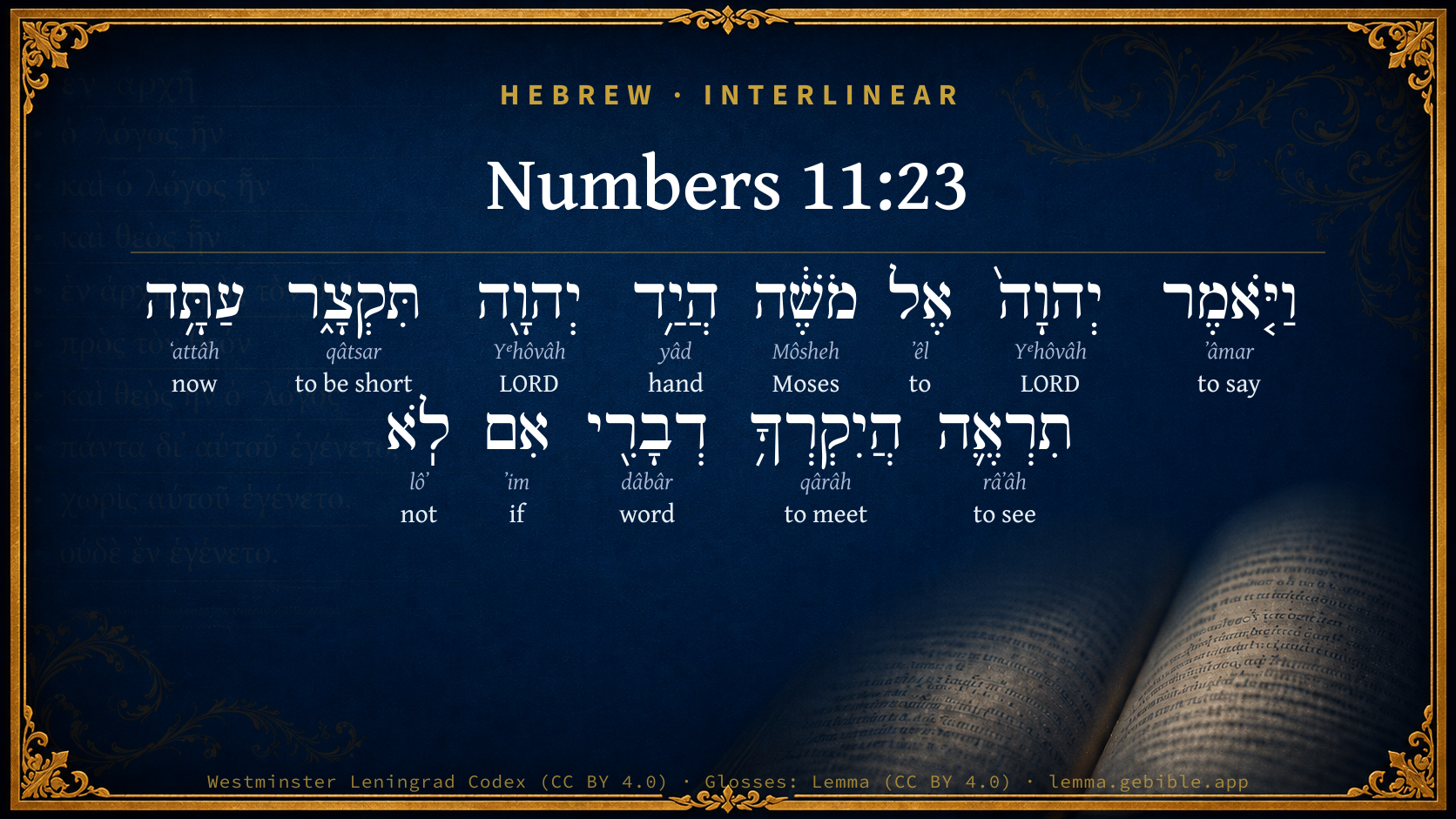
Hebrew (Westminster Leningrad Codex) Numbers 11:23 appears in the Hebrew Old Testament. The text above is from the Westminster Leningrad Codex. Each word links to its Strong’s number, a concise gloss, and parsing drawn from the Open Scriptures Hebrew Bible morphology. Click any word for its full Brown-Driver-Briggs (BDB) entry.
Download image
Cite this verse

Numbers 11:23 (World English Bible). Public Domain. Lemma interlinear Bible study tool, https://lemma.gebible.app/v/numbers/11/23.

Show BibTeX & RIS
BibTeX
RIS
English Translation
Yahweh said to Moses, Has Yahweh's hand grown short? now shall you see whether my word shall happen to you or not.
World English Bible · Public Domain
Download a study sheet

One document with this verse’s original text, its word-by-word gloss line, the meaning frame, cross-references with their text, attributed commentary, and full source and license credits — printable, and it pastes into notes with its structure intact.

This verse Autodidact and up

Study sheet (.html) Plain text (.txt)

A passage Seminary Student

Up to 50 verses in one chapter. A passage sheet keeps up to 6 commentary sources and 12 cross-references per verse, in the order this page ranks them, and says so on the sheet whenever that leaves anything out. Ask for a single verse and you get the Autodidact verse sheet above.

Everything on this page stays free to read, with no account — the sheet is a download of what is already on screen, not access to it.

Want to remove ads? Support Godless Engineer
Compare translations 3

The same verse in 3 English versions, stacked beneath the original-language interlinear above. Click any original word for its lexicon entry.

Each is an independent rendering of the whole verse — the interlinear is not word-aligned to these translations.

Highlighted words mark where these versions differ — a whole-verse word diff, not a word-by-word alignment.

  • World English Bible Public Domain
    Yahweh said to Moses, Has Yahweh's hand grown short? now shall you see whether my word shall happen to you or not.
  • King James Version Public Domain
    And the LORD said unto Moses, Is the LORD's hand waxed short? thou shalt see now whether my word shall come to pass unto thee or not.
  • unfoldingWord Literal Text CC BY-SA 4.0
    And Yahweh said to Moses, “Is the hand of Yahweh short? Now you will see whether my word will happen to you or not.”

unfoldingWord Literal Text — © unfoldingWord, licensed CC BY-SA 4.0. Word-aligned USFM3 via Door43 (git.door43.org/unfoldingWord/en_ult).

Versions to compare (up to 4)

3 of 4 selected

Show all 18 translations

Every available English version of this verse, each an independent rendering of the whole verse.

  • World English Bible Public Domain
    Yahweh said to Moses, Has Yahweh's hand grown short? now shall you see whether my word shall happen to you or not.
  • Berean Standard Bible Public Domain
    The LORD answered Moses, “Is the LORD’s arm too short? Now you will see whether or not My word will come to pass.”
  • Majority Standard Bible Public Domain
    The LORD answered Moses, “Is the LORD’s arm too short? Now you will see whether or not My word will come to pass.”
  • King James Version Public Domain
    And the LORD said unto Moses, Is the LORD's hand waxed short? thou shalt see now whether my word shall come to pass unto thee or not.
  • American Standard Version (1901) Public Domain
    And Jehovah said unto Moses, Is Jehovah's hand waxed short? now shalt thou see whether my word shall come to pass unto thee or not.
  • Revised Version (1885) Public Domain
    And the LORD said unto Moses, Is the LORD’S hand waxed short? now shalt thou see whether my word shall come to pass unto thee or not.
  • Geneva Bible (1599) Public Domain
    And the Lord saide vnto Moses, Is the Lordes hand shortened? thou shalt see now whether my word shall come to passe vnto thee, or no.
  • Douay-Rheims (1899) Public Domain
    And the Lord answered him: Is the hand of the Lord unable? Thou shalt presently see whether my word shall come to pass or no.
  • Young's Literal Translation Public Domain
    And Jehovah saith unto Moses, `Is the hand of Jehovah become short? now thou dost see whether My word meeteth thee or not.'
  • Literal Standard Version CC BY-SA 4.0
    And YHWH says to Moses, “Has the hand of YHWH become short? Now you see whether My word meets you or not.”
  • Unlocked Literal Bible CC BY-SA 4.0
    Yahweh said to Moses, “Is my hand short? Now you will see whether or not my word is true.”
  • unfoldingWord Literal Text CC BY-SA 4.0
    And Yahweh said to Moses, “Is the hand of Yahweh short? Now you will see whether my word will happen to you or not.”
  • Darby Bible Public Domain
    And Jehovah said to Moses, Hath Jehovah's hand become short? Now shalt thou see whether my word will come to pass unto thee or not.
  • World Messianic Bible Public Domain
    The LORD said to Moses, “Has the LORD’s hand grown short? Now you will see whether my word will happen to you or not.”
  • Webster's Bible Public Domain
    And the LORD said to Moses, Is the LORD'S hand shortened? thou shalt see now whether my word shall come to pass to thee, or not.
  • Free Bible Version CC BY-SA 4.0
    “Doesn't the Lord have the power to do that?” the Lord responded. “Now you're going to find out whether what I've said will happen or not!”
  • Bible in Basic English Public Domain
    And the Lord said to Moses, Has the Lord's hand become short? Now you will see if my word comes true for you or not.
  • JPS Tanakh (1917) Public Domain
    And the LORD said unto Moses: 'Is the LORD'S hand waxed short? now shalt thou see whether My word shall come to pass unto thee or not.'

Literal Standard Version (2020), Covenant Press — licensed CC BY-SA 4.0. Text via the HelloAO Bible API (eBible.org). Unlocked Literal Bible (unfoldingWord) — licensed CC BY-SA 4.0. Text via the HelloAO Bible API (eBible.org). unfoldingWord Literal Text — © unfoldingWord, licensed CC BY-SA 4.0. Word-aligned USFM3 via Door43 (git.door43.org/unfoldingWord/en_ult). Free Bible Version, Dr. Jonathan Gallagher — licensed CC BY-SA 4.0. Text via the HelloAO Bible API (eBible.org).

Word by word

More ways to search: Search by grammar → Find every occurrence → Compare this word →

Practice this passage: Drill this verse → Learn its vocabulary →

הֲיִקְרְךָ֥
qârâh
H7136
“to meet · you”
Particle, Interrogative + Verb, Qal, Imperfect, 3rd Person, Masculine, Singular + Suffix, Personal, 2nd Person, Masculine, Singular
Part of Speech
Particle + Verb
Stem
Qal
Form
Imperfect
Person
3rd Person
Gender
Masculine
Number
Singular
Full BDB Definition

Origin: a primitive root

TWOT: 2068 , 2068e

to encounter, meet, befall, happen, come to meet - (Qal) - to encounter, meet - to befall - (Niphal) - to encounter, meet (without pre-arrangement) - to chance to be present - to come to meet - (Hiphil) to cause to meet, appoint - to build with beams - (Piel) to lay the beams of, furnish with beams
  1. וַיֹּ֤אמֶר ʼâmar H559 “and · to say” Conjunction + Verb, Qal, Sequential Imperfect, 3rd Person, Masculine, Singular
  2. יְהוָה֙ Yᵉhôvâh H3068 “LORD” Noun, Proper
  3. אֶל ʼêl H413 “to” Preposition
  4. מֹשֶׁ֔ה Môsheh H4872 “Moses” Noun, Proper
  5. הֲיַ֥ד yâd H3027 “hand of” Particle, Interrogative + Noun, Common, Both, Singular, Construct
  6. יְהוָ֖ה Yᵉhôvâh H3068 “LORD” Noun, Proper
  7. תִּקְצָ֑ר qâtsar H7114 “to be short” Verb, Qal, Imperfect, 3rd Person, Feminine, Singular
  8. עַתָּ֥ה ʻattâh H6258 “now” Adverb
  9. תִרְאֶ֛ה râʼâh H7200 “to see” Verb, Qal, Imperfect, 2nd Person, Masculine, Singular
  10. דְבָרִ֖י dâbâr H1697 “word · my” Noun, Common, Masculine, Singular, Construct + Suffix, Personal, 1st Person, Common, Singular
  11. אִם ʼim H518 “if” Conjunction
  12. לֹֽא lôʼ H3808 “not” Particle, Negative

About this verse

These counts appear in no published source. They are computed here, from the morphology-tagged text and Lemma’s own curated glosses. What Lemma adds →

13
words
12
distinct lemmas
Pentateuch
section

Shared distinctive vocabulary

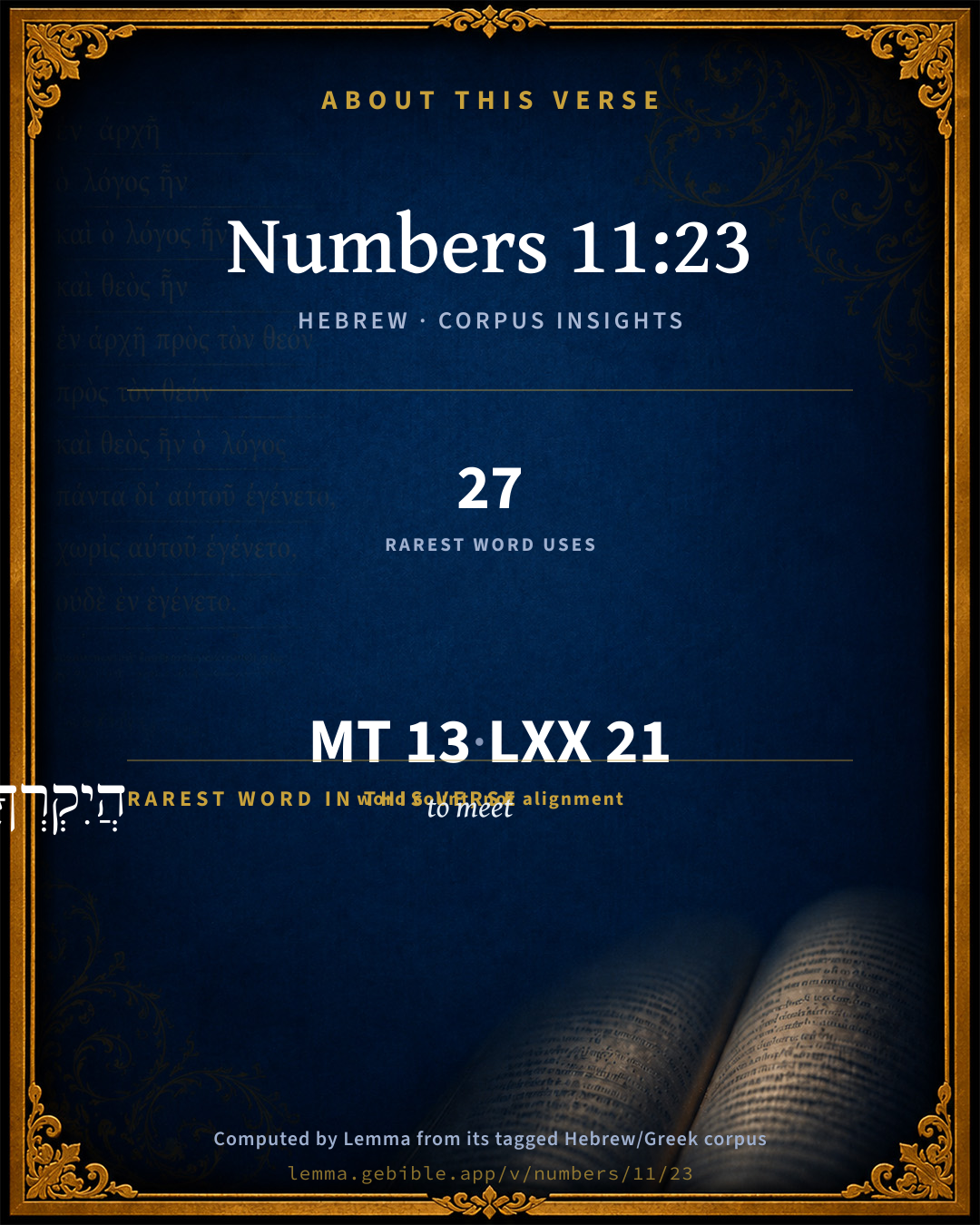
הֲיִקְרְךָ֥ to meet H7136 occurs in 27 verses of the Hebrew Bible. Also found in:

Grammatical profile

  • 4 verbs
  • 5 nouns
  • 1 preposition
  • 1 conjunction
  • 1 adverb
  • 1 particle

Verb forms

  • וַיֹּ֤אמֶר Qal · Sequential Imperfect
  • תִּקְצָ֑ר Qal · Imperfect
  • תִרְאֶ֛ה Qal · Imperfect
  • הֲיִקְרְךָ֥ Qal · Imperfect

Repetition

A word recurs within this verse — often emphatic in Hebrew:

  • יְהוָה֙ LORD H3068 ×2

Hebrew & Septuagint length

In English translation the verse runs 22 words from the Hebrew and 31 from the Septuagint (LXX English) — the Septuagint runs noticeably longer here. See the side-by-side →

A rough comparison of the two English renderings, which tokenize alike — not a word-level alignment.

Word counts can differ between the Hebrew and the Greek without any difference in meaning — e.g. the Hebrew direct-object marker אֵת has no separate Greek word, and Greek often adds the article ὁ.

In the original languages it is 13 Hebrew tokens and 21 Greek tokens — but the two are counted differently (Hebrew bundles its prefixes and suffixes into one token; the Greek is in lemma form), so that isn’t a like-for-like length.

Cross-references

14

Topical passages linked to Numbers 11:23 in the Treasury of Scripture Knowledge — connected by theme and wording, ordered by reader-vote popularity; previews shown in the World English Bible.

  • Genesis 18:14 Is anything too hard for Yahweh? At the set time I will return to you, when the season comes round, and Sarah will have a son."
  • Isaiah 50:2 Why, when I came, was there no man? when I called, was there none to answer? Is my hand shortened at all, that it can't redeem? or have I no power to deliver? Behold, at my rebuke I dry up the sea, I make the rivers a wilderness: their fish stink, because there is no water, and die for thirst.
  • Isaiah 59:1 Behold, Yahweh's hand is not shortened, that it can't save; neither his ear heavy, that it can't hear:
  • Matthew 19:26 Looking at them, Jesus said, "With men this is impossible, but with God all things are possible."
  • Luke 1:37 For everything spoken by God is possible."
  • Numbers 23:19 God is not a man, that he should lie, Neither the son of man, that he should repent: Has he said, and will he not do it? Or has he spoken, and will he not make it good?
  • Ezekiel 12:25 For I am Yahweh; I will speak, and the word that I shall speak shall be performed; it shall be no more deferred: for in your days, rebellious house, will I speak the word, and will perform it, says the Lord Yahweh.
  • Ezekiel 24:14 I, Yahweh, have spoken it: it shall happen, and I will do it: I will not go back, neither will I spare, neither will I repent; according to your ways, and according to your doings, shall they judge you, says the Lord Yahweh.
  • Matthew 24:35 Heaven and earth will pass away, but my words will not pass away.
  • Micah 2:7 Shall it be said, O house of Jacob: "Is the Spirit of Yahweh angry? Are these his doings? Don't my words do good to him who walks blamelessly?"
  • Jeremiah 44:28–29 Those who escape the sword shall return out of the land of Egypt into the land of Judah, few in number; and all the remnant of Judah, who have gone into the land of Egypt to sojourn there, shall know whose word shall stand, mine, or theirs.
  • 2 Kings 7:17–19 The king appointed the captain on whose hand he leaned to have the charge of the gate: and the people trod on him in the gate, and he died as the man of God had said, who spoke when the king came down to him.
  • Psalms 78:41 They turned again and tempted God, And provoked the Holy One of Israel.
  • 2 Kings 7:2 Then the captain on whose hand the king leaned answered the man of God, and said, Behold, if Yahweh should make windows in heaven, might this thing be? He said, Behold, you shall see it with your eyes, but shall not eat of it.

Cross-references courtesy of OpenBible.info (CC BY 4.0).

Hebrew and Greek witnesses Masoretic Hebrew ↔ Greek Septuagint

The same verse in the two great witnesses to the Old Testament, shown verse-for-verse.

Here the Septuagint runs noticeably longer than the Hebrew — LXX2012 (modern English Septuagint) 31 words vs World English Bible 22. A rough length comparison of the two English translations, not a word-level alignment — read both below.

These are two independent witnesses, not word-aligned to each other, and the Septuagint is shown in lemma (dictionary) form.

Hebrew Numbers 11:23 Masoretic · Westminster Leningrad Codex

וַיֹּ֤אמֶר יְהוָה֙ אֶל מֹשֶׁ֔ה הֲיַ֥ד יְהוָ֖ה תִּקְצָ֑ר עַתָּ֥ה תִרְאֶ֛ה הֲיִקְרְךָ֥ דְבָרִ֖י אִם לֹֽא

Yahweh said to Moses, Has Yahweh's hand grown short? now shall you see whether my word shall happen to you or not.

World English Bible · Public Domain

Greek LXX Numbers 11:23 Septuagint · lemma form

καί εἶπον κύριος πρός μωυσῆς μή χείρ κύριος οὐ ἐκἀρκέω ἤδη γιγνώσκω εἰ ἐπι καταλαμβάνω σύ ὁ λόγος ἐγώ ἤ οὐ

And the Lord said to Moses, Shall not the hand of the Lord be fully sufficient? now shall you know whether my word shall come to pass to you or not.

LXX2012 (modern English Septuagint) · Public Domain

On this verse, Haydock's Catholic Bible Commentary discusses the Septuagint’s reading. Read the note in Commentary ↓

Hebrew: Westminster Leningrad Codex (CC BY 4.0). Greek: Septuagint (public domain); English from LXX2012 (modern English Septuagint) (Public Domain). How the Septuagint differs from the Hebrew →

Targum (Aramaic paraphrase)

2

The Targum is the ancient Jewish Aramaic paraphrase of the Hebrew Scriptures — an interpretive translation, not the Hebrew text itself. Onkelos (literal) and Pseudo-Jonathan (expansive) render the Torah, and Jonathan the Prophets. Coverage is partial: where no permissively-licensed English translation exists for a verse, only the Aramaic is shown. This is verse-level text, not a word-by-word alignment to the Hebrew.

  1. Targum Onkelos Torah (Genesis–Deuteronomy)
    וַאֲמַר יְיָ לְמשֶׁה הֲמֵימְרָא דַיְיָ יִתְעַכָּב כְּעַן תֶּחֱזֵי הַיְעַרְעִנָךְ פִּתְגָמִי אִם לָא

    (no public-domain English translation for this verse)

    Targum Onkelos — Aramaic: “Onkelos Genesis” (public domain); “Onkelos Exodus” (public domain); “Onkelos Leviticus” (public domain); “Onkelos Numbers” (public domain); “Onkelos Deuteronomy” (public domain). English: “Sefaria Community Translation” (CC0 1.0 (public-domain dedication)); “J.W. Etheridge. The Targums of Onkelos and Jonathan Ben Uzziel on the Pentateuch. London: Longmans, Green, 1862” (public domain). Text via Sefaria.

  2. Targum Pseudo-Jonathan Torah (Genesis–Deuteronomy)
    וַאֲמַר יְיָ לְמשֶׁה הַאֶפְשַׁר דְאִית קֳדָם יְיָ מַחְסוֹר כְּדוֹן תֶּחֱמֵי הַיְאַרְעִינָךְ פִּתְגָמִי אִין לָא

    And the Lord said to Mosheh, Can any thing fail before the Lord? Now shalt thou see whether what I have said to thee shall come to pass or not.

    Targum Pseudo-Jonathan — Aramaic: “Targum Jonathan on Genesis” (public domain); “Targum Jonathan on Exodus” (public domain); “Targum Jonathan on Leviticus” (public domain); “Targum Jonathan on Numbers” (public domain); “Targum Jonathan on Deuteronomy” (public domain). English: “The Targum of Jonathan ben Uzziel, trans. J. W. Etheridge, London, 1862” (public domain). Text via Sefaria.

Commentary

Notes on Numbers 11:23 from classic Christian and Jewish commentators (each source and its license shown beneath its notes). The classic Christian expositions comment on the surrounding passage and are grouped to its opening verse, so a note may address several verses; the Jewish commentaries on the Tanakh (Rashi and others) are per-verse, so they appear only where the commentator wrote on this verse.

Lemma curates 59 commentaries, every one of them public domain or Creative Commons licensed, each selected and text-cleaned for this edition rather than reprinted as found. About our sources →

Trapp's Complete Commentary

John Trapp

Num 11:23 And the LORD said unto Moses, Is the LORD’S hand waxed short? thou shalt see now whether my word shall come to pass unto thee or not.

Ver. 23. And the Lord said unto Moses.] God bears with Moses here; which afterwards he did not, {Num 20:12} because then he showed his distrust before the people. God will not pass by the scandalous practices of his own people without a sensible check.

Is the Lord’s hand shortened.] Moses thought God had made an unadvised promise, and prays him to consider, that the people were so many thousand, and that the flocks and herds would not suffice them. But God answers here, that he is never nonplussed.

John Trapp, A Commentary or Exposition upon All the Books of the Old and New Testament (1647–1656) — public domain. Text from a community e-Sword module.

The Biblical Illustrator

Joseph S. Exell

Num_11:23

Is the Lords hand waxed short?

Gods challenge to the faith and co-operation of His people

I. These words have special reference to a divinely-revealed purpose which staggers human reason.

1. Let us look at this purpose. God hath sent His Son into the world,. . . that the world through Him might be saved.

2. The difficulties in the way of this gracious purpose, which excite mens fears. There is the inveterate carnality of the human heart, the stubborn resistance of the human will to the Divine; there is the stolid indifference ,of great masses in Christian lands to the practical duties and claims of religion; and the growing scepticism of the day regarding the verities of the gospel. Consider also the prevalence of idolatrous systems and heathen superstitions among great masses of mankind. Take also the subtle rationalism and keen-witted infidelity which prevail in civilised and semi-Christianised countries. It requires strong faith in a man to calmly survey this formidable host of evil in the world and then take his stand by the side of Christ, confident that His cause will triumph.

II. We have in these words an assertion of divine power which warrants human confidence. Gods purpose is a promise. He stakes His character on the fulfilment of His Word.

1. He cannot forget.

2. He cannot fail through insincerity.

3. He cannot fail through inadequate power to perform.

III. In these words we have Gods challenge to the earnest faith, prayer, and co-operation of his people.

1. The true attitude of the Christian labourer or the Church is to stand, with one hand of believing prayer taking hold of God, and the other hand of loving labour taking hold of fallen man, that the fallen may be raised, and the lost saved.

2. When we are ready for a blessing, God will not fail to bestow it. (John Innocent.)

The glorious right hand of God

I. With regard to the church as a whole, how often is it true that she so behaveth herself as if she had a question in her mind as to whether the Lords hand had waxed short? The mass of us would be afraid to go out trusting in God to supply our needs. We should need first that everything should be prepared for us, and that the way should be paved; but we are not ready to leap as champions upon the wall of the citadel, leading the forlorn hope and planting the standard where it never stood before. No, we can follow in the track of others. We have few Careys and few Knibbs, few men who can go first and foremost saying, This is Gods cause; Jehovah is the only God, and in the name of the Eternal let the idols be abolished. Oh, for more anointed ones to preach the gospel believing in its intrinsic might, assured that where it is preached faithfully, the Spirit of God is never absent! O Zion! get thee up, get thee up! Count no more thy hosts, for their strength is thy weakness; measure no longer thy wealth, for thy wealth has often been thy poverty, and thy poverty thy wealth; think not of the learning or the eloquence of thy ministers and missionaries, for full often these things do but stand in the way of the Eternal God. But come thou forth in simple confidence in His promise, and thou shalt see whether He will not do according to His Word.

II. When believers doubt their God with regard to providence, the question might well be asked of them, Is the Lords hand waxed short? I do not doubt that I am speaking to some who have had many losses and crosses in their business. Instead of getting forward they are going back, and perhaps even bankruptcy stares them in the face. Or possibly, being hard-working men, they may have been long out of employment, and nothing seems now to be before their eyes but the starvation of themselves and their little ones. It is hard to bear this. But dost thou doubt, O believer, dost thou doubt as to whether God will fulfil His promise wherein He said, His place of defence shall be the munitions of rocks; bread shall be given him; his waters shall be sure? Thy God heareth the young ravens when they cry, and giveth liberally to all the creatures that His hands hath made, and will He forget His sons and His daughters--His people bought with blood, His own peculiar heritage? No; dare to believe Him now. His hand has not waxed short. Please not Satan, and vex not thyself by indulging any more those hard thoughts of Him. Say, My Father, Thou wilt hear my cry; Thou wilt supply all my needs; and according to thy faith, so shall it be done unto thee.

III. There is a third way by which this question might be very naturally suggested, and that is when a man who has faith in christ is exercised with doubts and fears with regard to his own final perseverance or his own present acceptance in Christ.

IV. This is a question which I may well ask of any here present who are convinced of sin, but are afraid to trust their souls now, at this very hour, in the hand of a loving Saviour. Oh, He cannot save me, I am so guilty, so callous! Could I repent as I ought, could I but feel as I ought, then He could save me; but I am naked and poor and miserable. How can He clothe, enrich, and bless me? I am cast out from His presence. I have grieved away His Spirit; I have sinned against light and knowledge--against mercy--against constant grace received. He cannot save me. And the Lord said unto Moses, Is the Lords hand waxed short? thou shalt see now whether My word shall come to pass unto thee or not. Did He not save the chief of sinners, Saul of Tarsus? Why, then, can He not save you? Is it not written, The blood of Jesus Christ His Son, cleanseth us from all sin? Has that blood lost its efficacy?

V. And you say, do you, that God will not avenge your sins upon you, that ye may go on in your iniquities and yet meet with no punishment; that ye may reject Christ and do it safely. Well, soul, thou shalt see whether His word shall come to pass or not. But let me tell thee His hand is not waxed short; He is as strong to punish as when He bade the floods cover the earth; as powerful to avenge as when He rained hail out of heaven upon the cities of the plain. He is to-day as mighty to overtake and punish His enemies as when He sent the angel through the midst of Egypt, or afterwards smote the hosts of Sennacherib. Thou shalt see whether He will keep His word or not. Go on in the neglect of His great salvation; go to thy dying bed, and buoy thyself up with the false hope that there is no hereafter; but, sinner, thou shalt see; thou shalt see. This point in dispute shall not long be a matter of question to be cavilled at on the one side, and to be taught with tears on the other. (C. H. Spurgeon.)

A strange question

It is a singular thing that such a question as this should ever be asked at all: Has the Lords hand waxed short? If we look anywhere and everywhere, apart from the conduct of man, there is nothing to suggest the suspicion.

1. Look to Gods creation! Is there anything there which would make you say, Is the Lords hand waxed short? What pillar of the heavens hath begun to reel? What curtain of the sky hath been rent or moth-eaten? Have the foundations of the earth begun to start? Hath the sun grown dim with age? or have the starry lamps flickered or gone out in darkness? Are there signs of decay to-day upon the face of Gods creation? Have not howling tempests, the yawning ocean, and death-bearing hurricanes, asserted but yesterday their undiminished might? Say, is not the green earth as full of vitality, as ready to yield us harvests now, as it ever hath been? Do the showers fall less frequently? No; journey where you will, you will see God as potent upon the face of the earth, and in the very bowels of the globe, as He was when He first said, Let there be light and there was light. There is nothing which would tempt us to the surmise or the suspicion that the Lords hand hath waxed short.

2. And look ye too in providence; is there aught there that would suggest the question? Are not His prophecies still fulfilled? Does He not cause all things to work together for good? Do the cattle on a thousand hills low out to Him for hunger? Do you meet with the skeletons of birds that have fallen to the ground from famine? Doth He neglect to give to the fish their food, or do the sea-monsters die? Doth not God still open His hand and supply the want of every living thing? Is He less bounteous to-day than He was in the time of Adam? Is not the cornucopia still as full? Doth He not still scatter mercies with both His hands right lavishly? Are there any tokens in providence any more than in nature, that Gods arm hath waxed short?

3. And look ye too in the matter of grace; is there any token in She work of grace that Gods power is failing? Are not sinners still saved? Are not profligates still reclaimed? Are not drunkards still uplifted from their sties to sit upon the throne with princes? Is not the Word of God still quick and powerful, sharper than any two-edged sword? Where have ye seen the sword of the Lord snapped in twain? When hath God assayed to melt a h-art and failed in the attempt? Which of His people has found the riches of His grace drained dry? Which of His children has had to mourn that the unsearchable riches of Christ had failed to supply his need? How is it, then, that such a question as this ever came from the lips of God Himself? What could there have been that should lead Him or any of His creatures to say, Is the Lords hand waxed short? We answer, there is but one creature that God has made that ever doubts Him. The little sparrows doubt not: though they have no barn nor field, yet they sweetly sing at night as they go to their roosts, though they know not where to-morrows meal shall be found. The very cattle trust Him; and even in days of drought, ye have seen them when they pant for thirst, how they expect the water; how the very first token of it makes them show in their very animal frame, by some dumb language, that they felt that God would not leave them to perish. The angels never doubt Him, nor the devils either: devils believe and tremble. But it was left for man, the most favoured of all creatures, to mistrust his God. This high, this black, this infamous sin of doubting the power and faithfulness of Jehovah, was reserved for the fallen race of rebellious Adam; and we alone, out of all the beings that God has ever fashioned, dishonour Him by unbelief and tarnish His honour by mistrust. (C. H. Spurgeon.)

No failure of Tower with God

Amongst all the gods of the heathen Jupiter was in the greatest esteem, as the father and king of gods and was called Jupiter, quasi juvans pater, a helping father, yet (as the poets feign) be wept when he could not set Sarpedon at liberty; such was the imbecility and impotency of this master-god of the heathen. But the hand of our God is never shortened that it cannot help, He is ever able to relieve us, always ready to deliver us. Amongst all the gods there is none like unto Him, none can do like unto His works, He is God Omnipotent. (J. Spencer.)

The Biblical Illustrator, edited by Joseph S. Exell (c. 1880s–1900s) — public domain. Text from a community e-Sword module.

Joseph Benson's Commentary

Num 11:23. Is the Lord’s hand waxed short? — Is the divine power diminished? Isa 50:2; Isa 59:1. What has not God done to convince mankind that his power is always unlimited? And yet man is still ready to fall into the weakness of thinking that there are circumstances in which the power of God cannot afford relief or deliverance, but must, as it were, remain inactive.

Joseph Benson's Commentary on the Old and New Testaments (1811–1818) — public domain. Text from a community e-Sword module.

Adam Clarke's Commentary

Verse 23. Is the Lord's hand waxed short?] Hast thou forgotten the miracles which I have already performed? or thinkest thou that my power is decreased? The power that is unlimited can never be diminished.

Adam Clarke's Commentary on the Bible (1810–1826) — public domain. Text from a community e-Sword/MySword module.

John Gill's Exposition

And the Lord said unto Moses,.... In answer to his objection, without upbraiding him with his sin of unbelief:

is the Lord's hand waxed short? or his power diminished since the creation, when he formed all things out of nothing, and what is it then he is not able to do? or since he wrought the wonders in Egypt, divided the Red sea, rained down manna from heaven, and smote the rock at Horeb, from whence waters flowed sufficient for all this people, and their flocks and herds; and he that did all this could give them flesh that would suffice them a whole month, see Isa 59:1,

thou shall see now whether my words shall come to pass unto thee or no; whether I am able to make good my promise; a short time will decide it, it shall be seen presently whether I am and will do what I have said.

John Gill's Exposition of the Whole Bible (1746–1763) — public domain (CC PDM 1.0). Text via the HelloAO Bible API.

Haydock's Catholic Bible Commentary

Unable: Hebrew, "shortened." Septuagint, "insufficient." Moses had expresed his astonishment, not his doubts; though the words might convey the latter idea to us more than his behaviour in chap. xx. 10. But God sees the heart. --- To pass. Hebrew may be also, "hath called thee;" (Calmet) Septuagint, "shall come upon thee," and execute the thing, as soon as thou shalt promise it. (Haydock)

George Leo Haydock (1774–1849), Haydock's Catholic Family Bible and Commentary, 1859 edition — public domain. Excludes Psalms (Douay-Rheims chapter numbering differs from Protestant) and Deuterocanonical books (Catholic canon only).

Matthew Poole's English Annotations

Waxed short, i.e. less able to work such great and glorious miracles as I have done.

Matthew Poole's English Annotations on the Holy Bible (1683–1685) — public domain. Text from a community e-Sword/MySword module.

Whedon's Commentary on the Bible

Daniel D. Whedon

23. Is the Lord’s hand waxed short — The hand is the instrument, and hence the symbol, of power. To say that a person’s hand is short is, in Hebrew conception, to say that he is impotent. Among the modern Arabs and Persians a long hand denotes strength, a short hand weakness. When the idea of omnipotence as available for human necessities in answer to prayer drops out of the mind, unbelief enters. Hence Jesus says to the blind men, “Believe ye that I am able to do this?” The burden of Paul’s epistles and prayers is, that believers “may know the exceeding greatness of his power to us-ward who believe.” Eph_1:19. It is of the utmost importance to all Christians, especially to all preachers, to keep the almightiness of God ever before the soul. This entire verse is a rebuke to the littleness of Moses’s faith.

Daniel D. Whedon (gen. ed.), Commentary on the Old and New Testaments (1874–1909) — public domain. Text from a community e-Sword module.

The Pulpit Commentary

Is the Lord"s hand waxed short? So that it cannot reach far enough to fulfill his purposes. This simple and expressive figure of speech is adopted by Isaiah. (Isa_1:2 Isa_59:1)

The Pulpit Commentary (1880–1919), ed. H.D.M. Spence-Jones & Joseph S. Exell — public domain. Text from a community e-Sword module.

Rashi

Rabbi Shlomo Yitzchaki (Rashi)

עתה תראה היקרך דברי THOU SHALT SEE NOW WHETHER MY WORD SHALL COME TO PASS UNTO THEE [OR NOT]. — R. Gamliel, the son of R. Judah ha-Nasi said, “The dialogue took the following course: Moses said, “One can never understand a babbler! (One can never fathom his meaning.) Since they are merely seeking a pretext You will never satisfy them (the meaning of the text is: If all the cattle in the world were slaughtered for them, ומצא להם, would this suffice them, i. e., would they be satisfied with that?), in the end they will always argue against You. If You give them flesh of large cattle (oxen) they will say ‘We wanted that of small cattle (sheep)’; if You will give them flesh of sheep, they will say We wanted that of oxen’, or, ‘we wanted wild beasts (venison) and fowls’, ‘we wanted fish and locusts!’ Thereupon He said to him, ‘If that be so and I give them nothing at all, they will say that My hand has waxed short!’ “Moses thereupon said, “I will go and appease them”. He answered him: “Thou shalt see now whether My word shall come to pass unto thee — for they will not listen to thee”. Moses went to appease them and said to them, “Is the hand of the Lord waxed short? Behold, he continued with the words used later by the Psalmist, (Psalms 78:20): “He smote the rock that the waters gushed out, etc. Surely then he can give bread also [and can provide flesh for His people!]”. But they (the Israelites) said: “This what you have said is only a compromise (a way of satisfying us). He has really no power to grant our request!” This is what Scripture means by: “and Moses went out and spake to the people [the words of the Lord]” (i.e. he told them the words used by the Lord only with a different implication). Since, however, they would not listen to him, he gathered the seventy men of the elders [of the people] etc.” (cf. Sifrei Bamidbar 95:1; Tosefta Sota 6:4).

Rashi on the Tanakh — English translations: “The Judaica Press complete Tanach with Rashi, translated by A. J. Rosenberg” (CC BY 4.0); “Pentateuch with Rashi's commentary by M. Rosenbaum and A.M. Silbermann, 1929-1934” (public domain); “The Metsudah Tanach series, Lakewood, N.J” (CC BY 4.0); and “The Book of Joshua, Metsudah Publications, 1997” (CC BY 4.0). Text via Sefaria.

Lesson kit

Teaching starters — assembled from the data on this page, not authored interpretation. Every prompt links to the verse data it draws on. Edit before teaching.

Numbers, in the Pentateuch, opens this verse with 13 words (12 distinct Hebrew lemmas). Its most distinctive word is qârâh (“to meet”). The Greek Septuagint runs longer here. A historical commentator’s framing appears above. Read the whole chapter for the surrounding context.

Discussion questions

  1. How does “to meet” (qârâh) shape what this verse is saying?
  2. How does Genesis 24:12, which shares the word «to meet», read alongside this verse?
  3. What does the repetition of “LORD” (2× in this one verse) do in this verse?
  4. The Septuagint runs longer here than the Hebrew. What might account for the difference?
  5. The translations on this page render this verse differently — a whole-verse word diff, not a word-by-word alignment. What might account for the different wordings?
  6. «וַיֹּ֤אמֶר» is a Qal Sequential Imperfect verb. How does that grammatical form shape the action described?
  7. Compare how Trapp's Complete Commentary and The Biblical Illustrator read this verse. Where do they agree or differ?

Things to notice

Reading settings

Reading text

Shown beneath each verse's original-language words.

Old Testament
Old Testament edition

Read the OT as the Masoretic Hebrew (MT) or the Greek Septuagint (LXX).

English shown for the Greek Septuagint (in the Hebrew ↔ Greek comparison).

Comparing translations? Open the Compare panel on any verse page to stack up to four side by side.