1 Thessalonians 3:5

Greek (Tischendorf 8th ed.) 1 Thessalonians 3:5 appears in the Greek New Testament. The text above is from the Tischendorf 8th edition. Each word links to its Strong’s number and a concise gloss. Click any word for its full Thayer’s Greek Lexicon entry.
Download image
Cite this verse

1 Thessalonians 3:5 (World English Bible). Public Domain. Lemma interlinear Bible study tool, https://lemma.gebible.app/v/1-thessalonians/3/5.

Show BibTeX & RIS
BibTeX
RIS
English Translation
For this cause I also, when I couldn't stand it any longer, sent that I might know your faith, for fear that by any means the tempter had tempted you, and our labor would have been in vain.
World English Bible · Public Domain
Download a study sheet

One document with this verse’s original text, its word-by-word gloss line, the meaning frame, cross-references with their text, attributed commentary, and full source and license credits — printable, and it pastes into notes with its structure intact.

This verse Autodidact and up

Study sheet (.html) Plain text (.txt)

A passage Seminary Student

Up to 50 verses in one chapter. A passage sheet keeps up to 6 commentary sources and 12 cross-references per verse, in the order this page ranks them, and says so on the sheet whenever that leaves anything out. Ask for a single verse and you get the Autodidact verse sheet above.

Everything on this page stays free to read, with no account — the sheet is a download of what is already on screen, not access to it.

Want to remove ads? Support Godless Engineer
Compare translations 3

The same verse in 3 English versions, stacked beneath the original-language interlinear above. Click any original word for its lexicon entry.

Each is an independent rendering of the whole verse — the interlinear is not word-aligned to these translations.

Highlighted words mark where these versions differ — a whole-verse word diff, not a word-by-word alignment.

  • World English Bible Public Domain
    For this cause I also, when I couldn't stand it any longer, sent that I might know your faith, for fear that by any means the tempter had tempted you, and our labor would have been in vain.
  • King James Version Public Domain
    For this cause, when I could no longer forbear, I sent to know your faith, lest by some means the tempter have tempted you, and our labour be in vain.
  • unfoldingWord Literal Text CC BY-SA 4.0
    Because of this, I also, no longer enduring, sent to know about your faith, lest somehow the tempter had tempted you, and our labor might have been in vain.

unfoldingWord Literal Text — © unfoldingWord, licensed CC BY-SA 4.0. Word-aligned USFM3 via Door43 (git.door43.org/unfoldingWord/en_ult).

Versions to compare (up to 4)

3 of 4 selected

Show all 19 translations

Every available English version of this verse, each an independent rendering of the whole verse.

  • World English Bible Public Domain
    For this cause I also, when I couldn't stand it any longer, sent that I might know your faith, for fear that by any means the tempter had tempted you, and our labor would have been in vain.
  • Berean Standard Bible Public Domain
    For this reason, when I could bear it no longer, I sent to find out about your faith, for fear that the tempter had somehow tempted you and caused our labor to be in vain.
  • Majority Standard Bible Public Domain
    For this reason, when I could bear it no longer, I sent to find out about your faith, for fear that the tempter had somehow tempted you and caused our labor to be in vain.
  • King James Version Public Domain
    For this cause, when I could no longer forbear, I sent to know your faith, lest by some means the tempter have tempted you, and our labour be in vain.
  • American Standard Version (1901) Public Domain
    For this cause I also, when I could no longer forbear, sent that I might know your faith, lest by any means the tempter had tempted you, and our labor should be in vain.
  • Revised Version (1885) Public Domain
    For this cause I also, when I could no longer forbear, sent that I might know your faith, lest by any means the tempter had tempted you, and our labour should be in vain.
  • Geneva Bible (1599) Public Domain
    Euen for this cause, when I could no longer forbeare, I sent him that I might knowe of your faith, lest the tempter had tempted you in any sort, and that our labour had bene in vaine.
  • Douay-Rheims (1899) Public Domain
    For this cause also, I, forbearing no longer, sent to know your faith: lest perhaps he that tempteth should have tempted you, and our labour should be made vain.
  • Young's Literal Translation Public Domain
    because of this also, I, no longer forbearing, did send to know your faith, lest he who is tempting did tempt you, and in vain might be our labour.
  • Literal Standard Version CC BY-SA 4.0
    because of this also, I, no longer enduring, sent to know your faith, lest he who is tempting tempted you, and our labor might be in vain.
  • Unlocked Literal Bible CC BY-SA 4.0
    For this reason, when I could no longer stand it, I sent that I might know about your faith. Perhaps the tempter had somehow tempted you, and our labor was in vain.
  • unfoldingWord Literal Text CC BY-SA 4.0
    Because of this, I also, no longer enduring, sent to know about your faith, lest somehow the tempter had tempted you, and our labor might have been in vain.
  • Darby Bible Public Domain
    For this reason *I* also, no longer able to refrain myself, sent to know your faith, lest perhaps the tempter had tempted you and our labour should be come to nothing.
  • World Messianic Bible Public Domain
    For this cause I also, when I couldn’t stand it any longer, sent that I might know your faith, for fear that by any means the tempter had tempted you, and our labor would have been in vain.
  • Webster's Bible Public Domain
    For this cause, when I could no longer forbear, I sent to know your faith, lest by some means the tempter may have tempted you, and our labor be in vain.
  • Free Bible Version CC BY-SA 4.0
    This is why, when I couldn't stand it anymore, I sent to find out whether you were still trusting in God. I was concerned that the devil had successfully tempted you and that all our work had been for nothing!
  • Bible in Basic English Public Domain
    For this reason, when I was no longer able to keep quiet, I sent to get news of your faith, fearing that you might be tested by the Evil One and that our work might come to nothing.
  • Text-Critical English NT CC BY 4.0
    For this reason, when I could bear it no longer, I sent Timothy to find out about your faith, lest somehow the tempter had tempted you and our labor had been in vain.
  • Tyndale New Testament (1534) Public Domain
    For this cause when I coulde no lenger forbeare I sent that I myght have knowledge of youre fayth lest haply the tempter had tempted you and that oure laboure had bene bestowed in vayne.

Literal Standard Version (2020), Covenant Press — licensed CC BY-SA 4.0. Text via the HelloAO Bible API (eBible.org). Unlocked Literal Bible (unfoldingWord) — licensed CC BY-SA 4.0. Text via the HelloAO Bible API (eBible.org). unfoldingWord Literal Text — © unfoldingWord, licensed CC BY-SA 4.0. Word-aligned USFM3 via Door43 (git.door43.org/unfoldingWord/en_ult). Free Bible Version, Dr. Jonathan Gallagher — licensed CC BY-SA 4.0. Text via the HelloAO Bible API (eBible.org).

Word by word

More ways to search: Search by grammar → Find every occurrence → Compare this word →

Practice this passage: Drill this verse → Learn its vocabulary →

στέγων
stégō
G4722
“to cover”
Verb, Present, Active, Participle, Nominative, Singular, Masculine
Part of Speech
Verb
Tense
Present
Voice
Active
Mood
Participle
Case
Nominative
Number
Singular
Gender
Masculine
Full Thayer's Definition

Origin: from G4721

TDNT: 16:45,1

1. deck, thatch, to cover a. to protect or keep by covering, to preserve 2. to cover over with silence a. to keep secret b. to hide, conceal 1. of the errors and faults of others 3. by covering to keep off something which threatens, to bear up against, hold out against, and so endure, bear, forbear
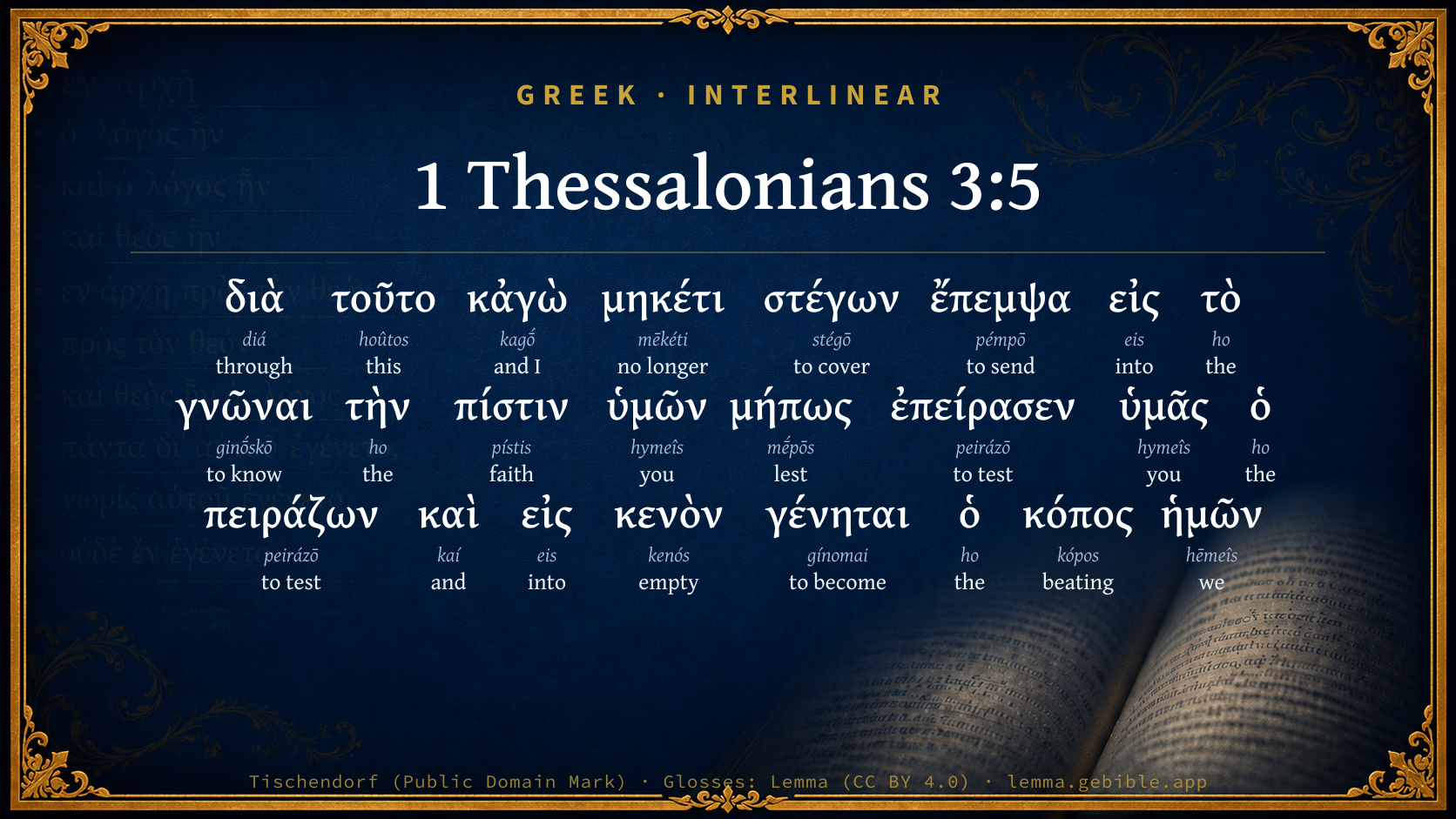
  1. διὰ diá G1223 “through” Preposition
  2. τοῦτο hoûtos G3778 “this” Demonstrative pronoun, Accusative, Singular, Neuter
  3. κἀγὼ kagṓ G2504 “and I” Personal pronoun, 1st person, Nominative, Singular, Aramaic form
  4. μηκέτι mēkéti G3371 “no longer” Adverb, Negative
  5. ἔπεμψα pémpō G3992 “to send” Verb, Aorist, Active, Indicative, 1st person, Singular
  6. εἰς eis G1519 “into” Preposition
  7. τὸ ho G3588 “the” Article, Accusative, Singular, Neuter
  8. γνῶναι ginṓskō G1097 “to know” Verb, Aorist, Active, Infinitive
  9. τὴν ho G3588 “the” Article, Accusative, Singular, Feminine
  10. πίστιν pístis G4102 “faith” Noun, Accusative, Singular, Feminine
  11. ὑμῶν hymeîs G5210 “you” Personal pronoun, 2nd person, Genitive, Plural
  12. μήπως mḗpōs G3381 “lest” Conjunction, Negative
  13. ἐπείρασεν peirázō G3985 “to test” Verb, Imperfect, Active, Indicative, 3rd person, Singular
  14. ὑμᾶς hymeîs G5210 “you” Personal pronoun, 2nd person, Accusative, Plural
  15. ὁ ho G3588 “the” Article, Nominative, Singular, Masculine
  16. πειράζων peirázō G3985 “to test” Verb, Present, Active, Participle, Nominative, Singular, Masculine
  17. καὶ kaí G2532 “and” Conjunction
  18. εἰς eis G1519 “into” Preposition
  19. κενὸν kenós G2756 “empty” Adjective, Accusative, Singular, Neuter
  20. γένηται gínomai G1096 “to become” Verb, Aorist, Middle deponent, Subjunctive, 3rd person, Singular
  21. ὁ ho G3588 “the” Article, Nominative, Singular, Masculine
  22. κόπος kópos G2873 “beating” Noun, Nominative, Singular, Masculine
  23. ἡμῶν hēmeîs G2249 “we” Personal pronoun, 1st person, Genitive, Plural

About this verse

These counts appear in no published source. They are computed here, from the morphology-tagged text and Lemma’s own curated glosses. What Lemma adds →

24
words
18
distinct lemmas
Pauline Epistles
section

Notable vocabulary

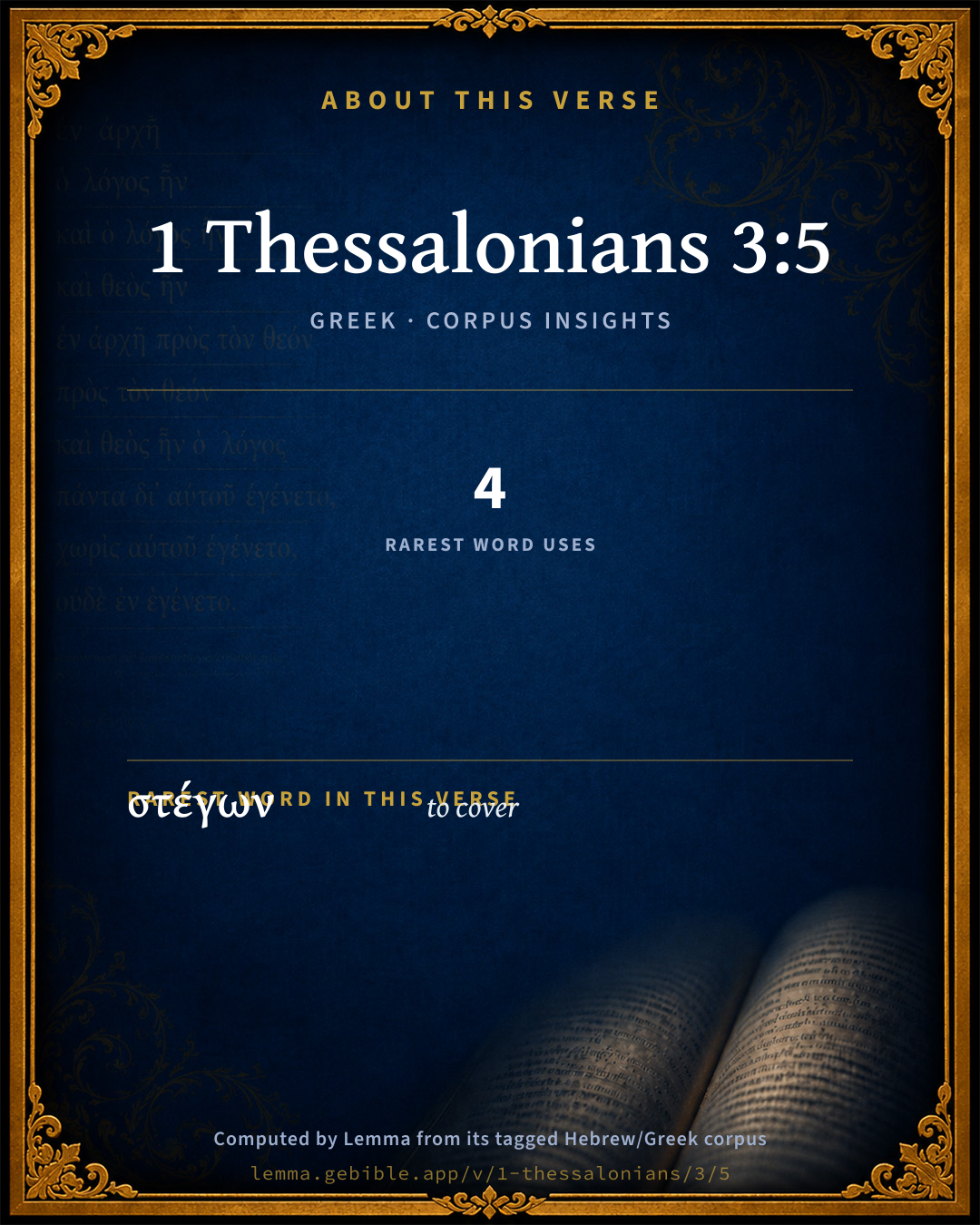
The rarest word here is στέγων to cover G4722 — appearing just 4 times in the whole Greek New Testament.

Shared distinctive vocabulary

στέγων to cover G4722 occurs in 4 verses of the Greek New Testament. Also found in:

Repetition

Words recur within this verse:

  • εἰς into G1519 ×2
  • ἐπείρασεν to test G3985 ×2
  • τὸ the G3588 ×4
  • ὑμῶν you G5210 ×2

Cross-references

17

Topical passages linked to 1 Thessalonians 3:5 in the Treasury of Scripture Knowledge — connected by theme and wording, ordered by reader-vote popularity; previews shown in the World English Bible.

  • James 1:13–14 Let no man say when he is tempted, "I am tempted by God," for God can't be tempted by evil, and he himself tempts no one.
  • Matthew 4:3 The tempter came and said to him, "If you are the Son of God, command that these stones become bread."
  • 2 Corinthians 2:11 that no advantage may be gained over us by Satan; for we are not ignorant of his schemes.
  • Isaiah 49:4 But I said, I have labored in vain, I have spent my strength for nothing and vanity; yet surely the justice [due] to me is with Yahweh, and my recompense with my God.
  • Galatians 1:6–9 I marvel that you are so quickly deserting him who called you in the grace of Christ to a different gospel;
  • Ephesians 4:14 that we may no longer be children, tossed back and forth and carried about with every wind of doctrine, by the trickery of men, in craftiness, after the wiles of error;
  • Philippians 2:16 holding up the word of life; that I may have something to boast in the day of Christ, that I didn't run in vain nor labor in vain.
  • 1 Corinthians 7:5 Don't deprive one another, unless it is by consent for a season, that you may give yourselves to fasting and prayer, and may be together again, that Satan doesn't tempt you because of your lack of self-control.
  • 2 Corinthians 7:5–7 For even when we had come into Macedonia, our flesh had no relief, but we were afflicted on every side. Fightings were outside. Fear was inside.
  • 2 Corinthians 11:2–3 For I am jealous over you with a godly jealousy. For I married you to one husband, that I might present you as a pure virgin to Christ.
  • 2 Corinthians 11:13–15 For such men are false apostles, deceitful workers, masquerading as Christ's apostles.
  • Galatians 2:2 I went up by revelation, and I laid before them the Gospel which I preach among the Gentiles, but privately before those who were respected, for fear that I might be running, or had run, in vain.
  • Galatians 4:11 I am afraid for you, that I might have wasted my labor for you.
  • 1 Thessalonians 3:1–2 Therefore, when we couldn't stand it any longer, we thought it good to be left behind at Athens alone,
  • Acts 15:36 After some days Paul said to Barnabas, "Let's return now and visit our brothers in every city in which we proclaimed the word of the Lord, to see how they are doing."
  • 1 Thessalonians 2:1 For you yourselves know, brothers, our visit to you wasn't in vain,
  • 1 Thessalonians 3:6 But when Timothy came just now to us from you, and brought us glad news of your faith and love, and that you have good memories of us always, longing to see us, even as we also long to see you;

Cross-references courtesy of OpenBible.info (CC BY 4.0).

Commentary

Notes on 1 Thessalonians 3:5 from classic Christian and Jewish commentators (each source and its license shown beneath its notes). The classic Christian expositions comment on the surrounding passage and are grouped to its opening verse, so a note may address several verses; the Jewish commentaries on the Tanakh (Rashi and others) are per-verse, so they appear only where the commentator wrote on this verse.

Lemma curates 59 commentaries, every one of them public domain or Creative Commons licensed, each selected and text-cleaned for this edition rather than reprinted as found. About our sources →

The Cambridge Bible for Schools and Colleges

gen. ed. J. J. S. Perowne

5. For this cause, when I could no longer forbear, I sent to know your faith] Rather, I also, no longer enduring it, sent, &c. St Paul repeats what he said in 1Th_3:1, but in a different manner, there stating the facts themselves, here indicating his own share in the trouble of his readers: “You were in affliction, and your faith endangered; and I too felt for you an unendurable anxiety.” He has just spoken of Timothy as sent to comfort them, but he was sent at the same time to comfort him (the Apostle), to relieve his distressing fears about them (see 1Th_3:5 b and 6). His own troubles and despondency at Corinth helped to make him apprehensive for the Thessalonian Church (see 1Th_3:7, and comp. Act_18:5; Act_18:9-10 and 1Co_2:3).

The Greek verb for “know” in this clause is different from that employed in the last; it means to ascertain, get to know—that I might ascertain your faith—“might learn its condition, and know whether or not you were still standing fast in the Lord.”

lest by some means the tempter have tempted you] “Have” is here the English subjunctive perfect, modern “should have”; but the Greek verb is indicative, and implies a positive expectation: lest by any means the tempter had tempted you (R. V.)—a fact of which there was little doubt; the apprehension is revealed in the next clause (Greek subjunctive),—and our labour should prove in vain. This was the dark thought which crossed the Apostle’s mind, that he could “no longer bear.”

This “labour” (or “toil,” same word as in ch. 1Th_1:3, see note, and ch. 1Th_2:9) is that which St Paul described pathetically in ch. 1Th_2:1-12, beginning with the “entrance” that certainly “was not vain.” To think that all this labour might be lost, and a success at first so glorious end in blank failure!—The sentence might be rendered quite as grammatically, and more vividly, in the interrogative, expressing the apprehension as it actually arose in the Apostle’s mind: I sent that I might know about your faith: had the Tempter haply tempted you, and would our labour prove in vain?

“The Tempter” is so styled once besides, in the account of Christ’s Temptation, Mat_4:3. Comp. note on Satan, ch. 1Th_2:18. While “hindering” Paul from coming to their help, Satan would be “tempting” the Thessalonians to forsake their faith. This fear wrung the Apostle’s heart.

In passing from 1Th_3:5-6 there is a striking change from painful suspense to relief and joy—

The Cambridge Bible for Schools and Colleges (gen. ed. J. J. S. Perowne; Cambridge University Press, 1878–1918) — public domain. Text from a community e-Sword module.

The Biblical Illustrator

Joseph S. Exell

1Th_3:5

For this cause, when I could no longer forbear, I sent to know your faith

Christian solicitude

I.

Its nature. When I could no longer forbear.

1. As a moral quality and exercise it must be distinguished from personal anxiety. This is everywhere forbidden: Take no thought, etc., Be careful for nothing. And it is easy to see why it is prohibited. It is selfish, and is provocative of those vices which are detrimental to the Christian character--irritation, unbelief, fear, and general unfitness for duty. But Christian solicitude is for others, is unselfish, self-forgetful, benevolent, and inspires a good many of those virtues which are inseparable from an exemplary Christian life--sympathy, self-sacrifice, helpfulness.

2. In certain cases it warrantably assumes an intense form. When a relative or a friend is in perilous circumstances through travel, occupation, etc., it is legitimate to feel anxious about him. This we generally do. But how much keener should be our anxiety when his soul is in danger, either through being unawakened, or through being exposed like the Thessalonians to temptation? Yet how insensible most are to the latter duty. A father, terribly solicitous about his sons temporal advancement, never bestows a thought about his eternal interests. When a daughter is away in some sphere of fashion or frivolity the mothers care about her health, prospects of marriage, etc., will be carried to the point of distress; while the nature of the moral atmosphere which the daughter breathes will hardly enter the mothers mind. How different with Paul. As the context shows he had the deepest sympathy with them in their physical dangers, but his supreme concern is about their faith.

II. Its method: I sent. This was all he could do. And this is often all we can do. We cannot always be with our friends to give them the benefit of our counsel, sympathy, help and protection; but we can always send--

1. Messages to them. How seldom are letters employed as means of usefulness! What an immense amount of correspondence many of us get through in a year, and yet how little of it is utilized for God. How trivial much of it is even with those who need that it should be serious and practical. Yet no means could be more effective for conveying admonition, encouragement, and advice. The spoken word passes to be often forgotten; the written word may remain to be pondered. And then there are those who are too diffident to speak, who have no difficulty in writing.

2. Prayers to God. We may be sure of the acceptableness of our solicitude when expressed to Him. He only can help in times of spiritual danger. Our anxiety as expressed to them is only helpful as it drives them to God; then equally helpful is that prayerful solicitude which brings God near to them.

III. Its purpose.

1. Deliverance from spiritual peril.

2. Maintenance of spiritual work.

The temptations of one hour may undo all the efforts of parents, friends, pastors and teachers for years. How often has a timely word or message arrested a downward career and saved a soul. (J. W. Burn.)

The Tempter--

Satan more prominent in the New Testament than in the Old

Very remarkable is the prominence which Satan assumes in the New Testament, compared with the manner in which he is kept in the background in the Old. There, after the first appearance of the adversary in paradise, he is withdrawn for a long while from the scene; nay, there is but a glimpse of him, a passing indication here and there of such a spiritual head of the kingdom of evil, through the whole earlier economy--as in Job_1:1-22; Job_2:1-13; Zec_3:1-2; 1Ch_21:1; he is only referred to twice in the Apocrypha (Wis_2:24; Sir_21:27). This may partly be explained on the principle that where lights are brightest, shadows are darkest; it needed the highest revelation of good to show us the deepest depth of evil. But, no doubt in that childhood of the human race, men were not ripe for this knowledge. For as many as took it in earnest it would have been too dreadful thus to know of one who had been a prince of light. Those, therefore, who are under a Divine education are not allowed to understand anything very distinctly of Satan, till with the spiritual eye it is given to them to behold him as lightning fall from heaven; then the Scripture speaks of him without reserve. Notice the analogy in 1Jn_2:13-14. To some the doctrine of the tempter is a stumbling block; but it is not by Scriptural arguments alone that it is supported. There is a dark, mysterious element in mans life and history, which nothing else can explain. All who shrink from looking down into the abysmal depths of mans fall, seem to count that much will have been gained thereby; although it may be pertinently asked, What is the profit of getting rid of the devil, so long as the devilish remains? of explaining away an evil one, so long as the evil ones who remain are so many? What profit, indeed? Assuredly this doctrine of an evil spirit, tempting, seducing, deceiving, prompting to rebellion, so far from casting a deeper gloom on the mysterious destinies of humanity, is full of consolation, and lights up with a gleam of hope spots which would seem utterly dark without it. One might well despair of oneself, having no choice but to believe that all the strange suggestions of evil which have risen up before ones own heart had been born there; one might well despair of ones kind, having no choice but to believe that all its hideous sins and monstrous crimes had been self-conceived and born in its own bosom. But there is hope, if an enemy hath done this; if, however, the soil in which all these wicked thoughts and works have sprung up has been the heart of man, yet the seed from which they sprung had been sown there by the hand of another. And who will venture to deny this devilish, as distinguished from the animal in man? None, certainly, who knows aught of the dread possibilities of sin lurking in his own bosom, who has studied with any true insight the moral history of the world. In what way else explain that men not merely depart from God, but that they defy Him? What else will account for delight in the contemplation or infliction of pain, for strange inventions of wickedness, above all, of cruelty and lust--lust hard by hate? What else will account for evil chosen for its own sake, and for the fierce joy men so often find in the violation of law, this violation being itself the attraction? The mystery is as inexplicable as it is dreadful, so long as man will know nothing of a spiritual world beneath him as well as above him; but it is only too easy to understand, so soon as we recognize mans evil as not altogether his own, but detect behind his transgression an earlier transgressor--one who fell, not as men fall, for mans fall was broken by the very flesh which invited it; but who fell as only spirits can fall, from the height of heaven to the depth of hell; fell, never to rise again; for he was not deceived, was not tempted as was Adam; but himself chose the evil with the clearest intuition that it was evil, forsook the good with the clearest intuition that it was good: whose sin, therefore, in its essence, was the sin against the Holy Ghost, and as such never to be forgiven. All is explicable when we recognize the existence of such a spirit; who being lost without hope of redemption himself, seeks to work the same loss in other of Gods creatures, and counts it a small triumph to have made a man bestial, unless he can make him devilish as well. (Abp. Trench.)

The subtlety of the Tempter

An enemy, before he besiegeth a city, surroundeth it at a distance to see where the wall is weakest, best to be battered, lowest, easiest to be scaled; ditch narrowest to be bridged, shallowest to be waded over; what place, if not regularly fortified, where he may approach with least danger, and assault with most advantage. So Satan walketh about surveying all the powers of our souls, where he may most probably lay his temptations,--as whether our understandings are easier corrupted with error, or our fancies with levity, or our wills with frowardness, or our affections with excess. (J. Spencer.)

Degrees in temptation

Satan seldom comes to Christians with great temptations, or with a temptation to commit a great sin. You bring a green log and a candle together, and they are very safe neighbours; but bring a few shavings, and set them alight, and then bring a few small sticks and let them take fire, and the log be in the midst of them, and you will soon get rid of your log. And so it is with little sins. You will be startled with the idea of committing a great sin; and so the devil brings you a little temptation, and leaves you to indulge yourself. There is no great harm in this; no great peril in that; and so by these little chips we are first easily lighted up, and at last the green log is burned. (J. Newton.)

Seduction of temptation

Of the Lurleyberg on the Rhine, with the whirlpool and deceitful eddies near it, where many a raft and fishing boat has gone down, many wild legends are related. Tradition makes the rock the dwelling place of a Syren, who, by her sweet songs, enchanted all who heard her. The mariners of the Rhine, heedless of the dangers which beset them at this point, when once they heard the seducing song of the water nymph, altogether abandoned their charge to the course of the current, and frequently perished in the whirlpool, or were wrecked against the rock. (W. Denton, M. A.)

Where temptation assails

There is a deep truth contained in the fabled story of old, where a mother, wishing to render her son invulnerable, plunged him into the Styx, but forgot to dip in his heel, by which she held him. We are baptized in the blood and fire of sorrow, that temptation may make us invulnerable; but let us remember that trials will assail our most vulnerable part, be it the head, or heart, or heel. (F. W. Robertson, M. A.)

Temptation comes unawares

Many horses fall at the bottom of a hill because the driver thinks the danger past and the need to hold the reins with a firm grip less pressing. So it is often with us when we are not specially tempted to overt sin, we are more in danger through slothful ease. There is no devil, says Ralph Erskine, so bad as no devil. (C. H. Spurgeon.)

Sinful hearts invite temptation

No one would make overtures to a bolted door or a dead wall. It is some face at the window that invites proffer. (H. W. Beecher.)

Resistance to temptation possible

It is the devils part to suggest: ours not to consent. As oft as we resist him, so often we overcome him; as often as we overcome him, so often we bring joy to the angels and glory to God; who opposeth us that we may contend; and assisteth us that we may conquer. (St. Bernard.)

Trial endured

Constantius (father of Constantine the Great) once published an edict requiring all Christians in his dominions to abjure their religion on pain of losing all their civil honours and offices. Some thereupon, like Demas and Diotrephes, forsook Christ and embraced the present world, but others stood firm, being willing to count all things but loss for their faith and for the love of their Master. Constantius then, having discovered who the real Christians were, restored them to their places, and banished the hypocrites, saying: They can never be true to their emperor who are false to their Maker.

Temptation without warning

One summer the earth heaved like a tumultuous sea, and Ischia and its capital were in ruins and death; and a few weeks later the ocean rolled its force over Eastern islands, and lands, and houses, and men disappeared beneath its waves. In this way, oftentimes without warning, does temptation sweep on the soul. And its assault comes when night, is over, and our eyes are shut to duty, to God, and to good. Reason will not daunt the tempter, for he makes the reason his captive. Imagination and memory fly to his side; and even conscience assumes but a proud neutrality. Oh, that is the hour of humbling; we were, we are not! Heaven looks on in pity, and Satan exults over a sinner who had repented and has gone back. There is no influence, no possibility of escape for man unless in the interposed power of his God. The power that is in us, is it asleep often? Do we often fall? Oh! wake up that gift, stir it into energy; beat down the environing defences of your basest foe; and remember Him of whom you are to walk worthy, and that true and holy fellowship of the saints in which you are called to live. (The Quiver.)

The Biblical Illustrator, edited by Joseph S. Exell (c. 1880s–1900s) — public domain. Text from a community e-Sword module.

Joseph Benson's Commentary

1Th 3:5-8. For this cause — The apostle proceeds to explain more fully what he began to speak of 1Th 3:1; when I could no longer forbear — Or endure the state of anxious uncertainty I was in with regard to persons so dear to me, in such circumstances; I sent to know your faith — Whether you continued steadfast and constant in your adherence to the truth; lest the tempter — Satan; should have tempted you — That is, should by his temptations have caused you to faint under your trials, and so to depart from the faith. Temptations of different kinds usually accompany persecutions. But now, when Timothy came from you — Immediately after whose return, it seems, St. Paul wrote this epistle, while his joy was fresh, and his tenderness at the height; and brought us good tidings of your faith, &c., and that ye have good remembrance of us — Think of us with affection, and make respectful mention of us upon all occasions. The apostle undoubtedly means their remembering him and his fellow-labourers with respect, as teachers sent from God; and with gratitude, as those who had given them the knowledge of the true God and of eternal life. These things are the best foundations of a respectful, grateful remembrance; for, as Chandler observes, the persons who are converted by the labours of the faithful ministers of Christ owe to their spiritual fathers their own souls; an obligation that ought not to be soon or easily forgotten. Therefore, brethren, we were comforted over, or concerning, you — The faithfulness and constancy of the people of God are a great source of comfort to their teachers. For now we live indeed — Our life is worth having; or, we enjoy life; if, or seeing that, ye stand fast in the Lord — Continue firm in the faith of Christ and of his grace. So great is our affection for you. In like manner, faithful ministers of the gospel, after the apostle’s example, have no higher joy than when they find their wishes, their prayers, and their labours effectual to the conversion of their people, and for their establishment in truth and grace.

Joseph Benson's Commentary on the Old and New Testaments (1811–1818) — public domain. Text from a community e-Sword module.

Tyndale Open Study Notes

Tyndale Open Resources

3:5 Paul was concerned that Satan, the tempter (Mark 1:13; 1 Cor 7:5), had undermined the Thessalonians’ faith (1 Thes 3:2, 6, 8) and rendered his work among them futile (Gal 2:2; Phil 2:16).

Tyndale Open Study Notes — © Tyndale Open Resources, licensed CC BY-SA 4.0. Text via the HelloAO Bible API.

Bengel's Gnomon

Johann Albrecht Bengel

1Th 3:5. Ὁ πειράζων, the tempter) i.e. Satan, ch. 1Th 2:18. The expression contains an Euphemism. Often this enemy is near [lurks underneath] when one would not think that he is. Comp. at Mat 4:3.

Bengel's Gnomon of the New Testament — English translation (T&T Clark, Edinburgh, 1860) — public domain. Text from a community e-Sword module.

Meyer's Critical & Exegetical Commentary

Heinrich August Wilhelm Meyer

1Th_3:5. Διὰ τοῦτο] on this account, i.e. on account of the actual commencement of trouble. But, incorrectly, Fromond.: ne tribulationibus meis turbaremini.

The καί in κἀγώ does not belong to the whole sentence: therefore also, no longer forbearing, I sent (de Wette, Koch, Bisping), for then διὰ καὶ τοῦτο would have been written (the passages adduced by de Wette to the contrary do not prove what is designed); rather καί impressively gives prominence to the person of the ἐγώ: therefore I also. Thus a relation must be contained in it to other persons. Schott, whom Olshausen follows, supposes these others the Thessalonians, finding the thought expressed: as ye, in consequence of the troubles which befell me, were anxious for me, so I also could no longer bear to be without information concerning you. But, according to the connection (καὶ ἐγένετο καὶ οἴδατε, 1Th_3:4), a relation must be contained in κἀγώ to others, of whom, as of Paul, a μηκέτι στέγειν in respect of the Thessalonians is asserted.[47] These others are the Christian circle with the apostle in Athens (Act_17:34), including Timotheus sent from it to Thessalonica. Events such as befell the Thessalonians must have awakened lively sympathy in every Christian who heard of them. Entirely perverted is the view of Hofmann, who takes the singular, 1Th_3:5, as a contrast to the plural, 1Th_3:1. In 1Th_3:5 only Paul is spoken of, whereas in 1Th_3:1 Paul and Silvanus are referred to. He accordingly infers, that besides Timotheus, sent by Paul and Silvanus jointly to Thessalonica, there was another sent specially by Paul. After Timotheus was on his journey to strengthen the Thessalonian Church against the persecution which had broken out upon them, Paul, at a time when Silvanus was also absent, sent a second, this time for his own sake; his own troubled condition making the want of news from Thessalonica insupportable, lest perhaps the fruit of his labours among them might be entirely lost. Yet before the return of this unknown messenger Silvanus and also Timotheus had rejoined the apostle!

εἰς τὸ γνῶναι] in order to learn, belongs to the subject of the verb ἔπεμψα; thus: in order that I, the sender, might learn; not: in order that he (Timotheus) might learn (Pelt, Olshausen, and others).

τὴν πίστιν ὑμῶν] your faith, i.e. how it is with it, how it stands.

μήπως] depends on γνῶναι, not on ἔπεμψα, and is the introductory particle of an indirect question: whether perhaps the tempter has tempted you. So Wahl, Schott, and de Wette; also Bouman, Chartae theolog. I. p. 80. Without reason, Beza, Grotius, Turretin, Benson, Koppe, Flatt, Pelt, Winer, p. 448 [E. T. 633 f.], supply φοβούμενος before μήπως: filled with anxiety lest the tempter should have tempted you.

ὁ πειράζων] another expression for ὁ σατανᾶς, 1Th_2:18. Comp. Mat_4:3.

εἰς κενόν] see Meyer on Gal_2:2.

ἐπείρασεν … γένηται] correctly, Schott: ut cognoscerem, quomodo se haberet persuasio vestra, num forte tentator vos tentaverit, adeo ut (quod deus avertat!) labor meus irritus fieri possit. The aorist indicative refers to a fact which possibly may have already happened; but the conjunctive γένηται refers to a fact which belongs to the future, and is conceived as a consequence of the first fact. Fritzsche (Opusc. Fritzschiorum, p. 176), to whom de Wette and Koch adhere, explains it: ut … cognoscerem, an forte Satanas vos tentasset et ne forte labores mei irriti essent. He thus takes μήπως in the first clause as an interrogative particle, and in the second clause as an expression of fear; an explanation which Winer rightly designates as harsh.

Moreover, incorrectly, Whitby, Macknight, Baumgarten-Crusius: in ἐπείρασεν is implied tempted with success, seduced. The idea of seduction exists only by the addition of εἰς κενὸν γένηται.

[47] It might otherwise be assumed that Paul here anticipates what he first, in ver. 6, observes of the Thessalonians, namely, that they also had a longing for him; and thus κἀγώ, which belongs to μηκέτι στέγων, not to ἔπεμψα, is explained. But this is an expedient which is artificial, and is to be rejected because μηκέτι στέγειν, ver. 5, and ἐπιποθεῖν, ver. 6, are not co-extensive ideas.

Meyer — Critical and Exegetical Commentary on the New Testament — English translation by Peter Christie, edited by Frederick Crombie (T&T Clark, 1880) — public domain. Text from a community e-Sword module.

Expositor's Greek Testament

ed. W. Robertson Nicoll

1Th 3:5 . Resuming the thought of 1Th 3:1-3 a , after the parenthetical digression of 3 b , 4, but adding a fresh reason for the mission of Timothy, viz. , the apostle’s desire to have his personal anxiety about the Thessalonians relieved. It is needless to suppose (with Hofmann and Spitta) that 1Th 3:5 refers to a fresh messenger or a letter (Wohl.) despatched by Paul on his own account. As in 1Th 2:18 , Paul passes to the singular, to emphasise his personal interest in the matter; the change of number, especially after the generic use of the plural in 3, 4, does not necessarily prove that the plural of 1Th 3:1 means Paul alone. The dominating anxiety of Paul was about their faith (1Th 3:5-10 ). He was overjoyed to hear that they retained “a kindly remembrance” of himself, and he reciprocates their desire for another meeting; but, while this undoubtedly entered into their general Christian position, it is the former on which unselfishly he dwells ( cf. the transition in 10 a and 10 b ). πίστιν κ . τ . λ . “Initium omnium malarum tentationum inconstantia animi est et parua ad Deum confidentia” ( De Imit. Christi , i. 13, 5). ἐπείρασεν , with success, it is implied.

The Expositor's Greek Testament, edited by W. Robertson Nicoll (1897–1910) — public domain. Text from a community e-Sword module.

Cambridge Greek Testament for Schools and Colleges

5. την υμων πιστιν (WH, margin), B 37 73 116: this (for Paul) unusual order (cf. e.g. 1Th 3:2; 1Th 3:6) may be original. On the other hand, 1Th 3:7 may have deflected the reading of B here.

5. διὰ τοῦτο κἀγὼ μηκέτι στέγων ἔπεμψα κ.τ.λ. On this account I myself also, no longer bearing (it), sent, &c.: a re-assertion, in the singular number, of what 1Th 3:1 related in the plural, with an additional reason brought into view—διὰ τοῦτο, scil. εἰς τὸ γνῶναι κ.τ.λ. Some suppose (a) that the plur. and sing. of 1Th 3:1; 1Th 3:5 are used indifferently, that indeed the 1st plur throughout the Epistle is a conventional pluralis auctoris; but this is improbable, on general grounds (see Introd. pp. xxxix. f.). (b) Hofmann and Spitta (Urchristenthum, Band i., pp. 121 f.) draw quite another inference from the discrepancy of number; they conclude that St Paul in his impatience sent a second messenger, on his own account, with the enquiry stated in this verse, after Timothy had been despatched by himself and Silas (1Th 3:1). But the words of 1Th 3:1 are deliberately resumed, as if expressly to identify the two (quite congruous) purposes stated in 1Th 3:2; 1Th 3:5; moreover it is Timothy (1Th 3:6) who returns with the report that allayed St Paul’s anxiety. (c) Assuming, then, that 1Th 3:1; 1Th 3:5 refer to one and the same visit, and that the distinction of number in the double grammatical subject is not otiose, we must understand that, while the two chiefs concurred in sending Timothy to Thessalonica from Athens, the action was St Paul’s principally; and that, while both the senders were wishful to strengthen the faith of the Thessalonians, St Paul attributes to himself, rather than to Silas, the apprehension that this faith might have given way. In 1Th 2:18 St Paul distinguished himself as having made a second, unshared, attempt to get back to Thessalonica; and here, as being actuated by a second motive, that was perhaps not at the time so explicit, in directing Timothy’s errand. If διὰ τοῦτο be prospective to εἰς τὸ γνῶναι, the construction resembles that of 1Ti 1:16, 2Ti 2:10, Phm 1:15; but the above interpretation is consistent with the more usual retrospective reference of the prepositional phrase—scil. to προελέγομεν κ.τ.λ.—the purpose of Timothy’s visit being understood as growing out of the prevision expressed in 1Th 3:4: “expecting this continued trial for you, I sent, in some apprehension, to see how you were bearing it.”

εἰς τὸ γνῶναι τὴν πίστιν ὑμῶν. (On this account I indeed sent Timothy), so that I might ascertain your faith: to learn its condition—whether, and how, you are maintaining it. Γινώσκω, in distinction from οῖδα, to be aware of, acquainted with (1Th 3:4, &c.), means to get to know, perceive, recognize: cf. Col 4:8, and the two verbs as associated in Eph 5:5; also 2Co 2:9. “The brevity of the expression shows how entirely ἡ πίστις forms the all-comprising and fundamental concept for the whole life of Christianity as it is called into existence by the Gospel” (Bornemann).

μή πως ἐπείρασεν ὑμᾶς ὁ πειράζων καὶ εἰς κενὸν γένηται ὁ κόπος ἡμῶν, lest (fearing that) somehow the Tempter had tempted you, and our toil should prove in vain. Upon this, the generally accepted, construction, the μή of apprehension is followed by the aorist indicative in the first clause inasmuch as the πειράζειν belongs to the sphere of historical facts, while the εἰς κενὸν γενέσθαι was matter of eventual contingency (aor. subjunctive): see Winer-Moulton, pp. 633 f., Blass, Grammar, p. 213, Ellicott ad loc.: the opposite transition—from subjunctive to indicative, after μήπως—is observed in Gal 2:2 (see Lightfoot ad loc.). It is possible, however, both in this passage and in Gal 2:2, to read μήπως as the indirect interrogative, in which case γένηται (subj.) implies contingency in the matter of enquiry (see Winer-Moulton, pp. 373 f.; and the exx. in Liddell and Scott, s.v. μή, C.2 Thessalonians 1): (enquiring), Had the Tempter anyhow tempted you, and would our toil prove in vain? ut cognoscerem … num forte tentator vos tentaverit, adeo ut labor meus (rather noster) irritus fieri possit (Schott). See Grimm-Thayer, Lexicon, s.v. μήπως; also Hofmann’s, Bornemann’s, or Lünemann’s (Meyer’s Commentary) note ad loc Ἔπεμψα εἰς τὸ γνῶναι describes an act of virtual interrogation; in the two members of the question united by καί, upon this construction, ἐπείρασεν relates to (presumable) fact, and the dubitative γένηται to the possible consequence thereof. Eph 6:21 (ἵνα εἴδητε τὰ κατʼ ἐμέ, τί πράσσω) and Act 15:36 (ἐπισκεψώμεθα τοὺς ἀδελφοὺς …, πῶς ἔχουσιν) afford similar instances of the indirect question attached to the accusative after a verbum cognoscendi. Only one other instance is quoted of interrogative μήπως, viz. Iliad x. 101, while μήπως of apprehension is frequent in St Paul (1Co 8:9; 1Co 9:27; 2Co 9:4; 2Co 11:3; 2Co 12:20, &c.); but there is nothing in the added πως inconsistent with interrog. μή: cf. εἴπως in Rom 1:10; Rom 11:14, Act 27:12. The practical difference between the two constructions is small.

Ὁ πειράζων (for the substantival participle see note on ὁ ῥυόμενος, 1Th 1:10) is ὁ Σατανᾶς of 1Th 2:18, in his characteristic activity: cf. Mat 4:3; Mat 6:13; Mar 1:13; 1Co 7:5. God is ὁ δοκιμάζων (1Th 2:4), “the Prover (of hearts)”: the difference of the verbs lies in the bad or good intent of the trial; see Trench’s Synon. § 74. The repetition of the verb in subject and predicate almost assumes the fact of temptation; the stress of the apprehension (or interrogation: see previous note) rests on the second half of the sentence. For εἰς κενόν (to a void issue), cf. note on κενή, 1Th 2:1; also 2Co 6:1; Gal 2:2; Php 2:16; in the LXX, Isa 65:23, Jeremiah 28. (Heb. or Eng. 51) 58, Mic 1:14. For κόπος, see note on 1Th 1:3. Ὁ κόπος ἡμῶν closes the question with emphasis: that “our toil”—such labour as 1Th 1:9 to 1Th 2:12 described, and attended with such success—“should prove abortive,” was a fear that wrung St Paul’s soul.

Cambridge Greek Testament for Schools and Colleges (Cambridge University Press, 1896; 21 vols, various authors incl. Carr, Maclear, Plummer, Farrar, Lumby, Moule, M. R. James, Simcox) — public domain. Text from a community e-Sword module.

Jamieson, Fausset & Brown

Robert Jamieson, A. R. Fausset & David Brown

For this cause--Because I know of your "tribulation" having actually begun (Th1 3:4).

when I--Greek, "when I also (as well as Timothy, who, Paul delicately implies, was equally anxious respecting them, compare "we," Th1 3:1), could no longer contain myself (endure the suspense)."

I sent--Paul was the actual sender; hence the "I" here: Paul, Silas, and Timothy himself had agreed on the mission already, before Paul went to Athens: hence the "we," (see on Th1 3:1).

to know--to learn the state of your faith, whether it stood the trial (Col 4:8).

lest . . . have tempted . . . and . . . be--The indicative is used in the former sentence, the subjunctive in the latter. Translate therefore, "To know . . . whether haply the tempter have tempted you (the indicative implying that he supposed such was the case), and lest (in that case) our labor may prove to be in vain" (compare Gal 4:11). Our labor in preaching would in that case be vain, so far as ye are concerned, but not as concerns us in so far as we have sincerely labored (Isa 49:4; Co1 3:8).

Jamieson, Fausset & Brown — Commentary Critical and Explanatory on the Whole Bible (1871) — public domain (CC PDM 1.0). Text via the HelloAO Bible API.

Adam Clarke's Commentary

Verse 5. For this cause] Knowing that you would be persecuted, and knowing that your apostasy was possible, I sent to know your faith-whether you continued steadfast in the truth, lest you might have been tempted by Satan to consult your present ease, and abandon the Gospel, for which you suffered persecution.

Adam Clarke's Commentary on the Bible (1810–1826) — public domain. Text from a community e-Sword/MySword module.

John Calvin's Commentaries

5 Lest perhaps the tempter has tempted you. By this term he teaches us that temptations are always to be dreaded, because it is the proper office of Satan to tempt. As, however, he never ceases to place ambushes for us on all sides, and to lay snares for us all around, so we must be on our watch, eagerly taking heed. And now he says openly what in the outset he had avoided saying, as being too harsh — that he had felt concerned lest his labors should be vain, if, peradventure, Satan should prevail. And this he does that they may be carefully upon their watch, and may stir themselves up the more vigorously to resistance.

John Calvin's Commentaries (1540-1563) — public domain. Text from the Calvin Translation Society English edition (1840s-50s) via the Christian Classics Ethereal Library (ccel.org). Calvin's coverage is partial (roughly two-thirds of the Bible); uncommented books and verses are honest gaps, never fabricated. The 19th-century editor's footnotes and remarks are omitted so the notes are faithfully Calvin's own voice.

Ellicott's Commentary for English Readers

(5) For this cause.—“Because I knew that temptation was sure to overtake you, I sent to see whether our work still lived, and was likely to live, in spite of it.”

To know your faith.—“To ascertain whether you still believed:” only the form courteously implies that the faith was certainly there, and St. Paul only sent to “make assurance doubly sure.”

The tempter.—See Mat_4:3. The word and the tense in the Greek imply, not only that it is his character to tempt, but that it is his constant occupation.

Have tempted you . . . .—The original implies no doubt on the writer’s part that the Thessalonians had been tempted; the only doubt was, how they had borne it. The striking out of the comma after “tempted you,” and reading the clauses quickly together, will give a fair notion of the purport. It might be paraphrased, “Lest, in consequence of the temptations which the tempter brought against you, our toil should prove in vain.” The “temptations” were those of persecution, and the time at which they befell, the same as in 1Th_3:4, “it came to pass.”

A Bible Commentary for English Readers, edited by Charles John Ellicott (1878–1897) — public domain. Text from a community e-Sword module.

John Gill's Exposition

For this cause, when I could no longer forbear,.... Or "bear" the above vehement desire of seeing them, or of hearing from them. Here the apostle speaks in the singular number, and seems to intimate, as if what was said before of the like kind is to be understood singly of him; for these words are a repetition and summary of the foregoing, with some diversity:

I sent to know your faith; how it stood, whether it was staggering through these afflictions, or firm; whether it was weak or strong, what was wanting in it; and whether it grew and increased. The Arabic version adds, "and charity"; for of this, as well as of faith, Timothy brought an account, as appears from the following verse.

Lest by some means the tempter; Satan, so called from his common and constant employ in tempting men to sin; see Mat 4:3

have tempted you with success, and got an advantage over them, improving these afflictions to such a purpose as to move them from the hope of the Gospel, and relinquish the profession of it; for otherwise there was no question to be made but he had tempted them, or solicited them to it; for none of the saints are free from his temptations; the apostle himself was not, nor indeed our Lord Jesus Christ: but the apostle's fears were, lest he should so have tempted them as to have gained upon them, and have persuaded them to have turned their backs upon the Gospel, and not expose their name and credit, and hazard the toss of worldly substance, and even life itself, for the sake of it.

And our labour be in vain: in preaching the Gospel among them; not with respect to God, to whom the word never returns void and empty; nor with regard to the apostles, whose judgment was with the Lord, and their work with their God, who will of his own grace reward them; but with respect to the Thessalonians, to whom, should Satan gain his point, it would be of no use and service, for which the concern was. The Ethiopic version reads, "and your labour be in vain": in receiving the apostles, embracing and professing the Gospel, and suffering for it; see Gal 3:4 but the common reading is best, and agrees with what the apostle elsewhere says, Gal 4:11.

John Gill's Exposition of the Whole Bible (1746–1763) — public domain (CC PDM 1.0). Text via the HelloAO Bible API.

Trapp's Complete Commentary

John Trapp

5 For this cause, when I could no longer forbear, I sent to know your faith, lest by some means the tempter have tempted you, and our labour be in vain.

Ver. 5. To know your faith] That is, your perseverance and increase in faith. That which the devil mainly endeavoureth, is, to hinder and unsettle our faith, as he dealt by Eve and Peter, Luk 22:31-32, to batter this buckler, Eph 6:16, for then he knows he may do what he will with us. Omnia perdidit, qui fidem amisit. He destroys all things who loses faith. (Seneca.)

Lest by some means the tempter] Who feels our pulses, and fits his assaults accordingly. {See Trapp on "Mat 4:3"}

And our labour be in vain] So it proves many times by Satan’s malice. Other labourers can find their work as they left it, not so ministers; the devil cometh and marreth all.

John Trapp, A Commentary or Exposition upon All the Books of the Old and New Testament (1647–1656) — public domain. Text from a community e-Sword module.

Albert Barnes' Notes on the Bible

For this cause - Since I knew that you were so liable to be persecuted, and since I feared that some might be turned from the truth by this opposition.

When I could no longer forbear - See the notes at 1Th 3:1.

I sent to know your faith - That is, your fidelity. or your steadfastness in the gospel.

Lest by some means - Either by allurements to apostasy, set before you by your former pagan friends; or by the arts of false teachers; or by the severity of suffering. Satan has many methods of seducing people from the truth, and Paul was fearful that by some of his arts he might be successful there.

The tempter - Satan; for though the Jews were the immediate actors in those transactions, yet the apostle regarded them as being under the direction of Satan, and as accomplishing his purposes. He was, therefore, the real author of the persecutions which had been excited. He is here called the “Tempter,” as he is often (compare Matt. iv.), and the truths taught are:

(1) That Satan is the great author of persecution; and,

(2) That in a time of persecution - or of trial of any kind - he endeavors to tempt people to swerve from the truth, and to abandon their religion. In persecution, people are tempted to apostatize from God, in order to avoid suffering. In afflictions of other kinds, Satan often tempts the sufferer to murmur and complain; to charge God with harshness, partiality, and severity, and to give vent to expressions that will show that religion has none of its boasted power to support the soul in the day of trial; compare Job 1:9-11. In all times of affliction, as well as in prosperity, we may be sure that “the Tempter” is not far off, and should be on our guard against his wiles.

And our labour be in vain - By your being turned from the faith; notes, Gal 4:11.

Albert Barnes' Notes on the Bible (1834–1885) — public domain. Text from a community e-Sword/MySword module.

Matthew Poole's English Annotations

The apostle here gives a further account of the reason why he sent Timothy to them, which was to know their faith, whether it continued stedfast under all their sufferings and temptations. He feared Satan, whom he calls

the tempter, might have some way or other tempted them, either by false teachers to seduce them, or by sufferings to affright them. He was more concerned about the inward state of their souls, than their outward condition; and commonly temptations go along with persecutions. And the apostle, having bestowed great labour upon them, feared lest it might

be in vain, that the tempter had prevailed. Satan’s first work is to keep men from believing, his next is to destroy their faith: young converts are commonly most assaulted. Paul’s heart was therefore very solicitous for them, so that (as he said before) he could not any longer forbear sending to know how it was with them.

Matthew Poole's English Annotations on the Holy Bible (1683–1685) — public domain. Text from a community e-Sword/MySword module.

Whedon's Commentary on the Bible

Daniel D. Whedon

5. For this cause—Their afflictions: an earnest repetition. It was not for cause of mere homesick longing for them; but for cause of their trials and the persistence of their faith, and the surety of their eternal salvation, that he could no longer forbear.

The tempter—Satan, 1Th_2:18, by himself or his human agents.

Daniel D. Whedon (gen. ed.), Commentary on the Old and New Testaments (1874–1909) — public domain. Text from a community e-Sword module.

The Pulpit Commentary

For this cause, when I could no longer forbear; no longer repress my anxiety, and endure my want of information concerning you. I sent to know your faith; to receive information concerning your spiritual condition. Lest by some means the tempter; a designation of Satan, used also by Mat_4:3. Have tempted you, and our labor be in vain; that is, useless, without result (see on 1Th_2:1; comp. also. Gal_4:11, "I am afraid, lest I have bestowed upon you labor in vain The temptation to which the Thessalonians were exposed was that of apostasy from Christianity, through the fear or endurance of persecution. That the tempter had tempted them is probable it was almost unavoidable; that he had succeeded in his temptation, and had thus rendered the apostle"s labors among them useless, was uncertain a contingency which might possibly have taken place.

HOMILIES BY W.F. ADENEY

Ver. 5.

How the work of the gospel may be frustrated by temptation.

St. Paul has just referred to the external hindrance to his journeying that Satan was able to throw across his path. (1Th_2:18) He now writes of a much more serious Satanic opposition in the temptation of his converts to unfaithfulness. He is anxious lest during his absence the fierce enmity of the Jews, either by some more violent attack on the Church or by the harassing of incessant petty persecution, may at length have broken down the fidelity of the Christians at Thessalonica. And he shows his anxiety by sending to inquire of the state of the Thessalonian Church. The danger in which these Greek Christians lay besets the people of God in all ages, though the form in which it presents itself varies considerably.

I THE TEMPTER RAISES UP TEMPTATIONS IN ORDER TO FRUSTRATE THE WORK OF THE GOSPEL.

1. The tempter furnishes temptations. A temptation implies two things:

(1) a latent appetite or desire in the mind of the tempted, which appetite or desire may be natural or acquired, innocent or corrupt, such as the innate instinct of self-preservation or the artificial craving for strong drink; and

(2) external circumstances that tend to rouse the internal longing. Now, the tempter may work through either of these two elements of temptation. He may sway the mind towards certain thoughts and impulses, or he may present to the mind occasions of sin by bringing about an arrangement of circumstances which shall appeal to the internal desire in such a way that indulgence would be unlawful. Thus dangers appeal to the instinct of self-preservations and forbidden delights to the love of pleasure.

2. These temptations tend to frustrate the work of the gospel. All is undone if the Church proves unfaithful. High knowledge may be acquired, elaborate organization may be perfected, busy work may be accomplished, and yet, if the purity of the spiritual life is invaded, or the faithfulness that should mark the soldier of Christ corrupted, the labor that led to the happiest results is all in vain.

II THE TEMPTER CAN ONLY FRUSTRATE THE WORK OF THE GOSPEL WHEN THE TEMPTED YIELD TO TEMPTATION.

1. The power of the tempter is limited to temptation. He can persuade; he cannot compel. He may use threats, or he may use cajolery. But he cannot use force. For the violence that is done to the body of the martyr is no violence to his soul, but only a powerful persuasive influence. Satan goes about like a roaring lion. He has a deep throat, but blunt fangs.

2. We are free to resist temptation. Temptation cannot destroy free-will. The tempter simply tries to induce us to choose the evil. If we do not choose it, he is powerless. And the decision lies entirely with ourselves.

3. The grace of God will help us to resist temptation effectually. We are not left alone to battle with the tempter. If Satan is against us, God is for us. Stronger and greater influences for good are provided for counteracting the evil influences. But these are equally outside our liberty of choice good persuasion as against bad persuasion. It is for us to lend ourselves to the helpful grace of God in Christ if we are to be strong to resist temptation and to prevent the work of the gospel from being frustrated in us. W.F.A.

The Pulpit Commentary (1880–1919), ed. H.D.M. Spence-Jones & Joseph S. Exell — public domain. Text from a community e-Sword module.

Kretzmann's Popular Commentary

Paul E. Kretzmann

The effect upon the apostle of Timothy’s encouraging report:

v. 5. For this cause, when I could no longer forbear, I sent to know your faith, lest by some means the Tempter have tempted you, and our labor be in vain.

v. 6. But now, when Timotheus came from you unto us and brought us good tidings of your faith and charity, and that ye have good remembrance of us always, desiring greatly to see us, as we also to see you,

v. 7. therefore, brethren, we were comforted over you in all our affliction and distress by your faith;

v. 8. for now we live, if ye stand fast in the Lord.

The apostle here resumes the thought of 1Th 3:1, referring again to his constant anxiety in their behalf: On this account I also, when I could no longer bear it, sent to find out about your faith, whether perhaps the Tempter had tempted you and our toil had been thrown away. The apostle’s personal interest in the matter is here brought out by his changing from the plural to the singular. The Thessalonians had experienced suffering; he, on his part, had done what he could to keep them firm in the faith. His anxiety for them having reached the point when he could no longer endure the suspense, Timothy had been dispatched as his representative to get information concerning their stand in the faith. For, as Paul tells his readers, there was always danger that the devil might have succeeded in trapping them and thus rendering all his hard labor in their city useless and frustrating all his toil in their behalf. The same danger threatens the Christians of our day. The devil either leads them to a false security and thus creates an attitude of indifference, or he brings persecutions upon them, causing them to deny their faith.

Now, however, the apostle’s anxiety had been quieted: Now, however, Timothy having come to us from you and having brought us the good news of your faith and love, and that you have a good remembrance of us always, eagerly desiring to see us, just as also we are to see you, for that reason we were comforted, brethren, concerning you, in all our own distress and trouble, through your faith, because now we live if you stand firm in the Lord. Timothy had now joined the apostle at Corinth, and it was his report that had urged the apostle to pen these lines at once. Good news he had brought, an excellent account of their faith and love. The Gospel had not been preached in their midst in vain. It had not only worked faith in the hearts of the Thessalonians, but it had kept them in the faith, and it had brought forth the fruit of faith in their lives, love toward God and their fellow-men. Their attachment to the apostle was also as warm as ever; they still remembered him kindly, they were filled with anxious longing to see him, their eagerness in this respect equaling his own. All these factors combined in giving Paul the greatest comfort and cheer. Amidst all his own troubles and afflictions he was at least fully satisfied about them. Their perseverance in faith was such a source of consolation to him that all considerations of his own state dwindled into insignificance. He felt refreshed, revived, he was full of the true joy of living. If they would but remain firm in the Lord, in faith, he would consider that he had not lived and was not living in vain. It was an appeal which was intended to stimulate the Thessalonians to their highest efforts in their Christian life.

Paul E. Kretzmann, Popular Commentary of the Bible (1921–1924) — public domain. Text from a community e-Sword module.

Burkitt's Expository Notes on the New Testament

William Burkitt

Observe here, 1. One special end why St. Paul sent Timothy to Thessalonica, it was to know their faith, that is, their constancy in the faith; for he had a fear upon him lest Satan the tempter had taken occasion, from the present persecution they were under, to turn them from Christianity; and that by their yielding to his temptation, and apostatizing from the faith, his labour in the gospel had been in vain amongst them.

Here note, that the saints’ persecutions are called temptations, and ascribed to Satan the tempter, who, by his ministers and instruments, endeavours to hinder the progress of the gospel, and by persecutions, to terrify and turn men from the profession of it.

Note further, that there is a holy jealousy in the minds of the faithful ministers of Christ, who, though they hope the best, yet are apt to fear the worst, with reference to the poor people, lest they should run in vain, and labour in vain amongst them; for though their labour shall not be in vain, with respect to themselves, their reward is with the Lord; (the careful nurse shall be paid, though the child dies at the breast;) yet, with respect to their people, they may be in vain, yea worse, for a testimony against them, Mar 6:11.

Observe, 2. How happily the apostle’s fear was prevented, touching these Thessalonians, by the return of Timothy, and the good tidings which he carried along with him, of the stedfastness of their faith, of the fervency of their charity, and of their particular respect to himself, having always remembrance of him in their prayers, and making a repectful mention of his ministerial labours and diligence, and this always when they had occasion to speak of him.

And lastly, by their passionate and impatient desire to see him, (so much the original word signifies) to which he adds, that his desire was no less ardent to see them, though the providence of God had hitherto hindered him.

Learn hence, that the best tidings which can be brought to the ear of a faithful minister of Jesus Christ is this, that his people are sound and stedfast in the faith, maintainers of charity, and promoters of good works, and do account highly of, and honourably esteem the ministers and ambassadors of Jesus Christ; Timothy brought us good tidings of your faith, charity, and kind remembrance of us.

Learn farther, from the Thessalonians’ fervent desire to see St. Paul, and he to see them, that Christian love doth earnestly long to evidence itself in Christian fellowship, and passionately desires the communion of saints, for the mutual comfort and spirtual advantage of each other; the sweetest privilege, next to communion with God, is communion with his saints.

O! What a pleasure is it, to behold the beautiful and blessed graces of the Holy Spirit of God, sparkling and shining in each other, exciting and quickening one another, acquainting each other with their experiences, and making known to each other their griefs, their doubts, and fears. No wonder then that the Thessalonians desired so passionately to see St. Paul, and he as earnestly to see them.

William Burkitt's Expository Notes on the New Testament (1700–1703) — public domain. Text from a community e-Sword module.

Godbey's Commentary on the New Testament

William B. Godbey

5. Here we see Paul feared they would apostatize, and be lost. In that case his labor was in vain.

6,7. Much were they cheered by the favorable report which Timothy and Silas brought to Corinth relative to their faith and love, the essential graces of the Christian, the former the human side, and the latter the Divine.

William B. Godbey, Commentary on the New Testament (1896–1900) — public domain. Text from a community e-Sword module.

McGarvey & Pendleton's Commentaries

J. W. McGarvey

For this cause [because he feared that persecution might cause them to apostatize] I also, when I could no longer forbear [resuming the thought of verse 1], sent that I might know your faith, lest by any means [and Satan has many] the tempter had tempted you, and our labor should be in vain . [It is sad to lose spiritual labor, but sadder still to lose the souls which are the results of it. But we should not leave this passage without observing that if Paul had had Calvinism in mind, and had wished to assert that the elect might fall from grace and be lost despite their election, he could hardly have stated his point more clearly, for these words are addressed to those whom he has just pronounced elect.]

J. W. McGarvey (with Philip Y. Pendleton), Commentaries on the New Testament (The Fourfold Gospel, 1914; Acts; and the epistles) — public domain. Text from a community e-Sword/MySword module.

The People's New Testament

B. W. Johnson

5. Lest by some means the tempter, etc. The tempter is Satan. Unable to hear from them, fearing the effect of their fiery trial, he sent Timothy, not only to strengthen them, but to report to him their state.

B. W. Johnson's The People's New Testament with Notes (1889–1891) — public domain. Electronic text from the Christian Classics Ethereal Library (CCEL) ThML edition.

Alford’s Greek Testament

Henry Alford

5.] διὰ τοῦτο, because tribulation had verily begun among you (καθὼς καὶ ἐγένετο).

κἀγώ seems to convey a delicate hint that Timotheus also was anxious respecting them: or it may have the same reference as καὶ ἡμεῖς, ch. 2:13,—viz. to the other Christians who had heard of their tribulation. De W. would render, not, ‘therefore I also &c.’—but ‘therefore also, I &c.’ But this would require (as Lün.) διὰ καὶ τοῦτο—or καὶ διὰ τ.

εἰς τὸ γν.] that I (not ‘he’) might know (be informed about): belongs to the subject of the verb ἔπεμψα.

μή πως κ.τ.λ.] lest perchance the tempter (ref.) have tempted (not, as Whitby, al., ‘seduced’) you (indicative betokening the fact absolute), and our labour might be (subjunctive, betokening the fact conditional) to no purpose (reff.). Fritz. and De W. rather harshly take μή πως in two different meanings,—with the first clause as ‘an forte,’ and with the second as ‘ne forte.’

Henry Alford, The Greek Testament (1849–1861) — public domain. Text from a community e-Sword module.

International Critical Commentary

5. διὰ τοῦτο κἀγώ κτλ Contrary to the slanders which you are hearing, “I too, as well as Silvanus, intending to stand the separation no longer, sent Timothy to get a knowledge of your faith.” This verse obviously resumes v. 1, though the purpose of the sending of Timothy is put in different language. As in 2:18 (ἐγὼ μέ), so here the change from the plural to the singular (κἀγω) is due to the fact that the Jews had singled out Paul as especially the one who, indifferent to the sufferings of the converts, had left them in the lurch with no intention of returning. The και before ἐγω is emphatic, “I too as well as Silvanus.” That the object of ἕπεμψ is Τιμόθεο is plain not only from v. 1 but from v. 6 which reports the return of Timothy only.

μή πως ἐπείρασεν κτλ. He sent to get a knowledge of their faith, “fearing that” (sc φοβούμενο, and cf. Gal 4:11) the Tempter had tempted them, that is, in the light of v. 3, that the Jews, taking advantage of the persecutions, had beguiled them from their faith; and fearing that, as the result of the temptation, the labour already expended might prove to be fruitless. The aorist indicative ἐπείρασε suggests that the tempting has taken place, though the issue of it is at the time of writing uncertain; the aorist subjunctive γένητα intimates that the work may turn out to be in vain, though that result has not yet been reached (cf. Gal 2:2 μή πως εἰς κενὸν τρέχω ἢ ἔδραμο. The designation of Satan (2:18) as ὁ πειράζω is found elsewhere in the Gk. Bib. only Mat 4:3; it is appropriate, for as Calvin remarks: proprium Satanae officium est tentare (cf. 1Co 7:5).

The construction of μή πως κτλ assumed above (cf. BMT 225 and Bl 65:3) is preferable to that which takes it as an indirect question (cf. Luk 3:15). The order of B τὴν ὑμῶν πίστι puts an emphasis on ὑμῶ which is more suitable in v. 7. On the subject of γνῶνα, see on the subject of στηρίξα v. 2. εἰς κενό, found in N. T. only in Paul, is a common phrase in the Lxx e. g. with γίνεσθα (as here; Mic 1:14), τρέχει (Gal 2:2, Php 2:16), δέχεσθα (2Co 6:1), εἶνα (Lev 26:20), and κοπιᾶ (Php 2:16; Job 2:9, Job 39:16, Isa 65:23, Jer. 28:58). For ὁ κόπος ἡμῶ, see 1:3 and cf. 1Co 15:58. The designation of Satan as ὁ πειράζω does not appear in Lxx Test. xii, Ps. Sol. or in the Apostolic Fathers.

(6) Timothy’s Return and Report (3:6-10)

The apprehension that induced Paul to send Timothy is allayed by the favourable report of the religious and moral status of the converts and of their personal regard for him. From their faith which still kept hardy in trials, Paul derived courage to face his own privations and persecutions: “We live if you stand fast in the Lord.” Transported by the good news, he cannot find adequate words to express to God the joy he has, as he prays continually that he might see them and amend the shortcomings of their faith. The exuberance of joy, the references to the visit (vv. 6, 10), the insistence that the joy is διʼ ὑμᾶ (v. 9) and the thanksgiving περὶ ὑμῶ (v. 9) imply that the insinuations of the Jews are still in mind. The Tempter has tempted them but they have not succumbed. To be sure the exuberance of feeling; due not only to their personal affection for him, but also to their spiritual excellence, does not blind his mind to the fact that deficiencies exist, to which in 4:1 ff. he turns.

6But now that Timothy has just come to us from you and has brought us good news of your faith and love, and has told us that you have been having a kindly remembrance of us always and have been longing to see us as we too to see you,—7 for this reason, brothers, we became encouraged in you to face all our privations and persecutions through your faith, 8for now we live if you stand fast in the Lord. 9Indeed, what adequate thanks can we return to God for you for all the joy we express for your sake in the presence of our God, 10begging night and day most earnestly to see your face and make up the deficiencies of your faith.

International Critical Commentary — older volumes (1896–1929), various authors — public domain. Text from a community e-Sword module.

Vincent's Word Studies in the New Testament

Marvin R. Vincent

The tempter [ο πειραζων] . Only here and Mt 4:3. LXX See on Mt 6:13.

In vain [εις κενον] . The phrase only in Paul. See 2Co 6:1; Gal 2:2; Phi 2:16. The force of the preposition is fairly represented by to in the phrase to no purpose. LXX has eijv kenon, eijv to kenon, and eijv kena.

Marvin R. Vincent, Word Studies in the New Testament (1887–1900) — public domain. Text from a community e-Sword/MySword module.

Lesson kit

Teaching starters — assembled from the data on this page, not authored interpretation. Every prompt links to the verse data it draws on. Edit before teaching.

1 Thessalonians, in the Pauline Epistles, opens this verse with 24 words (18 distinct Greek lemmas). Its most distinctive word is stégō (“to cover”). A historical commentator’s framing appears above. Read the whole chapter for the surrounding context.

Discussion questions

  1. The word stégō carries the sense “to cover.” How does it shape the verse?
  2. How does 1 Corinthians 9:12, which shares the word «to cover», read alongside this verse?
  3. What does the repetition of “into” (2× in this one verse) do in this verse?
  4. These translations render this verse differently. What is at stake in choosing one wording over another?
  5. Compare how The Cambridge Bible for Schools and Colleges and The Biblical Illustrator read this verse. Where do they agree or differ?

Things to notice

Reading settings

Reading text

Shown beneath each verse's original-language words.

Old Testament
Old Testament edition

Read the OT as the Masoretic Hebrew (MT) or the Greek Septuagint (LXX).

English shown for the Greek Septuagint (in the Hebrew ↔ Greek comparison).

Comparing translations? Open the Compare panel on any verse page to stack up to four side by side.