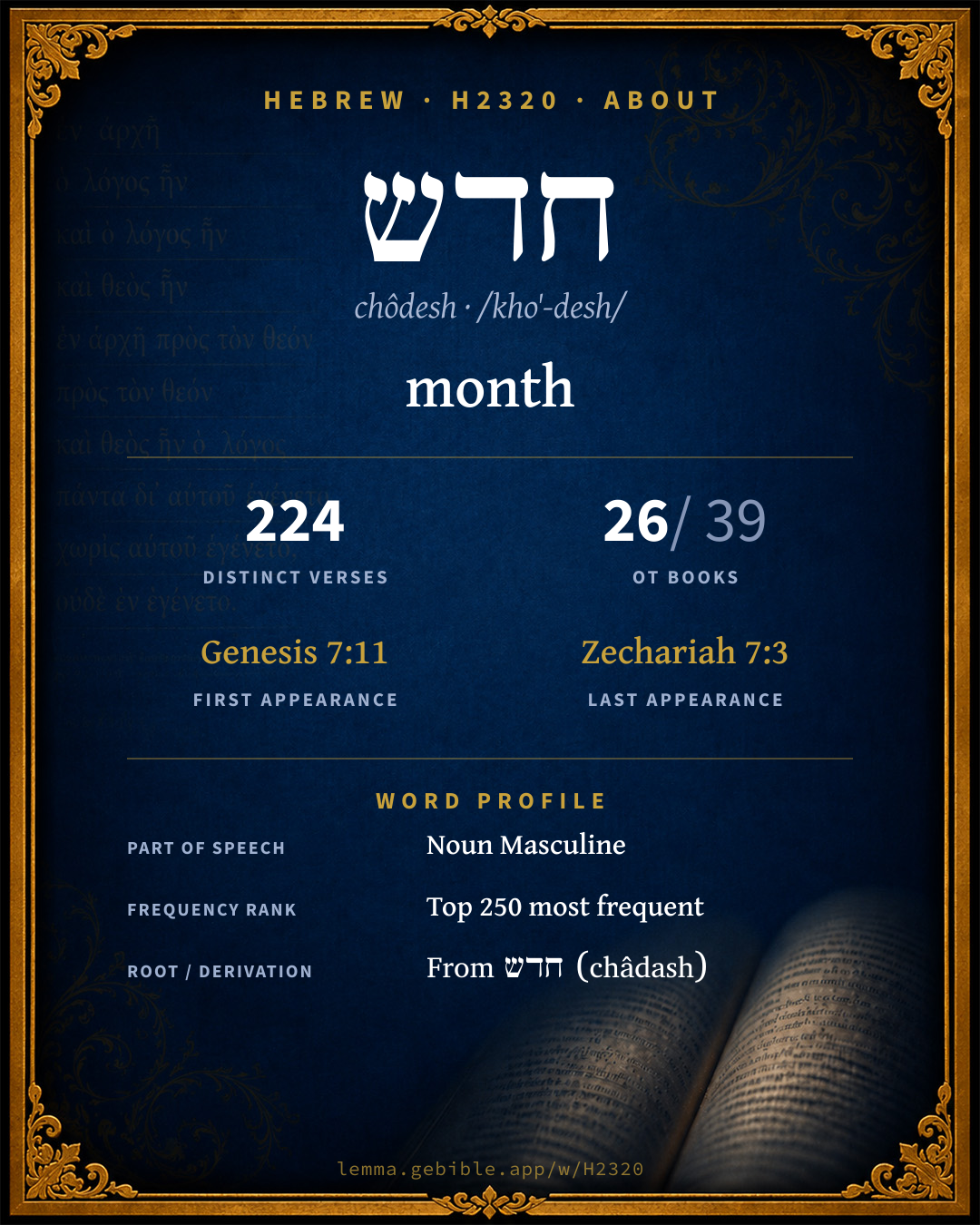
חֹ֫דֶשׁ
month
also: the new moon, monthly fuller range ↓
Full lexicon entry — Brown-Driver-Briggs (BDB)
From Brown-Driver-Briggs (BDB)
Where this word appears
See every Absolute-state word in the Hebrew Bible →
Grammar key — what these labels mean
Part of speech
- Noun
- A naming word — a person, place, thing, or idea.
Noun type
- Common
- A common noun — a general class of person, place, or thing (“king,” “city,” “water”), not a specific name.
State
- Absolute
- The independent form of a noun, not bound to a following word.
- Construct
- A noun bound to a following noun in a possessive / “of” relationship (the construct chain).
Gender
- Masculine
- Grammatically masculine.
Number
- Singular
- One.
- Plural
- More than one (in Hebrew, generally three or more).
Grammatical forms
- Noun, Common, Masculine, Singular, Absolute 206 times (73%)
- Noun, Common, Masculine, Plural, Absolute 38 times (13%)
- Noun, Common, Masculine, Singular, Construct 30 times (11%)
- Noun, Common, Masculine, Plural, Construct 9 times (3%)
Parsed forms decoded from the imported morphology (morphhb / Westminster Leningrad Codex — WLC text public domain, morphhb tagging CC BY 4.0), counted across 283 parsed occurrences — not distinct verses.
Page 1 of 2 — showing verses 1–200 of 224 distinct verses where H2320 appears, across 26 books. Click any verse to open its interlinear word-by-word view. Verse text shown in the World English Bible for context — . Each verse’s Hebrew form is shown with its reference; the English is not keyword-highlighted, since the data carries no word-level English alignment. Use “Compare translations” on any verse to read it across multiple English versions. This concordance covers the Hebrew Bible; Septuagint (Greek Old Testament) occurrences are not indexed here.
Genesis 7 verses
- Genesis 7:11 בַּ/חֹ֨דֶשׁ֙ לַ/חֹ֑דֶשׁ prep det + n c ms prep det + n c ms In the six hundredth year of Noah's life, in the second month, on the seventeenth day of the month, on the same day all the fountains of the great deep were burst open, and the sky's windows were opened.
- Genesis 8:4 בַּ/חֹ֣דֶשׁ לַ/חֹ֑דֶשׁ prep det + n c ms prep det + n c ms The ark rested in the seventh month, on the seventeenth day of the month, on Ararat's mountains.
- Genesis 8:5 הַ/חֹ֣דֶשׁ לַ/חֹ֔דֶשׁ ptcl def.art + n c ms prep det + n c ms The waters receded continually until the tenth month. In the tenth month, on the first day of the month, the tops of the mountains were seen.
- Genesis 8:13 לַ/חֹ֔דֶשׁ prep det + n c ms It happened in the six hundred first year, in the first month, the first day of the month, the waters were dried up from off the earth. Noah removed the covering of the ark, and looked. He saw that the surface of the ground was dried.
- Genesis 8:14 וּ/בַ/חֹ֨דֶשׁ֙ לַ/חֹ֑דֶשׁ conj + prep det + n c ms prep det + n c ms In the second month, on the twenty-seventh day of the month, the earth was dry.
- Genesis 29:14 חֹ֥דֶשׁ n c ms cs Laban said to him, Surely you are my bone and my flesh. He lived with him for a month.
- Genesis 38:24 חֳדָשִׁ֗ים n c mp It happened about three months later, that it was told Judah, saying, "Tamar, your daughter-in-law, has played the prostitute; and moreover, behold, she is with child by prostitution." Judah said, "Bring her forth, and let her be burnt."
Exodus 12 verses
- Exodus 12:2 הַ/חֹ֧דֶשׁ חֳדָשִׁ֑ים לְ/חָדְשֵׁ֖י ptcl def.art + n c ms n c mp prep + n c mp cs "This month shall be to you the beginning of months. It shall be the first month of the year to you.
- Exodus 12:3 לַ/חֹ֣דֶשׁ prep det + n c ms Speak to all the congregation of Israel, saying, 'On the tenth day of this month, they shall take to them every man a lamb, according to their fathers' houses, a lamb for a household;
- Exodus 12:6 לַ/חֹ֣דֶשׁ prep det + n c ms and you shall keep it until the fourteenth day of the same month; and the whole assembly of the congregation of Israel shall kill it at evening.
- Exodus 12:18 לַ/חֹ֨דֶשׁ֙ לַ/חֹ֖דֶשׁ prep det + n c ms prep det + n c ms In the first month, on the fourteenth day of the month at evening, you shall eat unleavened bread, until the twenty first day of the month at evening.
- Exodus 13:4 בְּ/חֹ֖דֶשׁ prep + n c ms cs This day you go forth in the month Abib.
- Exodus 13:5 בַּ/חֹ֥דֶשׁ prep det + n c ms It shall be, when Yahweh shall bring you into the land of the Canaanite, and the Hittite, and the Amorite, and the Hivite, and the Jebusite, which he swore to your fathers to give you, a land flowing with milk and honey, that you shall keep this service in this month.
- Exodus 16:1 לַ/חֹ֣דֶשׁ prep det + n c ms They took their journey from Elim, and all the congregation of the children of Israel came to the wilderness of Sin, which is between Elim and Sinai, on the fifteenth day of the second month after their departing out of the land of Egypt.
- Exodus 19:1 בַּ/חֹ֨דֶשׁ֙ prep det + n c ms In the third month after the children of Israel had gone forth out of the land of Egypt, on that same day they came into the wilderness of Sinai.
- Exodus 23:15 חֹ֣דֶשׁ n c ms cs You shall observe the feast of unleavened bread. Seven days you shall eat unleavened bread, as I commanded you, at the time appointed in the month Abib (for in it you came out from Egypt), and no one shall appear before me empty.
- Exodus 34:18 חֹ֣דֶשׁ בְּ/חֹ֣דֶשׁ n c ms cs prep + n c ms cs "You shall keep the feast of unleavened bread. Seven days you shall eat unleavened bread, as I commanded you, at the time appointed in the month Abib; for in the month Abib you came out from Egypt.
- Exodus 40:2 הַ/חֹ֥דֶשׁ לַ/חֹ֑דֶשׁ ptcl def.art + n c ms prep det + n c ms "On the first day of the first month you shall raise up the tent of the Tent of Meeting.
- Exodus 40:17 בַּ/חֹ֧דֶשׁ לַ/חֹ֑דֶשׁ prep det + n c ms prep det + n c ms It happened in the first month in the second year, on the first day of the month, that the tent was raised up.
Leviticus 11 verses
- Leviticus 16:29 בַּ/חֹ֣דֶשׁ לַ/חֹ֜דֶשׁ prep det + n c ms prep det + n c ms "It shall be a statute to you forever: in the seventh month, on the tenth day of the month, you shall afflict your souls, and shall do no manner of work, the native-born, or the stranger who lives as a foreigner among you:
- Leviticus 23:5 בַּ/חֹ֣דֶשׁ לַ/חֹ֖דֶשׁ prep det + n c ms prep det + n c ms In the first month, on the fourteenth day of the month in the evening, is Yahweh's Passover.
- Leviticus 23:6 לַ/חֹ֣דֶשׁ prep det + n c ms On the fifteenth day of the same month is the feast of unleavened bread to Yahweh. Seven days you shall eat unleavened bread.
- Leviticus 23:24 בַּ/חֹ֨דֶשׁ לַ/חֹ֗דֶשׁ prep det + n c ms prep det + n c ms "Speak to the children of Israel, saying, 'In the seventh month, on the first day of the month, shall be a solemn rest to you, a memorial of blowing of trumpets, a holy convocation.
- Leviticus 23:27 לַ/חֹדֶשׁ֩ prep det + n c ms "However on the tenth day of this seventh month is the day of atonement: it shall be a holy convocation to you, and you shall afflict yourselves; and you shall offer an offering made by fire to Yahweh.
- Leviticus 23:32 לַ/חֹ֨דֶשׁ֙ prep det + n c ms It shall be a Sabbath of solemn rest for you, and you shall deny yourselves. In the ninth day of the month at evening, from evening to evening, you shall keep your Sabbath."
- Leviticus 23:34 לַ/חֹ֤דֶשׁ prep det + n c ms "Speak to the children of Israel, and say, 'On the fifteenth day of this seventh month is the feast of tents for seven days to Yahweh.
- Leviticus 23:39 לַ/חֹ֣דֶשׁ prep det + n c ms "'So on the fifteenth day of the seventh month, when you have gathered in the fruits of the land, you shall keep the feast of Yahweh seven days: on the first day shall be a solemn rest, and on the eighth day shall be a solemn rest.
- Leviticus 23:41 בַּ/חֹ֥דֶשׁ prep det + n c ms You shall keep it a feast to Yahweh seven days in the year: it is a statute forever throughout your generations; you shall keep it in the seventh month.
- Leviticus 25:9 בַּ/חֹ֣דֶשׁ לַ/חֹ֑דֶשׁ prep det + n c ms prep det + n c ms Then you shall sound the loud trumpet on the tenth day of the seventh month. On the Day of Atonement you shall sound the trumpet throughout all your land.
- Leviticus 27:6 חֹ֗דֶשׁ n c ms If the person is from a month old even to five years old, then your valuation shall be for a male five shekels of silver, and for a female your valuation shall be three shekels of silver.
Numbers 31 verses
- Numbers 1:1 לַ/חֹ֨דֶשׁ prep det + n c ms Yahweh spoke to Moses in the wilderness of Sinai, in the Tent of Meeting, on the first day of the second month, in the second year after they had come out of the land of Egypt, saying,
- Numbers 1:18 לַ/חֹ֣דֶשׁ prep det + n c ms They assembled all the congregation together on the first day of the second month; and they declared their ancestry by their families, by their fathers' houses, according to the number of the names, from twenty years old and upward, one by one.
- Numbers 3:15 חֹ֥דֶשׁ n c ms "Number the children of Levi by their fathers' houses, by their families: every male from a month old and upward shall you number."
- Numbers 3:22 חֹ֖דֶשׁ n c ms Those who were numbered of them, according to the number of all the males, from a month old and upward, even those who were numbered of them were seven thousand five hundred.
- Numbers 3:28 חֹ֖דֶשׁ n c ms According to the number of all the males, from a month old and upward, there were eight thousand six hundred, keeping the charge of the sanctuary.
- Numbers 3:34 חֹ֖דֶשׁ n c ms Those who were numbered of them, according to the number of all the males, from a month old and upward, were six thousand two hundred.
- Numbers 3:39 חֹ֣דֶשׁ n c ms All who were numbered of the Levites, whom Moses and Aaron numbered at the commandment of Yahweh, by their families, all the males from a month old and upward, were twenty-two thousand.
- Numbers 3:40 חֹ֖דֶשׁ n c ms Yahweh said to Moses, "Number all the firstborn males of the children of Israel from a month old and upward, and take the number of their names.
- Numbers 3:43 חֹ֥דֶשׁ n c ms All the firstborn males according to the number of names, from a month old and upward, of those who were numbered of them, were twenty-two thousand two hundred seventy-three.
- Numbers 9:1 בַּ/חֹ֥דֶשׁ prep det + n c ms Yahweh spoke to Moses in the wilderness of Sinai, in the first month of the second year after they had come out of the land of Egypt, saying,
- Numbers 9:3 בַּ/חֹ֨דֶשׁ prep det + n c ms On the fourteenth day of this month, at evening, you shall keep it in its appointed season-- according to all its statutes, and according to all its ordinances, you shall keep it."
- Numbers 9:5 לַ/חֹ֛דֶשׁ prep det + n c ms They kept the Passover in the first month, on the fourteenth day of the month, at evening, in the wilderness of Sinai. According to all that Yahweh commanded Moses, so the children of Israel did.
- Numbers 9:11 בַּ/חֹ֨דֶשׁ prep det + n c ms In the second month, on the fourteenth day at evening they shall keep it; they shall eat it with unleavened bread and bitter herbs.
- Numbers 9:22 חֹ֣דֶשׁ n c ms Whether it was two days, or a month, or a year that the cloud stayed on the tabernacle, remaining on it, the children of Israel remained encamped, and didn't travel; but when it was taken up, they traveled.
- Numbers 10:10 חָדְשֵׁי/כֶם֒ n c mp cs + sfx pers 2mp Also in the day of your gladness, and in your set feasts, and in the beginnings of your months, you shall blow the trumpets over your burnt offerings, and over the sacrifices of your peace-offerings; and they shall be to you for a memorial before your God: I am Yahweh your God.
- Numbers 10:11 בַּ/חֹ֥דֶשׁ בַּ/חֹ֑דֶשׁ prep det + n c ms prep det + n c ms It happened in the second year, in the second month, on the twentieth day of the month, that the cloud was taken up from over the tent of the testimony.
- Numbers 11:20 חֹ֣דֶשׁ n c ms cs but a whole month, until it come out at your nostrils, and it be loathsome to you; because that you have rejected Yahweh who is among you, and have wept before him, saying, Why came we forth out of Egypt?
- Numbers 11:21 חֹ֥דֶשׁ n c ms cs Moses said, The people, among whom I am, are six hundred thousand footmen; and you have said, I will give them flesh, that they may eat a whole month.
- Numbers 18:16 חֹ֣דֶשׁ n c ms Those who are to be redeemed of them from a month old shall you redeem, according to your estimation, for the money of five shekels, after the shekel of the sanctuary (the same is twenty gerahs).
- Numbers 20:1 בַּ/חֹ֣דֶשׁ prep det + n c ms The children of Israel, even the whole congregation, came into the wilderness of Zin in the first month: and the people abode in Kadesh; and Miriam died there, and was buried there.
- Numbers 26:62 חֹ֣דֶשׁ n c ms Those who were numbered of them were twenty-three thousand, every male from a month old and upward: for they were not numbered among the children of Israel, because there was no inheritance given them among the children of Israel.
- Numbers 28:11 חָדְשֵׁי/כֶ֔ם n c mp cs + sfx pers 2mp In the beginnings of your months you shall offer a burnt offering to Yahweh: two young bulls, and one ram, seven he-lambs a year old without blemish;
- Numbers 28:14 חֹ֨דֶשׁ֙ בְּ/חָדְשׁ֔/וֹ לְ/חָדְשֵׁ֖י n c ms prep + n c ms cs + sfx pers 3ms prep + n c mp cs Their drink-offerings shall be half a hin of wine for a bull, and the third part of a hin for the ram, and the fourth part of a hin for a lamb: this is the burnt offering of every month throughout the months of the year.
- Numbers 28:16 וּ/בַ/חֹ֣דֶשׁ לַ/חֹ֑דֶשׁ conj + prep det + n c ms prep det + n c ms In the first month, on the fourteenth day of the month, is Yahweh's Passover.
- Numbers 28:17 לַ/חֹ֥דֶשׁ prep det + n c ms On the fifteenth day of this month shall be a feast: seven days shall unleavened bread be eaten.
- Numbers 29:1 וּ/בַ/חֹ֨דֶשׁ לַ/חֹ֗דֶשׁ conj + prep det + n c ms prep det + n c ms In the seventh month, on the first day of the month, you shall have a holy convocation; you shall do no servile work: it is a day of blowing of trumpets to you.
- Numbers 29:6 הַ/חֹ֜דֶשׁ ptcl def.art + n c ms besides the burnt offering of the new moon, and the meal-offering of it, and the continual burnt offering and the meal-offering of it, and their drink-offerings, according to their ordinance, for a sweet savor, an offering made by fire to Yahweh.
- Numbers 29:7 לַ/חֹ֨דֶשׁ prep det + n c ms On the tenth day of this seventh month you shall have a holy convocation; and you shall afflict your souls: you shall do no manner of work;
- Numbers 29:12 לַ/חֹ֣דֶשׁ prep det + n c ms On the fifteenth day of the seventh month you shall have a holy convocation; you shall do no servile work, and you shall keep a feast to Yahweh seven days:
- Numbers 33:3 בַּ/חֹ֣דֶשׁ לַ/חֹ֣דֶשׁ prep det + n c ms prep det + n c ms They traveled from Rameses in the first month, on the fifteenth day of the first month; on the next day after the Passover the children of Israel went out with a high hand in the sight of all the Egyptians,
- Numbers 33:38 בַּ/חֹ֥דֶשׁ לַ/חֹֽדֶשׁ prep det + n c ms prep det + n c ms Aaron the priest went up into Mount Hor at the commandment of Yahweh, and died there, in the fortieth year after the children of Israel were come out of the land of Egypt, in the fifth month, on the first day of the month.
Deuteronomy 2 verses
- Deuteronomy 1:3 חֹ֖דֶשׁ לַ/חֹ֑דֶשׁ n c ms prep det + n c ms It happened in the fortieth year, in the eleventh month, on the first day of the month, that Moses spoke to the children of Israel, according to all that Yahweh had given him in commandment to them;
- Deuteronomy 16:1 חֹ֣דֶשׁ בְּ/חֹ֣דֶשׁ n c ms cs prep + n c ms cs Observe the month of Abib, and keep the Passover to Yahweh your God; for in the month of Abib Yahweh your God brought you forth out of Egypt by night.
Joshua 2 verses
- Joshua 4:19 לַ/חֹ֣דֶשׁ prep det + n c ms The people came up out of the Jordan on the tenth day of the first month, and encamped in Gilgal, on the east border of Jericho.
- Joshua 5:10 לַ/חֹ֛דֶשׁ prep det + n c ms The children of Israel encamped in Gilgal; and they kept the Passover on the fourteenth day of the month at even in the plains of Jericho.
Judges 5 verses
- Judges 11:37 חֳדָשִׁ֗ים n c mp She said to her father, Let this thing be done for me: let me alone two months, that I may depart and go down on the mountains, and bewail my virginity, I and my companions.
- Judges 11:38 חֳדָשִׁ֑ים n c mp He said, Go. He sent her away for two months: and she departed, she and her companions, and mourned her virginity on the mountains.
- Judges 11:39 חֳדָשִׁ֗ים n c mp It happened at the end of two months, that she returned to her father, who did with her according to his vow which he had vowed: and she was a virgin. It was a custom in Israel,
- Judges 19:2 חֳדָשִֽׁים n c mp His concubine played the prostitute against him, and went away from him to her father's house to Bethlehem Judah, and was there the space of four months.
- Judges 20:47 חֳדָשִֽׁים n c mp But six hundred men turned and fled toward the wilderness to the rock of Rimmon, and abode in the rock of Rimmon four months.
1 Samuel 7 verses
- 1 Samuel 6:1 חֳדָשִֽׁים n c mp The ark of Yahweh was in the country of the Philistines seven months.
- 1 Samuel 20:5 חֹ֨דֶשׁ֙ n c ms David said to Jonathan, Behold, tomorrow is the new moon, and I should not fail to sit with the king at meat: but let me go, that I may hide myself in the field to the third day at evening.
- 1 Samuel 20:18 חֹ֑דֶשׁ n c ms Then Jonathan said to him, Tomorrow is the new moon: and you will be missed, because your seat will be empty.
- 1 Samuel 20:24 הַ/חֹ֔דֶשׁ ptcl def.art + n c ms So David hid himself in the field: and when the new moon was come, the king sat him down to eat food.
- 1 Samuel 20:27 הַ/חֹ֨דֶשׁ֙ ptcl def.art + n c ms It happened on the next day after the new moon, [which was] the second [day], that David's place was empty: and Saul said to Jonathan his son, Why doesn't the son of Jesse come to meat, neither yesterday, nor today?
- 1 Samuel 20:34 הַ/חֹ֤דֶשׁ ptcl def.art + n c ms So Jonathan arose from the table in fierce anger, and ate no food the second day of the month; for he was grieved for David, because his father had done him shame.
- 1 Samuel 27:7 חֳדָשִֽׁים n c mp The number of the days that David lived in the country of the Philistines was a full year and four months.
2 Samuel 5 verses
- 2 Samuel 2:11 חֳדָשִֽׁים n c mp The time that David was king in Hebron over the house of Judah was seven years and six months.
- 2 Samuel 5:5 חֳדָשִׁ֑ים n c mp In Hebron he reigned over Judah seven years and six months; and in Jerusalem he reigned thirty-three years over all Israel and Judah.
- 2 Samuel 6:11 חֳדָשִׁ֑ים n c mp The ark of Yahweh remained in the house of Obed-edom the Gittite three months: and Yahweh blessed Obed-edom, and all his house.
- 2 Samuel 24:8 חֳדָשִׁ֛ים n c mp So when they had gone back and forth through all the land, they came to Jerusalem at the end of nine months and twenty days.
- 2 Samuel 24:13 חֳ֠דָשִׁים n c mp So Gad came to David, and told him, and said to him, Shall seven years of famine come to you in your land? or will you flee three months before your foes while they pursue you? or shall there be three days' pestilence in your land? now advise you, and consider what answer I shall return to him who sent me.
1 Kings 9 verses
- 1 Kings 4:7 חֹ֧דֶשׁ n c ms Solomon had twelve officers over all Israel, who provided food for the king and his household: each man had to make provision for a month in the year.
- 1 Kings 4:27 חָדְשׁ֑/וֹ n c ms cs + sfx pers 3ms Those officers provided food for king Solomon, and for all who came to king Solomon's table, every man in his month; they let nothing be lacking.
- 1 Kings 5:14 בַּ/חֹ֨דֶשׁ֙ חֹ֚דֶשׁ חֳדָשִׁ֖ים prep det + n c ms n c ms n c mp He sent them to Lebanon, ten thousand a month by courses; a month they were in Lebanon, and two months at home; and Adoniram was over the men subject to forced labor.
- 1 Kings 6:1 בְּ/חֹ֣דֶשׁ הַ/חֹ֣דֶשׁ prep + n c ms cs ptcl def.art + n c ms It happened in the four hundred and eightieth year after the children of Israel were come out of the land of Egypt, in the fourth year of Solomon's reign over Israel, in the month Ziv, which is the second month, that he began to build the house of Yahweh.
- 1 Kings 6:38 הַ/חֹ֣דֶשׁ ptcl def.art + n c ms In the eleventh year, in the month Bul, which is the eighth month, was the house finished throughout all the parts of it, and according to all the fashion of it. So was he seven years in building it.
- 1 Kings 8:2 הַ/חֹ֥דֶשׁ ptcl def.art + n c ms All the men of Israel assembled themselves to king Solomon at the feast, in the month Ethanim, which is the seventh month.
- 1 Kings 11:16 חֳדָשִׁ֛ים n c mp (for Joab and all Israel remained there six months, until he had cut off every male in Edom);
- 1 Kings 12:32 בַּ/חֹ֣דֶשׁ לַ/חֹ֜דֶשׁ prep det + n c ms prep det + n c ms Jeroboam ordained a feast in the eighth month, on the fifteenth day of the month, like the feast that is in Judah, and he went up to the altar; so did he in Bethel, sacrificing to the calves that he had made: and he placed in Bethel the priests of the high places that he had made.
- 1 Kings 12:33 בַּ/חֹ֣דֶשׁ בַּ/חֹ֖דֶשׁ prep det + n c ms prep det + n c ms He went up to the altar which he had made in Bethel on the fifteenth day in the eighth month, even in the month which he had devised of his own heart: and he ordained a feast for the children of Israel, and went up to the altar, to burn incense.
2 Kings 9 verses
- 2 Kings 4:23 חֹ֖דֶשׁ n c ms He said, Why will you go to him today? it is neither new moon nor Sabbath. She said, It shall be well.
- 2 Kings 15:8 חֳדָשִֽׁים n c mp In the thirty-eighth year of Azariah king of Judah did Zechariah the son of Jeroboam reign over Israel in Samaria six months.
- 2 Kings 23:31 חֳדָשִׁ֔ים n c mp Jehoahaz was twenty-three years old when he began to reign; and he reigned three months in Jerusalem: and his mother's name was Hamutal the daughter of Jeremiah of Libnah.
- 2 Kings 24:8 חֳדָשִׁ֔ים n c mp Jehoiachin was eighteen years old when he began to reign; and he reigned in Jerusalem three months: and his mother's name was Nehushta the daughter of Elnathan of Jerusalem.
- 2 Kings 25:1 בַּ/חֹ֣דֶשׁ לַ/חֹדֶשׁ֒ prep det + n c ms prep det + n c ms It happened in the ninth year of his reign, in the tenth month, in the tenth day of the month, that Nebuchadnezzar king of Babylon came, he and all his army, against Jerusalem, and encamped against it; and they built forts against it round about.
- 2 Kings 25:3 לַ/חֹ֔דֶשׁ prep det + n c ms On the ninth day of the [fourth] month the famine was sore in the city, so that there was no bread for the people of the land.
- 2 Kings 25:8 וּ/בַ/חֹ֤דֶשׁ לַ/חֹ֔דֶשׁ conj + prep det + n c ms prep det + n c ms Now in the fifth month, on the seventh day of the month, which was the nineteenth year of king Nebuchadnezzar, king of Babylon, came Nebuzaradan the captain of the guard, a servant of the king of Babylon, to Jerusalem.
- 2 Kings 25:25 בַּ/חֹ֣דֶשׁ prep det + n c ms But it happened in the seventh month, that Ishmael the son of Nethaniah, the son of Elishama, of the royal seed came, and ten men with him, and struck Gedaliah, so that he died, and the Jews and the Chaldeans that were with him at Mizpah.
- 2 Kings 25:27 חֹ֔דֶשׁ לַ/חֹ֑דֶשׁ n c ms prep det + n c ms It happened in the seven and thirtieth year of the captivity of Jehoiachin king of Judah, in the twelfth month, on the seven and twentieth day of the month, that Evilmerodach king of Babylon, in the year that he began to reign, did lift up the head of Jehoiachin king of Judah out of prison;
1 Chronicles 19 verses
- 1 Chronicles 3:4 חֳדָשִׁ֑ים n c mp six were born to him in Hebron; and there he reigned seven years and six months. In Jerusalem he reigned thirty-three years;
- 1 Chronicles 12:15 בַּ/חֹ֣דֶשׁ prep det + n c ms These are those who went over the Jordan in the first month, when it had overflowed all its banks; and they put to flight all them of the valleys, both toward the east, and toward the west.
- 1 Chronicles 13:14 חֳדָשִׁ֑ים n c mp The ark of God remained with the family of Obed-edom in his house three months: and Yahweh blessed the house of Obed-edom, and all that he had.
- 1 Chronicles 21:12 חֳדָשִׁ֜ים n c mp either three years of famine; or three months to be consumed before your foes, while the sword of your enemies overtakes you; or else three days the sword of Yahweh, even pestilence in the land, and the angel of Yahweh destroying throughout all the borders of Israel. Now therefore consider what answer I shall return to him who sent me.
- 1 Chronicles 23:31 לֶ/חֳדָשִׁ֖ים prep det + n c mp and to offer all burnt offerings to Yahweh, on the Sabbaths, on the new moons, and on the set feasts, in number according to the ordinance concerning them, continually before Yahweh;
- 1 Chronicles 27:1 חֹ֣דֶשׁ בְּ/חֹ֔דֶשׁ חָדְשֵׁ֣י n c ms prep + n c ms n c mp cs Now the children of Israel after their number, the heads of fathers' [houses] and the captains of thousands and of hundreds, and their officers who served the king, in any matter of the divisions which came in and went out month by month throughout all the months of the year--of every division were twenty-four thousand.
- 1 Chronicles 27:2 לַ/חֹ֣דֶשׁ prep det + n c ms Over the first division for the first month was Jashobeam the son of Zabdiel: and in his division were twenty-four thousand.
- 1 Chronicles 27:3 לַ/חֹ֥דֶשׁ prep det + n c ms [He was] of the children of Perez, the chief of all the captains of the host for the first month.
- 1 Chronicles 27:4 הַ/חֹ֣דֶשׁ ptcl def.art + n c ms Over the division of the second month was Dodai the Ahohite, and his division; and Mikloth the ruler: and in his division were twenty-four thousand.
- 1 Chronicles 27:5 לַ/חֹ֣דֶשׁ prep det + n c ms The third captain of the host for the third month was Benaiah, the son of Jehoiada the priest, chief: and in his division were twenty-four thousand.
- 1 Chronicles 27:7 לַ/חֹ֣דֶשׁ prep det + n c ms The fourth [captain] for the fourth month was Asahel the brother of Joab, and Zebadiah his son after him: and in his division were twenty-four thousand.
- 1 Chronicles 27:8 לַ/חֹ֣דֶשׁ prep det + n c ms The fifth captain for this fifth month was Shamhuth the Izrahite: and in his division were twenty-four thousand.
- 1 Chronicles 27:9 לַ/חֹ֣דֶשׁ prep det + n c ms The sixth [captain] for the sixth month was Ira the son of Ikkesh the Tekoite: and in his division were twenty-four thousand.
- 1 Chronicles 27:10 לַ/חֹ֣דֶשׁ prep det + n c ms The seventh [captain] for the seventh month was Helez the Pelonite, of the children of Ephraim: and in his division were twenty-four thousand.
- 1 Chronicles 27:11 לַ/חֹ֣דֶשׁ prep det + n c ms The eighth [captain] for the eighth month was Sibbecai the Hushathite, of the Zerahites: and in his division were twenty-four thousand.
- 1 Chronicles 27:12 לַ/חֹ֣דֶשׁ prep det + n c ms The ninth [captain] for the ninth month was Abiezer the Anathothite, of the Benjamites: and in his division were twenty-four thousand.
- 1 Chronicles 27:13 לַ/חֹ֣דֶשׁ prep det + n c ms The tenth [captain] for the tenth month was Maharai the Netophathite, of the Zerahites: and in his division were Twenty-four thousand.
- 1 Chronicles 27:14 הַ/חֹ֔דֶשׁ ptcl def.art + n c ms The eleventh [captain] for the eleventh month was Benaiah the Pirathonite, of the children of Ephraim: and in his division were twenty-four thousand.
- 1 Chronicles 27:15 הַ/חֹ֔דֶשׁ ptcl def.art + n c ms The twelfth [captain] for the twelfth month was Heldai the Netophathite, of Othniel: and in his division were twenty-four thousand.
2 Chronicles 16 verses
- 2 Chronicles 2:4 וְ/לֶ֣/חֳדָשִׁ֔ים conj + prep det + n c mp Behold, I am about to build a house for the name of Yahweh my God, to dedicate it to him, and to burn before him incense of sweet spices, and for the continual show bread, and for the burnt offerings morning and evening, on the Sabbaths, and on the new moons, and on the set feasts of Yahweh our God. This is [an ordinance] forever to Israel.
- 2 Chronicles 3:2 בַּ/חֹ֤דֶשׁ prep det + n c ms He began to build in the second [day] of the second month, in the fourth year of his reign.
- 2 Chronicles 5:3 הַ/חֹ֥דֶשׁ ptcl def.art + n c ms And all the men of Israel assembled themselves to the king at the feast, which was [in] the seventh month.
- 2 Chronicles 7:10 לַ/חֹ֣דֶשׁ prep det + n c ms On the three and twentieth day of the seventh month he sent the people away to their tents, joyful and glad of heart for the goodness that Yahweh had shown to David, and to Solomon, and to Israel his people.
- 2 Chronicles 8:13 וְ/לֶ֣/חֳדָשִׁ֔ים conj + prep det + n c mp even as the duty of every day required, offering according to the commandment of Moses, on the Sabbaths, and on the new moons, and on the set feasts, three times in the year, [even] in the feast of unleavened bread, and in the feast of weeks, and in the feast of tents.
- 2 Chronicles 15:10 בַּ/חֹ֣דֶשׁ prep det + n c ms So they gathered themselves together at Jerusalem in the third month, in the fifteenth year of the reign of Asa.
- 2 Chronicles 29:3 בַּ/חֹ֣דֶשׁ prep det + n c ms He in the first year of his reign, in the first month, opened the doors of the house of Yahweh, and repaired them.
- 2 Chronicles 29:17 לַ/חֹ֣דֶשׁ לַ/חֹ֗דֶשׁ לַ/חֹ֥דֶשׁ prep det + n c ms prep det + n c ms prep det + n c ms Now they began on the first [day] of the first month to sanctify, and on the eighth day of the month came they to the porch of Yahweh; and they sanctified the house of Yahweh in eight days: and on the sixteenth day of the first month they made an end.
- 2 Chronicles 30:2 בַּ/חֹ֥דֶשׁ prep det + n c ms For the king had taken counsel, and his princes, and all the assembly in Jerusalem, to keep the Passover in the second month.
- 2 Chronicles 30:13 בַּ/חֹ֣דֶשׁ prep det + n c ms There assembled at Jerusalem much people to keep the feast of unleavened bread in the second month, a very great assembly.
- 2 Chronicles 30:15 לַ/חֹ֣דֶשׁ prep det + n c ms Then they killed the Passover on the fourteenth [day] of the second month: and the priests and the Levites were ashamed, and sanctified themselves, and brought burnt offerings into the house of Yahweh.
- 2 Chronicles 31:3 וְ/לֶ/חֳדָשִׁ֣ים conj + prep det + n c mp [He appointed] also the king's portion of his substance for the burnt-offerings, [to wit], for the morning and evening burnt offerings, and the burnt offerings for the Sabbaths, and for the new moons, and for the set feasts, as it is written in the law of Yahweh.
- 2 Chronicles 31:7 בַּ/חֹ֨דֶשׁ֙ וּ/בַ/חֹ֥דֶשׁ prep det + n c ms conj + prep det + n c ms In the third month they began to lay the foundation of the heaps, and finished them in the seventh month.
- 2 Chronicles 35:1 לַ/חֹ֥דֶשׁ prep det + n c ms Josiah kept a Passover to Yahweh in Jerusalem: and they killed the Passover on the fourteenth [day] of the first month.
- 2 Chronicles 36:2 חֳדָשִׁ֔ים n c mp Joahaz was twenty-three years old when he began to reign; and he reigned three months in Jerusalem.
- 2 Chronicles 36:9 חֳדָשִׁים֙ n c mp Jehoiachin was eight years old when he began to reign; and he reigned three months and ten days in Jerusalem: and he did that which was evil in the sight of Yahweh.
Ezra 11 verses
- Ezra 3:1 הַ/חֹ֣דֶשׁ ptcl def.art + n c ms When the seventh month was come, and the children of Israel were in the cities, the people gathered themselves together as one man to Jerusalem.
- Ezra 3:5 וְ/לֶ֣/חֳדָשִׁ֔ים conj + prep det + n c mp and afterward the continual burnt-offering, and [the offerings] of the new moons, and of all the set feasts of Yahweh that were consecrated, and of everyone who willingly offered a freewill-offering to Yahweh.
- Ezra 3:6 לַ/חֹ֣דֶשׁ prep det + n c ms From the first day of the seventh month began they to offer burnt offerings to Yahweh: but the foundation of the temple of Yahweh was not yet laid.
- Ezra 3:8 בַּ/חֹ֖דֶשׁ prep det + n c ms Now in the second year of their coming to the house of God at Jerusalem, in the second month, began Zerubbabel the son of Shealtiel, and Jeshua the son of Jozadak, and the rest of their brothers the priests and the Levites, and all those who were come out of the captivity to Jerusalem, and appointed the Levites, from twenty years old and upward, to have the oversight of the work of the house of Yahweh.
- Ezra 6:19 לַ/חֹ֥דֶשׁ prep det + n c ms The children of the captivity kept the Passover on the fourteenth [day] of the first month.
- Ezra 7:8 בַּ/חֹ֣דֶשׁ prep det + n c ms He came to Jerusalem in the fifth month, which was in the seventh year of the king.
- Ezra 7:9 לַ/חֹ֣דֶשׁ לַ/חֹ֣דֶשׁ prep det + n c ms prep det + n c ms For on the first [day] of the first month began he to go up from Babylon; and on the first [day] of the fifth month came he to Jerusalem, according to the good hand of his God on him.
- Ezra 8:31 לַ/חֹ֣דֶשׁ prep det + n c ms Then we departed from the river Ahava on the twelfth [day] of the first month, to go to Jerusalem: and the hand of our God was on us, and he delivered us from the hand of the enemy and the bandit by the way.
- Ezra 10:9 חֹ֥דֶשׁ בַּ/חֹ֑דֶשׁ n c ms cs prep det + n c ms Then all the men of Judah and Benjamin gathered themselves together to Jerusalem within the three days; it was the ninth month, on the twentieth [day] of the month: and all the people sat in the broad place before the house of God, trembling because of this matter, and for the great rain.
- Ezra 10:16 לַ/חֹ֣דֶשׁ prep det + n c ms The children of the captivity did so. Ezra the priest, [with] certain heads of fathers' [houses], after their fathers' houses, and all of them by their names, were set apart; and they sat down in the first day of the tenth month to examine the matter.
- Ezra 10:17 לַ/חֹ֥דֶשׁ prep det + n c ms They made an end with all the men who had married foreign women by the first day of the first month.
Nehemiah 7 verses
- Nehemiah 1:1 בְ/חֹֽדֶשׁ prep + n c ms cs The words of Nehemiah the son of Hacaliah. Now it happened in the month Chislev, in the twentieth year, as I was in Shushan the palace,
- Nehemiah 2:1 בְּ/חֹ֣דֶשׁ prep + n c ms cs It happened in the month Nisan, in the twentieth year of Artaxerxes the king, when wine was before him, that I took up the wine, and gave it to the king. Now I had not been [before] sad in his presence.
- Nehemiah 7:73 הַ/חֹ֣דֶשׁ ptcl def.art + n c ms So the priests, and the Levites, and the porters, and the singers, and some of the people, and the Nethinim, and all Israel, lived in their cities. When the seventh month was come, the children of Israel were in their cities.
- Nehemiah 8:2 לַ/חֹ֥דֶשׁ prep det + n c ms Ezra the priest brought the law before the assembly, both men and women, and all who could hear with understanding, on the first day of the seventh month.
- Nehemiah 8:14 בַּ/חֹ֥דֶשׁ prep det + n c ms They found written in the law, how that Yahweh had commanded by Moses, that the children of Israel should dwell in booths in the feast of the seventh month;
- Nehemiah 9:1 לַ/חֹ֣דֶשׁ prep det + n c ms Now in the twenty-fourth day of this month the children of Israel were assembled with fasting, and with sackcloth, and earth on them.
- Nehemiah 10:33 הֶ/חֳדָשִׁ֜ים ptcl def.art + n c mp for the show bread, and for the continual meal-offering, and for the continual burnt-offering, for the Sabbaths, for the new moons, for the set feasts, and for the holy things, and for the sin-offerings to make atonement for Israel, and for all the work of the house of our God.
Esther 13 verses
- Esther 2:12 חֹ֔דֶשׁ חֳדָשִׁים֙ חֳדָשִׁים֙ n c ms n c mp n c mp Now when the turn of every maiden was come to go in to king Ahasuerus, after it had been done to her as prescribed for the women twelve months (for so were the days of their purification accomplished, [to wit], six months with oil of myrrh, and six months with sweet odors and with the things for the purifying of the women),
- Esther 2:16 בַּ/חֹ֥דֶשׁ חֹ֣דֶשׁ prep det + n c ms n c ms cs So Esther was taken to king Ahasuerus into his house royal in the tenth month, which is the month Tebeth, in the seventh year of his reign.
- Esther 3:7 בַּ/חֹ֤דֶשׁ חֹ֣דֶשׁ וּ/מֵ/חֹ֛דֶשׁ לְ/חֹ֥דֶשׁ חֹ֥דֶשׁ prep det + n c ms n c ms cs conj + prep + n c ms prep + n c ms n c ms cs In the first month, which is the month Nisan, in the twelfth year of king Ahasuerus, they cast Pur, that is, the lot, before Haman from day to day, and from month to month, [to] the twelfth [month], which is the month Adar.
- Esther 3:12 בַּ/חֹ֣דֶשׁ prep det + n c ms Then were the king's scribes called in the first month, on the thirteenth day of it; and there was written according to all that Haman commanded to the king's satraps, and to the governors who were over every province, and to the princes of every people, to every province according to the writing of it, and to every people after their language; in the name of king Ahasuerus was it written, and it was sealed with the king's ring.
- Esther 3:13 לְ/חֹ֥דֶשׁ חֹ֣דֶשׁ prep + n c ms n c ms cs Letters were sent by posts into all the king's provinces, to destroy, to kill, and to cause to perish, all Jews, both young and old, little children and women, in one day, even on the thirteenth [day] of the twelfth month, which is the month Adar, and to take the spoil of them for a prey.
- Esther 8:9 בַּ/חֹ֨דֶשׁ חֹ֣דֶשׁ prep det + n c ms n c ms cs Then were the king's scribes called at that time, in the third month Sivan, on the three and twentieth [day] of it; and it was written according to all that Mordecai commanded to the Jews, and to the satraps, and the governors and princes of the provinces which are from India to Ethiopia, one hundred twenty-seven provinces, to every province according to the writing of it, and to every people after their language, and to the Jews according to their writing, and according to their language.
- Esther 8:12 לְ/חֹ֥דֶשׁ חֹ֥דֶשׁ prep + n c ms n c ms cs on one day in all the provinces of king Ahasuerus, [namely], on the thirteenth [day] of the twelfth month, which is the month Adar.
- Esther 9:1 חֹ֜דֶשׁ חֹ֣דֶשׁ n c ms n c ms cs Now in the twelfth month, which is the month Adar, on the thirteenth day of the same, when the king's commandment and his decree drew near to be put in execution, on the day that the enemies of the Jews hoped to have rule over them, (whereas it was turned to the contrary, that the Jews had rule over those who hated them),
- Esther 9:15 לְ/חֹ֣דֶשׁ prep + n c ms cs The Jews who were in Shushan gathered themselves together on the fourteenth day also of the month Adar, and killed three hundred men in Shushan; but they didn't lay their hand on the spoil.
- Esther 9:17 לְ/חֹ֣דֶשׁ prep + n c ms cs [This was done] on the thirteenth day of the month Adar; and on the fourteenth day of the same they rested, and made it a day of feasting and gladness.
- Esther 9:19 לְ/חֹ֣דֶשׁ prep + n c ms cs Therefore do the Jews of the villages, who dwell in the unwalled towns, make the fourteenth day of the month Adar [a day of] gladness and feasting, and a good day, and of sending portions one to another.
- Esther 9:21 לְ/חֹ֣דֶשׁ prep + n c ms cs to enjoin those who they should keep the fourteenth day of the month Adar, and the fifteenth day of the same, yearly,
- Esther 9:22 וְ/הַ/חֹ֗דֶשׁ conj + ptcl def.art + n c ms as the days in which the Jews had rest from their enemies, and the month which was turned to them from sorrow to gladness, and from mourning into a good day; that they should make them days of feasting and gladness, and of sending portions one to another, and gifts to the needy.
Job 2 verses
- Job 14:5 חֳדָשָׁ֥י/ו n c mp cs + sfx pers 3ms Seeing his days are determined, The number of his months is with you, And you have appointed his bounds that he can't pass;
- Job 21:21 חֳדָשָׁ֣י/ו n c mp cs + sfx pers 3ms For what does he care for his house after him, When the number of his months is cut off?
Psalms 1 verse
Isaiah 4 verses
- Isaiah 1:13 חֹ֤דֶשׁ n c ms Bring no more vain offerings. Incense is an abomination to me; New moons, Sabbaths, and convocations: I can't bear with evil assemblies.
- Isaiah 1:14 חָדְשֵׁי/כֶ֤ם n c mp cs + sfx pers 2mp My soul hates your New Moons and your appointed feasts; They are a burden to me. I am weary of bearing them.
- Isaiah 47:13 לֶ/חֳדָשִׁ֔ים prep det + n c mp You are wearied in the multitude of your counsels: let now the astrologers, the star-gazers, the monthly prognosticators, stand up, and save you from the things that shall come on you.
- Isaiah 66:23 חֹ֨דֶשׁ֙ בְּ/חָדְשׁ֔/וֹ n c ms prep + n c ms cs + sfx pers 3ms It shall happen, that from one new moon to another, and from one Sabbath to another, shall all flesh come to worship before me, says Yahweh.
Jeremiah 13 verses
- Jeremiah 1:3 בַּ/חֹ֥דֶשׁ prep det + n c ms It came also in the days of Jehoiakim the son of Josiah, king of Judah, to the end of the eleventh year of Zedekiah, the son of Josiah, king of Judah, to the carrying away of Jerusalem captive in the fifth month.
- Jeremiah 2:24 בְּ/חָדְשָׁ֖/הּ prep + n c ms cs + sfx pers 3fs a wild donkey used to the wilderness, that snuffs up the wind in her desire; in her occasion who can turn her away? all those who seek her will not weary themselves; in her month they shall find her.
- Jeremiah 28:1 בַּ/חֹ֖דֶשׁ prep det + n c ms It happened the same year, in the beginning of the reign of Zedekiah king of Judah, in the fourth year, in the fifth month, that Hananiah the son of Azzur, the prophet, who was of Gibeon, spoke to me in the house of Yahweh, in the presence of the priests and of all the people, saying,
- Jeremiah 28:17 בַּ/חֹ֖דֶשׁ prep det + n c ms So Hananiah the prophet died the same year in the seventh month.
- Jeremiah 36:9 בַּ/חֹ֣דֶשׁ prep det + n c ms Now it happened in the fifth year of Jehoiakim the son of Josiah, king of Judah, in the ninth month, that all the people in Jerusalem, and all the people who came from the cities of Judah to Jerusalem, proclaimed a fast before Yahweh.
- Jeremiah 36:22 בַּ/חֹ֖דֶשׁ prep det + n c ms Now the king was sitting in the winter-house in the ninth month: and [there was a fire in] the brazier burning before him.
- Jeremiah 39:1 בַּ/חֹ֣דֶשׁ prep det + n c ms It happened when Jerusalem was taken, (in the ninth year of Zedekiah king of Judah, in the tenth month, came Nebuchadrezzar king of Babylon and all his army against Jerusalem, and besieged it;
- Jeremiah 39:2 בַּ/חֹ֥דֶשׁ לַ/חֹ֑דֶשׁ prep det + n c ms prep det + n c ms in the eleventh year of Zedekiah, in the fourth month, the ninth day of the month, a breach was made in the city),
- Jeremiah 41:1 בַּ/חֹ֣דֶשׁ prep det + n c ms Now it happened in the seventh month, that Ishmael the son of Nethaniah, the son of Elishama, of the seed royal and [one of] the chief officers of the king, and ten men with him, came to Gedaliah the son of Ahikam to Mizpah; and there they ate bread together in Mizpah.
- Jeremiah 52:4 בַּ/חֹ֣דֶשׁ לַ/חֹדֶשׁ֒ prep det + n c ms prep det + n c ms It happened in the ninth year of his reign, in the tenth month, in the tenth day of the month, that Nebuchadrezzar king of Babylon came, he and all his army, against Jerusalem, and encamped against it; and they built forts against it round about.
- Jeremiah 52:6 בַּ/חֹ֤דֶשׁ לַ/חֹ֔דֶשׁ prep det + n c ms prep det + n c ms In the fourth month, in the ninth day of the month, the famine was sore in the city, so that there was no bread for the people of the land.
- Jeremiah 52:12 וּ/בַ/חֹ֤דֶשׁ לַ/חֹ֔דֶשׁ conj + prep det + n c ms prep det + n c ms Now in the fifth month, in the tenth day of the month, which was the nineteenth year of king Nebuchadrezzar, king of Babylon, came Nebuzaradan the captain of the guard, who stood before the king of Babylon, into Jerusalem:
- Jeremiah 52:31 חֹ֔דֶשׁ לַ/חֹ֑דֶשׁ n c ms prep det + n c ms It happened in the seven and thirtieth year of the captivity of Jehoiachin king of Judah, in the twelfth month, in the five and twentieth day of the month, that Evilmerodach king of Babylon, in the [first] year of his reign, lifted up the head of Jehoiachin king of Judah, and brought him forth out of prison;
Ezekiel 25 verses
- Ezekiel 1:1 לַ/חֹ֔דֶשׁ prep det + n c ms Now it happened in the thirtieth year, in the fourth [month], in the fifth [day] of the month, as I was among the captives by the river Chebar, that the heavens were opened, and I saw visions of God.
- Ezekiel 1:2 לַ/חֹ֑דֶשׁ prep det + n c ms In the fifth [day] of the month, which was the fifth year of king Jehoiachin's captivity,
- Ezekiel 8:1 לַ/חֹ֔דֶשׁ prep det + n c ms It happened in the sixth year, in the sixth [month], in the fifth [day] of the month, as I sat in my house, and the elders of Judah sat before me, that the hand of the Lord Yahweh fell there on me.
- Ezekiel 20:1 לַ/חֹ֔דֶשׁ prep det + n c ms It happened in the seventh year, in the fifth [month], the tenth [day] of the month, that certain of the elders of Israel came to inquire of Yahweh, and sat before me.
- Ezekiel 24:1 בַּ/חֹ֣דֶשׁ לַ/חֹ֖דֶשׁ prep det + n c ms prep det + n c ms Again, in the ninth year, in the tenth month, in the tenth [day] of the month, the word of Yahweh came to me, saying,
- Ezekiel 26:1 לַ/חֹ֑דֶשׁ prep det + n c ms It happened in the eleventh year, in the first [day] of the month, that the word of Yahweh came to me, saying,
- Ezekiel 29:1 לַ/חֹ֑דֶשׁ prep det + n c ms In the tenth year, in the tenth [month], in the twelfth [day] of the month, the word of Yahweh came to me, saying,
- Ezekiel 29:17 לַ/חֹ֑דֶשׁ prep det + n c ms It came to pass in the seven and twentieth year, in the first [month], in the first [day] of the month, the word of Yahweh came to me, saying,
- Ezekiel 30:20 לַ/חֹ֑דֶשׁ prep det + n c ms It happened in the eleventh year, in the first [month], in the seventh [day] of the month, that the word of Yahweh came to me, saying,
- Ezekiel 31:1 לַ/חֹ֑דֶשׁ prep det + n c ms It happened in the eleventh year, in the third [month], in the first [day] of the month, that the word of Yahweh came to me, saying,
- Ezekiel 32:1 חֹ֖דֶשׁ לַ/חֹ֑דֶשׁ n c ms prep det + n c ms It happened in the twelfth year, in the twelfth month, in the first [day] of the month, that the word of Yahweh came to me, saying,
- Ezekiel 32:17 לַ/חֹ֑דֶשׁ prep det + n c ms It happened also in the twelfth year, in the fifteenth [day] of the month, that the word of Yahweh came to me, saying,
- Ezekiel 33:21 לַ/חֹ֖דֶשׁ prep det + n c ms It happened in the twelfth year of our captivity, in the tenth [month], in the fifth [day] of the month, that one who had escaped out of Jerusalem came to me, saying, The city has been struck.
- Ezekiel 39:12 חֳדָשִֽׁים n c mp Seven months shall the house of Israel be burying them, that they may cleanse the land.
About this entry
At a glance — auto-summarized from this page’s data, not written by a person. Every figure links to its source below. This summary describes the numbers; it doesn’t interpret them.
“month” is the headline sense of the Hebrew noun חדש (chôdesh). First canonically at Genesis 7:11, it enters the text early. It turns up in 224 verses across 26 books, a common footprint. Not a single-sense word: its full sense range also takes in “the new moon” and “monthly”. From the same root come חדש, חדש and חדש. See the sense tree, 224-verse concordance, and the renderings breakdown below.
Gloss history
Strong's 1890 vs modern scholarship
About this word
Strong's H2320 catalogs a Hebrew word from the Hebrew Old Testament.
These counts are not copied from any lexicon or concordance. They are computed here, from the morphology-tagged Hebrew Old Testament. What Lemma adds →
- 224
- distinct verses
- The word appears in 224 distinct verses.
- 26 / 39
- OT books
- The word appears in 26 of 39 Old Testament books.
- #177
- by frequency
- Top 250 most frequent Hebrew words (rank 177 of 8,640 Hebrew words by occurrence).
View all 224 occurrences in the concordance →
Most concentrated in
- Numbers 31 verses 14%
- Ezekiel 25 verses 11%
- 1 Chronicles 19 verses 8%
By section of the Old Testament
By traditional corpus
Conventional, traditional groupings — biblical authorship is debated, so this is a traditional corpus grouping, not an authorship claim. Each share is this word’s portion of its verses in that division of the Hebrew canon. Each figure is a share of the word’s 224 distinct verses.
- Prophets (Nevi'im) 91 verses · 41%
- Writings (Ketuvim) 70 verses · 31%
- Torah (Pentateuch) 63 verses · 28%
How translations render this word
Counts come from each version’s own published word-to-Strong’s tagging or interlinear alignment — an approximate guide to how each version renders this word, not a word-level alignment the data otherwise carries. Because each total is that version’s own tagged count, the per-version totals vary from one another and need not match the appearance or distinct-verse counts above. These counts may also differ from a printed concordance because Lemma counts each distinctly tagged rendering and does not collapse phrase taggings into a single head-word total. This is a fixed set of word-tagged versions (KJV, ASV, BSB, ULT) and does not change with the reading translation you choose elsewhere. Each version’s license is shown beside its name below (and on Sources).
BDB lists this Strong’s number as 2 distinct words (homographs). Each count above pools all of them and is not split by sense — see the Senses section below. A low-frequency rendering may belong to a different one of those words, not the primary meaning.
- King James Version†: Month 160×, Day of the month 36×, Months 33×
- American Standard Version†: Month 156×, Months 31×, Day of the month 24×
- Berean Standard Bible†: Month 158×, Months 31×, Day 18×
- unfoldingWord Literal Text†: Month 176×, The 75×, Months 34×
King James Version Public Domain
Renders H2320 across 276† tagged occurrences — most commonly:
Plus 20 renderings that appear only once — usually multi-word phrases or single function words the recovered tagging swept in, not distinct renderings.
American Standard Version Public Domain
Renders H2320 across 276† tagged occurrences — most commonly:
Plus 31 renderings that appear only once — usually multi-word phrases or single function words the recovered tagging swept in, not distinct renderings.
Berean Standard Bible Public Domain
Renders H2320 across 253† tagged occurrences — most commonly:
Plus 10 renderings that appear only once — usually multi-word phrases or single function words the recovered tagging swept in, not distinct renderings. Not rendered by a distinct English word in 30 further occurrences.
unfoldingWord Literal Text CC BY-SA 4.0
Renders H2320 across 358† tagged occurrences — most commonly:
Plus 11 renderings that appear only once — usually multi-word phrases or single function words the recovered tagging swept in, not distinct renderings.
Senses in the full BDB
What do BDB’s symbols mean?
BDB uses these scholarly abbreviations:
| Symbol | Meaning |
|---|---|
| 𝔊 | the Septuagint (the ancient Greek translation, LXX) |
| 𝔙 | the Vulgate (the Latin translation) |
| 𝔖 | the Syriac version (the Peshitta) |
| 𝔗 | the Targum (the Aramaic translation) |
| ψ | the Psalms |
| √ | root (the underlying root or stem) |
| ‖ | parallel passage (a synonymous or contrasted parallel) |
| † | the dagger: every passage where the word occurs is cited |
The 4 senses and sub-senses the full Brown-Driver-Briggs lexicon distinguishes for this word, in lexicon order (not ranked by frequency), with BDB’s own verbatim wording and sub-sense lettering. Shown in Hebrew script with BDB’s own scholarly abbreviations. The condensed entry is in the Lexicon Entry tab. See also the Forms in the corpus table below.
חדש I
- 1. new moon=day, time, of new moon, as religious festival 1 S 20:5, 18, 24, 27, 34 (Dr); cf. יֹאכְלֵם ח׳ Ho 5:7 a new moon shall devour them, Hi St VB, but on text v. We; usually ‖ שַׁבָּת Am 8:5 2 K 4:23 Is 1:13 (+קְרֹא מִקְרָא), מִדֵּי חֹדֶשׁ בְּחָדְשׁוֹ 66:23, Ez 46:1, 6 (both יוֹם הַח׳), 1 Ch 23:31 2 Ch 2:3; 8:13; 31:3 Ne 10:34 (all + מוֹעֵד), Ho 2:13 Ez 45:17 (both + חג, מועד); ‖ מוֹעֵד alone Is 1:14 Ez 3:5; ‖ יוֹם חַגֵּנוּ ψ 81:4; (cf. רֹאשׁ הַח׳ Nu 10:10; 28:11; on religious observance of new moon cf. Di Lv p. 578 f BenzArchäol. § 69); as time of augury in Babylon (astrolog. prognost.) Is 47:13. e.g. 1 Samuel 20:5
- 2. month (as beginning with new moon, lunar month; cf. BenzArchäol. § 30, but then, without ref. to day of beginning):
- a. as measure of time during which Gn 38:24 (J), Nu 11:20, 21 (JE), 9:22 (P), Ju 11:37, 38, 39; 20:47 1 S 6:1; 27:7 2 S 2:11; 5:5; 6:11; 24:8, 13 = 1 Ch 21:12, Am 4:7 1 K 4:7; 5:7, 28(×3); 11:16 2 K 15:8; 23:31; 24:8 Ez 39:12, 14 1 Ch 3:4; 13:14 2 Ch 36:2, 9 Est 2:12(×3). In 1 S 10:27 b read prob. כְּמֵחֹרֶשׁ for MT כמחרישׁ, and join to 11:1, so 𝔊 We Dr (cf. Gn 38:24); in combinatios, ח׳ יָמִים a month (of) time (cf. יֶרַח ימים Dt 21:1 2 K 15:23) Gn 29:14 (J), Nu 11:20, 26 (JE), ימים ארבעה ח׳ Ju 19:2; of age מִסְפַּר־ח׳ number of his months=length of his life Jb 14:5; 21:21; cf. especially בֶּן־ח׳ Lv 27:6 Nu 3:15, 22, 28, 34, 39, 40, 43; 18:16; 26:62 (all P). e.g. Genesis 38:24
- b. calendar months, †(1) with names ח׳ הָאָבִיב Ex 13:4; 23:15; 34:18(×2) (all JE; = 1st mo. 12:2 P), Dt 16:11; ח׳ זִו 1 K 6:1 (=2nd mo. ib.;=יֶרַח זִו v 37); cf. 8:2 (הַח׳ הַשְּׁבִיעִי = יֶרַח הָאֵתָנִים), 6:38 (הַח׳ הַשְּׁמִינִי = יֶרַח בּוּל); in the postex. books occur Babyl. names (v. the several words):—ח׳ נִיסָן Ne 2:1 Est 3:7 (= 1st mo. Est 3:7); ח׳ סִיוָן Est 8:9=3rd mo.; ח׳ כִּסְלֵו Zc 7:1 Ne 1:1 (=9th mo. Zc 7:1); ח׳ טֵבֵ֑ת Est 2:16=10th mo.; ח׳ שְׁבָט Zc 1:7=11th mo.; ח׳ אֲדָר Est 3:7, 13; 8:12; 9:1 in all=12th mo., 9:15, 17, 19, 21; (cf. also אֱלוּל Ne 6:15, without ח׳ or יֶרַח; this was 6th mo.; v. further SchrCOT Ne 1:1 Benzl.c.).† (2) merely numbered (chiefly P and late) e.g. בַּח׳ הַשֵּׁנִי Gn 7:11, cf. 8:4, 5, 14 Lv 16:29 Nu 1:1, 18 (all P) + often P; Dt 1:3 (P), 1 K 12:32, 33; 2 K 25:1, 3, 8, 25, 27 Je 1:3 + 11 times Je, Ez 24:1; 32:1 Hg 1:1, 15 Zc 1:1; 7:1, 3; 1 Ch 12:15, cf. entire list 27:2–15 2 Ch 3:2 + 12 times 2 Ch; Ezr 3:1 + 10 times Ezr; Ne 7:72; 8:2, 14 Est 3:12; note especially הַח׳ הַזֶּה לָכֶם רֹאשׁ חָדָשִׁ֑ים רִאשׁוֹן הוּא לָכֶם Ex 12:2 (P), as implying that the 1st mo. was formerly not in the spring; observe also usage of omitting ח׳, e.g. בָּרִאשׁוֹן = בַּח׳ הָר׳ Gn 8:13, cf. v 5; so commonly in Ezek.:—Ez 1:1; 8:1; 20:1; 29:1, 17; 30:20; 31:1; 33:21; 45:18, 21, 25 + 26:1; 32:17; 45:20 Co(ח׳ sometimes expr., v. Ez 24:1; 32:1 supr.; on like usage with יום v. יום). (3) special phrases and usages are:— †עֹלַת חֹדֶשׁ בְּחָדְשׁוֹ לְחָדְשֵׁי שָׁנָה Nu 28:14 (P; cf. יום, and Is 66:23 supr. 1); מִיּוֹם לְיוֹם וּמֵחֹדֶשׁ לְחֹדֶשׁ Est 3:7 from day to day and from month to month; חָדְשָׁהּ Je 2:24 of wild she-ass’s mating time.† e.g. Exodus 13:4
חדש II f. a wife of Shaharaim of Benj. 1 Ch 8
Senses from the full Brown-Driver-Briggs lexicon (Brown, Driver, Briggs; Oxford 1906 — public domain), digitized via Sefaria, supplemented by the OpenScriptures HebrewLexicon (CC BY 4.0). Full attribution on Sources.
Word origin
I. n.m. Gn 7:11 (f. MT 38:24 but m. Sam Di) (newness), new moon, month (on format. cf. LgBN 144; on usage, names, etc., Muss-ArnoltJBL 1892, 72 ff., 160 ff.)—ח׳ abs. Gn 7:11 +; cstr. (rare) Gn 29:14 +; sf. חָדְשׁוֹ Nu 28:14 + 2 times; חָדְשָׁהּ Ho 2:13 Je 2:24; pl. חֳדָשִׁים Gn 38:24 +; cstr. חָדְשֵׁי Ex 12:2 + 2 times; sf. חֳדָשָׁיו Jb 14:5 + 2 times; חָדְשֵׁיכֶם Is 1:14 Nu 28:11; חָדְשֵׁכֶם Nu 10:10;—
II. n.pr.f. a wife of Shaharaim of Benj. 1 Ch 8:9, 𝔊 Ἁδα, 𝔊L Βαδαα (so v 8 = בַּעֲרָה).
— Brown-Driver-Briggs (Oxford 1906, public domain), digitized via Sefaria, supplemented by the OpenScriptures HebrewLexicon (CC BY 4.0). See Sources.
Derived from חדש (châdash) (H2318) — to renew.
Jastrow Dictionary
A second Hebrew/Aramaic lexicon for comparison, covering Aramaic and post-biblical (Talmudic, Targumic, Midrashic) usage that the biblical-Hebrew BDB does not. Matched by lemma rather than by Strong’s number, so a lemma may carry more than one Jastrow headword (shown separately below), and the entries cover usage well beyond the Bible.
חָדַשׁ
- (b. h.) [to be bright,] to be new.
- 1. to renew, renovate, polish. Lev. R. s. 29 (ref. to בחדש, Ps. LXXXI, 4) תְּחַדְּשׁוּ מעשיכם ye shall polish (cleanse) your doings. Gen. R. s. 78, beg. (ref. to Lam. III, 23) אתה מְחַדְּשֵׁנוּ וכ׳ thou renewest our lives every morning; אתה מח׳ לבוקרן וכ׳ thou inspirest us with new life in the morning (rise to power) &c., v. בֹּקֶר; a. fr. e.g. Psalms 81:4
- 2. to commence anew, do again. R. Hash. 7ᵃ, a. e. (ref. to Num. XXVIII, 14) חַדֵּשׁ והבא וכ׳ commence a new account and offer T’rumah of the new produces. e.g. Numbers 28:14
- 3. to promulgate a new law, to establish a new interpretation of a Biblical law; to find a new point. Sabb. 104ᵃ, a. fr. (ref. to Lev. XXVI, 46) אין נביא רשאי לְחַדֵּשׁ וכ׳ (v. Rabb. D. S. a. l.) since the promulgation of these laws no prophet has a right to issue a new law. Y. Erub. V, 22ᶜ bot. it is called the New Gate, because there חִידְּשׁוּ וכ׳ (not חו׳) the Sof’rim instituted the interpretation (Halakhah); a. fr. e.g. Leviticus 26:46
- 1. to be renewed, to be established as a new interpretation (cmp. Lat. novellae); to be offered as a new point (דבר חדש). Y. Yeb. VIII, 9ᶜ top (ref. to I Chr. VIII, 9) שעל ידיה נִתְחַדְּשָׁה הלכה וכ׳ at her instance the new interpretation (of the law Deut. XXIII, 4) was established; Midr. Sam. ch. XXII; Ruth R. to II, 5 כבר נ׳ הלכה the law has been interpreted long before. Sot. 3ᵇ, a. fr. לא נשנית אלא בשביל דבר שנ׳ בה the section is repeated for the sake of a new point added. e.g. 1 Chronicles 8:9
- 2. to change turns. Yoma 26ᵃ משמרות מִתְחַדְּשׁוֹת the Temple attendants are relieved.
חָדָשׁ
- preced.) new, fresh, additional. Ber. IX, 3. Sifra introd. לידון בדבר ח׳ in order to be defined by a new point (not included in the general law); a. fr.—Esp. הֶחָ׳ or חָ׳ the new produces of the field not permitted for use before the Omer day (Lev. XXIII, 10—14). Kidd. I, 9 (37ᵃ) אף (מןּ) הח׳ also with the exception of the new produces (the law concerning which applies even to foreign countries). Ib. 39ᵃ תני ח׳ read ‘the new fruit’ (leaving out ‘also’). Dem. IV, 7 שלי ח׳ הוא mine is new fruit (not yet permitted); a. fr.—Pl. חֲדָשִׁים. Yoma II, 4 ח׳ לקטורת בֹּאוּ new men for offering incense (such as never before have performed that function), come and &c. Ib. ח׳ גם ישנים new men and also old ones (who have officiated before this). Lev. R. s. 2, end (ref. to Cant. VII, 14) ח׳ the later leaders, opp. to ישנים the patriarchs; a. fr.—Fem. חֲדָשָׁה. Lev. R. s. 13 תורה ח׳ a new law, expl. חִדּוּשׁ תורה a novel interpretation of the law (concerning slaughtering). Pesik. Baḥod., p. 102ᵃ פרוזדוגמא ח׳ a recent decree; a. fr. e.g. Leviticus 23:10
חֹדֶשׁ
- preced.)
- 1. new moon, i.e. the first appearance of the crescent. R. Hash. I, 9, a. e. מי שראה את הח׳ he who sees the new moon (when it was his duty to travel to the place of the Supreme Court to testify). Ib. יוצאין לעדות הח׳ they travel for the purpose of testifying to the sight of the new moon; a. fr.
- 2. month. Snh. V, 1 באיזה ח׳ in what month?; בכמה בַּח׳ on what day of the month?; a. v. fr.—ראש ח׳ (abbr. ר"ח) the first day of the month, the festival of New Moon. Meg. 21ᵇ פרשת ר"ח the section of the Law read on the New Moon Day (Num. XXVIII, 1—15); a. fr.—Pl. חֳדָשִׁים. Ib. III, 4 בראשי ח׳ on New Moon Days. R. Hash. I, 3 על ששה ח׳ וכ׳ for the proclamation of six New Moon Days messengers are sent abroad. Keth. 60ᵃ שלשה ח׳ at an age of three months; a. fr. [Pesik. Baḥod., p. 154ᵇ ניטש מח׳ וכ׳, read חוֹרֶשׁ.—Y. Shebi. IV, 35ᵇ bot. בחדשי׳, read בחרשי׳, v. חוֹרֶשׁ.] e.g. Numbers 28:1
A Dictionary of the Targumim, the Talmud Babli and Yerushalmi, and the Midrashic Literature (Marcus Jastrow; London, Luzac, 1903) — Public Domain. Digitized via Sefaria. Digitized via Sefaria. Full attribution on Sources.
Forms in the corpus
The 84 distinct written forms H2320 takes in the Hebrew Bible, most frequent first — each parse links to that state’s occurrences in the concordance. Hebrew forms include their vowel points and cantillation, so a single lemma takes many written forms.
The 60 most common forms are shown; 24 rarer forms follow in the full concordance.
Same root — word family
Other BDB entries built from the same root as H2320, grouped by Strong’s listed origin. These share a root / origin per the lexicon — not necessarily a shared meaning. Each links to that word’s own entry.
Derives from
Shares the same root
Proper names from this root
People and places named from this root — a name, not an additional meaning of the word.
Compare all same-root words → 1 of the same-root words is a proper name (a person or place). They share a root, not necessarily a meaning.
Septuagint verse parallels
This word appears in 215 verses that also exist in the Greek Old Testament (Septuagint), out of the 224 Hebrew verses it occurs in. You can read those verses in Greek by switching the Old Testament edition to the Septuagint.
Read these verses in the Septuagint
- Genesis 7:11
- Exodus 12:2
- Leviticus 16:29
- Numbers 1:1
- Deuteronomy 1:3
- Joshua 4:19
- Judges 11:37
- 1 Samuel 6:1
- 2 Samuel 2:11
- 1 Kings 4:7
- 2 Kings 4:23
- 1 Chronicles 3:4
This is a verse-level parallel only — the same verses exist in both the Hebrew and Greek Old Testaments. No word-level Hebrew↔Greek correspondence is claimed: the data carries no such alignment, so no Greek word is shown as this Hebrew word’s translation. Coverage is not total — the Septuagint omits the deuterocanon and renumbers the Psalms, so some Hebrew verses have no direct Greek parallel.