Jeremiah 39:2

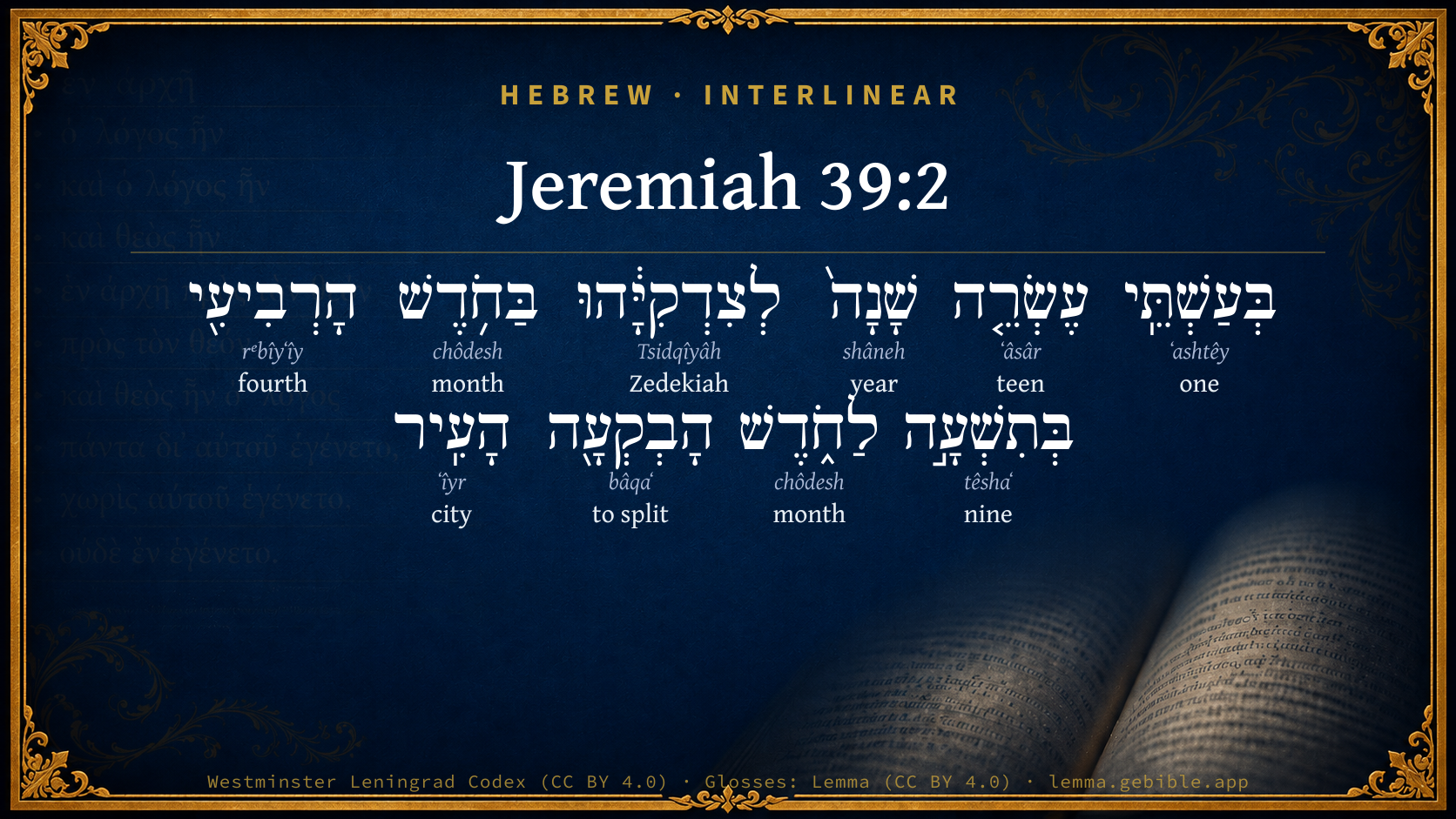
Hebrew (Westminster Leningrad Codex) Jeremiah 39:2 appears in the Hebrew Old Testament. The text above is from the Westminster Leningrad Codex. Each word links to its Strong’s number, a concise gloss, and parsing drawn from the Open Scriptures Hebrew Bible morphology. Click any word for its full Brown-Driver-Briggs (BDB) entry.
Download image
Cite this verse

Jeremiah 39:2 (World English Bible). Public Domain. Lemma interlinear Bible study tool, https://lemma.gebible.app/v/jeremiah/39/2.

Show BibTeX & RIS
BibTeX
RIS
English Translation
in the eleventh year of Zedekiah, in the fourth month, the ninth day of the month, a breach was made in the city),
World English Bible · Public Domain
Download a study sheet

One document with this verse’s original text, its word-by-word gloss line, the meaning frame, cross-references with their text, attributed commentary, and full source and license credits — printable, and it pastes into notes with its structure intact.

This verse Autodidact and up

Study sheet (.html) Plain text (.txt)

A passage Seminary Student

Up to 50 verses in one chapter. A passage sheet keeps up to 6 commentary sources and 12 cross-references per verse, in the order this page ranks them, and says so on the sheet whenever that leaves anything out. Ask for a single verse and you get the Autodidact verse sheet above.

Everything on this page stays free to read, with no account — the sheet is a download of what is already on screen, not access to it.

Want to remove ads? Support Godless Engineer
Compare translations 3

The same verse in 3 English versions, stacked beneath the original-language interlinear above. Click any original word for its lexicon entry.

Each is an independent rendering of the whole verse — the interlinear is not word-aligned to these translations.

Highlighted words mark where these versions differ — a whole-verse word diff, not a word-by-word alignment.

  • World English Bible Public Domain
    in the eleventh year of Zedekiah, in the fourth month, the ninth day of the month, a breach was made in the city),
  • King James Version Public Domain
    And in the eleventh year of Zedekiah, in the fourth month, the ninth day of the month, the city was broken up.
  • unfoldingWord Literal Text CC BY-SA 4.0
    In the eleventh year and fourth month of Zedekiah, on the ninth day of the month, the city was broken into.

unfoldingWord Literal Text — © unfoldingWord, licensed CC BY-SA 4.0. Word-aligned USFM3 via Door43 (git.door43.org/unfoldingWord/en_ult).

Versions to compare (up to 4)

3 of 4 selected

Show all 18 translations

Every available English version of this verse, each an independent rendering of the whole verse.

  • World English Bible Public Domain
    in the eleventh year of Zedekiah, in the fourth month, the ninth day of the month, a breach was made in the city),
  • Berean Standard Bible Public Domain
    And on the ninth day of the fourth month of Zedekiah’s eleventh year, the city was breached.
  • Majority Standard Bible Public Domain
    And on the ninth day of the fourth month of Zedekiah’s eleventh year, the city was breached.
  • King James Version Public Domain
    And in the eleventh year of Zedekiah, in the fourth month, the ninth day of the month, the city was broken up.
  • American Standard Version (1901) Public Domain
    in the eleventh year of Zedekiah, in the fourth month, the ninth day of the month, a breach was made in the city,)
  • Revised Version (1885) Public Domain
    in the eleventh year of Zedekiah, in the fourth month, the ninth day of the month, a breach was made in the city:)
  • Geneva Bible (1599) Public Domain
    And in the eleuenth yeere of Zedekiah in the fourth moneth, the ninth day of the moneth, the citie was broken vp.
  • Douay-Rheims (1899) Public Domain
    And in the I eleventh year of Sedecias, in the fourth month, the fifth day of the month, the city was opened.
  • Young's Literal Translation Public Domain
    in the eleventh year of Zedekiah, in the fourth month, in the ninth of the month, hath the city been broken up;
  • Literal Standard Version CC BY-SA 4.0
    in the eleventh year of Zedekiah, in the fourth month, on the ninth of the month, the city has been broken up;
  • Unlocked Literal Bible CC BY-SA 4.0
    In the eleventh year and fourth month of Zedekiah, on the ninth day of the month, the city was broken into.
  • unfoldingWord Literal Text CC BY-SA 4.0
    In the eleventh year and fourth month of Zedekiah, on the ninth day of the month, the city was broken into.
  • Darby Bible Public Domain
    In the eleventh year of Zedekiah, in the fourth month, on the ninth of the month, the city was broken into;
  • World Messianic Bible Public Domain
    In the eleventh year of Zedekiah, in the fourth month, the ninth day of the month, a breach was made in the city.
  • Webster's Bible Public Domain
    And in the eleventh year of Zedekiah, in the fourth month, the ninth day of the month, the city was broken up.
  • Free Bible Version CC BY-SA 4.0
    On the ninth day of the fourth month of the eleventh year of Zedekiah's reign, the city wall was broken through.
  • Bible in Basic English Public Domain
    In the eleventh year of Zedekiah, in the fourth month, on the ninth day of the month, the town was broken into:)
  • JPS Tanakh (1917) Public Domain
    in the eleventh year of Zedekiah, in the fourth month, the ninth day of the month, a breach was made in the city —

Literal Standard Version (2020), Covenant Press — licensed CC BY-SA 4.0. Text via the HelloAO Bible API (eBible.org). Unlocked Literal Bible (unfoldingWord) — licensed CC BY-SA 4.0. Text via the HelloAO Bible API (eBible.org). unfoldingWord Literal Text — © unfoldingWord, licensed CC BY-SA 4.0. Word-aligned USFM3 via Door43 (git.door43.org/unfoldingWord/en_ult). Free Bible Version, Dr. Jonathan Gallagher — licensed CC BY-SA 4.0. Text via the HelloAO Bible API (eBible.org).

Word by word

More ways to search: Search by grammar → Find every occurrence → Compare this word →

Practice this passage: Drill this verse → Learn its vocabulary →

בְּעַשְׁתֵּֽי
ʻashtêy
H6249
“in/at · one”
Preposition + Adjective, Cardinal number, Both, Singular, Construct
Part of Speech
Preposition + Adjective
Type
Cardinal number
Gender
Both
Number
Singular
State
Construct
Full BDB Definition

Origin: apparently masc. pl. construction of H6247 in the sense of an afterthought (used only in connection with H6240 in lieu of H259 ) eleven or (ordinal) eleventh

TWOT: 1717c

one, eleven, eleventh
  1. עֶשְׂרֵ֤ה ʻâsâr H6240 “teen” Adjective, Cardinal number, Feminine, Singular, Absolute
  2. שָׁנָה֙ shâneh H8141 “year” Noun, Common, Feminine, Singular, Absolute
  3. לְצִדְקִיָּ֔הוּ Tsidqîyâh H6667 “to/for · Zedekiah” Preposition + Noun, Proper
  4. בַּחֹ֥דֶשׁ chôdesh H2320 “in/at the · month” Preposition, Determined + Noun, Common, Masculine, Singular, Absolute
  5. הָרְבִיעִ֖י rᵉbîyʻîy H7243 “the · fourth” Particle, Definite Article + Adjective, Ordinal number, Masculine, Singular, Absolute
  6. בְּתִשְׁעָ֣ה têshaʻ H8672 “in/at · nine” Preposition + Adjective, Cardinal number, Masculine, Singular, Absolute
  7. לַחֹ֑דֶשׁ chôdesh H2320 “to/for the · month” Preposition, Determined + Noun, Common, Masculine, Singular, Absolute
  8. הָבְקְעָ֖ה bâqaʻ H1234 “to split” Verb, Hophal, Perfect, 3rd Person, Feminine, Singular
  9. הָעִֽיר ʻîyr H5892 “the · city” Particle, Definite Article + Noun, Common, Feminine, Singular, Absolute

About this verse

These counts appear in no published source. They are computed here, from the morphology-tagged text and Lemma’s own curated glosses. What Lemma adds →

10
words
9
distinct lemmas
Prophets
section

Notable vocabulary

The rarest word here is בְּעַשְׁתֵּֽי one H6249 — appearing just 19 times in the whole Hebrew Bible.

Shared distinctive vocabulary

בְּעַשְׁתֵּֽי one H6249 occurs in 18 verses of the Hebrew Bible. Also found in:

Grammatical profile

  • 1 verb
  • 5 nouns
  • 4 adjectives

Verb forms

  • הָבְקְעָ֖ה Hophal · Perfect

Repetition

A word recurs within this verse — often emphatic in Hebrew:

  • בַּחֹ֥דֶשׁ month H2320 ×2

Cross-references

6

Topical passages linked to Jeremiah 39:2 in the Treasury of Scripture Knowledge — connected by theme and wording, ordered by reader-vote popularity; previews shown in the World English Bible.

  • 2 Kings 25:3–4 On the ninth day of the [fourth] month the famine was sore in the city, so that there was no bread for the people of the land.
  • Jeremiah 5:10 Go up on her walls, and destroy; but don't make a full end: take away her branches; for they are not Yahweh's.
  • Jeremiah 52:6–7 In the fourth month, in the ninth day of the month, the famine was sore in the city, so that there was no bread for the people of the land.
  • Ezekiel 33:21 It happened in the twelfth year of our captivity, in the tenth [month], in the fifth [day] of the month, that one who had escaped out of Jerusalem came to me, saying, The city has been struck.
  • Micah 2:12–13 I will surely assemble, Jacob, all of you; I will surely gather the remnant of Israel; I will put them together as the sheep of Bozrah, As a flock in the midst of their pasture; They will swarm with people.
  • Zephaniah 1:10 In that day, says Yahweh, there will be the noise of a cry from the fish gate, a wailing from the second quarter, and a great crashing from the hills.

Cross-references courtesy of OpenBible.info (CC BY 4.0).

Hebrew and Greek witnesses Masoretic Hebrew ↔ Greek Septuagint

The same verse in the two great witnesses to the Old Testament, shown verse-for-verse.

These are two independent witnesses, not word-aligned to each other, and the Septuagint is shown in lemma (dictionary) form.

Hebrew Jeremiah 39:2 Masoretic · Westminster Leningrad Codex

בְּעַשְׁתֵּֽי עֶשְׂרֵ֤ה שָׁנָה֙ לְצִדְקִיָּ֔הוּ בַּחֹ֥דֶשׁ הָרְבִיעִ֖י בְּתִשְׁעָ֣ה לַחֹ֑דֶשׁ הָבְקְעָ֖ה הָעִֽיר

in the eleventh year of Zedekiah, in the fourth month, the ninth day of the month, a breach was made in the city),

World English Bible · Public Domain

Greek LXX Structure differs

In the Septuagint, Jeremiah is about an eighth shorter than the Hebrew and arranges its material differently — the Oracles Against the Nations (Hebrew chapters 46–51) appear in the middle of the Greek book, after 25:13. Because the chapter and verse boundaries do not line up, a verse-for-verse comparison with the Hebrew is not shown.

A verse-for-verse comparison isn’t shown here because the chapters and verses don’t line up. Switch to the LXX edition with the MT / LXX toggle above to read the Greek directly.

Hebrew: Westminster Leningrad Codex (CC BY 4.0). Greek: Septuagint (public domain); English from a public-domain English Septuagint. How the Septuagint differs from the Hebrew →

Targum (Aramaic paraphrase)

1

The Targum is the ancient Jewish Aramaic paraphrase of the Hebrew Scriptures — an interpretive translation, not the Hebrew text itself. Onkelos (literal) and Pseudo-Jonathan (expansive) render the Torah, and Jonathan the Prophets. Coverage is partial: where no permissively-licensed English translation exists for a verse, only the Aramaic is shown. This is verse-level text, not a word-by-word alignment to the Hebrew.

  1. Targum Jonathan Prophets (Joshua–Malachi)
    בַּחֲדָא עַשְׂרֵי שְׁנִין לְצִדְקִיָה בְּיַרְחָא רְבִיעָאָה בְּתִשְׁעָא לְיַרְחָא אִתְרְעַת קַרְתָּא:

    (no public-domain English translation for this verse)

    Targum Jonathan — Aramaic: “Mikraot Gedolot” (public domain). English: “Sefaria Community Translation” (CC0 1.0 (public-domain dedication)); “London "Chaldee Paraphrase," 1871” (public domain). Text via Sefaria.

Commentary

Notes on Jeremiah 39:2 from classic Christian and Jewish commentators (each source and its license shown beneath its notes). The classic Christian expositions comment on the surrounding passage and are grouped to its opening verse, so a note may address several verses; the Jewish commentaries on the Tanakh (Rashi and others) are per-verse, so they appear only where the commentator wrote on this verse.

Lemma curates 59 commentaries, every one of them public domain or Creative Commons licensed, each selected and text-cleaned for this edition rather than reprinted as found. About our sources →

Trapp's Complete Commentary

John Trapp

Jer 39:2 [And] in the eleventh year of Zedekiah, in the fourth month, the ninth [day] of the month, the city was broken up.

Ver. 2. And in the eleventh year.] See on 2Ki 25:2. The sacking of Jerusalem occured four hundred and nineteen years after the building of the temple, (1004 to 588 BC) in the forty-seventh Olympiad, and when Tarquinius Priseus was king of Rome.

The city was broken up.] See on 2Ki 25:4.

John Trapp, A Commentary or Exposition upon All the Books of the Old and New Testament (1647–1656) — public domain. Text from a community e-Sword module.

Tyndale Open Study Notes

Tyndale Open Resources

39:2 The Babylonian siege took a long time because the stone walls of Jerusalem were thick and the people’s resistance was strong.

Tyndale Open Study Notes — © Tyndale Open Resources, licensed CC BY-SA 4.0. Text via the HelloAO Bible API.

Geneva Bible (1599)

Geneva Bible translators

The gates and walls were broken down.

Geneva Bible (1599) marginal notes — public domain. Text via Bolls.life.

Adam Clarke's Commentary

Verse 2. The eleventh year - in the fourth month] This month in the Hebrew calendar is called Thammuz, and commences with the first new moon of our July. The siege had lasted just eighteen months.

The city was broken up.] A breach was made in the wall by which the Chaldeans entered.

Adam Clarke's Commentary on the Bible (1810–1826) — public domain. Text from a community e-Sword/MySword module.

John Calvin's Commentaries

It then follows, In the eleventh year, in the fourth month, the city was broken up We hence see that the city was besieged for a year and half; for there was the whole of the tenth year, and then added must be two months of the ninth year and four months of the eleventh year; and thus a year and half was the whole time. Here also we must remember how much the Jews must have suffered; for were a city at this day to bear a siege for a few months, it would appear a rare instance of valor; but Jerusalem was besieged for a year and half. Let us now consider what number of people must have been there, and we have seen that the Prophet threatened them with famine. And how much scarcity there was in the city, the Prophet has not only testified elsewhere, but in the book of Lamentations he has shewed most fully. (Lamentations 4:10.) And there was not only famine, but it was followed by pestilence. We hence learn how ferocious must have been the character of the king, that he could see miserable men perishing by scores, and yet persist in his obstinacy. Nor is there a doubt but that the people were also on their part obstinate, and became at length stupefied through their sufferings; for there was hardly one, from the least to the greatest, who did not despise what the Prophet taught; and thus they were all blinded by madness and stupidity.

It ought to be noticed that they bore a siege for a year and six months, and that they were not even then persuaded to surrender themselves, until the city was broken up, that is, until the walls were beaten down by battering-rams and other warlike engines; for the city was broken when the wall, beaten by the engines, fell down. In short, the city was gained by storm; this is what is meant, and will hereafter be more fully expressed. But I cannot proceed further now.

John Calvin's Commentaries (1540-1563) — public domain. Text from the Calvin Translation Society English edition (1840s-50s) via the Christian Classics Ethereal Library (ccel.org). Calvin's coverage is partial (roughly two-thirds of the Bible); uncommented books and verses are honest gaps, never fabricated. The 19th-century editor's footnotes and remarks are omitted so the notes are faithfully Calvin's own voice.

John Gill's Exposition

And in the eleventh year of Zedekiah, in the fourth month,.... The month Tammuz, which answers to part of June, and part of July:

the ninth day of the month, the city was broken up; or taken by storm; the walls of it were broken by engines and battering rams, so that the Chaldeans could enter it, and take it. This was just a year and a half after it had been besieged, not being able to hold out any longer, because of the famine; see Jer 52:6.

John Gill's Exposition of the Whole Bible (1746–1763) — public domain (CC PDM 1.0). Text via the HelloAO Bible API.

Haydock's Catholic Bible Commentary

Fifth. The parallel passages and other editions read ninth. Some pretend that (Calmet) the city was taken on the 5th of the 4th month, and after being pillaged was burnt on the 7th (4 Kings xxiv. 8.) or 10th of the 5th month, chap. lii. 12. (Sanctius; Cornelius a Lapide) --- But the city was taken on the 9th of the 4th month, and Nabuzardan entered on the 7th of the 5th month, and burnt it and the temple on the 10th. (Salien, &c.) (Calmet) --- From the beginning of the siege (the year of the world 3414) to the end (the year 3416.; Usher), two years and a half elapsed. It was interrupted a short time. Two fasts are still observed by the Jews to deplore these events, Zacharias vii. 3., and viii. 19.

George Leo Haydock (1774–1849), Haydock's Catholic Family Bible and Commentary, 1859 edition — public domain. Excludes Psalms (Douay-Rheims chapter numbering differs from Protestant) and Deuterocanonical books (Catholic canon only).

Matthew Poole's English Annotations

The siege lasted a year and half, for it was the fourth month of Zedekiah’s eleventh year before it was taken: it is said here to be broken up, because their way of taking fortified places then was by beating down the walls of the besieged with iron rams and engines, as we now do with great guns. This kingdom had now held three hundred and eighty years, from Rehoboam their first king, in which they had had twenty kings (besides Athaliah). The ten tribes had been now in captivity one hundred and thirty years, so as the kingdom of Israel stood but two hundred and fifty years after the division, in which time they had had eighteen princes, but of several families; all the kings of Judah were of the house of David, lineally descended from him.

Matthew Poole's English Annotations on the Holy Bible (1683–1685) — public domain. Text from a community e-Sword/MySword module.

Scofield Reference Notes

C. I. Scofield

fourth month

i.e. July.

The Scofield Reference Bible (1917 edition), notes by C. I. Scofield — public domain. Text from a community e-Sword module.

Lesson kit

Teaching starters — assembled from the data on this page, not authored interpretation. Every prompt links to the verse data it draws on. Edit before teaching.

Jeremiah, in the Prophets, opens this verse with 10 words (9 distinct Hebrew lemmas). Its most distinctive word is ʻashtêy (“one”). A historical commentator’s framing appears above. Read the whole chapter for the surrounding context.

Discussion questions

  1. How does “one” (ʻashtêy) shape what this verse is saying?
  2. How does Exodus 26:7, which shares the word «one», read alongside this verse?
  3. What does the repetition of “month” (2× in this one verse) do in this verse?
  4. These translations render this verse differently; the difference is in the English rendering, not the original. What questions does that raise?
  5. «הָבְקְעָ֖ה» is a Hophal Perfect verb. How does that grammatical form shape the action described?
  6. Compare how Trapp's Complete Commentary and Tyndale Open Study Notes read this verse. Where do they agree or differ?

Things to notice

  • These translations choose different wording for 5 words in this verse.
  • “month” occurs 2× in this single verse.
  • 9 distinct Hebrew lemmas span 10 words in this verse.

Reading settings

Reading text

Shown beneath each verse's original-language words.

Old Testament
Old Testament edition

Read the OT as the Masoretic Hebrew (MT) or the Greek Septuagint (LXX).

English shown for the Greek Septuagint (in the Hebrew ↔ Greek comparison).

Comparing translations? Open the Compare panel on any verse page to stack up to four side by side.