
Nehemiah 8:2

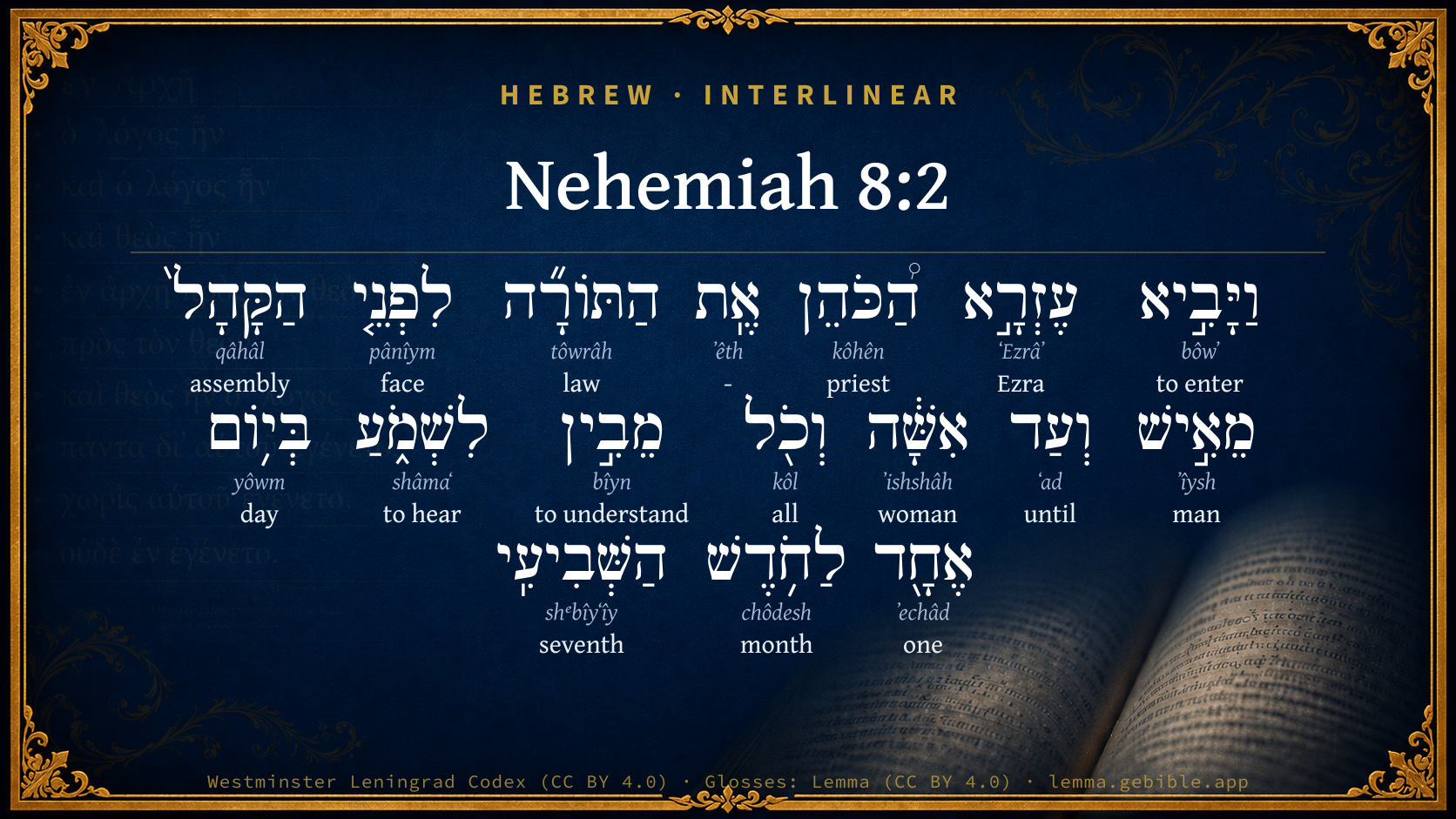
Hebrew (Westminster Leningrad Codex) Nehemiah 8:2 appears in the Hebrew Old Testament. The text above is from the Westminster Leningrad Codex. Each word links to its Strong’s number, a concise gloss, and parsing drawn from the Open Scriptures Hebrew Bible morphology. Click any word for its full Brown-Driver-Briggs (BDB) entry.
Download image
Cite this verse

Nehemiah 8:2 (World English Bible). Public Domain. Lemma interlinear Bible study tool, https://lemma.gebible.app/v/nehemiah/8/2.

Show BibTeX & RIS
BibTeX
RIS
English Translation
Ezra the priest brought the law before the assembly, both men and women, and all who could hear with understanding, on the first day of the seventh month.
World English Bible · Public Domain
Download a study sheet

One document with this verse’s original text, its word-by-word gloss line, the meaning frame, cross-references with their text, attributed commentary, and full source and license credits — printable, and it pastes into notes with its structure intact.

This verse Autodidact and up

Study sheet (.html) Plain text (.txt)

A passage Seminary Student

Up to 50 verses in one chapter. A passage sheet keeps up to 6 commentary sources and 12 cross-references per verse, in the order this page ranks them, and says so on the sheet whenever that leaves anything out. Ask for a single verse and you get the Autodidact verse sheet above.

Everything on this page stays free to read, with no account — the sheet is a download of what is already on screen, not access to it.

Want to remove ads? Support Godless Engineer
Compare translations 3

The same verse in 3 English versions, stacked beneath the original-language interlinear above. Click any original word for its lexicon entry.

Each is an independent rendering of the whole verse — the interlinear is not word-aligned to these translations.

Highlighted words mark where these versions differ — a whole-verse word diff, not a word-by-word alignment.

  • World English Bible Public Domain
    Ezra the priest brought the law before the assembly, both men and women, and all who could hear with understanding, on the first day of the seventh month.
  • King James Version Public Domain
    And Ezra the priest brought the law before the congregation both of men and women, and all that could hear with understanding, upon the first day of the seventh month.
  • unfoldingWord Literal Text CC BY-SA 4.0
    And Ezra the priest brought the law before the face of the assembly of both men and women and all who were understanding to hear, on day one of the seventh month.

unfoldingWord Literal Text — © unfoldingWord, licensed CC BY-SA 4.0. Word-aligned USFM3 via Door43 (git.door43.org/unfoldingWord/en_ult).

Versions to compare (up to 4)

3 of 4 selected

Show all 18 translations

Every available English version of this verse, each an independent rendering of the whole verse.

  • World English Bible Public Domain
    Ezra the priest brought the law before the assembly, both men and women, and all who could hear with understanding, on the first day of the seventh month.
  • Berean Standard Bible Public Domain
    On the first day of the seventh month, Ezra the priest brought the Law before the assembly of men and women and all who could listen and understand.
  • Majority Standard Bible Public Domain
    On the first day of the seventh month, Ezra the priest brought the Law before the assembly of men and women and all who could listen and understand.
  • King James Version Public Domain
    And Ezra the priest brought the law before the congregation both of men and women, and all that could hear with understanding, upon the first day of the seventh month.
  • American Standard Version (1901) Public Domain
    And Ezra the priest brought the law before the assembly, both men and women, and all that could hear with understanding, upon the first day of the seventh month.
  • Revised Version (1885) Public Domain
    And Ezra the priest brought the law before the congregation, both men and women, and all that could hear with understanding, upon the first day of the seventh month.
  • Geneva Bible (1599) Public Domain
    And Ezra the Priest brought the Lawe before the Congregation both of men and women, and of all that coulde heare and vnderstand it, in the first day of the seuenth moneth,
  • Douay-Rheims (1899) Public Domain
    Then Esdras the priest brought the law before the multitude of men and women, and all those that could understand, in the first day of the seventh month.
  • Young's Literal Translation Public Domain
    And Ezra the priest bringeth the law before the assembly, both of men and women, and every one intelligent to hear, on the first day of the seventh month,
  • Literal Standard Version CC BY-SA 4.0
    And Ezra the priest brings the Law before the assembly, both of men and women, and everyone intelligent to hear, on the first day of the seventh month,
  • Unlocked Literal Bible CC BY-SA 4.0
    On the first day of the seventh month, Ezra the priest brought the law before the assembly, both men and women, and all who could hear and understand.
  • unfoldingWord Literal Text CC BY-SA 4.0
    And Ezra the priest brought the law before the face of the assembly of both men and women and all who were understanding to hear, on day one of the seventh month.
  • Darby Bible Public Domain
    And Ezra the priest brought the law before the congregation, both of men and women, and all that could hear with understanding, on the first day of the seventh month.
  • World Messianic Bible Public Domain
    Ezra the priest brought the law before the assembly, both men and women, and all who could hear with understanding, on the first day of the seventh month.
  • Webster's Bible Public Domain
    And Ezra the priest brought the law before the congregation both of men and women, and all that could hear with understanding, upon the first day of the seventh month.
  • Free Bible Version CC BY-SA 4.0
    On the first day of the seventh month, Ezra the priest brought the Law before the assembly—men and women, and all those children who could listen and understand.
  • Bible in Basic English Public Domain
    And Ezra the priest put the law before the meeting of the people, before the men and women and all those who were able to take it in, on the first day of the seventh month.
  • JPS Tanakh (1917) Public Domain
    And Ezra the priest brought the Law before the congregation, both men and women, and all that could hear with understanding, upon the first day of the seventh month.

Literal Standard Version (2020), Covenant Press — licensed CC BY-SA 4.0. Text via the HelloAO Bible API (eBible.org). Unlocked Literal Bible (unfoldingWord) — licensed CC BY-SA 4.0. Text via the HelloAO Bible API (eBible.org). unfoldingWord Literal Text — © unfoldingWord, licensed CC BY-SA 4.0. Word-aligned USFM3 via Door43 (git.door43.org/unfoldingWord/en_ult). Free Bible Version, Dr. Jonathan Gallagher — licensed CC BY-SA 4.0. Text via the HelloAO Bible API (eBible.org).

Word by word

More ways to search: Search by grammar → Find every occurrence → Compare this word →

Practice this passage: Drill this verse → Learn its vocabulary →

עֶזְרָ֣א
ʻEzrâʼ
H5830
“Ezra”
Noun, Proper
Part of Speech
Noun
Type
Proper
Full BDB Definition

Origin: a variation of H5833

TWOT: None

Ezra = "help" - the priest and scribe who led the reforms of the returned exiles in Jerusalem; co-worker with Nehemiah - a priest with Zerubbabel - another post-exilic Jew
  1. וַיָּבִ֣יא bôwʼ H935 “and · to enter” Conjunction + Verb, Hiphil, Sequential Imperfect, 3rd Person, Masculine, Singular
  2. הַ֠כֹּהֵן kôhên H3548 “the · priest” Particle, Definite Article + Noun, Common, Masculine, Singular, Absolute
  3. אֶֽת ʼêth H853 “-” Particle, Direct Object
  4. הַתּוֹרָ֞ה tôwrâh H8451 “the · law” Particle, Definite Article + Noun, Common, Feminine, Singular, Absolute
  5. לִפְנֵ֤י pânîym H6440 “to/for · face(s) of” Preposition + Noun, Common, Both, Plural, Construct
  6. הַקָּהָל֙ qâhâl H6951 “the · assembly” Particle, Definite Article + Noun, Common, Masculine, Singular, Absolute
  7. מֵאִ֣ישׁ ʼîysh H376 “from · man” Preposition + Noun, Common, Masculine, Singular, Absolute
  8. וְעַד ʻad H5704 “and · until” Conjunction + Preposition
  9. אִשָּׁ֔ה ʼishshâh H802 “woman” Noun, Common, Feminine, Singular, Absolute
  10. וְכֹ֖ל kôl H3605 “and · all of” Conjunction + Noun, Common, Masculine, Singular, Construct
  11. מֵבִ֣ין bîyn H995 “understanding” Verb, Hiphil, Participle Active, Masculine, Singular, Absolute
  12. לִשְׁמֹ֑עַ shâmaʻ H8085 “to hear” Preposition + Verb, Qal, Infinitive Construct
  13. בְּי֥וֹם yôwm H3117 “in/at · day” Preposition + Noun, Common, Masculine, Singular, Absolute
  14. אֶחָ֖ד ʼechâd H259 “one” Adjective, Cardinal number, Masculine, Singular, Absolute
  15. לַחֹ֥דֶשׁ chôdesh H2320 “to/for the · month” Preposition, Determined + Noun, Common, Masculine, Singular, Absolute
  16. הַשְּׁבִיעִֽי shᵉbîyʻîy H7637 “the · seventh” Particle, Definite Article + Adjective, Ordinal number, Masculine, Singular, Absolute

About this verse

These counts appear in no published source. They are computed here, from the morphology-tagged text and Lemma’s own curated glosses. What Lemma adds →

17
words
17
distinct lemmas
Historical
section

Notable vocabulary

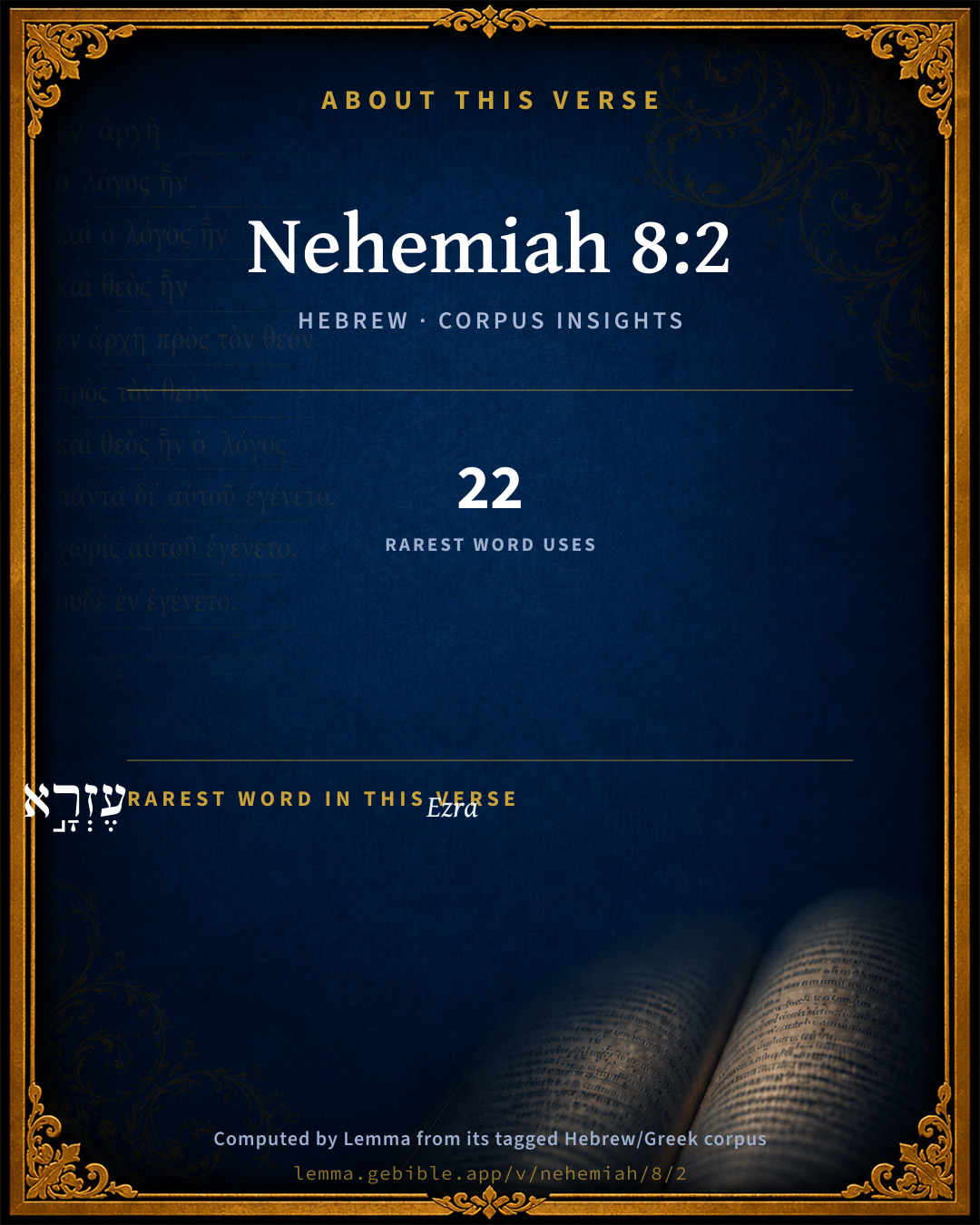
The rarest word here is עֶזְרָ֣א Ezra H5830 — appearing just 22 times in the whole Hebrew Bible.

Shared distinctive vocabulary

עֶזְרָ֣א Ezra H5830 occurs in 22 verses of the Hebrew Bible. Also found in:

Grammatical profile

  • 3 verbs
  • 10 nouns
  • 2 adjectives
  • 1 preposition
  • 1 particle

Verb forms

  • וַיָּבִ֣יא Hiphil · Sequential Imperfect
  • מֵבִ֣ין Hiphil · Participle Active
  • לִשְׁמֹ֑עַ Qal · Infinitive Construct

Cross-references

8

Topical passages linked to Nehemiah 8:2 in the Treasury of Scripture Knowledge — connected by theme and wording, ordered by reader-vote popularity; previews shown in the World English Bible.

  • Leviticus 23:24 "Speak to the children of Israel, saying, 'In the seventh month, on the first day of the month, shall be a solemn rest to you, a memorial of blowing of trumpets, a holy convocation.
  • Malachi 2:7 For the priest's lips should keep knowledge, and they should seek the law at his mouth; for he is the messenger of Yahweh of Hosts.
  • Numbers 29:1 In the seventh month, on the first day of the month, you shall have a holy convocation; you shall do no servile work: it is a day of blowing of trumpets to you.
  • Deuteronomy 17:18 It shall be, when he sits on the throne of his kingdom, that he shall write him a copy of this law in a book, out of [that which is] before the priests the Levites:
  • Deuteronomy 31:9–13 Moses wrote this law, and delivered it to the priests the sons of Levi, who bore the ark of the covenant of Yahweh, and to all the elders of Israel.
  • Isaiah 28:9 Whom will he teach knowledge? and whom will he make to understand the message? those who are weaned from the milk, and drawn from the breasts?
  • Acts 15:21 For Moses from generations of old has in every city those who preach him, being read in the synagogues every Sabbath."
  • 2 Chronicles 17:7–9 Also in the third year of his reign he sent his princes, even Ben Hail, and Obadiah, and Zechariah, and Nethanel, and Micaiah, to teach in the cities of Judah;

Cross-references courtesy of OpenBible.info (CC BY 4.0).

Hebrew and Greek witnesses Masoretic Hebrew ↔ Greek Septuagint

The same verse in the two great witnesses to the Old Testament, shown verse-for-verse.

These are two independent witnesses, not word-aligned to each other, and the Septuagint is shown in lemma (dictionary) form.

Hebrew Nehemiah 8:2 Masoretic · Westminster Leningrad Codex

וַיָּבִ֣יא עֶזְרָ֣א הַ֠כֹּהֵן אֶֽת הַתּוֹרָ֞ה לִפְנֵ֤י הַקָּהָל֙ מֵאִ֣ישׁ וְעַד אִשָּׁ֔ה וְכֹ֖ל מֵבִ֣ין לִשְׁמֹ֑עַ בְּי֥וֹם אֶחָ֖ד לַחֹ֥דֶשׁ הַשְּׁבִיעִֽי

Ezra the priest brought the law before the assembly, both men and women, and all who could hear with understanding, on the first day of the seventh month.

World English Bible · Public Domain

Greek LXX Structure differs

The Septuagint has no separate book of Nehemiah. Its Greek text is the second half of Esdras B (2 Esdras), chapters 11–23; Ezra is the first half (1–10).

A verse-for-verse comparison isn’t shown here because the chapters and verses don’t line up. Switch to the LXX edition with the MT / LXX toggle above to read the Greek directly.

Hebrew: Westminster Leningrad Codex (CC BY 4.0). Greek: Septuagint (public domain); English from a public-domain English Septuagint. How the Septuagint differs from the Hebrew →

Commentary

Notes on Nehemiah 8:2 from classic Christian and Jewish commentators (each source and its license shown beneath its notes). The classic Christian expositions comment on the surrounding passage and are grouped to its opening verse, so a note may address several verses; the Jewish commentaries on the Tanakh (Rashi and others) are per-verse, so they appear only where the commentator wrote on this verse.

Lemma curates 59 commentaries, every one of them public domain or Creative Commons licensed, each selected and text-cleaned for this edition rather than reprinted as found. About our sources →

Trapp's Complete Commentary

John Trapp

Neh 8:2 And Ezra the priest brought the law before the congregation both of men and women, and all that could hear with understanding, upon the first day of the seventh month.

Ver. 2. And Ezra the priest brought the law] The commandment (he knew well) was a lamp, and the law a light; and reproofs of instruction the way of life, Pro 6:23. The Greeks call the law νομον, quasi θεου νοον μενοντα, the standing mind of God (Plato in Cratylo). And if Demosthenes could say of men’s laws, that they were the invention of God; if Xenophon could say of the Persian laws, that they kept the people even from coveting any wickedness; if Cicero durst say of the Roman laws, that they far excelled and exceeded all the learned libraries of the philosophers, both in weight and worth; how much more may all this and more be said of this perfect law of God, the book whereof was here brought forth by Ezra, and read and expounded in the ears of all the people! μη τοιουτους εσεσθαι τους πολιτας, ωστε πονηρου τινος εργου εφιεσθαι..

Before the congregation both of men and women] Heb. From man to woman; for souls have no sexes; and in Christ there is no difference, Gal 4:28. The Jews at this day little regard their women; not suffering them to come within their synagogue. And the Turkish women never go to their mosques; neither is there any heed taken or reckoning made of their religion at all. The Papists say that a distaff is fitter for a woman than a Bible.

And all that can hear with understanding] i.e. Children also, that were of any growth. Little pitchers have ears, and little children will understand much, if well principled.

Upon the first day of the seventh month] A month of more solemnities than any other. This first day was a double holy day, Lev 23:24. See Deu 31:11.

John Trapp, A Commentary or Exposition upon All the Books of the Old and New Testament (1647–1656) — public domain. Text from a community e-Sword module.

Joseph Benson's Commentary

Neh 8:2. Upon the first day of the seventh month — This was the feast of trumpets, which is called a sabbath, and on which they were to have a holy convocation, Lev 23:24. And it was on this day the altar was set up, after their return from captivity; in remembrance of which they had probably kept it ever since, with more than ordinary solemnity.

Joseph Benson's Commentary on the Old and New Testaments (1811–1818) — public domain. Text from a community e-Sword module.

Scofield Reference Notes

C. I. Scofield

seventh month

i.e. October; Neh 8:2; Neh 8:14.

The Scofield Reference Bible (1917 edition), notes by C. I. Scofield — public domain. Text from a community e-Sword module.

Tyndale Open Study Notes

Tyndale Open Resources

8:2 on October 8: The people came together on this day to celebrate the Festival of Trumpets (Lev 23:24-25), which marked the beginning of a new year in the postexilic calendar.

Tyndale Open Study Notes — © Tyndale Open Resources, licensed CC BY-SA 4.0. Text via the HelloAO Bible API.

Geneva Bible (1599)

Geneva Bible translators

Which had age and discretion to understand.

Geneva Bible (1599) marginal notes — public domain. Text via Bolls.life.

Adam Clarke's Commentary

Verse 2. All that could hear with understanding] Infants, idiots, and children not likely to receive instruction, were not permitted to attend this meeting; nor should any such, in any place, be ever brought to the house of God, if it can be avoided: yet, rather than a poor mother should be deprived of the ordinances of God, let her come with her child in her arms; and although it be inconvenient to the congregation, and to some ministers, to hear a child cry, it is cruel to exclude the mother on this account, who, having no person to take care of her child while absent, must bring it with her, or be totally deprived of the ordinances of the Christian Church.

Upon the first day of the seventh month.] This was the first day of what was called the civil year; and on it was the feast of trumpets, the year being ushered in by the sound of these instruments.

Adam Clarke's Commentary on the Bible (1810–1826) — public domain. Text from a community e-Sword/MySword module.

Ellicott's Commentary for English Readers

(2) Both of men and women, and all that could hear with understanding.—Men, women, and children who had reached years of discretion.

Upon the first day of the seventh month.—As the seventh was the most important month, in a religious sense, so the first day, the Feast of Trumpets, was the most important new moon (Lev_23:24).

A Bible Commentary for English Readers, edited by Charles John Ellicott (1878–1897) — public domain. Text from a community e-Sword module.

The Cambridge Bible for Schools and Colleges

gen. ed. J. J. S. Perowne

2. Ezra the priest] cf. Ezr_7:1; Ezr_7:11.

the law] i.e. the book of the law. Cf. 2Co_3:14 ‘the old covenant’ for ‘the book of the old covenant.’ The word ‘Torah’ is here used in the sense, which afterwards became universal, of the written ‘Law.’

all that could hear with understanding] lit. ‘every one of intelligence to hear and understand,’ i.e. all except quite children, cf. Neh_10:28 ‘all …, their wives and their sons and their daughters, every one that had knowledge and understanding.’ The Vulgate ‘sapientium’ gives a wrong idea.

upon the first day of the seventh month] In the Priestly Laws the first day of the month Tisri was ‘the Feast of Trumpets’ (see Lev_23:23-25; Num_29:1-6), a day of ‘holy convocation,’ cf. Neh_8:9; see Ezr_3:1.

Were the people assembled to celebrate this festival, or were the people summoned on the first day of the month, because the new-moon days were always regarded as sacred in Palestine? Considering that the people were even uninstructed how to celebrate the Feast of Tabernacles according to the Law (Neh_8:13-15), it is not likely that they would have been acquainted with the ‘feast of trumpets’ before the time of the reading of the Law. It is therefore most probable that the special holiness of the day lay in its being the new-moon day of the month in which occurred not only the change of year according to the autumn era but also the most popular of the Israelite festivals, ‘the feast of tabernacles.’ The observance of the new-moon seems to have been universal among Oriental nations in ancient times. Among the Israelites, it was at all times strictly maintained, cf. 1Sa_20:5; 2Ki_4:23; Isa_1:13; Isa_66:23; Eze_26:1; Eze_46:1; Hos_2:11; Amo_8:5; Hag_1:1; Jdt_8:6; Col_2:16.

The Cambridge Bible for Schools and Colleges (gen. ed. J. J. S. Perowne; Cambridge University Press, 1878–1918) — public domain. Text from a community e-Sword module.

John Gill's Exposition

And Ezra the priest brought the law before the congregation,.... Having a perfect copy of it, which the people knew, and therefore desired him to bring it; he brought it either out of his own case or chest, or out of the temple where it was laid up; some restrain this to the book of Deuteronomy; this he produced in sight of the whole assembly:

both of men and women; adult persons of each sex, who met promiscuously; though Grotius thinks the women had a separate place:

and all that could hear with understanding; all under age, who yet were capable of hearing the law read to some advantage to them:

upon the first day of the seventh month; the month Tisri, answering to part of September and October; this was a high day, for not only the first of every month was a festival, but the first of the seventh month was the feast of blowing of trumpets, Lev 23:24, and besides, this was New Year's day, the first day of their civil year, as the first of Nisan was of their ecclesiastical year, and was of greater antiquity than that; and so Jarchi says, this was the first day of the year; to which may be added, that this was the day on which the altar was first set up, on the Jews' return from captivity, Ezr 3:6.

John Gill's Exposition of the Whole Bible (1746–1763) — public domain (CC PDM 1.0). Text via the HelloAO Bible API.

Albert Barnes' Notes on the Bible

Upon the first day of the seventh month - The day of the “Feast of Trumpets” (see the margin reference note). The gathering together of the people, spoken of in Neh 8:1, was probably to observe this feast.

Albert Barnes' Notes on the Bible (1834–1885) — public domain. Text from a community e-Sword/MySword module.

Haydock's Catholic Bible Commentary

Women, who were in a separate place. --- Understand, being come to the use of reason. (Calmet)

George Leo Haydock (1774–1849), Haydock's Catholic Family Bible and Commentary, 1859 edition — public domain. Excludes Psalms (Douay-Rheims chapter numbering differs from Protestant) and Deuterocanonical books (Catholic canon only).

Matthew Poole's English Annotations

Ezra the priest came twelve or thirteen years before Nehemiah to Jerusalem; and either tarried there, or went back to Babylon, being forced to do so by the king’s command, or indispensable occasions, and then returned again with Nehemiah.

All that could hear with understanding, i.e. and such children as were come to years of understanding.

Matthew Poole's English Annotations on the Holy Bible (1683–1685) — public domain. Text from a community e-Sword/MySword module.

Whedon's Commentary on the Bible

Daniel D. Whedon

2. Ezra the priest — He was descended from Aaron, and was therefore a priest, as well as a most distinguished scribe. See note on Ezr_7:1.

All that could hear with understanding — More literally, all having understanding to hear; that is, all children and young persons old enough to listen intelligently to the reading and exposition of the law.

The first day of the seventh month — The day for the feast of trumpets.

Lev_23:24. This month bore the names Ethanim and Tisri, and corresponded nearly with our October. It was also the first month of the civil year, so that its first was new year’s day. The tenth of this month was the day of atonement, and on the fifteenth began the feast of tabernacles.

Lev_23:27; Lev_23:34.

Daniel D. Whedon (gen. ed.), Commentary on the Old and New Testaments (1874–1909) — public domain. Text from a community e-Sword module.

The Pulpit Commentary

Ezra the priest brought the law. Ezra, God"s true priest, at once responded to the call He did not say, "The law is difficult, hard to be understood, might mislead you, should be reserved for the learned;" but at once "brought it," and "read therein" before the congregation both of men and women, and of all that could hear with understanding, i.e. of all (youths and maidens) that were old enough to understand the words.

The Pulpit Commentary (1880–1919), ed. H.D.M. Spence-Jones & Joseph S. Exell — public domain. Text from a community e-Sword module.

John Wesley's Explanatory Notes

First day - This was the feast of trumpets, which is called a sabbath, and on which they were to have an holy convocation, Lev. xxiii, 24. And it was on this day, the altar was set up, after their return from captivity; in remembrance of which they had probably kept it ever since, with more than ordinary solemnity.

John Wesley, Explanatory Notes Upon the Whole Bible (1754–1765) — public domain. Text via the GEBible commentary corpus.

Rashi

Rabbi Shlomo Yitzchaki (Rashi)

on the first day of the seventh month That is the day of Rosh Hashanah.

Rashi on the Tanakh — English translations: “The Judaica Press complete Tanach with Rashi, translated by A. J. Rosenberg” (CC BY 4.0); “Pentateuch with Rashi's commentary by M. Rosenbaum and A.M. Silbermann, 1929-1934” (public domain); “The Metsudah Tanach series, Lakewood, N.J” (CC BY 4.0); and “The Book of Joshua, Metsudah Publications, 1997” (CC BY 4.0). Text via Sefaria.

Lesson kit

Teaching starters — assembled from the data on this page, not authored interpretation. Every prompt links to the verse data it draws on. Edit before teaching.

Nehemiah, in the Historical, opens this verse with 17 words (17 distinct Hebrew lemmas). Its most distinctive word is ʻEzrâʼ (“Ezra”). A historical commentator’s framing appears above. Read the whole chapter for the surrounding context.

Discussion questions

  1. The word ʻEzrâʼ carries the sense “Ezra.” How does it shape the verse?
  2. How does Ezra 7:1, which shares the word «Ezra», read alongside this verse?
  3. These translations render this verse differently; the difference is in the English rendering, not the original. What questions does that raise?
  4. «וַיָּבִ֣יא» is a Hiphil Sequential Imperfect verb. How does that grammatical form shape the action described?
  5. Compare how Trapp's Complete Commentary and Joseph Benson's Commentary read this verse. Where do they agree or differ?

Things to notice

Reading settings

Reading text

Shown beneath each verse's original-language words.

Old Testament
Old Testament edition

Read the OT as the Masoretic Hebrew (MT) or the Greek Septuagint (LXX).

English shown for the Greek Septuagint (in the Hebrew ↔ Greek comparison).

Comparing translations? Open the Compare panel on any verse page to stack up to four side by side.