
Exodus 12:2

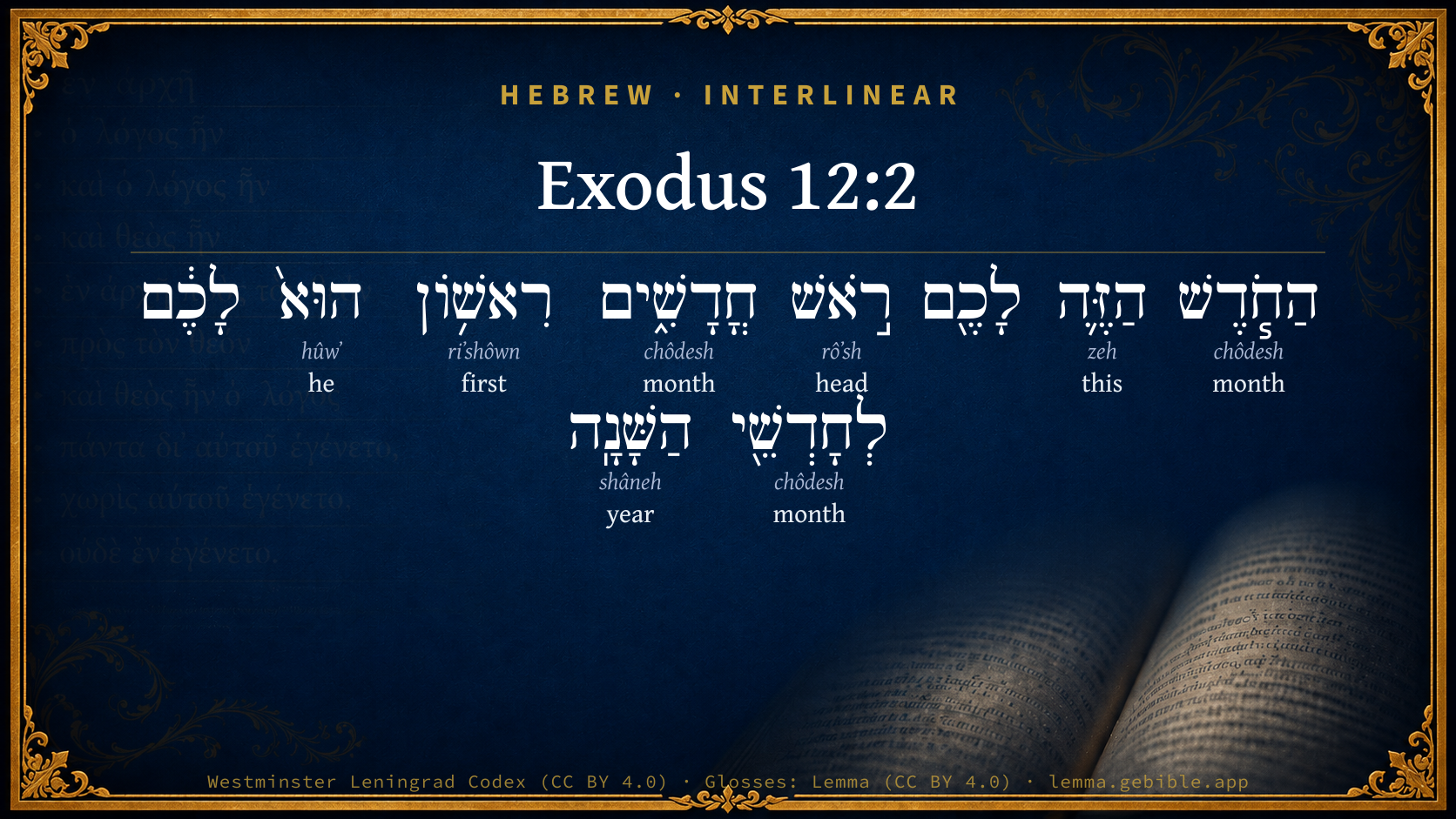
Hebrew (Westminster Leningrad Codex) Exodus 12:2 appears in the Hebrew Old Testament. The text above is from the Westminster Leningrad Codex. Each word links to its Strong’s number, a concise gloss, and parsing drawn from the Open Scriptures Hebrew Bible morphology. Click any word for its full Brown-Driver-Briggs (BDB) entry.
Download image
Cite this verse

Exodus 12:2 (World English Bible). Public Domain. Lemma interlinear Bible study tool, https://lemma.gebible.app/v/exodus/12/2.

Show BibTeX & RIS
BibTeX
RIS
English Translation
"This month shall be to you the beginning of months. It shall be the first month of the year to you.
World English Bible · Public Domain
Download a study sheet

One document with this verse’s original text, its word-by-word gloss line, the meaning frame, cross-references with their text, attributed commentary, and full source and license credits — printable, and it pastes into notes with its structure intact.

This verse Autodidact and up

Study sheet (.html) Plain text (.txt)

A passage Seminary Student

Up to 50 verses in one chapter. A passage sheet keeps up to 6 commentary sources and 12 cross-references per verse, in the order this page ranks them, and says so on the sheet whenever that leaves anything out. Ask for a single verse and you get the Autodidact verse sheet above.

Everything on this page stays free to read, with no account — the sheet is a download of what is already on screen, not access to it.

Want to remove ads? Support Godless Engineer
Compare translations 3

The same verse in 3 English versions, stacked beneath the original-language interlinear above. Click any original word for its lexicon entry.

Each is an independent rendering of the whole verse — the interlinear is not word-aligned to these translations.

Highlighted words mark where these versions differ — a whole-verse word diff, not a word-by-word alignment.

  • World English Bible Public Domain
    "This month shall be to you the beginning of months. It shall be the first month of the year to you.
  • King James Version Public Domain
    This month shall be unto you the beginning of months: it shall be the first month of the year to you.
  • unfoldingWord Literal Text CC BY-SA 4.0
    “This month is to you the head of the months. It is the first to you of the months of the year.

unfoldingWord Literal Text — © unfoldingWord, licensed CC BY-SA 4.0. Word-aligned USFM3 via Door43 (git.door43.org/unfoldingWord/en_ult).

Versions to compare (up to 4)

3 of 4 selected

Show all 18 translations

Every available English version of this verse, each an independent rendering of the whole verse.

  • World English Bible Public Domain
    "This month shall be to you the beginning of months. It shall be the first month of the year to you.
  • Berean Standard Bible Public Domain
    “This month is the beginning of months for you; it shall be the first month of your year.
  • Majority Standard Bible Public Domain
    “This month is the beginning of months for you; it shall be the first month of your year.
  • King James Version Public Domain
    This month shall be unto you the beginning of months: it shall be the first month of the year to you.
  • American Standard Version (1901) Public Domain
    This month shall be unto you the beginning of months: it shall be the first month of the year to you.
  • Revised Version (1885) Public Domain
    This month shall be unto you the beginning of months: it shall be the first month of the year to you.
  • Geneva Bible (1599) Public Domain
    This moneth shalbe vnto you the beginning of moneths: it shalbe to you the first moneth of the yere.
  • Douay-Rheims (1899) Public Domain
    This month shall be to you the beginning of months: it shall be the first in the months of the year.
  • Young's Literal Translation Public Domain
    `This month `is' to you the chief of months -- it `is' the first to you of the months of the year;
  • Literal Standard Version CC BY-SA 4.0
    “This month [is] the chief of months to you—it [is] the first of the months of the year to you;
  • Unlocked Literal Bible CC BY-SA 4.0
    “For you, this month will be the start of months, the first month of the year to you.
  • unfoldingWord Literal Text CC BY-SA 4.0
    “This month is to you the head of the months. It is the first to you of the months of the year.
  • Darby Bible Public Domain
    This month shall be unto you the beginning of months: it shall be the first month of the year to you.
  • World Messianic Bible Public Domain
    “This month shall be to you the beginning of months. It shall be the first month of the year to you.
  • Webster's Bible Public Domain
    This month shall be to you the beginning of months: it shall be the first month of the year to you.
  • Free Bible Version CC BY-SA 4.0
    “This month will be for you the first month, the first month of your year.
  • Bible in Basic English Public Domain
    Let this month be to you the first of months, the first month of the year.
  • JPS Tanakh (1917) Public Domain
    'This month shall be unto you the beginning of months; it shall be the first month of the year to you.

Literal Standard Version (2020), Covenant Press — licensed CC BY-SA 4.0. Text via the HelloAO Bible API (eBible.org). Unlocked Literal Bible (unfoldingWord) — licensed CC BY-SA 4.0. Text via the HelloAO Bible API (eBible.org). unfoldingWord Literal Text — © unfoldingWord, licensed CC BY-SA 4.0. Word-aligned USFM3 via Door43 (git.door43.org/unfoldingWord/en_ult). Free Bible Version, Dr. Jonathan Gallagher — licensed CC BY-SA 4.0. Text via the HelloAO Bible API (eBible.org).

Word by word

More ways to search: Search by grammar → Find every occurrence → Compare this word →

Practice this passage: Drill this verse → Learn its vocabulary →

רִאשׁ֥וֹן
riʼshôwn
H7223
“first”
Adjective, Ordinal number, Masculine, Singular, Absolute
Part of Speech
Adjective
Type
Ordinal number
Gender
Masculine
Number
Singular
State
Absolute
Full BDB Definition

Origin: from H7221

TWOT: 2097c

first, primary, former (adjective) - former (of time) - ancestors - former things - foremost (of location) - first (in time) - first, chief (in degree) - first, before, formerly, at first (adverb)
  1. הַחֹ֧דֶשׁ chôdesh H2320 “the · month” Particle, Definite Article + Noun, Common, Masculine, Singular, Absolute
  2. הַזֶּ֛ה zeh H2088 “the · this” Particle, Definite Article + Pronoun, Demonstrative, Masculine, Singular
  3. רֹ֣אשׁ rôʼsh H7218 “head of” Noun, Common, Masculine, Singular, Construct
  4. חֳדָשִׁ֑ים chôdesh H2320 “months” Noun, Common, Masculine, Plural, Absolute
  5. הוּא֙ hûwʼ H1931 “he” Pronoun, Personal, 3rd Person, Masculine, Singular
  6. לְחָדְשֵׁ֖י chôdesh H2320 “to/for · months of” Preposition + Noun, Common, Masculine, Plural, Construct
  7. הַשָּׁנָֽה shâneh H8141 “the · year” Particle, Definite Article + Noun, Common, Feminine, Singular, Absolute

About this verse

These counts appear in no published source. They are computed here, from the morphology-tagged text and Lemma’s own curated glosses. What Lemma adds →

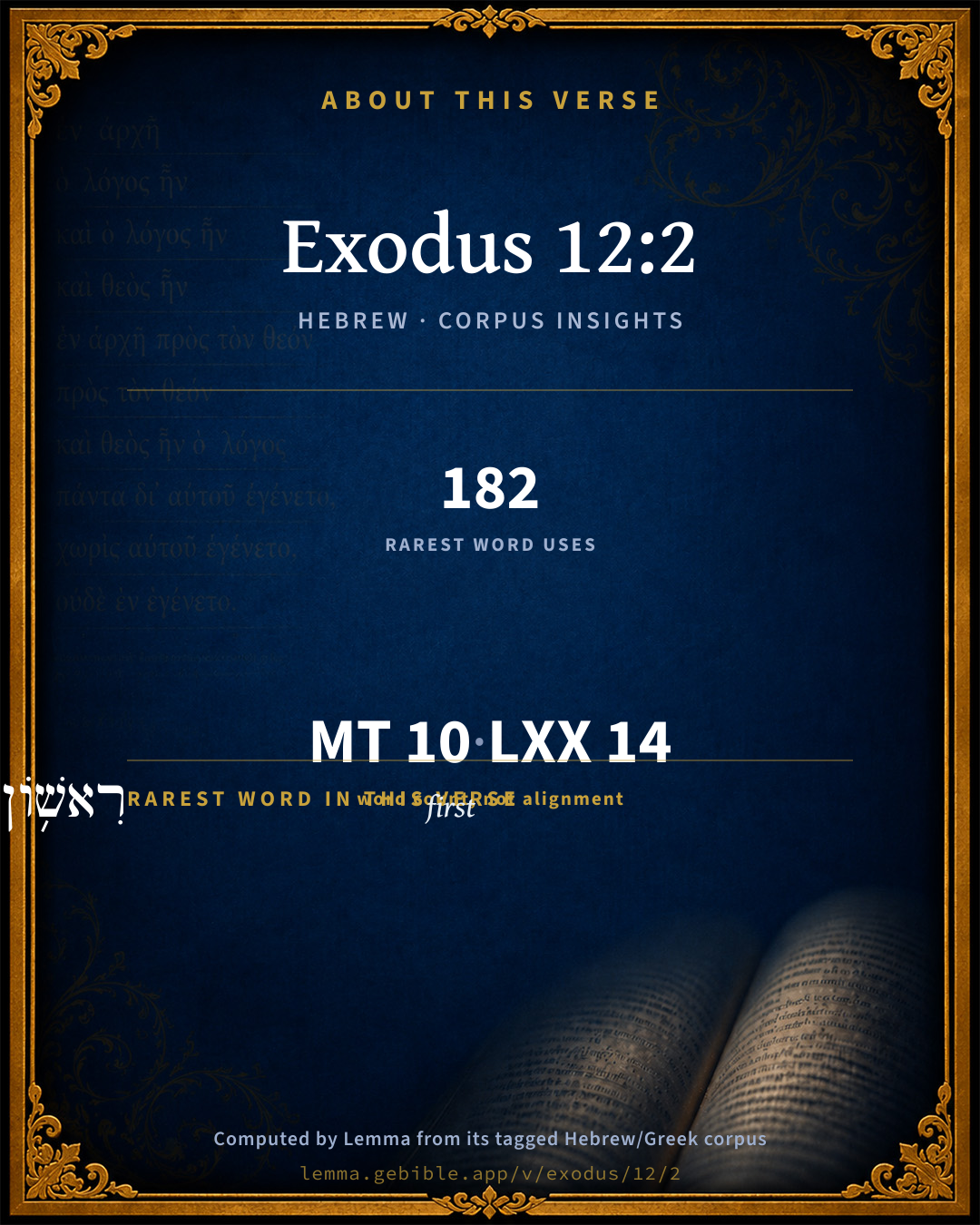
10
words
6
distinct lemmas
Pentateuch
section

Grammatical profile

  • 5 nouns
  • 1 adjective
  • 2 pronouns
  • 2 prepositions

Repetition

A word recurs within this verse — often emphatic in Hebrew:

  • הַחֹ֧דֶשׁ month H2320 ×3

Hebrew & Septuagint length

In English translation the verse runs 21 words from the Hebrew and 22 from the Septuagint (LXX English) — closely comparable.

A rough comparison of the two English renderings, which tokenize alike — not a word-level alignment.

Word counts can differ between the Hebrew and the Greek without any difference in meaning — e.g. the Hebrew direct-object marker אֵת has no separate Greek word, and Greek often adds the article ὁ.

In the original languages it is 10 Hebrew tokens and 14 Greek tokens — but the two are counted differently (Hebrew bundles its prefixes and suffixes into one token; the Greek is in lemma form), so that isn’t a like-for-like length.

Cross-references

7

Topical passages linked to Exodus 12:2 in the Treasury of Scripture Knowledge — connected by theme and wording, ordered by reader-vote popularity; previews shown in the World English Bible.

  • Exodus 13:4 This day you go forth in the month Abib.
  • Deuteronomy 16:1 Observe the month of Abib, and keep the Passover to Yahweh your God; for in the month of Abib Yahweh your God brought you forth out of Egypt by night.
  • Exodus 34:18 "You shall keep the feast of unleavened bread. Seven days you shall eat unleavened bread, as I commanded you, at the time appointed in the month Abib; for in the month Abib you came out from Egypt.
  • Exodus 23:15 You shall observe the feast of unleavened bread. Seven days you shall eat unleavened bread, as I commanded you, at the time appointed in the month Abib (for in it you came out from Egypt), and no one shall appear before me empty.
  • Leviticus 23:5 In the first month, on the fourteenth day of the month in the evening, is Yahweh's Passover.
  • Numbers 28:16 In the first month, on the fourteenth day of the month, is Yahweh's Passover.
  • Esther 3:7 In the first month, which is the month Nisan, in the twelfth year of king Ahasuerus, they cast Pur, that is, the lot, before Haman from day to day, and from month to month, [to] the twelfth [month], which is the month Adar.

Cross-references courtesy of OpenBible.info (CC BY 4.0).

Hebrew and Greek witnesses Masoretic Hebrew ↔ Greek Septuagint

The same verse in the two great witnesses to the Old Testament, shown verse-for-verse.

These are two independent witnesses, not word-aligned to each other, and the Septuagint is shown in lemma (dictionary) form.

Hebrew Exodus 12:2 Masoretic · Westminster Leningrad Codex

הַחֹ֧דֶשׁ הַזֶּ֛ה לָכֶ֖ם רֹ֣אשׁ חֳדָשִׁ֑ים רִאשׁ֥וֹן הוּא֙ לָכֶ֔ם לְחָדְשֵׁ֖י הַשָּׁנָֽה

"This month shall be to you the beginning of months. It shall be the first month of the year to you.

World English Bible · Public Domain

Greek LXX Exodus 12:2 Septuagint · lemma form

ὁ μήν οὗτος σύ ἀρχή μήν πρῶτος εἰμί σύ ἐν ὁ μήν ὁ ἐνιαυτός

This month shall be to you the beginning of months: it is the first to you among the months of the year.

LXX2012 (modern English Septuagint) · Public Domain

Hebrew: Westminster Leningrad Codex (CC BY 4.0). Greek: Septuagint (public domain); English from LXX2012 (modern English Septuagint) (Public Domain). How the Septuagint differs from the Hebrew →

Targum (Aramaic paraphrase)

2

The Targum is the ancient Jewish Aramaic paraphrase of the Hebrew Scriptures — an interpretive translation, not the Hebrew text itself. Onkelos (literal) and Pseudo-Jonathan (expansive) render the Torah, and Jonathan the Prophets. Coverage is partial: where no permissively-licensed English translation exists for a verse, only the Aramaic is shown. This is verse-level text, not a word-by-word alignment to the Hebrew.

  1. Targum Onkelos Torah (Genesis–Deuteronomy)
    יַרְחָא הָדֵין לְכוֹן רֵישׁ יַרְחִין קַדְמַאי הוּא לְכוֹן לְיַרְחֵי שַׁתָּא:

    This month will be for them: the head of months. The first - it will be for them: of the months of the year.

    Targum Onkelos — Aramaic: “Onkelos Genesis” (public domain); “Onkelos Exodus” (public domain); “Onkelos Leviticus” (public domain); “Onkelos Numbers” (public domain); “Onkelos Deuteronomy” (public domain). English: “Sefaria Community Translation” (CC0 1.0 (public-domain dedication)); “J.W. Etheridge. The Targums of Onkelos and Jonathan Ben Uzziel on the Pentateuch. London: Longmans, Green, 1862” (public domain). Text via Sefaria.

  2. Targum Pseudo-Jonathan Torah (Genesis–Deuteronomy)
    יַרְחָא הָדֵין לְכוֹן לְמִקְבְּעֵיהּ רֵישׁ יַרְחַיָּיא וּמִנֵּיהּ תֵּשְׁרוּן לְמִמְנֵי חַגַיָא וְזִמְנַיָא וּתְקוּפְתָּא קַדְמָאֵי הוּא לְכוֹן לְמִנְיַן יַרְחֵי שַׁתָּא

    This month is ordained to be to you the beginning of the months; and from it you shall begin to number for festivals, and times, and cycles; it shall be to you the first of the number of the months of the year.

    Targum Pseudo-Jonathan — Aramaic: “Targum Jonathan on Genesis” (public domain); “Targum Jonathan on Exodus” (public domain); “Targum Jonathan on Leviticus” (public domain); “Targum Jonathan on Numbers” (public domain); “Targum Jonathan on Deuteronomy” (public domain). English: “The Targum of Jonathan ben Uzziel, trans. J. W. Etheridge, London, 1862” (public domain). Text via Sefaria.

Commentary

Notes on Exodus 12:2 from classic Christian and Jewish commentators (each source and its license shown beneath its notes). The classic Christian expositions comment on the surrounding passage and are grouped to its opening verse, so a note may address several verses; the Jewish commentaries on the Tanakh (Rashi and others) are per-verse, so they appear only where the commentator wrote on this verse.

Lemma curates 59 commentaries, every one of them public domain or Creative Commons licensed, each selected and text-cleaned for this edition rather than reprinted as found. About our sources →

Trapp's Complete Commentary

John Trapp

Exo 12:2 This month [shall be] unto you the beginning of months: it [shall be] the first month of the year to you.

Ver. 2. This month.] Called Abib in Exo 13:4; with us called March or April; when the day lengthening, and the sun ascending, each thing begins to revive. To show, saith one, that by the true Passover, Christ Jesus, not only is our time and all other things sanctified, but also that we should in recent remembrance of that benefit of our redemption, all our days and years be thankful to our gracious Redeemer, and that by his death, true life and reviving came unto mankind.

It shall be the first month,] viz., In respect of sacred, not civil affairs, as Junius here proveth out of Josephus. {a} The jubilees began in September. {Lev 25:8 Exo 23:16} The creation of the world began then, as some will have it: but Luther and others think it was in the spring rather.

{a} Antiq., lib. i. cap. 4.

John Trapp, A Commentary or Exposition upon All the Books of the Old and New Testament (1647–1656) — public domain. Text from a community e-Sword module.

Tyndale Open Study Notes

Tyndale Open Resources

12:2 This month was the month Abib (13:4; 23:15; 34:18; Deut 16:1; later called by the Babylonian name, Nisan, Neh 2:1; Esth 3:7), which falls within the months of March and April. Many cultures held festivals about this time of the year, celebrating the renewal of plant life. Israel’s festival celebrated the historic event in which God defeated death and rescued his people from bondage in Egypt.

Tyndale Open Study Notes — © Tyndale Open Resources, licensed CC BY-SA 4.0. Text via the HelloAO Bible API.

Geneva Bible (1599)

Geneva Bible translators

Called Nisan, containing part of March, and part of April.

As touching the observation of feasts: as for other policies, they reckoned from September.

Geneva Bible (1599) marginal notes — public domain. Text via Bolls.life.

Jamieson, Fausset & Brown

Robert Jamieson, A. R. Fausset & David Brown

this month shall be unto you the beginning of months--the first not only in order but in estimation. It had formerly been the seventh according to the reckoning of the civil year, which began in September, and continued unchanged, but it was thenceforth to stand first in the national religious year which began in March, April.

Jamieson, Fausset & Brown — Commentary Critical and Explanatory on the Whole Bible (1871) — public domain (CC PDM 1.0). Text via the HelloAO Bible API.

Adam Clarke's Commentary

Verse 2. This month shall be unto you the beginning of months] It is supposed that God now changed the commencement of the Jewish year. The month to which this verse refers, the month Abib, answers to a part of our March and April; whereas it is supposed that previously to this the year began with Tisri, which answers to a part of our September; for in this month the Jews suppose God created the world, when the earth appeared at once with all its fruits in perfection. From this circumstance the Jews have formed a twofold commencement of the year, which has given rise to a twofold denomination of the year itself, to which they afterwards attended in all their reckonings: that which began with Tisri or September was called their civil year; that which began with Abib or March was called the sacred or ecclesiastical year.

As the exodus of the Israelites formed a particular era, which is referred to in Jewish reckonings down to the building of the temple, I have marked it as such in the chronology in the margin; and shall carry it down to the time in which it ceased to be acknowledged.

Some very eminently learned men dispute this; and especially Houbigant, who contends with great plausibility of argument that no new commencement of the year is noted in this place; for that the year had always begun in this month, and that the words shall be, which are inserted by different versions, have nothing answering to them in the Hebrew, which he renders literally thus. Hic mensis vobis est caput mensium; hic vobis primus est anni mensis. "This month is to you the head or chief of the months; it is to you the first month of the year." And he observes farther that God only marks it thus, as is evident from the context, to show the people that this month, which was the beginning of their year, should be so designated as to point out to their posterity on what month and on what day of the month they were to celebrate the passover and the fast of unleavened bread. Hi words are these: "Ergo superest, et Hebr. ipso ex contextu efficitur, non hic novi ordinis annum constitui, sed eum anni mensem, qui esset primus, ideo commemorari, ut posteris constaret, quo mense, et quo die mensis paseha et azyma celebranda essent."

Adam Clarke's Commentary on the Bible (1810–1826) — public domain. Text from a community e-Sword/MySword module.

Ellicott's Commentary for English Readers

(2) The beginning of months.—Hitherto the Hebrews had commenced the year with Tisri, at or near the autumnal equinox. (See Exo_23:16.) In thus doing, they followed neither the Egyptian nor the Babylonian custom. The Egyptians began the year in June, with the first rise of the Nile; the Babylonians in Nisannu, at the vernal equinox. It was this month which was now made, by God’s command, the first month of the Hebrew year; but as yet it had not the name Nisan: it was called Abib (Exo_13:4), the month of “greenness.” Henceforth the Hebrews had two years, a civil and a sacred one (Joseph., Ant. Jud., i. 3, § 3). The civil year began with Tisri, in the autumn, at the close of the harvest; the sacred year began with Abib (called afterwards Nisan), six months earlier. It followed that the first civil was the seventh sacred month, and vice versa.

A Bible Commentary for English Readers, edited by Charles John Ellicott (1878–1897) — public domain. Text from a community e-Sword module.

The Cambridge Bible for Schools and Colleges

gen. ed. J. J. S. Perowne

2. This month, &c.] The ‘month’ is the one corresponding to our Mar.–Apr., called in J and E (Exo_13:4, Exo_23:15, Exo_34:18) and Deu_16:1) ‘Abib,’ and in the later post-exilic writings (Neh_2:1, Est_3:7) by its Bab. name, Nisan. P never, like the older pre-exilic writers, calls the months by their Canaanitish or Phoenician names, Abib (ll.cc.), Ziv (1Ki_6:1; 1Ki_6:37), Ethanim (ib. 1Ki_8:2), Bul (ib. 1Ki_6:38); but, as do the late parts of Kings (1Ki_12:32-33 [compiler], 2Ki_25:1; 2Ki_25:3; 2Ki_25:8; 2Ki_25:25; 2Ki_25:27), Jer. (Jer_1:3, Jer_28:1; Jer_28:17, Jer_36:22 al.), Ezek. (Eze_1:1, Eze_8:1 al.), Hag. (Hag_1:1; Hag_1:15, Hag_2:1), Zech. (Zec_1:1; Zec_1:7, Zec_7:1; Zec_7:3), and Chron., denotes them by numbers (1Ch_16:1; 1Ch_19:1; Lev_16:29, &c.). The old Hebrew year began in autumn (Exo_23:16; cf. Exo_34:22, 1Sa_1:20); and P here refers the later custom of beginning it in spring (see Jer_36:22) to the time of the institution of the Passover in Egypt. The Bab. year began in spring; but whether the Hebrew custom was due to Bab. influence is uncertain. The earliest clear cases of the Heb. year beginning in spring are in the dates quoted above from Kings and Jer.; but 2Ki_19:29 (= Isa_37:30) perhaps pre-supposes it. As the passages from Kings and Jer. shew, the reckoning from spring was more than a merely ecclesiastical calendar, it was used also for dating civil events. See further Nowack, Arch. i. 217 ff. DB. iv. 764; EB. iv. 5365 f.; König, ZDMG. lvi. (1906), p. 624 ff. There is a survival in P of the old mode of reckoning in the first day of the seventh month being celebrated as New Year’s day (Lev_23:24).

The Cambridge Bible for Schools and Colleges (gen. ed. J. J. S. Perowne; Cambridge University Press, 1878–1918) — public domain. Text from a community e-Sword module.

John Gill's Exposition

This month shall be unto you the beginning of months,.... Not only the first, as after expressed, but the chief and principal of them, now famous for their coming out of Egypt in it, and would be more so for the sufferings and death of the Messiah, and redemption by him from sin, Satan, and the world, law, hell, and death, for he suffered at the time of the passover. This month was called Abib, Exo 13:4, which signifies an ear of corn, and at this time we find that the barley was in ear, Exo 9:31 which clearly shows in what month the above things were transacted; afterwards it was called Nisan, which seems to be the Chaldean name for it, Neh 2:1, it shall be the first month of the year to you; which before was the seventh; while the Israelites were in Egypt they observed the same beginning of the year and course of months as the Egyptians, as Josephus (z) intimates; and with the Egyptians, the month Thot was the first month, which answered to Tisri with the Jews, and both to our September, or a part of it, so that the beginning of the year was then in the autumnal equinox, at which season it is thought the world was created; but now to the Israelites it was changed unto the vernal equinox, for this month of Abib or Nisan answers to part of our March and part of April; though indeed both beginnings of the year were observed by them, the one on ecclesiastic, the other on civil accounts; or, as Josephus (a) expresses it, the month of Nisan was the beginning with respect to things divine, but in buying and selling, and such like things, the ancient order was observed; and so the Targum of Jonathan here paraphrases it,"from hence ye shall begin to reckon the feasts, the times, and the revolutions.''Indeed the Jews had four beginnings of the year according to their Misnah (b); the first of Nisan (or March) was the beginning of the year for kings and for festivals; the first of Elul (or August) for the tithing of cattle; the first of Tisri (or September) for the sabbatical years, jubilees, and planting of trees and herbs; and the first of Shebet (or January) for the tithing the fruit of trees.

(z) Antiqu. l. 1. c. 3. sect. 3. (a) Antiqu. l. 1. c. 3. sect. 3. (b) Misn. Roshhashanah, c. 1. sect. 1.

John Gill's Exposition of the Whole Bible (1746–1763) — public domain (CC PDM 1.0). Text via the HelloAO Bible API.

Albert Barnes' Notes on the Bible

This month - Abib Exo 13:4. It was called “Nisan” by the later Hebrews, and nearly corresponds to our April. The Israelites are directed to take Abib henceforth as the beginning of the year; the year previously began with the month Tisri, when the harvest was gathered in; see Exo 23:16. The injunction touching Abib or Nisan referred only to religious rites; in other affairs they retained the old arrangement, even in the beginning of the Sabbatic year; see Lev 25:9.

Albert Barnes' Notes on the Bible (1834–1885) — public domain. Text from a community e-Sword/MySword module.

Haydock's Catholic Bible Commentary

Year, sacred or ecclesiastical, which is most commonly used in Scripture. The civil year commenced with Tisri, in September, and regulated the jubilee, contracts, &c. (Lapide) --- January was the first month to determine the age of trees, and August to decide when cattle became liable to be tithed. (Chap. xxii. 29; Leviticus xix. 23.) (Calmet) --- Before the captivity, the months were not styled Nisan, &c., but abib, (chap xiii. 5,) the first....Bul the 11th, (1 Kings vi.), &c. Sa.

George Leo Haydock (1774–1849), Haydock's Catholic Family Bible and Commentary, 1859 edition — public domain. Excludes Psalms (Douay-Rheims chapter numbering differs from Protestant) and Deuterocanonical books (Catholic canon only).

Matthew Poole's English Annotations

This month was the first month after the vernal equinox, called Abib, Exo 13:4; 23:15; Deu 16:1, and Nissan, Neh 2:1; Est 3:7; containing part of our March, and part of April.

The beginning; Heb. the head; which, I conceive, notes not so much the order, which is more plainly mentioned in the following words, as the eminency of it, that it shall be accounted the chief and principal of all months; as the sabbath hath been called by some the queen of days. And justly must they prefer this month before the rest, whether they looked back to their prodigious deliverance from Egypt therein, or forward to their spiritual redemption by Christ, and to the acceptable year of the Lord, Luk 4:19; for in this very month our Lord Jesus suffered, Joh 18:28.

It shall be the first month: heretofore your first month for all affairs hath been Tisri, which in part answers to our September, and is the first month after the autumnal equinox; and so it shall be to you still as to civil affairs, as it appears from Exo 23:16; 34:22; Lev 25:8-10; but as to sacred and ecclesiastical matters, this shall henceforth be your first month.

Matthew Poole's English Annotations on the Holy Bible (1683–1685) — public domain. Text from a community e-Sword/MySword module.

Whedon's Commentary on the Bible

Daniel D. Whedon

2. This month (Abib or Nisan) shall be unto you the beginning (head) of months… first month of the year — Hitherto the year had commenced with the month Tisri, (or September,) but henceforth the year was to be reckoned from Abib, the month of Israel’s birth. Abib signifies “an ear of grain;” it was the month when barley ripened, corresponding with our close of March and beginning of April. The Hebrew months were lunar, and Abib was the month commencing with the new moon just after or just before the vernal equinox. This was the sacred year, by which the festivals were reckoned; but the civil or common year was still reckoned from Tisri. The passover was, then, instituted some time in the month of Israel’s deliverance, but not after the final interview with Pharaoh described in the last chapter, since four days, inclusive, were to elapse after the choice of the lamb before the passover.

Daniel D. Whedon (gen. ed.), Commentary on the Old and New Testaments (1874–1909) — public domain. Text from a community e-Sword module.

The Pulpit Commentary

This month shall be unto you the beginning of months. The Israelite year would seem to have hitherto commenced with the autumnal equinox, (Exo_23:16) or at any rate with the month Tisri (or Ethanim), which corresponded to our October. Henceforth two reckonings were employed, one for sacred, the other for civil purposes, the first month of each year, sacred or civil, being the seventh month of the other. Abib, "the month of ears our April, nearly became now the first month of the ecclesiastical year, while Tisri became its seventh or sabbatical month. It is remarkable that neither the Egyptians nor the Babylonians agreed with the original Israelite practice, the Egyptians commencing their year with Thoth, or July; and the Babylonians and Assyrians theirs with Nisannu, or April.

HOMILIES BY J. ORR Ver. 2. The beginning of months.

The exodus from Egypt was the birthday of the nation of Israel. In commemoration of this great event, the day from which the (religious) year began was changed. The month Abib was thenceforth to be "the beginning of months." The civil year continued to begin with Tisri (cf. Exo_23:16)

I REDEMPTION, THE TRUE STARTING-POINT OF HUMAN EXISTENCE. The day when salvation comes to a man"s house (Act_16:34) is the true "beginning of days" to him.

1. It is the commencement of a new life. "Born again"; (Joh_3:3) "passed from death into life"; (Joh_5:24) "a new creature". (2Co_5:17) "The years we spent before we turned to the Lord are not worth counting; the best that can happen to them is to be buried out of sight" (Dr. J. M. Gibson).

2. It is the day of separation from the world. Some think that up to this time the Israelites had used the Egyptian calendar, which began about the time of the summer solstice. "From this time, however, all connection with Egypt was to be broken off, and the commencement of the sacred year was to commemorate the time when Jehovah led them forth to liberty and independence" (Geikie).

3. It is the day which begins the journey to heaven. Redemption is the beginning of the new life: it is, however, but the beginning. The wilderness journey follows it. Conversion is not a resting-place, but a starting-point. It begins, but does not complete, salvation.

II TIME, A MEMORIALIST OF GOD"S MIGHTY WORKS. Even on so immaterial a thing as time, God has inscribed a memorial of His three greatest works.

1. Creation. He has built into the structure of the week an imperishable record of the six days" work.

2. The Exodus. The order of the year in Israel was made to testify to the deliverance from Egypt.

3. The Christian redemption. The advent of Christ has founded an era. The bitterest enemy of the Gospel is compelled to do it, at least, the involuntary homage of dating his years from the Lord"s advent. By his use of the Christian calendar, the infidel testifies unwittingly to the power of the religion which he seeks to overthrow.

III THE SPHERES OF THE SACRED AND THE CIVIL ARE DISTINCT. One indication of this, even in the polity of Israel, is seen in the fact that the sacred year began in one month, and the civil in another. J.O.

The Pulpit Commentary (1880–1919), ed. H.D.M. Spence-Jones & Joseph S. Exell — public domain. Text from a community e-Sword module.

John Wesley's Explanatory Notes

This shall be to you the beginning of months - They had hitherto begun their year from the middle of September, but hence-forward they were to begin it from the middle of March, at least in all their ecclesiastical computations. We may suppose that while Moses was bringing the ten plagues upon the Egyptians, he was directing the Israelites to prepare for their departure at an hour's warning. Probably he had, by degrees, brought them near together from their dispersions, for they are here called the congregation of Israel; and to them, as a congregation, orders are here sent.

John Wesley, Explanatory Notes Upon the Whole Bible (1754–1765) — public domain. Text via the GEBible commentary corpus.

Scofield Reference Notes

C. I. Scofield

first month

i.e. April.

The Scofield Reference Bible (1917 edition), notes by C. I. Scofield — public domain. Text from a community e-Sword module.

Rashi

Rabbi Shlomo Yitzchaki (Rashi)

החדש הזה — He showed him the moon in the first stage of its renewal, and He said to him, “The time when the moon renews itself thus, shall be unto you the beginning of the month”. (The translation therefore is: “This stage of renewal (חדש) shall be the moment of beginning the months”; cf. Mekhilta). But no Scriptural verse can lose its literal meaning, and He really spoke this in reference to the month Nisan: this month shall be the beginning in the order of counting the months, so that Iyar shall be called the second, Sivan the third.

הזה THIS [STAGE OF RENEWAL] — Moses was in perplexity regarding the Molad of (the exact moment when begins) the new moon — how much of it must be visible before it is proper to consecrate it as new moon: He therefore pointed it out to him in the sky with the finger and said to him, “Behold it like this, and consecrate it” (i. e., when you see the moon in a stage of renewal similar to this which you now behold you may proclaim that a new month has begun). But how could He point it out to him, for did He not conserve with him only by day, as it is said, (Exodus 6:28) “And it came to pass on the day when the Lord spake [unto Moses]”; (Leviticus 7:38) “On the day when he commanded”; (Numbers 15:23) “From the day that the Lord commanded and henceforward”? But the explanation is: This chapter was spoken to him close to sunset and He pointed it out to him at nightfall (more lit., near darkness) (Mekhilta).

Rashi on the Tanakh — English translations: “The Judaica Press complete Tanach with Rashi, translated by A. J. Rosenberg” (CC BY 4.0); “Pentateuch with Rashi's commentary by M. Rosenbaum and A.M. Silbermann, 1929-1934” (public domain); “The Metsudah Tanach series, Lakewood, N.J” (CC BY 4.0); and “The Book of Joshua, Metsudah Publications, 1997” (CC BY 4.0). Text via Sefaria.

Ramban (Nachmanides)

Rabbi Moshe ben Nachman (Ramban / Nachmanides)

THIS MONTH SHALL BE UNTO YOU THE BEGINNING OF MONTHS. This is the first commandment which the Holy One, blessed be He, commanded Israel through Moses. Therefore it says here [that the Eternal spoke unto Moses and Aaron] in the land of Egypt, for the rest of the commandments of the Torah were given to him on Mount Sinai. It may be that the intent of the expression, in the land of Egypt, is to exclude the city of Egypt, just as our Rabbis have said: “In the land of Egypt. This means outside the city.”Now Scripture should have first said, Speak ye unto all the congregation of Israel, saying: This month shall be unto you the beginning of months, and so on to the end of the chapter. [Why then is the verse, Speak ye, etc., mentioned after the verse, This month, etc.?] It is because Moses and Aaron — [as mentioned in Verse 1: And the Eternal spoke unto Moses and Aaron in the land of Egypt, saying: This month, etc.] — are in the place of Israel. Saying it to them is equivalent to saying it to Israel in all their generations. In the following verse, however, He repeats by saying, Speak ye unto all the congregation of Israel, in order to command them something which is not binding for all time, namely, the buying of the paschal offering in Egypt on the tenth day of Nisan., etc., applying as it does for all time, it is sufficient for Scripture to mention only Moses and Aaron in connection with it, since they are in place of Israel for all times. But since the command mentioned in Verse 3, In the tenth day of this month they shall take to them every man a lamb, applied only to the paschal offering in Egypt, He therefore preceded it again by saying, Speak ye unto all the congregation of Israel, the Israel of that time.According to the Midrashic interpretation, lachem (unto you) [in the verse, This month shall be unto you], means that “the Sanctification of the New Moon” is to be performed only by a Court of experts [as Moses and Aaron were]. And this is the reason it does not say at the beginning [of Verse 2], Speak ye unto all the congregation of Israel, since “the Sanctification of the New Moon” can be performed only by Moses and Aaron and their like.Now the purport of the expression, This month shall be unto you the beginning of months, is that Israel is to count this as the first of the months, and from it they are to count all months — second, third, etc., until a year of twelve months is completed — in order that there be through this enumeration a remembrance of the great miracle, [i.e., the exodus from Egypt, which occurred in the first month]. Whenever we will mention the months, the miracle will be remembered. It is for this reason that the months have no individual names in the Torah. Instead, Scripture says: In the third month; And it came to pass in the second year, in the second month … that the cloud was taken up from over the Tabernacle of the Testimony; And in the seventh month, on the first day of the month, etc., 29:1. and so in all cases. Just as in counting the weekdays we always remember the Sabbath-day since the weekdays have no specific name of their own, but instead are called “one day in the Sabbath,” “the second day in the Sabbath,” as I will explain, so we remember the exodus from Egypt in our counting “the first month,” “the second month,” “the third month,” etc., to our redemption.This order of the counting of the months is not in regard to the years, for the beginning of our years is from Tishri, [the seventh month], as it is written, And the feast of ingathering at the turn of the year, 34:22. Now the feast of ingathering is in the seventh month (Leviticus 23:39) and yet Scripture calls it here at the turn of the year, which means the beginning of the new year. Thus we learn that Tishri is the beginning of the year, although in the order of the counting of the months it is the seventh month. and it is further written, And the feast of ingathering, at the end of the year., 23:16. If so, when we call the month of Nisan the first of the months and Tishri the seventh, the meaning thereof is “the first [month] to the redemption” and “the seventh month” thereto. This then is the intent of the expression, it shall be the first month to you, meaning that it is not the first in regard to the year but it is the first “to you,” i.e., that it be called “the first” for the purpose of remembering our redemption.Our Rabbis have already mentioned this matter when saying, “The names of the months came up with us from Babylon,” since at first we had no names for the months. The reason for this [adoption of the names of the months when our ancestors returned from Babylon to build the Second Temple], was that at first their reckoning was a memorial to the exodus from Egypt, but when we came up from Babylon, and the words of Scripture were fulfilled — And it shall no more be said: As the Eternal liveth, that brought up the children of Israel out of the land of Egypt, but: As the Eternal liveth that brought up and that led the children of Israel from the land of the north is found ibid., 23:8. — from then on we began to call the months by the names they were called in the land of Babylon. We are thus reminded that there we stayed [during our exile] and from there, blessed G-d brought us up [to our Land]. These names — Nisan, Iyar, and the others — are Persian names and are to be found only in the books of the prophets of the Babylonian era and in the Scroll of Esther. It is for this reason that Scripture says, In the first month, which is the month of Nisan, Thus both memorials are mentioned simultaneously: the first month to our redemption from Egypt, which is the month of Nisan, a name which is reminiscent of our Babylonian exile from which we have also been redeemed. just as it says, they cast ‘pur,’ that is, the lot. In this case too Scripture explains the Persian word pur as meaning lot, just as it explained the name Nisan as being “the first month.” To this day, people of Persia and Media use these names of the months — Nisan, Tishri, and the others — as we do. Thus through the names of the months we remember our second redemption even as we had done until then with regard to the first one.

Ramban (Nachmanides) on the Tanakh — English translation: “Commentary on the Torah by Ramban (Nachmanides). Translated and annotated by Charles B. Chavel. New York, Shilo Pub. House, 1971-1976” (CC BY 4.0). Text via Sefaria.

Lesson kit

Teaching starters — assembled from the data on this page, not authored interpretation. Every prompt links to the verse data it draws on. Edit before teaching.

Exodus, in the Pentateuch, opens this verse with 10 words (6 distinct Hebrew lemmas). Its most distinctive word is riʼshôwn (“first”). A historical commentator’s framing appears above. Read the whole chapter for the surrounding context.

Discussion questions

  1. How does “first” (riʼshôwn) shape what this verse is saying?
  2. How does Exodus 13:4, which shares this passage’s theme, read alongside this verse?
  3. What does the repetition of “month” (3× in this one verse) do in this verse?
  4. The translations on this page render this verse differently — a whole-verse word diff, not a word-by-word alignment. What might account for the different wordings?
  5. Compare how Trapp's Complete Commentary and Tyndale Open Study Notes read this verse. Where do they agree or differ?

Things to notice

Reading settings

Reading text

Shown beneath each verse's original-language words.

Old Testament
Old Testament edition

Read the OT as the Masoretic Hebrew (MT) or the Greek Septuagint (LXX).

English shown for the Greek Septuagint (in the Hebrew ↔ Greek comparison).

Comparing translations? Open the Compare panel on any verse page to stack up to four side by side.