
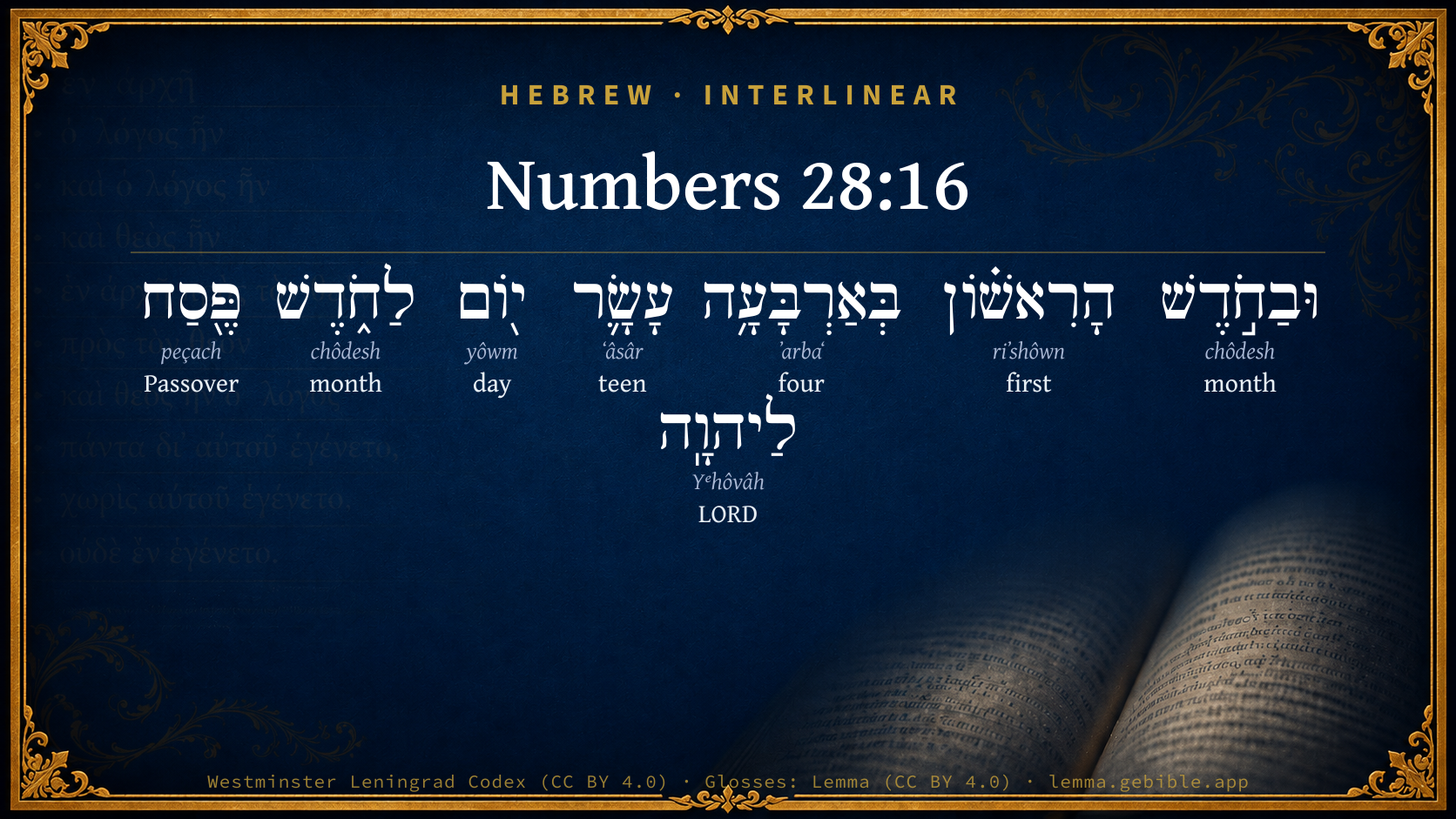
Numbers 28:16

Hebrew (Westminster Leningrad Codex) Numbers 28:16 appears in the Hebrew Old Testament. The text above is from the Westminster Leningrad Codex. Each word links to its Strong’s number, a concise gloss, and parsing drawn from the Open Scriptures Hebrew Bible morphology. Click any word for its full Brown-Driver-Briggs (BDB) entry.
Download image
Cite this verse

Numbers 28:16 (World English Bible). Public Domain. Lemma interlinear Bible study tool, https://lemma.gebible.app/v/numbers/28/16.

Show BibTeX & RIS
BibTeX
RIS
English Translation
In the first month, on the fourteenth day of the month, is Yahweh's Passover.
World English Bible · Public Domain
Download a study sheet

One document with this verse’s original text, its word-by-word gloss line, the meaning frame, cross-references with their text, attributed commentary, and full source and license credits — printable, and it pastes into notes with its structure intact.

This verse Autodidact and up

Study sheet (.html) Plain text (.txt)

A passage Seminary Student

Up to 50 verses in one chapter. A passage sheet keeps up to 6 commentary sources and 12 cross-references per verse, in the order this page ranks them, and says so on the sheet whenever that leaves anything out. Ask for a single verse and you get the Autodidact verse sheet above.

Everything on this page stays free to read, with no account — the sheet is a download of what is already on screen, not access to it.

Want to remove ads? Support Godless Engineer
Compare translations 3

The same verse in 3 English versions, stacked beneath the original-language interlinear above. Click any original word for its lexicon entry.

Each is an independent rendering of the whole verse — the interlinear is not word-aligned to these translations.

Highlighted words mark where these versions differ — a whole-verse word diff, not a word-by-word alignment.

  • World English Bible Public Domain
    In the first month, on the fourteenth day of the month, is Yahweh's Passover.
  • King James Version Public Domain
    And in the fourteenth day of the first month is the passover of the LORD.
  • unfoldingWord Literal Text CC BY-SA 4.0
    And in the first month, on day 14 of the month is the Passover of Yahweh.

unfoldingWord Literal Text — © unfoldingWord, licensed CC BY-SA 4.0. Word-aligned USFM3 via Door43 (git.door43.org/unfoldingWord/en_ult).

Versions to compare (up to 4)

3 of 4 selected

Show all 18 translations

Every available English version of this verse, each an independent rendering of the whole verse.

  • World English Bible Public Domain
    In the first month, on the fourteenth day of the month, is Yahweh's Passover.
  • Berean Standard Bible Public Domain
    The fourteenth day of the first month is the LORD’s Passover.
  • Majority Standard Bible Public Domain
    The fourteenth day of the first month is the LORD’s Passover.
  • King James Version Public Domain
    And in the fourteenth day of the first month is the passover of the LORD.
  • American Standard Version (1901) Public Domain
    And in the first month, on the fourteenth day of the month, is Jehovah's passover.
  • Revised Version (1885) Public Domain
    And in the first month, on the fourteenth day of the month, is the LORD’S passover.
  • Geneva Bible (1599) Public Domain
    Also the fourtenth day of the first moneth is the Passeouer of the Lord.
  • Douay-Rheims (1899) Public Domain
    And in the first month, on the fourteenth day of the month, shall be the phase of the Lord,
  • Young's Literal Translation Public Domain
    `And in the first month, in the fourteenth day of the month, `is' the passover to Jehovah;
  • Literal Standard Version CC BY-SA 4.0
    And in the first month, on the fourteenth day of the month, [is] the Passover to YHWH;
  • Unlocked Literal Bible CC BY-SA 4.0
    During the first month, on the fourteenth day of the month, comes Yahweh's Passover.
  • unfoldingWord Literal Text CC BY-SA 4.0
    And in the first month, on day 14 of the month is the Passover of Yahweh.
  • Darby Bible Public Domain
    And in the first month, on the fourteenth day of the month, is the passover to Jehovah.
  • World Messianic Bible Public Domain
    “‘In the first month, on the fourteenth day of the month, is the LORD’s Passover.
  • Webster's Bible Public Domain
    And on the fourteenth day of the first month is the passover of the LORD.
  • Free Bible Version CC BY-SA 4.0
    The Lord's Passover is on the fourteenth day of the first month.
  • Bible in Basic English Public Domain
    And in the first month, on the fourteenth day of the month, is the Lord's Passover.
  • JPS Tanakh (1917) Public Domain
    And in the first month, on the fourteenth day of the month, is the LORD'S passover.

Literal Standard Version (2020), Covenant Press — licensed CC BY-SA 4.0. Text via the HelloAO Bible API (eBible.org). Unlocked Literal Bible (unfoldingWord) — licensed CC BY-SA 4.0. Text via the HelloAO Bible API (eBible.org). unfoldingWord Literal Text — © unfoldingWord, licensed CC BY-SA 4.0. Word-aligned USFM3 via Door43 (git.door43.org/unfoldingWord/en_ult). Free Bible Version, Dr. Jonathan Gallagher — licensed CC BY-SA 4.0. Text via the HelloAO Bible API (eBible.org).

Word by word

More ways to search: Search by grammar → Find every occurrence → Compare this word →

Practice this passage: Drill this verse → Learn its vocabulary →

About this verse

These counts appear in no published source. They are computed here, from the morphology-tagged text and Lemma’s own curated glosses. What Lemma adds →

8
words
7
distinct lemmas
Pentateuch
section

Shared distinctive vocabulary

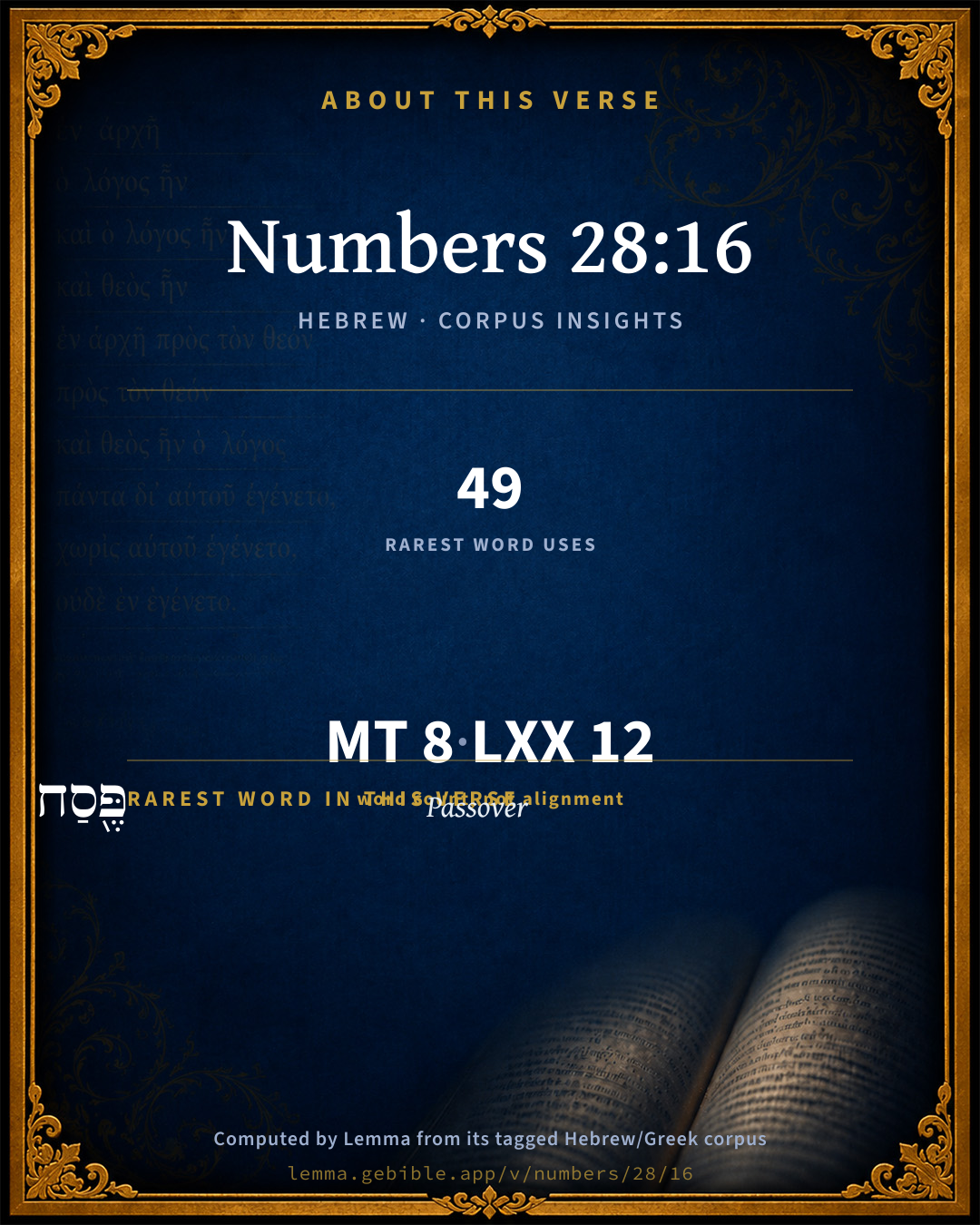
פֶּ֖סַח Passover H6453 occurs in 46 verses of the Hebrew Bible. Also found in:

Grammatical profile

  • 5 nouns
  • 3 adjectives

Repetition

A word recurs within this verse — often emphatic in Hebrew:

  • וּבַחֹ֣דֶשׁ month H2320 ×2

Hebrew & Septuagint length

In English translation the verse runs 14 words from the Hebrew and 18 from the Septuagint (LXX English) — closely comparable.

A rough comparison of the two English renderings, which tokenize alike — not a word-level alignment.

Word counts can differ between the Hebrew and the Greek without any difference in meaning — e.g. the Hebrew direct-object marker אֵת has no separate Greek word, and Greek often adds the article ὁ.

In the original languages it is 8 Hebrew tokens and 12 Greek tokens — but the two are counted differently (Hebrew bundles its prefixes and suffixes into one token; the Greek is in lemma form), so that isn’t a like-for-like length.

Cross-references

12

Topical passages linked to Numbers 28:16 in the Treasury of Scripture Knowledge — connected by theme and wording, ordered by reader-vote popularity; previews shown in the World English Bible.

  • Exodus 12:18 In the first month, on the fourteenth day of the month at evening, you shall eat unleavened bread, until the twenty first day of the month at evening.
  • Deuteronomy 16:1–8 Observe the month of Abib, and keep the Passover to Yahweh your God; for in the month of Abib Yahweh your God brought you forth out of Egypt by night.
  • Exodus 12:2–11 "This month shall be to you the beginning of months. It shall be the first month of the year to you.
  • Leviticus 23:5–8 In the first month, on the fourteenth day of the month in the evening, is Yahweh's Passover.
  • Numbers 9:3–5 On the fourteenth day of this month, at evening, you shall keep it in its appointed season-- according to all its statutes, and according to all its ordinances, you shall keep it."
  • 1 Corinthians 5:7–8 Purge out the old yeast, that you may be a new lump, even as you are unleavened. For indeed Christ, our Passover, has been sacrificed in our place.
  • Exodus 12:43–49 Yahweh said to Moses and Aaron, "This is the ordinance of the Passover. There shall no foreigner eat of it,
  • Ezekiel 45:21–24 In the first [month], in the fourteenth day of the month, you shall have the Passover, a feast of seven days; unleavened bread shall be eaten.
  • Matthew 26:2 "You know that after two days the Passover is coming, and the Son of Man will be delivered up to be crucified."
  • Matthew 26:17 Now on the first day of unleavened bread, the disciples came to Jesus, saying to him, "Where do you want us to prepare for you to eat the Passover?"
  • Luke 22:7–8 The day of unleavened bread came, on which the Passover must be sacrificed.
  • Acts 12:3–4 When he saw that it pleased the Jews, he proceeded to seize Peter also. This was during the days of unleavened bread.

Cross-references courtesy of OpenBible.info (CC BY 4.0).

Hebrew and Greek witnesses Masoretic Hebrew ↔ Greek Septuagint

The same verse in the two great witnesses to the Old Testament, shown verse-for-verse.

These are two independent witnesses, not word-aligned to each other, and the Septuagint is shown in lemma (dictionary) form.

Hebrew Numbers 28:16 Masoretic · Westminster Leningrad Codex

וּבַחֹ֣דֶשׁ הָרִאשׁ֗וֹן בְּאַרְבָּעָ֥ה עָשָׂ֛ר י֖וֹם לַחֹ֑דֶשׁ פֶּ֖סַח לַיהוָֽה

In the first month, on the fourteenth day of the month, is Yahweh's Passover.

World English Bible · Public Domain

Greek LXX Numbers 28:16 Septuagint · lemma form

καί ἐν ὁ μήν ὁ πρῶτος οςτεσσαρεσκαιδέκατ ἡμέρα ὁ μήν πασχα κύριος

And in the first month, on the fourteenth day of the month, is the passover to the Lord.

LXX2012 (modern English Septuagint) · Public Domain

Hebrew: Westminster Leningrad Codex (CC BY 4.0). Greek: Septuagint (public domain); English from LXX2012 (modern English Septuagint) (Public Domain). How the Septuagint differs from the Hebrew →

Targum (Aramaic paraphrase)

2

The Targum is the ancient Jewish Aramaic paraphrase of the Hebrew Scriptures — an interpretive translation, not the Hebrew text itself. Onkelos (literal) and Pseudo-Jonathan (expansive) render the Torah, and Jonathan the Prophets. Coverage is partial: where no permissively-licensed English translation exists for a verse, only the Aramaic is shown. This is verse-level text, not a word-by-word alignment to the Hebrew.

  1. Targum Onkelos Torah (Genesis–Deuteronomy)
    וּבְיַרְחָא קַדְמָאָה בְּאַרְבַּעַת עַשְׂרָא יוֹמָא לְיַרְחָא פִּסְחָא קֳדָם יְיָ

    (no public-domain English translation for this verse)

    Targum Onkelos — Aramaic: “Onkelos Genesis” (public domain); “Onkelos Exodus” (public domain); “Onkelos Leviticus” (public domain); “Onkelos Numbers” (public domain); “Onkelos Deuteronomy” (public domain). English: “Sefaria Community Translation” (CC0 1.0 (public-domain dedication)); “J.W. Etheridge. The Targums of Onkelos and Jonathan Ben Uzziel on the Pentateuch. London: Longmans, Green, 1862” (public domain). Text via Sefaria.

  2. Targum Pseudo-Jonathan Torah (Genesis–Deuteronomy)
    וּבְיַרְחָא דְנִיסָן בְּאַרְבֵּיסְרֵי יוֹמִין לְיַרְחָא נִכְסַת פִּסְחָא קֳדָם יְיָ

    And in the month of Nisan, on the fourteenth day of the month, is the sacrifice of the Pascha before the Lord.

    Targum Pseudo-Jonathan — Aramaic: “Targum Jonathan on Genesis” (public domain); “Targum Jonathan on Exodus” (public domain); “Targum Jonathan on Leviticus” (public domain); “Targum Jonathan on Numbers” (public domain); “Targum Jonathan on Deuteronomy” (public domain). English: “The Targum of Jonathan ben Uzziel, trans. J. W. Etheridge, London, 1862” (public domain). Text via Sefaria.

Commentary

Notes on Numbers 28:16 from classic Christian and Jewish commentators (each source and its license shown beneath its notes). The classic Christian expositions comment on the surrounding passage and are grouped to its opening verse, so a note may address several verses; the Jewish commentaries on the Tanakh (Rashi and others) are per-verse, so they appear only where the commentator wrote on this verse.

Lemma curates 59 commentaries, every one of them public domain or Creative Commons licensed, each selected and text-cleaned for this edition rather than reprinted as found. About our sources →

Joseph Benson's Commentary

Num 28:16-17. The fourteenth day of the first month — The fourth stated and national sacrifice was annual, namely, the great passover festival, with the feast of unleavened bread annexed to it. In the fifteenth day — On the fourteenth day at even the passover was kept; and the next day began the feast of unleavened bread, Lev 23:6.

Joseph Benson's Commentary on the Old and New Testaments (1811–1818) — public domain. Text from a community e-Sword module.

Whedon's Commentary on the Bible

Daniel D. Whedon

LAW OF OFFERINGS AT THE PASSOVER, Num_28:16-25.

16. The first month — The passover month, answering in part to our March. Lev_23:5, note.

Daniel D. Whedon (gen. ed.), Commentary on the Old and New Testaments (1874–1909) — public domain. Text from a community e-Sword module.

Tyndale Open Study Notes

Tyndale Open Resources

28:16-25 The Passover, followed by the Festival of Unleavened Bread, was the first of five great annual festivals; it was held in early spring (March~April). The Passover required no public sacrifices—it was a family occasion celebrated at home (see also 9:1-4; Exod 12:1–13:10; Lev 23:5-8; Deut 16:1-8). This festival played a special role in the background of the Last Supper (see Matt 26:17-19, 26-27; Mark 14:12; John 11:55; 12:1; 13:1; 18:28, 39; 19:14, 31; cp. 1 Cor 5:7).

Tyndale Open Study Notes — © Tyndale Open Resources, licensed CC BY-SA 4.0. Text via the HelloAO Bible API.

Matthew Henry's Commentary

Here is, I. The appointment of the pass-over sacrifices; not that which was the chief, the paschal lamb (sufficient instructions had formerly been given concerning that), but those which were to be offered upon the seven days of unleavened bread, which followed it, Num 28:17-25. The first and last of those seven days were to be sanctified as sabbaths, by a holy rest and a holy convocation, and on each of the seven days they were to be liberal in their sacrifices, in token of their great and constant thankfulness for their deliverance out of Egypt: Two bullocks, a ram, and seven lambs. A gospel conversation, in gratitude for Christ our passover who was sacrificed, is called the keeping of this feast (Co1 5:8); for it is not enough that we purge out the leavened bread of malice and wickedness, but we must offer the bread of our God, even the sacrifice of praise, continually, and continue herein unto the end. 2. The sacrifices are likewise appointed which were to be offered at the feast of pentecost, here called the day of the first-fruits, Num 28:26. In the feast of unleavened bread they offered a sheaf of their first-fruits of barley (which with them was first ripe) to the priest (Lev 23:10), as an introduction to the harvest; but now, about seven weeks after, they were to bring a new meat-offering to the Lord, at the end of harvest, in thankfulness to God, who had not only given, but preserved to their use, the kindly fruits of the earth, so as that in due time they did enjoy them. It was at this feast that the Spirit was poured out (Act 2:1, etc.), and thousands were converted by the preaching of the apostles, and were presented to Christ, to be a kind of first-fruits of his creatures. The sacrifice that was to be offered with the loaves of the first-fruits was appointed, Lev 23:18. But over and above, besides that and besides the daily offerings, they were to offer two bullocks, one ram, and seven lambs, with a kid for a sin-offering, Num 28:27-30. When God sows plentifully upon us he expects to reap accordingly from us. Bishop Patrick observes that no peace-offerings are appointed in this chapter, which were chiefly for the benefit of the offerers, and therefore in them they were left more to themselves; but burnt-offerings were purely for the honour of God, were confessions of his dominion, and typified evangelical piety and devotion, by which the soul is wholly offered up to God in the flames of holy love; and sin-offerings were typical of Christ's sacrifice of himself, by which we and our services are perfected and sanctified.

Matthew Henry's Commentary on the Whole Bible (1708–1710) — public domain (CC PDM 1.0). Text via the HelloAO Bible API.

Jamieson, Fausset & Brown

Robert Jamieson, A. R. Fausset & David Brown

in the fourteenth day of the first month is the passover--The law for that great annual festival is given (Lev 23:5), but some details are here introduced, as certain specified offerings are prescribed to be made on each of the seven days of unleavened bread [Num 28:18-25].

Jamieson, Fausset & Brown — Commentary Critical and Explanatory on the Whole Bible (1871) — public domain (CC PDM 1.0). Text via the HelloAO Bible API.

Ellicott's Commentary for English Readers

(16, 17) And in the fourteenth day of the first month . . . —The observance of the Passover had been in abeyance for thirty-eight years. The law is now promulgated afresh. The observance of the first and seventh days of the feast are enjoined in Exo_12:16 and Lev_23:7-8; and in the latter place it is enjoined that an offering made by fire should be offered for seven days. The nature of that offering is stated in the 19th verse of this chapter, and the fact that the details are not found in Leviticus 23 may be adduced in proof of the prospective character of much of the Levitical legislation.

A Bible Commentary for English Readers, edited by Charles John Ellicott (1878–1897) — public domain. Text from a community e-Sword module.

John Gill's Exposition

And in the fourteenth day of the first month,.... The month Nisan, as the Targum of Jonathan or Abib, which, upon the Israelites coming out of Egypt, and on that account, was made the first month; otherwise Tisri or September was the first month, see Exo 12:2,

is the passover of the Lord; a feast in which a lamb was killed and eaten, in memory of the Lord's passing over the houses of the Israelites, when he slew the firstborn in Egypt; see Exo 12:6.

John Gill's Exposition of the Whole Bible (1746–1763) — public domain (CC PDM 1.0). Text via the HelloAO Bible API.

Albert Barnes' Notes on the Bible

The Passover offering was the same as that of the New moon, and was repeated on each of the seven days of the festival, thus marking the importance and the solemnity of the occasion. The details of the offering had not been previously prescribed.

Albert Barnes' Notes on the Bible (1834–1885) — public domain. Text from a community e-Sword/MySword module.

Haydock's Catholic Bible Commentary

Phase, or Passover, the most solemn of all the festivals, when the lamb was to be eaten on the 15th of Nisan, and during the eight days no leavened bread was allowed. The Jews searched all the corners of their houses, lest some might be concealed by mice, and they would not so much as name it. St. Paul exhorts us to do the like, in a spiritual sense, by purifying ourselves from every defilement of sin when we receive the blessed sacrament, and by not even mentioning sins of impurity, 1 Corinthians v. 7., and Ephesians v. 3. (Haydock)

George Leo Haydock (1774–1849), Haydock's Catholic Family Bible and Commentary, 1859 edition — public domain. Excludes Psalms (Douay-Rheims chapter numbering differs from Protestant) and Deuterocanonical books (Catholic canon only).

Matthew Poole's English Annotations

Instituted by him, and to his honour and service. See on Lev 23:5.

Matthew Poole's English Annotations on the Holy Bible (1683–1685) — public domain. Text from a community e-Sword/MySword module.

The Pulpit Commentary

Vers. 16-25. The feast at the passover time.

I IT WAS A REMINDER OF HOW SERIOUSLY GOD"S GIFTS TO THE ISRAELITES HAD BEEN INTERFERED WITH. There was the gift of the day with its morning and evening, the gift of the new moon, and probably we shall not do wrong in concluding that the patriarchs understood and appreciated much of the blessing of the Sabbath. But what were these to the Israelites amid the bitterness of their bondage in Egypt? Pharaoh had taken the choice gifts of God and distorted them into agents of the most exquisite pain. Instead of having a heart for the morning and evening sacrifice, they were in a state such as Moses indicated might occur to them again in the event of disobedience. (Deu_28:67) Their morning cry might justly have been, "Would God it were even!" and their evening" cry, "Would God it were morning!" In Egypt they had not materials enough for daily work, let alone holy service. Thus we have a forcible illustration of the way in which spiritual evil has embittered all God"s natural gifts. In the use of them, they get turned away from his intentions so as to serve the selfish purposes of some, and cause perhaps the life-long privations and miseries of others. We must indeed be thankful for what God gives, even when it is interfered with, for the gift shows the disposition of the giver, and it is a good thing for us to be at all times assured of this. But then we must also carefully mark how much there is in human society to intercept, distort, and even as it were transmute these loving and suitable gifts of God. The very abundance of the blessings which God is disposed to bestow, should lead us to view with much alarm, with deep and abiding concern, the obstacles which lie in the way of a complete and profitable reception of the blessings.

II IT WAS A REMINDER OF HOW COMPLETELY GOD HAD TAKEN THE OBSTACLES OUT OF THE WAY. The week of unleavened bread was a period for joyous commemoration of the deliverance from Egypt; and by their offerings Israel recognized that the deliverance was entirely by the act of God. Israel did nothing but walk out of the prison-door when it was opened. This was an inestimable blessing, to be a free nation, even although a nation whose territory had yet to be gained. Liberty leads to all other blessings. We cannot rejoice too much in the spiritual liberty which Christ has achieved for the children of men. We are bound to commemorate it in fitting ways; ways adequate to glorify God, and to impress us more and more with the magnitude of the blessing we have gained. As to the particular mode of commemoration, every Christian must judge for himself, as in the sight of God, with respect to the due season (verse 2). Easter has come as a matter of fact to have special associations and special value for many. They feel that they have proved the worth of the season in their own experience, and can amply justify the observing of it. Those of us who live outside the traditions, the habits of thinking, and the peculiar spirit fostered by the observance of an ecclesiastical year, can hardly claim to be competent judges of the value of such times and seasons. But mark one thing. No observance can be worth calling such unless it comment, orates an actual, personal deliverance.

God not only put his strong hand on the gaoler Pharaoh, but drew forth the captive Israel. When Christ our passover was sacrificed for the children of men, he brought them into a new relation to God, one of possible reconciliation to him, and possible liberty for the whole man. How far the reconciliation and liberty shall be actual depends on our personal repentance and faith.

III THE PARTICULAR COMMEMORATIVE VALUE OF THE UNLEAVENED BREAD. The people leaving Egypt were not allowed to finish the preparing of their bread according to their wont. They were hastened out of the land at a moment"s notice. And it was not God who did this, as when the angels hastened Lot out of Sodom. The Israelites were thrust out by the Egyptians themselves. The gaoler himself was found a fellow-labourer with the liberator. Thus the unleavened bread becomes an impressive reminder of the complete rupture which God makes between his people and their spiritual enemies. As there could be no mistake about the effect which was produced in Egypt by the death of the first-born, so there can be no mistake about the efficacy of the blow which God in Christ Jesus has dealt on our great spiritual adversary. That our Saviour in his own person, and for himself, has completely conquered sin, is a fact which we cannot dwell upon too much, as full of hope for ourselves and for a sinful and miserable world.

IV NOTE THE SEASON OF THE YEAR IN WHICH THIS FEAST WAS OBSERVED. It happened in the first month of the year, made the first month on account of this very deliverance. How devoutly would the true Israelite look upon the beginning of this month I Hail I new moon which brings near the season for celebrating the deliverance from Egypt. Who can doubt that such a soul as Simeon kept the days of unleavened bread in the very spirit of them, living as he did in those dark humiliating times, which were Egypt over again, when the land of his fathers was captive, and the temple of his God neglected by its own custodians? It is the most fitting time to recollect the sure mercies of the past when we need a renewal and perhaps an increase of them.

V THE CONTINUAL OBLIGATION OF THE DAILY OFFERING. The bondage in Egypt embittered the gifts of God, yet even then a patient and willing soul would find something to be thankful for. And when liberty came, if right thoughts came with it, the gifts of God becoming available for use would inspire "special thankfulness for the mercy that had made them so. How much God"s daily blessing"s should be heightened and sweetened in our esteem by the larger use which we can make of them as believers in Christ! We must not under-value common, daily mercies even in the presence of God"s unspeakable gift. He who is the brightness of the Father"s glory casts something of that brightness on every gift of the Father"s love. That is no right appreciation of God"s mercy in Christ Jesus which does not lead us to a better appreciation of every other mercy. God, whose presence and power we are called to observe in the redemption of the world, would have us to see the same presence and power wherever we have faculties to see them. To go from the cross, with the meaning of it and the spirit of it filling our minds, and in such a mood to receive the common mercies of God as one by one they come to us, will fill them with a new power. Henceforth they will minister, not only to the wants of flesh and blood, but to our growth in grace and meetness for glory. Y.

The Pulpit Commentary (1880–1919), ed. H.D.M. Spence-Jones & Joseph S. Exell — public domain. Text from a community e-Sword module.

Keil & Delitzsch

C. F. Keil & F. Delitzsch

The same number of sacrifices as at the new moon were to be offered on every one of the seven days of the feast of unleavened bread (Mazzoth), from the 15th to the 21st of the month, whereas there was no general festal offering on the day of the Passover, or the 14th of the month (Exo 12:3-14). With regard to the feast of Mazzoth, the rule is repeated from Exo 12:15-20 and Lev 23:6-8, that on the first and seventh day there was to be a Sabbath rest and holy meeting.

Keil & Delitzsch — Biblical Commentary on the Old Testament (1861–1891) — public domain (CC PDM 1.0). Text via the HelloAO Bible API. (Old Testament only.)

Scofield Reference Notes

C. I. Scofield

first month

i.e. April.

The Scofield Reference Bible (1917 edition), notes by C. I. Scofield — public domain. Text from a community e-Sword module.

Kretzmann's Popular Commentary

Paul E. Kretzmann

The Sacrifices of the Passover and of the Feast of Unleavened Bread

v. 16. And in the fourteenth day of the first month, the month Abib or Nisan, with which the church-year of the Jews began, is the Passover of the Lord. Exo 12:6-18; Lev 23:5.

v. 17. And in the fifteenth day of this month, and most intimately connected with the Passover, is the feast, as the seven days of unleavened bread are here simply called, Lev 23:6; seven days shall unleavened bread be eaten.

v. 18. In the first day shall be an holy convocation, a solemn assembly in the Sanctuary, for the purpose of worship. Ye shall do no servile work therein, as on the Sabbath, Lev 23:7;

v. 19. but ye shall offer a sacrifice made by fire for a burnt offering unto the Lord: two young bullocks and one ram and seven lambs of the first year, as on the new moon; they shall be unto you without blemish.

v. 20. And their meat-offering, which must invariably accompany the bloody sacrifice, shall be of flour mingled with oil; three-tenth deals shall ye offer for a bullock and two-tenth deals tor a ram;

v. 21. a several tenth deal shalt thou offer for every lamb throughout the seven lambs,

v. 22. and one goat for a sin-offering, to make an atonement for you.

v. 23. Ye shall offer these beside, in addition to, the burnt offering in the morning, which is for a continual burnt offering.

v. 24. After this manner ye shall offer daily, throughout the seven days, the same kind and amount of sacrifices for each individual day, the meat of the sacrifice made by fire, food devoted to the Lord, of a sweet savor unto the Lord; it shall be offered beside the continual burnt offering, and his drink-offering.

v. 25. And on the seventh day ye shall have an holy convocation, as on the first; ye shall do no servile work. Cf Exo 12:15-20; Lev 23:6-8.

Paul E. Kretzmann, Popular Commentary of the Bible (1921–1924) — public domain. Text from a community e-Sword module.

unfoldingWord translationNotes

Door43 World Missions Community

General Information:

Yahweh continues telling Moses what the people must do.

the first month, on the fourteenth day of the month ... On the fifteenth day of this month

"During the first month, on day 14 of the month ... On day 15 day of this month." This refers to the first month of the Hebrew calendar. (See: Hebrew Months and Ordinal Numbers)

comes Yahweh's Passover

"you must celebrate Yahweh's Passover"

a feast is to be held

This can be stated in active form. "you must have a feast" (See: Active or Passive)

bread without yeast must be eaten

This can be stated in active form. "you must eat bread without yeast" (See: Active or Passive)

On the first day

This refers to the first day of the feast. This can be stated clearly. AT: "On day 1 of the feast" (See: Ordinal Numbers and Assumed Knowledge and Implicit Information)

there must be a holy assembly to honor Yahweh

"you must gather together to worship and honor Yahweh." The phrase "a holy assembly" means the people gather together to worship Yahweh. Worshiping Yahweh is a holy event.

translationWords

day

Yahweh

Passover

feast

bread

yeast

holy

assembly

honor

unfoldingWord translationNotes — © Distant Shores Media and the Door43 World Missions Community, licensed CC BY-SA 4.0. Source: git.door43.org/Door43/en_tn.

Lesson kit

Teaching starters — assembled from the data on this page, not authored interpretation. Every prompt links to the verse data it draws on. Edit before teaching.

Numbers, in the Pentateuch, opens this verse with 8 words (7 distinct Hebrew lemmas). Its most distinctive word is peçach (“Passover”). A historical commentator’s framing appears above. Read the whole chapter for the surrounding context.

Discussion questions

  1. How does “Passover” (peçach) shape what this verse is saying?
  2. How does Exodus 12:11, which shares the word «Passover», read alongside this verse?
  3. What does the repetition of “month” (2× in this one verse) do in this verse?
  4. The translations on this page render this verse differently — a whole-verse word diff, not a word-by-word alignment. What might account for the different wordings?
  5. Compare how Joseph Benson's Commentary and Whedon's Commentary on the Bible read this verse. Where do they agree or differ?

Things to notice

Reading settings

Reading text

Shown beneath each verse's original-language words.

Old Testament
Old Testament edition

Read the OT as the Masoretic Hebrew (MT) or the Greek Septuagint (LXX).

English shown for the Greek Septuagint (in the Hebrew ↔ Greek comparison).

Comparing translations? Open the Compare panel on any verse page to stack up to four side by side.