Jeremiah 36:22

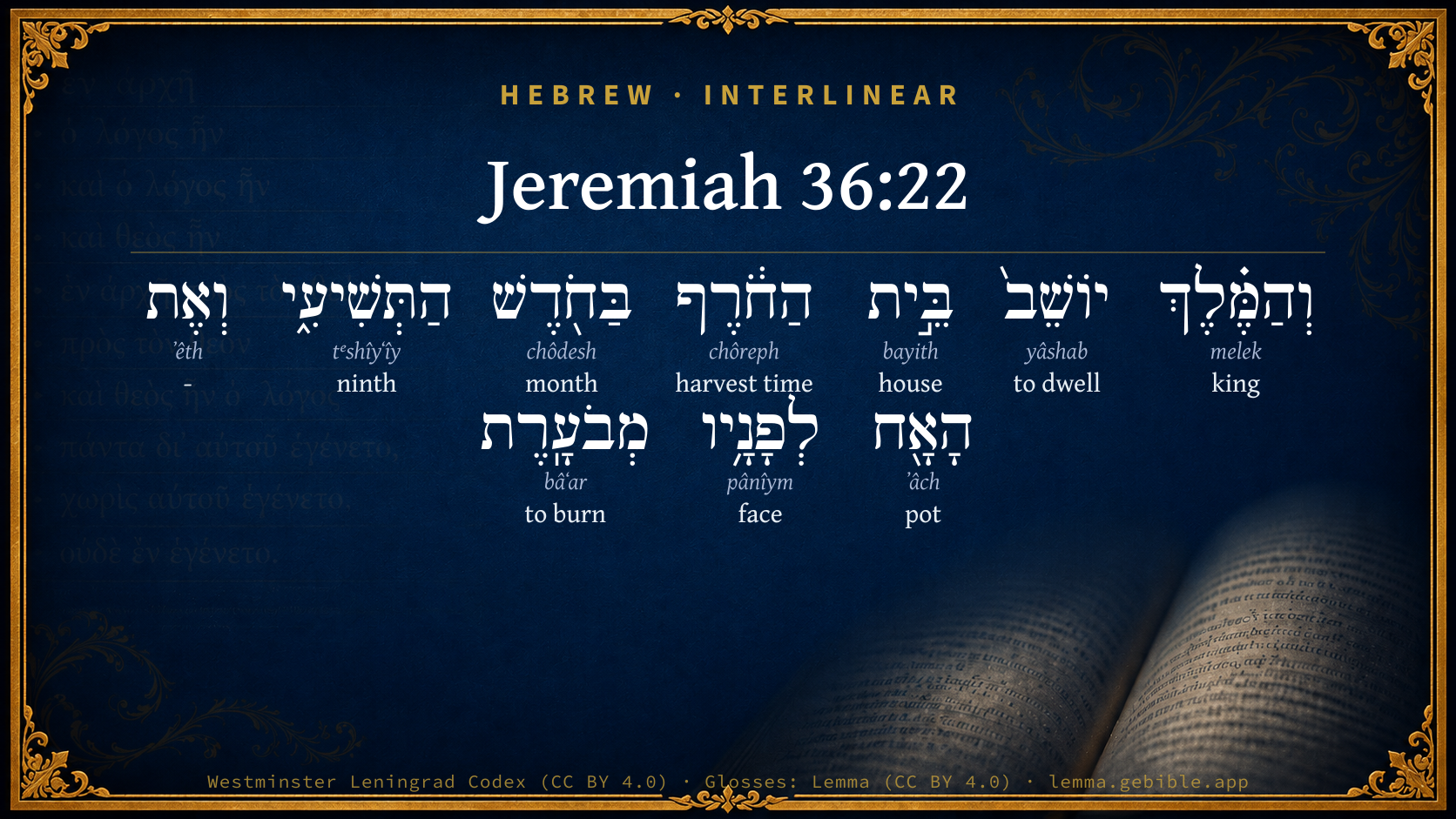
Hebrew (Westminster Leningrad Codex) Jeremiah 36:22 appears in the Hebrew Old Testament. The text above is from the Westminster Leningrad Codex. Each word links to its Strong’s number, a concise gloss, and parsing drawn from the Open Scriptures Hebrew Bible morphology. Click any word for its full Brown-Driver-Briggs (BDB) entry.
Download image
Cite this verse

Jeremiah 36:22 (World English Bible). Public Domain. Lemma interlinear Bible study tool, https://lemma.gebible.app/v/jeremiah/36/22.

Show BibTeX & RIS
BibTeX
RIS
English Translation
Now the king was sitting in the winter-house in the ninth month: and [there was a fire in] the brazier burning before him.
World English Bible · Public Domain
Highlights
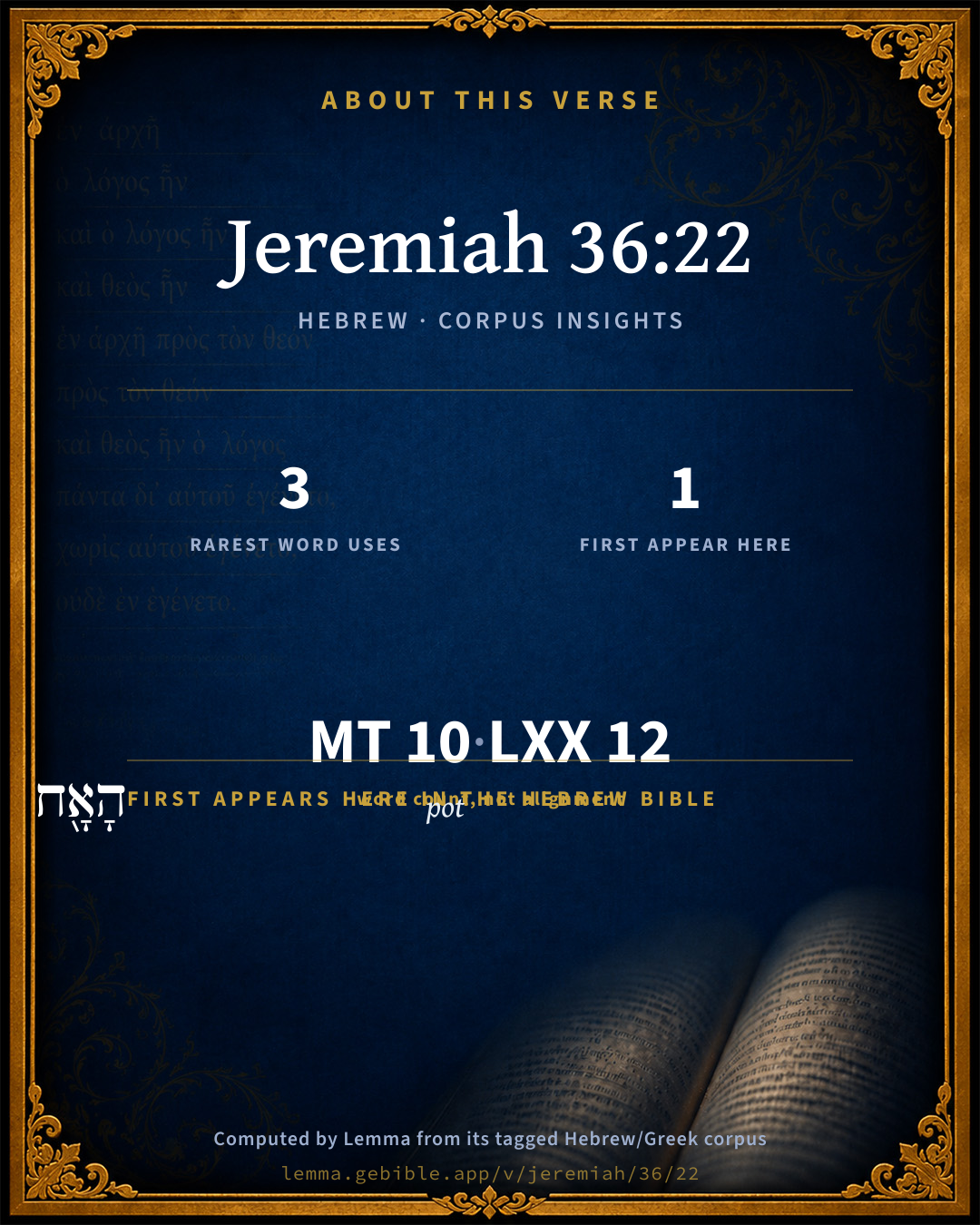
  • 1 first appearance in the Hebrew Bible
Full analysis ↓
Download a study sheet

One document with this verse’s original text, its word-by-word gloss line, the meaning frame, cross-references with their text, attributed commentary, and full source and license credits — printable, and it pastes into notes with its structure intact.

This verse Autodidact and up

Study sheet (.html) Plain text (.txt)

A passage Seminary Student

Up to 50 verses in one chapter. A passage sheet keeps up to 6 commentary sources and 12 cross-references per verse, in the order this page ranks them, and says so on the sheet whenever that leaves anything out. Ask for a single verse and you get the Autodidact verse sheet above.

Everything on this page stays free to read, with no account — the sheet is a download of what is already on screen, not access to it.

Want to remove ads? Support Godless Engineer
Compare translations 3

The same verse in 3 English versions, stacked beneath the original-language interlinear above. Click any original word for its lexicon entry.

Each is an independent rendering of the whole verse — the interlinear is not word-aligned to these translations.

Highlighted words mark where these versions differ — a whole-verse word diff, not a word-by-word alignment.

  • World English Bible Public Domain
    Now the king was sitting in the winter-house in the ninth month: and [there was a fire in] the brazier burning before him.
  • King James Version Public Domain
    Now the king sat in the winterhouse in the ninth month: and there was a fire on the hearth burning before him.
  • unfoldingWord Literal Text CC BY-SA 4.0
    Now the king was staying in the winter house in the ninth month, and a brazier was burning in front of him.

unfoldingWord Literal Text — © unfoldingWord, licensed CC BY-SA 4.0. Word-aligned USFM3 via Door43 (git.door43.org/unfoldingWord/en_ult).

Versions to compare (up to 4)

3 of 4 selected

Show all 18 translations

Every available English version of this verse, each an independent rendering of the whole verse.

  • World English Bible Public Domain
    Now the king was sitting in the winter-house in the ninth month: and [there was a fire in] the brazier burning before him.
  • Berean Standard Bible Public Domain
    Since it was the ninth month, the king was sitting in his winter quarters with a fire burning before him.
  • Majority Standard Bible Public Domain
    Since it was the ninth month, the king was sitting in his winter quarters with a fire burning before him.
  • King James Version Public Domain
    Now the king sat in the winterhouse in the ninth month: and there was a fire on the hearth burning before him.
  • American Standard Version (1901) Public Domain
    Now the king was sitting in the winter-house in the ninth month: and `there was a fire in' the brazier burning before him.
  • Revised Version (1885) Public Domain
    Now the king sat in the winter house in the ninth month: and there was a fire in the brasier burning before him.
  • Geneva Bible (1599) Public Domain
    Nowe the King sate in the winter House, in the ninth moneth, and there was a fire burning before him.
  • Douay-Rheims (1899) Public Domain
    Now the king sat in the winter house, In the ninth month: and there was a hearth before him full of burning coals.
  • Young's Literal Translation Public Domain
    and the king is sitting in the winter-house, in the ninth month, and the stove before him is burning,
  • Literal Standard Version CC BY-SA 4.0
    and the king is sitting in the winter-house, in the ninth month, and the stove is burning before him,
  • Unlocked Literal Bible CC BY-SA 4.0
    Now the king was staying in the winter house in the ninth month, and a brazier was burning in front of him.
  • unfoldingWord Literal Text CC BY-SA 4.0
    Now the king was staying in the winter house in the ninth month, and a brazier was burning in front of him.
  • Darby Bible Public Domain
    Now the king was sitting in the winter-house in the ninth month, and with the fire-pan burning before him.
  • World Messianic Bible Public Domain
    Now the king was sitting in the winter house in the ninth month, and there was a fire in the brazier burning before him.
  • Webster's Bible Public Domain
    Now the king sat in the winter-house in the ninth month: and there was a fire on the hearth burning before him.
  • Free Bible Version CC BY-SA 4.0
    It was the ninth month and the king was sitting in front of a fire in his winter quarters.
  • Bible in Basic English Public Domain
    Now the king was seated in the winter house, and a fire was burning in the fireplace in front of him.
  • JPS Tanakh (1917) Public Domain
    Now the king was sitting in the winter-house in the ninth month; and the brazier was burning before him.

Literal Standard Version (2020), Covenant Press — licensed CC BY-SA 4.0. Text via the HelloAO Bible API (eBible.org). Unlocked Literal Bible (unfoldingWord) — licensed CC BY-SA 4.0. Text via the HelloAO Bible API (eBible.org). unfoldingWord Literal Text — © unfoldingWord, licensed CC BY-SA 4.0. Word-aligned USFM3 via Door43 (git.door43.org/unfoldingWord/en_ult). Free Bible Version, Dr. Jonathan Gallagher — licensed CC BY-SA 4.0. Text via the HelloAO Bible API (eBible.org).

Word by word

More ways to search: Search by grammar → Find every occurrence → Compare this word →

Practice this passage: Drill this verse → Learn its vocabulary →

הָאָ֖ח
ʼâch
H254
“the · pot”
Particle, Definite Article + Noun, Common, Masculine, Singular, Absolute
Part of Speech
Particle + Noun
Type
Common
Gender
Masculine
Number
Singular
State
Absolute
Full BDB Definition

Origin: of uncertain derivation

TWOT: 66a

fire-pot, brazier
  1. וְהַמֶּ֗לֶךְ melek H4428 “and · the · king” Conjunction + Particle, Definite Article + Noun, Common, Masculine, Singular, Absolute
  2. יוֹשֵׁב֙ yâshab H3427 “dwelling” Verb, Qal, Participle Active, Masculine, Singular, Absolute
  3. בֵּ֣ית bayith H1004 “house of” Noun, Common, Masculine, Singular, Construct
  4. הַחֹ֔רֶף chôreph H2779 “the · harvest time” Particle, Definite Article + Noun, Common, Masculine, Singular, Absolute
  5. בַּחֹ֖דֶשׁ chôdesh H2320 “in/at the · month” Preposition, Determined + Noun, Common, Masculine, Singular, Absolute
  6. הַתְּשִׁיעִ֑י tᵉshîyʻîy H8671 “the · ninth” Particle, Definite Article + Adjective, Ordinal number, Masculine, Singular, Absolute
  7. וְאֶת ʼêth H853 “and · -” Conjunction + Particle, Direct Object
  8. לְפָנָ֥יו pânîym H6440 “to/for · face(s) · his” Preposition + Noun, Common, Both, Plural, Construct + Suffix, Personal, 3rd Person, Masculine, Singular
  9. מְבֹעָֽרֶת bâʻar H1197 “burnt” Verb, Pual, Participle Passive, Feminine, Singular, Absolute

About this verse

These counts appear in no published source. They are computed here, from the morphology-tagged text and Lemma’s own curated glosses. What Lemma adds →

10
words
10
distinct lemmas
Prophets
section

Notable vocabulary

The rarest word here is הָאָ֖ח pot H254 — appearing just 3 times in the whole Hebrew Bible.

First appearance in Scripture

This word makes its first canonical appearance in the Hebrew Bible here:

  • הָאָ֖ח pot H254

Shared distinctive vocabulary

הָאָ֖ח pot H254 occurs in 2 verses of the Hebrew Bible. Also found in:

Grammatical profile

  • 2 verbs
  • 6 nouns
  • 1 adjective
  • 1 particle

Verb forms

  • יוֹשֵׁב֙ Qal · Participle Active
  • מְבֹעָֽרֶת Pual · Participle Passive

Hebrew & Septuagint length

In the original languages it is 10 Hebrew tokens and 12 Greek tokens — but the two are counted differently (Hebrew bundles its prefixes and suffixes into one token; the Greek is in lemma form), so that isn’t a like-for-like length.

Cross-references

4

Topical passages linked to Jeremiah 36:22 in the Treasury of Scripture Knowledge — connected by theme and wording, ordered by reader-vote popularity; previews shown in the World English Bible.

  • Amos 3:15 I will strike the winter house with the summer house; And the houses of ivory will perish, And the great houses will have an end," says Yahweh.
  • Jeremiah 3:20 Surely as a wife treacherously departs from her husband, so have you dealt treacherously with me, house of Israel, says Yahweh.
  • Jeremiah 22:14–16 who says, I will build me a wide house and spacious chambers, and cuts him out windows; and it is ceiling with cedar, and painted with vermilion.
  • Jeremiah 36:9 Now it happened in the fifth year of Jehoiakim the son of Josiah, king of Judah, in the ninth month, that all the people in Jerusalem, and all the people who came from the cities of Judah to Jerusalem, proclaimed a fast before Yahweh.

Cross-references courtesy of OpenBible.info (CC BY 4.0).

Hebrew and Greek witnesses Masoretic Hebrew ↔ Greek Septuagint

The same verse in the two great witnesses to the Old Testament, shown verse-for-verse.

These are two independent witnesses, not word-aligned to each other, and the Septuagint is shown in lemma (dictionary) form.

Hebrew Jeremiah 36:22 Masoretic · Westminster Leningrad Codex

וְהַמֶּ֗לֶךְ יוֹשֵׁב֙ בֵּ֣ית הַחֹ֔רֶף בַּחֹ֖דֶשׁ הַתְּשִׁיעִ֑י וְאֶת הָאָ֖ח לְפָנָ֥יו מְבֹעָֽרֶת

Now the king was sitting in the winter-house in the ninth month: and [there was a fire in] the brazier burning before him.

World English Bible · Public Domain

Greek LXX Structure differs

In the Septuagint, Jeremiah is about an eighth shorter than the Hebrew and arranges its material differently — the Oracles Against the Nations (Hebrew chapters 46–51) appear in the middle of the Greek book, after 25:13. Because the chapter and verse boundaries do not line up, a verse-for-verse comparison with the Hebrew is not shown.

A verse-for-verse comparison isn’t shown here because the chapters and verses don’t line up. Switch to the LXX edition with the MT / LXX toggle above to read the Greek directly.

On this verse, Joseph Benson's Commentary discusses the Septuagint’s reading. Read the note in Commentary ↓

Hebrew: Westminster Leningrad Codex (CC BY 4.0). Greek: Septuagint (public domain); English from a public-domain English Septuagint. How the Septuagint differs from the Hebrew →

Targum (Aramaic paraphrase)

1

The Targum is the ancient Jewish Aramaic paraphrase of the Hebrew Scriptures — an interpretive translation, not the Hebrew text itself. Onkelos (literal) and Pseudo-Jonathan (expansive) render the Torah, and Jonathan the Prophets. Coverage is partial: where no permissively-licensed English translation exists for a verse, only the Aramaic is shown. This is verse-level text, not a word-by-word alignment to the Hebrew.

  1. Targum Jonathan Prophets (Joshua–Malachi)
    וּמַלְכָּא יָתֵיב בֵּית סִתְוָא בְּיַרְחָא תְּשִׁיעַיְתָא וְיַת נוּרָא קֳדָמוֹהִי מַדְלְקִין:

    (no public-domain English translation for this verse)

    Targum Jonathan — Aramaic: “Mikraot Gedolot” (public domain). English: “Sefaria Community Translation” (CC0 1.0 (public-domain dedication)); “London "Chaldee Paraphrase," 1871” (public domain). Text via Sefaria.

Commentary

Notes on Jeremiah 36:22 from classic Christian and Jewish commentators (each source and its license shown beneath its notes). The classic Christian expositions comment on the surrounding passage and are grouped to its opening verse, so a note may address several verses; the Jewish commentaries on the Tanakh (Rashi and others) are per-verse, so they appear only where the commentator wrote on this verse.

Lemma curates 59 commentaries, every one of them public domain or Creative Commons licensed, each selected and text-cleaned for this edition rather than reprinted as found. About our sources →

Trapp's Complete Commentary

John Trapp

Jer 36:22 Now the king sat in the winterhouse in the ninth month: and [there was a fire] on the hearth burning before him.

Ver. 22. Now the king sat in the winter house.] There sat he, in that his stately and sumptuous palace built by iniquity, {Jer 22:13-14} curans cuticulam ad focum, keeping himself warm in his winter chamber, and careless of calling upon God; while the people, cold and empty, were fasting and praying in the temple, and hearing the Word read by Baruch.

In the ninth month,] sc., Of the sacred year, which month was part of our November and part of December, a cold season; but that thing of naught, his body, which he now made so much of, was shortly after to be cast out unburied, in the day to the heat, and in the night to the frost. {Jer 36:30}

John Trapp, A Commentary or Exposition upon All the Books of the Old and New Testament (1647–1656) — public domain. Text from a community e-Sword module.

Joseph Benson's Commentary

Jer 36:22. Now the king sat in the winter-house — The princes and great men had distinct houses, or apartments, fitted for the several seasons of the year, Amo 3:15. In the ninth month — Which answers to the latter end of our November and part of December. And there was a fire on the hearth burning before him — Hebrew, יאת האח לפניו מבערת, et focus coram ipso ardebat, Buxtorff: literally, And a hearth, or, fire-pan was burning before him. Thus the LXX., και εσγαρα πυρος κατα

προσωπον αυτου: and a pan of fire before him. To the same purpose the Vulgate, et posita erat arula coram eo plena prunis, There was set before him a little altar, or fire-pan, full of burning coals. The reason of this phraseology we have in the account which Lightfoot gives us from Maimonides, namely, that chimneys were not admitted at Jerusalem by reason of the smoke. And Mr. Harmer tells us, (chap. 3. obs. 24,) that Sir John Chardin, in his MS. notes, supposes that the fire which was burning before Jehoiakim was a pan of coals; and cites a passage from him, which says, in French, “This was just as persons of quality warm themselves in winter in Persia, and particularly in Media, and wherever there is no want of wood. The manner in which they sit will not allow them to be near a chimney: in these places, therefore, of the East, they have great brasiers of lighted coals.” Harmer likewise informs us, that “the fires used at Aleppo, in the lodging rooms, are of charcoal in pans; and that pans of coals are the fires which are often made use of in winter in Egypt.” It may be observed further here, that this description of Jehoiakim sitting in his winter-house, in the ninth month, with a pan of fire before him, answers to Dr. Russel’s account, who says, that the most delicate in those countries make no fires till the end of November. How long they continue the use of them he does not say: but we learn from other sources, that in Judea they are continued far into the spring: see Joh 18:18.

Joseph Benson's Commentary on the Old and New Testaments (1811–1818) — public domain. Text from a community e-Sword module.

Keil & Delitzsch

C. F. Keil & F. Delitzsch

The punishment which is to come on Jehoiakim for his wicked act. - Jer 36:27. After the burning of the roll by the king, Jeremiah received from the Lord the command to get all that had been on the former roll written on another, and to announce the following to Jehoiakim the king: Jer 36:29. "Thus saith Jahveh: Thou hast burned this roll, whilst thou sayest, Why hast thou written thereon, The king of Babylon shall surely come and destroy this land, and root out man and beast from it? Jer 36:30. Therefore thus saith Jahveh regarding Jehoiakim the king of Judah: He shall not have one who sits upon the throne of David, and his corpse shall be cast forth to the heat by day and to the frost by night. Jer 36:31. And I shall punish him, his servants, and his seed for their iniquity, and bring on them and on all the inhabitants of Judah and all the men of Judah all the evil which I have spoken to them; but they did not hear." On the meaning of Jer 36:29 see p. 316, supra. The threatening expressed in Jer 36:30. is really only a repetition of what is given in Jer 22:18-19, and has already been explained there. "There shall not be to him one who sits upon the throne of David," i.e., he is not to have a son that shall occupy the throne of David after him. This does not contradict the fact that, after his death, his son Jehoiachin ascended the throne. For this ascension could not be called a sitting on the throne, a reign, inasmuch as he was immediately besieged in Jerusalem by Nebuchadnezzar, and compelled to surrender after three months, then go into exile to Babylon. On Jer 36:31 cf. Jer 35:17; Jer 19:15.

Jer 36:22-32

Thereupon Jeremiah made his attendant Baruch write all the words of the former roll on a new one, "out of his mouth," i.e., at his dictation; and to these he added many other words like them. כּהמּה, i.e., of like import with those on the previous roll. Hence we perceive that on the first roll there were written down not all the several addresses fully, but only the most important parts of his oral announcements.

Keil & Delitzsch — Biblical Commentary on the Old Testament (1861–1891) — public domain (CC PDM 1.0). Text via the HelloAO Bible API. (Old Testament only.)

Geneva Bible (1599)

Geneva Bible translators

Which contained part of November, and part of December.

Geneva Bible (1599) marginal notes — public domain. Text via Bolls.life.

Jamieson, Fausset & Brown

Robert Jamieson, A. R. Fausset & David Brown

winter house-- (Amo 3:15).

ninth month--namely, of the religious year, that is, November or December.

fire on . . . hearth--rather, the stove was burning before him. In the East neither chimneys nor ovens are used, but, in cold weather, a brazen vessel containing burning charcoal; when the wood has burned to embers, a cover is placed over the pot to make it retain the heat.

Jamieson, Fausset & Brown — Commentary Critical and Explanatory on the Whole Bible (1871) — public domain (CC PDM 1.0). Text via the HelloAO Bible API.

Adam Clarke's Commentary

Verse 22. Winterhouse] A warm apartment suited to the season of the year, (December,) when in Palestine there is often snow upon the ground, though it does not last long. A fire on the hearth-a pan or brazier of burning coals. This is the case to the present day. In cold weather the rich burn wood in brass or earthen pans, placed in any part of the room; the indigent burn sticks on the floor.

Adam Clarke's Commentary on the Bible (1810–1826) — public domain. Text from a community e-Sword/MySword module.

Ellicott's Commentary for English Readers

(22) Now the king sat in the winterhouse in the ninth month.—The “winterhouse” (the palaces of kings seem to have been commonly provided with such a special apartment; comp. Amo_3:15) was probably the southern wing of the palace. It was in November or December, and, as glass windows were unknown, a charcoal fire, placed after the Eastern fashion in a brazier, or earthen pot, in the middle of the room, was a necessity. So we find a fire in the court of the high priest’s palace in the raw early morning of a Passover in March or April (Joh_18:18).

A Bible Commentary for English Readers, edited by Charles John Ellicott (1878–1897) — public domain. Text from a community e-Sword module.

The Cambridge Bible for Schools and Colleges

gen. ed. J. J. S. Perowne

22. in the winter house] See on Jer_36:9. It was a cold and rainy time of the year (see Ezr_10:9). Amos (Jer_3:15) mentions both winter and summer houses. “In common parlance the lower apartments are simply el beit—the house; the upper is the ullîyeh, which is the summer house. Every respectable dwelling has both.… If these are on the same storey, then the external and airy apartment is the summer house, and that for winter is the interior and more sheltered room. It is rare to meet a family which has an entirely separate dwelling for summer.”—Thomson, The Land and the Book, p. 309.

in the ninth month] omit with LXX.

there was a fire in the brasier] Brasiers containing charcoal are placed in a depression in the middle of a room for purposes of warming. The change of one Hebrew consonant gives us the right sense. As the MT. stands, it is defective and lacking in grammar.

The Cambridge Bible for Schools and Colleges (gen. ed. J. J. S. Perowne; Cambridge University Press, 1878–1918) — public domain. Text from a community e-Sword module.

John Gill's Exposition

Now the king sat in the winter house, in the ninth month,.... The month Cisleu, which answers to part of November, and part of December; and so was the midst of winter, and a proper time for the king to be in his winter house; though, as this was a fast day, it would have been more proper for him to have been at the worship of God in the temple, Jer 36:9. This winter house probably was a winter parlour, as distinguished from a summer parlour, Jdg 3:20; and both might be under the same roof, or parts of the same house; only the one might be more airy and cool, and the other more close and warm. Kings had their summer and winter houses; see Amo 3:15; this circumstance is mentioned for the sake of what follows, the burning of the roll; and accounts for there being a fire at hand to do it:

and there was a fire on the hearth burning before him; there was a stove, or some such vessel or instrument, in which a large fire of wood was made, at which the king sat to keep himself warm while the roll was reading, and about which the princes stood.

John Gill's Exposition of the Whole Bible (1746–1763) — public domain (CC PDM 1.0). Text via the HelloAO Bible API.

Albert Barnes' Notes on the Bible

The winterhouse - A separate portion of the palace was used for residence according to the season (marginal reference).

And there was a fire on the hearth ... - And the fire-pan burning before them. On the middle of the floor was a brazier containing burning charcoal.

Albert Barnes' Notes on the Bible (1834–1885) — public domain. Text from a community e-Sword/MySword module.

Haydock's Catholic Bible Commentary

Winter-house. He was very magnificent, and had other apartments for summer. Though the climate was warm, fires would be useful in November. --- Hearth. There was no chimney used, and the smoke went out by the door, or by holes at the top of the room, as we see in some old monasteries. (Calmet) --- Charcoal was probably used, Baruch vi. 42.

George Leo Haydock (1774–1849), Haydock's Catholic Family Bible and Commentary, 1859 edition — public domain. Excludes Psalms (Douay-Rheims chapter numbering differs from Protestant) and Deuterocanonical books (Catholic canon only).

Matthew Poole's English Annotations

The ninth month with them answered part of our November and December, which was a time of the year called for fires.

Matthew Poole's English Annotations on the Holy Bible (1683–1685) — public domain. Text from a community e-Sword/MySword module.

Whedon's Commentary on the Bible

Daniel D. Whedon

THE READING TO THE KING, Jer_36:19-26.

22. Winter house — A special part of the palace used for that season.

Fire on the hearth — Brazier. The houses of the Jews, as usual in the east, were warmed not by means of chimneys or living fires, but by open vessels containing coals.

Daniel D. Whedon (gen. ed.), Commentary on the Old and New Testaments (1874–1909) — public domain. Text from a community e-Sword module.

The Pulpit Commentary

In the winter house; i.e. that part of the royal palace (beth, house, may also be rendered apartment) which was arranged for a winter habitation. (comp. Amo_3:15) According to Dr. Thomson ("The Land and the Book," p. 309), the more airy part of a house is called "summerhouse," and the more sheltered room "winter house." The ninth month, in which the events now being related took place, corresponded approximately to our December. It was, therefore, the cold and rainy season; December is a stormy month in Palestine. A fire on the hearth; rather, in the chafing dish (or, brazier). It was a vessel with live coals placed in the centre of the room, still used in the East in cold weather.

Vers. 22-26. The burning of the roll.

When the princes informed Jehoiakim of the circumstances connected with the reading of Jeremiah"s prophecies, the king sent an attendant, Jehudi, to fetch the roll and read it to him. It has been said that he showed contempt for the Word of God by relegating the reading to a page instead of sending for Baruch. But Baruch had probably escaped to seclusion at the warning of the courtiers (ver. 19), and as he had left the roll in other hands, what was more natural than that Jehoiakim should send for it without a thought of Jeremiah"s appointment of a reader? Indeed, it matters little who reads; the question is How is the reading received?

I CONSIDER THE ACTION OF THE KING. It was December the cold and rainy month. A fire blazed on the brazier. As the roll was read, the king cut it up and flung the sections into the fire, till he had destroyed the whole of it. His action was one of rage and folly. He would have no more of the prophet"s dreadful words for himself; he would prevent them from further influencing others; he would vent his rage upon the record, though he could not touch the truths contained in it. Are there not many who inwardly sympathize with this violence of Jehoiakim? They dare not say they wish the Bible to be destroyed. But there are things in it which testify against them so strongly that they would keep them forever out of sight. The special features of Jehoiakim"s action are significant.

1. It was beyond his rights. King as he was, the roll did not belong to him. Neither had he any authority over the inspired word of prophecy. Earthly power confers no privilege and power in Divine things.

2. It was brutally violent. Jehoiakim cut up and burnt the roll that was all he could do. To refute its contents was beyond his power.

3. It was vain and futile. The roll might be burnt, but the truth it contained could not be destroyed, nor could it even be suppressed. Another roll could be written, and the burning of the first would be an advertisement for the second. Violent opposition thus benefits the cause it would destroy. The burning of Tyndale"s Bibles was one of the best means for securing the circulation of a larger number of English Bibles.

4. It was suggested by a temptation. The fire was at hand an unusual thing, apparently, just suited to the occasion. There is an evil providence as well as a higher providence of good. It is not safe to follow the superficial indication of events. That is as likely to come from below as from above.

5. It was deliberate. Piece by piece the roll was cut up and burnt. Hasty passion might excuse the first burning, but not the whole process.

6. It was complete. All the roll was consumed. There was no discrimination. The act was symbolical. The rejection Of one part of truth will lead to the rejection of the whole of it.

7. It was really injurious only to the perpetrator. The roll could not feel; the truth could not be destroyed; another roll could be written. But the burning of the roll was to the king"s own loss. That roll contained the only available prescription for the healing of the distresses of himself and his kingdom. The Bible is really sent for the good of the worst of men. Their rejection of it is only to their own loss.

II CONSIDER THE CONDUCT OF THE COURTIERS.

1. Some stood by and watched the burning. They did not aid it; but they did not hinder it. Therefore they shared the responsibility of the king. For we are responsible for the evil we will not restrain as well as for that we commit, so that in doing little harm we may yet be guilty of much. The courtiers had no valid excuse for their indifference. Royal authority cannot justify acquiescence in wrong. Personal fear is no excuse, since it is better to die for the right than desert it in sheer cowardice. These men showed no fear (ver. 24). They had been alarmed (ver. 16). But religious fears are transitory, and if not acted on leave the heart more hardened than they find it.

2. Some expostulated. These men had been more permanently affected by the reading of Baruch. They carried the impressions made in the temple to their conduct at the court. That is a proof of a real influence of the words of Jeremiah upon them. It is little that we feel the weight of religion in church. The test is how far this dwells with us in the world, and when it would urge to unpopular, difficult, or dangerous actions.

The Pulpit Commentary (1880–1919), ed. H.D.M. Spence-Jones & Joseph S. Exell — public domain. Text from a community e-Sword module.

John Wesley's Explanatory Notes

The ninth month - Answered to part of our November and December.

John Wesley, Explanatory Notes Upon the Whole Bible (1754–1765) — public domain. Text via the GEBible commentary corpus.

Scofield Reference Notes

C. I. Scofield

ninth month

i.e. December.

The Scofield Reference Bible (1917 edition), notes by C. I. Scofield — public domain. Text from a community e-Sword module.

Rashi

Rabbi Shlomo Yitzchaki (Rashi)

and the brazier Heb. האח. Our Rabbis (Shabbath 21a) defined it as wood, called so because they burn with brotherhood. (That is to say that they are ignited one from the other, like brothers, who benefit each other. Omitted in other editions.) And according to its simple meaning, it appears that it is a vessel upon which they kindle fire before the princes.

Rashi on the Tanakh — English translations: “The Judaica Press complete Tanach with Rashi, translated by A. J. Rosenberg” (CC BY 4.0); “Pentateuch with Rashi's commentary by M. Rosenbaum and A.M. Silbermann, 1929-1934” (public domain); “The Metsudah Tanach series, Lakewood, N.J” (CC BY 4.0); and “The Book of Joshua, Metsudah Publications, 1997” (CC BY 4.0). Text via Sefaria.

Lesson kit

Teaching starters — assembled from the data on this page, not authored interpretation. Every prompt links to the verse data it draws on. Edit before teaching.

Jeremiah, in the Prophets, opens this verse with 10 words (10 distinct Hebrew lemmas). Its most distinctive word is ʼâch (“pot”). A historical commentator’s framing appears above. Read the whole chapter for the surrounding context.

Discussion questions

  1. How does “pot” (ʼâch) shape what this verse is saying?
  2. The word “pot” first appears here in Scripture. What is being introduced at this debut?
  3. Jeremiah 36:23 shares the word «pot» with this verse. How do the two illuminate each other?
  4. The translations on this page render this verse differently — a whole-verse word diff, not a word-by-word alignment. What might account for the different wordings?
  5. The verb «יוֹשֵׁב֙» is Qal Participle Active. How does its form color the action?
  6. Reading how Trapp's Complete Commentary and Joseph Benson's Commentary read this verse, where do the two commentators agree and where do they part?

Things to notice

Reading settings

Reading text

Shown beneath each verse's original-language words.

Old Testament
Old Testament edition

Read the OT as the Masoretic Hebrew (MT) or the Greek Septuagint (LXX).

English shown for the Greek Septuagint (in the Hebrew ↔ Greek comparison).

Comparing translations? Open the Compare panel on any verse page to stack up to four side by side.