
Leviticus 25:9

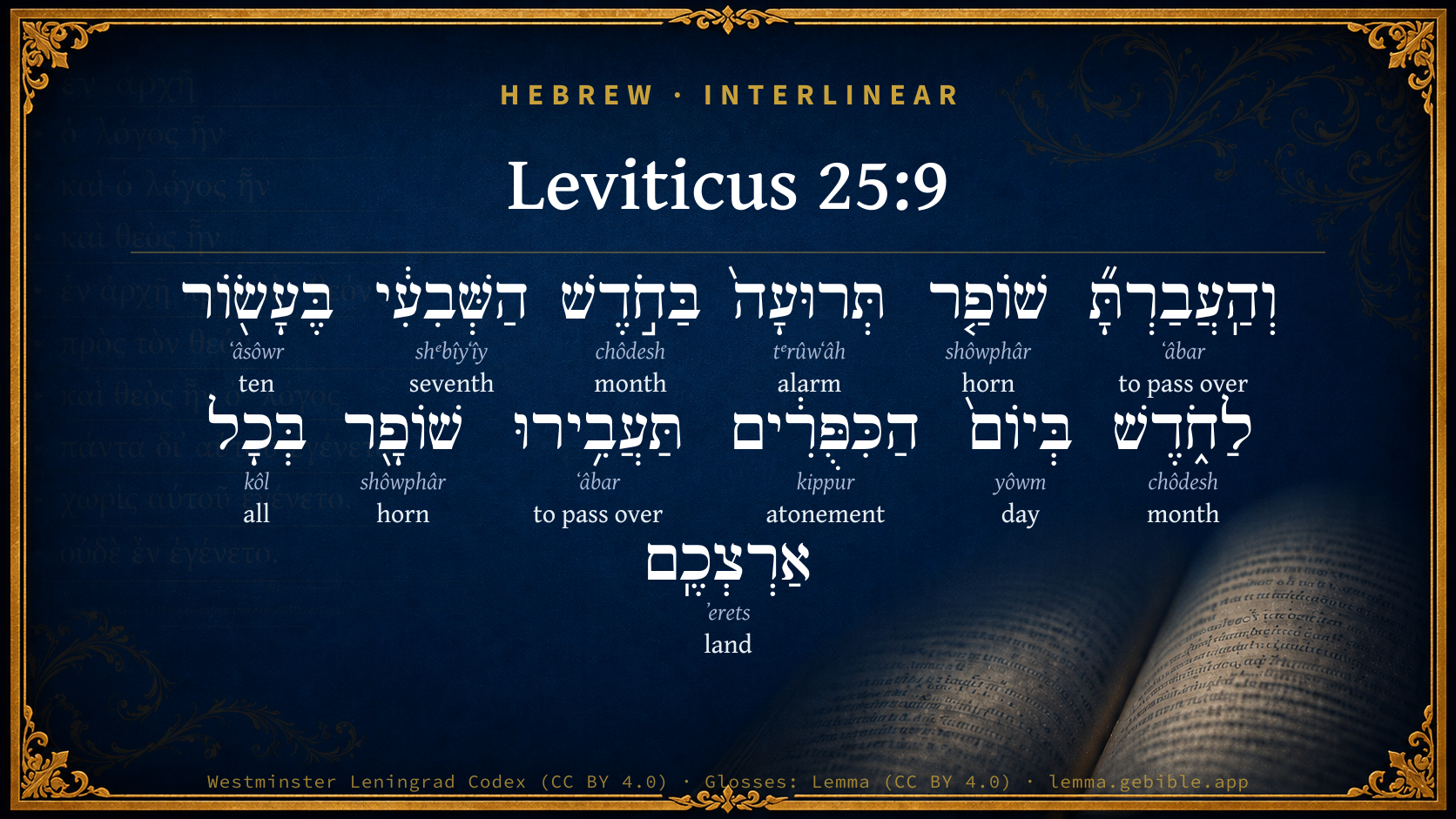
Hebrew (Westminster Leningrad Codex) Leviticus 25:9 appears in the Hebrew Old Testament. The text above is from the Westminster Leningrad Codex. Each word links to its Strong’s number, a concise gloss, and parsing drawn from the Open Scriptures Hebrew Bible morphology. Click any word for its full Brown-Driver-Briggs (BDB) entry.
Download image
Cite this verse

Leviticus 25:9 (World English Bible). Public Domain. Lemma interlinear Bible study tool, https://lemma.gebible.app/v/leviticus/25/9.

Show BibTeX & RIS
BibTeX
RIS
English Translation
Then you shall sound the loud trumpet on the tenth day of the seventh month. On the Day of Atonement you shall sound the trumpet throughout all your land.
World English Bible · Public Domain
Download a study sheet

One document with this verse’s original text, its word-by-word gloss line, the meaning frame, cross-references with their text, attributed commentary, and full source and license credits — printable, and it pastes into notes with its structure intact.

This verse Autodidact and up

Study sheet (.html) Plain text (.txt)

A passage Seminary Student

Up to 50 verses in one chapter. A passage sheet keeps up to 6 commentary sources and 12 cross-references per verse, in the order this page ranks them, and says so on the sheet whenever that leaves anything out. Ask for a single verse and you get the Autodidact verse sheet above.

Everything on this page stays free to read, with no account — the sheet is a download of what is already on screen, not access to it.

Want to remove ads? Support Godless Engineer
Compare translations 3

The same verse in 3 English versions, stacked beneath the original-language interlinear above. Click any original word for its lexicon entry.

Each is an independent rendering of the whole verse — the interlinear is not word-aligned to these translations.

Highlighted words mark where these versions differ — a whole-verse word diff, not a word-by-word alignment.

  • World English Bible Public Domain
    Then you shall sound the loud trumpet on the tenth day of the seventh month. On the Day of Atonement you shall sound the trumpet throughout all your land.
  • King James Version Public Domain
    Then shalt thou cause the trumpet of the jubilee to sound on the tenth day of the seventh month, in the day of atonement shall ye make the trumpet sound throughout all your land.
  • unfoldingWord Literal Text CC BY-SA 4.0
    And you shall cause a horn of loud blast to pass through in the seventh month, on the tenth of the month. On the Day of Atonement you shall cause a horn to pass through in all your land.

unfoldingWord Literal Text — © unfoldingWord, licensed CC BY-SA 4.0. Word-aligned USFM3 via Door43 (git.door43.org/unfoldingWord/en_ult).

Versions to compare (up to 4)

3 of 4 selected

Show all 18 translations

Every available English version of this verse, each an independent rendering of the whole verse.

  • World English Bible Public Domain
    Then you shall sound the loud trumpet on the tenth day of the seventh month. On the Day of Atonement you shall sound the trumpet throughout all your land.
  • Berean Standard Bible Public Domain
    Then you are to sound the horn far and wide on the tenth day of the seventh month, the Day of Atonement. You shall sound it throughout your land.
  • Majority Standard Bible Public Domain
    Then you are to sound the horn far and wide on the tenth day of the seventh month, the Day of Atonement. You shall sound it throughout your land.
  • King James Version Public Domain
    Then shalt thou cause the trumpet of the jubilee to sound on the tenth day of the seventh month, in the day of atonement shall ye make the trumpet sound throughout all your land.
  • American Standard Version (1901) Public Domain
    Then shalt thou send abroad the loud trumpet on the tenth day of the seventh month; in the day of atonement shall ye send abroad the trumpet throughout all your land.
  • Revised Version (1885) Public Domain
    Then shalt thou send abroad the loud trumpet on the tenth day of the seventh month; in the day of atonement shall ye send abroad the trumpet throughout all your land.
  • Geneva Bible (1599) Public Domain
    Then thou shalt cause to blow the trumpet of the Iubile in the tenth day of the seuenth moneth: euen in the day of the reconciliation shall ye make the trumpet blowe, throughout all your lande.
  • Douay-Rheims (1899) Public Domain
    And thou shalt sound the trumpet in the seventh month, the tenth day of the month, in the time of the expiation in all your land.
  • Young's Literal Translation Public Domain
    and thou hast caused a trumpet of shouting to pass over in the seventh month, in the tenth of the month; in the day of the atonements ye do cause a trumpet to pass over through all your land;
  • Literal Standard Version CC BY-SA 4.0
    and you have caused a horn of shouting to pass over in the seventh month, on the tenth of the month; in the Day of Atonements you cause a horn to pass over through all your land;
  • Unlocked Literal Bible CC BY-SA 4.0
    Then you must blow a loud trumpet everywhere on the tenth day of the seventh month. On the Day of Atonement you must blow a trumpet throughout all your land.
  • unfoldingWord Literal Text CC BY-SA 4.0
    And you shall cause a horn of loud blast to pass through in the seventh month, on the tenth of the month. On the Day of Atonement you shall cause a horn to pass through in all your land.
  • Darby Bible Public Domain
    Then shalt thou cause the loud sound of the trumpet to go forth in the seventh month, on the tenth of the month; on the day of atonement shall ye cause the trumpet to go forth throughout your land.
  • World Messianic Bible Public Domain
    Then you shall sound the loud shofar on the tenth day of the seventh month. On the Day of Atonement you shall sound the shofar throughout all your land.
  • Webster's Bible Public Domain
    Then shalt thou cause the trumpet of the jubilee to sound, on the tenth day of the seventh month, in the day of atonement shall ye make the trumpet sound throughout all your land.
  • Free Bible Version CC BY-SA 4.0
    Then blow the trumpet all through the country on the tenth day of the seventh month, which is the Day of Atonement. Make sure this signal is heard throughout your whole country.
  • Bible in Basic English Public Domain
    Then let the loud horn be sounded far and wide on the tenth day of the seventh month; on the day of taking away sin let the horn be sounded through all your land.
  • JPS Tanakh (1917) Public Domain
    Then shalt thou make proclamation with the blast of the horn on the tenth day of the seventh month; in the day of atonement shall ye make proclamation with the horn throughout all your land.

Literal Standard Version (2020), Covenant Press — licensed CC BY-SA 4.0. Text via the HelloAO Bible API (eBible.org). Unlocked Literal Bible (unfoldingWord) — licensed CC BY-SA 4.0. Text via the HelloAO Bible API (eBible.org). unfoldingWord Literal Text — © unfoldingWord, licensed CC BY-SA 4.0. Word-aligned USFM3 via Door43 (git.door43.org/unfoldingWord/en_ult). Free Bible Version, Dr. Jonathan Gallagher — licensed CC BY-SA 4.0. Text via the HelloAO Bible API (eBible.org).

Word by word

More ways to search: Search by grammar → Find every occurrence → Compare this word →

Practice this passage: Drill this verse → Learn its vocabulary →

הַכִּפֻּרִ֔ים
kippur
H3725
“the · atonement”
Particle, Definite Article + Noun, Common, Masculine, Plural, Absolute
Part of Speech
Particle + Noun
Type
Common
Gender
Masculine
Number
Plural
State
Absolute
Full BDB Definition

Origin: from H3722

TWOT: 1023b

atonement
  1. וְהַֽעֲבַרְתָּ֞ ʻâbar H5674 “and · to pass over” Conjunction + Verb, Hiphil, Sequential Perfect, 2nd Person, Masculine, Singular
  2. שׁוֹפַ֤ר shôwphâr H7782 “horn of” Noun, Common, Masculine, Singular, Construct
  3. תְּרוּעָה֙ tᵉrûwʻâh H8643 “alarm” Noun, Common, Feminine, Singular, Absolute
  4. בַּחֹ֣דֶשׁ chôdesh H2320 “in/at the · month” Preposition, Determined + Noun, Common, Masculine, Singular, Absolute
  5. הַשְּׁבִעִ֔י shᵉbîyʻîy H7637 “the · seventh” Particle, Definite Article + Adjective, Ordinal number, Masculine, Singular, Absolute
  6. בֶּעָשׂ֖וֹר ʻâsôwr H6218 “in/at the · ten” Preposition, Determined + Noun, Common, Masculine, Singular, Absolute
  7. לַחֹ֑דֶשׁ chôdesh H2320 “to/for the · month” Preposition, Determined + Noun, Common, Masculine, Singular, Absolute
  8. בְּיוֹם֙ yôwm H3117 “in/at · day of” Preposition + Noun, Common, Masculine, Singular, Construct
  9. תַּעֲבִ֥ירוּ ʻâbar H5674 “to pass over” Verb, Hiphil, Imperfect, 2nd Person, Masculine, Plural
  10. שׁוֹפָ֖ר shôwphâr H7782 “horn” Noun, Common, Masculine, Singular, Absolute
  11. בְּכָל kôl H3605 “in/at · all of” Preposition + Noun, Common, Masculine, Singular, Construct
  12. אַרְצְכֶֽם ʼerets H776 “land · your” Noun, Common, Both, Singular, Construct + Suffix, Personal, 2nd Person, Masculine, Plural

About this verse

These counts appear in no published source. They are computed here, from the morphology-tagged text and Lemma’s own curated glosses. What Lemma adds →

13
words
10
distinct lemmas
Pentateuch
section

Notable vocabulary

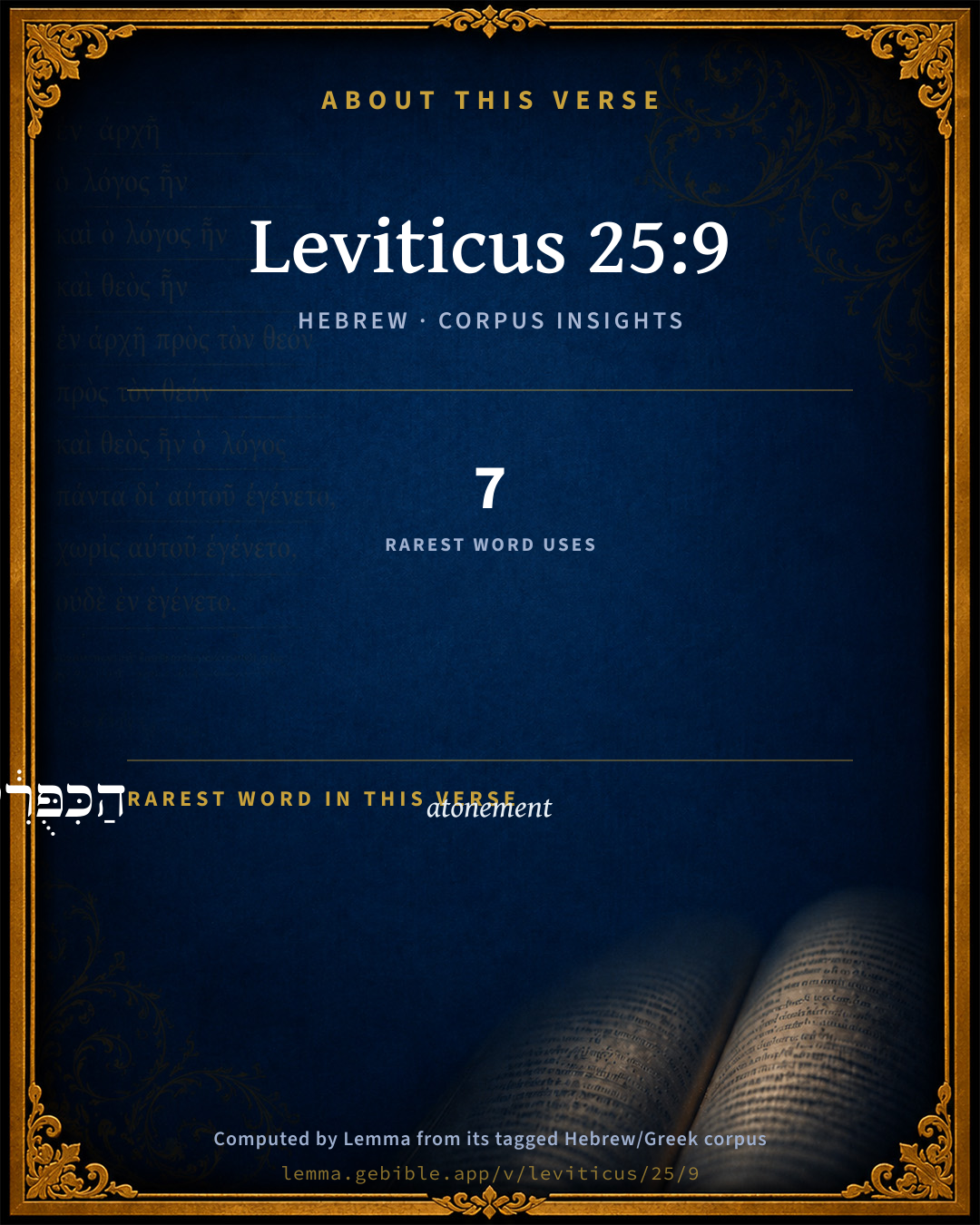
The rarest word here is הַכִּפֻּרִ֔ים atonement H3725 — appearing just 7 times in the whole Hebrew Bible.

Shared distinctive vocabulary

הַכִּפֻּרִ֔ים atonement H3725 occurs in 7 verses of the Hebrew Bible. Also found in:

Grammatical profile

  • 2 verbs
  • 10 nouns
  • 1 adjective

Verb forms

  • וְהַֽעֲבַרְתָּ֞ Hiphil · Sequential Perfect
  • תַּעֲבִ֥ירוּ Hiphil · Imperfect

Repetition

Words recur within this verse — often emphatic in Hebrew:

  • וְהַֽעֲבַרְתָּ֞ to pass over H5674 ×2
  • שׁוֹפַ֤ר horn H7782 ×2
  • בַּחֹ֣דֶשׁ month H2320 ×2

Hebrew & Septuagint length

In English translation the verse runs 29 words from the Hebrew and 43 from the Septuagint (LXX English) — the Septuagint runs noticeably longer here. See the side-by-side →

A rough comparison of the two English renderings, which tokenize alike — not a word-level alignment.

Word counts can differ between the Hebrew and the Greek without any difference in meaning — e.g. the Hebrew direct-object marker אֵת has no separate Greek word, and Greek often adds the article ὁ.

Cross-references

15

Topical passages linked to Leviticus 25:9 in the Treasury of Scripture Knowledge — connected by theme and wording, ordered by reader-vote popularity; previews shown in the World English Bible.

  • Leviticus 23:24 "Speak to the children of Israel, saying, 'In the seventh month, on the first day of the month, shall be a solemn rest to you, a memorial of blowing of trumpets, a holy convocation.
  • Leviticus 23:27 "However on the tenth day of this seventh month is the day of atonement: it shall be a holy convocation to you, and you shall afflict yourselves; and you shall offer an offering made by fire to Yahweh.
  • Leviticus 16:30 for on this day shall atonement be made for you, to cleanse you; from all your sins you shall be clean before Yahweh.
  • Leviticus 27:17 If he dedicates his field from the Year of Jubilee, according to your valuation it shall stand.
  • Leviticus 27:24 In the Year of Jubilee the field shall return to him from whom it was bought, even to him to whom the possession of the land belongs.
  • Numbers 10:10 Also in the day of your gladness, and in your set feasts, and in the beginnings of your months, you shall blow the trumpets over your burnt offerings, and over the sacrifices of your peace-offerings; and they shall be to you for a memorial before your God: I am Yahweh your God.
  • 1 Thessalonians 1:8 For from you has sounded forth the word of the Lord, not only in Macedonia and Achaia, but also in every place your faith toward God has gone forth; so that we need not to say anything.
  • Leviticus 16:20 "When he has made an end of atoning for the Holy Place, the Tent of Meeting, and the altar, he shall present the live goat.
  • Leviticus 25:10–12 You shall make the fiftieth year holy, and proclaim liberty throughout the land to all its inhabitants. It shall be a jubilee to you; and each of you shall return to his own property, and each of you shall return to his family.
  • Numbers 36:4 When the jubilee of the children of Israel shall be, then will their inheritance be added to the inheritance of the tribe whereunto they shall belong: so will their inheritance be taken away from the inheritance of the tribe of our fathers.
  • Psalms 89:15 Blessed are the people who learn to acclaim you. They walk in the light of your presence, Yahweh.
  • Acts 13:38–39 Be it known to you therefore, brothers, that through this man is proclaimed to you remission of sins,
  • Romans 10:18 But I say, didn't they hear? Yes, most assuredly, "Their sound went out into all the earth, Their words to the ends of the world."
  • Romans 15:19 in the power of signs and wonders, in the power of God's Spirit; so that from Jerusalem, and around as far as to Illyricum, I have fully preached the Gospel of Christ;
  • 2 Corinthians 5:19–21 namely, that God was in Christ reconciling the world to himself, not reckoning to them their trespasses, and having committed to us the word of reconciliation.

Cross-references courtesy of OpenBible.info (CC BY 4.0).

Hebrew and Greek witnesses Masoretic Hebrew ↔ Greek Septuagint

The same verse in the two great witnesses to the Old Testament, shown verse-for-verse.

Here the Septuagint runs noticeably longer than the Hebrew — LXX2012 (modern English Septuagint) 43 words vs World English Bible 29. A rough length comparison of the two English translations, not a word-level alignment — read both below.

These are two independent witnesses, not word-aligned to each other, and the Septuagint is shown in lemma (dictionary) form.

Hebrew Leviticus 25:9 Masoretic · Westminster Leningrad Codex

וְהַֽעֲבַרְתָּ֞ שׁוֹפַ֤ר תְּרוּעָה֙ בַּחֹ֣דֶשׁ הַשְּׁבִעִ֔י בֶּעָשׂ֖וֹר לַחֹ֑דֶשׁ בְּיוֹם֙ הַכִּפֻּרִ֔ים תַּעֲבִ֥ירוּ שׁוֹפָ֖ר בְּכָל אַרְצְכֶֽם

Then you shall sound the loud trumpet on the tenth day of the seventh month. On the Day of Atonement you shall sound the trumpet throughout all your land.

World English Bible · Public Domain

Greek LXX Leviticus 25:9 Septuagint · lemma form

καί διαἀγγέλλω σάλπιγξ φωνή ἐν πᾶς ὁ γῆ σύ ὁ μήν ὁ ἕβδομος ὁ δέκατος ὁ μήν ὁ ἡμέρα ὁ ἱλασμός διαἀγγέλλω σάλπιγξ ἐν πᾶς ὁ γῆ σύ

In the seventh month, on the tenth day of the month, you⌃ shall make a proclamation with the sound of a trumpet in all your land; on the day of atonement you⌃ shall make a proclamation with a trumpet in all your land.

LXX2012 (modern English Septuagint) · Public Domain

Hebrew: Westminster Leningrad Codex (CC BY 4.0). Greek: Septuagint (public domain); English from LXX2012 (modern English Septuagint) (Public Domain). How the Septuagint differs from the Hebrew →

Targum (Aramaic paraphrase)

2

The Targum is the ancient Jewish Aramaic paraphrase of the Hebrew Scriptures — an interpretive translation, not the Hebrew text itself. Onkelos (literal) and Pseudo-Jonathan (expansive) render the Torah, and Jonathan the Prophets. Coverage is partial: where no permissively-licensed English translation exists for a verse, only the Aramaic is shown. This is verse-level text, not a word-by-word alignment to the Hebrew.

  1. Targum Onkelos Torah (Genesis–Deuteronomy)
    וְתַעֲבַר שׁוֹפָר יַבָּבָא בְּיַרְחָא שְׁבִיעָאָה בְּעַשְׂרָא לְיַרְחָא בְּיוֹמָא דְכִפּוּרַיָא תַּעַבְרוּן שׁוֹפָרָא בְּכָל אַרְעֲכוֹן

    (no public-domain English translation for this verse)

    Targum Onkelos — Aramaic: “Onkelos Genesis” (public domain); “Onkelos Exodus” (public domain); “Onkelos Leviticus” (public domain); “Onkelos Numbers” (public domain); “Onkelos Deuteronomy” (public domain). English: “Sefaria Community Translation” (CC0 1.0 (public-domain dedication)); “J.W. Etheridge. The Targums of Onkelos and Jonathan Ben Uzziel on the Pentateuch. London: Longmans, Green, 1862” (public domain). Text via Sefaria.

  2. Targum Pseudo-Jonathan Torah (Genesis–Deuteronomy)
    וְתַעֲבַר קַל שׁוֹפָר יַבָּבָא בְּיַרְחָא שְׁבִיעָאָה בְּעַשְרָא לְיַרְחָא בְּיוֹמָא דְכִפּוּרַיָא תַּעַבְרוּן קַל שׁוֹפָר חֵירוּתָא בְּכָל אַרְעֲכוֹן

    And thou shalt make the voice of the trumpet to sound a jubilee in the seventh month, on the tenth day of the month, on the Day of the Expiations thou shalt make the voice of the trumpet of Liberty to pass through all your land.

    Targum Pseudo-Jonathan — Aramaic: “Targum Jonathan on Genesis” (public domain); “Targum Jonathan on Exodus” (public domain); “Targum Jonathan on Leviticus” (public domain); “Targum Jonathan on Numbers” (public domain); “Targum Jonathan on Deuteronomy” (public domain). English: “The Targum of Jonathan ben Uzziel, trans. J. W. Etheridge, London, 1862” (public domain). Text via Sefaria.

Commentary

Notes on Leviticus 25:9 from classic Christian and Jewish commentators (each source and its license shown beneath its notes). The classic Christian expositions comment on the surrounding passage and are grouped to its opening verse, so a note may address several verses; the Jewish commentaries on the Tanakh (Rashi and others) are per-verse, so they appear only where the commentator wrote on this verse.

Lemma curates 59 commentaries, every one of them public domain or Creative Commons licensed, each selected and text-cleaned for this edition rather than reprinted as found. About our sources →

Trapp's Complete Commentary

John Trapp

Lev 25:9 Then shalt thou cause the trumpet of the jubile to sound on the tenth [day] of the seventh month, in the day of atonement shall ye make the trumpet sound throughout all your land.

Ver. 9. In the day of atonement.] Here began the jubilee: this feast was founded in a fast. "They that sow in tears, shall reap in joy": neither is there any such comfort as theirs that have soundly soaked themselves in godly sorrow. Pardon of sin is the only foundation of all jubilees: and when God hath pardoned us, our hearts are in fittest frame to pardon others.

John Trapp, A Commentary or Exposition upon All the Books of the Old and New Testament (1647–1656) — public domain. Text from a community e-Sword module.

Joseph Benson's Commentary

Lev 25:9. Cause the trumpet of jubilee to sound — The name jubilee is taken either from the Hebrew word יובל jobel, which signifies first a ram, and then a ram’s horn by the sound whereof it was proclaimed; or from Jubal, the inventor of musical instruments, (Gen 4:21,) because it was celebrated with music and all expressions of joy. The seventh month — Which was the first month of the year for civil affairs; the jubilee therefore began in that month; and, as it seems, upon this very tenth day, when the trumpet sounded, as other feasts generally began when the trumpet sounded. In the day of atonement — A very fit time, that when they fasted and prayed for God’s mercy to them in the pardon of their sins, then they might exercise their charity to men in forgiving their debts; and to teach us, that the foundation of all solid comfort must be laid in repentance and atonement for our sins through Christ.

Joseph Benson's Commentary on the Old and New Testaments (1811–1818) — public domain. Text from a community e-Sword module.

Geneva Bible (1599)

Geneva Bible translators

In the beginning of the 50th year was the Jubilee, so called, because the joyful tidings of liberty [were] publicly proclaimed by the sound of a cornet.

Geneva Bible (1599) marginal notes — public domain. Text via Bolls.life.

Ellicott's Commentary for English Readers

(9) Cause the trumpet of the jubile to sound.—Better, cause the blast of the cornet to sound; literally, cause to resound the cornet of loud sound. According to the authorities during the second Temple, the cornets used on this occasion, like those of the Feast of Trumpets or New Year, were of rams’ horns, they were straight, and had their mouth-piece covered with gold.

In the day of atonement shall ye make the trumpet sound.—Better, In the day of atonement shall ye cause the cornet to sound. On the close of the great Day of Atonement, when the Hebrews realised that they had peace of mind, that their heavenly Father had annulled their sins, and that they had become reunited to Him through His forgiving mercy, every Israelite was called upon to proclaim throughout the land, by nine blasts of the cornet, that he too had given the soil rest, that he had freed every encumbered family estate, and that he had given liberty to every slave, who was now to rejoin his kindred. Inasmuch as God has forgiven his debts, he also is to forgive his debtors.

A Bible Commentary for English Readers, edited by Charles John Ellicott (1878–1897) — public domain. Text from a community e-Sword module.

The Cambridge Bible for Schools and Colleges

gen. ed. J. J. S. Perowne

9. The year of Jubile began on the tenth of the seventh month and was proclaimed by the sound of the trumpet. The coincidence of this ceremony with the Day of Atonement presents a difficulty to some commentators, but according to Eze_40:1 the tenth day of the month is sometimes reckoned as the first day of the year. Others would regard the words ‘in the day of atonement’ as a later insertion. Dillmann sees nothing incongruous in the trumpet sound on the Day of Atonement, and considers the reconciliation of that day as an appropriate beginning of a year in which each one acquired his liberty. Restoration to God’s favour was the preliminary to entering upon his possession. Another explanation of the text is that the trumpet sound was a note of preparation six months before the actual commencement of the Jubile in the spring—but the ceremony seems intended to usher in the actual year, and was coincident with the proclamation of liberty.

The Cambridge Bible for Schools and Colleges (gen. ed. J. J. S. Perowne; Cambridge University Press, 1878–1918) — public domain. Text from a community e-Sword module.

John Gill's Exposition

Then shall thou cause the trumpet of the jubilee to sound,.... At the end of forty nine years, or at the beginning of the fiftieth; or "the trumpet of a loud sound"; for here the word "jubilee" is not, which, according to some, was so called from the peculiar sound of the trumpet on this day, different from all others; though others, as Ben Melech, think, and the Jews commonly, that it had its name from the trumpet itself, which they suppose was made of a ram's horn, "jobel", in the Arabic language, signifying a ram; but the former reason is best; though perhaps it is best of all to derive it from "to bring back, restore, return", because at this time men were returned to their liberty, estates, and families, as hereafter expressed:

on the tenth day of the seventh month; the month Tisri or September, the first day of which was the beginning of the year for "jubilees" (s); for the computation of the jubilee year was made from the first day of the month, though the trumpet was not blown, and the rights of the year did not begin till the tenth, as Maimonides (t) observes:

in the day of atonement shall ye make the trumpet sound throughout all your land; which day of atonement was on the tenth day of the said month, and a very proper time it was to sound the trumpet, that after they had been afflicting themselves, then to have joy and comfort; and when atonement was made for all their sins, then to hear the joyful sound; and when it might be presumed they were in a good disposition to release their servants, and restore the poor to their possessions, when they themselves were favoured with the forgiveness of all their sins. This sounding was made throughout all the land of Israel; throughout all the highways, as Aben Ezra, that all might know the year of jubilee was come; and this was done by the order of the sanhedrim, as Maimonides (u) says, and who, also observes, that from the beginning of the year, to the day of atonement, servants were not released to their own houses, but did not serve their masters, nor were fields returned to their owners; but servants ate, and drank, and rejoiced, and wore garlands on their heads; and when the day of atonement came, the sanhedrim blew the trumpet, and the servants were dismissed to their houses, and fields returned to their owners.

(s) Misn. Roshhashanah, c. 1. sect. 1. (t) In Misn. ib. (u) Hilchot Shemitah Vejobel, c. 10. sect. 10, 14.

John Gill's Exposition of the Whole Bible (1746–1763) — public domain (CC PDM 1.0). Text via the HelloAO Bible API.

Matthew Poole's English Annotations

The jubilee signified the true liberty from our spiritual debts and slaveries, to be purchased by Christ, and to be published to the world by the sound of the gospel.

The seventh month was the first month of the year for civil and worldly affairs, which were mainly concerned in the jubilee, and therefore it began in that month; and, as it seems, upon this very tenth day, when the trumpet sounded, as other feasts generally began when the trumpet sounded.

In the day of atonement; a very fit time, that when they fasted and prayed for God’s mercy to them in the pardon of their sins, then they might exercise their charity and kindness to men in forgiving their debts, which is the true fast, as is noted Isa 58:6, and to teach us that the foundation of all solid comfort and joy must be laid in bitter repentance and atonement for our sins through Christ.

Matthew Poole's English Annotations on the Holy Bible (1683–1685) — public domain. Text from a community e-Sword/MySword module.

Whedon's Commentary on the Bible

Daniel D. Whedon

9. Cause the trumpet of the jubilee to sound — Literally, thou shalt cause a horn of loud clangor to pass through the land: R.V., “Send abroad the loud trumpet.” The trumpets used in the proclamation of the jubilee appear to have been curved horns, not the long, straight trumpets represented on the arch of Titus, (see illustration, Num_4:7, note,) and which, according to Hengstenberg, are the only ones represented in Egyptian sculptures and paintings. See Jos_6:4, note.

Day of atonement — See chap. 16. It does not seem likely that this great fast was disturbed by the joyful sound which, probably, burst forth in the afternoon when the high priest had concluded the solemn services of atonement. This view gives a deep significance to the jubilee, as a type of that era of gospel grace which follows the propitiatory death of the Lamb of God, the great sin offering. To avoid the incongruity of the jubilee and the great national fast on the same day, Hupfield would emend the text, so as to make the jubilee occur ten days earlier, at the feast of trumpets. See chap. xxiii, 24, note. According to Maimonides the interval of eight days between the feast of trumpets and the jubilee was a sort of saturnalia or carnival to all servants. On the tenth day the great Sanhedrin directed the trumpets to be sounded, and at that instant the bondmen became free and the lands reverted to their original owners.

All your land — We are not to suppose that one trumpet passed from place to place, sounding through all the land, but many trumpets were simultaneously sounded by the priests in all their cities, in accordance with Num_10:8. All the Jewish writers assert that trumpets were sounded extensively all over the land — in the mountains, in the streets, and at nearly every door — when the signal was given by the proper authorities, called the “House of Judgment,” or the Great Sanhedrin. The design was to reach the ear of every Hebrew who had alienated his inheritance or divested himself of liberty.

Daniel D. Whedon (gen. ed.), Commentary on the Old and New Testaments (1874–1909) — public domain. Text from a community e-Sword module.

John Wesley's Explanatory Notes

The jubilee - Signified the true liberty from our spiritual debts and slaveries to be purchased by Christ, and to be published to the world by the sound of the gospel. The seventh month - Which was the first month of the year for civil affairs; the jubilee therefore began in that month; and, as it seems, upon this very tenth day, when the trumpet sounded, as other feasts generally began when the trumpet sounded. In the day of atonement - A very fit time, that when they fasted and prayed for God's mercy to them in the pardon of their sins, then they might exercise their charity to men in forgiving their debts; and to teach us, that the foundation of all solid comfort must be laid in repentance and atonement for our sins through Christ.

John Wesley, Explanatory Notes Upon the Whole Bible (1754–1765) — public domain. Text via the GEBible commentary corpus.

Scofield Reference Notes

C. I. Scofield

seventh month

i.e. October.

atonement (See Scofield "Exo 29:33").

The Scofield Reference Bible (1917 edition), notes by C. I. Scofield — public domain. Text from a community e-Sword module.

Rashi

Rabbi Shlomo Yitzchaki (Rashi)

והעברת has the same meaning as the verb in (Exodus 36:6) “and they caused it to be proclaimed (ויעבירו קול) in the camp” — it is a term for proclamation (i. e. והעברת has not the literal meaning of causing a cornet to pass, i. e. to carry it about in the land as a symbol of freedom) (Rosh Hashanah 34a).

ביום הכפורים [ON THE TENTH DAY OF THE SEVENTH MONTH] ON THE DAY OF EXPIATION [SHALL YE CAUSE THE CORNET TO SOUND] — Since Scripture states “on the day of expiation” do I not know that it is “on the tenth day of the seventh month”? Why, then, does Scripture add “on the tenth day of the month”? But it adds these words in order to tell you: the blowing Of the שופר on the tenth day of the month sets aside the Sabbath (supersedes the Sabbath Law) throughout all your land (בכל ארצכם); whilst the blowing of the Shofar on the New Year, the first day of that month, does not supersede the Sabbath Law “throughout all your land”, but only at the law-court (בי"ד) alone (Sifra, Behar, Section 1 5; Rosh Hashanah 29b).

Rashi on the Tanakh — English translations: “The Judaica Press complete Tanach with Rashi, translated by A. J. Rosenberg” (CC BY 4.0); “Pentateuch with Rashi's commentary by M. Rosenbaum and A.M. Silbermann, 1929-1934” (public domain); “The Metsudah Tanach series, Lakewood, N.J” (CC BY 4.0); and “The Book of Joshua, Metsudah Publications, 1997” (CC BY 4.0). Text via Sefaria.

Ramban (Nachmanides)

Rabbi Moshe ben Nachman (Ramban / Nachmanides)

THEN SHALT THOU MAKE PROCLAMATION WITH THE BLAST OF THE HORN ON THE TENTH DAY OF THE SEVENTH MONTH; IN THE DAY OF ATONEMENT SHALL YE MAKE PROCLAMATION WITH THE HORN THROUGHOUT ALL YOUR LAND. “Since Scripture states in the Day of Atonement do I not know that it is on the tenth day of the seventh month? Why then does Scripture state on the tenth day? [It is to teach us that] the blowing [of the Shofar] on the tenth day of the seventh month overrides the Sabbath throughout all your Land, but the blowing [of the Shofar] on the New Year does not override the Sabbath throughout all your Land, but only at the court alone.” This is Rashi’s language.Now the Rabbi [Rashi], with his expert knowledge of the Talmud, and because it is all for him like a ready-laid table, was not concerned when he quoted Beraithoth without qualification, but they are misleading for the rest of the people [who are not as expert in the Talmud as he was]. For it is known and clear in the Gemara that all blowings of the Shofar, whether on the New Year, or the Day of Atonement [in the Jubilee year], or even [blowing] out of one’s own desire [without any intention to fulfill a commandment], are permitted on the Sabbath [by law of the Torah], since blowing [of the Shofar] is merely an art and not “work.” They used [in fact] to blow the Shofar everywhere by law of the Torah on the Sabbath of the New Year and on the Day of Atonement; and the matter of blowing the Shofar [only] at the court, was ordained by Rabban Yochanan ben Zaccai after the Temple was destroyed. This was decreed [by Rabban Yochanan ben Zaccai], because they [the Sages] prohibited the blowing of the Shofar [if the New Year fell on a Sabbath]. Since everyone is obliged to blow the Shofar [or to hear it blown, but not everyone is expert in it, thus we fear that] perhaps he will take the Shofar in his hand and go to an expert to learn, and thus he will carry it the distance of four cubits in a public thoroughfare [which is forbidden by law of the Torah on the Sabbath]; and Rabban Yochanan ben Zaccai therefore only permitted us to do it at the court [where the fear of the judges ensures that nobody will violate the Sabbath on account of the blowing of the Shofar]. There is thus no basis whatsoever for this prohibition in Scripture [and so how could Rashi interpret the verse before us on the basis of this Rabbinic enactment]? And the Rabbis, in mentioning that “the blowing of the Shofar on the tenth day [of the seventh month] overrides the Sabbath,” intended to say that it is done on every Day of Atonement [in the Jubilee year, whether it falls on a weekday or on the Sabbath]; for there is no difference between overriding the Day of Atonement when it falls on the Sabbath or when it falls on a weekday, since the Day of Atonement itself is like the Sabbath in respect of [the prohibition of] all work, whether that of carrying [an object four cubits in a public thoroughfare, or transferring it from “public” to “private” ground and vice versa], or any other kind of [forbidden] work. on the New Year is concerned, there is a clear distinction between a New Year which falls on a weekday and one which occurs on the Sabbath. In the latter case, Rabban Yochanan ben Zaccai prohibited blowing the Shofar [except at the court] lest someone may accidentally carry the Shofar and thereby transgress a law of the Torah, as explained in the text. But when the New Year falls on a weekday, there is no question of forbidding blowing the Shofar, because carrying on a festival is permitted. But on the Day of Atonement, unlike other festivals, carrying is prohibited as on the Sabbath. Thus when the Beraitha quoted by Rashi states that the blowing of the Jubilee horn was permitted on the Day of Atonement which fell on the Sabbath, this is equivalent to saying that it is permitted on every Day of Atonement, whether weekday or Sabbath. Hence the thought conveyed by the Beraitha is not as Rashi has it [that the blowing of the Jubilee overrides the Sabbath day], for as the Day of Atonement is concerned everyday of the week is like the Sabbath! Even so, the Rabbi [Rashi] wished to teach us that the blowing of the Shofar on the Day of Atonement is to be done in all places, for the meaning of the expression ye shall make proclamation with the horn throughout all your Land is to teach us that each individual is obliged to blow [or hear the sound of] the Shofar, and that the blowing is not done only at the court, as is the counting [of the years]., 23:15 that this counting is done by the court only.

Ramban (Nachmanides) on the Tanakh — English translation: “Commentary on the Torah by Ramban (Nachmanides). Translated and annotated by Charles B. Chavel. New York, Shilo Pub. House, 1971-1976” (CC BY 4.0). Text via Sefaria.

Sforno

Rabbi Ovadia Sforno

You shall make a proclamation with the shofor. This proclamation is for the rejoicing of the freedom of the slaves and the return of the fields to their owners.

Sforno on the Tanakh — English translation: “Yalkut, Sifsei Chachomim Chumash, Metsudah Publications, 2009” (CC BY 4.0). Text via Sefaria.

Lesson kit

Teaching starters — assembled from the data on this page, not authored interpretation. Every prompt links to the verse data it draws on. Edit before teaching.

Leviticus, in the Pentateuch, opens this verse with 13 words (10 distinct Hebrew lemmas). Its most distinctive word is kippur (“atonement”). The Greek Septuagint runs longer here. A historical commentator’s framing appears above. Read the whole chapter for the surrounding context.

Discussion questions

  1. How does “atonement” (kippur) shape what this verse is saying?
  2. Exodus 29:36 shares the word «atonement» with this verse. How do the two illuminate each other?
  3. “to pass over” occurs 2× in this one verse. What is the effect of the repetition?
  4. Compared with the Hebrew, the Septuagint runs longer here. What questions does that raise?
  5. These translations render this verse differently; the difference is in the English rendering, not the original. What questions does that raise?
  6. The verb «וְהַֽעֲבַרְתָּ֞» is Hiphil Sequential Perfect. How does its form color the action?
  7. Reading how Trapp's Complete Commentary and Joseph Benson's Commentary read this verse, where do the two commentators agree and where do they part?

Things to notice

  • These translations choose different wording for 12 words in this verse.
  • “to pass over” occurs 2× in this single verse.
  • 10 distinct Hebrew lemmas span 13 words in this verse.

Reading settings

Reading text

Shown beneath each verse's original-language words.

Old Testament
Old Testament edition

Read the OT as the Masoretic Hebrew (MT) or the Greek Septuagint (LXX).

English shown for the Greek Septuagint (in the Hebrew ↔ Greek comparison).

Comparing translations? Open the Compare panel on any verse page to stack up to four side by side.