
Numbers 33:3

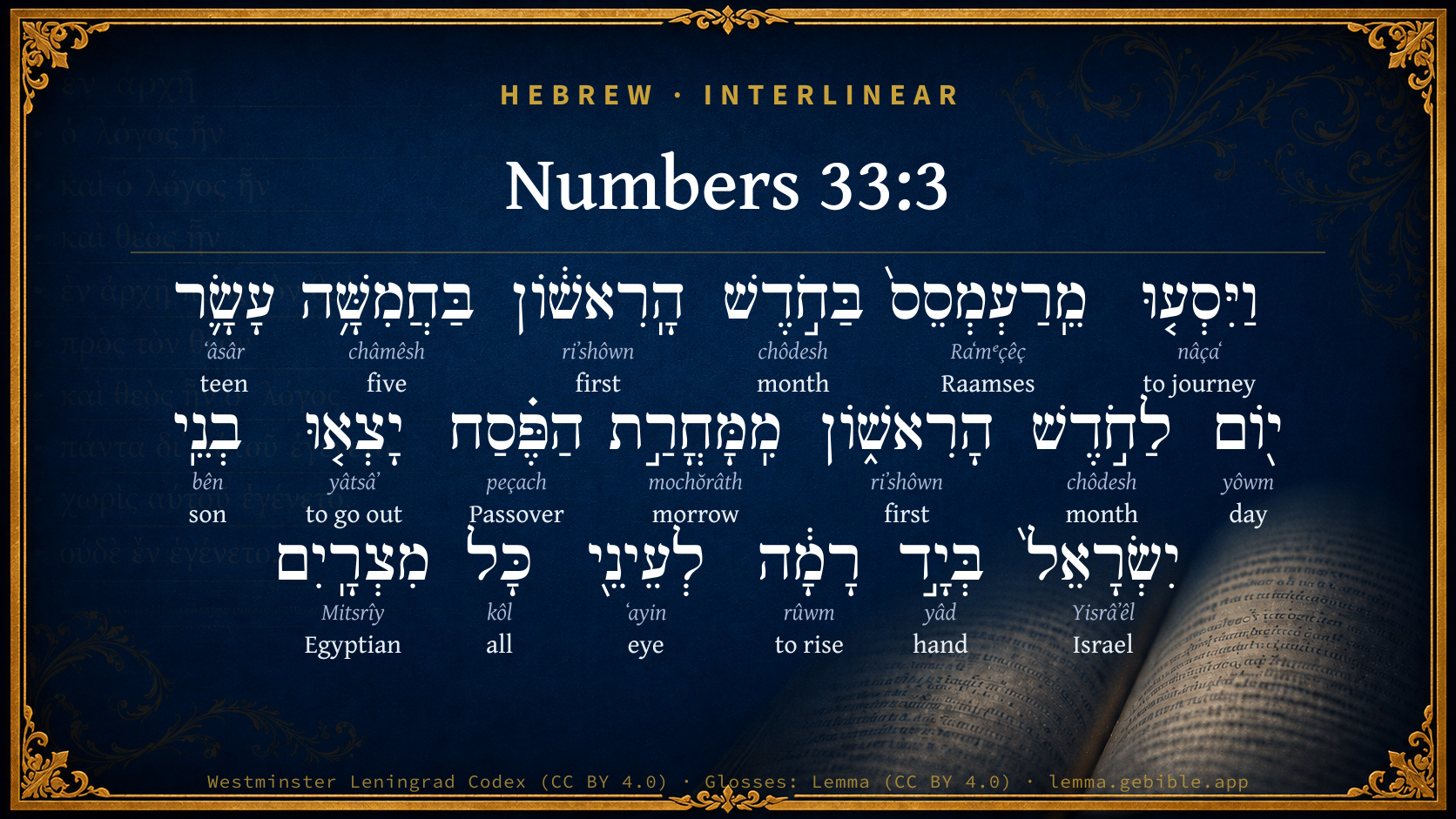
Hebrew (Westminster Leningrad Codex) Numbers 33:3 appears in the Hebrew Old Testament. The text above is from the Westminster Leningrad Codex. Each word links to its Strong’s number, a concise gloss, and parsing drawn from the Open Scriptures Hebrew Bible morphology. Click any word for its full Brown-Driver-Briggs (BDB) entry.
Download image
Cite this verse

Numbers 33:3 (World English Bible). Public Domain. Lemma interlinear Bible study tool, https://lemma.gebible.app/v/numbers/33/3.

Show BibTeX & RIS
BibTeX
RIS
English Translation
They traveled from Rameses in the first month, on the fifteenth day of the first month; on the next day after the Passover the children of Israel went out with a high hand in the sight of all the Egyptians,
World English Bible · Public Domain
Download a study sheet

One document with this verse’s original text, its word-by-word gloss line, the meaning frame, cross-references with their text, attributed commentary, and full source and license credits — printable, and it pastes into notes with its structure intact.

This verse Autodidact and up

Study sheet (.html) Plain text (.txt)

A passage Seminary Student

Up to 50 verses in one chapter. A passage sheet keeps up to 6 commentary sources and 12 cross-references per verse, in the order this page ranks them, and says so on the sheet whenever that leaves anything out. Ask for a single verse and you get the Autodidact verse sheet above.

Everything on this page stays free to read, with no account — the sheet is a download of what is already on screen, not access to it.

Want to remove ads? Support Godless Engineer
Compare translations 3

The same verse in 3 English versions, stacked beneath the original-language interlinear above. Click any original word for its lexicon entry.

Each is an independent rendering of the whole verse — the interlinear is not word-aligned to these translations.

Highlighted words mark where these versions differ — a whole-verse word diff, not a word-by-word alignment.

  • World English Bible Public Domain
    They traveled from Rameses in the first month, on the fifteenth day of the first month; on the next day after the Passover the children of Israel went out with a high hand in the sight of all the Egyptians,
  • King James Version Public Domain
    And they departed from Rameses in the first month, on the fifteenth day of the first month; on the morrow after the passover the children of Israel went out with an high hand in the sight of all the Egyptians.
  • unfoldingWord Literal Text CC BY-SA 4.0
    And they set out from Rameses on the first month, on day 15 of the first month, from the day after the Passover the sons of Israel went out with a raised hand before the eyes of all the Egyptians.

unfoldingWord Literal Text — © unfoldingWord, licensed CC BY-SA 4.0. Word-aligned USFM3 via Door43 (git.door43.org/unfoldingWord/en_ult).

Versions to compare (up to 4)

3 of 4 selected

Show all 18 translations

Every available English version of this verse, each an independent rendering of the whole verse.

  • World English Bible Public Domain
    They traveled from Rameses in the first month, on the fifteenth day of the first month; on the next day after the Passover the children of Israel went out with a high hand in the sight of all the Egyptians,
  • Berean Standard Bible Public Domain
    On the fifteenth day of the first month, on the day after the Passover, the Israelites set out from Rameses. They marched out defiantly in full view of all the Egyptians,
  • Majority Standard Bible Public Domain
    On the fifteenth day of the first month, on the day after the Passover, the Israelites set out from Rameses. They marched out defiantly in full view of all the Egyptians,
  • King James Version Public Domain
    And they departed from Rameses in the first month, on the fifteenth day of the first month; on the morrow after the passover the children of Israel went out with an high hand in the sight of all the Egyptians.
  • American Standard Version (1901) Public Domain
    And they journeyed from Rameses in the first month, on the fifteenth day of the first month; on the morrow after the passover the children of Israel went out with a high hand in the sight of all the Egyptians,
  • Revised Version (1885) Public Domain
    And they journeyed from Rameses in the first month, on the fifteenth day of the first month; on the morrow after the passover the children of Israel went out with an high hand in the sight of all the Egyptians,
  • Geneva Bible (1599) Public Domain
    Nowe they departed from Rameses the first moneth, euen the fifteenth day of the first moneth, on the morowe after the Passeouer: and the children of Israel went out with an hie hand in the sight of all the Egyptians.
  • Douay-Rheims (1899) Public Domain
    Now the children of Israel departed from Ramesses the first month, on the fifteenth day of the first month, the day after the phase, with a mighty hand, in the eight of all the Egyptians,
  • Young's Literal Translation Public Domain
    And they journey from Rameses in the first month, on the fifteenth day of the first month, on the morrow of the passover have the sons of Israel gone out with a high hand, before the eyes of all the Egyptians --
  • Literal Standard Version CC BY-SA 4.0
    And they journey from Rameses in the first month, on the fifteenth day of the first month; from the day after the Passover the sons of Israel have gone out with a high hand before the eyes of all the Egyptians—
  • Unlocked Literal Bible CC BY-SA 4.0
    They traveled from Rameses during the first month, leaving on the fifteenth day of the first month. On the morning after the Passover, the people of Israel left openly, in the sight of all the Egyptians.
  • unfoldingWord Literal Text CC BY-SA 4.0
    And they set out from Rameses on the first month, on day 15 of the first month, from the day after the Passover the sons of Israel went out with a raised hand before the eyes of all the Egyptians.
  • Darby Bible Public Domain
    They journeyed from Rameses in the first month, on the fifteenth day of the first month. On the morrow after the passover the children of Israel went out with a high hand in the sight of all the Egyptians.
  • World Messianic Bible Public Domain
    They traveled from Rameses in the first month, on the fifteenth day of the first month; on the next day after the Passover, the children of Israel went out with a high hand in the sight of all the Egyptians,
  • Webster's Bible Public Domain
    And they departed from Rameses in the first month, on the fifteenth day of the first month; on the morrow after the passover the children of Israel went out with a high hand in the sight of all the Egyptians.
  • Free Bible Version CC BY-SA 4.0
    The Israelites left Rameses on the fifteenth day of the first month, the day after the Passover. They set out in triumph as all the Egyptians watched.
  • Bible in Basic English Public Domain
    On the fifteenth day of the first month they went out from Rameses; on the day after the Passover the children of Israel went out by the power of the Lord before the eyes of all the Egyptians,
  • JPS Tanakh (1917) Public Domain
    And they journeyed from Rameses in the first month, on the fifteenth day of the first month; on the morrow after the passover the children of Israel went out with a high hand in the sight of all the Egyptians,

Literal Standard Version (2020), Covenant Press — licensed CC BY-SA 4.0. Text via the HelloAO Bible API (eBible.org). Unlocked Literal Bible (unfoldingWord) — licensed CC BY-SA 4.0. Text via the HelloAO Bible API (eBible.org). unfoldingWord Literal Text — © unfoldingWord, licensed CC BY-SA 4.0. Word-aligned USFM3 via Door43 (git.door43.org/unfoldingWord/en_ult). Free Bible Version, Dr. Jonathan Gallagher — licensed CC BY-SA 4.0. Text via the HelloAO Bible API (eBible.org).

Word by word

More ways to search: Search by grammar → Find every occurrence → Compare this word →

Practice this passage: Drill this verse → Learn its vocabulary →

מֵֽרַעְמְסֵס֙
Raʻmᵉçêç
H7486
“from · Raamses”
Preposition + Noun, Proper
Part of Speech
Preposition + Noun
Type
Proper
Full BDB Definition

Origin: of Egyptian origin

TWOT: None

Raamses or Rameses = "child of the sun" - a city in lower Egypt built by Hebrew slaves; probably in Goshen
  1. וַיִּסְע֤וּ nâçaʻ H5265 “and · to journey” Conjunction + Verb, Qal, Sequential Imperfect, 3rd Person, Masculine, Plural
  2. בַּחֹ֣דֶשׁ chôdesh H2320 “in/at the · month” Preposition, Determined + Noun, Common, Masculine, Singular, Absolute
  3. הָֽרִאשׁ֔וֹן riʼshôwn H7223 “the · first” Particle, Definite Article + Adjective, Ordinal number, Masculine, Singular, Absolute
  4. בַּחֲמִשָּׁ֥ה châmêsh H2568 “in/at the · five” Preposition, Determined + Adjective, Cardinal number, Masculine, Singular, Absolute
  5. עָשָׂ֛ר ʻâsâr H6240 “teen” Adjective, Cardinal number, Masculine, Singular, Absolute
  6. י֖וֹם yôwm H3117 “day” Noun, Common, Masculine, Singular, Absolute
  7. לַחֹ֣דֶשׁ chôdesh H2320 “to/for the · month” Preposition, Determined + Noun, Common, Masculine, Singular, Absolute
  8. הָרִאשׁ֑וֹן riʼshôwn H7223 “the · first” Particle, Definite Article + Adjective, Ordinal number, Masculine, Singular, Absolute
  9. מִֽמָּחֳרַ֣ת mochŏrâth H4283 “from · morrow of” Preposition + Noun, Common, Feminine, Singular, Construct
  10. הַפֶּ֗סַח peçach H6453 “the · Passover” Particle, Definite Article + Noun, Common, Masculine, Singular, Absolute
  11. יָצְא֤וּ yâtsâʼ H3318 “to go out” Verb, Qal, Perfect, 3rd Person, Common, Plural
  12. בְנֵֽי bên H1121 “sons of” Noun, Common, Masculine, Plural, Construct
  13. יִשְׂרָאֵל֙ Yisrâʼêl H3478 “Israel” Noun, Proper
  14. בְּיָ֣ד yâd H3027 “in/at · hand” Preposition + Noun, Common, Both, Singular, Absolute
  15. רָמָ֔ה rûwm H7311 “rising” Verb, Qal, Participle Active, Feminine, Singular, Absolute
  16. לְעֵינֵ֖י ʻayin H5869 “to/for · eyes of” Preposition + Noun, Common, Both, Dual, Construct
  17. כָּל kôl H3605 “all of” Noun, Common, Masculine, Singular, Construct
  18. מִצְרָֽיִם Mitsrîy H4713 “Egyptian” Noun, Proper

About this verse

These counts appear in no published source. They are computed here, from the morphology-tagged text and Lemma’s own curated glosses. What Lemma adds →

19
words
17
distinct lemmas
Pentateuch
section

Notable vocabulary

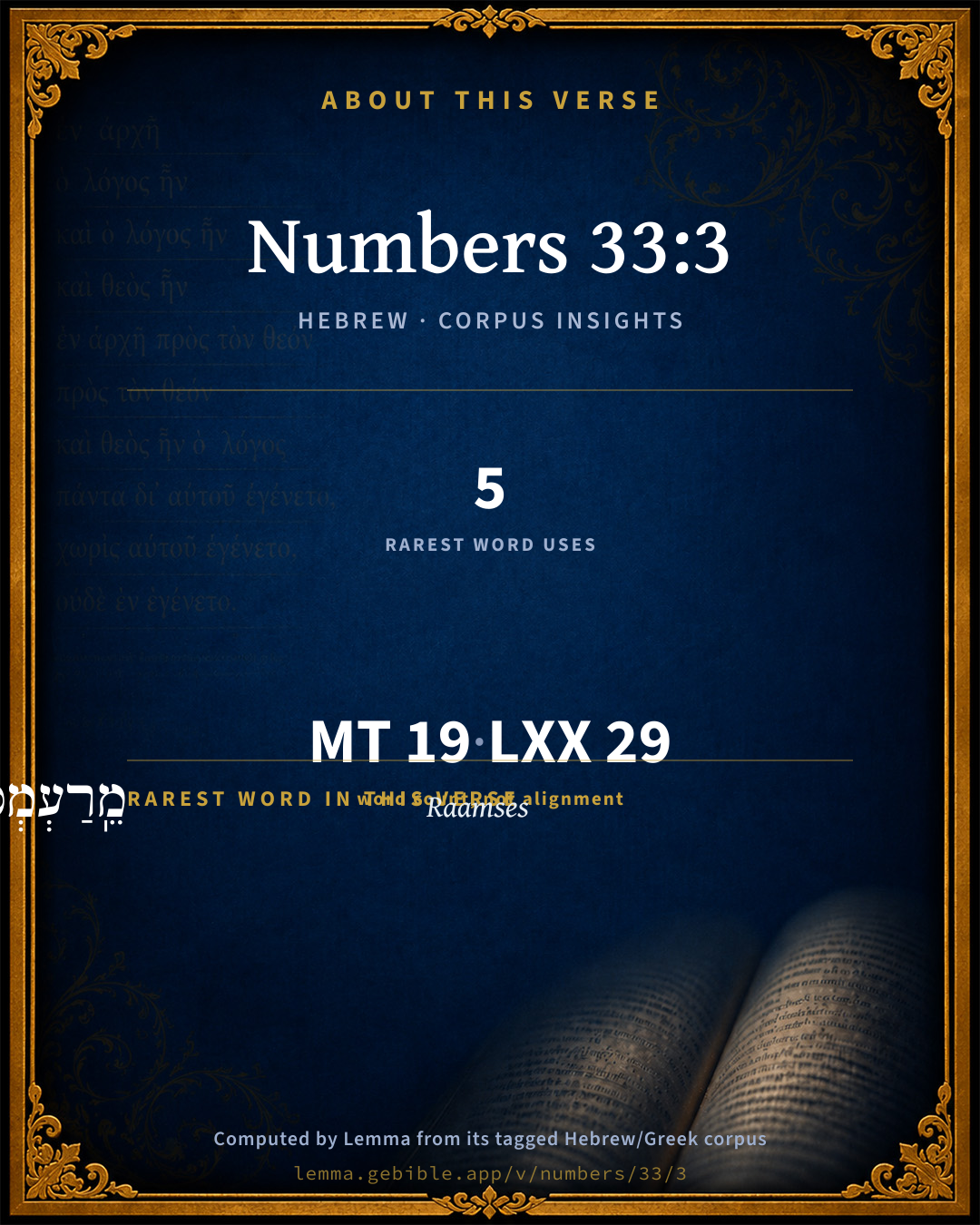
The rarest word here is מֵֽרַעְמְסֵס֙ Raamses H7486 — appearing just 5 times in the whole Hebrew Bible.

Shared distinctive vocabulary

מֵֽרַעְמְסֵס֙ Raamses H7486 occurs in 5 verses of the Hebrew Bible. Also found in:

Grammatical profile

  • 3 verbs
  • 12 nouns
  • 4 adjectives

Verb forms

  • וַיִּסְע֤וּ Qal · Sequential Imperfect
  • יָצְא֤וּ Qal · Perfect
  • רָמָ֔ה Qal · Participle Active

Repetition

Words recur within this verse — often emphatic in Hebrew:

  • בַּחֹ֣דֶשׁ month H2320 ×2
  • הָֽרִאשׁ֔וֹן first H7223 ×2

Hebrew & Septuagint length

In English translation the verse runs 40 words from the Hebrew and 36 from the Septuagint (LXX English) — closely comparable.

A rough comparison of the two English renderings, which tokenize alike — not a word-level alignment.

Word counts can differ between the Hebrew and the Greek without any difference in meaning — e.g. the Hebrew direct-object marker אֵת has no separate Greek word, and Greek often adds the article ὁ.

In the original languages it is 19 Hebrew tokens and 29 Greek tokens — but the two are counted differently (Hebrew bundles its prefixes and suffixes into one token; the Greek is in lemma form), so that isn’t a like-for-like length.

Cross-references

9

Topical passages linked to Numbers 33:3 in the Treasury of Scripture Knowledge — connected by theme and wording, ordered by reader-vote popularity; previews shown in the World English Bible.

  • Exodus 14:8 Yahweh hardened the heart of Pharaoh king of Egypt, and he pursued after the children of Israel; for the children of Israel went out with a high hand.
  • Exodus 12:37 The children of Israel traveled from Rameses to Succoth, about six hundred thousand on foot who were men, besides children.
  • Exodus 13:4 This day you go forth in the month Abib.
  • Genesis 47:11 Joseph placed his father and his brothers, and gave them a possession in the land of Egypt, in the best of the land, in the land of Rameses, as Pharaoh had commanded.
  • Exodus 12:2 "This month shall be to you the beginning of months. It shall be the first month of the year to you.
  • Psalms 105:38 Egypt was glad when they departed, For the fear of them had fallen on them.
  • Isaiah 52:12 For you shall not go out in haste, neither shall you go by flight: for Yahweh will go before you; and the God of Israel will be your rearward.
  • Micah 2:13 He who breaks open the way goes up before them. They break through the gate, and go out. And their king passes on before them, With Yahweh at their head."
  • Exodus 1:11 Therefore they set taskmasters over them to afflict them with their burdens. They built storage cities for Pharaoh: Pithom and Raamses.

Cross-references courtesy of OpenBible.info (CC BY 4.0).

Hebrew and Greek witnesses Masoretic Hebrew ↔ Greek Septuagint

The same verse in the two great witnesses to the Old Testament, shown verse-for-verse.

These are two independent witnesses, not word-aligned to each other, and the Septuagint is shown in lemma (dictionary) form.

Hebrew Numbers 33:3 Masoretic · Westminster Leningrad Codex

וַיִּסְע֤וּ מֵֽרַעְמְסֵס֙ בַּחֹ֣דֶשׁ הָֽרִאשׁ֔וֹן בַּחֲמִשָּׁ֥ה עָשָׂ֛ר י֖וֹם לַחֹ֣דֶשׁ הָרִאשׁ֑וֹן מִֽמָּחֳרַ֣ת הַפֶּ֗סַח יָצְא֤וּ בְנֵֽי יִשְׂרָאֵל֙ בְּיָ֣ד רָמָ֔ה לְעֵינֵ֖י כָּל מִצְרָֽיִם

They traveled from Rameses in the first month, on the fifteenth day of the first month; on the next day after the Passover the children of Israel went out with a high hand in the sight of all the Egyptians,

World English Bible · Public Domain

Greek LXX Numbers 33:3 Septuagint · lemma form

ἀποαἴρω ἐκ ραμεσση ὁ μήν ὁ πρῶτος ὁ πεντεκαιδέκατος ἡμέρα ὁ μήν ὁ πρῶτος ὁ ἐπαύριον ὁ πασχα ἐκἔρχομαι ὁ υἱός ἰσραήλ ἐν χείρ ὑψηλός ἐναντίον πᾶς ὁ αἰγύπτιος

They departed from Ramesses in the first month, on the fifteenth day of the first month; on the day after the passover the children of Israel went forth with a high hand before all the Egyptians.

LXX2012 (modern English Septuagint) · Public Domain

Hebrew: Westminster Leningrad Codex (CC BY 4.0). Greek: Septuagint (public domain); English from LXX2012 (modern English Septuagint) (Public Domain). How the Septuagint differs from the Hebrew →

Targum (Aramaic paraphrase)

2

The Targum is the ancient Jewish Aramaic paraphrase of the Hebrew Scriptures — an interpretive translation, not the Hebrew text itself. Onkelos (literal) and Pseudo-Jonathan (expansive) render the Torah, and Jonathan the Prophets. Coverage is partial: where no permissively-licensed English translation exists for a verse, only the Aramaic is shown. This is verse-level text, not a word-by-word alignment to the Hebrew.

  1. Targum Onkelos Torah (Genesis–Deuteronomy)
    וּנְטָלוּ מֵרַעְמְסֵס בְּיַרְחָא קַדְמָאָה בְּחַמְשָׁא עַשְׂרָא יוֹמָא לְיַרְחָא קַדְמָאָה מִבָּתַר יוֹמָא דְפִסְחָא נְפָקוּ בְנֵי יִשְרָאֵל בְּרֵישׁ גְלֵי לְעֵינֵי כָּל מִצְרָאֵי

    (no public-domain English translation for this verse)

    Targum Onkelos — Aramaic: “Onkelos Genesis” (public domain); “Onkelos Exodus” (public domain); “Onkelos Leviticus” (public domain); “Onkelos Numbers” (public domain); “Onkelos Deuteronomy” (public domain). English: “Sefaria Community Translation” (CC0 1.0 (public-domain dedication)); “J.W. Etheridge. The Targums of Onkelos and Jonathan Ben Uzziel on the Pentateuch. London: Longmans, Green, 1862” (public domain). Text via Sefaria.

  2. Targum Pseudo-Jonathan Torah (Genesis–Deuteronomy)
    וּנְטָלוּ מִן פִּילוּסִין בְּיַרְחָא דְנִיסָן בַּחֲמֵשַׁת עַסְרָא יוֹמָא לְיַרְחָא קַדְמָאָה מִבָּתַר דְאָכְלוּ נִכְסַת פִּסְחָא נְפָקוּ בְּנֵי יִשְרָאֵל בְּרֵישׁ גְלֵי לְמֵחְמֵיהוֹן דְכָל מִצְרָאֵי

    They departed from Pelusin in the month of Nisan, on the fifteenth day of the month; after they had eaten the sacrifice of the Pascha did the children of Israel go forth, with uncovered head, in sight of all the Mizraee.

    Targum Pseudo-Jonathan — Aramaic: “Targum Jonathan on Genesis” (public domain); “Targum Jonathan on Exodus” (public domain); “Targum Jonathan on Leviticus” (public domain); “Targum Jonathan on Numbers” (public domain); “Targum Jonathan on Deuteronomy” (public domain). English: “The Targum of Jonathan ben Uzziel, trans. J. W. Etheridge, London, 1862” (public domain). Text via Sefaria.

Commentary

Notes on Numbers 33:3 from classic Christian and Jewish commentators (each source and its license shown beneath its notes). The classic Christian expositions comment on the surrounding passage and are grouped to its opening verse, so a note may address several verses; the Jewish commentaries on the Tanakh (Rashi and others) are per-verse, so they appear only where the commentator wrote on this verse.

Lemma curates 59 commentaries, every one of them public domain or Creative Commons licensed, each selected and text-cleaned for this edition rather than reprinted as found. About our sources →

Joseph Benson's Commentary

Num 33:3-4. They departed from Rameses — Whither they repaired, by order of Moses, from all parts of the land. Upon their gods — Either their princes and rulers, who are sometimes called gods in Scripture; for God slew the firstborn, not only of the meaner sort, but even of their king and princes: or, their false gods, those beasts which the Egyptians worshipped as gods; for the firstborn of men and beasts were then killed. Probably their images also were thrown down, as Dagon afterward before the ark.

Joseph Benson's Commentary on the Old and New Testaments (1811–1818) — public domain. Text from a community e-Sword module.

Tyndale Open Study Notes

Tyndale Open Resources

33:3 left defiantly: See Exod 14:8.

Tyndale Open Study Notes — © Tyndale Open Resources, licensed CC BY-SA 4.0. Text via the HelloAO Bible API.

Jamieson, Fausset & Brown

Robert Jamieson, A. R. Fausset & David Brown

Rameses--generally identified with Heroopoils, now the modern Abu-Keisheid (see on Exo 12:37), which was probably the capital of Goshen, and, by direction of Moses, the place of general rendezvous previous to their departure.

Jamieson, Fausset & Brown — Commentary Critical and Explanatory on the Whole Bible (1871) — public domain (CC PDM 1.0). Text via the HelloAO Bible API.

Adam Clarke's Commentary

Verse 3. From Rameses] This appears to have been the metropolis of the land of Goshen, and the place of rendezvous whence the whole Israelitish nation set out on their journey to the promised land; and is supposed to be the same as Cairo. See Clarke on Ex 12:37.

Adam Clarke's Commentary on the Bible (1810–1826) — public domain. Text from a community e-Sword/MySword module.

Ellicott's Commentary for English Readers

(3-5) And they departed . . . —In these verses the departure from Rameses, at which place the Israelites seem to have been gathered together previously to the exodus, is related as in Exo_12:37. The places of encampment from Succoth to the wilderness of Sinai (Num_33:6-15) agree with those which are recorded in Exo_13:20 (Succoth and Etham), 14:2 (Pi-hahiroth and Migdol), 15:22 (the wilderness, i.e., of Shur), 15:23-27 (Marah and Elim), 16:1 (wilderness of Sin), 17:1 (Rephidim), except that there is no mention in Exodus of the station at the Red Sea (Num_33:10), and of the stations at Dophkah and Alush (Num_33:12-13). The first two stations named after the departure from Sinai, viz., Kibroth-hattaavah, or the graves of lust, and Hazeroth, enclosures, agree with those which are found in Num_11:34-35. The next station named in this list is Rithmah. Now, according to Num_12:16, the next encampment after Hazeroth was in the wilderness of Paran, from whence Moses, in obedience to the Divine command, sent the spies to search out the land of Canaan (Num_13:3). If, then, we compare these two accounts, and take into further consideration the fact that the Wady Abu Retemat is not far distant from Kadesh, and that, according to Robinson (I., p. 279), it abounds with the retem, or broom, and that near it there is a copious spring of water called Ain el Kudeirât, it seems reasonable to infer that the encampment at Rithmah which is recorded in this chapter is the same as that at Kadesh, “in the wilderness of Paran,” as recorded in Num_12:16. If this inference be admitted, it is reasonable to conclude further that the seventeen places of encampment which are mentioned in Num_33:19-36 between Rithmah and Kadesh are those at which the Israelites pitched their camps during the thirty-eight years of wandering in the wilderness. An apparent difficulty, however, arises on this supposition out of a comparison of Num_33:30-33 of this chapter with Deu_10:6-7, where we find mention made of four places which appear to be identical with those named in this chapter, viz., Beeroth of the children of Jaakan, Mosera, Gudgodah, and Jotbath, which correspond to Bene-jaakan, i.e., the children of Jaakan (an abbreviation, probably, of Beeroth-bene-Jaakan, i.e., the wells of the sons of Jaakan), Moseroth, the plural form of Mosera, Hor-hagidgad, i.e., the cave of Gidgad or Gudgodah, and Jotbathah, an alternative form of Jotbath. The apparent difficulty, however, of the identification arises out of the fact that whereas in this chapter the Israelites are said to have journeyed from Moseroth to Bene-jaakan, they are represented in Deu_10:6 to have journeyed “from Beeroth of the children of Jaakan to Mosera.” It is evident, however, that in Deuteronomy 10, where the account is manifestly parenthetical, the reference is to the journeys of the Israelites after the final breaking up of the encampment at Kadesh, at the expiration of the thirty-eight years of wandering in the wilderness; whereas, if the supposition stated above is correct, the reference in this chapter is to the period of the wanderings in the wilderness after the first departure from Kadesh. In this case a change in the order of encampments presents no difficulty, inasmuch as whilst the Israelites, at the later period, must, in all probability, have taken the most direct course open to them from Kadesh to Ezion-geber, there is no improbability involved in the supposition that at the earlier period, whilst wandering about in the wilderness, their places of encampment should have been determined not so much by geographical considerations as by the particular advantages which each spot presented in regard to pasturage and water. It may be observed, further that if the supposition above stated is correct, it will account for the fact that, whereas seventeen places of encampment between Rithmah and Ezion-geber are named in Num_33:19-35, no intermediate stations between Ezion-geber and Kadesh are mentioned in Num_33:36, the same places of encampment, as may reasonably be inferred, being selected (if, indeed, any formal encampments were made during so hasty a journey) on the return to Kadesh as had been previously occupied on the journey from Kadesh to Ezion-geber, which is at the northern extremity of the Elanitic Gulf.

A Bible Commentary for English Readers, edited by Charles John Ellicott (1878–1897) — public domain. Text from a community e-Sword module.

John Gill's Exposition

And they departed from Rameses,.... A city in Egypt, where the children of Israel, a little before their departure, seem to have been gathered together in a body, in order to march out all together, as they did. This place the Targum of Jonathan calls Pelusium. Dr. Shaw (a) thinks it might be Cairo, from whence they set forward; see Exo 12:37 and it was

in the first month; in the month Nisan, as the same Targum, or Abib, which was appointed the first month on this account, and answers to part of our March and April:

on the fifteenth of the first month, on the morrow after the passover; that was kept on the fourteenth, when the Lord passed over the houses of the Israelites, and slew all the firstborn in Egypt, which made way for their departure the next morning; the Egyptians being urgent upon them to be gone:

the children of Israel went out with an high hand in the sight of all the Egyptians; openly and publicly, with great courage and boldness, without any fear of their enemies; who seeing them march out, had no power to stop them, or to move their lips at them, nay, were willing to be rid of them; see Exo 11:7.

(a) Travels, p. 307. Ed. 2.

John Gill's Exposition of the Whole Bible (1746–1763) — public domain (CC PDM 1.0). Text via the HelloAO Bible API.

Haydock's Catholic Bible Commentary

Ramesses, a city of great note, about 60 miles from the Red Sea, Exodus i. 11. (Calmet)

George Leo Haydock (1774–1849), Haydock's Catholic Family Bible and Commentary, 1859 edition — public domain. Excludes Psalms (Douay-Rheims chapter numbering differs from Protestant) and Deuterocanonical books (Catholic canon only).

Matthew Poole's English Annotations

They all repaired to

Rameses by Moses’s order from all parts of the land.

In the sight of all the Egyptians. See Exo 14:8; Num 15:30.

Matthew Poole's English Annotations on the Holy Bible (1683–1685) — public domain. Text from a community e-Sword/MySword module.

Whedon's Commentary on the Bible

Daniel D. Whedon

3. Rameses — Exo_12:37, note.

First month — The event was so important that it became the beginning of a new era. Exo_12:2, note.

With a high hand — Not the armed hand of the Israelites, but the hand of the omnipotent Jehovah. The high hand of man denotes defiant sin. Chap. Num_15:30, note.

Daniel D. Whedon (gen. ed.), Commentary on the Old and New Testaments (1874–1909) — public domain. Text from a community e-Sword module.

The Pulpit Commentary

They departed from Rameses. Hebrew, Raemses. See on Exo_1:11 Exo_12:37. The brief description here given of the departure from Egypt touches upon every material circumstance as related at large in Exo_12:41. In the sight of all the Egyptians. The journey was begun by night, (Exo_12:42) but was of course con-tinned on the following day.

The Pulpit Commentary (1880–1919), ed. H.D.M. Spence-Jones & Joseph S. Exell — public domain. Text from a community e-Sword module.

Scofield Reference Notes

C. I. Scofield

first month

i.e. April.

The Scofield Reference Bible (1917 edition), notes by C. I. Scofield — public domain. Text from a community e-Sword module.

unfoldingWord translationNotes

Door43 World Missions Community

General Information:

Moses lists the places the Israelites went after they left Egypt. (See: How to Translate Names)

during the first month, leaving on the fifteenth day of the first month

Here "first" is the ordinal number one and "fifteenth" is the ordinal number fifteen. This is the first month of the Hebrew calendar. The fifteenth day is near the beginning of April on Western calendars. (See: Hebrew Months and Ordinal Numbers)

the people of Israel left openly, in the sight of all the Egyptians

"the Israelites left in plain view of the Egyptians"

their firstborn

This refers to the firstborn sons. AT: "their firstborn sons" (See: Assumed Knowledge and Implicit Information)

he also inflicted punishment on their gods

Yahweh proving that he is more powerful than all of the false gods that the Egyptians worshiped is spoken of as if Yahweh punished those false gods. AT: "he also proved that he is greater than their gods" (See: Metaphor)

translationWords

day

Passover

bury

firstborn

punish

false god

unfoldingWord translationNotes — © Distant Shores Media and the Door43 World Missions Community, licensed CC BY-SA 4.0. Source: git.door43.org/Door43/en_tn.

Lesson kit

Teaching starters — assembled from the data on this page, not authored interpretation. Every prompt links to the verse data it draws on. Edit before teaching.

Numbers, in the Pentateuch, opens this verse with 19 words (17 distinct Hebrew lemmas). Its most distinctive word is Raʻmᵉçêç (“Raamses”). A historical commentator’s framing appears above. Read the whole chapter for the surrounding context.

Discussion questions

  1. What does “Raamses” (Raʻmᵉçêç) contribute to the verse as a whole?
  2. How does Genesis 47:11, which shares the word «Raamses», read alongside this verse?
  3. What does the repetition of “month” (2× in this one verse) do in this verse?
  4. These translations render this verse differently; the difference is in the English rendering, not the original. What questions does that raise?
  5. «וַיִּסְע֤וּ» is a Qal Sequential Imperfect verb. How does that grammatical form shape the action described?
  6. Compare how Joseph Benson's Commentary and Tyndale Open Study Notes read this verse. Where do they agree or differ?

Things to notice

Reading settings

Reading text

Shown beneath each verse's original-language words.

Old Testament
Old Testament edition

Read the OT as the Masoretic Hebrew (MT) or the Greek Septuagint (LXX).

English shown for the Greek Septuagint (in the Hebrew ↔ Greek comparison).

Comparing translations? Open the Compare panel on any verse page to stack up to four side by side.