Isaiah 66:23

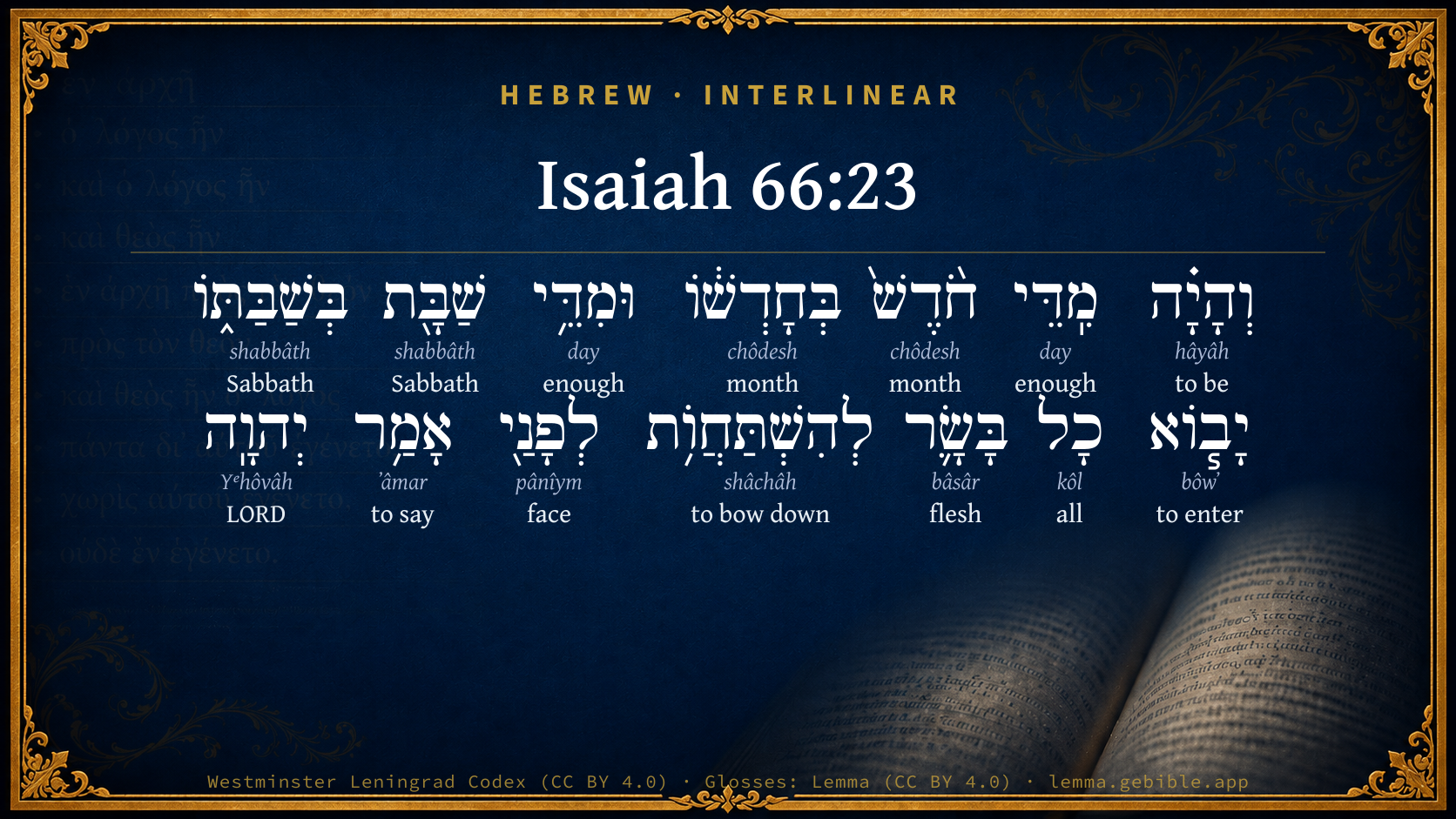
Hebrew (Westminster Leningrad Codex) Isaiah 66:23 appears in the Hebrew Old Testament. The text above is from the Westminster Leningrad Codex. Each word links to its Strong’s number, a concise gloss, and parsing drawn from the Open Scriptures Hebrew Bible morphology. Click any word for its full Brown-Driver-Briggs (BDB) entry.
Download image
Cite this verse

Isaiah 66:23 (World English Bible). Public Domain. Lemma interlinear Bible study tool, https://lemma.gebible.app/v/isaiah/66/23.

Show BibTeX & RIS
BibTeX
RIS
English Translation
It shall happen, that from one new moon to another, and from one Sabbath to another, shall all flesh come to worship before me, says Yahweh.
World English Bible · Public Domain
Download a study sheet

One document with this verse’s original text, its word-by-word gloss line, the meaning frame, cross-references with their text, attributed commentary, and full source and license credits — printable, and it pastes into notes with its structure intact.

This verse Autodidact and up

Study sheet (.html) Plain text (.txt)

A passage Seminary Student

Up to 50 verses in one chapter. A passage sheet keeps up to 6 commentary sources and 12 cross-references per verse, in the order this page ranks them, and says so on the sheet whenever that leaves anything out. Ask for a single verse and you get the Autodidact verse sheet above.

Everything on this page stays free to read, with no account — the sheet is a download of what is already on screen, not access to it.

Want to remove ads? Support Godless Engineer
Compare translations 3

The same verse in 3 English versions, stacked beneath the original-language interlinear above. Click any original word for its lexicon entry.

Each is an independent rendering of the whole verse — the interlinear is not word-aligned to these translations.

Highlighted words mark where these versions differ — a whole-verse word diff, not a word-by-word alignment.

  • World English Bible Public Domain
    It shall happen, that from one new moon to another, and from one Sabbath to another, shall all flesh come to worship before me, says Yahweh.
  • King James Version Public Domain
    And it shall come to pass, that from one new moon to another, and from one sabbath to another, shall all flesh come to worship before me, saith the LORD.
  • unfoldingWord Literal Text CC BY-SA 4.0
    And it will be, from new moon to its new moon and from Sabbath to its Sabbath, all flesh will come to bow down to my face,” says Yahweh.

unfoldingWord Literal Text — © unfoldingWord, licensed CC BY-SA 4.0. Word-aligned USFM3 via Door43 (git.door43.org/unfoldingWord/en_ult).

Versions to compare (up to 4)

3 of 4 selected

Show all 18 translations

Every available English version of this verse, each an independent rendering of the whole verse.

  • World English Bible Public Domain
    It shall happen, that from one new moon to another, and from one Sabbath to another, shall all flesh come to worship before me, says Yahweh.
  • Berean Standard Bible Public Domain
    From one New Moon to another and from one Sabbath to another, all mankind will come to worship before Me,” says the LORD.
  • Majority Standard Bible Public Domain
    From one New Moon to another and from one Sabbath to another, all mankind will come to worship before Me,” says the LORD.
  • King James Version Public Domain
    And it shall come to pass, that from one new moon to another, and from one sabbath to another, shall all flesh come to worship before me, saith the LORD.
  • American Standard Version (1901) Public Domain
    And it shall come to pass, that from one new moon to another, and from one sabbath to another, shall all flesh come to worship before me, saith Jehovah.
  • Revised Version (1885) Public Domain
    And it shall come to pass, that from one new moon to another, and from one sabbath to another, shall all flesh come to worship before me, saith the LORD.
  • Geneva Bible (1599) Public Domain
    And from moneth to moneth, and from Sabbath to Sabbath shall all flesh come to worship before me, saith the Lord.
  • Douay-Rheims (1899) Public Domain
    And there shall be month after month, and sabbath after sabbath: and all flesh shall come to adore before my face, saith the Lord.
  • Young's Literal Translation Public Domain
    And it hath been from month to month, And from sabbath to sabbath, Come do all flesh to bow themselves before Me, Said Jehovah.
  • Literal Standard Version CC BY-SA 4.0
    And it has been from month to month, || And from Sabbath to Sabbath, || All flesh come to bow themselves before Me,” said YHWH.
  • Unlocked Literal Bible CC BY-SA 4.0
    From one month to the next, and from one Sabbath to the next, all people will come to bow down to me—says Yahweh.
  • unfoldingWord Literal Text CC BY-SA 4.0
    And it will be, from new moon to its new moon and from Sabbath to its Sabbath, all flesh will come to bow down to my face,” says Yahweh.
  • Darby Bible Public Domain
    And it shall come to pass from new moon to new moon, and from sabbath to sabbath, all flesh shall come to worship before me, saith Jehovah.
  • World Messianic Bible Public Domain
    It shall happen that from one new moon to another, and from one Sabbath to another, all flesh will come to worship before me,” says the LORD.
  • Webster's Bible Public Domain
    And it shall come to pass, that from one new moon to another, and from one sabbath to another, shall all flesh come to worship before me, saith the LORD.
  • Free Bible Version CC BY-SA 4.0
    Everyone will come and worship me, from one New Moon to the next, and from one Sabbath to the next, says the Lord.
  • Bible in Basic English Public Domain
    And it will be, that from new moon to new moon, and from Sabbath to Sabbath, all flesh will come to give worship before me, says the Lord.
  • JPS Tanakh (1917) Public Domain
    And it shall come to pass, that from one new moon to another, and from one sabbath to another, shall all flesh come to worship before Me, saith the LORD.

Literal Standard Version (2020), Covenant Press — licensed CC BY-SA 4.0. Text via the HelloAO Bible API (eBible.org). Unlocked Literal Bible (unfoldingWord) — licensed CC BY-SA 4.0. Text via the HelloAO Bible API (eBible.org). unfoldingWord Literal Text — © unfoldingWord, licensed CC BY-SA 4.0. Word-aligned USFM3 via Door43 (git.door43.org/unfoldingWord/en_ult). Free Bible Version, Dr. Jonathan Gallagher — licensed CC BY-SA 4.0. Text via the HelloAO Bible API (eBible.org).

Word by word

More ways to search: Search by grammar → Find every occurrence → Compare this word →

Practice this passage: Drill this verse → Learn its vocabulary →

מִֽדֵּי
day
H1767
“from · enough of”
Preposition + Noun, Common, Masculine, Singular, Construct
Part of Speech
Preposition + Noun
Type
Common
Gender
Masculine
Number
Singular
State
Construct
Full BDB Definition

Origin: of uncertain derivation

TWOT: 425

sufficiency, enough - enough - for, according to the abundance of, out of the abundance of, as often as
  1. וְהָיָ֗ה hâyâh H1961 “and · to be” Conjunction + Verb, Qal, Sequential Perfect, 3rd Person, Masculine, Singular
  2. חֹ֨דֶשׁ֙ chôdesh H2320 “month” Noun, Common, Masculine, Singular, Absolute
  3. בְּחָדְשׁ֔וֹ chôdesh H2320 “in/at · month · his” Preposition + Noun, Common, Masculine, Singular, Construct + Suffix, Personal, 3rd Person, Masculine, Singular
  4. וּמִדֵּ֥י day H1767 “and · from · enough of” Conjunction + Preposition + Noun, Common, Masculine, Singular, Construct
  5. שַׁבָּ֖ת shabbâth H7676 “Sabbath” Noun, Common, Both, Singular, Absolute
  6. בְּשַׁבַּתּ֑וֹ shabbâth H7676 “in/at · Sabbath · his” Preposition + Noun, Common, Both, Singular, Construct + Suffix, Personal, 3rd Person, Masculine, Singular
  7. יָב֧וֹא bôwʼ H935 “to enter” Verb, Qal, Imperfect, 3rd Person, Masculine, Singular
  8. כָל kôl H3605 “all of” Noun, Common, Masculine, Singular, Construct
  9. בָּשָׂ֛ר bâsâr H1320 “flesh” Noun, Common, Masculine, Singular, Absolute
  10. לְהִשְׁתַּחֲוֺ֥ת shâchâh H7812 “to bow down” Preposition + Verb, Hithpael, Infinitive Construct
  11. לְפָנַ֖י pânîym H6440 “to/for · face(s) · my” Preposition + Noun, Common, Both, Plural, Construct + Suffix, Personal, 1st Person, Common, Singular
  12. אָמַ֥ר ʼâmar H559 “to say” Verb, Qal, Perfect, 3rd Person, Masculine, Singular
  13. יְהוָֽה Yᵉhôvâh H3068 “LORD” Noun, Proper

About this verse

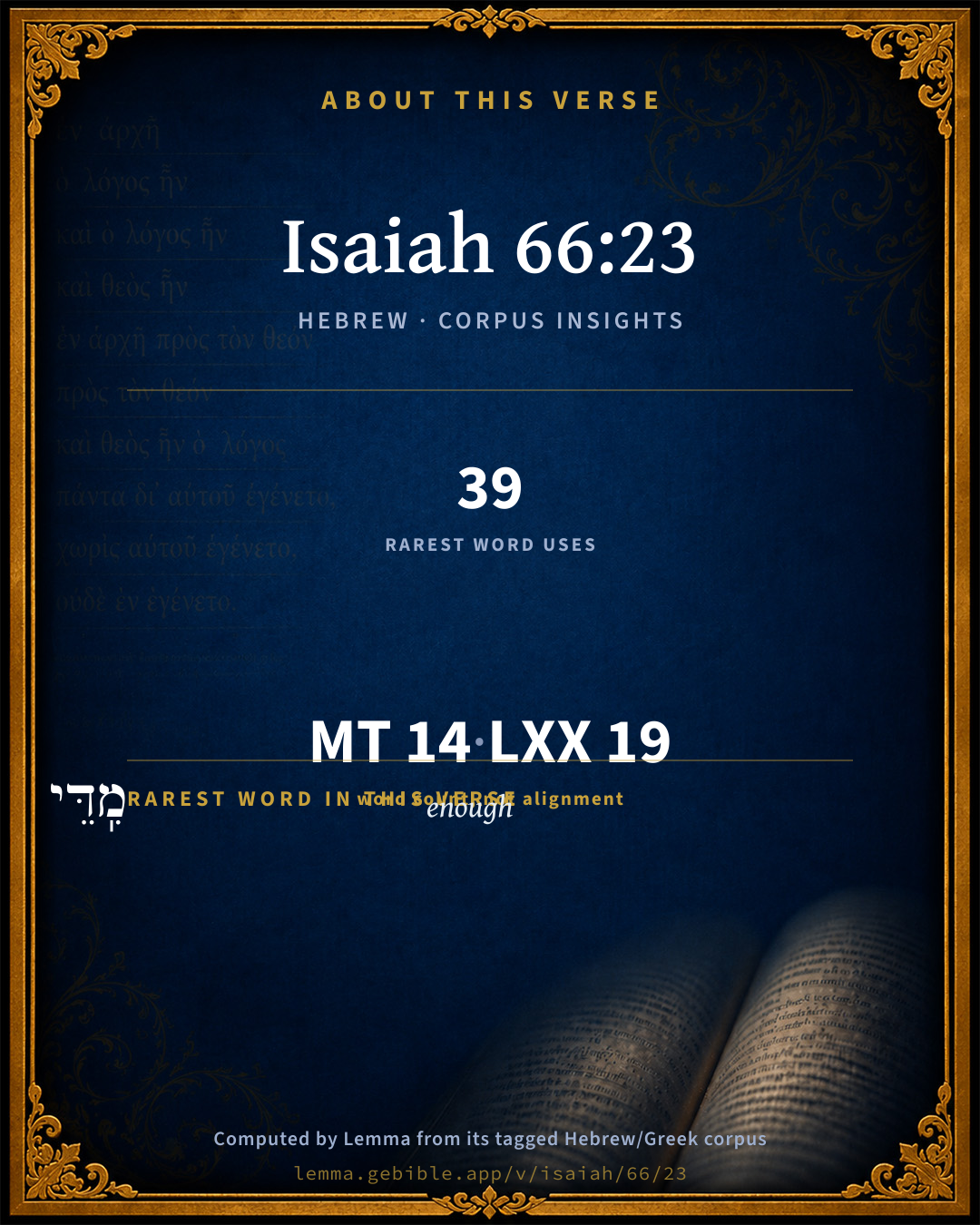
These counts appear in no published source. They are computed here, from the morphology-tagged text and Lemma’s own curated glosses. What Lemma adds →

14
words
11
distinct lemmas
Prophets
section

Shared distinctive vocabulary

מִֽדֵּי enough H1767 occurs in 35 verses of the Hebrew Bible. Also found in:

Grammatical profile

  • 4 verbs
  • 10 nouns

Verb forms

  • וְהָיָ֗ה Qal · Sequential Perfect
  • יָב֧וֹא Qal · Imperfect
  • לְהִשְׁתַּחֲוֺ֥ת Hithpael · Infinitive Construct
  • אָמַ֥ר Qal · Perfect

Repetition

Words recur within this verse — often emphatic in Hebrew:

  • מִֽדֵּי enough H1767 ×2
  • חֹ֨דֶשׁ֙ month H2320 ×2
  • שַׁבָּ֖ת Sabbath H7676 ×2

Hebrew & Septuagint length

In English translation the verse runs 26 words from the Hebrew and 29 from the Septuagint (LXX English) — closely comparable.

A rough comparison of the two English renderings, which tokenize alike — not a word-level alignment.

Word counts can differ between the Hebrew and the Greek without any difference in meaning — e.g. the Hebrew direct-object marker אֵת has no separate Greek word, and Greek often adds the article ὁ.

In the original languages it is 14 Hebrew tokens and 19 Greek tokens — but the two are counted differently (Hebrew bundles its prefixes and suffixes into one token; the Greek is in lemma form), so that isn’t a like-for-like length.

Cross-references

15

Topical passages linked to Isaiah 66:23 in the Treasury of Scripture Knowledge — connected by theme and wording, ordered by reader-vote popularity; previews shown in the World English Bible.

  • Ezekiel 46:1 Thus says the Lord Yahweh: The gate of the inner court that looks toward the east shall be shut the six working days; but on the Sabbath day it shall be opened, and on the day of the new moon it shall be opened.
  • Psalms 86:9 All nations you have made will come and worship before you, Lord. They shall glorify your name.
  • Ezekiel 46:6 On the day of the new moon it shall be a young bull without blemish, and six lambs, and a ram; they shall be without blemish:
  • Zechariah 14:16 It will happen that everyone who is left of all the nations that came against Jerusalem will go up from year to year to worship the King, Yahweh of Hosts, and to keep the feast of tents.
  • Colossians 2:16–17 Let no man therefore judge you in eating, or in drinking, or with respect to a feast day or a new moon or a Sabbath day,
  • Psalms 65:2 You who hear prayer, To you all men will come.
  • Psalms 81:3–4 Blow the trumpet at the New Moon, At the full moon, on our feast day.
  • Isaiah 1:13–14 Bring no more vain offerings. Incense is an abomination to me; New moons, Sabbaths, and convocations: I can't bear with evil assemblies.
  • Zechariah 8:20–23 Thus says Yahweh of Hosts: "Many peoples, and the inhabitants of many cities will yet come;
  • Zechariah 14:14 Judah also will fight at Jerusalem; and the wealth of all the surrounding nations will be gathered together: gold, and silver, and clothing, in great abundance.
  • Malachi 1:11 For from the rising of the sun even to the going down of the same, my name is great among the nations, and in every place incense will be offered to my name, and a pure offering: for my name is great among the nations," says Yahweh of Hosts.
  • John 4:23 But the hour comes, and now is, when the true worshippers will worship the Father in spirit and truth, for the Father seeks such to be his worshippers.
  • Revelation 15:4 Who wouldn't fear you, Lord, And glorify your name? For you only are holy. For all the nations will come and worship before you. For your righteous acts have been revealed."
  • 2 Kings 4:23 He said, Why will you go to him today? it is neither new moon nor Sabbath. She said, It shall be well.
  • Isaiah 19:21 Yahweh shall be known to Egypt, and the Egyptians shall know Yahweh in that day; yes, they shall worship with sacrifice and offering, and shall vow a vow to Yahweh, and shall perform it.

Cross-references courtesy of OpenBible.info (CC BY 4.0).

Hebrew and Greek witnesses Masoretic Hebrew ↔ Greek Septuagint

The same verse in the two great witnesses to the Old Testament, shown verse-for-verse.

These are two independent witnesses, not word-aligned to each other, and the Septuagint is shown in lemma (dictionary) form.

Hebrew Isaiah 66:23 Masoretic · Westminster Leningrad Codex

וְהָיָ֗ה מִֽדֵּי חֹ֨דֶשׁ֙ בְּחָדְשׁ֔וֹ וּמִדֵּ֥י שַׁבָּ֖ת בְּשַׁבַּתּ֑וֹ יָב֧וֹא כָל בָּשָׂ֛ר לְהִשְׁתַּחֲוֺ֥ת לְפָנַ֖י אָמַ֥ר יְהוָֽה

It shall happen, that from one new moon to another, and from one Sabbath to another, shall all flesh come to worship before me, says Yahweh.

World English Bible · Public Domain

Greek LXX Isaiah 66:23 Septuagint · lemma form

καί εἰμί μήν ἐκ μήν καί σάββατον ἐκ σάββατον ἥκω πᾶς σάρξ ἐνώπιον ἐγώ προςκυνέω ἐν ἰερουσαλήμ εἶπον κύριος

And it shall come to pass from month to month, and from sabbath to sabbath, that all flesh shall come to worship before me in Jerusalem, says the Lord.

LXX2012 (modern English Septuagint) · Public Domain

Hebrew: Westminster Leningrad Codex (CC BY 4.0). Greek: Septuagint (public domain); English from LXX2012 (modern English Septuagint) (Public Domain). How the Septuagint differs from the Hebrew →

Targum (Aramaic paraphrase)

1

The Targum is the ancient Jewish Aramaic paraphrase of the Hebrew Scriptures — an interpretive translation, not the Hebrew text itself. Onkelos (literal) and Pseudo-Jonathan (expansive) render the Torah, and Jonathan the Prophets. Coverage is partial: where no permissively-licensed English translation exists for a verse, only the Aramaic is shown. This is verse-level text, not a word-by-word alignment to the Hebrew.

  1. Targum Jonathan Prophets (Joshua–Malachi)
    וִיהֵי בִּזְמַן רֵישׁ יְרַח בִּירַח וּבִזְמַן שַׁבָּא בְּשַׁבָּא יֵיתוּן כָּל בִּשְׂרָא לְמִסְגַד קֳדָמַי אֲמַר יְיָ:

    And it shall come to pass at the time of the beginning of each month, and at the time of each Sabbath, that all flesh shall come to worship before me, saith the Lord.

    Targum Jonathan — Aramaic: “Mikraot Gedolot” (public domain). English: “Sefaria Community Translation” (CC0 1.0 (public-domain dedication)); “London "Chaldee Paraphrase," 1871” (public domain). Text via Sefaria.

Commentary

Notes on Isaiah 66:23 from classic Christian and Jewish commentators (each source and its license shown beneath its notes). The classic Christian expositions comment on the surrounding passage and are grouped to its opening verse, so a note may address several verses; the Jewish commentaries on the Tanakh (Rashi and others) are per-verse, so they appear only where the commentator wrote on this verse.

Lemma curates 59 commentaries, every one of them public domain or Creative Commons licensed, each selected and text-cleaned for this edition rather than reprinted as found. About our sources →

Trapp's Complete Commentary

John Trapp

Isa 66:23 And it shall come to pass, [that] from one new moon to another, and from one sabbath to another, shall all flesh come to worship before me, saith the LORD.

Ver. 23. And it shall come to pass, that from one new moon to another.] God shall be served with all diligence and delight. In the kingdom of Christ here, but especially in heaven, it shall be holiday all the week, as we say; a constant solemnity, a perpetual Sabbath. King Edgar ordained that the Lord’s day should be kept here in England from Saturday nine of the clock till Monday morning. {a} The Ebionites kept the Saturday with the Jews, and the Sunday with the Christians. But here it is foretold - and we see it fulfilled - that all flesh, i.e., all the faithful, whether Jews or Gentiles, shall not only keep every day holiday, {1Co 5:8} by resting from sin and rejoicing in God, but shall also, both "in season and out of season," have their Church meetings for holy services, worshipping God - from day to day, and from month to month, as the phrase is {Est 3:7} - in spirit and in truth, and having the continual feast of a good conscience.

{a} Acts and Mon.

John Trapp, A Commentary or Exposition upon All the Books of the Old and New Testament (1647–1656) — public domain. Text from a community e-Sword module.

Jamieson, Fausset & Brown

Robert Jamieson, A. R. Fausset & David Brown

Literally, "As often as the new moon (shall be) in its own new moon," that is, every month (Zac 14:16).

sabbath--which is therefore perpetually obligatory on earth.

all flesh-- (Psa 65:2; Psa 72:11).

before me--at Jerusalem (Jer 3:16-17).

Jamieson, Fausset & Brown — Commentary Critical and Explanatory on the Whole Bible (1871) — public domain (CC PDM 1.0). Text via the HelloAO Bible API.

Ellicott's Commentary for English Readers

(23) From one new moon to another . . .—Under the Mosaic law Israelites were bound, at least in theory, to attend the temple at the three great feasts. In the new Jerusalem, as the prophet thought of it, the pilgrimages would be both more frequent and more universal. Every sabbath and new moon would witness not Israel only, but “all flesh,” thronging into the courts of the temple. It lies in the nature of the case that the words never have received, and never can receive, a literal fulfilment. The true realisation is found in the new Jerusalem of Rev_21:22-27, of the perpetual sabbatism of Heb_4:9, and even that glorious vision is but the symbol of spiritual realities.

A Bible Commentary for English Readers, edited by Charles John Ellicott (1878–1897) — public domain. Text from a community e-Sword module.

The Cambridge Bible for Schools and Colleges

gen. ed. J. J. S. Perowne

23. Comp. Zec_14:16. from one new moon to another, &c.] Lit. “as often as (ch. Isa_28:19) there is a new-moon on its new-moon &c.,” i.e. apparently “at each separate new-moon &c.,”—a peculiar idiom found also in Num_28:10; Num_28:14.

23, 24. Month by month and week by week all flesh shall come to Jerusalem to worship, while the dead bodies of the rebellious Israelites shall remain as a fearful spectacle and an abhorring to all flesh.

The Cambridge Bible for Schools and Colleges (gen. ed. J. J. S. Perowne; Cambridge University Press, 1878–1918) — public domain. Text from a community e-Sword module.

John Gill's Exposition

And it shall come to pass, that from one new moon to another,.... Or, "from month in its months" (q),

The Targum is,

"in the time of the beginning of the "month in its month";''

that is, in every day of the month; or rather every month:

and from one sabbath to another; the form of expressions the same as before; and in like manner paraphrased in the Targum; and signifies either every day in the week; or rather every sabbath, or first day in the week; for we are not to imagine that new moons and Jewish sabbaths, that is, seventh day sabbaths, shall now be observed, which have been long abolished, Col 2:16 but, as New Testament officers of churches are, in the preceding verses, called by Old Testament names; so here the times and seasons of Gospel worship are expressed in Old Testament language; and the sense is, that the people of Christ and members of churches, in the latter day, shall constantly attend church meetings; shall assemble together every month to celebrate the Lord's supper; and every Lord's day, to hear the word, pray and sing praises together; hereby enjoying much spiritual peace and rest, and increasing in evangelical light, signified by the new moons and sabbaths; and especially this will have a fuller accomplishment in the New Jerusalem state, when there will be a perfect sabbatism, which now remains for the people of God, and when their light will be exceeding great and glorious; and so the Jews (r) interpret this of the world to come, which is all sabbath or rest; that is, from all toil and labour, from sin and sorrow, from Satan's temptations, and the world's persecutions; but not from the worship and service of God; though that will be in a different and more perfect manner than now it is; as follows:

all flesh shall come to worship before me, saith the Lord; that is, men of all nations, and persons of each sex; not Jews only, and their males, as formerly, but men and women; not every individual, but all that will be converted, which will be many, shall come to the places of public worship, where the saints meet together for that purpose, and join together in it; and this they shall do continually and without intermission, as the first Christians did, Act 2:42. The Talmud (s) interprets this of such whose heart is become as flesh; see Eze 36:26 these shall not only worship in the presence of God, and in the view of him the omniscient God, and by his assistance, and to his glory; but him himself, Father, Son, and Spirit, with reverence and devotion, in spirit and in truth, and that constantly, in the New Jerusalem, and ultimate glory, in the utmost perfection and purity.

(q) "a tempore mensis in mense ejus"; Montanus; "de mense in mensem suum", Forerius. (r) Midrash Tillim in Psal. xc. 15. apud Galatia de Arcan, Cathol. Ver. l. 11. c. 8. p. 691. (s) T. Bab. Sota, fol. 5. 1.

John Gill's Exposition of the Whole Bible (1746–1763) — public domain (CC PDM 1.0). Text via the HelloAO Bible API.

Albert Barnes' Notes on the Bible

And it shall come to pass - As the prophet closes the book and winds up his whole prophecy, he directs the attention to that future period which had occupied so much of his attention in vision, when the whole world should be acquainted with the true religion, and all nations should worship Yahweh. Of such a book there could be no more appropriate close; and such a contemplation especially became the last prophetic moments of the ‘evangelical prophet’ Isaiah.

From one new moon to another - Margin, ‘New moon to his new moon.’ The Hebrew literally is, ‘As often as the month cometh in its month;’ that is, in its time, every month, every new moon (Gesenius, Lexicon, on the word מדי midēy). The Hebrews held a festival on the return of each month, or at every new moon (see the notes at Isa 1:14). A similar prophecy occurs in Zec 14:16 : ‘And it shall come to pass, that every one that is left of all the nations which came up against Jerusalem, shall even go up from year to year to worship the King, the Lord of hosts, and to keep the feast of tabernacles.’ In regard to the meaning of this, it is evident that it cannot be taken literally. In the nature of things it would be impossible for all nations to go literally before Yahweh in Jerusalem once a month, or once a year, to worship. It must then be meant that at periodical seasons, all the human family would worship Yahweh. The festivals of the new moon, the feast of tabernacles, and the sabbaths, were the set time among the Hebrews for the worship of God; and the idea is, that on set times, or at regularly recurring intervals, the worship of God would yet be celebrated in all lands. I see no evidence, therefore, that this means that there should be established on the earth the habit of meeting for prayer, or for the worship of God once a month - anymore than the passage above quoted from Zechariah proves that a feast like that of tabernacles would be celebrated once a year. But the idea is clear, that the time would come when Yahweh would be worshipped regularly and periodically everywhere; that in all nations his worship would be established in a manner similar in some respects to that which prevailed among his people in ancient times.

And from one Sabbath to another - (Compare the notes at Isa 58:13-14). There can be no permanent worship of God, and no permanent religion on earth, without a Sabbath; and hence it was, that while the observance of the feasts of tabernacles, and of the Passover, and of the new moons, made a part of the ceremonial law, the law respecting the sabbaths was incorporated with the ten commandments as of moral and perpetual obligation; and it will be literally true that all the race shall yet be brought to worship God on the return of that holy day. It was instituted in paradise; and as one design of the plan of redemption is to bring man back to the state in which he was in paradise, so one effect of the true religion everywhere will be, and is, to make people reverence the Sabbath of the Lord. No man becomes truly pious who does not love the holy Sabbath. No nation ever has been, or ever can be converted which will not, and which does not, love and observe that day. Every successful effort to propagate the true religion is a successful effort to extend the practice of observing it; and just as certain as it is that Christianity will be spread around the world, so cerrain will it be that the Sabbath will be observed in all lands. The period is, therefore, yet to arrive when the delightful spectacle will be presented of all the nations of the earth bowing on the return of that day before the living God. The plans of this life will be suspended; toil and care will be laid aside; and the sun, as he rolls around the world, will rouse nation after nation to the worship of the true God; and the peace and order and loveliness of the Christian Sabbath will spread over all the hills and vales of the world. Who that loves the race will not desire that such a period may soon come? Who can wonder that Isaiah should have fixed his eye in the close of his prophetic labors on a scene so full of loveliness, and so replete with honor to God, and with goodwill to people?

Shall all flesh - All the human family, all nations - a most unequivocal promise that the true religion shall yet prevail around the world.

Come to worship before me - That is, they shall assemble for the worship of God in their respective places of devotion.

Albert Barnes' Notes on the Bible (1834–1885) — public domain. Text from a community e-Sword/MySword module.

Haydock's Catholic Bible Commentary

Sabbath. Grotius explains this of the Gentiles, who should come to Jerusalem. But this was never realized before the propagation of the gospel. The Jews came thrice a-year. Christians shall attend the sacred mysteries every week, Exodus xiii. 14., and Malachias i. 11.

George Leo Haydock (1774–1849), Haydock's Catholic Family Bible and Commentary, 1859 edition — public domain. Excludes Psalms (Douay-Rheims chapter numbering differs from Protestant) and Deuterocanonical books (Catholic canon only).

Matthew Poole's English Annotations

In the gospel church there shall be as constant and settled a course of worship (though of another nature) as ever was in the Jewish church. Christians are not bound to keep the Jewish sabbath or new moons, Ga 4 10,11; Col 2:16; but New Testament worship is often expressed by Old Testament phrases. The Jews were only obliged to appear three times in a year at Jerusalem, but (saith the prophet) the gospel church shall worship God from one

sabbath to another.

Matthew Poole's English Annotations on the Holy Bible (1683–1685) — public domain. Text from a community e-Sword/MySword module.

Whedon's Commentary on the Bible

Daniel D. Whedon

23. From one new moon to another — Literally, as often as the moon cometh in its month, in its time every month, at which time a festival (of the new moon) was held.

All flesh — That is, all nations, shall come up to worship, as if at Jerusalem. Of course this is figurative. The prophet does not cease to be a Jew, to talk in Jewish costume, and to the comprehension of his own times. These new-moon festivals are not such as God hated in Isa_1:13, because in those far future times to which they refer their original intent will be observed. The meaning clearly is, that millions over the earth will statedly and habitually be truly observant of the purposes and services of a living, spiritual Christianity. The sabbath will be observed, and God will be worshipped “in spirit and in truth.” The divine ordinances will be sacredly attended to, and institutions for practical good to the world will be kept perpetually established.

Daniel D. Whedon (gen. ed.), Commentary on the Old and New Testaments (1874–1909) — public domain. Text from a community e-Sword module.

The Pulpit Commentary

From one new moon to another, and from one sabbath to another. Not that "new moons" and "sabbaths" will continue to be observed, for "new moons" have already lapsed, and "sabbaths" too will lapse when life is one perpetual sabbath passed in the worship of God. The phrase, used by the prophet is intended to express absolute continuance without an interval. Shall all flesh come to worship before me. (comp. Psa_65:2) The prophet still uses habitual modes of expression, though speaking of a time and circumstances to which they are no longer appropriate. "The literal meaning," as Dr. Pusey says ("Prophecy of Jesus," p. 39), "was physically impossible." "All flesh," in all regions of the "newearth," could not worship in one spot, "and so it was plain that Isaiah spoke of a worship other than that at any given place of a worship such as that whereof our Lord spoke to the Samaritan woman, "Woman, believe me, the hour cometh, when ye shall neither in this mountain, nor in Jerusalem, worship the Father". (Joh_4:21)

The universal worship.

"From one sabbath to another, shall a flesh come to worship before me, saith the Lord.

I IN MEETING TOGETHER FOR PUBLIC WORSHIP WE FOLLOW THE NATURAL IMPULSE OF OUR OWN HEARTS, AS WELL AS OBEY THE COMMANDMENTS OF OUR GOD. To look up and pray is one of the most original and essential impulses of humanity, one of the commonest characteristics of the race. Prayer is properly associated with the whole circle of our relations with God. As spirits we are God"s children, and God"s erring, wilful children; we must find expression for our conscious need of spiritual blessings. Our bodies are the Divine creation, the care of Divine Providence, and out of the sense of the relation of our bodily life to God we are impelled to pray for temporal blessings. We are set in close associations one with another, as families; and as those having similar preferences and convictions; out of such relations come our united family and sanctuary worship. There are even larger associations into which we enter as fellow-citizens, fellow-countrymen, fellow-men. Our welfare in all these relationships directly depends on him who is Lord of natural laws, Lord of storms, Lord of pestilences, Lord of harvests, Lord of sunshine, Lord of the wrath of men, and Lord of their wealth. So far as we feel this aright we shall be impelled to say to every fellow-creature, made in the image of God, and made for God even as we are, "O come, let us worship and bow down: let us kneel before the Lord our Maker." We have not to seek for reasons that may prove persuasions to worship. What men have to seek for is excuse for their neglect of the universal worship. It is not sufficiently recognized that God deals with us collectively here on earth. We have no reason for assuming that there are separate churches in heaven; or organized families; or towns with local interests; or nations with national interests and national characteristics. These are all earthly conditions; and in these conditions is laid the basis for collective prayer, for public and united worship. The man that refuses to unite in public worship is breaking away from the claims of his common humanity; refusing to recognize the conditions under which God has placed him; and withholding the sympathy which his fellow-creatures have a right to demand from him. Further, it may be shown that in meeting for public or universal worship, we do but follow the indications that have been given us of the Divine will. In Jewish history great importance attached to large national gatherings for acts of worship. From the time of the great meeting between the Mounts Ebal and Gerizim down to the times of Messiah, there were three great religious meetings of the people every year, besides occasional special gatherings. The Jewish service included praise and prayer, in which the whole people might unite. The best men, such as David, turned from the joys of private devotion to the yet higher joys of God"s house and worship. Our Lord set the example of private prayer, but the evangelists are careful to remind us that "he went, as he was wont, into the synagogue on the sabbath day." And the apostles urge the early Christians "not to forsake the assembling of themselves together.

II IN NEGLECTING PUBLIC WORSHIP WE HAVE TO DELUDE OURSELVES BY MAKING VERY UNWORTHY EXCUSES. TO put our reasons out into the light, to get them fairly expressed, is to make us feel ashamed of them. Some incline to say, "Your worship is not intended for us; it is meant only for those whom you call specially Christians, and we do not call ourselves by that name." Our worshipping arrangements have certainly been made on this principle; but the worship of God is for men, all men, everywhere. Whether men agree with our ideas or not, let them come and worship the God that made them, clothes them, feeds them, cares for them, loves them, and would save them from their sins. Perhaps most of those who stay away from worship do so in sheer heedlessness; they yield to the indifference which settles down on men who are simply living to self and sin. The real evil is that sinful man is indisposed to worship; the only shrine be cares for is the shrine of ease and self-indulgence. We must try to make God more real to men, and so get the persuasion of his love as the constraint, urging men to offer to him their "gold, frankincense, and myrrh." We must try to make the services of our sanctuaries more suitable for the expression of the universal dependence and the universal praise. Christian worship should be the best possible medium for lifting up the hearts of men, as men, unto God; the best utterance of the universal sense of the Divine Creator-hood. It should be man"s acknowledgment of God, our God, the one God, the holy God, the redeeming God. It is "he that hath made us, and not we ourselves." It is he that "redeemeth our life from destruction." It is even he "that sent his Son into the world, that we might live through him." "Let us kneels" let us all kneel together, "before the Lord our Maker. R.T.

The Pulpit Commentary (1880–1919), ed. H.D.M. Spence-Jones & Joseph S. Exell — public domain. Text from a community e-Sword module.

John Wesley's Explanatory Notes

And, &c. - In the gospel-church there shall be as constant and settled a course of worship (though of another nature) as ever was in the Jewish church: Christians are not bound to keep the Jewish sabbaths or new-moons. But New Testament worship is expressed by Old Testament phrases. The Jews were only obliged to appear three times in a year at Jerusalem, but (saith the prophet) the gospel-church shall worship God from one sabbath to another.

John Wesley, Explanatory Notes Upon the Whole Bible (1754–1765) — public domain. Text via the GEBible commentary corpus.

Keil & Delitzsch

C. F. Keil & F. Delitzsch

"And it will come to pass: from new moon to new moon, and from Sabbath to Sabbath, all flesh will come, to worship before me, saith Jehovah." New moons and Sabbaths will still be celebrated therefore; and the difference is simply this, that just as all Israel once assembled in Jerusalem at the three great feasts, all flesh now journey to Jerusalem every new moon and every Sabbath. דּי (construct דּי) signifies that which suffices, then that which is plentiful (see Isa 40:16), that which is due or fitting, so that (שׁבת) חדשׁ מדּי (with a temporal, not an explanatory min, as Gesenius supposes) signifies "from the time when, or as often as what is befitting to the new moon (or Sabbath) occurs" (cf., Isa 28:19). If (בשׁבת) בחדשׁ be added, בּ is that of exchange: as often as new moon (Sabbath) for new moon (Sabbath) is befitting, i.e., ought to occur: Sa1 7:16; Zac 14:16 (cf., Sa1 1:7; Kg1 10:25; Ch1 27:1 : "year by year," "month by month"). When we find (בּשׁבּתּו) בּחדשׁו as we do here, the meaning is, "as often as it has to occur on one new moon (or Sabbath) after the other," i.e., in the periodical succession of one after another. At the same time it might be interpreted in accordance with Kg1 8:59, בּיומו יום דּבר, which does not mean the obligation of one day after the other, but rather "of a day on the fitting day" (cf., Num 28:10, Num 28:14), although the meaning of change and not of a series might be sustained in the passage before us by the suffixless mode of expression which occurs in connection with it.

Keil & Delitzsch — Biblical Commentary on the Old Testament (1861–1891) — public domain (CC PDM 1.0). Text via the HelloAO Bible API. (Old Testament only.)

J. A. Alexander on Isaiah

Joseph Addison Alexander

“And it shall be (or come to pass) that from new-moon to new-moon (or on every new moon), and from sabbath to sabbath (or on every sabbath), shall come all flesh to bow themselves (or worship) before me, saith Jehovah.” The form of expression in the first clause is so idiomatic and peculiar that it does not admit of an exact translation. A slavish copy of the original would be, ‘from the sufficiency of new moon in its new moon and from the sufficiency of sabbath in its sabbath.’ For the usage of the Hebrew phrase, see above, on Isa 28:19. It sometimes stands where we should say ‘as often as’ (Sam 18:30; 1Ki 14:28). Although the form is so peculiar, there is no doubt as to the essential meaning, viz. from new moon to new moon, or at every new moon. At these stated periods of public worship under the old economy (those of most frequent recurrence being specified) ‘all flesh shall come up to worship before me.’ There is no more need of excluding Jerusalem from one verse than the other, since the Prophet, in accordance with his constant practice, speaks of the emancipated church in language borrowed from her state of bondage; and that this form of expression is a natural one, may be inferred from the facility with which it is perpetuated in the common parlance of the church and of religion, the Jerusalem or Zion of our prayers and hymns being perfectly identical with that of the prophecy before us. Thus understood, the verse is a prediction of the general diffusion of the true religion with its stated observances and solemn forms.

Joseph Addison Alexander, The Prophecies of Isaiah (1846–1847; New York: Scribner, 1870–1878) — public domain. Text from a community e-Sword module.

Ibn Ezra

Rabbi Abraham ibn Ezra

מדי חדש Whenever new moon will be. מדי has nearly the same meaning as בכל עת whenever (Est. 5:13). Comp. מדי עברו whenever he passed (2 Kings 4:8).

חדש בחדשו a new moon on the day appointed for it. Comp. דבר יום ביומו the task of every day on the day appointed for it (Ex. 5:13). From this verse the ancients derived that the wicked had to suffer the future punishment for twelve months; they explain the word מדי to signify one year. The meaning of מדי שבת בשבתו I have explained in my commentary on the chapter concerning the seven weeks. 25:1-13. The words מדי שבת בשבתו are explained in neither of the two passages. I. E. is perhaps of opinion that the expression שבת, used here by the prophet, includes also the festivals, and he refers therefore to his remark on Lev. 23:11, in which he proves that the word שבת in the phrase ממחרת השבת refers to the first day of Passover.

Ibn Ezra on the Tanakh — English translations: “Sefaria Community Translation” (CC0 1.0 (public-domain dedication)); “Yalkut, Sifsei Chachomim Chumash, Metsudah Publications, 2009” (CC BY 4.0); and “Commentary of Ibn Ezra on Isaiah - trans. by M. Friedlander, 1873” (public domain). Text via Sefaria.

Lesson kit

Teaching starters — assembled from the data on this page, not authored interpretation. Every prompt links to the verse data it draws on. Edit before teaching.

Isaiah, in the Prophets, opens this verse with 14 words (11 distinct Hebrew lemmas). Its most distinctive word is day (“enough”). A historical commentator’s framing appears above. Read the whole chapter for the surrounding context.

Discussion questions

  1. The word day carries the sense “enough.” How does it shape the verse?
  2. Exodus 36:5 shares the word «enough» with this verse. How do the two illuminate each other?
  3. “enough” occurs 2× in this one verse. What is the effect of the repetition?
  4. These translations render this verse differently; the difference is in the English rendering, not the original. What questions does that raise?
  5. The verb «וְהָיָ֗ה» is Qal Sequential Perfect. How does its form color the action?
  6. Reading how Trapp's Complete Commentary and Jamieson, Fausset & Brown read this verse, where do the two commentators agree and where do they part?

Things to notice

Reading settings

Reading text

Shown beneath each verse's original-language words.

Old Testament
Old Testament edition

Read the OT as the Masoretic Hebrew (MT) or the Greek Septuagint (LXX).

English shown for the Greek Septuagint (in the Hebrew ↔ Greek comparison).

Comparing translations? Open the Compare panel on any verse page to stack up to four side by side.