
Ezra 6:19

Hebrew (Westminster Leningrad Codex) Ezra 6:19 appears in the Hebrew Old Testament. The text above is from the Westminster Leningrad Codex. Each word links to its Strong’s number, a concise gloss, and parsing drawn from the Open Scriptures Hebrew Bible morphology. Click any word for its full Brown-Driver-Briggs (BDB) entry.
Download image
Cite this verse

Ezra 6:19 (World English Bible). Public Domain. Lemma interlinear Bible study tool, https://lemma.gebible.app/v/ezra/6/19.

Show BibTeX & RIS
BibTeX
RIS
English Translation
The children of the captivity kept the Passover on the fourteenth [day] of the first month.
World English Bible · Public Domain
Download a study sheet

One document with this verse’s original text, its word-by-word gloss line, the meaning frame, cross-references with their text, attributed commentary, and full source and license credits — printable, and it pastes into notes with its structure intact.

This verse Autodidact and up

Study sheet (.html) Plain text (.txt)

A passage Seminary Student

Up to 50 verses in one chapter. A passage sheet keeps up to 6 commentary sources and 12 cross-references per verse, in the order this page ranks them, and says so on the sheet whenever that leaves anything out. Ask for a single verse and you get the Autodidact verse sheet above.

Everything on this page stays free to read, with no account — the sheet is a download of what is already on screen, not access to it.

Want to remove ads? Support Godless Engineer
Compare translations 3

The same verse in 3 English versions, stacked beneath the original-language interlinear above. Click any original word for its lexicon entry.

Each is an independent rendering of the whole verse — the interlinear is not word-aligned to these translations.

Highlighted words mark where these versions differ — a whole-verse word diff, not a word-by-word alignment.

  • World English Bible Public Domain
    The children of the captivity kept the Passover on the fourteenth [day] of the first month.
  • King James Version Public Domain
    And the children of the captivity kept the passover upon the fourteenth day of the first month.
  • unfoldingWord Literal Text CC BY-SA 4.0
    So the sons of the exile performed the Passover on day 14 of the first month.

unfoldingWord Literal Text — © unfoldingWord, licensed CC BY-SA 4.0. Word-aligned USFM3 via Door43 (git.door43.org/unfoldingWord/en_ult).

Versions to compare (up to 4)

3 of 4 selected

Show all 18 translations

Every available English version of this verse, each an independent rendering of the whole verse.

  • World English Bible Public Domain
    The children of the captivity kept the Passover on the fourteenth [day] of the first month.
  • Berean Standard Bible Public Domain
    On the fourteenth day of the first month, the exiles kept the Passover.
  • Majority Standard Bible Public Domain
    On the fourteenth day of the first month, the exiles kept the Passover.
  • King James Version Public Domain
    And the children of the captivity kept the passover upon the fourteenth day of the first month.
  • American Standard Version (1901) Public Domain
    And the children of the captivity kept the passover upon the fourteenth `day' of the first month.
  • Revised Version (1885) Public Domain
    And the children of the captivity kept the passover upon the fourteenth day of the first month.
  • Geneva Bible (1599) Public Domain
    And the childre of the captiuitie kept the Passeouer on ye fourtenth day of the first moneth.
  • Douay-Rheims (1899) Public Domain
    And the children of Israel of the captivity kept the phase, 0 on the fourteenth day of the first month.
  • Young's Literal Translation Public Domain
    And the sons of the captivity make the passover on the fourteenth of the first month,
  • Literal Standard Version CC BY-SA 4.0
    And the sons of the captivity make the Passover on the fourteenth of the first month,
  • Unlocked Literal Bible CC BY-SA 4.0
    So those who had been in exile celebrated the Passover on the fourteenth day of the first month.
  • unfoldingWord Literal Text CC BY-SA 4.0
    So the sons of the exile performed the Passover on day 14 of the first month.
  • Darby Bible Public Domain
    And the children of the captivity held the passover upon the fourteenth of the first month.
  • World Messianic Bible Public Domain
    The children of the captivity kept the Passover on the fourteenth day of the first month.
  • Webster's Bible Public Domain
    And the children of the captivity kept the passover upon the fourteenth day of the first month.
  • Free Bible Version CC BY-SA 4.0
    The exiles who had returned observed the Passover on the fourteenth day of the first month.
  • Bible in Basic English Public Domain
    And the children of Israel who had come back kept the Passover on the fourteenth day of the first month.
  • JPS Tanakh (1917) Public Domain
    And the children of the captivity kept the passover upon the fourteenth day of the first month.

Literal Standard Version (2020), Covenant Press — licensed CC BY-SA 4.0. Text via the HelloAO Bible API (eBible.org). Unlocked Literal Bible (unfoldingWord) — licensed CC BY-SA 4.0. Text via the HelloAO Bible API (eBible.org). unfoldingWord Literal Text — © unfoldingWord, licensed CC BY-SA 4.0. Word-aligned USFM3 via Door43 (git.door43.org/unfoldingWord/en_ult). Free Bible Version, Dr. Jonathan Gallagher — licensed CC BY-SA 4.0. Text via the HelloAO Bible API (eBible.org).

Word by word

More ways to search: Search by grammar → Find every occurrence → Compare this word →

Practice this passage: Drill this verse → Learn its vocabulary →

הַגּוֹלָ֖ה
gôwlâh
H1473
“the · exile”
Particle, Definite Article + Noun, Common, Feminine, Singular, Absolute
Part of Speech
Particle + Noun
Type
Common
Gender
Feminine
Number
Singular
State
Absolute
Full BDB Definition

Origin: active participle of H1540

TWOT: 350a

exiles, exile, captivity - exiles (collective) - exile, captivity (abstract)
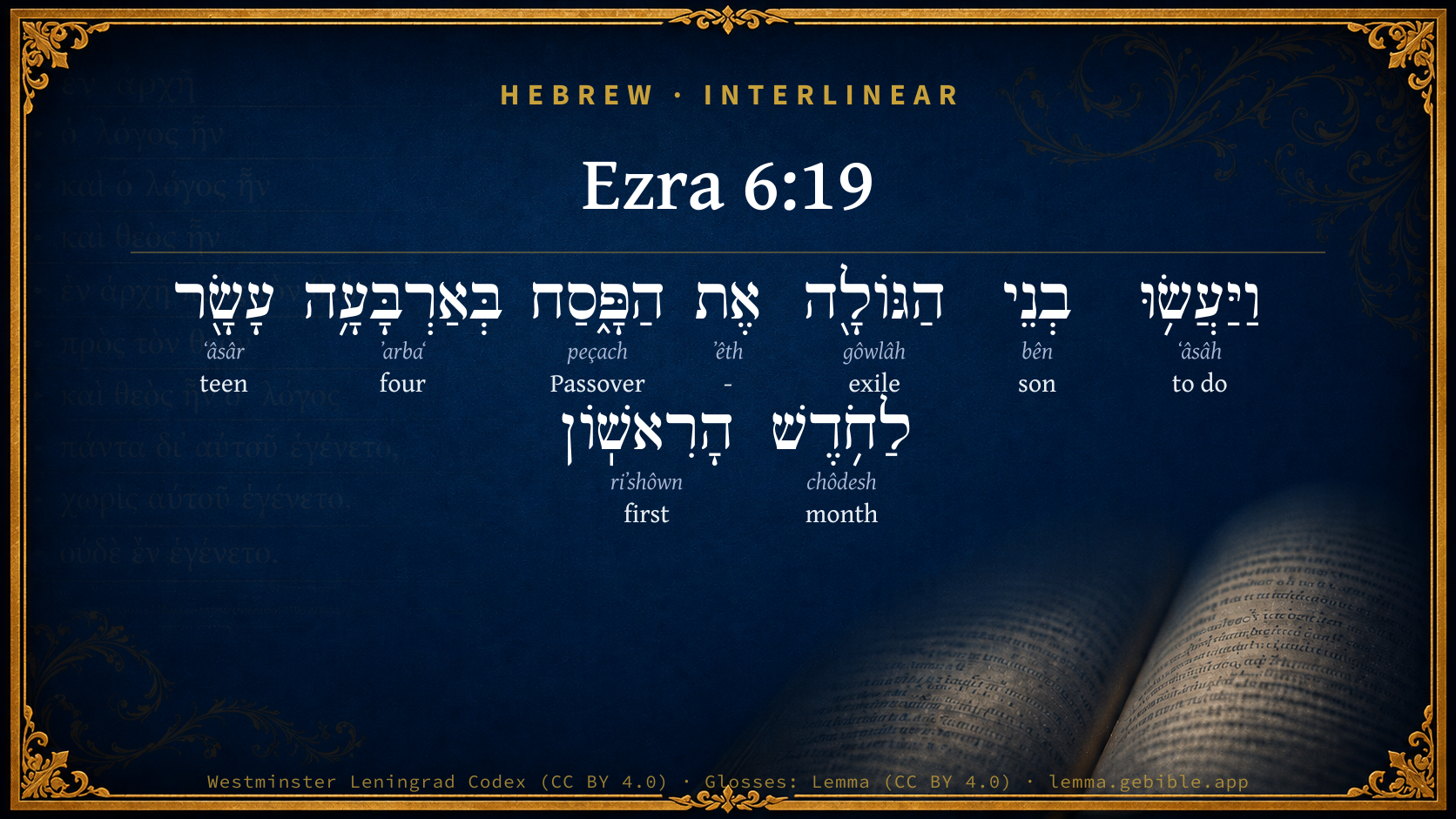
  1. וַיַּעֲשׂ֥וּ ʻâsâh H6213 “and · to do” Conjunction + Verb, Qal, Sequential Imperfect, 3rd Person, Masculine, Plural
  2. בְנֵי bên H1121 “sons of” Noun, Common, Masculine, Plural, Construct
  3. אֶת ʼêth H853 “-” Particle, Direct Object
  4. הַפָּ֑סַח peçach H6453 “the · Passover” Particle, Definite Article + Noun, Common, Masculine, Singular, Absolute
  5. בְּאַרְבָּעָ֥ה ʼarbaʻ H702 “in/at · four” Preposition + Adjective, Cardinal number, Masculine, Singular, Absolute
  6. עָשָׂ֖ר ʻâsâr H6240 “teen” Adjective, Cardinal number, Masculine, Singular, Absolute
  7. לַחֹ֥דֶשׁ chôdesh H2320 “to/for the · month” Preposition, Determined + Noun, Common, Masculine, Singular, Absolute
  8. הָרִאשֽׁוֹן riʼshôwn H7223 “the · first” Particle, Definite Article + Adjective, Ordinal number, Masculine, Singular, Absolute

About this verse

These counts appear in no published source. They are computed here, from the morphology-tagged text and Lemma’s own curated glosses. What Lemma adds →

9
words
9
distinct lemmas
Historical
section

Shared distinctive vocabulary

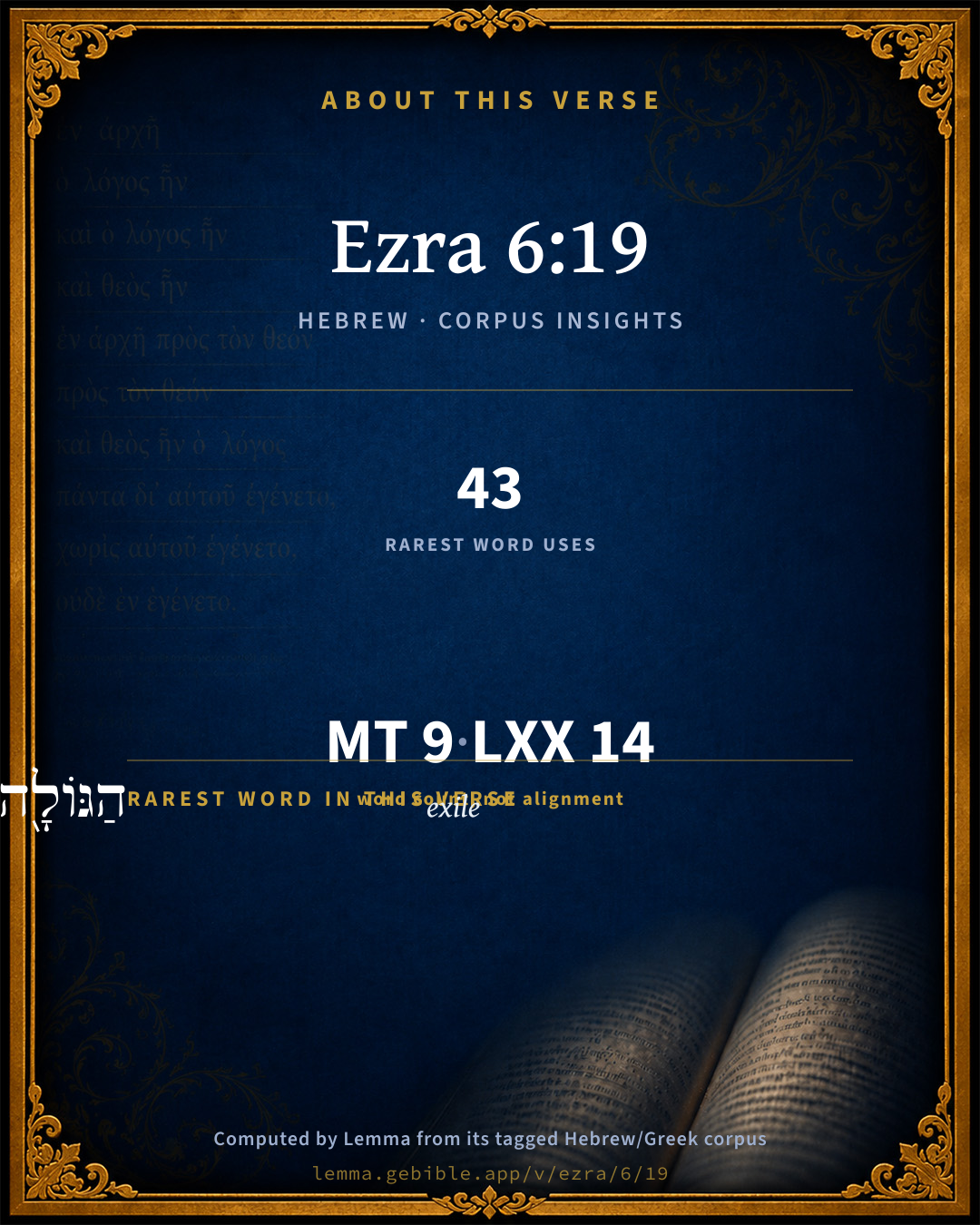
הַגּוֹלָ֖ה exile H1473 occurs in 42 verses of the Hebrew Bible. Also found in:

Grammatical profile

  • 1 verb
  • 4 nouns
  • 3 adjectives
  • 1 particle

Verb forms

  • וַיַּעֲשׂ֥וּ Qal · Sequential Imperfect

Hebrew & Septuagint length

In English translation the verse runs 16 words from the Hebrew and 17 from the Septuagint (LXX English) — closely comparable.

A rough comparison of the two English renderings, which tokenize alike — not a word-level alignment.

Word counts can differ between the Hebrew and the Greek without any difference in meaning — e.g. the Hebrew direct-object marker אֵת has no separate Greek word, and Greek often adds the article ὁ.

In the original languages it is 9 Hebrew tokens and 14 Greek tokens — but the two are counted differently (Hebrew bundles its prefixes and suffixes into one token; the Greek is in lemma form), so that isn’t a like-for-like length.

Cross-references

3

Topical passages linked to Ezra 6:19 in the Treasury of Scripture Knowledge — connected by theme and wording, ordered by reader-vote popularity; previews shown in the World English Bible.

  • Exodus 12:6–36 and you shall keep it until the fourteenth day of the same month; and the whole assembly of the congregation of Israel shall kill it at evening.
  • Joshua 5:10 The children of Israel encamped in Gilgal; and they kept the Passover on the fourteenth day of the month at even in the plains of Jericho.
  • 2 Chronicles 30:1–27 Hezekiah sent to all Israel and Judah, and wrote letters also to Ephraim and Manasseh, that they should come to the house of Yahweh at Jerusalem, to keep the Passover to Yahweh, the God of Israel.

Cross-references courtesy of OpenBible.info (CC BY 4.0).

Hebrew and Greek witnesses Masoretic Hebrew ↔ Greek Septuagint

The same verse in the two great witnesses to the Old Testament, shown verse-for-verse.

These are two independent witnesses, not word-aligned to each other, and the Septuagint is shown in lemma (dictionary) form.

Hebrew Ezra 6:19 Masoretic · Westminster Leningrad Codex

וַיַּעֲשׂ֥וּ בְנֵי הַגּוֹלָ֖ה אֶת הַפָּ֑סַח בְּאַרְבָּעָ֥ה עָשָׂ֖ר לַחֹ֥דֶשׁ הָרִאשֽׁוֹן

The children of the captivity kept the Passover on the fourteenth [day] of the first month.

World English Bible · Public Domain

Greek LXX Ezra 6:19 Septuagint · lemma form

καί ποιέω ὁ υἱός ὁ ἀποικεσία ὁ πασχα ὁ οςτεσσαρεσκαιδέκατ ὁ μήν ὁ πρῶτος

And the children of the captivity kept the passover on the fourteenth day of the first month.

LXX2012 (modern English Septuagint) · Public Domain

In the Septuagint this is one book — Esdras B (2 Esdras): Ezra is chapters 1–10, Nehemiah 11–23.

Hebrew: Westminster Leningrad Codex (CC BY 4.0). Greek: Septuagint (public domain); English from LXX2012 (modern English Septuagint) (Public Domain). How the Septuagint differs from the Hebrew →

Commentary

Notes on Ezra 6:19 from classic Christian and Jewish commentators (each source and its license shown beneath its notes). The classic Christian expositions comment on the surrounding passage and are grouped to its opening verse, so a note may address several verses; the Jewish commentaries on the Tanakh (Rashi and others) are per-verse, so they appear only where the commentator wrote on this verse.

Lemma curates 59 commentaries, every one of them public domain or Creative Commons licensed, each selected and text-cleaned for this edition rather than reprinted as found. About our sources →

Trapp's Complete Commentary

John Trapp

Ezr 6:19 And the children of the captivity kept the passover upon the fourteenth [day] of the first month.

Ver. 19. And the children of the captivity] So the returned captives are called, first, to keep still afoot the remembrance of their late misery, lest they should despise the chastening of the Lord, Heb 12:5. Secondly, to remind them of that signal mercy of their return to their own country. Hence doth the evangelist Matthew so oft mention their transportation to Babylon, and rings it in the ears of his ungrateful countrymen, Mat 1:11-12; Mat 1:17.

Kept the passover] In remembrance, that the punishing angel passed over their ancestors in Egypt, Exo 12:12-14, and for confirmation of their faith in Christ, the true paschal Lamb. Hast thou escaped a danger? offer a passover. Hath Christ delivered thee from the wrath to come? keep the feast with the unleavened bread of sincerity and truth 1Co 5:8.

Upon the fourteenth day of the first month] See Exo 12:2, with the note.

John Trapp, A Commentary or Exposition upon All the Books of the Old and New Testament (1647–1656) — public domain. Text from a community e-Sword module.

Joseph Benson's Commentary

Ezr 6:19. And the children, of the captivity kept the passover — Now they were newly delivered out of their bondage in Babylon, it was seasonable to commemorate their deliverance out of their bondage in Egypt. Fresh mercies should put us in mind of former mercies. We may suppose that they had kept the passover, after a sort, every year since their return; for they had an altar and a tabernacle. But they were liable to frequent disturbances from their enemies, were straitened for room, and had not conveniences about them, so that they could not do it with due solemnity, till the temple was built; and now they made a joyful festival of it, it falling out in the next month after the temple was finished and dedicated.

Joseph Benson's Commentary on the Old and New Testaments (1811–1818) — public domain. Text from a community e-Sword module.

Whedon's Commentary on the Bible

Daniel D. Whedon

THE PASSOVER OBSERVED, Ezr_6:19-22.

19. The fourteenth day — The day of old appointed for the killing of the paschal lamb. Exo_12:6.

The first month — Nisan, which followed immediately after Adar. Compare Ezr_6:15. The year is not mentioned, but it was, doubtless, the very next month after the feast of dedication, which the writer had just described. As Israel improved the first opportunity after they entered Canaan to celebrate the passover, (Jos_5:10,) so now they do the same at the earliest opportunity after they have returned from exile and finished the house of God. Then the reproach of Egypt had just been rolled away, (Jos_5:9,) now the reproach of Babylon had ceased.

Daniel D. Whedon (gen. ed.), Commentary on the Old and New Testaments (1874–1909) — public domain. Text from a community e-Sword module.

The Pulpit Commentary

CELEBRATION OF THE PASSOVER IN THE ENSUING MONTH, AND OBSERVANCE OF THE FEAST OF UNLEAVENED BREAD. (Ezr_6:19-22) Specially solemn passovers were celebrated on specially solemn occasions; and these received special record at the hands of the sacred writers. Of this kind are the passover celebrated By Hezekiah in the year B.C. 726, recorded in 2Ch 30, and that celebrated by Josiah in B.C. 624, recorded in 2Ch 35. Both of these followed upon a cleansing of the temple, and restoration of the temple worship after a period of suspension. Ezra seems to place the passover of B.C. 516 in the same category. It marked the period of the full re-establishment of the regular ordinances of religion, more or less interrupted from the time of the destruction of the temple by Nebuchadnezzar. It terminated the abnormal and commenced the normal condition of things. Perhaps it is to mark this, that Ezra at this point disuses the Chaldee dialect, which he had introduced in ch. 4:8, and returns to the Hebrew, the established language of the Jewish religion. Upon the fourteenth day of the first month. The day fixed by the law of Moses. (see Exo_12:6)

HOMILIES BY J.A. MACDONALD Vers. 19-22.

The passover.

Six memorable passovers are mentioned in Old Testament Scripture. The first was in Egypt. (Ex 12) The second in the wilderness. (Nu 11) The third at Gilgal. (Jos 5) The fourth in the days of Hezekiah. (2Ch 30) The fifth in the eighteenth year of Josiah. (2Ki 23) The sixth is that here mentioned. The subject is distributed into two parts:

I THE FEAST. This also is distributed into two parts.

1. The passover proper.

(1) This was held "upon the fourteenth day of the first month." This was the anniversary of the night before the departure of the children of Israel from Egypt, when the angel who destroyed the first-born of the Egyptians passed over the Israelites, who were protected by the blood of a slaughtered lamb.

(2) What an expressive type of the protection we derive through the sprinkling of the blood of Christ! (see 1Co_5:7) The very time of the death of Jesus was indicated in this date. He suffered not only in the first month and on the fourteenth day, but also "between the evenings". (Mat_27:46)

2. The feast of unleavened bread,

(1) Scrupulous care was taken that no leaven should be found in their dwellings. Leaven is a salt and sour matter which is put into dough to ferment the mass for bread, and is also of a putrefying nature. Its exclusion by the ancient Israelite expressed his aversion to the abominations of the Egyptians from which he was delivered. (Exo_12:17 Exo_13:3) These Jews would associate with the abominations of Egypt those of Babylon from which they were now delivered.

(2) The Eucharist is our feast of unleavened bread. Those who partake of this should put away all leaven of heresy. (Mat_16:16) All notorious and scandalous living. (1Co_5:6, 1Co_5:7) All malice and wickedness of the heart. (1Co_1:8)

3. The feast was kept with joy.

(1) With the joy ordinarily fitting to such an occasion. They kept it "seven days, and therefore with its "holy convocations" on the first and last days. Holy convocations to godly persons are essentially joyous. They anticipate the convocation in the heavens.

(2) But they had special reason for rejoicing. "For the Lord had made them joyful by turning the heart of the king of Assyria unto them to strengthen their hands," etc. The Persian monarchs are here collectively called the "king of Assyria" because they were rulers over the ancient Assyrian territory. (Note May not this suggest the key to many prophecies which evidently relate in their fuller expression to the latter times, in which names of ancient kingdoms are still used?) The finishing of their temple was an occasion of great joy. There is no joy to be compared with that which the Lord makes for us.

II THE PREPARATION.

1. The priests were purified, and the Levites were all of them pure. The state of things was now as it had been in the days of Hezekiah, when the passover had to be held in the second month because the priests had not sufficiently sanctified themselves to hold it at the more proper time. (2Ch_30:3) Note When the spiritual temple is complete the priests and Levites the saints of God will be all morally pure.

2. All the children of the captivity were pure.

(1) This is evident from the fact that the passover was killed for them all (ver. 20). The second passover was instituted to meet the case of those who through ceremonial uncleanness were incapable of taking the first. (see Num_9:6-11) Here there was no need of a second, for the whole nation was ceremonially clean. This was a very remarkable circumstance, and shows what a wonderful providence was over their families, for a dead body in a house was sufficient to render its inmates unfit for this feast. (see Num_19:14) What a type of the glorified Church! The joy of the paschal feast when it is renewed in the kingdom of God will not be interrupted by death. All there will be pure in the noblest sense.

3. Believing Gentiles were joined with their Jewish brethren (ver. 21). They were qualified for this holy fellowship

(1) By "separating themselves from the filthiness of the heathen land." Some may have come with them from Babylon, as the mixed multitude came up from Egypt. (see Exo_12:38; Neh_13:3) Some may have been "people of the land," descendants of Esar-haddon"s importation. (Ezr_4:2) But they must have become Jewish proselytes.

(2) By "seeking the Lord God of Israel." True worship and salvation are nowhere else to be found. (see Joh_4:22) At whatever sacrifice, let us seek the fellowship of the saints. J.A.M. (Eph_2:13-22)

The Pulpit Commentary (1880–1919), ed. H.D.M. Spence-Jones & Joseph S. Exell — public domain. Text from a community e-Sword module.

Keil & Delitzsch

C. F. Keil & F. Delitzsch

Celebration of the feast of the passover, and of the feast of unleavened bread, in the year following the dedication, as an historical testimony to the fact that the worship of God with its festivals was regularly carried on in the new temple.

Ezr 6:19-20

The feast of the passover, on the fourteenth day of the first month, took place only a few weeks after the dedication of the temple. The reason given in Ezr 6:20 - for the priests and Levites had purified themselves without exception (כּאחד, like Ezr 3:9); they were all clean, and they killed the passover for all the sons of the captivity (i.e., the laity who had returned from exile), and for their brethren the priests, and for themselves - has in this connection the meaning: Then the congregation celebrated the passover, and they were able to keep and to eat the passover, because the priests had purified themselves that they might be qualified for performing the office incumbent upon them of sprinkling the blood; and the Levites were also clean, that they might be able to kill the lambs for the whole congregation (comp. the remarks on Ch2 30:17, etc., and Ch2 35:11, Ch2 35:14). From the days of Josiah, it seems to have been customary for the Levites to take the place of the heads of families (Exo 12:6, etc.) in slaughtering the passover lambs for the whole community, both priesthood and laity: for the laity, that no person who was unclean might kill the paschal lamb; for the priests, that their labours might be lightened, the sprinkling of blood and the offering of sacrifices occupying them far into the night (Ch2 35:11, Ch2 35:14-15). And this custom was followed at this time also. The priests are called אחיהם, brethren of the Levites, as in Ch2 29:34; Ch2 35:15.

Ezr 6:21

Thus the sons of Israel who had returned from captivity, and all that had separated themselves unto them from the uncleanness of the heathen of the country to seek Jahve the God of Israel, could eat the passover. הארץ גּויי = הארץ עמּי, Ezr 10:2, Ezr 10:11, are the heathen races dwelling in Palestine. The expression is not essentially different from הארצות עמּי, Ezr 9:1., Ezr 3:3, and is only distinguishable therefrom, inasmuch as the latter appellation includes not merely the heathen inhabitants of Palestine, but also the heathen of other lands, as the Moabites, Ammonites, Egyptians, etc. (Ezr 9:1.). Those who had separated themselves from the uncleanness of the heathen to them (the Jews) to seek Jahve, are not proselytes from heathenism (Aben Ezra, Rashi, Clericus, and others), but Israelites, who had till now lived in Palestine, and mingled with the heathen inhabitants of the land. They were descended from those Israelites whom the kings of Assyria and Babylon had not carried away from the realms of Israel and Judah, and who with respect to religion had combined heathenism and the worship of Jahve (Kg2 17:32, etc.), and thus defiled themselves with heathen impurity, but who now, after the erection of the temple, joined themselves to the new community, for the purpose of worshipping with them the God of their fathers in His temple, according to the law of Moses. For, as Bertheau rightly remarks, "in the days of Ezra the princes of the new community complain that the laity, the priests, and Levites do not separate from the people of the lands (Ezr 9:1); reference is made to the dangers which threaten the Israelites, because they dwell in the holy land among the unclean (Ezr 9:10). To separate from the uncleanness of the nations means to renounce intermarriage and other connection with them. Ezr 10:2, Ezr 10:10. They are Israelites who are summoned, Ezr 10:11, to separate from the peoples of the land; the seed of Israel is, in Neh 9:2, separated from the sons of the stranger, and in Neh 10:29 they who separate from them are evidently Israelites, for, when they bind themselves to walk according to the law of God, they are said to join their brethren, i.e., their fellow-countrymen." Hence in this passage also we cannot but regard those who separated themselves as Israelites, dissolving their connection with the heathen for the sake of the God of Israel.

Ezr 6:22

Hereupon they kept the feast of unleavened bread for seven days with joy; for the Lord had made them joyful, and turned to them (i.e., had made them joyful by turning to them) the heart of the king of Assyria. With regard to the expression, comp. Ch2 20:27; Neh 12:43. The king of Assur is the Persian king Darius, who as ruler of the former realm of Assyria is thus designated. The turning of this king's heart to them consisted in this, that their hands were strengthened for the work of the house of God, i.e., that through the goodwill of the king they were enabled to complete the building of their temple, and to restore the worship of the God of Israel. On בּ ידיהם חזּק, comp. Sa1 23:19.

Keil & Delitzsch — Biblical Commentary on the Old Testament (1861–1891) — public domain (CC PDM 1.0). Text via the HelloAO Bible API. (Old Testament only.)

Tyndale Open Study Notes

Tyndale Open Resources

6:19 The Passover celebration commemorates God’s sparing of the firstborn of each family that put blood on the doorposts of their home (Exod 12–13). This occasion was the first time any of these people had celebrated a joyous national festival.

Tyndale Open Study Notes — © Tyndale Open Resources, licensed CC BY-SA 4.0. Text via the HelloAO Bible API.

Ellicott's Commentary for English Readers

(19) Upon the fourteenth day of the first month.—Recording the special celebration of the Passover—after the precedent of Hezekiah and Josiah—Ezra returns to the Hebrew language. The occasion was, as it were, a renewal of the redemption from Egypt, and another wilderness had been passed.

A Bible Commentary for English Readers, edited by Charles John Ellicott (1878–1897) — public domain. Text from a community e-Sword module.

The Cambridge Bible for Schools and Colleges

gen. ed. J. J. S. Perowne

19. The Hebrew is here resumed.

the children of the captivity] cf. Ezr_6:16, Ezr_8:35.

kept the passover] on the 14th of the 1st month (Nisan) as was commanded in Exo_12:6. Very few celebrations of the Passover are recorded. Besides the original occasion of the Passover, we only read in the O.T. of its being kept (1) under Moses on the second year after the Exodus (Num_9:5), (2) under Joshua at Gilgal after the reconsecration of the people by the rite of circumcision (Jos_5:10), (3) in the reign of Hezekiah, after the purification of the Temple (2Ch_30:1-2, ff.), (4) in the reign of Josiah, after the religious reformation (2Ki_23:21; 2 Chronicles 35), (5) under Zerubbabel and Jeshua.

On each of these occasions the celebration of the Passover marks a new or a restored order of worship, and the solemn rededication by the people of their Covenant relation with God.

The Cambridge Bible for Schools and Colleges (gen. ed. J. J. S. Perowne; Cambridge University Press, 1878–1918) — public domain. Text from a community e-Sword module.

John Gill's Exposition

And the children of Israel, which were come again out of captivity,.... The tribes of Judah and Benjamin, with some of the ten tribes mixed with them:

and all such as had separated themselves unto them, from the filthiness of the Heathen of the land, to seek the Lord God of Israel, did eat; such of the Gentiles in the dominions of Babylon, and came with the Jews from thence, who were enlightened into the knowledge and worship of the true God, and not only renounced their idolatry, here called filthiness, but were circumcised, and embraced the religion of the Jews, and so were proselytes of righteousness, as they call them; or otherwise they would not have been allowed to eat of the passover, as they did, Exo 12:48.

John Gill's Exposition of the Whole Bible (1746–1763) — public domain (CC PDM 1.0). Text via the HelloAO Bible API.

Albert Barnes' Notes on the Bible

With this verse the writer resumes the use of the Hebrew language, which he had discarded for the Chaldee from Ezr 4:8. With the exception of the letter of Artaxerxes Ezr 7:12-26, all the remainder of the book is in Hebrew.

Albert Barnes' Notes on the Bible (1834–1885) — public domain. Text from a community e-Sword/MySword module.

Haydock's Catholic Bible Commentary

And. Here the author resumes the Hebrew language. (Calmet) --- Captivity, from which they were released, ver. 17. (Haydock)

George Leo Haydock (1774–1849), Haydock's Catholic Family Bible and Commentary, 1859 edition — public domain. Excludes Psalms (Douay-Rheims chapter numbering differs from Protestant) and Deuterocanonical books (Catholic canon only).

Scofield Reference Notes

C. I. Scofield

first month

i.e. April.

The Scofield Reference Bible (1917 edition), notes by C. I. Scofield — public domain. Text from a community e-Sword module.

unfoldingWord translationNotes

Door43 World Missions Community

fourteenth day of the first month

This is the first month of the Hebrew calendar. The fourteenth day is near the beginning of April on Western calendars. (See: Hebrew Months and Ordinal Numbers)

purified themselves

"made themselves pure." Being pure represents being acceptable to God. AT: "made themselves acceptable to God" (See: Metaphor)

translationWords

exile

Passover

day

pure

slaughter

sacrifice

unfoldingWord translationNotes — © Distant Shores Media and the Door43 World Missions Community, licensed CC BY-SA 4.0. Source: git.door43.org/Door43/en_tn.

Rashi

Rabbi Shlomo Yitzchaki (Rashi)

the Passover [offering] Now Israel made the Passover offering on this fourteenth of Nissan, which followed this Adar, when the building was completed.

Rashi on the Tanakh — English translations: “The Judaica Press complete Tanach with Rashi, translated by A. J. Rosenberg” (CC BY 4.0); “Pentateuch with Rashi's commentary by M. Rosenbaum and A.M. Silbermann, 1929-1934” (public domain); “The Metsudah Tanach series, Lakewood, N.J” (CC BY 4.0); and “The Book of Joshua, Metsudah Publications, 1997” (CC BY 4.0). Text via Sefaria.

Lesson kit

Teaching starters — assembled from the data on this page, not authored interpretation. Every prompt links to the verse data it draws on. Edit before teaching.

Ezra, in the Historical, opens this verse with 9 words (9 distinct Hebrew lemmas). Its most distinctive word is gôwlâh (“exile”). A historical commentator’s framing appears above. Read the whole chapter for the surrounding context.

Discussion questions

  1. What does “exile” (gôwlâh) contribute to the verse as a whole?
  2. 2 Kings 24:14 shares the word «exile» with this verse. How do the two illuminate each other?
  3. These translations render this verse differently. What is at stake in choosing one wording over another?
  4. The verb «וַיַּעֲשׂ֥וּ» is Qal Sequential Imperfect. How does its form color the action?
  5. Reading how Trapp's Complete Commentary and Joseph Benson's Commentary read this verse, where do the two commentators agree and where do they part?

Things to notice

Reading settings

Reading text

Shown beneath each verse's original-language words.

Old Testament
Old Testament edition

Read the OT as the Masoretic Hebrew (MT) or the Greek Septuagint (LXX).

English shown for the Greek Septuagint (in the Hebrew ↔ Greek comparison).

Comparing translations? Open the Compare panel on any verse page to stack up to four side by side.