
1 Kings 4:27

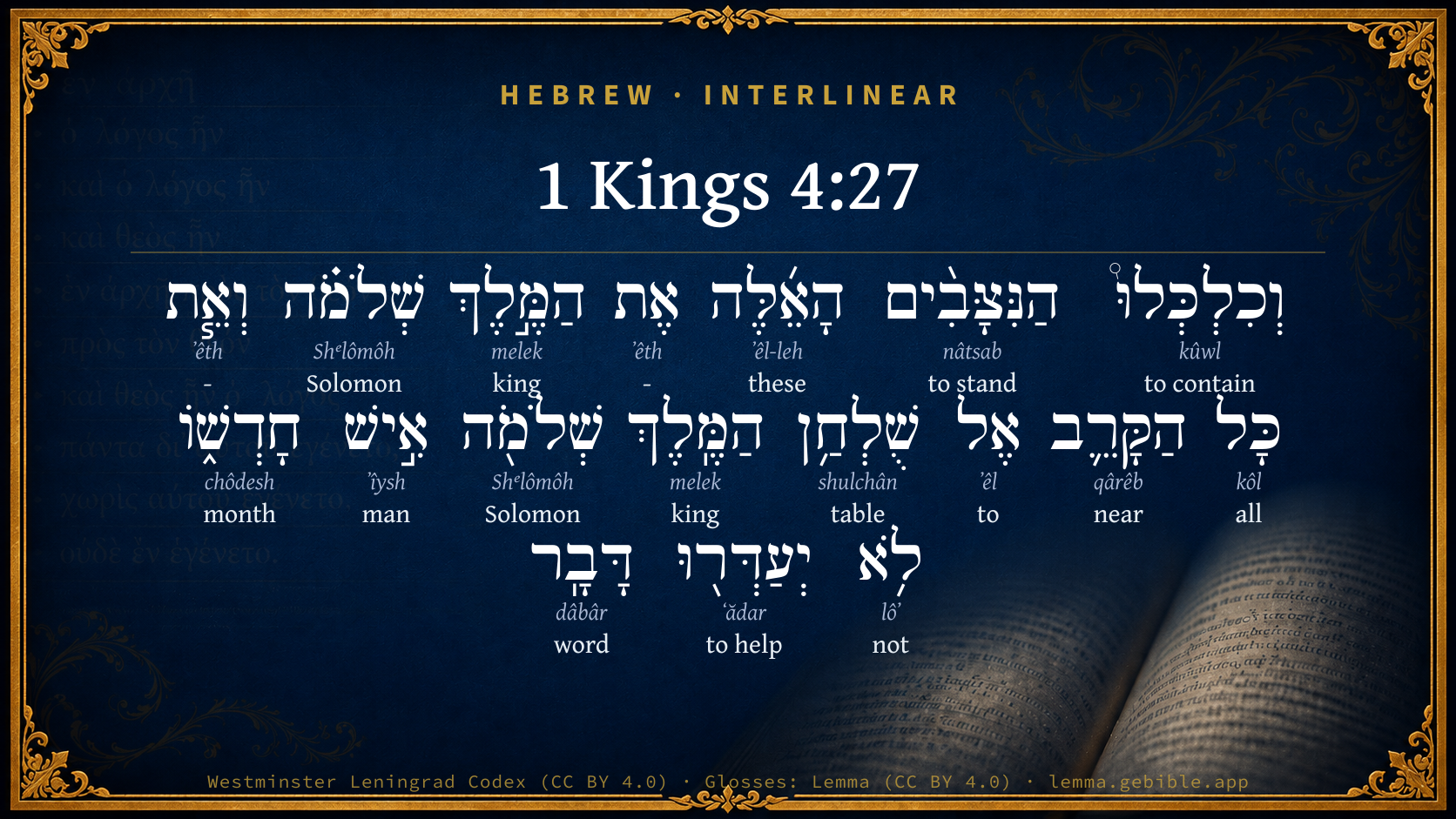
Hebrew (Westminster Leningrad Codex) 1 Kings 4:27 appears in the Hebrew Old Testament. The text above is from the Westminster Leningrad Codex. Each word links to its Strong’s number, a concise gloss, and parsing drawn from the Open Scriptures Hebrew Bible morphology. Click any word for its full Brown-Driver-Briggs (BDB) entry.
Download image
Cite this verse

1 Kings 4:27 (World English Bible). Public Domain. Lemma interlinear Bible study tool, https://lemma.gebible.app/v/1-kings/4/27.

Show BibTeX & RIS
BibTeX
RIS
English Translation
Those officers provided food for king Solomon, and for all who came to king Solomon's table, every man in his month; they let nothing be lacking.
World English Bible · Public Domain
Download a study sheet

One document with this verse’s original text, its word-by-word gloss line, the meaning frame, cross-references with their text, attributed commentary, and full source and license credits — printable, and it pastes into notes with its structure intact.

This verse Autodidact and up

Study sheet (.html) Plain text (.txt)

A passage Seminary Student

Up to 50 verses in one chapter. A passage sheet keeps up to 6 commentary sources and 12 cross-references per verse, in the order this page ranks them, and says so on the sheet whenever that leaves anything out. Ask for a single verse and you get the Autodidact verse sheet above.

Everything on this page stays free to read, with no account — the sheet is a download of what is already on screen, not access to it.

Want to remove ads? Support Godless Engineer
Compare translations 3

The same verse in 3 English versions, stacked beneath the original-language interlinear above. Click any original word for its lexicon entry.

Each is an independent rendering of the whole verse — the interlinear is not word-aligned to these translations.

Highlighted words mark where these versions differ — a whole-verse word diff, not a word-by-word alignment.

  • World English Bible Public Domain
    Those officers provided food for king Solomon, and for all who came to king Solomon's table, every man in his month; they let nothing be lacking.
  • King James Version Public Domain
    And those officers provided victual for king Solomon, and for all that came unto king Solomon's table, every man in his month: they lacked nothing.
  • unfoldingWord Literal Text CC BY-SA 4.0
    And those deputies sustained King Solomon and all of the near to the table of King Solomon, a man his month. They did not let a thing lack.

unfoldingWord Literal Text — © unfoldingWord, licensed CC BY-SA 4.0. Word-aligned USFM3 via Door43 (git.door43.org/unfoldingWord/en_ult).

Versions to compare (up to 4)

3 of 4 selected

Show all 18 translations

Every available English version of this verse, each an independent rendering of the whole verse.

  • World English Bible Public Domain
    Those officers provided food for king Solomon, and for all who came to king Solomon's table, every man in his month; they let nothing be lacking.
  • Berean Standard Bible Public Domain
    Each month the governors in turn provided food for King Solomon and all who came to his table. They saw to it that nothing was lacking.
  • Majority Standard Bible Public Domain
    Each month the governors in turn provided food for King Solomon and all who came to his table. They saw to it that nothing was lacking.
  • King James Version Public Domain
    And those officers provided victual for king Solomon, and for all that came unto king Solomon's table, every man in his month: they lacked nothing.
  • American Standard Version (1901) Public Domain
    And those officers provided victuals for king Solomon, and for all that came unto king Solomon's table, every man in his month; they let nothing be lacking.
  • Revised Version (1885) Public Domain
    And those officers provided victual for king Solomon, and for all that came unto king Solomon’s table, every man in his month: they let nothing be lacking.
  • Geneva Bible (1599) Public Domain
    And these officers prouided vitaile for king Salomon, and for all that came to King Salomons table, euery man his moneth, and they suffred to lacke nothing.
  • Douay-Rheims (1899) Public Domain
    And the foresaid governors of the king fed them: and they furnished the necessaries also for king Solomon's table, with great care in their time.
  • Young's Literal Translation Public Domain
    And these officers have sustained king Solomon and every one drawing near unto the table of king Solomon, each `in' his month; they let nothing be lacking.
  • Literal Standard Version CC BY-SA 4.0
    And these officers have sustained King Solomon and everyone drawing near to the table of King Solomon, each [in] his month; they let nothing be lacking.
  • Unlocked Literal Bible CC BY-SA 4.0
    Those officials provided food for King Solomon and for all who came to King Solomon's table, every man in his month. They let nothing be lacking.
  • unfoldingWord Literal Text CC BY-SA 4.0
    And those deputies sustained King Solomon and all of the near to the table of King Solomon, a man his month. They did not let a thing lack.
  • Darby Bible Public Domain
    And those officers provided food for king Solomon, and for all who came to king Solomon's table, every man in his month: they let nothing be wanting.
  • World Messianic Bible Public Domain
    Those officers provided food for King Solomon, and for all who came to King Solomon’s table, every man in his month. They let nothing be lacking.
  • Webster's Bible Public Domain
    And those officers provided victuals for king Solomon, and for all that came to king Solomon's table, every man in his month: they lacked nothing.
  • Free Bible Version CC BY-SA 4.0
    Every month the area governors provided in turn food for King Solomon and all who ate at his table. They made sure that nothing was missing.
  • Bible in Basic English Public Domain
    And those overseers, every man in his month, saw that food was produced for Solomon and all his guests, they took care that nothing was overlooked.
  • JPS Tanakh (1917) Public Domain
    (5-7) And those officers provided victual for king Solomon, and for all that came unto king Solomon's table, every man in his month; they let nothing be lacking.

Literal Standard Version (2020), Covenant Press — licensed CC BY-SA 4.0. Text via the HelloAO Bible API (eBible.org). Unlocked Literal Bible (unfoldingWord) — licensed CC BY-SA 4.0. Text via the HelloAO Bible API (eBible.org). unfoldingWord Literal Text — © unfoldingWord, licensed CC BY-SA 4.0. Word-aligned USFM3 via Door43 (git.door43.org/unfoldingWord/en_ult). Free Bible Version, Dr. Jonathan Gallagher — licensed CC BY-SA 4.0. Text via the HelloAO Bible API (eBible.org).

Word by word

More ways to search: Search by grammar → Find every occurrence → Compare this word →

Practice this passage: Drill this verse → Learn its vocabulary →

הַקָּרֵ֛ב
qârêb
H7131
“the · near”
Particle, Definite Article + Adjective, Adjective, Masculine, Singular, Absolute
Part of Speech
Particle + Adjective
Type
Adjective
Gender
Masculine
Number
Singular
State
Absolute
Full BDB Definition

Origin: from H7126

TWOT: 2065a

near, approaching
  1. וְכִלְכְּלוּ֩ kûwl H3557 “and · to contain” Conjunction + Verb, Pilpel, Perfect, 3rd Person, Common, Plural
  2. הַנִּצָּבִ֨ים nâtsab H5324 “the · standing” Particle, Definite Article + Verb, Niphal, Participle Active, Masculine, Plural, Absolute
  3. הָאֵ֜לֶּה ʼêl-leh H428 “the · these” Particle, Definite Article + Pronoun, Demonstrative, Common, Plural
  4. אֶת ʼêth H853 “-” Particle, Direct Object
  5. הַמֶּ֣לֶךְ melek H4428 “the · king” Particle, Definite Article + Noun, Common, Masculine, Singular, Absolute
  6. שְׁלֹמֹ֗ה Shᵉlômôh H8010 “Solomon” Noun, Proper
  7. וְאֵ֧ת ʼêth H853 “and · -” Conjunction + Particle, Direct Object
  8. כָּל kôl H3605 “all of” Noun, Common, Masculine, Singular, Construct
  9. אֶל ʼêl H413 “to” Preposition
  10. שֻׁלְחַ֥ן shulchân H7979 “table of” Noun, Common, Masculine, Singular, Construct
  11. הַמֶּֽלֶךְ melek H4428 “the · king” Particle, Definite Article + Noun, Common, Masculine, Singular, Absolute
  12. שְׁלֹמֹ֖ה Shᵉlômôh H8010 “Solomon” Noun, Proper
  13. אִ֣ישׁ ʼîysh H376 “man” Noun, Common, Masculine, Singular, Absolute
  14. חָדְשׁ֑וֹ chôdesh H2320 “month · his” Noun, Common, Masculine, Singular, Construct + Suffix, Personal, 3rd Person, Masculine, Singular
  15. לֹ֥א lôʼ H3808 “not” Particle, Negative
  16. יְעַדְּר֖וּ ʻădar H5737 “to help” Verb, Piel, Imperfect, 3rd Person, Masculine, Plural
  17. דָּבָֽר dâbâr H1697 “word” Noun, Common, Masculine, Singular, Absolute

About this verse

These counts appear in no published source. They are computed here, from the morphology-tagged text and Lemma’s own curated glosses. What Lemma adds →

18
words
15
distinct lemmas
Historical
section

Notable vocabulary

The rarest word here is הַקָּרֵ֛ב near H7131 — appearing just 8 times in the whole Hebrew Bible.

Shared distinctive vocabulary

הַקָּרֵ֛ב near H7131 occurs in 7 verses of the Hebrew Bible. Also found in:

Grammatical profile

  • 3 verbs
  • 9 nouns
  • 1 adjective
  • 1 pronoun
  • 1 preposition
  • 3 particles

Verb forms

  • וְכִלְכְּלוּ֩ Pilpel · Perfect
  • הַנִּצָּבִ֨ים Niphal · Participle Active
  • יְעַדְּר֖וּ Piel · Imperfect

Repetition

Words recur within this verse — often emphatic in Hebrew:

  • הַמֶּ֣לֶךְ king H4428 ×2
  • שְׁלֹמֹ֗ה Solomon H8010 ×2
Hebrew and Greek witnesses Masoretic Hebrew ↔ Greek Septuagint

The same verse in the two great witnesses to the Old Testament, shown verse-for-verse.

These are two independent witnesses, not word-aligned to each other, and the Septuagint is shown in lemma (dictionary) form.

Hebrew 1 Kings 4:27 Masoretic · Westminster Leningrad Codex

וְכִלְכְּלוּ֩ הַנִּצָּבִ֨ים הָאֵ֜לֶּה אֶת הַמֶּ֣לֶךְ שְׁלֹמֹ֗ה וְאֵ֧ת כָּל הַקָּרֵ֛ב אֶל שֻׁלְחַ֥ן הַמֶּֽלֶךְ שְׁלֹמֹ֖ה אִ֣ישׁ חָדְשׁ֑וֹ לֹ֥א יְעַדְּר֖וּ דָּבָֽר

Those officers provided food for king Solomon, and for all who came to king Solomon's table, every man in his month; they let nothing be lacking.

World English Bible · Public Domain

On this verse, The Cambridge Bible for Schools and Colleges discusses the Septuagint’s reading. Read the note in Commentary ↓

Hebrew: Westminster Leningrad Codex (CC BY 4.0). Greek: Septuagint (public domain); English from a public-domain English Septuagint. How the Septuagint differs from the Hebrew →

Commentary

Notes on 1 Kings 4:27 from classic Christian and Jewish commentators (each source and its license shown beneath its notes). The classic Christian expositions comment on the surrounding passage and are grouped to its opening verse, so a note may address several verses; the Jewish commentaries on the Tanakh (Rashi and others) are per-verse, so they appear only where the commentator wrote on this verse.

Lemma curates 59 commentaries, every one of them public domain or Creative Commons licensed, each selected and text-cleaned for this edition rather than reprinted as found. About our sources →

Trapp's Complete Commentary

John Trapp

1Ki 4:27 And those officers provided victual for king Solomon, and for all that came unto king Solomon’s table, every man in his month: they lacked nothing.

Ver. 27. And for all that came unto king Solomon’s table.] Who were not a few, not only natives, but foreigners; not ambassadors only, but others, who came from all parts to hear his wisdom, {1Ki 4:34} and so to be proselyted haply. But Josephus relateth of the Jews, that they were very careful how they received proselytes in Solomon’s time; because then the state of the Jews flourished.

John Trapp, A Commentary or Exposition upon All the Books of the Old and New Testament (1647–1656) — public domain. Text from a community e-Sword module.

The Biblical Illustrator

Joseph S. Exell

1Ki_4:22-23; 1Ki_4:27-28

Solomons provisions for one day.

--

Solomons feast

This would seem to be part of the Parable of the Prodigal Son before its time. This typical feast of Solomons has no reference to gluttony. We have read of Caligula, who would never eat bread unless it was gilded--had a coating of gold over the crust; but we are not commending such men in representing Solomons feast as the feast of fat things and wine upon the lees well refined, as being part of the viands and provision of the table of God, which is so abundantly--yea, lavishly--spread. When did God give just enough? When was there less at the end than there was at the beginning? When He had five loaves and fed five thousand, how many basketfuls of fragments took ye up? Let God be judged by the fragments, whoever found the loaves; let God be judged by the harvest, whoever lent the seed out of which it sprang. (J. Parker, D. D.)

The Biblical Illustrator, edited by Joseph S. Exell (c. 1880s–1900s) — public domain. Text from a community e-Sword module.

Joseph Benson's Commentary

1Ki 4:27-28. Those officers — Named above, 1Ki 4:7. They lacked nothing — Or, rather, they suffered nothing to be lacking to any man that came to Solomon’s table, but plentifully provided all things necessary. This is repeated to show their diligence, exactness, and care, which was remarkable; especially since they took care of his stables as well as of his house, as it follows in the next verse. Barley also and straw — Barley was anciently horse-corn, as appears by many places in Homer. For the horses and dromedaries — The Hebrew word, rechesh, signifies swift horses, as Abarbinel thinks; see Est 8:14; but others take them for mules. Where the officers were — Or, rather, Where the beasts were; for there is no word for officers in the Hebrew. Every man according to his charge — Which lasted for a month every year.

Joseph Benson's Commentary on the Old and New Testaments (1811–1818) — public domain. Text from a community e-Sword module.

The Cambridge Bible for Schools and Colleges

gen. ed. J. J. S. Perowne

27. And those officers] Referring to the twelve enumerated in 1Ki_4:8-19. There is a degree of awkwardness in the way in which the fresh mention of them is introduced, and this no doubt led to the transposition in the LXX. which has been noticed above.

they lacked nothing] Rather, ‘they let nothing be missing.’ The notion of the verb is that of inspecting troops, and marking, and at once correcting, deficiencies.

The Cambridge Bible for Schools and Colleges (gen. ed. J. J. S. Perowne; Cambridge University Press, 1878–1918) — public domain. Text from a community e-Sword module.

John Gill's Exposition

And Solomon's wisdom excelled the wisdom of all the children of the east,.... The Arabians, and Persians, famous for wisdom, and who lay to the east of the land of Judea; whose wisdom lay in the knowledge of the stars, in divination by birds, and soothsaying (m):

and all the wisdom of Egypt; which it was eminent for in the times of Moses, and in which he was learned and well-skilled, Act 7:22; and hence in later times the philosophers of the Gentiles travelled to get knowledge, as Pherecydes, Pythagoras, Anaxagoras, Plato, and others to Egypt, said to be the mother of arts and sciences (n).

(m) Midrash Kohelet. fol. 76. 3. (n) Macrob. in Som. Scip. c. 19. 21. & Saturnal l. 1. c. 15.

John Gill's Exposition of the Whole Bible (1746–1763) — public domain (CC PDM 1.0). Text via the HelloAO Bible API.

Haydock's Catholic Bible Commentary

Fed them and is omitted in Hebrew and Septuagint. (Haydock)

George Leo Haydock (1774–1849), Haydock's Catholic Family Bible and Commentary, 1859 edition — public domain. Excludes Psalms (Douay-Rheims chapter numbering differs from Protestant) and Deuterocanonical books (Catholic canon only).

Matthew Poole's English Annotations

Those officers; named above, 1Ki 4:7, &c.

They lacked nothing; or rather, they suffered nothing to be lacking to any man that came thither, but plentifully provided all things necessary.

Matthew Poole's English Annotations on the Holy Bible (1683–1685) — public domain. Text from a community e-Sword/MySword module.

Whedon's Commentary on the Bible

Daniel D. Whedon

27. Those officers — That is, the officers named in 1Ki_4:7-19.

Daniel D. Whedon (gen. ed.), Commentary on the Old and New Testaments (1874–1909) — public domain. Text from a community e-Sword module.

The Pulpit Commentary

And those rather, these, i.e., the officers mentioned vv. 7-19 officers provided victual for Heb. nourished king Solomon and for all that came unto king Solomon"s table we can hardly see here (with Keil) "a further proof of the blessings of peace." The words were probably suggested by the mental wonder how the cavalry, etc., could be maintained, and so the author states that this great number of horses and horsemen depended on the twelve purveyors for their food every man in his month; they lacked nothing rather, suffered nothing to be lacking. So Gesen.; and the context seems to require it.

The Pulpit Commentary (1880–1919), ed. H.D.M. Spence-Jones & Joseph S. Exell — public domain. Text from a community e-Sword module.

John Wesley's Explanatory Notes

The officers - Named above. They lacked - Or rather, they suffered nothing to be lacking to any man that came thither, but plentifully provided all things necessary.

John Wesley, Explanatory Notes Upon the Whole Bible (1754–1765) — public domain. Text via the GEBible commentary corpus.

Lesson kit

Teaching starters — assembled from the data on this page, not authored interpretation. Every prompt links to the verse data it draws on. Edit before teaching.

1 Kings, in the Historical, opens this verse with 18 words (15 distinct Hebrew lemmas). Its most distinctive word is qârêb (“near”). A historical commentator’s framing appears above. Read the whole chapter for the surrounding context.

Discussion questions

  1. What does “near” (qârêb) contribute to the verse as a whole?
  2. Numbers 17:13 shares the word «near» with this verse. How do the two illuminate each other?
  3. “king” occurs 2× in this one verse. What is the effect of the repetition?
  4. These translations render this verse differently. What is at stake in choosing one wording over another?
  5. The verb «וְכִלְכְּלוּ֩» is Pilpel Perfect. How does its form color the action?
  6. Reading how Trapp's Complete Commentary and The Biblical Illustrator read this verse, where do the two commentators agree and where do they part?

Things to notice

Reading settings

Reading text

Shown beneath each verse's original-language words.

Old Testament
Old Testament edition

Read the OT as the Masoretic Hebrew (MT) or the Greek Septuagint (LXX).

English shown for the Greek Septuagint (in the Hebrew ↔ Greek comparison).

Comparing translations? Open the Compare panel on any verse page to stack up to four side by side.