

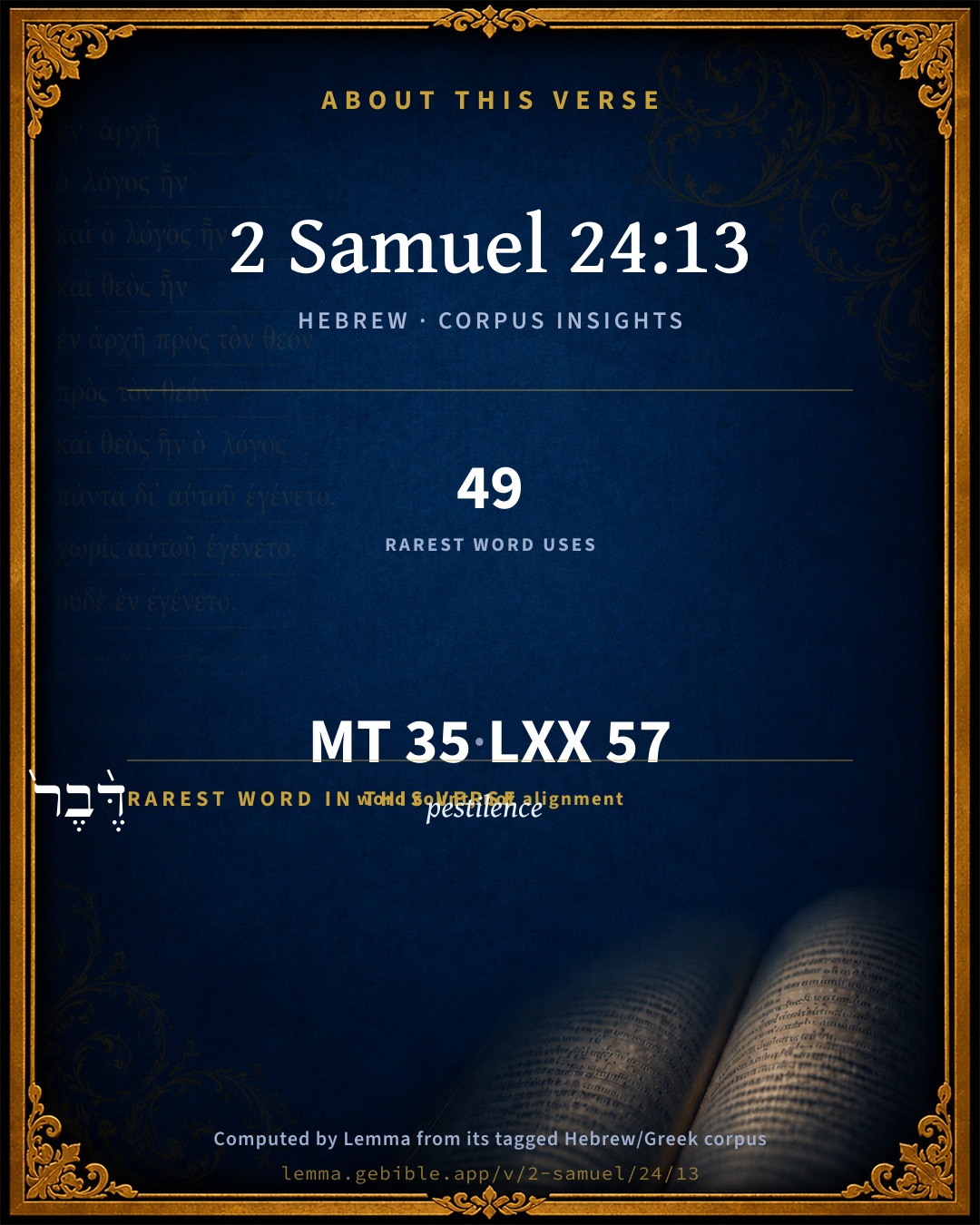
2 Samuel 24:13

Hebrew (Westminster Leningrad Codex) 2 Samuel 24:13 appears in the Hebrew Old Testament. The text above is from the Westminster Leningrad Codex. Each word links to its Strong’s number, a concise gloss, and parsing drawn from the Open Scriptures Hebrew Bible morphology. Click any word for its full Brown-Driver-Briggs (BDB) entry.
Download image
Cite this verse

2 Samuel 24:13 (World English Bible). Public Domain. Lemma interlinear Bible study tool, https://lemma.gebible.app/v/2-samuel/24/13.

Show BibTeX & RIS
BibTeX
RIS
English Translation
So Gad came to David, and told him, and said to him, Shall seven years of famine come to you in your land? or will you flee three months before your foes while they pursue you? or shall there be three days' pestilence in your land? now advise you, and consider what answer I shall return to him who sent me.
World English Bible · Public Domain
Download a study sheet

One document with this verse’s original text, its word-by-word gloss line, the meaning frame, cross-references with their text, attributed commentary, and full source and license credits — printable, and it pastes into notes with its structure intact.

This verse Autodidact and up

Study sheet (.html) Plain text (.txt)

A passage Seminary Student

Up to 50 verses in one chapter. A passage sheet keeps up to 6 commentary sources and 12 cross-references per verse, in the order this page ranks them, and says so on the sheet whenever that leaves anything out. Ask for a single verse and you get the Autodidact verse sheet above.

Everything on this page stays free to read, with no account — the sheet is a download of what is already on screen, not access to it.

Want to remove ads? Support Godless Engineer
Compare translations 3

The same verse in 3 English versions, stacked beneath the original-language interlinear above. Click any original word for its lexicon entry.

Each is an independent rendering of the whole verse — the interlinear is not word-aligned to these translations.

Highlighted words mark where these versions differ — a whole-verse word diff, not a word-by-word alignment.

  • World English Bible Public Domain
    So Gad came to David, and told him, and said to him, Shall seven years of famine come to you in your land? or will you flee three months before your foes while they pursue you? or shall there be three days' pestilence in your land? now advise you, and consider what answer I shall return to him who sent me.
  • King James Version Public Domain
    So Gad came to David, and told him, and said unto him, Shall seven years of famine come unto thee in thy land? or wilt thou flee three months before thine enemies, while they pursue thee? or that there be three days' pestilence in thy land? now advise, and see what answer I shall return to him that sent me.
  • unfoldingWord Literal Text CC BY-SA 4.0
    And Gad came to David, and he declared to him. Then he said to him, “Shall seven years of famine come to you in your land, or three months of your fleeing to the face of your enemies and he is pursuing you, or three days of plague being in your land? Now, know and see what word I shall return the one having sent me.”

unfoldingWord Literal Text — © unfoldingWord, licensed CC BY-SA 4.0. Word-aligned USFM3 via Door43 (git.door43.org/unfoldingWord/en_ult).

Versions to compare (up to 4)

3 of 4 selected

Show all 18 translations

Every available English version of this verse, each an independent rendering of the whole verse.

  • World English Bible Public Domain
    So Gad came to David, and told him, and said to him, Shall seven years of famine come to you in your land? or will you flee three months before your foes while they pursue you? or shall there be three days' pestilence in your land? now advise you, and consider what answer I shall return to him who sent me.
  • Berean Standard Bible Public Domain
    So Gad went and said to David, “Do you choose to endure three years of famine in your land, three months of fleeing the pursuit of your enemies, or three days of plague upon your land? Now then, think it over and decide how I should reply to Him who sent me.”
  • Majority Standard Bible Public Domain
    So Gad went and said to David, “Do you choose to endure three years of famine in your land, three months of fleeing the pursuit of your enemies, or three days of plague upon your land? Now then, think it over and decide how I should reply to Him who sent me.”
  • King James Version Public Domain
    So Gad came to David, and told him, and said unto him, Shall seven years of famine come unto thee in thy land? or wilt thou flee three months before thine enemies, while they pursue thee? or that there be three days' pestilence in thy land? now advise, and see what answer I shall return to him that sent me.
  • American Standard Version (1901) Public Domain
    So Gad came to David, and told him, and said unto him, Shall seven years of famine come unto thee in thy land? or wilt thou flee three months before thy foes while they pursue thee? or shall there be three days' pestilence in thy land? now advise thee, and consider what answer I shall return to him that sent me.
  • Revised Version (1885) Public Domain
    So Gad came to David, and told him, and said unto him, Shall seven years of famine come unto thee in thy land? or wilt thou flee three months before thy foes while they pursue thee? or shall there be three days pestilence in thy land? now advise thee, and consider what answer I shall return to him that sent me.
  • Geneva Bible (1599) Public Domain
    So Gad came to Dauid, and shewed him, and said vnto him, Wilt thou that seuen yeeres famine come vpon thee in thy lande, or wilt thou flee three moneths before thine enemies, they following thee, or that there bee three dayes pestilence in thy land? nowe aduise thee, and see, what answere I shall giue to him that sent me.
  • Douay-Rheims (1899) Public Domain
    And when Gad was come to David, he told him, saying: Either seven years of famine shall come to thee in thy land: or thou shalt flee three months before thy adversaries, and they shall pursue thee: or for three days there shall be a pestilence in thy land. Now therefore deliberate, and see what answer I shall return to him that sent me.
  • Young's Literal Translation Public Domain
    And Gad cometh in unto David, and declareth to him, and saith to him, `Do seven years of famine come in to thee in thy land? or three months art thou fleeing before thine adversary -- and he pursuing thee? or are three days' pestilence in thy land? now, know and see what word I take back to Him sending me.'
  • Literal Standard Version CC BY-SA 4.0
    And Gad comes to David, and declares [it] to him, and says to him, “Does seven years of famine come to you in your land? Or are you fleeing before your adversary [for] three months—and he is pursuing you? Or is there pestilence [for] three days in your land? Now, know and see what word I take back to Him sending me.”
  • Unlocked Literal Bible CC BY-SA 4.0
    So Gad went to David and said to him, “Will three years of famine come to you in your land? Or will you flee three months from your enemies while they pursue you? Or will there be three days of plague in your land? Now decide what answer I should return to him who sent me.”
  • unfoldingWord Literal Text CC BY-SA 4.0
    And Gad came to David, and he declared to him. Then he said to him, “Shall seven years of famine come to you in your land, or three months of your fleeing to the face of your enemies and he is pursuing you, or three days of plague being in your land? Now, know and see what word I shall return the one having sent me.”
  • Darby Bible Public Domain
    And Gad came to David, and told him, and said to him, Shall seven years of famine come to thee in thy land? or wilt thou flee three months before thine adversaries while they pursue thee? or shall there be three days' pestilence in thy land? Now be aware and consider what word I shall bring again to him that sent me.
  • World Messianic Bible Public Domain
    So Gad came to David, and told him, saying, “Shall seven years of famine come to you in your land? Or will you flee three months before your foes while they pursue you? Or shall there be three days’ pestilence in your land? Now answer, and consider what answer I shall return to him who sent me.”
  • Webster's Bible Public Domain
    So Gad came to David, and told him, and said to him, Shall seven years of famine come upon thee in thy land? or wilt thou flee three months before thy enemies, while they pursue thee? or that there be three days' pestilence in thy land? Now consider, and see what answer I shall return to him that sent me.
  • Free Bible Version CC BY-SA 4.0
    So Gad went and told David, “You can choose three years of famine in your land, or three months of running from your enemies while they chase you, or three days of plague in your land. So think about it and decide how I should reply to the One who sent me.”
  • Bible in Basic English Public Domain
    So Gad came to David, and gave him word of this and said to him, Are there to be three years when there is not enough food in your land? or will you go in flight from your haters for three months, while they go after you? or will you have three days of violent disease in your land? take thought and say what answer I am to give to him who sent me.
  • JPS Tanakh (1917) Public Domain
    So Gad came to David, and told him, and said unto him: 'Shall seven years of famine come unto thee in thy land? or wilt thou flee three months before thy foes while they pursue thee? or shall there be three days' pestilence in thy land? now advise thee, and consider what answer I shall return to Him that sent Me.'

Literal Standard Version (2020), Covenant Press — licensed CC BY-SA 4.0. Text via the HelloAO Bible API (eBible.org). Unlocked Literal Bible (unfoldingWord) — licensed CC BY-SA 4.0. Text via the HelloAO Bible API (eBible.org). unfoldingWord Literal Text — © unfoldingWord, licensed CC BY-SA 4.0. Word-aligned USFM3 via Door43 (git.door43.org/unfoldingWord/en_ult). Free Bible Version, Dr. Jonathan Gallagher — licensed CC BY-SA 4.0. Text via the HelloAO Bible API (eBible.org).

Word by word

More ways to search: Search by grammar → Find every occurrence → Compare this word →

Practice this passage: Drill this verse → Learn its vocabulary →

דֶּ֨בֶר֙
deber
H1698
“pestilence”
Noun, Common, Masculine, Singular, Absolute
Part of Speech
Noun
Type
Common
Gender
Masculine
Number
Singular
State
Absolute
Full BDB Definition

Origin: from H1696 (in the sense of destroying)

TWOT: 399b

pestilence, plague - murrain, cattle disease, cattle-plague
  1. וַיָּבֹא bôwʼ H935 “and · to enter” Conjunction + Verb, Qal, Sequential Imperfect, 3rd Person, Masculine, Singular
  2. גָ֥ד Gâd H1410 “Gad” Noun, Proper
  3. אֶל ʼêl H413 “to” Preposition
  4. דָּוִ֖ד Dâvid H1732 “David” Noun, Proper
  5. וַיַּגֶּד nâgad H5046 “and · to make known” Conjunction + Verb, Hiphil, Sequential Imperfect, 3rd Person, Masculine, Singular
  6. וַיֹּ֣אמֶר ʼâmar H559 “and · to say” Conjunction + Verb, Qal, Sequential Imperfect, 3rd Person, Masculine, Singular
  7. הֲתָב֣וֹא bôwʼ H935 “to enter” Particle, Interrogative + Verb, Qal, Imperfect, 3rd Person, Feminine, Singular
  8. שֶֽׁבַע shebaʻ H7651 “seven” Adjective, Cardinal number, Feminine, Singular, Absolute
  9. שָׁנִ֣ים shâneh H8141 “years” Noun, Common, Feminine, Plural, Absolute
  10. רָעָ֣ב râʻâb H7458 “famine” Noun, Common, Masculine, Singular, Absolute
  11. בְּאַרְצֶ֡ךָ ʼerets H776 “in/at · land · your” Preposition + Noun, Common, Both, Singular, Construct + Suffix, Personal, 2nd Person, Masculine, Singular
  12. אִם ʼim H518 “if” Conjunction
  13. שְׁלֹשָׁ֣ה shâlôwsh H7969 “three” Adjective, Cardinal number, Masculine, Singular, Absolute
  14. חֳ֠דָשִׁים chôdesh H2320 “months” Noun, Common, Masculine, Plural, Absolute
  15. נֻסְךָ֨ nûwç H5127 “to flee · you” Verb, Qal, Infinitive Construct + Suffix, Personal, 2nd Person, Masculine, Singular
  16. לִפְנֵֽי pânîym H6440 “to/for · face(s) of” Preposition + Noun, Common, Both, Plural, Construct
  17. צָרֶ֜יךָ tsar H6862 “distresses · your” Noun, Common, Masculine, Plural, Construct + Suffix, Personal, 2nd Person, Masculine, Singular
  18. וְה֣וּא hûwʼ H1931 “and · he” Conjunction + Pronoun, Personal, 3rd Person, Masculine, Singular
  19. רֹדְפֶ֗ךָ râdaph H7291 “pursuing · you” Verb, Qal, Participle Active, Masculine, Singular, Construct + Suffix, Personal, 2nd Person, Masculine, Singular
  20. וְאִם ʼim H518 “and · if” Conjunction + Conjunction
  21. הֱ֠יוֹת hâyâh H1961 “to be” Verb, Qal, Infinitive Construct
  22. שְׁלֹ֨שֶׁת shâlôwsh H7969 “three” Adjective, Cardinal number, Masculine, Singular, Construct
  23. יָמִ֥ים yôwm H3117 “days” Noun, Common, Masculine, Plural, Absolute
  24. בְּאַרְצֶ֔ךָ ʼerets H776 “in/at · land · your” Preposition + Noun, Common, Both, Singular, Construct + Suffix, Personal, 2nd Person, Masculine, Singular
  25. עַתָּה֙ ʻattâh H6258 “now” Adverb
  26. דַּ֣ע yâdaʻ H3045 “know” Verb, Qal, Imperative, 2nd Person, Masculine, Singular
  27. וּרְאֵ֔ה râʼâh H7200 “and · see” Conjunction + Verb, Qal, Imperative, 2nd Person, Masculine, Singular
  28. מָה mâh H4100 “what” Particle, Interrogative
  29. אָשִׁ֥יב shûwb H7725 “to return” Verb, Hiphil, Imperfect, 1st Person, Common, Singular
  30. שֹׁלְחִ֖י shâlach H7971 “sending · me” Verb, Qal, Participle Active, Masculine, Singular, Construct + Suffix, Personal, 1st Person, Common, Singular
  31. דָּבָֽר dâbâr H1697 “word” Noun, Common, Masculine, Singular, Absolute

About this verse

These counts appear in no published source. They are computed here, from the morphology-tagged text and Lemma’s own curated glosses. What Lemma adds →

35
words
28
distinct lemmas
Historical
section

Shared distinctive vocabulary

דֶּ֨בֶר֙ pestilence H1698 occurs in 48 verses of the Hebrew Bible. Also found in:

Grammatical profile

  • 11 verbs
  • 12 nouns
  • 3 adjectives
  • 1 pronoun
  • 4 prepositions
  • 2 conjunctions
  • 1 adverb
  • 1 particle

Verb forms

  • וַיָּבֹא Qal · Sequential Imperfect
  • וַיַּגֶּד Hiphil · Sequential Imperfect
  • וַיֹּ֣אמֶר Qal · Sequential Imperfect
  • הֲתָב֣וֹא Qal · Imperfect
  • נֻסְךָ֨ Qal · Infinitive Construct
  • רֹדְפֶ֗ךָ Qal · Participle Active
  • הֱ֠יוֹת Qal · Infinitive Construct
  • דַּ֣ע Qal · Imperative
  • וּרְאֵ֔ה Qal · Imperative
  • אָשִׁ֥יב Hiphil · Imperfect
  • שֹׁלְחִ֖י Qal · Participle Active

Repetition

Words recur within this verse — often emphatic in Hebrew:

  • וַיָּבֹא to enter H935 ×2
  • בְּאַרְצֶ֡ךָ land H776 ×2
  • שְׁלֹשָׁ֣ה three H7969 ×2
  • אִם if H518 ×2

Hebrew & Septuagint length

In English translation the verse runs 61 words from the Hebrew and 76 from the Septuagint (LXX English) — closely comparable.

A rough comparison of the two English renderings, which tokenize alike — not a word-level alignment.

Word counts can differ between the Hebrew and the Greek without any difference in meaning — e.g. the Hebrew direct-object marker אֵת has no separate Greek word, and Greek often adds the article ὁ.

In the original languages it is 35 Hebrew tokens and 57 Greek tokens — but the two are counted differently (Hebrew bundles its prefixes and suffixes into one token; the Greek is in lemma form), so that isn’t a like-for-like length.

Cross-references

16

Topical passages linked to 2 Samuel 24:13 in the Treasury of Scripture Knowledge — connected by theme and wording, ordered by reader-vote popularity; previews shown in the World English Bible.

  • 1 Chronicles 21:12 either three years of famine; or three months to be consumed before your foes, while the sword of your enemies overtakes you; or else three days the sword of Yahweh, even pestilence in the land, and the angel of Yahweh destroying throughout all the borders of Israel. Now therefore consider what answer I shall return to him who sent me.
  • Leviticus 26:25 I will bring a sword upon you, that will execute the vengeance of the covenant; and you will be gathered together within your cities: and I will send the pestilence among you; and you will be delivered into the hand of the enemy.
  • 2 Samuel 21:1 There was a famine in the days of David three years, year after year; and David sought the face of Yahweh. Yahweh said, It is for Saul, and for his bloody house, because he put to death the Gibeonites.
  • 1 Kings 17:1–7 Elijah the Tishbite, who was of the foreigners of Gilead, said to Ahab, As Yahweh, the God of Israel, lives, before whom I stand, there shall not be dew nor rain these years, but according to my word.
  • Leviticus 26:16–17 I also will do this to you: I will appoint terror over you, even consumption and fever, that shall consume the eyes, and make the soul to pine away; and you will sow your seed in vain, for your enemies will eat it.
  • Leviticus 26:20 and your strength will be spent in vain; for your land won't yield its increase, neither will the trees of the land yield their fruit.
  • Leviticus 26:36–37 "'As for those of you who are left, I will send a faintness into their hearts in the lands of their enemies: and the sound of a driven leaf will put them to flight; and they shall flee, as one flees from the sword; and they will fall when no one pursues.
  • Deuteronomy 28:22 Yahweh will strike you with consumption, and with fever, and with inflammation, and with fiery heat, and with the sword, and with blasting, and with mildew; and they shall pursue you until you perish.
  • Deuteronomy 28:25 Yahweh will cause you to be struck before your enemies; you shall go out one way against them, and shall flee seven ways before them: and you shall be tossed back and forth among all the kingdoms of the earth.
  • Deuteronomy 28:27 Yahweh will strike you with the boil of Egypt, and with the tumors, and with the scurvy, and with the itch, of which you can not be healed.
  • Deuteronomy 28:35 Yahweh will strike you in the knees, and in the legs, with a sore boil, of which you can not be healed, from the sole of your foot to the crown of your head.
  • Deuteronomy 28:52 They shall besiege you in all your gates, until your high and fortified walls come down, in which you trusted, throughout all your land; and they shall besiege you in all your gates throughout all your land, which Yahweh your God has given you.
  • Ezekiel 14:13 Son of man, when a land sins against me by committing a trespass, and I stretch out my hand on it, and break the staff of the bread of it, and send famine on it, and cut off from it man and animal;
  • Ezekiel 14:19–21 Or if I send a pestilence into that land, and pour out my wrath on it in blood, to cut off from it man and animal;
  • Luke 4:25 But truly I tell you, there were many widows in Israel in the days of Elijah, when the sky was shut up three years and six months, when a great famine came over all the land.
  • Psalms 91:6 Nor of the pestilence that walks in darkness, Nor of the destruction that wastes at noonday.

Cross-references courtesy of OpenBible.info (CC BY 4.0).

Hebrew and Greek witnesses Masoretic Hebrew ↔ Greek Septuagint

The same verse in the two great witnesses to the Old Testament, shown verse-for-verse.

These are two independent witnesses, not word-aligned to each other, and the Septuagint is shown in lemma (dictionary) form.

Hebrew 2 Samuel 24:13 Masoretic · Westminster Leningrad Codex

וַיָּבֹא גָ֥ד אֶל דָּוִ֖ד וַיַּגֶּד ל֑וֹ וַיֹּ֣אמֶר ל֡וֹ הֲתָב֣וֹא לְךָ֣ שֶֽׁבַע שָׁנִ֣ים רָעָ֣ב בְּאַרְצֶ֡ךָ אִם שְׁלֹשָׁ֣ה חֳ֠דָשִׁים נֻסְךָ֨ לִפְנֵֽי צָרֶ֜יךָ וְה֣וּא רֹדְפֶ֗ךָ וְאִם הֱ֠יוֹת שְׁלֹ֨שֶׁת יָמִ֥ים דֶּ֨בֶר֙ בְּאַרְצֶ֔ךָ עַתָּה֙ דַּ֣ע וּרְאֵ֔ה מָה אָשִׁ֥יב שֹׁלְחִ֖י דָּבָֽר

So Gad came to David, and told him, and said to him, Shall seven years of famine come to you in your land? or will you flee three months before your foes while they pursue you? or shall there be three days' pestilence in your land? now advise you, and consider what answer I shall return to him who sent me.

World English Bible · Public Domain

Greek LXX 2 Samuel 24:13 Septuagint · lemma form

καί εἰςἔρχομαι γαδ πρός δαυίδ καί ἀναἀγγέλλω αὐτός καί εἶπον αὐτός ἐκλέγω σεαυτοῦ γίγνομαι εἰ ἔρχομαι σύ τρεῖς ἔτος λιμός ἐν ὁ γῆ σύ ἤ τρεῖς μήν φεύγω σύ ἔμπροσθεν ὁ ἐχθρός σύ καί εἰμί διώκω σύ ἤ γίγνομαι τρεῖς ἡμέρα θάνατος ἐν ὁ γῆ σύ νῦν οὖν γιγνώσκω καί ὁράω τίς ἀποκρίνω ὁ ἀποστέλλω ἐγώ ῥῆμα

And Gad went in to David, and told him, and said to him, Choose one of these things to befall you, whether there shall come upon you for three years famine in your land; or that you should flee three months before your enemies, and they should pursue you; or that there should be for three days mortality in your land. Now then decide, and see what answer I shall return to him that sent me.

LXX2012 (modern English Septuagint) · Public Domain

On this verse, Adam Clarke's Commentary discusses the Septuagint’s reading. Read the note in Commentary ↓

Hebrew: Westminster Leningrad Codex (CC BY 4.0). Greek: Septuagint (public domain); English from LXX2012 (modern English Septuagint) (Public Domain). How the Septuagint differs from the Hebrew →

Targum (Aramaic paraphrase)

1

The Targum is the ancient Jewish Aramaic paraphrase of the Hebrew Scriptures — an interpretive translation, not the Hebrew text itself. Onkelos (literal) and Pseudo-Jonathan (expansive) render the Torah, and Jonathan the Prophets. Coverage is partial: where no permissively-licensed English translation exists for a verse, only the Aramaic is shown. This is verse-level text, not a word-by-word alignment to the Hebrew.

  1. Targum Jonathan Prophets (Joshua–Malachi)
    וַאֲתָא גָד לְוַת דָוִד וְחַוֵי לֵיהּ וַאֲמַר לֵיהּ הֲתָעוֹל לָךְ שְׁבַע שְׁנִין כַּפְנָא בְּאַרְעָךְ אִם תְּלָתָא יַרְחִין תְּהֵי עָרִיק קֳדָם סַנְאָךְ וְהוּא רָדִיף לָךְ וְאִם מֶהֱוֵה תְּלָתָא יוֹמִין מוֹתָא בְּאַרְעָךְ כְּעַן דַע וַחֲזֵי מָה אֲתִיב שֹׁלְחִי פִּתְגָמָא:

    (no public-domain English translation for this verse)

    Targum Jonathan — Aramaic: “Mikraot Gedolot” (public domain). English: “Sefaria Community Translation” (CC0 1.0 (public-domain dedication)); “London "Chaldee Paraphrase," 1871” (public domain). Text via Sefaria.

Commentary

Notes on 2 Samuel 24:13 from classic Christian and Jewish commentators (each source and its license shown beneath its notes). The classic Christian expositions comment on the surrounding passage and are grouped to its opening verse, so a note may address several verses; the Jewish commentaries on the Tanakh (Rashi and others) are per-verse, so they appear only where the commentator wrote on this verse.

Lemma curates 59 commentaries, every one of them public domain or Creative Commons licensed, each selected and text-cleaned for this edition rather than reprinted as found. About our sources →

Trapp's Complete Commentary

John Trapp

2Sa 24:13 So Gad came to David, and told him, and said unto him, Shall seven years of famine come unto thee in thy land? or wilt thou flee three months before thine enemies, while they pursue thee? or that there be three days’ pestilence in thy land? now advise, and see what answer I shall return to him that sent me.

Ver. 13. Shall seven years of famine?] That is, Shall there to the three bygone years of famine, and to this Sabbatical year - qui nova messe destitutus priora damna resarcire non potest, which, having no new harvest, cannot make up the losses of the last years - be added three more such? {1Ch 21:11}

Or that there be three days’ pestilence in the land?] An extraordinary pestilence, inflicted by the hand of a destroying angel. Hippocrates Pestem το Yειον, vocat. {a} But how happy was Ferdinand III, king of Spain, who reigned thirty-five years, and during all that time there was neither famine nor pestilence in his dominions. {b}

{a} In Prognost.

{b} Lopez, Gloss. in Prolog., part. i.

John Trapp, A Commentary or Exposition upon All the Books of the Old and New Testament (1647–1656) — public domain. Text from a community e-Sword module.

The Biblical Illustrator

Joseph S. Exell

2Sa_24:13

Now advise, and see what answer I shall return to him that sent me.

Christians exhorted to consider what answer their ministers will have to return to God concerning them

I. Christian ministers are the messengers of God, and sent on an important errand.

1. They are sent of God.

2. They are sent on an important errand.

II. Ministers are to return an answer to Him that sendeth them.

1. They are to return to their Master.

2. They are to answer as to their own fidelity.

3. They are likewise to return an answer concerning the reception which they themselves met with.

III. It becometh the members of Christian churches seriously to consider what answers their ministers will have to return concerning them. Application.

1. This subject affords some useful instruction to Christian ministers. It should lead them to magnify their office, as the messengers of God. It should excite their warmest gratitude that they are employed under Christ, on the same errand which brought him into the world. Further, they may learn to deliver their message with all plainness, seriousness, and fidelity.

2. Christian people may derive some useful instruction from these particulars. Learn, then, to be thankful that messengers are sent to you on so kind and gracious an errand. (J. Orton.)

The Biblical Illustrator, edited by Joseph S. Exell (c. 1880s–1900s) — public domain. Text from a community e-Sword module.

Tyndale Open Study Notes

Tyndale Open Resources

24:13 David had already experienced the first two options—fleeing from Saul and Absalom, and famine because Saul had murdered the Gibeonites (21:1). While three days of severe plague sounded less traumatic, 70,000 people perished (24:15).

Tyndale Open Study Notes — © Tyndale Open Resources, licensed CC BY-SA 4.0. Text via the HelloAO Bible API.

Geneva Bible (1599)

Geneva Bible translators

For three years of famine were past for the Gibeonites’ matter: this was the fourth year to the which should have been added other three years more, 1 Chron. 21:12.

Geneva Bible (1599) marginal notes — public domain. Text via Bolls.life.

Jamieson, Fausset & Brown

Robert Jamieson, A. R. Fausset & David Brown

Shall seven years of famine come unto thee--that is, in addition to the three that had been already, with the current year included (see on Ch1 21:11).

Jamieson, Fausset & Brown — Commentary Critical and Explanatory on the Whole Bible (1871) — public domain (CC PDM 1.0). Text via the HelloAO Bible API.

Adam Clarke's Commentary

Verse 13. Shall seven years of famine] In 1Ch 21:12, the number is three, not seven; and here the Septuagint has three, the same as in Chronicles: this is no doubt the true reading, the letter ז zain, SEVEN, being mistaken for ג gimel, THREE. A mistake of this kind might be easily made from the similarity of the letters.

Adam Clarke's Commentary on the Bible (1810–1826) — public domain. Text from a community e-Sword/MySword module.

Ellicott's Commentary for English Readers

(13) Seven years.—In Chronicles “three years,” and so the LXX. reads here also. This would be more in accordance with the “three” months and “three” days.

A Bible Commentary for English Readers, edited by Charles John Ellicott (1878–1897) — public domain. Text from a community e-Sword module.

The Cambridge Bible for Schools and Colleges

gen. ed. J. J. S. Perowne

13. seven years of famine] The reading of the Sept. and Chron. is three years, and this is unquestionably to be preferred, as required by the symmetry of the statement. Famine, war, and pestilence are three of Jehovah’s four sore judgments (Eze_14:21). Two of them David had already experienced. Note the expanded form in which Gad’s speech is given in 1Ch_21:12, especially the representation of the pestilence as “the angel of the Lord destroying throughout all the coasts of Israel.”

advise] Lit. know or consider. Advise, like advise thyself in 1Ch_21:12 means reflect or consider So Milton, Par. Lost, II. 376:

Advise, if this be worth

Attempting.

The Cambridge Bible for Schools and Colleges (gen. ed. J. J. S. Perowne; Cambridge University Press, 1878–1918) — public domain. Text from a community e-Sword module.

John Gill's Exposition

So Gad came to David, and told him,.... Said nothing to him about his sin, but correction for it; which confirms it that David was made sensible of his sin before he came to him:

and said unto him, shall seven years of famine come unto thee in thy land? in Ch1 21:12, only "three years" are mentioned, and so the Septuagint version here; but Josephus (d), the Targum, the Syriac and Arabic versions, have the number "seven"; three seems to be more agreeable to the numbers after mentioned, and no more as to come were designed, though seven are here expressed; for the reconciling of which let it be observed, that there had been three years of famine already on account of the sin of Saul, Sa2 21:1; and in the current year, through the rains not falling in the proper time, the land was barren and unfruitful; or through the penury of the preceding years the famine would be continued at least until the harvest; and then three years more now proposed made seven years; or, if these three years would have immediately followed the other three, the following in course would be a sabbatical year, in which were no ploughing, sowing, nor reaping, or the current year was such an one: and the sense is, shall there be a continuance of seven years of famine, that is, three more added to what had been? which must be most dreadful to think of; but a learned writer (e) thinks it a mistake of the copier, writing "seven", for "three":

or wilt thou flee three months before thine enemies, while they pursue thee? be in such a condition as not to be able to face or fight his enemies, or, if he did, would not be able to stand his ground, but be forced to flee before them, and be pursued by them three months running; during which time a prodigious number might well be thought to be slain, sad devastations made in the land, and great shame and disgrace endured, and what a man of David's spirit could not bear the thoughts of:

or that there be three days' pestilence in thy land? which in Ch1 21:12 is called "the sword of the Lord", in distinction from the sword of man, it coming immediately from him, and the destroying angel, in all the coasts of the land; being inflicted by means of one:

now advise, and see what answer I shall return to him that sent me; that is, consult with himself, or with his friends, or both, what answer the prophet must return to the Lord that sent him; for him he means.

(d) Antiqu. l. 7. c. 13. sect. 2. (e) Dr. Kennicott's Dissert. 1. p. 474.

John Gill's Exposition of the Whole Bible (1746–1763) — public domain (CC PDM 1.0). Text via the HelloAO Bible API.

Albert Barnes' Notes on the Bible

Compare Eze 14:13-21. The “seven” years of famine correspond with the “seven” years of famine in Gen 41:27, Gen 41:30, and with the same number of years in 2Ki 8:1. But in Chronicles, it is “three years,” which agrees better with the “three” months and “three” days. The whole passage is amplified in Chronicles, which has less the aspect of an original text than this.

Albert Barnes' Notes on the Bible (1834–1885) — public domain. Text from a community e-Sword/MySword module.

Haydock's Catholic Bible Commentary

Seven. Paralipomenon, three; which makes the contrast more striking. (Haydock) --- The Septuagint, and some copies of the Arabic version, have the latter number. (Calmet) --- Gad might first propose seven, and then reduce it to three. (Menochius) --- But did the prophet deliver the message twice? Usher pleads for the truth of both numbers, though he says, "It was always my opinion, that the Hebrew copy of the Old Testament has been no less exposed to the errors of writers, than that of the New, and all other books." (Synt. p. 219.) Boxtorf also declares, "it is better piously to believe that both is right." Why? "because both is written." (Antic. p. 401 and 420!) The contradiction, in fact, seems to have been occasion by the mistake of a numeral letter, g (3) for z (7). (Kennicott) --- Usher, Malvenda, &c., adopt an hypothesis, beautiful enough, but destitute of proof, when they say that God proposed three years in punishment of David’s criminal curiosity. But as that famine would have immediately followed the three years’ scarcity, already endured, (chap. xxi.) and during the seventh, or sabbatical year, nothing could be reaped, the famine would thus rage for seven years. (Calmet) Salien places the 62nd sabbatical year at this very time, the year of the world 3017, and terminates the famine occasioned by the cruel injustice of Saul, the year before Christ 1013, which cannot agree with the aforesaid system. (Haydock)

George Leo Haydock (1774–1849), Haydock's Catholic Family Bible and Commentary, 1859 edition — public domain. Excludes Psalms (Douay-Rheims chapter numbering differs from Protestant) and Deuterocanonical books (Catholic canon only).

Matthew Poole's English Annotations

Seven years of famine.

Object. In 1Ch 21:12, it is only three years of famine.

Answ. 1. Some conceive that here was an error in the transcriber, and that the true reading is three years, as the LXX. read it in this place, being supposed to have found it so in their copies, and that otherwise they durst never have presumed to make so great a change in the text.

2. In Chron. he speaks exactly of those years of famine only which came for David’s sin; but here he speaks more confusedly and comprehensively, including those three years of famine sent for Saul’s sin, 2Sa 21. And this sin of David’s was committed in the year next after them, which was in a manner a year of famine; either because it was the sabbatical year, wherein they might not sow nor reap; or rather, because not being able to sow in the third year, because of the excessive drought, they were not capable of reaping this fourth year. And three years more being added to these four, make up the seven here mentioned. So the meaning of the words is this, As thou hast already had four years of famine, shall three years more come? And that it is said of these seven years, that they shall come, it is a synecdochical expression frequent in Scripture, because part of the years were yet to come; even as it is said of the Israelites, that they should wander in the wilderness forty years, Num 14:33, when part of that time was already spent.

Matthew Poole's English Annotations on the Holy Bible (1683–1685) — public domain. Text from a community e-Sword/MySword module.

The Pulpit Commentary

Seven years of famine. In 1Ch_21:12 and here in the Septuagint we find "three years." This is probably right as being in harmony with the rest. Three years of famine, three months of defeat, or three days of pestilence. In Eze_14:21 famine, pestilence, and the sword are mentioned as three of God"s four sore judgments. But a fourth judgment is there enumerated, namely, that of the increase of wild beasts, and Joshua the Stylite says that in Mesopotamia, as a result of the desolating war between the Romans and Persians, about A.D. 505, beasts of prey had become so numerous that they entered the villages and carried off the children from the streets, and were so bold and ferocious that even the men scarcely dared go about their labours in the fields (Jos. Styl., edit. Ur., chap. 85). Now advise, and see; Hebrew, now know, and see. The phrase is common in the historical books. (see 1Sa_12:17 1Sa_14:38 1Sa_23:22 1Sa_24:11 1Sa_25:17, etc.) Our translators render the phrase in a multitude of ways without greatly improving it.

Ver. 13 (JERUSALEM.) (1Ch_21:12)

Preachers and hearers.

advise know, and see what answer I shall return to him that sent me." The intercourse of the prophet with the king, especially his language at the close of the first interview, is suggestive of

I THE VOCATION OF THE PREACHER of the gospel.

1. Every true preacher is sent forth by God.

2. He is put in trust with the Word of God, and is sent to proclaim it toothers, as his messenger and ambassador; (2Co_5:20) not to teach his own speculations.

3. The purpose of the proclamation is their spiritual welfare theirinstruction, edification, salvation. "They watch on behalf of your souls". (Heb_13:17) But, too often, "The aim of all".

Is how to shine: e"en they whose office is To preach the gospel, let the gospel sleep, And pass their own inventions off instead. The sheep, meanwhile, poor witless ones, return From pasture, fed with wind: and what avails For their excuse, they do not see their harm? Christ said not to his first conventicle, "Go forth and preach impostures to the world," But gave them truth to build on. (Dante, "Par.," 29.)

1. The fulfilment of his calling demands the highest qualities wisdom, sincerity, sympathy, disinterestedness, self-denial, fidelity, courage, zeal, assiduity.

2. The manner of his reception varies, (Act_17:34) and tests the character of those to whom he is sent (Mat_10:11-13; 2Co_2:16)

3. He must return to him who sent him, and give account, not only of hisown conduct, but also of the manner in which they have treated him and his message, (Eze_33:30-33) and the effect produced in their lives. His return takes place in private communion with God on earth, and at "the end of his life". (Heb_13:7) "What answer," etc.?

II THE RESPONSIBILITY OF THE HEARER of the Word.

1. He receives through the preacher a message from God of unspeakableimportance; not, indeed, an announcement of judgment, but a revelation of mercy and of his will concerning him; repentance, faith, and obedience; "all the words of this life". (Act_5:20)

2. He has the power of considering and understanding it, and of acceptingor rejecting it.

3. He is under the strongest obligation to accept and not reject it.

4. He cannot avoid doing the one or the other; indifference, inattention, orprocrastination being itself an "answer" little short of positive rejection.

5. Whatever may be his treatment thereof, it is fully known to God.

6. According to the manner in which he treats the message of God, is hejustly treated by God, both here and hereafter. "The word that I have spoken, the same shall judge him in the last day". (Joh_12:48) "Nowtherefore advise thyself." "Consider". (1Sa_12:24) "Take heed. therefore how ye hear". (Luk_8:1-18)

III THE MUTUAL DEPENDENCE OF PREACHER AND HEARER.

1. On the preacher, his character, adaptation, diligence (as well as onhimself), depend the hearer"s acceptance of the message and his spiritual benefit.

2. On the hearer, his attention, acceptance, obedience (as well as himself), depend the preacher"s efficiency, success, and present joy. "That they may do this watch, etc. with joy, and not with grief; for this were unprofitable for you". (Heb_13:17)

3. The relation in which they stand to each other will fully appear in thelight of the great day; when the salvation of the hearer will be clearly seen to have been connected with the faithful labours of the preacher, (Dan_12:3) and the reward of the preacher will be proportioned to his success (and not merely to his fidelity). "For what is our hope, or joy, or crown of rejoicing?" etc. (1Th_2:19, 1Th_2:20; 1Jn_2:28)

4. For his own benefit, therefore (as well as that of the hearer), thepreacher should seek that the hearer may be believing, obedient, and fruitful in good works. (1Th_3:2 1Th_5:12, 1Th_5:13)

5. For his own benefit, also, the hearer should seek that the preacher maybe faithful and successful.

6. Each should pray for the blessing of God upon the other, so that theproper end of preaching and hearing may be accomplished. D.

Pressing for an answer to God"s message.

and see what answer I shall return to him that sent me." These words of Gad to David might well be addressed by religious teachers, and especially ministers of the gospel, to those whom they instruct. Notice

I GOD"S MESSENGERS. "Him that sent me.

1. True ministers of Christ are God"s messengers. Their office is not a human invention. They are not mere lecturers, who may choose their own themes and aims; not mere philosophers, free to speculate at will and give the people the result of their speculations; still less mere performers, whose business is to amuse. They are sent of God, by the operations of his Spirit, the guidance of his providence, and the appointment of his Church; and have a definite message from him to their hearers, viz. the gospel (in the wider sense) of Jesus Christ its revelations, precepts, promises, and threatenings. In delivering this message, they have a definite end to seek the salvation of their hearers. He who is not convinced that he is God sent moved by the Holy Ghost to take upon him this office andministration" (Prayer book) ought not to assume it.

2. They should cherish a due sense of their position. Which will keep alive:

(1) The feeling of responsibility to God. "As they that must give account". (Heb_13:17)

(2) Humility. The consciousness of a Divine mission might tempt them to pride and arrogance, but the consciousness of unworthiness and unfitness for so sacred a work will keep them humble. "Who is sufficient for these things?". (2Co_2:16)

(3) Care as to what they teach. That it may be the very message of God. "Preach the preaching that I bid thee". (Jon_3:2)

(4) Care as to the spirit and aim of their teaching. Not to exalt or enrich themselves, or merely please men, but to glorify God and promote the salvation of their hearers (Joh_7:18; Gal_1:10; Col_1:28)

(5) Faith and hope. That he whose messengers they are will guide and support them, give success to their endeavours, and amply reward them.

3. Hearers should recognize the position of their ministers. Such recognition will:

(1) Regulate their expectations from them. They will not expect them to flatter, or merely entertain, or to suppress unwelcome truths. They will desire them to be faithful to their convictions as to the message God would have them deliver.

(2) Induce them to give earnest heed to their instructions and admonitions. Their attitude will be that of Cornelius and his friends: (Act_10:33) "Now therefore are we all here present before God, to hear all things that are commanded thee of God;" and, when the words addressed to them are perceived to be Divine truth, they will receive them "not as the word of men, but as the Word of God", (1Th_2:13) with faith and obedience. (For the opposite spirit and practice, see (Eze_33:31, Eze_33:32)

II THE ALTERNATIVES THEY PRESENT. Happily they have not, like Gad, to offer a choice of fearful calamities, but of:

1. On the one hand, eternal life; commencing now in the enjoyment ofpardon and peace, holiness and hope; and perfected in heaven. This to be secured by faith in the Son of God as Saviour and Lord, with corresponding love and obedience.

2. And, on the other, eternal punishment; "indignation and wrath,tribulation and anguish"; (Rom_2:8, Rom_2:9) to be assuredly secured by rejection of Christ, and of God in him. These solemn alternatives must not, cannot, be kept cut of view by a faithful messenger of God; and the thought of them will give earnestness to his ministrations, and to the treatment of them by his hearers. (comp. Deu_30:15-19)

III THE ANSWER FOR WHICH THEY PRESS. Christian ministers should endeavour as far as possible privately to urge individuals to consider what answer they will give to the Divine message, what choice they will make between the alternatives presented to them. This cannot be always done; but in their public addresses they ought to be urgent in pressing their hearers to definite consideration and decision. They should show them:

1. That an answer has to be given, and that to God, who searches the heart. That, in fact, they are ever giving a reply; ever choosing the evil, if not the good.

2. That their answer should be the result of careful consideration. "Advise, and see;" consider and determine. A great point is gained when men are induced to consider the claims of God and their souls.

3. That such consideration should be.prompt. It is both sinful and perilous to delay. To put off attention to God"s message is insulting to him, and may end in his deciding suddenly and unexpectedly for us which of the two alternatives shall be ours.

4. That they are themselves intensely concerned that the answer givenshould be that which is alone wise and good the hearty acceptance of Christ and salvation. "As though God did beseech you by us: we pray you in Christ"s stead, be ye reconciled to God G.W. (2Co_5:20)

The Pulpit Commentary (1880–1919), ed. H.D.M. Spence-Jones & Joseph S. Exell — public domain. Text from a community e-Sword module.

Scofield Reference Notes

C. I. Scofield

famine

Scofield "Gen 12:10".

The Scofield Reference Bible (1917 edition), notes by C. I. Scofield — public domain. Text from a community e-Sword module.

unfoldingWord translationNotes

Door43 World Missions Community

I am in deep trouble

"I am in terrible trouble"

Let us fall into Yahweh's hands rather than into the hand of man

Here "hands" refer to power or control. AT: "Let Yahweh and not people punish us" (See: Metonymy)

translationWords

famine

plague

send

trouble

hand

mercy

unfoldingWord translationNotes — © Distant Shores Media and the Door43 World Missions Community, licensed CC BY-SA 4.0. Source: git.door43.org/Door43/en_tn.

Lesson kit

Teaching starters — assembled from the data on this page, not authored interpretation. Every prompt links to the verse data it draws on. Edit before teaching.

2 Samuel, in the Historical, opens this verse with 35 words (28 distinct Hebrew lemmas). Its most distinctive word is deber (“pestilence”). A historical commentator’s framing appears above. Read the whole chapter for the surrounding context.

Discussion questions

  1. The word deber carries the sense “pestilence.” How does it shape the verse?
  2. How does Exodus 5:3, which shares the word «pestilence», read alongside this verse?
  3. What does the repetition of “to enter” (2× in this one verse) do in this verse?
  4. These translations render this verse differently; the difference is in the English rendering, not the original. What questions does that raise?
  5. «וַיָּבֹא» is a Qal Sequential Imperfect verb. How does that grammatical form shape the action described?
  6. Compare how Trapp's Complete Commentary and The Biblical Illustrator read this verse. Where do they agree or differ?

Things to notice

Reading settings

Reading text

Shown beneath each verse's original-language words.

Old Testament
Old Testament edition

Read the OT as the Masoretic Hebrew (MT) or the Greek Septuagint (LXX).

English shown for the Greek Septuagint (in the Hebrew ↔ Greek comparison).

Comparing translations? Open the Compare panel on any verse page to stack up to four side by side.