Ezekiel 32:17

Hebrew (Westminster Leningrad Codex) Ezekiel 32:17 appears in the Hebrew Old Testament. The text above is from the Westminster Leningrad Codex. Each word links to its Strong’s number, a concise gloss, and parsing drawn from the Open Scriptures Hebrew Bible morphology. Click any word for its full Brown-Driver-Briggs (BDB) entry.
Download image
Cite this verse

Ezekiel 32:17 (World English Bible). Public Domain. Lemma interlinear Bible study tool, https://lemma.gebible.app/v/ezekiel/32/17.

Show BibTeX & RIS
BibTeX
RIS
English Translation
It happened also in the twelfth year, in the fifteenth [day] of the month, that the word of Yahweh came to me, saying,
World English Bible · Public Domain
Download a study sheet

One document with this verse’s original text, its word-by-word gloss line, the meaning frame, cross-references with their text, attributed commentary, and full source and license credits — printable, and it pastes into notes with its structure intact.

This verse Autodidact and up

Study sheet (.html) Plain text (.txt)

A passage Seminary Student

Up to 50 verses in one chapter. A passage sheet keeps up to 6 commentary sources and 12 cross-references per verse, in the order this page ranks them, and says so on the sheet whenever that leaves anything out. Ask for a single verse and you get the Autodidact verse sheet above.

Everything on this page stays free to read, with no account — the sheet is a download of what is already on screen, not access to it.

Want to remove ads? Support Godless Engineer
Compare translations 3

The same verse in 3 English versions, stacked beneath the original-language interlinear above. Click any original word for its lexicon entry.

Each is an independent rendering of the whole verse — the interlinear is not word-aligned to these translations.

Highlighted words mark where these versions differ — a whole-verse word diff, not a word-by-word alignment.

  • World English Bible Public Domain
    It happened also in the twelfth year, in the fifteenth [day] of the month, that the word of Yahweh came to me, saying,
  • King James Version Public Domain
    It came to pass also in the twelfth year, in the fifteenth day of the month, that the word of the LORD came unto me, saying,
  • unfoldingWord Literal Text CC BY-SA 4.0
    Then it happened in the twelfth year, on the fifteenth day of the month, that the word of Yahweh came to me, saying,

unfoldingWord Literal Text — © unfoldingWord, licensed CC BY-SA 4.0. Word-aligned USFM3 via Door43 (git.door43.org/unfoldingWord/en_ult).

Versions to compare (up to 4)

3 of 4 selected

Show all 18 translations

Every available English version of this verse, each an independent rendering of the whole verse.

  • World English Bible Public Domain
    It happened also in the twelfth year, in the fifteenth [day] of the month, that the word of Yahweh came to me, saying,
  • Berean Standard Bible Public Domain
    In the twelfth year, on the fifteenth day of the month, the word of the LORD came to me, saying,
  • Majority Standard Bible Public Domain
    In the twelfth year, on the fifteenth day of the month, the word of the LORD came to me, saying,
  • King James Version Public Domain
    It came to pass also in the twelfth year, in the fifteenth day of the month, that the word of the LORD came unto me, saying,
  • American Standard Version (1901) Public Domain
    It came to pass also in the twelfth year, in the fifteenth `day' of the month, that the word of Jehovah came unto me, saying,
  • Revised Version (1885) Public Domain
    It came to pass also in the twelfth year, in the fifteenth day of the month, that the word of the LORD came unto me, saying,
  • Geneva Bible (1599) Public Domain
    In the twelfth yeere also in the fifteenth day of the moneth, came the worde of the Lord vnto me, saying,
  • Douay-Rheims (1899) Public Domain
    And it came to pass in the twelfth year, in the fifteenth day of the month that the word of the Lord came to me, saying:
  • Young's Literal Translation Public Domain
    And it cometh to pass, in the twelfth year, in the fifteenth of the month, hath a word of Jehovah been unto me, saying,
  • Literal Standard Version CC BY-SA 4.0
    And it comes to pass, in the twelfth year, on the fifteenth of the month, a word of YHWH has been to me, saying,
  • Unlocked Literal Bible CC BY-SA 4.0
    Then it happened in the twelfth year, on the fifteenth day of the month, that the word of Yahweh came to me, saying,
  • unfoldingWord Literal Text CC BY-SA 4.0
    Then it happened in the twelfth year, on the fifteenth day of the month, that the word of Yahweh came to me, saying,
  • Darby Bible Public Domain
    And it came to pass in the twelfth year, on the fifteenth of the month, the word of Jehovah came unto me, saying,
  • World Messianic Bible Public Domain
    Also in the twelfth year, in the fifteenth day of the month, the LORD’s word came to me, saying,
  • Webster's Bible Public Domain
    It came to pass also in the twelfth year, in the fifteenth day of the month, that the word of the LORD came to me, saying,
  • Free Bible Version CC BY-SA 4.0
    On the fifteenth day of the twelfth month of the twelfth year, a message from the Lord came to me, saying,
  • Bible in Basic English Public Domain
    And in the twelfth year, on the fifteenth day of the month, the word of the Lord came to me, saying,
  • JPS Tanakh (1917) Public Domain
    It came to pass also in the twelfth year, in the fifteenth day of the month, that the word of the LORD came unto me, saying:

Literal Standard Version (2020), Covenant Press — licensed CC BY-SA 4.0. Text via the HelloAO Bible API (eBible.org). Unlocked Literal Bible (unfoldingWord) — licensed CC BY-SA 4.0. Text via the HelloAO Bible API (eBible.org). unfoldingWord Literal Text — © unfoldingWord, licensed CC BY-SA 4.0. Word-aligned USFM3 via Door43 (git.door43.org/unfoldingWord/en_ult). Free Bible Version, Dr. Jonathan Gallagher — licensed CC BY-SA 4.0. Text via the HelloAO Bible API (eBible.org).

Word by word

More ways to search: Search by grammar → Find every occurrence → Compare this word →

Practice this passage: Drill this verse → Learn its vocabulary →

לַחֹ֑דֶשׁ
chôdesh
H2320
“to/for the · month”
Preposition, Determined + Noun, Common, Masculine, Singular, Absolute
Part of Speech
Preposition + Noun
Type
Common
Gender
Masculine
Number
Singular
State
Absolute
Full BDB Definition

Origin: from H2318

TWOT: 613b

the new moon, month, monthly - the first day of the month - the lunar month
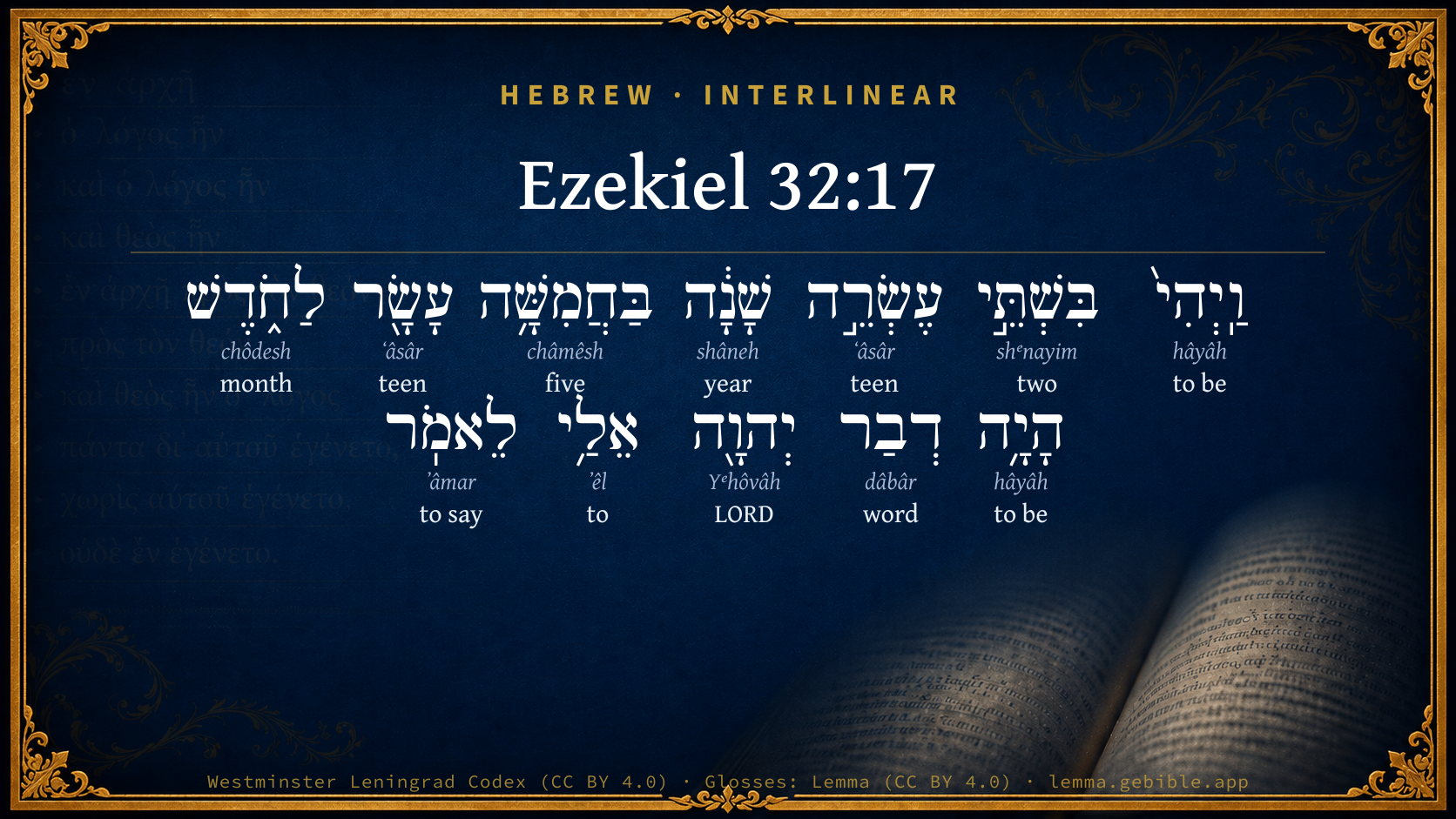
  1. וַֽיְהִי֙ hâyâh H1961 “and · to be” Conjunction + Verb, Qal, Sequential Imperfect, 3rd Person, Masculine, Singular
  2. בִּשְׁתֵּ֣י shᵉnayim H8147 “in/at · two” Preposition + Adjective, Cardinal number, Feminine, Dual, Construct
  3. עֶשְׂרֵ֣ה ʻâsâr H6240 “teen” Adjective, Cardinal number, Feminine, Singular, Absolute
  4. שָׁנָ֔ה shâneh H8141 “year” Noun, Common, Feminine, Singular, Absolute
  5. בַּחֲמִשָּׁ֥ה châmêsh H2568 “in/at the · five” Preposition, Determined + Adjective, Cardinal number, Masculine, Singular, Absolute
  6. עָשָׂ֖ר ʻâsâr H6240 “teen” Adjective, Cardinal number, Masculine, Singular, Absolute
  7. הָיָ֥ה hâyâh H1961 “to be” Verb, Qal, Perfect, 3rd Person, Masculine, Singular
  8. דְבַר dâbâr H1697 “word of” Noun, Common, Masculine, Singular, Construct
  9. יְהוָ֖ה Yᵉhôvâh H3068 “LORD” Noun, Proper
  10. אֵלַ֥י ʼêl H413 “to · me” Preposition + Suffix, Personal, 1st Person, Common, Singular
  11. לֵאמֹֽר ʼâmar H559 “to say” Preposition + Verb, Qal, Infinitive Construct

About this verse

These counts appear in no published source. They are computed here, from the morphology-tagged text and Lemma’s own curated glosses. What Lemma adds →

12
words
10
distinct lemmas
Prophets
section

Grammatical profile

  • 3 verbs
  • 4 nouns
  • 4 adjectives
  • 1 preposition

Verb forms

  • וַֽיְהִי֙ Qal · Sequential Imperfect
  • הָיָ֥ה Qal · Perfect
  • לֵאמֹֽר Qal · Infinitive Construct

Repetition

Words recur within this verse — often emphatic in Hebrew:

  • וַֽיְהִי֙ to be H1961 ×2
  • עֶשְׂרֵ֣ה teen H6240 ×2

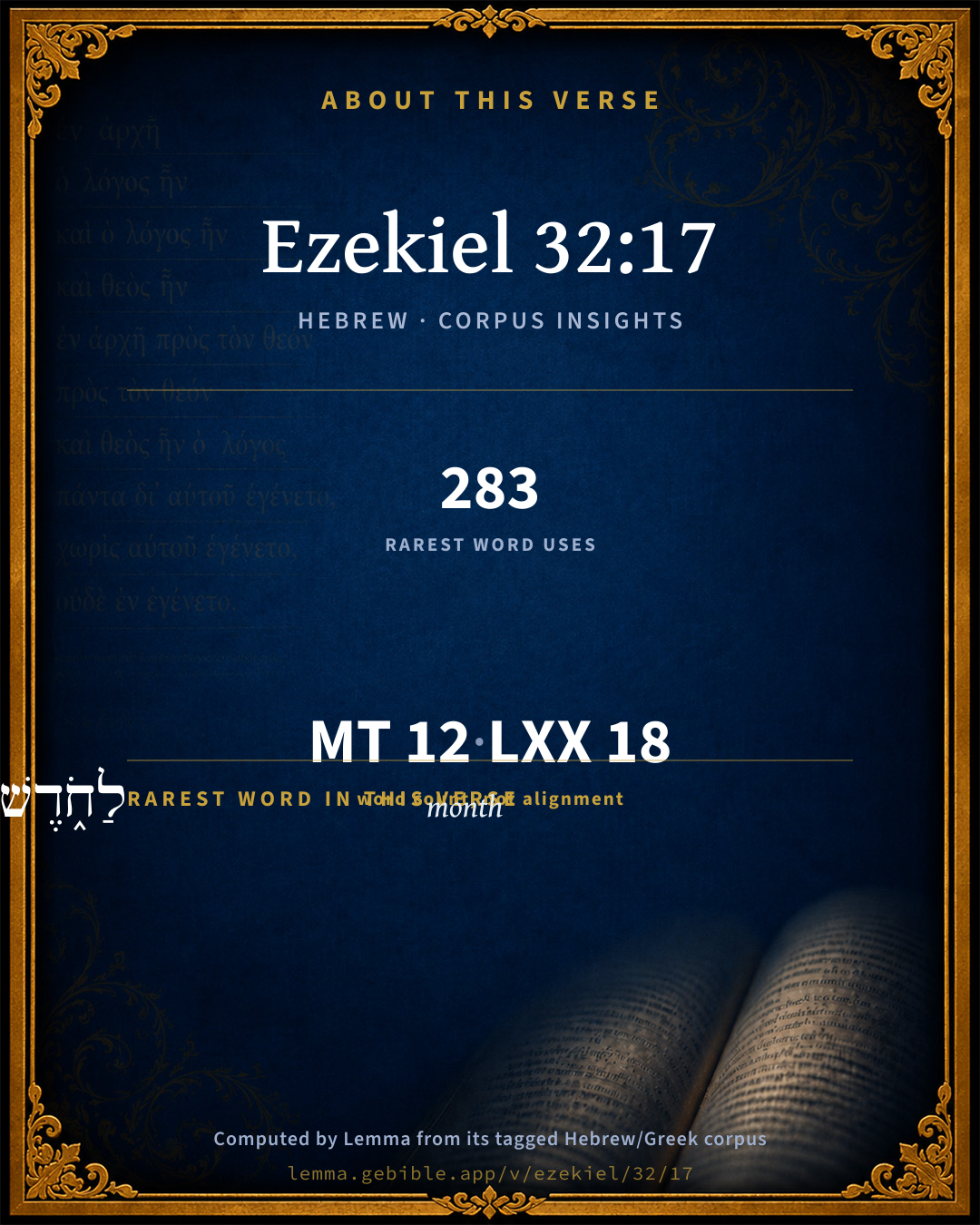
Hebrew & Septuagint length

In English translation the verse runs 23 words from the Hebrew and 29 from the Septuagint (LXX English) — closely comparable.

A rough comparison of the two English renderings, which tokenize alike — not a word-level alignment.

Word counts can differ between the Hebrew and the Greek without any difference in meaning — e.g. the Hebrew direct-object marker אֵת has no separate Greek word, and Greek often adds the article ὁ.

In the original languages it is 12 Hebrew tokens and 18 Greek tokens — but the two are counted differently (Hebrew bundles its prefixes and suffixes into one token; the Greek is in lemma form), so that isn’t a like-for-like length.

Cross-references

4

Topical passages linked to Ezekiel 32:17 in the Treasury of Scripture Knowledge — connected by theme and wording, ordered by reader-vote popularity; previews shown in the World English Bible.

  • Ezekiel 32:1 It happened in the twelfth year, in the twelfth month, in the first [day] of the month, that the word of Yahweh came to me, saying,
  • Ezekiel 1:2 In the fifth [day] of the month, which was the fifth year of king Jehoiachin's captivity,
  • Ezekiel 31:1 It happened in the eleventh year, in the third [month], in the first [day] of the month, that the word of Yahweh came to me, saying,
  • Ezekiel 33:21 It happened in the twelfth year of our captivity, in the tenth [month], in the fifth [day] of the month, that one who had escaped out of Jerusalem came to me, saying, The city has been struck.

Cross-references courtesy of OpenBible.info (CC BY 4.0).

Hebrew and Greek witnesses Masoretic Hebrew ↔ Greek Septuagint

The same verse in the two great witnesses to the Old Testament, shown verse-for-verse.

These are two independent witnesses, not word-aligned to each other, and the Septuagint is shown in lemma (dictionary) form.

Hebrew Ezekiel 32:17 Masoretic · Westminster Leningrad Codex

וַֽיְהִי֙ בִּשְׁתֵּ֣י עֶשְׂרֵ֣ה שָׁנָ֔ה בַּחֲמִשָּׁ֥ה עָשָׂ֖ר לַחֹ֑דֶשׁ הָיָ֥ה דְבַר יְהוָ֖ה אֵלַ֥י לֵאמֹֽר

It happened also in the twelfth year, in the fifteenth [day] of the month, that the word of Yahweh came to me, saying,

World English Bible · Public Domain

Greek LXX Ezekiel 32:17 Septuagint · lemma form

καί γίγνομαι ἐν ὁ δωδέκατος ἔτος ὁ πρῶτος μήν πεντεκαιδέκατος ὁ μήν γίγνομαι λόγος κύριος πρός ἐγώ λέγω

And it came to pass in the twelfth year, in the first month, on the fifteenth day of the month, the word of the Lord came to me, saying,

LXX2012 (modern English Septuagint) · Public Domain

On this verse, The Cambridge Bible for Schools and Colleges discusses the Septuagint’s reading. Read the note in Commentary ↓

Hebrew: Westminster Leningrad Codex (CC BY 4.0). Greek: Septuagint (public domain); English from LXX2012 (modern English Septuagint) (Public Domain). How the Septuagint differs from the Hebrew →

Targum (Aramaic paraphrase)

1

The Targum is the ancient Jewish Aramaic paraphrase of the Hebrew Scriptures — an interpretive translation, not the Hebrew text itself. Onkelos (literal) and Pseudo-Jonathan (expansive) render the Torah, and Jonathan the Prophets. Coverage is partial: where no permissively-licensed English translation exists for a verse, only the Aramaic is shown. This is verse-level text, not a word-by-word alignment to the Hebrew.

  1. Targum Jonathan Prophets (Joshua–Malachi)
    וַהֲוָה בְּתַרְתָּא עַסְרֵי שְׁנִין בְּחַמְשָׁא עֲסַר לְיַרְחָא הֲוָה פִּתְגַם נְבוּאָה מִן קֳדָם יְיָ עִמִי לְמֵימָר:

    (no public-domain English translation for this verse)

    Targum Jonathan — Aramaic: “Mikraot Gedolot” (public domain). English: “Sefaria Community Translation” (CC0 1.0 (public-domain dedication)); “London "Chaldee Paraphrase," 1871” (public domain). Text via Sefaria.

Commentary

Notes on Ezekiel 32:17 from classic Christian and Jewish commentators (each source and its license shown beneath its notes). The classic Christian expositions comment on the surrounding passage and are grouped to its opening verse, so a note may address several verses; the Jewish commentaries on the Tanakh (Rashi and others) are per-verse, so they appear only where the commentator wrote on this verse.

Lemma curates 59 commentaries, every one of them public domain or Creative Commons licensed, each selected and text-cleaned for this edition rather than reprinted as found. About our sources →

Trapp's Complete Commentary

John Trapp

Eze 32:17 It came to pass also in the twelfth year, in the fifteenth [day] of the month, [that] the word of the LORD came unto me, saying,

Ver. 17. In the fifteenth day of the month,] i.e., Of the twelfth month, {Eze 32:1} and about a fortnight after the former prophecy. God loves to foretell, and to do it often.

John Trapp, A Commentary or Exposition upon All the Books of the Old and New Testament (1647–1656) — public domain. Text from a community e-Sword module.

Albert Barnes' Notes on the Bible

The seventh prophecy against Egypt Ezek. 32:17-32. A funeral dirge founded on Eze 31:18. The figure is the same as in Isa. 14, where see the notes. In this dirge Pharaoh is especially addressed. The other nations are represented by their kings, the nations’ overthrow being depicted by the king’s body laid low in the grave.

The month - i. e., the twelfth (see Eze 32:1).

Albert Barnes' Notes on the Bible (1834–1885) — public domain. Text from a community e-Sword/MySword module.

Joseph Benson's Commentary

Eze 32:17-18. It came to pass, in the fifteenth day of the month — Namely, of the month before mentioned, which was a few days after the time of the preceding revelation. The word of the Lord came unto me — Giving me further directions how to improve the fall of Egypt. Son of man, wail for the multitude of Egypt — Prepare the funeral ceremonies at the burial of Egypt, and compose an elegy suitable to the sad occasion. Bishop Lowth observes, that “this prophetic ode is a master-piece in that species of writing which is appropriated to the exciting terror.” And cast them down, even her, &c. — Houbigant renders this clause, And thrust them down with the daughters of the nations; thrust them down to the lower parts of the earth, to those who are gone down to the lake. And he observes, that “the prophet is commanded to thrust the Egyptians down to the shades below; that is, to exhibit, by an hypotyposis, familiar with the prophets, the ruin of the Egyptians, similar to the ruin of the people who have been destroyed and gone down to the regions of the dead.” The reader will observe that this figure of speech is a representation of things painted in such strong and bright colours as may cause the imagination of the hearers to conceive of them rather as present to their view than described in words. Such is the representation which the prophet here gives of the calamities of the Egyptians. The expressions, Unto the nether parts of the earth, with them that go down into the pit, denote utter destruction, and are parallel to those elsewhere used, of being brought down to hell, to the grave, or into silence. The Egyptians affected to be buried in their pyramids, and their kings, princes, and nobles would be laid by themselves, but Ezekiel provides them their graves among common people, to lie just where they fell.

Joseph Benson's Commentary on the Old and New Testaments (1811–1818) — public domain. Text from a community e-Sword module.

Keil & Delitzsch

C. F. Keil & F. Delitzsch

Funeral-Dirge for the Destruction of the Might of Egypt

This second lamentation or mourning ode, according to the heading in Eze 32:17, belongs to the same year as the preceding, and to the 15th of the month, no doubt the 12th month; in which case it was composed only fourteen days after the first. The statement of the month is omitted here, as in Eze 26:1; and the omission is, no doubt, to be attributed to a copyist in this instance also. In the ode, which Ewald aptly describes as a "dull, heavy lamentation," we have six regular strophes, preserving the uniform and monotonous character of the lamentations for the dead, in which the thought is worked out, that Egypt, like other great nations, is cast down to the nether world. The whole of it is simply an elegiac expansion of the closing thought of the previous chapter (Ezekiel 31).

Eze 32:18-21

Introduction and first strophe. - Eze 32:18. Son of man, lament over the tumult of Egypt, and hurl it down, her, like the daughters of glorious nations, into the nether world, to those who go into the pit! Eze 32:19. Whom dost thou surpass in loveliness? Go down and lay thyself with the uncircumcised. Eze 32:20. Among those slain with the sword will they fall; the sword is handed, draw her down and all her tumult. Eze 32:21. The strong ones of the heroes say of it out of the midst of hell with its helpers: they are gone down, they lie there, the uncircumcised, slain with the sword. - נהה, utter a lamentation, and והורדהוּ, thrust it (the tumult of Egypt) down, are co-ordinate. With the lamentation, or by means thereof, is Ezekiel to thrust down the tumult of Egypt into hell. The lamentation is God's word; and as such it has the power to accomplish what it utters. אותהּ is not intended as a repetition of the suffix ־הוּ, but resumes the principal idea contained in the object already named, viz., מצרים, Egypt, i.e., its population. אותהּ and the daughters of glorious nations are co-ordinate. בּנות, as in the expression, daughter of Tyre, daughter Babel, denotes the population of powerful heathen nations. The גּוים אדּרם can only be the nations enumerated in Eze 32:22, Eze 32:24., which, according to these verses, are already in Sheol, not about to be thrust down, but thrust down already. Consequently the copula ו before בּנות is to be taken in the sense of a comparison, as in Sa1 12:15 (cf. Ewald, 340b). All these glorious nations have also been hurled down by the word of God; and Egypt is to be associated with them. By thus placing Egypt on a level with all the fallen nations, the enumeration of which fills the middle strophes of the ode, the lamentation over Egypt is extended into a funeral-dirge on the fall of all the heathen powers of the world. For ארץ תּחתּיּות and יורדי , compare Ezekiel 276:20. The ode itself commences in Eze 32:19, by giving prominence to the glory of the falling kingdom. But this prominence consists in the brief inquiry ממּי נעמתּ, before whom art thou lovely? i.e., art thou more lovely than any one else? The words are addressed either to המון מצרים (Eze 32:18), or what is more probable, to Pharaoh with all his tumult (cf. Eze 32:32), i.e., to the world-power, Egypt, as embodied in the person of Pharaoh; and the meaning of the question is the following: - Thou, Egypt, art indeed lovely; but thou art not better or more lovely than other mighty heathen nations; therefore thou canst not expect any better fate than to go down into Sheol, and there lie with the uncircumcised. ערלים, as in Eze 31:18. This is carried out still further in Eze 32:20, and the ground thereof assigned. The subject to יפּלוּ is the Egyptians, or Pharaoh and his tumult. They fall in the midst of those pierced with the sword. The sword is already handed to the executor of the judgment, the king of Babel (Eze 31:11). Their destruction is so certain, that the words are addressed to the bearers of the sword: "Draw Egypt and all its tumult down into Sheol" (משׁכוּ is imperative for משׁכוּ in Exo 12:21), and, according to Eze 32:21, the heathen already in Sheol are speaking of his destruction. ידבּרוּ לו is rendered by many, "there speak to him, address him, greet him," with an allusion to Isa 14:9., where the king of Babel, when descending into Sheol, is greeted with malicious pleasure by the kings already there. But however obvious the fact may be that Ezekiel has this passage in mind, there is no address in the verse before us as in Isa 14:10, but simply a statement concerning the Egyptians, made in the third person. Moreover, את־עזריו could hardly be made to harmonize with ידבּרוּ לו, if לו signified ad eum. For it is not allowable to connect עת־עזריו (taken in the sense of along with their helpers) with אלי גבּורים as a noun in apposition, for the simple reason that the two are separated by מתּוך שׁאול. Consequently את־עזריו can only belong to ידבּרוּ: they talk (of him) with his helpers. עזריו, his (Pharaoh's) helpers are his allies, who have already gone down before him into hell (cf. Eze 30:8). The singular suffix, which has offended Hitzig, is quite in order as corresponding to לו. The words, "they have gone down, lie there," etc., point once more to the fact that the same fate has happened to the Egyptians as to all the rest of the rulers and nations of the world whom God has judged. For אלי גבּורים, strong ones of the heroes, compare the comm. on Eze 31:11. שׁאול, hell = the nether world, the gathering-place of the dead; not the place of punishment for the damned. חללי without the article is a predicate, and not in apposition to הערלים. On the application of this epithet to the Egyptians, Kliefoth has correctly observed that "the question whether the Egyptians received circumcision is one that has no bearing upon this passage; for in the sense in which Ezekiel understands circumcision, the Egyptians were uncircumcised, even if they were accustomed to circumcise their flesh."

In the four following strophes (Eze 32:22-30) a series of heathen nations is enumerated, whom the Egyptian finds already in hell, and with whom he will share the same fate. There are six of these - namely, Asshur, Elam, Meshech-Tubal, Edom, the princes of the north, and Sidon. The six are divisible into two classes - three great and remote world-powers, and three smaller neighbouring nations. In this no regard is paid to the time of destruction. With the empire of Asshur, which had already fallen, there are associated Elam and Meshech-Tubal, two nations, which only rose to the rank of world-powers in the more immediate and more remote future; and among the neighbouring nations, the Sidonians and princes of the north, i.e., The Syrian kings, are grouped with Edom, although the Sidonians had long ago given up their supremacy to Tyre, and the Aramean kings, who had once so grievously oppressed the kingdom of Israel, had already been swallowed up in the Assyrian and Chaldean empire. It may, indeed, be said that "in any case, at the time when Ezekiel prophesied, princes enough had already descended into Sheol both of the Assyrians and Elamites, etc., to welcome the Egyptians as soon as they came" (Kliefoth); but with the same justice may it also be said that many of the rulers and countrymen of Egypt had also descended into Sheol already, at the time when Pharaoh, reigning in Ezekiel's day, was to share the same fate. It is evident, therefore, that "any such reflection upon chronological relations is out of place in connection with our text, the intention of which is merely to furnish an exemplification" (Kliefoth), and that Ezekiel looks upon Egypt more in the light of a world-power, discerning in its fall the overthrow of all the heathen power of the world, and predicting it under the prophetic picture, that Pharaoh and his tumult are expected and welcomed by the princes and nations that have already descended into Sheol, as coming to share their fate with them.

Eze 32:22-23

Second strophe. - Eze 32:22. There is Asshur and all its multitude, round about it their graves, all of them slain, fallen by the sword Eze 32:23. Whose graves are made in the deepest pit, and its multitude is round about its grave; all slain, fallen by the sword, who spread terror in the land of the living. - The enumeration commences with Asshur, the world-power, which had already been overthrown by the Chaldeans. It is important to notice here, that אשּׁוּר, like עילם in Eze 32:24, and משׁך in Eze 32:26, is construed as a feminine, as המונהּ which follows in every case plainly shows. It is obvious, therefore, that the predominant idea is not that of the king or people, but that of the kingdom or world-power. It is true that in the suffixes attached to סביבותיו קברתיו in Eze 32:22, and סביבותיו in Eze 32:25 and Eze 32:26, the masculine alternates with the feminine, and Hitzig therefore proposes to erase these words; but the alternation may be very simply explained, on the ground that the ideas of the kingdom and its king are not kept strictly separate, but that the words oscillate from one idea to the other. It is affirmed of Asshur, that as a world-power it lies in Sheol, and the gravers of its countrymen are round about the graves of its ruler. They all lie there as those who have fallen by the sword, i.e., who have been swept away by a judgment of God. To this is added in Eze 32:23 the declaration that the graves of Asshur lie in the utmost sides, i.e., the utmost or deepest extremity of Sheol; whereas so long as this power together with its people was in the land of the living, i.e., so long as they ruled on earth, they spread terror all around them by their violent deeds. From the loftiest height of earthly might and greatness, they are hurled down to the lowest hell. The higher on earth, the deeper in the nether world. Hvernick has entirely misunderstood the words "round about Asshur are its graves" (Eze 32:22), and "its multitude is round about its grave" (the grave of this world-power), when he finds therein the thought that the graves and corpses are to be regarded as separated, so that the dead are waiting near their graves in deepest sorrow, looking for the honour of burial, but looking in vain. There is not a word of this in the text, but simply that the graves of the people lie round about the grave of their ruler.

Eze 32:24-25

Third strophe. - Eze 32:24. There is Elam, and all its multitude round about its grave; all of them slain, fallen by the sword, who went down uncircumcised into the nether world, who spread terror before them in the land of the living, and bear their shame with those who went into the pit. Eze 32:25. In the midst of the slain have they made it a bed with all its multitude, round about it are their graves; all of them uncircumcised, pierced with the sword; because terror was spread before them in the land of the living, they bear their shame with those who have gone into the pit. In the midst of slain ones is he laid. - Asshur is followed by עילם, Elam, the warlike people of Elymais, i.e., Susiana, the modern Chusistan, whose archers served in the Assyrian army (Isa 22:6), and which is mentioned along with the Medes as one of the conquerors of Babylon (Isa 21:2), whereas Jeremiah prophesied its destruction at the commencement of Zedekiah's reign (Jer 49:34.). Ezekiel says just the same of Elam as he has already said of Asshur, and almost in the same words. The only difference is, that his description is more copious, and that he expresses more distinctly the thought of shameful destruction which is implied in the fact of lying in Sheol among the slain, and repeats it a second time, and that he also sets the bearing of shame into Sheol in contrast with the terror which Elam had spread around it during its life on earth. נשׂא , as in Eze 16:52. The ב in בּכל־המונהּ is either the "with of association," or the fact of being in the midst of a crowd. להּ refers to עילם; and נתנוּ has an indefinite subject, "they gave" = there was given. משׁכּב, the resting-place of the dead, as in Ch2 16:14. The last clause in Eze 32:25 is an emphatic repetition of the leading thought: he (Elam) is brought or laid in the midst of the slain.

Eze 32:26-28

Fourth strophe. - Eze 32:26. There is Meshech-Tubal and all its multitude, its graves round about it; all of them uncircumcised, slain in with the sword, because they spread terror before them in the land of the living. Eze 32:27. They lie not with the fallen heroes of uncircumcised men, who went down into hell with their weapons of war, whose swords they laid under their heads; their iniquities have come upon their bones, because they were a terror of the heroes in the land of the living. Eze 32:28. Thou also wilt be dashed to pieces among uncircumcised men, and lie with those slain with the sword. - משׁך and תּבל, the Moschi and Tibareni of the Greeks (see the comm. on Eze 27:13), are joined together ἀσυνδετῶς here as one people or heathen power; and Ewald, Hitzig, and others suppose that the reference is to the Scythians, who invaded the land in the time of Josiah, and the majority of whom had miserably perished not very long before (Herod. i. 106). But apart from the fact that the prophets of the Old Testament make no allusion to any invasion of Palestine by the Scythians (see Minor Prophets, vol. ii. p. 124, Eng. transl.), this view is founded entirely upon the erroneous supposition that in this funeral-dirge Ezekiel mentions only such peoples as had sustained great defeats a longer or shorter time before. Meshech-Tubal comes into consideration here, as in Ezekiel 38, as a northern power, which is overcome in its conflict with the kingdom of God, and is prophetically exhibited by the prophet as having already fallen under the judgment of death. In Eze 32:26 Ezekiel makes the same announcement as he has already made concerning Asshur in Eze 32:22, Eze 32:23, and with regard to Elam in Eze 32:24, Eze 32:25. But the announcement in Eze 32:27 is obscure. Rosenmller, Ewald, Hvernick, and others, regard this verse as a question (ולא in the sense of הלא): "and should they not lie with (rest with) other fallen heroes of the uncircumcised, who...?" i.e., they do lie with them, and could not possibly expect a better fate. But although the interrogation is merely indicated by the tone where the language is excited, and therefore ולא might stand for הלא, as in Exo 8:22, there is not the slightest indication of such excitement in the description given here as could render this assumption a probable one. On the contrary, ולא at the commencement of the sentence suggests the supposition that an antithesis is intended to the preceding verse. And the probability of this conjecture is heightened by the allusion made to heroes, who have descended into the nether world with their weapons of war; inasmuch as, at all events, something is therein affirmed which does not apply to all the heroes who have gone down into hell. The custom of placing the weapons of fallen heroes along with them in the grave is attested by Diod. Sic. xviii. 26; Arrian, i. 5; Virgil, Ane. vi. 233 (cf. Dougtaei Analectt. ss. i. pp. 281, 282); and, according to the ideas prevailing in ancient times, it was a mark of great respect to the dead. But the last place in which we should expect to meet with any allusion to the payment of such honour to the dead would be in connection with Meshech and Tubal, those wild hordes of the north, who were only known to Israel by hearsay. We therefore follow the Vulgate, the Rabbins, and many of the earlier commentators, and regard the verse before us as containing a declaration that the slain of Meshech-Tubal would not receive the honour of resting in the nether world along with those fallen heroes whose weapons were buried with them in the grave, because they fell with honour.

(Note: C. a Lapide has already given the true meaning: "He compares them, therefore, not with the righteous, but with the heathen, who, although uncircumcised, had met with a glorious death, i.e., they will be more wretched than these; for the latter went down to the shades with glory, but they with ignominy, as if conquered and slain.")

כּלי מלחמה, instruments of war, weapons, as in Deu 1:41. The text leaves it uncertain who they were who had been buried with such honours. The Seventy have confounded מערלים with מעולם, and rendered ,נפלים τῶν πεπτωκότων ἀπ ̓αἰῶνος possibly thinking of the gibborim of Gen 6:4. Dathe and Hitzig propose to alter the text to this; and even Hvernick imagines that the prophet may possibly have had such passages as Gen 6:4 and Gen 10:9. floating before his mind. But there is not sufficient ground to warrant an alteration of the text; and if Ezekiel had had Gen 6:4 in his mind, he would no doubt have written הגבּורים. The clause ותּהי עונותם is regarded by the more recent commentators as a continuation of the preceding 'ויּתּנוּ וגו, which is a very natural conclusion, if we simply take notice of the construction. But if we consider the sense of the words, this combination can hardly be sustained. The words, "and so were their iniquities upon their bones" (or they came upon them), can well be understood as an explanation of the reason for their descending into Sheol with their weapons, and lying upon their swords. We must therefore regard ותּהי עונותם as a continuation of ישׁכּבוּ, so that their not resting with those who were buried with their weapons of war furnishes the proof that their guilt lay upon their bones. The words, therefore, have no other meaning than the phrase ישׂאוּ כלמּתם in Eze 32:24 and Eze 32:30. Sin comes upon the bones when the punishment consequent upon it falls upon the bones of the sinner. In the last clause we connect גבּורים with חתּית, terror of the heroes, i.e., terrible even to heroes on account of their savage and cruel nature. In Eze 32:28 we cannot take אתּה as referring to Meshech-Tubal, as many of the commentators propose. A direct address to that people would be at variance with the whole plan of the ode. Moreover, the declaration contained in the verse would contradict what precedes. As Meshech-Tubal is already lying in Sheol among the slain, according to Eze 32:26, the announcement cannot be made to it for the first time here, that it is to be dashed in pieces and laid with those who are slain with the sword. It is the Egyptian who is addressed, and he is told that this fate will also fall upon him. And through this announcement, occurring in the midst of the list of peoples that have already gone down to Sheol, the design of that list is once more called to mind.

Eze 32:29-30

Fifth strophe. - Eze 32:29. There are Edom, its kings and all its princes, who in spite of their bravery are associated with those that are pierced with the sword; they lie with the uncircumcised and with those that have gone down into the pit. Eze 32:30. There are princes of the north, all of them, and all the Sidonians who have gone down to the slain, been put to shame in spite of the dread of them because of their bravery; they lie there as uncircumcised, and bear their shame with those who have gone into the pit. - In this strophe Ezekiel groups together the rest of the heathen nations in the neighbourhood of Israel; and in doing so, he changes the שׁם of the preceding list for שׁמּה, thither. This might be taken prophetically: thither will they come, "to these they also belong" (Hvernick), only such nations being mentioned here as are still awaiting their destruction. But, in the first place, the perfects אשׁר נתנוּ, אשׁר ירדוּ, in Eze 32:29, Eze 32:30, do not favour this explanation, inasmuch as they are used as preterites in Eze 32:22, Eze 32:24, Eze 32:25, Eze 32:26, Eze 32:27; and, secondly, even in the previous strophes, not only are such peoples mentioned as have already perished, but some, like Elam and Meshech-Tubal, which did not rise into historical importance, or exert any influence upon the development of the kingdom of God till after Ezekiel's time, whereas the Edomites and Sidonians were already approaching destruction. We therefore regard שׁמּה as simply a variation of expression in the sense of "thither have they come," without discovering any allusion to the future. - In the case of Edom, kings and נשׂיאים, i.e., tribe-princes, are mentioned. The allusion is to the 'alluphim or phylarchs, literally chiliarchs, the heads of the leading families (Gen 36:15.), in whose hands the government of the people lay, inasmuch as the kings were elective, and were probably chosen by the phylarchs (see the comm. on Gen 36:31.). בּגבוּרתם, in, or with their bravery, i.e., in spite of it. There is something remarkable in the allusion to princes of the north (נסיכי, lit., persons enfeoffed, vassal-princes; see the comm. on Jos 13:21 and Mic 5:4) in connection with the Sidonians, and after Meshech-Tubal the representative of the northern nations. The association with the Sidonians renders the conjecture a very natural one, that allusion is made to the north of Palestine, and more especially to the Aram of Scripture, with its many separate states and princes (Hvernick); although Jer 25:26, "the kings of the north, both far and near," does not furnish a conclusive proof of this. So much, at any rate, is certain, that the princes of the north are not to be identified with the Sidonians. For, as Kliefoth has correctly observed, "there are six heathen nations mentioned, viz., Asshur, Elam, Meshech-Tubal, Edom, the princes of the north, and Sidon; and if we add Egypt to the list, we shall have seven, which would be thoroughly adapted, as it was eminently intended, to depict the fate of universal heathenism." A principle is also clearly discernible in the mode in which they are grouped. Asshur, Elam, and Meshech-Tubal represent the greater and more distant world-powers; Edom the princes of the north, and Sidon the neighbouring nations of Israel on both south and north. בּחתּיתם מגּבוּרתם, literally, in dread of them, (which proceeded) from their bravery, i.e., which their bravery inspired. 'ויּשׂאוּ וגו, as in Eze 32:24.

Eze 32:31-32

Sixth and last strophe. - Eze 32:31. Pharaoh will see them, and comfort himself over all his multitude. Pharaoh and all his army are slain with the sword, is the saying of the Lord Jehovah. Eze 32:32. For I caused him to spread terror in the land of the living, therefore is he laid in the midst of uncircumcised, those slain with the sword. Pharaoh and all his multitude, is the saying of the Lord Jehovah. - In these verses the application to Egypt follows. Pharaoh will see in the nether world all the greater and smaller heathen nations with their rulers; and when he sees them all given up to the judgment of death, he will comfort himself over the fate which has fallen upon himself and his army, as he will perceive that he could not expect any better lot than that of the other rulers of the world. נחם על, to comfort oneself, as in Eze 31:16 and Eze 14:22. Hitzig's assertion, that נחם never signifies to comfort oneself, is incorrect (see the comm. on Eze 14:22). נתתּי את־חתּיתו, I have given terror of him, i.e., I have made him an instrument of terror. The Keri חתּיתי arose from a misunderstanding. The Chetib is confirmed by Eze 32:24 and Eze 32:26. In Eze 32:32 the ode is brought to a close by returning even in expression to Eze 32:19 and Eze 32:20.

If, now, we close with a review of the whole of the contents of the words of God directed against Egypt, in all of them is the destruction of the might of Pharaoh and Egypt as a world-power foretold. And this prophecy has been completely fulfilled. As Kliefoth has most truly observed, "one only needs to enter the pyramids of Egypt and its catacombs to see that the glory of the Pharaohs has gone down into Sheol. And it is equally certain that this destruction of the glory of ancient Egypt dates from the times of the Babylonio-Persian empire. Moreover, this destruction was so thorough, that even to the New Egypt of the Ptolemies the character of the Old Egypt was a perfect enigma, a thing forgotten and incomprehensible." But if Ezekiel repeatedly speaks of Nebuchadnezzar the king of Babylon as executing this judgment upon Egypt, we must bear in mind that here, as in the case of Tyre (see the comm. on Ezekiel 28:1-19), Ezekiel regards Nebuchadnezzar as the instrument of the righteous punishment of God in general, and discerns in what he accomplishes the sum of all that in the course of ages has been gradually fulfilling itself in history. At the same time, it is equally certain that this view of the prophet would have no foundation in truth unless Nebuchadnezzar really did conquer Egypt and lay it waste, and the might and glory of this ancient empire were so shattered thereby, that it never could recover its former greatness, but even after the turning of its captivity, i.e., after its recovery from the deadly wounds which the imperial monarchy of Babylonia and afterwards of Persia inflicted upon it, still remained a lowly kingdom, which could "no more rule over the nations" (Eze 29:13-16). Volney, however, in his Recherch. nouv. sur l'hist. anc. (III pp. 151ff.), and Hitzig (Ezekiel p. 231), dispute the conquest and devastation of Egypt by Nebuchadnezzar, because the Greek historians, with Herodotus (ii. 161ff.) at their head, make no allusion whatever to an invasion of Egypt; and their statements are even opposed to such an occurrence. But the silence of Greek historians, especially of Herodotus, is a most "miserable" argument. The same historians do not say a word about the defeat of Necho by Nebuchadnezzar at Carchemish; and yet even Hitzig accepts this as an indisputable fact. Herodotus and his successors derived their accounts of Egypt from the communications of Egyptian priests, who suppressed everything that was humiliating to the pride of Egypt, and endeavoured to cover it up with their accounts of glorious deeds which the Pharaohs had performed. But Hitzig has by no means proved that the statements of the Greeks are at variance with the assumption of a Chaldean invasion of Egypt, whilst he has simply rejected but not refuted the attempts of Perizonius, Vitringa, Hvernick, and others, to reconcile the biblical narrative of the conquest of Egypt by Nebuchadnezzar with the accounts given by Herodotus, Diodorus Siculus, and other Greeks, concerning the mighty feats of Necho, and his being slain by Amasis. The remark that, in the description given by Herodotus, Amasis appears as an independent king by the side of Cambyses, only less powerful than the Persian monarch, proves nothing more, even assuming the correctness of the fact, than that Amasis had made Egypt once more independent of Babylonia on the sudden overthrow of the Chaldean monarchy.

The conquest of Egypt by Nebuchadnezzar, after the attitude which Pharaoh Necho assumed towards the Babylonian empire, and even attempted to maintain in the time of Zedekiah by sending an army to the relief of Jerusalem when besieged by the Chaldeans, is not only extremely probable in itself, but confirmed by testimony outside the Bible. Even if no great importance can be attached to the notice of Megasthenes, handed down by Strabo (xv. 1. 6) and Josephus (c. Ap. i. 20): "he says that he (Nebuchadnezzar) conquered the greater part of Libya and Iberia;" Josephus not only quotes from Berosus (l.c. i. 19) to the effect that "the Babylonian got possession of Egypt, Syria, Phoenicia, Arabia," but, on the ground of such statements, relates the complete fulfilment of the prophecies of Scripture, saying, in Antt. x. 9. 7, with reference to Nebuchadnezzar, "he fell upon Egypt to conquer it. And the reigning king he slew; and having appointed another in his place, made those Jews prisoners who had hitherto resided there, and led them into Babylon." And even if Josephus does not give his authority in this case, the assertion that he gathered this from the prophecies of Jeremiah is untrue; because, immediately before the words we have quoted, he says that what Jeremiah had prophesied (Jer 43:10 and Jer 44) had thus come to pass; making a distinction, therefore, between prophecy and history. And suspicion is not to be cast upon this testimony by such objections as that Josephus does not mention the name of the Egyptian king, or state precisely the time when Egypt was conquered, but merely affirms in general terms that it was after the war with the Ammonites and Moabites.

Keil & Delitzsch — Biblical Commentary on the Old Testament (1861–1891) — public domain (CC PDM 1.0). Text via the HelloAO Bible API. (Old Testament only.)

Tyndale Open Study Notes

Tyndale Open Resources

32:17-32 This last, climactic message against Egypt sums up the whole series of messages against all of the nations.

Tyndale Open Study Notes — © Tyndale Open Resources, licensed CC BY-SA 4.0. Text via the HelloAO Bible API.

Matthew Henry's Commentary

This prophecy concludes and completes the burden of Egypt, and leaves it and all its multitude in the pit of destruction.

I. We are here invited to attend the funeral of that once flourishing kingdom, to lament its fall, and to take a view of those who attend it to the grave and accompany it in the grave.

1. This dead corpse of a kingdom is here brought to the grave. The prophet is ordered to cast them down to the pit (Eze 32:18), to foretel their destruction as one that had authority, as Jeremiah was set over the kingdoms, Jer 1:10. He must speak in God's name, and as from him who will cast them down. Yet he must foretel it as one that had an affectionate concern for them; he must wail for the multitude of Egypt, even when he casts them down. When Egypt is slain, let her have an honourable funeral, befitting her quality; let her be buried with the daughters of the famous nations, in their burying-places and with the same ceremony. It is but a poor allay to the reproach and terror of death to be buried with those that were famous; yet this is all that is allowed to Egypt. Shall Egypt think to exempt herself from the common fate of proud and imperious nations? No; she must take her lot with them (Eze 32:19): "Whom dost thou surpass in beauty? Art thou so much fairer than any other nation that thou shouldst expect therefore to be excused? No; others as fair as thou have sunk into the pit; go down therefore, and be thou laid with the uncircumcised. Thou art like them and art likely to lie among them. The multitude of Egypt shall all fall in the midst of those that are slain with the sword, now that there is a general slaughter made among the nations." Egypt with the rest must drink of the bloody cup, and therefore she is delivered to the sword, to the sword of war (but, in God's hand, the sword of justice), is delivered to be publicly executed. Draw her and all her multitude; draw them either as the dead bodies of great men are drawn in honour to the grave, in a hearse, or as malefactors are drawn in disgrace to the place of execution, on a sledge; draw them to the pit, and let them be made a spectacle to the world.

2. This corpse of a kingdom is bid welcome to the grave, and Pharaoh is made free of the congregation of the dead, and admitted into their regions, not without some pomp and ceremony. As the surprising fall of the king of Babylon is thus illustrated, Hell from beneath is moved for thee to meet thee at thy coming, and to introduce thee into those mansions of darkness (Isa 14:9, etc.), so here (Eze 32:21), They shall speak to him out of the midst of hell, as it were congratulating his arrival and calling him to join with them in acknowledging that which neither he nor they would be brought to own when they were in their pomp and pride, that it is in vain to think of contesting with God, and none ever hardened their hearts against him and prospered. They shall say to him, and to those that pretended to help him, Where are you now? What have you brought your attempts to at last? Divers nations are here mentioned as gone down to the grave before Egypt that are ready to give her a scornful reception and upbraid her with coming to them at last. These nations here spoken of were probably such as had been of late years ruined and wasted by the king of Babylon, and their princes cut off; let Egypt know that she has neighbour's fare. When she goes to the grave she does but migrare ad plures - migrate to the majority; there are innumerable before her. But it is observable that though Judah and Jerusalem were just about this time, or a little before, utterly ruined and laid waste, yet they are not mentioned here among the nations that welcome Egypt to the pit; for though they suffered the same things that these nations suffered, and by the same hand, yet the kind intentions of their affliction, and its happy issue at last, and the mercy God had yet in reserve for them, altered the property of it; it was not to them a going down to the pit, as it was to the heathen; they were not smitten as others were, nor slain according to the slaughter of other nations, Isa 27:7. But let us see who those are that have gone to the grave before Egypt, that lie uncircumcised, slain by the sword, with whom she must now take up her lodging. (1.) There lie the Assyrian empire, and all the princes and mighty men of that monarchy (Eze 32:22): Asshur is there and all her company, all the countries that were tributaries to and had dependence upon that crown. That mighty potentate who used to lie in state, with his guards and grandees about him, now lies in obscurity, with his graves about him and his soldiers in them, unable any longer to do him service or honour; they are all of them slain, fallen by the sword. The number of their months was cut off in the midst, and, being bloody and deceitful men, they were not suffered to live out half their days. Their braves were set in the sides of the pit, all in a row, like beds in a common chamber, Eze 32:23. All their company is such as were slain, fallen by the sword; a vast congregation there is of such, who had caused terror in the land of the living. But as the death of those to whom they were a terror put an end to their fears (in the grave the prisoners rest together and hear not the voice of the oppressor, Job 3:18), so the death of these mighty men puts an end to their terrors. Who is afraid of a dead lion? Note, Death will be a king of terrors to those who, instead of making themselves blessings, make themselves terrors, in their generation. (2.) There lies the kingdom of Persia, which perhaps within the memory of man at that time had been wasted and brought down: There is Elam and all her multitude, the king of Elam and his numerous armies, Eze 32:24, Eze 32:25. They also had caused their terror in the land of the living, had made a fearful noise and bluster among the nations in their day. But Elam has now a grave by herself, and the graves of the common people round about her, fallen by the sword; she has her bed in the midst of the slain that went down uncircumcised, unsanctified, unholy, and not in covenant with God. They have borne their shame with those that go down to the pit; they have fallen under the common disgrace and mortification of mankind, that they die and are buried; nay, they die under particular marks of ignominy, which God and man put upon them. Note, Those who cause their terror shall, sooner or later, bear their shame, and be made a terror to themselves. The king of Elam is put in the midst of those that are slain. All the honour he can now pretend to is to be buried in the chief sepulchre. (3.) There lies the Scythian power, which, about this time, was busy in the world. Meshech and Tubal, those barbarous northern nations, had lately made a descent upon the Medes, and caused their terror among them, lived among them upon free quarter for some years, making every thing their own that they could lay their hands on; but at length Cyaxares, king of the Medes, drew them by a wile into his power, but off abundance of them, and obliged them to quit his country, Eze 32:26. There lie Meshech and Tubal, and all their multitude; there is a burying place for them, with their chief commander in the midst of them, all of them uncircumcised, slain by the sword. These Scythians, dying ingloriously as they lived, are not laid, as the other nations spoken of before, in the bed of honour (Eze 32:27): They shall not lie with the mighty, shall not be buried in state, as those are, even by consent of the enemy, that are slain in the field of battle, that go down to their graves with their weapons of war carried before the hearse, or trailed after it, that have particularly their swords laid under their heads, as if they could sleep the sweeter in the grave when they laid their heads on such a pillow. These Scythians are not buried with these marks of honour, but their iniquities shall be upon their sons; they shall, for their iniquity, be left unburied, though they were the terror even of the mighty in the land of the living. (4.) There lies the kingdom of Edom, which had flourished long, but about this time, at least before the destruction of Egypt, was made quite desolate, as was foretold, Eze 25:13. Among the sepulchres of the nations there is Edom, Eze 32:29. There lie, not dignified with monuments or inscriptions, but mingled with common dust, her kings and all her princes, her wise statesmen (which Edom was famous for), and her brave soldiers. These with their might are laid by those that were slain by the sword; their might could not prevent it, nay, their might helped to procure it, for that both encouraged them to engage in war and incensed their neighbours against them, who thought it necessary to curb their growing greatness. A great deal of pains they took to ruin themselves, as many do, who with their might, with all their might, are laid by those that were slain with the sword. The Edomites retained circumcision, being of the seed of Abraham. But that shall stand them in no stead; they shall lie with the uncircumcised. (5.) There lie the princes of the north, and all the Zidonians. These were as well acquainted with maritime affairs as the Egyptians were, who relied much upon that part of their strength, but they have gone down with the slain (Eze 32:30), down to the pit. Now they are ashamed of their might, ashamed to think how much they boasted of it and trusted to it; and, as the Edomites with their might, so these with their terror, are laid with those that are slain by the sword and are forced to take their lot with them. They bear their shame with those that go down to the pit, die in as much disgrace as those that are cut off by the hand of public justice. (6.) All this is applied to Pharaoh and the Egyptians, who have no reason to flatter themselves with hopes of tranquillity when they see how the wisest, and wealthiest, and strongest, of their neighbours have been laid waste (Eze 32:28): "Yea, thou shalt be broken in the midst of the uncircumcised; when God is pulling down the unhumbled and unreformed nations thou must expect to come down with them." [1.] It will be some extenuation of the miseries of Egypt to observe that it has been the case of so many great and mighty nations before (Eze 32:31): Pharaoh shall see them and be comforted; it will be some ease to his mind that he is not the first king that has been slain in battle - his not the first army that has been routed, his not the first kingdom that has been made desolate. Mr. Greenhill observes here, "The comfort which wicked ones have after death is poor comfort, not real, but imaginary." They will find little satisfaction in having so many fellow-sufferers; the rich man in hell dreaded it. It is only in point of honour that Pharaoh can see and be comforted. [2.] But nothing will be an exemption from these miseries; for (Eze 32:32) I have caused my terror in the land of the living. Great men have caused their terror, have studied how to make every body fear them. Oderint dum metuant - Let them hate, so that they do but fear. But now the great God has caused his terror in the land of the living; and therefore he laughs at theirs, because he sees that his day is coming, Psa 37:13. In this day of terror Pharaoh and all his multitude shall be laid with those that are slain by the sword.

II. The view which this prophecy gives us of ruined states may show us something, 1. Of this present world, and the empire of death in it. Come, and see the calamitous state of human life; see what a dying world this is. The strong die, the mighty die, Pharaoh and all his multitude. See what a killing world this is. They are all slain with the sword. As if men did not die fast enough of themselves, men are ingenious at finding out ways to destroy one another. It is not only a great pit, but a great cock-pit. 2. Of the other world. Though it is the destruction of nations as such that perhaps is principally intended here, yet here is a plain allusion to the final and everlasting ruin of impenitent sinners, of those that are uncircumcised in heart; they are slain by the sword of divine justice; their iniquity is upon them, and with it they bear their shame. Those, Christ's enemies, that would not have him to reign over them, shall be brought forth and slain before him, though they be as pompous, though they be as numerous, as Pharaoh and all his multitude.

Matthew Henry's Commentary on the Whole Bible (1708–1710) — public domain (CC PDM 1.0). Text via the HelloAO Bible API.

Jamieson, Fausset & Brown

Robert Jamieson, A. R. Fausset & David Brown

The second lamentation for Pharaoh. This funeral dirge in imagination accompanies him to the unseen world. Egypt personified in its political head is ideally represented as undergoing the change by death to which man is liable. Expressing that Egypt's supremacy is no more, a thing of the past, never to be again.

the month--the twelfth month (Eze 32:1); fourteen days after the former vision.

Jamieson, Fausset & Brown — Commentary Critical and Explanatory on the Whole Bible (1871) — public domain (CC PDM 1.0). Text via the HelloAO Bible API.

Adam Clarke's Commentary

Verse 17. In the twelfth year] Two of Kennicott's MSS., one of De Rossi's, and one of my own, (that mentioned Eze 32:1,) have, in the ELEVENTH year; and so has the Syriac, as before. This prophecy concerns the people of Egypt.

Adam Clarke's Commentary on the Bible (1810–1826) — public domain. Text from a community e-Sword/MySword module.

Ellicott's Commentary for English Readers

(17) The fifteenth day of the month.—The month itself is not mentioned, but since the previous prophecy was in the twelfth, or last month of the year, this must be in the same. There was thus an interval of just fourteen days between them. This dirge, which occupies the rest of the chapter, is to be compared with Isaiah 14, on which it is evidently founded.

A Bible Commentary for English Readers, edited by Charles John Ellicott (1878–1897) — public domain. Text from a community e-Sword module.

The Cambridge Bible for Schools and Colleges

gen. ed. J. J. S. Perowne

17. The month is not specified, but presumably the same month as that named in Eze_32:1 is intended, the twelfth. The present passage would in that case date a fortnight later than Eze_32:1-16. LXX. reads first month of twelfth year; if this reading were followed the year in Eze_32:1 must be read eleventh (with Syr.).

17–32. Dirge sung at the interment of Egypt and its multitude

Several things are observable in this remarkable passage:

1. It is a funeral dirge primarily over the multitude or nation of Egypt; and so in the case of the other nations referred to, Asshur, Elam and the rest. These peoples are all gone down to Sheòl, uncircumcised, slain with the sword. There in the world of the dead each people has an abode to itself. Around one chief grave the graves of the general mass are gathered. The chief grave is probably that of the prince, though the prince is considered the genius, the embodiment of the spirit and being of the nation. The prophet regards the nations, even when no more existing on earth, as still having a subsistence in the world of the dead (cf. on Sodom, ch. 14). They are beings, who, having once lived, continue throughout all time. Though passed from the stage of history they still subsist in Sheòl. This idea of the continued existence, not of individuals only but of nationalities, suggests a conception of the meaning of history upon the earth which is not only weird but almost disturbing.

2. The prophet uses two words for the world of the dead, “the pit” and Sheòl. The former name seems suggested by the grave, which is regarded as the entrance to Sheòl, and indicates what kind of place Sheòl is. It is a vast burying-place, deep in the earth, and full of graves. The nationalities spoken of have, like Egypt, all fallen by the sword, and the scene on earth is transferred to the world below. The nation and its prince are represented as slain on the battle-field, and the graves that crowd the field, the prince or genius of the nation in the midst, and those of the multitude around, are let down so to speak into Sheòl beneath, where they abide. This scene of overthrow, the final experience of the nation on earth, expresses the meaning of the nation’s history and the verdict of God upon it, and it is consequently transferred to the world of the dead and made eternal. In this respect the idea of the prophet in regard to nations coincides with the general view of the Old Testament regarding individuals; the judgment of God regarding a man’s life becomes manifest at the close of it on earth, and the state of death but perpetuates the manner of the end of life.

3. For, of course, the prophet desires to express by his representation a moral truth. The nations which he mentions are those that have come into conflict with Israel, although their sin is regarded as more general than this. They are chiefly the contemporary peoples whom Nebuchadnezzar, under commission from Jehovah, was to destroy, though Asshur belongs to an earlier time. Although, therefore, the nations can hardly be supposed to fall under a common judgment, the day of the Lord, the effect is the same. Their fate is the judgment of Jehovah upon them, his verdict in regard to their life as nations. Their common sin is violence: they put their terror in the land of the living. And their fate is but the nemesis of their conduct: taking the sword they perish by it. The history of nations is the judgment of nations. But the nations like individuals continue to subsist, they bear their shame in Sheòl for ever.

4. The text of the passage is in considerable disorder. The LXX. offers a briefer and smoother text, though it is also marked by singular blunders (cf. Eze_32:29-30). It can hardly be doubted that the Hebrew is to some extent overgrown with glosses. The meaning too is in some parts obscure. The passage has affinities with Isaiah 14, but the representations there are in some respects different, and care must be taken to allow each passage to speak for itself. It is doubtful if any ideas to be called specially Babylonian be found in either of the prophets. There are two points in the interpretation of some difficulty: 1. There are two names for the world of the dead, “the pit” and Sheòl; are they different in meaning? or, do they indicate, if not strictly a different locality in the underworld, a different condition? The usage of other passages appears decidedly against any distinction. The term “pit” is used of what we so call, e.g. of the pit into which Joseph was cast (Gen_37:24), of the “dungeon” into which Jeremiah was thrown (Jer_38:6 seq.), and the like (Jer_41:7). The ideas of the people regarding the world of the dead were formed by looking into the grave and from the condition of the body in death. The world of the dead was created by the shuddering imagination out of these things. Apparently the name “pit” was given to the underworld because the grave was the mouth of it. The “pit” is used in parallelism with Sheòl, and in the same sense, e.g. Psa_30:3; Psa_88:3; Psa_4:2. Another question closely connected is this. Certain persons called the mighty ones (Eze_32:21; Eze_32:27) are referred to and spoken of as being in Sheòl (A.V. hell), and the question is, are these persons, though in Sheòl, in a condition in some measure different from those like Pharaoh and his multitude, slain by the sword? Unfortunately in both verses the Heb. and Greek disagree. In Eze_32:27 Heb. reads: they (Meshech and Tubal) shall not lie with the mighty ones, while LXX. omits the not, making their destiny the same.

The Cambridge Bible for Schools and Colleges (gen. ed. J. J. S. Perowne; Cambridge University Press, 1878–1918) — public domain. Text from a community e-Sword module.

John Gill's Exposition

It came to pass also the twelfth year,.... Another prophecy of the like kind was delivered out the same year as before:

in the fifteenth day of the month; of the twelfth month, the month Adar, which is not here expressed, because mentioned before, Eze 32:1, it was about a fortnight after the other prophecy. The Septuagint and Arabic versions read it,

"it came to pass in the twelfth year, the first month, the fifteenth day of the month;''

according to which this prophecy was before the other, which is not to be supposed.

John Gill's Exposition of the Whole Bible (1746–1763) — public domain (CC PDM 1.0). Text via the HelloAO Bible API.

Haydock's Catholic Bible Commentary

Month: probably the twelfth, ver. 1.

George Leo Haydock (1774–1849), Haydock's Catholic Family Bible and Commentary, 1859 edition — public domain. Excludes Psalms (Douay-Rheims chapter numbering differs from Protestant) and Deuterocanonical books (Catholic canon only).

Matthew Poole's English Annotations

In the twelfth year: see Eze 32:1.

The fifteenth day; about the 19th of February new style, or the 1st of March old style.

Matthew Poole's English Annotations on the Holy Bible (1683–1685) — public domain. Text from a community e-Sword/MySword module.

Whedon's Commentary on the Bible

Daniel D. Whedon

17. The prophet closed his last prophecy by bringing into vivid relief the funeral cortege of the dead Egyptian empire, in which the princesses, who represent the surrounding nations which yet live, appear chanting the funeral dirge. In his prophecy-poem, which seems to have been uttered a fortnight later, the prophet sees the entire procession, mourning women and all, engulfed in Sheol. (Compare Isaiah xiv, and for Sheol see Appendix to chapter.) Their sins have found them out and judgment has overtaken them.

Daniel D. Whedon (gen. ed.), Commentary on the Old and New Testaments (1874–1909) — public domain. Text from a community e-Sword module.

The Pulpit Commentary

For yet fourteen days the mind of the prophet brooded over the fall of Egypt, and his thoughts at last found utterance in another lamentation, based upon that of Isaiah 14. Taken together, the two passages give a vivid picture of the thoughts of the Hebrews as to the unseen world, and we find in them the germs of the later belief of Judaism in Paradise and Gehenna. What I have called the Dante element in Ezekiel it seen here raised to its highest power.

Vers. 17-32. The gathering of the guilty nations in Hades.

This vision of the poet-prophet is one of the boldest and most sublime in the whole compass of literature. As a lofty flight of imagination it excites the wonder and admiration of every reader gifted with poetical appreciation. Ezekiel is bringing to a close his prophecies regarding the nations by which the land of Israel was encompassed. How far from the narrowness and the lack of sympathy sometimes attributed to the Hebrews was the prophet of the Oriental captivity! How wide the sweep of his vision! How ready his sympathy for the fate of other peoples than his own! And, above all, how sublime: his conception of the unity and the true immortality of the human race! As he was not limited by space, but interested himself in the territories and the dominions of distant monarchs, so he disdained the bounds of time, passed beyond this scene of discipline and probation, and anticipated the community of the heathen nations in the realm of Hades. There his prophetic spirit beheld Pharaoh and his people surrounded by the kings and armies and multitudes from other lands, participating in a just and common fate.

I THE COMMON SIN OF THE NATIONS. Of all those mentioned by the prophet, it may be said that they were unfaithful to their trust, and incurred the just displeasure of the Ruler of the universe.

1. They had all forgotten God, for it is in this light that we must view their idolatry.

2. They had all sought their own aggrandizement and glory rather than the life of righteousness.

3. They had all been rapacious, violent, and unscrupulous in their treatment of neighboring peoples.

II THE COMMON DOOM OF THE NATIONS. It is said of one after another of these guilty states, that they were all slain with the sword, and bore their shame with them that go down to the pit, to the midst of Sheol. It is said that "their iniquities were upon their bones" by which we may understand that their sin clave to them, that they were counted responsible for it, and were required to bear the penalties attaching to it. It would be absurd to attempt a precise explanation of the poetical language of this splendid vision, which is utterly insusceptible of logical analysis. It expresses the mood of the inspired prophet; it conveys a great moral truth; it aids us in the appreciation of national continuity and vitality; it brings powerfully before our mind the amenability of governments and states to the moral law and jurisdiction of the Eternal Righteousness.

III THE COMMON WOE AND LAMENTATION OF THE NATIONS. "Son of man," said the Lord, "wail for the multitude of Egypt." Although the nations are represented as lying still in the depths of Sheol their swords under their heads yet they are represented as in some measure conscious; Pharaoh of Egypt being "comforted" at the awful approach of his compeers in pride and terror, and the Zidonians as ashamed because of their sin and its recompense. Mourning and lamentation must ensue upon sin, even though during its commission there be insensibility and obduracy.

IV THE COMMON TESTIMONY OF THE NATIONS. The fate of the colossal world empires of antiquity has preached, in tones of power and in terms of unmistakable precision, to the after-times. These nations, in their worldly pride and in their providential fall, have taught mankind that there is but one sure foundation for a people"s well-being, and that those who build upon another foundation are doomed to fall. God himself is the Source of true national life and prosperity. Where he is repudiated or forgotten, ruin is sure. Where he is honored and obeyed, there and there only will there prevail progress and stability and peace. T.

Vers. 17-32Companionship in woe.

The prophet is a man of power. He is a king bearing an invisible scepter. As a monarch wields only a borrowed power a power lent by God so a true prophet is God"s vicegerent. Here he unfolds a terrible vision, the outline of a woeful reality. He leads the Egyptian king to the mouth of a vast abyss, in which lie multitudes of the vanquished and the slain. He is invited to contemplate the condition of those thus dishonored by the King of Babylon. And he is forewarned that such will be his doom. Escape was just possible, but it was almost a forlorn hope.

I DUTY OFTTIMES IS EXCEEDINGLY PAINFUL. God"s servant is called upon to wail He is even an agent, though a subordinate agent, in casting king and people into the abyss of death. He is under obligation to act for God. The path of duty is often severely rugged; yet no other path is smoother, though another path may seem to be. The course of righteousness will be in the end peace, but in the process there is strife and hard discipline. The harvest will be plentiful, but severe exertion is required, and faith is put to the strain. The pain of travail must precede the joy of young life. Through toil we pass to honor.

II SIN ALWAYS LEADS TO TERRIBLE DEGRADATION. Sin is already real degradation, although very often men do not see it. But the disease will appear by-and-by on the exterior circumstance. The seed will come to the fruitage. Sin is no "respecter of persons." Even "the daughters of the famous nations eminent for strength and beauty be cast down into the nether parts of the earth." There shall be visible a terrible downfall, an unmitigated degradation. As the lower orders of creatures cannot sin, neither can they suffer such degradation. The balances are in the hands of supreme justice, and the hour of final retribution draws on apace.

Though the mills of God grind slowly, yet they grind exceeding small.

III SELF-ESTEEM IS NO SAFEGUARD AGAINST JUST RETRIBUTION. "Whom dost thou pass in beauty? Go down, and be thou laid with the uncircumcised" The spirit of vanity may tempt us to say, "We are better than they. The doom of others will not be our doom" It is marvelous how men are taken in the web of self-deception. Yet no external circumstance has ever yet saved men from the effects of unrighteousness. Riches have not saved them. The beauty of Cleopatra did not protect her from a terrible doom. The honor of our contemporaries cannot save us. Posterity will easily reverse the present judgment of men, and the hand of justice will tear in pieces our flimsy reputation. Present fame may be future disgrace.

IV ASSOCIATION WITH OTHERS WILL BE DETERMINED BY MORAL AFFINITIES. In the present state, men are associated by natural affinities and by external circumstances. But such arrangements are temporary and provisional only. Children nursed at the same breast and fed at the same table will have their final portion as separate as the poles asunder. Now kings consort with kings, nobles with nobles, poets with poets; but in the final apportionment, the righteous of every social grade will consort with the righteous; vile kings will consort with vile beggars. Earthly circumstance and pomp will have disappeared. Only moral distinctions will remain. Association in sin must terminate by association in woe. Human beings and all beings gravitate to that state for which they are fitted. No affinities are so deep and strong as moral affinities, and, though for a time suppressed, they will by-and-by be uppermost.

V THE RUIN OF OTHERS IS IMPOTENT TO DETER FROM SIN. "The strong among the mighty shall speak to him out of the midst of hell" If only men would be warned by the fall and ruin of others, we might hope that all future generations of mankind would be saved. There are beacons without number to frighten men away from the rocks and quicksands of peril, yet all to no purpose. We think others to be in peril, not ourselves. Alas! "the heart is deceitful above all things." Nothing will turn us away from the fascinating eye of sin but the working of almighty grace within. Beacons become to us what scarecrows do to birds they soon cease to alarm.

VI SELF-INFLATION IS THE PRELUDE TO ETERNAL SHAME. "They were the terror of the mighty in the land of the living;" "With their terror, they are now ashamed of their might." After all, what a frail reed is the mightiest scepter or the most martial arm! What real weakness is at the heart of him who brandishes the gory sword! Like the frog who attempted to inflate himself to the magnitude of an ox, so the paltry man who assays to play the tyrant soon collapses. One sharp prick, and the windbag soon collapses. As a child feels overwhelmed with shame when he sees in the clear light of morning the tree or the gate-pest that terrified him in the darkness; so men at length discover the emptiness of the monarch, whose frown was for a moment their terror. All pretence to power and authority shall presently be hurled to the ground, ay, cast into the pit of oblivion. All real power shall abide.

VII GOD"S TERROR IS SUPREME OVER MAN"S. "I have caused my terror in the land of the living." There is such a thing as power in the universe an infinite power before which it becomes every man to tremble; but this power is in the hand of God. "Jehovah reigneth, therefore let the people tremble." "Before him the inhabitants of the earth are as grasshoppers; they are like the small dust of the balance." His power is real, all-pervading, all-enduring. No being in the universe can diminish it nor resist it. Being a real power, it is becoming that it should inspire us with awe. The terror which tyrants and warriors awaken is only for a moment. The sham soon gets exposed. But presently the King of kings will make even tyrants shake, and the hearts of warriors melt. "Vengeance is mine," saith God; "I will repay." When Jehovah appears, tyrants hide themselves "in dens and caves of the earth.

Fear him, ye saints, and ye will then Have nothing else to fear. D.

Vers. 17-32. A vision of the unseen world.

In this highly figurative prophetic utterance we have

I THE PROPHET"S VISION ITSELF. He sees Egypt taking her place, as a fallen power, amongst the departed in the nether world. Nothing could save her; there was no reason why she should not go down as other guilty powers had done, "Whom did she pass in beauty?" (Ver. 19). No distinction could be made in her case; she must "go down and be laid with the uncircumcised" (Ver. 19), "she and all her multitude" (Ver. 20). "The strong amongst the mighty" (in Shoal) give the latest comer welcome (Ver. 21). Assyria, with all tier company, is there to greet her; there, too, is Persia (Elam), and there is Scythia (Ver. 26), with "their swords under their heads, but their iniquities upon their bones (Ver. 27); Edom also is there, with her kings and princes, and "all the Zidonians, gone down with the slain." The old kingdoms that arose and that were sustained by violence have "perished with the sword", (Mat_26:52) and the prophet of Jehovah is commissioned to" cast down Pharaoh" (Ver. 18) into "the nether parts of the earth" with them.

1. It is Egypt"s sad fate to be discrowned of her power, as a mighty monarchy, to come down from her high place of honor and of command, to suffer a humiliating prostration from which she could have no hope of recovering.

2. It was Egypt"s comfort that, in this descent, she would take her place amongst the greatest and strongest powers that once were upon the earth, but that had "gone down" to the shades. Pharaoh should see these, "and be comforted." She would not suffer alone.

II ITS HISTORICAL PARALLEL. Those who have lived as God"s servants, and have cared for the cause of righteousness, for the kingdom of God, have watched that they might witness the working of his hand among the great kingdoms of the earth. And they have seen that issue which Ezekiel here foretells concerning Egypt. They have seen great empires, rich and flourishing cities, powerful republics, that once "stood strong and even claimed to be immortal, broken under the weight of their iniquities, burdened with their wealth and all the corruptions it engendered, struck by the holy hand of Divine retribution," go down," and disappear. We look for them now, but they are no more. The same skies and the same hills and plains are there; the rivers that ran through the land still flow on; but what is left of their buildings, if anything is left at all, is in ruin; and the power that once was has utterly departed. It lives in nothing but in story and in song. But what is

III ITS PERSONAL APPLICATION. Not only the king or the prince, but also "the multitude," are seen in the nether parts (Vers. 18, 24, 26). The people are there. This directs us to:

1. A common impending fate. Some day the grave will hold all the living. Indeed, to the poet"s eye, this earth is less the home of the living than the resting-place of the dead.

The hills, Rock-ribbed and ancient as the sun, the vales Stretching in pensive quietness between; The venerable woods, rivers that move In majesty, and the complaining brooks That make the meadows green; and, poured round all, Old ocean"s grey and melancholy waste, Are but the solemn decorations all Of the great tomb of man. (Bryant. )

As the multitude that once trod the earth now "slumber in its bosom," so we also shall soon find our place beneath the ground.

2. A poetical consolation. Small comfort would it be to Pharaoh (see Ver. 31) to find that he and his were in no worse plight than other kings and peoples who tenanted the shades. But such as it was, it was at his service. And it is quite true, as the same writer (supra) reminds us

Yet not to thine eternal resting-place Shalt thou retire alone. Thou shalt lie down With patriarchs of the infant world, with kings, The powerful of the earth, the wise, the good, Fair forms, and hoary seers of ages past, All in one mighty sepulcher.

But we want some better consolation than this very imaginary and unsatisfying one. Surely this is a very poor alleviation for losing life and all that a true and full human life holds. We must look elsewhere for our comfort. And we shall not fail to find it.

3. The real redeeming thought, viz. that the future to which we look forward, as the disciples and followers of Christ, is neither the dark grave in the cemetery nor the little less inviting Sheol of Hebrew thought, but the home of the blessed in the near presence of God, where life is free and full and pure, the mansions of the Father"s house. C.

The Pulpit Commentary (1880–1919), ed. H.D.M. Spence-Jones & Joseph S. Exell — public domain. Text from a community e-Sword module.

Kretzmann's Popular Commentary

Paul E. Kretzmann

Dirge over tile Destruction of tile Egyptian Power

v. 17. It came to pass also in the twelfth year, in the fifteenth day of the month, most likely of the twelfth month and therefore only fourteen days after the previous message of lamentation, that the word of the Lord came unto me, saying,

v. 18. Son of man, wail, in a gloomy, sorrowful grave-song, for the multitude of Egypt, the inhabitants of the country with all their pomp, pride, and tumult, and cast them down, even her, and the daughters of the famous nations, the various glorious heathen peoples of former times, whose evil fate had already overtaken them, unto the nether parts of the earth, with them that go down into the pit, those who were even then in the realm of the dead.

v. 19. Whom dost thou, namely, Egypt with its king, pass in beauty? Where was a heathen people lovelier or more excellent than Egypt? Yet the command here goes forth, Go down and be thou laid with the uncircumcised, to share the fate of other heathen nations; for Egypt, after all, could not demand a preference for itself and expect exemption when other great and glorious nations had been overthrown.

v. 20. They, namely, Pharaoh and his tumultuous and boastful multitude, shall fall in the midst of them that are slain by the sword, pierced through in the same slaughter; she is delivered to the sword, as one upon whom sentence has been passed; draw her and all her multitudes, dragging them down to the realm of the underworld.

v. 21. The strong among the mighty, the allies and associates of Pharaoh that have preceded him into the realm of the dead, shall speak to him out of the midst of hell with them that help him, for so certain is his overthrow; they are gone down, they lie uncircumcised, slain by the sword, so that he joins them with the other dead.

v. 22. Asshur is there and all her company, haying been overthrown some time before; his graves are about him, all holding their dead, all of them slain, fallen by the sword,

v. 23. whose graves are set in the sides of the pit, according to the custom in the Orient of hollowing out the rock and laying the dead in niches thus hewn out, and her company is round about her grave, all of them slain, fallen by the sword, which caused terror in the land of the living.

v. 24. There is Elam, whose territory lay in what is now Persia, adjoining that of Assyria, and all her multitude round about her grave, sharing the fate of Assyria in every particular, all of them slain, fallen by the sword, which are gone down uncircumcised, perishing in their godlessness, into the nether parts of the earth, which caused their terror in the land of the living, also known for the ruthlessness of their conduct over against others; yet have they borne their shame with them that go down to the pit, that is, they properly bear this disgrace of being overcome by death.

v. 25. They have set her, the land of Elam, a bed in the midst of the slain with all her multitude, so that there is no question of her being entirely in the power of death and destruction; her graves are round about him, those destined to hold the slain of Earn; all of them uncircumcised, slain by the sword; though their terror was caused in the land of the living, rather, "because terror was spread before them," yet have they borne their shame with them that go down to the pit, properly being loaded down with this disgrace; he is put in the midst of them that be slain.

v. 26. There is Meshech, most likely the Scythians north of the Black Sea, Tubal, a northern power, apparently between the Black and the Caspian Sea, and all her multitude, the people with all their wealth and tumult; her graves are round about him, as in the case of the other heathen powers; all of them uncircumcised, slain by the sword; though they caused their terror in the land of the living, they also spread fear before them wherever they went. Yet there is a difference between these nations and those mentioned before.

v. 27. And they shall not lie with the mighty that are fallen of the uncircumcised, not even be accorded the honor which the other godless nations enjoyed, which are gone down to hell with their weapons of war, the burial with weapons being one of the ways in which soldiers fallen in battle were distinguished, and they have laid their swords under their heads, the survivors honoring their heroes in this manner; but their iniquity shall be upon their bones, namely, by their being obliged to bear the consequences of their guilt, though they were the terror of the mighty in the land of the living, so that even those who excelled by virtue of their fierceness were not excluded from the Lord’s punishment, for all human accomplishments and excellencies cannot redeem from His wrath.

v. 28. Yea, thou, namely, Meshech-Tubal, shalt be broken in the midst of the uncircumcised, sharing the fate of the godless in every way, and shalt lie with them that are slain with the sword.

v. 29. There is Edom, or Idumea, the country south of the Dead Sea, extending to the Elanitic Gulf, her kings and all her princes, which with their might, in spite of all their courage and fearlessness, are laid by them that were slain by the sword, also included in the Lord’s punishment upon all the godless nations; they shall lie with the uncircumcised and with them that go down to the pit.

v. 30. There be the princes of the North, all of them, very likely all those of ancient Syria and its tributary states, and all the Zidonians, the people of Phoenicia, which are gone down with the slain; with their terror they are ashamed of their might, that is, in spite of their fierce courage which inspired such abject terror in the hearts of their enemies, they have been brought to shame, covered with disgrace; and they lie uncircumcised with them that be slain by the sword and bear their shame with them that go down to the pit.

v. 31. Pharaoh, when entering into the realm of the dead, shall see them and shall be comforted over all his multitude, deriving at least some measure of satisfaction over the fact that others, even before him, have had the same fate which now strikes him, even Pharaoh and all his army slain by the sword, saith the Lord God.

v. 32. For I have caused My terror in the land of the living, that is, God permitted him to spread terror on earth, he was, in some instances, the scourge of the Lord; and he, having become guilty as set forth throughout these ers, shall be laid in the midst of the uncircumcised with them that are slain with the sword, even Pharaoh and all his multitude, saith the Lord God. It is a somewhat fanciful picture which is drawn in this dirge, in having nations represented in this manner after they have entered into the kingdom of death, but the form is most effective in bringing out the just punishments of the Lord upon all godless people.

Paul E. Kretzmann, Popular Commentary of the Bible (1921–1924) — public domain. Text from a community e-Sword module.

unfoldingWord translationNotes

Door43 World Missions Community

Then it happened

This phrase is used here to mark the beginning of a new message. If your language has a way for doing this, you could consider using it here.

in the twelfth year

Possible meanings are 1) This happened in the twelfth year after the Babylonians took the Israelites to Babylon or 2) this happened in the twelfth year after the Babylonians took Jehoiachin to Babylon. (See: Assumed Knowledge and Implicit Information)

the word of Yahweh came

This is an idiom that is used to introduce something that God told his prophets or his people. See how you translated this in Ezekiel 3:16. AT: "Yahweh spoke this message" or "Yahweh spoke these words" (See: Idiom)

Son of man

"Son of a human being" or "Son of humanity." God calls Ezekiel this to emphasize that Ezekiel is only a human being. God is eternal and powerful, but humans are not. See how you translated this in Ezekiel 2:1. AT: "Mortal person" or "Human"

bring them down—her and the daughters of majestic nations

God is perhaps telling Ezekiel to cause this to happen by giving a prophetic command.

her

Once again, the land of Egypt is referred to as a woman.

the daughters of majestic nations

Possible meanings are 1) "the people of powerful nations" or 2) "other powerful nations."

the lowest earth

"to the places under the ground." When people died, they were put in the ground. So "bring them down ... to the lowest earth" means "make them die." (See: Idiom)

with those who have gone down to the pit

"with everyone else who has died and gone into the ground"

the pit

"The pit" refers to the grave; because the grave was thought to be the entrance to the world of the dead, the pit also represents that world. See how you translated this in Ezekiel 31:16. (See: Metonymy)

translationWords

word of God

Son of Man

majesty

nation

pit

unfoldingWord translationNotes — © Distant Shores Media and the Door43 World Missions Community, licensed CC BY-SA 4.0. Source: git.door43.org/Door43/en_tn.

Lesson kit

Teaching starters — assembled from the data on this page, not authored interpretation. Every prompt links to the verse data it draws on. Edit before teaching.

Ezekiel, in the Prophets, opens this verse with 12 words (10 distinct Hebrew lemmas). Its most distinctive word is chôdesh (“month”). A historical commentator’s framing appears above. Read the whole chapter for the surrounding context.

Discussion questions

  1. What does “month” (chôdesh) contribute to the verse as a whole?
  2. Ezekiel 32:1 shares this passage’s theme. How do the two illuminate each other?
  3. “to be” occurs 2× in this one verse. What is the effect of the repetition?
  4. These translations render this verse differently; the difference is in the English rendering, not the original. What questions does that raise?
  5. The verb «וַֽיְהִי֙» is Qal Sequential Imperfect. How does its form color the action?
  6. Reading how Trapp's Complete Commentary and Albert Barnes' Notes on the Bible read this verse, where do the two commentators agree and where do they part?

Things to notice

Reading settings

Reading text

Shown beneath each verse's original-language words.

Old Testament
Old Testament edition

Read the OT as the Masoretic Hebrew (MT) or the Greek Septuagint (LXX).

English shown for the Greek Septuagint (in the Hebrew ↔ Greek comparison).

Comparing translations? Open the Compare panel on any verse page to stack up to four side by side.