
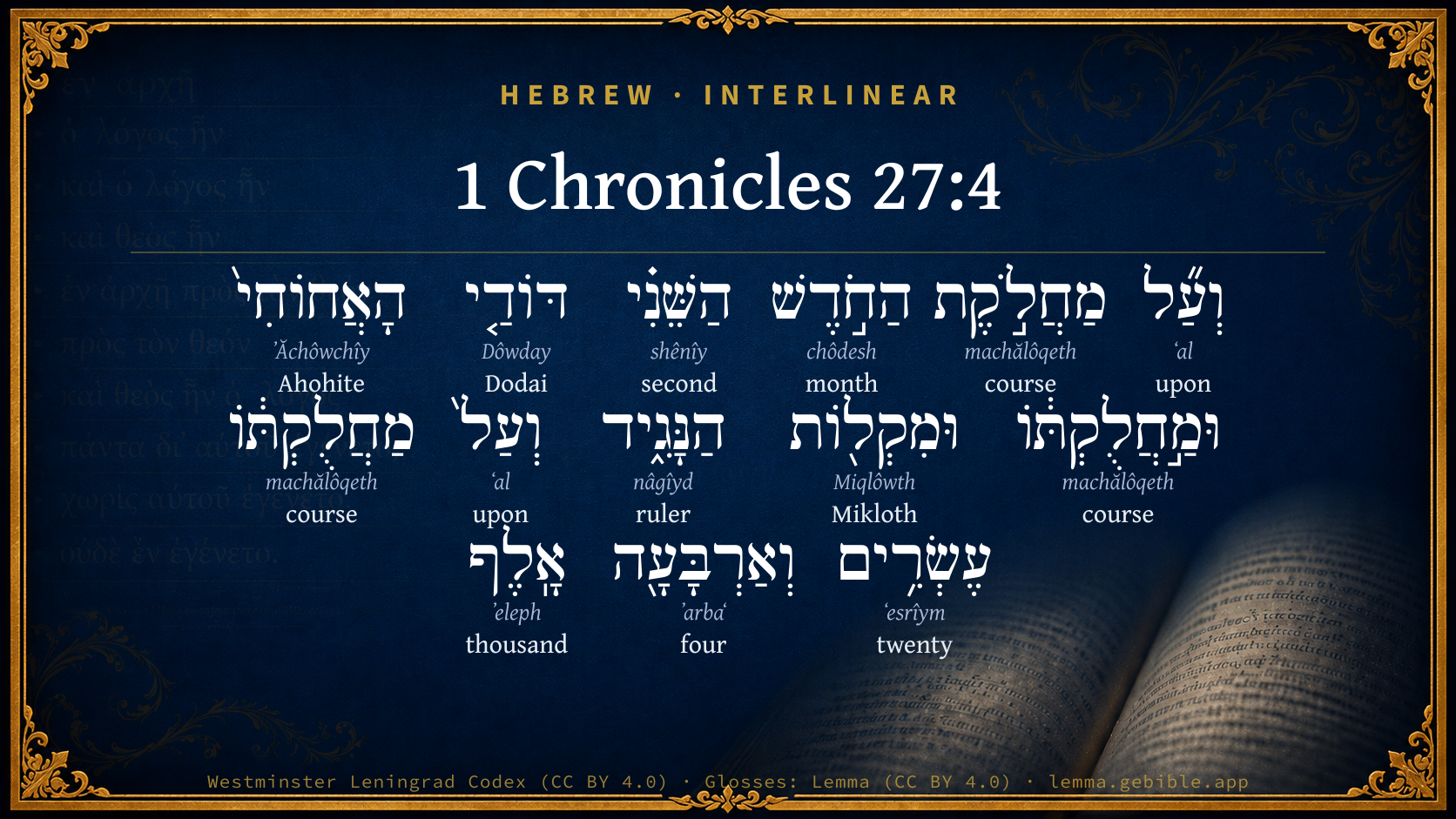
1 Chronicles 27:4

Hebrew (Westminster Leningrad Codex) 1 Chronicles 27:4 appears in the Hebrew Old Testament. The text above is from the Westminster Leningrad Codex. Each word links to its Strong’s number, a concise gloss, and parsing drawn from the Open Scriptures Hebrew Bible morphology. Click any word for its full Brown-Driver-Briggs (BDB) entry.
Download image
Cite this verse

1 Chronicles 27:4 (World English Bible). Public Domain. Lemma interlinear Bible study tool, https://lemma.gebible.app/v/1-chronicles/27/4.

Show BibTeX & RIS
BibTeX
RIS
English Translation
Over the division of the second month was Dodai the Ahohite, and his division; and Mikloth the ruler: and in his division were twenty-four thousand.
World English Bible · Public Domain
Highlights Full analysis ↓
Download a study sheet

One document with this verse’s original text, its word-by-word gloss line, the meaning frame, cross-references with their text, attributed commentary, and full source and license credits — printable, and it pastes into notes with its structure intact.

This verse Autodidact and up

Study sheet (.html) Plain text (.txt)

A passage Seminary Student

Up to 50 verses in one chapter. A passage sheet keeps up to 6 commentary sources and 12 cross-references per verse, in the order this page ranks them, and says so on the sheet whenever that leaves anything out. Ask for a single verse and you get the Autodidact verse sheet above.

Everything on this page stays free to read, with no account — the sheet is a download of what is already on screen, not access to it.

Want to remove ads? Support Godless Engineer
Compare translations 3

The same verse in 3 English versions, stacked beneath the original-language interlinear above. Click any original word for its lexicon entry.

Each is an independent rendering of the whole verse — the interlinear is not word-aligned to these translations.

Highlighted words mark where these versions differ — a whole-verse word diff, not a word-by-word alignment.

  • World English Bible Public Domain
    Over the division of the second month was Dodai the Ahohite, and his division; and Mikloth the ruler: and in his division were twenty-four thousand.
  • King James Version Public Domain
    And over the course of the second month was Dodai an Ahohite, and of his course was Mikloth also the ruler: in his course likewise were twenty and four thousand.
  • unfoldingWord Literal Text CC BY-SA 4.0
    And over the division of the second month Dodai the Ahohite, and his division Mikloth also a leader, and in his division 24,000.

unfoldingWord Literal Text — © unfoldingWord, licensed CC BY-SA 4.0. Word-aligned USFM3 via Door43 (git.door43.org/unfoldingWord/en_ult).

Versions to compare (up to 4)

3 of 4 selected

Show all 18 translations

Every available English version of this verse, each an independent rendering of the whole verse.

  • World English Bible Public Domain
    Over the division of the second month was Dodai the Ahohite, and his division; and Mikloth the ruler: and in his division were twenty-four thousand.
  • Berean Standard Bible Public Domain
    Dodai the Ahohite was in charge of the division for the second month, and Mikloth was the leader. There were 24,000 men in his division.
  • Majority Standard Bible Public Domain
    Dodai the Ahohite was in charge of the division for the second month, and Mikloth was the leader. There were 24,000 men in his division.
  • King James Version Public Domain
    And over the course of the second month was Dodai an Ahohite, and of his course was Mikloth also the ruler: in his course likewise were twenty and four thousand.
  • American Standard Version (1901) Public Domain
    And over the course of the second month was Dodai the Ahohite, and his course; and Mikloth the ruler: and in his course were twenty and four thousand.
  • Revised Version (1885) Public Domain
    And over the course of the second month was Dodai the Ahohite, and his course; and Mikloth the ruler: and in his course were twenty and four thousand.
  • Geneva Bible (1599) Public Domain
    And ouer the course of the second moneth was Dodai, an Ahohite, and this was his course, and Mikloth was a captaine, and in his course were foure and twentie thousand.
  • Douay-Rheims (1899) Public Domain
    The company of the second month was under Dudia, an Ahohite, and after him was another named Macelloth, who commanded a part of the army of four and twenty thousand.
  • Young's Literal Translation Public Domain
    And over the course of the second month `is' Dodai the Ahohite, and his course, and Mikloth `is' the president, and on his course `are' twenty and four thousand.
  • Literal Standard Version CC BY-SA 4.0
    And over the division of the second month [is] Dodai the Ahohite, and Mikloth [is] also president of his division, and twenty-four thousand [are] on his division.
  • Unlocked Literal Bible CC BY-SA 4.0
    Over the division for the second month was Dodai, from the clan descended from Ahoah. Mikloth was second in rank. In his division were twenty-four thousand men.
  • unfoldingWord Literal Text CC BY-SA 4.0
    And over the division of the second month Dodai the Ahohite, and his division Mikloth also a leader, and in his division 24,000.
  • Darby Bible Public Domain
    And over the division of the second month was Dodai the Ahohite; and in his division was Mikloth ruler; and in his division were twenty-four thousand.
  • World Messianic Bible Public Domain
    Over the division of the second month was Dodai the Ahohite and his division, and Mikloth the ruler; and in his division were twenty-four thousand.
  • Webster's Bible Public Domain
    And over the course of the second month was Dodai an Ahohite, and of his course was Mikloth also the ruler: in his course likewise were twenty and four thousand.
  • Free Bible Version CC BY-SA 4.0
    In command of the division for the second month was Dodai the Ahohite. Mikloth was his division leader. He had 24,000 men in his division.
  • Bible in Basic English Public Domain
    And over the division for the second month was Eleazar, the son of Dodai the Ahohite, the ruler; and in his division were twenty-four thousand.
  • JPS Tanakh (1917) Public Domain
    And over the course of the second month was Dodai the Ahohite, and his course, and Mikloth the ruler; and in his course were twenty and four thousand.

Literal Standard Version (2020), Covenant Press — licensed CC BY-SA 4.0. Text via the HelloAO Bible API (eBible.org). Unlocked Literal Bible (unfoldingWord) — licensed CC BY-SA 4.0. Text via the HelloAO Bible API (eBible.org). unfoldingWord Literal Text — © unfoldingWord, licensed CC BY-SA 4.0. Word-aligned USFM3 via Door43 (git.door43.org/unfoldingWord/en_ult). Free Bible Version, Dr. Jonathan Gallagher — licensed CC BY-SA 4.0. Text via the HelloAO Bible API (eBible.org).

Word by word

More ways to search: Search by grammar → Find every occurrence → Compare this word →

Practice this passage: Drill this verse → Learn its vocabulary →

דּוֹדַ֤י
Dôwday
H1737
“Dodai”
Noun, Proper
Part of Speech
Noun
Type
Proper
Full BDB Definition

Origin: formed like H1736

TWOT: None

Dodai = "loving" or " amorous" - an Ahohite who commanded the course of the second month; probably the same as 'Dodo'
  1. וְעַ֞ל ʻal H5921 “and · upon” Conjunction + Preposition
  2. מַחֲלֹ֣קֶת machălôqeth H4256 “course of” Noun, Common, Feminine, Singular, Construct
  3. הַחֹ֣דֶשׁ chôdesh H2320 “the · month” Particle, Definite Article + Noun, Common, Masculine, Singular, Absolute
  4. הַשֵּׁנִ֗י shênîy H8145 “the · second” Particle, Definite Article + Adjective, Ordinal number, Masculine, Singular, Absolute
  5. הָאֲחוֹחִי֙ ʼĂchôwchîy H266 “the · Ahohite” Particle, Definite Article + Noun, Gentilic, Masculine, Singular, Absolute
  6. וּמַ֣חֲלֻקְתּ֔וֹ machălôqeth H4256 “and · course · his” Conjunction + Noun, Common, Feminine, Singular, Construct + Suffix, Personal, 3rd Person, Masculine, Singular
  7. וּמִקְל֖וֹת Miqlôwth H4732 “and · Mikloth” Conjunction + Noun, Proper
  8. הַנָּגִ֑יד nâgîyd H5057 “the · ruler” Particle, Definite Article + Noun, Common, Masculine, Singular, Absolute
  9. וְעַל֙ ʻal H5921 “and · upon” Conjunction + Preposition
  10. מַחֲלֻקְתּ֔וֹ machălôqeth H4256 “course · his” Noun, Common, Feminine, Singular, Construct + Suffix, Personal, 3rd Person, Masculine, Singular
  11. עֶשְׂרִ֥ים ʻesrîym H6242 “twenty” Adjective, Cardinal number, Both, Plural, Absolute
  12. וְאַרְבָּעָ֖ה ʼarbaʻ H702 “and · four” Conjunction + Adjective, Cardinal number, Masculine, Singular, Absolute
  13. אָֽלֶף ʼeleph H505 “thousand” Adjective, Cardinal number, Both, Singular, Absolute

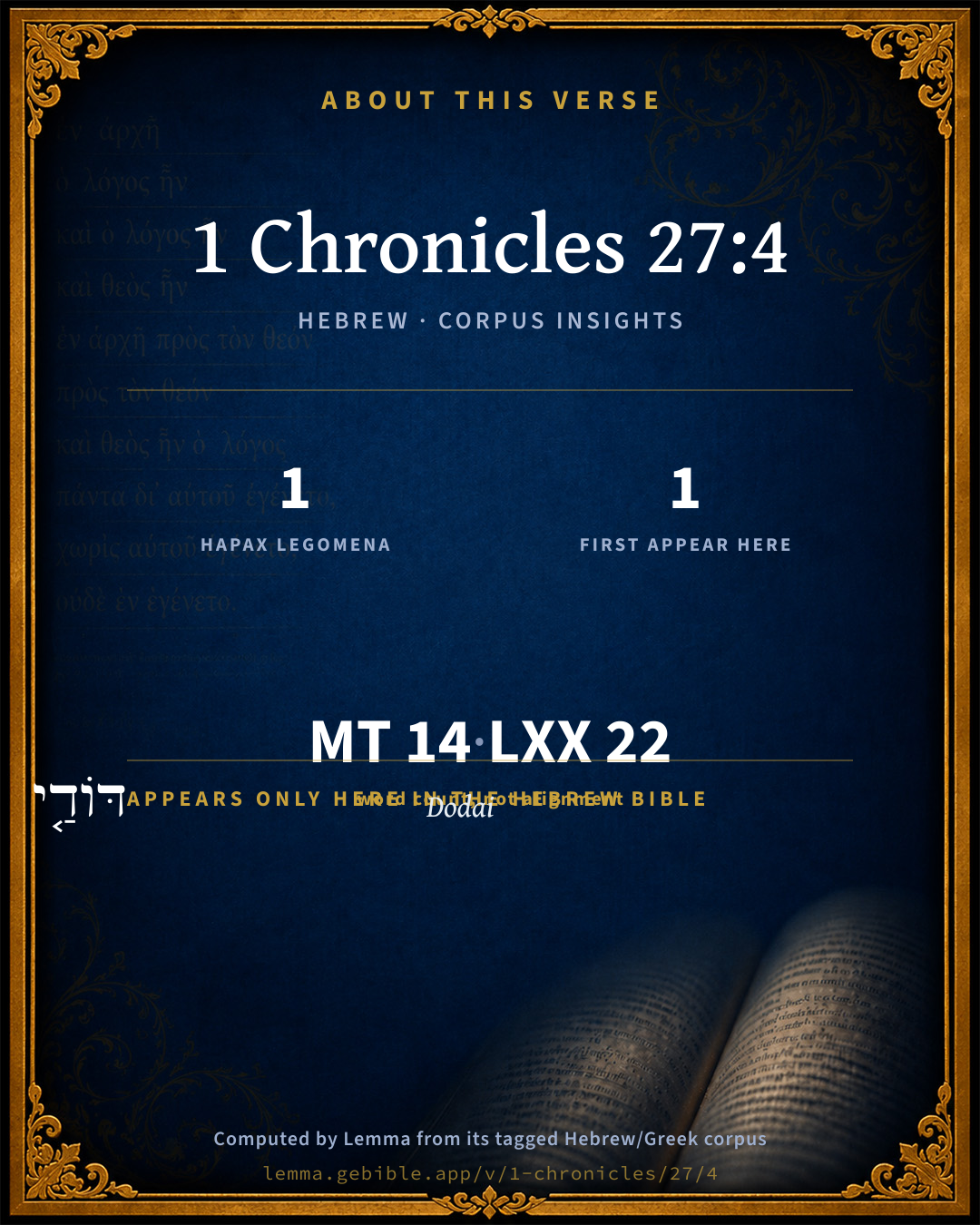
About this verse

These counts appear in no published source. They are computed here, from the morphology-tagged text and Lemma’s own curated glosses. What Lemma adds →

14
words
11
distinct lemmas
Historical
section

Notable vocabulary

1 hapax legomenon — a word that appears only here in the entire Hebrew Bible:

  • דּוֹדַ֤י Dodai H1737

First appearance in Scripture

This word makes its first canonical appearance in the Hebrew Bible here:

  • דּוֹדַ֤י Dodai H1737

Shared distinctive vocabulary

וּמִקְל֖וֹת Mikloth H4732 occurs in 4 verses of the Hebrew Bible. Also found in:

Grammatical profile

  • 8 nouns
  • 4 adjectives
  • 2 prepositions

Repetition

Words recur within this verse — often emphatic in Hebrew:

  • מַחֲלֹ֣קֶת course H4256 ×3
  • וְעַ֞ל upon H5921 ×2

Hebrew & Septuagint length

In English translation the verse runs 25 words from the Hebrew and 36 from the Septuagint (LXX English) — the Septuagint runs noticeably longer here. See the side-by-side →

A rough comparison of the two English renderings, which tokenize alike — not a word-level alignment.

Word counts can differ between the Hebrew and the Greek without any difference in meaning — e.g. the Hebrew direct-object marker אֵת has no separate Greek word, and Greek often adds the article ὁ.

In the original languages it is 14 Hebrew tokens and 22 Greek tokens — but the two are counted differently (Hebrew bundles its prefixes and suffixes into one token; the Greek is in lemma form), so that isn’t a like-for-like length.

Cross-references

2

Topical passages linked to 1 Chronicles 27:4 in the Treasury of Scripture Knowledge — connected by theme and wording, ordered by reader-vote popularity; previews shown in the World English Bible.

  • 2 Samuel 23:9 After him was Eleazar the son of Dodai the son of an Ahohite, one of the three mighty men with David, when they defied the Philistines who were there gathered together to battle, and the men of Israel were gone away.
  • 1 Chronicles 11:12 After him was Eleazar the son of Dodo, the Ahohite, who was one of the three mighty men.

Cross-references courtesy of OpenBible.info (CC BY 4.0).

Hebrew and Greek witnesses Masoretic Hebrew ↔ Greek Septuagint

The same verse in the two great witnesses to the Old Testament, shown verse-for-verse.

Here the Septuagint runs noticeably longer than the Hebrew — LXX2012 (modern English Septuagint) 36 words vs World English Bible 25. A rough length comparison of the two English translations, not a word-level alignment — read both below.

These are two independent witnesses, not word-aligned to each other, and the Septuagint is shown in lemma (dictionary) form.

Hebrew 1 Chronicles 27:4 Masoretic · Westminster Leningrad Codex

וְעַ֞ל מַחֲלֹ֣קֶת הַחֹ֣דֶשׁ הַשֵּׁנִ֗י דּוֹדַ֤י הָאֲחוֹחִי֙ וּמַ֣חֲלֻקְתּ֔וֹ וּמִקְל֖וֹת הַנָּגִ֑יד וְעַל֙ מַחֲלֻקְתּ֔וֹ עֶשְׂרִ֥ים וְאַרְבָּעָ֖ה אָֽלֶף

Over the division of the second month was Dodai the Ahohite, and his division; and Mikloth the ruler: and in his division were twenty-four thousand.

World English Bible · Public Domain

Greek LXX 1 Chronicles 27:4 Septuagint · lemma form

καί ἐπί ὁ διαίρεσις ὁ μήν ὁ δεύτερος δωδια ὁ εχωχι καί ἐπί ὁ διαίρεσις αὐτός εἴκοσι καί τέσσαρες χιλιάς ἄρχων δύναμις

And over the division of the second month was Dodia the son of Ecchoc, and over his division was Makelloth also chief: and in his division were twenty and four thousand, chief men of the host.

LXX2012 (modern English Septuagint) · Public Domain

On this verse, Ellicott's Commentary for English Readers discusses the Septuagint’s reading. Read the note in Commentary ↓

Hebrew: Westminster Leningrad Codex (CC BY 4.0). Greek: Septuagint (public domain); English from LXX2012 (modern English Septuagint) (Public Domain). How the Septuagint differs from the Hebrew →

Commentary

Notes on 1 Chronicles 27:4 from classic Christian and Jewish commentators (each source and its license shown beneath its notes). The classic Christian expositions comment on the surrounding passage and are grouped to its opening verse, so a note may address several verses; the Jewish commentaries on the Tanakh (Rashi and others) are per-verse, so they appear only where the commentator wrote on this verse.

Lemma curates 59 commentaries, every one of them public domain or Creative Commons licensed, each selected and text-cleaned for this edition rather than reprinted as found. About our sources →

Joseph Benson's Commentary

1Ch 27:4. And Mikloth also was the ruler — Either, 1st, The captain of this course after the death of this Dodai, as Zebadiah was after Asahel, 1Ch 27:7. Or, 2d, His lieutenant, or deputy, in case of his necessary absence. Or, rather, 3d, One of the officers of his course; who seems here to be particularly named, as a person then of great note and eminence.

Joseph Benson's Commentary on the Old and New Testaments (1811–1818) — public domain. Text from a community e-Sword module.

Geneva Bible (1599)

Geneva Bible translators

That is, Dodai’s lieutenant.

Geneva Bible (1599) marginal notes — public domain. Text via Bolls.life.

Jamieson, Fausset & Brown

Robert Jamieson, A. R. Fausset & David Brown

second month was Dodai--or, "Dodo." Here the text seems to require the supplement of "Eleazar the son of Dodo" (Sa2 23:9).

Jamieson, Fausset & Brown — Commentary Critical and Explanatory on the Whole Bible (1871) — public domain (CC PDM 1.0). Text via the HelloAO Bible API.

Ellicott's Commentary for English Readers

(4) Dodai an Ahohite.—The Ahohite. 1Ch_11:11 proves that the right reading is Eliezer son of Dodai the Ahohite.

And of his course was Mikloth also the ruler.—Literally, and his course, and Mikloth the prince (nâgîd); which appears meaningless. Perhaps the “and” before Mikloth is spurious. (Comp. end of 1Ch_27:6.) The sense may then be that this division included Mikloth “the prince,” an unknown personage; or that Mikloth was the chief man in the division. (See 1Ch_8:32; 1Ch_9:37, where Mikloth is a Benjamite name.) The LXX. and Vulg. agree with Authorised Version; the Syriac and Arabic are wanting in this chapter.

A Bible Commentary for English Readers, edited by Charles John Ellicott (1878–1897) — public domain. Text from a community e-Sword module.

The Cambridge Bible for Schools and Colleges

gen. ed. J. J. S. Perowne

4. Dodai an Ahohite] Perhaps we should read (cp. 1Ch_11:12), “Eleazar the son of Dodo, the Ahohite.”

of his course was Mikloth also the ruler] The words are corrupt and are omitted in the LXX. Perhaps the original text said that Mikloth (a Benjamite, 1Ch_8:32) was deputy-ruler over this course. Cp. 1Ch_27:6.

in his course likewise] R.V. and in his course.

The Cambridge Bible for Schools and Colleges (gen. ed. J. J. S. Perowne; Cambridge University Press, 1878–1918) — public domain. Text from a community e-Sword module.

Albert Barnes' Notes on the Bible

Dodai The words “Eleazar, son of,” have probably fallen out before Dodai (or Dodo). According to Jewish tradition, EIeazar 1Ch 11:12 was cousin to David; his father, Dodai, being Jesse’s brother. Mikloth was probably second in command to Eleazar.

Albert Barnes' Notes on the Bible (1834–1885) — public domain. Text from a community e-Sword/MySword module.

Haydock's Catholic Bible Commentary

Dudia, of Dodi, the father of Eleazar, chap. xi. 12. (Calmet) --- After him, his substitute. (Tirinus) --- Hebrew, "and Macelloth, chief also of his course, consisting likewise of 24,000." (Haydock)

George Leo Haydock (1774–1849), Haydock's Catholic Family Bible and Commentary, 1859 edition — public domain. Excludes Psalms (Douay-Rheims chapter numbering differs from Protestant) and Deuterocanonical books (Catholic canon only).

Matthew Poole's English Annotations

Of his course was Mikloth the ruler; who was either,

1. The captain of this course after the death of this Dodai, as Zebadiah was after Asahel, 1Ch 27:7. But the differing phrase there and here sufficiently intimates that the same thing is not meant in both places. Or,

2. His lieutenant or deputy, in case of his necessary absence. But why should such a one be named here, and not in the rest of the courses? Or rather,

3. One of the officers of his course, who seems here particularly to be named as a person then of great note and eminency.

Matthew Poole's English Annotations on the Holy Bible (1683–1685) — public domain. Text from a community e-Sword/MySword module.

The Pulpit Commentary

Before the name Dodai we must supply "Eleazar the son of," on the authority of 1Ch_11:12; 2Sa_23:9. The allusion to Mikloth (of the tribe of Benjamin, according to 1Ch_8:32 1Ch_9:37) in this verse is not plain. The translation may possibly be the same which our Authorized Version gives, And over the course of the second month was (Eleazar, the son of) Dodai the Ahohite, and (over) his (or, its) course also Mikloth was ruler . The appearances of the Hebrew text, however, favour the supposition of an inaccurate text. A somewhat similar con. struction and position of words in ver. 6 is less difficult by the absence of a conjunction before Ammizabad.

The Pulpit Commentary (1880–1919), ed. H.D.M. Spence-Jones & Joseph S. Exell — public domain. Text from a community e-Sword module.

Scofield Reference Notes

C. I. Scofield

second month

i.e. May.

The Scofield Reference Bible (1917 edition), notes by C. I. Scofield — public domain. Text from a community e-Sword module.

unfoldingWord translationNotes

Door43 World Missions Community

Over the division

"In charge of the division"

the second month

This is the second month of the Hebrew calendar. It is during the last part of April and the first part of May on Western calendars. (See: Hebrew Months and Ordinal Numbers)

Dodai ... Mikloth ... Ammizabad

These are the names of men. (See: How to Translate Names)

Ahoah

See how you translated this man's name in 1 Chronicles 8:4. (See: How to Translate Names)

In his division

"In his group of soldiers"

twenty-four thousand men

"24,000 men" (See: Numbers)

the third month

This is the third month of the Hebrew calendar. It is during the last part of May and the first part of June on Western calendars. (See: Hebrew Months and Ordinal Numbers)

Jehoiada

See how you translated these men's names in 1 Chronicles 11:22. (See: How to Translate Names)

the thirty

"the 30." This refers to "David's 30 mightiest soldiers." (See: Numbers)

over the thirty

This is an idiom. AT: "in charge of the 30 men" (See: Idiom)

translationWords

clan

Benaiah

priest

unfoldingWord translationNotes — © Distant Shores Media and the Door43 World Missions Community, licensed CC BY-SA 4.0. Source: git.door43.org/Door43/en_tn.

Rashi

Rabbi Shlomo Yitzchaki (Rashi)

Umikloth was the leader His fellow division member, who assisted him, was Umikloth.

Rashi on the Tanakh — English translations: “The Judaica Press complete Tanach with Rashi, translated by A. J. Rosenberg” (CC BY 4.0); “Pentateuch with Rashi's commentary by M. Rosenbaum and A.M. Silbermann, 1929-1934” (public domain); “The Metsudah Tanach series, Lakewood, N.J” (CC BY 4.0); and “The Book of Joshua, Metsudah Publications, 1997” (CC BY 4.0). Text via Sefaria.

Lesson kit

Teaching starters — assembled from the data on this page, not authored interpretation. Every prompt links to the verse data it draws on. Edit before teaching.

1 Chronicles, in the Historical, opens this verse with 14 words (11 distinct Hebrew lemmas). Its most distinctive word is Dôwday (“Dodai”). The Greek Septuagint runs longer here. A historical commentator’s framing appears above. Read the whole chapter for the surrounding context.

Discussion questions

  1. How does “Dodai” (Dôwday) shape what this verse is saying?
  2. This verse holds 1 word here found nowhere else in the Hebrew Bible. What might the rare word draw attention to?
  3. The word “Dodai” first appears here in Scripture. What is being introduced at this debut?
  4. 1 Chronicles 8:32 shares the word «Mikloth» with this verse. How do the two illuminate each other?
  5. “course” occurs 3× in this one verse. What is the effect of the repetition?
  6. Compared with the Hebrew, the Septuagint runs longer here. What questions does that raise?
  7. The translations on this page render this verse differently — a whole-verse word diff, not a word-by-word alignment. What might account for the different wordings?
  8. Reading how Joseph Benson's Commentary and Geneva Bible (1599) read this verse, where do the two commentators agree and where do they part?

Things to notice

  • 1 word in this verse appears nowhere else in the Hebrew Bible.
  • 1 word makes its first canonical appearance in Scripture here.
  • This verse counts 14 Hebrew ↔ 22 Greek words.
  • These translations choose different wording for 11 words in this verse.
  • “course” occurs 3× in this single verse.

Reading settings

Reading text

Shown beneath each verse's original-language words.

Old Testament
Old Testament edition

Read the OT as the Masoretic Hebrew (MT) or the Greek Septuagint (LXX).

English shown for the Greek Septuagint (in the Hebrew ↔ Greek comparison).

Comparing translations? Open the Compare panel on any verse page to stack up to four side by side.