
Jeremiah 52:12

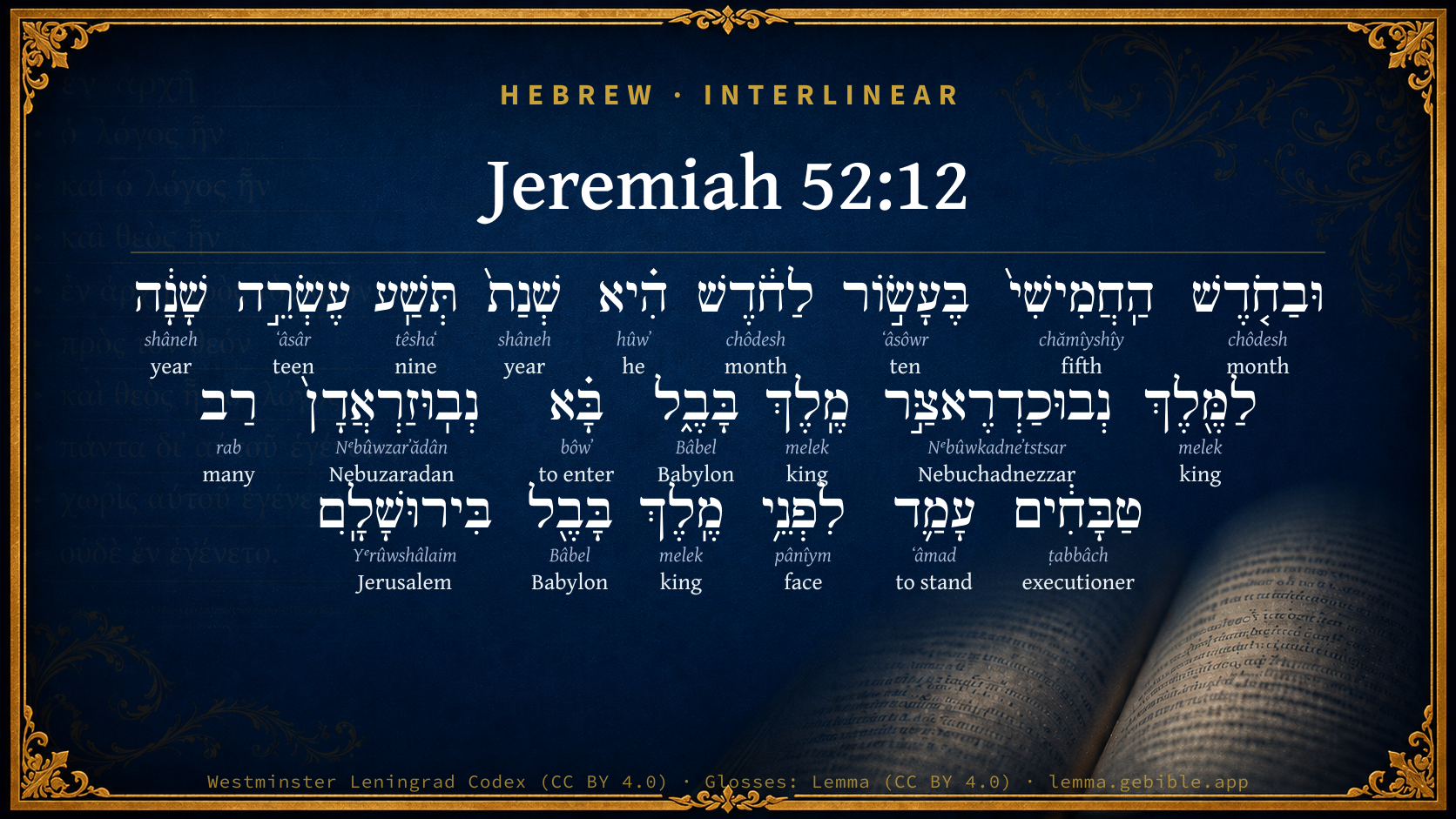
Hebrew (Westminster Leningrad Codex) Jeremiah 52:12 appears in the Hebrew Old Testament. The text above is from the Westminster Leningrad Codex. Each word links to its Strong’s number, a concise gloss, and parsing drawn from the Open Scriptures Hebrew Bible morphology. Click any word for its full Brown-Driver-Briggs (BDB) entry.
Download image
Cite this verse

Jeremiah 52:12 (World English Bible). Public Domain. Lemma interlinear Bible study tool, https://lemma.gebible.app/v/jeremiah/52/12.

Show BibTeX & RIS
BibTeX
RIS
English Translation
Now in the fifth month, in the tenth day of the month, which was the nineteenth year of king Nebuchadrezzar, king of Babylon, came Nebuzaradan the captain of the guard, who stood before the king of Babylon, into Jerusalem:
World English Bible · Public Domain
Download a study sheet

One document with this verse’s original text, its word-by-word gloss line, the meaning frame, cross-references with their text, attributed commentary, and full source and license credits — printable, and it pastes into notes with its structure intact.

This verse Autodidact and up

Study sheet (.html) Plain text (.txt)

A passage Seminary Student

Up to 50 verses in one chapter. A passage sheet keeps up to 6 commentary sources and 12 cross-references per verse, in the order this page ranks them, and says so on the sheet whenever that leaves anything out. Ask for a single verse and you get the Autodidact verse sheet above.

Everything on this page stays free to read, with no account — the sheet is a download of what is already on screen, not access to it.

Want to remove ads? Support Godless Engineer
Compare translations 3

The same verse in 3 English versions, stacked beneath the original-language interlinear above. Click any original word for its lexicon entry.

Each is an independent rendering of the whole verse — the interlinear is not word-aligned to these translations.

Highlighted words mark where these versions differ — a whole-verse word diff, not a word-by-word alignment.

  • World English Bible Public Domain
    Now in the fifth month, in the tenth day of the month, which was the nineteenth year of king Nebuchadrezzar, king of Babylon, came Nebuzaradan the captain of the guard, who stood before the king of Babylon, into Jerusalem:
  • King James Version Public Domain
    Now in the fifth month, in the tenth day of the month, which was the nineteenth year of Nebuchadrezzar king of Babylon, came Nebuzaradan, captain of the guard, which served the king of Babylon, into Jerusalem,
  • unfoldingWord Literal Text CC BY-SA 4.0
    Now in the fifth month, on the tenth day of the month, which was the nineteenth year of the reign of King Nebuchadnezzar, king of Babylon, Nebuzaradan came to Jerusalem. He was the commander of the king’s bodyguards and a servant of the king of Babylon.

unfoldingWord Literal Text — © unfoldingWord, licensed CC BY-SA 4.0. Word-aligned USFM3 via Door43 (git.door43.org/unfoldingWord/en_ult).

Versions to compare (up to 4)

3 of 4 selected

Show all 18 translations

Every available English version of this verse, each an independent rendering of the whole verse.

  • World English Bible Public Domain
    Now in the fifth month, in the tenth day of the month, which was the nineteenth year of king Nebuchadrezzar, king of Babylon, came Nebuzaradan the captain of the guard, who stood before the king of Babylon, into Jerusalem:
  • Berean Standard Bible Public Domain
    On the tenth day of the fifth month, in the nineteenth year of Nebuchadnezzar’s reign over Babylon, Nebuzaradan captain of the guard, a servant of the king of Babylon, entered Jerusalem.
  • Majority Standard Bible Public Domain
    On the tenth day of the fifth month, in the nineteenth year of Nebuchadnezzar’s reign over Babylon, Nebuzaradan captain of the guard, a servant of the king of Babylon, entered Jerusalem.
  • King James Version Public Domain
    Now in the fifth month, in the tenth day of the month, which was the nineteenth year of Nebuchadrezzar king of Babylon, came Nebuzaradan, captain of the guard, which served the king of Babylon, into Jerusalem,
  • American Standard Version (1901) Public Domain
    Now in the fifth month, in the tenth day of the month, which was the nineteenth year of king Nebuchadrezzar, king of Babylon, came Nebuzaradan the captain of the guard, who stood before the king of Babylon, into Jerusalem:
  • Revised Version (1885) Public Domain
    Now in the fifth month, in the tenth day of the month, which was the nineteenth year of king Nebuchadrezzar, king of Babylon, came Nebuzaradan the captain of the guard, which stood before the king of Babylon, into Jerusalem:
  • Geneva Bible (1599) Public Domain
    Now in the fift moneth in the tenth day of the moneth (which was the nineteenth yere of ye King Nebuchad-nezzar King of Babel) came Nebuzar-adan chiefe steward which stoode before the king of Babel in Ierusalem,
  • Douay-Rheims (1899) Public Domain
    And in the fifth month, the tenth day of the month, the same is the nineteenth year of Nabuchodonosor, king of Babylon, came Nabuzardan the general of the army, who stood before the king of Babylon in Jerusalem.
  • Young's Literal Translation Public Domain
    And in the fifth month, in the tenth of the month -- it `is' the nineteenth year of king Nebuchadrezzar king of Babylon -- come hath Nebuzar-Adan, chief of the executioners; he hath stood before the king of Babylon in Jerusalem,
  • Literal Standard Version CC BY-SA 4.0
    And in the fifth month, on the tenth of the month—it [is] the nineteenth year of King Nebuchadnezzar king of Babylon—Nebuzar-Adan, chief of the executioners, has come; he has stood before the king of Babylon in Jerusalem,
  • Unlocked Literal Bible CC BY-SA 4.0
    Now in the fifth month, on the tenth day of the month, which was the nineteenth year of the reign of King Nebuchadnezzar, king of Babylon, Nebuzaradan came to Jerusalem. He was the commander of the king's bodyguards and a servant of the king of Babylon.
  • unfoldingWord Literal Text CC BY-SA 4.0
    Now in the fifth month, on the tenth day of the month, which was the nineteenth year of the reign of King Nebuchadnezzar, king of Babylon, Nebuzaradan came to Jerusalem. He was the commander of the king’s bodyguards and a servant of the king of Babylon.
  • Darby Bible Public Domain
    And in the fifth month, on the tenth of the month, which was in the nineteenth year of Nebuchadrezzar king of Babylon, Nebuzar-adan, captain of the body-guard, who stood before the king of Babylon, came unto Jerusalem;
  • World Messianic Bible Public Domain
    Now in the fifth month, in the tenth day of the month, which was the nineteenth year of King Nebuchadnezzar, king of Babylon, Nebuzaradan the captain of the guard, who stood before the king of Babylon, came into Jerusalem.
  • Webster's Bible Public Domain
    Now in the fifth month, in the tenth day of the month, which was the nineteenth year of Nebuchadrezzar king of Babylon, came Nebuzar-adan, captain of the guard, who served the king of Babylon, into Jerusalem,
  • Free Bible Version CC BY-SA 4.0
    On the tenth day of the fifth month, in the nineteenth year of Nebuchadnezzar, king of Babylon, Nebuzaradan, the commander of the guard, an officer of the king of Babylon, entered Jerusalem.
  • Bible in Basic English Public Domain
    Now in the fifth month, on the tenth day of the month, in the nineteenth year of King Nebuchadrezzar, king of Babylon, Nebuzaradan, the captain of the armed men, a servant of the king of Babylon, came into Jerusalem.
  • JPS Tanakh (1917) Public Domain
    Now in the fifth month, in the tenth day of the month, which was the nineteenth year of king Nebuchadrezzar, king of Babylon, came Nebuzaradan the captain of the guard, who stood before the king of Babylon, into Jerusalem;

Literal Standard Version (2020), Covenant Press — licensed CC BY-SA 4.0. Text via the HelloAO Bible API (eBible.org). Unlocked Literal Bible (unfoldingWord) — licensed CC BY-SA 4.0. Text via the HelloAO Bible API (eBible.org). unfoldingWord Literal Text — © unfoldingWord, licensed CC BY-SA 4.0. Word-aligned USFM3 via Door43 (git.door43.org/unfoldingWord/en_ult). Free Bible Version, Dr. Jonathan Gallagher — licensed CC BY-SA 4.0. Text via the HelloAO Bible API (eBible.org).

Word by word

More ways to search: Search by grammar → Find every occurrence → Compare this word →

Practice this passage: Drill this verse → Learn its vocabulary →

בֶּעָשׂ֣וֹר
ʻâsôwr
H6218
“in/at the · ten”
Preposition, Determined + Noun, Common, Masculine, Singular, Absolute
Part of Speech
Preposition + Noun
Type
Common
Gender
Masculine
Number
Singular
State
Absolute
Full BDB Definition

Origin: from H6235

TWOT: 1711d

ten, decade - ten, tenth - ten-stringed, harp
  1. וּבַחֹ֤דֶשׁ chôdesh H2320 “and · in/at the · month” Conjunction + Preposition, Determined + Noun, Common, Masculine, Singular, Absolute
  2. הַֽחֲמִישִׁי֙ chămîyshîy H2549 “the · fifth” Particle, Definite Article + Adjective, Ordinal number, Masculine, Singular, Absolute
  3. לַחֹ֔דֶשׁ chôdesh H2320 “to/for the · month” Preposition, Determined + Noun, Common, Masculine, Singular, Absolute
  4. הִ֗יא hûwʼ H1931 “he” Pronoun, Personal, 3rd Person, Feminine, Singular
  5. שְׁנַת֙ shâneh H8141 “year of” Noun, Common, Feminine, Singular, Construct
  6. תְּשַֽׁע têshaʻ H8672 “nine” Adjective, Cardinal number, Feminine, Singular, Absolute
  7. עֶשְׂרֵ֣ה ʻâsâr H6240 “teen” Adjective, Cardinal number, Feminine, Singular, Absolute
  8. שָׁנָ֔ה shâneh H8141 “year” Noun, Common, Feminine, Singular, Absolute
  9. לַמֶּ֖לֶךְ melek H4428 “to/for the · king” Preposition, Determined + Noun, Common, Masculine, Singular, Absolute
  10. נְבוּכַדְרֶאצַּ֣ר Nᵉbûwkadneʼtstsar H5019 “Nebuchadnezzar” Noun, Proper
  11. מֶֽלֶךְ melek H4428 “king of” Noun, Common, Masculine, Singular, Construct
  12. בָּבֶ֑ל Bâbel H894 “Babylon” Noun, Proper
  13. בָּ֗א bôwʼ H935 “to enter” Verb, Qal, Perfect, 3rd Person, Masculine, Singular
  14. נְבֽוּזַרְאֲדָן֙ Nᵉbûwzarʼădân H5018 “Nebuzaradan” Noun, Proper
  15. רַב rab H7227 “many of” Noun, Common, Masculine, Singular, Construct
  16. טַבָּחִ֔ים ṭabbâch H2876 “executioners” Noun, Common, Masculine, Plural, Absolute
  17. עָמַ֛ד ʻâmad H5975 “to stand” Verb, Qal, Perfect, 3rd Person, Masculine, Singular
  18. לִפְנֵ֥י pânîym H6440 “to/for · face(s) of” Preposition + Noun, Common, Both, Plural, Construct
  19. מֶֽלֶךְ melek H4428 “king of” Noun, Common, Masculine, Singular, Construct
  20. בָּבֶ֖ל Bâbel H894 “Babylon” Noun, Proper
  21. בִּירוּשָׁלִָֽם Yᵉrûwshâlaim H3389 “in/at · Jerusalem” Preposition + Noun, Proper

About this verse

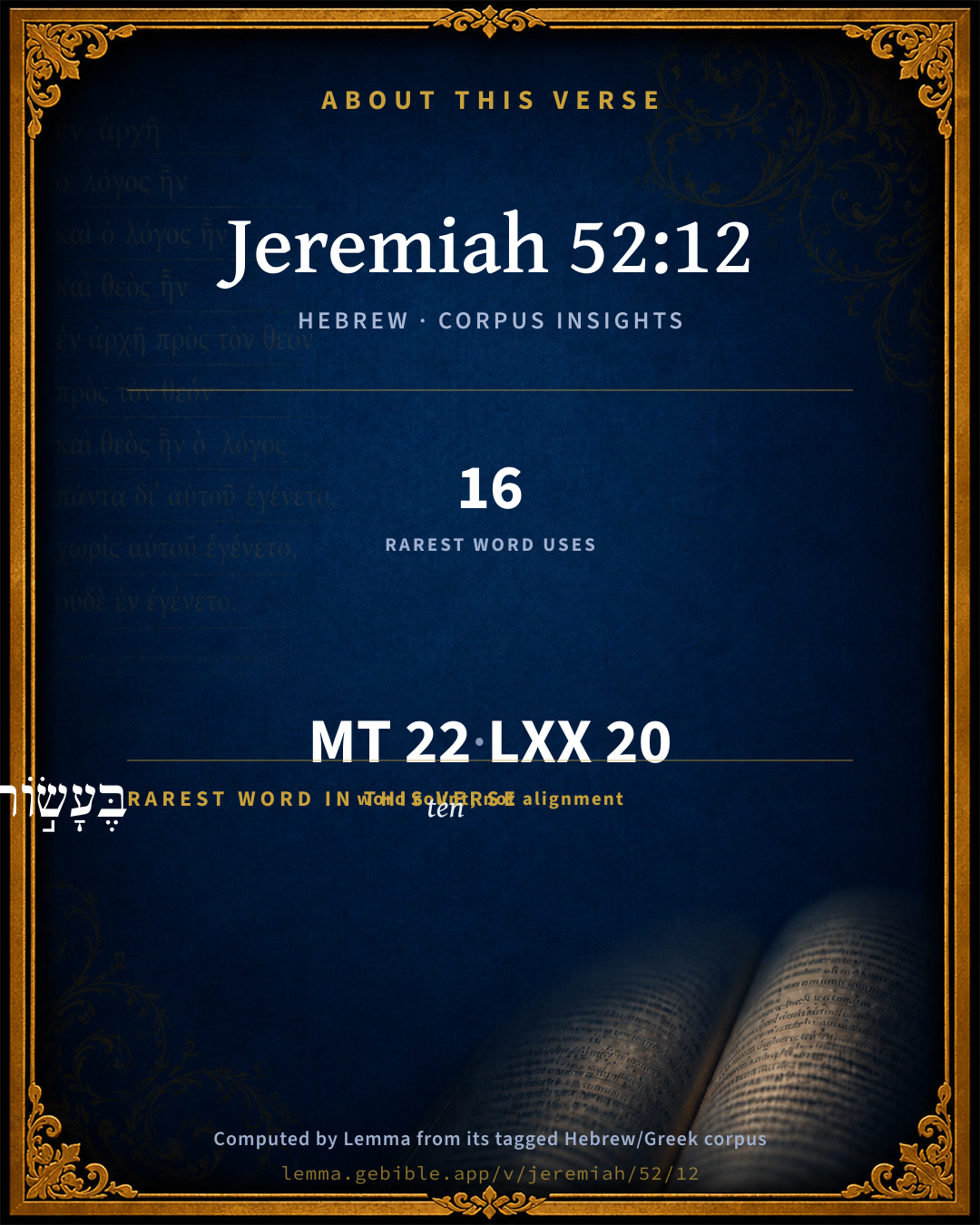
These counts appear in no published source. They are computed here, from the morphology-tagged text and Lemma’s own curated glosses. What Lemma adds →

22
words
17
distinct lemmas
Prophets
section

Notable vocabulary

The rarest word here is בֶּעָשׂ֣וֹר ten H6218 — appearing just 16 times in the whole Hebrew Bible.

Shared distinctive vocabulary

בֶּעָשׂ֣וֹר ten H6218 occurs in 16 verses of the Hebrew Bible. Also found in:

Grammatical profile

  • 2 verbs
  • 16 nouns
  • 3 adjectives
  • 1 pronoun

Verb forms

  • בָּ֗א Qal · Perfect
  • עָמַ֛ד Qal · Perfect

Repetition

Words recur within this verse — often emphatic in Hebrew:

  • לַמֶּ֖לֶךְ king H4428 ×3
  • וּבַחֹ֤דֶשׁ month H2320 ×2
  • שְׁנַת֙ year H8141 ×2
  • בָּבֶ֑ל Babylon H894 ×2

Hebrew & Septuagint length

In the original languages it is 22 Hebrew tokens and 20 Greek tokens — but the two are counted differently (Hebrew bundles its prefixes and suffixes into one token; the Greek is in lemma form), so that isn’t a like-for-like length.

Cross-references

8

Topical passages linked to Jeremiah 52:12 in the Treasury of Scripture Knowledge — connected by theme and wording, ordered by reader-vote popularity; previews shown in the World English Bible.

  • 2 Kings 25:8 Now in the fifth month, on the seventh day of the month, which was the nineteenth year of king Nebuchadnezzar, king of Babylon, came Nebuzaradan the captain of the guard, a servant of the king of Babylon, to Jerusalem.
  • Jeremiah 39:9 Then Nebuzaradan the captain of the guard carried away captive into Babylon the residue of the people who remained in the city, the deserters also who fell away to him, and the residue of the people who remained.
  • Jeremiah 52:29 in the eighteenth year of Nebuchadrezzar he carried away captive from Jerusalem eight hundred thirty-two persons;
  • Zechariah 8:19 Thus says Yahweh of Hosts: "The fasts of the fourth fifth, seventh, and tenth months shall be for the house of Judah joy and gladness, and cheerful feasts. Therefore love truth and peace."
  • 2 Kings 24:12 and Jehoiachin the king of Judah went out to the king of Babylon, he, and his mother, and his servants, and his princes, and his officers: and the king of Babylon took him in the eighth year of his reign.
  • Genesis 37:36 The Midianites sold him into Egypt to Potiphar, an officer of Pharaoh's, the captain of the guard.
  • Jeremiah 52:14 All the army of the Chaldeans, who were with the captain of the guard, broke down all the walls of Jerusalem round about.
  • Zechariah 7:3–5 and to speak to the priests of the house of Yahweh of Hosts, and to the prophets, saying, "Should I weep in the fifth month, separating myself, as I have done these so many years?"

Cross-references courtesy of OpenBible.info (CC BY 4.0).

Hebrew and Greek witnesses Masoretic Hebrew ↔ Greek Septuagint

The same verse in the two great witnesses to the Old Testament, shown verse-for-verse.

These are two independent witnesses, not word-aligned to each other, and the Septuagint is shown in lemma (dictionary) form.

Hebrew Jeremiah 52:12 Masoretic · Westminster Leningrad Codex

וּבַחֹ֤דֶשׁ הַֽחֲמִישִׁי֙ בֶּעָשׂ֣וֹר לַחֹ֔דֶשׁ הִ֗יא שְׁנַת֙ תְּשַֽׁע עֶשְׂרֵ֣ה שָׁנָ֔ה לַמֶּ֖לֶךְ נְבוּכַדְרֶאצַּ֣ר מֶֽלֶךְ בָּבֶ֑ל בָּ֗א נְבֽוּזַרְאֲדָן֙ רַב טַבָּחִ֔ים עָמַ֛ד לִפְנֵ֥י מֶֽלֶךְ בָּבֶ֖ל בִּירוּשָׁלִָֽם

Now in the fifth month, in the tenth day of the month, which was the nineteenth year of king Nebuchadrezzar, king of Babylon, came Nebuzaradan the captain of the guard, who stood before the king of Babylon, into Jerusalem:

World English Bible · Public Domain

Greek LXX Structure differs

In the Septuagint, Jeremiah is about an eighth shorter than the Hebrew and arranges its material differently — the Oracles Against the Nations (Hebrew chapters 46–51) appear in the middle of the Greek book, after 25:13. Because the chapter and verse boundaries do not line up, a verse-for-verse comparison with the Hebrew is not shown.

A verse-for-verse comparison isn’t shown here because the chapters and verses don’t line up. Switch to the LXX edition with the MT / LXX toggle above to read the Greek directly.

Hebrew: Westminster Leningrad Codex (CC BY 4.0). Greek: Septuagint (public domain); English from a public-domain English Septuagint. How the Septuagint differs from the Hebrew →

Targum (Aramaic paraphrase)

1

The Targum is the ancient Jewish Aramaic paraphrase of the Hebrew Scriptures — an interpretive translation, not the Hebrew text itself. Onkelos (literal) and Pseudo-Jonathan (expansive) render the Torah, and Jonathan the Prophets. Coverage is partial: where no permissively-licensed English translation exists for a verse, only the Aramaic is shown. This is verse-level text, not a word-by-word alignment to the Hebrew.

  1. Targum Jonathan Prophets (Joshua–Malachi)
    וּבְיַרְחָא חֲמִישָׁאָה בְּעַסְרָא לְיַרְחָא הִיא שְׁנַת תְּשַׁע עַסְרֵי שְׁנִין לְמַלְכָּא נְבוּכַדְרֶאצַר מַלְכָּא דְבָבֶל אֲתָא נְבוּזַרְאֲדָן רַב קָטוֹלַיָא קָם קֳדָם מַלְכָּא דְבָבֶל בִירוּשְׁלֵם:

    (no public-domain English translation for this verse)

    Targum Jonathan — Aramaic: “Mikraot Gedolot” (public domain). English: “Sefaria Community Translation” (CC0 1.0 (public-domain dedication)); “London "Chaldee Paraphrase," 1871” (public domain). Text via Sefaria.

Commentary

Notes on Jeremiah 52:12 from classic Christian and Jewish commentators (each source and its license shown beneath its notes). The classic Christian expositions comment on the surrounding passage and are grouped to its opening verse, so a note may address several verses; the Jewish commentaries on the Tanakh (Rashi and others) are per-verse, so they appear only where the commentator wrote on this verse.

Lemma curates 59 commentaries, every one of them public domain or Creative Commons licensed, each selected and text-cleaned for this edition rather than reprinted as found. About our sources →

Joseph Benson's Commentary

Jer 52:12-13. Now in the fifth month — This gave occasion to that solemn fast of the fifth month, observed in the times of the captivity: see Zec 7:3-5; Zec 8:19. In the tenth day of the month — In the parallel place, 2Ki 25:8, we read, on the seventh day. This difference some attempt to reconcile, by supposing that the one place may speak of the day Nebuzar-adan set out from Riblah, and the other of the day that he arrived at Jerusalem; or else, that he came on the seventh, but did not set fire to the building till the tenth. “But it is more likely,” says Blaney,” to have arisen from some mistake of the transcriber, perhaps, in setting down the numbers at full length, which were expressed by numeral letters in the old copies. And in this instance such a mistake might easily happen between the זand the י, of which the first stands for seven, the latter for ten.” And burned the house of the Lord — After it had stood, says Josephus, four hundred and seventy years; but Archbishop Usher reckons it only four hundred and twenty-four years from the laying of the first foundation by Solomon: see note on 2Ki 25:9.

Joseph Benson's Commentary on the Old and New Testaments (1811–1818) — public domain. Text from a community e-Sword module.

Keil & Delitzsch

C. F. Keil & F. Delitzsch

The destruction of Jerusalem and of the temple, and the carrying away of the people, which are only very summarily stated in Jer 39:8-10, are here related in complete accordance with the account given in Kg2 25:8-17. The deviations for the most part originated through the freedom exercised by the epitomizer in his work, or only when mistakes were made by later copyists. The text before us has some amplifications (especially the notices regarding the ornaments of the brazen pillars, Jer 52:23) which are found nowhere else in the Old Testament. The difference in date between Jer 52:12 ("on the tenth of the month") and the passage in Kings ("on the seventh of the month") has arisen through one number having been mistaken for another in copying; it cannot now be decided which is correct; see on Kg2 25:18. As to Nebuzaradan, see on Jer 39:13. Instead of עמד , is found עבד in Kg2 25:8, which certainly is a simpler reading, but one having less appearance of being the original. The only strange point is the want of the relative אשׁר in plain prose before עמד, which is probably to be pointed עמד. בּירוּשׁלים, instead of ירוּשׁלים (Kings), is a pregnant expression for "he came into Jerusalem." - Jer 52:14. From the expression את־כּל־חומות, as given in Jer 52:14, "all" is omitted in Kings, as being not indispensable for the meaning.

Keil & Delitzsch — Biblical Commentary on the Old Testament (1861–1891) — public domain (CC PDM 1.0). Text via the HelloAO Bible API. (Old Testament only.)

Lange's Commentary on the Holy Scriptures

2. THE DESTRUCTION OF THE CITY AND DEPORTATION OF THE PEOPLE

Jer_52:12-16

12Now in the fifth month, in the tenth day of the month, which was the nineteenth year of Nebuchadrezzar king of Babylon, came Nebuzar-adan, captain of the guard [of the halberdiers], who served [stood before]6 the king of Babylon, into Jerusalem. 13And burned the house of the Lord [Jehovah] and the king’s house; and all the houses of Jerusalem, and all the houses of the great men [every great house],7 burned 14he with fire. And all the army of the Chaldeans, that were with the captain of 15the guard, brake down all the walls of Jerusalem, round about. Then Nebuzaradan captain of the guard [halberdiers] carried away captive certain of the poor [a part of the lowest] of the people, and the residue of the people that remained in the city, and those that fell away, that fell to the king of Babylon, and the rest of 16the multitude [work-people].8 But Nebuzar adan the captain of the guard left certain of the poor [part of the meanest]9 of the land for vinedressers and for husbandmen.10

EXEGETICAL AND CRITICAL

Jer_52:12-14. Now in the fifth … round about. Instead of the tenth day, 2 Kings (as also Bar_1:2) mentions the seventh, as the same text also states three cubits instead of the five in Jer_52:23, and five men instead of the seven in Jer_52:25. Hitzig, Thenius, Graf, Keil [Blayney, Henderson] rightly suppose that these differences arose from the interchange of the letters of the older alphabet used as numerals. Which statements are correct is not ascertainable. Thenius [comp. also Wordsworth] declares the statement here made to be the correct one, because the Jews afterward kept the ninth day as a fast. But on the other hand comp. Keil on 2Ki_25:8.

Jer_52:15-16. Then Nebuzar-adan. … husbandmen.—The poor of the people, which is wanting in 2 Ki., has come here either by mistake from Jer_52:16, where it also begins the sentence, or it is to express the thought, that the poor people did not all remain behind, but were partly carried away. the latter is probably the correct view.—Multitude [work-people]. It is difficult to decide which is the correct rendering. Both suit the sense, for a remnant of workpeople might just as well be spoken of as a remnant, of the masses of the people (either in antithesis to the warriors or the population of the city). I prefer to take the word in the sense in which it undoubtedly occurs in Pro_8:30 [then was I as a workman with him], and Son_7:1.

DOCTRINAL AND ETHICAL

1. “Docemur hoc capite, quod comminationes divinæ rum sint de pelvi fulgura, quodque Deus pro misericordia sua infinita calamitates a se immissas mitigare plerumque soleat, si seria interveniat pœnitentia.” Förster.

2. On Jer_52:1-3. “From this we see why God sometimes places ungodly rulers over a country, who cast it to destruction. It is done on account of the rulers’ and the people’s sins, that they may draw down the well merited punishment, as Sirach says. On account of violence, injustice and avarice, a kingdom passes from one nation to another (Jer_10:8). So also says king Solomon. Because of the sins of a nation occur many changes of rulers, but for the sake of the people who are intelligent and reasonable, the State is prolonged (Pro_28:2).” Wurtemb. Summarien.

3. On Jer_52:4. “God allows many slight and mild punishments to come as warnings, till at last comes the finishing stroke. This is a witness to the divine long-suffering (Rom_2:4).” Cramer.

4. On Jer_52:6. “The fact that in this siege compassionate women had to kill and eat their own children (Lam_4:10) is a reminder that by bodily hunger God would punish; 1. satiation and disgust towards His holy word and soul-food; 2. the terrible offering up of children to Moloch; 3. the loose discipline of children.” Cramer.

5. On Jer_52:7. “No fortress can protect the ungodly, even though they had their nest in the clouds.” Cramer.

6. On Jer_52:8. “An example of faithless, perjured men of war. But as Zedekiah broke his oath to the king at Babylon, he was paid back in the same coin.” Cramer. “His people forsook the poor king Zedekiah on his flight and he was captured, from which we see that great men cannot depend on their body-guard; these flee in time of need, and leave their masters in the lurch. The surest and best protection is when we have the holy angels for our guard … This angelic protection is, however, to be obtained and preserved by faith and godliness, but is lost by unbelief and ungodly conduct.” Wurtemb. Summ.

7. On Jer_52:9-11. The punishment of perjury. “Ubi monemur, quod fides hosti, etiam barbaro, qualis hodie Turca, a Christianis data, mimine violanda.” Förster.

8. On Jer_52:9. sqq. “God had shown Zedekiah by Jeremiah a way in which he could escape the calamity. But because he forsook the Lord and would not follow it, the others were only leaky cisterns (Jer_2:13). For woe to the rebellious who take counsel without the Lord (Isa_30:1). This is useful for an instance against the holy by works, who reject God’s way of escaping the Devil; when they devise other ways for themselves they are caught by the Chaldeans of hell.” Cramer.

9. On Jer_52:12 sqq. “Holy places, external ceremonies and opus operatum do not avail for hypocrites … If God punished His own institution so severely, how shall human institutions remain unpunished?” Cramer.

10. On Jer_52:12. “Quale fatum, ne et nostris obtingat templis … caveamus, ne profanemus templa ulterius tum externa vel materialia, tum interna vel spiritualia in cordibus nostris, de quibus 1Co_3:16 sqq.; Jer_6:19 sqq.” Förster.

11. On Jer_52:15. “It is another work of mercy that some of Judah were preserved. For God’s grace is always to be found in His punishments.” Cramer.

12. On Jer_52:15. “He who will not serve God and his neighbor at home and in quiet, must learn to do it in a strange land in affliction and distress.” Cramer.

13. On Jer_52:24 sqq. “As teachers are often to blame for their behaviour that sin gets the upper hand in a community, it is exceedingly just when God brings such for an example into great punitive judgment (1Sa_2:27-34).” Starke.

14. On Jer_52:24. “The priests are caught and slain; 1. because they could not believe the truth for themselves; 2. because they led others astray; 3. because they appealed to the temple of the Lord; 4. because they persecuted the true prophets; 5. because they troubled the whole church of God. But he who troubleth shall bear his judgment, whosoever he be (Gal_5:10).” Cramer.

15. On Jer_52:31 sqq. “Sane omnino verisimile videtur judicio Philippi Melanchthonis in Chron. part, I fol. 33 Evilmerodachum amplexum esse doctrinam Danielis de Vero Deo, quam et pater publico edic professus est, eamque ob causam clementiam exercuisse erga regem Jechoniam.” Förster.—“Narrant Hebræi hujusmodi fabulam: Evilmerodach, qui patre suo Nabuchodonosor vivente per septem annos inter bestias, ante regnaverat, postquam ille restitutus in regno est, usque ad mortem patris cum Joakim rege Judæ in vinculis fuit; quo mortuo, quum rursus in regnum succederet, et non susciperetur a principibus, qui metuebant, ne viveret qui dicebatur extinctus, ut fidem patris mortui faceret, aperuit sepulcrum et cadaver ejus unco et funibus traxit.” Jerome on Jer_14:18-19. Josephus speaks of it as follows: “Ἀβιλαμαρώδαχος εὐθὺς τὸν ‘Ιεχωνίαν τῶν δεσμῶν ἀφεὶς ἐν τοῖς ἀναγκαιοτάτοις φίλοις εἱχε … ‘Ο γὰρ πατὴρ αὐτοῦ τὴν πίστιν οὐκ ἐφύλαξε τῷ ’Ιεχωνία, παραδόντι μετὰ γυναικαῶν καὶ τέκνων καὶ τῆς συγγενείας ὅλης ἑκουσίως ἑαυτὸν ὑπὲρ τῆς πατρἰδος, ὡς ἄν μὴ κατασκαφείη ληφθεῖσα τῇ πολιορκίᾳ.” (Antiqq., X. 11, 21.)

16. On Jer_52:31 sqq. “Ceterum potest hoc exemplo, quod Jechonias rex dignitati suæ in exilio Babylonico restitutus, refutari exceptio Judæorum contra vaticinium Jacobi (Gen_49:10) de Messia jamdudum exhibito, postquam per Romanos sceptrum de Juda ablatum, id quod τεκμήριον Messiæ jamjam nascituri esse debuit.” Förster.

17. On Jer_52:31 sqq. “No one should despair in misfortune, for the right hand of the Highest can change all (Psa_77:10) and Christ rules even in the midst of His enemies (Psa_110:2). For His are the praise, the glory and the power from everlasting to everlasting. Amen.” Cramer.

HOMILETICAL AND PRACTICAL

1. On Jer_52:1-11. The truth of the word “What a man soweth, that shall he also reap,” exhibited in the example of the Jewish State under Zedekiah.1. The seed (Jer_52:2); 2. The crop (a) the siege, (b) the famine, (c) the capture of the city and flight of the king, (d) the punishment of the king and his princes, (e) the fate of the people (Jer_52:3).

2. On Jer_52:12-20. The rejection of Judah appears at first sight a contradiction. For Jerusalem is the holy city (Mat_4:5; Neh_11:1; Neh_11:18), the city of God (Psa_46:5; Psa_48:2; Psa_48:9; Psa_78:3); the temple is the house of Jehovah (Jer_7:2. etc.); God’s service rests on divine authority (Ex. chh. 25–27, 30, 31). But God cannot contradict Himself. We have, therefore, to show “the unity of the divine thoughts in the choice and rejection of Jerusalem.” 1. The rejection was a conditional one (Jer_7:3 sqq). Hence notwithstanding the election the rejection involved nothing contradictory, but was a necessary consequence of the unfulfilled condition.—2. The election remains (a) objectively notwithstanding the rejection; it is (b) subjectively brought to its realization by the rejection; the latter as a means of discipline operating to produce the disposition, from which alone thefulfillment of this condition can proceed. Comp. rems. on Jer_32:41, p. 288.

3. On Jer_52:24-27. “That great lords sometimes make an example of gross miscreants, promotes righteousness, only it must not be done on the innocent, or with such severity that there is no proportion between the crime and its punishment (Jos_7:25).” Starke.

4. On Jer_52:31-34. The deliverance of Jehoiachin. 1. It shows us that the Lord can help (a) out of great distress (grievous imprisonment of thirty-seven years), (b) in a glorious manner. 2. It admonishes us (a) to steadfast patience, (b) to believing hope, Psalms 13 [“It was a prelude and pledge of the liberation and exaltation of the Jewish Nation, when it had been humbled and purified by the discipline of suffering; and of its return to its own land; and a joyful pre-announcement of that far more glorious future restoration which the prophets in the Old Testament, and the Apostles in the New foretell—of Israel to God in Christ; to whom, with the Father and Holt Ghost, be ascribed all honor, glory, dominion, adoration and praise, now and forever. Amen.” Wordsworth.—S. R. A.].

Footnotes:

[6]Jer_52:12.—For עָמַד לְבִּנֵי, of which words the former owes its punctuation to the erroneous connection with יִרוּשָלַם (hence also בִּי׳), 2 Kings reads עֶבֶד as a correction, and יר׳ without בִּי. He ought doubtless to read עֹמֵד. Comp. Jer_35:19; Jdg_20:28.

[7]Jer_52:13.—Before נָדוֹל the article is wanting in 2 Ki. according to rule. Comp. Naegelsb. Gr., § 82, 6. But the construct state of בֵּית is surprising in both cases. Probably it read originally, as Hitzig supposes. כַּיִת גַדוֹל. A mistake (comp. the בֵּית twice before) caused בֵּית, from which came בַּית הַנָדוֹל. This can be taken only in the sense of rhetorical emphasis, הַגָּדוֹל being collective for “the great” (2Ki_4:8; 2Ki_5:1). Then certainly the constr. state is perfectly normal, but, in 2 Ki. the traces of an older form of the text are to be recognized. Before חוֹמֹת Jer_52:14 is wanting in 2 Ki. the certainly unnecessary כֹּל, before רַב־ט׳ however the grammatically necessary אֵת.

[8]Jer_52:15.—Instead of יֶתֶר־הָמוֹן, 2 Ki. has הֶהָמוֹן. The word אמון must have seemed obscure even to the authors of the text of 2 Kings 25. and Jeremiah 39, the one rendering it as above, the other by הָעָם חַנִּשְׁאָרִים. In Pro_8:30 אָמוֹן and in Son_7:1 אָמִן certainly has the sense of work-man, and accordingly we may take the word here as a collective designation of the הָרָשׁ and מַסְגֵר, whose deportation is spoken of in Jer_24:1 and Jer_29:2. Thus Hitzig, Graf, Meier, Keil, on the other hand, appeals to Jer_39:9. But this passage, as well as 2Ki_25:11, proves only that to both authors the word אָמוֹן appeared strange. Whether they interpreted it correctly is another question. If it should be alleged that it is a word appertaining only to a higher style, we reply that it would not be an easy alteration from הַמוֹן.

[9]Jer_52:16.—Instead of מִדַּלּוֹת 2 Ki. has מִדַּלַּת. This also betrays the hand of the corrector, since דַּלּוֹת does not occur elsewhere either as plural or singular (Ewald, §165, c). It is the plural of דַּלָּה (Jer_40:7; 2Ki_24:14; 2Ki_25:12)=tenuitates, insignificances.

[10]Jer_52:16.—The name Nebuzar-adan appeared superfluous to the author of 2 Kings 25., having been mentioned in Jer_52:12. The word יֹגְבִים, which does not occur elsewhere, he altered into נָבִים (from גוּבּ, fodit, aravit). Comp. remarks on Jer_39:10.

Lange's Commentary on the Holy Scriptures (Critical, Doctrinal, and Homiletical), ed. John Peter Lange, English translation edited by Philip Schaff (1864–1880) — public domain. Text from a community e-Sword module.

Tyndale Open Study Notes

Tyndale Open Resources

52:12-21 This section adds some details not found in 2 Kgs 25. The Babylonians gained vast wealth by looting all the precious metals in the Temple before it was burned. • The Babylonian looters had to break large metal items into pieces in order to get them on wagons and carry them away. • 18 feet in circumference. They were hollow, with walls 3 inches thick: These words are an addition to the 2 Kgs 25 text.

52:12 On August 17 of that year: This date is three days later than the one recorded in 2 Kgs 25:8; the reason for the discrepancy is not known.

Tyndale Open Study Notes — © Tyndale Open Resources, licensed CC BY-SA 4.0. Text via the HelloAO Bible API.

Geneva Bible (1599)

Geneva Bible translators

That is, which was his servant, as 2 Kings 25:8.

In 2 Kings 25:8, it is called the seventh day, because the fire began then, and so continued to the tenth.

Geneva Bible (1599) marginal notes — public domain. Text via Bolls.life.

Matthew Henry's Commentary

We have here an account of the woeful havoc that was made by the Chaldean army, a month after the city was taken, under the command of Nebuzaradan, who was captain of the guard, or general of the army, in this action. In the margin he is called the chief of the slaughter-men, or executioners; for soldiers are but slaughter-men, and God employs them as executioners of his sentence against a sinful people. Nebuzaradan was chief of those soldiers, but, in the execution he did, we have reason to fear he had no eye to God, but he served the king of Babylon and his own designs, now that he came into Jerusalem, into the very bowels of it, as captain of the slaughter-men there. And, 1. He laid the temple in ashes, having first plundered it of every thing that was valuable: He burnt the house of the Lord, that holy and beautiful house, where their fathers praised him, Isa 64:11. 2. He burnt the royal palace, probably that which Solomon built after he had built the temple, which was, ever since, the king's house. 3. He burnt all the houses of Jerusalem, that is, all the houses of the great men, or those particularly; if any escaped, it was only some sorry cottages for the poor of the land. 4. He broke down all the walls of Jerusalem, to be revenged upon them for standing in the way of his army so long. Thus, of a defenced city, it was made a ruin, Isa 25:2. 5. He carried away many into captivity (Jer 52:15); he took away certain of the poor of the people, that is, of the people in the city, for the poor of the land (the poor of the country) he left for vine-dressers and husbandmen. He also carried off the residue of the people that remained in the city, that had escaped the sword and famine, and the deserters, such as he thought fit, or rather such as God thought fit; for he had already determined some for the pestilence, some for the sword, some for famine, and some for captivity, Jer 15:2. But, 6. Nothing is more particularly and largely related here than the carrying away of the appurtenances of the temple. All that were of great value were carried away before, the vessels of silver and gold, yet some of that sort remained, which were now carried away, Jer 52:19. But most of the temple-prey that was now seized was of brass, which, being of less value, was carried off last. When the gold was gone, the brass soon went after it, because the people repented not, according to Jeremiah's prediction, Jer 27:19, etc. When the walls of the city were demolished, the pillars of the temple were pulled down too, and both in token that God, who was the strength and stay both of their civil and their ecclesiastical government, had departed from them. No walls can protect those, nor pillars sustain those, from whom God withdraws. These pillars of the temple were not for support (for there was nothing built upon them), but for ornament and significancy. They were called Jachin - He will establish; and Boaz - In him is strength; so that the breaking of these signified that God would no longer establish his house nor be the strength of it. These pillars are here very particularly described (Jer 52:21-23, from Kg1 7:15), that the extraordinary beauty and stateliness of them may affect us the more with the demolishing of them. All the vessels that belonged to the brazen altar were carried away; for the iniquity of Jerusalem, like that of Eli's house, was not to be purged by sacrifice or offering, Sa1 3:14. It is said (Jer 52:20), The brass of all these vessels was without weight; so it was in the making of them (Kg1 7:47), the weight of the brass was not then found out (Ch2 4:18), and so it was in the destroying of them. Those that made great spoil of them did not stand to weigh them, as purchasers do, for, whatever they weighted, it was all their own.

Matthew Henry's Commentary on the Whole Bible (1708–1710) — public domain (CC PDM 1.0). Text via the HelloAO Bible API.

Jamieson, Fausset & Brown

Robert Jamieson, A. R. Fausset & David Brown

tenth day--But in Kg2 25:8, it is said "the seventh day." Nebuzara-dan started from Riblah on the "seventh" day and arrived in Jerusalem on the "tenth" day. Seeming discrepancies, when cleared up, confirm the genuineness of Scripture; for they show there was no collusion between the writers; as in all God's works there is latent harmony under outward varieties.

Jamieson, Fausset & Brown — Commentary Critical and Explanatory on the Whole Bible (1871) — public domain (CC PDM 1.0). Text via the HelloAO Bible API.

Adam Clarke's Commentary

Verse 12. Now in the fifth month] Answering nearly to our August.

Adam Clarke's Commentary on the Bible (1810–1826) — public domain. Text from a community e-Sword/MySword module.

Ellicott's Commentary for English Readers

(12) In the tenth day of the month.—2Ki_25:8 gives the “seventh day.” We have no means of ascertaining which of the two statements is the more accurate. The Jews have always kept the ninth day as a commemorative fast. And this date is given in the Syriac version of 2 Kings.

Which served the king of Babylon.—Better, which stand before the king. The Hebrew word is one used continually of honourable service (Jer_35:19; Num_27:2; Num_27:21; Deu_1:30). In 2Ki_25:8 we have the less accurate term of “servant” or “slave,” or “captain of the guard.” (See Note on Jer_39:9.)

A Bible Commentary for English Readers, edited by Charles John Ellicott (1878–1897) — public domain. Text from a community e-Sword module.

The Cambridge Bible for Schools and Colleges

gen. ed. J. J. S. Perowne

12–27. Severities following upon the capture

12. From this to Jer_52:23, a part of the narrative which has been summarized in Jer_39:8-10, we find in almost verbal accord with 2Ki_25:8-17.

in the fifth month] See Zec_7:3 for the commemorative fast.

tenth] 2 Kgs has seventh. We have no grounds whereby to decide between the two dates.

captain of the guard] See on Jer_39:9.

stood before] See on Jer_15:19.

The Cambridge Bible for Schools and Colleges (gen. ed. J. J. S. Perowne; Cambridge University Press, 1878–1918) — public domain. Text from a community e-Sword module.

John Gill's Exposition

And burnt the house of the Lord,.... The temple built by Solomon, after it had stood four hundred and seventy years, six months, and ten days, according to Josephus (z): but the Jews say it stood but four hundred ten years (a):

and the king's house; the royal palace; probably that which was built by Solomon, Kg1 7:1;

and all the houses of Jerusalem: of any note or strength:

and all the houses of the great men burnt he with fire; of the princes and nobles in Jerusalem; it is in the singular number, "and every house of the great one"; or "every great house" (b); Jarchi interprets it of the synagogue, where prayer was magnified; and others, he says, understood it of the schools, where the law was magnified.

(z) Autiqu. l. 10. c. 8. sect. 5. (a) T. Bab. Bava Bathra, fol. 3. 2. & Gloss. in ib. (b) "omnem domum magnatis", Cocceius; "omnemque domum magnam", Pagninus, Montanus, Schmidt.

John Gill's Exposition of the Whole Bible (1746–1763) — public domain (CC PDM 1.0). Text via the HelloAO Bible API.

Albert Barnes' Notes on the Bible

Served - The word implies high office.

Albert Barnes' Notes on the Bible (1834–1885) — public domain. Text from a community e-Sword/MySword module.

Haydock's Catholic Bible Commentary

Tenth: 4 Kings seventh, on which day Nabuzardan set out from Reblatha, according to some. But it was above sixty leagues, or hours journey, distant. (Calmet) --- He entered the city on the 7th, and put his orders in execution on the 10th. (Usher) --- Nothing of the king’s imprisonment, or of the city poor occurs, 4 Kings.

George Leo Haydock (1774–1849), Haydock's Catholic Family Bible and Commentary, 1859 edition — public domain. Excludes Psalms (Douay-Rheims chapter numbering differs from Protestant) and Deuterocanonical books (Catholic canon only).

Whedon's Commentary on the Bible

Daniel D. Whedon

12. The tenth day of the month — In 2Ki_25:8, we read the seventh day. This discrepancy is probably owing to letters having been used for numerals, and the proper letter having been wrongly transcribed.

Daniel D. Whedon (gen. ed.), Commentary on the Old and New Testaments (1874–1909) — public domain. Text from a community e-Sword module.

The Pulpit Commentary

Vers. 12, 13. A great burning.

I THE BURNING IN GENERAL. The sum of the details amounts to a statement that the city was reduced to ashes. For this not Babylon is to be blamed, but Zedekiah and his predecessors, together with their advisers. Babylon was only acting according to the fashion of the times. The hand of Jehovah was withdrawn, the hand that might have averted the torch; and it was withdrawn because the destruction of Jerusalem had become a better thing for the world than its preservation. Still, it is not to be said in the fullest sense of the word that Jehovah destroyed Jerusalem say as he destroyed Babylon. In the course of a few generations Jerusalem rose from its ashes, temple included. The mere destruction of buildings, terrible as it is at the time, may soon be got over, as witness the rebuilding of London, and Chicago. The decay of national spirit and national resources is the thing to be feared.

II THE BURNING OF THE TEMPLE IN PARTICULAR. Babylon had no fear in destroying the house of the Lord. Doubtless it was quite a common thing in war to destroy the temples of gods, for they were looked upon merely as part of the resources of nations. We must distinguish between what is essentially sacred and what is sacred only by association and to serve a purpose. When the purpose is accomplished the sacred sinks back into the common. God dwelleth not in temples made with hands. He was none the poorer for all this burning. Babylon learned hereafter that, though his house had been burned, his power was not at all diminished. The chief value of the temple lay in this, that it had been an expression of the piety and devotion of David and Solomon. Kings and people alike had proved themselves unworthy of their great ancestors. Y.

The Pulpit Commentary (1880–1919), ed. H.D.M. Spence-Jones & Joseph S. Exell — public domain. Text from a community e-Sword module.

Scofield Reference Notes

C. I. Scofield

fifth month

i.e. August.

The Scofield Reference Bible (1917 edition), notes by C. I. Scofield — public domain. Text from a community e-Sword module.

unfoldingWord translationNotes

Door43 World Missions Community

in the fifth month, on the tenth day of the month, which was the nineteenth year of the reign of King Nebuchadnezzar

Nebuchadnezzar had been king for eighteen years, four months, and nine days. This is the fifth month of the Hebrew calendar. It is during the dry season. The tenth day is near the beginning of August on Western calendars. (See: Hebrew Months and Ordinal Numbers)

the nineteenth year

"during year nineteen" (See: Ordinal Numbers)

Nebuzaradan

This is the name of a man. (See: How to Translate Names)

bodyguards

people whose job is to protect someone

translationWords

day

year

king

Nebuchadnezzar

Babylon

Jerusalem

commander

servant

house of God

palace

unfoldingWord translationNotes — © Distant Shores Media and the Door43 World Missions Community, licensed CC BY-SA 4.0. Source: git.door43.org/Door43/en_tn.

Lesson kit

Teaching starters — assembled from the data on this page, not authored interpretation. Every prompt links to the verse data it draws on. Edit before teaching.

Jeremiah, in the Prophets, opens this verse with 22 words (17 distinct Hebrew lemmas). Its most distinctive word is ʻâsôwr (“ten”). A historical commentator’s framing appears above. Read the whole chapter for the surrounding context.

Discussion questions

  1. What does “ten” (ʻâsôwr) contribute to the verse as a whole?
  2. How does Genesis 24:55, which shares the word «ten», read alongside this verse?
  3. What does the repetition of “king” (3× in this one verse) do in this verse?
  4. The translations on this page render this verse differently — a whole-verse word diff, not a word-by-word alignment. What might account for the different wordings?
  5. «בָּ֗א» is a Qal Perfect verb. How does that grammatical form shape the action described?
  6. Compare how Joseph Benson's Commentary and Keil & Delitzsch read this verse. Where do they agree or differ?

Things to notice

Reading settings

Reading text

Shown beneath each verse's original-language words.

Old Testament
Old Testament edition

Read the OT as the Masoretic Hebrew (MT) or the Greek Septuagint (LXX).

English shown for the Greek Septuagint (in the Hebrew ↔ Greek comparison).

Comparing translations? Open the Compare panel on any verse page to stack up to four side by side.