Ezekiel 46:3

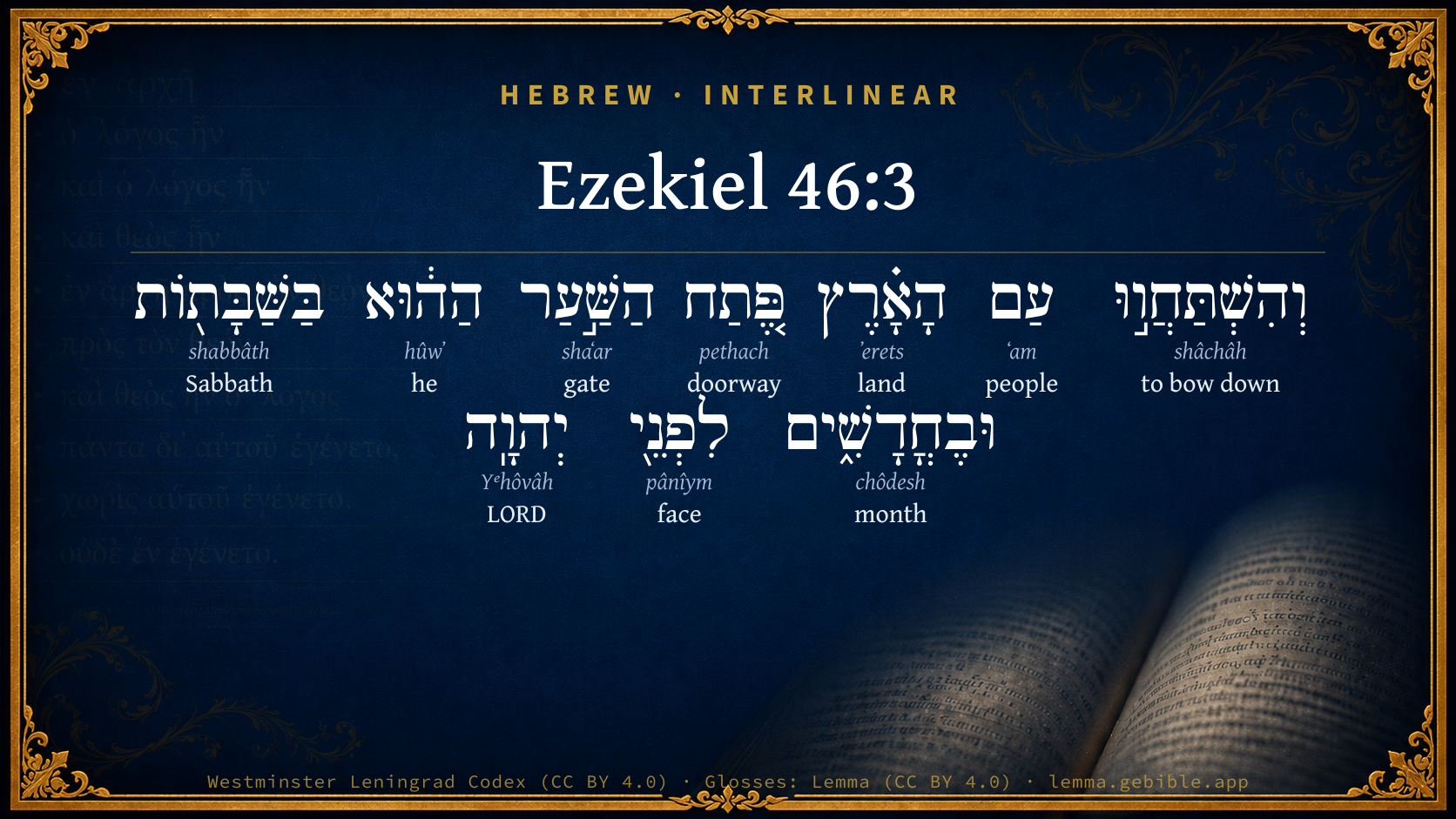
Hebrew (Westminster Leningrad Codex) Ezekiel 46:3 appears in the Hebrew Old Testament. The text above is from the Westminster Leningrad Codex. Each word links to its Strong’s number, a concise gloss, and parsing drawn from the Open Scriptures Hebrew Bible morphology. Click any word for its full Brown-Driver-Briggs (BDB) entry.
Download image
Cite this verse

Ezekiel 46:3 (World English Bible). Public Domain. Lemma interlinear Bible study tool, https://lemma.gebible.app/v/ezekiel/46/3.

Show BibTeX & RIS
BibTeX
RIS
English Translation
The people of the land shall worship at the door of that gate before Yahweh on the Sabbaths and on the new moons.
World English Bible · Public Domain
Download a study sheet

One document with this verse’s original text, its word-by-word gloss line, the meaning frame, cross-references with their text, attributed commentary, and full source and license credits — printable, and it pastes into notes with its structure intact.

This verse Autodidact and up

Study sheet (.html) Plain text (.txt)

A passage Seminary Student

Up to 50 verses in one chapter. A passage sheet keeps up to 6 commentary sources and 12 cross-references per verse, in the order this page ranks them, and says so on the sheet whenever that leaves anything out. Ask for a single verse and you get the Autodidact verse sheet above.

Everything on this page stays free to read, with no account — the sheet is a download of what is already on screen, not access to it.

Want to remove ads? Support Godless Engineer
Compare translations 3

The same verse in 3 English versions, stacked beneath the original-language interlinear above. Click any original word for its lexicon entry.

Each is an independent rendering of the whole verse — the interlinear is not word-aligned to these translations.

Highlighted words mark where these versions differ — a whole-verse word diff, not a word-by-word alignment.

  • World English Bible Public Domain
    The people of the land shall worship at the door of that gate before Yahweh on the Sabbaths and on the new moons.
  • King James Version Public Domain
    Likewise the people of the land shall worship at the door of this gate before the LORD in the sabbaths and in the new moons.
  • unfoldingWord Literal Text CC BY-SA 4.0
    The people of the land will also worship before Yahweh at the entrance to this gate on the Sabbaths and new moons.

unfoldingWord Literal Text — © unfoldingWord, licensed CC BY-SA 4.0. Word-aligned USFM3 via Door43 (git.door43.org/unfoldingWord/en_ult).

Versions to compare (up to 4)

3 of 4 selected

Show all 18 translations

Every available English version of this verse, each an independent rendering of the whole verse.

  • World English Bible Public Domain
    The people of the land shall worship at the door of that gate before Yahweh on the Sabbaths and on the new moons.
  • Berean Standard Bible Public Domain
    On the Sabbaths and New Moons the people of the land are also to bow in worship before the LORD at the entrance to that gateway.
  • Majority Standard Bible Public Domain
    On the Sabbaths and New Moons the people of the land are also to bow in worship before the LORD at the entrance to that gateway.
  • King James Version Public Domain
    Likewise the people of the land shall worship at the door of this gate before the LORD in the sabbaths and in the new moons.
  • American Standard Version (1901) Public Domain
    And the people of the land shall worship at the door of that gate before Jehovah on the sabbaths and on the new moons.
  • Revised Version (1885) Public Domain
    And the people of the land shall worship at the door of that gate before the LORD in the sabbaths and in the new moons.
  • Geneva Bible (1599) Public Domain
    Likewise the people of the lande shall worshippe at the entrie of this gate before the Lord on the Sabbaths, and in the newe moones.
  • Douay-Rheims (1899) Public Domain
    And the people of the land shall adore at the door of that gate before the Lord on the sabbaths, and on the new moons.
  • Young's Literal Translation Public Domain
    And bowed themselves have the people of the land at the opening of that gate, on sabbaths, and on new moons, before Jehovah.
  • Literal Standard Version CC BY-SA 4.0
    And the people of the land have bowed themselves at the opening of that gate, on Sabbaths, and on new moons, before YHWH.
  • Unlocked Literal Bible CC BY-SA 4.0
    The people of the land will also worship before Yahweh at the entrance to this gate on the Sabbaths and new moons.
  • unfoldingWord Literal Text CC BY-SA 4.0
    The people of the land will also worship before Yahweh at the entrance to this gate on the Sabbaths and new moons.
  • Darby Bible Public Domain
    And the people of the land shall worship at the door of this gate before Jehovah on the sabbaths and on the new moons.
  • World Messianic Bible Public Domain
    The people of the land shall worship at the door of that gate before the LORD on the Sabbaths and on the new moons.
  • Webster's Bible Public Domain
    Likewise the people of the land shall worship at the door of this gate before the LORD in the sabbaths and in the new moons.
  • Free Bible Version CC BY-SA 4.0
    The people of Israel will also bow before the Lord at the gateway entrance on Sabbaths and New Moons.
  • Bible in Basic English Public Domain
    And the people of the land are to give worship at the door of that doorway before the Lord on the Sabbaths and at the new moons.
  • JPS Tanakh (1917) Public Domain
    Likewise the people of the land shall worship at the door of that gate before the LORD in the sabbaths and in the new moons.

Literal Standard Version (2020), Covenant Press — licensed CC BY-SA 4.0. Text via the HelloAO Bible API (eBible.org). Unlocked Literal Bible (unfoldingWord) — licensed CC BY-SA 4.0. Text via the HelloAO Bible API (eBible.org). unfoldingWord Literal Text — © unfoldingWord, licensed CC BY-SA 4.0. Word-aligned USFM3 via Door43 (git.door43.org/unfoldingWord/en_ult). Free Bible Version, Dr. Jonathan Gallagher — licensed CC BY-SA 4.0. Text via the HelloAO Bible API (eBible.org).

Word by word

More ways to search: Search by grammar → Find every occurrence → Compare this word →

Practice this passage: Drill this verse → Learn its vocabulary →

בַּשַּׁבָּת֖וֹת
shabbâth
H7676
“in/at the · Sabbaths”
Preposition, Determined + Noun, Common, Both, Plural, Absolute
Part of Speech
Preposition + Noun
Type
Common
Gender
Both
Number
Plural
State
Absolute
Full BDB Definition

Origin: intensive from H7673

TWOT: 2323b

Sabbath - sabbath - day of atonement - sabbath year - week - produce (in sabbath year)
  1. וְהִשְׁתַּחֲו֣וּ shâchâh H7812 “and · to bow down” Conjunction + Verb, Hishtaphel, Sequential Perfect, 3rd Person, Common, Plural
  2. עַם ʻam H5971 “people of” Noun, Common, Masculine, Singular, Construct
  3. הָאָ֗רֶץ ʼerets H776 “the · land” Particle, Definite Article + Noun, Common, Both, Singular, Absolute
  4. פֶּ֚תַח pethach H6607 “doorway of” Noun, Common, Masculine, Singular, Construct
  5. הַשַּׁ֣עַר shaʻar H8179 “the · gate” Particle, Definite Article + Noun, Common, Masculine, Singular, Absolute
  6. הַה֔וּא hûwʼ H1931 “the · he” Particle, Definite Article + Pronoun, Personal, 3rd Person, Masculine, Singular
  7. וּבֶחֳדָשִׁ֑ים chôdesh H2320 “and · in/at the · months” Conjunction + Preposition, Determined + Noun, Common, Masculine, Plural, Absolute
  8. לִפְנֵ֖י pânîym H6440 “to/for · face(s) of” Preposition + Noun, Common, Both, Plural, Construct
  9. יְהוָֽה Yᵉhôvâh H3068 “LORD” Noun, Proper

About this verse

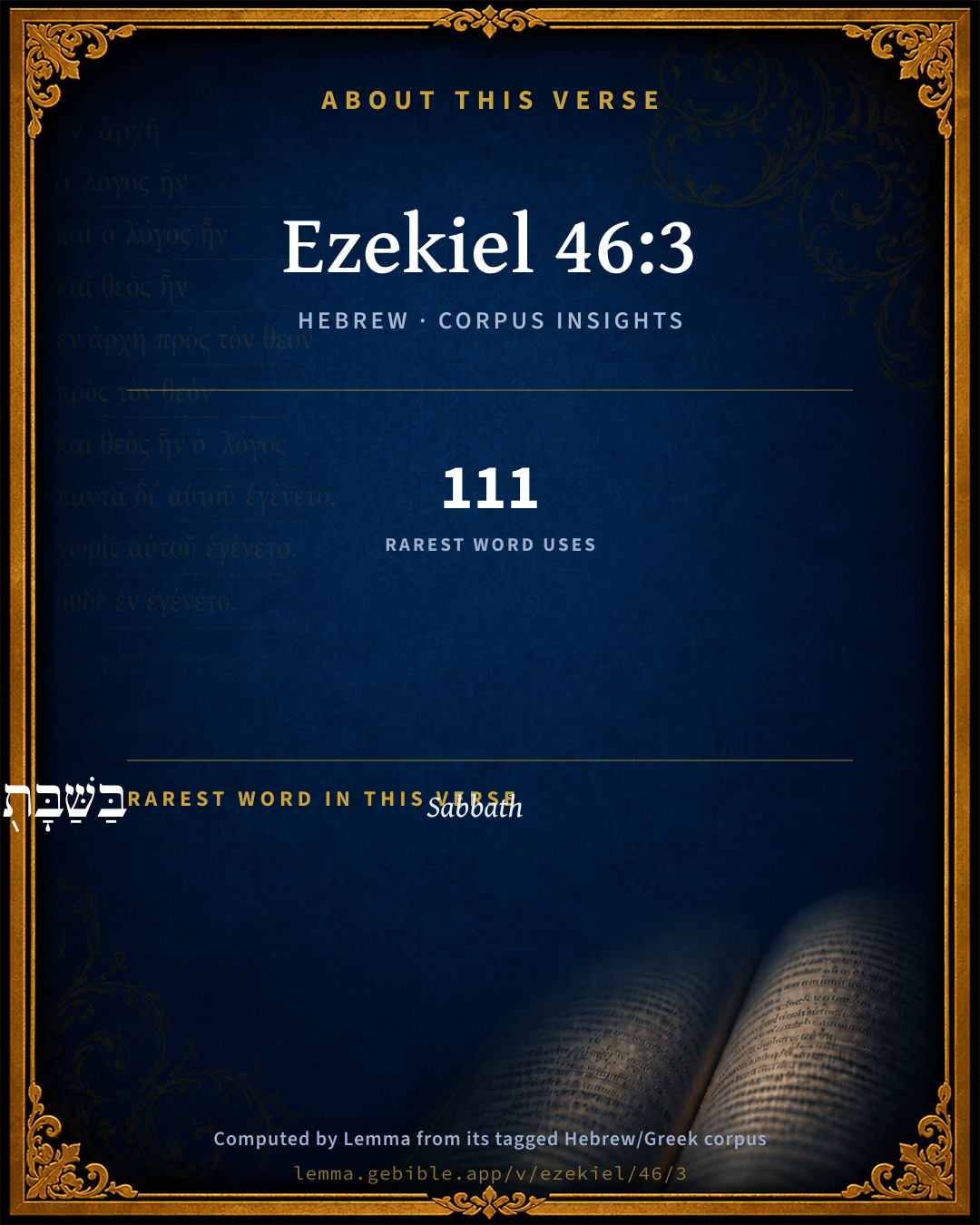
These counts appear in no published source. They are computed here, from the morphology-tagged text and Lemma’s own curated glosses. What Lemma adds →

10
words
10
distinct lemmas
Prophets
section

Grammatical profile

  • 1 verb
  • 8 nouns
  • 1 pronoun

Verb forms

  • וְהִשְׁתַּחֲו֣וּ Hishtaphel · Sequential Perfect

Hebrew & Septuagint length

In English translation the verse runs 23 words from the Hebrew and 26 from the Septuagint (LXX English) — closely comparable.

A rough comparison of the two English renderings, which tokenize alike — not a word-level alignment.

Word counts can differ between the Hebrew and the Greek without any difference in meaning — e.g. the Hebrew direct-object marker אֵת has no separate Greek word, and Greek often adds the article ὁ.

Cross-references

3

Topical passages linked to Ezekiel 46:3 in the Treasury of Scripture Knowledge — connected by theme and wording, ordered by reader-vote popularity; previews shown in the World English Bible.

  • Luke 1:10 The whole multitude of the people were praying outside at the hour of incense.
  • John 10:9 I am the door. If anyone enters in by me, he will be saved, and will go in and go out, and will find pasture.
  • Hebrews 10:19–22 Having therefore, brothers, boldness to enter into the holy place by the blood of Jesus,

Cross-references courtesy of OpenBible.info (CC BY 4.0).

Hebrew and Greek witnesses Masoretic Hebrew ↔ Greek Septuagint

The same verse in the two great witnesses to the Old Testament, shown verse-for-verse.

These are two independent witnesses, not word-aligned to each other, and the Septuagint is shown in lemma (dictionary) form.

Hebrew Ezekiel 46:3 Masoretic · Westminster Leningrad Codex

וְהִשְׁתַּחֲו֣וּ עַם הָאָ֗רֶץ פֶּ֚תַח הַשַּׁ֣עַר הַה֔וּא בַּשַּׁבָּת֖וֹת וּבֶחֳדָשִׁ֑ים לִפְנֵ֖י יְהוָֽה

The people of the land shall worship at the door of that gate before Yahweh on the Sabbaths and on the new moons.

World English Bible · Public Domain

Greek LXX Ezekiel 46:3 Septuagint · lemma form

καί προςκυνέω ὁ λαός ὁ γῆ κατά ὁ πρόθυρον ὁ πύλη ἐκεῖνος ἐν ὁ σάββατον καί ἐν ὁ νεομηνία ἐναντίον κύριος

And the people of the land shall worship at the entrance of that gate, both on the sabbaths and at the new moons, before the Lord.

LXX2012 (modern English Septuagint) · Public Domain

Hebrew: Westminster Leningrad Codex (CC BY 4.0). Greek: Septuagint (public domain); English from LXX2012 (modern English Septuagint) (Public Domain). How the Septuagint differs from the Hebrew →

Targum (Aramaic paraphrase)

1

The Targum is the ancient Jewish Aramaic paraphrase of the Hebrew Scriptures — an interpretive translation, not the Hebrew text itself. Onkelos (literal) and Pseudo-Jonathan (expansive) render the Torah, and Jonathan the Prophets. Coverage is partial: where no permissively-licensed English translation exists for a verse, only the Aramaic is shown. This is verse-level text, not a word-by-word alignment to the Hebrew.

  1. Targum Jonathan Prophets (Joshua–Malachi)
    וְיִסְגְדוּן עַמָא דְאַרְעָא בְּמַעֲלָנָא דְתַרְעָא הַהוּא בְּשַׁבַּיָא וּבְיַרְחַיָא קֳדָם יְיָ:

    (no public-domain English translation for this verse)

    Targum Jonathan — Aramaic: “Mikraot Gedolot” (public domain). English: “Sefaria Community Translation” (CC0 1.0 (public-domain dedication)); “London "Chaldee Paraphrase," 1871” (public domain). Text via Sefaria.

Commentary

Notes on Ezekiel 46:3 from classic Christian and Jewish commentators (each source and its license shown beneath its notes). The classic Christian expositions comment on the surrounding passage and are grouped to its opening verse, so a note may address several verses; the Jewish commentaries on the Tanakh (Rashi and others) are per-verse, so they appear only where the commentator wrote on this verse.

Lemma curates 59 commentaries, every one of them public domain or Creative Commons licensed, each selected and text-cleaned for this edition rather than reprinted as found. About our sources →

Trapp's Complete Commentary

John Trapp

Eze 46:3 Likewise the people of the land shall worship at the door of this gate before the LORD in the sabbaths and in the new moons.

Ver. 3. Likewise the people of the land.] The meanest of his subjects, if faithful, may have as near access to God as himself.

John Trapp, A Commentary or Exposition upon All the Books of the Old and New Testament (1647–1656) — public domain. Text from a community e-Sword module.

Tyndale Open Study Notes

Tyndale Open Resources

46:3 The ordinary Israelites, the common people, would be allowed to climb the stairs to the threshold to offer their worship when the gate was open on the Sabbath and the first day of the month; only then would they be able to see into the inner court. Otherwise, they were kept away from it.

Tyndale Open Study Notes — © Tyndale Open Resources, licensed CC BY-SA 4.0. Text via the HelloAO Bible API.

Ellicott's Commentary for English Readers

(3) Worship at the door.—The people, in so far as they might be present on the Sabbaths and new moons, are not to worship in the same place with the prince; but in the outer court, at the entrance of the east gate to the inner court.

A Bible Commentary for English Readers, edited by Charles John Ellicott (1878–1897) — public domain. Text from a community e-Sword module.

John Gill's Exposition

Likewise the people of the land shall worship at the door of this gate before the Lord,.... Publicly, and in a spiritual manner; attending the ministration of the word and ordinances with constancy and fervency; praying to God, praising his name, and hearing his word with attention; and performing all the duties of religious worship. The allusion is to the people of Israel meeting at the door of the tabernacle of the congregation, Exo 29:42, "in the sabbaths, and in the new moons"; at their stated weekly and monthly meetings; see Isa 66:23.

.

Ezekiel 46:4

eze 46:4

eze 46:4

eze 46:4And the burnt offering the prince shall offer unto the Lord in the sabbath day,.... In Eze 45:17, it is said to be the prince's part to give and prepare sacrifices in the feasts, new moons, sabbaths, and all solemnities; and there follows an account of them, for New Year's Day, and for the feasts of passover and tabernacles; and here an account is given of those for the sabbaths and new moons; which is very properly reserved for this place, to follow the account of the opening of the eastern gate at those seasons: and the burnt offering for the sabbath shall be

six lambs without blemish, and a ram without blemish; according to the law of Moses, only two lambs were the burnt offering for this day, besides the continual one, Num 28:9, here Jarchi confesses his ignorance; and Kimchi says it is a new thing; and indeed it is, and is a proof of the ceremonial law being now abolished. These seven denote the perfect sacrifice of Christ, by which he has perfected for ever them that are sanctified; and being without blemish, the purity and holiness of it; and as the people of God on the six working days commit much sin, and contract much guilt, the sacrifice of Christ is signified by six lambs, which it is necessary they should hear of, and it should be set before them in the ministry of the word on Lord's days, which is meant by the offering of it; that they may by faith apply it to themselves, to the removal of sin from their consciences, and take the comfort of it; as the one ram may denote the one sacrifice of Christ, though typified by many; and who, like the ram, is the leader and guide of the flock: now, more creatures being offered for this burnt offering than under the law, denotes the clearer knowledge of the sacrifice of Christ under the Gospel, and the more extensive efficacy of it, to the removal of the guilt of sin from the Lord's people.

John Gill's Exposition of the Whole Bible (1746–1763) — public domain (CC PDM 1.0). Text via the HelloAO Bible API.

Albert Barnes' Notes on the Bible

At the door of this gate - In Herod’s Temple the place for worshipping “before the Lord” was the court of Israel, west of the court of Women, separated from the inner court by a low parapet. In Ezekiel’s the worshippers were admitted into the inner court itself. The upper pavement (E. Plan II) on either side of the eastern gate provided room for such worshippers.

Albert Barnes' Notes on the Bible (1834–1885) — public domain. Text from a community e-Sword/MySword module.

Matthew Poole's English Annotations

Likewise, Heb. And, i.e. as the prince had done, bringing, standing, worshipping at the threshold of the gate, and departing when the sacrifice was finished, so must the people when they brought their sacrifices; but one manner, one gate, one sacrifice; but one Saviour.

Before the Lord; with due sense of God’s holy and glorious presence.

In the sabbaths; both weekly and other holy days, which are called sabbaths on good ground.

The new moons; which were solemn feasts to the Jews in their generation; but these days privileged them only to come thus near who brought their particular offerings, for I suppose the people might not approach at pleasure to see the stated morning and evening oblation sacrificed, this would crowd the gate; but at this time they kept in their own court.

Matthew Poole's English Annotations on the Holy Bible (1683–1685) — public domain. Text from a community e-Sword/MySword module.

The Pulpit Commentary

Likewise (or, and) to the people of the land should be accorded permission to worship at this inner gate, only not like the prince, in its porch, but at its door, yet on the same occasions as he, in the sabbaths and in the new moons. Kliefoth, who takes "this gate" to signify the outer gate, through which, according to his interpretation of ver. 2 (see above), the prince should pass so as to reach the inner east gate, conceives the import of the present verse to be that, while the prince should be permitted on the sabbaths and new moons to pass through the eastern gate, the people "should remain standing in front of the outer east gate, and, looking through it and the opened inner east gate, should pray before Jehovah." This, however, is unnatural, even on the hypothesis that the prince should pass through the outer east gate, and the view of Keil is greatly preferable, that "this gate" was the inner east gate, and that the people should reach it (even if the prince did not) by entering the outer court through the north gate or the south.

Ver. 3. The people"s worship.

Although there was an elaborate hierarchical system in the Hebrew religion, care was taken that the people generally should take an important part in the service. They were not admitted to the most sacred parts of the temple enclosure, but they were expected to come up to the temple and share in its worship.

I GOD LOOKS FOR THE PEOPLE"S WORSHIP. If this was expected under the Law, much more is it looked for in the gospel dispensation, according to which all the Lord"s people are priests, and all are admitted to the most holy place through the rent veil God has personal dealings with each soul, and it is right for each soul to come up before him in grateful adoration. The service in which the people do not take part cannot be said to be of much use to them. It is true that there is value in intercession, and we should all plead one for another. Still, we cannot grant to any priest a power of attorney to execute our religious contracts in our stead.

II THE PEOPLE CAN ENJOY WORSHIP. When the heart is in it, no joy on earth can be more rich and full.

Lord, how delightful "tis to see A whole assembly worship thee!

The dreariness of Sunday just arises from the fact that so many people who go to church really take no part in the service. It must be wearisome to sit as spectator of a feast of which one does not partake. But when once a living interest is taken in the worship, and the spectator becomes a guest at the table, the whole character of the scene is changed, and the joy of worship is experienced. Then it is possible to say, "How amiable are thy tabernacles, O Lord of hosts! my soul longeth, yea, even fainteth for the courts of the Lord;" and "I was glad when they said unto me, Let us go into the house of the Lord.

III WORSHIP SHOULD BE ADAPTED TO THE PEOPLE. It may not be possible to make it all that we would desire in form and external expression. Indeed, popular worship can never reach the standard of fastidious aestheticism. In trying to satisfy the refined taste of one or two cultured persons, we may simply destroy the means of worship for the majority of a congregation. In that case the service, while it reaches the perfection of art, loses its spiritual character and degenerates into a mere musical performance. We should always bear in mind the practical end of worship, always see that it is in touch with the people and expresses and helps the devotion of the congregation generally. The church should be the people"s home of worship, not the shrine of a privileged aristocracy. Christ was one of the people.

IV WORSHIP MUST NOT BE DEGRADED IN ORDER THAT IT MAY BE MADE POPULAR. There is considerable danger of running into this opposite extreme in the effort to attract and interest the indifferent. But then the whole object is defeated. We may get the people and amuse them for a while, but what is the use of doing so if we sacrifice the great end of assembling together the reverent adoration of the holy God? Fine art may be sacrificed, but spiritual reality must be retained. Religion, the essence of which is reverence, cannot be helped by mere vulgarity. The people"s worship must be worship.

HOMILIES BY J.R. THOMSON Ver. 3. Worship.

The prophet, having described by anticipation the sacred city and temple, having represented the several duties of prince, priest, and people, having given regulations for sacrifices and festivals, now proceeds to depict the sacred services for which all this preparation has been undertaken. The rulers of the nation, the ministers of religion, and the people of the land are beheld uniting in the solemn function of spiritual worship. This is the loftiest exercise of the Church, whether upon earth or in heaven. The worship of the individual soul yields in beauty and in grandeur to that sacrifice of worship in which multitudes, willingly, gratefully, and joyfully unite.

I THE OBJECT OF WORSHIP IS GOD ONLY. In this a distinction existed between Israel and the heathen people around; for whilst these worshipped gods many and lords many, the chosen people worshipped Jehovah, and him alone. In the Church of Christ, whilst many of the great and holy in former times are remembered with gratitude and veneration, worship, in the strict and proper sense of the term, is reserved for the Supreme and Eternal, who shares his honor with none beside. His glorious perfections demand the homage and adoration of his intelligent creatures; and the more his character is studied, the more will it appear worthy of all the admiration and reverence which can be brought into his sacred presence.

II THE WORSHIPPERS ARE THE CHURCH OF THE LIVING GOD. The great and the small, the young and the old, the learned and the lay, are all qualified to present to the Eternal the spiritual tribute which is his due. For it is in virtue of their humanity, their participation in human nature, experience, and powers, and not in virtue of any peculiar possession or acquisition, that they are summoned to unite in the worship of their Creator. The idea of the prophet.was one in a high degree expanded and comprehensive; yet even this fell short of the great reality as apprehended by the Apocalyptic seer.

III THE SEAT OF ACCEPTABLE WORSHIP IS THE HEART. It is true that this spiritual doctrine is especially that of Christianity, of the New Testament. But the attentive reader of the Psalms and prophecies of the old covenant is aware that the enlightened Hebrews were superior to a merely formal and mechanical view of worship. Sacrifices and offerings were known and felt to be of no avail unless they expressed the deep and sincere emotions of the inner nature. Thus it must ever be; he who is a Spirit must be worshipped in spirit and in truth.

IV THE CHARACTER OF TRUE WORSHIP CORRESPONDS WITH THE NATURE AND NEED OF THE WORSHIPPERS.

1. There must he acknowledgment of the Divine attributes, contemplated with reverence.

2. There must be humiliation and confession of sin.

3. There must be the presentation of the due offering of gratitude to him from whom all blessings proceed.

4. There must be petitions and intercessions for needed good.

V THE EXPRESSION AND FORM OF WORSHIP MUST VARY WITH THE INDIVIDUAL WORSHIPPER AND HIS CIRCUMSTANCES. It is narrow bigotry to insist upon one form of spiritual service or of uttered adoration and prayer. There are occasions upon which worship may be spontaneous and ejaculatory; and other occasions upon which it may be elaborate, artistic, and protracted. The worship of the individual who is momentarily touched by what is beautiful in nature, or impressive in the Word of God, is as acceptable as the liturgy of a cathedral service, or as the fervent service of praise in which expression may be given to a nation"s gratitude for signal favors.

VI THE SEASONS FOR WORSHIP ARE BOTH OCCASIONAL AND CONTINUOUS. The text speaks of the "new moons" and the "sabbaths" as opportunities for solemn and public services of devotion. Yet we read a little later of the daily offering. The truth is that there is no season when worship is unsuitable on the part of man or unacceptable So God. Yet there is wisdom in the appointment both of regular and of special seasons and occasions of worship. None can worship God too much, or too reverently, or too fervently.

From every place beneath the skies Let the Creator"s praise arise! Let the Redeemer"s Name be sung In every land, by every tongue! T.

The Pulpit Commentary (1880–1919), ed. H.D.M. Spence-Jones & Joseph S. Exell — public domain. Text from a community e-Sword module.

John Wesley's Explanatory Notes

In the sabbaths - Both weekly and other holy days, which are called sabbaths.

John Wesley, Explanatory Notes Upon the Whole Bible (1754–1765) — public domain. Text via the GEBible commentary corpus.

unfoldingWord translationNotes

Door43 World Missions Community

General Information:

Yahweh continues giving Ezekiel his message to the princes of Israel.

before Yahweh

See how you translated this in Ezekiel 43:24.

translationWords

Yahweh

lamb

ewe

grain offering

oil

unfoldingWord translationNotes — © Distant Shores Media and the Door43 World Missions Community, licensed CC BY-SA 4.0. Source: git.door43.org/Door43/en_tn.

Rashi

Rabbi Shlomo Yitzchaki (Rashi)

And the people of the land shall prostrate themselves all day, and whoever comes, too, and in the evening they shall close it.

Rashi on the Tanakh — English translations: “The Judaica Press complete Tanach with Rashi, translated by A. J. Rosenberg” (CC BY 4.0); “Pentateuch with Rashi's commentary by M. Rosenbaum and A.M. Silbermann, 1929-1934” (public domain); “The Metsudah Tanach series, Lakewood, N.J” (CC BY 4.0); and “The Book of Joshua, Metsudah Publications, 1997” (CC BY 4.0). Text via Sefaria.

Lesson kit

Teaching starters — assembled from the data on this page, not authored interpretation. Every prompt links to the verse data it draws on. Edit before teaching.

Ezekiel, in the Prophets, opens this verse with 10 words (10 distinct Hebrew lemmas). Its most distinctive word is shabbâth (“Sabbath”). A historical commentator’s framing appears above. Read the whole chapter for the surrounding context.

Discussion questions

  1. The word shabbâth carries the sense “Sabbath.” How does it shape the verse?
  2. Luke 1:10 shares this passage’s theme. How do the two illuminate each other?
  3. These translations render this verse differently; the difference is in the English rendering, not the original. What questions does that raise?
  4. The verb «וְהִשְׁתַּחֲו֣וּ» is Hishtaphel Sequential Perfect. How does its form color the action?
  5. Reading how Trapp's Complete Commentary and Tyndale Open Study Notes read this verse, where do the two commentators agree and where do they part?

Things to notice

Reading settings

Reading text

Shown beneath each verse's original-language words.

Old Testament
Old Testament edition

Read the OT as the Masoretic Hebrew (MT) or the Greek Septuagint (LXX).

English shown for the Greek Septuagint (in the Hebrew ↔ Greek comparison).

Comparing translations? Open the Compare panel on any verse page to stack up to four side by side.