Numbers 3:40

Hebrew (Westminster Leningrad Codex) Numbers 3:40 appears in the Hebrew Old Testament. The text above is from the Westminster Leningrad Codex. Each word links to its Strong’s number, a concise gloss, and parsing drawn from the Open Scriptures Hebrew Bible morphology. Click any word for its full Brown-Driver-Briggs (BDB) entry.
Download image
Cite this verse

Numbers 3:40 (World English Bible). Public Domain. Lemma interlinear Bible study tool, https://lemma.gebible.app/v/numbers/3/40.

Show BibTeX & RIS
BibTeX
RIS
English Translation
Yahweh said to Moses, "Number all the firstborn males of the children of Israel from a month old and upward, and take the number of their names.
World English Bible · Public Domain
Download a study sheet

One document with this verse’s original text, its word-by-word gloss line, the meaning frame, cross-references with their text, attributed commentary, and full source and license credits — printable, and it pastes into notes with its structure intact.

This verse Autodidact and up

Study sheet (.html) Plain text (.txt)

A passage Seminary Student

Up to 50 verses in one chapter. A passage sheet keeps up to 6 commentary sources and 12 cross-references per verse, in the order this page ranks them, and says so on the sheet whenever that leaves anything out. Ask for a single verse and you get the Autodidact verse sheet above.

Everything on this page stays free to read, with no account — the sheet is a download of what is already on screen, not access to it.

Want to remove ads? Support Godless Engineer
Compare translations 3

The same verse in 3 English versions, stacked beneath the original-language interlinear above. Click any original word for its lexicon entry.

Each is an independent rendering of the whole verse — the interlinear is not word-aligned to these translations.

Highlighted words mark where these versions differ — a whole-verse word diff, not a word-by-word alignment.

  • World English Bible Public Domain
    Yahweh said to Moses, "Number all the firstborn males of the children of Israel from a month old and upward, and take the number of their names.
  • King James Version Public Domain
    And the LORD said unto Moses, Number all the firstborn of the males of the children of Israel from a month old and upward, and take the number of their names.
  • unfoldingWord Literal Text CC BY-SA 4.0
    And Yahweh said to Moses, “Count every firstborn male of the sons of Israel from a son of a month and upward. And lift up the number of their names.

unfoldingWord Literal Text — © unfoldingWord, licensed CC BY-SA 4.0. Word-aligned USFM3 via Door43 (git.door43.org/unfoldingWord/en_ult).

Versions to compare (up to 4)

3 of 4 selected

Show all 18 translations

Every available English version of this verse, each an independent rendering of the whole verse.

  • World English Bible Public Domain
    Yahweh said to Moses, "Number all the firstborn males of the children of Israel from a month old and upward, and take the number of their names.
  • Berean Standard Bible Public Domain
    Then the LORD said to Moses, “Number every firstborn male of the Israelites a month old or more, and list their names.
  • Majority Standard Bible Public Domain
    Then the LORD said to Moses, “Number every firstborn male of the Israelites a month old or more, and list their names.
  • King James Version Public Domain
    And the LORD said unto Moses, Number all the firstborn of the males of the children of Israel from a month old and upward, and take the number of their names.
  • American Standard Version (1901) Public Domain
    And Jehovah said unto Moses, Number all the first-born males of the children of Israel from a month old and upward, and take the number of their names.
  • Revised Version (1885) Public Domain
    And the LORD said unto Moses, Number all the firstborn males of the children of Israel from a month old and upward, and take the number of their names.
  • Geneva Bible (1599) Public Domain
    And the Lord said vnto Moses, Nomber all the first borne that are Males among the children of Israel, from a moneth old and aboue, and take the nomber of their names.
  • Douay-Rheims (1899) Public Domain
    And the Lord said to Moses: Number the firstborn of the male sex of the children of Israel, from one month and upward, and thou shalt take the sum of them.
  • Young's Literal Translation Public Domain
    And Jehovah saith unto Moses, `Number every first-born male of the sons of Israel from a son of a month and upward, and take up the number of their names;
  • Literal Standard Version CC BY-SA 4.0
    And YHWH says to Moses, “Number every firstborn male of the sons of Israel from a son of a month and upward, and take up the number of their names;
  • Unlocked Literal Bible CC BY-SA 4.0
    Yahweh said to Moses, “Count all the firstborn males of the people of Israel who are aged one month old and older. List their names.
  • unfoldingWord Literal Text CC BY-SA 4.0
    And Yahweh said to Moses, “Count every firstborn male of the sons of Israel from a son of a month and upward. And lift up the number of their names.
  • Darby Bible Public Domain
    And Jehovah said to Moses, Number all the first-born males of the children of Israel from a month old and upward, and take the number of their names.
  • World Messianic Bible Public Domain
    The LORD said to Moses, “Count all the firstborn males of the children of Israel from a month old and upward, and take the number of their names.
  • Webster's Bible Public Domain
    And the LORD said to Moses, number all the first-born of the males of the children of Israel, from a month old and upward, and take the number of their names.
  • Free Bible Version CC BY-SA 4.0
    The Lord told Moses, “Conduct a census of all the firstborn Israelite males aged one month or older, and register their names.
  • Bible in Basic English Public Domain
    And the Lord said to Moses, Let all the first male children be numbered, and take the number of their names.
  • JPS Tanakh (1917) Public Domain
    And the LORD said unto Moses: 'Number all the first-born males of the children of Israel from a month old and upward, and take the number of their names.

Literal Standard Version (2020), Covenant Press — licensed CC BY-SA 4.0. Text via the HelloAO Bible API (eBible.org). Unlocked Literal Bible (unfoldingWord) — licensed CC BY-SA 4.0. Text via the HelloAO Bible API (eBible.org). unfoldingWord Literal Text — © unfoldingWord, licensed CC BY-SA 4.0. Word-aligned USFM3 via Door43 (git.door43.org/unfoldingWord/en_ult). Free Bible Version, Dr. Jonathan Gallagher — licensed CC BY-SA 4.0. Text via the HelloAO Bible API (eBible.org).

Word by word

More ways to search: Search by grammar → Find every occurrence → Compare this word →

Practice this passage: Drill this verse → Learn its vocabulary →

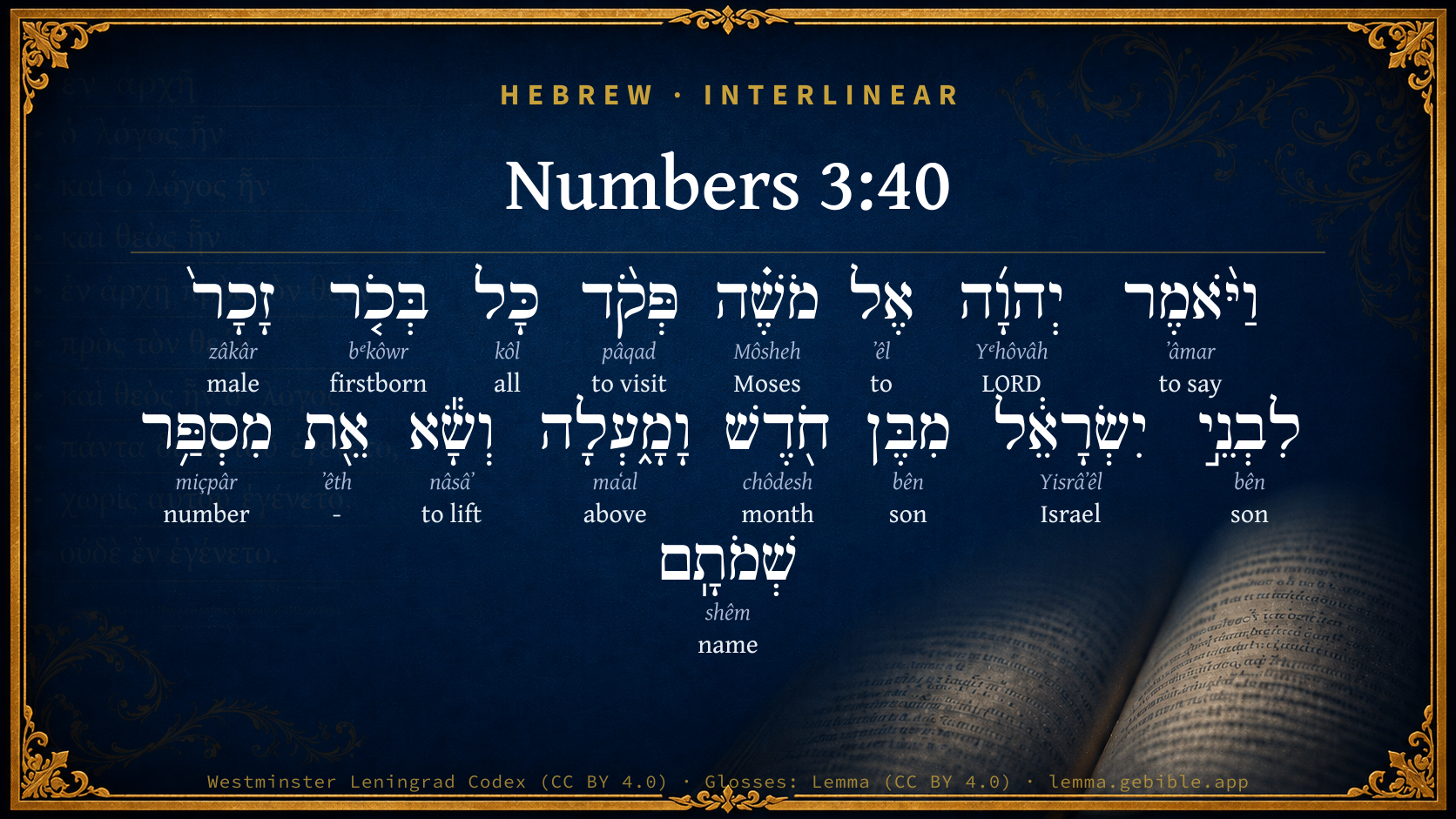
זָכָר֙
zâkâr
H2145
“male”
Adjective, Adjective, Masculine, Singular, Absolute
Part of Speech
Adjective
Type
Adjective
Gender
Masculine
Number
Singular
State
Absolute
Full BDB Definition

Origin: from H2142

TWOT: 551e

male (of humans and animals) (noun masculine) - male (of humans) (adjective)
  1. וַיֹּ֨אמֶר ʼâmar H559 “and · to say” Conjunction + Verb, Qal, Sequential Imperfect, 3rd Person, Masculine, Singular
  2. יְהוָ֜ה Yᵉhôvâh H3068 “LORD” Noun, Proper
  3. אֶל ʼêl H413 “to” Preposition
  4. מֹשֶׁ֗ה Môsheh H4872 “Moses” Noun, Proper
  5. פְּקֹ֨ד pâqad H6485 “visit” Verb, Qal, Imperative, 2nd Person, Masculine, Singular
  6. כָּל kôl H3605 “all of” Noun, Common, Masculine, Singular, Construct
  7. בְּכֹ֤ר bᵉkôwr H1060 “firstborn” Noun, Common, Masculine, Singular, Absolute
  8. לִבְנֵ֣י bên H1121 “to/for · sons of” Preposition + Noun, Common, Masculine, Plural, Construct
  9. יִשְׂרָאֵ֔ל Yisrâʼêl H3478 “Israel” Noun, Proper
  10. מִבֶּן bên H1121 “from · son of” Preposition + Noun, Common, Masculine, Singular, Construct
  11. חֹ֖דֶשׁ chôdesh H2320 “month” Noun, Common, Masculine, Singular, Absolute
  12. וָמָ֑עְלָה maʻal H4605 “and · above · toward” Conjunction + Adverb + Suffix, Demonstrative
  13. וְשָׂ֕א nâsâʼ H5375 “and · lift” Conjunction + Verb, Qal, Imperative, 2nd Person, Masculine, Singular
  14. אֵ֖ת ʼêth H853 “-” Particle, Direct Object
  15. מִסְפַּ֥ר miçpâr H4557 “number of” Noun, Common, Masculine, Singular, Construct
  16. שְׁמֹתָֽם shêm H8034 “names · their” Noun, Common, Masculine, Plural, Construct + Suffix, Personal, 3rd Person, Masculine, Plural

About this verse

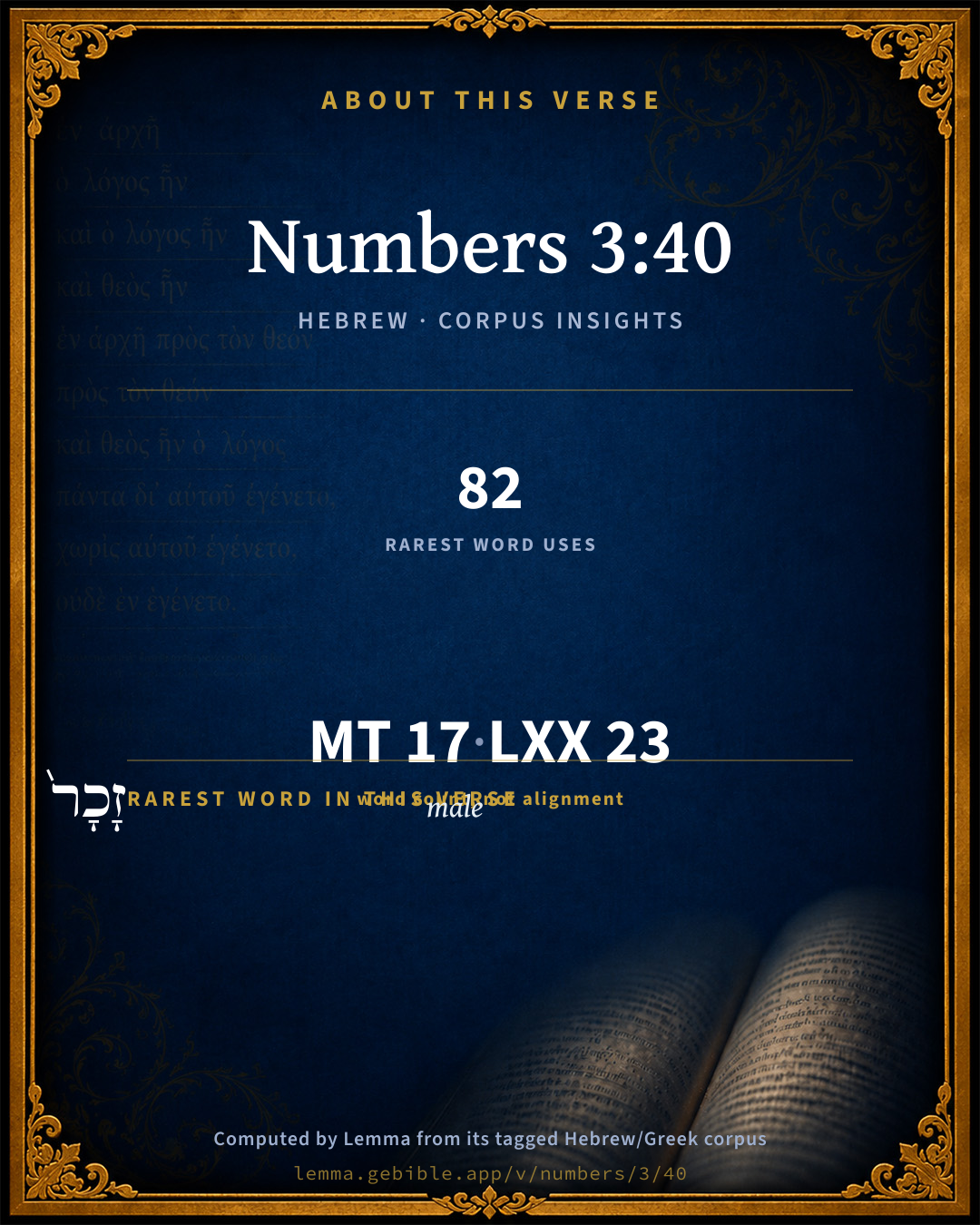
These counts appear in no published source. They are computed here, from the morphology-tagged text and Lemma’s own curated glosses. What Lemma adds →

17
words
16
distinct lemmas
Pentateuch
section

Grammatical profile

  • 3 verbs
  • 10 nouns
  • 1 adjective
  • 1 preposition
  • 1 adverb
  • 1 particle

Verb forms

  • וַיֹּ֨אמֶר Qal · Sequential Imperfect
  • פְּקֹ֨ד Qal · Imperative
  • וְשָׂ֕א Qal · Imperative

Repetition

A word recurs within this verse — often emphatic in Hebrew:

  • לִבְנֵ֣י son H1121 ×2

Hebrew & Septuagint length

In English translation the verse runs 27 words from the Hebrew and 28 from the Septuagint (LXX English) — closely comparable.

A rough comparison of the two English renderings, which tokenize alike — not a word-level alignment.

Word counts can differ between the Hebrew and the Greek without any difference in meaning — e.g. the Hebrew direct-object marker אֵת has no separate Greek word, and Greek often adds the article ὁ.

In the original languages it is 17 Hebrew tokens and 23 Greek tokens — but the two are counted differently (Hebrew bundles its prefixes and suffixes into one token; the Greek is in lemma form), so that isn’t a like-for-like length.

Cross-references

12

Topical passages linked to Numbers 3:40 in the Treasury of Scripture Knowledge — connected by theme and wording, ordered by reader-vote popularity; previews shown in the World English Bible.

  • Numbers 3:15 "Number the children of Levi by their fathers' houses, by their families: every male from a month old and upward shall you number."
  • Exodus 32:26–29 then Moses stood in the gate of the camp, and said, "Whoever is on Yahweh's side, come to me!" All the sons of Levi gathered themselves together to him.
  • Numbers 3:12 "Behold, I have taken the Levites from among the children of Israel instead of all the firstborn who open the womb among the children of Israel; and the Levites shall be mine:
  • Numbers 3:45 "Take the Levites instead of all the firstborn among the children of Israel, and the cattle of the Levites instead of their cattle; and the Levites shall be mine. I am Yahweh.
  • Psalms 87:6 Yahweh will count, when he writes up the peoples, "This one was born there." Selah.
  • Isaiah 4:3 It will happen, that he who is left in Zion, and he who remains in Jerusalem, shall be called holy, even everyone who is written among the living in Jerusalem;
  • Luke 10:20 Nevertheless, don't rejoice in this, that the spirits are subject to you, but rejoice that your names are written in heaven."
  • Philippians 4:3 Yes, I beg you also, true yoke-fellow, help these women, for they labored with me in the Gospel, with Clement also, and the rest of my fellow workers, whose names are in the book of life.
  • 2 Timothy 2:19 However God's firm foundation stands, having this seal, "The Lord knows those who are his," and, "Let every one who names the name of the Lord depart from unrighteousness."
  • Hebrews 12:23 to the general assembly and assembly of the firstborn who are enrolled in heaven, to God the Judge of all, to the spirits of just men made perfect,
  • Revelation 3:5 He who overcomes will be arrayed in white garments, and I will in no way blot his name out of the book of life, and I will confess his name before my Father, and before his angels.
  • Revelation 14:4 These are those who were not defiled with women, for they are virgins. These are those who follow the Lamb wherever he goes. These were redeemed by Jesus from among men, the first fruits to God and to the Lamb.

Cross-references courtesy of OpenBible.info (CC BY 4.0).

Hebrew and Greek witnesses Masoretic Hebrew ↔ Greek Septuagint

The same verse in the two great witnesses to the Old Testament, shown verse-for-verse.

These are two independent witnesses, not word-aligned to each other, and the Septuagint is shown in lemma (dictionary) form.

Hebrew Numbers 3:40 Masoretic · Westminster Leningrad Codex

וַיֹּ֨אמֶר יְהוָ֜ה אֶל מֹשֶׁ֗ה פְּקֹ֨ד כָּל בְּכֹ֤ר זָכָר֙ לִבְנֵ֣י יִשְׂרָאֵ֔ל מִבֶּן חֹ֖דֶשׁ וָמָ֑עְלָה וְשָׂ֕א אֵ֖ת מִסְפַּ֥ר שְׁמֹתָֽם

Yahweh said to Moses, "Number all the firstborn males of the children of Israel from a month old and upward, and take the number of their names.

World English Bible · Public Domain

Greek LXX Numbers 3:40 Septuagint · lemma form

καί εἶπον κύριος πρός μωυσῆς λέγω ἐπισκέπτω πᾶς πρωτότοκος ἄρσην ὁ υἱός ἰσραήλ ἀπό μηνιαῖος καί ἐπάνω καί λαμβάνω ὁ ἀριθμός ἐκ ὄνομα

And the Lord spoke to Moses, saying, Count every firstborn male of the children of Israel from a month old and upwards, and take the number by name.

LXX2012 (modern English Septuagint) · Public Domain

Hebrew: Westminster Leningrad Codex (CC BY 4.0). Greek: Septuagint (public domain); English from LXX2012 (modern English Septuagint) (Public Domain). How the Septuagint differs from the Hebrew →

Targum (Aramaic paraphrase)

2

The Targum is the ancient Jewish Aramaic paraphrase of the Hebrew Scriptures — an interpretive translation, not the Hebrew text itself. Onkelos (literal) and Pseudo-Jonathan (expansive) render the Torah, and Jonathan the Prophets. Coverage is partial: where no permissively-licensed English translation exists for a verse, only the Aramaic is shown. This is verse-level text, not a word-by-word alignment to the Hebrew.

  1. Targum Onkelos Torah (Genesis–Deuteronomy)
    וַאֲמַר יְיָ לְמשֶׁה מְנֵי כָּל בּוּכְרַיָא דִכְרַיָא לִבְנֵי יִשְׂרָאֵל מִבַּר יַרְחָא וּלְעֵלָא וְקַבֵּל יָת מִנְיַן שְׁמָהַתְהוֹן

    (no public-domain English translation for this verse)

    Targum Onkelos — Aramaic: “Onkelos Genesis” (public domain); “Onkelos Exodus” (public domain); “Onkelos Leviticus” (public domain); “Onkelos Numbers” (public domain); “Onkelos Deuteronomy” (public domain). English: “Sefaria Community Translation” (CC0 1.0 (public-domain dedication)); “J.W. Etheridge. The Targums of Onkelos and Jonathan Ben Uzziel on the Pentateuch. London: Longmans, Green, 1862” (public domain). Text via Sefaria.

  2. Targum Pseudo-Jonathan Torah (Genesis–Deuteronomy)
    וַאֲמַר יְיָ לְמשֶׁה מְנֵי כָּל בּוּכְרַיָא דוּכְרַיָא מִבְּנֵי יִשְרָאֵל מִבַּר יַרְחָא וּלְעֵילָא וְקַבֵּיל יַת סְכוּם מִנְיַין שְׁמָהַתְהוֹן

    And the Lord said unto Mosheh, Number all the first-bon males among the sons of Israel, from a month old and upward, and take the number of their names.

    Targum Pseudo-Jonathan — Aramaic: “Targum Jonathan on Genesis” (public domain); “Targum Jonathan on Exodus” (public domain); “Targum Jonathan on Leviticus” (public domain); “Targum Jonathan on Numbers” (public domain); “Targum Jonathan on Deuteronomy” (public domain). English: “The Targum of Jonathan ben Uzziel, trans. J. W. Etheridge, London, 1862” (public domain). Text via Sefaria.

Commentary

Notes on Numbers 3:40 from classic Christian and Jewish commentators (each source and its license shown beneath its notes). The classic Christian expositions comment on the surrounding passage and are grouped to its opening verse, so a note may address several verses; the Jewish commentaries on the Tanakh (Rashi and others) are per-verse, so they appear only where the commentator wrote on this verse.

Lemma curates 59 commentaries, every one of them public domain or Creative Commons licensed, each selected and text-cleaned for this edition rather than reprinted as found. About our sources →

Whedon's Commentary on the Bible

Daniel D. Whedon

CENSUS OF THE FIRSTBORN MALES OF THE ISRAELITES, Num_3:40-43.

We have already hinted that the firstborn intended in this enumeration could not be the firstborn of every age, from the babe a month old up to the grandfathers and great-grandfathers. The difficulties of this broad interpretation, as suggested by Keil, are insuperable. The census of the males from the twentieth year upward would show a male population of over a million. Divide this sum by the number of firstborn, and there would be only one firstborn to forty or forty-five males, and, consequently, every father must have begotten, or still have had, from thirty-nine to forty-four sons; whereas the ordinary proportion of firstborn sons to the whole male population is one to four. By an examination of Exo_13:2; Exo_13:11, and the following verses, we find nothing inconsistent with that interpretation which makes the requirement to sanctify the firstborn wholly prospective and not retrospective.

40. A month old — In Lev_27:6 the age of one month had been fixed as the age to be reached before the parents should redeem their firstborn son. Those dying under that age were not redeemed.

Daniel D. Whedon (gen. ed.), Commentary on the Old and New Testaments (1874–1909) — public domain. Text from a community e-Sword module.

Tyndale Open Study Notes

Tyndale Open Resources

3:40-51 There were 273 more firstborn sons in Israel (in the non-Levite tribes) than there were Levite males (cp. 3:39). Because the Levites served as substitutes for the firstborn of Israel (3:41; see study note on 3:11-13), a redemption price (3:48) of five pieces of silver (3:47) had to be paid for each of the extra firstborn sons (3:46; cp. Lev 27:6). It is not clear who covered this cost. This provision for a special class of substitutes points to Christ’s role as a substitute; through his death, Christ paid the redemption price for all humanity (see Mark 10:45; Gal 3:13; Eph 1:7; Heb 9:15).

Tyndale Open Study Notes — © Tyndale Open Resources, licensed CC BY-SA 4.0. Text via the HelloAO Bible API.

Matthew Henry's Commentary

Here is the exchange made of the Levites for the first-born. 1. The first-born were numbered from a month old, Num 3:42, Num 3:43. Those certainly were not reckoned who, though first-born, had become heads of families themselves, but those only that were under age; and the learned bishop Patrick is decidedly of opinion that none were numbered but those only that were born since their coming out of Egypt, when the first-born were sanctified, Exo 13:2. If there were 22,000 first-born males, we may suppose as many females, and all these brought forth in the first year after they came out of Egypt, we must hence infer that in the last year of their servitude, even when it was in the greatest extremity, there were abundance of marriages made among the Israelites; they were not discouraged by the present distress, but married in faith, expecting that God would shortly visit them with mercy, and that their children, though born in bondage, should live in liberty and honour. And it was a token of good to them, an evidence that they were blessed of the Lord, that they were not only kept alive, but greatly increased, in a barren wilderness. 2. The number of the first-born, and that of the Levites, by a special providence, came pretty near to each other; thus, when he divided the nations, he set the bounds of the people according to the number of the children of Israel, Deu 32:8. Known unto God are all his works beforehand, and there is an exact proportion between them, and so it will appear when they come to be compared. The Levites' cattle are said to be taken instead of the firstlings of the cattle of the children of Israel, that is, the Levites, with all their possessions, were devoted to God instead of the first-born and all theirs; for, when we give ourselves to God, all we have passes as appurtenances with the premises. 3. The small number of first-born which exceeded the number of the Levites (273 in all) were to be redeemed, at five shekels apiece, and the redemption-money given to Aaron; for it would not do well to have them added to the Levites. It is probable that in the exchange they began with the eldest of the first-born, and so downward, so that those were to be redeemed with money who were the 273 youngest of the first-born; more likely so than either that it was determined by lot or that the money was paid out of the public stock. The church is called the church of the first-born, which is redeemed, not as these were, with silver and gold, but, being devoted by sin to the justice of God, is ransomed with the precious blood of the Son of God.

Matthew Henry's Commentary on the Whole Bible (1708–1710) — public domain (CC PDM 1.0). Text via the HelloAO Bible API.

Jamieson, Fausset & Brown

Robert Jamieson, A. R. Fausset & David Brown

Number all the first-born of the males of the children of Israel, &c.--The principle on which the enumeration of the Levites had been made was now to be applied to the other tribes. The number of their male children, from a month old and upward, was to be reckoned, in order that a comparison might be instituted with that of the Levites, for the formal adoption of the latter as substitutes for the first-born. The Levites, amounting to twenty-two thousand, were given in exchange for an equal number of the first-born from the other tribes, leaving an excess of two hundred seventy-three; and as there were no substitutes for these, they were redeemed at the rate of five shekels for each (Num 18:15-16). Every Israelite would naturally wish that his son might be redeemed by a Levite without the payment of this tax, and yet some would have to incur the expense, for there were not Levites enough to make an equal exchange. Jewish writers say the matter was determined by lot, in this manner: Moses put into an urn twenty-two thousand pieces of parchment, on each of which he wrote "a son of Levi," and two hundred seventy-three more, containing the words, "five shekels." These being shaken, he ordered each of the first-born to put in his hand and take out a slip. If it contained the first inscription, the boy was redeemed by a Levite; if the latter, the parent had to pay. The ransom-money, which, reckoning the shekel at half a crown, would amount to 12s. 6d. each, was appropriated to the use of the sanctuary. The excess of the general over the Levitical first-born is so small, that the only way of accounting for it is, by supposing those first-born only were counted as were males remaining in their parents' household, or that those first-born only were numbered which had been born since the departure from Egypt, when God claimed all the first-born as his special property.

Jamieson, Fausset & Brown — Commentary Critical and Explanatory on the Whole Bible (1871) — public domain (CC PDM 1.0). Text via the HelloAO Bible API.

The Cambridge Bible for Schools and Colleges

gen. ed. J. J. S. Perowne

40–51. The substitution of the Levites for the first-born.

The Cambridge Bible for Schools and Colleges (gen. ed. J. J. S. Perowne; Cambridge University Press, 1878–1918) — public domain. Text from a community e-Sword module.

John Gill's Exposition

And thou shall take the Levites for me,.... For his service, to minister to his priests, and serve in his tabernacle:

I am the Lord; who has a right to all, and can claim who he pleases for himself in a special manner, and therefore could and did take the Levites to himself:

instead of the firstborn among the children of Israel; these he had taken to him before, and ordered to be sanctified unto him, and for whom a redemption price was paid to his priests for the support of them, and the tabernacle service, and now it was his will to make an exchange of these for the Levites:

and the cattle of the Levites, instead of all the firstling among the cattle of the children of Israel: every firstling of clean cattle was the Lord's, and given to his priests, and the firstlings of unclean cattle were redeemed with a lamb, and which were given to the same; and now instead of these he requires the cattle of the Levites; not that they should be deprived of their use of them, or that they should be taken and sacrificed, but that they should be with them devoted to him, and they should possess them in his right.

John Gill's Exposition of the Whole Bible (1746–1763) — public domain (CC PDM 1.0). Text via the HelloAO Bible API.

Matthew Poole's English Annotations

That they may be compared with the number of the Levites for the reason here following.

Matthew Poole's English Annotations on the Holy Bible (1683–1685) — public domain. Text from a community e-Sword/MySword module.

Keil & Delitzsch

C. F. Keil & F. Delitzsch

After this, Moses numbered the first-born of the children of Israel, to exchange them for the Levites according to the command of God, which is repeated in Num 3:41 and Num 3:44-45 from Num 3:11-13, and to adopt the latter in their stead for the service at the sanctuary (on Num 3:41 and Num 3:45, cf. Num 3:11-13). The number of the first-born of the twelve tribes amounted to 22,273 of a month old and upwards (Num 3:43). Of this number 22,000 were exchanged for the 22,000 Levites, and the cattle of the Levites were also set against the first-born of the cattle of the tribes of Israel, though without their being numbered and exchanged head for head. In Num 3:44 and Num 3:45 the command of God concerning the adoption of the Levites is repeated, for the purpose of adding the further instructions with regard to the 273, the number by which the first-born of the tribes exceeded those of the Levites. "And as for the redemption of the 273 (lit., the 273 to be redeemed) of the first-born of the children of Israel which were more than the Levites, thou shalt take five shekels a head," etc. This was the general price established by the law for the redemption of the first-born of men (see Num 18:16). On the sacred shekel, see at Exo 30:13. The redemption money for 273 first-born, in all 1365 shekels, was to be paid to Aaron and his sons as compensation for the persons who properly belonged to Jehovah, and had been appointed as first-born for the service of the priests.

Keil & Delitzsch — Biblical Commentary on the Old Testament (1861–1891) — public domain (CC PDM 1.0). Text via the HelloAO Bible API. (Old Testament only.)

unfoldingWord translationNotes

Door43 World Missions Community

the livestock of the Levites

This refers to all the Levites' livestock. AT: "you must take all the Levites' livestock" (See: Assumed Knowledge and Implicit Information)

translationWords

firstborn

livestock

descend

unfoldingWord translationNotes — © Distant Shores Media and the Door43 World Missions Community, licensed CC BY-SA 4.0. Source: git.door43.org/Door43/en_tn.

Rashi

Rabbi Shlomo Yitzchaki (Rashi)

פקד כל בכר זכר … מבן חדש ומעלה NUMBER ALL THE FIRSTBORN OF THE MALES [OF THE CHILDREN OF ISRAEL] FROM A MONTH OLD AND UPWARDS — as soon as he (the firstborn) has passed the age when it might possibly prove non-viable (Numbers Rabbah 4:3; cf. Rashi on v. 15).

Rashi on the Tanakh — English translations: “The Judaica Press complete Tanach with Rashi, translated by A. J. Rosenberg” (CC BY 4.0); “Pentateuch with Rashi's commentary by M. Rosenbaum and A.M. Silbermann, 1929-1934” (public domain); “The Metsudah Tanach series, Lakewood, N.J” (CC BY 4.0); and “The Book of Joshua, Metsudah Publications, 1997” (CC BY 4.0). Text via Sefaria.

Lesson kit

Teaching starters — assembled from the data on this page, not authored interpretation. Every prompt links to the verse data it draws on. Edit before teaching.

Numbers, in the Pentateuch, opens this verse with 17 words (16 distinct Hebrew lemmas). Its most distinctive word is zâkâr (“male”). A historical commentator’s framing appears above. Read the whole chapter for the surrounding context.

Discussion questions

  1. What does “male” (zâkâr) contribute to the verse as a whole?
  2. How does Numbers 3:15, which shares this passage’s theme, read alongside this verse?
  3. What does the repetition of “son” (2× in this one verse) do in this verse?
  4. These translations render this verse differently. What is at stake in choosing one wording over another?
  5. «וַיֹּ֨אמֶר» is a Qal Sequential Imperfect verb. How does that grammatical form shape the action described?
  6. Compare how Whedon's Commentary on the Bible and Tyndale Open Study Notes read this verse. Where do they agree or differ?

Things to notice

Reading settings

Reading text

Shown beneath each verse's original-language words.

Old Testament
Old Testament edition

Read the OT as the Masoretic Hebrew (MT) or the Greek Septuagint (LXX).

English shown for the Greek Septuagint (in the Hebrew ↔ Greek comparison).

Comparing translations? Open the Compare panel on any verse page to stack up to four side by side.