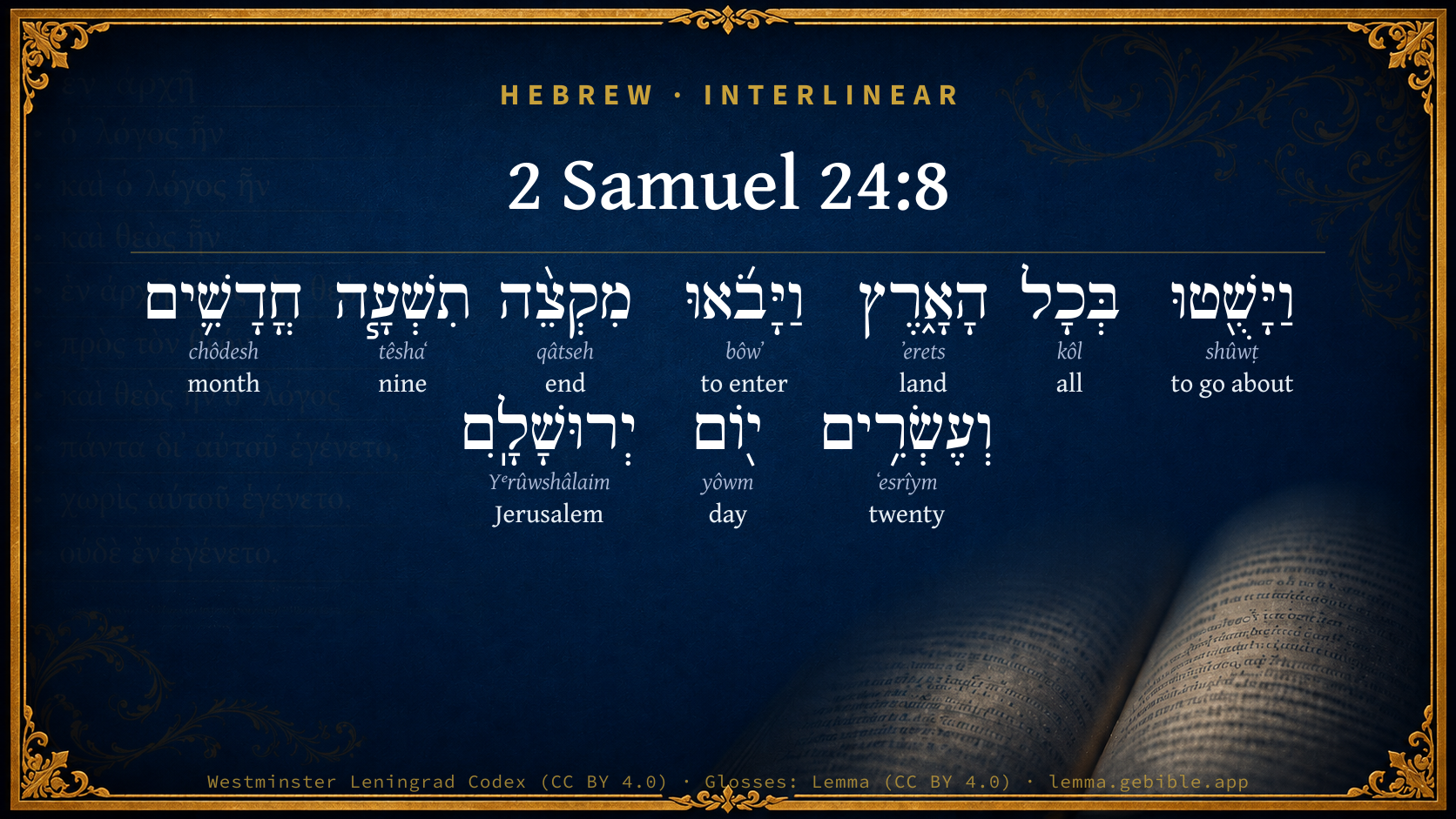
2 Samuel 24:8

Hebrew (Westminster Leningrad Codex) 2 Samuel 24:8 appears in the Hebrew Old Testament. The text above is from the Westminster Leningrad Codex. Each word links to its Strong’s number, a concise gloss, and parsing drawn from the Open Scriptures Hebrew Bible morphology. Click any word for its full Brown-Driver-Briggs (BDB) entry.
Download image
Cite this verse

2 Samuel 24:8 (World English Bible). Public Domain. Lemma interlinear Bible study tool, https://lemma.gebible.app/v/2-samuel/24/8.

Show BibTeX & RIS
BibTeX
RIS
English Translation
So when they had gone back and forth through all the land, they came to Jerusalem at the end of nine months and twenty days.
World English Bible · Public Domain
Download a study sheet

One document with this verse’s original text, its word-by-word gloss line, the meaning frame, cross-references with their text, attributed commentary, and full source and license credits — printable, and it pastes into notes with its structure intact.

This verse Autodidact and up

Study sheet (.html) Plain text (.txt)

A passage Seminary Student

Up to 50 verses in one chapter. A passage sheet keeps up to 6 commentary sources and 12 cross-references per verse, in the order this page ranks them, and says so on the sheet whenever that leaves anything out. Ask for a single verse and you get the Autodidact verse sheet above.

Everything on this page stays free to read, with no account — the sheet is a download of what is already on screen, not access to it.

Want to remove ads? Support Godless Engineer
Compare translations 3

The same verse in 3 English versions, stacked beneath the original-language interlinear above. Click any original word for its lexicon entry.

Each is an independent rendering of the whole verse — the interlinear is not word-aligned to these translations.

Highlighted words mark where these versions differ — a whole-verse word diff, not a word-by-word alignment.

  • World English Bible Public Domain
    So when they had gone back and forth through all the land, they came to Jerusalem at the end of nine months and twenty days.
  • King James Version Public Domain
    So when they had gone through all the land, they came to Jerusalem at the end of nine months and twenty days.
  • unfoldingWord Literal Text CC BY-SA 4.0
    So they went about in all of the land. And they came, at the end of nine months and twenty days, Jerusalem.

unfoldingWord Literal Text — © unfoldingWord, licensed CC BY-SA 4.0. Word-aligned USFM3 via Door43 (git.door43.org/unfoldingWord/en_ult).

Versions to compare (up to 4)

3 of 4 selected

Show all 18 translations

Every available English version of this verse, each an independent rendering of the whole verse.

  • World English Bible Public Domain
    So when they had gone back and forth through all the land, they came to Jerusalem at the end of nine months and twenty days.
  • Berean Standard Bible Public Domain
    At the end of nine months and twenty days, having gone through the whole land, they returned to Jerusalem.
  • Majority Standard Bible Public Domain
    At the end of nine months and twenty days, having gone through the whole land, they returned to Jerusalem.
  • King James Version Public Domain
    So when they had gone through all the land, they came to Jerusalem at the end of nine months and twenty days.
  • American Standard Version (1901) Public Domain
    So when they had gone to and from through all the land, they came to Jerusalem at the end of nine months and twenty days.
  • Revised Version (1885) Public Domain
    So when they had gone to and fro through all the land, they came to Jerusalem at the end of nine months and twenty days.
  • Geneva Bible (1599) Public Domain
    So when they had gone about all the lande, they returned to Ierusalem at the ende of nine moneths and twentie dayes.
  • Douay-Rheims (1899) Public Domain
    And having gone through the whole land, after nine months and twenty days, they came to Jerusalem.
  • Young's Literal Translation Public Domain
    And they go to and fro through all the land, and come in at the end of nine months and twenty days to Jerusalem,
  • Literal Standard Version CC BY-SA 4.0
    And they go to and fro through all the land, and come in to Jerusalem at the end of nine months and twenty days,
  • Unlocked Literal Bible CC BY-SA 4.0
    When they had gone throughout all the land, they came back to Jerusalem at the end of nine months and twenty days.
  • unfoldingWord Literal Text CC BY-SA 4.0
    So they went about in all of the land. And they came, at the end of nine months and twenty days, Jerusalem.
  • Darby Bible Public Domain
    And they went through all the land, and came to Jerusalem at the end of nine months and twenty days.
  • World Messianic Bible Public Domain
    So when they had gone back and forth through all the land, they came to Jerusalem at the end of nine months and twenty days.
  • Webster's Bible Public Domain
    So when they had gone through all the land, they came to Jerusalem at the end of nine months and twenty days.
  • Free Bible Version CC BY-SA 4.0
    After traveling throughout the whole country for nine months and twenty days, they returned to Jerusalem.
  • Bible in Basic English Public Domain
    So after going through all the land in every direction, they came to Jerusalem at the end of nine months and twenty days.
  • JPS Tanakh (1917) Public Domain
    So when they had gone to and fro through all the land, they came to Jerusalem at the end of nine months and twenty days.

Literal Standard Version (2020), Covenant Press — licensed CC BY-SA 4.0. Text via the HelloAO Bible API (eBible.org). Unlocked Literal Bible (unfoldingWord) — licensed CC BY-SA 4.0. Text via the HelloAO Bible API (eBible.org). unfoldingWord Literal Text — © unfoldingWord, licensed CC BY-SA 4.0. Word-aligned USFM3 via Door43 (git.door43.org/unfoldingWord/en_ult). Free Bible Version, Dr. Jonathan Gallagher — licensed CC BY-SA 4.0. Text via the HelloAO Bible API (eBible.org).

Word by word

More ways to search: Search by grammar → Find every occurrence → Compare this word →

Practice this passage: Drill this verse → Learn its vocabulary →

וַיָּשֻׁ֖טוּ
shûwṭ
H7751
“and · to go about”
Conjunction + Verb, Qal, Sequential Imperfect, 3rd Person, Masculine, Plural
Part of Speech
Conjunction + Verb
Stem
Qal
Form
Sequential Imperfect
Person
3rd Person
Gender
Masculine
Number
Plural
Full BDB Definition

Origin: a primitive root

TWOT: 2344 , 2344d

to go, go or rove about, go to and fro - (Qal) to go or rove about - (Polel) to go to and fro, go eagerly or quickly to and fro - (Hithpolel) to run to and fro - to row
  1. בְּכָל kôl H3605 “in/at · all of” Preposition + Noun, Common, Masculine, Singular, Construct
  2. הָאָ֑רֶץ ʼerets H776 “the · land” Particle, Definite Article + Noun, Common, Both, Singular, Absolute
  3. וַיָּבֹ֜אוּ bôwʼ H935 “and · to enter” Conjunction + Verb, Qal, Sequential Imperfect, 3rd Person, Masculine, Plural
  4. מִקְצֵ֨ה qâtseh H7097 “from · end of” Preposition + Noun, Common, Both, Singular, Construct
  5. תִשְׁעָ֧ה têshaʻ H8672 “nine” Adjective, Cardinal number, Masculine, Singular, Absolute
  6. חֳדָשִׁ֛ים chôdesh H2320 “months” Noun, Common, Masculine, Plural, Absolute
  7. וְעֶשְׂרִ֥ים ʻesrîym H6242 “and · twenty” Conjunction + Adjective, Cardinal number, Both, Plural, Absolute
  8. י֖וֹם yôwm H3117 “day” Noun, Common, Masculine, Singular, Absolute
  9. יְרוּשָׁלִָֽם Yᵉrûwshâlaim H3389 “Jerusalem” Noun, Proper

About this verse

These counts appear in no published source. They are computed here, from the morphology-tagged text and Lemma’s own curated glosses. What Lemma adds →

10
words
10
distinct lemmas
Historical
section

Notable vocabulary

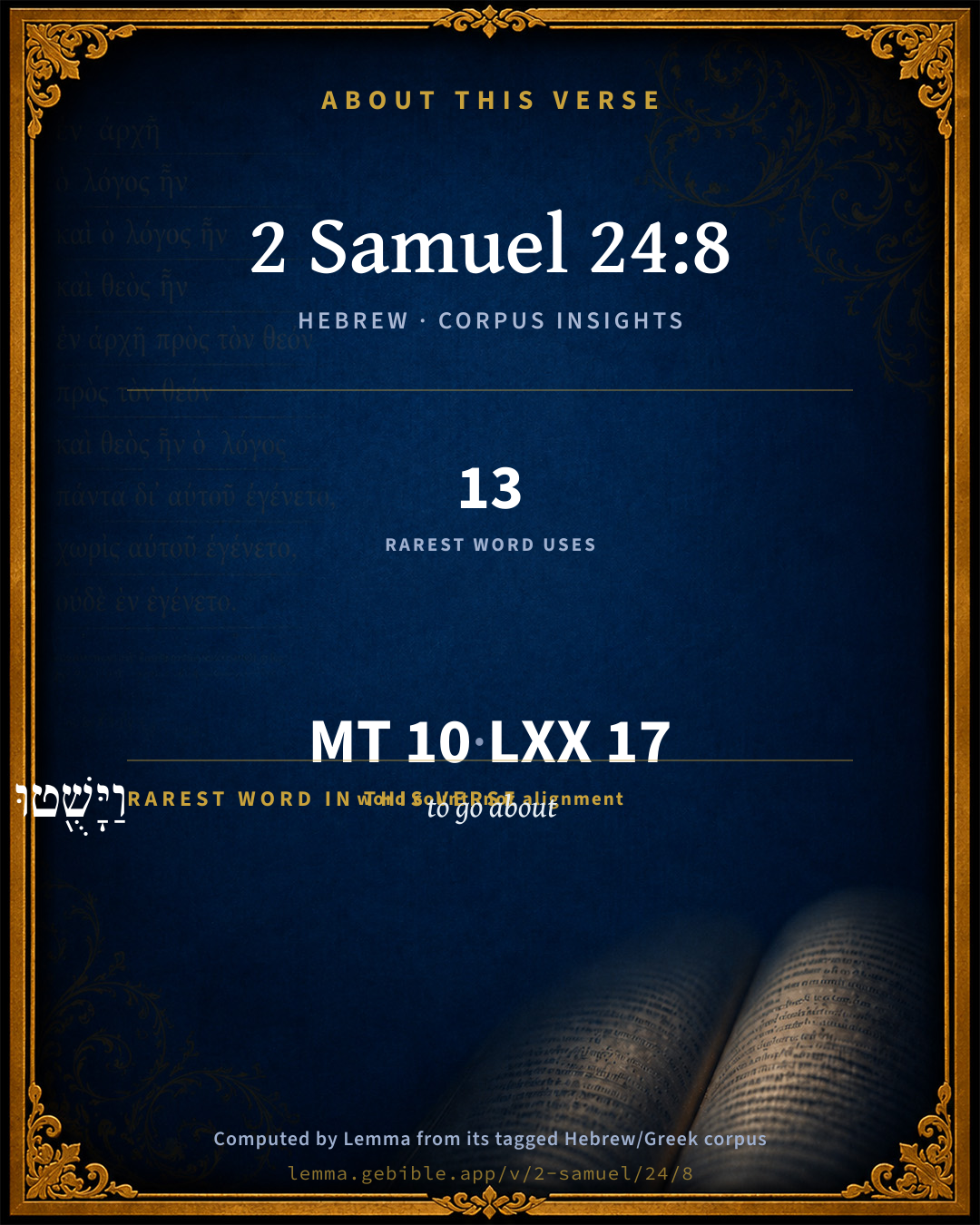
The rarest word here is וַיָּשֻׁ֖טוּ to go about H7751 — appearing just 13 times in the whole Hebrew Bible.

Shared distinctive vocabulary

וַיָּשֻׁ֖טוּ to go about H7751 occurs in 13 verses of the Hebrew Bible. Also found in:

Grammatical profile

  • 2 verbs
  • 6 nouns
  • 2 adjectives

Verb forms

  • וַיָּשֻׁ֖טוּ Qal · Sequential Imperfect
  • וַיָּבֹ֜אוּ Qal · Sequential Imperfect

Hebrew & Septuagint length

In English translation the verse runs 25 words from the Hebrew and 20 from the Septuagint (LXX English) — closely comparable.

A rough comparison of the two English renderings, which tokenize alike — not a word-level alignment.

Word counts can differ between the Hebrew and the Greek without any difference in meaning — e.g. the Hebrew direct-object marker אֵת has no separate Greek word, and Greek often adds the article ὁ.

In the original languages it is 10 Hebrew tokens and 17 Greek tokens — but the two are counted differently (Hebrew bundles its prefixes and suffixes into one token; the Greek is in lemma form), so that isn’t a like-for-like length.

Hebrew and Greek witnesses Masoretic Hebrew ↔ Greek Septuagint

The same verse in the two great witnesses to the Old Testament, shown verse-for-verse.

These are two independent witnesses, not word-aligned to each other, and the Septuagint is shown in lemma (dictionary) form.

Hebrew 2 Samuel 24:8 Masoretic · Westminster Leningrad Codex

וַיָּשֻׁ֖טוּ בְּכָל הָאָ֑רֶץ וַיָּבֹ֜אוּ מִקְצֵ֨ה תִשְׁעָ֧ה חֳדָשִׁ֛ים וְעֶשְׂרִ֥ים י֖וֹם יְרוּשָׁלִָֽם

So when they had gone back and forth through all the land, they came to Jerusalem at the end of nine months and twenty days.

World English Bible · Public Domain

Greek LXX 2 Samuel 24:8 Septuagint · lemma form

καί περιὁδεύω ἐν πᾶς ὁ γῆ καί παραγίγνομαι ἀπό τέλος ἐννέα μήν καί εἴκοσι ἡμέρα εἰς ἰερουσαλήμ

And they compassed the whole land; and they arrived at Jerusalem at the end of nine months and twenty days.

LXX2012 (modern English Septuagint) · Public Domain

Hebrew: Westminster Leningrad Codex (CC BY 4.0). Greek: Septuagint (public domain); English from LXX2012 (modern English Septuagint) (Public Domain). How the Septuagint differs from the Hebrew →

Targum (Aramaic paraphrase)

1

The Targum is the ancient Jewish Aramaic paraphrase of the Hebrew Scriptures — an interpretive translation, not the Hebrew text itself. Onkelos (literal) and Pseudo-Jonathan (expansive) render the Torah, and Jonathan the Prophets. Coverage is partial: where no permissively-licensed English translation exists for a verse, only the Aramaic is shown. This is verse-level text, not a word-by-word alignment to the Hebrew.

  1. Targum Jonathan Prophets (Joshua–Malachi)
    וְהֲלִיכוּ בְּכָל אַרְעָא וַאֲתוֹ מִסְיָפֵי תִשְׁעַת יַרְחִין וְעַסְרִין יוֹמִין לִירוּשְׁלֵם:

    (no public-domain English translation for this verse)

    Targum Jonathan — Aramaic: “Mikraot Gedolot” (public domain). English: “Sefaria Community Translation” (CC0 1.0 (public-domain dedication)); “London "Chaldee Paraphrase," 1871” (public domain). Text via Sefaria.

Commentary

Notes on 2 Samuel 24:8 from classic Christian and Jewish commentators (each source and its license shown beneath its notes). The classic Christian expositions comment on the surrounding passage and are grouped to its opening verse, so a note may address several verses; the Jewish commentaries on the Tanakh (Rashi and others) are per-verse, so they appear only where the commentator wrote on this verse.

Lemma curates 59 commentaries, every one of them public domain or Creative Commons licensed, each selected and text-cleaned for this edition rather than reprinted as found. About our sources →

Trapp's Complete Commentary

John Trapp

2Sa 24:8 So when they had gone through all the land, they came to Jerusalem at the end of nine months and twenty days.

Ver. 8. At the end of nine months and twenty days.] So long lay David in his sin unrepented of. It hath before been noted that God’s children may not only be drenched in the waves of sin, but lie in them for the time; and perhaps sink twice to the bottom, &c.

John Trapp, A Commentary or Exposition upon All the Books of the Old and New Testament (1647–1656) — public domain. Text from a community e-Sword module.

Joseph Benson's Commentary

2Sa 24:8-9. When they had gone through all the land — But not numbered all the people, for the work grew so tedious that they omitted Levi and Benjamin. Joab gave up the number of the people — There are two returns left us of this numbering, (one here and the other 1 Chronicles 21,) which differ considerably from one another; especially in relation to the men of Israel; which, in the first, are returned but eight hundred thousand, but in the last, one million one hundred thousand. “But I think,” says Delaney, “a careful attendance to both the texts, and to the nature of the thing, will easily reconcile them. The matter appears to me thus: Joab, who resolved from the beginning, not to number the whole of the people, but who, at the same time, wished to show his own tribe in the best light, and make their number as considerable as he could, numbered every man among them, from twenty years old and upward, and so returned them to be five hundred thousand: but in Israel he only made a return of such men as were exercised and approved in arms: and therefore the number of persons above twenty years old is less in his return here than in Chronicles. In a word, here the whole of Judah is returned, and only the men of approved valour in Israel. In 1Ch 21:5, the whole of Israel is expressly returned; but the particle all is not prefixed to those of Judah; and therefore possibly the men of tried valour in that tribe are only included in that return: and if so, the returns must of necessity be very different.” Perhaps, however, some mistake has been made in one of the texts by the copyists. In which case Houbigant prefers the smaller number.

Joseph Benson's Commentary on the Old and New Testaments (1811–1818) — public domain. Text from a community e-Sword module.

Adam Clarke's Commentary

Verse 8. Nine months and twenty days.] This was a considerable time; but they had much work to do, nor did they complete the work, as appears from 1Ch 21:6; 1Ch 27:24. William the Conqueror made a survey of all England, particularizing "how many hides or carucates the land is taxed at; whose it was in the time of his predecessor Edward; who the present owners and sub-tenants; what and how much arable land, meadow, pasture, and wood there is, how much in demesne, i.e., held and cultivated by the landowners; how much in tenantcy, and what number of ploughs it will keep; what mills and fisheries; how many sockmen, freemen, co-liberti, cotarii, bordarii, radmanni, radchenisters, villains, maid-servants, and bondmen, there are; how many hogs the woods would support; how many churches, priests, or parsons; what customary rents, prestations, and services, are to be paid and rendered out of the lands; what has been added to the manor; what has been withheld from it, and by whom; what land is waste, and what the whole was let for in the time of King Edward; and what the nett rent, and whether it was too dear rented, and whether it might be improved." This survey was begun in the year 1080, and was finished in the year 1086, six years having been employed in the work. This most important document is still preserved; it is in the Chapter House, Westminster, in two volumes, one in folio, on three hundred and eighty-two leaves of vellum. the other in quarto, on four hundred and fifty leaves; and is in as good preservation as it was seven hundred years ago. This work was much more difficult than that which was performed by Joab and his fellows. The work itself is known by the name Domesday Book.

Adam Clarke's Commentary on the Bible (1810–1826) — public domain. Text from a community e-Sword/MySword module.

The Cambridge Bible for Schools and Colleges

gen. ed. J. J. S. Perowne

8. through all the land] Joab however omitted the Levites, in accordance with the direction given to Moses (Num_1:47 ff.), because they were exempt from military service; and the Benjamites, possibly in order to avoid exciting disaffection in a tribe specially ready to take offence.

The Cambridge Bible for Schools and Colleges (gen. ed. J. J. S. Perowne; Cambridge University Press, 1878–1918) — public domain. Text from a community e-Sword module.

John Gill's Exposition

So when they had gone through all the land,.... Beginning at the east, and from thence to the north, and then going about to the west, came to the south, which finished their circuit:

they came to Jerusalem, at the end of nine months and twenty days: they were ten months wanting ten days in numbering the people; in which they seem to have been very expeditious.

John Gill's Exposition of the Whole Bible (1746–1763) — public domain (CC PDM 1.0). Text via the HelloAO Bible API.

Haydock's Catholic Bible Commentary

Land. Yet they did not number the Levites or Benjamin, nor even the rest exactly, as Joab acted with reluctance, 1 Paralipomenon xxi. 6., and xxvii. 24. (Menochius)

George Leo Haydock (1774–1849), Haydock's Catholic Family Bible and Commentary, 1859 edition — public domain. Excludes Psalms (Douay-Rheims chapter numbering differs from Protestant) and Deuterocanonical books (Catholic canon only).

The Pulpit Commentary

Nine months and twenty days. This long period seems excessive, if nothing more was intended than merely counting the heads of the people, especially as the census was left unfinished. But there might very probably be difficulties with the aliens dwelling in Israel; and it is still more probable that there was a complete examination of all the military resources of the land. The result showed a very different state of things from that described in 1Sa_13:19-22, and we can well understand the existence of much elation and war lust among the Israelites on the first flush of pride in their new empire.

The Pulpit Commentary (1880–1919), ed. H.D.M. Spence-Jones & Joseph S. Exell — public domain. Text from a community e-Sword module.

unfoldingWord translationNotes

Door43 World Missions Community

they had gone

"Joab and the commanders had gone"

nine months and twenty days

"9 months and 20 days" (See: Numbers)

Then Joab reported the total of the count of the fighting men to the king

"Then Joab told the king the total number of men ready for battle"

in Israel

This refers to the northern tribes of Israel.

800,000 ... 500,000

"eight hundred thousand ... five hundred thousand" (See: Numbers)

who drew the sword

This metonym refers to the men who were ready to fight in the army. (See: Metonymy)

of Judah

This refers to the southern tribe of Judah.

translationWords

Jerusalem

month

day

report

sword

unfoldingWord translationNotes — © Distant Shores Media and the Door43 World Missions Community, licensed CC BY-SA 4.0. Source: git.door43.org/Door43/en_tn.

Lesson kit

Teaching starters — assembled from the data on this page, not authored interpretation. Every prompt links to the verse data it draws on. Edit before teaching.

2 Samuel, in the Historical, opens this verse with 10 words (10 distinct Hebrew lemmas). Its most distinctive word is shûwṭ (“to go about”). A historical commentator’s framing appears above. Read the whole chapter for the surrounding context.

Discussion questions

  1. How does “to go about” (shûwṭ) shape what this verse is saying?
  2. How does Numbers 11:8, which shares the word «to go about», read alongside this verse?
  3. These translations render this verse differently. What is at stake in choosing one wording over another?
  4. «וַיָּשֻׁ֖טוּ» is a Qal Sequential Imperfect verb. How does that grammatical form shape the action described?
  5. Compare how Trapp's Complete Commentary and Joseph Benson's Commentary read this verse. Where do they agree or differ?

Things to notice

Reading settings

Reading text

Shown beneath each verse's original-language words.

Old Testament
Old Testament edition

Read the OT as the Masoretic Hebrew (MT) or the Greek Septuagint (LXX).

English shown for the Greek Septuagint (in the Hebrew ↔ Greek comparison).

Comparing translations? Open the Compare panel on any verse page to stack up to four side by side.