
2 Chronicles 31:3

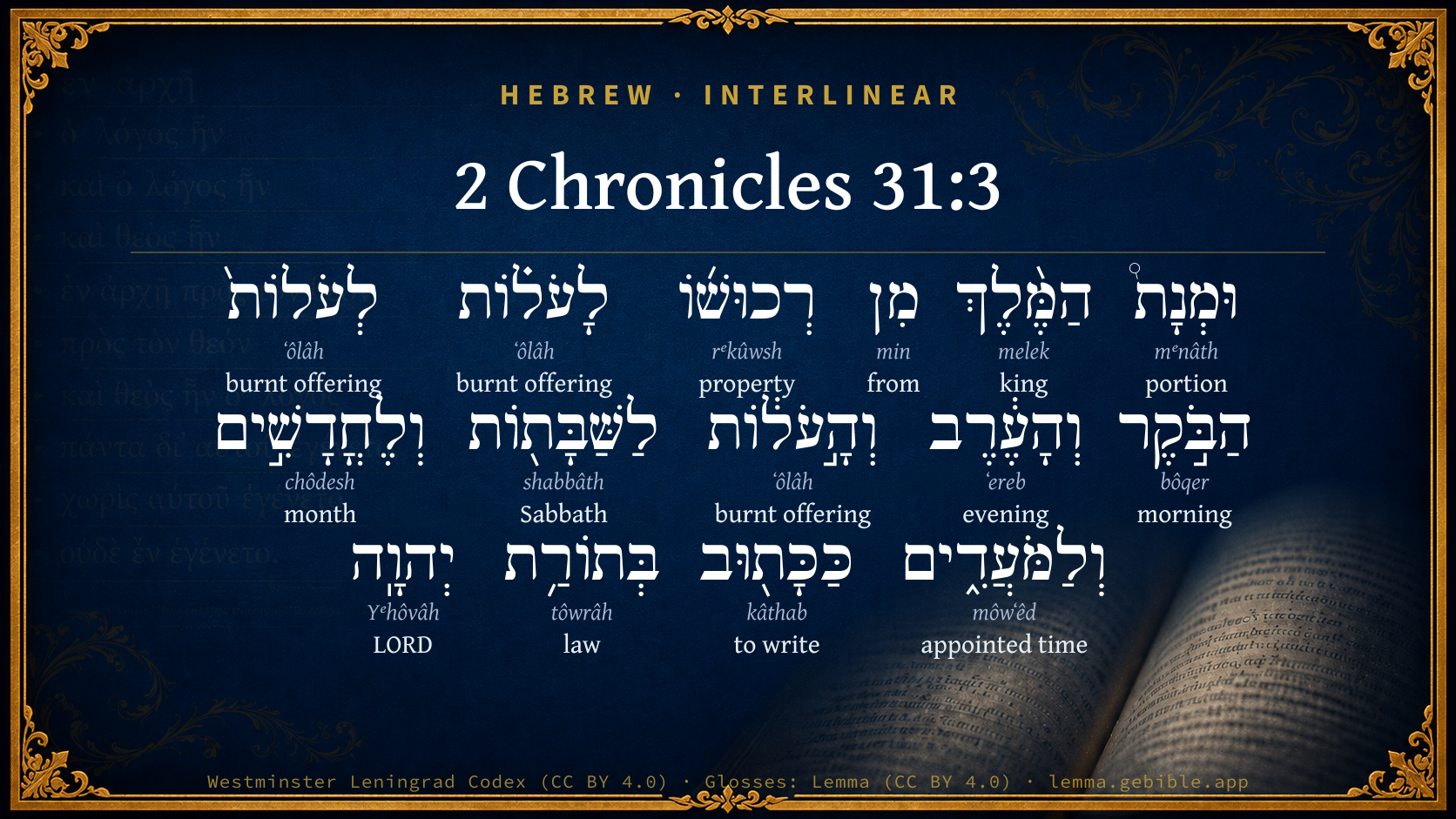
Hebrew (Westminster Leningrad Codex) 2 Chronicles 31:3 appears in the Hebrew Old Testament. The text above is from the Westminster Leningrad Codex. Each word links to its Strong’s number, a concise gloss, and parsing drawn from the Open Scriptures Hebrew Bible morphology. Click any word for its full Brown-Driver-Briggs (BDB) entry.
Download image
Cite this verse

2 Chronicles 31:3 (World English Bible). Public Domain. Lemma interlinear Bible study tool, https://lemma.gebible.app/v/2-chronicles/31/3.

Show BibTeX & RIS
BibTeX
RIS
English Translation
[He appointed] also the king's portion of his substance for the burnt-offerings, [to wit], for the morning and evening burnt offerings, and the burnt offerings for the Sabbaths, and for the new moons, and for the set feasts, as it is written in the law of Yahweh.
World English Bible · Public Domain
Highlights
  • 1 first appearance in the Hebrew Bible
Full analysis ↓
Download a study sheet

One document with this verse’s original text, its word-by-word gloss line, the meaning frame, cross-references with their text, attributed commentary, and full source and license credits — printable, and it pastes into notes with its structure intact.

This verse Autodidact and up

Study sheet (.html) Plain text (.txt)

A passage Seminary Student

Up to 50 verses in one chapter. A passage sheet keeps up to 6 commentary sources and 12 cross-references per verse, in the order this page ranks them, and says so on the sheet whenever that leaves anything out. Ask for a single verse and you get the Autodidact verse sheet above.

Everything on this page stays free to read, with no account — the sheet is a download of what is already on screen, not access to it.

Want to remove ads? Support Godless Engineer
Compare translations 3

The same verse in 3 English versions, stacked beneath the original-language interlinear above. Click any original word for its lexicon entry.

Each is an independent rendering of the whole verse — the interlinear is not word-aligned to these translations.

Highlighted words mark where these versions differ — a whole-verse word diff, not a word-by-word alignment.

  • World English Bible Public Domain
    [He appointed] also the king's portion of his substance for the burnt-offerings, [to wit], for the morning and evening burnt offerings, and the burnt offerings for the Sabbaths, and for the new moons, and for the set feasts, as it is written in the law of Yahweh.
  • King James Version Public Domain
    He appointed also the king's portion of his substance for the burnt offerings, to wit, for the morning and evening burnt offerings, and the burnt offerings for the sabbaths, and for the new moons, and for the set feasts, as it is written in the law of the LORD.
  • unfoldingWord Literal Text CC BY-SA 4.0
    And the portion of the king was from his property for burnt offerings, for the burnt offerings of the morning and the evening and the burnt offerings for the Sabbaths and for the new moons and for the appointed times, as is written in the law of Yahweh.

unfoldingWord Literal Text — © unfoldingWord, licensed CC BY-SA 4.0. Word-aligned USFM3 via Door43 (git.door43.org/unfoldingWord/en_ult).

Versions to compare (up to 4)

3 of 4 selected

Show all 18 translations

Every available English version of this verse, each an independent rendering of the whole verse.

  • World English Bible Public Domain
    [He appointed] also the king's portion of his substance for the burnt-offerings, [to wit], for the morning and evening burnt offerings, and the burnt offerings for the Sabbaths, and for the new moons, and for the set feasts, as it is written in the law of Yahweh.
  • Berean Standard Bible Public Domain
    The king contributed from his own possessions for the regular morning and evening burnt offerings and for the burnt offerings on the Sabbaths, New Moons, and appointed feasts, as written in the Law of the LORD.
  • Majority Standard Bible Public Domain
    The king contributed from his own possessions for the regular morning and evening burnt offerings and for the burnt offerings on the Sabbaths, New Moons, and appointed feasts, as written in the Law of the LORD.
  • King James Version Public Domain
    He appointed also the king's portion of his substance for the burnt offerings, to wit, for the morning and evening burnt offerings, and the burnt offerings for the sabbaths, and for the new moons, and for the set feasts, as it is written in the law of the LORD.
  • American Standard Version (1901) Public Domain
    `He appointed' also the king's portion of his substance for the burnt-offerings, `to wit', for the morning and evening burnt-offerings, and the burnt-offerings for the sabbaths, and for the new moons, and for the set feasts, as it is written in the law of Jehovah.
  • Revised Version (1885) Public Domain
    He appointed also the king’s portion of his substance for the burnt offerings, to wit, for the morning and evening burnt offerings, and the burnt offerings for the sabbaths, and for the new moons, and for the set feasts, as it is written in the law of the LORD.
  • Geneva Bible (1599) Public Domain
    (And the Kings portion was of his owne substance for the burnt offrings, euen for ye burnt offrings of the morning and of the euening, and the burnt offrings for the Sabbaths, and for the new moones, and for the solemne feastes, as it is written in the Law of the Lord)
  • Douay-Rheims (1899) Public Domain
    And the king's part was, that of his proper substance the holocaust should be offered always morning and evening, and on the sabbaths, and the new moons and the other solemnities, as it is written in the law of Moses.
  • Young's Literal Translation Public Domain
    And a portion of the king, from his substance, `is' for burnt-offerings, for burnt-offerings of the morning, and of the evening, and the burnt-offerings of sabbaths, and of new moons, and of appointed seasons, as it is written in the law of Jehovah.
  • Literal Standard Version CC BY-SA 4.0
    And a portion of the king, from his substance, [is] for burnt-offerings, for burnt-offerings of the morning and of the evening, and the burnt-offerings of Sabbaths, and of new moons, and of appointed times, as it is written in the Law of YHWH.
  • Unlocked Literal Bible CC BY-SA 4.0
    He also assigned the king's portion for the burnt offerings from his own possessions, that is, for the morning and evening burnt offerings, and the burnt offerings for the Sabbath days, the new moons, and the fixed festivals, as it was written in the law of Yahweh.
  • unfoldingWord Literal Text CC BY-SA 4.0
    And the portion of the king was from his property for burnt offerings, for the burnt offerings of the morning and the evening and the burnt offerings for the Sabbaths and for the new moons and for the appointed times, as is written in the law of Yahweh.
  • Darby Bible Public Domain
    And [he ordered] that the king's portion [should be taken] from his substance for the burnt-offerings: for the morning and evening burnt-offerings, for the burnt-offerings of the sabbaths, and of the new moons, and of the set feasts, as it is written in the law of Jehovah.
  • World Messianic Bible Public Domain
    He also appointed the king’s portion of his possessions for the burnt offerings: for the morning and evening burnt offerings, and the burnt offerings for the Sabbaths, for the new moons, and for the set feasts, as it is written in the LORD’s law.
  • Webster's Bible Public Domain
    He appointed also the king's portion of his substance for the burnt-offerings, to wit, for the morning and evening burnt-offerings, and the burnt-offerings for the sabbaths, and for the new-moons, and for the set feasts, as it is written in the law of the LORD.
  • Free Bible Version CC BY-SA 4.0
    The king contributed personally towards the morning and evening burnt offerings, and for the burnt offerings on the Sabbaths, new moons, and special feasts, as required by the Law of the Lord.
  • Bible in Basic English Public Domain
    And he gave the king's part of his private property for the burned offerings, that is, for the morning and evening offerings, and the offerings for the Sabbath and the new moons and the regular feasts, as it is recorded in the law of the Lord.
  • JPS Tanakh (1917) Public Domain
    He appointed also the king's portion of his substance for the burnt-offerings, to wit, for the morning and evening burnt-offerings, and the burnt-offerings for the sabbaths, and for the new moons, and for the appointed seasons, as it is written in the Law of the LORD.

Literal Standard Version (2020), Covenant Press — licensed CC BY-SA 4.0. Text via the HelloAO Bible API (eBible.org). Unlocked Literal Bible (unfoldingWord) — licensed CC BY-SA 4.0. Text via the HelloAO Bible API (eBible.org). unfoldingWord Literal Text — © unfoldingWord, licensed CC BY-SA 4.0. Word-aligned USFM3 via Door43 (git.door43.org/unfoldingWord/en_ult). Free Bible Version, Dr. Jonathan Gallagher — licensed CC BY-SA 4.0. Text via the HelloAO Bible API (eBible.org).

Word by word

More ways to search: Search by grammar → Find every occurrence → Compare this word →

Practice this passage: Drill this verse → Learn its vocabulary →

וּמְנָת֩
mᵉnâth
H4521
“and · portion of”
Conjunction + Noun, Common, Feminine, Singular, Construct
Part of Speech
Conjunction + Noun
Type
Common
Gender
Feminine
Number
Singular
State
Construct
Full BDB Definition

Origin: from H4487

TWOT: 1213d

portion
  1. הַמֶּ֨לֶךְ melek H4428 “the · king” Particle, Definite Article + Noun, Common, Masculine, Singular, Absolute
  2. מִן min H4480 “from” Preposition
  3. רְכוּשׁ֜וֹ rᵉkûwsh H7399 “property · his” Noun, Common, Masculine, Singular, Construct + Suffix, Personal, 3rd Person, Masculine, Singular
  4. לָעֹל֗וֹת ʻôlâh H5930 “to/for the · burnt offerings” Preposition, Determined + Noun, Common, Feminine, Plural, Absolute
  5. לְעֹלוֹת֙ ʻôlâh H5930 “to/for · burnt offerings of” Preposition + Noun, Common, Feminine, Plural, Construct
  6. הַבֹּ֣קֶר bôqer H1242 “the · morning” Particle, Definite Article + Noun, Common, Masculine, Singular, Absolute
  7. וְהָעֶ֔רֶב ʻereb H6153 “and · the · evening” Conjunction + Particle, Definite Article + Noun, Common, Masculine, Singular, Absolute
  8. וְהָ֣עֹל֔וֹת ʻôlâh H5930 “and · the · burnt offerings” Conjunction + Particle, Definite Article + Noun, Common, Feminine, Plural, Absolute
  9. לַשַּׁבָּת֖וֹת shabbâth H7676 “to/for the · Sabbaths” Preposition, Determined + Noun, Common, Both, Plural, Absolute
  10. וְלֶחֳדָשִׁ֣ים chôdesh H2320 “and · to/for the · months” Conjunction + Preposition, Determined + Noun, Common, Masculine, Plural, Absolute
  11. וְלַמֹּעֲדִ֑ים môwʻêd H4150 “and · to/for the · appointed times” Conjunction + Preposition, Determined + Noun, Common, Masculine, Plural, Absolute
  12. כַּכָּת֖וּב kâthab H3789 “like/as the · written” Preposition, Determined + Verb, Qal, Participle Passive, Masculine, Singular, Absolute
  13. בְּתוֹרַ֥ת tôwrâh H8451 “in/at · law of” Preposition + Noun, Common, Feminine, Singular, Construct
  14. יְהוָֽה Yᵉhôvâh H3068 “LORD” Noun, Proper

About this verse

These counts appear in no published source. They are computed here, from the morphology-tagged text and Lemma’s own curated glosses. What Lemma adds →

15
words
13
distinct lemmas
Historical
section

Notable vocabulary

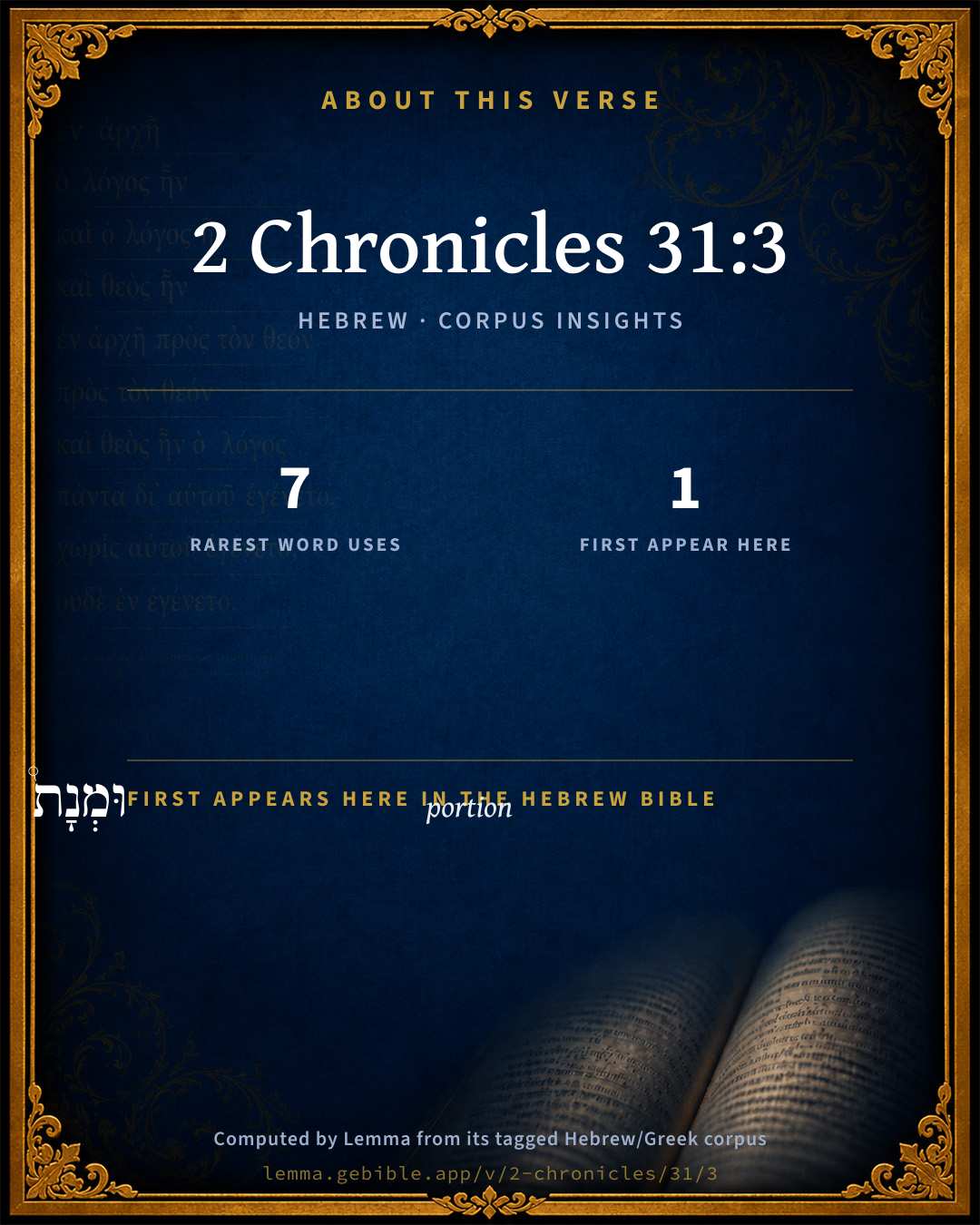
The rarest word here is וּמְנָת֩ portion H4521 — appearing just 7 times in the whole Hebrew Bible.

First appearance in Scripture

This word makes its first canonical appearance in the Hebrew Bible here:

  • וּמְנָת֩ portion H4521

Shared distinctive vocabulary

וּמְנָת֩ portion H4521 occurs in 7 verses of the Hebrew Bible. Also found in:

Grammatical profile

  • 1 verb
  • 13 nouns
  • 1 preposition

Verb forms

  • כַּכָּת֖וּב Qal · Participle Passive

Repetition

A word recurs within this verse — often emphatic in Hebrew:

  • לָעֹל֗וֹת burnt offering H5930 ×3

Hebrew & Septuagint length

In English translation the verse runs 47 words from the Hebrew and 47 from the Septuagint (LXX English) — the same length.

A rough comparison of the two English renderings, which tokenize alike — not a word-level alignment.

Word counts can differ between the Hebrew and the Greek without any difference in meaning — e.g. the Hebrew direct-object marker אֵת has no separate Greek word, and Greek often adds the article ὁ.

Cross-references

12

Topical passages linked to 2 Chronicles 31:3 in the Treasury of Scripture Knowledge — connected by theme and wording, ordered by reader-vote popularity; previews shown in the World English Bible.

  • Ezekiel 45:17 It shall be the prince's part to give the burnt offerings, and the meal-offerings, and the drink-offerings, in the feasts, and on the new moons, and on the Sabbaths, in all the appointed feasts of the house of Israel: he shall prepare the sin-offering, and the meal-offering, and the burnt offering, and the peace-offerings, to make atonement for the house of Israel.
  • 2 Chronicles 35:7 Josiah gave to the children of the people, of the flock, lambs and kids, all of them for the Passover offerings, to all who were present, to the number of thirty thousand, and three thousand bulls: these were of the king's substance.
  • Colossians 2:16–17 Let no man therefore judge you in eating, or in drinking, or with respect to a feast day or a new moon or a Sabbath day,
  • Exodus 29:38–42 "Now this is that which you shall offer on the altar: two lambs a year old day by day continually.
  • Leviticus 23:2–44 "Speak to the children of Israel, and tell them, 'The set feasts of Yahweh, which you shall proclaim to be holy convocations, even these are my set feasts.
  • Numbers 28:1–29:40 Yahweh spoke to Moses, saying,
  • Deuteronomy 16:1–17 Observe the month of Abib, and keep the Passover to Yahweh your God; for in the month of Abib Yahweh your God brought you forth out of Egypt by night.
  • 1 Chronicles 26:26 This Shelomoth and his brothers were over all the treasures of the dedicated things, which David the king, and the heads of the fathers' [houses], the captains over thousands and hundreds, and the captains of the host, had dedicated.
  • 2 Chronicles 30:24 For Hezekiah king of Judah did give to the assembly for offerings one thousand bulls and seven thousand sheep; and the princes gave to the assembly a thousand bulls and ten thousand sheep: and a great number of priests sanctified themselves.
  • Psalms 81:1–4 Sing aloud to God, our strength! Make a joyful shout to the God of Jacob!
  • Ezekiel 46:12–18 When the prince shall prepare a freewill-offering, a burnt offering or peace-offerings as a freewill-offering to Yahweh, one shall open for him the gate that looks toward the east; and he shall prepare his burnt offering and his peace-offerings, as he does on the Sabbath day: then he shall go forth; and after his going forth one shall shut the gate.
  • Ezekiel 46:4–7 The burnt offering that the prince shall offer to Yahweh shall be on the Sabbath day six lambs without blemish and a ram without blemish;

Cross-references courtesy of OpenBible.info (CC BY 4.0).

Hebrew and Greek witnesses Masoretic Hebrew ↔ Greek Septuagint

The same verse in the two great witnesses to the Old Testament, shown verse-for-verse.

These are two independent witnesses, not word-aligned to each other, and the Septuagint is shown in lemma (dictionary) form.

Hebrew 2 Chronicles 31:3 Masoretic · Westminster Leningrad Codex

וּמְנָת֩ הַמֶּ֨לֶךְ מִן רְכוּשׁ֜וֹ לָעֹל֗וֹת לְעֹלוֹת֙ הַבֹּ֣קֶר וְהָעֶ֔רֶב וְהָ֣עֹל֔וֹת לַשַּׁבָּת֖וֹת וְלֶחֳדָשִׁ֣ים וְלַמֹּעֲדִ֑ים כַּכָּת֖וּב בְּתוֹרַ֥ת יְהוָֽה

[He appointed] also the king's portion of his substance for the burnt-offerings, [to wit], for the morning and evening burnt offerings, and the burnt offerings for the Sabbaths, and for the new moons, and for the set feasts, as it is written in the law of Yahweh.

World English Bible · Public Domain

Greek LXX 2 Chronicles 31:3 Septuagint · lemma form

καί μερίς ὁ βασιλεύς ἐκ ὁ ὑποἄρχω αὐτός εἰς ὁ ὁλοκαύτωσις ὁ πρωινός καί ὁ δειλινός καί ὁλοκαύτωσις εἰς σάββατον καί εἰς ὁ νουμηνία καί εἰς ὁ ἑορτή ὁ γράφω ἐν ὁ νόμος κύριος

And the king's proportion out of his substance was appointed for the whole burnt offerings, the morning and the evening one, and the whole burnt offerings for the sabbaths, and for the new moons, and for the feasts that were ordered in the law of the Lord.

LXX2012 (modern English Septuagint) · Public Domain

Hebrew: Westminster Leningrad Codex (CC BY 4.0). Greek: Septuagint (public domain); English from LXX2012 (modern English Septuagint) (Public Domain). How the Septuagint differs from the Hebrew →

Commentary

Notes on 2 Chronicles 31:3 from classic Christian and Jewish commentators (each source and its license shown beneath its notes). The classic Christian expositions comment on the surrounding passage and are grouped to its opening verse, so a note may address several verses; the Jewish commentaries on the Tanakh (Rashi and others) are per-verse, so they appear only where the commentator wrote on this verse.

Lemma curates 59 commentaries, every one of them public domain or Creative Commons licensed, each selected and text-cleaned for this edition rather than reprinted as found. About our sources →

Trapp's Complete Commentary

John Trapp

2Ch 31:3 [He appointed] also the king’s portion of his substance for the burnt offerings, [to wit], for the morning and evening burnt offerings, and the burnt offerings for the sabbaths, and for the new moons, and for the set feasts, as [it is] written in the law of the LORD.

Ver. 3. He appointed also the king’s portion of his substance.] That is, Of his proper goods, and at his own particular cost. This he did of his princely liberality, for the ease of the people, who had been miserably peeled out and impoverished in his father’s days.

John Trapp, A Commentary or Exposition upon All the Books of the Old and New Testament (1647–1656) — public domain. Text from a community e-Sword module.

Joseph Benson's Commentary

2Ch 31:3. The king’s portion of his substance, &c. — Which had hitherto been taken out of the treasures of the temple; but that he might ease the people in their present poverty, which his predecessor had brought upon them, and engage them to a more cheerful attendance upon God’s service, he took the burden upon himself.

Joseph Benson's Commentary on the Old and New Testaments (1811–1818) — public domain. Text from a community e-Sword module.

Tyndale Open Study Notes

Tyndale Open Resources

31:3-10 Provisions for the Temple came from both the king and his subjects. Israel united in its support of the Temple, and the response was far greater than anticipated or required.

Tyndale Open Study Notes — © Tyndale Open Resources, licensed CC BY-SA 4.0. Text via the HelloAO Bible API.

Adam Clarke's Commentary

Verse 3. The king's portion of his substance for the burnt-offerings] It is conjectured that the Jewish kings, at least from the time of David, furnished the morning and evening sacrifice daily at their own expense, and several others also.

Adam Clarke's Commentary on the Bible (1810–1826) — public domain. Text from a community e-Sword/MySword module.

Ellicott's Commentary for English Readers

(3) He appointed also . . . set feasts.—Rather, And the king’s portion (i.e., the part he contributed) from his property was for the burnt offerings—viz., for the burnt offerings of the morning and the evening, and the burnt offerings on the Sabbath, and the new moons, the set feasts. The king gave the victims for the sacrifices prescribed in Numbers 28, 29, out of his own revenues. See the account of his wealth (2Ch_32:27-29). The “set feasts” were the three great festivals, &c, enumerated in Num. l.c.

A Bible Commentary for English Readers, edited by Charles John Ellicott (1878–1897) — public domain. Text from a community e-Sword module.

The Cambridge Bible for Schools and Colleges

gen. ed. J. J. S. Perowne

3. the burnt offerings] Cp. 2Ch_8:12-13.

The Cambridge Bible for Schools and Colleges (gen. ed. J. J. S. Perowne; Cambridge University Press, 1878–1918) — public domain. Text from a community e-Sword module.

John Gill's Exposition

He appointed also the king's portion of his substance,.... Out of his own treasury, of his royal bounty, over and above what was usual for kings to give for their own sacrifices, the treasury of the temple being exhausted, and the people being brought into low circumstances in the last reign:

for the burnt offerings, to wit, for the morning and evening burnt offerings; the daily sacrifice offered morning and evening, which had been neglected, but now revived:

and the burnt offerings for the sabbaths, and for the new moons, and for the set feasts; when beside the daily sacrifice there were additional ones: as it is written in the law of the Lord; in Num 28:9.

John Gill's Exposition of the Whole Bible (1746–1763) — public domain (CC PDM 1.0). Text via the HelloAO Bible API.

Albert Barnes' Notes on the Bible

The king’s portion - Amid the general neglect of the observances commanded by the Law, the tithe system had naturally fallen into disuse. Hezekiah revived it; and, to encourage the people to give what was due, cheerfully set the example of paying the full proportion from his own considerable possessions (compare 2Ch 32:28-29). His tithe was, it seems, especially devoted to the purposes mentioned in this verse (compare the marginal reference). There were needed for these purposes in the course of the year nearly 1,100 lambs, 113 bullocks, 37 rams, and 30 goats, besides vast quantities of flour, oil, and wine for the accompanying meat and drink offerings.

Albert Barnes' Notes on the Bible (1834–1885) — public domain. Text from a community e-Sword/MySword module.

Haydock's Catholic Bible Commentary

Substance. Since David had place the ark in the palace of Sion, it seems the kings had furnished the solemn victims for morning and evening, on all the festivals. Solomon also engaged to do it every day; and his magnificence herein astonished the queen of Saba, C. viii. 13., and ix. 4., and 3 K. ix. 25. Ezechiel (xlv.) assigns revenues to the prince for this purpose; but, as the people were often without any, they paid each the third part of a sicle, to furnish the victims, 2 Esdras x. 32. C. --- The king did not wish to exempt himself from contributing, while he required that the people should support the priests. The troublesome times had greatly impaired the revenues of the temple, &c. T.

George Leo Haydock (1774–1849), Haydock's Catholic Family Bible and Commentary, 1859 edition — public domain. Excludes Psalms (Douay-Rheims chapter numbering differs from Protestant) and Deuterocanonical books (Catholic canon only).

Matthew Poole's English Annotations

For the burnt-offerings; which had hitherto been, and were to be, taken out of the treasures of the temple which were collected from the people, 1Ch 26:20; Neh 10:32,33; but that he might ease them in their present poverty, which his predecessor had brought upon them, and engage them to a more cheerful attendance upon God’s service, he took the burden upon himself.

Matthew Poole's English Annotations on the Holy Bible (1683–1685) — public domain. Text from a community e-Sword/MySword module.

Whedon's Commentary on the Bible

Daniel D. Whedon

3. The king’s portion of his substance — That tithe or share of his revenue which it was deemed proper for the king to contribute for the maintenance of the regular worship. Hezekiah made himself no exception, but rather made himself an example for others by contributing his full share of lambs, bullocks, flour, oil, etc., (compare 2Ch_32:28-29,) which were required in the continual and special services according to the law.

Daniel D. Whedon (gen. ed.), Commentary on the Old and New Testaments (1874–1909) — public domain. Text from a community e-Sword module.

The Pulpit Commentary

Also the king"s portion of his substance; i.e. Hezekiah did not evade his own responsibilities in the matter of contribution. His "port, on" was the tithe, and he was evidently liable on "substance very much". (2Ch_32:29) Nu 28 Nu 29, and Le 23. give us the particulars of the offerings and set feasts, respectively here alluded to, in their original prescription.

The Pulpit Commentary (1880–1919), ed. H.D.M. Spence-Jones & Joseph S. Exell — public domain. Text from a community e-Sword module.

John Wesley's Explanatory Notes

Of his substance - Which had hitherto been taken out of the treasures of the temple, but that he might ease the people in their present poverty, which his predecessor had brought upon them, and engage them to a more chearful attendance upon God's service, he took the burden upon himself.

John Wesley, Explanatory Notes Upon the Whole Bible (1754–1765) — public domain. Text via the GEBible commentary corpus.

Rashi

Rabbi Shlomo Yitzchaki (Rashi)

And the king’s portion from his possessions for the burnt-offerings, etc. which he (willingly) gave to perform them.

Rashi on the Tanakh — English translations: “The Judaica Press complete Tanach with Rashi, translated by A. J. Rosenberg” (CC BY 4.0); “Pentateuch with Rashi's commentary by M. Rosenbaum and A.M. Silbermann, 1929-1934” (public domain); “The Metsudah Tanach series, Lakewood, N.J” (CC BY 4.0); and “The Book of Joshua, Metsudah Publications, 1997” (CC BY 4.0). Text via Sefaria.

Lesson kit

Teaching starters — assembled from the data on this page, not authored interpretation. Every prompt links to the verse data it draws on. Edit before teaching.

2 Chronicles, in the Historical, opens this verse with 15 words (13 distinct Hebrew lemmas). Its most distinctive word is mᵉnâth (“portion”). A historical commentator’s framing appears above. Read the whole chapter for the surrounding context.

Discussion questions

  1. The word mᵉnâth carries the sense “portion.” How does it shape the verse?
  2. This is the first place “portion” appears in Scripture (first appears here). What does its debut here establish?
  3. How does 2 Chronicles 31:4, which shares the word «portion», read alongside this verse?
  4. What does the repetition of “burnt offering” (3× in this one verse) do in this verse?
  5. These translations render this verse differently. What is at stake in choosing one wording over another?
  6. «כַּכָּת֖וּב» is a Qal Participle Passive verb. How does that grammatical form shape the action described?
  7. Compare how Trapp's Complete Commentary and Joseph Benson's Commentary read this verse. Where do they agree or differ?

Things to notice

  • 1 word makes its first canonical appearance in Scripture here.
  • These translations choose different wording for 12 words in this verse.
  • “burnt offering” occurs 3× in this single verse.
  • 13 distinct Hebrew lemmas span 15 words in this verse.

Reading settings

Reading text

Shown beneath each verse's original-language words.

Old Testament
Old Testament edition

Read the OT as the Masoretic Hebrew (MT) or the Greek Septuagint (LXX).

English shown for the Greek Septuagint (in the Hebrew ↔ Greek comparison).

Comparing translations? Open the Compare panel on any verse page to stack up to four side by side.