
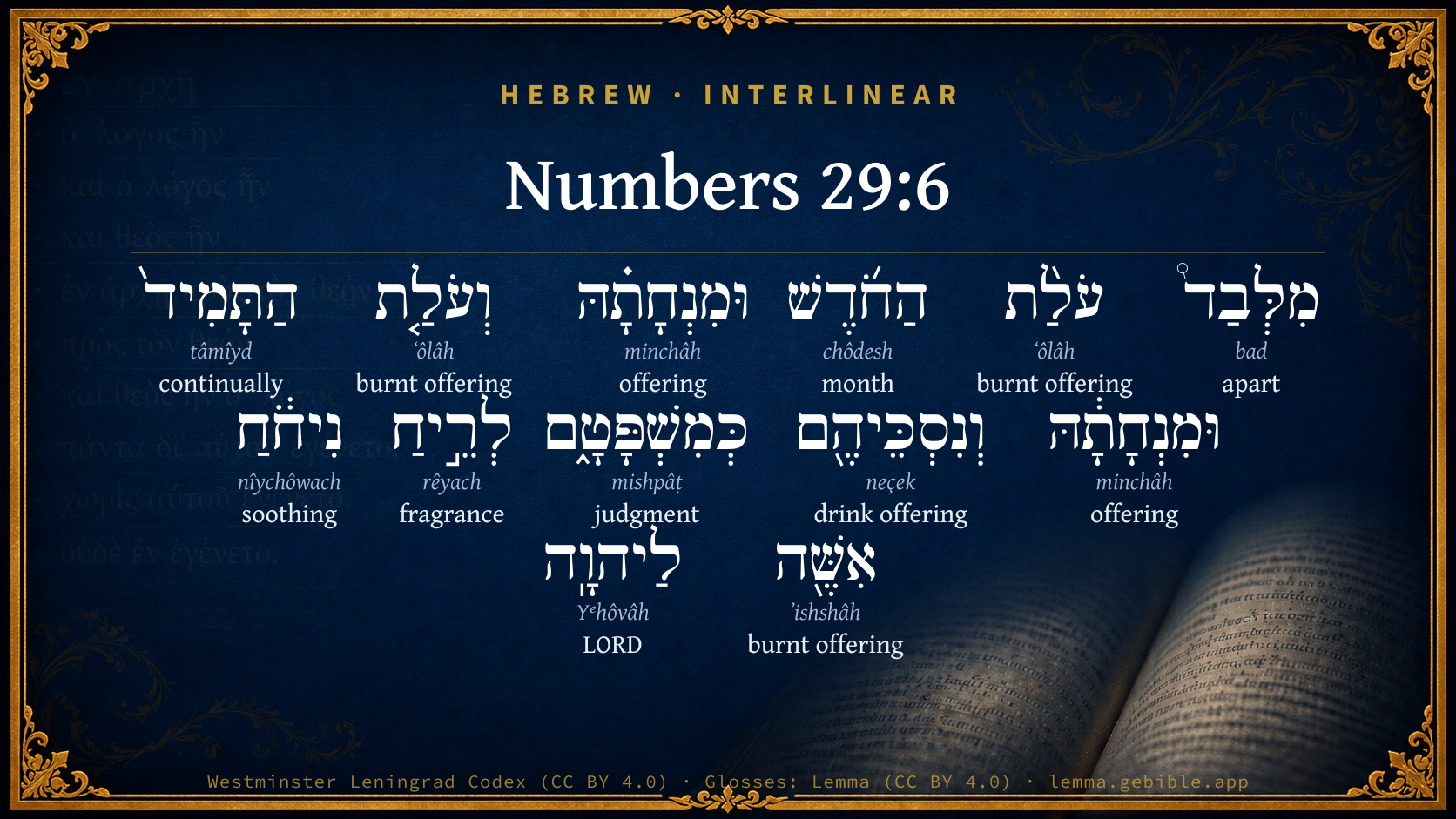
Numbers 29:6

Hebrew (Westminster Leningrad Codex) Numbers 29:6 appears in the Hebrew Old Testament. The text above is from the Westminster Leningrad Codex. Each word links to its Strong’s number, a concise gloss, and parsing drawn from the Open Scriptures Hebrew Bible morphology. Click any word for its full Brown-Driver-Briggs (BDB) entry.
Download image
Cite this verse

Numbers 29:6 (World English Bible). Public Domain. Lemma interlinear Bible study tool, https://lemma.gebible.app/v/numbers/29/6.

Show BibTeX & RIS
BibTeX
RIS
English Translation
besides the burnt offering of the new moon, and the meal-offering of it, and the continual burnt offering and the meal-offering of it, and their drink-offerings, according to their ordinance, for a sweet savor, an offering made by fire to Yahweh.
World English Bible · Public Domain
Download a study sheet

One document with this verse’s original text, its word-by-word gloss line, the meaning frame, cross-references with their text, attributed commentary, and full source and license credits — printable, and it pastes into notes with its structure intact.

This verse Autodidact and up

Study sheet (.html) Plain text (.txt)

A passage Seminary Student

Up to 50 verses in one chapter. A passage sheet keeps up to 6 commentary sources and 12 cross-references per verse, in the order this page ranks them, and says so on the sheet whenever that leaves anything out. Ask for a single verse and you get the Autodidact verse sheet above.

Everything on this page stays free to read, with no account — the sheet is a download of what is already on screen, not access to it.

Want to remove ads? Support Godless Engineer
Compare translations 3

The same verse in 3 English versions, stacked beneath the original-language interlinear above. Click any original word for its lexicon entry.

Each is an independent rendering of the whole verse — the interlinear is not word-aligned to these translations.

Highlighted words mark where these versions differ — a whole-verse word diff, not a word-by-word alignment.

  • World English Bible Public Domain
    besides the burnt offering of the new moon, and the meal-offering of it, and the continual burnt offering and the meal-offering of it, and their drink-offerings, according to their ordinance, for a sweet savor, an offering made by fire to Yahweh.
  • King James Version Public Domain
    Beside the burnt offering of the month, and his meat offering, and the daily burnt offering, and his meat offering, and their drink offerings, according unto their manner, for a sweet savor, a sacrifice made by fire unto the LORD.
  • unfoldingWord Literal Text CC BY-SA 4.0
    It is apart from the burnt offering of the month and its grain offering, and the burnt offering of the continuity and its grain offering, and their drink offerings according to their ordinance, for an aroma of soothing, an offering made by fire to Yahweh.

unfoldingWord Literal Text — © unfoldingWord, licensed CC BY-SA 4.0. Word-aligned USFM3 via Door43 (git.door43.org/unfoldingWord/en_ult).

Versions to compare (up to 4)

3 of 4 selected

Show all 18 translations

Every available English version of this verse, each an independent rendering of the whole verse.

  • World English Bible Public Domain
    besides the burnt offering of the new moon, and the meal-offering of it, and the continual burnt offering and the meal-offering of it, and their drink-offerings, according to their ordinance, for a sweet savor, an offering made by fire to Yahweh.
  • Berean Standard Bible Public Domain
    These are in addition to the monthly and daily burnt offerings with their prescribed grain offerings and drink offerings. They are a pleasing aroma, an offering made by fire to the LORD.
  • Majority Standard Bible Public Domain
    These are in addition to the monthly and daily burnt offerings with their prescribed grain offerings and drink offerings. They are a pleasing aroma, a food offering to the LORD.
  • King James Version Public Domain
    Beside the burnt offering of the month, and his meat offering, and the daily burnt offering, and his meat offering, and their drink offerings, according unto their manner, for a sweet savor, a sacrifice made by fire unto the LORD.
  • American Standard Version (1901) Public Domain
    besides the burnt-offering of the new moon, and the meal-offering thereof, and the continual burnt-offering and the meal-offering thereof, and their drink-offerings, according unto their ordinance, for a sweet savor, an offering made by fire unto Jehovah.
  • Revised Version (1885) Public Domain
    beside the burnt offering of the new moon, and the meal offering thereof, and the continual burnt offering and the meal offering thereof, and their drink offerings, according unto their ordinance, for a sweet savour, an offering made by fire unto the LORD.
  • Geneva Bible (1599) Public Domain
    Beside the burnt offring of the moneth, and his meat offring, and the continual burnt offring, and his meate offring and the drinke offrings of the same, according to their maner, for a sweete sauour: it is a sacrifice made by fire vnto ye Lord.
  • Douay-Rheims (1899) Public Domain
    Besides the holocaust of the first day of the month with the sacrifices thereof, and the perpetual holocaust with the accustomed libations. With the same ceremonies you shall offer a burnt sacrifice for a most sweet odour to the Lord.
  • Young's Literal Translation Public Domain
    apart from the burnt-offering of the month, and its present, and the continual burnt-offering, and its present, and their libations, according to their ordinance, for sweet fragrance, a fire-offering to Jehovah.
  • Literal Standard Version CC BY-SA 4.0
    apart from the burnt-offering of the month and its present, and the continual burnt-offering and its present, and their drink-offerings, according to their ordinance, for refreshing fragrance, a fire-offering to YHWH.
  • Unlocked Literal Bible CC BY-SA 4.0
    Make these offerings in the seventh month in addition to all of the offerings you will make on the first of each month: the special burnt offering and the grain offering to go with it. These must be in addition to the regular burnt offering, its grain offering, and its drink offerings. As you make these offerings, you will obey what has been decreed to produce a sweet aroma, an offering made by fire to Yahweh.
  • unfoldingWord Literal Text CC BY-SA 4.0
    It is apart from the burnt offering of the month and its grain offering, and the burnt offering of the continuity and its grain offering, and their drink offerings according to their ordinance, for an aroma of soothing, an offering made by fire to Yahweh.
  • Darby Bible Public Domain
    -- besides the monthly burnt-offering and its oblation, and the continual burnt-offering and its oblation, and their drink-offerings, according to their ordinance, for a sweet odour, an offering by fire to Jehovah.
  • World Messianic Bible Public Domain
    in addition to the burnt offering of the new moon with its meal offering, and the continual burnt offering with its meal offering, and their drink offerings, according to their ordinance, for a pleasant aroma, an offering made by fire to the LORD.
  • Webster's Bible Public Domain
    Besides the burnt-offering of the month, and his meat-offering, and the daily burnt-offering, and his meat-offering, and their drink-offerings, according to their manner, for a sweet savor, a sacrifice made by fire to the LORD.
  • Free Bible Version CC BY-SA 4.0
    These offerings are in addition to the monthly and daily burnt offerings along with their required grain offerings and drink offerings. They are burnt offerings acceptable to the Lord.
  • Bible in Basic English Public Domain
    In addition to the burned offering of the new moon, and its meal offering, and the regular burned offering and its meal offering, and their drink offerings, as they are ordered, for a sweet smell, an offering made by fire to the Lord.
  • JPS Tanakh (1917) Public Domain
    beside the burnt-offering of the new moon, and the meal-offering thereof, and the continual burnt-offering and the meal-offering thereof, and their drink-offerings, according unto their ordinance, for a sweet savour, an offering made by fire unto the LORD.

Literal Standard Version (2020), Covenant Press — licensed CC BY-SA 4.0. Text via the HelloAO Bible API (eBible.org). Unlocked Literal Bible (unfoldingWord) — licensed CC BY-SA 4.0. Text via the HelloAO Bible API (eBible.org). unfoldingWord Literal Text — © unfoldingWord, licensed CC BY-SA 4.0. Word-aligned USFM3 via Door43 (git.door43.org/unfoldingWord/en_ult). Free Bible Version, Dr. Jonathan Gallagher — licensed CC BY-SA 4.0. Text via the HelloAO Bible API (eBible.org).

Word by word

More ways to search: Search by grammar → Find every occurrence → Compare this word →

Practice this passage: Drill this verse → Learn its vocabulary →

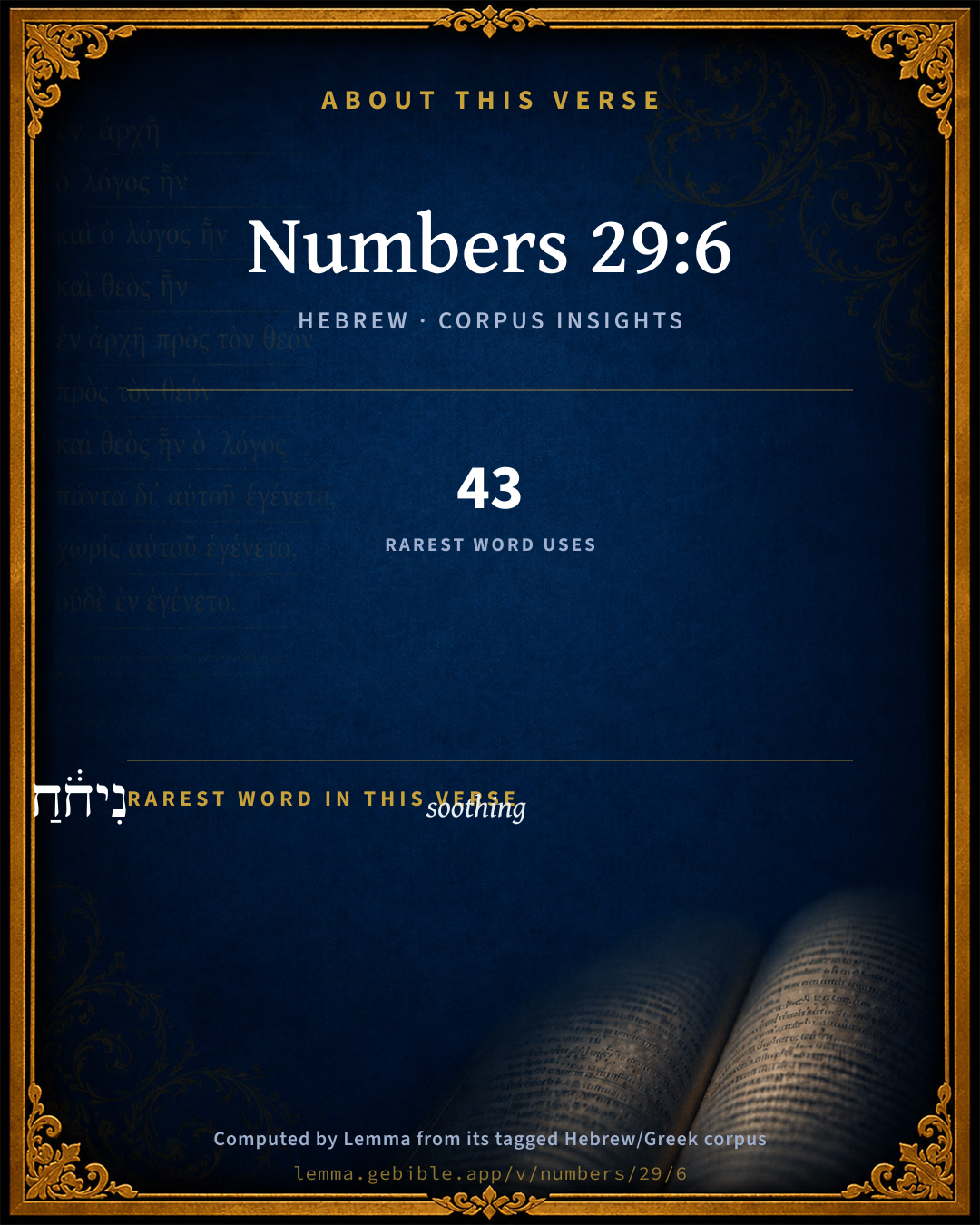
נִיחֹ֔חַ
nîychôwach
H5207
“soothing”
Noun, Common, Masculine, Singular, Absolute
Part of Speech
Noun
Type
Common
Gender
Masculine
Number
Singular
State
Absolute
Full BDB Definition

Origin: from H5117

TWOT: 1323c

soothing, quieting, tranquillising
  1. מִלְּבַד֩ bad H905 “from · to/for · apart of” Preposition + Preposition + Noun, Common, Masculine, Singular, Construct
  2. עֹלַ֨ת ʻôlâh H5930 “burnt offering of” Noun, Common, Feminine, Singular, Construct
  3. הַחֹ֜דֶשׁ chôdesh H2320 “the · month” Particle, Definite Article + Noun, Common, Masculine, Singular, Absolute
  4. וּמִנְחָתָ֗הּ minchâh H4503 “and · offering · her” Conjunction + Noun, Common, Feminine, Singular, Construct + Suffix, Personal, 3rd Person, Feminine, Singular
  5. וְעֹלַ֤ת ʻôlâh H5930 “and · burnt offering of” Conjunction + Noun, Common, Feminine, Singular, Construct
  6. הַתָּמִיד֙ tâmîyd H8548 “the · continually” Particle, Definite Article + Noun, Common, Masculine, Singular, Absolute
  7. וּמִנְחָתָ֔הּ minchâh H4503 “and · offering · her” Conjunction + Noun, Common, Feminine, Singular, Construct + Suffix, Personal, 3rd Person, Feminine, Singular
  8. וְנִסְכֵּיהֶ֖ם neçek H5262 “and · drink offerings · their” Conjunction + Noun, Common, Masculine, Plural, Construct + Suffix, Personal, 3rd Person, Masculine, Plural
  9. כְּמִשְׁפָּטָ֑ם mishpâṭ H4941 “like/as · judgment · their” Preposition + Noun, Common, Masculine, Singular, Construct + Suffix, Personal, 3rd Person, Masculine, Plural
  10. לְרֵ֣יחַ rêyach H7381 “to/for · fragrance of” Preposition + Noun, Common, Masculine, Singular, Construct
  11. אִשֶּׁ֖ה ʼishshâh H801 “burnt offering” Noun, Common, Masculine, Singular, Absolute
  12. לַיהוָֽה Yᵉhôvâh H3068 “to/for · LORD” Preposition + Noun, Proper

About this verse

These counts appear in no published source. They are computed here, from the morphology-tagged text and Lemma’s own curated glosses. What Lemma adds →

13
words
11
distinct lemmas
Pentateuch
section

Shared distinctive vocabulary

נִיחֹ֔חַ soothing H5207 occurs in 43 verses of the Hebrew Bible. Also found in:

Grammatical profile

  • 13 nouns

Repetition

Words recur within this verse — often emphatic in Hebrew:

  • עֹלַ֨ת burnt offering H5930 ×2
  • וּמִנְחָתָ֗הּ offering H4503 ×2

Hebrew & Septuagint length

In English translation the verse runs 41 words from the Hebrew and 39 from the Septuagint (LXX English) — closely comparable.

A rough comparison of the two English renderings, which tokenize alike — not a word-level alignment.

Word counts can differ between the Hebrew and the Greek without any difference in meaning — e.g. the Hebrew direct-object marker אֵת has no separate Greek word, and Greek often adds the article ὁ.

Cross-references

10

Topical passages linked to Numbers 29:6 in the Treasury of Scripture Knowledge — connected by theme and wording, ordered by reader-vote popularity; previews shown in the World English Bible.

  • Numbers 28:3–8 You shall tell them, This is the offering made by fire which you shall offer to Yahweh: he-lambs a year old without blemish, two day by day, for a continual burnt offering.
  • Numbers 28:11–15 In the beginnings of your months you shall offer a burnt offering to Yahweh: two young bulls, and one ram, seven he-lambs a year old without blemish;
  • Exodus 29:38–42 "Now this is that which you shall offer on the altar: two lambs a year old day by day continually.
  • Leviticus 6:9 "Command Aaron and his sons, saying, 'This is the law of the burnt offering: the burnt offering shall be on the hearth on the altar all night until the morning; and the fire of the altar shall be kept burning on it.
  • Numbers 9:14 If a foreigner lives among you, and desires to keep the Passover to Yahweh; according to the statute of the Passover, and according to its ordinance, so shall he do. You shall have one statute, both for the foreigner, and for him who is born in the land.'"
  • Numbers 15:11–12 Thus shall it be done for each bull, or for each ram, or for each of the he-lambs, or of the kids.
  • Numbers 15:24 then it shall be, if it be done unwittingly, without the knowledge of the congregation, that all the congregation shall offer one young bull for a burnt offering, for a sweet savor to Yahweh, with the meal-offering of it, and the drink-offering of it, according to the ordinance, and one male goat for a sin-offering.
  • Numbers 29:18 and their meal-offering and their drink-offerings for the bulls, for the rams, and for the lambs, according to their number, after the ordinance;
  • Numbers 29:21 and their meal-offering and their drink-offerings for the bulls, for the rams, and for the lambs, according to their number, after the ordinance;
  • Ezra 3:4 They kept the feast of tents, as it is written, and [offered] the daily burnt offerings by number, according to the ordinance, as the duty of every day required;

Cross-references courtesy of OpenBible.info (CC BY 4.0).

Hebrew and Greek witnesses Masoretic Hebrew ↔ Greek Septuagint

The same verse in the two great witnesses to the Old Testament, shown verse-for-verse.

These are two independent witnesses, not word-aligned to each other, and the Septuagint is shown in lemma (dictionary) form.

Hebrew Numbers 29:6 Masoretic · Westminster Leningrad Codex

מִלְּבַד֩ עֹלַ֨ת הַחֹ֜דֶשׁ וּמִנְחָתָ֗הּ וְעֹלַ֤ת הַתָּמִיד֙ וּמִנְחָתָ֔הּ וְנִסְכֵּיהֶ֖ם כְּמִשְׁפָּטָ֑ם לְרֵ֣יחַ נִיחֹ֔חַ אִשֶּׁ֖ה לַיהוָֽה

besides the burnt offering of the new moon, and the meal-offering of it, and the continual burnt offering and the meal-offering of it, and their drink-offerings, according to their ordinance, for a sweet savor, an offering made by fire to Yahweh.

World English Bible · Public Domain

Greek LXX Numbers 29:6 Septuagint · lemma form

πλήν ὁ ὁλοκαύτωμα ὁ νουμηνία καί ὁ θυσία αὐτός καί ὁ σπονδή αὐτός καί ὁ ὁλοκαύτωμα ὁ διά πᾶς καί ὁ θυσία αὐτός καί ὁ σπονδή αὐτός κατά ὁ σύγκρισις αὐτός εἰς ὀσμή εὐωδία κύριος

Beside the whole burnt offerings for the new moon, and their meat-offerings, and their drink-offerings, and their perpetual whole burnt offering; and their meat-offerings and their drink-offerings according to their ordinance for a sweet smelling savor to the Lord.

LXX2012 (modern English Septuagint) · Public Domain

Hebrew: Westminster Leningrad Codex (CC BY 4.0). Greek: Septuagint (public domain); English from LXX2012 (modern English Septuagint) (Public Domain). How the Septuagint differs from the Hebrew →

Targum (Aramaic paraphrase)

2

The Targum is the ancient Jewish Aramaic paraphrase of the Hebrew Scriptures — an interpretive translation, not the Hebrew text itself. Onkelos (literal) and Pseudo-Jonathan (expansive) render the Torah, and Jonathan the Prophets. Coverage is partial: where no permissively-licensed English translation exists for a verse, only the Aramaic is shown. This is verse-level text, not a word-by-word alignment to the Hebrew.

  1. Targum Onkelos Torah (Genesis–Deuteronomy)
    בַּר מֵעֲלַת יַרְחָא וּמִנְחָתַהּ וַעֲלַת תְּדִירָא וּמִנְחָתַהּ וְנִסְכֵּיהוֹן כִּדְחָזֵי לְהוֹן לְאִתְקַבָּלָא בְרַעֲוָא קוּרְבָּנָא קֳדָם יְיָ

    (no public-domain English translation for this verse)

    Targum Onkelos — Aramaic: “Onkelos Genesis” (public domain); “Onkelos Exodus” (public domain); “Onkelos Leviticus” (public domain); “Onkelos Numbers” (public domain); “Onkelos Deuteronomy” (public domain). English: “Sefaria Community Translation” (CC0 1.0 (public-domain dedication)); “J.W. Etheridge. The Targums of Onkelos and Jonathan Ben Uzziel on the Pentateuch. London: Longmans, Green, 1862” (public domain). Text via Sefaria.

  2. Targum Pseudo-Jonathan Torah (Genesis–Deuteronomy)
    בַּר מִן עָלַת רֵישׁ יַרְחָא וּמִנְחָתָהּ וְעוֹלַת תְּדִירָא וּמִנְחָתָהּ וְנִיסוּכֵיהוֹן כְּסֵדֶר דִינְהוֹן לְאִתְקַבָּלָא בְּרַעֲוָא קוּרְבָּנָא קֳדָם יְיָ

    besides the sacrifice for the beginning of the month and its mincha, and the perpetual sacrifice and its mincha; and their libations according to the order of their appointments, an oblation to be received with favour before the Lord.

    Targum Pseudo-Jonathan — Aramaic: “Targum Jonathan on Genesis” (public domain); “Targum Jonathan on Exodus” (public domain); “Targum Jonathan on Leviticus” (public domain); “Targum Jonathan on Numbers” (public domain); “Targum Jonathan on Deuteronomy” (public domain). English: “The Targum of Jonathan ben Uzziel, trans. J. W. Etheridge, London, 1862” (public domain). Text via Sefaria.

Commentary

Notes on Numbers 29:6 from classic Christian and Jewish commentators (each source and its license shown beneath its notes). The classic Christian expositions comment on the surrounding passage and are grouped to its opening verse, so a note may address several verses; the Jewish commentaries on the Tanakh (Rashi and others) are per-verse, so they appear only where the commentator wrote on this verse.

Lemma curates 59 commentaries, every one of them public domain or Creative Commons licensed, each selected and text-cleaned for this edition rather than reprinted as found. About our sources →

Joseph Benson's Commentary

Num 29:6. According unto their manner — Or the order which God appointed: first, the daily morning sacrifice was offered; then the sacrifices for the first day of every month; then those additional sacrifices for the first day of the seventh month.

Joseph Benson's Commentary on the Old and New Testaments (1811–1818) — public domain. Text from a community e-Sword module.

Geneva Bible (1599)

Geneva Bible translators

Which must be offered in the beginning of every month.

Which is for morning and evening.

Geneva Bible (1599) marginal notes — public domain. Text via Bolls.life.

Ellicott's Commentary for English Readers

(6) Beside the burnt offering of the month.—Better, of the new moon. (See Num_28:11, where the burnt offering of the beginning of the month is described.)

A Bible Commentary for English Readers, edited by Charles John Ellicott (1878–1897) — public domain. Text from a community e-Sword module.

The Cambridge Bible for Schools and Colleges

gen. ed. J. J. S. Perowne

6. which was ordained] in Exo_29:38-42.

The Cambridge Bible for Schools and Colleges (gen. ed. J. J. S. Perowne; Cambridge University Press, 1878–1918) — public domain. Text from a community e-Sword module.

John Gill's Exposition

And ye shall have on the tenth day of the seventh month an holy convocation,.... The month Tisri, as before; so the Targum of Jonathan:

and ye shall afflict your souls; or persons; their bodies by fasting, and their souls by repentance and humiliation; for this was a grand fast, as it is called Act 27:9,

ye shall not do any work therein; see Lev 23:28.

John Gill's Exposition of the Whole Bible (1746–1763) — public domain (CC PDM 1.0). Text via the HelloAO Bible API.

Matthew Poole's English Annotations

Of the month; belonging to every new moon, of which see Num 28:11,12; 2Ch 2:4.

According to their manner; according to the order, rites, and ceremonies appointed by God.

Matthew Poole's English Annotations on the Holy Bible (1683–1685) — public domain. Text from a community e-Sword/MySword module.

John Wesley's Explanatory Notes

Of the month - Belonging to every new moon.

John Wesley, Explanatory Notes Upon the Whole Bible (1754–1765) — public domain. Text via the GEBible commentary corpus.

unfoldingWord translationNotes

Door43 World Missions Community

in the seventh month ... the first of each month

"in month 7 ... day 1 of each month." The word "month" refers to a month of the Hebrew calendar. (See: Hebrew Months and Ordinal Numbers)

of each month: the special burnt offering ... with it

"of each month--the special burnt offering ... with it." This is the offering that is made on the first day of each month.

the regular burnt offering, its grain offering, and its drink offerings

This refers to the offerings the priests were to give every day. The grain offering and drink offering were to be offered with the regular burnt offering. AT: "the regular burnt offering, with the grain offering and drink offerings that accompany it" (See: Possession)

you will obey what has been decreed

This can be stated in active form. AT: "you will obey Yahweh's decree" or "you will obey what Yahweh had decreed" (See: Active or Passive)

an offering made by fire to Yahweh

This can be stated in active form. AT: "an offering you burnt on the altar to Yahweh" (See: Active or Passive)

translationWords

burnt offering

grain offering

drink offering

obey

decree

Yahweh

unfoldingWord translationNotes — © Distant Shores Media and the Door43 World Missions Community, licensed CC BY-SA 4.0. Source: git.door43.org/Door43/en_tn.

Rashi

Rabbi Shlomo Yitzchaki (Rashi)

מלבד עלת החדש BESIDES THE BURNT OFFERING OF THE NEW MOON — besides the additional offerings of the New Moon which is on the New Year Festival (the New Moon of the seventh month).

Rashi on the Tanakh — English translations: “The Judaica Press complete Tanach with Rashi, translated by A. J. Rosenberg” (CC BY 4.0); “Pentateuch with Rashi's commentary by M. Rosenbaum and A.M. Silbermann, 1929-1934” (public domain); “The Metsudah Tanach series, Lakewood, N.J” (CC BY 4.0); and “The Book of Joshua, Metsudah Publications, 1997” (CC BY 4.0). Text via Sefaria.

Ramban (Nachmanides)

Rabbi Moshe ben Nachman (Ramban / Nachmanides)

He mentioned [with reference to the Additional Offerings of] the first day of the seventh month [i.e., the New Year], beside the burnt-offering of the New Moon and the meal-offering thereof, but He did not mention the sin-offering of the New Moon, while [with reference to] the Day of Atonement He did mention beside the sin-offering of atonement, but did not mention the burnt-offering of atonement. The reason for this is that concerning the Day of Atonement, it is obvious that the burnt-offering which He commanded here to be brought on that day] is beside the burnt-offering which He commanded there, for both of them are commanded with reference to the same day, and they are not equal; for there [in the Book of Leviticus] the Israelites were only commanded [to bring on the Day of Atonement] one ram for a burnt-offering, and here He commanded as a burnt-offering [that they bring] a bullock, a ram, and seven he-lambs. If so, it is quite clear that these [offerings mentioned here] are in addition to those mentioned there. But [in the case of] the sin-offering, which is the same [both] here and there, one might possibly have made a mistake in connection with it, and think that [the one commanded here] is the same sin-offering which is mentioned there, since [we do not find] two sin-offerings [brought] on one day. Therefore when mentioning it [here] He expressly stated: [one he-goat for a sin-offering] ‘beside the sin-offering of atonement,’ for that sin-offering [mentioned in the Book of Leviticus] is the sin-offering of atonement, that is to say, it is the inner sin-offering that is burnt [outside the camp, or outside the city of Jerusalem], and atones for the holy place, because of the uncleanness of the children of Israel, and because of their transgressions, even all their sins; whereas this outer sin-offering is like other sin-offerings, which come together with the Additional Offerings. Similarly [when speaking about] the day of the first-fruits [the Festival of Weeks], it was not necessary to say that what is commanded here is “beside what has been said about it in the section of the festivals,” since the two sections are said about the same day, and the offerings are not the same [and therefore it is self-understood that the offerings mentioned here are in addition to those mentioned there]. Nor was it necessary to state [here when speaking about the offerings of the Festival of Weeks, i.e., Shavuoth, that they are beside] the sin-offering [mentioned in the section of the festivals], Verse 19. because Scripture said there explicitly, And ye shall present with the bread [seven lambs etc. And ye shall offer one he-goat for a sin-offering etc.], Verses 18-19. and it is quite clear [therefore] that all [the offerings] mentioned there come because of the [two] loaves and must he brought with them, and that these mentioned here are in addition to them. But in the case of the New Moon of this seventh month, one might have thought that when Scripture says, And in your New Moons ye shall present etc. it applies to all the other months [of the year], but that [on the New Moon of] the seventh month the total offering is to be only this [group of] offerings which He especially commanded for it; therefore it was necessary to say, beside the burnt-offering of the New Moon, and the meal-offering thereof. And having mentioned this, we can already deduce that everything that is mentioned in the section of And in your New Moons is an obligation for all months, including the sin-offering [of the New Moon], and therefore it was not necessary to say [here in the case of the New Year]: “beside the burnt-offering of the New Moon, and the meal-offering thereof ‘and the sin-offering thereof.’”

Ramban (Nachmanides) on the Tanakh — English translation: “Commentary on the Torah by Ramban (Nachmanides). Translated and annotated by Charles B. Chavel. New York, Shilo Pub. House, 1971-1976” (CC BY 4.0). Text via Sefaria.

Lesson kit

Teaching starters — assembled from the data on this page, not authored interpretation. Every prompt links to the verse data it draws on. Edit before teaching.

Numbers, in the Pentateuch, opens this verse with 13 words (11 distinct Hebrew lemmas). Its most distinctive word is nîychôwach (“soothing”). A historical commentator’s framing appears above. Read the whole chapter for the surrounding context.

Discussion questions

  1. The word nîychôwach carries the sense “soothing.” How does it shape the verse?
  2. How does Genesis 8:21, which shares the word «soothing», read alongside this verse?
  3. What does the repetition of “burnt offering” (2× in this one verse) do in this verse?
  4. These translations render this verse differently; the difference is in the English rendering, not the original. What questions does that raise?
  5. Compare how Joseph Benson's Commentary and Geneva Bible (1599) read this verse. Where do they agree or differ?

Things to notice

  • These translations choose different wording for 24 words in this verse.
  • “burnt offering” occurs 2× in this single verse.
  • 11 distinct Hebrew lemmas span 13 words in this verse.

Reading settings

Reading text

Shown beneath each verse's original-language words.

Old Testament
Old Testament edition

Read the OT as the Masoretic Hebrew (MT) or the Greek Septuagint (LXX).

English shown for the Greek Septuagint (in the Hebrew ↔ Greek comparison).

Comparing translations? Open the Compare panel on any verse page to stack up to four side by side.