
Zechariah 7:3

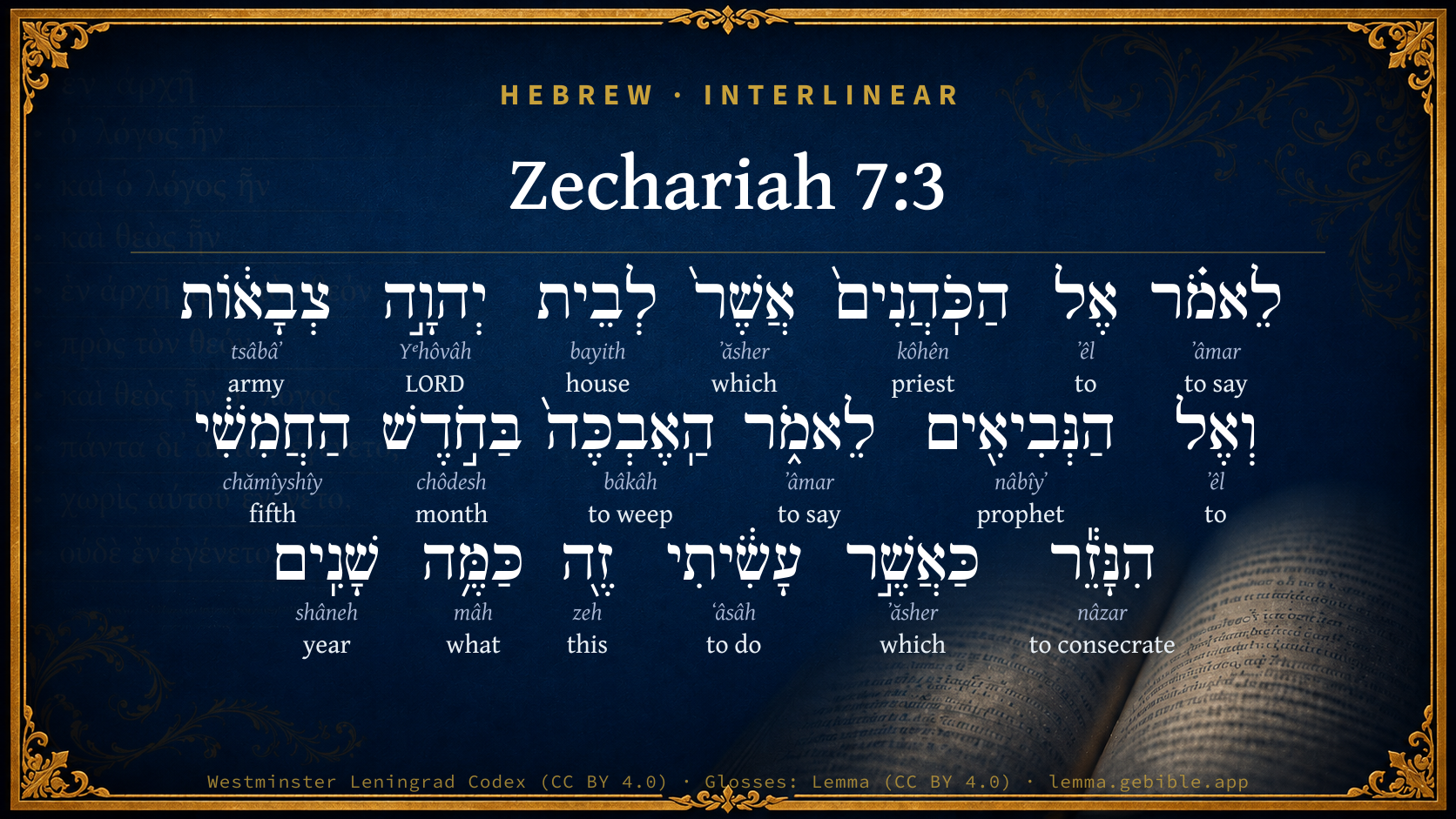
Hebrew (Westminster Leningrad Codex) Zechariah 7:3 appears in the Hebrew Old Testament. The text above is from the Westminster Leningrad Codex. Each word links to its Strong’s number, a concise gloss, and parsing drawn from the Open Scriptures Hebrew Bible morphology. Click any word for its full Brown-Driver-Briggs (BDB) entry.
Download image
Cite this verse

Zechariah 7:3 (World English Bible). Public Domain. Lemma interlinear Bible study tool, https://lemma.gebible.app/v/zechariah/7/3.

Show BibTeX & RIS
BibTeX
RIS
English Translation
and to speak to the priests of the house of Yahweh of Hosts, and to the prophets, saying, "Should I weep in the fifth month, separating myself, as I have done these so many years?"
World English Bible · Public Domain
Download a study sheet

One document with this verse’s original text, its word-by-word gloss line, the meaning frame, cross-references with their text, attributed commentary, and full source and license credits — printable, and it pastes into notes with its structure intact.

This verse Autodidact and up

Study sheet (.html) Plain text (.txt)

A passage Seminary Student

Up to 50 verses in one chapter. A passage sheet keeps up to 6 commentary sources and 12 cross-references per verse, in the order this page ranks them, and says so on the sheet whenever that leaves anything out. Ask for a single verse and you get the Autodidact verse sheet above.

Everything on this page stays free to read, with no account — the sheet is a download of what is already on screen, not access to it.

Want to remove ads? Support Godless Engineer
Compare translations 3

The same verse in 3 English versions, stacked beneath the original-language interlinear above. Click any original word for its lexicon entry.

Each is an independent rendering of the whole verse — the interlinear is not word-aligned to these translations.

Highlighted words mark where these versions differ — a whole-verse word diff, not a word-by-word alignment.

  • World English Bible Public Domain
    and to speak to the priests of the house of Yahweh of Hosts, and to the prophets, saying, "Should I weep in the fifth month, separating myself, as I have done these so many years?"
  • King James Version Public Domain
    And to speak unto the priests which were in the house of the LORD of hosts, and to the prophets, saying, Should I weep in the fifth month, separating myself, as I have done these so many years?
  • unfoldingWord Literal Text CC BY-SA 4.0
    saying to the priests who at the house of Yahweh of Armies and to the prophets, saying, “Should I weep in the fifth month, by separating myself, as I have done these many years?”

unfoldingWord Literal Text — © unfoldingWord, licensed CC BY-SA 4.0. Word-aligned USFM3 via Door43 (git.door43.org/unfoldingWord/en_ult).

Versions to compare (up to 4)

3 of 4 selected

Show all 18 translations

Every available English version of this verse, each an independent rendering of the whole verse.

  • World English Bible Public Domain
    and to speak to the priests of the house of Yahweh of Hosts, and to the prophets, saying, "Should I weep in the fifth month, separating myself, as I have done these so many years?"
  • Berean Standard Bible Public Domain
    by asking the priests of the house of the LORD of Hosts, as well as the prophets, “Should I weep and fast in the fifth month, as I have done these many years?”
  • Majority Standard Bible Public Domain
    by asking the priests of the house of the LORD of Hosts, as well as the prophets, “Should I weep and fast in the fifth month, as I have done these many years?”
  • King James Version Public Domain
    And to speak unto the priests which were in the house of the LORD of hosts, and to the prophets, saying, Should I weep in the fifth month, separating myself, as I have done these so many years?
  • American Standard Version (1901) Public Domain
    `and' to speak unto the priests of the house of Jehovah of hosts, and to the prophets, saying, Should I weep in the fifth month, separating myself, as I have done these so many years?
  • Revised Version (1885) Public Domain
    and to speak unto the priests of the house of the LORD of hosts, and to the prophets, saying, Should I weep in the fifth month, separating myself, as I have done these so many years?
  • Geneva Bible (1599) Public Domain
    And to speake vnto the Priests, which were in the House of the Lord of hostes, and to the Prophets, saying, Should I weepe in the fift moneth, and separate my selfe as I haue done these so many yeeres?
  • Douay-Rheims (1899) Public Domain
    To speak to the priests of the house of the Lord of hosts, and to the prophets, saying: Must I weep in the fifth month, or must I sanctify myself as I have now done for many years?
  • Young's Literal Translation Public Domain
    speaking unto the priests who `are' at the house of Jehovah of Hosts, and unto the prophets, saying, `Do I weep in the fifth month -- being separated -- as I have done these so many years?'
  • Literal Standard Version CC BY-SA 4.0
    speaking to the priests who [are] at the house of YHWH of Hosts, and to the prophets, saying, “Do I weep in the fifth month—being separated—as I have done these so many years?”
  • Unlocked Literal Bible CC BY-SA 4.0
    They spoke to the priests who were at the house of Yahweh of hosts and to the prophets; they said, “Should I mourn in the fifth month by means of a fast, as I have done these many years?”
  • unfoldingWord Literal Text CC BY-SA 4.0
    saying to the priests who at the house of Yahweh of Armies and to the prophets, saying, “Should I weep in the fifth month, by separating myself, as I have done these many years?”
  • Darby Bible Public Domain
    [and] to speak unto the priests that were in the house of Jehovah of hosts, and to the prophets, saying, Should I weep in the fifth month, separating myself, as I have done now so many years?
  • World Messianic Bible Public Domain
    and to speak to the priests of the house of the LORD of Hosts and to the prophets, saying, “Should I weep in the fifth month, separating myself, as I have done these so many years?”
  • Webster's Bible Public Domain
    And to speak to the priests who were in the house of the LORD of hosts, and to the prophets, saying, Should I weep in the fifth month, separating myself, as I have done these so many years?
  • Free Bible Version CC BY-SA 4.0
    They were to ask the priests of the Temple of the Lord Almighty and the prophets, “Should I go on mourning and fasting in the fifth month, as I have done for so many years?”
  • Bible in Basic English Public Domain
    And to say to the priests of the house of the Lord of armies and to the prophets, Am I to go on weeping in the fifth month, separating myself as I have done in past years?
  • JPS Tanakh (1917) Public Domain
    and to speak unto the priests of the house of the LORD of hosts, and to the prophets, saying: 'Should I weep in the fifth month, separating myself, as I have done these so many years?'

Literal Standard Version (2020), Covenant Press — licensed CC BY-SA 4.0. Text via the HelloAO Bible API (eBible.org). Unlocked Literal Bible (unfoldingWord) — licensed CC BY-SA 4.0. Text via the HelloAO Bible API (eBible.org). unfoldingWord Literal Text — © unfoldingWord, licensed CC BY-SA 4.0. Word-aligned USFM3 via Door43 (git.door43.org/unfoldingWord/en_ult). Free Bible Version, Dr. Jonathan Gallagher — licensed CC BY-SA 4.0. Text via the HelloAO Bible API (eBible.org).

Word by word

More ways to search: Search by grammar → Find every occurrence → Compare this word →

Practice this passage: Drill this verse → Learn its vocabulary →

הִנָּזֵ֕ר
nâzar
H5144
“to consecrate”
Verb, Niphal, Infinitive Absolute
Part of Speech
Verb
Stem
Niphal
Form
Infinitive Absolute
Full BDB Definition

Origin: a primitive root

TWOT: 1340

to dedicate, consecrate, separate - (Niphal) to dedicate oneself, devote oneself - (Hiphil) to keep sacredly separate - (Hiphil) to be a Nazarite, live as a Nazarite
  1. לֵאמֹ֗ר ʼâmar H559 “to say” Preposition + Verb, Qal, Infinitive Construct
  2. אֶל ʼêl H413 “to” Preposition
  3. הַכֹּֽהֲנִים֙ kôhên H3548 “the · priests” Particle, Definite Article + Noun, Common, Masculine, Plural, Absolute
  4. אֲשֶׁר֙ ʼăsher H834 “which” Particle, Relative
  5. לְבֵית bayith H1004 “to/for · house of” Preposition + Noun, Common, Masculine, Singular, Construct
  6. יְהוָ֣ה Yᵉhôvâh H3068 “LORD” Noun, Proper
  7. צְבָא֔וֹת tsâbâʼ H6635 “armies” Noun, Common, Both, Plural, Absolute
  8. וְאֶל ʼêl H413 “and · to” Conjunction + Preposition
  9. הַנְּבִיאִ֖ים nâbîyʼ H5030 “the · prophets” Particle, Definite Article + Noun, Common, Masculine, Plural, Absolute
  10. לֵאמֹ֑ר ʼâmar H559 “to say” Preposition + Verb, Qal, Infinitive Construct
  11. הַֽאֶבְכֶּה֙ bâkâh H1058 “to weep” Particle, Interrogative + Verb, Qal, Imperfect, 1st Person, Common, Singular
  12. בַּחֹ֣דֶשׁ chôdesh H2320 “in/at the · month” Preposition, Determined + Noun, Common, Masculine, Singular, Absolute
  13. הַחֲמִשִׁ֔י chămîyshîy H2549 “the · fifth” Particle, Definite Article + Adjective, Ordinal number, Masculine, Singular, Absolute
  14. כַּאֲשֶׁ֣ר ʼăsher H834 “like/as · which” Preposition + Particle, Relative
  15. עָשִׂ֔יתִי ʻâsâh H6213 “to do” Verb, Qal, Perfect, 1st Person, Common, Singular
  16. זֶ֖ה zeh H2088 “this” Pronoun, Demonstrative, Masculine, Singular
  17. כַּמֶּ֥ה mâh H4100 “like/as · what” Preposition + Particle, Interrogative
  18. שָׁנִֽים shâneh H8141 “years” Noun, Common, Feminine, Plural, Absolute

About this verse

These counts appear in no published source. They are computed here, from the morphology-tagged text and Lemma’s own curated glosses. What Lemma adds →

19
words
16
distinct lemmas
Prophets
section

Notable vocabulary

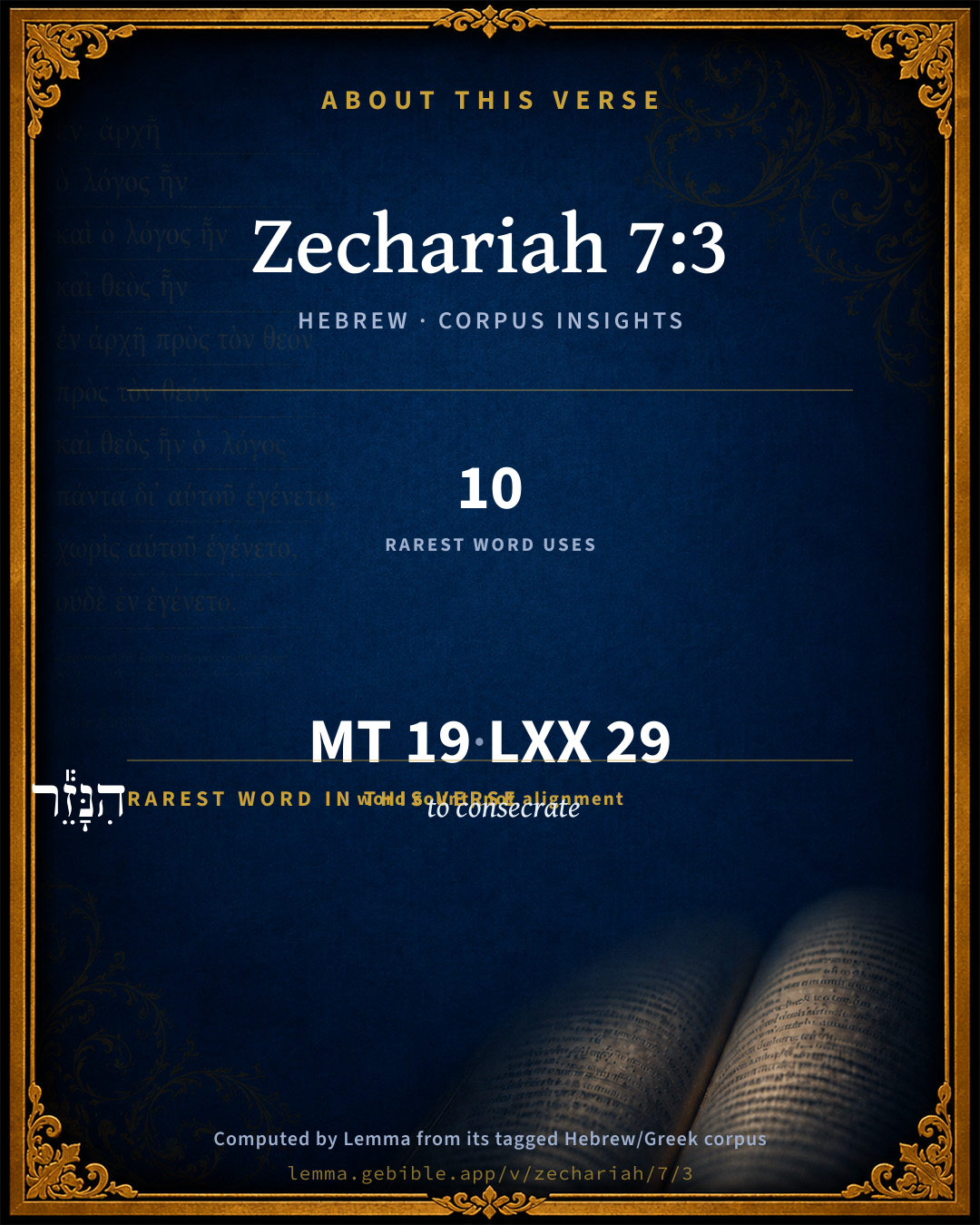
The rarest word here is הִנָּזֵ֕ר to consecrate H5144 — appearing just 10 times in the whole Hebrew Bible.

Shared distinctive vocabulary

הִנָּזֵ֕ר to consecrate H5144 occurs in 10 verses of the Hebrew Bible. Also found in:

Grammatical profile

  • 5 verbs
  • 7 nouns
  • 1 adjective
  • 1 pronoun
  • 2 prepositions
  • 3 particles

Verb forms

  • לֵאמֹ֗ר Qal · Infinitive Construct
  • לֵאמֹ֑ר Qal · Infinitive Construct
  • הַֽאֶבְכֶּה֙ Qal · Imperfect
  • הִנָּזֵ֕ר Niphal · Infinitive Absolute
  • עָשִׂ֔יתִי Qal · Perfect

Repetition

Words recur within this verse — often emphatic in Hebrew:

  • לֵאמֹ֗ר to say H559 ×2
  • אֶל to H413 ×2
  • אֲשֶׁר֙ which H834 ×2

Hebrew & Septuagint length

In English translation the verse runs 35 words from the Hebrew and 36 from the Septuagint (LXX English) — closely comparable.

A rough comparison of the two English renderings, which tokenize alike — not a word-level alignment.

Word counts can differ between the Hebrew and the Greek without any difference in meaning — e.g. the Hebrew direct-object marker אֵת has no separate Greek word, and Greek often adds the article ὁ.

In the original languages it is 19 Hebrew tokens and 29 Greek tokens — but the two are counted differently (Hebrew bundles its prefixes and suffixes into one token; the Greek is in lemma form), so that isn’t a like-for-like length.

Cross-references

19

Topical passages linked to Zechariah 7:3 in the Treasury of Scripture Knowledge — connected by theme and wording, ordered by reader-vote popularity; previews shown in the World English Bible.

  • Zechariah 8:19 Thus says Yahweh of Hosts: "The fasts of the fourth fifth, seventh, and tenth months shall be for the house of Judah joy and gladness, and cheerful feasts. Therefore love truth and peace."
  • James 4:8–10 Draw near to God, and he will draw near to you. Cleanse your hands, you sinners; and purify your hearts, you double-minded.
  • Hosea 4:6 My people are destroyed for lack of knowledge. Because you have rejected knowledge, I will also reject you, That you may be no priest to me. Because you have your God's law, I will also forget your children.
  • Malachi 2:7 For the priest's lips should keep knowledge, and they should seek the law at his mouth; for he is the messenger of Yahweh of Hosts.
  • Matthew 9:15 Jesus said to them, "Can the friends of the bridegroom mourn, as long as the bridegroom is with them? But the days will come when the bridegroom will be taken away from them, and then they will fast.
  • 1 Corinthians 7:5 Don't deprive one another, unless it is by consent for a season, that you may give yourselves to fasting and prayer, and may be together again, that Satan doesn't tempt you because of your lack of self-control.
  • Deuteronomy 17:9–11 and you shall come to the priests the Levites, and to the judge who shall be in those days: and you shall inquire; and they shall show you the sentence of judgment.
  • Deuteronomy 33:10 They shall teach Jacob your ordinances, Israel your law: They shall put incense before you, Whole burnt offering on your altar.
  • 2 Kings 25:8–9 Now in the fifth month, on the seventh day of the month, which was the nineteenth year of king Nebuchadnezzar, king of Babylon, came Nebuzaradan the captain of the guard, a servant of the king of Babylon, to Jerusalem.
  • Nehemiah 8:9–11 Nehemiah, who was the governor, and Ezra the priest the scribe, and the Levites who taught the people, said to all the people, This day is holy to Yahweh your God; don't mourn, nor weep. For all the people wept, when they heard the words of the law.
  • Nehemiah 9:1–3 Now in the twenty-fourth day of this month the children of Israel were assembled with fasting, and with sackcloth, and earth on them.
  • Ecclesiastes 3:4 A time to weep, And a time to laugh; A time to mourn, And a time to dance;
  • Isaiah 22:12–13 In that day did the Lord, Yahweh of Hosts, call to weeping, and to mourning, and to baldness, and to girding with sackcloth:
  • Jeremiah 52:12–14 Now in the fifth month, in the tenth day of the month, which was the nineteenth year of king Nebuchadrezzar, king of Babylon, came Nebuzaradan the captain of the guard, who stood before the king of Babylon, into Jerusalem:
  • Ezekiel 44:23–24 They shall teach my people the difference between the holy and the common, and cause them to discern between the unclean and the clean.
  • Joel 2:17 Let the priests, the ministers of Yahweh, weep between the porch and the altar, And let them say, "Spare your people, Yahweh, And don't give your heritage to reproach, That the nations should rule over them. Why should they say among the peoples, 'Where is their God?'"
  • Haggai 2:11 "Thus says Yahweh of Hosts: Ask now the priests concerning the law, saying,
  • Zechariah 7:5 "Speak to all the people of the land, and to the priests, saying, 'When you fasted and mourned in the fifth and in the seventh month for these seventy years, did you at all fast to me, really to me?
  • Zechariah 12:12–14 The land will mourn, every family apart; the family of the house of David apart, and their wives apart; the family of the house of Nathan apart, and their wives apart;

Cross-references courtesy of OpenBible.info (CC BY 4.0).

Hebrew and Greek witnesses Masoretic Hebrew ↔ Greek Septuagint

The same verse in the two great witnesses to the Old Testament, shown verse-for-verse.

These are two independent witnesses, not word-aligned to each other, and the Septuagint is shown in lemma (dictionary) form.

Hebrew Zechariah 7:3 Masoretic · Westminster Leningrad Codex

לֵאמֹ֗ר אֶל הַכֹּֽהֲנִים֙ אֲשֶׁר֙ לְבֵית יְהוָ֣ה צְבָא֔וֹת וְאֶל הַנְּבִיאִ֖ים לֵאמֹ֑ר הַֽאֶבְכֶּה֙ בַּחֹ֣דֶשׁ הַחֲמִשִׁ֔י הִנָּזֵ֕ר כַּאֲשֶׁ֣ר עָשִׂ֔יתִי זֶ֖ה כַּמֶּ֥ה שָׁנִֽים

and to speak to the priests of the house of Yahweh of Hosts, and to the prophets, saying, "Should I weep in the fifth month, separating myself, as I have done these so many years?"

World English Bible · Public Domain

Greek LXX Zechariah 7:3 Septuagint · lemma form

λέγω πρός ὁ ἱερεύς ὁ ἐν ὁ οἶκος κύριος παντοκράτωρ καί πρός ὁ προφήτης λέγω εἰςἐρχομαι ὧδε ἐν ὁ μήν ὁ πέμπτος ὁ ἁγίασμα καθότι ποιέω ἤδη ἱκανός ἔτος

speaking to the priests that were in the house of the Lord Almighty, and to the prophets, saying, The holy offering has come in hither in the fifth month, as it has done already many years.

LXX2012 (modern English Septuagint) · Public Domain

On this verse, Ellicott's Commentary for English Readers discusses the Septuagint’s reading. Read the note in Commentary ↓

Hebrew: Westminster Leningrad Codex (CC BY 4.0). Greek: Septuagint (public domain); English from LXX2012 (modern English Septuagint) (Public Domain). How the Septuagint differs from the Hebrew →

Targum (Aramaic paraphrase)

1

The Targum is the ancient Jewish Aramaic paraphrase of the Hebrew Scriptures — an interpretive translation, not the Hebrew text itself. Onkelos (literal) and Pseudo-Jonathan (expansive) render the Torah, and Jonathan the Prophets. Coverage is partial: where no permissively-licensed English translation exists for a verse, only the Aramaic is shown. This is verse-level text, not a word-by-word alignment to the Hebrew.

  1. Targum Jonathan Prophets (Joshua–Malachi)
    לְמֵימַר לְכַהֲנַיָא דִי מְשַׁמְשִׁין בְּבֵית מַקְדְשָׁא דַייָ צְבָאוֹת וּלְסַפְרַיָא לְמֵימַר דְאַבְכֵּי בְּיַרְחָא חֲמִישָׁאָה אֶמְנַע נַפְשִׁין מִתַּפְנוּקִין כְּמָא דַעֲבִדֵית דְנַן כַּמָה שְׁנִין:

    (no public-domain English translation for this verse)

    Targum Jonathan — Aramaic: “Mikraot Gedolot” (public domain). English: “Sefaria Community Translation” (CC0 1.0 (public-domain dedication)); “London "Chaldee Paraphrase," 1871” (public domain). Text via Sefaria.

Commentary

Notes on Zechariah 7:3 from classic Christian and Jewish commentators (each source and its license shown beneath its notes). The classic Christian expositions comment on the surrounding passage and are grouped to its opening verse, so a note may address several verses; the Jewish commentaries on the Tanakh (Rashi and others) are per-verse, so they appear only where the commentator wrote on this verse.

Lemma curates 59 commentaries, every one of them public domain or Creative Commons licensed, each selected and text-cleaned for this edition rather than reprinted as found. About our sources →

Trapp's Complete Commentary

John Trapp

Zec 7:3 [And] to speak unto the priests which [were] in the house of the LORD of hosts, and to the prophets, saying, Should I weep in the fifth month, separating myself, as I have done these so many years?

Ver. 3. And to speak unto the priests] Whose office is to preserve knowledge, and present it too; to teach Jacob God’s judgments, and to put incense before him, Deu 33:10, to sell oil, Mat 25:9, to bring balm from Gilead, Jer 8:22, to speak as the oracles of God, 1Pe 4:11, which scarcely one of a thousand has the skill of, Job 33:23.

And to the prophets] Who were extraordinarily raised up sometimes by God, to assist the priests in teaching the people, and to shame them for their backwardness to such businesses. {See Trapp on "Zec 7:1"}

Should I weep] That is, fast, which was ever with weeping, see Joe 2:15-17, and affliction of the soul, Lev 16:31; Lev 23:27; which indeed is the soul of a fast, and without the which it is but as a brainless head, or a lifeless carcase. What is a humble day (saith one) without a humble heart? not only an irreligious incongruity, but a high provocation; like Zimri’s act when all the congregation were weeping before the door of the tabernacle?

In the fifth month] Wherein the temple was consumed to ashes, Jer 52:12. In a sad remembrance whereof the Jews took up that tenth day of the fifth month for a solemn fast every year, till now.

Separating myself] Heb. Nazariting myself that is, abridging myself of meats, drinks, and delights. Hence a fasting day is called a day of restraint, Joe 2:15. Hence it hath its hand both in Hebrew and Greek, Tsom, Nηστειο Hence also it is spoken of as a foul fault, Isa 58:3 "Behold in the day of your fast ye find your pleasure." The Popish fast is a mere mock fast; for they separate themselves from some kind of meats only; it is not a total abstinence. And herein they come short of the very Turks, who upon their fasting days will not so much as taste a cup of water, or wash their mouths with water all the day long, before the stars appear in the sky; and then they make all the cheer and joy they can devise. Like as the Attic dames in their Thesmophoria (a feast of Ceres) prepared themselves with fasting, but after that laid the reins on the neck, and ran riot.

As I have done these so many years?] Seventy at least. But they seem to reckon up upon so many as was scarce to be told; and that therefore God was deep in their debt. Is it not time now to give over, since the temple was almost rebuilt? This was the great case propounded by these Questionists. Hereunto an answer is made by the prophet in the two following chapters, and this answer is partly reprehensory, Zec 7:1-14, partly consolatory, Zec 8:1-23. The Sun of righteousness loves not to set in a cloud.

John Trapp, A Commentary or Exposition upon All the Books of the Old and New Testament (1647–1656) — public domain. Text from a community e-Sword module.

Tyndale Open Study Notes

Tyndale Open Resources

7:3 The delegation from Bethel posed a practical procedural question.

Tyndale Open Study Notes — © Tyndale Open Resources, licensed CC BY-SA 4.0. Text via the HelloAO Bible API.

Geneva Bible (1599)

Geneva Bible translators

That is, prepare myself with all devotion to his fast.

By weeping and mourning, appear what exercises they used in their fasting.

Which was now since the time the Temple was destroyed.

Geneva Bible (1599) marginal notes — public domain. Text via Bolls.life.

Jamieson, Fausset & Brown

Robert Jamieson, A. R. Fausset & David Brown

Should I weep in the fifth month--"I" represents here the people of God (compare Zac 8:21). This rather favors MAURER'S view, taking "the house of God," the congregation, as nominative to "sent." Their hypocrisy appeared because they showed more concern about a ceremony of human institution (not improper in itself) than about moral obedience. If, too, they had trusted God's promise as to the restoration of Church and State, the fast would have now given place to joy, for which there was more cause than for grief [PEMBELLUS].

to the prophets--Haggai and Zechariah especially. The tenth day of the fifth month was kept a fast, being the anniversary of the destruction of Jerusalem (Jer 52:12-14). They ask, Should the fast be continued, now that the temple and city are being restored?

separating myself--sanctifying myself by separation, not only from food, but from all defilements (compare Joe 2:16) as was usual in a solemn fast.

Jamieson, Fausset & Brown — Commentary Critical and Explanatory on the Whole Bible (1871) — public domain (CC PDM 1.0). Text via the HelloAO Bible API.

John Calvin's Commentaries

Let us now consider the question which the captives proposed to the priests. They asked whether they were to weep in the fifth month, and whether they were to separate themselves as they had done for seventy years and more; for some years, as we have seen, had elapsed beyond that number. We hence learn that a regular fast was observed from the time in which the temple was burned and the city destroyed. He speaks here only of the fifth month, but shortly after mention is made of the seventh month. It is evident from sacred history that the city was demolished and the temple pulled down in the fifth month. It is therefore probable that there was a day of mourning observed by the people in memory of that sad event. In the seventh month, though not in the same year, Gedaliah was slain, and the remainder of the people were driven into exile. As the land became then desolate, it is also probable that another fast was appointed, that they might yearly humble themselves before God, and suppliantly seek his pardon. Since then there was a reason for both fasts, it is evident that they could not have been condemned by the priests: nor is there a doubt, but that it was by the public consent of all, that they every year kept these days of weeping. We also see the end which God has in view in prescribing a fast, — that men in coming to him may feel true penitence, and remind themselves by their external appearance of their own guilt. As then the Jews observed this rule in their fasts, we must conclude that they pleased God; for these were religious exercises, by which they might have been led to repentance.

Now they inquired, whether they were to continue their weeping; for the temple had now been begun to be built as well as the city. Since the reason for their mourning had been, that the temple no longer stood where they might offer their sacrifices, and that the holy city had been demolished, it was then doubtless right to give thanks to God, and to feel joy, when an end came to their calamities. However, the captives ventured not to change anything without the authority and consent of the priests, so that they might all agree together. And thus they also testified that they were true members of the Church, as they had no desire to have anything different from others.

The word fast is not mentioned; but they asked, “Shall we weep?” Hence also it appears, that they were not so gross in their ideas as to think that the chief part of religion is fasting, as hypocrites do, who imagine that they honor God by abstaining from food, and thus mock God, who is a Spirit, with mere trifles, when it is his express will to be spiritually worshipped. We then plainly see, that the Jews were not imbued with this gross and foolish thought, when they established this annual fast; for they put weeping in the place of fasting. And why was this weeping, except that they went into God’s presence conscious of their guilt and in a suppliant manner, and testified by external signs that they acknowledged their sins, so that they might obtain mercy and forgiveness?

They mentioned also consecration. The word נזר, nezar, which means to separate, is variously explained: but here many interpreters confine it to abstinence from food, as though they had said, “Shall we separate ourselves from food?” This seems forced to me: I therefore prefer to apply it to sanctification; for we know that when a day was prescribed for fasting or for offering sacrifices, there was sanctification added. For though it became the Jews through their whole life to abstain from all defilements, yet we know that when a fast or any particular sacrifice was appointed, they were more diligent and solicitous to cast aside every pollution. We now then understand what the Jews had in view, and what they meant by these words. It now follows —

John Calvin's Commentaries (1540-1563) — public domain. Text from the Calvin Translation Society English edition (1840s-50s) via the Christian Classics Ethereal Library (ccel.org). Calvin's coverage is partial (roughly two-thirds of the Bible); uncommented books and verses are honest gaps, never fabricated. The 19th-century editor's footnotes and remarks are omitted so the notes are faithfully Calvin's own voice.

Ellicott's Commentary for English Readers

(3) In.—Better, belonging to. LXX., wrongly, ἐν τῷ οἴκῳ.

In the fifth month.—On the tenth of the fifth month (Ab), Nebuzar-adan burnt the Temple and Jerusalem with fire (Jer_52:12-13), but in 2Ki_25:8-10, the seventh day of the fifth month is given as the date; perhaps it was in flames for three days. Now that the re-building was well in progress, they naturally desired to know whether the fast which had been kept in commemoration of the past calamity should be still held.

Separating myself—viz., from meat and drink. LXX., for “shall I weep, separating myself?” give εἰσελήλυθεν ὧδε . . . τὸ ἁγίασμα, reading the same consonants, but different vowels (see my Student’s Commentary). Consequently, instead of “as I have done,” LXX. give καθότι ἐποίησεν.

7:4-8:23. The prophet’s answer is contained in four sections (Zec_7:4-14; Zec_8:1-23), each of which is introduced by the words, “The word of the Lord of Hosts came,” &c., as a testimony that he spake not of himself.

A Bible Commentary for English Readers, edited by Charles John Ellicott (1878–1897) — public domain. Text from a community e-Sword module.

The Cambridge Bible for Schools and Colleges

gen. ed. J. J. S. Perowne

3. unto the priests] See Hag_2:11 and note.

which were in] of R.V.

and to the prophets] i.e. Haggai and Zechariah.

Should I weep] Similarly the sing. num. is used of a community or nation, Num_20:18-19; Jos_9:7, and elsewhere.

in the fifth month] 2Ki_25:8-9; Jer_52:12-13, from a comparison of which passages it appears that “from the seventh to the tenth day (of the fifth month) Jerusalem was in flames” (Pusey). While the Temple lay in ruins the Jews had marked this time by an annual fast. Now that it was being rebuilt the question naturally arose, should the fast be continued?

separating myself] Or, abstaining from meat and drink (Zec_7:5 with 6), and from all pleasure, Isa_58:5.

The Cambridge Bible for Schools and Colleges (gen. ed. J. J. S. Perowne; Cambridge University Press, 1878–1918) — public domain. Text from a community e-Sword module.

John Gill's Exposition

And to speak unto the priests which were in the house of the Lord of hosts,.... That ministered in the sanctuary, as the Targum explains it, who offered sacrifices, &c. and who were to be consulted in matters of religion, Mal 2:7,

and to the prophets; who were then in being, as Haggai, Zechariah and Malachi:

saying, Should I weep in the fifth month; which is the month Ab, and answers to July: now on the seventh day of this month, according to Kg2 25:8, the temple was burnt by the Chaldeans; and, according to Jer 3:12, it was on the tenth of this month, which day was kept by the Jews as a day of fasting and humiliation, in commemoration of it; and by the Misnic doctors (u) afterwards was removed, and kept on the ninth day of the said month; but, seeing the temple was in great forwardness of being rebuilt, the question with those Jews was, whether they should continue any longer mourning and fasting on that account:

separating myself: that is, from eating and drinking, and not taking the lawful pleasures and recreations of life:

as I have done these so many years? for the space of seventy years, as in Zac 7:5.

(u) Misn. Taanith, c. 4. sect. 7, 8. T. Bab. Taanith, fol. 29. 1.

John Gill's Exposition of the Whole Bible (1746–1763) — public domain (CC PDM 1.0). Text via the HelloAO Bible API.

Albert Barnes' Notes on the Bible

Should I weep in the fifth month, separating myself? - “In the fifth month,” from the seventh to the tenth day, Jerusalem was in flames, fired by Nebuchadnezzar. “He burnt the house of the Lord, and the king’s house, and all the houses of Jerusalem and every great man’s house he burnt with fire” .

Jerome: “Now since it is said that the temple is builded and we see that no cause of sorrow remaineth, answer, we pray, are we to do this or to change our sorrow into joy?”

Separating myself - This seems to be added, to intensify the fast which they had kept. The Nazarite was bound to “separate himself from wine and strong drink” Num 6:3, and so, they severed themselves to the Lord, and consecrated themselves to Him (Num. 5. See the note at Amo 2:11). These had severed themselves from food, from things pleasant, from pleasure, from sin, it may be, for the day, but not abidingly: they had not given themselves to God.

As I have done these so many years - Literally, “how many.” As if, although they knew that they were seventy years, they could not count them.

Albert Barnes' Notes on the Bible (1834–1885) — public domain. Text from a community e-Sword/MySword module.

Haydock's Catholic Bible Commentary

The fifth month. They fasted on the tenth day of the fifth month; because on that day the temple was burnt. Therefore they inquire whether they are to continue that fast after the temple is rebuilt. See this query answered [in] ver. 19 of the following chapter. (Challoner) --- The third of the seventh month (ver. 5) was also a fast, on account of the death of Godolias, (Calmet) during the captivity, 4 Kings xxv. 8, 25. (Worthington) --- Septuagint, "Has the sanctification entered hither in the fifth month, as they (or I) have done?" &c. (Haydock) --- Fasting and lamentation are styled sanctification, because they promote it; curatos quoque sanctificat; (St. Jerome) if the proper conditions be observed. (Haydock)

George Leo Haydock (1774–1849), Haydock's Catholic Family Bible and Commentary, 1859 edition — public domain. Excludes Psalms (Douay-Rheims chapter numbering differs from Protestant) and Deuterocanonical books (Catholic canon only).

Matthew Poole's English Annotations

To speak unto, to consult with, the priests: they were to be the ordinary casuists, and ought to be able and ready to answer all cases of conscience, as Mal 2:7.

Which were in; had their residence in or about the temple.

And to the prophets: these were extraordinary casuists, who, might be supposed able to satisfy the inquiry, if the priests could not. These prophets were Haggai and Zechariah.

Should I weep, i.e. fast, of which weeping was a part, 1Sa 1:7; Mat 9:15.

In the fifth month; in sad remembrance of the burning of the temple on the 10th day of that month.

Separating myself from worldly cares and designs, and afflicting myself. As I have done: this intimateth their former practice, and seems to include in it some little boasting of it.

These so many years: it had been easy for them to have reckoned up the exact number of years, but they choose rather to express it thus, to greaten their performance.

Matthew Poole's English Annotations on the Holy Bible (1683–1685) — public domain. Text from a community e-Sword/MySword module.

The Pulpit Commentary

The priests. They were addressed as interpreters of the Law. (see Hag_2:11, and note there) Which were in; rather, which belonged to. The prophets. Such as Zechariah, Haggai, and perhaps Malachi, through whom God communicated his will. Should I weep in the fifth month? The use of the first person singular to express a community or a people is not uncommon; here it means the Bethelites. (comp. Num_20:18, 19 Jos_9:7 1Sa_5:10, 1Sa_5:11) Weeping is the accompaniment of fasting. (Jud_1:20:26 Neh_1:4 Joe_2:12) This fast in the fifth month, the month of Ab, had been established in memory of the destruction of Jerusalem by Nebuchadnezzar. The temple was burnt on the ninth or tenth of the month. (see 2Ki_25:8, 9 Jer_52:12, Jer_52:13) The only fast-day enjoined by the Law of Moses was the great Day of Atonement on the tenth day of the seventh month, Ethanim. (Lev_23:26, etc.) But the Jews added others in memory of certain national events. (see Jud_1:20:26 1Sa_7:6 Isa_58:3, etc.) In Zec_8:19 mention is made of four extraordinary fasts instituted and observed during the Captivity, viz. on the ninth day of the fourth month, in memory of the capture of Jerusalem by the Chaldeans; in the fifth month, in remembrance of the burning of the temple and city; in the seventh month, in consequence of the murder of Gedaliah; (Jer_41:1, Jer_41:2) and in the tenth month, in memory of the commencement of the siege of Jerusalem by Nebuchadnezzar. (see note on Zec_8:19) Separating myself. Abstaining from food and pleasure. Vulgate, vel sanctificare me debeo, such separation or abstinence being regarded as a consecration to the Lord. The LXX has not understood the passage, rendering, Eiselhluyen wde en tw mhni tw peptw to agiasma . "The sanctification hath come in here in the fifth month." These so many years. All the seventy years of exile. There is, perhaps, some Pharisaical complacency in this assertion.

Shall we fast?

This question has been often asked down to our own day.

I There are NATIONAL FASTS. These are rare, and only appointed under very solemn circumstances. In 1853, when cholera prevailed, the Presbytery of Edinburgh (Church of Scotland) suggested to Lord Palmerston, then Home Secretary, the propriety of ordering a national fast. His lordship, in his reply, recommended observance of natural laws rather than fasting. If this were attended to, all would be well. Otherwise pestilence would come, in spite of all the prayers and lastings of a united but inactive nation. " He does not seem to have understood that the two things were quite compatible. Prayer and inaction is folly; but prayer and action is the highest wisdom. Surely there is something grand and beautiful in a whole nation bowed in humility and supplication before the Most High. (Buckle, vol. 2, has a characteristic notice of this, where he falls into the odd mistake that in Scotland "fasting" meant abstinence from food!)

II Then there are CHURCH FASTS. These are only binding on the members of the several Churches that appoint them. In Scotland it has for long been customary to have fast days in connection with the sacrament of the Lord"s Supper; but as to this there is now a change. First their enforcement under penalties ceased; then the rigour of their observance was given up; then, from the necessities of modern life, and the knowledge that they were often the occasion of more evil than good, they have come in ninny cases to be discontinued. The question is one of Christian expediency, and requires to be dealt with both with wisdom and gentleness.

III Besides these there is PRIVATE FASTING. As to this, no rule can be laid down. (cf. Rom_14:5, Rom_14:6) But certain principles should be kept in view, such as that fasting has no virtue in itself; that what may be good for one Christian may not suit another; and that the great end of all such observances is spiritual good, "room to deny ourselves," a path "to bring us daily nearer God. F.

The Pulpit Commentary (1880–1919), ed. H.D.M. Spence-Jones & Joseph S. Exell — public domain. Text from a community e-Sword module.

John Wesley's Explanatory Notes

The prophets - Haggai and Zechariah. Weep - Fast, in remembrance of the burning of the temple on the tenth day of that month. Separating myself - From worldly cares and designs.

John Wesley, Explanatory Notes Upon the Whole Bible (1754–1765) — public domain. Text via the GEBible commentary corpus.

Scofield Reference Notes

C. I. Scofield

fifth month

i.e. August.

The Scofield Reference Bible (1917 edition), notes by C. I. Scofield — public domain. Text from a community e-Sword module.

Rashi

Rabbi Shlomo Yitzchaki (Rashi)

abstaining To abstain from pleasure, as I have done these seventy years. The word נְזִירָה always means separation.

Rashi on the Tanakh — English translations: “The Judaica Press complete Tanach with Rashi, translated by A. J. Rosenberg” (CC BY 4.0); “Pentateuch with Rashi's commentary by M. Rosenbaum and A.M. Silbermann, 1929-1934” (public domain); “The Metsudah Tanach series, Lakewood, N.J” (CC BY 4.0); and “The Book of Joshua, Metsudah Publications, 1997” (CC BY 4.0). Text via Sefaria.

Radak

Rabbi David Kimhi (Radak)

To say to the house of the LORD — meaning, "in the house of the LORD." And Targum Jonathan translates as "who were serving in the Holy Temple of the LORD."

And to the prophets — Haggai, Zechariah, and Malachi. And Targum Jonathan translates as "and to the scribes."

Shall I weep — because they still did not believe in the construction of the House because of the enemies who had forced the work for many years, and now, even though they heard that they had built it, they were of little faith and did not want to go up from Babylon, because they did not believe that the construction of the House was finished and stood because of the enemies. And they asked if they should fast on the Ninth of Av as they did during the seventy years.

and shall I keep abstinent That is to say, "should I abstain from food and drink and pleasure." And Targum Jonathan translates as "shall I refrain my soul from enjoyable things."

Radak on the Tanakh — English translations: “Sefaria Community Translation” (CC0 1.0 (public-domain dedication)); “Eliyahu Munk, HaChut Hameshulash” (CC BY 4.0); “Rabbi Mike Feuer, Jerusalem Anthology” (CC BY 4.0); and “R. David Kimhi on the first book of Psalms, Translated by R.G. Finch, London, 1919” (public domain). Text via Sefaria.

Lesson kit

Teaching starters — assembled from the data on this page, not authored interpretation. Every prompt links to the verse data it draws on. Edit before teaching.

Zechariah, in the Prophets, opens this verse with 19 words (16 distinct Hebrew lemmas). Its most distinctive word is nâzar (“to consecrate”). A historical commentator’s framing appears above. Read the whole chapter for the surrounding context.

Discussion questions

  1. What does “to consecrate” (nâzar) contribute to the verse as a whole?
  2. How does Leviticus 15:31, which shares the word «to consecrate», read alongside this verse?
  3. What does the repetition of “to say” (2× in this one verse) do in this verse?
  4. The translations on this page render this verse differently — a whole-verse word diff, not a word-by-word alignment. What might account for the different wordings?
  5. «לֵאמֹ֗ר» is a Qal Infinitive Construct verb. How does that grammatical form shape the action described?
  6. Compare how Trapp's Complete Commentary and Tyndale Open Study Notes read this verse. Where do they agree or differ?

Things to notice

Reading settings

Reading text

Shown beneath each verse's original-language words.

Old Testament
Old Testament edition

Read the OT as the Masoretic Hebrew (MT) or the Greek Septuagint (LXX).

English shown for the Greek Septuagint (in the Hebrew ↔ Greek comparison).

Comparing translations? Open the Compare panel on any verse page to stack up to four side by side.