
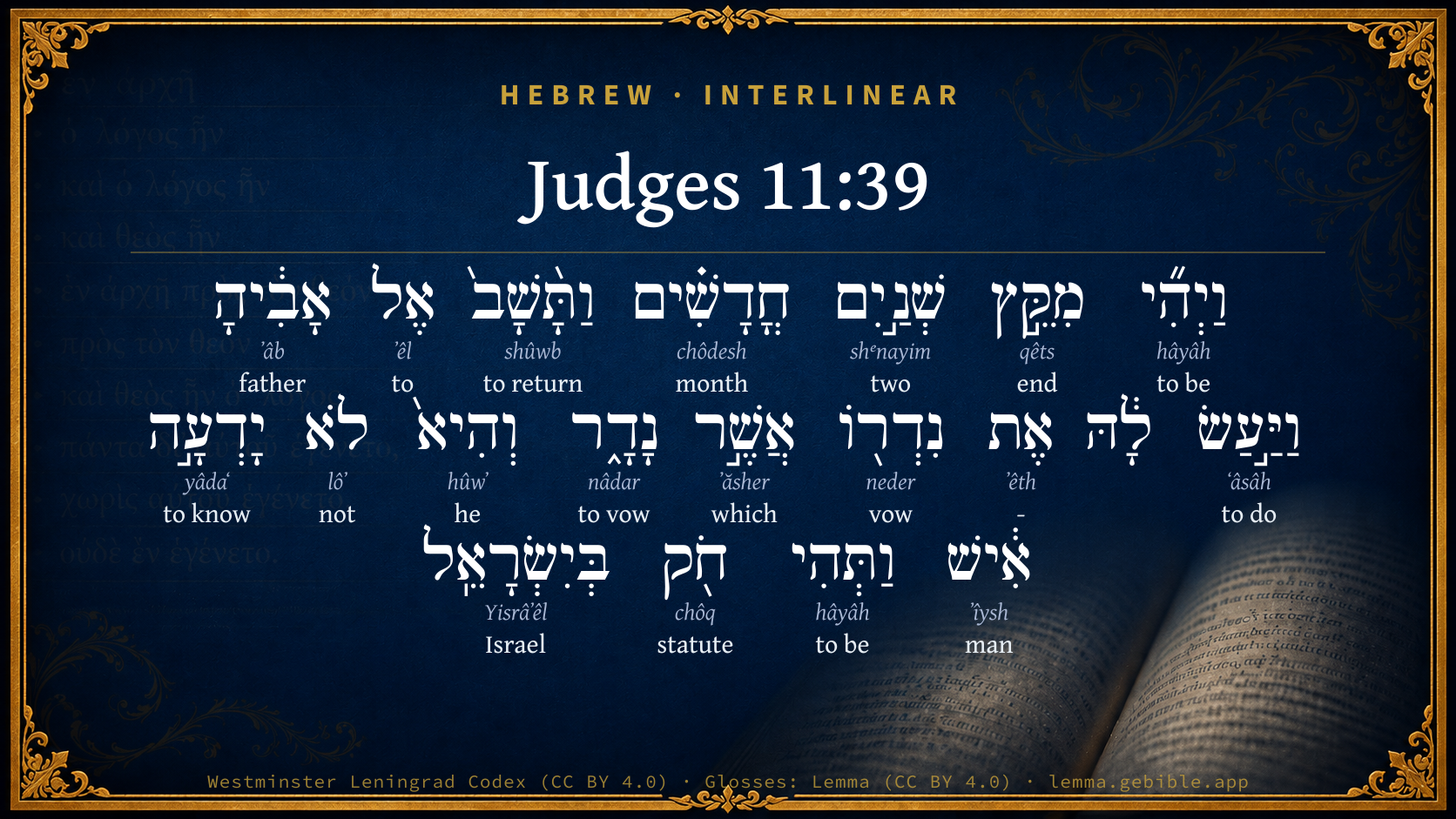
Judges 11:39

Hebrew (Westminster Leningrad Codex) Judges 11:39 appears in the Hebrew Old Testament. The text above is from the Westminster Leningrad Codex. Each word links to its Strong’s number, a concise gloss, and parsing drawn from the Open Scriptures Hebrew Bible morphology. Click any word for its full Brown-Driver-Briggs (BDB) entry.
Download image
Cite this verse

Judges 11:39 (World English Bible). Public Domain. Lemma interlinear Bible study tool, https://lemma.gebible.app/v/judges/11/39.

Show BibTeX & RIS
BibTeX
RIS
English Translation
It happened at the end of two months, that she returned to her father, who did with her according to his vow which he had vowed: and she was a virgin. It was a custom in Israel,
World English Bible · Public Domain
Download a study sheet

One document with this verse’s original text, its word-by-word gloss line, the meaning frame, cross-references with their text, attributed commentary, and full source and license credits — printable, and it pastes into notes with its structure intact.

This verse Autodidact and up

Study sheet (.html) Plain text (.txt)

A passage Seminary Student

Up to 50 verses in one chapter. A passage sheet keeps up to 6 commentary sources and 12 cross-references per verse, in the order this page ranks them, and says so on the sheet whenever that leaves anything out. Ask for a single verse and you get the Autodidact verse sheet above.

Everything on this page stays free to read, with no account — the sheet is a download of what is already on screen, not access to it.

Want to remove ads? Support Godless Engineer
Compare translations 3

The same verse in 3 English versions, stacked beneath the original-language interlinear above. Click any original word for its lexicon entry.

Each is an independent rendering of the whole verse — the interlinear is not word-aligned to these translations.

Highlighted words mark where these versions differ — a whole-verse word diff, not a word-by-word alignment.

  • World English Bible Public Domain
    It happened at the end of two months, that she returned to her father, who did with her according to his vow which he had vowed: and she was a virgin. It was a custom in Israel,
  • King James Version Public Domain
    And it came to pass at the end of two months, that she returned unto her father, who did with her according to his vow which he had vowed: and she knew no man. And it was a custom in Israel,
  • unfoldingWord Literal Text CC BY-SA 4.0
    And it happened at the end of two months that she returned to her father, and he did to her his vow that he had vowed. And she had not known a man. And it became a custom in Israel.

unfoldingWord Literal Text — © unfoldingWord, licensed CC BY-SA 4.0. Word-aligned USFM3 via Door43 (git.door43.org/unfoldingWord/en_ult).

Versions to compare (up to 4)

3 of 4 selected

Show all 18 translations

Every available English version of this verse, each an independent rendering of the whole verse.

  • World English Bible Public Domain
    It happened at the end of two months, that she returned to her father, who did with her according to his vow which he had vowed: and she was a virgin. It was a custom in Israel,
  • Berean Standard Bible Public Domain
    After two months, she returned to her father, and he did to her as he had vowed. And she had never had relations with a man. So it has become a custom in Israel
  • Majority Standard Bible Public Domain
    After two months, she returned to her father, and he did to her as he had vowed. And she had never had relations with a man. So it has become a custom in Israel
  • King James Version Public Domain
    And it came to pass at the end of two months, that she returned unto her father, who did with her according to his vow which he had vowed: and she knew no man. And it was a custom in Israel,
  • American Standard Version (1901) Public Domain
    And it came to pass at the end of two months, that she returned unto her father, who did with her according to his vow which he had vowed: and she knew not man. And it was a custom in Israel,
  • Revised Version (1885) Public Domain
    And it came to pass at the end of two months, that she returned unto her father, who did with her according to his vow which he had vowed: and she had not known man. And it was a custom in Israel,
  • Geneva Bible (1599) Public Domain
    And after the ende of two moneths, she turned againe vnto her father, who did with her according to his vowe which he had vowed, and she had knowen no man. and it was a custome in Israel:
  • Douay-Rheims (1899) Public Domain
    And the two months being expired, she returned to her father, and he did to her as he had vowed, and she knew no man. From thence came a fashion in Israel, and a custom has been kept:
  • Young's Literal Translation Public Domain
    and it cometh to pass at the end of two months that she turneth back unto her father, and he doth to her his vow which he hath vowed, and she knew not a man; and it is a statute in Israel:
  • Literal Standard Version CC BY-SA 4.0
    and it comes to pass at the end of two months that she turns back to her father, and he does to her his vow which he has vowed, and she did not know a man; and it is a statute in Israel:
  • Unlocked Literal Bible CC BY-SA 4.0
    At the end of two months she returned to her father, who did with her according to the promise of the vow he had made. Now she had never slept with a man, and it became a custom in Israel
  • unfoldingWord Literal Text CC BY-SA 4.0
    And it happened at the end of two months that she returned to her father, and he did to her his vow that he had vowed. And she had not known a man. And it became a custom in Israel.
  • Darby Bible Public Domain
    And at the end of two months, she returned to her father, who did with her according to his vow which he had made. She had never known a man. And it became a custom in Israel
  • World Messianic Bible Public Domain
    At the end of two months, she returned to her father, who did with her according to his vow which he had vowed. She was a virgin. It became a custom in Israel
  • Webster's Bible Public Domain
    And it came to pass at the end of two months, that she returned to her father, who did with her according to his vow which he had vowed: and she knew no man. And it was a custom in Israel,
  • Free Bible Version CC BY-SA 4.0
    When the two months were over, she returned to her father, and he did to her as he had promised, and she was a virgin. This is the origin of the custom in Israel
  • Bible in Basic English Public Domain
    And at the end of two months she went back to her father, who did with her as he had said in his oath: and she had never been touched by a man. So it became a rule in Israel,
  • JPS Tanakh (1917) Public Domain
    And it came to pass at the end of two months, that she returned unto her father, who did with her according to his vow which he had vowed; and she had not known man. And it was a custom in Israel,

Literal Standard Version (2020), Covenant Press — licensed CC BY-SA 4.0. Text via the HelloAO Bible API (eBible.org). Unlocked Literal Bible (unfoldingWord) — licensed CC BY-SA 4.0. Text via the HelloAO Bible API (eBible.org). unfoldingWord Literal Text — © unfoldingWord, licensed CC BY-SA 4.0. Word-aligned USFM3 via Door43 (git.door43.org/unfoldingWord/en_ult). Free Bible Version, Dr. Jonathan Gallagher — licensed CC BY-SA 4.0. Text via the HelloAO Bible API (eBible.org).

Word by word

More ways to search: Search by grammar → Find every occurrence → Compare this word →

Practice this passage: Drill this verse → Learn its vocabulary →

נָדָ֑ר
nâdar
H5087
“to vow”
Verb, Qal, Perfect, 3rd Person, Masculine, Singular
Part of Speech
Verb
Stem
Qal
Form
Perfect
Person
3rd Person
Gender
Masculine
Number
Singular
Full BDB Definition

Origin: a primitive root

TWOT: 1308

to vow, make a vow - (Qal) to vow a vow
  1. וַיְהִ֞י hâyâh H1961 “and · to be” Conjunction + Verb, Qal, Sequential Imperfect, 3rd Person, Masculine, Singular
  2. מִקֵּ֣ץ qêts H7093 “from · end of” Preposition + Noun, Common, Masculine, Singular, Construct
  3. שְׁנַ֣יִם shᵉnayim H8147 “two” Adjective, Cardinal number, Masculine, Dual, Absolute
  4. חֳדָשִׁ֗ים chôdesh H2320 “months” Noun, Common, Masculine, Plural, Absolute
  5. וַתָּ֨שָׁב֙ shûwb H7725 “and · to return” Conjunction + Verb, Qal, Sequential Imperfect, 3rd Person, Feminine, Singular
  6. אֶל ʼêl H413 “to” Preposition
  7. אָבִ֔יהָ ʼâb H1 “father · her” Noun, Common, Masculine, Singular, Construct + Suffix, Personal, 3rd Person, Feminine, Singular
  8. וַיַּ֣עַשׂ ʻâsâh H6213 “and · to do” Conjunction + Verb, Qal, Sequential Imperfect, 3rd Person, Masculine, Singular
  9. אֶת ʼêth H853 “-” Particle, Direct Object
  10. נִדְר֖וֹ neder H5088 “vow · his” Noun, Common, Masculine, Singular, Construct + Suffix, Personal, 3rd Person, Masculine, Singular
  11. אֲשֶׁ֣ר ʼăsher H834 “which” Particle, Relative
  12. וְהִיא֙ hûwʼ H1931 “and · he” Conjunction + Pronoun, Personal, 3rd Person, Feminine, Singular
  13. לֹא lôʼ H3808 “not” Particle, Negative
  14. יָדְעָ֣ה yâdaʻ H3045 “to know” Verb, Qal, Perfect, 3rd Person, Feminine, Singular
  15. אִ֔ישׁ ʼîysh H376 “man” Noun, Common, Masculine, Singular, Absolute
  16. וַתְּהִי hâyâh H1961 “and · to be” Conjunction + Verb, Qal, Sequential Imperfect, 3rd Person, Feminine, Singular
  17. חֹ֖ק chôq H2706 “statute” Noun, Common, Masculine, Singular, Absolute
  18. בְּיִשְׂרָאֵֽל Yisrâʼêl H3478 “in/at · Israel” Preposition + Noun, Proper

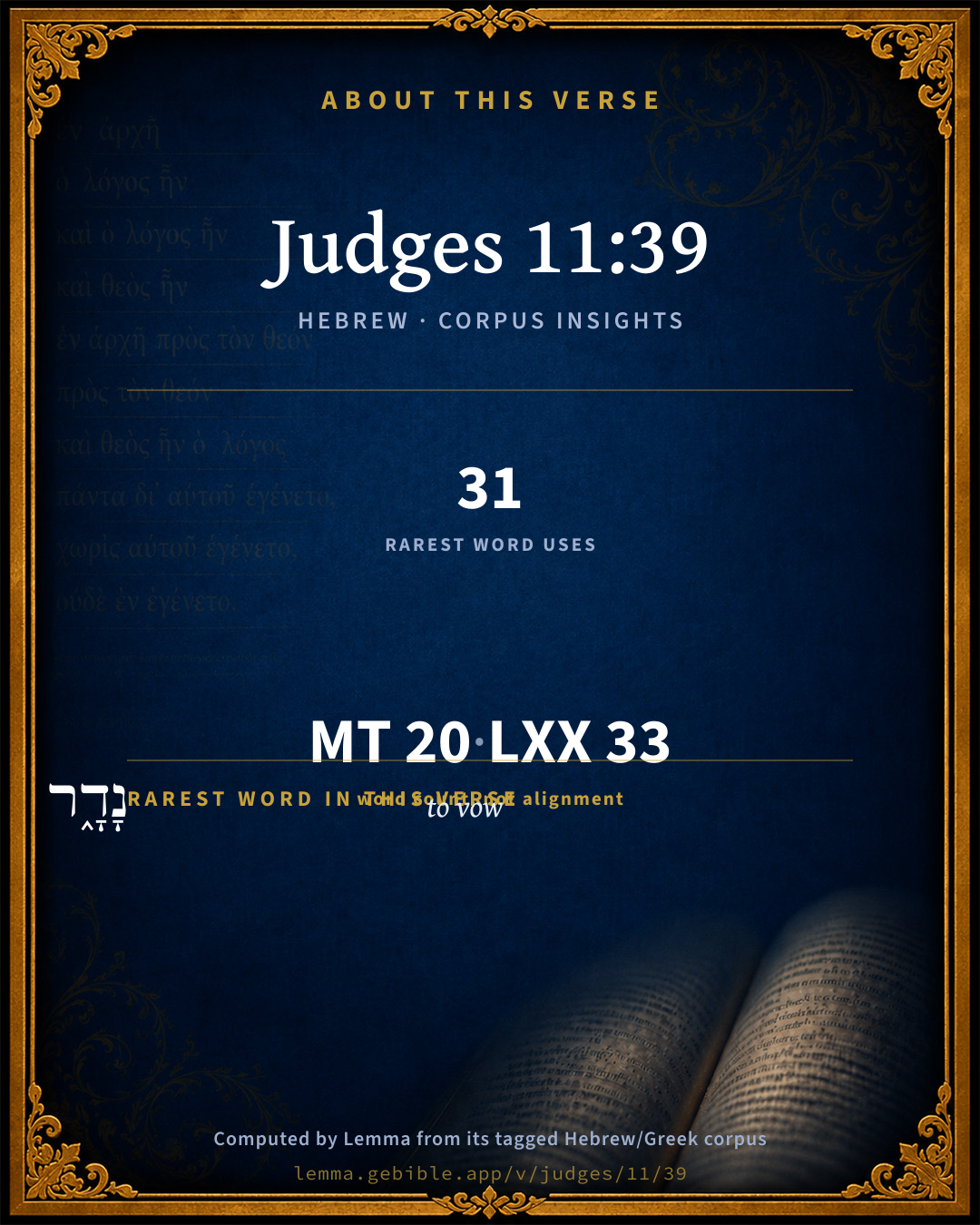
About this verse

These counts appear in no published source. They are computed here, from the morphology-tagged text and Lemma’s own curated glosses. What Lemma adds →

20
words
18
distinct lemmas
Historical
section

Shared distinctive vocabulary

נָדָ֑ר to vow H5087 occurs in 28 verses of the Hebrew Bible. Also found in:

Grammatical profile

  • 6 verbs
  • 7 nouns
  • 1 adjective
  • 1 pronoun
  • 2 prepositions
  • 3 particles

Verb forms

  • וַיְהִ֞י Qal · Sequential Imperfect
  • וַתָּ֨שָׁב֙ Qal · Sequential Imperfect
  • וַיַּ֣עַשׂ Qal · Sequential Imperfect
  • נָדָ֑ר Qal · Perfect
  • יָדְעָ֣ה Qal · Perfect
  • וַתְּהִי Qal · Sequential Imperfect

Repetition

A word recurs within this verse — often emphatic in Hebrew:

  • וַיְהִ֞י to be H1961 ×2

Hebrew & Septuagint length

In English translation the verse runs 37 words from the Hebrew and 33 from the Septuagint (LXX English) — closely comparable.

A rough comparison of the two English renderings, which tokenize alike — not a word-level alignment.

Word counts can differ between the Hebrew and the Greek without any difference in meaning — e.g. the Hebrew direct-object marker אֵת has no separate Greek word, and Greek often adds the article ὁ.

In the original languages it is 20 Hebrew tokens and 33 Greek tokens — but the two are counted differently (Hebrew bundles its prefixes and suffixes into one token; the Greek is in lemma form), so that isn’t a like-for-like length.

Cross-references

9

Topical passages linked to Judges 11:39 in the Treasury of Scripture Knowledge — connected by theme and wording, ordered by reader-vote popularity; previews shown in the World English Bible.

  • Judges 11:31 then it shall be, that whatever comes forth from the doors of my house to meet me, when I return in peace from the children of Ammon, it shall be Yahweh's, and I will offer it up for a burnt offering.
  • Isaiah 66:3 He who kills an ox is as he who kills a man; he who sacrifices a lamb, as he who breaks a dog's neck; he who offers an offering, [as he who offers] pig's blood; he who burns frankincense, as he who blesses an idol. Yes, they have chosen their own ways, and their soul delights in their abominations:
  • Leviticus 27:28–29 "'Notwithstanding, no devoted thing, that a man shall devote to Yahweh of all that he has, whether of man or animal, or of the field of his possession, shall be sold or redeemed: every devoted thing is most holy to Yahweh.
  • 1 Samuel 2:18 But Samuel ministered before Yahweh, being a child, girded with a linen ephod.
  • Deuteronomy 12:31 You shall not do so to Yahweh your God: for every abomination to Yahweh, which he hates, have they done to their gods; for even their sons and their daughters do they burn in the fire to their gods.
  • 1 Samuel 1:11 She vowed a vow, and said, Yahweh of hosts, if you will indeed look on the affliction of your handmaid, and remember me, and not forget your handmaid, but will give to your handmaid a man-child, then I will give him to Yahweh all the days of his life, and there shall no razor come on his head.
  • 1 Samuel 1:24 When she had weaned him, she took him up with her, with three bulls, and one ephah of meal, and a bottle of wine, and brought him to the house of Yahweh in Shiloh: and the child was young.
  • 1 Samuel 1:28 therefore also I have granted him to Yahweh; as long as he lives he is granted to Yahweh. He worshiped Yahweh there.
  • 1 Samuel 1:22 But Hannah didn't go up; for she said to her husband, [I will not go up] until the child be weaned; and then I will bring him, that he may appear before Yahweh, and there abide forever.

Cross-references courtesy of OpenBible.info (CC BY 4.0).

Hebrew and Greek witnesses Masoretic Hebrew ↔ Greek Septuagint

The same verse in the two great witnesses to the Old Testament, shown verse-for-verse.

These are two independent witnesses, not word-aligned to each other, and the Septuagint is shown in lemma (dictionary) form.

Hebrew Judges 11:39 Masoretic · Westminster Leningrad Codex

וַיְהִ֞י מִקֵּ֣ץ שְׁנַ֣יִם חֳדָשִׁ֗ים וַתָּ֨שָׁב֙ אֶל אָבִ֔יהָ וַיַּ֣עַשׂ לָ֔הּ אֶת נִדְר֖וֹ אֲשֶׁ֣ר נָדָ֑ר וְהִיא֙ לֹא יָדְעָ֣ה אִ֔ישׁ וַתְּהִי חֹ֖ק בְּיִשְׂרָאֵֽל

It happened at the end of two months, that she returned to her father, who did with her according to his vow which he had vowed: and she was a virgin. It was a custom in Israel,

World English Bible · Public Domain

Greek LXX Judges 11:39 Septuagint · lemma form

καί γίγνομαι ἐν τέλος ὁ δύο μήν καί ἐπιστρέφω πρός ὁ πατήρ αὐτός καί ποιέω ἐν αὐτός ὁ εὐχή αὐτός ὅς εὔχομαι καί αὐτός οὐ γιγνώσκω ἀνήρ καί γίγνομαι εἰς πρόσταγμα ἐν ἰσραήλ

And it came to pass at the end of the two months that she returned to her father; and he performed upon her his vow which he vowed; and she knew no man:

LXX2012 (modern English Septuagint) · Public Domain

On this verse, Keil & Delitzsch discusses the Septuagint’s reading. Read the note in Commentary ↓

Hebrew: Westminster Leningrad Codex (CC BY 4.0). Greek: Septuagint (public domain); English from LXX2012 (modern English Septuagint) (Public Domain). How the Septuagint differs from the Hebrew →

Targum (Aramaic paraphrase)

1

The Targum is the ancient Jewish Aramaic paraphrase of the Hebrew Scriptures — an interpretive translation, not the Hebrew text itself. Onkelos (literal) and Pseudo-Jonathan (expansive) render the Torah, and Jonathan the Prophets. Coverage is partial: where no permissively-licensed English translation exists for a verse, only the Aramaic is shown. This is verse-level text, not a word-by-word alignment to the Hebrew.

  1. Targum Jonathan Prophets (Joshua–Malachi)
    וַהֲוָה מִסּוֹף תְּרֵין יַרְחִין וְתָבַת לְוַת אֲבוּהָא וַעֲבַד לָהּ יַת נִדְרֵיהּ דִי נְדַר וְהִיא לָא יָדְעַת גְבַר וַהֲוַת לִגְזֵירָא בְּיִשְׂרָאֵל: [בְּדִיל דְלָא לְאַסָקָא גְבַר יַת בְּרֵיהּ וְיַת בְּרַתֵּיהּ לַעֲלָתָא כְּמָא דַעֲבַד יִפְתַּח גִלְעָדָאָה וְלָא שָׁאֵיל לְפִינְחָס כַּהֲנָא וְאִילוּ שָׁאֵיל לְפִינְחָס כַּהֲנָא הֲוָה פָרִיק יָתָהּ בְּדָמִין:]

    (no public-domain English translation for this verse)

    Targum Jonathan — Aramaic: “Mikraot Gedolot” (public domain). English: “Sefaria Community Translation” (CC0 1.0 (public-domain dedication)); “London "Chaldee Paraphrase," 1871” (public domain). Text via Sefaria.

Commentary

Notes on Judges 11:39 from classic Christian and Jewish commentators (each source and its license shown beneath its notes). The classic Christian expositions comment on the surrounding passage and are grouped to its opening verse, so a note may address several verses; the Jewish commentaries on the Tanakh (Rashi and others) are per-verse, so they appear only where the commentator wrote on this verse.

Lemma curates 59 commentaries, every one of them public domain or Creative Commons licensed, each selected and text-cleaned for this edition rather than reprinted as found. About our sources →

Trapp's Complete Commentary

John Trapp

Jdg 11:39 And it came to pass at the end of two months, that she returned unto her father, who did with her [according] to his vow which he had vowed: and she knew no man. And it was a custom in Israel,

Ver. 39. That she returned unto her father.] As Damon did to Dionysius; as Regulus the Roman did to the Carthaginians, though it were to receive punishment; they would not break their words, but die rather than lie.

Who did with her according to his vow.] {See Trapp on "Jdg 11:30"}

And it was a custom in Israel.] Or, An ordinance; and that for two reasons, saith Augustine: first, That parents might be admonished not to vow so rashly; secondly, That this noble virgin’s obedience to her father might be eternised.

John Trapp, A Commentary or Exposition upon All the Books of the Old and New Testament (1647–1656) — public domain. Text from a community e-Sword module.

Matthew Poole's English Annotations

Quest. What was it which Jephthah vowed and performed concerning his daughter?

Answ. Many, especially of modern writers, conceive that Jephthah’s daughter was not sacrificed, but only devoted to perpetual virginity, which then was esteemed a great curse and reproach. This they gather,

1. From Jdg 11:37,38, where we read that she bewailed not her death, which had been the chief cause of lamentation, if that had been vowed, but her virginity.

2. From Jdg 11:39, where, after he had said that

he did with her according to his vow, he adds, by way of declaration of the matter of that vow,

and she knew no man. But for the first, there may be a fair reason given, That she could not with honour bewail her death, which she had so generously and cheerfully accepted of, because it was attended with and occasioned by the public good, and her father’s honour and happiness, Jdg 11:36, and was a kind of martyrdom; and moreover, an act of religion, the payment of a vow, which ought to be done cheerfully; but only bewailed the circumstance of her death, that it was in some sort accursed and opprobrious; she having had no husband to take away her reproach, as they speak, Isa 4:1, and leaving no posterity to her father’s comfort, and the increase of God’s people. And for the second, that clause, and she knew no man, is plainly distinguished from the execution of his vow, which is here mentioned before; and this is added, not as an explication of the vow, but as an aggravating circumstance, that this was executed when she had not yet known any man. Besides, this opinion seems liable to weighty objections:

1. There is no example in all the Scripture of any woman that was obliged to perpetual virginity by any vow of her own, much less by the vow of her parents; nor have parents any such power over their children, either by the law of nature, or by the Holy Scripture.

2. The express words of the vow, Jdg 11:31, mention nothing of her virginity. but only that she should surely be the Lord’s, i.e. devoted to the service of the Lord, which might be without any obligation to perpetual virginity; for even Samuel, who was as fully devoted to the Lord by his parents as she could be, 1Sa 1:11; and Samson, who was devoted not only by his parents, but by God himself, and that in the highest degree, even to be a perpetual Nazarite, Jdg 13:5,7; yet were not prohibited marriage; nor were any of the most sacred persons, Levites, or priests, or high priests, though they were the Lord’s in a singular manner, obliged to perpetual virginity: and therefore if she was not offered up for a burnt-offering, as the authors of this opinion say, but only was consecrated to God, there was no occasion to bewail her virginity, which, for any thing that appears, she was not tied to.

3. If this were all, here was no sufficient cause why so wise and valiant a man as Jephthah should so bitterly and passionately lament over himself or his daughter. And therefore it may seem most probable that Jephthah did indeed sacrifice his daughter, as he had vowed to do; which was the opinion of Josephus the Jew, and of the Chaldee Paraphrast, and of divers of the Jewish doctors, and almost all the ancient fathers, and many eminent writers; and this best agrees with the words of the vow, delivered Jdg 11:31,

Whatsoever cometh forth of the doors of my house to meet me—shall surely be the Lord’s, and I will offer it for a burnt-offering. Nor is there one word in all the following verses which denies that she was thus offered; only the execution of the vow is delivered in more ambiguous and general terms, Jdg 11:39, which in all reason, and by the laws of good interpretation, ought to be limited and explained by the more plain and particular description of it. It is true, those words may seem capable of another interpretation; the conjunctive particle and may be here put for the disjunctive or, as it often is, as Exo 21:16-17; Le 6:3,5; 2Sa 2:19, &c.; and so the meaning is, That what I first meet shall surely be the Lord’s, or, I will offer it up for a burnt-offering, to wit if it be a creature fit to be offered; otherwise, say they, if a dog or an ass should have met him first, he should have been obliged to offer them, which was against the law. But it is sufficiently evident that he speaks of a human person, from the very phrase of

coming forth. to meet him at his return; which plainly argues a design to meet him, purposely to congratulate his return; this phrase of going to meet a person coming being very oft used in Scripture, and constantly of one person meeting another, as Gen 14:17; Gen 17:2; 24:17, &c., and never of any brute creature. And although and is sometimes put for or, yet it is not to be so used without necessity, which seems not to be in this place; nor is it very proper to distinguish two sentences in this manner, where the one is more general, and the other being more special, is comprehended within it, which is the case here; for it shall surely be the Lord’s, is the general; and its being offered up for a burnt-offering is the particular way or manner how it was to be the Lord’s; as it were very improper to say, this is either a man, or it is my servant John; because the latter branch is contained in the former; and therefore in all the alleged instances where and is put for or, they are two distinct persons or things, and not one comprehended within another, as Exo 21:17, father or mother; 2Sa 2:19, right hand or left. But the great objection against this opinion is this, that it seems a most horrid act, directly contrary to the law of nature, and to plain Scripture, thus to sacrifice his own daughter; and that it seems altogether incredible, either that such a man as Jephthah, so eminent for piety, and wisdom, and zeal, and faith, should either make so barbarous a vow, or pursue it for above two months’ space; and that none of the priests of that time should inform him of the unlawfulness of executing so wicked a vow, and of the liberty he had to redeem such a vow, by virtue of Lev 27:2,3, &c.; or that Jephthah would not willingly receive information, especially where it was so agreeable to his own interest and natural affection; or that the priests and people would suffer him to execute his own daughter, and not rather hinder him by force, as they afterwards did Saul which he had sworn the death of Jonathan. These and other such difficulties I confess there are in the case; but something may be truly and fairly said to allay the seeming monstrousness of this act.

1. These were times of great and general ignorance and corruption of religion, wherein the Israelites had apostatized from God, and learnt and followed the practices and worships of the heathen nations, Jdg 10:6, whereof this was one, to offer up human sacrifices to Moloch; and although they seem now to have repented and forsaken their idols, Jdg 10:16, yet they seem still to have retained part of the old leaven, and this among the rest, that they might offer human sacrifices, not to Moloch, as they had done, but unto the Lord. And whereas some of the Jewish writers pretend that Phinehas was alive at this time; and tell a fine story concerning him and Jephthah, that both stood upon their terms, and neither would go to the other to advise about the matter; yet it is more than probable that Phinehas was dead long before this time, and whosoever was the high priest then, he seems to be guilty either of gross ignorance or negligence; so that a late learned writer conceives that this was the reason why the priesthood was taken from him, and from that line, and translated to the line of Ithamar, which was done in the time of the judges, as may be gathered from 1Sa 2:35,36. Moreover Jephthah, though now a good man, may seem to have had but a rude and barbarous education; having been banished from his father’s house, and forced to wander and dispose himself in the utmost borders of the land of Gilead, beyond Jordan, at a great distance from the place of worship and instruction: nor is it strange that the priests and people did not resist Jephthah in this enterprise; partly because many of them might be under the same ignorance and mistake that Jephthah did; and partly because they knew Jephthah to be a stout, and resolute, and boisterous man, and were afraid to oppose him in a matter wherein he seemed to be so peremptory, and their persons and families were not much concerned.

2. This mistake of Jephthah’s, and of the rest of that age, was not without some plausible appearance of warrant from the holy text, even from Lev 27:28,29, wherein it is expressly provided, that no devoted thing, whether man or beast, should be redeemed, but should surely be put to death; a place which it is not strange that a soldier in so ignorant an age should mistake, seeing even some learned divines, in this knowing age, and Capellus, amongst the rest, have fallen into the same error, and justified Jephthah’s action from that place; and though I doubt not they run into the other extreme, as men commonly do, those words being to be otherwise understood than they take them, (of which see my notes on that place,) yet it must be granted that place gave Jephthah a very colourable pretext for the action; and being pushed on by zeal for God, and the conscience of his vow, he might easily be induced to it; and though this was a sin in him, yet it was but a sin of ignorance; which therefore was overlooked by a gracious God, and not reproved by any holy men of God. It is probably conceived, that the Greeks, who used to steal sacred histories, and turn them into fables, had from this history their relation of Iphigenia, (which may be put for Jephtigenia,) sacrificed by her father Agamemnon, which is described by many of the same circumstances wherewith this is accompanied.

She knew no man, to wit, carnally; she, died a virgin.

Matthew Poole's English Annotations on the Holy Bible (1683–1685) — public domain. Text from a community e-Sword/MySword module.

Joseph Benson's Commentary

Jdg 11:39. Did with her — That Jephthah’s daughter was not sacrificed, but only devoted to perpetual virginity, appears, 1st, From Jdg 11:37-38, where we read that she bewailed, not her death, which had been the chief cause of lamentation, if that had been vowed, but her virginity; 2d, From this verse, where, after the sacred writer had said, that he did with her according to his vow; he adds, by way of declaration of the matter of that vow, and she knew no man.

Joseph Benson's Commentary on the Old and New Testaments (1811–1818) — public domain. Text from a community e-Sword module.

Keil & Delitzsch

C. F. Keil & F. Delitzsch

At the end of two months she returned to her father again, "and he did to her the vow that he had vowed, and she knew no man." I consequence of this act of Jephthah and his daughter, "it became an ordinance (a standing custom) in Israel: from year to year (see Exo 13:10) the daughters of Israel go to praise the daughter of Jephthah the Gileadite four days in the year. תּנּה does not mean θρηνεῖν, to lament or bewail (lxx, Chald., etc.), but to praise, as R. Tanchum and others maintain.

With regard to Jephthah's vow, the view expressed so distinctly by Josephus and the Chaldee was the one which generally prevailed in the earlier times among both Rabbins and fathers of the church, viz., that Jephthah put his daughter to death and burned her upon the altar as a bleeding sacrifice to Jehovah. It was not till the middle ages that Mos. and Dav. Kimchi and certain other Rabbins endeavoured to establish the view, that Jephthah merely dedicated his daughter to the service of the sanctuary of Jehovah in a lifelong virginity. And lastly, Ludov. Cappellus, in his Diatriba de voto Jephtae, Salm. 1683 (which has been reprinted in his Notae critic. in Jud. xvi., and the Critici Sacri, tom. i.), has expressed the opinion that Jephthah put his daughter to death in honour of the Lord according to the law of the ban, because human beings were not allowed to be offered up as burnt-sacrifices. Of these different opinions the third has no foundation in the text of the Bible. For supposing that Jephthah had simply vowed that on his return he would offer to the Lord whatever came to meet him out of his house, with such restrictions only as were involved in the very nature of the case - viz., offering it as a burnt-offering if it were adapted for this according to the law; and if it were not, then proceeding with it according to the law of the ban, - the account of the fulfilment of this vow would certainly have defined with greater precision the manner in which he fulfilled the vow upon his daughter. The words "he did to her his vow which he had vowed," cannot be understood in any other way than that he offered her as עולה, i.e., as a burnt-offering, to the Lord. Moreover, the law concerning the ban and a vow of the ban could not possibly give any individual Israelite the right to ban either his own child or one of his household to the Lord, without opening a very wide door to the crime of murder. The infliction of the ban upon any man presupposed notorious wickedness, so that burnt-offering and ban were diametrically opposed the one to the other. Consequently the other two views are the only ones which can be entertained, and it is not easy to decide between them. Although the words "and I offer him as a burnt-offering" appear to favour the actual sacrifice so strongly, that Luther's marginal note, "some affirm that he did not sacrifice her, but the text is clear enough," is perpetually repeated with peculiar emphasis; yet, on looking more closely into the matter, we find insuperable difficulties in the way of the literal interpretation of the words. Since יצא אשׁר היּוצא cannot be taken impersonally, and therefore when Jephthah uttered his vow, he must at any rate have had the possibility of some human being coming to meet him in his mind; and since the two clauses "he shall be the Lords," and "I will offer him up for a burnt-offering," cannot be taken disjunctively in such a sense as this, it shall either be dedicated to the Lord, or, if it should be a sacrificial animal, I will offer it up as a burnt-offering, but the second clause simply contains a more precise definition of the first-Jephthah must at the very outset have contemplated the possibility of a human sacrifice. Yet not only were human sacrifices prohibited in the law under pain of death as an abomination in the sight of Jehovah (Lev 18:21; Lev 20:2-5; Deu 12:31; Deu 18:10), but they were never heard of among the Israelites in the early times, and were only transplanted to Jerusalem by the godless kings Ahaz and Manasseh.

(Note: "Human sacrifices do not even belong to heathenism generally, but to the darkest night of heathenism. They only occur among those nations which are the most thoroughly depraved in a moral and religious sense." This remark of Hengstenberg (Diss. iii. p. 118) cannot be set aside by a reference to Euseb. praep. ev. iv. 16; Baur, Symb. ii. 2, pp. 293ff.; Lasaulx, Shnopfer der Griechen und Rmer, 1841, pp. 8-12; Ghillany, die Menschenopfer der alten Hebrer, 1842, pp. 107ff., as Kurtz supposes, since the uncritical character of the proofs collected together in these writings is very obvious on a closer inspection, and Eusebius has simply taken his examples from Porphyry, and other writings of a very recent date.)

If Jephthah therefore vowed that he would offer a human sacrifice to Jehovah, he must either have uttered his vow without any reflection, or else have been thoroughly depraved in a moral and religious sense. But what we know of this brave hero by no means warrants any such assumptions, His acts do not show the slightest trace of impetuosity and rashness. He does not take to the sword at once, but waits till his negotiations with the king of the Ammonites have been without effect. Nor does he utter his vow in the midst of the confusion of battle, so that we might fancy he had made a vow in the heat of the conflict without fully weighting his words, but he uttered it before he set out against the Ammonites (see Jdg 11:30 and Jdg 11:32). So far as the religious training of Jephthah was concerned, it is true that he had led the life of a freebooter during his exile from his country and home, and before his election as the leader of the Israelites; but the analogous circumstances connected with David's life preclude us from inferring either moral depravity or religious barbarism from this. When David was obliged to fly from his country to escape from Saul, he also led a life of the same kind, so that all sorts of people came to him, not pious and virtuous people, but all who were in distress and had creditors, or were embittered in spirit (Sa1 22:2); and yet, even under these circumstances, David lived in the law of the Lord. Moreover, Jephthah was not destitute of the fear of God. This is proved first of all by the fact, that when he had been recalled from his exile he looked to Jehovah to give him the victory over the Ammonites, and made a treaty with the elders of Gilead "before Jehovah" (Jdg 11:9 and Jdg 11:10); and also by the fact, that he sought to ensure the help of God in war through the medium of a vow. And again, we have no right to attribute to him any ignorance of the law. Even if Kurtz is correct in his opinion, that the negotiations with the king of the Ammonites, which show the most accurate acquaintance with the Pentateuch, were not carried on independently and from his own knowledge of the law, and that the sending of messengers to the hostile king was resolved upon in the national assembly at Mizpeh, with the priests, Levites, and elders present, so that the Levites, who knew the law, may have supplied any defects in his own knowledge of the law and of the early history of his people; a private Israelite did not need to study the whole of the law of the Pentateuch, and to make himself master of the whole, in order to gain the knowledge and conviction that a human sacrifice was irreconcilable with the substance and spirit of the worship of Jehovah, and that Jehovah the God of Israel was not a Moloch. And again, even if we do not know to what extent the men and fathers of families in Israel were acquainted and familiar with the contents of the Mosaic law, the opinion is certainly an erroneous one, that the Israelites derived their knowledge of the law exclusively from the public reading of the law at the feast of tabernacles in the sabbatical year, as enjoined in Deu 31:10.; so that if this public reading, which was to take place only once in seven years, had been neglected, the whole nation would have been left without any instruction whatever in the law. The reason for this Mosaic precept was a totally different one from that of making the people acquainted with the contents of the law (see the commentary on this passage). And again, though we certainly do not find the law of the Lord so thoroughly pervading the religious consciousness of the people, received as it were in succum et sanguinem, in the time of the judges, that they were able to resist the bewitching power of nature-worship, but, on the contrary, we find them repeatedly falling away into the worship of Baal; yet we discover no trace whatever of human sacrifices even in the case of those who went a whoring after Baalim. And although the theocratical knowledge of the law seems to have been somewhat corrupted even in the case of such men as Gideon, so that this judge had an unlawful ephod made for himself at Ophrah; the opinion that the Baal-worship, into which the Israelites repeatedly fell, was associated with human sacrifices, is one of the many erroneous ideas that have been entertained as to the development of the religious life not only among the Israelites, but among the Canaanites, and which cannot be supported by historical testimonies or facts. That the Canaanitish worship of Baal and Astarte, to which the Israelites were addicted, required no human sacrifices, is indisputably evident from the fact, that even in the time of Ahab and his idolatrous wife Jezebel, the daughter of the Sidonian king Ethbaal, who raised the worship of Baal into the national religion in the kingdom of the ten tribes, persecuting the prophets of Jehovah and putting them to death, there is not the slightest allusion to human sacrifices. Even at that time human sacrifices were regarded by the Israelites as so revolting an abomination, that the two kings of Israel who besieged the king of the Moabites - not only the godly Jehoshaphat, but Jehoram the son of Ahab and Jezebel - withdrew at once and relinquished the continuance of the war, when the king of the Moabites, in the extremity of his distress, sacrificed his son as a burnt-offering upon the wall (Kg2 3:26-27). With such an attitude as this on the part of the Israelites towards human sacrifices before the time of Ahaz and Manasseh, who introduced the worship of Moloch into Jerusalem, we cannot, without further evidence, impute to Jephthah the offering of a bloody human sacrifice, the more especially as it is inconceivable, with the diametrical opposition between the worship of Jehovah and the worship of Moloch, that God should have chosen a worshipper of Moloch to carry out His work, or a man who was capable of vowing and offering a human-being sacrifice. The men whom God chose as the recipients of His revelation of mercy and the executors of His will, and whom He endowed with His Spirit as judges and leaders of His people, were no doubt affected with infirmities, faults, and sins of many kinds, so that they could fall to a very great depth; but nowhere is it stated that the Spirit of God came upon a worshipper of Moloch and endowed him with His own power, that he might be the helper and saviour of Israel.

We cannot therefore regard Jephthah as a servant of Moloch, especially when we consider that, in addition to what has already been said, the account of the actual fulfilment of his vow is apparently irreconcilable with the literal interpretation of the words עולה והעליתיהוּ, as signifying a bleeding burnt-offering. We cannot infer anything with certainty as to the mode of the sacrifice, from the grief which Jephthah felt and expressed when his only daughter came to meet him. For this is quite as intelligible, as even the supporters of the literal view of these words admit, on the supposition that Jephthah was compelled by his vow to dedicate his daughter to Jehovah in a lifelong virginity, as it would be if he had been obliged to put her to death and burn her upon the altar as a burnt-offering. But the entreaty of the daughter, that he would grant her two months' time, in order that she might lament her virginity upon the mountains with her friends, would have been marvellously out of keeping with the account that she was to be put to death as a sacrifice. To mourn one's virginity does not mean to mourn because one has to die a virgin, but because one has to live and remain a virgin. But even if we were to assume that mourning her virginity was equivalent to mourning on account of her youth (which is quite untenable, as בּתוּלים is not synonymous with נעוּרים), "it would be impossible to understand why this should take place upon the mountains. It would be altogether opposed to human nature, that a child who had so soon to die should make use of a temporary respite to forsake her father altogether. It would no doubt be a reasonable thing that she should ask permission to enjoy life for two months longer before she was put to death; but that she should only think of bewailing her virginity, when a sacrificial death was in prospect, which would rob her father of his only child, would be contrary to all the ordinary feelings of the human heart. Yet, inasmuch as the history lays special emphasis upon her bewailing her virginity, this must have stood in some peculiar relation to the nature of the vow. When a maiden bewails her virginity, the reason for this can only be that she will have to remain a bud that has not been allowed to unfold itself, prevented, too, not by death, but by life" (P. Cassel, p. 473). And this is confirmed by the expression, to bewail her virginity "upon the mountains." "If life had been in question, the same tears might have been shed at home. But her lamentations were devoted to her virginity, and such lamentations could not be uttered in the town, and in the presence of men. Modesty required the solitude of the mountains for these. The virtuous heart of the maiden does not open itself in the ears of all; but only in sacred silence does it pour out its lamentations of love" (P. Cassel, p. 476).

And so, again, the still further clause in the account of the fulfilment of the vow, "and she knew no man," is not in harmony with the assumption of a sacrificial death. This clause would add nothing to the description in that case, since it was already known that she was a virgin. The words only gain their proper sense if we connect them with the previous clause, he "did with her according to the vow which he had vowed," and understand them as describing what the daughter did in fulfilment of the vow. The father fulfilled his vow upon her, and she knew no man; i.e., he fulfilled the vow through the fact that she knew no man, but dedicated her life to the Lord, as a spiritual burnt-offering, in a lifelong chastity. It was this willingness of the daughter to sacrifice herself which the daughters of Israel went every year to celebrate-namely, upon the mountains whither her friends had gone with her to lament her virginity, and which they commemorated there four days in the year. And the idea of a spiritual sacrifice is supported not only by the words, but also most decisively by the fact that the historian describes the fulfilment of the vow in the words "he did to her according to his vow," in such a manner as to lead to the conclusion that he regarded the act itself as laudable and good. But a prophetic historian could never have approved of a human sacrifice; and it is evident that the author of the book of Judges does not conceal what was blameable even in the judges themselves, from his remarks concerning the conduct of Gideon (Jdg 8:27), which was only a very small offence in comparison with the abomination of a human sacrifice. To this we have to add the difficulties connected with such an act. The words "he did to her according to his vow" presuppose undoubtedly that Jephthah offered his daughter as עולה to Jehovah. But burnt-offerings, that is to say bleeding burnt-offerings, in which the victim was slaughtered and burnt upon the altar, could only be offered upon the lawful altar at the tabernacle, or before the ark, through the medium of the Levitical priests, unless the sacrifice itself had been occasioned by some extraordinary manifestation of God; and that we cannot for a moment think of here. But is it credible that a priest or the priesthood should have consented to offer a sacrifice upon the altar of Jehovah which was denounced in the law as the greatest abomination of the heathen? This difficulty cannot be set aside by assuming that Jephthah put his daughter to death, and burned her upon some secret altar, without the assistance and mediation of a priest; for such an act would not have been described by the prophetic historian as a fulfilment of the vow that he would offer a burnt-offering to the Lord, simply because it would not have been a sacrifice offered to Jehovah at all, but a sacrifice slaughtered to Moloch.

(Note: Auberlen's remarks upon this subject are very good. "The history of Jephthah's daughter," he says, "would hardly have been thought worth preserving in the Scriptures if the maiden had been really offered in sacrifice; for, in that case, the event would have been reduced, at the best, into a mere family history, without any theocratic significance, though in truth it would rather have been an anti-theocratic abomination, according to Deu 12:31 (cf. Jdg 18:9; Lev 18:21; Lev 20:1-5). Jephthah's action would in that case have stood upon the same platform as the incest of Lot (Gen 19:30.), and would owe its adoption into the canon simply to genealogical considerations, or others of a similar kind. But the very opposite is the case here; and if, from the conclusion of the whole narrative in Jdg 11:39-40, the object of it is supposed to be simply to explain the origin of the feast that was held in honour of Jephthah's daughter, even this would tell against the ordinary view. In the eye of the law the whole thing would still remain an abomination, and the canonical Scriptures would not stoop to relate and beautify an institution so directly opposed to the law.")

All these circumstances, when rightly considered, almost compel us to adopt the spiritual interpretation of the words, "offer as a burnt-offering." It is true that no exactly corresponding parallelisms can be adduced from the Old Testament in support of the spiritual view; but the germs of this view, as met with in the Psalms and the writings of the prophets, are contained in the demand of God addressed to Abraham to offer Him his only son Isaac as a burnt-offering, when compared with the issue of Abraham's temptation-namely, that God accepted his willingness to offer up his son as a completed sacrifice, and then supplied him with a ram to offer up as a bleeding sacrifice in the place of his son. As this fact teaches that what God demands is not a corporeal but a spiritual sacrifice, so the rules laid down in the law respecting the redemption of the first-born belonging to the Lord, and of persons vowed to Him (Exo 13:1, Exo 13:13; Num 18:15-16; Lev 27:1.), show clearly how the Israelites could dedicate themselves and those who belonged to them to the Lord, without burning upon the altar the persons who were vowed to Him. And lastly, it is evident, from the perfectly casual reference to the women who ministered at the tabernacle (Exo 38:8; Sa1 2:22), that there were persons in Israel who dedicated their lives to the Lord at the sanctuary, by altogether renouncing the world. And there can be no doubt that Jephthah had such a dedication as this in his mind when he uttered his vow; at all events in case the Lord, to whom he left the appointment of the sacrifice, should demand the offering up of a human being. The word עולה does not involve the idea of burning, like our word burnt-offering, but simply that of going up upon the altar, or of complete surrender to the Lord. עולה is a whole offering, as distinguished from the other sacrifices, of which only a part was given up to the Lord. When a virgin, therefore, was set apart as a spiritual עולה, it followed, as a matter of course, that henceforth she belonged entirely to the Lord: that is to say, was to remain a virgin for the remainder of her days. The fact that Nazarites contracted marriages, even such as were dedicated by a vow to be Nazarites all their lives, by no means warrants the conclusion that virgins dedicated to the Lord by a vow were also free to marry if they chose. It is true that we learn nothing definite from the Old Testament with regard to this spiritual sacrificial service; but the absence of any distinct statements upon the subject by no means warrants our denying the fact. Even with regard to the spiritual service of the women at the tabernacle we have no precise information; and we should not have known anything about this institution, if the women themselves had not offered their mirrors in the time of Moses to make the holy laver, or if we had not the account of the violation of such women by the sons of Eli. In this respect, therefore, the remarks of Clericus, though too frequently disregarded, as very true: "It was not to be expected, as I have often observed, that so small a volume as the Old Testament should contain all the customs of the Hebrew, and a full account of all the things that were done among them. There are necessarily many things alluded to, therefore, which we do not fully understand, simply because they are not mentioned elsewhere."

Keil & Delitzsch — Biblical Commentary on the Old Testament (1861–1891) — public domain (CC PDM 1.0). Text via the HelloAO Bible API. (Old Testament only.)

Adam Clarke's Commentary

Verse 39. And she knew no man] She continued a virgin all the days of her life.

Adam Clarke's Commentary on the Bible (1810–1826) — public domain. Text from a community e-Sword/MySword module.

Ellicott's Commentary for English Readers

(39) Who did with her according to his vow.—In this significant euphemism the narrator drops the veil—as though with a shudder—over the terrible sacrifice. Of course, “did with her according to his vow” can only mean “offered her up for a burnt offering” (Jdg_11:31). “Some,” says Luther, “affirm that he did not sacrifice her; but the text is clear enough.” The attempt, first started by Rabbi Kimchi, to make this mean “kept her unmarried until death”—i.e., shut her up in a sacred celibacy—is a mere sophistication of plain Scripture. That he did actually slay her in accordance with his cherem is clear, not only from the plain words, but also for the following reasons:—(1) The customs of that day knew nothing about treating women as “nuns.” If there had been any institution of vestals among the Jews we should without fail have heard of it, nor would the fate of Jephthah’s daughter been here regarded and represented as exceptionally tragic. (2) There are decisive Scriptural analogies to Jephthah’s vow, taken in its most literal sense—Abraham (Gen_23:3), Saul (1Sa_14:44), &c. (See on Jdg_11:31.) (3) There are decisive Pagan analogies, both Oriental (2Ki_3:27; Amo_2:1) and classical. Thus Idomeneus actually sacrificed his eldest son (Serv. ad Æn. iii. 331) in an exactly similar vow, and Agamemnon his daughter Iphigenia. (4) The ancient Jews, who were far better acquainted than we can be with the thoughts and customs of their race and the meaning of their own language, have always understood that Jephthah did literally offer his daughter as “a burnt offering.” The Targum of Jonathan adds to the words “it was a custom in Israel” the explanation, “in order that no one should make his son or his daughter a burnt offering, as Jephthah did, and did not consult Phinehas the priest. Had he done so, he would have redeemed her with money”—i.e., Phinehas would have decided that it was less crime to redeem such a cherem than to offer a human sacrifice. It is curious to find that another legend (hagadah) connects Phinehas with this event in a very different way. It says that Phinehas sanctioned, and even performed the sacrifice, and that for this very reason he was superseded by the indignation of the Israelites, which is the reason they offer for the fact that Eli was of the house, not of Phmehas, but of Ithamar (Lightfoot, Works, i. 12-18). In the same way Idomeneus, after sacrificing his eldest son, is punished by the gods with plague and by his citizens with banishment. Josephus agrees with these Jewish authorities, and says that Jephthah offered (holokautôsen) his daughter (see on Jdg_11:31); and so does Rabbi Tanchum. The opinion was undisputed till a thousand years after Christ, when Rabbi Kimchi invented the plausible hypothesis which has pleased so many commentators who carry their own notions to the Bible ready made, and then find them there. Ewald contents himself with saying that this “timid modern notion needs no refutation.” It is remarkable that we find a similar vow as late as the sixth century after Christ. Abd Almuttalib, grandfather of Mohammed, vows to kill his son Abd Allah if God will give him ten sons. He had twelve sons; but when he wishes to perform his vow the Koreish interfere, and Abd Almuttalib, at the bidding of a priestess, gives one hundred camels as a ransom (Weil, Mohammed, p. 8).

It was a custom.—Or, ordinance—namely, to lament Jephthah’s daughter. Probably the custom was local only, for we find no other allusion to it.

A Bible Commentary for English Readers, edited by Charles John Ellicott (1878–1897) — public domain. Text from a community e-Sword module.

The Cambridge Bible for Schools and Colleges

gen. ed. J. J. S. Perowne

39. who did with her according to his vow] The language is marked by a fine reserve, but the plain sense of it is that Jephthah offered the tragic sacrifice. Early Jewish interpretation took it to mean this; Talm. Ta‘anith 4 a (where the sacrifice is compared with that of Isaac and of Mesha’s son); Midrash Bereshith Rab. § 60; Jos., Ant. Jdg_11:7; Jdg_11:10. The same view was adopted by the Christian Fathers and Church writers (e.g. St Augustine, Opera, t. iii. 812 ‘procul dubio nihil aliud quam hominem cogitabit’; St Ambrose, Op. t. ii. 177, 178 and 281, 282; St Chrysostom, Op. t. ii. 147). In the Middle Ages, however, the natural meaning of the words was explained away, first by the Jewish commentators (e.g. by Ḳimḥi in loc. ‘he made a house for her and brought her into it, and she was there separated from mankind and from the ways of the world’), and following them by Christian interpreters. More recently it has been suggested that Jephthah dedicated the maiden to Jehovah as a virgin priestess or vestal in the local sanctuary; cf. Code of Ḫammurabi, § 181, which alleges the case of a father dedicating a votary to a god; Benzinger, Hebr. Arch.2 (1907), 360.

and she had not known man] she being a virgin (for the Hebr. idiom see Driver, Tenses, § 159). The sacrifice, therefore, was all the greater; her father’s race perished with her. Similarly in early Greek myths the human victim is nearly always a virgin; see Murray, Rise of the Gk. Epic, 121–123. Cf. Virgil, Aen. x. 518–520 (note juvenes).

The Cambridge Bible for Schools and Colleges (gen. ed. J. J. S. Perowne; Cambridge University Press, 1878–1918) — public domain. Text from a community e-Sword module.

Haydock's Catholic Bible Commentary

Father. Her fortitude is commended by St. Ambrose (Off. iii. 12,) as more worthy of admiration than that of the two Pythagorean friends, one of whom, being sentenced to die, procured the other to stand bond for his return; and, at the time appointed, came freely to deliver himself up; an instance of generosity which made the tyrant who had sentenced him to die, beg that they would admit him into the society of their friendship. (Haydock) --- Whatever we may think of Jephte, "we cannot sufficiently admire the dutiful behaviour, and amiable simplicity of the daughter, who voluntarily submitted to her parent’s will, and exhorted him to do as he had vowed. To die to sin, to resign the pomps of a licentious world, to renounce those pleasures and incentives to vice, which are inconsistent with a clean heart, is a sacrifice truly meritorious, and acceptable to God; it is a sacrifice which was solemnly begun at the font of baptism." (Reeves, in the year of the world 2817.) --- No man. It is remarked by those who believe that she was not slain, that this observation would be very unnecessary in the contrary opinion. No mention of death is made. The virgin only deplores, with pious resignation, that she cannot be the happy mother of the Messias.

George Leo Haydock (1774–1849), Haydock's Catholic Family Bible and Commentary, 1859 edition — public domain. Excludes Psalms (Douay-Rheims chapter numbering differs from Protestant) and Deuterocanonical books (Catholic canon only).

Whedon's Commentary on the Bible

Daniel D. Whedon

39. Did with her according to his vow — Literally, Did to her his vow which he had vowed. This plain and positive statement throws us back for the meaning of Jephthah’s act to Jdg_11:31, where the language of his vow is carefully recorded. Whatever act his vow contemplated, that certainly he did. Nothing more, nothing less. He devoutly kept his word. He had opened his mouth unto the Lord, and, notwithstanding all his anguish, he went not back from his solemn oath. So, according to the previous exposition of his language, we can understand nothing else than that he offered her for a burnt offering unto the Lord.

And she knew no man — This fact the sacred writer adds as that alone which, in the estimation of that age, was the sting of death to the heroic maiden. It is very natural that those expositors who seek to show that Jephthah’s daughter was not put to death at all, should regard these words as indicating the manner in which he fulfilled his vow. Why else, they ask, is this fact of her virginity again mentioned? If she was sacrificed, they affirm, the record would have been: “He did to her his vow which he had vowed, and offered her for a burnt offering.” Such an addition, we reply, was not necessary, and, after the full and careful statement of his vow in Jdg_11:31, would have been superfluous. But if, as we have shown above, and as most modern scholars are constrained to admit, he contemplated a human sacrifice, and if, instead of offering her as a burnt offering, he devoted her to a life of celibacy, then plainly he did NOT according to his vow which he had vowed, but contrary to it; and the mere addition, she knew no man, would be a most inexplicably strange way of informing us that Jephthah failed to keep his word. The sacred historian uses no needless word, nor does he attempt to picture the sad spectacle of the sacrifice; but he records, not as the manner in which Jephthah fulfilled his vow, but as the most fearful knell that, in the ears of her father and companions, sounded over that daughter’s funeral pile, and sent its lingering echo into the after-times — she knew no man.

It was a custom in Israel — What was a custom in Israel? For fathers to sacrifice daughters, after the example of Jephthah? This no one will pretend. To offer human sacrifices to Jehovah? No; for such a custom never prevailed to any considerable extent in Israel, and least of all was it occasioned by Jephthah’s example. To consecrate young maidens to perpetual virginity? There is not a particle of evidence that such a custom prevailed after this time more than before, and no certain evidence that it was ever a custom in Israel. On the contrary, the whole tendency of Hebrew laws and civilization was against a forced celibacy on the part of either sex. — What custom, then, sprang up in Israel on this occasion? Clearly, the custom described in the next verse, of the yearly celebration of Jephthah’s daughter. The Hebrew is, She became a custom in Israel; that is, her heroism and sublime submission to be sacrificed made such an impression on the daughters of Israel that they instituted a yearly celebration of her memory.

Daniel D. Whedon (gen. ed.), Commentary on the Old and New Testaments (1874–1909) — public domain. Text from a community e-Sword module.

The Pulpit Commentary

Who did with her according to his vow. Nothing can be more express than this statement. In fact, except the natural horror we feel at a human sacrifice, there is nothing to cast the least shade of doubt upon the fact that Jephthah"s daughter was offered up as a burnt offering, in accordance with heathen notions, but, as Josephus says, neither "conformably to the law, nor acceptably to God." Most of the early Jewish commentators and all the Christian Fathers for ten or eleven centuries (Origen, Chrysostom, Theo-doret, Jerome, Augustine, etc.) held this view. Luther"s comment is, "Some affirm that he did not sacrifice her, but the text is clear enough." She knew. Rather, she had known.

The Pulpit Commentary (1880–1919), ed. H.D.M. Spence-Jones & Joseph S. Exell — public domain. Text from a community e-Sword module.

John Wesley's Explanatory Notes

Did with her - Jephthah's daughter was not sacrificed, but only devoted to perpetual virginity. This appears,

1. From ver. 37, 38, where we read, that she bewailed not her death, which had been the chief cause of lamentation, if that had been vowed, but her virginity:

2. From this ver. 39, where, after he had said, that he did with her according to his vow; he adds, by way of declaration of the matter of that vow, and she knew no man. It is probably conceived, that the Greeks, who used to steal sacred histories, and turn them into fables, had from this history their relation of Iphigenia (which may be put for Jephtigenia) sacrificed by her father Agamemnon, which is described by many of the same circumstances wherewith this is accompanied.

John Wesley, Explanatory Notes Upon the Whole Bible (1754–1765) — public domain. Text via the GEBible commentary corpus.

Rashi

Rabbi Shlomo Yitzchaki (Rashi)

She became the subject of a law. Legislation was enacted prohibiting any repetition of this, for, had he approached Pinchos, or had Pinchos approached him, he would have released him from his vow. But they refused to humble themselves, and were, thus, both responsible for her ruin. They were punished. The Divine Presence departed from Pinchos, as it is said in Divrei Hayamim, "Adonoy was with him previously." We learn that he was not with him later. And Yiftoch was afflicted with ulcerations and the loss of his limbs, as it is said, "He was buried in the cities of Gilod." Another interpretation: "She became the subject of a law in Yisroel" relates to the following passage.

Rashi on the Tanakh — English translations: “The Judaica Press complete Tanach with Rashi, translated by A. J. Rosenberg” (CC BY 4.0); “Pentateuch with Rashi's commentary by M. Rosenbaum and A.M. Silbermann, 1929-1934” (public domain); “The Metsudah Tanach series, Lakewood, N.J” (CC BY 4.0); and “The Book of Joshua, Metsudah Publications, 1997” (CC BY 4.0). Text via Sefaria.

Lesson kit

Teaching starters — assembled from the data on this page, not authored interpretation. Every prompt links to the verse data it draws on. Edit before teaching.

Judges, in the Historical, opens this verse with 20 words (18 distinct Hebrew lemmas). Its most distinctive word is nâdar (“to vow”). A historical commentator’s framing appears above. Read the whole chapter for the surrounding context.

Discussion questions

  1. What does “to vow” (nâdar) contribute to the verse as a whole?
  2. Genesis 28:20 shares the word «to vow» with this verse. How do the two illuminate each other?
  3. “to be” occurs 2× in this one verse. What is the effect of the repetition?
  4. These translations render this verse differently. What is at stake in choosing one wording over another?
  5. The verb «וַיְהִ֞י» is Qal Sequential Imperfect. How does its form color the action?
  6. Reading how Trapp's Complete Commentary and Matthew Poole's English Annotations read this verse, where do the two commentators agree and where do they part?

Things to notice

Reading settings

Reading text

Shown beneath each verse's original-language words.

Old Testament
Old Testament edition

Read the OT as the Masoretic Hebrew (MT) or the Greek Septuagint (LXX).

English shown for the Greek Septuagint (in the Hebrew ↔ Greek comparison).

Comparing translations? Open the Compare panel on any verse page to stack up to four side by side.