Isaiah 1:14

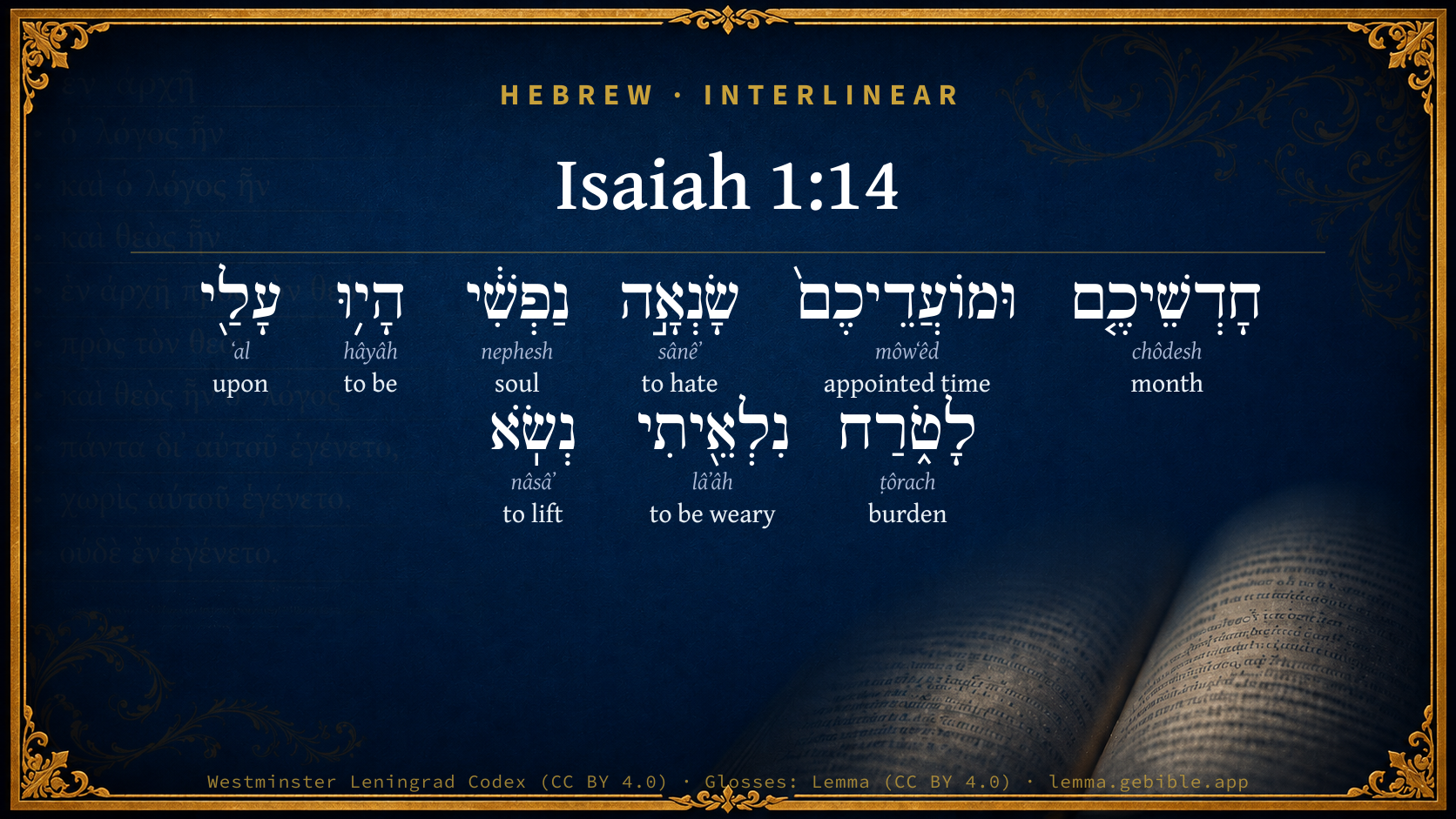
Hebrew (Westminster Leningrad Codex) Isaiah 1:14 appears in the Hebrew Old Testament. The text above is from the Westminster Leningrad Codex. Each word links to its Strong’s number, a concise gloss, and parsing drawn from the Open Scriptures Hebrew Bible morphology. Click any word for its full Brown-Driver-Briggs (BDB) entry.
Download image
Cite this verse

Isaiah 1:14 (World English Bible). Public Domain. Lemma interlinear Bible study tool, https://lemma.gebible.app/v/isaiah/1/14.

Show BibTeX & RIS
BibTeX
RIS
English Translation
My soul hates your New Moons and your appointed feasts; They are a burden to me. I am weary of bearing them.
World English Bible · Public Domain
Download a study sheet

One document with this verse’s original text, its word-by-word gloss line, the meaning frame, cross-references with their text, attributed commentary, and full source and license credits — printable, and it pastes into notes with its structure intact.

This verse Autodidact and up

Study sheet (.html) Plain text (.txt)

A passage Seminary Student

Up to 50 verses in one chapter. A passage sheet keeps up to 6 commentary sources and 12 cross-references per verse, in the order this page ranks them, and says so on the sheet whenever that leaves anything out. Ask for a single verse and you get the Autodidact verse sheet above.

Everything on this page stays free to read, with no account — the sheet is a download of what is already on screen, not access to it.

Want to remove ads? Support Godless Engineer
Compare translations 3

The same verse in 3 English versions, stacked beneath the original-language interlinear above. Click any original word for its lexicon entry.

Each is an independent rendering of the whole verse — the interlinear is not word-aligned to these translations.

Highlighted words mark where these versions differ — a whole-verse word diff, not a word-by-word alignment.

  • World English Bible Public Domain
    My soul hates your New Moons and your appointed feasts; They are a burden to me. I am weary of bearing them.
  • King James Version Public Domain
    Your new moons and your appointed feasts my soul hateth: they are a trouble unto me; I am weary to bear them.
  • unfoldingWord Literal Text CC BY-SA 4.0
    Your new moons and your annual festivals, my soul hates. They have become a burden upon me; I am wearied bearing.

unfoldingWord Literal Text — © unfoldingWord, licensed CC BY-SA 4.0. Word-aligned USFM3 via Door43 (git.door43.org/unfoldingWord/en_ult).

Versions to compare (up to 4)

3 of 4 selected

Show all 18 translations

Every available English version of this verse, each an independent rendering of the whole verse.

  • World English Bible Public Domain
    My soul hates your New Moons and your appointed feasts; They are a burden to me. I am weary of bearing them.
  • Berean Standard Bible Public Domain
    I hate your New Moons and your appointed feasts. They have become a burden to Me; I am weary of bearing them.
  • Majority Standard Bible Public Domain
    I hate your New Moons and your appointed feasts. They have become a burden to Me; I am weary of bearing them.
  • King James Version Public Domain
    Your new moons and your appointed feasts my soul hateth: they are a trouble unto me; I am weary to bear them.
  • American Standard Version (1901) Public Domain
    Your new moons and your appointed feasts my soul hateth; they are a trouble unto me; I am weary of bearing them.
  • Revised Version (1885) Public Domain
    Your new moons and your appointed feasts my soul hateth: they are a trouble unto me; I am weary to bear them.
  • Geneva Bible (1599) Public Domain
    My soule hateth your newe moones and your appointed feastes: they are a burden vnto me: I am weary to beare them.
  • Douay-Rheims (1899) Public Domain
    My soul hateth your new moons, and your solemnities: they are become troublesome to me, I am weary of bearing them.
  • Young's Literal Translation Public Domain
    Your new moons and your set seasons hath My soul hated, They have been upon me for a burden, I have been weary of bearing.
  • Literal Standard Version CC BY-SA 4.0
    My soul has hated your new moons and your set seasons, || They have been on Me for a burden, || I have been weary of bearing.
  • Unlocked Literal Bible CC BY-SA 4.0
    I hate your new moons and your appointed feasts; they are a burden to me; I am tired of enduring them.
  • unfoldingWord Literal Text CC BY-SA 4.0
    Your new moons and your annual festivals, my soul hates. They have become a burden upon me; I am wearied bearing.
  • Darby Bible Public Domain
    Your new moons and your set feasts my soul hateth: they are a burden to me; I am wearied of bearing [them].
  • World Messianic Bible Public Domain
    My soul hates your New Moons and your appointed feasts. They are a burden to me. I am weary of bearing them.
  • Webster's Bible Public Domain
    Your new moons and your appointed feasts my soul hateth: they are a trouble to me; I am weary to bear them.
  • Free Bible Version CC BY-SA 4.0
    I detest your new moon and yearly festivals with my whole being! They've become just a burden to me—I can't bear them anymore!
  • Bible in Basic English Public Domain
    Your new moons and your regular feasts are a grief to my soul: they are a weight in my spirit; I am crushed under them.
  • JPS Tanakh (1917) Public Domain
    Your new moons and your appointed seasons My soul hateth; they are a burden unto Me; I am weary to bear them.

Literal Standard Version (2020), Covenant Press — licensed CC BY-SA 4.0. Text via the HelloAO Bible API (eBible.org). Unlocked Literal Bible (unfoldingWord) — licensed CC BY-SA 4.0. Text via the HelloAO Bible API (eBible.org). unfoldingWord Literal Text — © unfoldingWord, licensed CC BY-SA 4.0. Word-aligned USFM3 via Door43 (git.door43.org/unfoldingWord/en_ult). Free Bible Version, Dr. Jonathan Gallagher — licensed CC BY-SA 4.0. Text via the HelloAO Bible API (eBible.org).

Word by word

More ways to search: Search by grammar → Find every occurrence → Compare this word →

Practice this passage: Drill this verse → Learn its vocabulary →

לָטֹ֑רַח
ṭôrach
H2960
“to/for · burden”
Preposition + Noun, Common, Masculine, Singular, Absolute
Part of Speech
Preposition + Noun
Type
Common
Gender
Masculine
Number
Singular
State
Absolute
Full BDB Definition

Origin: from H2959

TWOT: 825a

burden
  1. חָדְשֵׁיכֶ֤ם chôdesh H2320 “months · your” Noun, Common, Masculine, Plural, Construct + Suffix, Personal, 2nd Person, Masculine, Plural
  2. וּמוֹעֲדֵיכֶם֙ môwʻêd H4150 “and · appointed times · your” Conjunction + Noun, Common, Masculine, Plural, Construct + Suffix, Personal, 2nd Person, Masculine, Plural
  3. שָׂנְאָ֣ה sânêʼ H8130 “to hate” Verb, Qal, Perfect, 3rd Person, Feminine, Singular
  4. נַפְשִׁ֔י nephesh H5315 “soul · my” Noun, Common, Both, Singular, Construct + Suffix, Personal, 1st Person, Common, Singular
  5. הָי֥וּ hâyâh H1961 “to be” Verb, Qal, Perfect, 3rd Person, Common, Plural
  6. עָלַ֖י ʻal H5921 “upon · me” Preposition + Suffix, Personal, 1st Person, Common, Singular
  7. נִלְאֵ֖יתִי lâʼâh H3811 “to be weary” Verb, Niphal, Perfect, 1st Person, Common, Singular
  8. נְשֹֽׂא nâsâʼ H5375 “to lift” Verb, Qal, Infinitive Construct

About this verse

These counts appear in no published source. They are computed here, from the morphology-tagged text and Lemma’s own curated glosses. What Lemma adds →

9
words
9
distinct lemmas
Prophets
section

Notable vocabulary

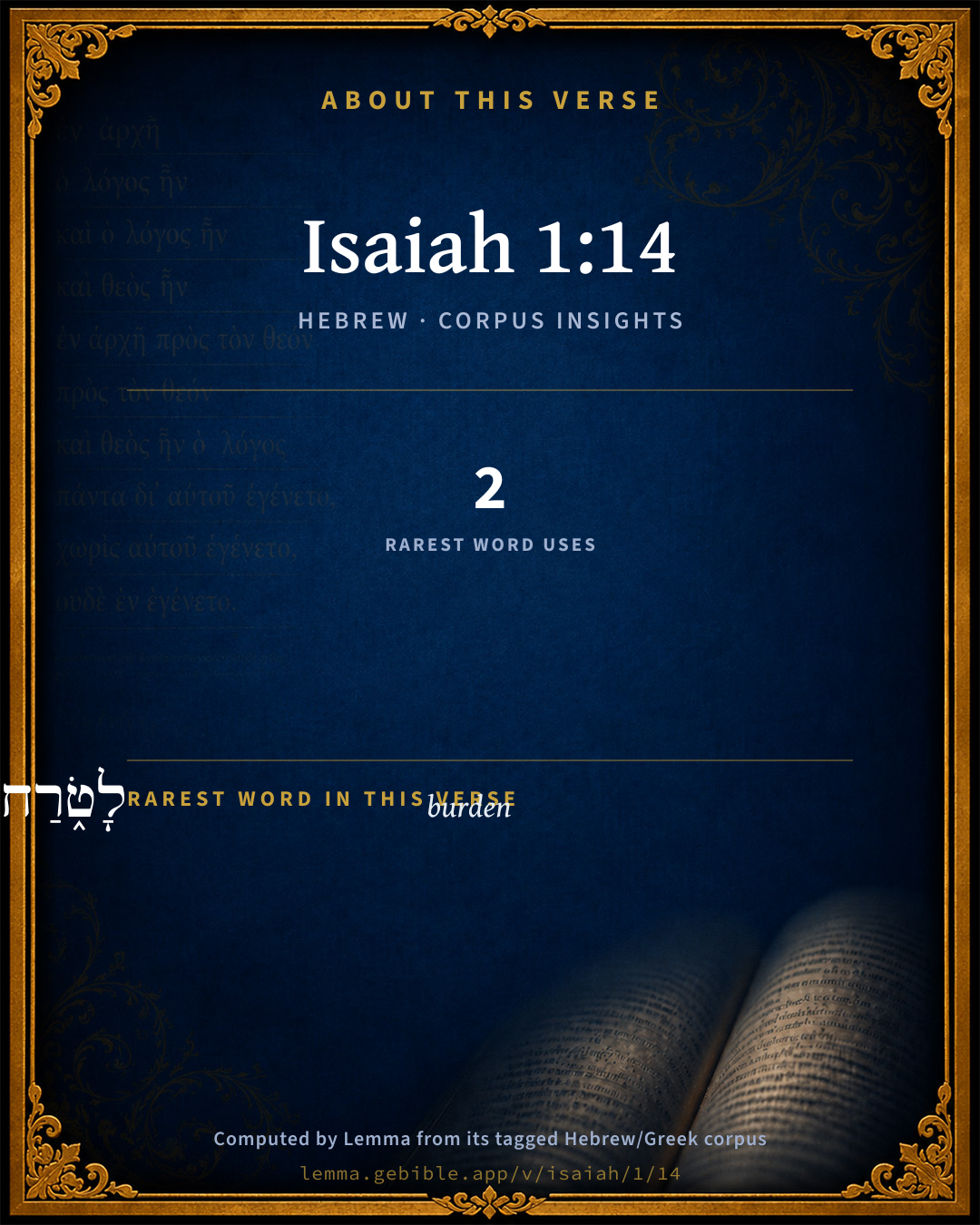
The rarest word here is לָטֹ֑רַח burden H2960 — appearing just 2 times in the whole Hebrew Bible.

Shared distinctive vocabulary

לָטֹ֑רַח burden H2960 occurs in 2 verses of the Hebrew Bible. Also found in:

Grammatical profile

  • 4 verbs
  • 4 nouns
  • 1 preposition

Verb forms

  • שָׂנְאָ֣ה Qal · Perfect
  • הָי֥וּ Qal · Perfect
  • נִלְאֵ֖יתִי Niphal · Perfect
  • נְשֹֽׂא Qal · Infinitive Construct

Hebrew & Septuagint length

In English translation the verse runs 22 words from the Hebrew and 29 from the Septuagint (LXX English) — closely comparable.

A rough comparison of the two English renderings, which tokenize alike — not a word-level alignment.

Word counts can differ between the Hebrew and the Greek without any difference in meaning — e.g. the Hebrew direct-object marker אֵת has no separate Greek word, and Greek often adds the article ὁ.

Cross-references

8

Topical passages linked to Isaiah 1:14 in the Treasury of Scripture Knowledge — connected by theme and wording, ordered by reader-vote popularity; previews shown in the World English Bible.

  • Amos 5:21 I hate, I despise your feasts, And I can't stand your solemn assemblies.
  • Isaiah 43:24 You have bought me no sweet cane with money, neither have you filled me with the fat of your sacrifices; but you have burdened me with your sins, you have wearied me with your iniquities.
  • Isaiah 7:13 He said, "Listen now, house of David: Is it not enough for you to try the patience of men, that you will try the patience of my God also?
  • Isaiah 61:8 For I, Yahweh, love justice, I hate robbery with iniquity; and I will give them their recompense in truth, and I will make an everlasting covenant with them.
  • Isaiah 29:1 Ho Ariel, Ariel, the city where David encamped! add you year to year; let the feasts come round:
  • Amos 2:13 Behold, I will crush you in your place, As a cart crushes that is full of grain.
  • Zechariah 11:8 I cut off the three shepherds in one month; for my soul was weary of them, and their soul also loathed me.
  • Malachi 2:17 You have wearied Yahweh with your words. Yet you say, 'How have we wearied him?' In that you say, 'Everyone who does evil is good in the sight of Yahweh, and he delights in them;' or 'Where is the God of justice?'

Cross-references courtesy of OpenBible.info (CC BY 4.0).

Hebrew and Greek witnesses Masoretic Hebrew ↔ Greek Septuagint

The same verse in the two great witnesses to the Old Testament, shown verse-for-verse.

These are two independent witnesses, not word-aligned to each other, and the Septuagint is shown in lemma (dictionary) form.

Hebrew Isaiah 1:14 Masoretic · Westminster Leningrad Codex

חָדְשֵׁיכֶ֤ם וּמוֹעֲדֵיכֶם֙ שָׂנְאָ֣ה נַפְשִׁ֔י הָי֥וּ עָלַ֖י לָטֹ֑רַח נִלְאֵ֖יתִי נְשֹֽׂא

My soul hates your New Moons and your appointed feasts; They are a burden to me. I am weary of bearing them.

World English Bible · Public Domain

Greek LXX Isaiah 1:14 Septuagint · lemma form

καί ὁ νουμηνία σύ καί ὁ ἑορτή σύ μισέω ὁ ψυχή ἐγώ γίγνομαι ἐγώ εἰς πλησμονή οὐκέτι ἀναἵημι ὁ ἁμαρτία σύ

your fasting, and rest from work, your new moons also, and your feasts my soul hates: you⌃ have become loathsome to me; I will no more pardon your sins.

LXX2012 (modern English Septuagint) · Public Domain

On this verse, Haydock's Catholic Bible Commentary discusses the Septuagint’s reading. Read the note in Commentary ↓

Hebrew: Westminster Leningrad Codex (CC BY 4.0). Greek: Septuagint (public domain); English from LXX2012 (modern English Septuagint) (Public Domain). How the Septuagint differs from the Hebrew →

Targum (Aramaic paraphrase)

1

The Targum is the ancient Jewish Aramaic paraphrase of the Hebrew Scriptures — an interpretive translation, not the Hebrew text itself. Onkelos (literal) and Pseudo-Jonathan (expansive) render the Torah, and Jonathan the Prophets. Coverage is partial: where no permissively-licensed English translation exists for a verse, only the Aramaic is shown. This is verse-level text, not a word-by-word alignment to the Hebrew.

  1. Targum Jonathan Prophets (Joshua–Malachi)
    יַרְחֵיכוֹן וּמוֹעֲדֵיכוֹן רָחֵיק מֵימְרִי הֲווֹ קֳדָמַי לְרִחוּק אַסְגֵיתִי לְמִשְׁבָּק:

    Your new moons and your appointed feasts my Word hates; they are an abomination before me. I have often forgiven you.

    Targum Jonathan — Aramaic: “Mikraot Gedolot” (public domain). English: “Sefaria Community Translation” (CC0 1.0 (public-domain dedication)); “London "Chaldee Paraphrase," 1871” (public domain). Text via Sefaria.

Commentary

Notes on Isaiah 1:14 from classic Christian and Jewish commentators (each source and its license shown beneath its notes). The classic Christian expositions comment on the surrounding passage and are grouped to its opening verse, so a note may address several verses; the Jewish commentaries on the Tanakh (Rashi and others) are per-verse, so they appear only where the commentator wrote on this verse.

Lemma curates 59 commentaries, every one of them public domain or Creative Commons licensed, each selected and text-cleaned for this edition rather than reprinted as found. About our sources →

The Cambridge Bible for Schools and Colleges

gen. ed. J. J. S. Perowne

14. appointed feasts] the stated festivals dependent on the season of the year; see Gen_1:14. trouble is literally burden.

The Cambridge Bible for Schools and Colleges (gen. ed. J. J. S. Perowne; Cambridge University Press, 1878–1918) — public domain. Text from a community e-Sword module.

Trapp's Complete Commentary

John Trapp

Isa 1:14 Your new moons and your appointed feasts my soul hateth: they are a trouble unto me; I am weary to bear [them].

Ver. 14. Your new moons.] These were commanded to be kept, to mind them of God’s governing of all things, as from whom come all alterations and changes, and so to teach them to rely on his providence at all times and turns. This they thought not on, and are therefore turned off with contempt.

Your appointed feasts.] Or rather your set meetings, whether for feasts or fasts.

My soul hateth.] Not all his senses only were offended, but his very soul also, which is an emphatic speech, and an argument of his hearty detestation. Hypocrisy is hateful to men, much more to the holy God. When Bernardine Ochin offered the Cardinal of Lorrain his service in writing against the Protestants, he slighted him with greatest scorn, because he knew he had dissembled and played the hypocrite. The other Papists should have dealt in like sort with Bolsecus, that twice banished and thrice apostate friar and physician, whom they basely hired to write the lives of Calvin and Beza, alleging him in all their writings as canonical.

They are a trouble unto me.] Or, A burden, a cumbrance, God, though he be not weary of bearing up the whole world, yet under this burden he buckles as it were, and elsewhere complains that he is pressed under it as a cart is pressed that is full of sheaves. {Amo 2:13}

John Trapp, A Commentary or Exposition upon All the Books of the Old and New Testament (1647–1656) — public domain. Text from a community e-Sword module.

The Biblical Illustrator

Joseph S. Exell

Isa_1:14

I am weary to bear them

God oppressed

Wonderful expression this! It suggests the idea that the Almighty is oppressed with the weight of human sins.

I. THE EXQUISITE MORAL SENSIBILITY OF GOD. God is not mere force or intellect, He is heart, He is infinite sensibility. All events and actions vibrate on His nature--He is feelingly alive to all.

II. THE AMAZING PATIENCE OF GOD. If He is weary why does He bear it? Why does He not quench in the midnight of eternal extinction all the authors of sin.

III. THE REMEDIAL AGENCY OF GOD. Because sin is so abhorrent, and the sinner so dear, He sent His only begotten Son into the world, in order to put away sin by the sacrifice of Himself. (Homilist)

The Biblical Illustrator, edited by Joseph S. Exell (c. 1880s–1900s) — public domain. Text from a community e-Sword module.

The Preacher's Complete Homiletical Commentary

Joseph S. Exell (gen. ed.)

GOD OPPRESSED

Isa_1:14. Your new moons and your appointed feasts my soul hateth: they are a trouble unto me; I am weary to bear them.

It is the Almighty who here speaks, and His speech is a protest to men who imagined that by their worship they would conciliate and please Him. Their worship He rejects: it was polluted by the pollution of those who offered it. Instead of cleansing them, as they vainly dreamed, they had defiled it. It is the Almighty who speaks, and in what terms of intensity of pain! He speaks as one who has long been burdened by a load that has at length become intolerable. Strictly speaking, it is of worship offered to Him by ungodly men that He here expresses His abhorrence; but it is not conceivable—it is contrary to repeated declarations of His Word to suppose—that this is the only form of human transgression that is grievous to Him; and therefore we may fairly widen our contemplation, and consider—

I. God’s sensibility to human sin. God is unchangeable; with Him there is no fickleness or caprice (Jas_1:17); this is one of the glories of His nature. But how strangely have philosophers and theologians interpreted this sublime declaration! They have presented us with a deity impassive as the stars, which shine with equal splendour upon the display of great virtues and the perpetration of hideous crimes, calm, serene, undisturbed by anything that takes place on earth. Not such is the God of the Bible. He thrills with intensest emotions of delight or of disapprobation, of joy or of sorrow (Jer_9:24; Nah_1:6; Zep_3:17; Gen_3:6). Let philosophers call these “anthropomorphic representations” if they will, but words have no meaning if such declarations do not teach that God is stirred by emotions which are determined by the character and conduct of men. He is no cast-iron deity: He is “the living God.” Sin is hateful to Him, because

1. It is an infraction of that order which He has established for the moral well-being of the universe. As the Sovereign of the universe, He is bound to resent and to punish any injury done to the meanest of His subjects [270]

2. It is a defiance of His authority. Every sinner is a rebel against the authority of the King of kings; and that king would be unworthy of his crown who could see his authority defied without feeling any emotion of displeasure, or without taking steps to vindicate his authority. It was precisely this selfish and pusillanimous weakness that made our Stephen despised and hated by his subjects. With God there is long-suffering and tender mercy, but there is no weakness. Sin is more than a defiance of God’s authority; it is—

3. An offence against His feelings. It is contrary to what we may call His instincts [273] That which is contrary to our best instincts fills us with disgust and anger. What profound emotion is stirred in a man of generosity and benevolence by a story of oppression and wrong! e.g., the effect upon David of Nathan’s parable (2Sa_12:8). Whole communities have been roused to uncontrollable indignation by a crime of unusual atrocity, even though no member of the community has been directly affected thereby. “Lynch Law.” So all sin, as sin, arouses the Divine disgust and indignation. “My soul hateth.”

4. It is a degradation of those whom God loves. We all condemn and loathe drunkenness; but who of us loathes it as does that mother who is being hurried by it to an untimely and dishonoured grave? God loves us more than any mother ever loved her son, and His hatred of sin is proportioned by His love for us whom it degrades and destroys [276]

5. It is often a wrong inflicted on those whom He loves. Few men sin without wronging others as well as themselves. Now with what anger do we burn when we detect our children defrauding and oppressing each other! But between the sputtering of a lucifer-match and the glowing fires of a volcano, there is not so much disparity as between the anger which the spectacle of sins against brotherhood kindles in us and that which it rouses in God (Jer_9:9). To form any adequate conception of the offensiveness of sin to God, we must remember that these considerations do not operate singly, but operate in combination to make it hateful to Him. How marvellous, then, is His endurance of it! Consider, then—

[270] The tempter persuadeth the sinner that it cannot be that God should make so great a matter of sin, because the thoughts of a man’s heart, or his words, or deeds, are matter of no great moment, when man himself is so poor a worm, and whatever he doth it is no hurt to God. But if God so much regard us as to make us, and preserve us continually, and to become our Governor, and make a law for us and judge us, and reward His servants with no less than heaven; then you may easily see that He so much regardeth us, as to observe whether we obey or break His laws. He that so far careth for a clock or watch, as to make it and wind it up, doth care whether it go true or false. What do these men make of God, who think He cares not what men do! Then He cares not if men beat you, or rob you, or kill you, for none of this hurteth God. And the king may say, “If any murder your friends and children, why should I punish him? he hurt not me.” But justice is to keep order in the world, and not only to preserve the governor from hurt: God may be wronged, though He be not hurt. And He will make you pay for it, if you hurt others: and smart for it, if you hurt yourself.—Baxter, 1615–1691.

[273] Our sin is not so much a violation of a law that lies outside of the bosom of God, as it is a disregard of the feelings and nature of God Himself. You will by a moment’s reflection see that there is a marked distinction between personal feeling infringed upon and law transgressed. The magistrate sits upon the bench, and a culprit is brought before him. There are two ways in which that culprit may be considered as transgressing. He may have broken the law of the land, which the magistrate represents officially, but not personally. The magistrate regards him as a culprit, to be sure. But suppose that, in the exercise of truth and justice by a pure administration or decision, the magistrate arounes the anger of the culprit, and he insults him to his face, and in his own court; is there any difference between his former crime, which was the violation of the law of the land, and in his latter crime, which is a transgression of the feeling of the magistrate, acting as a magistrate?

[276] Is there any human being who so hates the sin of a child, or the companion of that friend? To whose eye so much as to the eye of the lover is a defect a thing to be abhorred? Is there anywhere in the world such compassion as is found in a father or in a mother over the sin or fault of the child? Yea, with evil associates, with growing bluntness of feeling, with accumulating evasions and deceits, with a development of serpent passions, with a life by day and by night that emasculates manliness, the mother sees her boy going steadily down, step by step; and in her nightly vigils, with strong crying and tears, she pours herself out before God, abhorring with unutterable detestation all these terrible evils that threaten the life and immortality of her son; and for years she carries in her soul the suffering that ought to be in his, and bears his sin, his sorrow, and his shame, and lies humiliated, and bowed down in the dust, the just for the unjust.—Beecher.

God hates sin, because it destroys what He loves. He could live high and lifted up above all noise of man’s groaning, all smoke of his torment; but His nature is to come down after man—to grope for him amid all the dark pollutions of sin, and, if possible, to rescue and cleanse him.

God hates sin very much, as mothers hate wild beasts. One day a woman stood washing beside a stream. She was in a wild frontier country, and the woods were all around. Her little, only child was playing about near her. By and by she missed the infant’s prattle, and, looking about, she called its name. There was no answer. Alarmed, the mother ran to the house, but her babe was not there. In wild distress the poor woman now fled to search the woods, and there she found her child. But it was only its little body that she clasped to her heart. A wolf had seized her treasure, and when, at last, she rescued it from those bloody fangs, its spirit had gone. Oh, how that mother hated wolves? And do you know that this is the very figure Christ uses to show what feeling He has towards the sin that is seeking to devour His children!—Beecher.

It makes a difference to God how we act. His happiness is affected by the conduct of His children; for His heart is the heart of a father. If, when my child sins, a pang goes through my own soul, and I fly to rescue him from further iniquity, it is because God struck into my breast a little spark of what in Him is infinite.—Beecher.

It is the same everywhere. When you employ men in your affairs, yon know that there is a distinction between a disregard of the rules of business, and a personal disagreement with yourself. You know that when a man offends against you, his wrong is more heinous and provoking than when he offends against your rules or laws. We know that a child may violate the laws of morality as they are established by the Word of God and by the consent of the community; that he may violate the civil law of the land in which he dwells; that he may violate the rules and regulations of a well-ordered family; and yet, though all these courses of conduct are grievous wrongs which shock the parent, not be as culpable as when he treads on the feeling of the parent. There are exigencies in which the child flies, as it were, in the heart of the father and mother, and does not so much violate their command as their living feeling; and we all know that this is regarded as more intolerable and more flagrant than simply setting aside and forgetting or transgressing a law. In other words, it is possible to break a statute; that is one kind of transgression. It is possible, also, to sin by directly infringing upon the heart and the feeling; that is another kind of transgression, and one that is considered more stinging, more intolerable, and more unforgivable than any other.

Now God and His law are one, in the sense in which we approach Him as moral beings—one in such a sense that when we offend against His moral law, we offend against His own personal feeling. He is not a magistrate for whom a system has been framed, and to the administration of which He comes under a sense of justice. He is a universal Father, administering according to His own instincts, His own tastes, His own affections, His own feelings, among His children. God’s law is God’s self, pervading the universe, and our transgression is a personal affront of God Himself. Just as when your taste, or your love, or your conscience, is violated by the direct act of another person against yourself, the offence is greater than if any exterior canon were broken; so it is when we violate the divine commands.

This conception of God should quicken every moral sensibility, and make a life of sin painful and distasteful to us. It is one thing to sin against a government, and another thing to sin against a being. There are a great many children that will sin against the family arrangements, who would not sin against their mother. There is many a child to whom the mother says, “My dear child, yon know your father has made a law in this family, that such and such things shall not be done, and you know you have broken that law three or four times; now, for my sake, avoid breaking it again.” The child feels, when the mother interposes herself, that there is something that touches him which did not when it was only a law of the family that he was setting aside.

Now, God puts Himself in just that position, and the motive of obedience and righteousness is this: that God is the tenderest, the most patient, the gentlest, and the dearest friend that we have; that He knows everything within and without; and that though we are sinful and wicked, He, in His infinite compassion and mercy, forgives us, and says, “Do not sin against me, nor against mine.”—Beecher.

When a man defrauds you in weight, he sins against you, not against the scales, which are only the instruments of determining true and false weight. When men sin, it is against God, and not against His law, which is but the indicator of right and wrong. You care little for sins against God’s law. It has no blood in its veins, no sensibility. Now, every sin that you commit is personal to God, and not merely an infraction of His laws. It is casting javelins and arrows of base desire into His loving bosom. I think no truth can be discovered which would be so powerful upon the moral sense of men, as that which should disclose to them that sinning is always a personal offence against a personal God. Law without is only an echo of God’s heart-beat within.—Beecher.

II. God’s patience with human sin. He speaks here of being “troubled” by the worship of ungodly men; it is a burden of which He is “weary.” Why, then, does He bear it for a moment? Why, then, does He not give quick vent to the indignation that burns within Him, and consume His troublers with swift destruction? He bears with us—

1. That by His patience He may appeal to our better feelings. He does us good, and not evil (Mat_5:45), that we may be made ashamed to sin against such generosity. When men are not altogether hardened in iniquity, there is nothing so likely to overcome them as a requital of wrongs by blessing [279] especially where he who so requites it has full power to avenge himself. By His long-suffering, God has led countless thousands to repentance.

2. That He may set us an example of self-restraint. It is because He is Himself so slow to anger, that He is able to warn us against vindictiveness. God does not only lay upon us precepts of excellence: He Himself embodies them.

3. That He may place the righteousness of His judgments beyond dispute. A space of grace and forbearance seems necessary to enable onlookers to perceive that the awful doom which at length will come upon sinners is fully deserved, and is perfectly consistent with His own mercifulness. If “Wisdom” had not “called,” reproved, counselled, “stretched out her hands” in entreaty, the stern words in which she announces the awful and irrevocable doom of her despisers would shock us (Pro_1:20; Pro_1:32).

4. That a moral probation may be rendered possible. If punishment always instantly and obviously followed transgression, the world would be ruled by terror so overwhelming that free agency would be destroyed, and virtue consequently rendered impossible. For such reasons as these, God bears with sinners, and “sentence against an evil work” is not executed speedily.

[279] A group of rough men were assembled at a tavern one night. One man boasted that it did not make any difference what time he went home, his wife cheerfully opened the door, and provided an entertainment if he was hungry when he got home. So they laid a wager. They said: “Now, we’ll go along with you. So much shall be wagered. We’ll bet so much that when you go home, and make such a demand, she will resist it.” So they went along at two or three o’clock in the morning and knocked at the door. The door opened, and the man said to the wife: “Get us a supper.” She said: “What shall I get?” He selected the articles of food. Very cheerfully were they provided, and about three or four o’clock in the morning they sat down at the table—the most cheerful one in all that company the Christian wife—when the man, the ruffian, the villain, who had demanded all this, broke into tears and said: “I can’t stand this. Oh what a wretch I am!” He disbanded that group. He knelt down with his Christian wife and asked her to pray for the salvation of his immortal soul, and before the morning dawned they were united in the faith and hope of the Gospel. A patient, loving, Christian demeanour in the presence of transgression, in the presence of hardness, in the presence of obduracy and crime, is an argument from the throne of the Lord Almighty.—Talmage.

III. God’s protest against human sin. God suffers under human sin, but He does not suffer in silence: He vehemently protests against it. Two reasons should lead us to heed this protest:—

1. Gratitude. He might have sent vengeance without warning. His protests and threatenings are proofs of His love. All that is noblest and best in us should lead us to give instant and thankful heed when God appeals to us, and says, “Oh, do not this abominable thing that I hate!” (Jer_44:4). But if sin has so debased your nature that higher considerations such as this cannot move you, then I appeal—

2. to your instinct of self-preservation. God’s protest against sin is no unmeaning form: His threatenings against sin are no empty words (Pro_29:1). Rightly considered, the sinner’s untroubled condition is the most awful of all warnings [282]

[282] Since we know God to be grievously displeased with sin, there is something awful in His keeping silence while it is committed under His eye. If a child comes home conscious of having offended a parent, and the parent says nothing all that night, but merely looks very grave, the child is more frightened than he would be by a sharp rebuke or severe punishment, for if such rebuke or punishment were inflicted, he would at least know the worst; but when the parent is silent, he knows not what may be hanging over him. So when we remember how many things plainly offensive to God are going on all around us, it is a terrible thought that He is still silent. We fear that He is but getting ready to take vengeance on those who defy Him. And so that passage which we have quoted from the Psalms carries on the train of thought in what follows: “God is a righteous judge, strong and patient, and God is provoked every day. If a man will not turn, He will whet His sword, He hath bent His bow, and made it ready.”

[283] Since we know God to be grievously displeased with sin, there is something awful in His keeping silence while it is committed under His eye. If a child comes home conscious of having offended a parent, and the parent says nothing all that night, but merely looks very grave, the child is more frightened than he would be by a sharp rebuke or severe punishment, for if such rebuke or punishment were inflicted, he would at least know the worst; but when the parent is silent, he knows not what may be hanging over him. So when we remember how many things plainly offensive to God are going on all around us, it is a terrible thought that He is still silent. We fear that He is but getting ready to take vengeance on those who defy Him. And so that passage which we have quoted from the Psalms carries on the train of thought in what follows: “God is a righteous judge, strong and patient, and God is provoked every day. If a man will not turn, He will whet His sword, He hath bent His bow, and made it ready.”

[284] Since we know God to be grievously displeased with sin, there is something awful in His keeping silence while it is committed under His eye. If a child comes home conscious of having offended a parent, and the parent says nothing all that night, but merely looks very grave, the child is more frightened than he would be by a sharp rebuke or severe punishment, for if such rebuke or punishment were inflicted, he would at least know the worst; but when the parent is silent, he knows not what may be hanging over him. So when we remember how many things plainly offensive to God are going on all around us, it is a terrible thought that He is still silent. We fear that He is but getting ready to take vengeance on those who defy Him. And so that passage which we have quoted from the Psalms carries on the train of thought in what follows: “God is a righteous judge, strong and patient, and God is provoked every day. If a man will not turn, He will whet His sword, He hath bent His bow, and made it ready.”

In countries where earthquakes happen, a dead silence always goes before the earthquake. Nature seems hushed into an awful stillness, as if she were holding her breath at the thought of the coming disaster. The air hangs heavily; not a breath fans the leaves; the birds make no music; there is no hum of insects; there is no ripple of streams; and this while whole houses, and even cities sometimes, are hanging on the brink of ruin. So it is with God’s silence,—it will be followed, when it seems deepest, by the earthquake of His judgments. And so the holy Apostle writes to the Thessalonians: “When they shall say, Peace and safety” (from the fact of God’s being so still and so dumb), “then sudden destruction cometh upon them, as travail upon a woman with child, and they shall not escape.”—Goulburn.

The Preacher's Complete Homiletical Commentary (gen. ed. Joseph S. Exell; Funk & Wagnalls, c. 1892) — public domain (pre-1929). A full-Bible homiletical/sermon-outline anthology covering 65 of 66 books (2 John is absent from the source module). Text from a community e-Sword module.

Tyndale Open Study Notes

Tyndale Open Resources

1:14 New moon celebrations occurred on the first day of each lunar month (Num 28:11-15) and included sacrifices, feasting, and rest from work. • The annual festivals were the festivals of Passover, Harvest, Trumpets, and Shelters (Num 28:16–29:39; Deut 16:1-17).

Tyndale Open Study Notes — © Tyndale Open Resources, licensed CC BY-SA 4.0. Text via the HelloAO Bible API.

Geneva Bible (1599)

Geneva Bible translators

Your sacrifices offered in the new moons and feasts: he condemneth hereby hypocrites, which think to please God with ceremonies, and they themselves are void of faith and mercy.

Geneva Bible (1599) marginal notes — public domain. Text via Bolls.life.

Jamieson, Fausset & Brown

Robert Jamieson, A. R. Fausset & David Brown

appointed--the sabbath, passover, pentecost, day of atonement, and feast of tabernacles [HENGSTENBERG]; they alone were fixed to certain times of the year.

weary-- (Isa 43:24).

Jamieson, Fausset & Brown — Commentary Critical and Explanatory on the Whole Bible (1871) — public domain (CC PDM 1.0). Text via the HelloAO Bible API.

Ellicott's Commentary for English Readers

(14) Your new moons and your appointed feasts.—The latter word included the sabbaths (Lev_23:3). The words add nothing to what had been said before, but they come with all the emphasis of iteration.

My soul.—The words are in one sense anthropomorphic. With man the “soul” expresses the full intensity of life and consciousness, and so, in the language of the prophets, it does with God.

A Bible Commentary for English Readers, edited by Charles John Ellicott (1878–1897) — public domain. Text from a community e-Sword module.

John Gill's Exposition

Your new moons and your appointed feasts my soul hateth,.... The Targum is,

"my Word abhorreth;''

the Messiah, the essential Word. These are the same as before.

They are a trouble unto me; as they were kept and observed, either when they should not, or in a manner unbecoming:

I am weary to bear them; because of the sins with which they made him to serve, Isa 43:24.

John Gill's Exposition of the Whole Bible (1746–1763) — public domain (CC PDM 1.0). Text via the HelloAO Bible API.

Albert Barnes' Notes on the Bible

Your appointed feasts - That is, your assemblies convened on regular set times - מועד mô‛êd, from יעד yâ‛ad, to fix, to appoint. Hengstenberg (Chris. iii. p. 87) has shown that this word (מועדים mô‛ĕdı̂ym) is applied in the Scriptures only to the sabbath, passover, pentecost, day of atonement, and feast of tabernacles. Prof. Alexander, in loc. It is applied to those festivals, because they were fixed by law to certain periods of the year. This verse is a very impressive repetition of the former, as if the soul was full of the subject, and disposed to dwell upon it.

My soul hateth - I hate. Psa 11:5. The nouns נפשׁ nephesh, soul, and רוּח rûach, spirit, are often used to denote the person himself, and are to be construed as “I.” Thus, Isa 26:9 : ‘With my soul have I desired thee in the night; yea, with my spirit within me will I seek thee early;’ that is, ‘I myself seek thee; I myself do desire thee.’ So the phrase, ‘deliver my soul,’ - נפשׁי napheshı̂y - that is, deliver me, Psa 22:20; Psa 84:3; Psa 86:13-14; that thy soul may bless me, Gen 27:19; his soul shall dwell at ease, Psa 25:13; compare Num 11:6; Lev 16:29; Isa 55:2-3; Job 16:4. So the word spirit: ‘Thy watchfulness hath preserved my spirit’ - רוּחי rûchı̂y - Job 10:12; compare Psa 31:6; 1Ki 21:5. The expression here is emphatic, denoting cordial hatred: odi ex animo.

They are a trouble - טרח ṭôrach. In Deu 1:12, this word denotes a burden, an oppressive lead that produces weariness in bearing it. It is a strong expression, denoting that their acts of hypocrisy and sin had become so numerous, that they became a heavy, oppressive lead.

I am weary to bear them - This is language which is taken from the act of carrying a burden until a man becomes weary and faint. So, in accordance with human conceptions, God represents himself as burdened with their vain oblations, and evil conduct. There could be no more impressive statement of the evil effects of sin, than that even Omnipotence was exhausted as with a heavy, oppressive burden.

Albert Barnes' Notes on the Bible (1834–1885) — public domain. Text from a community e-Sword/MySword module.

Haydock's Catholic Bible Commentary

Bearing. Hebrew, &c., "pardoning," (Calmet) or "bearing." Septuagint, "I will no longer pardon your sins." (Haydock)

George Leo Haydock (1774–1849), Haydock's Catholic Family Bible and Commentary, 1859 edition — public domain. Excludes Psalms (Douay-Rheims chapter numbering differs from Protestant) and Deuterocanonical books (Catholic canon only).

Whedon's Commentary on the Bible

Daniel D. Whedon

14, 15. My soul hateth — The “soul” is the seat of emotions, affections, etc. God’s hatred, or anger, however, is different from men’s, in that it means an ethical intention to punish. Rom_1:18. But here the prophet speaks in God’s place, and as he supposes God feels. Year after year the cycle of new moon, sabbath, and festival ran its round, with no result to the people but that of Jehovah’s indignant non-acceptance. This was God’s punishment.

Spread forth your hands — The palms of your hands raised in prayer, in alarm. Jer_4:31. They may pray now in fear, but I am not hearing (Hebrew present participle) them, because it is in fear, not in repentance. Their hands are still full of blood.

Daniel D. Whedon (gen. ed.), Commentary on the Old and New Testaments (1874–1909) — public domain. Text from a community e-Sword module.

The Pulpit Commentary

Your new moons. (For the ceremonies to be observed at the opening of each month, see Num_28:11-15) Your appointed feasts. The "appointed feasts" are the great festival-times the Feast of Unleavened Bread, the Feast of Weeks, and the Feast of Tabernacles. They do not include the sabbath or the "new moon, "with which they are, both here and elsewhere, (1Ch_23:31 2Ch_31:3) contrasted. They are a trouble unto me; literally, an encumbrance. (see Deu_1:12)

The Pulpit Commentary (1880–1919), ed. H.D.M. Spence-Jones & Joseph S. Exell — public domain. Text from a community e-Sword module.

Keil & Delitzsch

C. F. Keil & F. Delitzsch

He gives a still stronger expression to His repugnance: "Your new-moons and your festive seasons my soul hateth; they have become a burden to me; I am weary of bearing them." As the soul (nephesh) of a man, regarded as the band which unites together bodily and spiritual life, though it is not the actual principle of self-consciousness, is yet the place in which he draws, as it were, the circle of self-consciousness, so as to comprehend the whole essence of His being in the single thought of "I;" so, according to a description taken from godlike man, the "soul" (nephesh) of God, as the expression "my soul" indicates, is the centre of His being, regarded as encircled and pervaded (personated) by self-consciousness; and therefore, whatever the soul of God hates (vid., Jer 15:1) or loves (Isa 42:1), is hated or loved in the inmost depths and to the utmost bounds of His being (Psychol. p. 218). Thus He hated each and all of the festivals that were kept in Jerusalem, whether the beginnings of the month, or the high feast-days (moadim, in which, according to Lev 23, the Sabbath was also included) observed in the course of the month. For a long time past they had become a burden and annoyance to Him: His long-suffering was weary of such worship. "To bear" (נשׂא), in Isaiah, even in Isa 18:3, for שׂאת or שׂאת ro , and here for לשׂאת: Ewald, 285, c) has for its object the seasons of worship already mentioned.

Keil & Delitzsch — Biblical Commentary on the Old Testament (1861–1891) — public domain (CC PDM 1.0). Text via the HelloAO Bible API. (Old Testament only.)

J. A. Alexander on Isaiah

Joseph Addison Alexander

The very rites ordained by God Himself, and once acceptable to Him, had, through the sin of those who used them, become irksome and disgusting. “Your new moons” (an emphatic repetition, as if He had said, Yes, your new moons) “and your convocations” (sabbaths and yearly feasts) “my soul hateth” not a mere periphrasis for ‘I hate’, but an emphatic phrase denoting cordial hatred, “they have become a burden on me” (implying that they were not so at first). “I am weary of bearing” (or have wearied myself bearing them). The common version of the second clause (they are a trouble unto me) is too vague. The noun should have its specific sense of burden, load, and the preposition its proper local sense of on.

Joseph Addison Alexander, The Prophecies of Isaiah (1846–1847; New York: Scribner, 1870–1878) — public domain. Text from a community e-Sword module.

unfoldingWord translationNotes

Door43 World Missions Community

General Information:

Isaiah speaks Yahweh's words to the people of Judah in the form of a poem. (See: Parallelism)

your new moons and your appointed feasts

The words "new moons" are a metonym for the celebrations of the new moon. They are also a synecdoche for all regular celebrations. AT: "your celebrations of the new moon and your other regular feasts" (See: Metonymy and Synecdoche)

new moons

A new moon is when the moon first shows light after having been dark.

they are a burden to me; I am tired of enduring them

This compares how God feels about the people's celebrations to carrying a heavy object. AT: "they are a heavy load that I am tired of carrying" (See: Metaphor)

I hide my eyes from you

This idiom is a way of saying "I will not look at you" or "I will not pay attention to you" (See: Idiom)

your hands are full of blood

This is the reason that God will not listen to their prayers. The blood likely refers to violence that they have done against people. AT: "because it is like your hands are covered with the blood of those you have harmed" or "because you are guilty of violence" (See: Metonymy)

translationWords

appoint

feast

burden

endure

pray

blood

unfoldingWord translationNotes — © Distant Shores Media and the Door43 World Missions Community, licensed CC BY-SA 4.0. Source: git.door43.org/Door43/en_tn.

Ibn Ezra

Rabbi Abraham ibn Ezra

They are a trouble unto me. These words imply the threat, I shall therefore banish you, and they—the festivals—will then cease.

I am weary. A figurative expression.

Ibn Ezra on the Tanakh — English translations: “Sefaria Community Translation” (CC0 1.0 (public-domain dedication)); “Yalkut, Sifsei Chachomim Chumash, Metsudah Publications, 2009” (CC BY 4.0); and “Commentary of Ibn Ezra on Isaiah - trans. by M. Friedlander, 1873” (public domain). Text via Sefaria.

Lesson kit

Teaching starters — assembled from the data on this page, not authored interpretation. Every prompt links to the verse data it draws on. Edit before teaching.

Isaiah, in the Prophets, opens this verse with 9 words (9 distinct Hebrew lemmas). Its most distinctive word is ṭôrach (“burden”). A historical commentator’s framing appears above. Read the whole chapter for the surrounding context.

Discussion questions

  1. The word ṭôrach carries the sense “burden.” How does it shape the verse?
  2. How does Deuteronomy 1:12, which shares the word «burden», read alongside this verse?
  3. The translations on this page render this verse differently — a whole-verse word diff, not a word-by-word alignment. What might account for the different wordings?
  4. «שָׂנְאָ֣ה» is a Qal Perfect verb. How does that grammatical form shape the action described?
  5. Compare how The Cambridge Bible for Schools and Colleges and Trapp's Complete Commentary read this verse. Where do they agree or differ?

Things to notice

Reading settings

Reading text

Shown beneath each verse's original-language words.

Old Testament
Old Testament edition

Read the OT as the Masoretic Hebrew (MT) or the Greek Septuagint (LXX).

English shown for the Greek Septuagint (in the Hebrew ↔ Greek comparison).

Comparing translations? Open the Compare panel on any verse page to stack up to four side by side.