Ezekiel 46:6

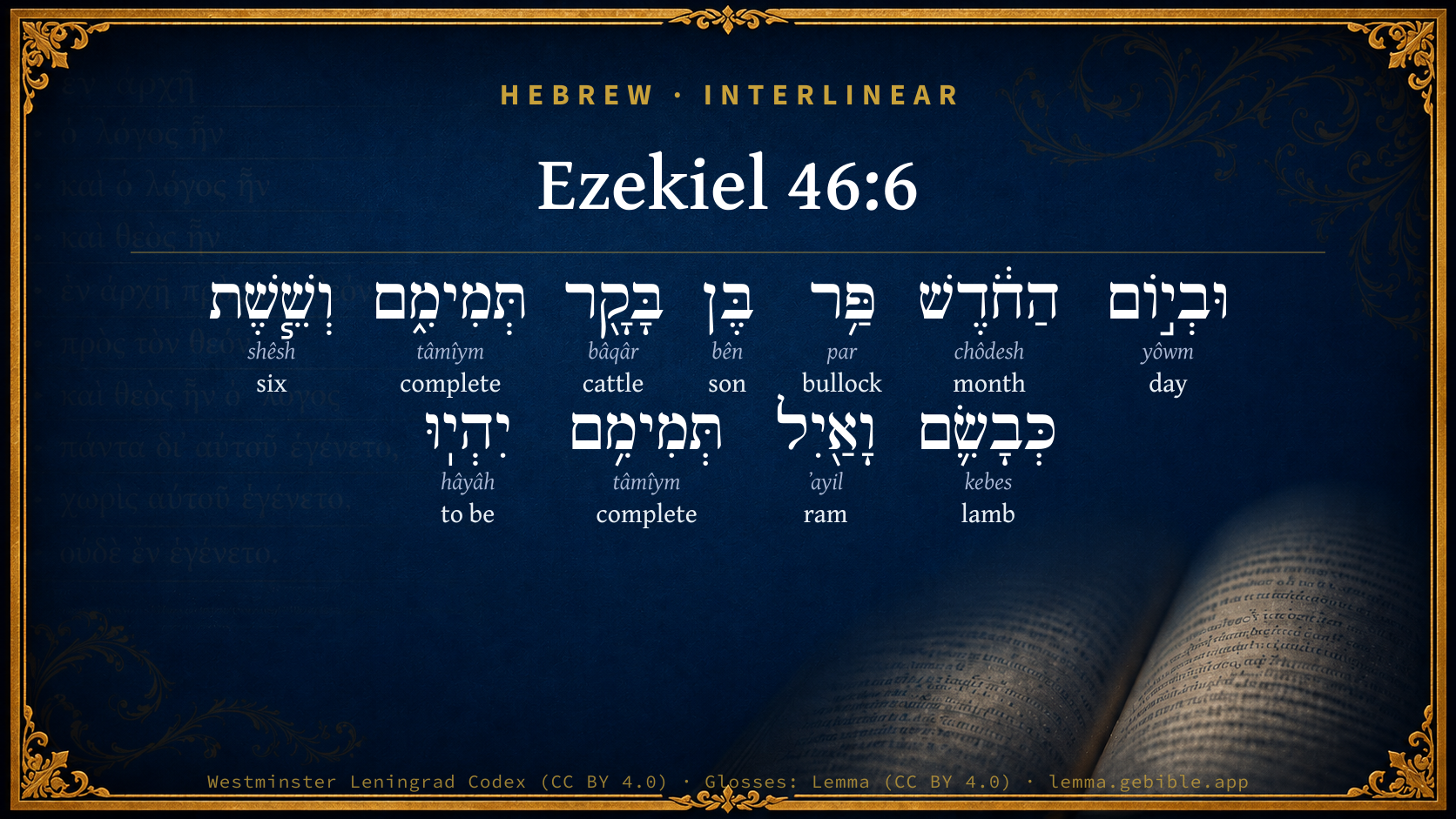
Hebrew (Westminster Leningrad Codex) Ezekiel 46:6 appears in the Hebrew Old Testament. The text above is from the Westminster Leningrad Codex. Each word links to its Strong’s number, a concise gloss, and parsing drawn from the Open Scriptures Hebrew Bible morphology. Click any word for its full Brown-Driver-Briggs (BDB) entry.
Download image
Cite this verse

Ezekiel 46:6 (World English Bible). Public Domain. Lemma interlinear Bible study tool, https://lemma.gebible.app/v/ezekiel/46/6.

Show BibTeX & RIS
BibTeX
RIS
English Translation
On the day of the new moon it shall be a young bull without blemish, and six lambs, and a ram; they shall be without blemish:
World English Bible · Public Domain
Download a study sheet

One document with this verse’s original text, its word-by-word gloss line, the meaning frame, cross-references with their text, attributed commentary, and full source and license credits — printable, and it pastes into notes with its structure intact.

This verse Autodidact and up

Study sheet (.html) Plain text (.txt)

A passage Seminary Student

Up to 50 verses in one chapter. A passage sheet keeps up to 6 commentary sources and 12 cross-references per verse, in the order this page ranks them, and says so on the sheet whenever that leaves anything out. Ask for a single verse and you get the Autodidact verse sheet above.

Everything on this page stays free to read, with no account — the sheet is a download of what is already on screen, not access to it.

Want to remove ads? Support Godless Engineer
Compare translations 3

The same verse in 3 English versions, stacked beneath the original-language interlinear above. Click any original word for its lexicon entry.

Each is an independent rendering of the whole verse — the interlinear is not word-aligned to these translations.

Highlighted words mark where these versions differ — a whole-verse word diff, not a word-by-word alignment.

  • World English Bible Public Domain
    On the day of the new moon it shall be a young bull without blemish, and six lambs, and a ram; they shall be without blemish:
  • King James Version Public Domain
    And in the day of the new moon it shall be a young bullock without blemish, and six lambs, and a ram: they shall be without blemish.
  • unfoldingWord Literal Text CC BY-SA 4.0
    On the day of the new moon he must offer an unblemished bull from a herd, six lambs, and an unblemished ram.

unfoldingWord Literal Text — © unfoldingWord, licensed CC BY-SA 4.0. Word-aligned USFM3 via Door43 (git.door43.org/unfoldingWord/en_ult).

Versions to compare (up to 4)

3 of 4 selected

Show all 18 translations

Every available English version of this verse, each an independent rendering of the whole verse.

  • World English Bible Public Domain
    On the day of the new moon it shall be a young bull without blemish, and six lambs, and a ram; they shall be without blemish:
  • Berean Standard Bible Public Domain
    On the day of the New Moon he shall offer a young, unblemished bull, six lambs, and a ram without blemish.
  • Majority Standard Bible Public Domain
    On the day of the New Moon he shall offer a young, unblemished bull, six lambs, and a ram without blemish.
  • King James Version Public Domain
    And in the day of the new moon it shall be a young bullock without blemish, and six lambs, and a ram: they shall be without blemish.
  • American Standard Version (1901) Public Domain
    And on the day of the new moon it shall be a young bullock without blemish, and six lambs, and a ram; they shall be without blemish:
  • Revised Version (1885) Public Domain
    And in the day of the new moon it shall be a young bullock without blemish; and six lambs, and a ram; they shall be without blemish:
  • Geneva Bible (1599) Public Domain
    And in the day of the newe moone it shall be a yong bullocke without blemish, and sixe lambes and a ram: they shalbe without blemish.
  • Douay-Rheims (1899) Public Domain
    And on the day of the new moon a calf of the herd without blemish: and the six lambs, and the rams shall be without blemish.
  • Young's Literal Translation Public Domain
    And on the day of the new moon a bullock, a son of the herd, a perfect one, and six lambs and a ram, they are perfect.
  • Literal Standard Version CC BY-SA 4.0
    And on the day of the new moon—a bullock, a son of the herd, a perfect one, and six lambs and a ram; they are perfect.
  • Unlocked Literal Bible CC BY-SA 4.0
    On the day of the new moon he must offer an unblemished bull from a herd, six lambs, and an unblemished ram.
  • unfoldingWord Literal Text CC BY-SA 4.0
    On the day of the new moon he must offer an unblemished bull from a herd, six lambs, and an unblemished ram.
  • Darby Bible Public Domain
    And on the day of the new moon, a young bullock without blemish, and six lambs, and a ram: they shall be without blemish.
  • World Messianic Bible Public Domain
    On the day of the new moon it shall be a young bull without defect, six lambs, and a ram. They shall be without defect.
  • Webster's Bible Public Domain
    And in the day of the new moon it shall be a young bullock without blemish, and six lambs, and a ram: they shall be without blemish.
  • Free Bible Version CC BY-SA 4.0
    On the day of the New Moon he is to offer a young bull, six lambs, and a ram. They are all to be without defects.
  • Bible in Basic English Public Domain
    And at the time of the new moon it is to be a young ox of the herd without a mark on him, and six lambs and a male sheep, all without a mark:
  • JPS Tanakh (1917) Public Domain
    And in the day of the new moon it shall be a young bullock without blemish; and six lambs, and a ram; they shall be without blemish;

Literal Standard Version (2020), Covenant Press — licensed CC BY-SA 4.0. Text via the HelloAO Bible API (eBible.org). Unlocked Literal Bible (unfoldingWord) — licensed CC BY-SA 4.0. Text via the HelloAO Bible API (eBible.org). unfoldingWord Literal Text — © unfoldingWord, licensed CC BY-SA 4.0. Word-aligned USFM3 via Door43 (git.door43.org/unfoldingWord/en_ult). Free Bible Version, Dr. Jonathan Gallagher — licensed CC BY-SA 4.0. Text via the HelloAO Bible API (eBible.org).

Word by word

More ways to search: Search by grammar → Find every occurrence → Compare this word →

Practice this passage: Drill this verse → Learn its vocabulary →

תְּמִימִ֑ם
tâmîym
H8549
“complete”
Adjective, Adjective, Masculine, Plural, Absolute
Part of Speech
Adjective
Type
Adjective
Gender
Masculine
Number
Plural
State
Absolute
Full BDB Definition

Origin: from H8552

TWOT: 2522d

complete, whole, entire, sound - complete, whole, entire - whole, sound, healthful - complete, entire (of time) - sound, wholesome, unimpaired, innocent, having integrity - what is complete or entirely in accord with truth and fact (neuter adjective/substantive)
  1. וּבְי֣וֹם yôwm H3117 “and · in/at · day of” Conjunction + Preposition + Noun, Common, Masculine, Singular, Construct
  2. הַחֹ֔דֶשׁ chôdesh H2320 “the · month” Particle, Definite Article + Noun, Common, Masculine, Singular, Absolute
  3. פַּ֥ר par H6499 “bullock” Noun, Common, Masculine, Singular, Absolute
  4. בֶּן bên H1121 “son of” Noun, Common, Masculine, Singular, Construct
  5. בָּקָ֖ר bâqâr H1241 “cattle” Noun, Common, Both, Singular, Absolute
  6. וְשֵׁ֧שֶׁת shêsh H8337 “and · six” Conjunction + Adjective, Cardinal number, Masculine, Singular, Construct
  7. כְּבָשִׂ֛ם kebes H3532 “lambs” Noun, Common, Masculine, Plural, Absolute
  8. וָאַ֖יִל ʼayil H352 “and · ram” Conjunction + Noun, Common, Masculine, Singular, Absolute
  9. תְּמִימִ֥ם tâmîym H8549 “complete” Adjective, Adjective, Masculine, Plural, Absolute
  10. יִהְיֽוּ hâyâh H1961 “to be” Verb, Qal, Imperfect, 3rd Person, Masculine, Plural

About this verse

These counts appear in no published source. They are computed here, from the morphology-tagged text and Lemma’s own curated glosses. What Lemma adds →

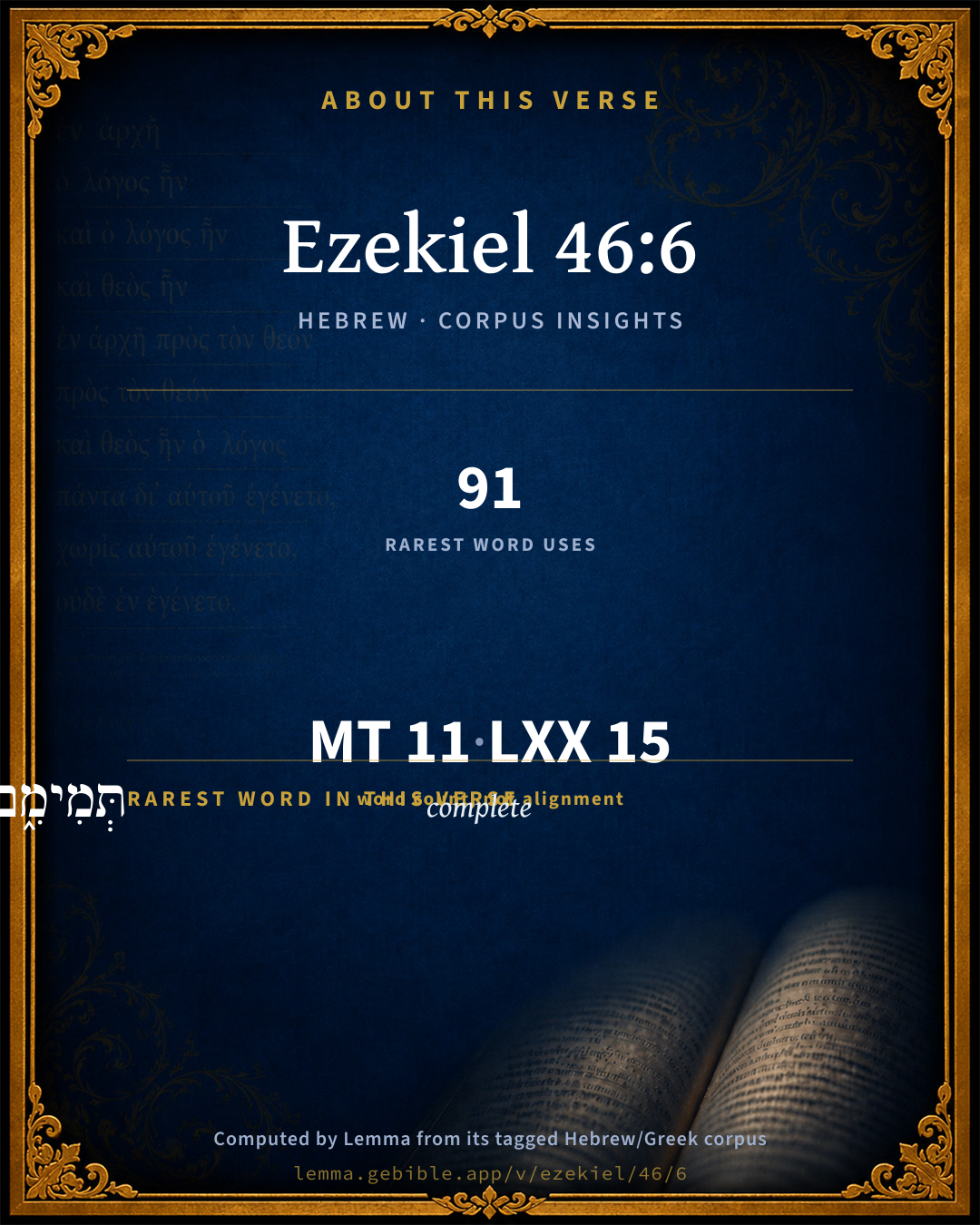
11
words
10
distinct lemmas
Prophets
section

Grammatical profile

  • 1 verb
  • 7 nouns
  • 3 adjectives

Verb forms

  • יִהְיֽוּ Qal · Imperfect

Repetition

A word recurs within this verse — often emphatic in Hebrew:

  • תְּמִימִ֑ם complete H8549 ×2

Hebrew & Septuagint length

In English translation the verse runs 26 words from the Hebrew and 23 from the Septuagint (LXX English) — closely comparable.

A rough comparison of the two English renderings, which tokenize alike — not a word-level alignment.

Word counts can differ between the Hebrew and the Greek without any difference in meaning — e.g. the Hebrew direct-object marker אֵת has no separate Greek word, and Greek often adds the article ὁ.

In the original languages it is 11 Hebrew tokens and 15 Greek tokens — but the two are counted differently (Hebrew bundles its prefixes and suffixes into one token; the Greek is in lemma form), so that isn’t a like-for-like length.

Cross-references

1

Topical passages linked to Ezekiel 46:6 in the Treasury of Scripture Knowledge — connected by theme and wording, ordered by reader-vote popularity; previews shown in the World English Bible.

  • Ezekiel 46:1 Thus says the Lord Yahweh: The gate of the inner court that looks toward the east shall be shut the six working days; but on the Sabbath day it shall be opened, and on the day of the new moon it shall be opened.

Cross-references courtesy of OpenBible.info (CC BY 4.0).

Hebrew and Greek witnesses Masoretic Hebrew ↔ Greek Septuagint

The same verse in the two great witnesses to the Old Testament, shown verse-for-verse.

These are two independent witnesses, not word-aligned to each other, and the Septuagint is shown in lemma (dictionary) form.

Hebrew Ezekiel 46:6 Masoretic · Westminster Leningrad Codex

וּבְי֣וֹם הַחֹ֔דֶשׁ פַּ֥ר בֶּן בָּקָ֖ר תְּמִימִ֑ם וְשֵׁ֧שֶׁת כְּבָשִׂ֛ם וָאַ֖יִל תְּמִימִ֥ם יִהְיֽוּ

On the day of the new moon it shall be a young bull without blemish, and six lambs, and a ram; they shall be without blemish:

World English Bible · Public Domain

Greek LXX Ezekiel 46:6 Septuagint · lemma form

καί ἐν ὁ ἡμέρα ὁ νεομηνία μόσχος ἄμωμος καί ἕξ ἀμνός καί κριός ἄμωμος εἰμί

And on the day of the new moon a calf without blemish, and six lambs, and there shall be a ram without blemish;

LXX2012 (modern English Septuagint) · Public Domain

Hebrew: Westminster Leningrad Codex (CC BY 4.0). Greek: Septuagint (public domain); English from LXX2012 (modern English Septuagint) (Public Domain). How the Septuagint differs from the Hebrew →

Targum (Aramaic paraphrase)

1

The Targum is the ancient Jewish Aramaic paraphrase of the Hebrew Scriptures — an interpretive translation, not the Hebrew text itself. Onkelos (literal) and Pseudo-Jonathan (expansive) render the Torah, and Jonathan the Prophets. Coverage is partial: where no permissively-licensed English translation exists for a verse, only the Aramaic is shown. This is verse-level text, not a word-by-word alignment to the Hebrew.

  1. Targum Jonathan Prophets (Joshua–Malachi)
    וּבְיוֹמָא דְיַרְחָא תּוֹר בַּר תּוֹרֵי שְׁלִים וְשִׁתָּא אִימְרִין וּדְכַר שָׁלְמִין יְהוֹן:

    (no public-domain English translation for this verse)

    Targum Jonathan — Aramaic: “Mikraot Gedolot” (public domain). English: “Sefaria Community Translation” (CC0 1.0 (public-domain dedication)); “London "Chaldee Paraphrase," 1871” (public domain). Text via Sefaria.

Commentary

Notes on Ezekiel 46:6 from classic Christian and Jewish commentators (each source and its license shown beneath its notes). The classic Christian expositions comment on the surrounding passage and are grouped to its opening verse, so a note may address several verses; the Jewish commentaries on the Tanakh (Rashi and others) are per-verse, so they appear only where the commentator wrote on this verse.

Lemma curates 59 commentaries, every one of them public domain or Creative Commons licensed, each selected and text-cleaned for this edition rather than reprinted as found. About our sources →

Trapp's Complete Commentary

John Trapp

Eze 46:6 And in the day of the new moon [it shall be] a young bullock without blemish, and six lambs, and a ram: they shall be without blemish.

Ver. 6. And in the day of the new moon.] Which pointed them to the coming of Christ, by whom all things are become new.

It shall be a young bullock.] It was wont to be two. See on Eze 46:4.

And six lambs and a ram.] To signify, saith Rabanus, that as it is necessary for us to keep the Sabbath; so it is likewise that we rely upon Christ for expiation as of our week days’ sins, so also of those that we fall into even on that holy day.

John Trapp, A Commentary or Exposition upon All the Books of the Old and New Testament (1647–1656) — public domain. Text from a community e-Sword module.

Ellicott's Commentary for English Readers

(6) A young bullock . . . and six lambs, and a ram.—The law required for the new moons, for a burnt offering, two bullocks, seven lambs, and a ram (Num_28:11), so that this sacrifice is here diminished; it also required a he-goat for a sin offering, of which no mention is here made.

A Bible Commentary for English Readers, edited by Charles John Ellicott (1878–1897) — public domain. Text from a community e-Sword module.

John Gill's Exposition

And he shall prepare a meat offering, an ephah for a bullock, and an ephah for a ram,.... See Gill on Eze 45:24,

and for the lambs according as his hand shall attain unto, and an hin of oil to an ephah; See Gill on Eze 46:5.

John Gill's Exposition of the Whole Bible (1746–1763) — public domain (CC PDM 1.0). Text via the HelloAO Bible API.

Albert Barnes' Notes on the Bible

Compare with Num. 28. The enumeration of the offerings both for the Sabbath and new moon is here less complete than there; e. g., the drink offerings are passed by, and in the case of the new moon festival no mention is made of the blowing of trumpets (compare Num 10:10).

Albert Barnes' Notes on the Bible (1834–1885) — public domain. Text from a community e-Sword/MySword module.

Haydock's Catholic Bible Commentary

Calf. Moses orders two, and seven lambs, Numbers xxviii. 11. (Calmet) --- The rams. Hebrew, "a ram. They shall," &c. (Haydock)

George Leo Haydock (1774–1849), Haydock's Catholic Family Bible and Commentary, 1859 edition — public domain. Excludes Psalms (Douay-Rheims chapter numbering differs from Protestant) and Deuterocanonical books (Catholic canon only).

Matthew Poole's English Annotations

In these verses nothing new occurs but the appointing a bullock with its meat-offering for the new moon sacrifice, of which also on another occasion already, Eze 46:1.

A young bullock: see Eze 45:22.

Without blemish: see Eze 45:4.

Six lambs: see Eze 46:4.

Matthew Poole's English Annotations on the Holy Bible (1683–1685) — public domain. Text from a community e-Sword/MySword module.

The Pulpit Commentary

Verses. 6, 7 specify the corresponding sacrifices for the new moons.

(1) A burnt offering of a young bullock without blemish, six lambs, and a ram, with which may be compared the two bullocks, one ram, and seven lambs of the Mosaic Torah. (Num_28:11-15)

(2) A meat (or, meal) offering of an ephah for the bullock, an ephah for the ram, and for the lambs according as his hand shall attain unto (comp. ver 5; and the similar expressions in Lev_5:7, 11 12:8) with a hin of oil to an ephah. This also is less than that which had been demanded by the Law, viz. three-tenths of an ephah of fine flour mingled with oil for each bullock, two-tenths for the ram and one-tenth for every. (Num_28:11-15) The Torah of Ezekiel omits the sin offering of a he-goat, which had a place in the Torah of Moses.

The Pulpit Commentary (1880–1919), ed. H.D.M. Spence-Jones & Joseph S. Exell — public domain. Text from a community e-Sword module.

unfoldingWord translationNotes

Door43 World Missions Community

General Information:

Yahweh continues giving Ezekiel his message to the princes of Israel.

unblemished

perfectly healthy and normal

portico

covering in front of an entrance with columns or posts for support. See how you translated this in Ezekiel 8:16.

translationWords

new moon

cow

flocks

grain offering

grain

prince

unfoldingWord translationNotes — © Distant Shores Media and the Door43 World Missions Community, licensed CC BY-SA 4.0. Source: git.door43.org/Door43/en_tn.

Rashi

Rabbi Shlomo Yitzchaki (Rashi)

But on the New Moon: a young bull without blemish Our Rabbis expounded upon this verse in Menahoth (45a): Why does it say, “a young bull”? Since it is stated in the Torah (Num. 28:11): “And at the beginnings of your months, etc., two young bulls,” how do you know that if he did not find two, he should bring one? Because it is stated: “a bull.”

and six lambs Why is it necessary to state this? Since it is said in the Torah, “seven,” how do you know that if he did not find seven, he should bring six? Because it is stated: “and six lambs.” And how do you know [that he should bring] even one? Because the Torah says, “but for the lambs as much as he can afford.”

Rashi on the Tanakh — English translations: “The Judaica Press complete Tanach with Rashi, translated by A. J. Rosenberg” (CC BY 4.0); “Pentateuch with Rashi's commentary by M. Rosenbaum and A.M. Silbermann, 1929-1934” (public domain); “The Metsudah Tanach series, Lakewood, N.J” (CC BY 4.0); and “The Book of Joshua, Metsudah Publications, 1997” (CC BY 4.0). Text via Sefaria.

Lesson kit

Teaching starters — assembled from the data on this page, not authored interpretation. Every prompt links to the verse data it draws on. Edit before teaching.

Ezekiel, in the Prophets, opens this verse with 11 words (10 distinct Hebrew lemmas). Its most distinctive word is tâmîym (“complete”). A historical commentator’s framing appears above. Read the whole chapter for the surrounding context.

Discussion questions

  1. How does “complete” (tâmîym) shape what this verse is saying?
  2. How does Ezekiel 46:1, which shares this passage’s theme, read alongside this verse?
  3. What does the repetition of “complete” (2× in this one verse) do in this verse?
  4. These translations render this verse differently; the difference is in the English rendering, not the original. What questions does that raise?
  5. «יִהְיֽוּ» is a Qal Imperfect verb. How does that grammatical form shape the action described?
  6. Compare how Trapp's Complete Commentary and Ellicott's Commentary for English Readers read this verse. Where do they agree or differ?

Things to notice

Reading settings

Reading text

Shown beneath each verse's original-language words.

Old Testament
Old Testament edition

Read the OT as the Masoretic Hebrew (MT) or the Greek Septuagint (LXX).

English shown for the Greek Septuagint (in the Hebrew ↔ Greek comparison).

Comparing translations? Open the Compare panel on any verse page to stack up to four side by side.