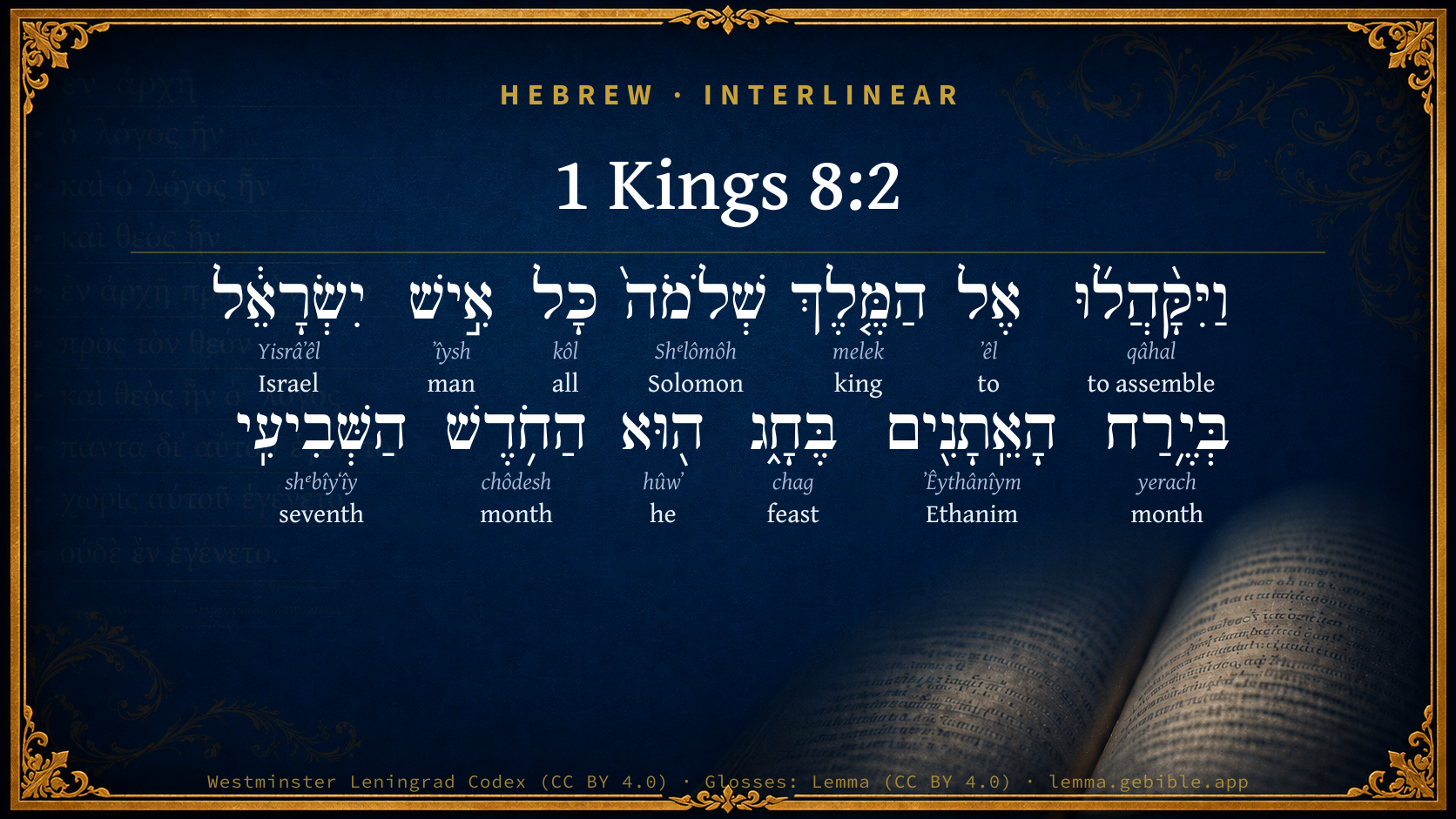
1 Kings 8:2

Hebrew (Westminster Leningrad Codex) 1 Kings 8:2 appears in the Hebrew Old Testament. The text above is from the Westminster Leningrad Codex. Each word links to its Strong’s number, a concise gloss, and parsing drawn from the Open Scriptures Hebrew Bible morphology. Click any word for its full Brown-Driver-Briggs (BDB) entry.
Download image
Cite this verse

1 Kings 8:2 (World English Bible). Public Domain. Lemma interlinear Bible study tool, https://lemma.gebible.app/v/1-kings/8/2.

Show BibTeX & RIS
BibTeX
RIS
English Translation
All the men of Israel assembled themselves to king Solomon at the feast, in the month Ethanim, which is the seventh month.
World English Bible · Public Domain
Highlights Full analysis ↓
Download a study sheet

One document with this verse’s original text, its word-by-word gloss line, the meaning frame, cross-references with their text, attributed commentary, and full source and license credits — printable, and it pastes into notes with its structure intact.

This verse Autodidact and up

Study sheet (.html) Plain text (.txt)

A passage Seminary Student

Up to 50 verses in one chapter. A passage sheet keeps up to 6 commentary sources and 12 cross-references per verse, in the order this page ranks them, and says so on the sheet whenever that leaves anything out. Ask for a single verse and you get the Autodidact verse sheet above.

Everything on this page stays free to read, with no account — the sheet is a download of what is already on screen, not access to it.

Want to remove ads? Support Godless Engineer
Compare translations 3

The same verse in 3 English versions, stacked beneath the original-language interlinear above. Click any original word for its lexicon entry.

Each is an independent rendering of the whole verse — the interlinear is not word-aligned to these translations.

Highlighted words mark where these versions differ — a whole-verse word diff, not a word-by-word alignment.

  • World English Bible Public Domain
    All the men of Israel assembled themselves to king Solomon at the feast, in the month Ethanim, which is the seventh month.
  • King James Version Public Domain
    And all the men of Israel assembled themselves unto king Solomon at the feast in the month Ethanim, which is the seventh month.
  • unfoldingWord Literal Text CC BY-SA 4.0
    And all of the men of Israel assembled to King Solomon in the month of Ethanim, at the feast (it the seventh month).

unfoldingWord Literal Text — © unfoldingWord, licensed CC BY-SA 4.0. Word-aligned USFM3 via Door43 (git.door43.org/unfoldingWord/en_ult).

Versions to compare (up to 4)

3 of 4 selected

Show all 18 translations

Every available English version of this verse, each an independent rendering of the whole verse.

  • World English Bible Public Domain
    All the men of Israel assembled themselves to king Solomon at the feast, in the month Ethanim, which is the seventh month.
  • Berean Standard Bible Public Domain
    And all the men of Israel came together to King Solomon at the feast in the seventh month, the month of Ethanim.
  • Majority Standard Bible Public Domain
    And all the men of Israel came together to King Solomon at the feast in the seventh month, the month of Ethanim.
  • King James Version Public Domain
    And all the men of Israel assembled themselves unto king Solomon at the feast in the month Ethanim, which is the seventh month.
  • American Standard Version (1901) Public Domain
    And all the men of Israel assembled themselves unto king Solomon at the feast, in the month Ethanim, which is the seventh month.
  • Revised Version (1885) Public Domain
    And all the men of Israel assembled themselves unto king Solomon at the feast, in the month Ethanim, which is the seventh month.
  • Geneva Bible (1599) Public Domain
    And all the men of Israel assembled vnto King Salomon at the feast in the moneth of Ethanim, which is the seuenth moneth.
  • Douay-Rheims (1899) Public Domain
    And all Israel assembled themselves to king Solomon on the festival day in the month of Ethanim, the same is the seventh month.
  • Young's Literal Translation Public Domain
    and all the men of Israel are assembled unto king Solomon, in the month of Ethanim, in the festival -- `is' the seventh month.
  • Literal Standard Version CC BY-SA 4.0
    and all the men of Israel are assembled to King Solomon, in the month of Ethanim, in the festival (the seventh month).
  • Unlocked Literal Bible CC BY-SA 4.0
    All the men of Israel assembled before King Solomon at the feast, in the month of Ethanim, which is the seventh month.
  • unfoldingWord Literal Text CC BY-SA 4.0
    And all of the men of Israel assembled to King Solomon in the month of Ethanim, at the feast (it the seventh month).
  • Darby Bible Public Domain
    And all the men of Israel assembled themselves to king Solomon at the feast in the month Ethanim, that is, the seventh month.
  • World Messianic Bible Public Domain
    All the men of Israel assembled themselves to King Solomon at the feast in the month Ethanim, which is the seventh month.
  • Webster's Bible Public Domain
    And all the men of Israel assembled themselves to king Solomon at the feast in the month Ethanim, which is the seventh month.
  • Free Bible Version CC BY-SA 4.0
    All the men of Israel assembled before King Solomon at the festival which is held in the seventh month, the month of Ethanim.
  • Bible in Basic English Public Domain
    And all the men of Israel came together to King Solomon at the feast, in the month Ethanim, the seventh month.
  • JPS Tanakh (1917) Public Domain
    And all the men of Israel assembled themselves unto king Solomon at the feast, in the month Ethanim, which is the seventh month.

Literal Standard Version (2020), Covenant Press — licensed CC BY-SA 4.0. Text via the HelloAO Bible API (eBible.org). Unlocked Literal Bible (unfoldingWord) — licensed CC BY-SA 4.0. Text via the HelloAO Bible API (eBible.org). unfoldingWord Literal Text — © unfoldingWord, licensed CC BY-SA 4.0. Word-aligned USFM3 via Door43 (git.door43.org/unfoldingWord/en_ult). Free Bible Version, Dr. Jonathan Gallagher — licensed CC BY-SA 4.0. Text via the HelloAO Bible API (eBible.org).

Word by word

More ways to search: Search by grammar → Find every occurrence → Compare this word →

Practice this passage: Drill this verse → Learn its vocabulary →

הָאֵֽתָנִ֖ים
ʼÊythânîym
H388
“the · Ethanim”
Particle, Definite Article + Adjective, Adjective, Masculine, Plural, Absolute
Part of Speech
Particle + Adjective
Type
Adjective
Gender
Masculine
Number
Plural
State
Absolute
Full BDB Definition

Origin: plural of H386

TWOT: None

Ethanim = "enduring" - seventh Jewish month, corresponding to modern Oct. to Nov.; so named because permanent streams still flowed
  1. וַיִּקָּ֨הֲל֜וּ qâhal H6950 “and · to assemble” Conjunction + Verb, Niphal, Sequential Imperfect, 3rd Person, Masculine, Plural
  2. אֶל ʼêl H413 “to” Preposition
  3. הַמֶּ֤לֶךְ melek H4428 “the · king” Particle, Definite Article + Noun, Common, Masculine, Singular, Absolute
  4. שְׁלֹמֹה֙ Shᵉlômôh H8010 “Solomon” Noun, Proper
  5. כָּל kôl H3605 “all of” Noun, Common, Masculine, Singular, Construct
  6. אִ֣ישׁ ʼîysh H376 “man of” Noun, Common, Masculine, Singular, Construct
  7. יִשְׂרָאֵ֔ל Yisrâʼêl H3478 “Israel” Noun, Proper
  8. בְּיֶ֥רַח yerach H3391 “in/at · month of” Preposition + Noun, Common, Masculine, Singular, Construct
  9. בֶּחָ֑ג chag H2282 “in/at the · feast” Preposition, Determined + Noun, Common, Masculine, Singular, Absolute
  10. ה֖וּא hûwʼ H1931 “he” Pronoun, Personal, 3rd Person, Masculine, Singular
  11. הַחֹ֥דֶשׁ chôdesh H2320 “the · month” Particle, Definite Article + Noun, Common, Masculine, Singular, Absolute
  12. הַשְּׁבִיעִֽי shᵉbîyʻîy H7637 “the · seventh” Particle, Definite Article + Adjective, Ordinal number, Masculine, Singular, Absolute

About this verse

These counts appear in no published source. They are computed here, from the morphology-tagged text and Lemma’s own curated glosses. What Lemma adds →

13
words
13
distinct lemmas
Historical
section

Notable vocabulary

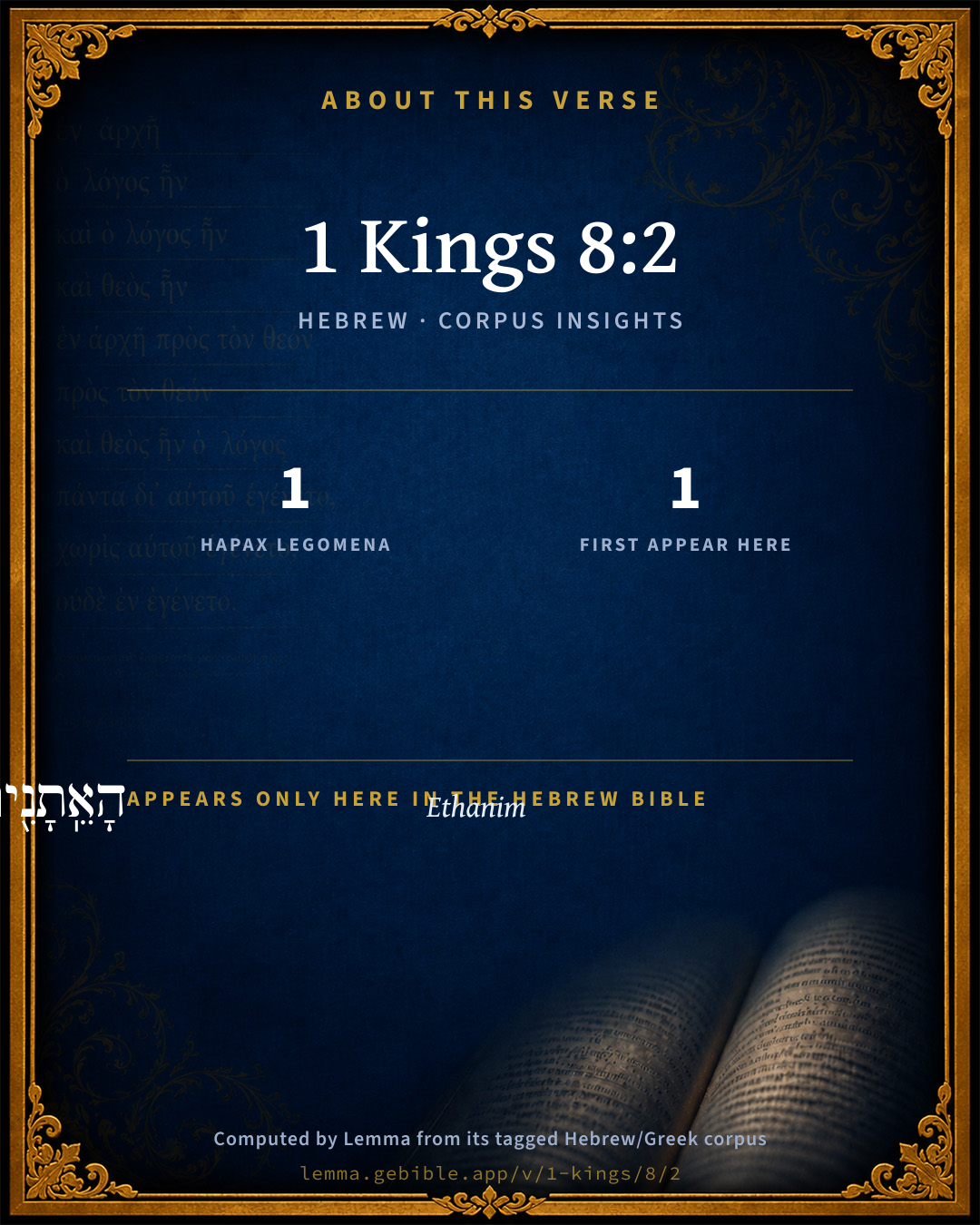
1 hapax legomenon — a word that appears only here in the entire Hebrew Bible:

  • הָאֵֽתָנִ֖ים Ethanim H388

First appearance in Scripture

This word makes its first canonical appearance in the Hebrew Bible here:

  • הָאֵֽתָנִ֖ים Ethanim H388

Shared distinctive vocabulary

בְּיֶ֥רַח month H3391 occurs in 13 verses of the Hebrew Bible. Also found in:

Grammatical profile

  • 1 verb
  • 8 nouns
  • 2 adjectives
  • 1 pronoun
  • 1 preposition

Verb forms

  • וַיִּקָּ֨הֲל֜וּ Niphal · Sequential Imperfect

Hebrew & Septuagint length

In English translation the verse runs 22 words from the Hebrew and 5 from the Septuagint (LXX English) — the Septuagint runs noticeably shorter here. See the side-by-side →

A rough comparison of the two English renderings, which tokenize alike — not a word-level alignment.

Word counts can differ between the Hebrew and the Greek without any difference in meaning — e.g. the Hebrew direct-object marker אֵת has no separate Greek word, and Greek often adds the article ὁ.

Cross-references

11

Topical passages linked to 1 Kings 8:2 in the Treasury of Scripture Knowledge — connected by theme and wording, ordered by reader-vote popularity; previews shown in the World English Bible.

  • Leviticus 23:34 "Speak to the children of Israel, and say, 'On the fifteenth day of this seventh month is the feast of tents for seven days to Yahweh.
  • 2 Chronicles 7:8–10 So Solomon held the feast at that time seven days, and all Israel with him, a very great assembly, from the entrance of Hamath to the brook of Egypt.
  • Numbers 29:12–40 On the fifteenth day of the seventh month you shall have a holy convocation; you shall do no servile work, and you shall keep a feast to Yahweh seven days:
  • Deuteronomy 16:13 You shall keep the feast of tents seven days, after that you have gathered in from your threshing floor and from your winepress:
  • 1 Kings 8:65 So Solomon held the feast at that time, and all Israel with him, a great assembly, from the entrance of Hamath to the brook of Egypt, before Yahweh our God, seven days and seven days, even fourteen days.
  • 2 Chronicles 5:3 And all the men of Israel assembled themselves to the king at the feast, which was [in] the seventh month.
  • Ezra 3:4 They kept the feast of tents, as it is written, and [offered] the daily burnt offerings by number, according to the ordinance, as the duty of every day required;
  • Nehemiah 8:14–18 They found written in the law, how that Yahweh had commanded by Moses, that the children of Israel should dwell in booths in the feast of the seventh month;
  • Zechariah 14:16–19 It will happen that everyone who is left of all the nations that came against Jerusalem will go up from year to year to worship the King, Yahweh of Hosts, and to keep the feast of tents.
  • John 7:2 Now the feast of the Jews, the Feast of Booths, was at hand.
  • John 7:37 Now on the last and greatest day of the feast, Jesus stood and cried out, "If anyone is thirsty, let him come to me and drink!

Cross-references courtesy of OpenBible.info (CC BY 4.0).

Hebrew and Greek witnesses Masoretic Hebrew ↔ Greek Septuagint

The same verse in the two great witnesses to the Old Testament, shown verse-for-verse.

Here the Septuagint runs noticeably shorter than the Hebrew — LXX2012 (modern English Septuagint) 5 words vs World English Bible 22. A rough length comparison of the two English translations, not a word-level alignment — read both below.

These are two independent witnesses, not word-aligned to each other, and the Septuagint is shown in lemma (dictionary) form.

Hebrew 1 Kings 8:2 Masoretic · Westminster Leningrad Codex

וַיִּקָּ֨הֲל֜וּ אֶל הַמֶּ֤לֶךְ שְׁלֹמֹה֙ כָּל אִ֣ישׁ יִשְׂרָאֵ֔ל בְּיֶ֥רַח הָאֵֽתָנִ֖ים בֶּחָ֑ג ה֖וּא הַחֹ֥דֶשׁ הַשְּׁבִיעִֽי

All the men of Israel assembled themselves to king Solomon at the feast, in the month Ethanim, which is the seventh month.

World English Bible · Public Domain

Greek LXX 1 Kings 8:2 Septuagint · lemma form

ἐν μήν αθανιν

in the month of Athanin.

LXX2012 (modern English Septuagint) · Public Domain

On this verse, Ellicott's Commentary for English Readers discusses the Septuagint’s reading. Read the note in Commentary ↓

Hebrew: Westminster Leningrad Codex (CC BY 4.0). Greek: Septuagint (public domain); English from LXX2012 (modern English Septuagint) (Public Domain). How the Septuagint differs from the Hebrew →

Targum (Aramaic paraphrase)

1

The Targum is the ancient Jewish Aramaic paraphrase of the Hebrew Scriptures — an interpretive translation, not the Hebrew text itself. Onkelos (literal) and Pseudo-Jonathan (expansive) render the Torah, and Jonathan the Prophets. Coverage is partial: where no permissively-licensed English translation exists for a verse, only the Aramaic is shown. This is verse-level text, not a word-by-word alignment to the Hebrew.

  1. Targum Jonathan Prophets (Joshua–Malachi)
    וְאִתְכְּנִישׁוּ לְוַת מַלְכָּא שְׁלֹמֹה כָּל אֱנַשׁ יִשְׂרָאֵל בְּיַרְחָא דְעַתִּיקַיָא דְקָרָן לֵיהּ יַרְחָא קַדְמָאָה בְּחַגָא וּכְעַן הוּא יַרְחָא שְׁבִיעָאָה:

    (no public-domain English translation for this verse)

    Targum Jonathan — Aramaic: “Mikraot Gedolot” (public domain). English: “Sefaria Community Translation” (CC0 1.0 (public-domain dedication)); “London "Chaldee Paraphrase," 1871” (public domain). Text via Sefaria.

Commentary

Notes on 1 Kings 8:2 from classic Christian and Jewish commentators (each source and its license shown beneath its notes). The classic Christian expositions comment on the surrounding passage and are grouped to its opening verse, so a note may address several verses; the Jewish commentaries on the Tanakh (Rashi and others) are per-verse, so they appear only where the commentator wrote on this verse.

Lemma curates 59 commentaries, every one of them public domain or Creative Commons licensed, each selected and text-cleaned for this edition rather than reprinted as found. About our sources →

Trapp's Complete Commentary

John Trapp

1Ki 8:2 And all the men of Israel assembled themselves unto king Solomon at the feast in the month Ethanim, which [is] the seventh month.

Ver. 2. In the month Ethanim.] Which signifieth ripeness or strengh: either because the fruits were then ripe, sc., in September, and strengthened the heart of man; or else, by this festival month men’s hearts were filled with the joy of the Lord, which was their strength, {Neh 8:10} and lifted up in the ways of his precepts.

John Trapp, A Commentary or Exposition upon All the Books of the Old and New Testament (1647–1656) — public domain. Text from a community e-Sword module.

Joseph Benson's Commentary

1Ki 8:2. All the men of Israel assembled — Not only the chief men, who were particularly invited, but a vast number of the common people, as being desirous to see and join in this great and glorious solemnity. At the feast — This feast of the dedication to which Solomon had invited them. In the month Ethanim, which is the seventh month — This time he chose for the people’s greater convenience, because now they had gathered in all their fruits, and were going up to Jerusalem to celebrate the feast of tabernacles. But it may be objected, “According to 1Ki 6:38, the temple was not finished till the eighth month, how then could he invite them to the dedication of it in the seventh month?” To this it must be answered, It was the seventh month of the next year. For although the house in all its parts was finished the year before, yet, it seems, the utensils of it were not then fully finished; and many preparations were to be made for this great and extraordinary occasion. Add to this, that Solomon chose to defer this solemnity till the next year, that he might celebrate it with the greater magnificence, that being the year of jubilee, their ninth, according to Archbishop Usher, which opened the fourth millenary of the world; and at the solemnity of the jubilee, there used to be always a vast concourse of people from all parts of the kingdom. “This ceremony” then of the dedication “began on the eighth day of the seventh month of the sacred year, which was the first of the civil year, answering to the latter end of our October, and lasted seven days, at the end of which began the feast of tabernacles.”

Joseph Benson's Commentary on the Old and New Testaments (1811–1818) — public domain. Text from a community e-Sword module.

Tyndale Open Study Notes

Tyndale Open Resources

8:2 Although the Temple was completed in the eighth month (6:38), Solomon apparently delayed the dedication until the following year so it could take place at the annual Festival of Shelters, which is held in early autumn in the month of Ethanim. This schedule allowed time to prepare for the spectacular celebration and gave the occasion double significance. As prescribed in the law, Solomon and the people expressed their gratitude to God for the completed harvest season. They also celebrated the fulfillment of Moses’ song of deliverance, which promised that God would one day settle his people in the Promised Land and make his dwelling there (Exod 15:17; Deut 12:10-14). Solomon’s dedicatory prayer and blessing may indicate that he was consciously leading his people in covenantal renewal, as prescribed in Deut 31:10-13, in the seventh month of the seventh year of his reign.

Tyndale Open Study Notes — © Tyndale Open Resources, licensed CC BY-SA 4.0. Text via the HelloAO Bible API.

Geneva Bible (1599)

Geneva Bible translators

Containing part of September and part of October in the which month they held three solemn feasts, Num. 29:1.

Geneva Bible (1599) marginal notes — public domain. Text via Bolls.life.

Adam Clarke's Commentary

Verse 2. At the feast in the month Ethanim] The feast of tabernacles, which was celebrated in the seventh month of what is called the ecclesiastical gear.

Adam Clarke's Commentary on the Bible (1810–1826) — public domain. Text from a community e-Sword/MySword module.

Ellicott's Commentary for English Readers

(2) The month Ethanim (called after the Captivity Tisri), corresponded with the end of September and beginning of October. The name is supposed (by Thenius) to be properly, as in the LXX., Athanim, and to signify the “month of gifts,” so called as bringing with it the gathering in of the vintage, and of the last of the crops. According to the Chaldee Targum, it was in old times the beginning of the civil, as Abib of the ecclesiastical year. The feast in this month was the Feast of Tabernacles—of all feasts of the year the most joyful—marking the gathering in of all the fruits of the land, commemorating the dwelling in tabernacles in the wilderness, and thanking God for settlement and blessing in the land (Lev_23:33-44). It was, perhaps, the time when the Israelites could best be absent from their lands for a prolonged festival; but there was also a peculiar appropriateness in thus giving it a higher consecration, by celebrating on it the transference of the ark from the movable tabernacle to a fixed and splendid habitation. In this instance the festival was doubled in duration, from seven to fourteen days. (See 1Ki_8:65.)

A Bible Commentary for English Readers, edited by Charles John Ellicott (1878–1897) — public domain. Text from a community e-Sword module.

The Cambridge Bible for Schools and Colleges

gen. ed. J. J. S. Perowne

2. at the feast in the month Ethanim which is the seventh month] Josephus tells us that the feast of tabernacles fell at this time, and that that festival and the dedication services were combined into one great feast. We know from Lev_23:34, that the feast of tabernacles commenced on the fifteenth day of the seventh month and was held for seven days. The month Ethanim, which name only occurs here, is described as the seventh month. The name, which is connected with a word used for running water, is thought to signify ‘the rainy month.’ Josephus calls it Θισρὶ, which was the month between the new moons of October and November. If heavy rains were common at the time it was an unfortunate date for the feast of tabernacles. The ‘early rains’ spoken of in Scripture were the rains of autumn, and fell at the end of October or beginning of November, but came on very gradually. The ‘latter rains’ were those of spring, mostly in March. If the feast took place towards the middle of October it would close before the rains began to fall.

Supposing the Temple to have been dedicated as soon as possible after its completion, this festival must have been held in the twelfth year of Solomon’s reign. For in 1Ki_6:37 we are told that the actual building was finished in the eighth month of the eleventh year. The seventh month, named for the dedication, must have been in the year following.

The Cambridge Bible for Schools and Colleges (gen. ed. J. J. S. Perowne; Cambridge University Press, 1878–1918) — public domain. Text from a community e-Sword module.

John Gill's Exposition

And all the men of Israel assembled themselves unto King Solomon at the feast,.... Not of tabernacles, as the Targum on Ch2 5:3 and so Jarchi; though that was in the same month next mentioned, and began on the fifteenth of it, and held seven days; wherefore this must be the feast of the dedication of the temple, and which was kept before that; since both lasted fourteen days, and the people were dismissed on the twenty third of the month; now not only the above principal persons convened, but a vast number of the common people came to see the solemnity of removing the ark, and of dedicating the temple, and to attend the feast of it, and the more, since in a few days was the time for all the males in Israel to appear there:

in the month Ethanim, which is the seventh month; it was, as the Targum says, originally the first month; but upon the children of Israel coming out of Egypt in Ab or Nisan, that became the first month, and this was the seventh from that; and is the same with Tisri, which answers to part of September, and part of October, here called Ethanim; which some render the month of the ancients, others of strong ones; either because of the many feasts that were in it, as some say; or because it was the time of ingathering all the increase and fruits of the earth, which strengthen and support man's life; or rather of "never failing", i.e. waters, showers falling in this month, and the rivers full of water (l); so September is "septimus imber", according to Isidore (m), and the three following months are alike derived; this, by the Egyptians, was called Theuth, and was with them the first month in the year (n); so Porphyry says (o), with the Egyptians the beginning of the year was not Aquarius, as with the Romans, but Cancer; and so the month of September was the first with the Ethiopians (p), and with most people (q); though with the Chinese about the middle of Aquarius (r). Now, though the temple was finished in the eighth month, Kg1 6:38, it was not dedicated until the seventh in the following year; it required time to finish the utensils and vessels, and put them in their proper place, and for the drying of the walls, &c.

(l) Vid. Hackman. Praecidan. Sacr. p. 130, 131. (m) Origin. l. 5. c. 33. (n) Lactant. de Fals. Felig. l. 1. c. 6. (o) De Antro Nymph. prope finem. (p) Ludolf. Lexic. Ethiopic. p. 65. & Hist. Ethiop. l. 3. c. 6. (q) Julian. Opera, par. 1. orat. 4. p. 290, 291. (r) Martin. Sinic. Hist. l. 1. p. 22.

John Gill's Exposition of the Whole Bible (1746–1763) — public domain (CC PDM 1.0). Text via the HelloAO Bible API.

Albert Barnes' Notes on the Bible

The feast in the month Ethanim - i. e. the Feast of Tabernacles, or the Feast of Ingathering, the commemoration of the dwelling in booths at the time of the Exodus (margin reference), and the festival of thanksgiving on account of the completion of harvest Exo 23:16; Lev 23:39; Deu 16:13. It was one of the three on which the people were required to “appear before the Lord.”

Albert Barnes' Notes on the Bible (1834–1885) — public domain. Text from a community e-Sword/MySword module.

Haydock's Catholic Bible Commentary

Ethanim was afterwards called Tisri. (Haydock) --- Usher places the dedication on Friday, 30th October, the 8th of the seventh month. The people continued at Jerusalem till the 23rd. The feast of expiation fell on the 10th, (Haydock) during the octave of the dedication. After this, the feast of tabernacles commenced on the 15th, for other seven days. This was the year of jubilee; and Solomon had waited on purpose, that the people might have more leisure to attend on such a solemn occasion. (Calmet) --- But on this we cannot rely. There might be other reasons for the delay; (See chap. vi. 38.) and one of the chief might be, a desire to perform this ceremony in the seventh or sabbatical month, which was honoured with more festivals than any other. It had just elapsed, before the temple was finished, in the preceding year. (Haydock)

George Leo Haydock (1774–1849), Haydock's Catholic Family Bible and Commentary, 1859 edition — public domain. Excludes Psalms (Douay-Rheims chapter numbering differs from Protestant) and Deuterocanonical books (Catholic canon only).

Matthew Poole's English Annotations

All the men of Israel; not only the chief men who were particularly invited, but a vast number of the common people, as being forward to see and to join in this great and glorious solemnity.

At the feast: understand either, first, The feast of tabernacles. Or rather, secondly, The feast of the dedication, to which Solomon had invited them, which was before that feast; for that began on the 15th day of the 7th month, Lev 23:34, but this began at the least seven days before that feast; for Solomon and the people kept the feast for fourteen days, here, 1Ki 8:65, i.e. seven days for the dedication of the temple, and seven other days for that of tabernacles; and after both these were finished, he sent all the people to their homes on the twenty-third day of the month. See 2Ch 7:9,10.

Which is the seventh month; which time he chose with common respect to his people’s convenience, because now they had gathered in all their fruits, and now they were come up to Jerusalem to celebrate the feast of tabernacles.

Quest. The temple was not finished till the eighth month, 1Ki 6:38, how then could he invite them in the seventh month

Answ. This was the seventh month of the next year; for although the house in all its parts was finished the year before, yet the utensils of it, described 1Ki 7, were not then fully finished, but took up a considerable time afterward; and many preparations were to be made for this great and extraordinary occasion.

Matthew Poole's English Annotations on the Holy Bible (1683–1685) — public domain. Text from a community e-Sword/MySword module.

Whedon's Commentary on the Bible

Daniel D. Whedon

2. The feast in the month Ethanim — Which was the feast of tabernacles. See at Lev_23:34-43. Ethanim, which Gesenius defines as “the month of flowing streams,” corresponded with our October. Solomon finished the temple in the eighth month, (1Ki_6:38,) but waited till the seventh month of the next year for the dedication, that it might be coincident with the feast of tabernacles. It is probable, also, that while the temple itself was finished in the eighth month of Solomon’s eleventh year, (1Ki_6:38,) the various vessels described in 1Ki_7:23-50 were not completed till some time afterward, and the temple could not be dedicated till all these were finished. It is absurd, however, to suppose, as some do, that Solomon deferred the dedication of the temple for thirteen years after he had completed it. This feast was designed for a thanksgiving and rejoicing over the fruits of harvest, (Exo_23:16; Deu_16:13,) and also for a commemoration of the time when Israel dwelt in booths, in the desert. Lev_23:43. It was therefore fitting to associate the dedication of the temple with this important feast, for the ark that had dwelt in a tabernacle, and been carried to and fro for five hundred years, was now to enter into its place of rest. Compare 1Ch_28:2; 2Ch_6:41. And so the holy house, begun in the month of flowers and finished in the month of garnered fruits, (see note on 1Ki_6:38,) was appropriately consecrated in the month of thanksgiving.

Daniel D. Whedon (gen. ed.), Commentary on the Old and New Testaments (1874–1909) — public domain. Text from a community e-Sword module.

The Pulpit Commentary

And all the men of Israel not all the heads of the tribes just mentioned (ver. 1), as Keil, but all who came to the feast, as every male Israelite was under obligation to do (Deu_16:16) assembled themselves unto King Solomon at the feast the Heb. word gjh (with the art.) always means the feast of tabernacles. The same word is used of the feast of passover (Exo_23:15) and pentecost (ib. ver. 16), but "the feast" here can only mean that of tabernacles. As the "feast of ingathering", (Exo_23:16) as commemorating the deliverance from, (Lev_23:43) and as peculiarly a social festival (ib. vers. 40, Num_29:12 sqq.) it was the most joyous as well as the greatest (Jos., Ant. 8:4. 1) gathering of the year. (Compare the Jewish saying of a later date: "He who has never seen the rejoicing at the pouring out of the water of Siloam, has never seen rejoicing in his life.") It was doubtless for this reason that tabernacles was selected for the dedication. A special feast of dedication, however, was held for seven days before the feast of tabernacles proper commenced (see on ver. 65). It did not displace that great feast, however (Stanley), but simply preceded it. It is worthy of notice that Jeroboam selected the same feast (1Ki_12:32) for the inauguration of his new cultus. The idea of Josephus, that the feast of tabernacles "happened to coincide with the dedication" hardly seems probable in the month Ethanim variously interpreted to mean gifts, i.e., fruits (Thenius), flowing streams (Gesenius) it falls about the time of the early rains and equinox (Bottcher), which is the seventh month.

(This is added because the month was subsequently known as Tisri (see on 1Ki_6:1), or to show that "the feast" was the feast of tabernacles.)

Ver. Heb_9:24. The temple of Solomon, therefore, must correspond to things in the heavens. It does this, first, in its structure; secondly, in its furniture; thirdly, in its services.

I IN ITS STRUCTURE. The temple, we have seen, was a reproduction, on an enlarged scale, and in a more permanent form, of the tabernacle. And the tabernacle was fashioned after a heavenly pattern. (Exo_25:40 Exo_26:30 Exo_27:8 Heb_8:5) Thrice was Moses admonished to make it "according to the fashion which was showed him in the mount." It has been well said that earth is

"But the shadow of heaven, and things therein Are to each other like.

But this is true in a special sense of the earthly and heavenly temples. Their resemblance is recognized in the very language used of the temple. "Heaven thy dwelling place" is constantly found in close connexion with "this house". (1Ki_8:30, 1Ki_8:34, 1Ki_8:39, 1Ki_8:43) The same word Zebul used of the temple in 1Ki_8:13 is used of heaven in Isa_63:15. Compare also ver. 18, "a settled place for thee to dwell in," etc., with vers. 30, 39, 48, etc. (Hebrews) The same word Haycal again, used of the temple in 1Ki_6:5, 83 7:50 2Ki_24:13, is elsewhere used of heaven (Psa_11:4 Psa_18:7 Psa_29:9, etc.) But can we trace the resemblance? Can we suggest any points of contact? Let us try, premising, first, that a "general analogy is all that we can look for". (Alford Rev_8:8)

1. The temple was tripartite (see ch. 6. Introduction). It was composed of porch, holy place, and oracle (the side chambers were hardly integral parts of the structure; see note on 1Ki_6:6). Now it is remarkable that though the Jewish fathers spoke of "seven heavens some held that there were two Holy Scripture speaks of three, and three only. When St. Paul would describe the very dwelling place of Deity, he calls it "the third heaven". (2Co_12:2) What are the three heavens whether atmospheric (nubiferum), sidereal (astriferum), and angelic (angeliferum), or what it does not concern us to say; it is enough for our purpose that there are three. And three, it must be remembered, is the number and signature of God.

2. All the temple was God"s dwelling place. It is a mistake to suppose that the oracle was the abode of God, the holy place the abode of the people. In the temple the people had no place. It was the "house of the great God" (Ezr_5:8); a palace for God, and not for man. (1Ch_29:1) "As the whole house, so also each compartment is called "the dwelling place (Bahr). Again, the holy place, as well as the entire sanctuary, is called the palace. (1Ki_6:5 with 2Ki_24:13) The primary design of the temple, as of the tabernacle, was to afford a habitation for the ark and for Him whose covenant it contained.

1. But the inner temple was God"s shrine. In the holy of holies, He was revealed. He dwelt "between the cherubim" (Exo_25:22 1Sa_4:4 2Ki_19:15, etc.) The word Shechinah, which is used to denote the Presence, is derived from shachan, "he dwelt." So it is in heaven. Heaven is God"s throne; (Isa_66:1 Act_7:49) but there is a "heaven of heavens," where He is revealed. True "the heaven and heaven of heavens" cannot contain Him, any more than the holy and the holy of holies, but in each He has His special habitation. Here again temple and temple not built with hands are alike.

2. The temple blazed with gold and gems. It was "exceeding magnifical" as the palace of the Godhead. Everything was appropriate to a great king. "Pure gold," "gold of Uphaz," cedar, olive wood, all was "for glory and beauty". (Exo_28:2) Compare the description of heaven in Rev_21:9 sqq. Like a jasper stone (ver. 11); pure gold (vers. 18, 21); precious stones (vers. 19, 20); twelve pearls (ver. 21).

II IN ITS FURNITURE. Observe: the furniture and appointments outside the house, in the court of the priests brazen altar, molten sea, layers, etc. have no counterparts in heaven. They are "of the earth, earthy." In the holy place were the altar of incense, the table of shewbread, the ten candlesticks, etc. (1Ki_7:48-50) In the most holy place were the mercy seat, the cherubim of glory, the ark, the golden censer, etc. And heaven has its golden altar, (Rev_6:9 Rev_8:8 Rev_9:18) its incense, (Rev_8:8, Rev_8:4) its seven lamps. (Rev_4:5; cf. Exodus Zec_4:2) And for the table of shewbread, see Rev_22:2. Or if it be said that the "table of the face" has no counterpart in heaven, we may reply that it is not needed, because His servants "see his face" and feast upon His presence. Similarly heaven has its mercy seat the Fount of Mercy dwells there its cherubim and seraphim, (Isa_6:2 Rev_4:7; cf. Eze_1:10) and its golden censer. (Rev_8:3, Rev_8:5) It has no ark the covenant is writ in the heart of the Eternal, as He now writes it on the hearts of men. (Heb_8:10) But it has its throne Rev_4:2 et passim), and the ark was the throne of God. (cf. Isa_6:2)

III IN ITS SERVICES. Here we must distinguish between

(1) the service of the holy place, and

(2) the service of the Holiest of all.

As to the former, it must here suffice to say that it centred round the altar of incense. Morning and evening, year in, year out, incense was burnt upon the golden altar. And we have already seen that incense is offered in heaven. As to its meaning, lessons, etc., we have spoken elsewhere (pp. 199, 200). Let us turn, therefore, to the worship of the most holy place. And here we observe

1. The cherubim of glory overshadowed the mercy seat. (Heb_9:5) They were, as it were, choirs on either side of the place of the Presence. Now the cherubim were symbolical representations of all created existences (see note on 1Ki_6:29) from the highest to the lowest. But especially did they shadow forth the highest forms of intelligence, the celestial beings who surround the Lord of glory; they were earthly counterparts of the heavenly seraphim, (Isa_6:2) and so they pourtrayed, as far as was possible, the worship of the heavenly hosts. It is true they were silent they could not be otherwise but still they conveyed the idea of ceaseless contemplation, of the most profound and reverent homage, of awestruck adoration. Indeed, we only understand what they symbolized by comparing the shadow with the substance. For we find that heaven has its cherubim. The "four beasts (zwa) round about the throne, full of eyes before and behind", (Rev_4:6-8) are clearly the "very substance" of those things of which Isaiah"s and Ezekiel"s winged creatures (Isa_6:2 Eze_1:10 Eze_10:14) were the likeness, and of which Solomon"s cherubim were the copies. The silent, stately cherubim consequently were adumbrations of the mysterious hierarchy who ceaselessly praise the Uncreated Light and lead the worship of the skies, (Rev_4:8-11 Rev_5:8, Rev_5:9, Rev_5:14) "raising their Trisagion ever and aye.

2. The high priest entered the most holy place once a year. The ceremonial of the day of atonement (Le 16) foreshadowed, as we are expressly told in Hebrews 9., the entry of our great High Priest into heaven itself. The Jewish high priest, robed in spotless white vestments, passed through the veil of blue and purple and scarlet (Exo_26:31) into the holy oracle, with the blood of calves and goats, etc. Even so our unspotted Lord, "the High Priest of our profession", (Heb_2:1) passed through (not into, dielhluqota) the blue heavens (Heb_4:14) into the presence of the Eternal, with His own blood (ch. 9:12). And as the high priest presented the tokens of death as he sprinkled the blood (which is the life of the flesh) seven times before the mercy seat eastward, (Lev_16:15) and so in figure pleaded the meritorious death of Him who should come to put away sin, so does our great High Priest present his pierced and wounded form He stands before the throne as a "Lamb as it had been slain" (Rev_5:6) and pleads His passion, the death of One who has come, for the salvation and life of the world. It may be that, like the high priest, He utters no articulate words; it may be that, like him, He simply appears as the representative of man to show the tokens and pledges of atonement; or it may be that as the incense was burned when the blood was sprinkled, so His powerful intercession, of which the incense was a type, is joined to the silent pleading of His wounds. But whichever way it is, it is clear that the ritual of the holy of holies has its blessed counterpart in the ritual of the heaven of heavens.

The Pulpit Commentary (1880–1919), ed. H.D.M. Spence-Jones & Joseph S. Exell — public domain. Text from a community e-Sword module.

John Wesley's Explanatory Notes

All Israel - Not only the chief men, but a vast number of the common people. The feast - The feast of the dedication, to which Solomon had invited them. Seventh month - Which time he chose with respect to his peoples convenience, because now they had gathered in all their fruits, and were come up to Jerusalem, to celebrate the feast of tabernacles. But the temple was not finished till the eighth month, chap. vi, 38, how then could he invite them in the seventh month? This was the seventh month of the next year. For although the house in all its parts was finished the year before, yet the utensils of it were not then fully finished: and many preparations were to be made for this great and extraordinary occasion.

John Wesley, Explanatory Notes Upon the Whole Bible (1754–1765) — public domain. Text via the GEBible commentary corpus.

Scofield Reference Notes

C. I. Scofield

Ethanim

Seventh month i.e. October.

The Scofield Reference Bible (1917 edition), notes by C. I. Scofield — public domain. Text from a community e-Sword module.

Rashi

Rabbi Shlomo Yitzchaki (Rashi)

In the month Eisonim. [Targum] Yonoson rendered, “In the month which people of the ancient times called the first month, on the festival, and at present it is the seventh month,” i.e., since the Torah was given, and it is written in the month of Nissan which it is the first of the months, [therefore,] Tishrei is called the seventh [month].

Rashi on the Tanakh — English translations: “The Judaica Press complete Tanach with Rashi, translated by A. J. Rosenberg” (CC BY 4.0); “Pentateuch with Rashi's commentary by M. Rosenbaum and A.M. Silbermann, 1929-1934” (public domain); “The Metsudah Tanach series, Lakewood, N.J” (CC BY 4.0); and “The Book of Joshua, Metsudah Publications, 1997” (CC BY 4.0). Text via Sefaria.

Lesson kit

Teaching starters — assembled from the data on this page, not authored interpretation. Every prompt links to the verse data it draws on. Edit before teaching.

1 Kings, in the Historical, opens this verse with 13 words (13 distinct Hebrew lemmas). Its most distinctive word is ʼÊythânîym (“Ethanim”). The Greek Septuagint runs shorter here. A historical commentator’s framing appears above. Read the whole chapter for the surrounding context.

Discussion questions

  1. How does “Ethanim” (ʼÊythânîym) shape what this verse is saying?
  2. 1 word here appears nowhere else in the Hebrew Bible. Why might the author reach for such rare wording?
  3. This is the first place “Ethanim” appears in Scripture (first appears here). What does its debut here establish?
  4. How does Exodus 2:2, which shares the word «month», read alongside this verse?
  5. The Septuagint runs shorter here than the Hebrew. What might account for the difference?
  6. These translations render this verse differently. What is at stake in choosing one wording over another?
  7. «וַיִּקָּ֨הֲל֜וּ» is a Niphal Sequential Imperfect verb. How does that grammatical form shape the action described?
  8. Compare how Trapp's Complete Commentary and Joseph Benson's Commentary read this verse. Where do they agree or differ?

Things to notice

  • 1 word in this verse appears nowhere else in the Hebrew Bible.
  • 1 word makes its first canonical appearance in Scripture here.
  • These translations choose different wording for 2 words in this verse.
  • 13 distinct Hebrew lemmas span 13 words in this verse.

Reading settings

Reading text

Shown beneath each verse's original-language words.

Old Testament
Old Testament edition

Read the OT as the Masoretic Hebrew (MT) or the Greek Septuagint (LXX).

English shown for the Greek Septuagint (in the Hebrew ↔ Greek comparison).

Comparing translations? Open the Compare panel on any verse page to stack up to four side by side.