
Jeremiah 1:3

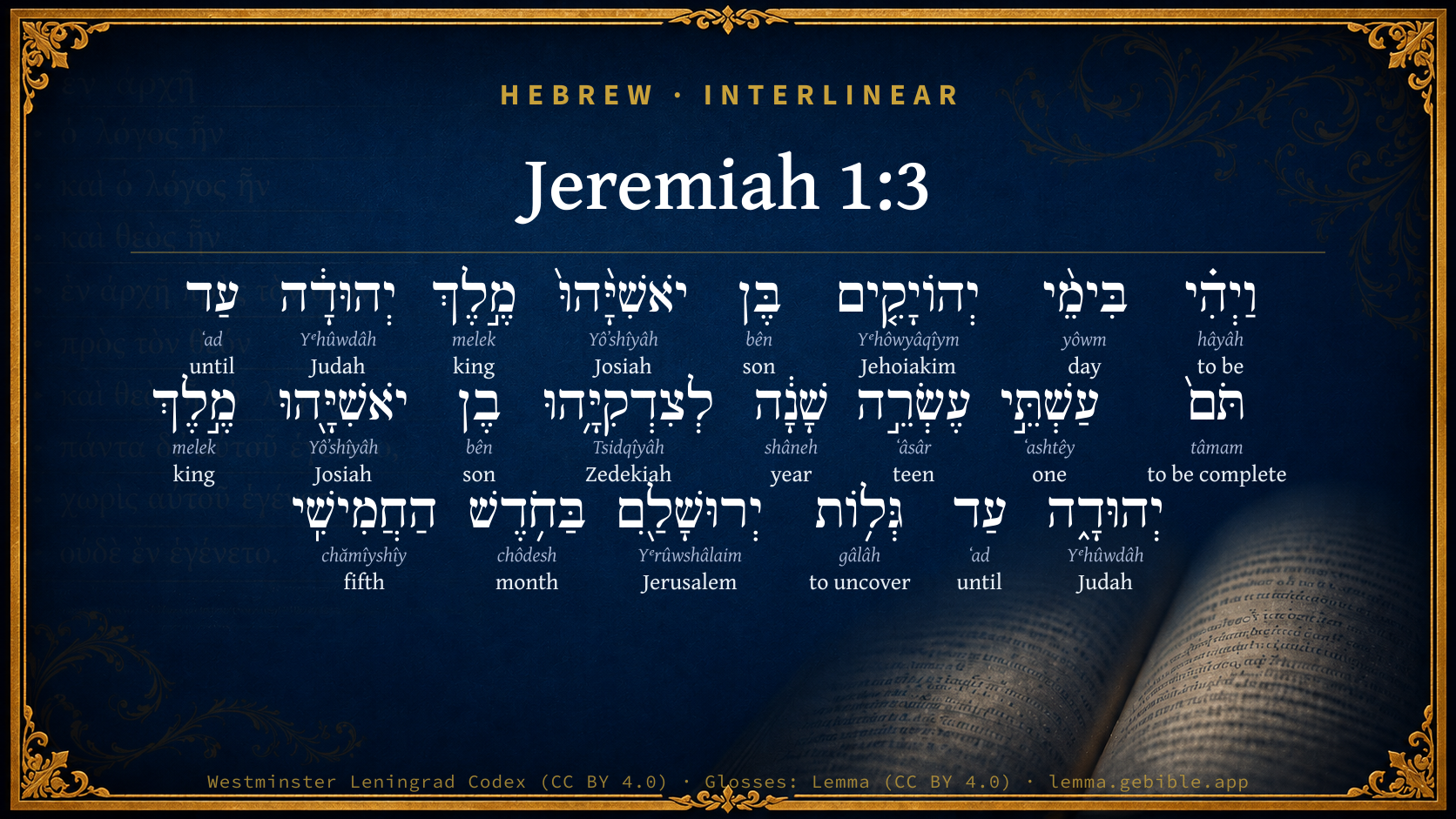
Hebrew (Westminster Leningrad Codex) Jeremiah 1:3 appears in the Hebrew Old Testament. The text above is from the Westminster Leningrad Codex. Each word links to its Strong’s number, a concise gloss, and parsing drawn from the Open Scriptures Hebrew Bible morphology. Click any word for its full Brown-Driver-Briggs (BDB) entry.
Download image
Cite this verse

Jeremiah 1:3 (World English Bible). Public Domain. Lemma interlinear Bible study tool, https://lemma.gebible.app/v/jeremiah/1/3.

Show BibTeX & RIS
BibTeX
RIS
English Translation
It came also in the days of Jehoiakim the son of Josiah, king of Judah, to the end of the eleventh year of Zedekiah, the son of Josiah, king of Judah, to the carrying away of Jerusalem captive in the fifth month.
World English Bible · Public Domain
Download a study sheet

One document with this verse’s original text, its word-by-word gloss line, the meaning frame, cross-references with their text, attributed commentary, and full source and license credits — printable, and it pastes into notes with its structure intact.

This verse Autodidact and up

Study sheet (.html) Plain text (.txt)

A passage Seminary Student

Up to 50 verses in one chapter. A passage sheet keeps up to 6 commentary sources and 12 cross-references per verse, in the order this page ranks them, and says so on the sheet whenever that leaves anything out. Ask for a single verse and you get the Autodidact verse sheet above.

Everything on this page stays free to read, with no account — the sheet is a download of what is already on screen, not access to it.

Want to remove ads? Support Godless Engineer
Compare translations 3

The same verse in 3 English versions, stacked beneath the original-language interlinear above. Click any original word for its lexicon entry.

Each is an independent rendering of the whole verse — the interlinear is not word-aligned to these translations.

Highlighted words mark where these versions differ — a whole-verse word diff, not a word-by-word alignment.

  • World English Bible Public Domain
    It came also in the days of Jehoiakim the son of Josiah, king of Judah, to the end of the eleventh year of Zedekiah, the son of Josiah, king of Judah, to the carrying away of Jerusalem captive in the fifth month.
  • King James Version Public Domain
    It came also in the days of Jehoiakim the son of Josiah king of Judah, unto the end of the eleventh year of Zedekiah the son of Josiah king of Judah, unto the carrying away of Jerusalem captive in the fifth month.
  • unfoldingWord Literal Text CC BY-SA 4.0
    And it happened in the days of Jehoiakim son of Josiah, king of Judah, until the end of the eleventh year of Zedekiah son of Josiah, king of Judah, until the exile of Jerusalem in the fifth month.

unfoldingWord Literal Text — © unfoldingWord, licensed CC BY-SA 4.0. Word-aligned USFM3 via Door43 (git.door43.org/unfoldingWord/en_ult).

Versions to compare (up to 4)

3 of 4 selected

Show all 18 translations

Every available English version of this verse, each an independent rendering of the whole verse.

  • World English Bible Public Domain
    It came also in the days of Jehoiakim the son of Josiah, king of Judah, to the end of the eleventh year of Zedekiah, the son of Josiah, king of Judah, to the carrying away of Jerusalem captive in the fifth month.
  • Berean Standard Bible Public Domain
    and through the days of Jehoiakim son of Josiah king of Judah, until the fifth month of the eleventh year of Zedekiah son of Josiah king of Judah, when the people of Jerusalem went into exile.
  • Majority Standard Bible Public Domain
    and through the days of Jehoiakim son of Josiah king of Judah, until the fifth month of the eleventh year of Zedekiah son of Josiah king of Judah, when the people of Jerusalem went into exile.
  • King James Version Public Domain
    It came also in the days of Jehoiakim the son of Josiah king of Judah, unto the end of the eleventh year of Zedekiah the son of Josiah king of Judah, unto the carrying away of Jerusalem captive in the fifth month.
  • American Standard Version (1901) Public Domain
    It came also in the days of Jehoiakim the son of Josiah, king of Judah, unto the end of the eleventh year of Zedekiah, the son of Josiah, king of Judah, unto the carrying away of Jerusalem captive in the fifth month.
  • Revised Version (1885) Public Domain
    It came also in the days of Jehoiakim the son of Josiah, king of Judah, unto the end of the eleventh year of Zedekiah the son of Josiah, king of Judah; unto the carrying away of Jerusalem captive in the fifth month.
  • Geneva Bible (1599) Public Domain
    And also in the dayes of Iehoiakim the sonne of Iosiah King of Iudah vnto the ende of the eleuenth yeere of Zedekiah, the sonne of Iosiah King of Iudah, euen vnto the carying away of Ierusalem captiue in the fift moneth.
  • Douay-Rheims (1899) Public Domain
    And which came to him in the days of Joakim the son of Josias king of Juda, unto the end of the eleventh year of Sedecias the son of Josias king of Juda, even unto the carrying away of Jerusalem captive, in the fifth month.
  • Young's Literal Translation Public Domain
    and it is in the days of Jehoiakim son of Josiah, king of Judah, till the completion of the eleventh year of Zedekiah son of Josiah, king of Judah, till the removal of Jerusalem in the fifth month.
  • Literal Standard Version CC BY-SA 4.0
    and it is in the days of Jehoiakim son of Josiah, king of Judah, until the completion of the eleventh year of Zedekiah son of Josiah, king of Judah, until the expulsion of Jerusalem in the fifth month.
  • Unlocked Literal Bible CC BY-SA 4.0
    It also came in the days of Jehoiakim son of Josiah, king of Judah, until the fifth month of the eleventh year of Zedekiah son of Josiah, king of Judah, when the people of Jerusalem were taken away as prisoners.
  • unfoldingWord Literal Text CC BY-SA 4.0
    And it happened in the days of Jehoiakim son of Josiah, king of Judah, until the end of the eleventh year of Zedekiah son of Josiah, king of Judah, until the exile of Jerusalem in the fifth month.
  • Darby Bible Public Domain
    it came also in the days of Jehoiakim the son of Josiah, king of Judah, unto the end of the eleventh year of Zedekiah the son of Josiah, king of Judah, unto the carrying away of Jerusalem captive, in the fifth month.
  • World Messianic Bible Public Domain
    It came also in the days of Jehoiakim the son of Josiah, king of Judah, to the end of the eleventh year of Zedekiah, the son of Josiah, king of Judah, to the carrying away of Jerusalem captive in the fifth month.
  • Webster's Bible Public Domain
    It came also in the days of Jehoiakim the son of Josiah king of Judah, to the end of the eleventh year of Zedekiah the son of Josiah king of Judah, to the carrying away of Jerusalem captive in the fifth month.
  • Free Bible Version CC BY-SA 4.0
    and on through the time of Jehoiakim, son of Josiah, king of Judah, up to the fifth month of the eleventh year of Zedekiah, son of Josiah, king of Judah, which was when the people of Jerusalem went into exile.
  • Bible in Basic English Public Domain
    And it came again in the days of Jehoiakim, the son of Josiah, king of Judah, up to the eleventh year of Zedekiah, the son of Josiah, king of Judah; till Jerusalem was taken away in the fifth month.
  • JPS Tanakh (1917) Public Domain
    It came also in the days of Jehoiakim the son of Josiah, king of Judah, unto the end of the eleventh year of Zedekiah the son of Josiah, king of Judah, unto the carrying away of Jerusalem captive in the fifth month.

Literal Standard Version (2020), Covenant Press — licensed CC BY-SA 4.0. Text via the HelloAO Bible API (eBible.org). Unlocked Literal Bible (unfoldingWord) — licensed CC BY-SA 4.0. Text via the HelloAO Bible API (eBible.org). unfoldingWord Literal Text — © unfoldingWord, licensed CC BY-SA 4.0. Word-aligned USFM3 via Door43 (git.door43.org/unfoldingWord/en_ult). Free Bible Version, Dr. Jonathan Gallagher — licensed CC BY-SA 4.0. Text via the HelloAO Bible API (eBible.org).

Word by word

More ways to search: Search by grammar → Find every occurrence → Compare this word →

Practice this passage: Drill this verse → Learn its vocabulary →

עַשְׁתֵּ֣י
ʻashtêy
H6249
“one”
Adjective, Ordinal number, Both, Plural, Construct
Part of Speech
Adjective
Type
Ordinal number
Gender
Both
Number
Plural
State
Construct
Full BDB Definition

Origin: apparently masc. pl. construction of H6247 in the sense of an afterthought (used only in connection with H6240 in lieu of H259 ) eleven or (ordinal) eleventh

TWOT: 1717c

one, eleven, eleventh
  1. וַיְהִ֗י hâyâh H1961 “and · to be” Conjunction + Verb, Qal, Sequential Imperfect, 3rd Person, Masculine, Singular
  2. בִּימֵ֨י yôwm H3117 “in/at · days of” Preposition + Noun, Common, Masculine, Plural, Construct
  3. יְהוֹיָקִ֤ים Yᵉhôwyâqîym H3079 “Jehoiakim” Noun, Proper
  4. בֶּן bên H1121 “son of” Noun, Common, Masculine, Singular, Construct
  5. יֹאשִׁיָּ֨הוּ֙ Yôʼshîyâh H2977 “Josiah” Noun, Proper
  6. מֶ֣לֶךְ melek H4428 “king of” Noun, Common, Masculine, Singular, Construct
  7. יְהוּדָ֔ה Yᵉhûwdâh H3063 “Judah” Noun, Proper
  8. עַד ʻad H5704 “until” Preposition
  9. תֹּם֙ tâmam H8552 “to be complete” Verb, Qal, Infinitive Construct
  10. עֶשְׂרֵ֣ה ʻâsâr H6240 “teen” Adjective, Cardinal number, Feminine, Singular, Absolute
  11. שָׁנָ֔ה shâneh H8141 “year” Noun, Common, Feminine, Singular, Absolute
  12. לְצִדְקִיָּ֥הוּ Tsidqîyâh H6667 “to/for · Zedekiah” Preposition + Noun, Proper
  13. בֶן bên H1121 “son of” Noun, Common, Masculine, Singular, Construct
  14. יֹאשִׁיָּ֖הוּ Yôʼshîyâh H2977 “Josiah” Noun, Proper
  15. מֶ֣לֶךְ melek H4428 “king of” Noun, Common, Masculine, Singular, Construct
  16. יְהוּדָ֑ה Yᵉhûwdâh H3063 “Judah” Noun, Proper
  17. עַד ʻad H5704 “until” Preposition
  18. גְּל֥וֹת gâlâh H1540 “to uncover” Verb, Qal, Infinitive Construct
  19. יְרוּשָׁלִַ֖ם Yᵉrûwshâlaim H3389 “Jerusalem” Noun, Proper
  20. בַּחֹ֥דֶשׁ chôdesh H2320 “in/at the · month” Preposition, Determined + Noun, Common, Masculine, Singular, Absolute
  21. הַחֲמִישִֽׁי chămîyshîy H2549 “the · fifth” Particle, Definite Article + Adjective, Ordinal number, Masculine, Singular, Absolute

About this verse

These counts appear in no published source. They are computed here, from the morphology-tagged text and Lemma’s own curated glosses. What Lemma adds →

22
words
17
distinct lemmas
Prophets
section

Notable vocabulary

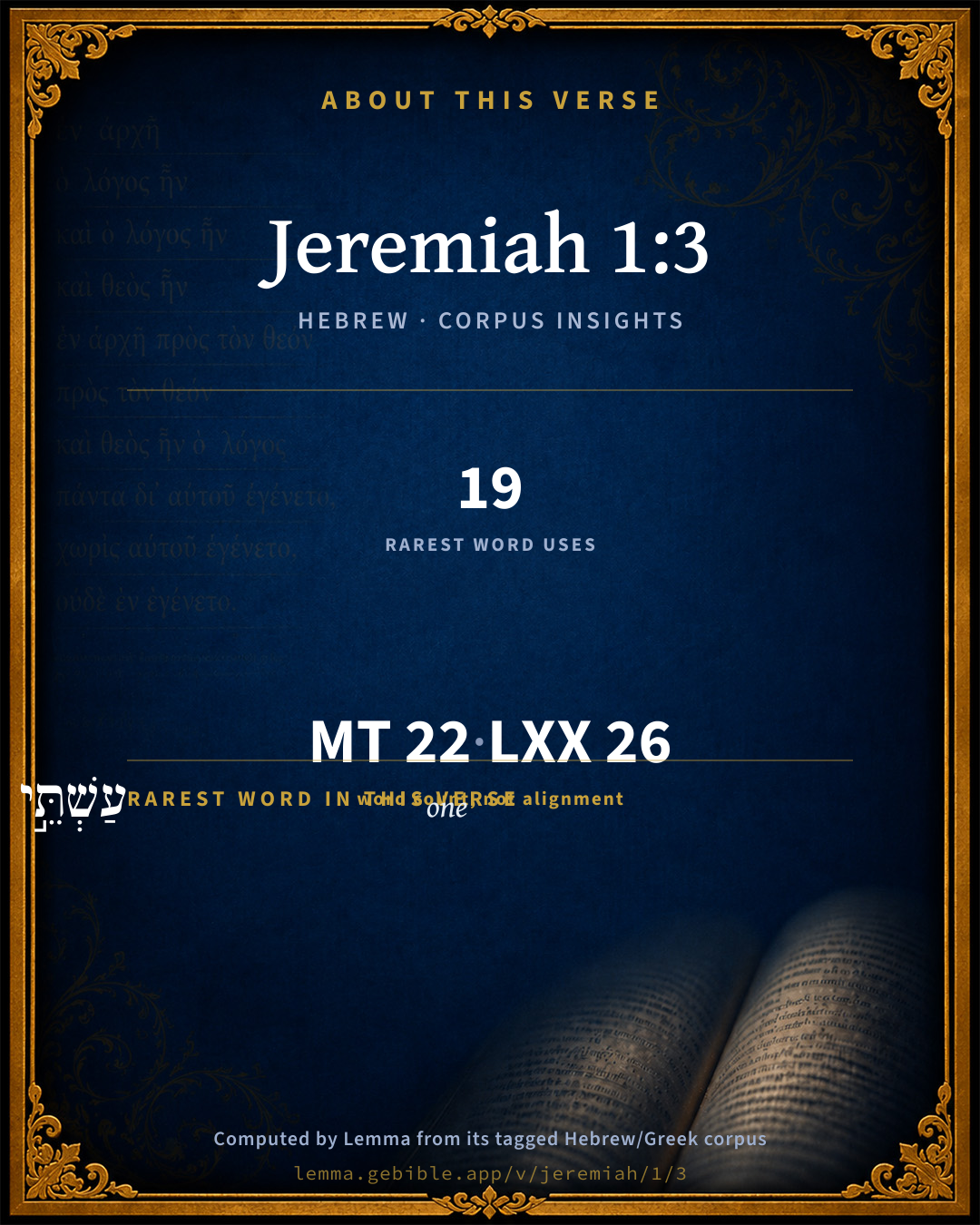
The rarest word here is עַשְׁתֵּ֣י one H6249 — appearing just 19 times in the whole Hebrew Bible.

Shared distinctive vocabulary

עַשְׁתֵּ֣י one H6249 occurs in 18 verses of the Hebrew Bible. Also found in:

Grammatical profile

  • 3 verbs
  • 14 nouns
  • 3 adjectives
  • 2 prepositions

Verb forms

  • וַיְהִ֗י Qal · Sequential Imperfect
  • תֹּם֙ Qal · Infinitive Construct
  • גְּל֥וֹת Qal · Infinitive Construct

Repetition

Words recur within this verse — often emphatic in Hebrew:

  • בֶּן son H1121 ×2
  • יֹאשִׁיָּ֨הוּ֙ Josiah H2977 ×2
  • מֶ֣לֶךְ king H4428 ×2
  • יְהוּדָ֔ה Judah H3063 ×2
  • עַד until H5704 ×2

Hebrew & Septuagint length

In the original languages it is 22 Hebrew tokens and 26 Greek tokens — but the two are counted differently (Hebrew bundles its prefixes and suffixes into one token; the Greek is in lemma form), so that isn’t a like-for-like length.

Cross-references

16

Topical passages linked to Jeremiah 1:3 in the Treasury of Scripture Knowledge — connected by theme and wording, ordered by reader-vote popularity; previews shown in the World English Bible.

  • 2 Kings 23:34 Pharaoh Necoh made Eliakim the son of Josiah king in the room of Josiah his father, and changed his name to Jehoiakim: but he took Jehoahaz away; and he came to Egypt, and died there.
  • 2 Chronicles 36:5–8 Jehoiakim was Twenty-five years old when he began to reign; and he reigned eleven years in Jerusalem: and he did that which was evil in the sight of Yahweh his God.
  • Jeremiah 39:2 in the eleventh year of Zedekiah, in the fourth month, the ninth day of the month, a breach was made in the city),
  • Zechariah 7:5 "Speak to all the people of the land, and to the priests, saying, 'When you fasted and mourned in the fifth and in the seventh month for these seventy years, did you at all fast to me, really to me?
  • 2 Kings 24:1–9 In his days Nebuchadnezzar king of Babylon came up, and Jehoiakim became his servant three years: then he turned and rebelled against him.
  • 2 Kings 24:17–25:30 The king of Babylon made Mattaniah, [Jehoiachin's] father's brother, king is his place, and changed his name to Zedekiah.
  • 1 Chronicles 3:15 The sons of Josiah: the firstborn Johanan, the second Jehoiakim, the third Zedekiah, the fourth Shallum.
  • 2 Chronicles 36:11–21 Zedekiah was twenty-one years old when he began to reign; and he reigned eleven years in Jerusalem:
  • Jeremiah 21:1–14 The word which came to Jeremiah from Yahweh, when king Zedekiah sent to him Pashhur the son of Malchijah, and Zephaniah the son of Maaseiah, the priest, saying,
  • Jeremiah 25:1–3 The word that came to Jeremiah concerning all the people of Judah, in the fourth year of Jehoiakim the son of Josiah, king of Judah (the same was the first year of Nebuchadrezzar king of Babylon),
  • Jeremiah 26:1–24 In the beginning of the reign of Jehoiakim the son of Josiah, king of Judah, came this word from Yahweh, saying,
  • Jeremiah 28:1–17 It happened the same year, in the beginning of the reign of Zedekiah king of Judah, in the fourth year, in the fifth month, that Hananiah the son of Azzur, the prophet, who was of Gibeon, spoke to me in the house of Yahweh, in the presence of the priests and of all the people, saying,
  • Jeremiah 34:1–35:19 The word which came to Jeremiah from Yahweh, when Nebuchadnezzar king of Babylon, and all his army, and all the kingdoms of the earth that were under his dominion, and all the peoples, were fighting against Jerusalem, and against all the cities of it, saying:
  • Jeremiah 37:1–21 Zedekiah the son of Josiah reigned as king, instead of Coniah the son of Jehoiakim, whom Nebuchadrezzar king of Babylon made king in the land of Judah.
  • Jeremiah 52:1–34 Zedekiah was twenty-one years old when he began to reign; and he reigned eleven years in Jerusalem: and his mother's name was Hamutal the daughter of Jeremiah of Libnah.
  • Zechariah 8:19 Thus says Yahweh of Hosts: "The fasts of the fourth fifth, seventh, and tenth months shall be for the house of Judah joy and gladness, and cheerful feasts. Therefore love truth and peace."

Cross-references courtesy of OpenBible.info (CC BY 4.0).

Hebrew and Greek witnesses Masoretic Hebrew ↔ Greek Septuagint

The same verse in the two great witnesses to the Old Testament, shown verse-for-verse.

These are two independent witnesses, not word-aligned to each other, and the Septuagint is shown in lemma (dictionary) form.

Hebrew Jeremiah 1:3 Masoretic · Westminster Leningrad Codex

וַיְהִ֗י בִּימֵ֨י יְהוֹיָקִ֤ים בֶּן יֹאשִׁיָּ֨הוּ֙ מֶ֣לֶךְ יְהוּדָ֔ה עַד תֹּם֙ עַשְׁתֵּ֣י עֶשְׂרֵ֣ה שָׁנָ֔ה לְצִדְקִיָּ֥הוּ בֶן יֹאשִׁיָּ֖הוּ מֶ֣לֶךְ יְהוּדָ֑ה עַד גְּל֥וֹת יְרוּשָׁלִַ֖ם בַּחֹ֥דֶשׁ הַחֲמִישִֽׁי

It came also in the days of Jehoiakim the son of Josiah, king of Judah, to the end of the eleventh year of Zedekiah, the son of Josiah, king of Judah, to the carrying away of Jerusalem captive in the fifth month.

World English Bible · Public Domain

Greek LXX Structure differs

In the Septuagint, Jeremiah is about an eighth shorter than the Hebrew and arranges its material differently — the Oracles Against the Nations (Hebrew chapters 46–51) appear in the middle of the Greek book, after 25:13. Because the chapter and verse boundaries do not line up, a verse-for-verse comparison with the Hebrew is not shown.

A verse-for-verse comparison isn’t shown here because the chapters and verses don’t line up. Switch to the LXX edition with the MT / LXX toggle above to read the Greek directly.

Hebrew: Westminster Leningrad Codex (CC BY 4.0). Greek: Septuagint (public domain); English from a public-domain English Septuagint. How the Septuagint differs from the Hebrew →

Targum (Aramaic paraphrase)

1

The Targum is the ancient Jewish Aramaic paraphrase of the Hebrew Scriptures — an interpretive translation, not the Hebrew text itself. Onkelos (literal) and Pseudo-Jonathan (expansive) render the Torah, and Jonathan the Prophets. Coverage is partial: where no permissively-licensed English translation exists for a verse, only the Aramaic is shown. This is verse-level text, not a word-by-word alignment to the Hebrew.

  1. Targum Jonathan Prophets (Joshua–Malachi)
    וַהֲוָה בִּימֵי יְהוֹיָקִים בַּר יֹאשִׁיָה מְלַךְ שִׁבְטָא דְבֵית יְהוּדָה עַד דִשְׁלִימָא חֲדָא עַשְׂרֵי שִׁבְטָא דְבֵית יְהוּדָה עַד דִשְׁלִימָא חֲדָא עַשְׂרֵי שְׁנִין לְצִדְקִיָה אֲחוּהִי בַר יֹאשִׁיָה מְלַךְ שִׁבְטָא דְבֵית יְהוּדָה עַד דַאֲתָא נְבוּכַדְנֶצַר מַלְכָּא דְבָבֶל וְצָר עַל יְרוּשְׁלֵם תְּלַת שְׁנִין וְאַגְלֵי עַמָא דְבָהּ בְיַרְחָא חֲמִישָׁאָה:

    (no public-domain English translation for this verse)

    Targum Jonathan — Aramaic: “Mikraot Gedolot” (public domain). English: “Sefaria Community Translation” (CC0 1.0 (public-domain dedication)); “London "Chaldee Paraphrase," 1871” (public domain). Text via Sefaria.

Commentary

Notes on Jeremiah 1:3 from classic Christian and Jewish commentators (each source and its license shown beneath its notes). The classic Christian expositions comment on the surrounding passage and are grouped to its opening verse, so a note may address several verses; the Jewish commentaries on the Tanakh (Rashi and others) are per-verse, so they appear only where the commentator wrote on this verse.

Lemma curates 59 commentaries, every one of them public domain or Creative Commons licensed, each selected and text-cleaned for this edition rather than reprinted as found. About our sources →

Trapp's Complete Commentary

John Trapp

Jer 1:3 It came also in the days of Jehoiakim the son of Josiah king of Judah, unto the end of the eleventh year of Zedekiah the son of Josiah king of Judah, unto the carrying away of Jerusalem captive in the fifth month.

Ver. 3. It came also in the days of Jehoiakim.] Called at first Eliakim by his good father Josiah, from whom he degenerated, cutting Jeremiah’s roll with a penknife and burning it, {Jer 36:23} at which his father’s heart would have melted. {2Ch 34:27}

Unto the end of the eleventh year of Zedekiah.] Jehoahaz and Jehoiakim are not mentioned, because their reign was so short, hardly half a year. By this computation it appeareth that Jeremiah prophesied forty years at least. And the Holy Ghost setteth a special mark (as a reverend writer {a} hath well observed) upon those forty years of his prophesying, {Eze 4:6} where, when the Lord summeth up the years that were between the falling away of the ten tribes and the burning of the temple, three hundred and ninety in all, and counteth them by the prophet’s lying so many days upon his left side, he bids him to lie forty days upon his right side, and bear the iniquity of the house of Judah forty days, a day for a year. Not to signify that it was forty years above three hundred and ninety between the revolt of the ten tribes and the captivity of Judah (for it was but three hundred and ninety exactly in all), but because he would set and mark out Judah’s singular iniquity by a singular mark; for that they had forty years so pregnant instructions and admonitions by so eminent a prophet, and yet were impenitent to their own destruction.

Unto the carrying away of Jerusalem.] He thought, belike, when he prefixed this title, that he should have prophesied no more, when once Jerusalem was carried captive; but it proved otherwise, for he prophesied after that in Egypt; {Jer 44:24} yet not forty years also after the captivity, as the Jews have fabled. Nor is it so certain that for that prophecy he was slain by Pharaohophra (whom Herodotus {b} calleth Apryes, and saith he was a very proud prince), as some have reported.

{a} Lightfoot’s Harmony: Chron. of Old Test.

{b} Lib. ii. in fine.

John Trapp, A Commentary or Exposition upon All the Books of the Old and New Testament (1647–1656) — public domain. Text from a community e-Sword module.

Joseph Benson's Commentary

Jer 1:3. It came also — Namely, the word of the Lord, as Jer 1:2; in the days of Jehoiakim — Called at first by Josiah, Eliakim, 2Ki 23:34. It must be observed, that Jehoahaz, who reigned before him, (2 Kings 28:8,) and Jehoiakim, who succeeded him, are not mentioned here, because each of them reigned only three months, and could hardly be said to be established in the government. Unto the end of the eleventh year of Zedekiah — The meaning is, that he prophesied not only during the reigns of Josiah and Jehoiakim, but also during the whole reign of Zedekiah, which was eleven years: unto the carrying away of Jerusalem captive — That great event of which he had so often prophesied. He continued, indeed, to prophesy after that, (Jer 40:1,) but the computation of the time is here made to end with that event, because it was the accomplishment of many of his predictions: and from the thirteenth year of Josiah to the captivity was just forty years. It is observed from Dr. Lightfoot, that as Moses was forty years a teacher of the Israelites in the wilderness, till they entered into their own land; Jeremiah was so long a teacher in their own land before they were sent into the wilderness of the heathen: and he thinks that therefore a special mark is set upon the last forty years of the iniquity of Judah, which Ezekiel bore forty days, a day for a year, because, during all that time, they had Jeremiah prophesying among them, which was a great aggravation of their impenitency.

Joseph Benson's Commentary on the Old and New Testaments (1811–1818) — public domain. Text from a community e-Sword module.

Geneva Bible (1599)

Geneva Bible translators

Of the eleventh year of Zedekiah, who was also called Mattaniah, and at this time the Jews were carried away into Babylon by Nebuchadnezzar.

Meaning, the nephew of Josiah: for Jehoahaz was his father, who reigned but three months, and therefore is not mentioned, no more is Jehoiakim that reigned no longer.

Geneva Bible (1599) marginal notes — public domain. Text via Bolls.life.

John Calvin's Commentaries

As to the beginning of his time and its termination, it has been briefly shewn, why he says that he had been chosen a prophet in the thirteenth year of Josiah, and that he discharged his office till the eleventh year of Zedekiah.

Now that Josiah is called the son of Amon, it is doubtful whether Josiah was properly his son. Amon began to reign in his twenty-second year, and reigned only two years. Josiah succeeded him in the eighth year of his age. If we number the years precisely, Josiah must have been born when Amon was in his sixteenth year; but it does not appear likely, that Amon was a father when he was sixteen years of age, for in this case he must have begotten a son in his fifteenth year; as the birth must have taken place nine months after. Then Josiah must have been begotten in the fifteenth year of Amon’s age. It is hence a probable conclusion, that he was a son by law and not by nature, according to what is afterwards said of Zedekiah, that he was Josiah’s son, because he was his successor, while he was, as many think, his nephew, a brother’s son. But it was a common thing to call the successors of kings their sons, who were their sons by law, and not, as I have said, by nature. It now follows-

John Calvin's Commentaries (1540-1563) — public domain. Text from the Calvin Translation Society English edition (1840s-50s) via the Christian Classics Ethereal Library (ccel.org). Calvin's coverage is partial (roughly two-thirds of the Bible); uncommented books and verses are honest gaps, never fabricated. The 19th-century editor's footnotes and remarks are omitted so the notes are faithfully Calvin's own voice.

Ellicott's Commentary for English Readers

(3) It came also . . .—The short reigns of Jehoahaz (three months) and Jehoiachin or Jeconiah (three months also) are passed over, and mention made of the more conspicuous reigns of Jehoiakim (eleven years) and Zedekiah (also eleven). Assuming Jeremiah to have been about twenty when the prophetic call came to him, he was sixty or sixty-one at the time of the captivity.

A Bible Commentary for English Readers, edited by Charles John Ellicott (1878–1897) — public domain. Text from a community e-Sword module.

The Cambridge Bible for Schools and Colleges

gen. ed. J. J. S. Perowne

3. in the fifth month] See ch. Jer_52:12 ff. The city had been captured in the preceding month (2Ki_25:4; 2Ki_25:8-10).

The Cambridge Bible for Schools and Colleges (gen. ed. J. J. S. Perowne; Cambridge University Press, 1878–1918) — public domain. Text from a community e-Sword module.

John Gill's Exposition

And it came also in the days of Jehoiakim, the son of Josiah king of Judah,.... In the beginning of his reign, and in the fourth year of his reign; see Jer 25:1, no mention is made of Jehoahaz, who reigned between Josiah and Jehoiakim, because his reign was short, but three months, Kg2 23:31, and perhaps no word of the Lord came to Jeremiah in his time, though it did before and after:

unto the end of the eleventh year of Zedekiah the son of Josiah king of Judah; so that Jeremiah must prophesy in the land of Judea upwards of forty years; eighteen under Josiah, Kg2 22:11, three months under Jehoahaz, Kg2 23:31 eleven years under Jehoiakim, Kg2 23:36, three months under Jeconiah, Kg2 24:8, and eleven years under Zedekiah, when the city was besieged and taken, Kg2 25:2. Josiah had three sons as kings of Judah, Jehoahaz, Jehoiakim, and Zedekiah, under all whom Jeremiah prophesied:

even unto the carrying away of Jerusalem captive in the fifth month: the month Ab, which answers to part of July and part of August; and it was on the ninth or tenth day of this month that the city of Jerusalem was burnt, and the people carried captive, Kg2 25:8 the ninth of the said month is now kept by the Jews as a fast on that account.

John Gill's Exposition of the Whole Bible (1746–1763) — public domain (CC PDM 1.0). Text via the HelloAO Bible API.

Albert Barnes' Notes on the Bible

The whole period contained in this verse is no less than 40 years and 6 months, namely, 18 years under Josiah, two periods of 11 years each under Jehoiakim and Zedekiah, and 3 months under each of the omitted kings, Jehoahaz and Jeconiah.

In the fifth month - The capture of Jerusalem took place in the fourth month, but its destruction was in the fifth month (see the marginal references), the ninth day of which was subsequently kept as a fast-day Zec 7:3.

Albert Barnes' Notes on the Bible (1834–1885) — public domain. Text from a community e-Sword/MySword module.

Haydock's Catholic Bible Commentary

Joakim. His immediate predecessor and successor, both called Jechonias, (Haydock) are passed over, as their reign was short, (Calmet) only lasting three months each. (Haydock) --- Fifth. Jerusalem was taken on the 9th of the preceding month. But the temple was not burnt, nor the captives sent off till the fifth month, or the 10th of the civil year, chap. xxxix. 8., and lii. 13., and 4 Kings xxv. 2. (Calmet) --- Jeremias also prophesied in Egypt, chap. xliv. (Worthington) --- But this title alludes to his principal predictions. (Menochius)

George Leo Haydock (1774–1849), Haydock's Catholic Family Bible and Commentary, 1859 edition — public domain. Excludes Psalms (Douay-Rheims chapter numbering differs from Protestant) and Deuterocanonical books (Catholic canon only).

Matthew Poole's English Annotations

It, viz. the word of the Lord, as Jer 1:2,

came also in the days of Jehoiakim; called at first by Josiah, Eliakim, 2Ki 23:34. Jehoahaz and Jehoiachin, whereof the former reigned before him, 2Ki 23:31, the latter succeeded, 2Ki 24:8, are conceived not to be mentioned, because they reigned but each of them three months, and therefore not considerable, the Scripture often taking little notice of a small time, as of six months: compare 2Sa 5:5, with 1Ki 2:11; see Jer 1:2.

Zedekiah; of whom read 1Ch 3:15,16.

Unto the carrying away of Jerusalem captive, i.e. the inhabitants of Jerusalem, namely, under Zedekiah, 2Ki 25:11, during all which time, things standing in that state and condition, Jeremiah prophesied. This doth not terminate the time of his prophecies, for he prophesied also both in Judea, and in Egypt afterwards; but only relates to what he prophesied while the city and temple were standing, the rest seeming rather to be added as a supplement, than to be reduced unto this general title of his prophecies.

In the fifth month, viz. of that present year; for though the year end not at the fifth month, yet it might end the year of Zedekiah’s reign, because he might begin his reign at the fifth month of the year.

Matthew Poole's English Annotations on the Holy Bible (1683–1685) — public domain. Text from a community e-Sword/MySword module.

The Pulpit Commentary

Unto the end of the eleventh year, etc. The limit is accurate with regard to Jeremiah 1-39. The later prophecies have a superscription of their own. (see Jer_40:1) In the fifth month. (comp. Jer_40:12)

The Pulpit Commentary (1880–1919), ed. H.D.M. Spence-Jones & Joseph S. Exell — public domain. Text from a community e-Sword module.

John Wesley's Explanatory Notes

It - The word of the Lord. Jehoiakim - Called at first by Josiah, Eliakim. Jehoahaz and Jehoiakin, whereof the former reigned before him, the latter succeeded, are conceived not to be mentioned, because they reigned each of them but three months, and therefore not considerable. Of Jerusalem - The inhabitants of Jerusalem, under Zedekiah, during all which time Jeremiah prophesied. Captive - This does not terminate the time of his prophecies; for he prophesied also both in Judea, and in Egypt afterwards: but only relates to what he prophesied while the city and temple were standing, the rest seeming to be added as a supplement. Fifth month - Of that present year; for, tho' the year end not at the fifth month, yet it might end the year of Zedekiah's reign, because he might begin his reign at the fifth month of the year.

John Wesley, Explanatory Notes Upon the Whole Bible (1754–1765) — public domain. Text via the GEBible commentary corpus.

Scofield Reference Notes

C. I. Scofield

fifth month

i.e. August.

The Scofield Reference Bible (1917 edition), notes by C. I. Scofield — public domain. Text from a community e-Sword module.

Rashi

Rabbi Shlomo Yitzchaki (Rashi)

And he was in the days of Jehoiakim And he was a prophet all the remaining days of Josiah, the days of his son Jehoiakim, and the days of his son Zedekiah, until the end of the eleventh year that is the year until the exile of Jerusalem in the fifth month.

Rashi on the Tanakh — English translations: “The Judaica Press complete Tanach with Rashi, translated by A. J. Rosenberg” (CC BY 4.0); “Pentateuch with Rashi's commentary by M. Rosenbaum and A.M. Silbermann, 1929-1934” (public domain); “The Metsudah Tanach series, Lakewood, N.J” (CC BY 4.0); and “The Book of Joshua, Metsudah Publications, 1997” (CC BY 4.0). Text via Sefaria.

Lesson kit

Teaching starters — assembled from the data on this page, not authored interpretation. Every prompt links to the verse data it draws on. Edit before teaching.

Jeremiah, in the Prophets, opens this verse with 22 words (17 distinct Hebrew lemmas). Its most distinctive word is ʻashtêy (“one”). A historical commentator’s framing appears above. Read the whole chapter for the surrounding context.

Discussion questions

  1. What does “one” (ʻashtêy) contribute to the verse as a whole?
  2. How does Exodus 26:7, which shares the word «one», read alongside this verse?
  3. What does the repetition of “son” (2× in this one verse) do in this verse?
  4. These translations render this verse differently. What is at stake in choosing one wording over another?
  5. «וַיְהִ֗י» is a Qal Sequential Imperfect verb. How does that grammatical form shape the action described?
  6. Compare how Trapp's Complete Commentary and Joseph Benson's Commentary read this verse. Where do they agree or differ?

Things to notice

Reading settings

Reading text

Shown beneath each verse's original-language words.

Old Testament
Old Testament edition

Read the OT as the Masoretic Hebrew (MT) or the Greek Septuagint (LXX).

English shown for the Greek Septuagint (in the Hebrew ↔ Greek comparison).

Comparing translations? Open the Compare panel on any verse page to stack up to four side by side.