Jeremiah 52:6

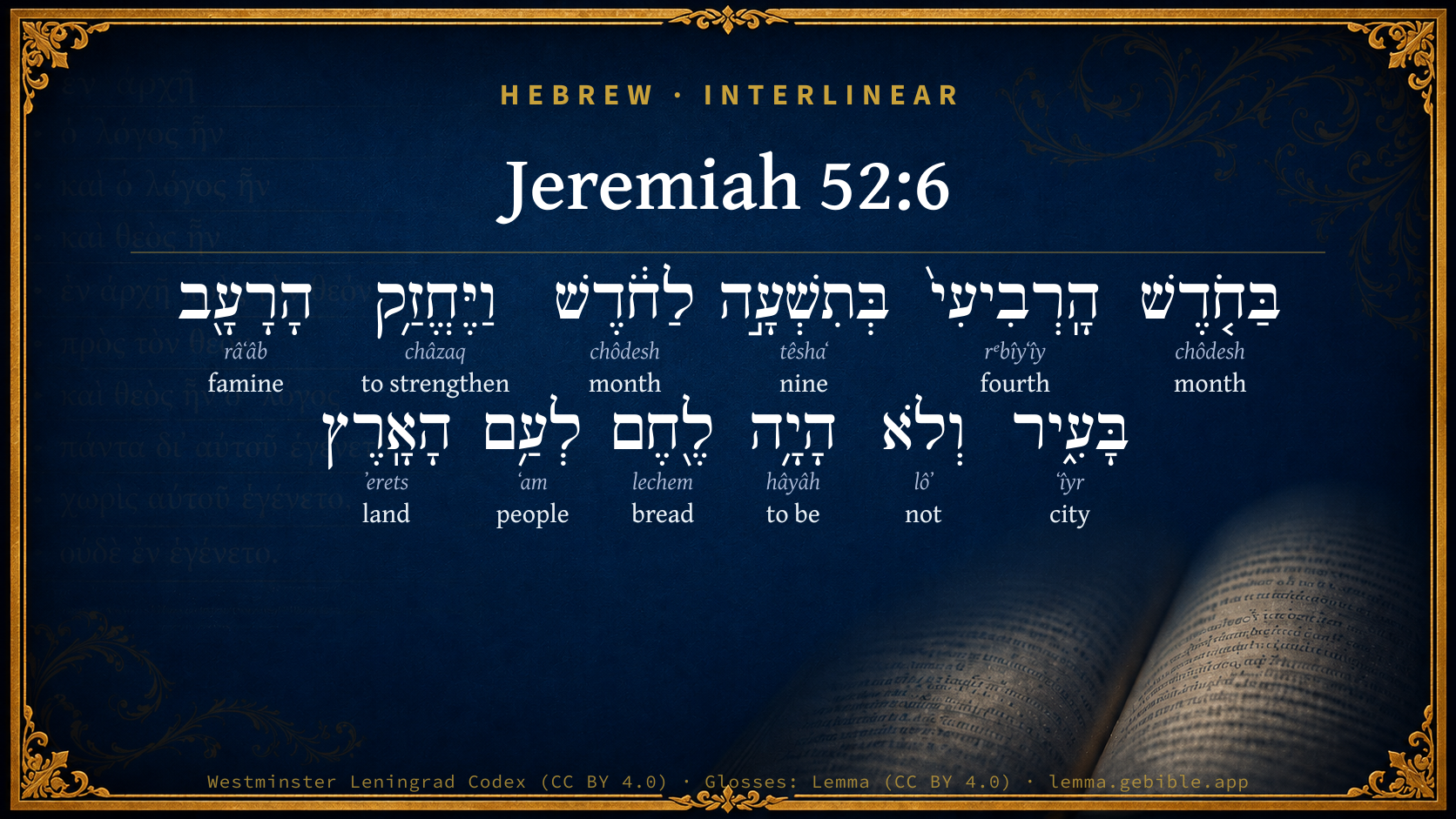
Hebrew (Westminster Leningrad Codex) Jeremiah 52:6 appears in the Hebrew Old Testament. The text above is from the Westminster Leningrad Codex. Each word links to its Strong’s number, a concise gloss, and parsing drawn from the Open Scriptures Hebrew Bible morphology. Click any word for its full Brown-Driver-Briggs (BDB) entry.
Download image
Cite this verse

Jeremiah 52:6 (World English Bible). Public Domain. Lemma interlinear Bible study tool, https://lemma.gebible.app/v/jeremiah/52/6.

Show BibTeX & RIS
BibTeX
RIS
English Translation
In the fourth month, in the ninth day of the month, the famine was sore in the city, so that there was no bread for the people of the land.
World English Bible · Public Domain
Download a study sheet

One document with this verse’s original text, its word-by-word gloss line, the meaning frame, cross-references with their text, attributed commentary, and full source and license credits — printable, and it pastes into notes with its structure intact.

This verse Autodidact and up

Study sheet (.html) Plain text (.txt)

A passage Seminary Student

Up to 50 verses in one chapter. A passage sheet keeps up to 6 commentary sources and 12 cross-references per verse, in the order this page ranks them, and says so on the sheet whenever that leaves anything out. Ask for a single verse and you get the Autodidact verse sheet above.

Everything on this page stays free to read, with no account — the sheet is a download of what is already on screen, not access to it.

Want to remove ads? Support Godless Engineer
Compare translations 3

The same verse in 3 English versions, stacked beneath the original-language interlinear above. Click any original word for its lexicon entry.

Each is an independent rendering of the whole verse — the interlinear is not word-aligned to these translations.

Highlighted words mark where these versions differ — a whole-verse word diff, not a word-by-word alignment.

  • World English Bible Public Domain
    In the fourth month, in the ninth day of the month, the famine was sore in the city, so that there was no bread for the people of the land.
  • King James Version Public Domain
    And in the fourth month, in the ninth day of the month, the famine was sore in the city, so that there was no bread for the people of the land.
  • unfoldingWord Literal Text CC BY-SA 4.0
    By the ninth day of the fourth month the famine was so severe in the city that there was no food for the people of the land.

unfoldingWord Literal Text — © unfoldingWord, licensed CC BY-SA 4.0. Word-aligned USFM3 via Door43 (git.door43.org/unfoldingWord/en_ult).

Versions to compare (up to 4)

3 of 4 selected

Show all 18 translations

Every available English version of this verse, each an independent rendering of the whole verse.

  • World English Bible Public Domain
    In the fourth month, in the ninth day of the month, the famine was sore in the city, so that there was no bread for the people of the land.
  • Berean Standard Bible Public Domain
    By the ninth day of the fourth month, the famine in the city was so severe that the people of the land had no food.
  • Majority Standard Bible Public Domain
    By the ninth day of the fourth month, the famine in the city was so severe that the people of the land had no food.
  • King James Version Public Domain
    And in the fourth month, in the ninth day of the month, the famine was sore in the city, so that there was no bread for the people of the land.
  • American Standard Version (1901) Public Domain
    In the fourth month, in the ninth day of the month, the famine was sore in the city, so that there was no bread for the people of the land.
  • Revised Version (1885) Public Domain
    In the fourth month, in the ninth day of the month, the famine was sore in the city, so that there was no bread for the people of the land.
  • Geneva Bible (1599) Public Domain
    Now in the fourth moneth, the ninth day of the moneth, the famine was sore in ye citie, so that there was no more bread for ye people of the land.
  • Douay-Rheims (1899) Public Domain
    And in the fourth month, the ninth day of the month, a famine overpowered the city: and there was no food for the people of the land.
  • Young's Literal Translation Public Domain
    In the fourth month, in the ninth of the month, when the famine is severe in the city, and there hath been no bread for the people of the land,
  • Literal Standard Version CC BY-SA 4.0
    In the fourth month, on the ninth of the month, when the famine is severe in the city, and there has been no bread for the people of the land,
  • Unlocked Literal Bible CC BY-SA 4.0
    By the ninth day of the fourth month the famine was so severe in the city that there was no food for the people of the land.
  • unfoldingWord Literal Text CC BY-SA 4.0
    By the ninth day of the fourth month the famine was so severe in the city that there was no food for the people of the land.
  • Darby Bible Public Domain
    In the fourth month, on the ninth of the month, the famine prevailed in the city, and there was no bread for the people of the land.
  • World Messianic Bible Public Domain
    In the fourth month, in the ninth day of the month, the famine was severe in the city, so that there was no bread for the people of the land.
  • Webster's Bible Public Domain
    And in the fourth month, in the ninth day of the month, the famine was severe in the city, so that there was no bread for the people of the land.
  • Free Bible Version CC BY-SA 4.0
    By the ninth day of the fourth month, the famine in the city was so bad that the people had nothing left to eat.
  • Bible in Basic English Public Domain
    In the fourth month, on the ninth day of the month, the store of food in the town was almost gone, so that there was no food for the people of the land.
  • JPS Tanakh (1917) Public Domain
    In the fourth month, in the ninth day of the month, the famine was sore in the city, so that there was no bread for the people of the land.

Literal Standard Version (2020), Covenant Press — licensed CC BY-SA 4.0. Text via the HelloAO Bible API (eBible.org). Unlocked Literal Bible (unfoldingWord) — licensed CC BY-SA 4.0. Text via the HelloAO Bible API (eBible.org). unfoldingWord Literal Text — © unfoldingWord, licensed CC BY-SA 4.0. Word-aligned USFM3 via Door43 (git.door43.org/unfoldingWord/en_ult). Free Bible Version, Dr. Jonathan Gallagher — licensed CC BY-SA 4.0. Text via the HelloAO Bible API (eBible.org).

Word by word

More ways to search: Search by grammar → Find every occurrence → Compare this word →

Practice this passage: Drill this verse → Learn its vocabulary →

הָֽרְבִיעִי֙
rᵉbîyʻîy
H7243
“the · fourth”
Particle, Definite Article + Adjective, Ordinal number, Masculine, Singular, Absolute
Part of Speech
Particle + Adjective
Type
Ordinal number
Gender
Masculine
Number
Singular
State
Absolute
Full BDB Definition

Origin: from H7251

TWOT: 2107c

fourth - fourth - four square - fourth part
  1. בַּחֹ֤דֶשׁ chôdesh H2320 “in/at the · month” Preposition, Determined + Noun, Common, Masculine, Singular, Absolute
  2. בְּתִשְׁעָ֣ה têshaʻ H8672 “in/at · nine” Preposition + Adjective, Cardinal number, Masculine, Singular, Absolute
  3. לַחֹ֔דֶשׁ chôdesh H2320 “to/for the · month” Preposition, Determined + Noun, Common, Masculine, Singular, Absolute
  4. וַיֶּחֱזַ֥ק châzaq H2388 “and · to strengthen” Conjunction + Verb, Qal, Sequential Imperfect, 3rd Person, Masculine, Singular
  5. הָרָעָ֖ב râʻâb H7458 “the · famine” Particle, Definite Article + Noun, Common, Masculine, Singular, Absolute
  6. בָּעִ֑יר ʻîyr H5892 “in/at the · city” Preposition, Determined + Noun, Common, Feminine, Singular, Absolute
  7. וְלֹא lôʼ H3808 “and · not” Conjunction + Particle, Negative
  8. הָיָ֥ה hâyâh H1961 “to be” Verb, Qal, Perfect, 3rd Person, Masculine, Singular
  9. לֶ֖חֶם lechem H3899 “bread” Noun, Common, Both, Singular, Absolute
  10. לְעַ֥ם ʻam H5971 “to/for · people of” Preposition + Noun, Common, Masculine, Singular, Construct
  11. הָאָֽרֶץ ʼerets H776 “the · land” Particle, Definite Article + Noun, Common, Both, Singular, Absolute

About this verse

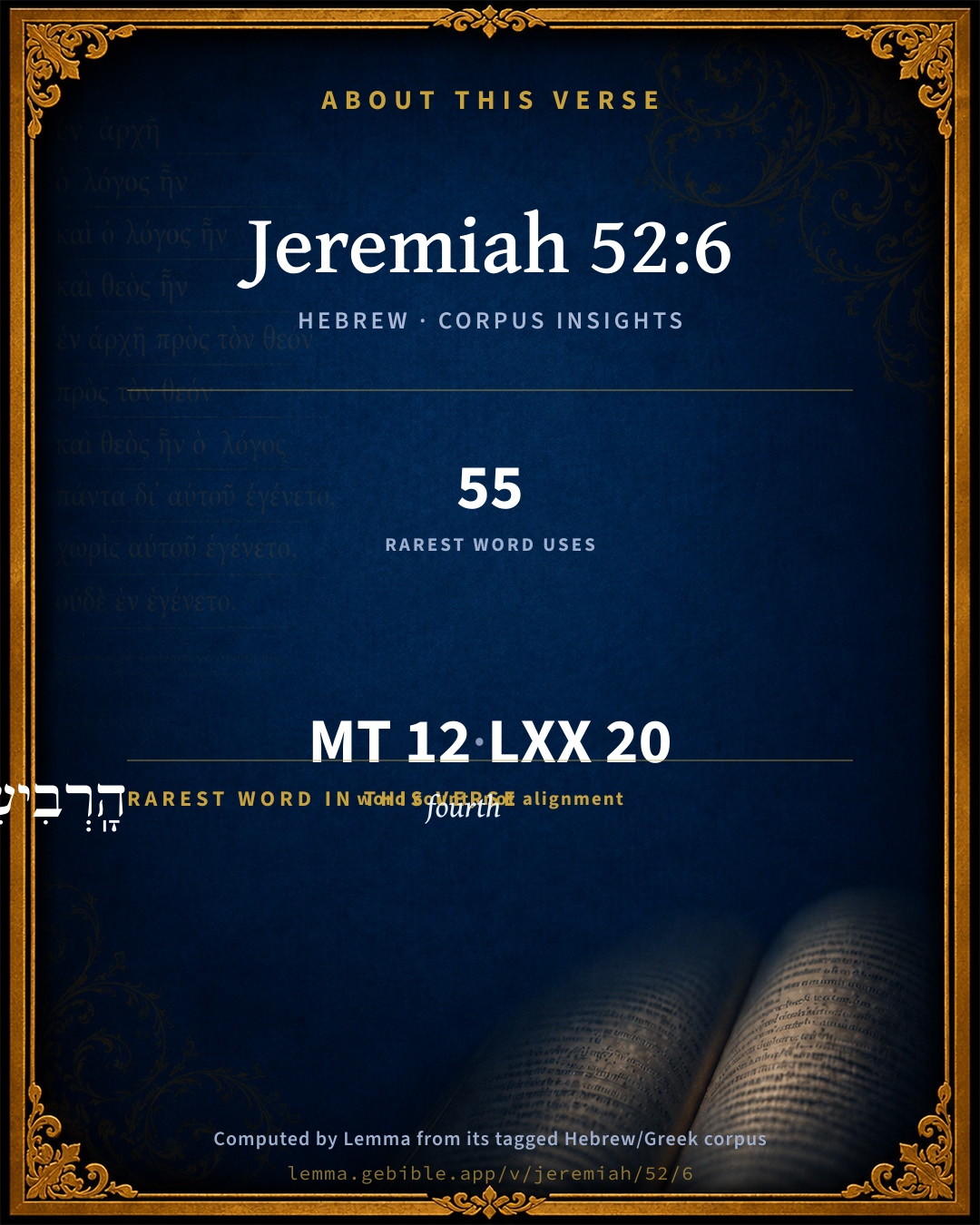
These counts appear in no published source. They are computed here, from the morphology-tagged text and Lemma’s own curated glosses. What Lemma adds →

12
words
11
distinct lemmas
Prophets
section

Shared distinctive vocabulary

הָֽרְבִיעִי֙ fourth H7243 occurs in 53 verses of the Hebrew Bible. Also found in:

Grammatical profile

  • 2 verbs
  • 7 nouns
  • 2 adjectives
  • 1 particle

Verb forms

  • וַיֶּחֱזַ֥ק Qal · Sequential Imperfect
  • הָיָ֥ה Qal · Perfect

Repetition

A word recurs within this verse — often emphatic in Hebrew:

  • בַּחֹ֤דֶשׁ month H2320 ×2

Hebrew & Septuagint length

In the original languages it is 12 Hebrew tokens and 20 Greek tokens — but the two are counted differently (Hebrew bundles its prefixes and suffixes into one token; the Greek is in lemma form), so that isn’t a like-for-like length.

Cross-references

18

Topical passages linked to Jeremiah 52:6 in the Treasury of Scripture Knowledge — connected by theme and wording, ordered by reader-vote popularity; previews shown in the World English Bible.

  • Isaiah 3:1 For, behold, the Lord, Yahweh of Hosts, takes away from Jerusalem and from Judah supply and support, The whole supply of bread, And the whole supply of water;
  • Jeremiah 39:2 in the eleventh year of Zedekiah, in the fourth month, the ninth day of the month, a breach was made in the city),
  • 2 Kings 25:3 On the ninth day of the [fourth] month the famine was sore in the city, so that there was no bread for the people of the land.
  • Jeremiah 38:9 My lord the king, these men have done evil in all that they have done to Jeremiah the prophet, whom they have cast into the dungeon; and he is likely to die in the place where he is, because of the famine; for there is no more bread in the city.
  • Leviticus 26:26 When I break your staff of bread, ten women shall bake your bread in one oven, and they shall deliver your bread again by weight: and you shall eat, and not be satisfied.
  • Deuteronomy 28:52–53 They shall besiege you in all your gates, until your high and fortified walls come down, in which you trusted, throughout all your land; and they shall besiege you in all your gates throughout all your land, which Yahweh your God has given you.
  • Deuteronomy 32:24 [They shall be] wasted with hunger, and devoured with burning heat Bitter destruction; The teeth of animals will I send on them, With the poison of crawling things of the dust.
  • Jeremiah 15:2 It shall happen, when they tell you, Where shall we go forth? then you shall tell them, Thus says Yahweh: Such as are for death, to death; and such as are for the sword, to the sword; and such as are for the famine, to the famine; and such as are for captivity, to captivity.
  • Jeremiah 19:9 I will cause them to eat the flesh of their sons and the flesh of their daughters; and they shall eat everyone the flesh of his friend, in the siege and in the distress, with which their enemies, and those who seek their life, shall distress them.
  • Jeremiah 21:9 He who remains in this city shall die by the sword, and by the famine, and by the pestilence; but he who goes out, and passes over to the Chaldeans who besiege you, he shall live, and his life shall be to him for a prey.
  • Jeremiah 25:10 Moreover I will take from them the voice of mirth and the voice of gladness, the voice of the bridegroom and the voice of the bride, the sound of the millstones, and the light of the lamp.
  • Lamentations 4:4–6 The tongue of the sucking child cleaves to the roof of his mouth for thirst: The young children ask bread, and no man breaks it to them.
  • Lamentations 5:10 Our skin is black like an oven, Because of the burning heat of famine.
  • Ezekiel 4:9–17 Take for yourself also wheat, and barley, and beans, and lentils, and millet, and spelt, and put them in one vessel, and make you bread of it; [according to] the number of the days that you shall lie on your side, even three hundred ninety days, shall you eat of it.
  • Ezekiel 5:10–12 Therefore the fathers shall eat the sons in the midst of you, and the sons shall eat their fathers; and I will execute judgments on you; and the whole remnant of you will I scatter to all the winds.
  • Ezekiel 7:15 The sword is outside, and the pestilence and the famine within: he who is in the field shall die with the sword: and he who is in the city, famine and pestilence shall devour him.
  • Ezekiel 14:21 For thus says the Lord Yahweh: How much more when I send my four sore judgments on Jerusalem, the sword, and the famine, and the evil animals, and the pestilence, to cut off from it man and animal!
  • Zechariah 8:19 Thus says Yahweh of Hosts: "The fasts of the fourth fifth, seventh, and tenth months shall be for the house of Judah joy and gladness, and cheerful feasts. Therefore love truth and peace."

Cross-references courtesy of OpenBible.info (CC BY 4.0).

Hebrew and Greek witnesses Masoretic Hebrew ↔ Greek Septuagint

The same verse in the two great witnesses to the Old Testament, shown verse-for-verse.

These are two independent witnesses, not word-aligned to each other, and the Septuagint is shown in lemma (dictionary) form.

Hebrew Jeremiah 52:6 Masoretic · Westminster Leningrad Codex

בַּחֹ֤דֶשׁ הָֽרְבִיעִי֙ בְּתִשְׁעָ֣ה לַחֹ֔דֶשׁ וַיֶּחֱזַ֥ק הָרָעָ֖ב בָּעִ֑יר וְלֹא הָיָ֥ה לֶ֖חֶם לְעַ֥ם הָאָֽרֶץ

In the fourth month, in the ninth day of the month, the famine was sore in the city, so that there was no bread for the people of the land.

World English Bible · Public Domain

Greek LXX Structure differs

In the Septuagint, Jeremiah is about an eighth shorter than the Hebrew and arranges its material differently — the Oracles Against the Nations (Hebrew chapters 46–51) appear in the middle of the Greek book, after 25:13. Because the chapter and verse boundaries do not line up, a verse-for-verse comparison with the Hebrew is not shown.

A verse-for-verse comparison isn’t shown here because the chapters and verses don’t line up. Switch to the LXX edition with the MT / LXX toggle above to read the Greek directly.

Hebrew: Westminster Leningrad Codex (CC BY 4.0). Greek: Septuagint (public domain); English from a public-domain English Septuagint. How the Septuagint differs from the Hebrew →

Targum (Aramaic paraphrase)

1

The Targum is the ancient Jewish Aramaic paraphrase of the Hebrew Scriptures — an interpretive translation, not the Hebrew text itself. Onkelos (literal) and Pseudo-Jonathan (expansive) render the Torah, and Jonathan the Prophets. Coverage is partial: where no permissively-licensed English translation exists for a verse, only the Aramaic is shown. This is verse-level text, not a word-by-word alignment to the Hebrew.

  1. Targum Jonathan Prophets (Joshua–Malachi)
    בְּיַרְחָא רְבִיעָאָה בְּתִשְׁעָא לְיַרְחָא וּתְקֵיף כַּפְנָא בְּקַרְתָּא וְלָא הֲוַת מֵיכַל לְעַמָא דְאַרְעָא:

    (no public-domain English translation for this verse)

    Targum Jonathan — Aramaic: “Mikraot Gedolot” (public domain). English: “Sefaria Community Translation” (CC0 1.0 (public-domain dedication)); “London "Chaldee Paraphrase," 1871” (public domain). Text via Sefaria.

Commentary

Notes on Jeremiah 52:6 from classic Christian and Jewish commentators (each source and its license shown beneath its notes). The classic Christian expositions comment on the surrounding passage and are grouped to its opening verse, so a note may address several verses; the Jewish commentaries on the Tanakh (Rashi and others) are per-verse, so they appear only where the commentator wrote on this verse.

Lemma curates 59 commentaries, every one of them public domain or Creative Commons licensed, each selected and text-cleaned for this edition rather than reprinted as found. About our sources →

Adam Clarke's Commentary

Verse 6. And in the fourth month] See Clarke on Jer 39:1, &c. The fourth month answers nearly to our July.

Adam Clarke's Commentary on the Bible (1810–1826) — public domain. Text from a community e-Sword/MySword module.

Ellicott's Commentary for English Readers

(6) And in the fourth month.—Omitted in the Hebrew of 2Ki_25:3, but supplied in the English version.

A Bible Commentary for English Readers, edited by Charles John Ellicott (1878–1897) — public domain. Text from a community e-Sword module.

The Cambridge Bible for Schools and Colleges

gen. ed. J. J. S. Perowne

6. In the fourth month] In memory of this date also, a fast was appointed (Zec_8:19). The numeral, which was dropped out of the Kgs. narrative, here survives.

famine] described in detail in Lamentations (Jer_2:19 f., Jer_4:3 ff., Jer_5:10). Cp. Eze_4:16 f., Jer_5:16 f.

the people of the land] the poorer classes, who had taken refuge in Jerusalem, or who dwelt there.

The Cambridge Bible for Schools and Colleges (gen. ed. J. J. S. Perowne; Cambridge University Press, 1878–1918) — public domain. Text from a community e-Sword module.

John Gill's Exposition

Then the city was broken up,.... Either its gates were broke open, some one or other of them; or a breach was made in the walls of it, through which the Chaldean army entered:

and all the men of war fled; the soldiers, with their officers, not being able to stand before the army of the king of Babylon:

and went forth out of the city by night; at which time, very probably, the attack was made, and the gates of the city forced open, or the walls broke down; Josephus (p) says it was taken in the middle of the night:

by the way of the gate between the two walls, which was by the king's garden; See Gill on Jer 39:4;

now the Chaldeans were by the city round about; as part of their army entered into it, the other part surrounded it; or, however, were placed at the gates and avenues all around, that none might escape:

and they went by the way of the plain; that is, the men of war or soldiers that fled, together with King Zedekiah, his family and princes; see Jer 39:4.

(p) Antiqu. l. 10. c. 8. sect. 2. Ed. Hudson.

John Gill's Exposition of the Whole Bible (1746–1763) — public domain (CC PDM 1.0). Text via the HelloAO Bible API.

The Pulpit Commentary

The famine was sore. (see the pathetic descriptions in Lam_1:19, 20 2:11, 12, 20 4:9, 10)

Famine.

One of the most frightful that over befell any city is told of here. Its ghastly details may be traced out from this verse and different parts of the writings of Jeremiah and Ezekiel. This verse tells how the store of bread gradually failed; Jer_37:21 and Jer_38:2-9 with what difficulty ever so little was gained (also Eze_5:16 Eze_5:16 Eze_12:19) Then Lam_4:7 and Lam_5:10 tell of the sufferings of the nobles; Lam_4:5 and Eze_4:12-15 of the degradation of the high-born ladies of Jerusalem, snatching morsels of bread from the dunghills. The cries of the poor little children; (Lam_2:11, Lam_2:12, 19 4:4) the hard-heartedness of their parents. (Lam_4:3) Fathers ate the flesh of their own sons; (Eze_5:10) mothers that of their new-born babes. (Lam_2:20 Lam_4:10) Thus frightful was this famine. And it is ever a fearful thing, let the cause be what it may. Note

I WHEREFORE THEY ARE SENT.

I As punishment:

(1) For violation of natural law. When men will crowd together in space too limited or on lands that will not yield sufficient, or will out of greed or selfishness refuse to cultivate aright the land they have, then sooner or later famine will come.

(2) For violation of Divine laws. So in the case of famine told of here. But: They are sent as prompters and promoters of repentance and amendment. In case of violated natural laws they have again and again performed this needed office. Men have spread themselves abroad, communications between one district and another have been opened up, improved methods of cultivation have been adopted, wiser and juster laws have been enacted, and men"s energies and thoughts have been roused to devise remedies and safeguards against the recurrence of the evil. And when it is the Divine laws that have been violated, the Divine laws against sin for natural laws are also Divine famine has brought many a prodigal to himself, and led him to say," I will arise and go to my Father, and will say unto him, Father, I have sinned." It did so in the case of the Jews.

II BUT FAMINE IS AN UNNECESSARY AND UNNATURAL THING. For in our Father"s house there is bread enough and to spare, and none need perish with hunger. The world contains ample store; the resources of nature are in no degree exhausted, and therefore it can only be by negligence of God"s laws in nature that famine can in ordinary cases occur. And why need any go away into the far country of sin, and so compel the righteous and loving Father to send such sore judgment after them in order to bring them back? "O Israel, thou hast destroyed thyself!" It is not according to God"s will in any case.

III AND WHAT IS TRUE OF THE LITERAL IS TRUE ALSO OF THE SPIRITUAL FAMINE.

1. It is caused by man"s disobedience. So it was at the first. Sin thrust him forth from the Father"s house, the happy home where he never knew what want was. And so it is still. Had those who knew of Christ and his redemption but obeyed the word, "Let him that heareth say, Come," long ere this the whole world would have been evangelized. And if the same command were obeyed now, the like result would speedily follow. Christ has given a self-propagating power to his Church, which it has failed to use, and therefore spiritual famines are and will be until the Church obeys her Lord"s commands. But:

2. Such famine need not be. Christ is the "Bread of life" for all, and there is enough and to spare for all

CONCLUSION. Let not thy brother hunger if thou canst give him of this bread. Think of what famine means, and let thy charity be aroused. Take care that thou eatest not merely talkest of the Bread of life thyself. C.

The Pulpit Commentary (1880–1919), ed. H.D.M. Spence-Jones & Joseph S. Exell — public domain. Text from a community e-Sword module.

Scofield Reference Notes

C. I. Scofield

fourth month

i.e. July.

The Scofield Reference Bible (1917 edition), notes by C. I. Scofield — public domain. Text from a community e-Sword module.

unfoldingWord translationNotes

Door43 World Missions Community

By the ninth day of the fourth month

This is the fourth month of the Hebrew calendar. It is during the dry season. The ninth day is near the beginning of July on Western calendars. Zedekiah had been king for ten years, three months, and eight days. (See: Hebrew Months and Ordinal Numbers)

city

This refers to Jerusalem.

the city was broken into

This can be translated in active form. AT: "the Babylonians broke through the wall around the city" (See: Active or Passive)

the two walls

the wall of the king's garden and the wall of the city

plains

flat land

All his army was scattered

This can be translated in active form. Possible meanings are 1) "the Chaldeans scattered his entire army" or 2) "all of his soldiers ran away in different directions." (See: Active or Passive)

translationWords

day

year

famine

gate

Chaldea

Arabah

Jordan River

Jericho

unfoldingWord translationNotes — © Distant Shores Media and the Door43 World Missions Community, licensed CC BY-SA 4.0. Source: git.door43.org/Door43/en_tn.

Lesson kit

Teaching starters — assembled from the data on this page, not authored interpretation. Every prompt links to the verse data it draws on. Edit before teaching.

Jeremiah, in the Prophets, opens this verse with 12 words (11 distinct Hebrew lemmas). Its most distinctive word is rᵉbîyʻîy (“fourth”). A historical commentator’s framing appears above. Read the whole chapter for the surrounding context.

Discussion questions

  1. The word rᵉbîyʻîy carries the sense “fourth.” How does it shape the verse?
  2. Genesis 1:19 shares the word «fourth» with this verse. How do the two illuminate each other?
  3. “month” occurs 2× in this one verse. What is the effect of the repetition?
  4. The translations on this page render this verse differently — a whole-verse word diff, not a word-by-word alignment. What might account for the different wordings?
  5. The verb «וַיֶּחֱזַ֥ק» is Qal Sequential Imperfect. How does its form color the action?
  6. Reading how Adam Clarke's Commentary and Ellicott's Commentary for English Readers read this verse, where do the two commentators agree and where do they part?

Things to notice

Reading settings

Reading text

Shown beneath each verse's original-language words.

Old Testament
Old Testament edition

Read the OT as the Masoretic Hebrew (MT) or the Greek Septuagint (LXX).

English shown for the Greek Septuagint (in the Hebrew ↔ Greek comparison).

Comparing translations? Open the Compare panel on any verse page to stack up to four side by side.