
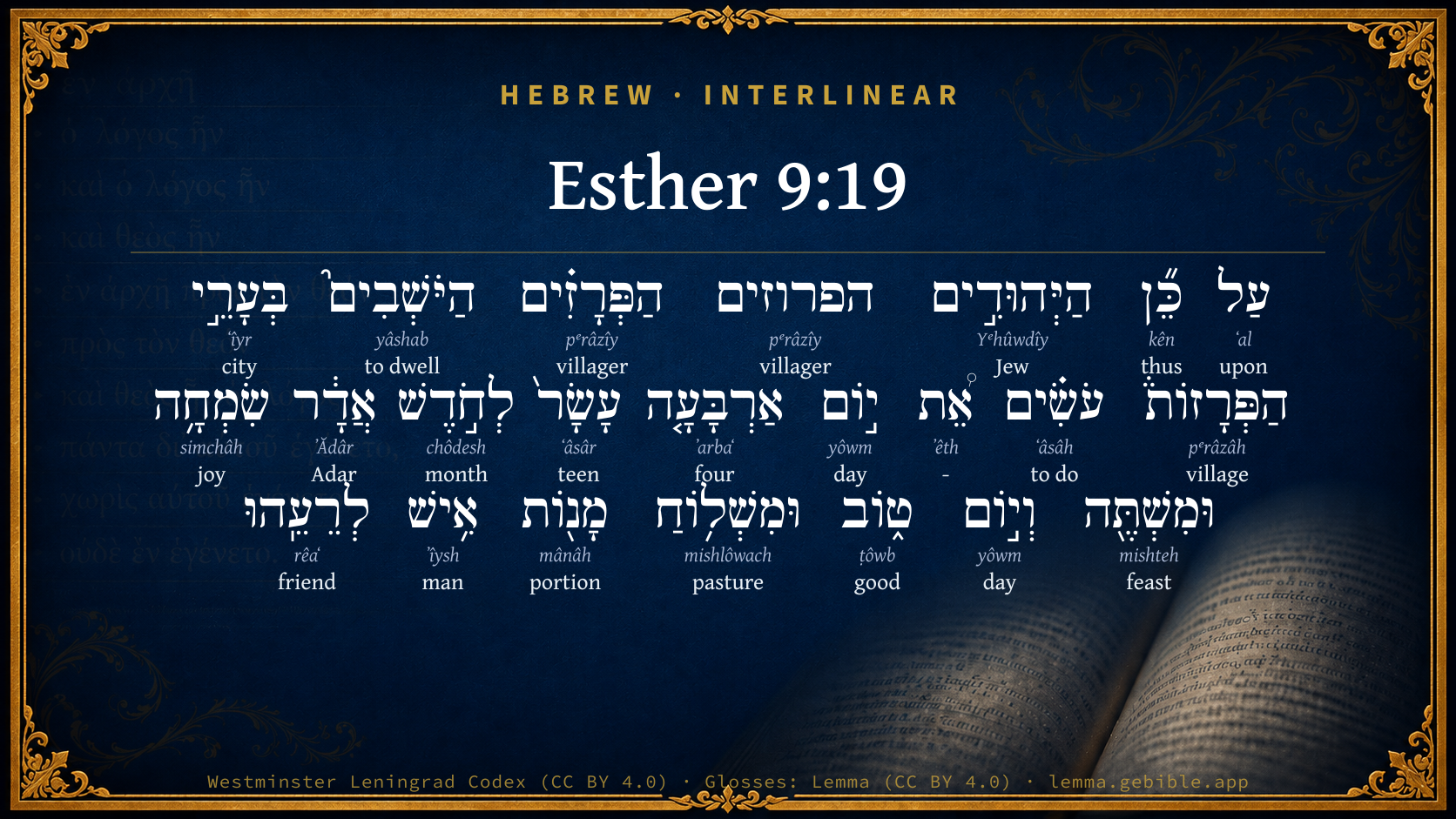
Esther 9:19

Hebrew (Westminster Leningrad Codex) Esther 9:19 appears in the Hebrew Old Testament. The text above is from the Westminster Leningrad Codex. Each word links to its Strong’s number, a concise gloss, and parsing drawn from the Open Scriptures Hebrew Bible morphology. Click any word for its full Brown-Driver-Briggs (BDB) entry.
Download image
Cite this verse

Esther 9:19 (World English Bible). Public Domain. Lemma interlinear Bible study tool, https://lemma.gebible.app/v/esther/9/19.

Show BibTeX & RIS
BibTeX
RIS
English Translation
Therefore do the Jews of the villages, who dwell in the unwalled towns, make the fourteenth day of the month Adar [a day of] gladness and feasting, and a good day, and of sending portions one to another.
World English Bible · Public Domain
Highlights
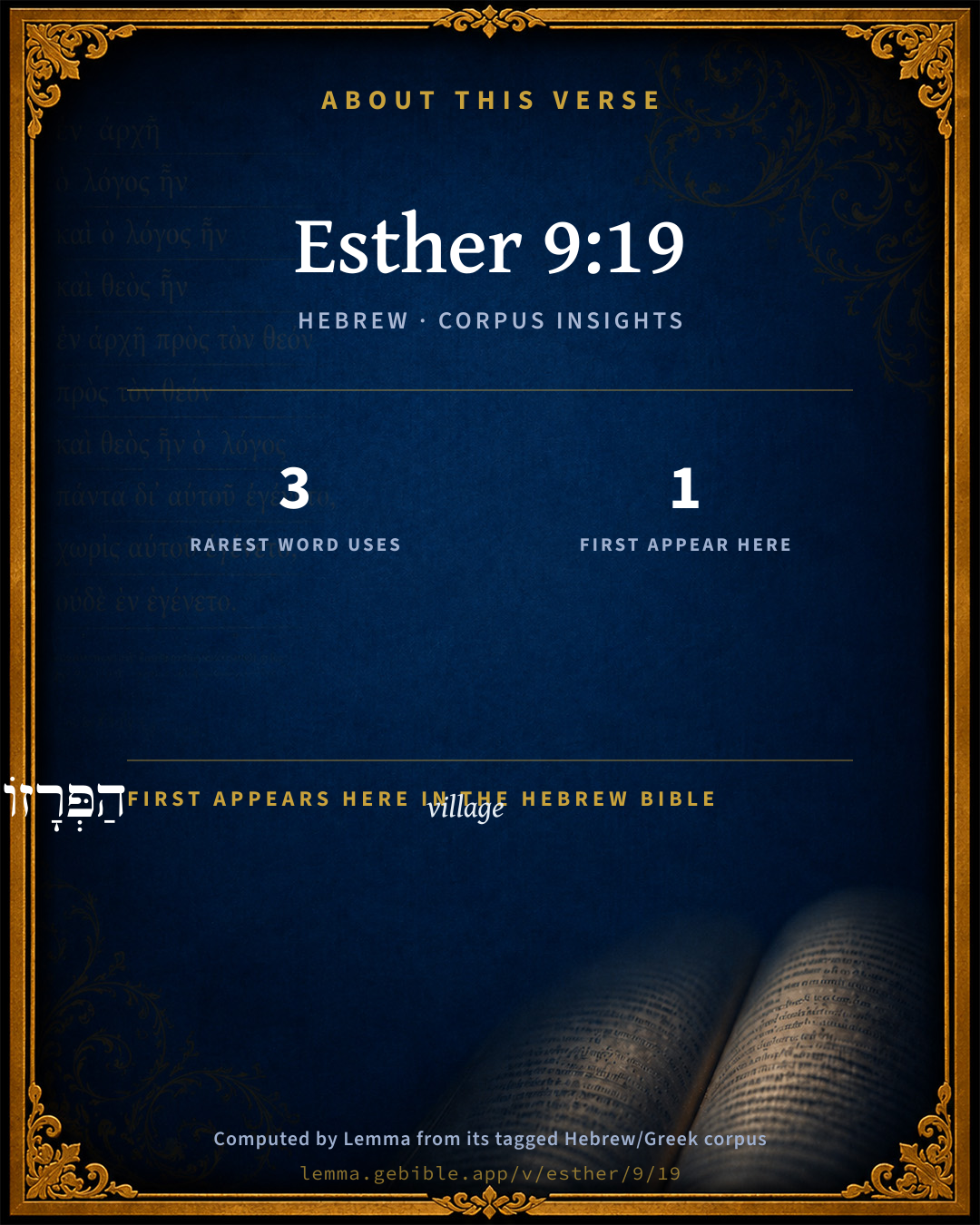
  • 1 first appearance in the Hebrew Bible
Full analysis ↓
Download a study sheet

One document with this verse’s original text, its word-by-word gloss line, the meaning frame, cross-references with their text, attributed commentary, and full source and license credits — printable, and it pastes into notes with its structure intact.

This verse Autodidact and up

Study sheet (.html) Plain text (.txt)

A passage Seminary Student

Up to 50 verses in one chapter. A passage sheet keeps up to 6 commentary sources and 12 cross-references per verse, in the order this page ranks them, and says so on the sheet whenever that leaves anything out. Ask for a single verse and you get the Autodidact verse sheet above.

Everything on this page stays free to read, with no account — the sheet is a download of what is already on screen, not access to it.

Want to remove ads? Support Godless Engineer
Compare translations 3

The same verse in 3 English versions, stacked beneath the original-language interlinear above. Click any original word for its lexicon entry.

Each is an independent rendering of the whole verse — the interlinear is not word-aligned to these translations.

Highlighted words mark where these versions differ — a whole-verse word diff, not a word-by-word alignment.

  • World English Bible Public Domain
    Therefore do the Jews of the villages, who dwell in the unwalled towns, make the fourteenth day of the month Adar [a day of] gladness and feasting, and a good day, and of sending portions one to another.
  • King James Version Public Domain
    Therefore the Jews of the villages, that dwelt in the unwalled towns, made the fourteenth day of the month Adar a day of gladness and feasting, and a good day, and of sending portions one to another.
  • unfoldingWord Literal Text CC BY-SA 4.0
    Therefore, the Jews, the ones of the open country, the ones who dwell in the cities of the open areas, make day 14 of the month of Adar for rejoicing and for feasting and a good day and for the sending of gifts, a man to his friend.

unfoldingWord Literal Text — © unfoldingWord, licensed CC BY-SA 4.0. Word-aligned USFM3 via Door43 (git.door43.org/unfoldingWord/en_ult).

Versions to compare (up to 4)

3 of 4 selected

Show all 18 translations

Every available English version of this verse, each an independent rendering of the whole verse.

  • World English Bible Public Domain
    Therefore do the Jews of the villages, who dwell in the unwalled towns, make the fourteenth day of the month Adar [a day of] gladness and feasting, and a good day, and of sending portions one to another.
  • Berean Standard Bible Public Domain
    This is why the rural Jews, who live in the villages, observe the fourteenth day of the month of Adar as a day of joy and feasting. It is a holiday for sending gifts to one another.
  • Majority Standard Bible Public Domain
    This is why the rural Jews, who live in the villages, observe the fourteenth day of the month of Adar as a day of joy and feasting. It is a holiday for sending gifts to one another.
  • King James Version Public Domain
    Therefore the Jews of the villages, that dwelt in the unwalled towns, made the fourteenth day of the month Adar a day of gladness and feasting, and a good day, and of sending portions one to another.
  • American Standard Version (1901) Public Domain
    Therefore do the Jews of the villages, that dwell in the unwalled towns, make the fourteenth day of the month Adar `a day of' gladness and feasting, and a good day, and of sending portions one to another.
  • Revised Version (1885) Public Domain
    Therefore do the Jews of the villages, that dwell in the unwalled towns, make the fourteenth day of the month Adar a day of gladness and feasting, and a good day, and of sending portions one to another.
  • Geneva Bible (1599) Public Domain
    Therefore the Iewes of the villages that dwelt in the vnwalled townes, kept the foureteenth day of the moneth Adar with ioy and feasting, euen a ioyfull day, and euery one sent presents vnto his neighbour.
  • Douay-Rheims (1899) Public Domain
    But those Jews that dwelt in towns not walled and in villages, appointed the fourteenth day of the month Adar for banquets and gladness, so as to rejoice on that day, and send one another portions of their banquets and meats.
  • Young's Literal Translation Public Domain
    Therefore the Jews of the villages, who are dwelling in cities of the villages, are making the fourteenth day of the month of Adar -- joy and banquet, and a good day, and of sending portions one to another.
  • Literal Standard Version CC BY-SA 4.0
    Therefore the Jews of the open places, who are dwelling in cities of the open places, are making the fourteenth day of the month of Adar—joy and banquet, and a good day, and of sending portions to one another.
  • Unlocked Literal Bible CC BY-SA 4.0
    That is why the Jews of the villages, who make their homes in the rural towns, observe the fourteenth day of the month of Adar as a day of gladness and feasting, and as a day on which they send gifts of food to one another.
  • unfoldingWord Literal Text CC BY-SA 4.0
    Therefore, the Jews, the ones of the open country, the ones who dwell in the cities of the open areas, make day 14 of the month of Adar for rejoicing and for feasting and a good day and for the sending of gifts, a man to his friend.
  • Darby Bible Public Domain
    Therefore the Jews of the villages that dwell in the country towns make the fourteenth of the month Adar a day of joy and feasting, and a good day, and on which they send portions one to another.
  • World Messianic Bible Public Domain
    Therefore the Judeans of the villages, who live in the unwalled towns, make the fourteenth day of the month Adar a day of gladness and feasting, a holiday, and a day of sending presents of food to one another.
  • Webster's Bible Public Domain
    Therefore the Jews of the villages, that dwelt in the unwalled towns, made the fourteenth day of the month Adar a day of gladness and feasting, and a good day, and of sending portions one to another.
  • Free Bible Version CC BY-SA 4.0
    To this day rural Jews, living in the villages, observe the fourteenth day of the month of Adar as a day of celebration and feasting, a holiday when they send gifts to one another.
  • Bible in Basic English Public Domain
    So the Jews of the country places living in unwalled towns make the fourteenth day of the month Adar a day of feasting and joy and a good day, a day for sending offerings one to another.
  • JPS Tanakh (1917) Public Domain
    Therefore do the Jews of the villages, that dwell in the unwalled towns, make the fourteenth day of the month Adar a day of gladness and feasting, and a good day, and of sending portions one to another.

Literal Standard Version (2020), Covenant Press — licensed CC BY-SA 4.0. Text via the HelloAO Bible API (eBible.org). Unlocked Literal Bible (unfoldingWord) — licensed CC BY-SA 4.0. Text via the HelloAO Bible API (eBible.org). unfoldingWord Literal Text — © unfoldingWord, licensed CC BY-SA 4.0. Word-aligned USFM3 via Door43 (git.door43.org/unfoldingWord/en_ult). Free Bible Version, Dr. Jonathan Gallagher — licensed CC BY-SA 4.0. Text via the HelloAO Bible API (eBible.org).

Word by word

More ways to search: Search by grammar → Find every occurrence → Compare this word →

Practice this passage: Drill this verse → Learn its vocabulary →

הַפְּרָזוֹת֒
pᵉrâzâh
H6519
“the · villages”
Particle, Definite Article + Noun, Common, Feminine, Plural, Absolute
Part of Speech
Particle + Noun
Type
Common
Gender
Feminine
Number
Plural
State
Absolute
Full BDB Definition

Origin: from the same as H6518

TWOT: 1812a

open region, hamlet, unwalled village, open country
  1. עַל ʻal H5921 “upon” Preposition
  2. כֵּ֞ן kên H3651 “thus” Particle, Demonstrative
  3. הַיְּהוּדִ֣ים Yᵉhûwdîy H3064 “the · Jews” Particle, Definite Article + Noun, Gentilic, Masculine, Plural, Absolute
  4. הפרוזים pᵉrâzîy H6521 “the · villagers” Particle, Definite Article + Noun, Common, Masculine, Plural, Absolute
  5. הַפְּרָזִ֗ים pᵉrâzîy H6521 “the · villagers” Particle, Definite Article + Noun, Common, Masculine, Plural, Absolute
  6. הַיֹּשְׁבִים֮ yâshab H3427 “the · dwelling” Particle, Definite Article + Verb, Qal, Participle Active, Masculine, Plural, Absolute
  7. בְּעָרֵ֣י ʻîyr H5892 “in/at · cities of” Preposition + Noun, Common, Feminine, Plural, Construct
  8. עֹשִׂ֗ים ʻâsâh H6213 “doing” Verb, Qal, Participle Active, Masculine, Plural, Absolute
  9. אֵ֠ת ʼêth H853 “-” Particle, Direct Object
  10. י֣וֹם yôwm H3117 “day of” Noun, Common, Masculine, Singular, Construct
  11. אַרְבָּעָ֤ה ʼarbaʻ H702 “four” Adjective, Cardinal number, Masculine, Singular, Absolute
  12. עָשָׂר֙ ʻâsâr H6240 “teen” Adjective, Cardinal number, Masculine, Singular, Absolute
  13. לְחֹ֣דֶשׁ chôdesh H2320 “to/for · month of” Preposition + Noun, Common, Masculine, Singular, Construct
  14. אֲדָ֔ר ʼĂdâr H143 “Adar” Noun, Proper
  15. שִׂמְחָ֥ה simchâh H8057 “joy” Noun, Common, Feminine, Singular, Absolute
  16. וּמִשְׁתֶּ֖ה mishteh H4960 “and · feast” Conjunction + Noun, Common, Masculine, Singular, Absolute
  17. וְי֣וֹם yôwm H3117 “and · day” Conjunction + Noun, Common, Masculine, Singular, Absolute
  18. ט֑וֹב ṭôwb H2896 “good” Adjective, Adjective, Masculine, Singular, Absolute
  19. וּמִשְׁל֥וֹחַ mishlôwach H4916 “and · pasture of” Conjunction + Noun, Common, Masculine, Singular, Construct
  20. מָנ֖וֹת mânâh H4490 “portions” Noun, Common, Feminine, Plural, Absolute
  21. אִ֥ישׁ ʼîysh H376 “man” Noun, Common, Masculine, Singular, Absolute
  22. לְרֵעֵֽהוּ rêaʻ H7453 “to/for · friend · his” Preposition + Noun, Common, Masculine, Singular, Construct + Suffix, Personal, 3rd Person, Masculine, Singular

About this verse

These counts appear in no published source. They are computed here, from the morphology-tagged text and Lemma’s own curated glosses. What Lemma adds →

23
words
21
distinct lemmas
Historical
section

Notable vocabulary

The rarest word here is הַפְּרָזוֹת֒ village H6519 — appearing just 3 times in the whole Hebrew Bible.

First appearance in Scripture

This word makes its first canonical appearance in the Hebrew Bible here:

  • הַפְּרָזוֹת֒ village H6519

Shared distinctive vocabulary

הַפְּרָזוֹת֒ village H6519 occurs in 3 verses of the Hebrew Bible. Also found in:

Grammatical profile

  • 2 verbs
  • 15 nouns
  • 3 adjectives
  • 1 preposition
  • 2 particles

Verb forms

  • הַיֹּשְׁבִים֮ Qal · Participle Active
  • עֹשִׂ֗ים Qal · Participle Active

Repetition

Words recur within this verse — often emphatic in Hebrew:

  • הפרוזים villager H6521 ×2
  • י֣וֹם day H3117 ×2

Hebrew & Septuagint length

In English translation the verse runs 38 words from the Hebrew and 31 from the Septuagint (LXX English) — closely comparable.

A rough comparison of the two English renderings, which tokenize alike — not a word-level alignment.

Word counts can differ between the Hebrew and the Greek without any difference in meaning — e.g. the Hebrew direct-object marker אֵת has no separate Greek word, and Greek often adds the article ὁ.

Cross-references

10

Topical passages linked to Esther 9:19 in the Treasury of Scripture Knowledge — connected by theme and wording, ordered by reader-vote popularity; previews shown in the World English Bible.

  • Esther 8:17 In every province, and in every city, wherever the king's commandment and his decree came, the Jews had gladness and joy, a feast and a good day. Many from among the peoples of the land became Jews; for the fear of the Jews was fallen on them.
  • Deuteronomy 16:14 and you shall rejoice in your feast, you, and your son, and your daughter, and your man-servant, and your maid-servant, and the Levite, and the foreigner, and the fatherless, and the widow, who are within your gates.
  • Nehemiah 8:10–12 Then he said to them, Go your way, eat the fat, and drink the sweet, and send portions to him for whom nothing is prepared; for this day is holy to our Lord: neither be you grieved; for the joy of Yahweh is your strength.
  • Esther 9:22 as the days in which the Jews had rest from their enemies, and the month which was turned to them from sorrow to gladness, and from mourning into a good day; that they should make them days of feasting and gladness, and of sending portions one to another, and gifts to the needy.
  • Revelation 11:10 Those who dwell on the earth rejoice over them, and they will be glad. They will give gifts to one another, because these two prophets tormented those who dwell on the earth.
  • Deuteronomy 16:11 and you shall rejoice before Yahweh your God, you, and your son, and your daughter, and your man-servant, and your maid-servant, and the Levite who is within your gates, and the foreigner, and the fatherless, and the widow, who are in the midst of you, in the place which Yahweh your God shall choose, to cause his name to dwell there.
  • Deuteronomy 3:5 All these were cities fortified with high walls, gates, and bars; besides the unwalled towns a great many.
  • Psalms 118:11–16 They surrounded me, yes, they surrounded me. In the name of Yahweh I indeed cut them off.
  • Zechariah 2:4 and said to him, "Run, speak to this young man, saying, 'Jerusalem will be inhabited as villages without walls, because of the multitude of men and cattle in it.
  • Luke 11:41 But give for gifts to the needy those things which are within, and behold, all things will be clean to you.

Cross-references courtesy of OpenBible.info (CC BY 4.0).

Hebrew and Greek witnesses Masoretic Hebrew ↔ Greek Septuagint

The same verse in the two great witnesses to the Old Testament, shown verse-for-verse.

These are two independent witnesses, not word-aligned to each other, and the Septuagint is shown in lemma (dictionary) form.

Hebrew Esther 9:19 Masoretic · Westminster Leningrad Codex

עַל כֵּ֞ן הַיְּהוּדִ֣ים הפרוזים הַפְּרָזִ֗ים הַיֹּשְׁבִים֮ בְּעָרֵ֣י הַפְּרָזוֹת֒ עֹשִׂ֗ים אֵ֠ת י֣וֹם אַרְבָּעָ֤ה עָשָׂר֙ לְחֹ֣דֶשׁ אֲדָ֔ר שִׂמְחָ֥ה וּמִשְׁתֶּ֖ה וְי֣וֹם ט֑וֹב וּמִשְׁל֥וֹחַ מָנ֖וֹת אִ֥ישׁ לְרֵעֵֽהוּ

Therefore do the Jews of the villages, who dwell in the unwalled towns, make the fourteenth day of the month Adar [a day of] gladness and feasting, and a good day, and of sending portions one to another.

World English Bible · Public Domain

Greek LXX Esther 9:19 Septuagint · lemma form

διά οὗτος οὖν ὁ ἰουδαῖος ὁ διασπείρω ἐν πᾶς χώρα ὁ ἔξω ἄγω ὁ οςτεσσαρεσκαιδέκατ ὁ αδαρ ἡμέρα ἀγαθός μετά εὐφροσύνη ἀποστέλλω μερίς ἕκαστος ὁ πλησίον ὁ δέ καταοἰκέω ἐν ὁ μητρόπολις καί ὁ πεντεκαιδέκατος ὁ αδαρ ἡμέρα εὐφροσύνη ἀγαθός ἄγω ἐκ ἀποστέλλω μερίς ὁ πλησίον

On this account then it is that the Jews dispersed in every foreign land keep the fourteenth of Adar as a holy day with joy, sending portions each to his neighbor.

LXX2012 (modern English Septuagint) · Public Domain

On this verse, The Cambridge Bible for Schools and Colleges discusses the Septuagint’s reading. Read the note in Commentary ↓

Hebrew: Westminster Leningrad Codex (CC BY 4.0). Greek: Septuagint (public domain); English from LXX2012 (modern English Septuagint) (Public Domain). How the Septuagint differs from the Hebrew →

Commentary

Notes on Esther 9:19 from classic Christian and Jewish commentators (each source and its license shown beneath its notes). The classic Christian expositions comment on the surrounding passage and are grouped to its opening verse, so a note may address several verses; the Jewish commentaries on the Tanakh (Rashi and others) are per-verse, so they appear only where the commentator wrote on this verse.

Lemma curates 59 commentaries, every one of them public domain or Creative Commons licensed, each selected and text-cleaned for this edition rather than reprinted as found. About our sources →

Trapp's Complete Commentary

John Trapp

Est 9:19 Therefore the Jews of the villages, that dwelt in the unwalled towns, made the fourteenth day of the month Adar [a day of] gladness and feasting, and a good day, and of sending portions one to another.

Ver. 19. Therefore the Jews of the villages, &c.] Pagani. This is expounded in the next words.

That dwelt in the unwalled towns] Such as is the Hague in Holland, that hath two thousand households in it; and chooseth rather to be counted the principal village of Europe than a lesser city.

Made the fourteenth day, &c.] See Est 9:17, while the Jews in Shushan were destroying the remainder of their enemies. This day was afterwards called Mordecai’s holiday, H Mαρδοχαικη ημερα, 2Ma 15:36.

And of sending portions one to another] See Neh 8:10. To the rich they sent in courtesy, to the poor in charity, and both these to testify their thankfulness to God for their lives, liberties, and estates, so lately and graciously restored unto them.

John Trapp, A Commentary or Exposition upon All the Books of the Old and New Testament (1647–1656) — public domain. Text from a community e-Sword module.

Joseph Benson's Commentary

Est 9:19. The Jews of the villages, that dwelt in the unwalled towns — Hebrew, in the cities of the villages; that is, in the lesser cities and villages, which are here opposed to the great city Shushan, and those who dwelt in it. Made the fourteenth day a day of gladness, &c. — Namely, because they did their whole work upon the thirteenth day, as was observed Est 9:17, to which this manifestly relates, the 18th verse coming in by way of parenthesis. And a good day, and of sending portions one to another — A day of thanksgiving and praise to God, as well as of feasting one with another, and of sending meat from their tables to their neighbours, that the meaner sort might feast and rejoice also. Hence the Jews have a rule, that they should make a collection of money, at this time of the year, to send to the poor, to enable them to provide for themselves things necessary to make a feast; which money they judge it unlawful to apply to any other use.

Joseph Benson's Commentary on the Old and New Testaments (1811–1818) — public domain. Text from a community e-Sword module.

Tyndale Open Study Notes

Tyndale Open Resources

9:19 The annual festival and holiday of Purim celebrates God’s blessing of peace from their enemies (see Deut 25:19; Josh 21:44; 1 Sam 7:11-14). The narrator reports that the festival was celebrated to this day. Now, more than 2,400 years later, it is still celebrated annually by Jewish people. • The exchange of gifts of food demonstrated the unity of the people and their care for one another and helped them to spread an atmosphere of joy for everyone celebrating the festival.

Tyndale Open Study Notes — © Tyndale Open Resources, licensed CC BY-SA 4.0. Text via the HelloAO Bible API.

Geneva Bible (1599)

Geneva Bible translators

As the Jews do even to this day, calling it in the Persian language Purim, that is, the day of lots.

Geneva Bible (1599) marginal notes — public domain. Text via Bolls.life.

Jamieson, Fausset & Brown

Robert Jamieson, A. R. Fausset & David Brown

a day of . . . feasting . . . of sending portions one to another--The princes and people of the East not only invite their friends to feasts, but it is their custom to send a portion of the banquet to those who cannot well come to it, especially their relations, and those who are detained at home in a state of sorrow or distress.

Jamieson, Fausset & Brown — Commentary Critical and Explanatory on the Whole Bible (1871) — public domain (CC PDM 1.0). Text via the HelloAO Bible API.

Adam Clarke's Commentary

Verse 19. The Jews of the villages] They joined that to the preceding day, and made it a day of festivity, and of sending portions to each other; that is, the rich sent portions of the sacrifices slain on this occasion to the poor, that they also might be enabled to make the day a day of festivity; that as the sorrow was general, so also might the joy be.

It is worthy of remark that the ancient Itala or Ante-hieronymian version of this book omits the whole of these nineteen verses. Query, Were they originally in this book?

Adam Clarke's Commentary on the Bible (1810–1826) — public domain. Text from a community e-Sword/MySword module.

Ellicott's Commentary for English Readers

(19) The Jews of the villages . . . the unwalled towns.—Virtually the same Hebrew word is used in both these cases (perazim, perazoth). The meaning is that of country towns, undefended by bulwarks, or, at any rate, not in the sense in which the capital would be. We find the word used in contrast with “fenced cities” in Deu_3:5.

A Bible Commentary for English Readers, edited by Charles John Ellicott (1878–1897) — public domain. Text from a community e-Sword module.

The Cambridge Bible for Schools and Colleges

gen. ed. J. J. S. Perowne

19. the Jews of the villages, that dwell in the unwalled towns, make etc.] not ‘dwelt’ and ‘made’ as in the A.V. The writer is describing the custom of his own day as arising out of the circumstances here recounted. He implies that in his time the Jews who did not come under the above description followed the date at which those in Shushan celebrated their deliverance. The LXX., however, inserts a clause to this effect, viz. ‘But those who dwell in the chief cities keep the fifteenth day of Adar as a day of glad feasting, and of sending portions likewise to their neighbours.’

and of sending portions one to another] i.e. that the poor might share in the happiness of the occasion. The same procedure was enjoined by Nehemiah (Neh_8:10; Neh_8:12) at the proclamation of the Law in his time. It was in accordance with the ordinance (Deu_16:11; Deu_16:14) that the enjoyment of the Feast of Weeks should be extended to ‘the stranger, the fatherless, and the widow.’ The custom of sending gifts (usually sweetmeats) is still preserved at Purim.

The Cambridge Bible for Schools and Colleges (gen. ed. J. J. S. Perowne; Cambridge University Press, 1878–1918) — public domain. Text from a community e-Sword module.

John Gill's Exposition

To stablish this among them,.... That it might be a settled thing, and annually observed in all future generations, what they had now done:

that they should keep the fourteenth day of the month Adar, and the fifteenth day of the same, yearly; as the former had been observed by the Jews in the provinces, and both by those in Shushan, Est 9:17 as festivals in commemoration of their great deliverance; hence the fourteenth of Adar is called the day of Mordecai, being established by him;"And they ordained all with a common decree in no case to let that day pass without solemnity, but to celebrate the thirtieth day of the twelfth month, which in the Syrian tongue is called Adar, the day before Mardocheus' day.'' (2 Maccabees 15:36)

John Gill's Exposition of the Whole Bible (1746–1763) — public domain (CC PDM 1.0). Text via the HelloAO Bible API.

Albert Barnes' Notes on the Bible

The Jews of the villages ... - Rather, “the Jews of the country districts, that dwelt in the country towns,” as distinguished from those who dwelt in the metropolis.

Albert Barnes' Notes on the Bible (1834–1885) — public domain. Text from a community e-Sword/MySword module.

Haydock's Catholic Bible Commentary

Meats, not only to the poor, but to all their friends, ver. 22., and 2 Esdras viii. 10. (Calmet)

George Leo Haydock (1774–1849), Haydock's Catholic Family Bible and Commentary, 1859 edition — public domain. Excludes Psalms (Douay-Rheims chapter numbering differs from Protestant) and Deuterocanonical books (Catholic canon only).

Matthew Poole's English Annotations

Therefore, to wit, because they did their whole work upon the thirteenth day, as was noted Est 9:17, to which this manifestly relates, the 18th verse coming in as it were by way of parenthesis.

In the unwalled towns, Heb. in the cities of the villages, i.e. in the lesser cities and villages, which are here opposed to the great city Shushan, and those who dwelt in it.

Matthew Poole's English Annotations on the Holy Bible (1683–1685) — public domain. Text from a community e-Sword/MySword module.

Whedon's Commentary on the Bible

Daniel D. Whedon

19. Therefore… the fourteenth day — Because the Jews outside of Shushan did all their fighting on the thirteenth, and rested on the fourteenth, as stated in Est_9:17, therefore they made the latter day their day of feasting and joy; but the Jews in Shushan, having fought both on the thirteenth and fourteenth, made the fifteenth their feast day, Est_9:18. See also Est_9:21.

Jews of the villages — Rather, of the country places, that is, as distinguished from those who dwelt at the capital, Shushan. They are further defined as those that dwelt in cities of the country, (not unwalled towns, as our version has it, for some of these country towns may have had walls.) The writer of this was evidently a citizen of Shushan, and seems to have regarded the whole Persian empire outside of this capital city as country.

Sending portions — Comp. Neh_8:10, note.

Daniel D. Whedon (gen. ed.), Commentary on the Old and New Testaments (1874–1909) — public domain. Text from a community e-Sword module.

The Pulpit Commentary

The Jews of the villages, that dwelt in the unwalled towns. Rather, "the Jews of the country, who dwelt in the country towns." There are places where the word translated unwalled" connotes that idea e.g. Eze_38:11; Zec_2:8; but the main notion which it expresses is always that of a "country region." Here walls are not at all in the thought of the writer, who intends a contrast between the Jews of the metropolis and those of the provinces. Ecbatana and Babylon are country towns" to a Jew of Susa, such as the writer. A good day. Compare Est_8:17, with the comment. Sending portions one to another. Compare Neh_8:10; and for the precept on which the practice was founded see Deu_16:14. In modern times the Jews keep up the practice, and on the 15th of Adar both interchange gifts, chiefly sweetmeats, and make liberal offerings for the poor (comp. ver. 22, ad fin.).

Vers. 19, 22.

The elements of perfect joy.

good day, and of sending portions one to another:.., days of feasting and joy, and of sending portions one to another, and gifts to the poor." Twice then, among the other particulars of the people"s glad celebration of their deliverance from a savage massacre, is this detail included, that they sent "portions one to another;" and once it is added that they sent "gifts to the poor." This was no ancient prescription of the law, so far as literal command is concerned. But the spirit of it is no doubt to be detected even there, especially in those passages which urge the principle of taking care that days of general joy should be felt in their warming influence by "the stranger, the fatherless, and the widow." In the same spirit we read in Nehemiah, (Neh_8:10) however, what comes verbally much nearer our present passage. A day of deep feeling and special cause of joy was to be observed as a day of feasting, and of sending "portions unto them for whom nothing is prepared." There can be no question that we have here a portion of the genuine history of the human heart. We seem to hear some of the better and simpler utterances of human nature. The joy of the saved people of God is before us. And whatever other marks it may have, it certainly has those which make it a type of Christian joy on earth. In this light principally we may now regard it. We notice here

I A GENERAL AND SIMULTANEOUS JOY. It was not in every respect equal. But in one respect it was equal, in that wherever it spread it was the joy of life, of life rescued from the brink of destruction. Joy need not be equal all round a family; nor all round the world"s family; for there are in hearts exceedingly various degrees of susceptibility, and these by themselves are sure to govern largely the exact amount of what can be called happiness or joy. All that is necessary to the one largest, purest, most loving heart in the whole circle is, that all others be blessed and happy at the same time, and according to the full measure of their capacity. But a joy that is not general, that is exposed to overhearing the sounds of complaining, or the sighs of those who mourn alone, or the echoes of the outcry of pain, is deeply felt to be imperfect.

II A JOY FULL OF MUTUAL KINDNESS. Quite independently of the differences in human life that show one man rich and possessing all things, and another poor and needy, there are differences within a far less range of compass, and yet innumerable. These do not show the extremes of condition; and by Divine wisdom they do make the room for all the play of sympathy, for all the works of mutual kindness. These save hearts from stagnation, and make the healthful ripples and movement after movement of life, stirring the affections within. Were all this at an end, the dead level of human life and feeling would be appalling indeed. The joy that does not find this room for mutual service, for "readiness to good works," for interchange of the offices of affection and friendship, if general, would nevertheless be selfish to the last degree. How happy that short reign of community of goods in the early apostolic history, when all "of them that believed were of one heart and one soul: neither said any of them that aught of the things which he possessed was his own; but they had all things common." And that would be inferior to the conscious pleasure of a constant exchange of the tokens of sympathy and of the deeds of kindness. In the joy that should shut out the prizes of mutual service it would be felt that there was something wanting.

III A JOY FULL OF CHARITABLE KINDNESS. There can be no doubt that the kindness of charity is in reality an easier exercise and a less rare grace than that of a perfect mutual kindness. Yet we know the special honour put upon poverty both by the life and the lip of Jesus. And we know the abounding promises that his word makes to those who pity and give to the poor. There is indeed a certain subtle danger that may lurk in the perpetual exercise of charitable kindness. The giver can almost always reckon on the exaltation of position which belongs to the patron. He may be injured by what underlies the beautiful and ever-welcome words of the regretful Job: "When the ear heard me, then it blessed me; and when the eye saw me, it gave witness to me." Nevertheless, men little need at present to be warned of the danger; they seldom come near enough to this temptation. And, meantime, must not the joy that knows not the spirit of charity to the poor fatally want? There must be something different from vacant want indeed, bad as that should be. That joy must feel itself "a guilty thing." But now in this typical joy of God"s suddenly-rescued people in the days of Esther all these elements were present. The people had all been in one danger, had all enjoyed one deliverance, and they all experience one general pervading joy. Common suffering while it lasts draws us near to one another by a proverb; it is rather the index of cowardice of heart. But when the return of common mercy finds us drawing near to one another in the works of practical fellowship, and showing compassion to the poor in the works of charity, then a happiness is kindled of the best that earth knows. The companions in danger and in rescue are found still companions in prosperity. In woe and in weal they have learned to be one. The common escape from danger quickens a sincere compassion. And this history cannot be judged to fall short of portraying the one danger of the whole race of mankind, the one rescue open to them, and the one united life of joy, of love, of charity that Christians ought to live here on earth. B.

The Pulpit Commentary (1880–1919), ed. H.D.M. Spence-Jones & Joseph S. Exell — public domain. Text from a community e-Sword module.

Scofield Reference Notes

C. I. Scofield

month Adar

i.e. March; Est 9:15; Est 9:17.

The Scofield Reference Bible (1917 edition), notes by C. I. Scofield — public domain. Text from a community e-Sword module.

Rashi

Rabbi Shlomo Yitzchaki (Rashi)

the...villagers who do not dwell in walled cities, [celebrate] on the fourteenth, and those who dwell in walled cities [celebrate] on the fifteenth, like Shushan, and [these cities] must be surrounded [by walls] since the days of Joshua the son of Nun. So did our Sages expound and learn.

and...sending Heb. וּמִשְּׁלֹחַ. This is a noun, like מִשְּׁמָר, watch, מִשְּׁמָע hearing. Therefore, the “shin” is vowelized soft (without a “dagesh”).

Rashi on the Tanakh — English translations: “The Judaica Press complete Tanach with Rashi, translated by A. J. Rosenberg” (CC BY 4.0); “Pentateuch with Rashi's commentary by M. Rosenbaum and A.M. Silbermann, 1929-1934” (public domain); “The Metsudah Tanach series, Lakewood, N.J” (CC BY 4.0); and “The Book of Joshua, Metsudah Publications, 1997” (CC BY 4.0). Text via Sefaria.

Lesson kit

Teaching starters — assembled from the data on this page, not authored interpretation. Every prompt links to the verse data it draws on. Edit before teaching.

Esther, in the Historical, opens this verse with 23 words (21 distinct Hebrew lemmas). Its most distinctive word is pᵉrâzâh (“village”). A historical commentator’s framing appears above. Read the whole chapter for the surrounding context.

Discussion questions

  1. How does “village” (pᵉrâzâh) shape what this verse is saying?
  2. The word “village” first appears here in Scripture. What is being introduced at this debut?
  3. Ezekiel 38:11 shares the word «village» with this verse. How do the two illuminate each other?
  4. “villager” occurs 2× in this one verse. What is the effect of the repetition?
  5. These translations render this verse differently. What is at stake in choosing one wording over another?
  6. The verb «הַיֹּשְׁבִים֮» is Qal Participle Active. How does its form color the action?
  7. Reading how Trapp's Complete Commentary and Joseph Benson's Commentary read this verse, where do the two commentators agree and where do they part?

Things to notice

  • 1 word makes its first canonical appearance in Scripture here.
  • These translations choose different wording for 24 words in this verse.
  • “villager” occurs 2× in this single verse.
  • 21 distinct Hebrew lemmas span 23 words in this verse.

Reading settings

Reading text

Shown beneath each verse's original-language words.

Old Testament
Old Testament edition

Read the OT as the Masoretic Hebrew (MT) or the Greek Septuagint (LXX).

English shown for the Greek Septuagint (in the Hebrew ↔ Greek comparison).

Comparing translations? Open the Compare panel on any verse page to stack up to four side by side.