
2 Chronicles 8:13

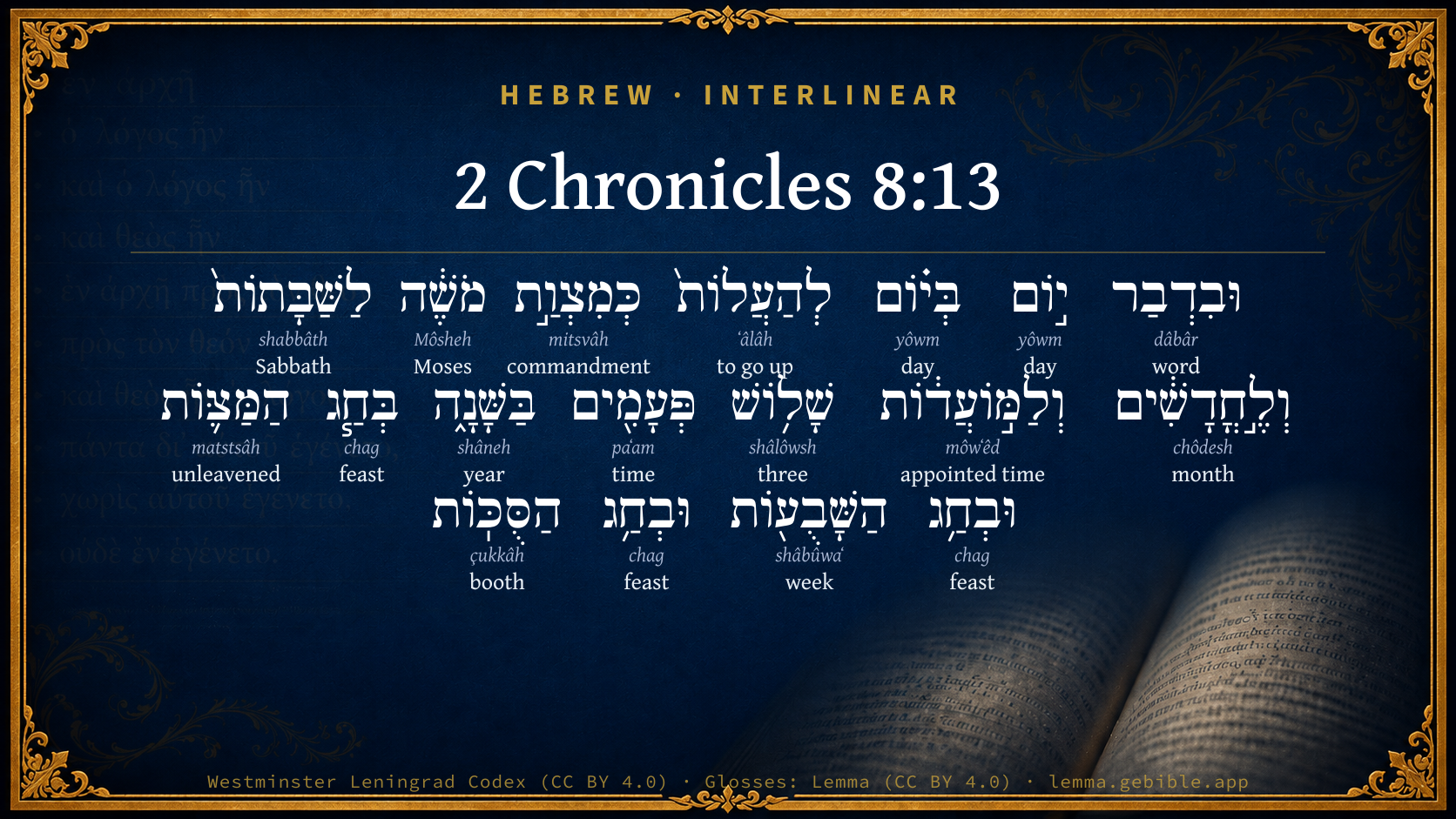
Hebrew (Westminster Leningrad Codex) 2 Chronicles 8:13 appears in the Hebrew Old Testament. The text above is from the Westminster Leningrad Codex. Each word links to its Strong’s number, a concise gloss, and parsing drawn from the Open Scriptures Hebrew Bible morphology. Click any word for its full Brown-Driver-Briggs (BDB) entry.
Download image
Cite this verse

2 Chronicles 8:13 (World English Bible). Public Domain. Lemma interlinear Bible study tool, https://lemma.gebible.app/v/2-chronicles/8/13.

Show BibTeX & RIS
BibTeX
RIS
English Translation
even as the duty of every day required, offering according to the commandment of Moses, on the Sabbaths, and on the new moons, and on the set feasts, three times in the year, [even] in the feast of unleavened bread, and in the feast of weeks, and in the feast of tents.
World English Bible · Public Domain
Download a study sheet

One document with this verse’s original text, its word-by-word gloss line, the meaning frame, cross-references with their text, attributed commentary, and full source and license credits — printable, and it pastes into notes with its structure intact.

This verse Autodidact and up

Study sheet (.html) Plain text (.txt)

A passage Seminary Student

Up to 50 verses in one chapter. A passage sheet keeps up to 6 commentary sources and 12 cross-references per verse, in the order this page ranks them, and says so on the sheet whenever that leaves anything out. Ask for a single verse and you get the Autodidact verse sheet above.

Everything on this page stays free to read, with no account — the sheet is a download of what is already on screen, not access to it.

Want to remove ads? Support Godless Engineer
Compare translations 3

The same verse in 3 English versions, stacked beneath the original-language interlinear above. Click any original word for its lexicon entry.

Each is an independent rendering of the whole verse — the interlinear is not word-aligned to these translations.

Highlighted words mark where these versions differ — a whole-verse word diff, not a word-by-word alignment.

  • World English Bible Public Domain
    even as the duty of every day required, offering according to the commandment of Moses, on the Sabbaths, and on the new moons, and on the set feasts, three times in the year, [even] in the feast of unleavened bread, and in the feast of weeks, and in the feast of tents.
  • King James Version Public Domain
    Even after a certain rate every day, offering according to the commandment of Moses, on the sabbaths, and on the new moons, and on the solemn feasts, three times in the year, even in the feast of unleavened bread, and in the feast of weeks, and in the feast of tabernacles.
  • unfoldingWord Literal Text CC BY-SA 4.0
    And by the matter day by day to bring up, according to the commandment of Moses, for the Sabbaths, and for the new moons, and for the appointed times three times in the year: at the Feast of Unleavened Bread, and at the Feast of Weeks, and at the Feast of Booths.

unfoldingWord Literal Text — © unfoldingWord, licensed CC BY-SA 4.0. Word-aligned USFM3 via Door43 (git.door43.org/unfoldingWord/en_ult).

Versions to compare (up to 4)

3 of 4 selected

Show all 18 translations

Every available English version of this verse, each an independent rendering of the whole verse.

  • World English Bible Public Domain
    even as the duty of every day required, offering according to the commandment of Moses, on the Sabbaths, and on the new moons, and on the set feasts, three times in the year, [even] in the feast of unleavened bread, and in the feast of weeks, and in the feast of tents.
  • Berean Standard Bible Public Domain
    He observed the daily requirement for offerings according to the commandment of Moses for Sabbaths, New Moons, and the three annual appointed feasts—the Feast of Unleavened Bread, the Feast of Weeks, and the Feast of Tabernacles.
  • Majority Standard Bible Public Domain
    He observed the daily requirement for offerings according to the commandment of Moses for Sabbaths, New Moons, and the three annual appointed feasts—the Feast of Unleavened Bread, the Feast of Weeks, and the Feast of Tabernacles.
  • King James Version Public Domain
    Even after a certain rate every day, offering according to the commandment of Moses, on the sabbaths, and on the new moons, and on the solemn feasts, three times in the year, even in the feast of unleavened bread, and in the feast of weeks, and in the feast of tabernacles.
  • American Standard Version (1901) Public Domain
    even as the duty of every day required, offering according to the commandment of Moses, on the sabbaths, and on the new moons, and on the set feasts, three times in the year, `even' in the feast of unleavened bread, and in the feast of weeks, and in the feast of tabernacles.
  • Revised Version (1885) Public Domain
    even as the duty of every day required, offering according to the commandment of Moses, on the sabbaths, and on the new moons, and on the set feasts, three times in the year, even in the feast of unleavened bread, and in the feast of weeks, and in the feast of tabernacles.
  • Geneva Bible (1599) Public Domain
    To offer according to the commandement of Moses euery day, in the Sabbaths, and in the newe moones, and in the solemne feastes, three times in the yeere, that is, in the feast of the Vnleauened bread, and in the feast of the Weekes, and in the feast of the Tabernacles.
  • Douay-Rheims (1899) Public Domain
    That every day an offering might be made on it according to the ordinance of Moses, in the sabbaths, and on the new moons, and on the festival days three times a year, that is to say, in the feast of unleavened bread, and in the feast of weeks, and in the feast of tabernacles.
  • Young's Literal Translation Public Domain
    even by the matter of a day in its day, to cause to ascend according to the command of Moses, on sabbaths, and on new moons, and on appointed seasons, three times in a year -- in the feast of unleavened things, and in the feast of weeks, and in the feast of booths.
  • Literal Standard Version CC BY-SA 4.0
    even by the matter of a day in its day, to cause to ascend according to the command of Moses, on Sabbaths, and on new moons, and on appointed times, three times in a year—in the Celebration of Unleavened Things, and in the Celebration of Weeks, and in the Celebration of Shelters.
  • Unlocked Literal Bible CC BY-SA 4.0
    He offered sacrifices just as the daily schedule required; he offered them, following the directions found in the commandment of Moses, on the Sabbath days, the new moons, and on the set festivals three times every year: the Festival of Unleavened Bread, the Festival of Weeks, and the Festival of Shelters.
  • unfoldingWord Literal Text CC BY-SA 4.0
    And by the matter day by day to bring up, according to the commandment of Moses, for the Sabbaths, and for the new moons, and for the appointed times three times in the year: at the Feast of Unleavened Bread, and at the Feast of Weeks, and at the Feast of Booths.
  • Darby Bible Public Domain
    even as the duty of every day required, offering according to the commandment of Moses, on the sabbaths, and on the new moons, and at the set feasts, three times in the year, -- at the feast of unleavened bread, and at the feast of weeks, and at the feast of tabernacles.
  • World Messianic Bible Public Domain
    even as the duty of every day required, offering according to the commandment of Moses on the Sabbaths, on the new moons, and on the set feasts, three times per year, during the feast of unleavened bread, during the feast of weeks, and during the feast of booths.
  • Webster's Bible Public Domain
    Even after a certain rate every day, offering according to the commandment of Moses, on the sabbaths, and on the new moons, and on the solemn feasts, three times in the year, even in the feast of unleavened bread, and in the feast of weeks, and in the feast of tabernacles.
  • Free Bible Version CC BY-SA 4.0
    He followed the requirement for daily offerings as Moses had ordered for Sabbaths, new moons, and the three annual festivals—the Festival of Unleavened Bread, the Festival of Weeks, and the Festival of Shelters.
  • Bible in Basic English Public Domain
    Offering every day what had been ordered by Moses, on the Sabbaths and at the new moon and at the regular feasts three times a year, that is at the feast of unleavened bread, the feast of weeks, and the feast of tents.
  • JPS Tanakh (1917) Public Domain
    even as the duty of every day required, offering according to the commandment of Moses, on the sabbaths, and on the new moons, and on the appointed seasons, three times in the year, even in the feast of unleavened bread, and in the feast of weeks, and in the feast of tabernacles.

Literal Standard Version (2020), Covenant Press — licensed CC BY-SA 4.0. Text via the HelloAO Bible API (eBible.org). Unlocked Literal Bible (unfoldingWord) — licensed CC BY-SA 4.0. Text via the HelloAO Bible API (eBible.org). unfoldingWord Literal Text — © unfoldingWord, licensed CC BY-SA 4.0. Word-aligned USFM3 via Door43 (git.door43.org/unfoldingWord/en_ult). Free Bible Version, Dr. Jonathan Gallagher — licensed CC BY-SA 4.0. Text via the HelloAO Bible API (eBible.org).

Word by word

More ways to search: Search by grammar → Find every occurrence → Compare this word →

Practice this passage: Drill this verse → Learn its vocabulary →

הַשָּׁבֻע֖וֹת
shâbûwaʻ
H7620
“the · weeks”
Particle, Definite Article + Noun, Common, Masculine, Plural, Absolute
Part of Speech
Particle + Noun
Type
Common
Gender
Masculine
Number
Plural
State
Absolute
Full BDB Definition

Origin: properly, pass part of H7650 as a denom. of H7651

TWOT: 2318d

seven, period of seven (days or years), heptad, week - period of seven days, a week - Feast of Weeks - heptad, seven (of years)
  1. וּבִדְבַר dâbâr H1697 “and · in/at · word of” Conjunction + Preposition + Noun, Common, Masculine, Singular, Construct
  2. י֣וֹם yôwm H3117 “day” Noun, Common, Masculine, Singular, Absolute
  3. בְּי֗וֹם yôwm H3117 “in/at · day” Preposition + Noun, Common, Masculine, Singular, Absolute
  4. לְהַעֲלוֹת֙ ʻâlâh H5927 “to go up” Preposition + Verb, Hiphil, Infinitive Construct
  5. כְּמִצְוַ֣ת mitsvâh H4687 “like/as · commandment of” Preposition + Noun, Common, Feminine, Singular, Construct
  6. מֹשֶׁ֔ה Môsheh H4872 “Moses” Noun, Proper
  7. לַשַּׁבָּתוֹת֙ shabbâth H7676 “to/for the · Sabbaths” Preposition, Determined + Noun, Common, Both, Plural, Absolute
  8. וְלֶ֣חֳדָשִׁ֔ים chôdesh H2320 “and · to/for the · months” Conjunction + Preposition, Determined + Noun, Common, Masculine, Plural, Absolute
  9. וְלַמּ֣וֹעֲד֔וֹת môwʻêd H4150 “and · to/for the · appointed times” Conjunction + Preposition, Determined + Noun, Common, Masculine, Plural, Absolute
  10. שָׁל֥וֹשׁ shâlôwsh H7969 “three” Adjective, Cardinal number, Feminine, Singular, Absolute
  11. פְּעָמִ֖ים paʻam H6471 “times” Noun, Common, Feminine, Plural, Absolute
  12. בַּשָּׁנָ֑ה shâneh H8141 “in/at the · year” Preposition, Determined + Noun, Common, Feminine, Singular, Absolute
  13. בְּחַ֧ג chag H2282 “in/at · feast of” Preposition + Noun, Common, Masculine, Singular, Construct
  14. הַמַּצּ֛וֹת matstsâh H4682 “the · unleavened bread” Particle, Definite Article + Noun, Common, Feminine, Plural, Absolute
  15. וּבְחַ֥ג chag H2282 “and · in/at · feast of” Conjunction + Preposition + Noun, Common, Masculine, Singular, Construct
  16. וּבְחַ֥ג chag H2282 “and · in/at · feast of” Conjunction + Preposition + Noun, Common, Masculine, Singular, Construct
  17. הַסֻּכּֽוֹת çukkâh H5521 “the · booths” Particle, Definite Article + Noun, Common, Feminine, Plural, Absolute

About this verse

These counts appear in no published source. They are computed here, from the morphology-tagged text and Lemma’s own curated glosses. What Lemma adds →

18
words
15
distinct lemmas
Historical
section

Notable vocabulary

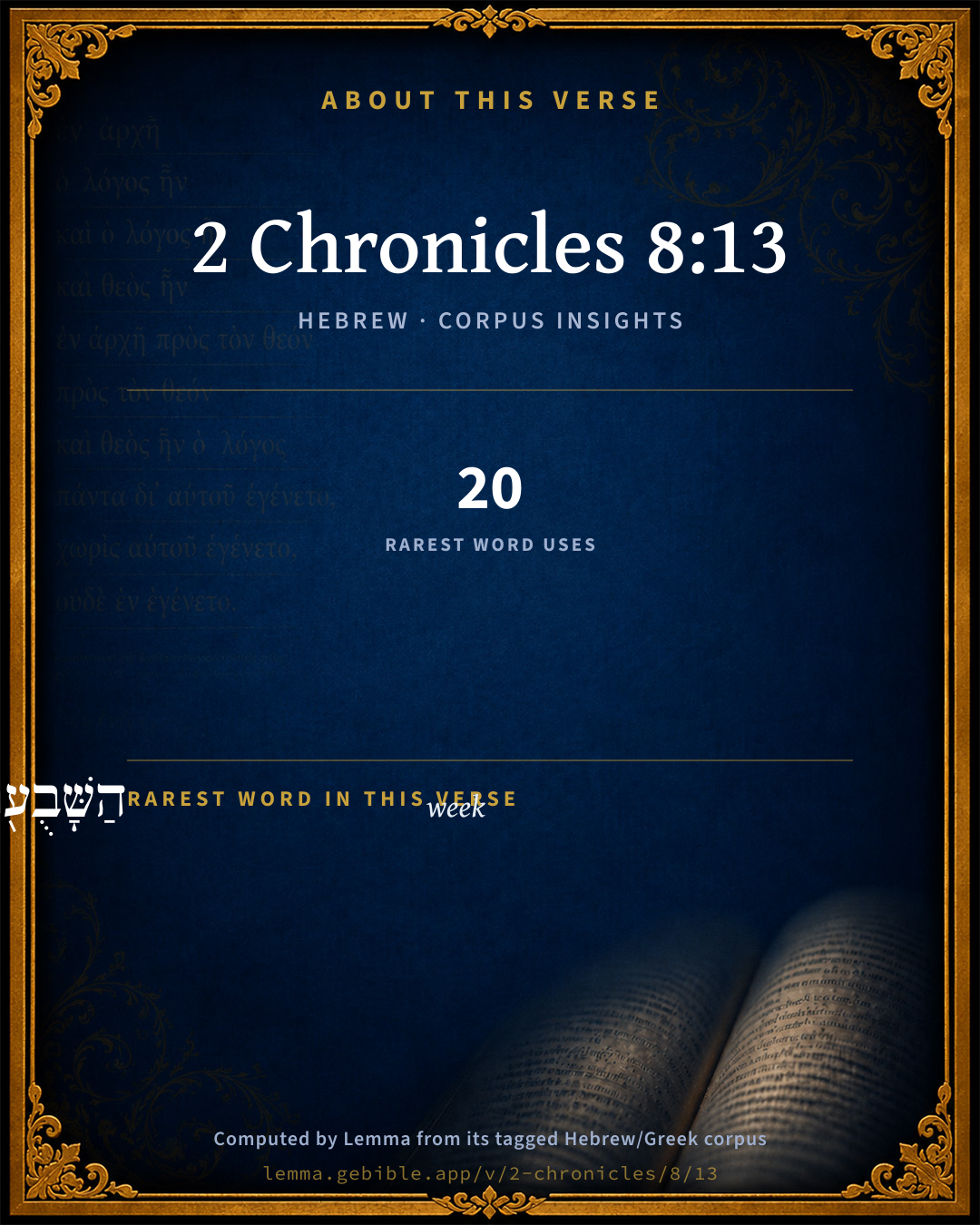
The rarest word here is הַשָּׁבֻע֖וֹת week H7620 — appearing just 20 times in the whole Hebrew Bible.

Shared distinctive vocabulary

הַשָּׁבֻע֖וֹת week H7620 occurs in 17 verses of the Hebrew Bible. Also found in:

Grammatical profile

  • 1 verb
  • 16 nouns
  • 1 adjective

Verb forms

  • לְהַעֲלוֹת֙ Hiphil · Infinitive Construct

Repetition

Words recur within this verse — often emphatic in Hebrew:

  • בְּחַ֧ג feast H2282 ×3
  • י֣וֹם day H3117 ×2

Hebrew & Septuagint length

In English translation the verse runs 52 words from the Hebrew and 50 from the Septuagint (LXX English) — closely comparable.

A rough comparison of the two English renderings, which tokenize alike — not a word-level alignment.

Word counts can differ between the Hebrew and the Greek without any difference in meaning — e.g. the Hebrew direct-object marker אֵת has no separate Greek word, and Greek often adds the article ὁ.

Cross-references

8

Topical passages linked to 2 Chronicles 8:13 in the Treasury of Scripture Knowledge — connected by theme and wording, ordered by reader-vote popularity; previews shown in the World English Bible.

  • Deuteronomy 16:16 Three times in a year shall all your males appear before Yahweh your God in the place which he shall choose: in the feast of unleavened bread, and in the feast of weeks, and in the feast of tents; and they shall not appear before Yahweh empty:
  • Exodus 29:38–42 "Now this is that which you shall offer on the altar: two lambs a year old day by day continually.
  • Ezekiel 46:3–15 The people of the land shall worship at the door of that gate before Yahweh on the Sabbaths and on the new moons.
  • Exodus 23:14–17 "You shall observe a feast to me three times a year.
  • Leviticus 23:1–17 Yahweh spoke to Moses, saying,
  • Numbers 28:1–29 Yahweh spoke to Moses, saying,
  • 1 Kings 9:25 Three times a year did Solomon offer burnt offerings and peace-offerings on the altar which he built to Yahweh, burning incense therewith, [on the altar] that was before Yahweh. So he finished the house.
  • Ezekiel 45:17 It shall be the prince's part to give the burnt offerings, and the meal-offerings, and the drink-offerings, in the feasts, and on the new moons, and on the Sabbaths, in all the appointed feasts of the house of Israel: he shall prepare the sin-offering, and the meal-offering, and the burnt offering, and the peace-offerings, to make atonement for the house of Israel.

Cross-references courtesy of OpenBible.info (CC BY 4.0).

Hebrew and Greek witnesses Masoretic Hebrew ↔ Greek Septuagint

The same verse in the two great witnesses to the Old Testament, shown verse-for-verse.

These are two independent witnesses, not word-aligned to each other, and the Septuagint is shown in lemma (dictionary) form.

Hebrew 2 Chronicles 8:13 Masoretic · Westminster Leningrad Codex

וּבִדְבַר י֣וֹם בְּי֗וֹם לְהַעֲלוֹת֙ כְּמִצְוַ֣ת מֹשֶׁ֔ה לַשַּׁבָּתוֹת֙ וְלֶ֣חֳדָשִׁ֔ים וְלַמּ֣וֹעֲד֔וֹת שָׁל֥וֹשׁ פְּעָמִ֖ים בַּשָּׁנָ֑ה בְּחַ֧ג הַמַּצּ֛וֹת וּבְחַ֥ג הַשָּׁבֻע֖וֹת וּבְחַ֥ג הַסֻּכּֽוֹת

even as the duty of every day required, offering according to the commandment of Moses, on the Sabbaths, and on the new moons, and on the set feasts, three times in the year, [even] in the feast of unleavened bread, and in the feast of weeks, and in the feast of tents.

World English Bible · Public Domain

Greek LXX 2 Chronicles 8:13 Septuagint · lemma form

καί κατά ὁ λόγος ἡμέρα ἐν ἡμέρα ὁ ἀναφέρω κατά ὁ ἐντολή μωυσῆ ἐν ὁ σάββατον καί ἐν ὁ μήν καί ἐν ὁ ἑορτή τρεῖς καιρός ὁ ἐνιαυτός ἐν ὁ ἑορτή ὁ ἄζυμος καί ἐν ὁ ἑορτή ὁ ἑβδομάς καί ἐν ὁ ἑορτή ὁ σκηνή

according to the daily rate, to offer up sacrifices according to the commandments of Moses, on the sabbaths, and at the new moons, and at the feasts, three times in the year, at the feast of unleavened bread, and at the feast of weeks, and at the feast of tabernacles.

LXX2012 (modern English Septuagint) · Public Domain

Hebrew: Westminster Leningrad Codex (CC BY 4.0). Greek: Septuagint (public domain); English from LXX2012 (modern English Septuagint) (Public Domain). How the Septuagint differs from the Hebrew →

Commentary

Notes on 2 Chronicles 8:13 from classic Christian and Jewish commentators (each source and its license shown beneath its notes). The classic Christian expositions comment on the surrounding passage and are grouped to its opening verse, so a note may address several verses; the Jewish commentaries on the Tanakh (Rashi and others) are per-verse, so they appear only where the commentator wrote on this verse.

Lemma curates 59 commentaries, every one of them public domain or Creative Commons licensed, each selected and text-cleaned for this edition rather than reprinted as found. About our sources →

Trapp's Complete Commentary

John Trapp

2Ch 8:13 Even after a certain rate every day, offering according to the commandment of Moses, on the sabbaths, and on the new moons, and on the solemn feasts, three times in the year, [even] in the feast of unleavened bread, and in the feast of weeks, and in the feast of tabernacles.

Ver. 13. Three times in a year.] At the three great feasts following.

John Trapp, A Commentary or Exposition upon All the Books of the Old and New Testament (1647–1656) — public domain. Text from a community e-Sword module.

Geneva Bible (1599)

Geneva Bible translators

Read Lev. 23.

Or, after the manner of every day.

Geneva Bible (1599) marginal notes — public domain. Text via Bolls.life.

Adam Clarke's Commentary

Verse 13. Three times in the year] These were the three great annual feasts.

Adam Clarke's Commentary on the Bible (1810–1826) — public domain. Text from a community e-Sword/MySword module.

Ellicott's Commentary for English Readers

(13) Even after a certain rate every day.—Literally, and with a day’s matter on a day (Lev_23:37) they had to offer (infinitive construct, as at 1Ch_13:4; 1Ch_15:2), or, perhaps, he would offer.

The solemn feasts.—Literally, set seasons, viz., the three great festivals whose designations follow. (The form mô‘adôth for mô‘adîm occurs here only.)

A Bible Commentary for English Readers, edited by Charles John Ellicott (1878–1897) — public domain. Text from a community e-Sword module.

John Gill's Exposition

And they departed not from the commandment of the king unto the priests and Levites,.... The priests and Levites departed not from it, not from the commandment of Solomon, according to the order of David, but in all things obeyed it:

concerning any matter; which related to the office of either of them, sacrificers, singers, or porters:

or concerning the treasures; such of the Levites as had the care of them were faithful to their trust, see Ch1 26:20, &c.

John Gill's Exposition of the Whole Bible (1746–1763) — public domain (CC PDM 1.0). Text via the HelloAO Bible API.

Lesson kit

Teaching starters — assembled from the data on this page, not authored interpretation. Every prompt links to the verse data it draws on. Edit before teaching.

2 Chronicles, in the Historical, opens this verse with 18 words (15 distinct Hebrew lemmas). Its most distinctive word is shâbûwaʻ (“week”). A historical commentator’s framing appears above. Read the whole chapter for the surrounding context.

Discussion questions

  1. What does “week” (shâbûwaʻ) contribute to the verse as a whole?
  2. Genesis 29:27 shares the word «week» with this verse. How do the two illuminate each other?
  3. “feast” occurs 3× in this one verse. What is the effect of the repetition?
  4. The translations on this page render this verse differently — a whole-verse word diff, not a word-by-word alignment. What might account for the different wordings?
  5. The verb «לְהַעֲלוֹת֙» is Hiphil Infinitive Construct. How does its form color the action?
  6. Reading how Trapp's Complete Commentary and Geneva Bible (1599) read this verse, where do the two commentators agree and where do they part?

Things to notice

Reading settings

Reading text

Shown beneath each verse's original-language words.

Old Testament
Old Testament edition

Read the OT as the Masoretic Hebrew (MT) or the Greek Septuagint (LXX).

English shown for the Greek Septuagint (in the Hebrew ↔ Greek comparison).

Comparing translations? Open the Compare panel on any verse page to stack up to four side by side.