
Genesis 29:14

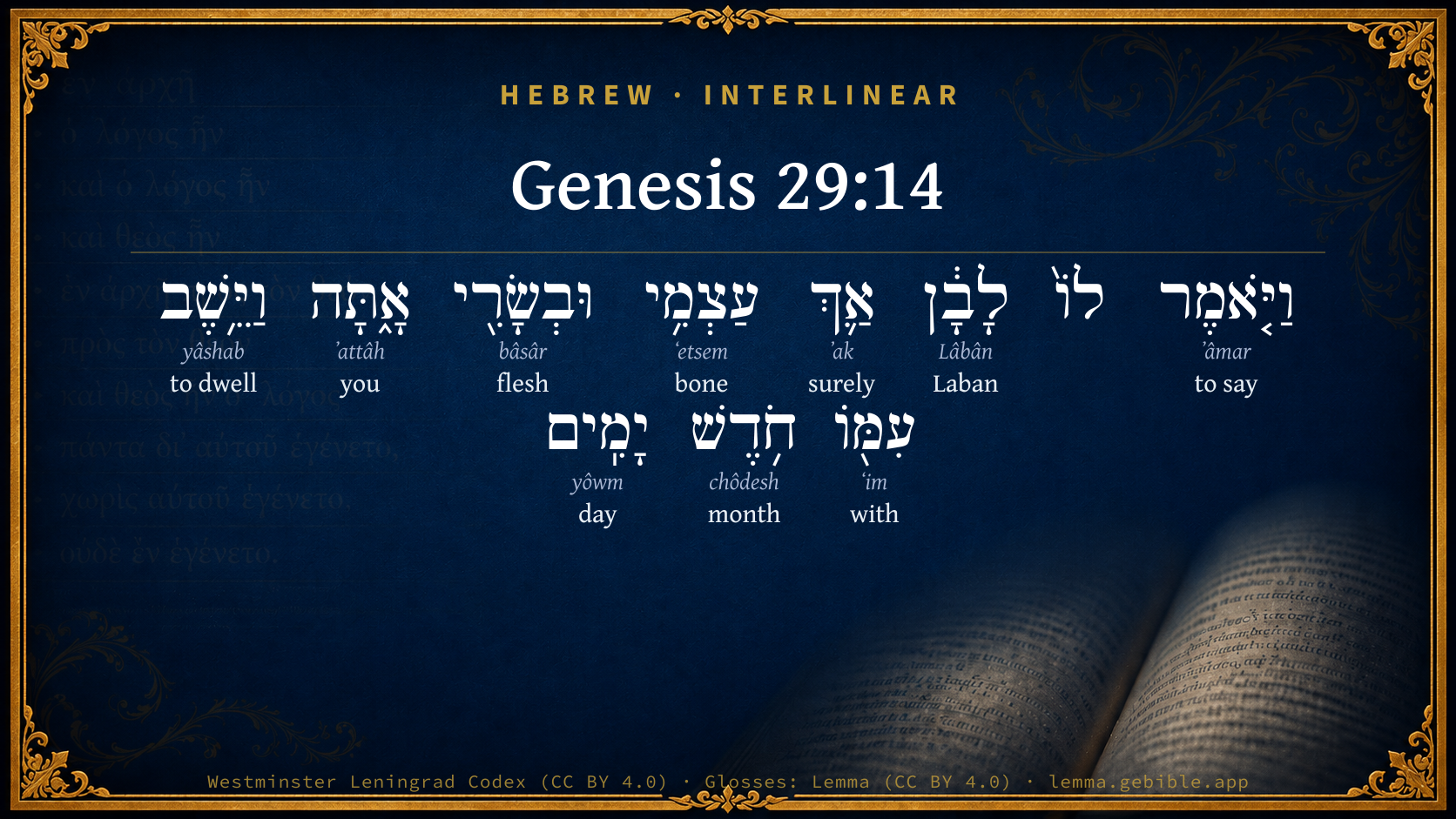
Hebrew (Westminster Leningrad Codex) Genesis 29:14 appears in the Hebrew Old Testament. The text above is from the Westminster Leningrad Codex. Each word links to its Strong’s number, a concise gloss, and parsing drawn from the Open Scriptures Hebrew Bible morphology. Click any word for its full Brown-Driver-Briggs (BDB) entry.
Download image
Cite this verse

Genesis 29:14 (World English Bible). Public Domain. Lemma interlinear Bible study tool, https://lemma.gebible.app/v/genesis/29/14.

Show BibTeX & RIS
BibTeX
RIS
English Translation
Laban said to him, Surely you are my bone and my flesh. He lived with him for a month.
World English Bible · Public Domain
Download a study sheet

One document with this verse’s original text, its word-by-word gloss line, the meaning frame, cross-references with their text, attributed commentary, and full source and license credits — printable, and it pastes into notes with its structure intact.

This verse Autodidact and up

Study sheet (.html) Plain text (.txt)

A passage Seminary Student

Up to 50 verses in one chapter. A passage sheet keeps up to 6 commentary sources and 12 cross-references per verse, in the order this page ranks them, and says so on the sheet whenever that leaves anything out. Ask for a single verse and you get the Autodidact verse sheet above.

Everything on this page stays free to read, with no account — the sheet is a download of what is already on screen, not access to it.

Want to remove ads? Support Godless Engineer
Compare translations 3

The same verse in 3 English versions, stacked beneath the original-language interlinear above. Click any original word for its lexicon entry.

Each is an independent rendering of the whole verse — the interlinear is not word-aligned to these translations.

Highlighted words mark where these versions differ — a whole-verse word diff, not a word-by-word alignment.

  • World English Bible Public Domain
    Laban said to him, Surely you are my bone and my flesh. He lived with him for a month.
  • King James Version Public Domain
    And Laban said to him, Surely thou art my bone and my flesh. And he abode with him the space of a month.
  • unfoldingWord Literal Text CC BY-SA 4.0
    and Laban said to him, “You indeed my bone and my flesh!” Jacob Works for Laban to Marry Rachel and Leah 29:14b-30 Then he stayed with him a month of days.

unfoldingWord Literal Text — © unfoldingWord, licensed CC BY-SA 4.0. Word-aligned USFM3 via Door43 (git.door43.org/unfoldingWord/en_ult).

Versions to compare (up to 4)

3 of 4 selected

Show all 18 translations

Every available English version of this verse, each an independent rendering of the whole verse.

  • World English Bible Public Domain
    Laban said to him, Surely you are my bone and my flesh. He lived with him for a month.
  • Berean Standard Bible Public Domain
    Then Laban declared, “You are indeed my own flesh and blood.” After Jacob had stayed with him a month,
  • Majority Standard Bible Public Domain
    Then Laban declared, “You are indeed my own flesh and blood.” After Jacob had stayed with him a month,
  • King James Version Public Domain
    And Laban said to him, Surely thou art my bone and my flesh. And he abode with him the space of a month.
  • American Standard Version (1901) Public Domain
    And Laban said to him, Surely thou art my bone and my flesh. And he abode with him the space of a month.
  • Revised Version (1885) Public Domain
    And Laban said to him, Surely thou art my bone and my flesh. And he abode with him the space of a month.
  • Geneva Bible (1599) Public Domain
    To whome Laban sayd, Well, thou art my bone and my flesh. and he abode with him the space of a moneth.
  • Douay-Rheims (1899) Public Domain
    He answered: Thou art my bone and my flesh. And after the days of one month were expired,
  • Young's Literal Translation Public Domain
    and Laban saith to him, `Only my bone and my flesh `art' thou;' and he dwelleth with him a month of days.
  • Literal Standard Version CC BY-SA 4.0
    and Laban says to him, “You [are] surely my bone and my flesh”; and he dwells with him a month of days.
  • Unlocked Literal Bible CC BY-SA 4.0
    Laban said to him, “You are indeed my bone and my flesh.” Then Jacob stayed with him for about one month.
  • unfoldingWord Literal Text CC BY-SA 4.0
    and Laban said to him, “You indeed my bone and my flesh!” Jacob Works for Laban to Marry Rachel and Leah 29:14b-30 Then he stayed with him a month of days.
  • Darby Bible Public Domain
    And Laban said to him, Thou art indeed my bone and my flesh. And he abode with him a month's time.
  • World Messianic Bible Public Domain
    Laban said to him, “Surely you are my bone and my flesh.” Jacob stayed with him for a month.
  • Webster's Bible Public Domain
    And Laban said to him, Surely thou art my bone and my flesh: and he abode with him the space of a month.
  • Free Bible Version CC BY-SA 4.0
    Laban told him, “No question about it—you're my own flesh and blood!” Jacob stayed with Laban for a month.
  • Bible in Basic English Public Domain
    And Laban said to him, Truly, you are my bone and my flesh. And he kept Jacob with him for the space of a month.
  • JPS Tanakh (1917) Public Domain
    And Laban said to him: 'Surely thou art my bone and my flesh.' And he abode with him the space of a month.

Literal Standard Version (2020), Covenant Press — licensed CC BY-SA 4.0. Text via the HelloAO Bible API (eBible.org). Unlocked Literal Bible (unfoldingWord) — licensed CC BY-SA 4.0. Text via the HelloAO Bible API (eBible.org). unfoldingWord Literal Text — © unfoldingWord, licensed CC BY-SA 4.0. Word-aligned USFM3 via Door43 (git.door43.org/unfoldingWord/en_ult). Free Bible Version, Dr. Jonathan Gallagher — licensed CC BY-SA 4.0. Text via the HelloAO Bible API (eBible.org).

Word by word

More ways to search: Search by grammar → Find every occurrence → Compare this word →

Practice this passage: Drill this verse → Learn its vocabulary →

לָבָ֔ן
Lâbân
H3837
“Laban”
Noun, Proper
Part of Speech
Noun
Type
Proper
Full BDB Definition

Origin: the same as H3836

TWOT: None

Laban = "white" - son of Bethuel, brother of Rebekah, and father of Leah and Rachel (noun proper masculine) - a wilderness encampment of the Israelites (noun proper locative)
  1. וַיֹּ֤אמֶר ʼâmar H559 “and · to say” Conjunction + Verb, Qal, Sequential Imperfect, 3rd Person, Masculine, Singular
  2. אַ֛ךְ ʼak H389 “surely” Particle, Accusative
  3. עַצְמִ֥י ʻetsem H6106 “bone · my” Noun, Common, Feminine, Singular, Construct + Suffix, Personal, 1st Person, Common, Singular
  4. וּבְשָׂרִ֖י bâsâr H1320 “and · flesh · my” Conjunction + Noun, Common, Masculine, Singular, Construct + Suffix, Personal, 1st Person, Common, Singular
  5. אָ֑תָּה ʼattâh H859 “you” Pronoun, Personal, 2nd Person, Masculine, Singular
  6. וַיֵּ֥שֶׁב yâshab H3427 “and · to dwell” Conjunction + Verb, Qal, Sequential Imperfect, 3rd Person, Masculine, Singular
  7. עִמּ֖וֹ ʻim H5973 “with · him” Preposition + Suffix, Personal, 3rd Person, Masculine, Singular
  8. חֹ֥דֶשׁ chôdesh H2320 “month of” Noun, Common, Masculine, Singular, Construct
  9. יָמִֽים yôwm H3117 “days” Noun, Common, Masculine, Plural, Absolute

About this verse

These counts appear in no published source. They are computed here, from the morphology-tagged text and Lemma’s own curated glosses. What Lemma adds →

11
words
10
distinct lemmas
Pentateuch
section

Shared distinctive vocabulary

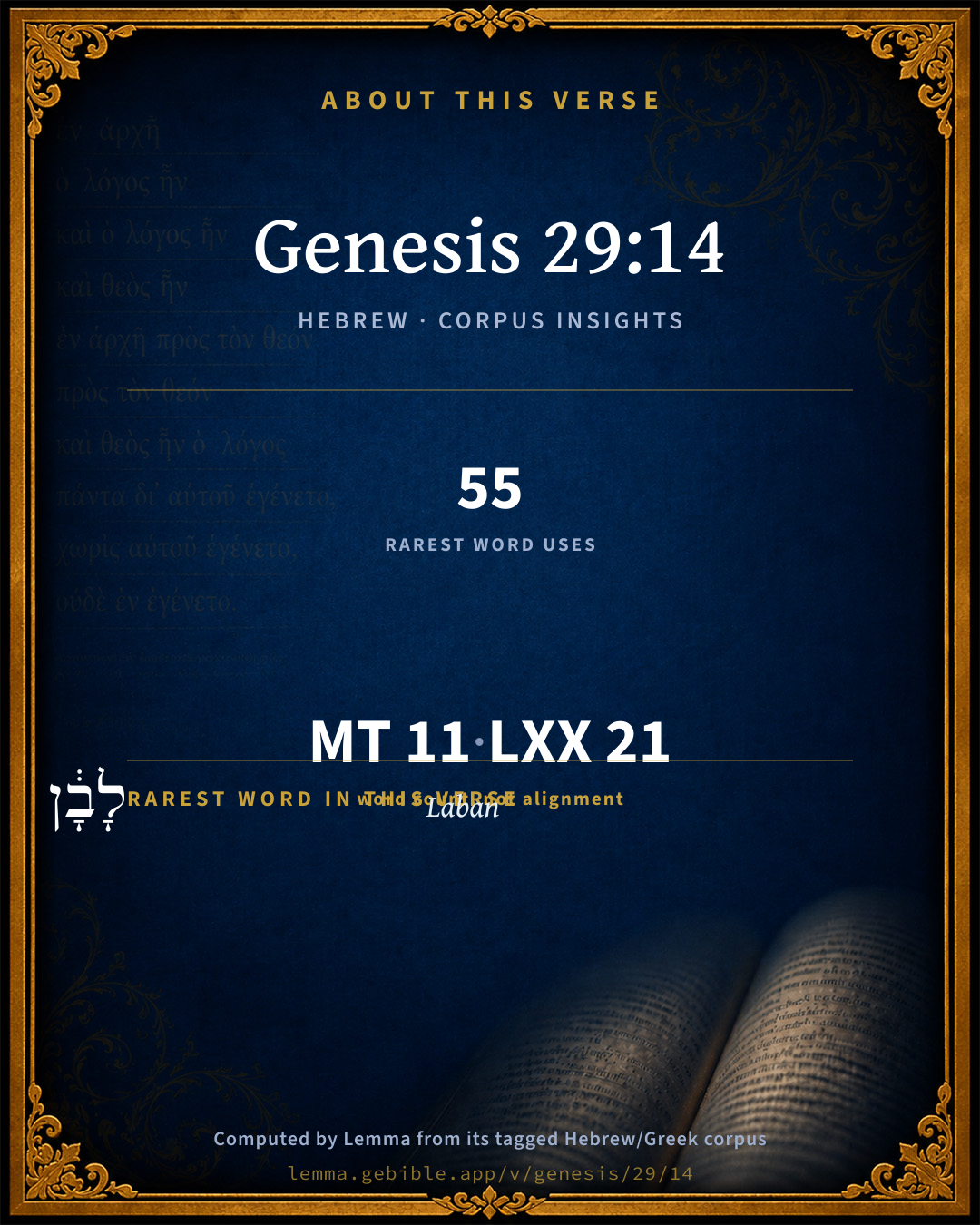
לָבָ֔ן Laban H3837 occurs in 47 verses of the Hebrew Bible. Also found in:

Grammatical profile

  • 2 verbs
  • 5 nouns
  • 1 pronoun
  • 2 prepositions
  • 1 particle

Verb forms

  • וַיֹּ֤אמֶר Qal · Sequential Imperfect
  • וַיֵּ֥שֶׁב Qal · Sequential Imperfect

Hebrew & Septuagint length

In English translation the verse runs 19 words from the Hebrew and 22 from the Septuagint (LXX English) — closely comparable.

A rough comparison of the two English renderings, which tokenize alike — not a word-level alignment.

Word counts can differ between the Hebrew and the Greek without any difference in meaning — e.g. the Hebrew direct-object marker אֵת has no separate Greek word, and Greek often adds the article ὁ.

In the original languages it is 11 Hebrew tokens and 21 Greek tokens — but the two are counted differently (Hebrew bundles its prefixes and suffixes into one token; the Greek is in lemma form), so that isn’t a like-for-like length.

Cross-references

9

Topical passages linked to Genesis 29:14 in the Treasury of Scripture Knowledge — connected by theme and wording, ordered by reader-vote popularity; previews shown in the World English Bible.

  • 2 Samuel 19:12–13 You are my brothers, you are my bone and my flesh: why then are you the last to bring back the king?
  • Genesis 2:23 The man said, "This is now bone of my bones, and flesh of my flesh. She will be called Woman, because she was taken out of Man."
  • Judges 9:2 Please speak in the ears of all the men of Shechem, Whether is better for you, that all the sons of Jerubbaal, who are seventy persons, rule over you, or that one rule over you? Remember also that I am your bone and your flesh.
  • 2 Samuel 5:1 Then came all the tribes of Israel to David to Hebron, and spoke, saying, Behold, we are your bone and your flesh.
  • Genesis 13:8 Abram said to Lot, "Please, let there be no strife between me and you, and between my herdsmen and your herdsmen; for we are relatives.
  • Genesis 29:12 Jacob told Rachel that he was her father's brother, and that he was Rebekah's son. She ran and told her father.
  • Genesis 29:15 Laban said to Jacob, "Because you are my brother, should you therefore serve me for nothing? Tell me, what will your wages be?"
  • Micah 7:5 Don't trust in a neighbor. Don't put confidence in a friend. With the woman lying in your embrace, Be careful of the words of your mouth!
  • Ephesians 5:30 because we are members of his body, of his flesh and bones.

Cross-references courtesy of OpenBible.info (CC BY 4.0).

Hebrew and Greek witnesses Masoretic Hebrew ↔ Greek Septuagint

The same verse in the two great witnesses to the Old Testament, shown verse-for-verse.

These are two independent witnesses, not word-aligned to each other, and the Septuagint is shown in lemma (dictionary) form.

Hebrew Genesis 29:14 Masoretic · Westminster Leningrad Codex

וַיֹּ֤אמֶר לוֹ֙ לָבָ֔ן אַ֛ךְ עַצְמִ֥י וּבְשָׂרִ֖י אָ֑תָּה וַיֵּ֥שֶׁב עִמּ֖וֹ חֹ֥דֶשׁ יָמִֽים

Laban said to him, Surely you are my bone and my flesh. He lived with him for a month.

World English Bible · Public Domain

Greek LXX Genesis 29:14 Septuagint · lemma form

καί εἶπον αὐτός λαβαν ἐκ ὁ ὀστέον ἐγώ καί ἐκ ὁ σάρξ ἐγώ εἰμί σύ καί εἰμί μετά αὐτός μήν ἡμέρα

And Laban said to him, You are of my bones and of my flesh; and he was with him a full month.

LXX2012 (modern English Septuagint) · Public Domain

Hebrew: Westminster Leningrad Codex (CC BY 4.0). Greek: Septuagint (public domain); English from LXX2012 (modern English Septuagint) (Public Domain). How the Septuagint differs from the Hebrew →

Targum (Aramaic paraphrase)

2

The Targum is the ancient Jewish Aramaic paraphrase of the Hebrew Scriptures — an interpretive translation, not the Hebrew text itself. Onkelos (literal) and Pseudo-Jonathan (expansive) render the Torah, and Jonathan the Prophets. Coverage is partial: where no permissively-licensed English translation exists for a verse, only the Aramaic is shown. This is verse-level text, not a word-by-word alignment to the Hebrew.

  1. Targum Onkelos Torah (Genesis–Deuteronomy)
    וַאֲמַר לֵהּ לָבָן בְּרַם קָרִיבִי וּבִשְׂרִי אָתְּ וִיתֵיב עִמֵּהּ יְרַח יוֹמִין

    (no public-domain English translation for this verse)

    Targum Onkelos — Aramaic: “Onkelos Genesis” (public domain); “Onkelos Exodus” (public domain); “Onkelos Leviticus” (public domain); “Onkelos Numbers” (public domain); “Onkelos Deuteronomy” (public domain). English: “Sefaria Community Translation” (CC0 1.0 (public-domain dedication)); “J.W. Etheridge. The Targums of Onkelos and Jonathan Ben Uzziel on the Pentateuch. London: Longmans, Green, 1862” (public domain). Text via Sefaria.

  2. Targum Pseudo-Jonathan Torah (Genesis–Deuteronomy)
    וַאֲמַר לֵיהּ לָבָן בְּרַם קְרִיבִי וְדָמִי לִי אַנְתְּ וִיתֵיב עִמֵיהּ יְרַח יוֹמִין

    And Laban said to him, Truly thou art my near one and my blood; and he dwelt with him a month of days.

    Targum Pseudo-Jonathan — Aramaic: “Targum Jonathan on Genesis” (public domain); “Targum Jonathan on Exodus” (public domain); “Targum Jonathan on Leviticus” (public domain); “Targum Jonathan on Numbers” (public domain); “Targum Jonathan on Deuteronomy” (public domain). English: “The Targum of Jonathan ben Uzziel, trans. J. W. Etheridge, London, 1862” (public domain). Text via Sefaria.

Commentary

Notes on Genesis 29:14 from classic Christian and Jewish commentators (each source and its license shown beneath its notes). The classic Christian expositions comment on the surrounding passage and are grouped to its opening verse, so a note may address several verses; the Jewish commentaries on the Tanakh (Rashi and others) are per-verse, so they appear only where the commentator wrote on this verse.

Lemma curates 59 commentaries, every one of them public domain or Creative Commons licensed, each selected and text-cleaned for this edition rather than reprinted as found. About our sources →

Trapp's Complete Commentary

John Trapp

Gen 29:14 And Laban said to him, Surely thou [art] my bone and my flesh. And he abode with him the space of a month.

Ver. 14. Surely thou art my bone, &c.] Good words cost nothing; and the veriest countrymen are commonly freer of them than of real courtesies. Pertinax the emperor was surnamed Cρηστολογος, quid blandus esset, magis quam benignus . But that of Nero was abominable, who, the very day before he killed his mother, most lovingly embraced her, kissed her eyes and hands, and, accompanying her when she departed, used these sweet words: All happiness attend you, my good mother; for in you I live, and by you I reign. {a} "As a potsherd covered with silver dross, so are burning lips and a wicked heart". {Pro 26:23}

{a} Mητερ ερρωσο μοι, και υγιαινε, εν γαρ σοι και εγω ζω, και δια σου Bασιλευω. - Dio in Ner.

John Trapp, A Commentary or Exposition upon All the Books of the Old and New Testament (1647–1656) — public domain. Text from a community e-Sword module.

Tyndale Open Study Notes

Tyndale Open Resources

29:14-30 Jacob’s joyful prospect of marriage to the lovely Rachel became an occasion for Laban’s shrewdness and Jacob’s discipline. Jacob and his mother had deceived his father and brother to gain the blessing; now his mother’s brother deceived him. Jacob received a dose of his own duplicity through twenty years of labor, affliction, and deception in Laban’s service (31:38). In God’s justice, people harvest what they plant (Gal 6:7). Laban’s deception was perfectly designed to make Jacob aware of his own craftiness. God often brings people into the lives of believers to discipline them. But Jacob was tenacious, and God blessed him abundantly with a large family and many possessions (30:25-43) during this time of service.

29:14 You really are my own flesh and blood! Laban welcomed Jacob into his house and treated him much like a son.

Tyndale Open Study Notes — © Tyndale Open Resources, licensed CC BY-SA 4.0. Text via the HelloAO Bible API.

Geneva Bible (1599)

Geneva Bible translators

That is, of my blood and kindred.

Geneva Bible (1599) marginal notes — public domain. Text via Bolls.life.

Jamieson, Fausset & Brown

Robert Jamieson, A. R. Fausset & David Brown

he abode a month--Among pastoral people a stranger is freely entertained for three days; on the fourth day he is expected to tell his name and errand; and if he prolongs his stay after that time, he must set his hand to work in some way, as may be agreed upon. A similar rule obtained in Laban's establishment, and the wages for which his nephew engaged to continue in his employment was the hand of Rachel.

Jamieson, Fausset & Brown — Commentary Critical and Explanatory on the Whole Bible (1871) — public domain (CC PDM 1.0). Text via the HelloAO Bible API.

Adam Clarke's Commentary

Verse 14. My bone and my flesh.] One of my nearest relatives.

Adam Clarke's Commentary on the Bible (1810–1826) — public domain. Text from a community e-Sword/MySword module.

John Calvin's Commentaries

14. And he abode with him the space of a month. Though Laban did not doubt that Jacob was his nephew by his sister, he nevertheless puts his character to trial during a month, and then treats with him respecting wages. Hence may be inferred the uprightness of the holy man; because he was not idle while with his uncle, but employed himself in honest labors, that he might not in idleness eat another’s bread for nothing; hence Laban is compelled to acknowledge that some reward beyond his mere food was due to him. When he says, “Because thou art my brother, shouldest thou therefore serve me for nought?” his meaning may be twofold; either that it would be excessively absurd and unjust to defraud a relation of his due reward, for whom he ought to have greater consideration than for any stranger; or that he was unwilling to exact gratuitous service under the color of relationship. This second exposition is the more suitable, and is received nearly by the consent of all. For they read in one connected sentence, “Because thou art my brother, shalt thou therefore serve me for nought?” Moreover, we must note the end for which Moses relates these things. In the first place, a great principle of equity is set before us in Laban; inasmuch as this sentiment is inherent in almost all minds, that justice ought to be mutually cultivated, till blind cupidity draws them away in another direction. And God has engraven in man’s nature a law of equity; so that whoever declines from that rule, through an immoderate desire of private advantage, is left utterly without excuse. But a little while after, when it came to a matter of practice, Laban, forgetful of this equity, thinks only of what may be profitable to himself. Such an example is certainly worthy of notice, for men seldom err in general principles, and therefore, with one mouth, confess that every man ought to receive what is his due but as soon as they descend to their own affairs, perverse self-love blinds them, or at least envelopes them in such clouds that they are carried in an opposite course. Wherefore, let us learn to restrain ourselves, that a desire of our own advantage may not prevail to the sacrifice of justice. And hence has arisen the proverb, that no one is a fit judge in his own cause, because each, being unduly favorable to himself, becomes forgetful of what is right. Wherefore, we must ask God to govern and restrain our affections by a spirit of sound judgment. Laban, in wishing to enter into a covenant, does what tends to avoid contentions and complaints. The ancient saying is known, “We should deal lawfully with our friends, that we may not afterwards be obliged to go to law with them.” For, whence arise so many legal broils, except that every one is more liberal towards himself, and more niggardly towards others than he ought to be? Therefore, for the purpose of cherishing concord, firm compacts are necessary, which may prevent injustice on one side or the other.

John Calvin's Commentaries (1540-1563) — public domain. Text from the Calvin Translation Society English edition (1840s-50s) via the Christian Classics Ethereal Library (ccel.org). Calvin's coverage is partial (roughly two-thirds of the Bible); uncommented books and verses are honest gaps, never fabricated. The 19th-century editor's footnotes and remarks are omitted so the notes are faithfully Calvin's own voice.

Ellicott's Commentary for English Readers

(14) The space of a month.—Heb., a month of days, that is, a full month.

A Bible Commentary for English Readers, edited by Charles John Ellicott (1878–1897) — public domain. Text from a community e-Sword module.

The Cambridge Bible for Schools and Colleges

gen. ed. J. J. S. Perowne

14. my bone and my flesh] See note on Gen_2:23, and cf. Gen_37:27. Laban readily acknowledges the relationship which Jacob claims.

the space of a month] Lit. “a month of days.” See on Gen_24:55, “a few days.”

The Cambridge Bible for Schools and Colleges (gen. ed. J. J. S. Perowne; Cambridge University Press, 1878–1918) — public domain. Text from a community e-Sword module.

John Gill's Exposition

And Laban said to him, surely thou art my bone and my flesh,.... Nearly allied in blood, being his sister's son:

and he abode with him the space of a month; or "a month of days" (m), a full month to a day; all this while feeding his flocks, and doing whatsoever service he had for him to do.

(m) "mensem dierum", Pagninus, Montanus, Drusius, Schmidt.

John Gill's Exposition of the Whole Bible (1746–1763) — public domain (CC PDM 1.0). Text via the HelloAO Bible API.

Haydock's Catholic Bible Commentary

My flesh, entitled to my utmost protection and friendship. (Calmet)

George Leo Haydock (1774–1849), Haydock's Catholic Family Bible and Commentary, 1859 edition — public domain. Excludes Psalms (Douay-Rheims chapter numbering differs from Protestant) and Deuterocanonical books (Catholic canon only).

Matthew Poole's English Annotations

Thou art my bone and my flesh; of the same bone and flesh with myself, by our common grandfather Terah, and therefore art justly dear to me, and with me thou shalt be in safety. See the same or like expression, Ge 2:23; Jdg 9:2; 2Sa 19:12,13.

Matthew Poole's English Annotations on the Holy Bible (1683–1685) — public domain. Text from a community e-Sword/MySword module.

The Pulpit Commentary

And Laban said unto him (giving utterance to the impression Jacob s recital had produced upon his mind), Surely thou art my bone and my flesh i.e. my blood relation (cf. Jud_1:9:2; 2Sa_5:1) Laban meant that Jacob had satisfactorily proved himself Rebekah"s son. And he abode with him the space of a month literally, a month of days (cf. Gen_41:1; Num_11:20) or a month as regards time, "the second substantive describing the general notion of which the first is a specification" (Kalisch).

The Pulpit Commentary (1880–1919), ed. H.D.M. Spence-Jones & Joseph S. Exell — public domain. Text from a community e-Sword module.

Rashi

Rabbi Shlomo Yitzchaki (Rashi)

אך עצמי ובשרי SURELY THOU ART MY BONE AND MY FLESH — Really, I have no reason to take you into my house, since you have brought nothing with you; but because of our relationship I will put up with you for “the space of a month”. Thus, indeed, he did, but even this was not for nothing, for he tended Laban’s sheep.

Rashi on the Tanakh — English translations: “The Judaica Press complete Tanach with Rashi, translated by A. J. Rosenberg” (CC BY 4.0); “Pentateuch with Rashi's commentary by M. Rosenbaum and A.M. Silbermann, 1929-1934” (public domain); “The Metsudah Tanach series, Lakewood, N.J” (CC BY 4.0); and “The Book of Joshua, Metsudah Publications, 1997” (CC BY 4.0). Text via Sefaria.

Radak

Rabbi David Kimhi (Radak)

ויאמר...אך עצמי, the word אך in this instance means “truly!” It appears in this meaning in several other passages in the Scriptures, as for instance, Psalms 73,1 אך טוב לישראל”G’d is truly good to Israel.” Or, Isaiah 63,8 אך עמי המה, “truly, they are My people!” Essentially, what Lavan said to Yaakov was that he should not worry about having left home seeing that all he needed would be provided for him by Lavan.

Radak on the Tanakh — English translations: “Sefaria Community Translation” (CC0 1.0 (public-domain dedication)); “Eliyahu Munk, HaChut Hameshulash” (CC BY 4.0); “Rabbi Mike Feuer, Jerusalem Anthology” (CC BY 4.0); and “R. David Kimhi on the first book of Psalms, Translated by R.G. Finch, London, 1919” (public domain). Text via Sefaria.

Lesson kit

Teaching starters — assembled from the data on this page, not authored interpretation. Every prompt links to the verse data it draws on. Edit before teaching.

Genesis, in the Pentateuch, opens this verse with 11 words (10 distinct Hebrew lemmas). Its most distinctive word is Lâbân (“Laban”). A historical commentator’s framing appears above. Read the whole chapter for the surrounding context.

Discussion questions

  1. The word Lâbân carries the sense “Laban.” How does it shape the verse?
  2. Genesis 24:29 shares the word «Laban» with this verse. How do the two illuminate each other?
  3. These translations render this verse differently; the difference is in the English rendering, not the original. What questions does that raise?
  4. The verb «וַיֹּ֤אמֶר» is Qal Sequential Imperfect. How does its form color the action?
  5. Reading how Trapp's Complete Commentary and Tyndale Open Study Notes read this verse, where do the two commentators agree and where do they part?

Things to notice

Reading settings

Reading text

Shown beneath each verse's original-language words.

Old Testament
Old Testament edition

Read the OT as the Masoretic Hebrew (MT) or the Greek Septuagint (LXX).

English shown for the Greek Septuagint (in the Hebrew ↔ Greek comparison).

Comparing translations? Open the Compare panel on any verse page to stack up to four side by side.