
Leviticus 23:32

Hebrew (Westminster Leningrad Codex) Leviticus 23:32 appears in the Hebrew Old Testament. The text above is from the Westminster Leningrad Codex. Each word links to its Strong’s number, a concise gloss, and parsing drawn from the Open Scriptures Hebrew Bible morphology. Click any word for its full Brown-Driver-Briggs (BDB) entry.
Download image
Cite this verse

Leviticus 23:32 (World English Bible). Public Domain. Lemma interlinear Bible study tool, https://lemma.gebible.app/v/leviticus/23/32.

Show BibTeX & RIS
BibTeX
RIS
English Translation
It shall be a Sabbath of solemn rest for you, and you shall deny yourselves. In the ninth day of the month at evening, from evening to evening, you shall keep your Sabbath."
World English Bible · Public Domain
Download a study sheet

One document with this verse’s original text, its word-by-word gloss line, the meaning frame, cross-references with their text, attributed commentary, and full source and license credits — printable, and it pastes into notes with its structure intact.

This verse Autodidact and up

Study sheet (.html) Plain text (.txt)

A passage Seminary Student

Up to 50 verses in one chapter. A passage sheet keeps up to 6 commentary sources and 12 cross-references per verse, in the order this page ranks them, and says so on the sheet whenever that leaves anything out. Ask for a single verse and you get the Autodidact verse sheet above.

Everything on this page stays free to read, with no account — the sheet is a download of what is already on screen, not access to it.

Want to remove ads? Support Godless Engineer
Compare translations 3

The same verse in 3 English versions, stacked beneath the original-language interlinear above. Click any original word for its lexicon entry.

Each is an independent rendering of the whole verse — the interlinear is not word-aligned to these translations.

Highlighted words mark where these versions differ — a whole-verse word diff, not a word-by-word alignment.

  • World English Bible Public Domain
    It shall be a Sabbath of solemn rest for you, and you shall deny yourselves. In the ninth day of the month at evening, from evening to evening, you shall keep your Sabbath."
  • King James Version Public Domain
    It shall be unto you a sabbath of rest, and ye shall afflict your souls: in the ninth day of the month at even, from even unto even, shall ye celebrate your sabbath.
  • unfoldingWord Literal Text CC BY-SA 4.0
    It a sabbath of sabbaths for you, and you shall humble your souls. On nine of the month in the evening, from evening until evening, you shall observe your sabbath.”

unfoldingWord Literal Text — © unfoldingWord, licensed CC BY-SA 4.0. Word-aligned USFM3 via Door43 (git.door43.org/unfoldingWord/en_ult).

Versions to compare (up to 4)

3 of 4 selected

Show all 18 translations

Every available English version of this verse, each an independent rendering of the whole verse.

  • World English Bible Public Domain
    It shall be a Sabbath of solemn rest for you, and you shall deny yourselves. In the ninth day of the month at evening, from evening to evening, you shall keep your Sabbath."
  • Berean Standard Bible Public Domain
    It will be a Sabbath of complete rest for you, and you shall humble yourselves. From the evening of the ninth day of the month until the following evening you are to keep your Sabbath.”
  • Majority Standard Bible Public Domain
    It will be a Sabbath of complete rest for you, and you shall humble yourselves. From the evening of the ninth day of the month until the following evening you are to keep your Sabbath.”
  • King James Version Public Domain
    It shall be unto you a sabbath of rest, and ye shall afflict your souls: in the ninth day of the month at even, from even unto even, shall ye celebrate your sabbath.
  • American Standard Version (1901) Public Domain
    It shall be unto you a sabbath of solemn rest, and ye shall afflict your souls: in the ninth day of the month at even, from even unto even, shall ye keep your sabbath.
  • Revised Version (1885) Public Domain
    It shall be unto you a sabbath of solemn rest, and ye shall afflict your souls: in the ninth day of the month at even, from even unto even, shall ye keep your sabbath.
  • Geneva Bible (1599) Public Domain
    This shalbe vnto you a Sabbath of rest, and ye shall humble your soules: in the ninth day of the moneth at euen, from euen to euen shall ye celebrate your Sabbath.
  • Douay-Rheims (1899) Public Domain
    It is a sabbath of rest, and you shell afflict your souls beginning on the ninth day of the month: from evening until evening you shall celebrate your sabbaths.
  • Young's Literal Translation Public Domain
    It `is' a sabbath of rest to you, and ye have humbled yourselves in the ninth of the month at even; from evening till evening ye do keep your sabbath.'
  • Literal Standard Version CC BY-SA 4.0
    It [is] a Sabbath of rest for yourselves, and you have humbled yourselves in the ninth of the month at evening; you keep your Sabbath from evening until evening.”
  • Unlocked Literal Bible CC BY-SA 4.0
    This day must be to you a Sabbath of solemn rest, and you must humble yourselves the ninth day of the month at the evening. From evening to evening you are to observe your Sabbath.”
  • unfoldingWord Literal Text CC BY-SA 4.0
    It a sabbath of sabbaths for you, and you shall humble your souls. On nine of the month in the evening, from evening until evening, you shall observe your sabbath.”
  • Darby Bible Public Domain
    A sabbath of rest shall it be unto you; and ye shall afflict your souls. On the ninth of the month at even, from even unto even, shall ye celebrate your sabbath.
  • World Messianic Bible Public Domain
    It shall be a Sabbath of solemn rest for you, and you shall deny yourselves. In the ninth day of the month at evening, from evening to evening, you shall keep your Sabbath.”
  • Webster's Bible Public Domain
    It shall be to you a sabbath of rest, and ye shall afflict your souls in the ninth day of the month at evening: from evening to evening shall ye celebrate your sabbath.
  • Free Bible Version CC BY-SA 4.0
    It is to be a Sabbath of complete rest for you, and you shall practice self-denial. You are to observe your Sabbath from the evening of the ninth day of the month until evening the next day.”
  • Bible in Basic English Public Domain
    Let this be a Sabbath of special rest to you, and keep yourselves from all pleasure; on the ninth day of the month at nightfall from evening to evening, let this Sabbath be kept.
  • JPS Tanakh (1917) Public Domain
    It shall be unto you a sabbath of solemn rest, and ye shall afflict your souls; in the ninth day of the month at even, from even unto even, shall ye keep your sabbath.

Literal Standard Version (2020), Covenant Press — licensed CC BY-SA 4.0. Text via the HelloAO Bible API (eBible.org). Unlocked Literal Bible (unfoldingWord) — licensed CC BY-SA 4.0. Text via the HelloAO Bible API (eBible.org). unfoldingWord Literal Text — © unfoldingWord, licensed CC BY-SA 4.0. Word-aligned USFM3 via Door43 (git.door43.org/unfoldingWord/en_ult). Free Bible Version, Dr. Jonathan Gallagher — licensed CC BY-SA 4.0. Text via the HelloAO Bible API (eBible.org).

Word by word

More ways to search: Search by grammar → Find every occurrence → Compare this word →

Practice this passage: Drill this verse → Learn its vocabulary →

שַׁבָּת֥וֹן
shabbâthôwn
H7677
“Sabbath observance”
Noun, Common, Masculine, Singular, Absolute
Part of Speech
Noun
Type
Common
Gender
Masculine
Number
Singular
State
Absolute
Full BDB Definition

Origin: from H7676

TWOT: 2323d

Sabbath observance, sabbatism - of weekly sabbath - day of atonement - sabbatical year - of Feast of Trumpets - of the 1st and last days of the Feast of Tabernacles
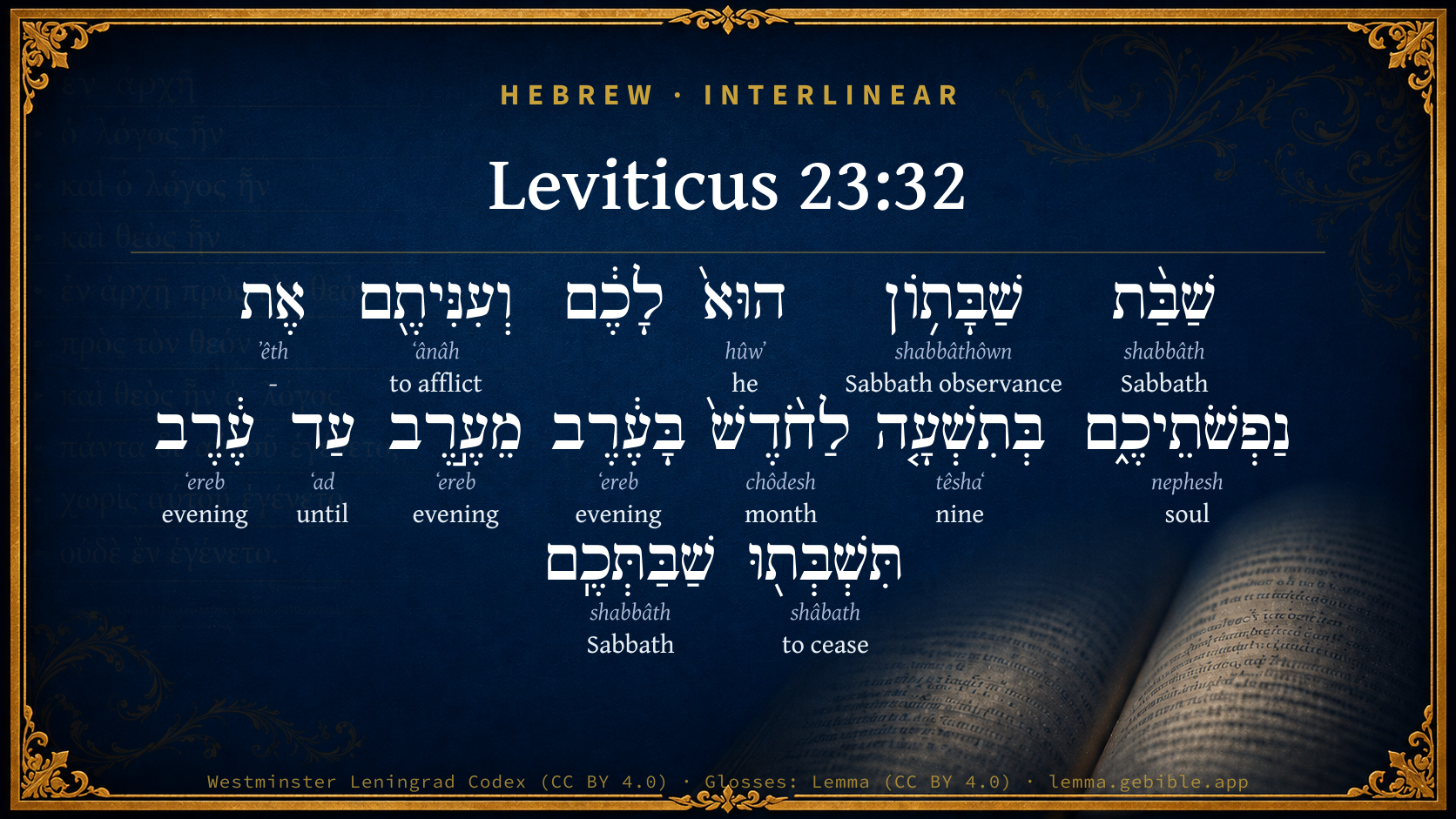
  1. שַׁבַּ֨ת shabbâth H7676 “Sabbath of” Noun, Common, Both, Singular, Construct
  2. הוּא֙ hûwʼ H1931 “he” Pronoun, Personal, 3rd Person, Masculine, Singular
  3. וְעִנִּיתֶ֖ם ʻânâh H6031 “and · to afflict” Conjunction + Verb, Piel, Sequential Perfect, 2nd Person, Masculine, Plural
  4. אֶת ʼêth H853 “-” Particle, Direct Object
  5. נַפְשֹׁתֵיכֶ֑ם nephesh H5315 “souls · your” Noun, Common, Both, Plural, Construct + Suffix, Personal, 2nd Person, Masculine, Plural
  6. בְּתִשְׁעָ֤ה têshaʻ H8672 “in/at · nine” Preposition + Adjective, Cardinal number, Masculine, Singular, Absolute
  7. לַחֹ֨דֶשׁ֙ chôdesh H2320 “to/for the · month” Preposition, Determined + Noun, Common, Masculine, Singular, Absolute
  8. בָּעֶ֔רֶב ʻereb H6153 “in/at the · evening” Preposition, Determined + Noun, Common, Masculine, Singular, Absolute
  9. מֵעֶ֣רֶב ʻereb H6153 “from · evening” Preposition + Noun, Common, Masculine, Singular, Absolute
  10. עַד ʻad H5704 “until” Preposition
  11. עֶ֔רֶב ʻereb H6153 “evening” Noun, Common, Masculine, Singular, Absolute
  12. תִּשְׁבְּת֖וּ shâbath H7673 “to cease” Verb, Qal, Imperfect, 2nd Person, Masculine, Plural
  13. שַׁבַּתְּכֶֽם shabbâth H7676 “Sabbath · your” Noun, Common, Both, Singular, Construct + Suffix, Personal, 2nd Person, Masculine, Plural

About this verse

These counts appear in no published source. They are computed here, from the morphology-tagged text and Lemma’s own curated glosses. What Lemma adds →

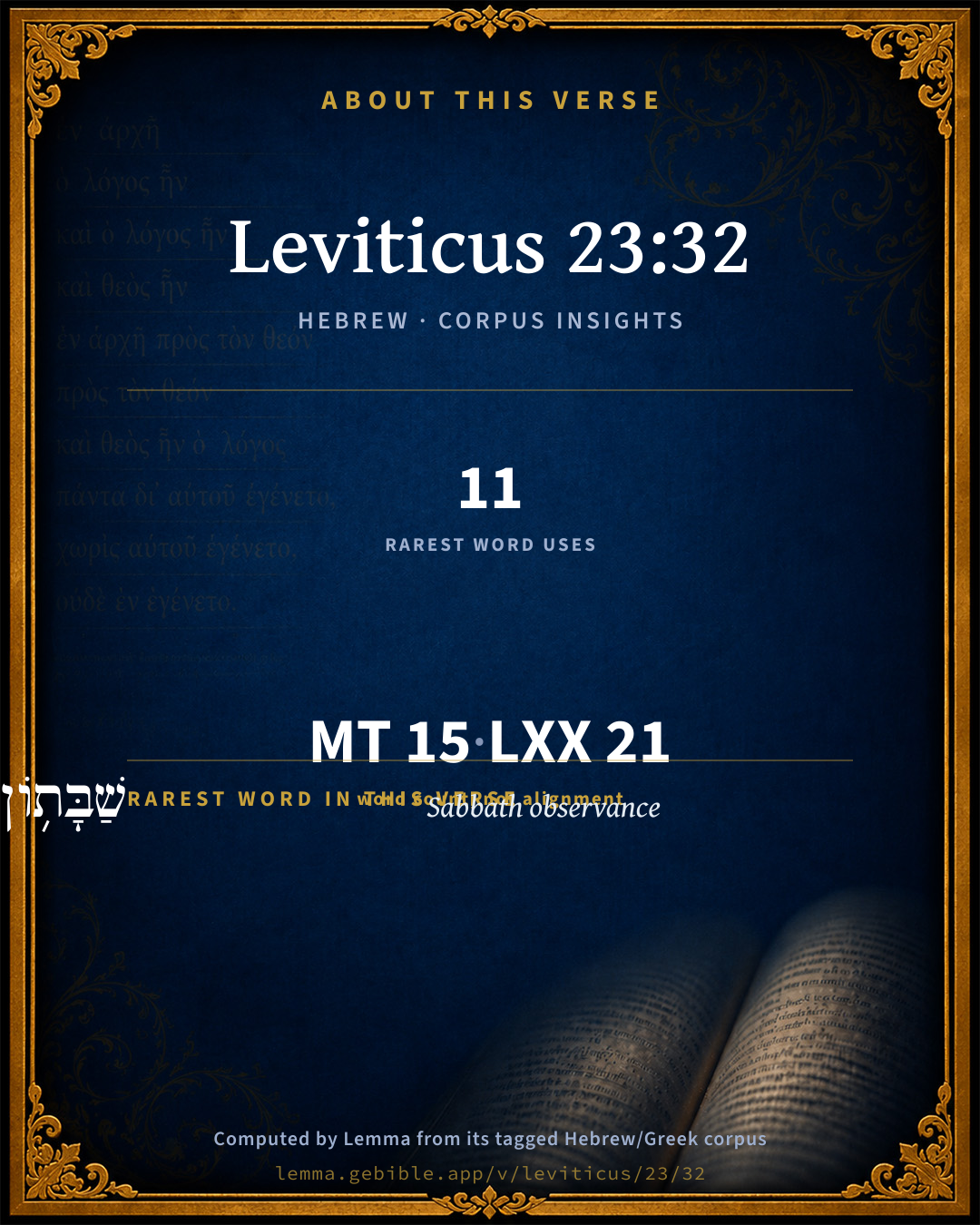
15
words
11
distinct lemmas
Pentateuch
section

Notable vocabulary

The rarest word here is שַׁבָּת֥וֹן Sabbath observance H7677 — appearing just 11 times in the whole Hebrew Bible.

Shared distinctive vocabulary

שַׁבָּת֥וֹן Sabbath observance H7677 occurs in 10 verses of the Hebrew Bible. Also found in:

Grammatical profile

  • 2 verbs
  • 8 nouns
  • 1 adjective
  • 1 pronoun
  • 2 prepositions
  • 1 particle

Verb forms

  • וְעִנִּיתֶ֖ם Piel · Sequential Perfect
  • תִּשְׁבְּת֖וּ Qal · Imperfect

Repetition

Words recur within this verse — often emphatic in Hebrew:

  • בָּעֶ֔רֶב evening H6153 ×3
  • שַׁבַּ֨ת Sabbath H7676 ×2

Hebrew & Septuagint length

In English translation the verse runs 33 words from the Hebrew and 30 from the Septuagint (LXX English) — closely comparable.

A rough comparison of the two English renderings, which tokenize alike — not a word-level alignment.

Word counts can differ between the Hebrew and the Greek without any difference in meaning — e.g. the Hebrew direct-object marker אֵת has no separate Greek word, and Greek often adds the article ὁ.

In the original languages it is 15 Hebrew tokens and 21 Greek tokens — but the two are counted differently (Hebrew bundles its prefixes and suffixes into one token; the Greek is in lemma form), so that isn’t a like-for-like length.

Cross-references

15

Topical passages linked to Leviticus 23:32 in the Treasury of Scripture Knowledge — connected by theme and wording, ordered by reader-vote popularity; previews shown in the World English Bible.

  • Leviticus 16:31 It is a Sabbath of solemn rest to you, and you shall afflict your souls; it is a statute forever.
  • Leviticus 23:27 "However on the tenth day of this seventh month is the day of atonement: it shall be a holy convocation to you, and you shall afflict yourselves; and you shall offer an offering made by fire to Yahweh.
  • Psalms 35:13 But as for me, when they were sick, my clothing was sackcloth. I afflicted my soul with fasting. My prayer returned into my own bosom.
  • Psalms 51:17 The sacrifices of God are a broken spirit. A broken and contrite heart, O God, you will not despise.
  • Psalms 69:10–11 When I wept and I fasted, That was to my reproach.
  • Matthew 11:28–30 "Come to me, all you who labor and are heavily burdened, and I will give you rest.
  • Isaiah 57:15 For thus says the high and lofty One who inhabits eternity, whose name is Holy: I dwell in the high and holy place, with him also who is of a contrite and humble spirit, to revive the spirit of the humble, and to revive the heart of the contrite.
  • Isaiah 58:3–7 Why have we fasted, [say they], and you don't see? [why] have we afflicted our soul, and you take no knowledge? Behold, in the day of your fast you find [your own] pleasure, and exact all your labors.
  • Isaiah 61:3 to appoint to those who mourn in Zion, to give to them a garland for ashes, the oil of joy for mourning, the garment of praise for the spirit of heaviness; that they may be called trees of righteousness, the planting of Yahweh, that he may be glorified.
  • Matthew 5:4 Blessed are those who mourn, For they shall be comforted.
  • 1 Corinthians 11:31 For if we discerned ourselves, we wouldn't be judged.
  • Hebrews 4:3 For we who have believed do enter into that rest, even as he has said, "As I swore in my wrath, they will not enter into my rest;" although the works were finished from the foundation of the world.
  • Hebrews 4:11 Let us therefore give diligence to enter into that rest, lest anyone fall after the same example of disobedience.
  • Psalms 126:5–6 Those who sow in tears will reap in joy.
  • Isaiah 57:18–19 I have seen his ways, and will heal him: I will lead him also, and restore comforts to him and to his mourners.

Cross-references courtesy of OpenBible.info (CC BY 4.0).

Hebrew and Greek witnesses Masoretic Hebrew ↔ Greek Septuagint

The same verse in the two great witnesses to the Old Testament, shown verse-for-verse.

These are two independent witnesses, not word-aligned to each other, and the Septuagint is shown in lemma (dictionary) form.

Hebrew Leviticus 23:32 Masoretic · Westminster Leningrad Codex

שַׁבַּ֨ת שַׁבָּת֥וֹן הוּא֙ לָכֶ֔ם וְעִנִּיתֶ֖ם אֶת נַפְשֹׁתֵיכֶ֑ם בְּתִשְׁעָ֤ה לַחֹ֨דֶשׁ֙ בָּעֶ֔רֶב מֵעֶ֣רֶב עַד עֶ֔רֶב תִּשְׁבְּת֖וּ שַׁבַּתְּכֶֽם

It shall be a Sabbath of solemn rest for you, and you shall deny yourselves. In the ninth day of the month at evening, from evening to evening, you shall keep your Sabbath."

World English Bible · Public Domain

Greek LXX Leviticus 23:32 Septuagint · lemma form

σάββατον σάββατον εἰμί σύ καί ταπεινόω ὁ ψυχή σύ ἀπό ἔνατος ὁ μήν ἀπό ἑσπέρα ἕως ἑσπέρα σαββατίζω ὁ σάββατον σύ

It shall be a holy sabbath to you; and you⌃ shall humble your souls, from the ninth day of the month: from evening to evening you⌃ shall keep your sabbaths.

LXX2012 (modern English Septuagint) · Public Domain

Hebrew: Westminster Leningrad Codex (CC BY 4.0). Greek: Septuagint (public domain); English from LXX2012 (modern English Septuagint) (Public Domain). How the Septuagint differs from the Hebrew →

Targum (Aramaic paraphrase)

2

The Targum is the ancient Jewish Aramaic paraphrase of the Hebrew Scriptures — an interpretive translation, not the Hebrew text itself. Onkelos (literal) and Pseudo-Jonathan (expansive) render the Torah, and Jonathan the Prophets. Coverage is partial: where no permissively-licensed English translation exists for a verse, only the Aramaic is shown. This is verse-level text, not a word-by-word alignment to the Hebrew.

  1. Targum Onkelos Torah (Genesis–Deuteronomy)
    שְׁבַת שְׁבָתָא הוּא לְכוֹן וּתְעַנוּן יָת נַפְשָׁתֵיכוֹן בְּתִשְׁעָה לְיַרְחָא בְּרַמְשָׁא מֵרַמְשָׁא עַד רַמְשָׁא תְּנוּחוּן נְיַחֲכוֹן

    (no public-domain English translation for this verse)

    Targum Onkelos — Aramaic: “Onkelos Genesis” (public domain); “Onkelos Exodus” (public domain); “Onkelos Leviticus” (public domain); “Onkelos Numbers” (public domain); “Onkelos Deuteronomy” (public domain). English: “Sefaria Community Translation” (CC0 1.0 (public-domain dedication)); “J.W. Etheridge. The Targums of Onkelos and Jonathan Ben Uzziel on the Pentateuch. London: Longmans, Green, 1862” (public domain). Text via Sefaria.

  2. Targum Pseudo-Jonathan Torah (Genesis–Deuteronomy)
    שַׁבָּא וְנַיְחָא הוּא לְכוֹן וּתְעַנוּן יַת נַפְשָׁתֵיכוֹן וְתִשְׁרוּן לְצַיְימָא בְּתִשְׁעָה יוֹמִין לְיַרְחָא בְּעִידוֹנֵי רַמְשָׁא מִן רַמְשָׁא הַהוּא עַד רַמְשָׁא חוֹרַן תֶּהֱווּן צַיְימִין צוּמְכוֹן וְשַׁבְּתוּן שׁוֹבֵיכוֹן וְעָבְדִין זִמְנִין מוֹעֲדֵיכוֹן בְּחֶדְוָא

    It is a Sabbath and time of leisure for you to humble your souls. And you shall begin to fast at the ninth day of the month at even time; from that evening, until the next evening, shall you fast your fast, and repose in your quietude, that you may employ the time of your festivals with joy.

    Targum Pseudo-Jonathan — Aramaic: “Targum Jonathan on Genesis” (public domain); “Targum Jonathan on Exodus” (public domain); “Targum Jonathan on Leviticus” (public domain); “Targum Jonathan on Numbers” (public domain); “Targum Jonathan on Deuteronomy” (public domain). English: “The Targum of Jonathan ben Uzziel, trans. J. W. Etheridge, London, 1862” (public domain). Text via Sefaria.

Commentary

Notes on Leviticus 23:32 from classic Christian and Jewish commentators (each source and its license shown beneath its notes). The classic Christian expositions comment on the surrounding passage and are grouped to its opening verse, so a note may address several verses; the Jewish commentaries on the Tanakh (Rashi and others) are per-verse, so they appear only where the commentator wrote on this verse.

Lemma curates 59 commentaries, every one of them public domain or Creative Commons licensed, each selected and text-cleaned for this edition rather than reprinted as found. About our sources →

Joseph Benson's Commentary

Lev 23:32. From even to even — The day of atonement began at the evening of the ninth day and continued till the evening of the tenth day. Ye shall celebrate your sabbath — This particular sabbath is called your sabbath, possibly to denote the difference between this and other sabbaths; for the weekly sabbath is oft called the sabbath of the Lord. The Jews are supposed to begin every day, and consequently their sabbaths, at the evening, in remembrance of the creation, as Christians generally begin their days and sabbaths with the morning, in memory of Christ’s resurrection.

Joseph Benson's Commentary on the Old and New Testaments (1811–1818) — public domain. Text from a community e-Sword module.

Geneva Bible (1599)

Geneva Bible translators

Hebrew, rest your Sabbath.

Which containeth a night and a day: yet they took it but for their natural day.

Geneva Bible (1599) marginal notes — public domain. Text via Bolls.life.

Ellicott's Commentary for English Readers

(32) It shall be unto you a sabbath of rest.—Rather, It shall be a sabbath of rest unto you, as the Authorised version renders it in Lev_16:31. It is most unaccountable why the translators varied this important formula, when it is exactly the same in the original in both passages. For the import of this phrase see Lev_16:31.

And ye shall afflict your souls.—Having set forth in Lev_23:30-31, and in the first clause of this verse, the duty of abstaining from all work, and of celebrating this day as a day of solemn rest, the law giver repeats the second feature of the day, which is of equal importance, viz., the fasting, lest some should think that doing the one and leaving the other undone would pass as having kept this law.

In the ninth day of the month at even.—In accordance with the ancient mode of counting the day, the tenth of the month began with the evening of the ninth. (See Lev_16:29.)

Celebrate your sabbath.—In Lev_25:2, where this phrase occurs again, the Authorised version inconsistently renders it keep . . . sabbath. In both instances, however, the margin has, “Heb., rest.” This alternative rendering of part of the phrase has no meaning. To convey to the English reader an idea of the Hebrew idiom here used, which was the intention of the translators, the whole phrase should have been translated, which is, rest the day of rest, that is, to “keep rest,” to “keep the day of rest.” Just as to “fast a fast” (2Sa_12:16; Zec_7:5) denotes “to keep a fast.” In 2Sa_12:16 the margin has consistently reproduced the Hebraism by remarking “Heb., fasted a fast.”

A Bible Commentary for English Readers, edited by Charles John Ellicott (1878–1897) — public domain. Text from a community e-Sword module.

The Cambridge Bible for Schools and Colleges

gen. ed. J. J. S. Perowne

32. from even unto even] i.e. from sunset to sunset, according to the Jewish mode of reckoning the day.

The Cambridge Bible for Schools and Colleges (gen. ed. J. J. S. Perowne; Cambridge University Press, 1878–1918) — public domain. Text from a community e-Sword module.

John Gill's Exposition

It shall be unto you a sabbath of rest,.... See Gill on Lev 16:31; and this is thought by some (q) to be the sabbath spoken of in Isa 58:13,

and ye shall afflict your souls; in the ninth day of the month at even; the fast was to begin at the close of the ninth day, and to continue to the end of the tenth; so Maimonides (r): he begins to fast and afflict himself at the evening of the ninth next to the tenth; and so at the going out of it he continues in his affliction a little while of the night of the eleventh, next to the tenth, which is confirmed by what follows:

from even unto even shall ye celebrate your sabbath; which some understand of the sabbath in general; but it seems to have a particular respect to the sabbath of the day of atonement, which was to last from the evening of the ninth to the evening of the tenth day.

(q) R. Alphes, par. 1. Yom Hacippurim, c. 1. fol. 357. 2. (r) Ut supra, (Maimon. Hilchot Shebitat Asher) c. 1. sect. 6.

John Gill's Exposition of the Whole Bible (1746–1763) — public domain (CC PDM 1.0). Text via the HelloAO Bible API.

Haydock's Catholic Bible Commentary

Sabbaths. The Church adopts this custom in her divine office. The Jewish day began and ended with sun-set, Exodus xii. 6. (Calmet) --- No part of the ninth of Tisri belonged to this feast, (ver. 27,) which only began at the expiration of it. (Haydock)

George Leo Haydock (1774–1849), Haydock's Catholic Family Bible and Commentary, 1859 edition — public domain. Excludes Psalms (Douay-Rheims chapter numbering differs from Protestant) and Deuterocanonical books (Catholic canon only).

Matthew Poole's English Annotations

This clause seems to be added to answer an objection, how this day of atonement could be both on the tenth day Lev 23:27, and on the ninth day here. The answer is, it began at the evening or close of the ninth day, and continued till the evening or close of the tenth day; and so both were true, especially if you consider, that the Jews did take in some part of the sixth day’s evening by way of preparation for the sabbath, and therefore would much more take in a part of the ninth day to prepare and begin the great and solemn work of their yearly atonement. And this clause may be understood either,

1. Of this-particular sabbath, called here

your sabbath, in the singular number, possibly to note the difference between this and other sabbaths; for the weekly sabbath is oft called the sabbath of the Lord, because that was in a special manner appointed for the praising, honouring, and serving of God, and celebrating his glorious works, as also the other sabbaths here mentioned were, whereas this was principally ordained for their need and for their good, even to seek and obtain the pardon of their sins. Or,

2. Of all their sabbaths, and consequently of this. The Jews are supposed to begin every day, and consequently their sabbaths, at the evening, in remembrance of the creation, Gen 1:5, as Christians generally begin their days and sabbaths with the morning, in memory of Christ’s resurrection.

Matthew Poole's English Annotations on the Holy Bible (1683–1685) — public domain. Text from a community e-Sword/MySword module.

John Wesley's Explanatory Notes

From even to even - The day of atonement began at the evening of the ninth day, and continued till the evening of the tenth day. Ye shall celebrate your sabbath - This particular sabbath is called your sabbath, possibly to note the difference between this and other sabbaths: for the weekly sabbath is oft called the sabbath of the Lord. The Jews are supposed to begin every day, and consequently their sabbaths, at the evening, in remembrance of the creation, as Christians generally begin their days and sabbaths with the morning in memory of Christ's resurrection.

John Wesley, Explanatory Notes Upon the Whole Bible (1754–1765) — public domain. Text via the GEBible commentary corpus.

Keil & Delitzsch

C. F. Keil & F. Delitzsch

"Ye shall rest your rest," i.e., observe the rest that is binding upon you from all laborious work.

Keil & Delitzsch — Biblical Commentary on the Old Testament (1861–1891) — public domain (CC PDM 1.0). Text via the HelloAO Bible API. (Old Testament only.)

Lesson kit

Teaching starters — assembled from the data on this page, not authored interpretation. Every prompt links to the verse data it draws on. Edit before teaching.

Leviticus, in the Pentateuch, opens this verse with 15 words (11 distinct Hebrew lemmas). Its most distinctive word is shabbâthôwn (“Sabbath observance”). A historical commentator’s framing appears above. Read the whole chapter for the surrounding context.

Discussion questions

  1. How does “Sabbath observance” (shabbâthôwn) shape what this verse is saying?
  2. Exodus 16:23 shares the word «Sabbath observance» with this verse. How do the two illuminate each other?
  3. “evening” occurs 3× in this one verse. What is the effect of the repetition?
  4. These translations render this verse differently; the difference is in the English rendering, not the original. What questions does that raise?
  5. The verb «וְעִנִּיתֶ֖ם» is Piel Sequential Perfect. How does its form color the action?
  6. Reading how Joseph Benson's Commentary and Geneva Bible (1599) read this verse, where do the two commentators agree and where do they part?

Things to notice

Reading settings

Reading text

Shown beneath each verse's original-language words.

Old Testament
Old Testament edition

Read the OT as the Masoretic Hebrew (MT) or the Greek Septuagint (LXX).

English shown for the Greek Septuagint (in the Hebrew ↔ Greek comparison).

Comparing translations? Open the Compare panel on any verse page to stack up to four side by side.