Ezra 3:6

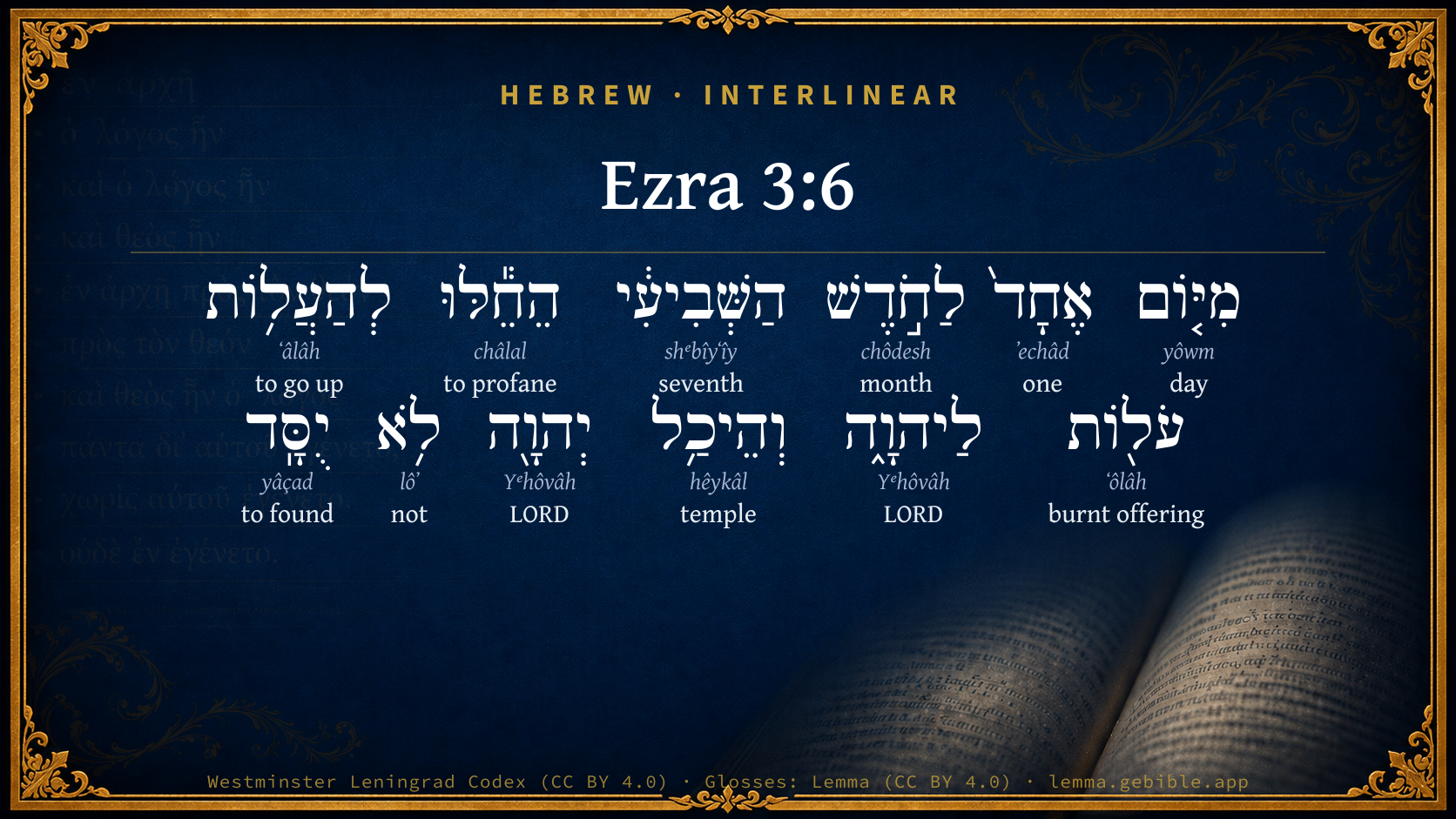
Hebrew (Westminster Leningrad Codex) Ezra 3:6 appears in the Hebrew Old Testament. The text above is from the Westminster Leningrad Codex. Each word links to its Strong’s number, a concise gloss, and parsing drawn from the Open Scriptures Hebrew Bible morphology. Click any word for its full Brown-Driver-Briggs (BDB) entry.
Download image
Cite this verse

Ezra 3:6 (World English Bible). Public Domain. Lemma interlinear Bible study tool, https://lemma.gebible.app/v/ezra/3/6.

Show BibTeX & RIS
BibTeX
RIS
English Translation
From the first day of the seventh month began they to offer burnt offerings to Yahweh: but the foundation of the temple of Yahweh was not yet laid.
World English Bible · Public Domain
Download a study sheet

One document with this verse’s original text, its word-by-word gloss line, the meaning frame, cross-references with their text, attributed commentary, and full source and license credits — printable, and it pastes into notes with its structure intact.

This verse Autodidact and up

Study sheet (.html) Plain text (.txt)

A passage Seminary Student

Up to 50 verses in one chapter. A passage sheet keeps up to 6 commentary sources and 12 cross-references per verse, in the order this page ranks them, and says so on the sheet whenever that leaves anything out. Ask for a single verse and you get the Autodidact verse sheet above.

Everything on this page stays free to read, with no account — the sheet is a download of what is already on screen, not access to it.

Want to remove ads? Support Godless Engineer
Compare translations 3

The same verse in 3 English versions, stacked beneath the original-language interlinear above. Click any original word for its lexicon entry.

Each is an independent rendering of the whole verse — the interlinear is not word-aligned to these translations.

Highlighted words mark where these versions differ — a whole-verse word diff, not a word-by-word alignment.

  • World English Bible Public Domain
    From the first day of the seventh month began they to offer burnt offerings to Yahweh: but the foundation of the temple of Yahweh was not yet laid.
  • King James Version Public Domain
    From the first day of the seventh month began they to offer burnt offerings unto the LORD. But the foundation of the temple of the LORD was not yet laid.
  • unfoldingWord Literal Text CC BY-SA 4.0
    From day one of the seventh month they began to offer up burnt up offerings to Yahweh, but the temple of Yahweh had not been founded.

unfoldingWord Literal Text — © unfoldingWord, licensed CC BY-SA 4.0. Word-aligned USFM3 via Door43 (git.door43.org/unfoldingWord/en_ult).

Versions to compare (up to 4)

3 of 4 selected

Show all 18 translations

Every available English version of this verse, each an independent rendering of the whole verse.

  • World English Bible Public Domain
    From the first day of the seventh month began they to offer burnt offerings to Yahweh: but the foundation of the temple of Yahweh was not yet laid.
  • Berean Standard Bible Public Domain
    On the first day of the seventh month, the Israelites began to offer burnt offerings to the LORD, although the foundation of the temple of the LORD had not been laid.
  • Majority Standard Bible Public Domain
    On the first day of the seventh month, the Israelites began to offer burnt offerings to the LORD, although the foundation of the temple of the LORD had not been laid.
  • King James Version Public Domain
    From the first day of the seventh month began they to offer burnt offerings unto the LORD. But the foundation of the temple of the LORD was not yet laid.
  • American Standard Version (1901) Public Domain
    From the first day of the seventh month began they to offer burnt-offerings unto Jehovah: but the foundation of the temple of Jehovah was not yet laid.
  • Revised Version (1885) Public Domain
    From the first day of the seventh month began they to offer burnt offerings unto the LORD: but the foundation of the temple of the LORD was not yet laid.
  • Geneva Bible (1599) Public Domain
    From the first day of the seuenth moneth began they to offer burnt offrings vnto the Lord: but the foundation of the Temple of the Lord was not layed.
  • Douay-Rheims (1899) Public Domain
    From the Brat day of the seventh month they began to offer holocausts to the Lord: but the temple of God was not yet founded.
  • Young's Literal Translation Public Domain
    From the first day of the seventh month they have begun to cause burnt-offerings to ascend to Jehovah, and the temple of Jehovah hath not been founded,
  • Literal Standard Version CC BY-SA 4.0
    From the first day of the seventh month they have begun to cause burnt-offerings to ascend to YHWH, and the temple of YHWH has not been founded,
  • Unlocked Literal Bible CC BY-SA 4.0
    They began to offer up burnt offerings to Yahweh on the first day of the seventh month, although the temple had not been founded.
  • unfoldingWord Literal Text CC BY-SA 4.0
    From day one of the seventh month they began to offer up burnt up offerings to Yahweh, but the temple of Yahweh had not been founded.
  • Darby Bible Public Domain
    From the first day of the seventh month they began to offer up burnt-offerings to Jehovah. But the foundation of the temple of Jehovah was not [yet] laid.
  • World Messianic Bible Public Domain
    From the first day of the seventh month, they began to offer burnt offerings to the LORD; but the foundation of the LORD’s temple was not yet laid.
  • Webster's Bible Public Domain
    From the first day of the seventh month they began to offer burnt-offerings to the LORD. But the foundation of the temple of the LORD was not yet laid.
  • Free Bible Version CC BY-SA 4.0
    So from the first day of the seventh month, the Israelites began to present burnt offerings to the Lord, even though the foundation of the Lord's Temple had not been laid.
  • Bible in Basic English Public Domain
    From the first day of the seventh month they made a start with the burned offerings, but the base of the Temple of the Lord had still not been put in its place.
  • JPS Tanakh (1917) Public Domain
    From the first day of the seventh month began they to offer burnt-offerings unto the LORD; but the foundation of the temple of the LORD was not yet laid.

Literal Standard Version (2020), Covenant Press — licensed CC BY-SA 4.0. Text via the HelloAO Bible API (eBible.org). Unlocked Literal Bible (unfoldingWord) — licensed CC BY-SA 4.0. Text via the HelloAO Bible API (eBible.org). unfoldingWord Literal Text — © unfoldingWord, licensed CC BY-SA 4.0. Word-aligned USFM3 via Door43 (git.door43.org/unfoldingWord/en_ult). Free Bible Version, Dr. Jonathan Gallagher — licensed CC BY-SA 4.0. Text via the HelloAO Bible API (eBible.org).

Word by word

More ways to search: Search by grammar → Find every occurrence → Compare this word →

Practice this passage: Drill this verse → Learn its vocabulary →

יֻסָּֽד
yâçad
H3245
“to found”
Verb, Pual, Perfect, 3rd Person, Masculine, Singular
Part of Speech
Verb
Stem
Pual
Form
Perfect
Person
3rd Person
Gender
Masculine
Number
Singular
Full BDB Definition

Origin: a primitive root

TWOT: 875

to found, fix, establish, lay foundation - (Qal) to found, establish, begin - (Niphal) - to fix or seat themselves close together, sit in conclave - to be founded - (Piel) - to found - to establish, appoint, ordain - (Pual) to be founded, be laid - (Hophal) to be founded
  1. מִיּ֤וֹם yôwm H3117 “from · day” Preposition + Noun, Common, Masculine, Singular, Absolute
  2. אֶחָד֙ ʼechâd H259 “one” Adjective, Cardinal number, Masculine, Singular, Absolute
  3. לַחֹ֣דֶשׁ chôdesh H2320 “to/for the · month” Preposition, Determined + Noun, Common, Masculine, Singular, Absolute
  4. הַשְּׁבִיעִ֔י shᵉbîyʻîy H7637 “the · seventh” Particle, Definite Article + Adjective, Ordinal number, Masculine, Singular, Absolute
  5. הֵחֵ֕לּוּ châlal H2490 “to profane” Verb, Hiphil, Perfect, 3rd Person, Common, Plural
  6. לְהַעֲל֥וֹת ʻâlâh H5927 “to go up” Preposition + Verb, Hiphil, Infinitive Construct
  7. עֹל֖וֹת ʻôlâh H5930 “burnt offerings” Noun, Common, Feminine, Plural, Absolute
  8. לַיהוָ֑ה Yᵉhôvâh H3068 “to/for · LORD” Preposition + Noun, Proper
  9. וְהֵיכַ֥ל hêykâl H1964 “and · temple of” Conjunction + Noun, Common, Masculine, Singular, Construct
  10. יְהוָ֖ה Yᵉhôvâh H3068 “LORD” Noun, Proper
  11. לֹ֥א lôʼ H3808 “not” Particle, Negative

About this verse

These counts appear in no published source. They are computed here, from the morphology-tagged text and Lemma’s own curated glosses. What Lemma adds →

12
words
11
distinct lemmas
Historical
section

Shared distinctive vocabulary

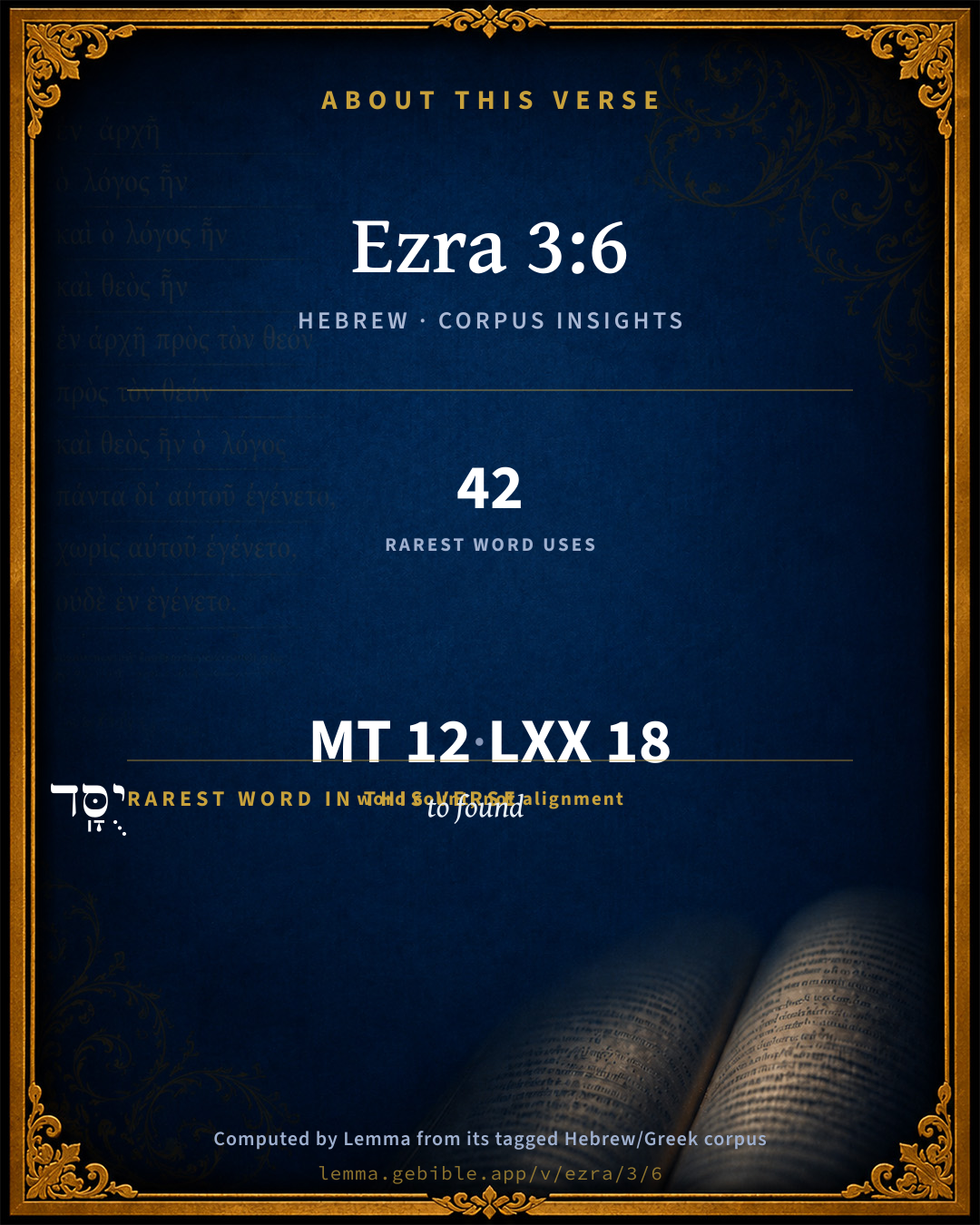
יֻסָּֽד to found H3245 occurs in 41 verses of the Hebrew Bible. Also found in:

Grammatical profile

  • 3 verbs
  • 6 nouns
  • 2 adjectives
  • 1 particle

Verb forms

  • הֵחֵ֕לּוּ Hiphil · Perfect
  • לְהַעֲל֥וֹת Hiphil · Infinitive Construct
  • יֻסָּֽד Pual · Perfect

Repetition

A word recurs within this verse — often emphatic in Hebrew:

  • לַיהוָ֑ה LORD H3068 ×2

Hebrew & Septuagint length

In English translation the verse runs 28 words from the Hebrew and 30 from the Septuagint (LXX English) — closely comparable.

A rough comparison of the two English renderings, which tokenize alike — not a word-level alignment.

Word counts can differ between the Hebrew and the Greek without any difference in meaning — e.g. the Hebrew direct-object marker אֵת has no separate Greek word, and Greek often adds the article ὁ.

In the original languages it is 12 Hebrew tokens and 18 Greek tokens — but the two are counted differently (Hebrew bundles its prefixes and suffixes into one token; the Greek is in lemma form), so that isn’t a like-for-like length.

Hebrew and Greek witnesses Masoretic Hebrew ↔ Greek Septuagint

The same verse in the two great witnesses to the Old Testament, shown verse-for-verse.

These are two independent witnesses, not word-aligned to each other, and the Septuagint is shown in lemma (dictionary) form.

Hebrew Ezra 3:6 Masoretic · Westminster Leningrad Codex

מִיּ֤וֹם אֶחָד֙ לַחֹ֣דֶשׁ הַשְּׁבִיעִ֔י הֵחֵ֕לּוּ לְהַעֲל֥וֹת עֹל֖וֹת לַיהוָ֑ה וְהֵיכַ֥ל יְהוָ֖ה לֹ֥א יֻסָּֽד

From the first day of the seventh month began they to offer burnt offerings to Yahweh: but the foundation of the temple of Yahweh was not yet laid.

World English Bible · Public Domain

Greek LXX Ezra 3:6 Septuagint · lemma form

ἐν ἡμέρα εἷς ὁ μήν ὁ ἕβδομος ἄρχω ἀναφέρω ὁλοκαύτωσις ὁ κύριος καί ὁ οἶκος κύριος οὐ θεμελιόω

On the first day of the seventh month they began to offer whole burnt offerings to the Lord: but the foundation of the house of the Lord was not laid.

LXX2012 (modern English Septuagint) · Public Domain

In the Septuagint this is one book — Esdras B (2 Esdras): Ezra is chapters 1–10, Nehemiah 11–23.

Hebrew: Westminster Leningrad Codex (CC BY 4.0). Greek: Septuagint (public domain); English from LXX2012 (modern English Septuagint) (Public Domain). How the Septuagint differs from the Hebrew →

Commentary

Notes on Ezra 3:6 from classic Christian and Jewish commentators (each source and its license shown beneath its notes). The classic Christian expositions comment on the surrounding passage and are grouped to its opening verse, so a note may address several verses; the Jewish commentaries on the Tanakh (Rashi and others) are per-verse, so they appear only where the commentator wrote on this verse.

Lemma curates 59 commentaries, every one of them public domain or Creative Commons licensed, each selected and text-cleaned for this edition rather than reprinted as found. About our sources →

Trapp's Complete Commentary

John Trapp

Ezr 3:6 From the first day of the seventh month began they to offer burnt offerings unto the LORD. But the foundation of the temple of the LORD was not [yet] laid.

Ver. 6. From the first day of the seventh month] Which was the feast of blowing of trumpets, signifying the just man’s joyfulness, and serving to put life and spirit into them.

Began they to offer] And so held on: for this month had as many feasts in it as were celebrated in all the year besides: so, as the Sabbath was the queen of days ( Regina dierum), so was this of months. {See Trapp on "Ezr 3:1"}

But the foundation of the temple] Heb. of the kingly palace, aula basilica, used here and elsewhere for the place where God’s honour dwelleth. God is a great King, Mal 1:14, and requires to be served like himself.

Was not yet laid] Heb. Was not yet founded. Nevertheless they would be worshipping God as they could at an altar till they had a temple. All the power of Persia could not keep God and Daniel asunder, Dan 6:10; the trade of godliness never standeth still. Demosthenes (Contra Arist.) could say that a heart beautified with piety, justice, and modesty is the best temple, and to God most acceptable.

John Trapp, A Commentary or Exposition upon All the Books of the Old and New Testament (1647–1656) — public domain. Text from a community e-Sword module.

The Biblical Illustrator

Joseph S. Exell

Ezr_3:6-13

From the first day of the seventh month began they to offer burnt-offerings unto the Lord.

The full establishment of religious services precedes She building of the temple

A weighty truth is enshrined in this apparently incongruous fact. The worship itself is felt to be more important than the house in which it is to be celebrated (Joh_4:21-24). How vain is it, then, to treat the erection of churches as though it were a revival of religion! As surely as the empty seashell can never secrete a living organism to inherit it, a mere building--whether it be the most gorgeous cathedral or the plainest village meeting-house--will never induce a living spirit of worship to dwell in its cold desolation. Every true revival of religion begins in the spiritual sphere. (Walter F. Adeney, M. A.)

They gave money also unto the carpenters.

The preparations for rebuilding the temple

I. The great work yet to be accomplished. This illustrates--

1. The incompleteness of human joys.

2. The incompleteness of human works.

The altar was built, but the temple was not begun. The work of the earnest man is never accomplished. Even when death approaches, most men have much which they desire to accomplish. This incompleteness of our human works is also ordered wisely and well. It tends to prevent stagnation; to rouse to earnest activities, etc.

3. The obligation of the Church of God. The Jews at Jerusalem felt themselves bound not to rest content with the joys and blessings of the altar, but to proceed to the more arduous task of rebuilding the temple.

II. The prompt preparations for the accomplishment of this work. Two points claim attention--

1. The variety of service and the unity of design.

2. The co-operation of Jews and Gentiles.

Conclusion--

1. Are we as living stones built up in the spiritual temple of God? (1Pe_2:4-6).

2. Are we also assisting to build this glorious temple? (1Co_3:10-15). (William Jones.)

The building of the temple

I. That difficulties ought not to discourage us in the Lords work. Paucity of numbers and feebleness of resources. Enemies.

II. The readiness of the people to give of their means unto the Lord (Ezr_2:68-69). Their first care was the house of God. Without homes of their own, their cities in ruins, with a thousand demands pressing upon them, they nevertheless provided first of all for the worship of the temple. How needful the lesson! Gods house before our own. God first and afterward self. This work first, and then our own.

1. They offered willingly. It was not the tithe which they were required by law to give. It was a free-will offering to God, and hence all the more acceptable (2Co_9:7).

2. They gave according to their ability. Proportionate giving as God has prospered us is one of the most pressing needs of the Church to-day. It is a duty as plainly enjoined as prayer and praise (Deu_16:17; 1Co_16:2).

III. The people were ready to work as well, as give. The Church needs willing workers even more than generous givers. Hearts and hands are always worth more than gold and silver.

1. They worked unitedly. The people laboured as one (margin). Their counsels were not divided. There were no jealousies, no personal ambitions to hinder the progress of the undertaking.

2. The work was systematically prosecuted. Zeal and energy were displayed, but without making them substitutes for intelligence and adaptation. One of the great needs of Gods people is appreciation of the advantages of systematic work.

IV. Thankful joy in the Lords service. The ancient men wept with a loud voice as they saw the foundation of the new house laid. Yet, after all, their weeping may have had nothing in it of the spirit of murmuring. Tears are ofttimes expressive of the deepest joy.

Theres not a string attuned to mirth

But has its chord in melancholy.

The joy that is touched with pain is the noblest of joys. The sweetest music is written in the minor key. Possibly the noise of their weeping was more grateful to God than the shouts of their younger companions. (Rufus S. Green, D. D.)

The second temple

I. The building of this temple was a visible and abiding testimony to mans firm faith in the existence and power of the god of heaven. The mystery of holy shrines, says Kinglake, lies deep in human nature. However the more spiritual minds may be able to rise and soar, the common man, during his mortal career, is tethered to the globe that is his appointed dwelling-place; and the more his affections are pure and holy, the more they seem to blend with some sacred spot, that belongs to the outward and visible world? Temples tell us of one who is invisible. As Jacob set up an altar in the place where God talked with him and called the name of the place Bethel, so always men have erected memorial stones to commemorate their faith in God.

II. The temples and altars which man builds dignify a desire on his part for nearer and more constant communion with God. From the first God had revealed Himself as One who was ready to meet with His people, to draw aside the veil, at least in part, and commune with them from off the holy place. Outside the walls of Eden He appeared above the altar of Abel. Whenever, in later times, the patriarchs set up an altar and called on the name of the Lord, they expected that He would come and sanctify the spot by His presence. They were not disappointed. Enoch walked with Him; Noah built an ark under His direction; Abraham saw His day; to Jacob He appeared again and again; He talked with Moses and showed His glory to Isaiah; Elijahs altar was touched with fire; to the whole people He showed a pillar of cloud and flame, and commanded them, saying, Let them make Me a sanctuary, that I may dwell among them, and when it was finished, the shekinah appeared, God dwelt in the Holy of holies, and from off the fiery seat talked with His prophets and priests. Although under the Christian dispensation the idea of communion with God is ennobled, and the fellowship made more exalted and spiritual, so that Jesus Christ is now our true sanctuary and passover, still the old conception is not altogether abandoned. While the veil of the temple is rent in twain and every common bush is aflame with God, still there is a special blessing for those who meet together in the sanctuary. The place of worship is correctly spoken of as the meeting house, the meeting-house where man comes to meet his God.

III. The conduct of these temple buildings indicates determination and self-sacrifice. (Sermons by Monday Club.)

The Biblical Illustrator, edited by Joseph S. Exell (c. 1880s–1900s) — public domain. Text from a community e-Sword module.

Joseph Benson's Commentary

Ezr 3:6. To offer burnt-offerings — And the other sacrifices which were to be offered with them upon that first day of the seventh month, which was the feast of trumpets. Burnt-offerings are often put for all sacrifices, and the meaning of these two verses is, that the holy rites of sacrificing were restored, and continued ever after, in their several seasons, on the new moons, and other festival solemnities.

Joseph Benson's Commentary on the Old and New Testaments (1811–1818) — public domain. Text from a community e-Sword module.

Ellicott's Commentary for English Readers

(6) From the first day.—The notes of time demand notice. The altar was raised before the month came; from the first until the fifteenth, when the Feast of Tabernacles began, the daily sacrifice was offered. The whole verse recapitulates, and its latter part is the transition to what follows.

A Bible Commentary for English Readers, edited by Charles John Ellicott (1878–1897) — public domain. Text from a community e-Sword module.

The Cambridge Bible for Schools and Colleges

gen. ed. J. J. S. Perowne

6. From the first day of the seventh month &c.] This statement taken in conjunction with Ezr_3:5 (‘and afterward’ &c.) can only mean, that the Jews began to offer burnt offerings on their altar on ‘the first day of the month’, when the altar was set up, but that the regular offering of the daily sacrifice was not begun till after the Feast of Tabernacles (15th to 22nd).

But the foundation &c.] R.V. ‘but’ &c.: no full-stop. The explanatory clause is added. The burnt offerings were regularly made on the altar, although there was no Temple building, nor Temple worship. Such a thing would have been almost incredible to the Jew of later centuries.

The Cambridge Bible for Schools and Colleges (gen. ed. J. J. S. Perowne; Cambridge University Press, 1878–1918) — public domain. Text from a community e-Sword module.

John Gill's Exposition

From the first of the seventh month began they to offer burnt offerings unto the Lord,.... And which day was not only a new moon, but a grand festival, the feast of blowing of trumpets, Lev 23:24, and no doubt but they observed the tenth day of this month, with all the rites of it, which was the day of atonement, Lev 23:27,

but the foundation of the temple of the Lord was not yet laid; they began first with sacrifices, that having thereby given thanks to God for their return to their own land, and for all the benefits they enjoyed, and made atonement for their sins in a typical way, they might be the more prepared and fit for the work of building the temple; or, "though the foundation" of it was not laid (z), yet they offered the above sacrifices.

(z) Etsi, Michaelis.

John Gill's Exposition of the Whole Bible (1746–1763) — public domain (CC PDM 1.0). Text via the HelloAO Bible API.

Matthew Poole's English Annotations

To offer burnt-offerings, and the other sacrifices which were to be offered with them upon that day, being the feast of trumpets, Num 29:1, &c. Burnt-offerings are oft put for all sacrifices, as hath been observed once and again.

The foundation of the temple was not yet laid; though it is probable they had done something towards the removing of the rubbish, and preparing the way for it.

Matthew Poole's English Annotations on the Holy Bible (1683–1685) — public domain. Text from a community e-Sword/MySword module.

John Wesley's Explanatory Notes

Burnt-offerings - And the other sacrifices which were to be offered with them upon that day, being the feast of trumpets. Burnt-offerings are often put for all sacrifices.

John Wesley, Explanatory Notes Upon the Whole Bible (1754–1765) — public domain. Text via the GEBible commentary corpus.

Scofield Reference Notes

C. I. Scofield

seventh month

i.e. October.

The Scofield Reference Bible (1917 edition), notes by C. I. Scofield — public domain. Text from a community e-Sword module.

unfoldingWord translationNotes

Door43 World Missions Community

the first day of the seventh month

This is the seventh month of the Hebrew calendar. The first day is near the middle of September on Western calendars. (See: Hebrew Months and Ordinal Numbers)

the temple had not been founded

The Jews began the ceremonies of worship even before they started building the temple. AT: "they had not yet laid the foundation for the temple" (See: Active or Passive)

as authorized for them by Cyrus, king of Persia

The letters sent by Cyrus gave the Jews permission to buy materials and build the temple.

translationWords

day

temple

Sidon

Tyre

cedar

Lebanon

Joppa

Cyrus

king

Persia

unfoldingWord translationNotes — © Distant Shores Media and the Door43 World Missions Community, licensed CC BY-SA 4.0. Source: git.door43.org/Door43/en_tn.

Lesson kit

Teaching starters — assembled from the data on this page, not authored interpretation. Every prompt links to the verse data it draws on. Edit before teaching.

Ezra, in the Historical, opens this verse with 12 words (11 distinct Hebrew lemmas). Its most distinctive word is yâçad (“to found”). A historical commentator’s framing appears above. Read the whole chapter for the surrounding context.

Discussion questions

  1. The word yâçad carries the sense “to found.” How does it shape the verse?
  2. How does Exodus 9:18, which shares the word «to found», read alongside this verse?
  3. What does the repetition of “LORD” (2× in this one verse) do in this verse?
  4. These translations render this verse differently. What is at stake in choosing one wording over another?
  5. «הֵחֵ֕לּוּ» is a Hiphil Perfect verb. How does that grammatical form shape the action described?
  6. Compare how Trapp's Complete Commentary and The Biblical Illustrator read this verse. Where do they agree or differ?

Things to notice

Reading settings

Reading text

Shown beneath each verse's original-language words.

Old Testament
Old Testament edition

Read the OT as the Masoretic Hebrew (MT) or the Greek Septuagint (LXX).

English shown for the Greek Septuagint (in the Hebrew ↔ Greek comparison).

Comparing translations? Open the Compare panel on any verse page to stack up to four side by side.