
Ezekiel 1:2

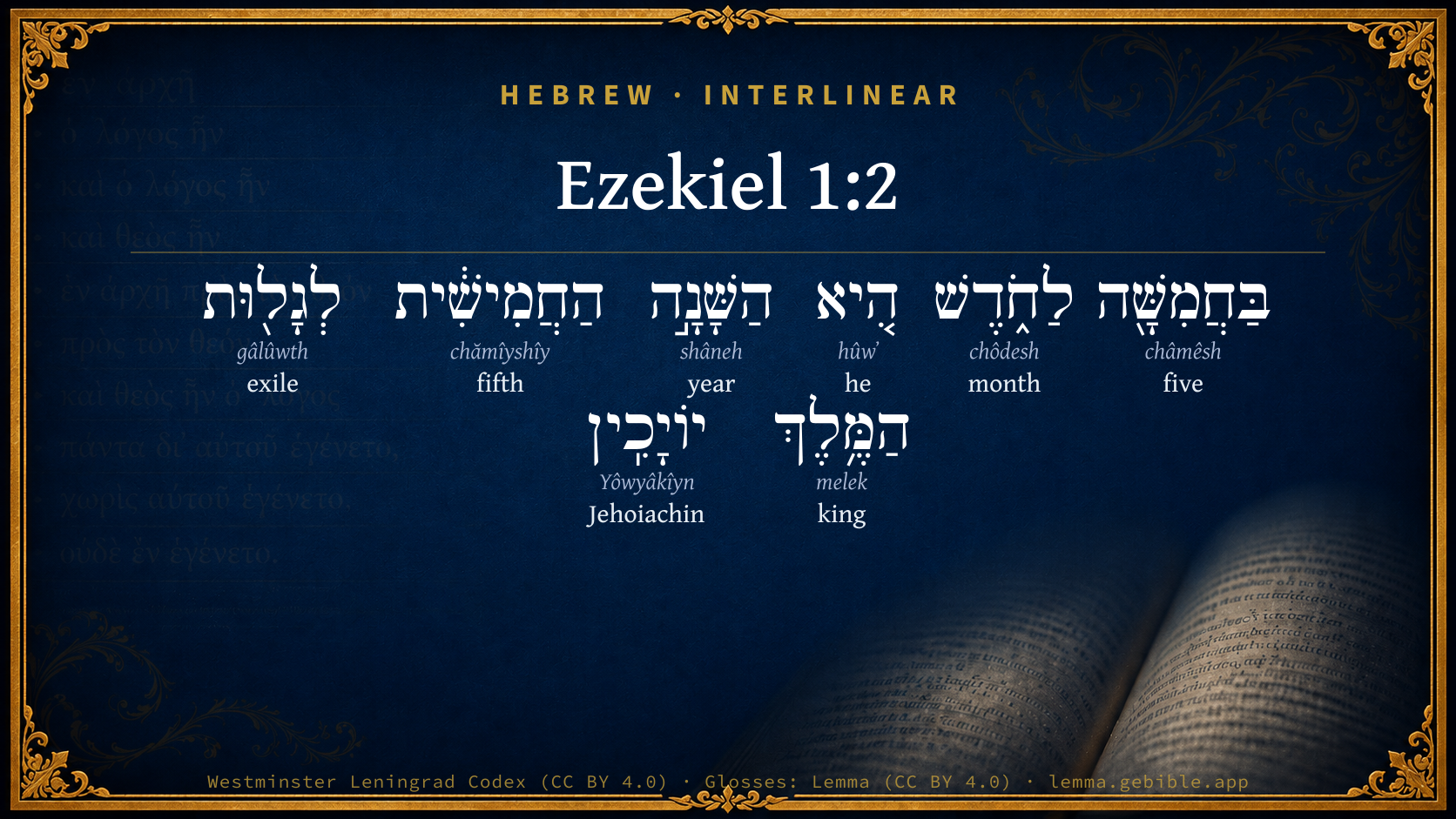
Hebrew (Westminster Leningrad Codex) Ezekiel 1:2 appears in the Hebrew Old Testament. The text above is from the Westminster Leningrad Codex. Each word links to its Strong’s number, a concise gloss, and parsing drawn from the Open Scriptures Hebrew Bible morphology. Click any word for its full Brown-Driver-Briggs (BDB) entry.
Download image
Cite this verse

Ezekiel 1:2 (World English Bible). Public Domain. Lemma interlinear Bible study tool, https://lemma.gebible.app/v/ezekiel/1/2.

Show BibTeX & RIS
BibTeX
RIS
English Translation
In the fifth [day] of the month, which was the fifth year of king Jehoiachin's captivity,
World English Bible · Public Domain
Highlights
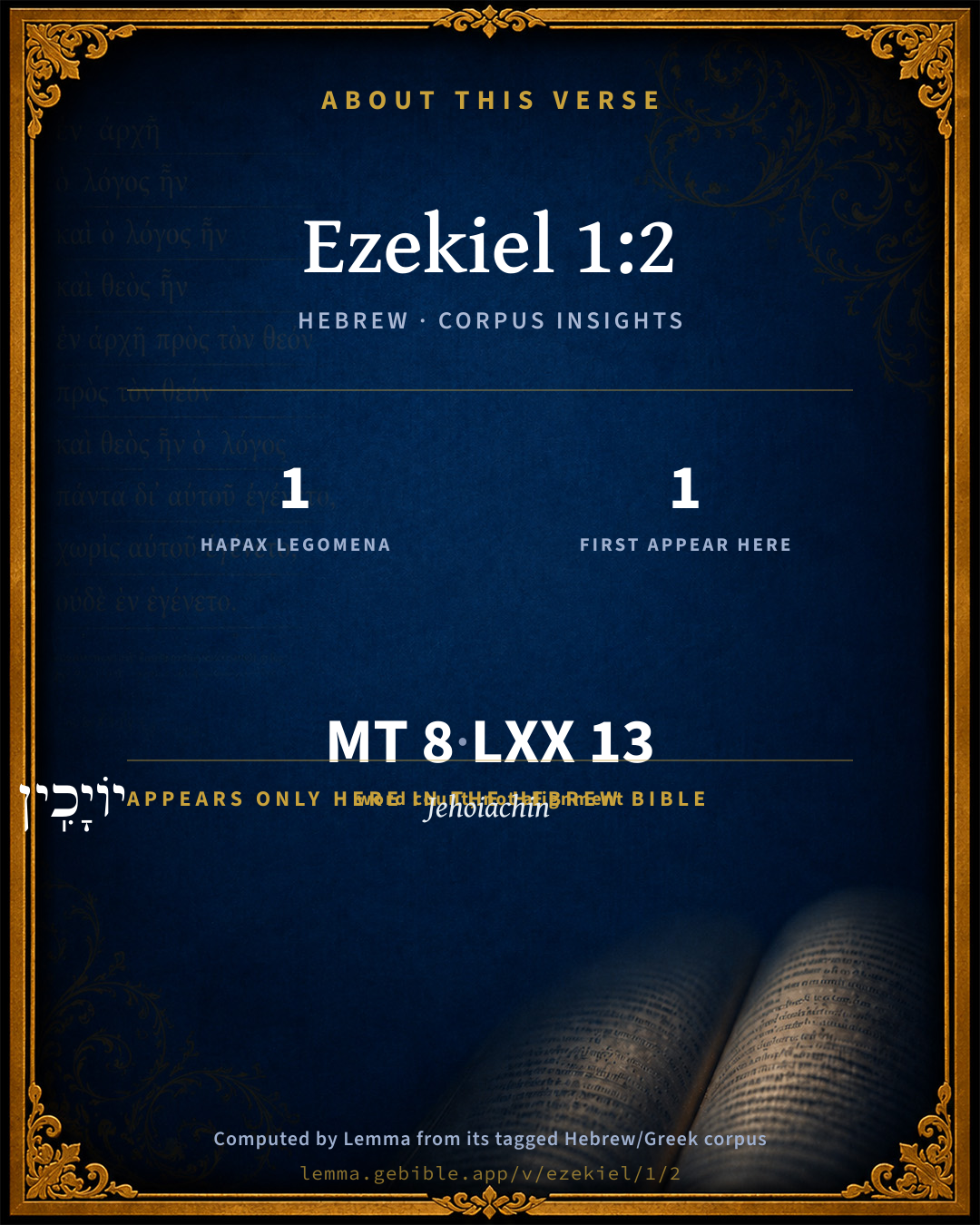
  • 1 hapax legomenon — only here in the Hebrew Bible
  • 1 first appearance in the Hebrew Bible
Full analysis ↓
Download a study sheet

One document with this verse’s original text, its word-by-word gloss line, the meaning frame, cross-references with their text, attributed commentary, and full source and license credits — printable, and it pastes into notes with its structure intact.

This verse Autodidact and up

Study sheet (.html) Plain text (.txt)

A passage Seminary Student

Up to 50 verses in one chapter. A passage sheet keeps up to 6 commentary sources and 12 cross-references per verse, in the order this page ranks them, and says so on the sheet whenever that leaves anything out. Ask for a single verse and you get the Autodidact verse sheet above.

Everything on this page stays free to read, with no account — the sheet is a download of what is already on screen, not access to it.

Want to remove ads? Support Godless Engineer
Compare translations 3

The same verse in 3 English versions, stacked beneath the original-language interlinear above. Click any original word for its lexicon entry.

Each is an independent rendering of the whole verse — the interlinear is not word-aligned to these translations.

Highlighted words mark where these versions differ — a whole-verse word diff, not a word-by-word alignment.

  • World English Bible Public Domain
    In the fifth [day] of the month, which was the fifth year of king Jehoiachin's captivity,
  • King James Version Public Domain
    In the fifth day of the month, which was the fifth year of king Jehoiachin's captivity,
  • unfoldingWord Literal Text CC BY-SA 4.0
    On the fifth day of that month—it was the fifth year of the exile of King Jehoiachin—

unfoldingWord Literal Text — © unfoldingWord, licensed CC BY-SA 4.0. Word-aligned USFM3 via Door43 (git.door43.org/unfoldingWord/en_ult).

Versions to compare (up to 4)

3 of 4 selected

Show all 18 translations

Every available English version of this verse, each an independent rendering of the whole verse.

  • World English Bible Public Domain
    In the fifth [day] of the month, which was the fifth year of king Jehoiachin's captivity,
  • Berean Standard Bible Public Domain
    On the fifth day of the month—it was the fifth year of the exile of King Jehoiachin—
  • Majority Standard Bible Public Domain
    On the fifth day of the month—it was the fifth year of the exile of King Jehoiachin—
  • King James Version Public Domain
    In the fifth day of the month, which was the fifth year of king Jehoiachin's captivity,
  • American Standard Version (1901) Public Domain
    In the fifth `day' of the month, which was the fifth year of king Jehoiachin's captivity,
  • Revised Version (1885) Public Domain
    In the fifth day of the month, which was the fifth year of king Jehoiachin’s captivity,
  • Geneva Bible (1599) Public Domain
    In the fift day of the moneth (which was the fift yere of King Ioiachins captiuitie)
  • Douay-Rheims (1899) Public Domain
    On the fifth day of the month, the same was the fifth year of the captivity of king Joachin,
  • Young's Literal Translation Public Domain
    In the fifth of the month -- it is the fifth year of the removal of the king Jehoiachin --
  • Literal Standard Version CC BY-SA 4.0
    In the fifth of the month—it is the fifth year of the expulsion of King Jehoiachin—
  • Unlocked Literal Bible CC BY-SA 4.0
    On the fifth day of that month—it was the fifth year of the exile of King Jehoiachin—
  • unfoldingWord Literal Text CC BY-SA 4.0
    On the fifth day of that month—it was the fifth year of the exile of King Jehoiachin—
  • Darby Bible Public Domain
    On the fifth of the month, (it was the fifth year of king Jehoiachin's captivity,)
  • World Messianic Bible Public Domain
    In the fifth of the month, which was the fifth year of King Jehoiachin’s captivity,
  • Webster's Bible Public Domain
    In the fifth day of the month, which was the fifth year of king Jehoiachin's captivity,
  • Free Bible Version CC BY-SA 4.0
    (On the fifth day of the month of the fifth year of King Jehoiachin's exile,
  • Bible in Basic English Public Domain
    On the fifth day of the month, in the fifth year after King Jehoiachin had been made a prisoner,
  • JPS Tanakh (1917) Public Domain
    In the fifth day of the month, which was the fifth year of king Jehoiachin's captivity,

Literal Standard Version (2020), Covenant Press — licensed CC BY-SA 4.0. Text via the HelloAO Bible API (eBible.org). Unlocked Literal Bible (unfoldingWord) — licensed CC BY-SA 4.0. Text via the HelloAO Bible API (eBible.org). unfoldingWord Literal Text — © unfoldingWord, licensed CC BY-SA 4.0. Word-aligned USFM3 via Door43 (git.door43.org/unfoldingWord/en_ult). Free Bible Version, Dr. Jonathan Gallagher — licensed CC BY-SA 4.0. Text via the HelloAO Bible API (eBible.org).

Word by word

More ways to search: Search by grammar → Find every occurrence → Compare this word →

Practice this passage: Drill this verse → Learn its vocabulary →

יוֹיָכִֽין
Yôwyâkîyn
H3112
“Jehoiachin”
Noun, Proper
Part of Speech
Noun
Type
Proper
Full BDB Definition

Origin: a form of H3078

TWOT: None

Jehoiachin = "Jehovah establishes" - king of Judah, son of Jehoiakim, and the next to last king of Judah before the Babylonian captivity; kingship lasted for 3 months and 10 days before he surrendered to Nebuchadnezzar who took him to Babylon and imprisoned him for 36 years when he was finally released
  1. בַּחֲמִשָּׁ֖ה châmêsh H2568 “in/at the · five” Preposition, Determined + Adjective, Cardinal number, Masculine, Singular, Absolute
  2. לַחֹ֑דֶשׁ chôdesh H2320 “to/for the · month” Preposition, Determined + Noun, Common, Masculine, Singular, Absolute
  3. הִ֚יא hûwʼ H1931 “he” Pronoun, Personal, 3rd Person, Feminine, Singular
  4. הַשָּׁנָ֣ה shâneh H8141 “the · year” Particle, Definite Article + Noun, Common, Feminine, Singular, Absolute
  5. הַחֲמִישִׁ֔ית chămîyshîy H2549 “the · fifth” Particle, Definite Article + Adjective, Ordinal number, Feminine, Singular, Absolute
  6. לְגָל֖וּת gâlûwth H1546 “to/for · exile of” Preposition + Noun, Common, Feminine, Singular, Construct
  7. הַמֶּ֥לֶךְ melek H4428 “the · king” Particle, Definite Article + Noun, Common, Masculine, Singular, Absolute

About this verse

These counts appear in no published source. They are computed here, from the morphology-tagged text and Lemma’s own curated glosses. What Lemma adds →

8
words
8
distinct lemmas
Prophets
section

Notable vocabulary

1 hapax legomenon — a word that appears only here in the entire Hebrew Bible:

  • יוֹיָכִֽין Jehoiachin H3112

First appearance in Scripture

This word makes its first canonical appearance in the Hebrew Bible here:

  • יוֹיָכִֽין Jehoiachin H3112

Shared distinctive vocabulary

לְגָל֖וּת exile H1546 occurs in 14 verses of the Hebrew Bible. Also found in:

Grammatical profile

  • 5 nouns
  • 2 adjectives
  • 1 pronoun

Hebrew & Septuagint length

In English translation the verse runs 16 words from the Hebrew and 18 from the Septuagint (LXX English) — closely comparable.

A rough comparison of the two English renderings, which tokenize alike — not a word-level alignment.

Word counts can differ between the Hebrew and the Greek without any difference in meaning — e.g. the Hebrew direct-object marker אֵת has no separate Greek word, and Greek often adds the article ὁ.

In the original languages it is 8 Hebrew tokens and 13 Greek tokens — but the two are counted differently (Hebrew bundles its prefixes and suffixes into one token; the Greek is in lemma form), so that isn’t a like-for-like length.

Cross-references

7

Topical passages linked to Ezekiel 1:2 in the Treasury of Scripture Knowledge — connected by theme and wording, ordered by reader-vote popularity; previews shown in the World English Bible.

  • 2 Kings 24:12–15 and Jehoiachin the king of Judah went out to the king of Babylon, he, and his mother, and his servants, and his princes, and his officers: and the king of Babylon took him in the eighth year of his reign.
  • Ezekiel 8:1 It happened in the sixth year, in the sixth [month], in the fifth [day] of the month, as I sat in my house, and the elders of Judah sat before me, that the hand of the Lord Yahweh fell there on me.
  • Ezekiel 20:1 It happened in the seventh year, in the fifth [month], the tenth [day] of the month, that certain of the elders of Israel came to inquire of Yahweh, and sat before me.
  • Ezekiel 40:1 In the five and twentieth year of our captivity, in the beginning of the year, in the tenth [day] of the month, in the fourteenth year after that the city was struck, in the same day, the hand of Yahweh was on me, and he brought me there.
  • Ezekiel 29:17 It came to pass in the seven and twentieth year, in the first [month], in the first [day] of the month, the word of Yahweh came to me, saying,
  • Ezekiel 29:1 In the tenth year, in the tenth [month], in the twelfth [day] of the month, the word of Yahweh came to me, saying,
  • Ezekiel 31:1 It happened in the eleventh year, in the third [month], in the first [day] of the month, that the word of Yahweh came to me, saying,

Cross-references courtesy of OpenBible.info (CC BY 4.0).

Hebrew and Greek witnesses Masoretic Hebrew ↔ Greek Septuagint

The same verse in the two great witnesses to the Old Testament, shown verse-for-verse.

These are two independent witnesses, not word-aligned to each other, and the Septuagint is shown in lemma (dictionary) form.

Hebrew Ezekiel 1:2 Masoretic · Westminster Leningrad Codex

בַּחֲמִשָּׁ֖ה לַחֹ֑דֶשׁ הִ֚יא הַשָּׁנָ֣ה הַחֲמִישִׁ֔ית לְגָל֖וּת הַמֶּ֥לֶךְ יוֹיָכִֽין

In the fifth [day] of the month, which was the fifth year of king Jehoiachin's captivity,

World English Bible · Public Domain

Greek LXX Ezekiel 1:2 Septuagint · lemma form

πέμπτος ὁ μήν οὗτος ὁ ἔτος ὁ πέμπτος ὁ αἰχμαλωσία ὁ βασιλεύς ιωακιμ

On the fifth day of the month; this was the fifth year of the captivity of king Joakim.

LXX2012 (modern English Septuagint) · Public Domain

Hebrew: Westminster Leningrad Codex (CC BY 4.0). Greek: Septuagint (public domain); English from LXX2012 (modern English Septuagint) (Public Domain). How the Septuagint differs from the Hebrew →

Targum (Aramaic paraphrase)

1

The Targum is the ancient Jewish Aramaic paraphrase of the Hebrew Scriptures — an interpretive translation, not the Hebrew text itself. Onkelos (literal) and Pseudo-Jonathan (expansive) render the Torah, and Jonathan the Prophets. Coverage is partial: where no permissively-licensed English translation exists for a verse, only the Aramaic is shown. This is verse-level text, not a word-by-word alignment to the Hebrew.

  1. Targum Jonathan Prophets (Joshua–Malachi)
    בְּחַמְשָׁא לְיַרְחָא הִיא שַׁתָּא חֲמֵשְׁתָּא לְגָלוּת מַלְכָּא יוֹיָכִין:

    (no public-domain English translation for this verse)

    Targum Jonathan — Aramaic: “Mikraot Gedolot” (public domain). English: “Sefaria Community Translation” (CC0 1.0 (public-domain dedication)); “London "Chaldee Paraphrase," 1871” (public domain). Text via Sefaria.

Commentary

Notes on Ezekiel 1:2 from classic Christian and Jewish commentators (each source and its license shown beneath its notes). The classic Christian expositions comment on the surrounding passage and are grouped to its opening verse, so a note may address several verses; the Jewish commentaries on the Tanakh (Rashi and others) are per-verse, so they appear only where the commentator wrote on this verse.

Lemma curates 59 commentaries, every one of them public domain or Creative Commons licensed, each selected and text-cleaned for this edition rather than reprinted as found. About our sources →

Trapp's Complete Commentary

John Trapp

Eze 1:2 In the fifth [day] of the month, which [was] the fifth year of king Jehoiachin’s captivity,

Ver. 2. In the fifth day.] The Sabbath day, likely, that queen of days, as the Jews call it. See on Eze 1:1.

Which was the fifth year of Jehoiakim’s captivity.] With whom Ezekiel and other precious persons, called by Jeremiah good figs, were carried captive. {Eze 40:1}

John Trapp, A Commentary or Exposition upon All the Books of the Old and New Testament (1647–1656) — public domain. Text from a community e-Sword module.

Joseph Benson's Commentary

Eze 1:2-3. In the fifth year of King Jehoiachin’s captivity — This was of course the fifth year of Zedekiah, who succeeded Jehoiachin. And as the city and temple were destroyed in the eleventh year of Zedekiah, (2Ki 25:2,) it follows that this vision appeared to Ezekiel six years before that event. The Hebrew writers, it must be observed, use several computations of the beginning of the Babylonish captivity: see the note on Jer 25:11. That under Jehoiachin, wherein Ezekiel was made a captive, is the computation he always follows in the succeeding parts of his prophecy. The word of the Lord — This expression signifies any sort of revelation, whether by a vision, such as is related in the following verses, or by a voice, as Eze 2:3; came expressly — Hebrew, היה היה, being was, or, in coming came, that is, came assuredly; unto Ezekiel — It came with such clearness and conviction that he could neither doubt of its divine authority, mistake its import, nor question his being appointed to the prophetical office; the priest — Being of the family of Aaron, he was a priest by birth, and was now made a prophet by an extraordinary call. In the land of the Chaldeans — In the worst places God can raise up instruments for the service of his church. And the hand of the Lord was there upon him — He felt sensible impressions of a divine power closing his senses to external objects, opening his eyes to see the visions, opening his ears to hear the voice, and his heart to receive both. When the hand of the Lord goes along with his word, then it becomes effectual.

Joseph Benson's Commentary on the Old and New Testaments (1811–1818) — public domain. Text from a community e-Sword module.

Tyndale Open Study Notes

Tyndale Open Resources

1:2 This happened during the fifth year of King Jehoiachin’s captivity: The word of the Lord first came to Ezekiel in 593 BC, while Judah was still a semi-independent state (see Ezekiel Book Introduction, “Setting”). Judah had been subjugated by the Babylonians in 597 BC, and King Jehoiachin had been carried into exile in Babylon at that time. Jehoiachin’s uncle, Zedekiah, ruled Judah as a Babylonian vassal (597–586 BC). Ezekiel dates his prophecy with reference to Jehoiachin’s captivity rather than to Zedekiah’s reign because he seems to have viewed Zedekiah as a stand-in for the lawful king, Jehoiachin. Zedekiah later rebelled against Nebuchadnezzar (2 Kgs 24:20), who besieged the city of Jerusalem (588 BC), destroyed it, and burned the Temple (586 BC).

Tyndale Open Study Notes — © Tyndale Open Resources, licensed CC BY-SA 4.0. Text via the HelloAO Bible API.

Jamieson, Fausset & Brown

Robert Jamieson, A. R. Fausset & David Brown

Jehoiachin's captivity--In the third or fourth year of Jehoiakim, father of Jehoiachin, the first carrying away of Jewish captives to Babylon took place, and among them was Daniel. The second was under Jehoiachin, when Ezekiel was carried away. The third and final one was at the taking of Jerusalem under Zedekiah.

Jamieson, Fausset & Brown — Commentary Critical and Explanatory on the Whole Bible (1871) — public domain (CC PDM 1.0). Text via the HelloAO Bible API.

Adam Clarke's Commentary

Verse 2. Jehoiachin's captivity] Called also Jeconiah and Coniah; see 2Kg 24:12. He was carried away by Nebuchadnezzar; see 2Kg 24:14.

Adam Clarke's Commentary on the Bible (1810–1826) — public domain. Text from a community e-Sword/MySword module.

The Cambridge Bible for Schools and Colleges

gen. ed. J. J. S. Perowne

2. fifth year … jehoiachin] Jehoiachin, son of Jehoiakim and grandson of Josiah, reigned only three months and ten days. He is also styled Jeconiah or Coniah, Jer_22:24 seq., Eze_24:1, Eze_27:20; 2Ki_24:8. His captivity dates b.c. 597, and Ezekiel’s call 592, six years before the fall of Jerusalem.

The Cambridge Bible for Schools and Colleges (gen. ed. J. J. S. Perowne; Cambridge University Press, 1878–1918) — public domain. Text from a community e-Sword module.

John Gill's Exposition

In the fifth day of the month,.... The month Tammuz, as before:

(which was the fifth year of Jehoiachin's captivity); the same with Jeconiah and Coniah, as he is sometimes called; he was taken by the king of Babylon, when he had reigned but three months, and his captivity held seven and thirty years, Kg2 24:8.

John Gill's Exposition of the Whole Bible (1746–1763) — public domain (CC PDM 1.0). Text via the HelloAO Bible API.

Albert Barnes' Notes on the Bible

The Jewish date. This verse and Eze 1:3, which seem rather to interrupt the course of the narrative, may have been added by the prophet when he revised and put together the whole book. The word “captivity” (as in Eze 1:1) refers to the “transportation” of the king and others from their native to foreign soil. This policy of settling a conquered people in lands distant from their home, begun by the Assyrians, was continued by the Persians and by Alexander the Great. The Jews were specially selected for such settlements, and this was no doubt a Providential preparation for the Gospel, the dispersed Jews carrying with them the knowledge of the true God and the sacred Scriptures, and thus paving the way for the messengers of the kingdom of Christ.

Albert Barnes' Notes on the Bible (1834–1885) — public domain. Text from a community e-Sword/MySword module.

Haydock's Catholic Bible Commentary

Captivity. Literally, "transmigration," (Haydock) which is more agreeable to the Hebrew, &c. Jechonias delivered himself up. Six years after this, Sedecias was taken. (St. Jerome)

George Leo Haydock (1774–1849), Haydock's Catholic Family Bible and Commentary, 1859 edition — public domain. Excludes Psalms (Douay-Rheims chapter numbering differs from Protestant) and Deuterocanonical books (Catholic canon only).

Matthew Poole's English Annotations

In the fifth day; the Hebrew hath only fifth, according to its concise style; we do well to supply day, as in Eze 1:1.

Of the month Tamuz, as Eze 1:1, answering to our June and July.

Which was the fifth year of king Jehoiachin’s captivity: this account observed will guide us in computing the times this prophet referred to, Eze 1:1, these five of Jehoiachin, and the eleven of his predecessor, added to fourteen of Josiah’s reign after he found the law, make up thirty years, Eze 1:1, which likely might be the jubilee, the most fit for so solemn a passover as Josiah kept.

Jehoiachin, who is also called Jeconiah, and Coniah, whose father Jehoiakim was slain by the Chaldeans, and he, after three months’ short reign, voluntarily yielded up himself to the Chaldees; of which rendition of himself and his we read 2Ki 24:12, &c. Though this man yielded up himself, yet the Babylonians made him prisoner, and carried him and his into captivity; and so the Hebrew, avers; though some distinguish this from captivity by calling it a transmigration, the Hebrew calls it

captivity.

Matthew Poole's English Annotations on the Holy Bible (1683–1685) — public domain. Text from a community e-Sword/MySword module.

The Pulpit Commentary

The fifth year of King Jehoiachin"s captivity. The date of this deportation stands as B.C. 599 (2Ki_24:8-16; 2Ch_36:9, 2Ch_36:10) and thus brings us to B.C. 595 4 as the time of Ezekiel"s first vision. It was for him and for his fellow exiles a natural starting point to reckon from. It would have been, in one sense, as natural to reckon from the beginning of Zedekiah"s reign, as Jeremiah does, but (Jer_39:1, Jer_39:2) Ezekiel does not recognize that prince who was, as it were, a mere satrap under Nebuchadnezzar as a true king, and throughout his book systematically adheres to this era. (Eze_8:1 Eze_20:1 Eze_24:1, et al. ) About this time, but a year before, the false prophets of Judah were prophesying the overthrow of Babylon and the return of Jeconiah within two years, (Jer_28:3) and the expectations thus raised wereprobably shared by many of Ezekiel"s companions in exile, while he himself adhered to the counsels of the leter which Jeremiah had sent (Jer_29:1-23) to the Jews of the Captivity. To one who felt himself thus apart from his brethren, musing over many things, and perhaps perplexed with the conflict of prophetic voices, there was given, in the "visions of God" which he relates, the guidance that he needed. They did not break in, we may well believe, suddenly and without preparation on the normal order of his life. Like other prophets, he felt, even before his call, the burdens of his time. and vexed his soul with the ungodly deeds of these among whom he lived.

The Pulpit Commentary (1880–1919), ed. H.D.M. Spence-Jones & Joseph S. Exell — public domain. Text from a community e-Sword module.

John Wesley's Explanatory Notes

The month - Thamus, as ver. 1, answering to our June and July. Fifth year - This account observed will guide us in computing the times referred to ver. 1. These five of Jehoiachin, and the eleven of his predecessor, added to fourteen of Josiah's reign, after he found the law, make up thirty years, ver.

1. Jehoiachin - Who is also called Jechoniah, and Coniah. It may be of use to keep an account, when and where God has manifested himself to us in a peculiar manner. Remember, O my soul, what thou didst receive at such a time, at such a place: tell others what God did for thee.

John Wesley, Explanatory Notes Upon the Whole Bible (1754–1765) — public domain. Text via the GEBible commentary corpus.

Rashi

Rabbi Shlomo Yitzchaki (Rashi)

that is the fifth year of King Jehoiachin’s exile Thus, we may deduce that the thirty years he counted, he counted from the beginning of the jubilee [cycle]: the last jubilee commenced at the beginning of the eighteenth year of Josiah[‘s reign]; that is, the year that Hilkiah found the scroll (II Kings 22). So we learn in Seder Olam (ch. 26), that the beginning of the jubilee was that [year]. Josiah reigned thirty one years. Subtracting from them the seventeen years that had already passed leaves fourteen years. Jehoiakim reigned eleven years; [together, that] totals twenty-five years. Jeconiah [Jehoiachin] his son, had reigned only three months when he was exiled, and the year that Ezekiel prophesied was the fifth [year] of his exile, hence the thirtieth year of the jubilee. And so we find that at the end of his prophecy, he gives a sign using the count of the jubilee [as a reference], for it says (40:1): “In the twenty-fifth year of our exile, at the beginning of the year, on the tenth of the month.” Our Rabbis said (Arachin 12a): What “year” is it that begins on the tenth of the month? You must say that this is the jubilee year [See Leviticus 25:9f.].

Rashi on the Tanakh — English translations: “The Judaica Press complete Tanach with Rashi, translated by A. J. Rosenberg” (CC BY 4.0); “Pentateuch with Rashi's commentary by M. Rosenbaum and A.M. Silbermann, 1929-1934” (public domain); “The Metsudah Tanach series, Lakewood, N.J” (CC BY 4.0); and “The Book of Joshua, Metsudah Publications, 1997” (CC BY 4.0). Text via Sefaria.

Lesson kit

Teaching starters — assembled from the data on this page, not authored interpretation. Every prompt links to the verse data it draws on. Edit before teaching.

Ezekiel, in the Prophets, opens this verse with 8 words (8 distinct Hebrew lemmas). Its most distinctive word is Yôwyâkîyn (“Jehoiachin”). A historical commentator’s framing appears above. Read the whole chapter for the surrounding context.

Discussion questions

  1. What does “Jehoiachin” (Yôwyâkîyn) contribute to the verse as a whole?
  2. This verse holds 1 word here found nowhere else in the Hebrew Bible. What might the rare word draw attention to?
  3. The word “Jehoiachin” first appears here in Scripture. What is being introduced at this debut?
  4. 2 Kings 25:27 shares the word «exile» with this verse. How do the two illuminate each other?
  5. The translations on this page render this verse differently — a whole-verse word diff, not a word-by-word alignment. What might account for the different wordings?
  6. Reading how Trapp's Complete Commentary and Joseph Benson's Commentary read this verse, where do the two commentators agree and where do they part?

Things to notice

Reading settings

Reading text

Shown beneath each verse's original-language words.

Old Testament
Old Testament edition

Read the OT as the Masoretic Hebrew (MT) or the Greek Septuagint (LXX).

English shown for the Greek Septuagint (in the Hebrew ↔ Greek comparison).

Comparing translations? Open the Compare panel on any verse page to stack up to four side by side.