Job 14:5

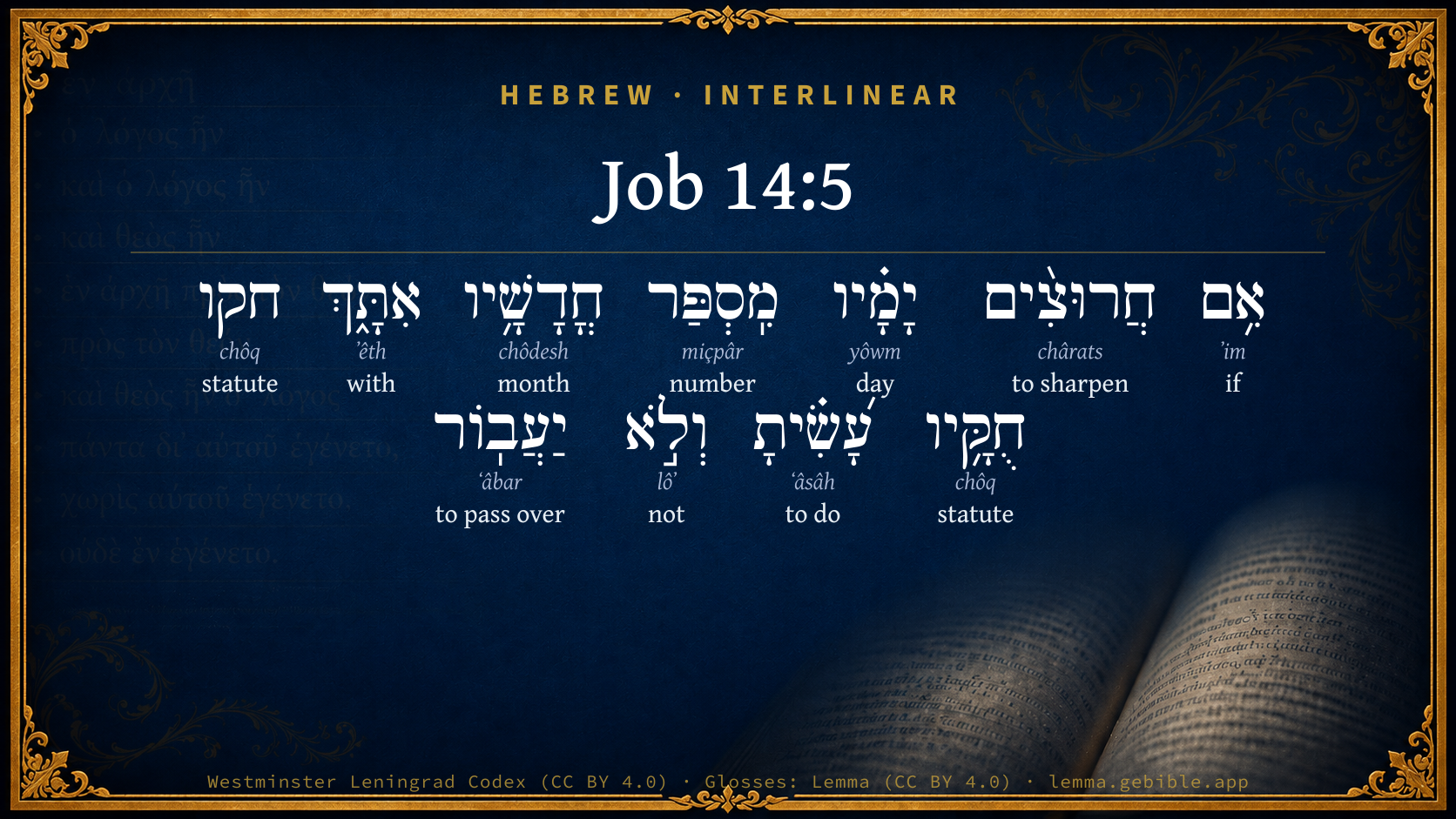
Hebrew (Westminster Leningrad Codex) Job 14:5 appears in the Hebrew Old Testament. The text above is from the Westminster Leningrad Codex. Each word links to its Strong’s number, a concise gloss, and parsing drawn from the Open Scriptures Hebrew Bible morphology. Click any word for its full Brown-Driver-Briggs (BDB) entry.
Download image
Cite this verse

Job 14:5 (World English Bible). Public Domain. Lemma interlinear Bible study tool, https://lemma.gebible.app/v/job/14/5.

Show BibTeX & RIS
BibTeX
RIS
English Translation
Seeing his days are determined, The number of his months is with you, And you have appointed his bounds that he can't pass;
World English Bible · Public Domain
Download a study sheet

One document with this verse’s original text, its word-by-word gloss line, the meaning frame, cross-references with their text, attributed commentary, and full source and license credits — printable, and it pastes into notes with its structure intact.

This verse Autodidact and up

Study sheet (.html) Plain text (.txt)

A passage Seminary Student

Up to 50 verses in one chapter. A passage sheet keeps up to 6 commentary sources and 12 cross-references per verse, in the order this page ranks them, and says so on the sheet whenever that leaves anything out. Ask for a single verse and you get the Autodidact verse sheet above.

Everything on this page stays free to read, with no account — the sheet is a download of what is already on screen, not access to it.

Want to remove ads? Support Godless Engineer
Compare translations 3

The same verse in 3 English versions, stacked beneath the original-language interlinear above. Click any original word for its lexicon entry.

Each is an independent rendering of the whole verse — the interlinear is not word-aligned to these translations.

Highlighted words mark where these versions differ — a whole-verse word diff, not a word-by-word alignment.

  • World English Bible Public Domain
    Seeing his days are determined, The number of his months is with you, And you have appointed his bounds that he can't pass;
  • King James Version Public Domain
    Seeing his days are determined, the number of his months are with thee, thou hast appointed his bounds that he cannot pass;
  • unfoldingWord Literal Text CC BY-SA 4.0
    Since his days are determined, the number of his months with you; you have set his limit and he will not pass,

unfoldingWord Literal Text — © unfoldingWord, licensed CC BY-SA 4.0. Word-aligned USFM3 via Door43 (git.door43.org/unfoldingWord/en_ult).

Versions to compare (up to 4)

3 of 4 selected

Show all 18 translations

Every available English version of this verse, each an independent rendering of the whole verse.

  • World English Bible Public Domain
    Seeing his days are determined, The number of his months is with you, And you have appointed his bounds that he can't pass;
  • Berean Standard Bible Public Domain
    Since his days are determined and the number of his months is with You, and since You have set limits that he cannot exceed,
  • Majority Standard Bible Public Domain
    Since his days are determined and the number of his months is with You, and since You have set limits that he cannot exceed,
  • King James Version Public Domain
    Seeing his days are determined, the number of his months are with thee, thou hast appointed his bounds that he cannot pass;
  • American Standard Version (1901) Public Domain
    Seeing his days are determined, The number of his months is with thee, And thou hast appointed his bounds that he cannot pass;
  • Revised Version (1885) Public Domain
    Seeing his days are determined, the number of his months is with thee, and thou hast appointed his bounds that he cannot pass;
  • Geneva Bible (1599) Public Domain
    Are not his dayes determined? the nober of his moneths are with thee: thou hast appointed his boundes, which he can not passe.
  • Douay-Rheims (1899) Public Domain
    The days of man are short, and the number of his months is with thee: thou hast appointed his bounds which cannot be passed.
  • Young's Literal Translation Public Domain
    If determined are his days, The number of his months `are' with Thee, His limit Thou hast made, And he passeth not over;
  • Literal Standard Version CC BY-SA 4.0
    If his days are determined, || The number of his months [are] with You, || You have made his limit, || And he does not pass over;
  • Unlocked Literal Bible CC BY-SA 4.0
    Man's days are determined. The number of his months is with you; you have appointed his limits that he cannot pass.
  • unfoldingWord Literal Text CC BY-SA 4.0
    Since his days are determined, the number of his months with you; you have set his limit and he will not pass,
  • Darby Bible Public Domain
    If his days are determined, if the number of his months is with thee, [and] thou hast appointed his bounds which he must not pass,
  • World Messianic Bible Public Domain
    Seeing his days are determined, the number of his months is with you, and you have appointed his bounds that he can’t pass.
  • Webster's Bible Public Domain
    Seeing his days are determined, the number of his months is with thee, thou hast appointed his bounds that he cannot pass;
  • Free Bible Version CC BY-SA 4.0
    You have determined how long we shall live—the number of months, a time limit on our lives.
  • Bible in Basic English Public Domain
    If his days are ordered, and you have knowledge of the number of his months, having given him a fixed limit past which he may not go;
  • JPS Tanakh (1917) Public Domain
    Seeing his days are determined, the number of his months is with Thee, and Thou hast appointed his bounds that he cannot pass;

Literal Standard Version (2020), Covenant Press — licensed CC BY-SA 4.0. Text via the HelloAO Bible API (eBible.org). Unlocked Literal Bible (unfoldingWord) — licensed CC BY-SA 4.0. Text via the HelloAO Bible API (eBible.org). unfoldingWord Literal Text — © unfoldingWord, licensed CC BY-SA 4.0. Word-aligned USFM3 via Door43 (git.door43.org/unfoldingWord/en_ult). Free Bible Version, Dr. Jonathan Gallagher — licensed CC BY-SA 4.0. Text via the HelloAO Bible API (eBible.org).

Word by word

More ways to search: Search by grammar → Find every occurrence → Compare this word →

Practice this passage: Drill this verse → Learn its vocabulary →

חֲרוּצִ֨ים
chârats
H2782
“sharpened”
Verb, Qal, Participle Passive, Masculine, Plural, Absolute
Part of Speech
Verb
Stem
Qal
Form
Participle Passive
Gender
Masculine
Number
Plural
State
Absolute
Full BDB Definition

Origin: a primitive root

TWOT: 752

to cut, sharpen, decide, decree, determine, maim, move, be decisive, be mutilated - (Qal) - to cut, mutilate - to sharpen - to decide - (Niphal) to be decisive
  1. אִ֥ם ʼim H518 “if” Conjunction
  2. יָמָ֗יו yôwm H3117 “days · his” Noun, Common, Masculine, Plural, Construct + Suffix, Personal, 3rd Person, Masculine, Singular
  3. מִֽסְפַּר miçpâr H4557 “number of” Noun, Common, Masculine, Singular, Construct
  4. חֳדָשָׁ֥יו chôdesh H2320 “months · his” Noun, Common, Masculine, Plural, Construct + Suffix, Personal, 3rd Person, Masculine, Singular
  5. אִתָּ֑ךְ ʼêth H854 “with · you” Preposition + Suffix, Personal, 2nd Person, Feminine, Singular
  6. חקו chôq H2706 “statute · his” Noun, Common, Masculine, Singular, Construct + Suffix, Personal, 3rd Person, Masculine, Singular
  7. חֻקָּ֥יו chôq H2706 “statutes · his” Noun, Common, Masculine, Plural, Construct + Suffix, Personal, 3rd Person, Masculine, Singular
  8. עָ֝שִׂ֗יתָ ʻâsâh H6213 “to do” Verb, Qal, Perfect, 2nd Person, Masculine, Singular
  9. וְלֹ֣א lôʼ H3808 “and · not” Conjunction + Particle, Negative
  10. יַעֲבֽוֹר ʻâbar H5674 “to pass over” Verb, Qal, Imperfect, 3rd Person, Masculine, Singular

About this verse

These counts appear in no published source. They are computed here, from the morphology-tagged text and Lemma’s own curated glosses. What Lemma adds →

11
words
10
distinct lemmas
Wisdom
section

Notable vocabulary

The rarest word here is חֲרוּצִ֨ים to sharpen H2782 — appearing just 12 times in the whole Hebrew Bible.

Shared distinctive vocabulary

חֲרוּצִ֨ים to sharpen H2782 occurs in 12 verses of the Hebrew Bible. Also found in:

Grammatical profile

  • 3 verbs
  • 5 nouns
  • 1 preposition
  • 1 conjunction
  • 1 particle

Verb forms

  • חֲרוּצִ֨ים Qal · Participle Passive
  • עָ֝שִׂ֗יתָ Qal · Perfect
  • יַעֲבֽוֹר Qal · Imperfect

Repetition

A word recurs within this verse — often emphatic in Hebrew:

  • חקו statute H2706 ×2

Hebrew & Septuagint length

In English translation the verse runs 23 words from the Hebrew and 34 from the Septuagint (LXX English) — the Septuagint runs noticeably longer here. See the side-by-side →

A rough comparison of the two English renderings, which tokenize alike — not a word-level alignment.

Word counts can differ between the Hebrew and the Greek without any difference in meaning — e.g. the Hebrew direct-object marker אֵת has no separate Greek word, and Greek often adds the article ὁ.

Cross-references

18

Topical passages linked to Job 14:5 in the Treasury of Scripture Knowledge — connected by theme and wording, ordered by reader-vote popularity; previews shown in the World English Bible.

  • Psalms 39:4 "Yahweh, show me my end, What is the measure of my days. Let me know how frail I am.
  • Acts 17:26 He made from one blood every nation of men to dwell on all the surface of the earth, having determined appointed seasons, and the boundaries of their dwellings,
  • Job 12:10 In whose hand is the life of every living thing, The breath of all mankind?
  • Hebrews 9:27 Inasmuch as it is appointed for men to die once, and after this, judgment,
  • Psalms 104:29 You hide your face: they are troubled; You take away their breath: they die, and return to the dust.
  • Job 21:21 For what does he care for his house after him, When the number of his months is cut off?
  • Daniel 5:26 This is the interpretation of the thing: MENE; God has numbered your kingdom, and brought it to an end;
  • Luke 12:20 "But God said to him, 'You foolish one, tonight your soul is required of you. The things which you have prepared--whose will they be?'
  • Job 23:13–14 But he stands alone, and who can oppose him? What his soul desires, even that he does.
  • Psalms 104:9 You have set a boundary that they may not pass over; That they don't turn again to cover the earth.
  • Daniel 4:35 All the inhabitants of the earth are reputed as nothing; and he does according to his will in the army of heaven, and among the inhabitants of the earth; and none can stay his hand, or tell him, What do you?
  • Job 7:1 "Isn't a man forced to labor on earth? Aren't his days like the days of a hired hand?
  • Job 14:14 If a man dies, shall he live again? All the days of my warfare would I wait, Until my release should come.
  • Revelation 3:7 "To the angel of the assembly in Philadelphia write: "He who is holy, he who is true, he who has the key of David, he who opens and no one can shut, and who shuts and no one opens, says these things:
  • Daniel 5:30 In that night Belshazzar the Chaldean King was slain.
  • Daniel 9:24 Seventy weeks are decreed on your people and on your holy city, to finish disobedience, and to make an end of sins, and to make reconciliation for iniquity, and to bring in everlasting righteousness, and to seal up vision and prophecy, and to anoint the most holy.
  • Daniel 11:36 The king shall do according to his will; and he shall exalt himself, and magnify himself above every god, and shall speak marvelous things against the God of gods; and he shall prosper until the indignation be accomplished; for that which is determined shall be done.
  • Revelation 1:18 and the Living one. I was dead, and behold, I am alive forevermore. Amen. I have the keys of Death and of Hades.

Cross-references courtesy of OpenBible.info (CC BY 4.0).

Hebrew and Greek witnesses Masoretic Hebrew ↔ Greek Septuagint

The same verse in the two great witnesses to the Old Testament, shown verse-for-verse.

Here the Septuagint runs noticeably longer than the Hebrew — LXX2012 (modern English Septuagint) 34 words vs World English Bible 23. A rough length comparison of the two English translations, not a word-level alignment — read both below.

These are two independent witnesses, not word-aligned to each other, and the Septuagint is shown in lemma (dictionary) form.

Hebrew Job 14:5 Masoretic · Westminster Leningrad Codex

אִ֥ם חֲרוּצִ֨ים יָמָ֗יו מִֽסְפַּר חֳדָשָׁ֥יו אִתָּ֑ךְ חקו חֻקָּ֥יו עָ֝שִׂ֗יתָ וְלֹ֣א יַעֲבֽוֹר

Seeing his days are determined, The number of his months is with you, And you have appointed his bounds that he can't pass;

World English Bible · Public Domain

Greek LXX Job 14:5 Septuagint · lemma form

ἐάν καί εἷς ἡμέρα ὁ βίος αὐτός ἐπί ὁ γῆ ἀριθμητός δέ μήν αὐτός παρά σύ εἰς χρόνος τίθημι καί οὐ μή ὑπερβαίνω

if even his life should be but one day upon the earth: and his months are numbered by him: you have appointed him for a time, and he shall by no means exceed it.

LXX2012 (modern English Septuagint) · Public Domain

Hebrew: Westminster Leningrad Codex (CC BY 4.0). Greek: Septuagint (public domain); English from LXX2012 (modern English Septuagint) (Public Domain). How the Septuagint differs from the Hebrew →

Commentary

Notes on Job 14:5 from classic Christian and Jewish commentators (each source and its license shown beneath its notes). The classic Christian expositions comment on the surrounding passage and are grouped to its opening verse, so a note may address several verses; the Jewish commentaries on the Tanakh (Rashi and others) are per-verse, so they appear only where the commentator wrote on this verse.

Lemma curates 59 commentaries, every one of them public domain or Creative Commons licensed, each selected and text-cleaned for this edition rather than reprinted as found. About our sources →

Trapp's Complete Commentary

John Trapp

Job 14:5 Seeing his days [are] determined, the number of his months [are] with thee, thou hast appointed his bounds that he cannot pass;

Ver. 5. Seeing his days are determined, &c.] God hath set every man both his time (whether shorter, called here his days, or longer, the number of his months, they have both their bounds which none can pass) and also his task, Act 13:25. John fulfilled his course, et in brevi vitae spatio tempora virtutum multa replevit, and he lived long in a little time; he wrought hard, as not willing to be taken with his task undone (Hieron.). So Act 13:36. David, after he had served his own generation, and had done all the will of God, fell on sleep. See more of this on Job 7:1.

Thou hast appointed his bounds] Heb. His statutes. It is appointed for all men once to die, Heb 9:27, once for all, and for ever it is appointed, and this statute is irrepealable. Here then we see the cause why some, likely to live long, die soon, and others more infirm live longer. God hath set the bounds of each one’s life to a very day. The bounds may be passed which our natural complexion setteth; the bounds cannot be passed which the providence and will of God setteth. Stat sua cuique dies - (Virg.).

John Trapp, A Commentary or Exposition upon All the Books of the Old and New Testament (1647–1656) — public domain. Text from a community e-Sword module.

Joseph Benson's Commentary

Job 14:5-6. Seeing his days are determined — Limited to a certain period. The number of his months is with thee — Exactly known to thee, and in thy power and disposal. Thou hast appointed his bounds, &c. — Thou hast appointed a certain end of his days, beyond which he cannot prolong his life. Turn from him, that he may rest — Withdraw thine afflicting hand from him, that he may have some present ease and comfort. Till he shall accomplish, as a hireling, his day — Give him some respite till he finish his course, and come to the period of his life, which thou hast allotted him, as a man appoints a set time to a hired servant; which period will be as welcome to him as the end of his day of labour and toil is to the hireling. This idea is implied in the word ירצה, jertzeh, here rendered, he shall accomplish. Which properly means, he shall be pleased, or delighted. And the sense seems to be, As the poor mercenary rests and rejoices when he has finished the work of the day, and received his wages; so must that be an acceptable and joyful time, which puts a period to the life and sufferings of a man sinking under the burden of numerous and heavy troubles, and which introduces him into a state of perfect rest and endless felicity.

Joseph Benson's Commentary on the Old and New Testaments (1811–1818) — public domain. Text from a community e-Sword module.

Jamieson, Fausset & Brown

Robert Jamieson, A. R. Fausset & David Brown

determined-- (Job 7:1; Isa 10:23; Dan 9:27; Dan 11:36).

Jamieson, Fausset & Brown — Commentary Critical and Explanatory on the Whole Bible (1871) — public domain (CC PDM 1.0). Text via the HelloAO Bible API.

Adam Clarke's Commentary

Verse 5. Seeing his days are determined] The general term of human life is fixed by God himself; in vain are all attempts to prolong it beyond this term. Several attempts have been made in all nations to find an elixir that would expel all the seeds of disease, and keep men in continual health; but all these attempts have failed. Basil, Valentine, Norton, Dastin, Ripley, Sandivogius, Artephius, Geber, Van Helmont, Paracelsus, Philalethes, and several others, both in Europe and Asia, have written copiously on the subject, and have endeavoured to prove that a tincture might be produced, by which all imperfect metals may be transmuted into perfect; and an elixir by which the human body may be kept in a state of endless repair and health. And these profess to teach the method by which this tincture and this elixir may be made! Yet all these are dead; and dead, for aught we know, comparatively young! Artephius is, indeed, said to have lived ninety years, which is probable; but some of his foolish disciples, to give credit to their thriftless craft, added another cipher, and made his age nine hundred! Man may endeavour to pass the bound; and God may, here and there, produce a Thomas Parr, who died in 1635, aged one hundred and fifty-two; and a Henry Jenkins, who died in 1670, aged one hundred and sixty-nine; but these are rare instances, and do not affect the general term. Nor can death be avoided. Dust thou art, and unto dust thou shalt return, is the law, and that will ever render nugatory all such pretended tinctures and elixirs.

But, although man cannot pass his appointed bounds, yet he may so live as never to reach them; for folly and wickedness abridge the term of human life; and therefore the psalmist says, Bloody and deceitful men shall not live out HALF their days, Ps 55:23, for by indolence, intemperance, and disorderly passions, the life of man is shortened in cases innumerable. We are not to understand the bounds as applying to individuals, but to the race in general. Perhaps there is no case in which God has determined absolutely that man's age shall be so long, and shall neither be more nor less. The contrary supposition involves innumerable absurdities.

Adam Clarke's Commentary on the Bible (1810–1826) — public domain. Text from a community e-Sword/MySword module.

The Cambridge Bible for Schools and Colleges

gen. ed. J. J. S. Perowne

5, 6. Man being of few days and full of trouble Job pleads that God would not load him with uncommon afflictions, but leave him oppressed with no more than those natural to his short and evil life.

The Cambridge Bible for Schools and Colleges (gen. ed. J. J. S. Perowne; Cambridge University Press, 1878–1918) — public domain. Text from a community e-Sword module.

John Gill's Exposition

Seeing his days are determined,.... Or "cut out" (i), exactly and precisely, how many he shall live, and what shall befall him every day of his life; whose life, because of the shortness of it, is rather measured by days than vents:

the number of his months are with thee; before him, in his sight, in his account, and fixed and settled by him:

thou hast appointed his bounds that he cannot pass; the boundaries of his life the period of his days, beyond which he cannot go; the term of man's life is so peremptorily fixed by God, that he cannot die sooner, nor live longer, than he has determined he should; as the time of a man's birth, so the time of his death is according to the purpose of God; and all intervening moments and articles of time, and all things that befall a man throughout the whole course of his life, all fall under the appointment of God, and are according to his determinate will; and when God requires of man his soul, no one has power over his spirit to retain it one moment; yet this hinders not the use of means for the preservation and comfort of life, since these are settled as well as the end, and are under the divine direction: the word for bounds signifies sometimes "statutes" (k): though not to be understood of laws appointed by God, either of a moral or ceremonial nature; but here it signifies set, stated, appointed times (l) Seneca (m) says the same thing;

"there is a boundary fixed for every man, which always remains where it is set, nor can any move it forward by any means whatsoever.''

(i) "exacte praefiniti sunt", Tigurine version. (k) "statuta ejus", V. L. Mercerus, Schmidt. (l) "Stata tempora", Beza. (m) Consolat. ad Marciam, c. 20.

John Gill's Exposition of the Whole Bible (1746–1763) — public domain (CC PDM 1.0). Text via the HelloAO Bible API.

Albert Barnes' Notes on the Bible

Seeing his days - are “determined” Since man is so frail, and so short-lived, let him alone, that he may pass his little time with some degree of comfort and then die; see the notes at Job 7:19-21. The word “determined” here means “fixed, settled.” God has fixed the number of his days, so that they cannot be exceeded; compare the notes at Isa 10:23, and notes at Psa 90:10.

The number of his months are with thee - Thou hast the ordering of them, or they are determined by thee.

Thou hast appointed his bounds - Thou hast fixed a limit, or hast determined the time which he is to live, and he cannot go beyond it. There is no elixir of life that can prolong our days beyond that period. Soon we shall come to that outer limit of life, and then we must die. When that is we know not, and it is not desirable to know. It is better that it should be concealed. If we knew that it was near, it would fill us with gloom, and deter us from the efforts and the plans of life altogether. If it were remote, we should be careless and secure, and should think there was time enough yet to prepare to die. As it is, we know that the period is not very far distant; we know not but that it may be very near at hand, and we would be always ready.

Albert Barnes' Notes on the Bible (1834–1885) — public domain. Text from a community e-Sword/MySword module.

Matthew Poole's English Annotations

His days; the days or (as it follows) months of his life. Are determined; are by thy sentence and decree limited to a certain period.

With thee, i.e. exactly known to thee, or in thy power and disposal. Thou hast appointed a certain end of his days, beyond which he cannot prolong his life; and therefore let this short life and unavoidable death suffice for man’s punishment, and do not add further and sorer calamities.

Matthew Poole's English Annotations on the Holy Bible (1683–1685) — public domain. Text from a community e-Sword/MySword module.

Whedon's Commentary on the Bible

Daniel D. Whedon

5. Seeing — Literally, “If his days are determined,” (as is the case.) This entire verse, with its three conditions, the two latter of which spring out of the former, is an hypothesis on which Job rests his touching appeal in ver.

Daniel D. Whedon (gen. ed.), Commentary on the Old and New Testaments (1874–1909) — public domain. Text from a community e-Sword module.

The Pulpit Commentary

Seeing his days are determined. Job here returns to the consideration of the shortness of man"s life. "His days are determined;" i.e. they are a limited period, known to and fixed beforehand by God. They are not like God"s days, which "endure throughout all generations". (Psa_102:24) The number of his months are with thee. "With thee" means here "known to thee," "laid up in thy counsels." Thou hast appointed his bounds that he cannot pass. "His bounds" are "the limit of his lifetime." The three clauses are pleonastic. One idea pervades them all.

The Pulpit Commentary (1880–1919), ed. H.D.M. Spence-Jones & Joseph S. Exell — public domain. Text from a community e-Sword module.

John Wesley's Explanatory Notes

Determined - Limited to a certain period. With thee - In thy power and disposal. Thou hast appointed a certain end of his days, beyond which he cannot prolong his life.

John Wesley, Explanatory Notes Upon the Whole Bible (1754–1765) — public domain. Text via the GEBible commentary corpus.

Rashi

Rabbi Shlomo Yitzchaki (Rashi)

If his days are limited If he is requited with this recompense—that his days are limited to a day set for death,

and the number of months is set with You, and [that] You set this boundary—and he will no longer exist in the world, [then] this payment is sufficient for You.

Rashi on the Tanakh — English translations: “The Judaica Press complete Tanach with Rashi, translated by A. J. Rosenberg” (CC BY 4.0); “Pentateuch with Rashi's commentary by M. Rosenbaum and A.M. Silbermann, 1929-1934” (public domain); “The Metsudah Tanach series, Lakewood, N.J” (CC BY 4.0); and “The Book of Joshua, Metsudah Publications, 1997” (CC BY 4.0). Text via Sefaria.

Lesson kit

Teaching starters — assembled from the data on this page, not authored interpretation. Every prompt links to the verse data it draws on. Edit before teaching.

Job, in the Wisdom, opens this verse with 11 words (10 distinct Hebrew lemmas). Its most distinctive word is chârats (“to sharpen”). The Greek Septuagint runs longer here. A historical commentator’s framing appears above. Read the whole chapter for the surrounding context.

Discussion questions

  1. What does “to sharpen” (chârats) contribute to the verse as a whole?
  2. How does Exodus 11:7, which shares the word «to sharpen», read alongside this verse?
  3. What does the repetition of “statute” (2× in this one verse) do in this verse?
  4. The Septuagint runs longer here than the Hebrew. What might account for the difference?
  5. The translations on this page render this verse differently — a whole-verse word diff, not a word-by-word alignment. What might account for the different wordings?
  6. «חֲרוּצִ֨ים» is a Qal Participle Passive verb. How does that grammatical form shape the action described?
  7. Compare how Trapp's Complete Commentary and Joseph Benson's Commentary read this verse. Where do they agree or differ?

Things to notice

Reading settings

Reading text

Shown beneath each verse's original-language words.

Old Testament
Old Testament edition

Read the OT as the Masoretic Hebrew (MT) or the Greek Septuagint (LXX).

English shown for the Greek Septuagint (in the Hebrew ↔ Greek comparison).

Comparing translations? Open the Compare panel on any verse page to stack up to four side by side.